Showing posts with label Edgar Rice Burroughs. Show all posts

November 14, 2013

Burroughs's The War Chief

Because of the John Carter movie, there's been a renewed interest in the work of Edgar Rice Burroughs. In recent years, I've posted a few links about him and his ideas about race. For instance:

Burroughs the conservative racist
Review of Warlord of Mars #1

But while talking about Martians as analogues of Indians, I neglected a more direct link. Burroughs wrote a whole novel about the Apache:

The War Chief

SynopsisTHE WAR CHIEF is a realistic historical novel about life and death on an Apache reservation during the final years of the Apache wars until the death of Cochise and the surrender of Geronimo. The story focuses on Andy MacDuff, an infant kidnapped by the Apaches in a raid, adopted by Geronimo and renamed Shoz-Dijiji, or Black Bear. He is given a proper Apache upbringing, including initiation into all the rites and responsibilities of Indian Manhood. He excels at the crucial skills of hunting and warfare, shows himself to be strong and courageous, and soon is made a highly prized war chief. During his apprenticeship, Shoz-Dijiji falls in love with Ish-Kay-Nay, an Apache maiden, who, unfortunately is coveted by another Apache chief, Juh, who hates Shoz-Dijiji for being Geronimo’s favorite. Burroughs’ great respect for the West and compassion for the exploitative treatment of the Indians the hands of the treacherous pin-dah-lickoyee (“white eyes”) is manifested throughout this honest, vivid, and sympathetic portrait of the West that does credit to both the Indians and Edgar Rice Burroughs.Project Gutenberg has posted the whole story online if you want to read it:

Title: The War Chief

Author: Edgar Rice Burroughs
* A Project Gutenberg of Australia eBook *
CHAPTER 1

GO-YAT-THLAY

NAKED but for a G-string, rough sandals, a bit of hide and a buffalo headress, a savage warrior leaped and danced to the beating of drums. Encircling fires, woman-tended, sent up curling tongues of flame, lighting, fitfully, sweat-glistening shoulders, naked arms and legs.

Distorted shadows, grotesque, mimicking, danced with the savage and his fellows. Above them, dark and mysterious and weirdly exaggerated by the night, loomed the Grampian Hills.

Rude bows and arrows, stone-shod spears, gaudy feathers, the waving tails of animals accentuated the barbaric atmosphere that was as yet uncontaminated by the fetid breath of civilization--pardon me!--that was as yet ignorant of the refining influences of imperial conquest, trained mercenaries and abhorrent disease.
But wait...it's a trick! These are the Scottish ancestors of the white men who will soon invade the land of Go-yat-thlay (Geronimo). How they came to have a buffalo headdress, I don't know, but the point is that they reek of savagery.

A few paragraphs later we meet Geronimo as he spies on a covered wagon:Go-yat-thlay had never before seen this wagon, but he had seen its dust from a great distance; he noted its volume and its rate of progress, and he had known that it was a wagon drawn by two mules, for there was less dust than an ox-drawn vehicle would have raised, since oxen do not lift their feet as high as horses or mules, and, too, its rate of progress eliminated oxen as a possible means of locomotion. That the wagon was drawn by mules rather than horses was but a shrewd guess based upon observation. The Apache knew that few horses survived thus far the long trek from the white man's country.

In the mind of Go-yat-thlay burned a recollection of the wrongs that had been heaped upon his people by the white man. In the legends of his fathers had come down the story of the conquests of the Spaniards, through Coronado and the priests, three-hundred years before. In those days the Apache had fought only to preserve the integrity of his domain from the domination of an alien race. In his heart there was not the bitter hatred that the cruelty and injustice and treachery of the more recent American invaders engendered.
So Burroughs treats the Indians decently. He makes a point of saying white men are just as savage as Indians.

But the story centers on a white man raised as an Apache. Needless to say, he becomes a great chief and woos a beautiful "princess." No doubt he's a classic "white Indian" who acts as savior of the savages.

War Chief comic strip

I was reminded of The War Chief when I saw the following images on Facebook:


Apparently, Edgar Rice Burroughs Inc. is producing "All New Weekly Comic Strips" of Tarzan, Pellucidar, Carson of Venus, and other Burroughs properties. With all the talent involved, I imagine they're pretty good.

January 31, 2011

Burroughs the conservative racist

Tarzan, a colonial symbol of bigotry

By Phil ShannonTarzan is a symbol of the white man’s conquest of Africa, set during the heyday of European colonialism, especially British.

“Never once,” writes Fenton, “did Burroughs waver from his conviction that the English were the height of aristocracy.”

John Clayton, the son of Lord and Lady Greystoke who were abandoned by mutineers on the African coast, was raised as Tarzan by an ape-mother. He nonetheless remained the rightful heir of his father’s House of Lords seat.

Despite his loincloth and primitive ape-English, Tarzan bears the “hallmark of aristocratic birth, the natural outcropping of many generations of fine breeding.” Such breeding was forged and tested in the British empire’s wars (“the noblest monument of historic achievement upon a thousand victorious battlefields,” editorialises an enthusiastic Burroughs in one Tarzan story).

Burroughs, born in 1875 in Chicago, was a political conservative and a fanatical opponent of the labour and socialist movements. These sentiments are shared by Fenton, his biographer and admirer-in-chief.

The 540-acre property-owning Burroughs uses one Tarzan story to whine that “to be poor assures one of an easier life than being rich, for the poor have no tax to pay.”
Comment:  We've seen a bit of how Burroughs stereotyped Indians, Africans, and other "primitive" people:

Review of WARLORD OF MARS #1
Barsoom = Indian territory
Stereotypes in A Princess of Mars
Stereotypes in Tarzan of the Apes

I didn't know Burroughs was a conservative, but it doesn't surprise me. It's evident in his stories of white men who dominate savage and barbaric races.

And don't bother saying he was a product of his times. A few years after Burroughs was born, Helen Hunt Jackson wrote her more sensitive play Ramona. Jack London, who was born a year after Burroughs, became a socialist and also wrote more sensitively about Native people.

January 03, 2011

Review of WARLORD OF MARS #1

Dynamite Entertainment is reviving John Carter of Mars in a new comic book. I decided to get the first issue because:

  • I've read all of Edgar Rice Burroughs's John Carter novels.

  • I recently wrote about Barsoom = Indian Territory and Stereotypes in A Princess of Mars

  • The story covered Carter's pre-Mars days and I wanted to see how Dynamite would handle it.

  • It cost only $1.00.

  • The main story invents a scene not in A Princess of Mars. Carter and his partner Powell are in an Arizona saloon when some ex-Union soldiers enter. They call the Confederates and their leaders cowards, but Carter ignores them. But when the Yankees insult Carter's beloved Virginia, he shoots them dead.

    Rob's reactions

    That was a great bit when I saw it in The Trouble with Tribbles 33 years ago. But it's a little unoriginal now.

    Carter is supposed to be a dignified, aristocratic gentleman. He's one of the last people who would fight his inferiors over an insult. And he wouldn't start shooting them when they hadn't shot first.

    The artist is drawing Carter to look much like Wolverine without the tufts of hair. His personality is Wolverine-like too. This Carter apparently will go into a berserker rage whenever he's provoked.

    Unfortunately, that's a total misreading of John Carter. It would be like portraying Sir Lancelot, James Bond, or Jean-Luc Picard as a barroom brawler. It has nothing to do with the original character except the name.

    The Indian aspects

    Alas, the Apache don't make an appearance in this issue. The Yankees call them "redskins" at the beginning so readers will know these white men are crude and rude. Near the end, Carter and Powell discover Indian scalps on the soldiers' horses. White men bad! Indians (possibly) good! That's different from the approach in the original novel, at least.

    Carter concludes by saying, "We'll have to be careful now. Apaches aren't going to be too pleased to see any more white faces." Yeah, because Carter and Powell plan to trespass on their land and take their mineral resources without permission. Who would be pleased at that?

    So some things haven't changed. John Carter still has a ridiculously inflated sense of white privilege and entitlement. Like a 2-year-old, he thinks that whatever he can find and see is his. He doesn't recognize the concept that other people have possessions and rights just like him.

    In that sense, he's a typical American. In the clash between sovereign Indian nations and selfish American greed, the latter wins.

    Anyway, I'd say WARLORD OF MARS #1 isn't even worth a dollar. You can safely skip this comic.

    For more on the subject, see America's Cult of Self and Capitalism Killed the Indians.

    October 18, 2010

    Barsoom = Indian territory

    Some interesting excerpts from John Seelye's introduction to the Penguin version of Edgar Rice Burroughs's A Princess of Mars:America, as a wise Native American once observed, needs Indians, being a country adversarially fixated, and the Red Planet as a cynosure of adventurous imaginations has been shining brightly for more than a century.

    From the ancient tradition, undoubtedly, came the assumption that whatever form Martians took it would be warlike and hostile to white, Anglo-Saxon incursions.

    Clearly inspired by the deeds of fairy-tale knights and heroes of the American West, Burroughs's Captain Carter slays ugly humanoid giants and marries a beautiful red-skinned princess.

    By 1899 the frontier had disappeared, having engendered a number of quasi-mystical American heroes with whom [Theodore] Roosevelt hoped to be associated, a line that began with Captain John Smith, included Daniel Boone and Davy Crockett, and ended with Buffalo Bill Cody.

    Captain Smith, who came ashore on a strange land populated by a noble yet fierce people, may be considered the prototype of the American traveler through space, the figurative ancestor of Burroughs's Captain John Carter. "A typical Southerner of the highest type" from Virginia, Carter in 1866 began a series of adventures on Mars the high point of which is the rescue of a beautiful, red-skinned princess, a literary descendant of Pocahontas, who in a romantic interlude rescued Captain Smith from certain death at the hands of her father.

    With the Western frontier closed, Americans were clearly looking for new territories in which to have, as Huck Finn put it, "howling adventures among the Injuns," and most recent commentators on A Princess of Mars have observed the imperial connection.

    The green giants of Mars may be stand-ins for the Apaches of Arizona, with their fierce love of cruelty for its own sake, but it is I think a mistake to think of A Princess of Mars as a racist allegory. Yes, Burroughs borrows stereotypical characteristics of American Indians with which to endow his Barsoomians, but as Carter points out they are shared by the Tharks and Heliumites, who at the start of the romance are inveterate enemies.

    An atavistic survivor of King Arthur's court, Burroughs's hero is clearly abstracted from the heroes of Walter Scott and Fenimore Cooper (he is a veteran of Indian wars as well as the War Between the States).
    Comment:  I don't think it's that hard to see A Princess of Mars as a racist allegory. The Tharks are the bad Indians and the Heliumites are the good Indians. Super-messiah Jesus Christ John Carter teaches them about love and peace so they can live together like civilized white people.

    The good Indian/bad Indian trope is common in Western novels and movies. Either way the Indians are savages compared to the white man. The good Indians need the white man's help to stop the bad Indians so they can enjoy harmonious relations.

    For more on the subject, see Stereotypes in A Princess of Mars and Stereotypes in Tarzan of the Apes.

    October 17, 2010

    Stereotypes in A Princess of Mars

    With a new comic book out and a movie coming out, it's time to look at a seminal science-fiction character:

    John Carter (character)John Carter is a fictional character, created by Edgar Rice Burroughs, who appears in the Martian series of novels. Though actually a Virginian from Earth and a visitor to Mars, he is often referred to as "John Carter of Mars" in reference to the general setting in which his deeds are recorded, in the time-honored tradition of other heroes (such as Lawrence of Arabia). The character is an enduring one and has appeared in various media following his 1912 serialized debut.

    John Carter first appeared in A Princess of Mars, the first Burroughs novel set on the fictionalized version of Mars that the author dubbed "Barsoom." Written between July and September 28, 1911, it was serialized as Under the Moons of Mars in the February to July 1912 issues of the magazine All-Story and first published in book form in October 1917.
    Burroughs also created Tarzan of the Apes, of course.

    What fans may forget is that A Princess of Mars is bookended with savage Indians. At the beginning, Carter and his partner Powell are prospecting for gold in the Arizona hills. Carter narrates:Since we had entered the territory we had not seen a hostile Indian, and we had, therefore, become careless in the extreme, and were wont to ridicule the stories we had heard of the great numbers of these vicious marauders that were supposed to haunt the trails, taking their toll in lives and torture of every white party which fell into their merciless clutches.

    Powell, I knew, was well armed and, further, an experienced Indian fighter; but I too had lived and fought for years among the Sioux in the North, and I knew that his chances were small against a party of cunning trailing Apaches. Finally I could endure the suspense no longer, and, arming myself with my two Colt revolvers and a carbine, I strapped two belts of cartridges about me and catching my saddle horse, started down the trail taken by Powell in the morning.
    Carter finds the missing Powell:I had forged ahead for perhaps a mile or more without hearing further sounds, when the trail suddenly debouched onto a small, open plateau near the summit of the pass. I had passed through a narrow, overhanging gorge just before entering suddenly upon this table land, and the sight which met my eyes filled me with consternation and dismay.

    The little stretch of level land was white with Indian tepees, and there were probably half a thousand red warriors clustered around some object near the center of the camp. Their attention was so wholly riveted to this point of interest that they did not notice me, and I easily could have turned back into the dark recesses of the gorge and made my escape with perfect safety. The fact, however, that this thought did not occur to me until the following day removes any possible right to a claim to heroism to which the narration of this episode might possibly otherwise entitle me.
    Carter to the rescue

    Carter rescues Powell's body, which is "fairly bristling with the hostile arrows of the braves," and flees into the hills. He hides in a mysterious cave but the Apaches find him:I had not long to wait before a stealthy sound apprised me of their nearness, and then a war-bonneted, paint-streaked face was thrust cautiously around the shoulder of the cliff, and savage eyes looked into mine. That he could see me in the dim light of the cave I was sure for the early morning sun was falling full upon me through the opening.

    The fellow, instead of approaching, merely stood and stared; his eyes bulging and his jaw dropped. And then another savage face appeared, and a third and fourth and fifth, craning their necks over the shoulders of their fellows whom they could not pass upon the narrow ledge. Each face was the picture of awe and fear, but for what reason I did not know, nor did I learn until ten years later. That there were still other braves behind those who regarded me was apparent from the fact that the leaders passed back whispered word to those behind them.

    Suddenly a low but distinct moaning sound issued from the recesses of the cave behind me, and, as it reached the ears of the Indians, they turned and fled in terror, panic-stricken. So frantic were their efforts to escape from the unseen thing behind me that one of the braves was hurled headlong from the cliff to the rocks below. Their wild cries echoed in the canyon for a short time, and then all was still once more.
    Carter's spirit escapes his body and flies to Mars, where he has various adventures. Then it returns to his body and he awakens:As my hands passed over my body they came in contact with pockets and in one of these a small parcel of matches wrapped in oiled paper. One of these matches I struck, and its dim flame lighted up what appeared to be a huge cave, toward the back of which I discovered a strange, still figure huddled over a tiny bench. As I approached it I saw that it was the dead and mummified remains of a little old woman with long black hair, and the thing it leaned over was a small charcoal burner upon which rested a round copper vessel containing a small quantity of greenish powder.

    Behind her, depending from the roof upon rawhide thongs, and stretching entirely across the cave, was a row of human skeletons. From the thong which held them stretched another to the dead hand of the little old woman; as I touched the cord the skeletons swung to the motion with a noise as of the rustling of dry leaves.

    It was a most grotesque and horrid tableau and I hastened out into the fresh air; glad to escape from so gruesome a place.
    Stereotype check

    What do we have here? Let's see:

  • Tipis and a warbonneted Apache...in Arizona? Flat-out wrong.

  • A mummified old woman and a row of skeletons? Theoretically possible but extremely unlikely. You might find something like that at a Maya or Inca site, but not in the American Southwest.

  • 500 Apaches gathered in one place to torture one victim? Unlikely.

  • Apaches wearing warpaint? I'm not sure, but I think that occurred mainly on the Plains, not in the Southwest.

    The descriptions of the Apache as cunning, savage, merciless torturers are par for the course. They may even have some validity. But note what Carter doesn't say. He doesn't claim he had the right to be in Apache territory. Presumably he didn't ask the Apaches' permission. He simply entered the land and began extracting its riches because of his white privilege. To Anglo-Americans of that era, taking was almost as common as breathing.

    Note also Carter's history. He fought as a Confederate soldier to preserve slavery. He fought and presumably killed the Sioux. He admits he's "not prone to sensitiveness," which is putting it mildly. He seems to be insensitive to anyone who isn't white like him.

    Despite this criticism, A Princess of Mars was one of my favorite books when I was growing up. I probably would've put it in my personal top 10. I haven't read it in ages, but I'd still give it a solid 8.0 of 10.

    For more on the subject, see The Best Indian Books.

  • July 17, 2010

    Stereotypes in Tarzan of the Apes

    Tarzan’s bit tarnished

    Edgar Rice Burroughs created a hero and a phenomenon that is still going strong almost a century later

    By Lois Legge
    "There are—simply no ifs ands or buts—racist descriptions of black Africans in this book, grotesquely racist depictions of black Africans," says the Dalhousie University associate professor, who teaches the first of Edgar Rice Burroughs’ Tarzan books in his first-year Reading Pop Culture class.

    "The tribe that Tarzan first meets are described as cannibals, as are pretty much every black African that’s represented," he says. "There’s an African-American figure in the character of Jane’s nanny who fulfills all the stereotypes of the southern mammy figure. She’s sycophantic, she’s childlike, she’s superstitious, she . . . simply becomes a comic figure through her speech, through her malapropisms. . . . If you’ve ever seen Gone with the Wind, she is that figure, it’s the same character almost to a T.

    "So the novel runs the gamut of anti-black racist stereotypes. Against this . . . Tarzan ends up being compared to the racistly-depicted savagery of the blacks and . . . Tarzan becomes this figure who can negotiate with vigour the physical demands of the jungle but also behaves rationally like the proper ‘civilized white man.’ "

    Burroughs’ 25 sequels continue the stereotypes in one way or another, Haslam says, noting the character of Tarzan is by turns violently, or paternalistically, racist.

    And some of the racial stereotypes the books depict have lived on in the larger culture.

    "It didn’t create these stereotypes but it certainly helped to perpetuate them," says the professor, sitting in his Dalhousie office, two copies of Tarzan of the Apes at hand.

    "I remember a certain Toronto mayor, it was Mel Lastman—it was during a Toronto Olympic bid when he was going to Africa—said that he had visions of being boiled in a pot. You know these are the stereotypes, whether he’s getting it from Tarzan or Bugs Bunny cartoons or whatever."
    Comment:  The interesting thing here is to compare African and Native American stereotypes.

    I think most of us could list the usual African stereotypes. We've probably seen about as many old jungle movies as old Westerns.

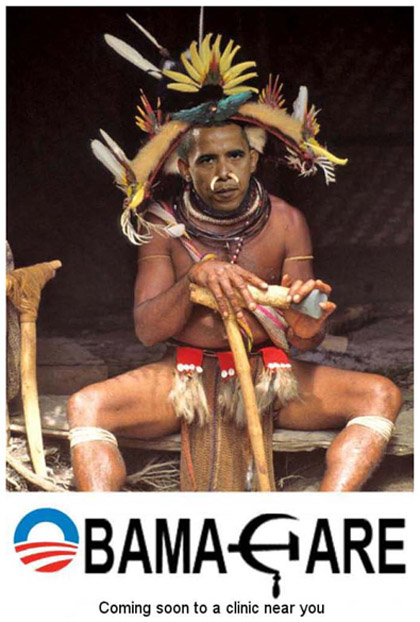
    But the African stereotypes have mostly faded from the scene. You may see them a few times a year, but that's about it. When a teabagger portrayed Obama as a witch doctor, it was shocking because it was so rare. Almost everyone condemned the picture because it was so obviously racist.

    And yet...for every African cannibal boiling a white man in a pot, we must see hundreds of Native stereotypes. These stereotypes are almost everywhere: at the checkout stand, in children's toys, on global TV, etc. They're just as outdated and offensive, but they're infinitely more pervasive. You'd have a hard time not seeing them every day.

    Our society condemns depictions of blacks as 19th-century savages, yet cherishes depictions of Indians as 19th-century savages. And we're still trying to address that, to figure out why that's so. Why is one type of racist stereotype considered odious while the other is perfectly acceptable to most Americans?

    For more on the subject, see Rima the "Native" White Girl and Indians Look Like Tarzan?

    Below:  Which outdated stereotype is still common in America?