Showing posts with label sasquatch. Show all posts

September 19, 2013

Bigfoot in Castle

In The Fast and the Furriest episode of Castle (airdate: 4/15/13), Native actress Marisa Quinn guest-starred as a homicide victim. Here's how her character was introduced:RYAN: Name is Anne Cardinal. Twenty-seven years old. She was Native American. Grew up on the Onondaga Reservation in central New York.

BECKETT: Any next of kin?

RYAN: No. She had no siblings, and both of her parents are gone. She lived in off-campus housing for Hudson University, where she was working towards a PhD in evolutionary biology.
The detectives learn she worked part-time at a primate sanctuary. But she was more than a primate caregiver:DR. MEEKS: Anne was studying evolutionary biology. She was an honors student at the university. But she was actually a hugely respected Bigfoot expert. She even gave me the extremely rare yeti finger.

CASTLE: Are you saying Anne was a Bigfoot hunter?

DR. MEEKS: N-N-No, no, no, uh, no, not a hunter. No, uh, Anne was, uh, Native American. And, uh, in her tribe's culture, a Bigfoot was considered...benevolent, or a protector. When she was a child, she actually saw a Bigfoot, and, so, after that, she devoted her life to their study.
Comment:  Alas, Quinn's character Anne appeared for only a few seconds as a corpse and a few seconds on a video recorded before her death.

After half an hour exploring the Bigfoot angle, the episode went in another direction. Turns out Anne wasn't hunting Bigfoot in New York City. She was looking for evidence to exonerate a friend accused of an earlier murder.

The key point here is how well the show treated the Native character. Her cultural beliefs were given respect, and she was described in positive, nonstereotypical terms. How often does a Native earn a PhD on television...never?

Castle continues to include Natives occasionally in a mostly respectful way. That puts it ahead of almost every other show on network TV.

For more on Castle, see Counting Coup in Castle and "Sacagawea" in Castle.

Below:  Marisa Quinn with Jonathan Frakes, who directed the episode.

June 20, 2012

Historical evidence for sasquatch

Writing on the wall: Pictographs, tribal tales add to lore of Sasquatch

By Scott SandsberryAlmost all of the painted images are instantly recognizable as creatures that would have inhabited the Sierras 500 to 1,000 years ago, when the pictographs are believed to have been created.

Three of the animals, though, can only be described in today’s lexicon as an adult male, adult female and child Sasquatch.

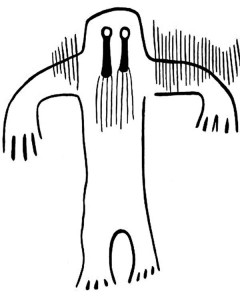
The big male, according to Yokuts tribal lore, is Hairy Man, standing on two legs, its arms spread wide, with long hair and, writes Forest Service archeologist Kathy Moskowitz Strain, “large, haunting eyes.” Next to it, with the same hairy, two-legged aspect, are what appear to be the adult female, the “mother,” and her child.

None of the animals shown on Painted Rock are proportionally larger than one would expect; they’re all either life-sized or smaller, as if in the distance.

The painting of Hairy Man is 8 1/2 feet tall.

By the time the first white man saw the Painted Rock pictographs in the 1870s, earlier European settlers of the American west were already well aware of Native Americans’ historical belief in the animal the Central California tribes called Hairy Man.

Many Native Americans, from the Cree people in Manitoba to the Cowichans in British Columbia to the tribes of central and northern California, have through the centuries taken a wide berth to avoid encountering a race or tribe of large, two-legged hairy beasts.

The account of a Methodist missionary found that the Salteaux Indians of Lake Winnipeg “living in dread” of what the missionary himself described as “these imaginary monsters.”

Anthropologists’ response to this has been mixed. Some believe the animals were a creation of tribal folklore meant to keep children in line and convince them not to stray too far from the villages.

But early white traders, settlers and miners often talked about the fervent belief held by the locals in what the whites invariably referred to as “mythical” creatures—which were described much the way Sasquatch is now described.

A 1790 publication related a Hudson’s Bay Company trader’s story about the North Saskatchewan River Indians’ belief in a giant, two-legged beast called the wendingo or windingo. The Indians, noted the trapper, “frequently persuade themselves that they see his track in the moss or snow.”

Two decades later a fur trader named David Thompson found a large footprint, described in historical journals as having been 14 inches long and eight inches wide, near what is now Jasper, Alberta. The print is often referred to as the first Sasquatch footprint found by a white man, though Thompson himself was said to have believed it to be the track of a large grizzly bear.

British Columbia periodicals in the late 1800s and early 1900s carried short news items referencing “the wild man of Vancouver Island” being seen by prospectors and others. And the region’s Kwakiutl Indians related tales of the “Woods Giant” which was routinely described the same way—much larger and hairier than humans, walking on two legs, with deep-set eyes under a thick, protruding forehead.
Comment:  For more on sasquatch, see Bigfoot Part of Indian Country and Sasquatch Exhibit in Washington Museum.

Below:  "This is a hand-drawn replica of Hairy Man as depicted—at 8 1/2 feet tall—in a Central California pictograph estimated to be several hundred years old." (Kathy Moskowitz Strain/Stanislaus National Forest)

June 24, 2011

Bigfoot part of Indian country

Looking for Bigfoot in Indian Country

By Michelle TiradoLong before this elusive creature became part of popular American folklore—we’re talking hundreds, if not thousands, of years—his presence had been accepted by North American tribes. Most had a name for him. The Lakota called him “Chiye-tanka,” the Chippewa, “Djeneta” and the Seminole, “Ssti capcaki.” Then, of course, there is “Sasquatch,” derived from the Salish in the Pacific Northwest. Depending on the tribe, he was regarded as a physical being, as real as any human, or a spirit that often manifested on Earth as a friend, never a foe, to mankind.

David Paulides, executive director of North America Bigfoot Search in Los Gatos, Calif., and author of the book Tribal Bigfoot, says Bigfoot has a firm place in many tribal cultures as “Keeper of the Forest” or “Keeper of the Earth.” “It’s someone that they’ve always revered, respected, admired and at times even traded with,” he says.

Paulides, a retired police officer, spent two years on the Hoopa Valley Indian Tribe’s reservation to investigate Bigfoot sightings. His work there, published in a book titled The Hoopa Project, entailed talking to hundreds of witnesses, people from three different tribes in the region and people who had to sign affidavits before recounting their experiences. He brought in the best forensic artist he could find—Harvey Pratt (Cheyenne and Arapaho) with the Oklahoma State Bureau of Investigation—who generated what Paulides describes as a “stunning” sketch based on the witnesses’ accounts.

Paulides came away from the Hoopa reservation with the conclusion there was something very real there, not any form of myth. “Everyone we talked to said it was human, and they related it as a type of tribal group. It was someone that they communicated with.”
Comment:  The arguments against the existence of Bigfoot are obvious. Where are the bodies and bones? The droppings? The refuse from meals? The footprints? The traces of blood and hair? The sightings on the ground? And from the air?

Sure, people have claimed to find some of these things. But there should be hundreds if not thousands of examples from recent history. What's the explanation for this missing evidence: that Bigfoot is clever enough to hide its existence from 300 million Americans and their cutting-edge technology?

The Patterson-Gimlin film (below) has generated reams of analyses by itself. On the one hand, some people who knew Patterson have called him a liar and a conman. A costume company has claimed it provided a gorilla suit and a man claimed he wore it. On the other hand, some scientists say a human couldn't have moved the way Bigfoot did. And some filmmakers say they couldn't duplicate the film without a great effort.

For more on the subject, see Sasquatch Exhibit in Washington Museum and Bigfoot in Popular Culture.

Below:  "This is a scene from the controversial Patterson-Gimlin film of a sasquatch, or bigfoot, taken in 1967 in California. Many critics called the film a hoax despite the fact that leading special effects experts were unable to figure out how the film could have been so brilliantly faked. Protracted analysis of the film has shown that no human being could possibly duplicate either the proportions of the film's subject or its specific patterns of movement. Footprints found at the scene were so deep and far apart over rough terrain that they could only have been made by an agile, powerful animal weighing six hundred pounds. The Indians of the Pacific Northwest have known of sasquatch for many generations: a pre-Columbian sculpture of a sasquatch foot from Lillooet, B.C., conforms closely to modern forensic footprint evidence. While no living specimen has been collected by western scientists, the preponderance of biological and carefully analyzed photographic evidence makes it clear that an undiscovered two-legged giant primate stalks the Pacific forests of North America."

January 24, 2010

Sasquatch exhibit in Washington museum

Exhibit explores history of sasquatch

By Jeffrey P. Mayor“Giants in the Mountains: The Search for Sasquatch” does not attempt to prove or disprove the existence of sasquatch, but instead looks at how and why the story is so ingrained in the cultural fabric of the Northwest.

The story of sasquatch certainly goes far beyond the 1987 movie “Harry and the Hendersons” or recent beef jerky TV commercials. It has been told for centuries among Northwest Indian tribes.

That mix of ancient mythology and modern commercialism is the focal point of a sasquatch exhibit that opened Saturday at the Washington State History Museum.
And:The exhibit is built around about 40 significant items, including casts of alleged footprints, ancient stone carving and Indian masks.

One of the key artifacts is a prehistoric stone head borrowed from the Maryhill Museum of Art. The carving was found in the Columbia Basin in the 1890s and is believed to date from 1,500 B.C. to 500 A.D., Perkins said.

“When you see them, they resemble gorillas. There have been at least four of these stone heads,” Perkins said.
Comment:  For more on the subject, see Origin of Sasquatch and Bigfoot and Native Things That Go Bump in the Night.

October 20, 2008

Bigfoot in popular culture

Bigfoot in popular cultureAdvertising

The words "Bigfoot" or "Sasquatch" are widely understood and as such have been used in advertising, being applied to many products and services, such as pizzas, beef jerky, skateboards, skis, an Internet search engine, a computer hard drive series, gas stations, Kokanee beer, and a monster truck.

Jack Link's brand of beef jerky has produced a series of commercials entitled "Messin with Sasquatch." In the commercials, men appearing to be hikers play tricks on Sasquatch (such as unscrewing the top of a salt shaker, causing salt to spill all over when Bigfoot goes to pour some on the food he is cooking). The end of the commercials usually show Sasquatch reacting angrily to the pranks, chasing and sometimes picking up the hikers and throwing them into the air, nearly killing them or injuring them.[

Tourism

There are annual Bigfoot-related conventions, and the creature plays a role in Pacific Northwest tourism, such as the annual "Sasquatch Daze" held for several years in Harrison Hot Springs, British Columbia. Napier writes, "Bigfoot in some quarters of North America has become big business. ... It can no longer be considered simply as a natural phenomenon that can be studied with the techniques of a naturalist; the entrepreneurs have moved in and folklore has become fakelore."
Comment:  There's also a long list of Bigfoot's appearances in movies, TV shows, books, video games, and record albums.

August 16, 2008

Natives, UFOs, and Bigfoot

Extraterrestrials and Ultradimensionals:  a Native American PerspectiveGrowing up, I cannot recall having ever heard anyone in my community speak of “aliens” or “Extraterrestrials”, though I did hear of distant relations and “Star People” living amongst the stars many times, mainly around campfires and during traditional ceremonies. Far from being anything to be feared, Star People was just another term I grew up around. I remember listening in awe and fascination at the thought of us having relations that lived off and outside our world, and sometimes spoke to them in my silent moments at night. I wanted to know who they were and what they looked like, if they had families like us, etc. In all honesty, the only time I was exposed to “aliens” per se was when I would go to the outhouse and read the Weekly World News or the National Enquirer. It wasn’t until my later teens that I discovered that people from the dominant cultures were talking about the same “people” as my elders did, though each side’s sense of perception of these people seemed radically different from one another.

Stories of abductions and such were not present (or at least not spoken of) in my surroundings. If anything, stories told by elders of interactions with Beings from other realms/worlds seemed to have more to do with telepathic communication and sometimes full on physical (and friendly) encounters than anything else. To this day, I’ve often wondered for instance, if White Buffalo Calf Woman, the teacher who brought Native people the four traditional medicines of sweetgrass, sage, cedar, and tobacco might have been one of these otherworldly visitors. And Weesageechak, our people’s original teacher and trickster, might also have been a representative of these people as well. To this day, there are still legends and stories in the Canadian north of a pale skinned, bearded man who appeared amongst my people thousands of years ago to give spiritual teachings and lessons. Perhaps the man known as Jesus himself was a part of this otherworldly race and he simply incarnated in our reality to teach and assist us into new phases of growth and understanding. Pity we had to kill him.

Bigfoot or Sasquatch, the main moneymaker for many tabloids, is (and was) ever present within Native culture. Known to many as “the wild man of the woods”, this creature to us is far more than a mere animal. We believe it to be more humanlike than not and in perfect sync with either the spirit world or Star People--or both. Like Extraterrestrials, one would have a hard time not finding someone in the community who has either seen or heard of this Being. And like everything else in Native culture, he is given full respect by rarely having his name mentioned unless his attention or help is desired. During my own encounters with this person (in both the dreamworld and our physical reality), it always struck me how completely and fully he knew everything about me. I could hide nothing from him even if I wanted to. Yet never once was I made to feel unsafe. Is Bigfoot actually a spirit? Does spirit world sometimes take on the form of something people from various cultures can relate with?
Below:  An ancient Aboriginal tosses a pizza pie while another tosses loaves of bread. They're just about ready to serve a delicious Italian meal.

Oh, wait...the roundish object is supposed to be a spaceship, not a pizza. This rock art is supposed to represent the "Star People," not two Native chefs. My mistake.

April 17, 2008

Indians play Sasquatch prank

Hays comes alive with Bigfoot rumorsSeveral people had spotted strange, very large prints in the snow and dirt—some marred with blood and hair—around the powwow grounds where Fort Belknap tribal members hold dances every summer.

Armed with only a camera, Horseman and two friends last month bravely headed into Mission Canyon, a mile south of Hays.

What they found surprised even the grizzled investigator. On the south end of the canyon park, some 25 prints were spotted in a 75-yard stretch. The prints looked like giant handprints, with fingers a good 4 inches longer than Horseman's.
The mystery solved:Pressured by the Tribune's staff of investigative reporters, Anthony Shambo spilled that the trickster was his brother, Reno Shambo, who intended to simply pull a prank on his young son.

"He brought it up to me two weeks before it happened," Shambo said Wednesday. "I kind of laughed at him and said nobody's going to believe that."

Reno Shambo, a coyote hunter, had cut the large prints out of 2-by-4s and strapped them to his feet.