Showing posts with label theater. Show all posts

July 18, 2015

Wyoming pageant features whites in redface

Wearing ‘red face’: A changed perspective

By Caitlin TanUnfortunately, there is one other event that makes the entire Green River Rendezvous Days controversial. The last day a play is put on called the “Pageant.” Basically it reenacts the meeting and trading of the mountain men and Native Americans.

The controversial part is the cast is made up almost entirely of white Pinedalians. The mountain men simply dress-up in buckskin hide outfits and fur hats; however, the Native American actors not only wear buckskin outfits, but their faces are painted a deep brown, almost red color, and they either wear black wigs or dye their hair crispy black.

I regret to say I have worn the latter costume in past years.

My only defense is I grew up in the town, submersed in the culture and simply did not know better. The entire town participates and people see the event as a fun, innocent celebration, and in some ways it is, but the ‘red face’ is simply taking it a step too far.

Even worse, Rendezvous involves excessive drinking; thus, many people painted-up in ‘red face’ are running around drunk, “playing” the roles of Native Americans.

Again, I painfully have to admit I used to do this.
Her conclusion:Therefore, white people dressing-up like Natives–painting their skin dark and attempting to reenact the culture–is simply a sad disgrace.

Changing my standards on this issue was incredibly difficult–I feel like I am saying goodbye to a part of myself forever; however, it is liberating to now stand for something that is morally correct and sensitive to another culture.
Comment:  Good for her!

For more on redface, see Ontario Camps Feature Mock Ceremonies and Sandler Crew "Bronzed" Native Actress.

March 26, 2015

Casting controversy in The Unplugging

A play in Toronto is causing the latest casting controversy:

The Unplugging tells an indigenous story, but the actresses are white

Author Yvette Nolan and director Nina Lee Aquino decided to find their ideal cast for Factory Theatre/Native Earth production, regardless of race.

By Richard Ouzounian
When Caucasian actress Allegra Fulton was offered the part of an aboriginal woman in the Factory Theatre/Native Earth production of The Unplugging, her negative reaction was immediate.

“I turned it down. I didn’t think it was right,” she said on a break from rehearsals for the play, which opens Wednesday. “It’s hard enough as an older white actress to get roles. For my friends who are Métis or First Nations, it’s practically impossible. Why should I take a part away from them?”

But a trio of influential voices kept trying to influence her: the director of both Factory Theatre and the production, Nina Lee Aquino, well known for her work in multiracial theatre; Ryan Cunningham, the artistic director of Native Earth; and the show’s author, Yvette Nolan, herself of mixed Algonquin and Irish heritage.

Fulton kept refusing. “I said ‘I can’t do this. Don’t ask me.’”

Then she remembered what playwright Tomson Highway had said to her years before when she was offered a major role as a Métis woman in a TV series and expressed similar qualms.

“Allegra,” said the flamboyant Cree theatre artist, “if you can’t play Métis, then I can’t play Oscar Wilde. Do it for me.”

So Fulton now finds herself in the show along with Diana Belshaw, also a white woman playing a role whose ethnicity isn’t clearly defined by the script, but whom director Aquino clearly labels as “indigenous.”

“Nina says we’re all indigenous on some level,” says Belshaw, who is also a professor of theatre performance at Humber College. “I’d have to agree with her there. We all have links to history, ancestry, culture in our past. For many of us it’s been broken.
But critics aren't necessarily buying it:

The Unplugging sparks debate by casting non-aboriginal actors in indigenous roles

Playwrights and actors divided on choice made by Toronto theatre company

By Kim Wheeler
“We talked about the casting, made a list which included not only the indigenous actors ‘of a certain age’ but actors from the larger multicultural community,” said Algonquin playwright Yvette Nolan, who made casting decisions along with director Nina Lee Aquino.

“There are not that many. For many reasons—attrition, retirement, fatigue. Many of the women on our list were already working in other shows or in movies or on much bigger projects."

Community backlash

When Columpa C. Bobb, an actor, writer, director and producer, heard about the casting decisions she created a long list of female indigenous actors on her Facebook page.

That started a discussion among the acting elite--including Tantoo Cardinal who was recently selected by ACTRA for the award of excellence.

“I don't care how talented you are, you will never convince me you are Indian. I have not seen a non-Indian actor catch nuance that needs to be there,” said Cardinal in a phone interview.
The problem isn't limited to one play:Playwright Ken Williams said his first mainstage production of Thunderstick—which went on to star Cree actor Lorne Cardinal and Anishinabe actor Craig Lauzon—had the same problem in 2002.

“We had the Isaac role cast but not one of the actors I wanted for Jacob were available. We ended up casting a non-native person for the role,” said Williams.

Drew Hayden Taylor's play, God & the Indian, will be the next Native Earth production. He's had over 70 productions of his work produced by several theatre companies.

Hayden said that on at least two occasions theatre companies have had to hire non-indigenous actors for his plays.

“I would rather have had a Native actress do the role, but as an artist, I would rather have a talented and experienced actress bring life to my characters than just somebody with a status card who's never acted,” said Taylor, who also saw The Unplugging.
Comment:  I don't think Native Voices at the Autry, here in Los Angeles, has ever experienced this problem. But it has a huge pool of Hollywood actors, including Natives, to draw on.

These articles don't quite address the core issue. Native Earth Performing Arts is supposedly a "professional Indigenous theatre company." Okay, then it should have developed a pool of talented Native actors in the Toronto area. In fact, Native Earth shouldn't exist unless it has a critical mass of Native actors, writers, directors, and so forth. What's the point of a Native theater company if you don't have enough Native people to put on Native plays?

I trust Native Earth has addressed and answered this question. Perhaps the article writers didn't have the time or space to go into it. But the question is central to the Unplugging controversy. Does Toronto have enough Native actors to put on Native plays or doesn't it? If it doesn't, what is Native Earth doing about it? If Native Earth is building an ensemble of Native actors but still can't find two of them for The Unplugging, it may be in the wrong business.

For more on Native theater, see Off the Rails at Native Voices and Stanford Cancels Bloody Jackson Play.

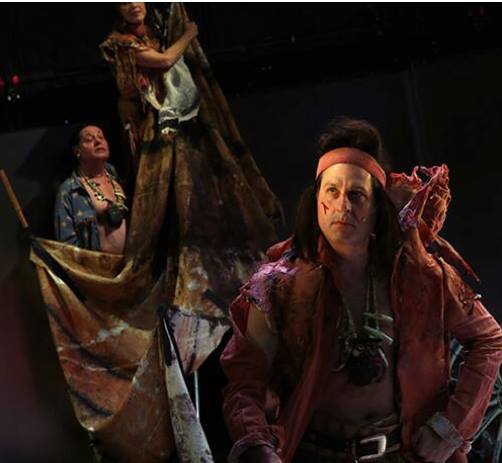
Below:  "Allegra Fulton and Diana Belshaw star in Yvette Nolan's play 'The Unplugging.' It runs in Toronto at Factory Theatre until April 5." (Akipari)

March 15, 2015

Off the Rails at Native Voices

Today I went to see the play Off the Rails at the Autry Museum. Here are some discussions of it:

Introduction

Native Voices at the Autry Presents the 20th Anniversary Production Off the Rails by Randy ReinholzContinuing its role as the only Equity theatre company dedicated to developing new work by Native American artists, Native Voices at the Autry presents its most ambitious production to date, Off the Rails by Randy Reinholz (Choctaw*). A bawdy and irreverent adaptation of Shakespeare's Measure for Measure set in Buffalo Bill's Wild West, the production is presented as part of Native Voices at the Autry's 2014–2015 season, themed “Legacy and Loss: Stories From the Indian Boarding School.”

“In Off the Rails I’ve relocated Shakespeare’s conflicts to the American frontier. We see love, righteousness, faith, and mercy compete for provenance in the foundation of a country. Adapting Shakespeare for a Native theatre company provides the structure and historical distance needed to explore why so much of the Native American story is missing from U.S. history,” said Reinholz, Native Voices Producing Artistic Director. “A key issue in Indian country today is the contradictory legacy and cultural damage of the American Indian boarding school system, whose motto was 'Kill the Indian, Save the Man.' In a moment in time when many Americans were advocating for the physical extermination of the remaining 218,000 American Indians it might seem that cultural genocide was the more benevolent choice. Important? Yes. Heavy? Not in this production. Think Blazing Saddles meets Shakespeare—with Native Americans taking the reins.”

Set in the nineteenth century in Genoa, Nebraska, Off the Rails focuses on Momaday (Shaun Taylor-Corbett), a young boarding school student who has been sentenced to death for impregnating an Irish girl. Brothel owner Madame Overdone (Shyla Marlin), her working girls, and saloon patrons hatch a plot to rescue Momaday. Key to his salvation is his older sister Isabel (Elizabeth Frances), a graduate of a boarding school. To save her brother, Isabel must win the affections of Captain Angelo (Michael Matthys), the new superintendent of the school. Angelo’s Victorian rules for life are threatened by his primal lust when the women in town combine forces to challenge his brief authority and save Momaday.

Off the Rails tackles the controversial and rarely discussed topic of Indian boarding schools. Typically absent from our nation’s history books, schools affected generations of Native Americans in unimaginable ways. Culture and identities were stripped, languages lost, lifelong friends were made, and unions were strengthened. Off the Rails dramatizes the polarizing national tensions in an audience-friendly way by combining knee-slapping comedy, vibrant music, and a set that transports theatregoers to 1886.


Background

INTERVIEW: Reinholz sheds light on American Indian boarding schools in new play

By John SoltesOff the Rails is a learning process even for the actors on stage. Reinholz said they walk away with “empowerment,” particularly for the native actors. Off the Rails is the capstone of an entire year where Native Voices attempted to understand the boarding school system and its implications.

“I think it’s really good for people who are activists to strongly consider how people can hear information, and again this play airs on the side of entertainment,” Reinholz said. “So you’ve got a lot of people thinking about, well, this stew is the United States and how we came together. For me, it’s not so much the horror of having killed all those people and the very frank discussion to kill the rest of them. I think it’s a miracle that we didn’t kill them all as a country. I just think, wow, there’s something to celebrate in that.”

The playwright said the adaptation, which is gaining interest from major theater companies, is approximately 20 percent Shakespeare and 80 percent invention.

“It’s not all in iambic [pentameter] because Shakespeare’s characters are all speaking in prose, particularly the clowns and in the bawdy scenes,” he said. “So that all feels like regular prose, but there are Shakespeare themes woven into much of the play. So the kids coopt lines from Romeo & Juliet, the young lovers. The woman who’s running the bar compares herself to Gertrude in Hamlet, so there’s all these coopting of lines. And that really comes from a very Deadwood kind of approach to the work. These people, their aspirational literature in the Old West would have been the King James Bible and a Collected Works of Shakespeare, so they would have been imitating those speech patterns.”

After raising enough funds for the Native Voices production—a campaign that included $20,000 in donations through Indiegogo—Reinholz said he’s hopeful the play will live on. “That was really our hope is to make something that colleges could look at and think about using it as a teaching tool, both to teach the history and the language and the performance value,” he said. “It just seems to be resonating. It’s because of this company that’s really supported the whole project from the beginning and really just threw themselves into it.”
The Autry offers a Native American perspective on Shakespeare with ‘Off The Rails’

Randy Reinholz is the writer and director of "Off The Rails," which will be presented as part of the Native Voices Series at the Autry National Center in Los Angeles Feb. 25-March 15.

By Michelle Mills
Reinholz, a Chula Vista resident who is also an administrator at San Diego State University, has directed more than 50 plays in the United States, Canada and Australia. Of Choctaw ancestry, he is focusing on raising awareness of the Native American experience. He also seeks to open eyes to the versatility of Native Americans, especially on stage.

“Native Americans have often been called invisible in American theater,” Reinholz said. “Doing something muscular with Shakespeare is a high bar in the theater world. So the idea that, can Indians really handle language?—well, here we’re going to show you, can Indians really do something with a classic?”

Presenting a great play, Reinholz said, shows that Native Americans—or anyone—can think in many different ways.
And:“What Native Voices is great about is having contemporary Native playwrights speak about who we are as Native people today, whereas I think what TV and movies are catching up to is the image that they portray.”

In turn, Reinholz said that the Native Voices company is diverse, boasting 100 professional performers, many of whom are multiracial. “Off the Rails” alone has a cast that includes actors who are full-blooded Native American and of mixed European and Native American descent, as well as African-Americans, Chinese and Anglos.

“It’s what the West might have looked like,” Reinholz said. “We tend to romanticize it and think of it as a rugged Anglo view, but there were Buffalo Soldiers out there, you had the immigrants and the indentured servants that were working on building railroads, you had former slaves. You had a really diverse mix-up and then you had the indigenous folks.”


Reviews

Autry’s “Off the Rails” Shakes Up the Old West

By MarkOff the Rails delivers all this lightly and rapidly, with combustible humor. Led by veteran Ted Barton as the town’s absent eminence, and Shyla Martin as the bordello keeper, the cast carves out clear characters and delivers the lines—old and new—with unfailing energy and clarity.

Christopher Salazar is especially strong as a wise aide, Román Zaragoza and Robert Vestal create a charming pair of scapegraces, and LeVance Tarver holds stage winningly as a chorus cowboy. Brian Joseph provides beautifully apt music. And of course Native Voices has Grandfather (Duane Minard) lending his dignity and blessing.

At times, the exuberance runs a bit off the rails, with almost constant movement (note to director Chris Anthony: Still moments run deep) and some odd, unmotivated blocking. But that’s a small matter.

Off the Rails gets the big things right. It’s colorful, lively and inventive theatre, and a bold satire our culture needs for healing. Grandfather Willie would be proud.
This Play Uses Shakespeare to Examine Our Country's Persecution of Native Americans (Go!)

By Deborah KlugmanIt's a lighthearted play with music, as opposed to a serious drama. But Off the Rails has plenty worthwhile to tell us about the cultural genocide perpetrated on Native Americans by a school system designed to indoctrinate and control. Under white governance, the community was ultimately fractured. We see this illustrated in the rift between Momaday and Isabel — one a traditionalist, the other a newly converted Christian.

Though all the performances are capable, the best of them emerge from the supporting ensemble. Under Chris Anthony's direction, they include the versatile and very funny Barton, who, besides the pompous general, plays a mentally suspect French executioner; Christopher Salazar as a decent government official dismayed by Angelo’s doings; and Robert Vestal as Pryor, the smart-aleck who takes over the saloon and brothel after Angelo declares that women—in this case Madame Overdone—may no longer own a business.
And a mini-review from Facebook:Awesome cast. Sold out show! Wonderful moments, comedic and in all seriousness--reflective of an infinitely different attitude toward Native Americans than today. Happily so:). Wonderful singing and instrument playing with old friend Duane Minard, beautiful Shyla Marlin, young talented man I met as an infant Roman Zaragoza, and one of my favs Robert Vestal as [a] major comedic character with a twist.

So many beautifully talented actors I can't mention all of their merits--such a well written adaptation of Shakespere's Measure for Measure. I wish my Elders from local Pechanga and Soboba could see .... Hope you can experience this multi cultured play with a Native American theme.
OFF THE RAILS PRESS PHOTOS
Photo credit: Craig Schwartz © 2015

December 09, 2014

Debating Peter Pan Live!

While I watched Peter Pan Live!, I did a bit of live-blogging on Facebook. I didn't plan to debate the production, but a couple of people responded and we were off.

Things started innocuously enough:

Off to Neverland

Watching Peter Pan Live!--the must-see event of the year!

I have a radical new idea for a remake: Cast a teenage boy to play Peter Pan the teenage boy. You know, instead of a grown woman.

Yes, I'm brilliant, I know. Thank you, thank you.

Didn't Christopher Walken used to sound normal when he was young? Now he sounds like he's doing a Christopher Walken impression.Casting a teenage boy presents a lot of issues from a musical theater perspective.It can't be much worse than trying to convince oneself that 26-year-old Allison Williams is a teenage boy. I'm not buying it.

I bet Daniel Radcliffe could've nailed it.Of course, a 25 year old man is much more convincing...it's about the voice, for one, and the ages of the Darling children.I meant when he was a teenager. "Cast a teenage boy [such as Radcliffe when he was a teenager] to play Peter Pan the teenage boy."

Problems arise

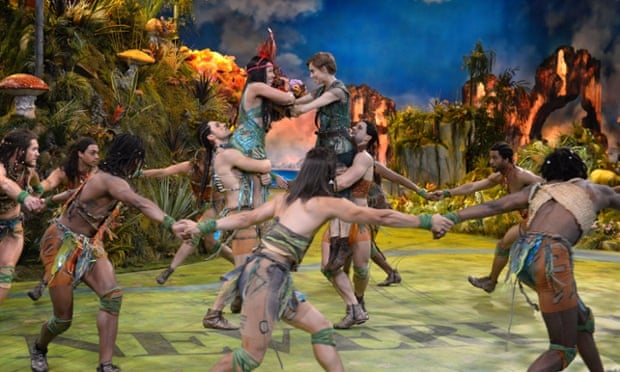
Race in ‪#‎PeterPanLive‬: Nine of the ten Lost Boys are white. The first four of Tiger Lily's tribe look brown-skinned and ethnic.

Even if the "tribal" actors are white, they're adorned with broad stripes of brown color. This conveys the impression that they're brown.

The tribesmen wear bone chokers and breastplates, and round pendants--like Indians. They tend to creep on all fours--like animals. ‪#‎PeterPanLive‬

The Lost Boys, including Michael Darling dressed as an Indian, reject Wendy's attempt to teach them how to avoid war. That's because Lost Boys, like Indian savages, are uncivilized.As near as I can tell, the Natives are also generic (tribally too unspecific).Yes, they're generic. But making them so doesn't solve the problem, it only redirects it.

The problem is that Peter's Lost Boys are wild, undisciplined, and ignorant because they have no rules, responsibilities, or parents. No law and order. In a word, they're uncivilized. And Tiger Lily's tribesmen are the same.

The message is that Lost Boys = indigenous people = savages. Whether the tribe is from the Americas, Africa, or Asia and the Pacific Islands doesn't really matter. The story is an indictment of all indigenous cultures. It suggests they're akin to children frolicking in the jungle, or animals in human form.As someone who grew up with this kind of unfounded, blatant, erroneous picture of Natives, I have only been condemning specific issues in these cases. But I am thrilled that we are finally at a place where we can finally address the broader ignorance issues that needs to be ended. Especially in popular media and entertainment.On the other hand:For heaven's sakes, it's FANTASY, it's silliness, it's choreographed -- did you notice how realistic the plants and trees were? *not*

Maybe you can go after "Santa Claus is Coming to Town" next time.
Are you seriously going to argue that people haven't gotten their ideas about Indians from Western movies, sports mascots, and corporate logos--all of which are forms of fiction? In fact, people absorb messages about reality from whatever they see, including fiction. As a few centuries of novels, plays, movies, TV shows, and comic books have proved.

So we should say nothing about racist stereotypes in movies or TV shows because they're "fantasies"? How about school plays, paintings and statues, or songs? Did you miss the last ten thousand times I criticized racist stereotypes in our culture?

A blackface minstrel show is just a fantasy. As is a Halloween party with Pocahotties and "Nava-hoes." Really, you expect me to give these a pass because they're "fantasies" like Peter Pan? As the last 20 years of my work has demonstrated, that's not gonna happen.

Lost Boys = Lord of the Flies?Haven't missed a one of your criticisms, and most often agree with them (although I'm protesting your NIGA group for its abominable acronym). I guess you've protested Peter Pan for 30 or more years now?

The Halloween analogy is false -- stupid women wanting to be "Nava-hoes" doesn't compare to Barrie's play, nor the musical. And if you knew the story, you would not put = between Lost Boys and the Indians in the show -- the Lost Boys are a different group altogether.

We've had plenty of literature, that for better or worse, deals with issues like this. Do we ban it all, or do we learn? Would you remove Lord of the Flies from the libraries (after all, they were certainly "Lost Boys" who became quite savage)?
The Indian savages perform the same function as the Lost Boys. They run and play in the forest, follow Peter Pan, and fight the pirates. They're different but equivalent groups.

That's why I said the message is that they're the same. Not that they're literally the same.

I didn't say my examples--the minstrel show and Halloween party--were alike in terms of "quality." But they're all examples of employing fictional or fantasy characters. They're alike in that regard.

And saying my analogy is "false" isn't much of an argument. Explain why it's false if you can.

In fact, anyone can present a racial stereotype and claim they're just "play-acting" or "pretending." If racism in "fantasy" is harmless, it's harmless whether it's a minstrel show, a Halloween party, or "Peter Pan." I say it's harmful in all these cases so the "fantasy" defense is rubbish.

I don't think the Lord of the Flies boys dressed specifically like Indians. Tiger Lily's tribe did. We're talking about characters who use racial stereotypes to represent a particular group--in this case, Indians or indigenous people. We're not talking about anyone who becomes "savage" in any way.

We're also not talking about censoring or removing Peter Pan. You invented that straw man because I didn't say a word about it. My solution is to fix the racist and sexist elements of this play and then present it.

If you want to present the original story with its racism and sexism, go ahead. You do that and I'll criticize it, just as I've done here.

Do we ban it or do we learn from it? I'm helping people learn from it by educating them about its racism and sexism. You're doing the opposite: telling people to ignore its problems and simply enjoy it as a "fantasy." Don't talk to us about "learning" when you're advocating the opposite.

P.S. My official critique of Peter Pan is 10 years old:

Tiger Lily in Peter Pan: An Allegory of Anglo-Indian Relations

I found every line about Indians in Barrie's original book to make sure I didn't miss anything. I understand his racist stereotyping well.

No doubt I mentioned the play and the Disney movie before then. And yet Peter Pan is only one of a thousand topics I've dealt with over the years. The facts prove there's no "obsession" here, so your claim is false and insulting.

You say you haven't missed my criticisms, yet you're surprised I criticized Peter Pan. Criticized it the same way I've criticized countless comic books, cartoons, video games, and other things that qualify as fantasies for children. So why are you surprised?

To reiterate, I've criticized Peter Pan and movies, TV shows, and plays like it many times before. My actions have been completely consistent so your surprise is illogical. In fact, the only surprise would be if I ignored a spectacle featuring Indians in prime-time television.

Racist and sexist, too

On the gender front, ‪#‎PeterPanLive‬ may be even worse. Girls = mothers = caretakers and servants = nags and scolds = killers of fun and freedom.

Wendy should slap some sense into Peter. "You say you want a mother, but you don't want to do anything I say? What do you think a mother is, you stupid twit?

"If you want someone to serve you, go hire a maid or a butler. I've got better things to do than to babysit babies."

Now she's singing about how she wants to kiss Peter Pan. Even a century ago, girls went for the charming bad boys who would love 'em and leave 'em. All Peter needs is a leather jacket and motorcycle to seal the deal.

Back to the racial issues:

If you want a race of animal-like savages, make them bestial for real. Centaurs, cat people, talking bears, etc. Or make them toy soldiers come to life a la Toy Story. There's really no excuse to equate savages with indigenous people. ‪#‎PeterPanLive‬

Getting a closer look at Tiger Lily's tribe as they dance. Perhaps half the actors are nonwhite. All have dark hair and several have dreadlocks. Shoes look like moccasins. Definitely an Afro-Indian vibe. ‪#‎PeterPanLive‬

And they're mixing the Wyandotte song title with "Hickory dickory dock" and "Tweedledee, tweedledum." Well, gee, thanks for making it clear that Native languages aren't just singsong nonsense words.

Not to mention the tom-tom beats and chanting that echo a thousand old Westerns. They aren't even subtle. This is obviously an "Indian" song in everything but name.

And Tiger Lily says Peter is the sun and the moon. Good thing she praised the "great white father" only once in this scene, or it would be unbearable.

Peter is mystified that Wendy, Tinkerbell, and Tiger Lily all want more from him. Why are girls so needy and clingy? Why can't they be strong and independent, like boys?! ‪#‎PeterPanLive‬Do you know when this story was written, what society was like at the time?It was written around the time when Dorothy traveled to Oz, took command of her destiny (more or less), and proceeded without any thought of clinging to a man or becoming a mother.

That was several decades after Alice had her solo adventures in Wonderland. A couple of centuries after Jane Austen's heroines showed what strong, independent women could do. Are you seriously arguing that having all three female characters long for Peter was a sign of the times? That authors like Barrie couldn't conceive of any other way of thinking?

And the producers are putting the play on in 2014, not 1902 when it was written. They're responsible for how its sexist message plays today. If you or they don't want anyone criticizing the sexism, don't put it on the air now. Leave it and the racist savages in the dustbin of history where they belong.

Next up: How Santa's message of toys for everyone obscures the structural poverty built into our society.

Tinkerbell must die

Captain Hook's "brilliant" plan to kill Peter Pan is to poison him. He puts the poison in Peter's medicine while he sits next to the sleeping Peter. How about stabbing him in the chest instead? ‪#‎PeterPanDead‬

But Tinkerbell drinks it instead! What a bumbler that Hook is!

Tweet to save Tinkerbell? #TinkerbellMustDie

Now Peter is speaking to the audience, telling us to clap if we believe in fairies. Die, you little piece of CGI fakery!!

Odd. The swelling music seems to indicate we should be filled with joy, not laughter at this silliness.You must have had a very sad childhood -- and I'm not trying to insult. That a grown man is so obsessed with a little musical that children love is worrisome. When I was a little girl, I thought Mary Martin was speaking directly to me. I found joy in the show, and still do. Lovely music, great dancing, lots of fun.As I said, I've posted critiques and analyses of thousands of Native stereotypes. I'm not sure Peter Pan is even in the top 25 or 50 of the subjects I've covered. Despite the fact that it's one of the longest-running and most prominent purveyors of Native stereotypes in existence.

If you're worried that I spent a couple of hours posting a few comments about one play, I'd hate to see your reaction to the subjects I've actually focused on. You know, things like the Washington Redskins and other mascots, The Lone Ranger and Twilight, and hipster headdresses. I guess you'd be amazed at my rock-solid opposition to racist stereotypes wherever they occur.

P.S. My childhood was stunningly normal, not "sad." I'm incredulous that you've suddenly discovered that I criticize things. If you somehow missed my last 10,000 postings, check them again. You'll see a decades-long pattern of denouncing racism, sexism, and other forms of prejudice.

If you don't like that, sorry, but that's what I do. I thought it was obvious, but now you know.

Here are some of the criticisms directed at this production:

http://nativenewsonline.net/currents/notyourtigerlily-nine-months-later-still-dont-get-point/

https://indiancountrytodaymedianetwork.com/2014/12/05/keene-why-fix-tiger-lily-why-cant-we-just-let-her-go-158155

http://americanindiansinchildrensliterature.blogspot.com/2014/12/true-blood-brothers-in-nbcs-production.html

http://www.salon.com/2014/12/05/the_boggling_mixed_signals_of_peter_pan_live_why_on_earth_did_nbc_decide_to_stage_this_show/

http://www.salon.com/2014/12/06/the_7_worst_things_about_nbcs_peter_pan_live_partner/

I guess a lot of people are "obsessed" or had "sad" childhoods. Which are obvious codewords for, "Stop criticizing my beloved fairy tale, you can't make me think about its racism and sexism, la la la la la I can't hear you!"

A tweet to sum up the racial issues:

Tiger Lily's tribe in ‪#‎PeterPanLive‬: brown skins, body paint, bone chokers and breastplates, crawling on all fours--but not stereotypical?!

For more on Peter Pan, see Native Stereotypes in Peter Pan Live! and Peter Pan Live! Reviewed.
December 08, 2014

Native stereotypes in Peter Pan Live!

Let's turn from the overall production of Peter Pan Live! to its Native aspects. First, the problems in the source material:

What's up, Tiger Lily? Peter Pan and the Native American stereotype that has certainly grown old

NBC featured an actress of Cherokee descent, but some say Rooney Mara’s forthcoming film turn will merely be ‘redface’. Is there any way to redeem JM Barrie’s most dated character?

By Alan Yuhas
In the 1904 play and 1911 novel that brought Peter Pan to fame, Barrie calls Tiger Lily a princess of a “Piccaninny tribe.” She has all the trappings we now recognize from the worst sort of Native American stereotype. Tiger Lily puts her ear to the earth, breaks out a peace pipe, and speaks with her cohorts in guttural gibberish. Most uncomfortably, Barrie is not only prolific with the word “redskin” but also has Tiger Lily rapturously declare Peter “the Great White Father,” after he saves her life.

There is, however, “something about Peter that captivated everyone and let Barrie get away with a lot,” said Anne Hiebert Alton, a professor at Central Michigan University and the editor of a scholarly edition of Peter Pan. From Barrie’s perspective, she said, the world divided easily between the British and everyone else.

“He’s not being consciously racist,” she said. “But we still can’t let him off the hook.”

Barrie’s works do stink of their era. He turns Tiger Lily into a hero but makes sure she is subservient to Peter; he treats her tribe as better than the true enemy (pirates, adults) but not nearly as important as the heroes (boys, kids, not girls). Alton also pointed out that Barrie died in 1937–long before anyone thought to take issue with his portrayal of Native Americans.


The production tried to fix the problems:

Ugg-A-Wha? Updating Stereotypes in ‘Peter Pan’

By Jeremy EgnerAll of which put the casting of Tiger Lily and a reworking of the song “Ugg-A-Wugg” near the top of the list of things NBC’s new “Peter Pan Live!,” which debuts at 8 p.m. Thursday Eastern time, had to get right.

“Tiger Lily needed to be Native American—that’s how Barrie conceived the role,” said Neil Meron, an executive producer. But the treatment can’t be “insulting to the Native American community,” he said.

Enter Alanna Saunders, 22, who graduated from the University of Miami in May and had lived in New York for roughly two weeks before she saw a flyer seeking Native American actors to audition for Tiger Lily. Ms. Saunders, a descendant of the Cherokee Nation, won the part and is thus starting her professional career on a live network extravaganza before an audience of millions, sharing the stage with the likes of Christopher Walken (as Captain Hook).

“It feels so ridiculous that I got this opportunity,” she said from the set last week.

Ms. Saunders brought no expectations to the production, she said, mostly because she had so little experience to draw upon. But she was curious about how “Peter Pan Live!” was going to handle one of the musical’s most famous numbers.

“I was thinking, ‘There’s no way they can do “Ugg-A-Wugg,”’” she said. “Because the lyrics are gibberish, and they’re pretty offensive in terms of trying to be any sort of authentic Native American reference.”

The song is a duet between Tiger Lily and Peter Pan, in which the islanders and Peter’s Lost Boys form an alliance against Captain Hook. To refresh it for modern sensibilities, the songwriter Amanda Green, the daughter of an original “Peter Pan” lyricist, Adolph Green, and David Chase, the production’s music director, worked with Jerod Impichchaachaaha’ Tate, an Emmy-winning composer and member of the Chickasaw Nation in Oklahoma. The nonsense lyrics were replaced with nursery rhymes and the rhythms were shifted to make the song less stereotypical and more authentically Native American. (Mr. Tate discussed the process in more detail in recent interviews.)
Natives still criticize production

From Debbie Reese's American Indians in Children's Literature blog:

"True Blood Brothers" in NBC's production of Peter PanThe take away? Lot of stereotyping:

Indians with crossed arms: check
Scantily clad Indians: check
Playing drum with hands: check
Kids playing Indian: check
Hollywood Indian music: check
Overrepresentation of men: check

So--a question.

"O-a-hey" is supposed to be a Wyandotte word. Does that make this all better? No. Not at all.


#NotYourTigerLily: Nine Months Later and They Still Don’t Get the Point

By Johnnie JaeHaving seen the production, I cannot even begin to understand how anyone could think that this gross misappropriation of our indigenous identities and culture is a step forward in diminishing harmful and racist stereotypes. It’s still the same disappointing, exploitative and racist characterization of indigenous women and people that it has always been. What’s really disheartening is that they took the same approach that Warner Bros. has decided to take with their feature film, Pan.

“They created a non-Native “tribe” that faux-headdress-loving Coachella fans would be proud of, while simultaneously engaging in an activity mainstream society is adept at—silencing Native peoples,” says Tara Houska of Not Your Mascots. “There are plenty of Native actors and actresses to fill Native roles, and plenty of Native writers to consult. If Hollywood feels the need to bring back a character entirely based on racist stereotypes, one would think the smartest approach would be involving Natives as much as possible in the character’s re-imagination.”

Let’s be honest. Peter Pan is one of the most racist and misogynistic literary classics and so are the cartoons, plays and films inspired by the novel. The world of Peter Pan is fiction, but the harm done through the blatantly racist treatment and portrayal of Indigenous people in the story is our reality.

I asked Not Your Mascots’ Maggie Hundley why it was important to discuss the issues with Tiger Lily and her Tribe in the Neverland Universe and she replied:

“Unfortunately, as a kid, I bought into the Indian ‘maiden’ and ‘princess’ caricatures that I saw in movies and cartoons and used them to judge myself. Things need to change. By calling out the degrading and exploitative character of Tiger Lily in Peter Pan movies and plays, we are challenging institutionalized stereotyping of indigenous girls and women in entertainment. It is important to call out these mockeries and create a new narrative to replace the false ones that are force-fed to us by major companies such as Warner Brothers and NBC.”
While Johnnie Jae wanted Native creators to fix the Native portrayals, Adrienne Keene suggested another approach:

Keene: Why 'Fix' Tiger Lily? Why Can't We Just Let Her Go?

By Dr. Adrienne KeeneThose who may have followed my writings on Tonto and Disney’s 2013 Lone Ranger film might see this as a marked switch from my attitude at the beginning of that journey. I argued, very strongly, that Disney should have cast a Native in the role of Tonto, that Comanche advisors and other Native peoples should have been involved much earlier in the process to shape and develop portrayals of Native peoples on the screen.

After watching that long saga unfold, I have a different opinion. I don’t want Native peoples to be forced into a role of trying to put band-aids on a gaping wound of racism. I want Hollywood to stop resurrecting these racist characters.

Think of the world created by the story of Peter Pan. Neverland is inhabited by mermaids, pirates*, fairies…and Indians. Fantasy creatures, meant to show how different Neverland is than the world the Darling children inhabit. The problem is, Native peoples aren’t fantasy creatures, nor are we something of the past, like pirates. We’re real, contemporary human beings. We don’t all live in tipis and smoke peace pipes and say things like “squ*w gettum firewood.”

So my advice the next time that a high school wants to put on Peter Pan or the next studio wants to make another remake: Cut the “Indians” out. Completely. Be creative. Find some other fantasy creature to replace them with. My colleagues last night came up with the idea of space aliens, which I kinda love. A completely fictional “other,” allowing for full creativity. Make up some shiny silver blobs for them to live in. Make up a language. Wrap them in foil or something. Just don’t call them Indians.
Comment:  For more on Peter Pan, see Peter Pan Live! Reviewed and A 21st-Century Peter Pan and Peter Pan's Racist History.

December 07, 2014

Peter Pan Live! reviewed

NBC's mega-event production of Peter Pan Live! aired Sunday night. The reviews were mixed, to say the least.

Some people liked it:

Smooth Flight to Neverland, Mostly. Just Ask @tinkerbell.

'Peter Pan Live' review: Allison Williams-led production, broadcast from Long Island, nearly soars

Others, including me, didn't find much to like:

TV Review: NBC's 'Peter Pan' falls sadly flat

By Mark KennedyThis "Peter Pan" needed a lot more fairy dust.

NBC's live telling of J.M. Barrie's classic tale Thursday was an oddly ponderous, disconnected, disjointed and jerky mess. If it had been a Broadway show, it would have gotten the hook (pun intended).

It wasn't the small things that broke the spell—ungraceful wire work, clunky transitions, a Tinkerbell that was as annoying as a mosquito and sounded like a wind chime, a tea cup that fell from Peter's head and some technical glitches.

"Peter Pan Live!" simply never flew.

It suffered a draggy start, cursed by a "Downton Abbey" drawing room dialogue and a call for everyone to go to bed. It grew better in the colorful Neverland but veered into parody with a Captain Hook by Christopher Walken that seemed like a failed "Saturday Night Live" sketch about Johnny Depp. The whole thing lost steam by the second hour. Was anyone still trying to save Tinkerbell with 45 minutes to go?
The boggling mixed signals of “Peter Pan Live!”: Why on earth did NBC decide to do this show?

"Peter Pan" wasn't a technical disaster or a racist cringe-fest--but man, was it weird

By Sonia Saraiya
NBC’s production of this 1904 musical did nothing different, interesting or risky. (It might not even have been sung live! What was the point, NBC?) Aside from a few changes to Tiger Lily’s song to make it slightly less racist, “Peter Pan Live!” was “Peter Pan,” more or less intact. Which is mind-boggling. If Disney had produced this, audiences would be asking: Why is it so overwhelmingly white? Why wasn’t Tiger Lily’s role rethought or cut entirely?

And the most obvious response to all of this, naturally, is that “Peter Pan” isn’t meant for television, because it’s a play, and it’s not meant for modern audiences, because it was written in 1904. But then that leads to the most obvious question that struck me as I was watching last night: Why on earth would anyone make this show in 2014? As the fabulous and opinionated Tom and Lorenzo wrote this morning: “There’s a difference between ‘old-fashioned entertainment’ and ‘offensive minstrel shows’ and this falls somewhere in the middle.”

We live in a world where a feminist retelling of the book of Genesis is a bestselling book and an upcoming miniseries on Lifetime. Where children’s fables are being unpacked and retold to include more female and minority perspectives. The “Hunger Games” franchise and the Marvel and DC universes are engaging with complex, dystopian themes in their storytelling. We are not shrinking violets in our American living rooms, and neither are our children, and yet this version of “Peter Pan” is like a time capsule from 1904, unwilling to do anything to disturb the fragile social norms of a bunch of long-dead white Brits.
The 7 worst things about NBC’s “Peter Pan Live!”

Nearly two days later, we still can't quite believe what we just saw

By EJ Dickson
1) Cast someone who can actually pull off the role of Peter Pan.

The problem was that Williams simply doesn’t have the charisma to pull off the Boy Who Never Grew Up. She looked nice, and sounded nice, but as the A.V. Club’s Caroline Siede put it, “Williams feels like the girl who got every lead role in high school but couldn’t quite compete with stronger performers in college. She’s not bad, but she lacks the right impulsive, impish energy for Peter Pan.” Someone with more firecracker energy, like an Anna Kendrick or an Ellen Page, would’ve made for a much stronger Peter.

4) Replace or cut out the “Ugg-A-Wugg/True Blood Brothers” number.

The trouble is that no matter what you do to Tiger Lily and the “Ugg-A-Wugg” number, it’s still a song about Native peoples celebrating Peter Pan, their white male savior; replacing the “gibberish” Native American lyrics with equally gibberish nursery rhymes doesn’t necessarily make it any better. And because the number itself really isn’t that integral to the narrative or even very good to begin with, the smart choice would’ve been for NBC producers to cut it (as they did with the operatic “Mysterious Lady,” presumably due to Williams’ vocal limitations) or replace it with a new, equally rousing, more politically correct number.

7) Pick a better show.

Let’s be real: Peter Pan is not the best musical in the world. While it’s great for parents to turn on when they’re busy, so they can plop their kids in front of it and watch them zonk out for a few hours, the pacing is slow, the score subpar and poorly edited—I know we all love Christopher Walken, but do we really need at least three musical numbers for Captain Hook and his band of pirates?—and the libretto full of stodgy, regressive ideas about women and gender. Considered as a whole, I’d take a good production of Guys and Dolls, The Music Man, South Pacific or even Grease over Peter Pan any day.
A few people simply gawked at it:

Peter Pan Live on NBC: Reviewed

Hate-watching “Peter Pan Live!”: The funniest tweets during tonight’s NBC musical

Comment:  For more on Peter Pan, see A 21st-Century Peter Pan and Peter Pan's Racist History.

December 03, 2014

A 21st-century Peter Pan

The Racist History of Peter Pan's Indian Tribe

Even in the early 20th century, though, critics saw Tiger Lily and her fellow "Picaninnies" as caricatures

By Sarah Laskow
More recently, though, directors who take on Peter Pan have tried to update these ideas, a tiny bit. Hook, the 1991 Robert Zemeckis movie, leaves the tribe out altogether. When the British director Tim Carroll staged Peter Pan for the Stratford Festival in 2010, he turned the tribe into Amazons.

"The role of the Indians in the play is to be both exotic and a bit savage," he wrote in an email. "But the use of the term (and the stereotyped language) could only cause offense to a North American audience. It seemed to me that 'Amazons' was a neat way of killing two birds with one stone: as mythic warriors they satisfied the 'exotic and savage' criterion; but it also allowed me to cast a group of women."

2015's Pan, a film that imagines Peter's first years in Neverland as an orphan kidnapped by pirates and forced to work in a mine, made a similar choice. The film features Rooney Mara as Tiger Lily but dresses her tribe in a sort of outlandishly bright array of pinks, purples, browns and bright blues that manages to be fantastic enough that no one would ever confuse this tribe with an American Indian tribe.

NBC's 2014 version of the 1954 musical is going in the opposite direction, in search of something like authenticity. Unknown actress Alanna Saunders, whose paternal heritage has distant ties to the Cherokee nation, will play Tiger Lily, and the song "Ugg-a-Wugg" was updated to include actual Native American phrases. Perhaps these changes will keep today's directors from looking, in another hundred years, like purveyors of crude racial stereotypes; perhaps they'll seem just as clumsy as Barrie's original conception of the tribe's relationship to Peter—"We redskins—you the great white father."
Updating the original

“We had to replace the lyrics ‘ugg-a-wugg’”: Meet the “Native American consultant” who worked on NBC’s “Peter Pan”

Salon talked to Jerod Tate about how NBC smoothed over the musical's un-p.c. edges

By Erin Keane
[T]hen the really big thing that we worked on was the replacement of [the lyrics] “ugg-a-wugg.” Just a little background: In general, what we all know is that the Indian tribe that’s represented in Peter Pan was influenced by knowledge of Northeast Indians of the United States. So we’re talking Iroquois, Huron, Wyandotte, Algonquin, these kinds of cultural regions. So what I did was I set out to find a replacement word for “ugg-a-wugg” that was literally a Wyandotte word.CTC conjures a 'Peter Pan' for the 21st century

As NBC prepares to screen the musical this week, Children's Theatre is working on an update that may become the standard.

By Rohan Preston
“What’s appalling about ‘Peter Pan’ is that everyone else in the play speaks perfect English, but when it comes to the Native Americans, the tribe, it’s the ‘ugga wugga’ song, which is made-up gibberish in the third person,” said playwright and choreographer Larissa FastHorse, a Lakota who grew up in South Dakota. “The play puts Native Americans in that realm of the fantastical, as if we were extinct. But we’re here, alive and creative, not better or worse than anyone else.”

FastHorse consulted with the Children’s Theatre, which plans to stage “Peter Pan” next spring and which wrestled with how to portray Tiger Lily, an Indian character, and the tribe. Artistic director Peter Brosius worked with director Peter Rothstein and new play director Elissa Adams to make changes to the script in consultation with some Indian artists.

They came up with an idea to change the tribe into a group of powerful, diverse girls known as the Pounce. They are a counterpoint to the show’s famous Lost Boys.

Theater officials were at first fearful that the licensing company would reject the suggested changes. Instead, Music Theatre International, which controls the performance rights of “Peter Pan,” is considering adopting them for all future productions that it licenses.
Comment:  Let's look at possible changes:

1) Omitting the Indian tribe altogether may be the best solution. It's not critical to the story; it can be replaced by a few individuals or nothing.

2) Changing the tribe to primitive people in multicolored feathers doesn't address the "exotic and savage" issue. That isn't a goal, it's a problem. Yes, some indigenous people still go half-naked and hunt with spears, but they're likely to watch TV or log onto the Internet after a day in the jungle. Equating them with fairies and pirates from a couple of centuries ago will always be stereotypical.

3) Changing the tribe to Amazon women or "a group of powerful, diverse girls known as the Pounce" is better--if they don't look primitive and indigenous. Why not dress these women like warriors from Wonder Woman's Paradise Island--in full armor? Or as gang members from a West Side Story-like background?

4) Like Tonto and Turok, Tiger Lily is an iconic, if minor, Native character. Indians have so few roles that it's a shame to lose one. Producers should think about keeping her Native--but only if they solve the "tribal" problem.

If Tiger Lily isn't leading an Indian tribe, she obviously doesn't need to be Native. But if her "tribe" is a group of girls like the Pounce, she still could be indigenous. There's no reason a brown-skinned woman shouldn't lead a multi-ethnic society.

For more on Peter Pan, see Peter Pan's Racist History and White Tiger Lily, Aboriginal Chief?

November 01, 2014

Stanford cancels Bloody Jackson play

Controversial Jackson Musical at Stanford University CanceledAt the Fountain, a student group at Stanford University in California, was going to put on a production of Bloody Bloody Andrew Jackson, a musical that American Indian groups have opposed—including the Stanford American Indian Organization.

After a number of conversations between At the Fountain and the SAIO, the musical was canceled. According to Kelly Gregg, director of on-campus activities for At the Fountain Theatricals, “students from At the Fountain as well as SAIO have turned this potentially divisive situation into a learning experience to increase conversations on campus (and, potentially, nationally) about the intersection of art and cultures,” she said in an email. “Together with Stanford’s Asian American Theatre Project (AATP) and Comparative Studies in Race and Ethnicity department (CSRE), ATF and SAIO have launched a series of programming exploring representation of minority groups and political correctness in theater and the media called Who Can Speak for Whom.”

“Between the efforts with Stanford American Indian Organization, and the team that was planning to produce the play, we ultimately were able to convince them to not produce this piece,” said Dahlton Brown, co-chair of the Stanford American Indian Organization. “After hearing our concerns as Native American leaders here at Stanford, they concluded it would be in everyone’s best interest that the play not be produced. While yes, this is a controversial issue, this production will not be happening here on the Stanford University campus.”
Comment:  A previous article, "Natives Oppose Stanford Musical," told the beginnings of this controversy. But Indian Country Today apparently took it down.

For more on the subject, see Bloody Jackson, Family Guy, and Archie Bunker and Why No Bloody Jackson Protests?

October 20, 2014

Berlin play features "naked savages"

Naked Faux Savages and Neo-Racism in Berlin

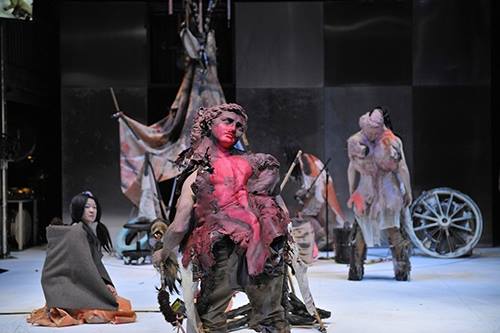
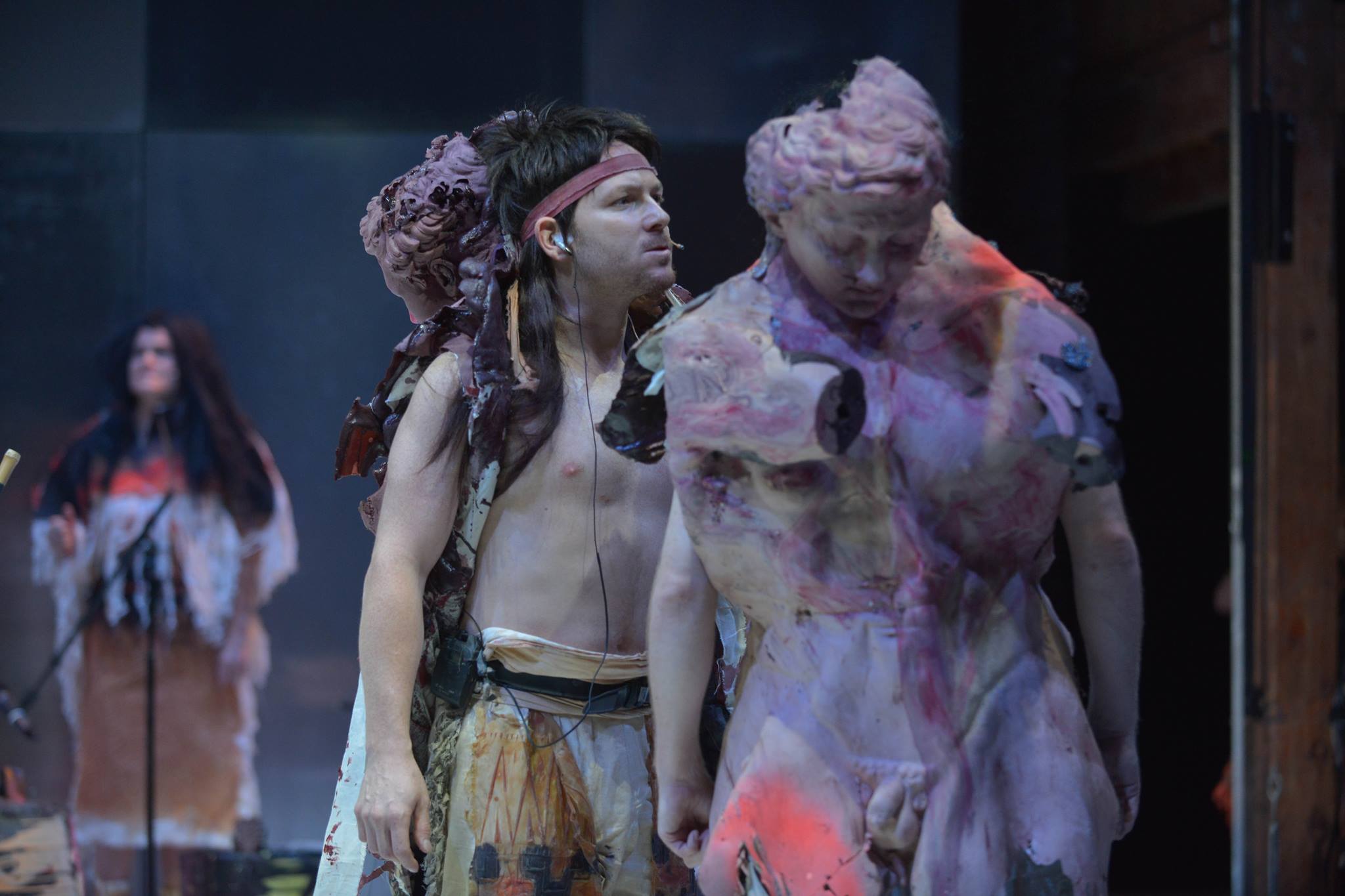
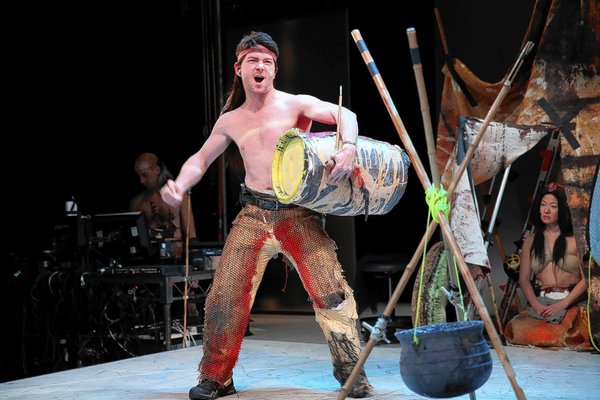
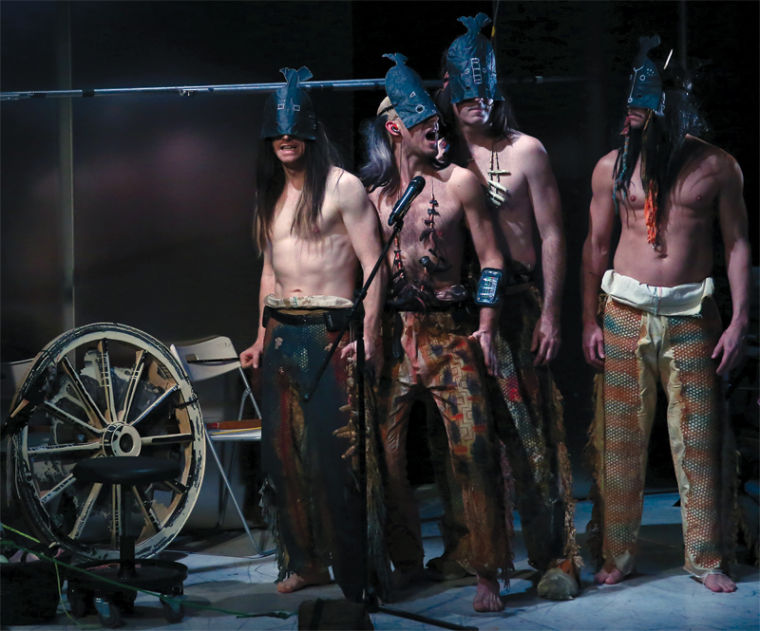
By Red HaircrowAt the Ethological Museum’s Humboldt Lab in Berlin, the play Captain Jacobsen recently premiered, featuring a performance by the group Das Helmi that culminated with brightly painted and masked dancers provocatively presenting what was supposed to be Natives of the Northwest during a potlatch feast. The dancers writhed intertwined and rode on each other’s backs in what was described as “a naked orgy of naked savages“ by the museum’s outraged former curator of the North American Collection, Peter Bolz (who retired in 2012). Males wore socks that covered their genitalia but most of the young female dancers were naked as they playfully simulated sexual wildness before an audience that included small children.

The play is about the ethnologist Adrian Jacobsen, who traveled to the Northwest Coast to trade with the Kwakiutl, Haida and other tribes, and much of his acquired booty is still at the museum to this day. At its premiere in September, the recreation of his adventures received mixed reviews.

“Part of the audience saw it as an innovative experiment, and part saw it as a form of neo-racism against Native Americans,” said Bolz. “Imagine if representatives of these Indigenous Peoples had been present in the hall. They would immediately leave Berlin under protest and never come back!”

Other opinions were even more harsh. “Lacking in every respect; coarse, anarchic, ironic, absurd” and “stereotypical and done with low skill” said the review in the The Berliner Zeitung. It said the show was representing “the vulnerability of traditional Indian cultures through contact with the ethnologist (Jacobsen), which was interpreted with anarchic humor by Berlin puppet theater, Das Helmi, whose core brand is ‘Nothing is sacred.’”
Comment:  For more on stereotypical plays, see Cry, Trojans! in Redface, Play Portrays Ishi as Rapist, Murderer, and Racism in Bloody, Bloody Jackson.

August 31, 2014

"Lazy" cultural stereotypes in Totem

Janet McAllister: Let down by 'lazy stereotypes'When she went to Cirque du Soleil's Totem last week, artist and curator Melissa Laing was impressed by the acts' "phenomenal" technical brilliance. But that's not her overwhelming memory of the show. Instead, she says "the performers were profoundly let down by the artistic director."

Onstage, the Native American woman on roller skates appears almost naked. The Scientist and all the "normal" people in contemporary costumes are white. Laing was appalled by this "lazy" use of cultural and gender stereotypes.

Overseas reviews agree (including a couple from audience members on Cirque's official website). "The show's treatment of world cultures is alarming," says the online news site Huffington Post, noting performers are costumed "like the singing dolls at Disneyland's It's a Small World" ride. Canada's The Globe and Mail points out that Cirque has a history of such cringe, wondering if James Cameron's noble savage in Avatar was inspired by a Cirque show.

Poor Robert Lepage. Totem's director may have thought he had circumvented such criticism this time: reportedly, Cirque consulted with "numerous First Nations elders," and principal singer and Huron-Wendat lyricist Christian Laveau has said the show was careful not to include sacred elements.

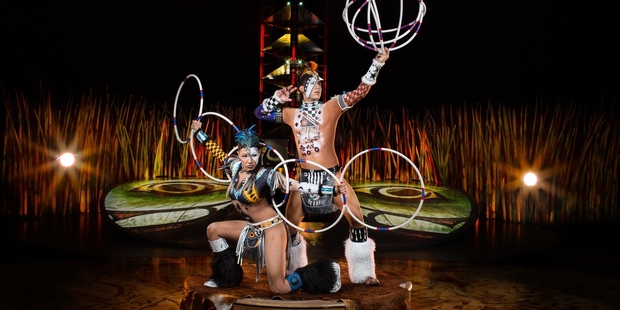
Costumes aside, such measures seem to have at least helped. Although otherwise scathing, the Portland Monthly reviewer expressed surprise and delight "that the act I expected to find most offensive from the press photos turned out to feel like the most authentic part"--that is, the Native American hoop dancing by Eric Hernandez, already a 12-year veteran at age 22.

But the problem is that such enlightening moments are packaged into a broader arc that pits us vs them, white vs exotic, "spectacularising a cultural other," as Laing puts it. Sometimes "attempts to celebrate a culture can actually add to the harm done to that culture," if those attempts are unconsciously patronising or simply clueless. Non-Western cultures are often presented as historically frozen "add-ons" to the dynamic Western default setting.


Comment:  I posted about Totem in Native Performers in Cirque du Soleil. I've seen pictures of Hernandez performing. I didn't say anything else about the show because I didn't have any more information.

But the outfits seen above--presumably worn by Shandien Larance (Hopi) and Eric Hernandez (Hopi)--are questionable. The hoop dancers I've seen don't perform as half-naked savages. They don't have strange checkered patterns on their arms, or a slash of paint across their faces. I'd say Cirque du Soleil is doing exactly what writer McAllister said: "spectacularising a cultural other."

If they performed in powwow-style regalia, they'd be less like the primitive people of countless old Westerns. The effect would be less "othering."

Normal vs. exotic

Here are some "characters" from Totem:

The Amerindian Dancer

The young Amerindian dancer takes us into a magical world, tracing the history of the evolution of species with his rings.


The Tracker

Environmentally conscious, a friend of the animals, he guides and assists the Scientist in his explorations. Angered by the thoughtless, polluting actions of a clown, he transforms before our eyes into a Toreador.


The Scientist

A Darwinesque Explorer who visits the different worlds of the show. In his advanced laboratory, aided by his assistants and a monkey, he dazzles us with his amazing physics experiments.


Clown Misha

Misha, a practical man, is wary of fuss and extravagance. He finds a silver lining (or a steel pot) for every situation life throws his way.


Hmm. Two white guys wearing more-or-less normal clothes. Two brown guys in exotic "tribal" costumes. Even if the Western guys are causing the problems and the non-Western guys are solving them, that's stereotypical.

Does Totem understand that Natives are on the leading edge of environmental issues: politically, legally, economically, culturally, and scientifically? They aren't just dancing to confront climate change and related issues. Because they're modern people, hey're conducting studies, filing legal briefs, and developing strategies on the Internet--just like everyone else.

In any show, if the characters from Africa, Asia, and other non-Western places wear colorful costumes and do colorful dances, that's a problem. There's no reason the Western characters should look and act modern while the others wear "ethnic" costumes and perform "tribal" rituals.

Indeed, you could make a whole show out of oddball Americans from a Coachella music fest, a Sturgis bike rally, or a Tea Party protest. These would be as representative as the usual stereotypical world characters: sombrero-wearing Mexicans, Hindu snake-charmers, Japanese geishas, et al.

June 22, 2014

Bloody Jackson, Family Guy, and Archie Bunker

A long but must-read column addresses many of the points I've raised here over the years. Check it out.

Commentary: 'Fashionable Bigotry' Creeps into Twin Cities Theatre Scene

By Rob CallahanI went to see "Bloody Bloody Andrew Jackson" by Minneapolis Musical Theatre, not because I wanted to give the show any ink, or because I thought I'd have anything more to add, but because the controversy surrounding its treatment of Native people was relevant to a topic I've been tracking. In short, this was a show that pitted an emo version of America's seventh president against a bunch of white people playing Indians. They were resplendent in fringed blankets, buckskin and other such Native equivalents to the trappings of blackface. The show also had performers chanting for the death of Indians, and there was a big song and dance number celebrating genocide.

So, yeah. Pretty racist, but the company and their communication team adamantly denied that allegation and the local critics were divided on the issue, so I had to see for myself. Was this all in harmless fun, was it completely racist, or was it what the kids these days refer to as "fashionable bigotry?" That raised even more questions, not the least of which was ...

Can racism be done ironically?

Fashionable bigotry (also called "hipster racism" or "ironic racism") is this strange, newish phenomenon that's been popping up all over the arts and entertainment industry. You've got the Flaming Lips, Macklemore, Fallin, Ullman and Silverman to name a few. Count Tarantino in, too, as he's basically the modern godfather of the stuff. You pretty much see it all over.

Here in the Twin Cities, we like to think our enlightened arts scene is immune to this sort of thing, but it looks like we're wrong. We dealt with Tomahawk Tassels and 'Miss Saigon' last year, there was that one uncomfortable portrayal in "A Very Die Hard Christmas" back in December, and now we've had "Bloody Bloody Andrew Jackson." For all I know, there may be others. This is just the stuff I've seen in my time as an arts writer, so my list may not be comprehensive. I've seen a lot of shows, but I don't see them all and I haven't been in the game that long.

As for what constitutes hipster racism, there are a couple of telltale signs. Sometimes it's just the intentional evocation of racism, but in a way that's supposed to come off as edgy and self-aware. It's a brand of racism that's meant solely to get attention, to get people talking about it and bring them out to see it. In this context, it's the performing arts equivalent of clickbait. The perpetrator probably doesn't actually believe in it, but if we think they do and we can't stop talking about them, then it's served its purpose.

When it gets worse is when it's employed another way, when ironic racism gets conjured up under the premise that genuine racism simply isn't real. The perpetrator believes it's no longer taken seriously, or it's simply obsolete in our modern post-racial society. In essence, the argument is that this can't be real racism, because racism like this doesn't happen anymore. By this reasoning, the perpetrator may excuse the meanest, most offensive racist nonsense imaginable while arguing that it doesn't matter because, obviously, no one's actually offended. By extension, anyone who does claim to be offended must be wrong, or perhaps they just don't get the joke. In essence, if someone's ironic racism offends you, it's because you're not smart enough.

That's one of a few de rigueur responses you'll see trotted out whenever people raise concerns over this type of material. Another is the tried and true tactic of crying wolf (or, in this case, crying censorship,) in which the perpetrator misrepresents his critics, and yet another is one in which the perpetrator misrepresents himself or his work.

It's a kind of deflection technique, arguing that a person can get away with it because someone else did, this one time, a while back in a completely different context. Seth MacFarlane, for example, is known for defending "Family Guy" on the basis that "All in the Family" was offensive, too. To him, the clueless bigotry of Peter Griffin is analogous to the clueless bigotry of Archie Bunker. If one was just fine, so must be the other.

Does the Archie Bunker defense work?

In the case of "Bloody Bloody Andrew Jackson," MMT artistic director Steven Meerdink took a page from MacFarlane's book and called the show "kind of a 'Family Guy' viewpoint of history." He constructed a sort of Aunt Sally defense for his interpretation of the character on the merits of someone else's entirely dissimilar character. Meerdink cites Peter Griffin as this rebooted Andrew Jackson's source material, and MacFarlane defaults to Archie Bunker. The inferred argument, that Jackson is based on a perfectly acceptable different bigot who, in turn, is based on another perfectly acceptable even more different bigot, is a bit of a stretch. It only works if you stick to the most superficial similarities.

That's because there's a reason why pop culture historians laud Archie Bunker: He was a pioneering character who turned the popular American sitcom into a mainstream venue for the discussion of some serious, heavy topics. This show wanted its audience to have hard conversations, and it used humor to soften the impact and keep those conversations going. Yes, Archie Bunker was a bigot, but he was also the butt of the joke. He was awful, but his awfulness always had consequences. That was the show's moral. In every way, he was a mirror in which mainstream America could gaze upon its own reflection, comfortably acknowledge the blemishes and hopefully deal with them.
Callahan goes on to address the white privilege behind the play and the "talk-back" session the theater held:Two Hennepin Theatre Trust employees were in the audience. They cut her off two other times, alleging that she was threatening to somehow ban or censor their production, and a group of white men directly behind me displayed exactly zero qualms about interrupting her once more after that. To be clear, she wasn't raising her voice. She wasn't making accusations. I never once heard her so much as allude to bans or censorship. Each time she was interrupted, she was calmly responding to a direct question. (Or trying to, anyway.)

If you've followed the follow up chatter out there, you've seen a lot of talk about the effects of privilege on that talk-back session: the privilege of ignorance of consequences, the privilege to silence your detractors, to cloak that silence under the guise of an open forum, and so on. Regardless of where you fell in the debate, you couldn't deny that privilege fueled it.

That's the thing about privilege. It shows itself in many ways. This time, it just happened to pop up as a group of authoritative white people publicly tag-teaming a lone woman of color, and being so oblivious to the prevailing power dynamic that it never occurred to them that this was a problem, or that the reporter in the room might notice.

How Are We Privileged?

The fact that "Bloody Bloody Andrew Jackson"'s first act couldn't make it five minutes (literally, I timed it) without a racial slur is troubling. That the critics in town can't agree over whether or not the show was racist? That's more than troubling. It's also ignorant and, as much as I hate to say it, cowardly.

Pay attention, fellow critics, because this is what people mean when they call us privileged: We have the privilege of watching ninety uninterrupted minutes of dictionary definition racism, then going back to the public and telling them we didn't see anything wrong. We ought to try and shake that privilege off. Now is as good a time as any to shed the subjectivity and pomp of the values dissonance that muddles our work.
Comment:  For more on white privilege, see Whites Are Blind to Their Privilege and Conservatives Champion White Privilege.

March 09, 2014

Stand-Off over Cry, Trojans!

After the performance of Stand-Off at HWY #37 I attended, Native Voices held a talkback session. They mentioned the controversy over Cry, Trojans! and how they've tried to express their concerns.

Some reviewers have also compared and contrasted the plays as they finish their Los Angeles runs.

A 'Stand-Off' over Native Americana in 'Cry, Trojans!'

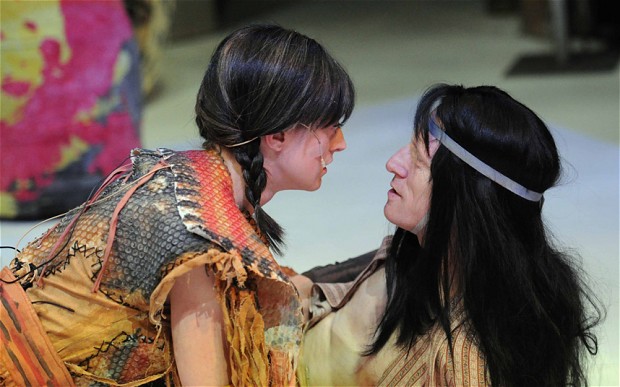
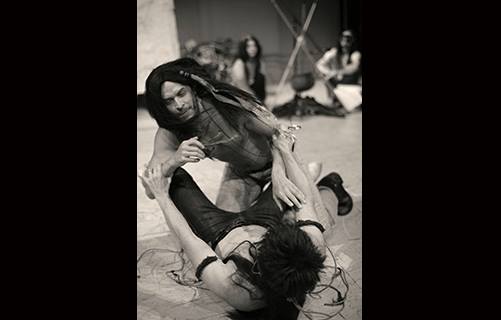
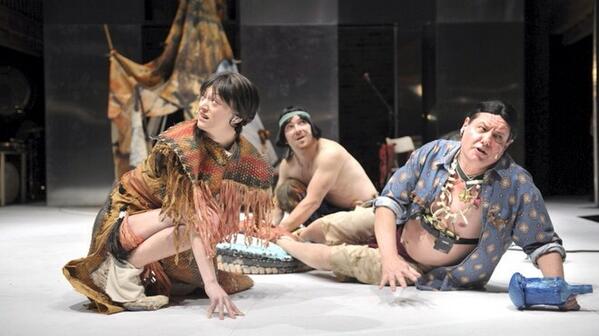
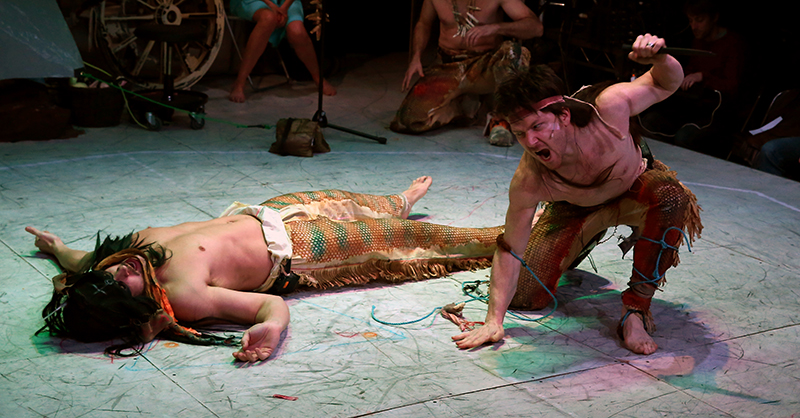
By Don Shirley"Stand-Off" is considerably more lucid than "Cry, Trojans!," which closed Sunday. "Trojans" began as a collaboration with the Royal Shakespeare Company for a 2012 production of the enormously challenging "Troilus and Cressida" in the UK. Shakespeare's play is set during the Trojan War. In that 2012 effort, the Americans played the Trojans as generic early American Indians, while the Brits played the invading Greeks (and, judging from photos, dressed in present-day military fatigues). Apparently the production attempted to comment on American imperialism through the centuries.

Returning to America after a disappointing reaction to the London production, the Wooster Group's director Elizabeth LeCompte decided to revive the material by assigning her actors to play all the parts on both sides, with the title "Cry, Trojans!," but also with the assistance of a tape of the British voices from the London production.

And so, at the play's official premiere at REDCAT, both the Trojans and the Greeks wore Indian clothes, while a tipi dominated the background. Almost any direct parallel to American imperialism faded - the conflict looked more like an inter-tribal Native war.

The Greeks were distinguished from the Trojans mostly by wearing little black masks atop their Indian outfits, which still exposed enough of the men's skin that the costumes (inadvertently? or ironically?) emphasized how white these actors are. They seemed to be white guys playing "Indians and Indians," as opposed to "cowboys and Indians."
And:In a talkback after the Friday performance, LeCompte cited a number of secondary sources she used in her research--books, movies, tapes, some of which were created by Native Americans. But there was scant evidence that she had talked to any Native Americans. According to Reinholz, "there are thousands of Native American theater artists, scholars, and community leaders easily available for art makers to call upon. We are not hiding in the margins."

During the talkback, LeCompte said a close friend--a playwright--had told her, "I wouldn't do a play like this without making sure I had a Native American in it." But, LeCompte added, "that is not where I live. I wouldn't do that. I couldn't do that." Then, though her language was vague, she appeared to indicate that she thought that adding Native Americans to the company would be seen as "who's at the party?" tokenism--"and that's horrible to me....Plus it's not about that. It's about everything bigger...We love the piece, we love the stories, we love the films, we love the people...We wanted to tell the story in this way and make it so big that this [lack of direct Native American input] wouldn't be a problem."

New York, we have a problem.
New Native American Play Feels Timely After Wooster Group Criticized for Using 'Redface'

By Jenny LowerWatching the world premiere of Stand-Off at HWY #37, Vickie Ramirez's world premiere play at Native Voices of the Autry, it's difficult not to reflect on another portrayal of Native Americans that was just presented across town--the Wooster Group's production of Cry, Trojans! at REDCAT. That Troilus and Cressida adaptation (which closed Sunday), has drawn criticism from members of the Native community and others for its "redface" portrayal of a fictionalized Native American tribe with a completely Anglo cast.

Native Voices' naturalistic production, directed by Jon Lawrence Rivera, couldn't be more different from the Wooster Group's stylized, experimental rendering. The latter was not trying to capture an authentic, specific Native experience, but used a pastiche of that culture as a set piece in depicting a soon-to-be-annihilated culture--and that may have been part of the problem. If the Wooster Group employed Native culture as a means to an artistic end, Stand-Off at HWY #37, though still in need of development, succeeds in portraying the complex, varied experiences of Native peoples as an end in itself.
And:At the performance reviewed, the actors held an audience talkback to discuss the Wooster Group production and why it matters to have Native actors portray Native roles onstage. As Studi observed, you wouldn't cast a production of Roots without black actors; whenever possible, the same standards should apply to portrayals of indigenous peoples. In that light, the very existence of this production and Native Voices--the only Equity theater company in the country devoted to telling Native American stories--feels like a victory.Why are so Many People Miffed about Wooster Group’s “Cry, Trojans!” at REDCAT?

By Colin MitchellWell it’s not because the show appears to be decidedly mediocre according to our LemonMeter Rating. Nope. It’s because a whole bunch of folks find this production’s use of “redface” to be incredibly racist. Check out the freakin’ rodeo of protest that’s occurring on the REDCAT Facebook page for the event.Then there's this difficult-to-understand defense of Cry, Trojans!:

The Cassandra Syndrome

By Guy ZimmermanBut what of the sensibilities of local indigenous American performers who angrily decry the racism allegedly at work in the Wooster’s appropriation of native American imagery? Here again, unspoken political dynamics swirl around the production; LeCompte’s decision to deploy a parody of American Indian motifs and tropes in her staging aims to critique the flawed representational logic of identity politics.Zimmerman claims Cry, Trojans! is a parody of Native motifs and tropes rather than a sincere but ignorant attempt to portray them. As I've said many times, if you can't tell a satire or parody from a straight attempt to tell a straight story, there is no difference.

In other words, the satire or parody exists only in the creator's mind. Or in this case, the reviewer's mind, since he's the only one claiming it's a parody.

Below:  LaVonne Rae Andrews as Aunt Bev, DeLanna Studi as Sandra Henhawk.

Reviews of Stand-Off at HWY #37

“Stand-Off at HWY #37” Examines Military Stand-Up then Stand Down in, as yet, Unexamined Places

By Jennifer K. HugusThat this stand-off takes place in such a lovely venue makes it all the more eerie and harrowing. The governments involved: The U.S. and Indian i.e. Native American involving the Iroquois, Cayuga and Mohawk. Set in upstate New York on the border of a small town and its local Haudenosaunee reservation, the dispute involves the expansion of Highway #37 and the, as yet, unsullied land surrounding it.And:Up until now, the crux of the tension has been centered around Doxdater’s mission vs. Indian preservation as Doxdater, and Baldwin alike, will argue that the freeway extension is an indication of “progress; that the U.S. government is simply tending to the surrounding land. After all, it’s “just sitting there, getting overgrown” and no one’s really using it. Aunt Bev will argue the same thing; but that the Native People are tending to the land just fine adding that the fact that it’s getting overgrown and remains unpopulated is “progress.” If ever there was an argument so timeless, yet historically exact, this is it in all its authenticity and I can’t help but feeling, as I watch it, that no time has passed at all since the white man’s initial arrival on Native soil as a bit of a chill shoots straight up my spine…Divided Loyalties, Mixed Motives Mingle in Indigenous Drama

By Ed RampellThere’s no doubt that the aboriginal bard is exploring and presenting a “ripped-from-the-headlines” type indigenous clash, as Natives must, once again, fight for their land to fend off what is referred to as “an occupying force.” But Ramirez also has something else up her tricky dramatist’s sleeve: Every one of her characters is beset by divided loyalties and mixed motives, which is the real leitmotif of her all-too-human drama.And:Aunt Bev’s exposition as the curtain lifts and before it drops violates rule #1 of dramatics: “Don’t tell me, show me!” But these, dear reader, are mere quibbles, and should not dissuade you from enjoying this thought provoking work, with its ensemble cast so ably directed by Jon Lawrence Rivera, a simple yet effective set (including, overhead, a Congressional resolution) by scenic designer Jeff McLaughlin, plus some projections designed by Adam Flemming. Los Angeles has North America’s largest urban Indian population—but to paraphrase those old wry rye bread ads, you don’t have to be Native to love this play, which is for any theatergoer who thrives on great drama, fab acting, quirky characters and a theatre of conscience and consciousness. Auds should not be stand-offish about seeing Ramirez’s sizzling Stand-Off at HWY #37.BWW Interviews: Playwright Vickie Ramirez Discusses STAND-OFF AT HWY #37

By Ellen DostalDo you hope that Stand-Off will change the way people see events like these?

V: I hope it makes them a little more aware of what's currently going on. These issues are ongoing. They're not anachronistic. Everybody seems to think that we're all good now and that everything's fine; since the boarding schools aren't happening anymore. We're good but the situation is not. It's awkward because, the truth is, I don't think anyone specifically is a black cowboy hat-wearing bad guy; it's just priorities are different and entitlements come from very different places, and there is invariably going to be a clash.

I read that you started a Native theatre company in the early 90s. Is that something you did to create more opportunities for Native Americans?

V: There was a group of us. It was Cochise Anderson, Irene Bedard, James Fall, Betsy Theobald, and a few others. We were tired of the anachronistic voice and the victimized Indian--the whole archetype of how people see us, because when they see us in that sort of persona, they don't actually see us as regular people. So we wanted to bring forward the contemporary Native voice to examine who we are now because we have been colonized; we have been changed dramatically. How do we cope? Who are we now? We do have major identity issues in the nations about where we fit in the world at large so we did work based on expressing those ideas.
Stand-Off at HWY #37 by Vickie Ramirez: Press Photos

Rob's review

I attended a performance of Stand-Off at HWY #37 this afternoon. Later, I briefly discussed writing plays with Facebook friend Brad:

Alas, I didn't think the play was that good. The majority of it was people saying or shouting talking points at each other.

If you embedded that much conflict in, say, a novel, it might work. But as a 75-minute drama of nonstop harangues, no.Yeah theater isn't my thing either. It all pretty much feels like 75 minutes of people shouting at each other to me.I'm surprised that so many plays come out that way. You have the same amount of time as a TV show of 1-2 hours. But TV writers understand that you should build up to a few emotional moments--usually at the commercial breaks and at the end. Playwrights think nonstop conflict is the way to go. Wrong.I'm not even sure it's the writing. I'm just annoyed by the ridiculous overacting.

It's like stage actors don't know how to have a normal conversation or do dialog without waving their arms around and shouting everything.
I'd blame this one on the writer and director. It's not like the actors were hamming up a few dialogue lines of conflict. They had no choice because most of the lines involved conflict. You'd have to double the play's length, at least, to add some natural "breathing space" between the lines.I can see where direction could be a problem too. Of course if it WAS written that way then nothing was going to save it.On the positive side, Stand-Off at HWY #37 presented a variety of modern-day Indians free of mistakes and stereotypes. It addressed a wealth of issues that never reach the mainstream media--that most Americans don't know about.

It would take a few rewrites before I could recommend it. But the raw material of a good play is there.

Below:  Eagle Young as Private Thomas Lee Doxdater and Kalani Queypo as Darrin.

March 01, 2014

Cry, Trojans! in redface

A play here in Los Angeles stirred up a protest soon after it premiered:The Wooster Group: CRY, TROJANS! (Troilus & Cressida)
February 27 to March 9

The Wooster Group’s newest production, Cry, Trojans!, tackles the Trojan side of Shakespeare’s dark and scabrous Trojan War play about sincere love corrupted and the downfall of a noble hero. The piece originated as a co-production between The Wooster Group and the Royal Shakespeare Company for the World Shakespeare Festival, presented in conjunction with the 2012 London Olympics. In that version, the RSC played the Greeks and the Group played the Trojans. Director Elizabeth LeCompte and the Wooster Group have converted the collaboration into an independent piece, reimagining the Trojans as a pastiche fictional tribe of early Americans struggling to assert its dignity in the face of doom.

For more information and tickets:
http://www.redcat.org/event/wooster-group-4

Funded in part by a generous grant from the National Endowment for the Arts.


The Facebook event generated a lot of comments from Natives and others:The commodification that your show makes from ‪#‎redface‬ is immoral and an ethical violation towards ALL indigenous peoples who occupied this land from time immemorial. Cancel the show!

Do you actually have a show using redface makeup in 2014 or did I just have a bad dream? Please respond to community criticism. Can you not cast Native or minority actors? Who thought this was a good idea? Trying to be "edgy"? Can we contact the NEA about this?

Your description states -->"....fictional tribe of early Americans struggling to assert its dignity in the face of doom"<-- Guess what folks, there are REAL native tribes in this country RIGHT_NOW struggling to assert our dignity in the face of as*hats that seem to think it is okay to parade around in REDFACE and continue the harm of stereotyping of native Americans for others entertainment. Shame on you people, shame.... I deeply admire TWG's work. But no longer. I walked out of tonight's show because I felt like I was attending the avant-garde theater's equivalent of a red face frat theme party. While I've studied and written about the long traditions of racism in the experimental as well as mainstream arts, I was ill-prepared for this barefaced reversion to red face as an attempt to revise Shakespeare's revision of Greek tragedy. Yes, I "got" the attempts at postmodern, postracial irony and farce, e.g. the repetition of the line "John Wayne's teeth" from Chris Eyre's movie Smoke Signals, the use of what looked like anthropological footage of Natives, etc. But in the end TWG's message is that white people think they can do anything. Especially to Native peoples. This kind of racism should be unthinkable. What does it take to see Native peoples as human beings? Cancel the show. Please cancel this show. This is a mockery of the lives and struggles of actual Native people and it is frankly disgusting.
So I would like an explanation to how you believe this display of red face would ever be acceptable? If you are really all that ignorant that is pitiful. I hope you didn't do this to bait for attention. If negative press is what you intended then prepare to get plenty of it. It's in everyone's best interest to cancel this atrocity.

Really? Redface? That's not "edgy" and "innovative," it's tired old tripe. Oh, and racist; let's not forget about that.

Stop this, and donate any money you may have already made to Native peoples who continue to experience the crushing effects of the genocide this play reproduces along with ongoing commodification of their cultures for the benefit of other people.

The National Endowment for the Arts sponsorship only spreads the blame for this vile racism. Cancel this show immediately. It is not ok for settlers to mock indigenous targets of settler colonial genocide. Why use a "pastiche fictional tribe" of natives (<-- what you mean when you use the colonizer's term "Americans")? Natives today, throughout Turtle Island, are engaged in struggles to assert dignity in the face of settler genocide. Amongst these populations are playwrights. If the topic interests you then you should have supported indigenous artists rather than dressing settlers up in redface. It's appalling. Now you only create another horror for Natives "to assert their dignity in the face of."


One commenter tried to reason with the Wooster Group:I know it can be hard to admit that you've made a mistake in public, especially when that mistake involves perpetuating racist stereotypes about indigenous peoples. And I also realize that it's going to be uncomfortable for you to cancel the event that you've put so much time and energy into.

But you need to not just think about your own discomfort, and start thinking about the discomfort that your racist redface act is going to cause for Native peoples. You need to think about the violent oppression that they experience on a daily basis as a result of these types of racist stereotypes leading people to see them as less than human. Yours is the discomfort of admitting a mistake and cancelling a show. Theirs is the discomfort of genocide and racist abuse.

Please listen to the voices of all of the Native folks that have posted here, and have enough respect for them to cancel the show. Make an apology, take this as a hard lesson and a chance for self-reflection and educating yourself about racism and Native struggles, and learn how you can act in solidarity to stop the genocide of Native peoples in the future.
I'm not sure anyone protesting the show has actually seen it. Most went by the description (above) and the photos:


A few caveats:

Since the play is an adaptation of Shakespeare, I doubt there was much room for a Native writer to come in and rewrite it.

Since the play is funded "in part by a generous grant from the National Endowment for the Arts," I doubt the Wooster Group would cancel the play and give back the grant. It's much more likely to ride out the controversy.

Since the play is showing only for 11 days, there's no point to a boycott. The run will be over before anyone can organize anything.

I gather the Wooster Group originated this show with the Royal Shakespeare Company in London. The Wooster Group did the Trojan half of Trolius and Cressida. It then brought this subset of the play to New York and Los Angeles on its own.

I also gather that people have contacted the Wooster Group and complained about the show at each stage--to no avail. The Wooster Group is ignoring the controversy, or perhaps stoking it to increase ticket sales.

The short run works against activists who would protest the play. But I wouldn't waste too much time trying to reason with the Wooster Group. If the play appears again, I'd set up protests outside the theater, start a social media campaign, and contact the group's nonprofit and corporate sponsors.

Critics are right

Other than the futility of some of the responses, the critics are right on. To reiterate the arguments:

  • A "pastiche fictional tribe" means a clichéd Plains tribe of teepees and half-naked warriors. This serves to homogenize the Americas' hundreds of cultures into one, to erase their wide-ranging diversity. That's stereotypical.

  • Using a "tribe of early Americans struggling to assert its dignity in the face of doom" places Native people in the past and assumes they were fated to die and disappear. That's stereotypical.

    Needless to say, most tribes survived and are thriving today. This play reinforces a commonly held but false impression of Native history.

  • Using white actors dressed in redface implies that being Indian is all about how you look and dress. Like any Halloween costumes, it makes a mockery of real tribal customs and practices. That's stereotypical.

    These "Indians" look so phony that they're laughable. Anyone who knows Native cultures would think this was a burlesque show out of the vaudeville era, not a serious play.

  • Below:  Looks like "Indians" fighting and dying tragicially.