Showing posts with label Manifest Destiny. Show all posts

May 25, 2015

Colonizing Mars = colonizing America

Colonize Mars? Not until we learn some lessons here on Earth

By Dr. Danielle N. Lee[I]s it right to think about the galaxy as a playground that is ours for the taking? History is full of examples of how of individuals and governments exploit others in order to gain access to limited resources like land, gold, water, and oil. The scientific community is not exempt from such impulses: Contemporary examples abound of scientists exploiting and harming others when broad and diverse groups of people are not allowed to advocate for their interests.

Add to this the fact that the dominant scientific narrative in the United States space program parallels the American cultural narrative, what Dr. Linda Billings, NASA Space Communicator and space policy analyst at George Washington University calls “frontier pioneering, continual progress, manifest destiny, free enterprise, rugged individualism, and a right to life without limits.” Within astrophysics circles, the idea that it is our right and imperative to conquer other planets is commonly presented as natural, in keeping with other aspects of human history: Just as Europeans immigrated to North America, so must the human race colonize Mars. Red Colony, a website for Mars exploration enthusiasts, opens its introduction with a parable on the benefits of creating settlements, focusing on “how the country that came out of [Western Expansion] advances the world perhaps centuries beyond its time in scientific, economic, diplomatic, and religious progress.”

The problem with the ideas being pushed by Musk and Hawking is that the conversation is focused only on the possible promises of a Mars colonization, not the potential perils. (Dr. Billings has criticized the idea of Mars as “the New World” extensively and written numerous reports and papers that examine the financial, legal and ethical impact of American cultural narratives on space programs and policy.) In short, the way Mars is discussed gives individuals like Musk–people with a strong commercial interests in space travel–both a platform for shaping public rhetoric concerning planetary exploration projects, and the ability to influence policies that would allow them to profit greatly from intergalactic expeditions.

It’s not just the rich and the famous, either. People like Robert Zubrin, co-founder of and Executive Director of The Mars Society, which aims to “further the exploration and settlement of the Red Planet,” praise the founding of America as if it is an uncomplicated narrative. Zubrin’s core argument, that “Mars is to the new age of exploration as North America was to the last,” doesn’t acknowledge is how these “New World” trade activities were based on the displacement and genocide of Indigenous people in the Americas and the forced immigration and labor of Africans. This new human civilization that held so much promise to those in Europe was also oppressive and exploitative to other groups, a development that led to what is the most powerfully disparate economic system in the world today.
Comment:  Martians don't have to exist for Lee's thesis to work. Her point is that "exploration" tends to favor the rich over the poor.

In other words, it's the opposite of the "neutral" scientific enterprise we think of. It's inherently biased by politics and economics.

Are people like Elon Musk planning to form nonprofits and donate everything they find to humanity as a whole? If not, Lee suggests, beware.

For more on colonization, see Rubio Ignorant of US History and Whites Destroy Other People's Homes.


March 30, 2015

Pioneer Girl impugns Little House

The true story of Laura Ingalls Wilder and her "little house on the prairie":

Pioneer Girl by Laura Ingalls Wilder review–gritty memoir dispels Little House myths

Full of theft, alcoholism and violence, the novelist’s unvarnished account of her childhood is a darker, more vicious affair

By Sarah Churchwell
For most of Laura’s childhood, she lived in close proximity to drunks, rapists, horse thieves, adulterers and more than one murderer, including perhaps a brush with a notorious family of serial killers.

Nor was the Ingalls family’s progress a simple westward expansion, as the novels more or less report it: Wilder deliberately simplified their back-and-forth journeys across the midwest in order to create the impression of westward progress, an image in keeping with her theme of nation-building. In fact, the Ingallses retreated east more than once, while the self-styled “pioneers” were land-grabbing as fast as they could: manifest destiny was a giant get-rich-quick scheme. The family emerges as far more opportunistic, even on occasion unscrupulous, than the whitewashed novels would have us believe. Charles Ingalls knew that he was in Indian Territory illegally, while his wife’s brother Tom went to the Badlands on an ill-fated and illegal search for gold. The family snuck away from debts on at least one occasion, making their escape in the middle of the night. The fundamental drama in the novels comes not from conflicts within the family, but with the external forces of government, Indians and nature. Of the three, the last is the one we are most apt to sympathise with today; the attitude of the settlers to the Indians makes for uncomfortable reading (“Treaties or no treaties, the land belongs to folks that’ll farm it. That’s only common sense and justice,” one neighbour declares). It is an attitude that the Ingallses and their relatives clearly shared; many of their actions were in flagrant violation of treaties.

The most extensive difference between the two accounts is Wilder’s decision to excise an entire interlude in Iowa from the novels. The family’s retreat to the east undermined her triumphalist tale of westward progress, but their time in Iowa also featured some of the family’s grimmest experiences. They lived in a hotel adjacent to a saloon, which is hard to imagine the fictional Ma Ingalls permitting; the decision was a mark of their “financial desperation,” as the editor of Pioneer Girl notes. There were bullet holes in a wall, made by a drunken man shooting at his wife; another dragged his wife around by her long hair, carrying a lamp that was pouring kerosene; Charles Ingalls intervened to keep them all from being burned to death.
Comment:  For more on Little House on the Prairie, see Little House = Libertarian Fable and Little House Celebrates Land Theft.

March 08, 2015

Obama's speech at Selma

Read the full transcript of Obama's rousing, emotional speech in Selma

Obama’s speech in Selma was an answer to those who question his love for America

By Ezra KleinObama's critics question his love for the country he governs. "I do not believe—and I know this is a horrible thing to say—but I do not believe that the president loves America," former New York Mayor Rudy Giuliani said in February. They look at Obama's steady belief that America is not yet good enough, not yet pure enough, not yet perfect enough, and they see a skeptic, not a patriot.

In this speech, Obama's answer to this criticism was direct:Fellow marchers, so much has changed in fifty years. We've endured war, and fashioned peace. We've seen technological wonders that touch every aspect of our lives, and take for granted convenience our parents might scarcely imagine. But what has not changed is the imperative of citizenship, that willingness of a 26 year-old deacon, or a Unitarian minister, or a young mother of five, to decide they loved this country so much that they'd risk everything to realize its promise.

That's what it means to love America. That's what it means to believe in America. That's what it means when we say America is exceptional.
There is an implicit radicalism in what Obama is saying here. To believe America is good enough is to abandon the tradition of criticism and activism that has made America great.

Obama's answer to Giuliani is that Giuliani has mistaken uncritical adoration for the hard work required of true love. Patriotism is active, not passive. Those who love America prove it by working to perfect America. They continue marching.
People tweeted their thoughts on the historic event:Retweeted Bill Maher (@billmaher):
Watching the commemoration in Selma on the news -- so much has changed in 50 years! Like, the cops didn't have tanks back then.

Retweeted Jamil Smith (@JamilSmith):
"What could be more American than what happened in this place?" President Obama asks. True of both the courage and the violence.

Retweeted Elizabeth Warren (@SenWarren):
It's up to us to make sure our government serves ALL of our people. We must restore the ‪#‎VotingRightsAct‬. ‪#‎Selma50‬ http://t.co/NZpYsrBsMa
While Democrats were celebrating the march of liberty and justice, Republicans were, uh, doing something else:

The GOP’s Conspicuous Absence from Selma

By Charles C. W. CookeIf we are to regard the founding generation as being worthy of contemporary political lionization—and we most assuredly should—then we must consider those who marched at Selma to be so, too. If we are to put George Washington upon our plinths, and to eulogize him on our currency, we must agree to elevate Martin Luther King Jr. to the same dizzy heights. They are less famous, perhaps, but by virtue of their brave march across the Edmund Pettus Bridge, John Lewis and Hosea Williams immortalized themselves into quintessential American heroes in the mold of Sam Adams and George Mason. To miss an opportunity to solemnize their daring is to blunder, disgracefully.

If all men really are created equal, the anniversary of Selma must be treated as a date every bit as important to American history as is the end of the Siege of Yorktown. As it would be unthinkable for the leadership of the Republican party to ignore July Fourth, it should be unthinkable for its luminaries not to celebrate the anniversary of the March to Montgomery either. Where have you gone, Speaker Boehner, a movement turns its lonely eyes to you.
The Native aspects

My thoughts on Obama's oration:

Good speech, though I might've cut it half.

We should elect this guy president. He has strong opinions on the things we need to change!

But why is he quoting from Scripture if he's a Muslim?!

Obama mentioned Natives twice:We are Lewis and Clark and Sacajawea—pioneers who braved the unfamiliar, followed by a stampede of farmers and miners, entrepreneurs and hucksters. That's our spirit.

We're the fresh-faced GIs who fought to liberate a continent, and we're the Tuskeegee Airmen, Navajo code-talkers, and Japanese-Americans who fought for this country even as their own liberty had been denied.
Okay, but the failure to say more was a missed opportunity considering the enormity of our crimes against Natives.

Canceling out these two mentions were these lines, which came just before the code-talker paragraph:We're the slaves who built the White House and the economy of the South. We're the ranch hands and cowboys who opened the West, and countless laborers who laid rail, and raised skyscrapers, and organized for workers' rights.That sounds something like, "We're the brave entrepreneurs who crossed the Atlantic to find workers for the South's burgeoning cotton industry."

The phrase "opened the West" covers up a lot and obscures the truth. The only way the West was "closed" was "closed off to the white man's colonization by signed treaties." So we're celebrating how ranchers, miners, and railroads opened the West to disease, poverty, and land theft? Great.

Or as I tweeted:

Obama at ‪#‎Selma50‬: "We're the ranch hands and cowboys who opened the West"...by breaking treaties and killing Indians, he forgot to say.

For more on the subject, see What the Crusades Controversy Is About and Ryan: Obama Threatens Western Valuess .

July 10, 2013

Ranger too racist to reboot

Spoiler alert as critics rip the whole "Lone Ranger" concept as arguably racist and unworkable:

Johnny Depp’s Tonto: Not as Racist as You Might Think. But Still Kind of Racist

By Aisha HarrisOn more than one occasion, Reid refuses to kill Cavendish when he has the chance, wishing instead that he will face the “full extent of the law.” Tonto, on the other hand, fully understands the way things work in the wild west—and he becomes frustrated each time John assumes this noble posture. The script takes a risk in addressing the line between savagery (historically attributed to Native Americans) and civilized morals (commonly attributed to whites). The Lone Ranger believes that “an eye for an eye” is a primitive approach to justice—even as he continuously fails to vanquish his enemies in any other way. “This is not justice,” he chides Tonto, when refusing to shoot Cavendish for the second time. “I am not a savage.” When Tonto responds by deeming him a “white coward,” the modern-day audience is meant to side with him rather than the Lone Ranger.

But the filmmakers ultimately can’t resist making the white man the hero of this story. Even though Tonto is the driving force for the majority of the movie, the Lone Ranger gets the pomp and circumstance from both the innocent citizens of Colby, Texas, and the film’s creators, in the end. This is to be expected: It is, after all, called The Lone Ranger. But when the Lone Ranger finally fulfills the role he was “destined” to play, it comes seemingly out of nowhere, nearly two hours into the 149-minute film, and feels completely unearned. Tonto, for all of the filmmakers’ evident intentions, becomes by the finale a less egregious rendition of Bagger Vance and countless other “mythical” minority characters, devoted to building up the courage and strength of the heroic white leads.

On a scale of 1 to The Searchers, The Lone Ranger rates at about a 4 in terms of its depiction of American Indians. Is it blatantly racist and shameful? No. But the filmmakers don’t succeed in their effort to have it both ways. Depp’s attempt to be a “warrior” role model to all the American Indian kids lucky enough to watch him save the day fails—and for the simple reason that the original material is too entrenched in an essentially racist ideology. While the attempt to humanize Tonto—to turn him into a complicated, fully realized, respectable character—seems noble, and maybe even a step above what we normally expect from Hollywood, the movie doesn’t make a strong enough case for bringing him back from the past in the first place. The spirits of certain cultural figures are probably better left alone.
With or Without Johnny Depp as Tonto, ‘The Lone Ranger’ Was Too Racist to Reboot

By Jason BaileyTonto, as played by Depp, is a collection of mannerisms and affectations, but not a character. He maintains the most culturally damaging element of the role, his definite article-free dialogue, with lines like, “Do not touch rock. Rock cursed.” But to offset that, he’s made the brains of the duo, the brilliant tracker and wise man, in order to do all that saluting and wrong-righting that Depp envisioned. But this is also a Disney summer tentpole flick, aimed to entertain, so laughs must be garnered by also making Tonto a standard-issue Depp buffoon in the Captain Jack mold—or, more accurately, in the style of Depp fave Buster Keaton, whose comic Western The General is all but remade in the film’s climax.

So, which is he? A broad stereotype, a noble shaman, or a comic charlatan? Depp doesn’t know; he’s a gifted performer but an undisciplined one, and Verbinski isn’t much for laser focus either, as the 149-minute running time makes clear. This is an actor who Disney is paying, as he has said, “stupid money,” so when he sees a white artist’s painting of an imaginary Native American and decides that’s how Tonto’s gonna look, well then, that’s how Tonto looks.

But the problem with The Lone Ranger—aside from it being lumbering, overlong, unfunny, and frequently dull—is that its script is no less confused about how to represent Native Americans than Depp is. They’ll dramatize a violent, terrifying Comanche raid, and exploit all of that loaded imagery, as long as it turns out that the “Indians” were actually masquerading white thugs. They’ll create a Tonto who “trades” feathers for the rings off a dead man’s fingers, as long as he’s given a sentimental backstory. And then they’ll send out their marquee leading man to explain how he’s pretending to be a Native American to “give some hope to kids on the reservations. They’re living without running water and seeing problems with drugs and booze. But I wanted to be able to show these kids, ‘Fuck that! You’re still warriors, man.’”

But the question remains: why bother? The fact is, sometimes time passes, and cultural norms change, and certain characters or tropes or texts just become too antiquated. The Lone Ranger left this viewer with a feeling weirdly similar to the aftertaste of Michael Radford’s 2004 Merchant of Venice (the Pacino one): like maybe we just don’t need to tell this story anymore, since it—though a classic, and an important piece of literature, etc. etc.—is deeply, unavoidably, problematically anti-Semitic. And the makers of The Lone Ranger find themselves in a similar conundrum, left twisting their narrative into pretzels in order to balance out the inexorably stereotypical nature of what is now its primary character. You can’t help but wonder why Depp and Verbinski didn’t just say to hell with this mythology, and start fresh with the Butch-and-Sundance-runaway-train-Western they so clearly wanted to do instead.


The Real Problem With a Lone Ranger Movie? It's the Racism, StupidIn a long interview posted to the Moviefone Canada site, Jesse Wente of the Toronto International Film Festival grants that those involved with the film may very well have intended to empower Tonto, but ended up with a character that is less progressive than the Native sidekicks played by Chief Dan George in The Outlaw Josey Wales (1976) and Gary Farmer in Dead Man (1995). And ultimately, Wente said, there is just a problem with the traditional Western. "Because of the nature of the Western, its ties to the idea of nationhood, particularly in the U.S.," he said. "These stories were, with Manifest Destiny, fundamental nation building [myths] for the U.S. If you think about the classic era of the Western, from the early '30s to the '50s, it came when the States was still a very young country and still needed to tell itself the story of its own origins, and this was the story it told. Unfortunately, it was told at the expense of the first inhabitants of this land because it altered the history, the truth of what happened. To me this film recalls a lot of those issues."

An article at Time.com suggested that "the issue isn’t so much the casting as it is the character." Adrienne Keene of Native Appropriations pointed out that Tonto is, unfortunately, one of just a few Native people--real or fictional--that non-Indians know of. The risk is that his quirks or character traits may be applied to an entire race: "Without an accurate pop-culture idea of a real-life Native American in moviegoers’ heads, Tonto is less of an individual character than he is a key piece of the popular image of a large and diverse population. The stereotype is particularly detrimental for its fantastical elements, [Keene] believes: when a real group of people seems as mystical as say, werewolves, in every pop-culture depiction of the group, it gets hard to pay any attention to the real people who are alive today and have real issues and achievements of their own."

In a piece for Slate entitled "Johnny Depp’s Tonto: Not as Racist as You Might Think. But Still Kind of Racist," Aisha Harris was more forgiving than others, but still couldn't get past the limitations of the source material. "Depp’s attempt to be a 'warrior' role model to all the American Indian kids lucky enough to watch him save the day fails—and for the simple reason that the original material is too entrenched in an essentially racist ideology."

It appears that, despite the filmmakers' intentions, The Lone Ranger did not reinvent Tonto or the Tonto-Ranger dynamic--and perhaps it's because America has simply moved on. Is there any reinventing of Uncle Remus from Song of the South, or Chop Chop from the old Blackhawk comic books? Arguably not. While a Native actor such as Adam Beach (often mentioned as a better fit for Tonto) might have been a more pleasing casting choice, in this case Depp's insistence on playing Tonto actually saved a Native actor the awkwardness of trying to sell viewers a story they were never going to buy.
Tonto WTF?!

By Annalee NewitzNow that we've all had time to digest the appalling mess that was The Lone Ranger, we need to talk about Tonto. Johnny Depp managed to create a character who is a horrifying mashup of Jar Jar and Jack Sparrow. What the hell happened there? Spoilers ahead.

It's hard to deny the similarities between Tonto and Jar Jar—both are clownish sidekicks to the true heroes of their stories, barely able to string four words together. But once in a while, they blunder their way into saving the day. Critics pointed to Jar Jar's accent and behavior as mirroring stereotypes of Caribbean people; still, it was possible for George Lucas to argue that sometimes a Gungan is just a Gungan. Obviously, nobody can make that argument with Tonto. Jar Jar is a racial stereotype by inference, while Tonto is pure, uncut racial stereotype.

Just in case you didn't get the stereotype message, though, the movie opens with an aged Tonto at 1930s sideshow, standing in a diorama labeled, "The Noble Savage in his Native Habitat." OK, thanks movie. This bit, and Tonto's frequent "stupid white man" comments, are supposed to make us think the movie is somehow in on a joke about racism with us. We can all just wink and nudge each other over how ridiculous those "noble savage" stereotypes are, right? Because nothing really proves that white people "get it" more than updating a racist Indian character invented in the 1930s with a white actor in facepaint and feathers, and having him speak in broken English to a dead crow.
And:This movie is neither a media meta-commentary, nor a tale of how people cope with tragedy through laughter. It's just a really awkward attempt to preserve the campy tone of the 1950s Lone Ranger TV series, while also inserting all the things that white liberals learned from watching Dances with Wolves.

So to return to my earlier question: How the hell did this happen? It's 2013 and we're still making movies where white guys play dumb Indians in a mythical version of the American west? I suppose picking Depp for Tonto is one way that this movie benefits from modern political transparency. It's more honest to have a white guy playing Tonto since the character is such a white fantasy of Indians anyway.

Ultimately the lesson I would take away from The Lone Ranger is that some stories just can't be rebooted. I'm reminded of King Kong, another famously racist story from the 1930s, full of ooga-booga natives and big black monkeys who are obsessed with teeny white ladies. Peter Jackson's reboot of King Kong was filled with the same kind of race fail as The Lone Ranger. There is just no way to contort those old-school racist adventures into fun, contemporary action movies. Their narrative foundations are built on stereotypes and social assumptions that don't work in the present day. Maybe they can be revived as dark satire, like Dead Man or Django Unchained—but even then, the risk of fail is pretty high.

There are already many reasons why the reboot frenzy in pop culture is impoverishing our abilities to tell fresh, challenging stories. But when a movie like The Lone Ranger gets remade like this, with its Tonto stereotype intact, we don't just starve ourselves creatively. We starve ourselves politically too.
Comment:  The 2003 WB Lone Ranger movie and the Dynamite Lone Ranger comic-book series weren't bad. So I wouldn't rule out the possibility of successfully rebooting the franchise.

But the formula will always be "white guy saves the day and preserves the status quo." He'll always be fighting "bad guys" while the US Army is hunting and killing Indians around him. That's a problem.

You might have to destroy the concept in order to save it. For instance, as I said before, make Tonto the Lone Ranger and the white guy his sidekick. Or make the Ranger a freedom fighter against the government, the Army, and the railroads destroying the Indians' way of life.

But then it wouldn't be the Lone Ranger everybody--well, a few people--loves. That's a problem too.

For more on Johnny Depp and Tonto, see Tonto = Captain Jack Sparrow and Depp Justifies Tonto's Stereotypes.

April 21, 2013

Overreactions to Boston bombing

Why does America lose its head over 'terror' but ignore its daily gun deaths?

The marathon bombs triggered a reaction that is at odds with last week's inertia over arms control

By Michael Cohen
Londoners, who endured IRA terror for years, might be forgiven for thinking that America over-reacted just a tad to the goings-on in Boston. They're right–and then some. What we saw was a collective freak-out like few that we've seen previously in the United States. It was yet another depressing reminder that more than 11 years after 9/11 Americans still allow themselves to be easily and willingly cowed by the "threat" of terrorism.

After all, it's not as if this is the first time that homicidal killers have been on the loose in a major American city. In 2002, Washington DC was terrorised by two roving snipers, who randomly shot and killed 10 people. In February, a disgruntled police officer, Christopher Dorner, murdered four people over several days in Los Angeles. In neither case was LA or DC put on lockdown mode, perhaps because neither of these sprees was branded with that magically evocative and seemingly terrifying word for Americans, terrorism.

To be sure, public officials in Boston appeared to be acting out of an abundance of caution. And it's appropriate for Boston residents to be asked to take precautions or keep their eyes open. But by letting one fugitive terrorist shut down a major American city, Boston not only bowed to outsize and irrational fears, but sent a dangerous message to every would-be terrorist–if you want to wreak havoc in the United States, intimidate its population and disrupt public order, here's your instruction booklet.

Putting aside the economic and psychological cost, the lockdown also prevented an early capture of the alleged bomber, who was discovered after Bostonians were given the all clear and a Watertown man wandered into his backyard for a cigarette and found a bleeding terrorist on his boat.

In some regards, there is a positive spin on this–it's a reflection of how little Americans have to worry about terrorism. A population such as London during the IRA bombings or Israel during the second intifada or Baghdad, pretty much every day, becomes inured to random political violence. Americans who have such little experience of terrorism, relatively speaking, are more primed to overreact–and assume the absolute worst when it comes to the threat of a terror attack. It is as if somehow in the American imagination, every terrorist is a not just a mortal threat, but is a deadly combination of Jason Bourne and James Bond.

If only Americans reacted the same way to the actual threats that exist in their country. There's something quite fitting and ironic about the fact that the Boston freak-out happened in the same week the Senate blocked consideration of a gun control bill that would have strengthened background checks for potential buyers. Even though this reform is supported by more than 90% of Americans, and even though 56 out of 100 senators voted in favour of it, the Republican minority prevented even a vote from being held on the bill because it would have allegedly violated the second amendment rights of "law-abiding Americans."

So for those of you keeping score at home–locking down an American city: a proper reaction to the threat from one terrorist. A background check to prevent criminals or those with mental illness from purchasing guns: a dastardly attack on civil liberties. All of this would be almost darkly comic if not for the fact that more Americans will die needlessly as a result. Already, more than 30,000 Americans die in gun violence every year (compared to the 17 who died last year in terrorist attacks).


How Boston exposes America’s dark post-9/11 bargain

Why did this story drive the whole country nuts? Because we traded rights for "security," and didn't get either

By Andrew O'Hehir
I think the real reason why this gruesome but small-scale attack sent the whole country into such an incoherent panic lies a little deeper than that. As a New Yorker who lived through 9/11, by the way, I’m aware that the trauma felt by people in and around Boston, whether or not they were directly affected, is real and likely to last quite a while. What I’m talking about is the media spectacle of fear and unreason delivered via TV, news sites and social media, the nationwide hysteria that made a vicious act apparently perpetrated by two losers with backpack bombs seem like an “existential threat” (to borrow a little bogus “Homeland”-speak) to the most powerful nation in the world.

Because it was, in a way. In America after 9/11, we made a deal with the devil, or with Dick Cheney, which is much the same thing. We agreed to give up most of our enumerated rights and civil liberties (except for the sacrosanct Second Amendment, of course) in exchange for a lot of hyper-patriotic tough talk, the promise of “security” and the freedom to go on sitting on our asses and consuming whatever the hell we wanted to. Don’t look the other way and tell me that you signed a petition or voted for John Kerry or whatever. The fact is that whatever dignified private opinions you and I may hold, we did not do enough to stop it, and our constitutional rights are now deemed to be partial or provisional rather than absolute, do not necessarily apply to everyone, and can be revoked by the government at any time.

The supposed tradeoff for that sacrifice was that we would be protected, at least for a while, from the political violence and terrorism and low-level warfare that is nearly an everyday occurrence in many parts of the world. According to the Afghan government, for example, a NATO air attack on April 6 killed 17 civilians in Kunar province, 12 of them children. We’ve heard almost nothing about that on this side of the world, partly because the United States military has not yet admitted that it even happened. But it’s not entirely fair to suggest that Americans think one kid killed by a bomb in Boston is worth more than 12 kids killed in Afghanistan. It’s more that we live in a profoundly asymmetrical world, and the dead child in Boston is surprising in a way any number of dead children in Afghanistan, horrifyingly enough, are not. He lived in a protected zone, after all, a place that was supposed to be sealed off from history, isolated from the blood and turmoil of the world. But of course that was a lie.

We are supposed to be protected, and then something like Boston comes along, a small-minded and bloody attack that appears to have been conducted by a couple of guys flying under the radar of law enforcement or national intelligence, pursuing some obscure agenda we will probably never understand. (We have recently learned that Tamerlan Tsarnaev and his family were interviewed by the FBI in 2011, apparently at the request of Russian intelligence, and agents found “no derogatory information.” Is that the right’s new Benghazi I smell?) Not only does it conjure up all the leftover post-traumatic jitters from 9/11–which for many of us will be there for the rest of our lives–it also makes clear that our Faustian bargain was completely bogus, and the devil never intended to hold up his end of the deal. We surrendered our rights to a government of war criminals, who promised us certainty and security in a world that offers none. We should have known better, and in fact we did. At the literal birth moment of American democracy, Benjamin Franklin summed it up in a single sentence: “Those who would give up essential liberty to obtain a little temporary safety, deserve neither liberty nor safety.”
Comment:  I don't agree with O'Hehir that "it’s not entirely fair to suggest that Americans think one kid killed by a bomb in Boston is worth more than 12 kids killed in Afghanistan." I'd say that's totally fair.

The idea that we're supposed to be safe is a corollary of the idea that we're God's chosen people--destined to bring enlightenment and civilization to the world. Which is another way of saying we (white Euro-Christians) are superior to the world's brown-skinned heathen masses.

Which takes back to one dead American is worth a thousand dead Muslims. As the image below explains.

Americans are making this calculation whether they realize it or not. If asked, many people would state it openly, with claims like, "They're not the same as us. They don't value life as much."

For more on Manifest Destiny, see "Chosen People" = Conquerors and Killers and Obama vs. Romney on Manifest Destiny.

November 05, 2012

"Chosen people" = conquerors and killers

‘Because the Bible tells me so’: Manifest Destiny and American Indians

By Steven Paul McSloyIn 1492, therefore, when the Christian kings of Europe, in Justice Marshall’s words, “conducted some of [their] adventurous sons into this western world,” they believed, as a religious matter, that whatever they found belonged to them as the “chosen people.” The entire Western Hemisphere was terra nullius–“vacant land.” If beings were found there who seemed human, but were not Christian, then they were, in the words of one colonial writer, “little superior, in point of Civilization, to the Beasts of the Field,” a formulation neatly tied to the mandate in the Book of Genesis that the sons of Adam shall have dominion over “every beast of the field.” (Genesis 2:19)

Being practical men, as they could not realize upon their “extravagant and absurd” claims, as Justice Marshall called them, for fear of military defeat by the Indians, and, in their own way, perhaps even concerned for Native people, the Europeans recognized that Native people had some rights to occupy and use their land. But it was nonetheless clear to the Europeans that Native people did not own their land and thus that the Indians had no power to sell it or otherwise to convey title. The land was owned, and title was held, by the Christian king whose explorers “discovered” it.

The English Crown’s charters to Cabot, Gilbert and Raleigh were nearly identical to the Pope’s Bulls in commissioning expeditions to “heathen and barbarious lands.” Pilgrim and Puritan sermons were replete with references to God’s covenant with them, and their divine mission, their “errand into the wilderness,” their “manifest destiny.” Such a belief is all the more remarkable given the Pilgrims’ famous dependence upon Indian peoples for food and the means to farm, celebrated today as Thanksgiving. This was rationalized by the Pilgrims through the belief that Indian hospitality was due not to the Indians but to the workings of the Pilgrims’ God. As historian Wilcomb Washburn noted, “[w]e read frequently such statements as ‘God caused the Indians to help us with fish at very cheap rates.’” The Puritans called America “Canaan,” meaning the land of promise–God’s promise. Civilization moved west, and with it the Cross, even going out into the Pacific as Hawaii was subdued by the United States Marines. A year later, President McKinley told the nation of how it was revealed to him in prayer that it was America’s responsibility to bring Christianity to the “little brown brothers” of the Philippines.
Comment:  Short version: God authorizes Christians to be genocidal maniacs. You can't argue because it's in the Bible, people!

Native pundits and non-Natives like me have made these points many times before, of course. We'll continue making them until everyone gets it.

For more on the subject, see Unitarians Repudiate Doctrine of Discovery and US Policy = Seeking Terror-Tory.

Below:  A good Christian soldier.

October 28, 2012

Republicans lie about "apology tour"

Why “no apologies” Mitt needs to grow up

Sorry, Mitt--Obama doesn't "apologize for America." But if he occasionally did, would that be so horrible?

By David Sirota
Truth-wise, “The Apology Tour” is about as factual as “Love Actually”—which is to say that, yes, there is a president of the United States, and this president does travel abroad and make speeches, but just like our president did not create a diplomatic crisis by leering at a British secretary, he did not travel abroad and give speeches apologizing for America. As CNN’s fact-checkers summarize, when Obama took the international trip in question in 2009, he “never uttered an apology for the United States.” This was previously confirmed by PolitiFact, which gave “The Apology Tour” its “Pants on Fire” rating, which is nothing short of the Academy Award for political lying.

To know the fact checkers are right is to simply go to Glenn Beck’s website and watch the collage of Obama video clips that Republican “Apology Tour” promoters insist is the documentary evidence supporting their hysterical agitprop. In those clips, of course, you won’t see any apology or contrition at all. Instead, you will merely see honesty and a recounting of indisputable facts. You will, for instance, see a president admit that “we sometimes make mistakes” that “we have not been perfect” and that we “at times have sought to dictate our terms” rather than work multilaterally. You will see him admit that when it comes to Europe, “There have been times where America has shown arrogance and been dismissive even derisive.” You will see him speak frankly about the United States, saying the country is “still working through some of our own darker periods in our history” and making some “required some course corrections.” You will even see him echo conservative libertarian critics of the Patriot Act by saying that, “In some cases (9/11) led us to act contrary to our traditions and ideals.”

In short, you won’t see contrition, you will merely see a president do what Affleck did—merely acknowledge basic contextual facts that, whether we like it or not, define and shape our ongoing foreign and national security policy challenges. Because that is even more rare and taboo in politics than it is in Hollywood, Obama has been excoriated by a completely fictitious story that has absolutely no connection to reality.

Considering its mendacity, why has “The Apology Tour” nonetheless metastasized into a talking point that is repeated so much that it has become unquestioned assumption? Because it taps into a virulent strain of jingoism that has been ascendant on the political right—a strain that got a public boost in the 1980s with Jeanne Kirkpatrick’s “Blame America First Crowd” speech and now categorizes any recitation of inconvenient historical facts or truisms as akin to “hating America.” Indeed, only a few years after George W. Bush rightly apologized for the atrocities at Abu Ghraib, the right’s “Apology Tour” catechism now effectively posits that the only way for a president to love America and build relationships in the world is for that president to never admit we’ve made mistakes and to use trips to foreign capitals as occasions to give the world a big Old-Glory-wrapped middle finger.

This raises another, even more troubling question: Even if Obama had actually apologized for American mistakes in the past (which, again, he didn’t), would that have been so horrible? The right says yes, arguing—as Romney did during the debate—that the world looks at contrition and sees “weakness.” This is a reiteration of the belief most clearly articulated by Sarah Palin, who said that no matter what happens or what we do, we have “nothing to apologize for.”

But, then, was Bush harming America when he apologized for Abu Ghraib? Was President Ronald Reagan showing “weakness” and unpatriotically undermining the country when he apologized to Japan, France, China and Soviet-controlled Poland for various international episodes? Hardly. They were instead showing the world that an exceptional nation is one that is mature enough to recognize problems and mistakes and to, yes, pursue what Obama would call a “course correction.” They were also showing their comprehension of the most coldly calculating truism in statecraft: Preserving important relationships and/or opening the possibility of bilateral reconciliation often means copping to the mistakes we’ve made.

Doing so doesn’t mean we are denigrating ourselves or even assuming blame for a soured international relationship. It just means we are fessing up to our past errors in the hopes of building trust and alliances in the future. Had Obama not merely noted disturbing facts but apologized for some of them, he would have deserved the same bipartisan support his predecessors received when they rightly expressed contrition. After all, if the weakening of history’s run-of-the-mill empires typically has been marked by hubris and an aversion to admitting mistakes, then those most interested in strengthening a truly Exceptional America should heartily embrace the opposite: namely, humility and a willingness to apologize for obvious transgressions.
Why Obama and Romney really do see the world differently

Don't be fooled by the moderate Mitt of last night's debate. His worldview is radically different from Obama's

By Kevin Mattson
Obama has ingested his Niebuhr, and it shows in various foreign policy areas. It animates the so-called “lead from behind” doctrine (a term an Obama adviser used in an interview with the New Yorker) and his continued faith that we must hold open discussions even with enemies like Iran. It animates his belief that America should not act alone in the world but build alliances—the sort of alliances his predecessor George W. Bush eschewed. The resultant view of American power is: Yes, America can stand for good abroad but must be cautious and act with a sense of humility. Obama has channeled his inner-Niebuhr ever since he made ending the Iraq War so central to his foreign policy.

Mitt Romney, on the other hand, projects a dangerous philosophy that America can reshape history to its liking. Throughout the campaign, Romney has tried to depict Obama as tentative and almost embarrassed by American power. Last night, he reiterated his bizarre charge that Obama went on an “apology tour” in the Middle East. Romney last night talked more about “peace” than about war, but in his key statement on foreign policy, an Oct. 8 address at the Virginia Military Institute, he talked up a president’s right and duty “to use America’s great power to shape history,” and cited the need for “confidence in our cause” and “resolve in our might.”

For Romney, any hint of concern that America might make mistakes, overextend itself or submit to virtually any constraint projects an image of weakness.
And:I’m not sure if Romney has read Chambers the way Obama has read Niebuhr. But his blithe confidence—a near-religious faith—in America’s dominant role in the world certainly colors everything Romney stands for. He channels the Cold War conservative tradition of self-certainty and rollback when he calls for renewing enemy-status for Russia, sending more troops to Iraq, arming rebels in Syria, getting tougher on Iran (though how he could get any tougher than Obama has been on this one is unclear). And of course most of his top foreign policy advisers—and presumably, in a Romney administration, top appointees—are neocon blowhards like Dan Senor and (God help us) John Bolton.

In an election where slipperiness on a range of issues is the hallmark of Romney’s candidacy, President Obama would have done voters a service by laying out his larger vision of America’s role in the world, and highlighting the deep gulf between his philosophy and Romney’s. The choice before us is too consequential to let such fundamental differences slip by without debate.
Comment:  As pundits have said, this debate is merely a continuation of the Manifest Destiny argument that's dominated America for 150-plus years.

For more on the subject, see Obama vs. Romney on Manifest Destiny and Hitler Loved Manifest Destiny.

October 22, 2012

Obama vs. Romney on Manifest Destiny

Elections 2012: Manifest Destiny is a Topic for Monday Debate

By Mark TrahantA T-shirt with the words “Manifest Destiny” became an instant cause in Indian country recently and especially on Social Media. Thousands of people told The Gap that the shirt was outrageous and should be pulled from the shelves. The campaign was successful, the clothing company responded, the designer apologized, and the shirt is no longer sold.

But Manifest Destiny is still the centerpiece in American thinking about the world. It’s topic one in tonight’s debate between President Barack Obama and Republican challenger Mitt Romney.
And:The idea of conquest was present long before the phrase “Manifest Destiny.” Thomas Jefferson had the same basic thought when he described America’s role as an “Empire of Liberty.”

No politician today would dare call for “Manifest Destiny.” But that same idea will surface tonight cloaked in the politically correct version, “American Exceptionalism.” (Although that phrase actually predates “Manifest Destiny.”)

One of the planned topic areas, probably the first one, is how the two candidates see America’s place in the world.

There will be two different answers both in terms of style and substance.

Critics of President Obama say that, at his core, he does not believe in this premise. The evidence is a 2010 speech where the president said: “I believe in American Exceptionalism, just as I suspect that the Brits believe in British exceptionalism and the Greeks believe in Greek exceptionalism.”

But Obama also said in that same speech, “I’m enormously proud of my country and its role and history in the world.” And, he continued, “I see no contradiction between believing that America has a continued extraordinary role in leading the world towards peace and prosperity and recognizing that that leadership is incumbent, depends on, our ability to create partnerships because we create partnerships because we can’t solve these problems alone.”

But that version of American Exceptionalism doesn’t fit Romney’s definition. “I think it’s fair to ask, you know, what is it that explains the absence of any discernable foreign policy from the president of the United States? And I believe that it flows from his fundamental disbelief in American exceptionalism,” Romney said on a talk show last year. “In the President’s world, all nations have common interests, the lines between good and evil are blurred, America’s history merits apology. And without a compass to guide him in our increasingly turbulent world, he’s tentative, indecisive, timid and nuanced.”

The very idea of nuances are opposite Manifest Destiny. The idea that God has ordained a particular kind of American power. Or as it was called during the pre-war build up to an invasion of Iraq, American Hegemony.

American Hegemony justified the Iraq war and the threats that Romney makes to Iran. One of the questions tonight: Is Romney even open to talking with Iran in order to prevent war.

At the Citadel military college in September, Romney used language that would have matched any 19th century Manifest Destiny speech.

“This century must be an American Century … America has the strongest economy and the strongest military in the world. In an American Century, America leads the free world and the free world leads the entire world,” he said. “God did not create this country to be a nation of followers. America is not destined to be one of several equally balanced global powers. America must lead the world, or someone else will. Without American leadership, without clarity of American purpose and resolve, the world becomes a far more dangerous place, and liberty and prosperity would surely be among the first casualties.”

Obama’s view is quite different. He outlined this in a 2010 National Security Strategy. “The burdens of a young century cannot fall on American shoulders alone. Indeed, our adversaries would like to see America sap our strength by overextending our power,” the president said. The power of the country comes not from its military strength but from its people. “Our long-term security will not come from our ability to instill fear in other peoples, but our capacity to speak to their hopes.” That idea, Obama argued, still requires American leadership.

So as you watch, listen, or tweet about tonight’s debate consider what the two candidates are saying–spoken words or not–about Manifest Destiny, American Exceptionalism or the American Century.
Comment:  For more on Manifest Destiny, see Hitler Loved Manifest Destiny and Bono Mack:  Pro-Indian = Anti-American.

October 20, 2012

Hitler loved Manifest Destiny

I've seen claims that Hitler based his "final solution" on his knowledge of the American genocide of Indians. But I hadn't seen any hard evidence of it. This passage comes closer to explaining the connection than anything I've seen so far.

The Ugly Roots Of The GAP’s Manifest Destiny

By Leon DonnellyThe German Friedrich Ratzel in his book “Lebensraum,” 1901, wrote of an impersonal, Darwinist ‘survival of the fittest’ struggle for existence among human beings. In considering the near extinction of Native American Indigenous peoples by Euro-American conquerors he saw in this a model for German racial expansion, conquest and extermination in the eastern lands of Europe. Ratzel wanted Germany to emulate the American model of aggressive conquest of all indigenous peoples that stood in Germany’s path of acquiring ‘living space’ in the East for her ever expanding ‘pure white Germanic race’, and so recommended aggressive war of acquisition and conquest which “quickly and completely displace the inhabitants, for which North America, Southern Brazil, Tasmania, and New Zealand provide the best examples.” Then, following these models, settler colonies could quickly be founded with a German yeomanry farmer class protected by forts and military units. It was upon this basis that Adolf Hitler formed Germany’s policy of aggressive acquisition & conquest in the East of Europe & Russia. In Nazi propaganda film and newspaper photographs of the Nazi colonisation of Eastern Europe German wagons rolling East were shown in conscious echo of images derived from Hollywood Western films celebrating Manifest Destiny and the conquest of the American West.

Ratzel was praising of American historian Frederick Jackson Turner who formulated his “Frontier Thesis” of American History in his essay “The Significance of the Frontier in American History” (1893), which celebrated the irresistible march of white Anglo-Saxon civilisation across the North American continent as an evolutionary process, and highlighted Turner’s contrast of the “dynamic borders of American Westward expansion” with the static borders of densely populated Europe. I quote from Wikipedia on Turner: “He believed the spirit and success of the United States was directly tied to the country’s westward expansion. Turner expounded an evolutionary model; he had been influenced by work with geologists at Wisconsin. The West, not the East, was where distinctively American characteristics emerged. The forging of the unique and rugged American identity occurred at the juncture between the civilization of settlement and the savagery of wilderness. This produced a new type of citizen–one with the power to tame the wild and one upon whom the wild had conferred strength and individuality…As each generation of pioneers moved 50 to 100 miles west, they abandoned useless European practices, institutions and ideas, and instead found new solutions to new problems created by their new environment. Over multiple generations, the frontier produced characteristics of informality, violence, crudeness, democracy and initiative that the world recognized as “American.” According to Wikipedia by the time Turner died in 1932 60% of the leading History departments in the US were teaching American History courses in Frontier History along Turnerian lines.

Adolf Hitler himself saw in the American conquest of the West a model for Germany’s conquest of the East to achieve her divine right of “Lebensraum” there. In “Mein Kampf” Hitler sees the American expansion into the West as an expression of white Anglo-Saxon Germanic racial superiority. Hitler commends these American settlers for keeping their Germanic blood pure by not intermarrying with Native peoples, and drew from it his own version of Manifest Destiny where German blood has the divine right to conquer land inhabited by “untermensch,” who are not to be considered human beings by the Germanic conqueror but are to be mercilessly starved, slaughtered and for all intents and purposes made extinct for the purposes of “Lebensraum” for the “pure white race” of the Greater German Reich.

American National Socialists know what “Manifest Destiny” means. The Klu Klux Klan will know. And the Native Americans know what it means. Genocide. Genocide of the Native American people. In the year in which UN Special Reporteur on Indigenous Human Rights, James Anaya, has alerted the world to widespread Human Rights abuses against the Native Americans, presently & historically, the need to return to them stolen lands and to redress the traumatic historical effects of Manifest Destiny, this seems a curious & perverse slogan for Gap to offer the world.
Comment:  For more on Manifest Destiny, see Bono Mack:  Pro-Indian = Anti-American and McNairy Apologizes for "Manifest Destiny" T-Shirt.

October 19, 2012

Bono Mack:  Pro-Indian = anti-American

A political campaign here in California has veered into racist territory:

ELECTIONS: Bono Mack gets heat from Indian Country, Ruiz from law enforcement community

By Ben GoadInland Rep. Mary Bono Mack is facing criticism from tribal groups following her campaign’s attacks against Democratic congressional candidate Raul Ruiz for participating in Thanksgiving Day protests in the 1990s.

Meanwhile, a pair of former law enforcement officials are taking Ruiz to task for his brush with the law in the same era, during which he spoke out in support of convicted killer Leonard Peltier.

Bono Mack, R-Palm Springs, and her campaign have made an issue of Ruiz’ involvement in the protests and other activities during his time in medical school, painting him as ultra-liberal and un-American.

On Friday, Oct. 19, the Tribal Alliance of Sovereign Indian Nations sent Bono Mack a letter condemning her for attacking Ruiz “on the basis that he stood with tribal people to protest the deplorable historic treatment of American Indians…”

The complete letter can be seen here. Here’s an excerpt:

“We certainly understand the rough and tumble nature of political campaigns, and we know that sometimes candidates say things that they later regret. As an agent of the federal government, however, you should be working to overcome the wounds of past wrongs done to Indian people, not deepen them. Vilifying someone who nobly stood with Indians and protected an Indian elder is at best gratuitous and opportunistic. At worst, it is a betrayal of a friendship, an attack against tribal peoples and others who have stood with us to protect the inherent rights we have left. Indeed, without these inherent rights more than 6,000 constituents in your district would not be employed by tribal government gaming. We know you know better.”

The letter comes a day after the Palm Springs-based Agua Caliente Band of Cahuilla Indians issued a statement calling the Bono Mack criticism outrageous.
Both that tribe and TASIN said stressed that they had a positive working relationship with Bono Mack in the past.
Mary Bono Mack comments denounced by Tribal Alliance of Sovereign Indian Nations

Bono Mack Says Native American-Supporting Opponent is Anti-American

By Rob CapricciosoU.S. Rep. Mary Bono Mack, R-California, currently in a dead heat in her race for re-election with Democratic challenger Raul Ruiz, has recently put out a series of ads, statements, a press release, and campaign tweets indicating that Ruiz is anti-American for his past support of causes identified with American Indians.

In 1997, Ruiz was arrested as a college student during a protest of the Thanksgiving holiday in Plymouth, Massachusetts that was intended to highlight Native American roles in American history and misrepresentations of Indians in contemporary American society. The event got out of hand, police pepper sprayed him and others, and charges were eventually dropped. City leaders ended up paying $100,000 toward a Native American scholarship fund, and they erected a plaque commemorating the event and Indian heritage.

In Bono Mack’s new ads, a serious-sounding narrator, accompanied by ominous music, asserts that Ruiz is “attacking Thanksgiving and our American values.” In a recent debate, the congresswoman sharpened the attack, saying, “He led protests against the celebration of Thanksgiving , no joke … because he opposes what Thanksgiving stands for and what it represents.”

Bono Mack’s campaign has also claimed that Ruiz read a letter aloud at the protest expressing support for a pardon of Leonard Peltier, an American Indian Movement activist who was convicted of shooting two FBI agents on the Pine Ridge Indian Reservation in 1975.

The Ruiz campaign says the candidate doesn’t remember expressing support for Peltier and that he didn’t support Peltier then or now. That’s in contrast to some Native Americans who believe Peltier was wrongfully convicted, and who call for his pardon to this day.

Still, Bono Mack campaign strategists, John Pezzullo and Marc Troast, have re-tweeted messages on Twitter indicating that Ruiz is a “radical liberal” for his participation in the Native-focused event, and they have re-tweeted messages claiming he supported Peltier. Their campaign also has released audio, which they say is Ruiz reading a statement in support of Peltier. The Ruiz campaign has not denied the authenticity of the audio, and says if Ruiz did read it, he was caught up in the moment and did not believe what he was reading.

The Agua Caliente Band of Cahuilla Indians is part of a growing chorus of Indians who are concerned with the Bono Mack political strategy. The tribe has put out a statement calling her ads “an outrageous and unacceptable insult to all Native Americans.”

“We are not endorsing either candidate at this time,” said Tribal Council Chairman Jeff L. Grubbe. “However, we call on Rep. Bono Mack to unequivocally repudiate this attempt to portray standing up for Native Americans as somehow un-American.”
Raul Ruiz 'regrets' reading Leonard Peltier support letter

Comment:  Bono Mack's comments are consistent with everything I've said about today's conservatives. They hate minorities in general and Indians in particular for reminding us of America's flaws.

The continued existence of people who suffer from past and present injustices is a stake through the heart of America's founding myth. You know, the belief that America is the land of opportunity where the playing field is level and everyone has an equal chance.

America was really founded on the Euro-Christian belief in the superiority of white civilization. This is embodied in the concepts of Manifest Destiny and American exceptionalism, which tell us Americans are meant to dominate the world.

Standing up for Indians, as Ruiz did, is "un-American" because it challenges the basis of white power and privilege. If the people who rule do so because they cheated, stole, and killed, they've forfeited the moral high ground. There's no reason to listen to liars and hypocrites, or keep them in power.

This conflict comes up again and again in our culture and in this blog. For more on the subject, see:

Gap removes "Manifest Destiny" t-shirt
Republicans:  White people own America
Custer-loving Republican resigns
Ethnic studies "undermine sovereignty"?
Fischer worships "God" of racism

October 17, 2012

McNairy apologizes for "Manifest Destiny" t-shirt

Gap Pulls "Manifest Destiny" T-Shirt, Gets History Lesson from Outraged Consumers

By Lylah M. AlphonseAdding fuel to the fire, the shirt's designer, Mark McNairy, tweeted "MANIFEST DESTINY. SURVIVAL OF THE FITTEST" last Friday in response to customer complaints. He quickly deleted his tweet, but not before a screengrab of it was widely circulated, and then he followed up—three days later—with an all-caps semi-apology.

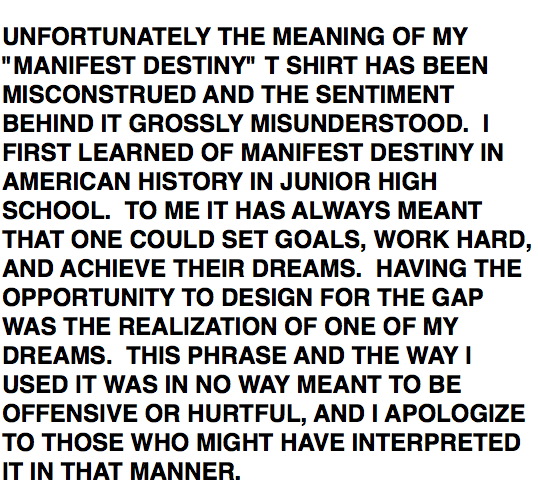
"Unfortunately, the meaning of my 'Manifest Destiny' T shirt has been misconstrued and the sentiment behind it grossly misunderstood," McNairy posted on Twitter on Tuesday, blatantly disregarding his "survival of the fittest" quip. "I first learned of Manifest Destiny in American History in Junior High School. To me it has always meant that one could set goals, work hard, and achieve their dreams. Having the opportunity to design for the Gap was the realization of one of my dreams. This phrase and they way I used it was in no way meant to be offensive or hurtful, and I apologize to those who might have interpreted it in that manner."

Dear Mark McNairy: The term "Manifest Destiny" does not mean what you think it means. (Also? Your junior high school history teacher is weeping right now.)

While it might be nice to think that it's some sort of inspirational mantra, maybe based on The Law of Attraction—Create your own life path! Manifest your destiny!—as McNairy and the PR department of Gap, Inc., have learned, "Manifest Destiny" actually refers to the mid-19th century mindset that white Americans had a divine obligation to claim as much of the continent as possible for themselves, slaughtering and oppressing native people in the process.
So McNairy "apologized" to those who, unlike him, didn't sleep through school and actually know what the words mean. Thanks for nothing, pal.

Some tweets responded to McNairy's semi-apology:@mmcnairy Considering that you are the one who misconstrued the meaning of the phrase, this is a pretty half-assed apology.

Hey @mmcnairy, since you didn't bother to Google "Manifest Destiny" I did it for you. Read before you speak again. http://en.m.wikipedia.org/wiki/Manifest_destiny #Gap

Is it just me, or did @mmcnairy just pull a "I'm sorry you're angry"? NOT an apology man...#Gap
My snarky addition to the pile-on was this:Breaking Gap news: McNairy's junior high school just checked his record. Turns out he flunked 7th-grade history and will have to repeat it.

Among other problems, he thought the Civil War was fought over stripes vs. solids, and the First Amendment says, "Do whatever feels good."
For more on the subject, see Gap Removes "Manifest Destiny" T-Shirt and McNairy "Hurt" by T-Shirt Criticism.

October 16, 2012

Gap removes "Manifest Destiny" t-shirt

Over the weekend, the Gap seemed blissfully unaware of the PR nightmare it was suffering in the "Manifest Destiny" t-shirt controversy. But on Monday, it finally responded via Twitter:


The Gap sent a similar response to people via e-mail:I wanted to update you that the “Manifest Destiny” t-shirt by Mark McNairy, offered through the GQ partnership, will no longer be sold in Gap stores or online. We value all customer feedback, and wish to emphasize that it was not our intention to offend.

Kind regards,

Edie Kissko
Gap Inc. spokesperson
As someone wrote:To those who sigh and roll their eyes thinking that standing up and speaking out is a waste of time...THINK AGAIN.Battle not over yet

But people investigated and found the shirts still on sale in some stores.

Gap's Colonization clothing line


Also, the Gap was selling related t-shirts online. These seem to be part of an "American Frontier" collection, with slogans such as "Onward," "Roam Free," and "Exploring East-West." These might not be a problem by themselves, but next to the "Manifest Destiny" shirts, their messages are suspect.


For more on the subject, see McNairy "Hurt" by T-Shirt Criticism.

October 15, 2012

McNairy "hurt" by t-shirt criticism

These days, Internet controversies often end in a matter of hours. But the Gap's "Manifest Destiny" controversy lingered over the weekend.

People tweeted comments to the Gap and shirt designer Mark McNairy. They also posted comments on the Gap's Facebook page, but someone quickly hid them.

No one from the Gap acknowledged the controversy. But McNairy responded to the tweets with this:


F.A.I.R. MEDIA's repsonse:This is what a NON-apology looks like.

Sorry about getting caught, not sorry about the Manifest Destiny shirt, and the effects of racism on millions who must live it every day.

Try again, Marc. This time, with meaning.
For more on Manifest Destiny, see America the Self-Declared Victim and Scalia Ignorant of Indian Law.

October 14, 2012

Gap's "Manifest Destiny" t-shirt

A new Native controversy burst out on the Internet Saturday. As an online petition explains:GAP is selling a black shirt with the words "MANIFEST DESTINY" written on it. This article of clothing promotes a belief that has resulted in the mass genocide of indigenous people, and it serves to normalize white privilege and oppression. This shirt is marketed to teens and young adults, and it gives no context for the racism and inequality that persists in our society, to this day, as a result of this doctrine. We are asking that this shirt be discontinued, and that an apology be issued.

Until this is done, we are asking that followers of this petition also consider other means of contacting GAP. This includes: *EMAIL* Gap at custserv@gap.com and CC the designer at info@markmcnairy.com; and/or *WRITE A REVIEW* of this shirt on the product's page; *CALL* Gap at (650) 952-4400. *MESSAGE or COMMENT* on the Gap Facebook company page, http://www.facebook.com/gap.

The tshirt that GAP is selling can be seen here: http://www.gap.com/browse/product.do?cid=47214&vid=1&pid=349697002

We thank the signers of this petition for their commitment to equality and social justice.

Aim Southern Cal shared some more thoughts on the shirt:‎GAP.... On your "Make a Difference" page, you state:

"Behind the label of any product is a deeper story about its social and environmental implications. Were the workers who made the product treated fairly? Were environmental considerations weighed during its design, manufacture and transport? What is a brand’s commitment to creating positive change?"

Did anyone ask these questions before designing, marketing, and selling the 'Manifest Destiny' shirt?

So, what IS your brand's commitment to creating positive change? Because this isn't it. I understand there's a lot of ignorance surrounding our history, and I don't really expect a t-shirt designer to have an education that would've given them a full understanding of what manifest destiny truly entailed. But, it has been brought to your attention now. This promotes the glorification of genocide and conquest.... that's the essence of manifest destiny. Not very positive. Unless the 'positive change' you're referring to, are the profits you make from such things."


Bloggers join the fray

Manifest Destiny--The T-Shirt!

By Phil CampbellI walked into the Gap at Astor Place during my lunch break and was surprised to see this t-shirt hanging pristinely on a clothes rack near the entrance. As you can see, “Manifest Destiny” is emblazoned on its front, as bold as any Nike logo.

Manifest Destiny? The 19th century philosophy that kick-started our national expansion beyond the Mississippi River? The original instigating principle of American exceptionalism? The concept that helped our country crush the Native Americans and help expand slavery into Texas?

What an odd thing to put on a t-shirt. I could think of a million other things to put on a shirt, a thousand things from the 19th century alone. Romanticism, anyone? Transcendentalism, anyone? They put Walt Whitman in a Levi’s commercial…When will this hundred-plus-year-old fashion nostalgia end? What new twists will our understanding of our expansionist past undergo before marketers find some new era to exploit? The 18th century has already been kicked around enough, thanks to 1776. I’d really like to see someone find a way to profit off the Trail of Tears, just to see if it’s possible.

I don’t mean to make this an attack on t-shirt marketers, who aren’t expected to be the most contemplative people in society, but the shirt does raise a bunch of questions. Who would buy this shirt? Do the hipsters of Manhattan and other liberal areas understand the history that underlies this saying? And why would designer Mark McNairy play with that singular phrase, what was his motivation? A lot of people on the left have associated Manifest Destiny with a kind of racist jingoism, and few on the right have bothered to take the time to defend the idea, preferring to let America’s triumphant history speak for itself (hey, we won, didn’t we?). I would have thought the idea kind of toxic, when it’s considered at all, but apparently not.

Manifest Destiny has nothing to do with the usual trove of easy themes that motivate marketers, like self-esteem and self-aggrandizement. Which is why it’s so baffling.
Manifest Destiny (or, whoa, Gap Inc, what the hell?)

By Belle JarManifest Destiny became the smart, fancy-sounding name for a belief that had already been around for quite some time: namely, that white folks of European descent were destined to rule the entirety of North America. These people truly believed that it was God’s will that they colonize the new world and systematically destroy any civilizations that might already be occupying the lands they wanted.

Manifest Destiny and the philosophy behind it are responsible for a whole bunch of really terrible things. It was used to justify the Mexican-American War, the War of 1812, and, most appallingly, the Indian Removal Act. Manifest Destiny was used to vindicate the myriad abuses suffered by people of colour at the hands of white North Americans. It’s the philosophy that lead to our continent-wide reservation system , not to mention the residential schools created for the Aboriginal peoples of Canada.

The effects of Manifest Destiny can still be felt, in the poverty and degradation suffered by American and Canadian people of colour, and in the deplorable conditions found on many reserves, both here and south of the border. The ideas behind manifest destiny still exist in our white western consciousness, as much as we might be loathe to admit it; they come up every time our (largely white) government asserts that it knows best when it comes to First Nations issues, or every time someone complains about how much freaking money has already been spent on Attawapiskat only to have their community still be in a state of crisis. Manifest Destiny is apparent every time someone chooses to be bigoted and wilfully ignorant about non-white immigrants, or tries to deny the far-reaching effects of racism; it’s apparent in the mindset of all the people who never take a moment to wonder why or how so many white people ended up owning so much fucking land.

Look, I don’t think that The Gap, or Mark McNairy, or GQ, or anyone involved here was trying to be offensive. My guess is that they thought that Manifest Destiny was a hip-sounding phrase, one that conveyed the idea of taking control over one’s own life or something like that. I’m certain (or at least hopeful) that Gap Inc. will end up pulling this shirt from their stores, issue a formal apology, and go through a brief, though sincere, period of mea culpa. As unbelievable as it is to me, I’m sure that those responsible for designing, approving and manufacturing this shirt did not understand the full scope of what its graphic meant.

And that, in a nutshell, is the main problem here.

The problem is that we want to forget; as white North Americans, we have everything to gain and nothing to lose by forgetting. We even ask that people of colour, especially, in this case, Aboriginal peoples, participate in our collective cultural amnesia. We tell them that we’ll never have the post-racial society that everyone wants until we stop bringing up the past, stop licking old wounds. We don’t want to feel guilty, especially as we often believe that we, the generation living now, are not responsible. After all, it wasn’t us drafting racist and genocidal laws calling for the relocation and often murder of an entire race of people; it wasn’t us sending thousands of First Nations kids to residential schools, where they would be subject to a dizzying array of abuses.

We don’t have blood on our hands; we’re good people. It’s not our fault that our ancestors were assholes, right?

What we often forget is that our privileged lives are built on the foundation of these grievous human rights abuses; we might not be our asshole ancestors, might even willingly speak out against the crimes they committed, but we’re still pretty fucking happy to reap the benefits of those crimes. We do have blood on our hands, whether we like it or not.

So maybe it’s not a bad thing that The Gap made this t-shirt; and maybe, rather than flinging vitriol at Gap Inc. and swearing to boycott their brand, we can all of us use this as an opportunity to start a dialogue about what Manifest Destiny really means, and the ways that we, as modern-day North Americans, can fight against its lasting effects. I would love if Gap Inc. would be the ones to start this dialogue; I would love for them to take this chance to talk about our racist heritage, and how our willful blindness to the past lead them to allow for the design and creation of this shirt. That would be pretty cool, right?
More responses

Since the controversy started Saturday, the Gap didn't respond over the weekend. But whoever was staffing the Gap's Facebook page deleted postings about the shirt, so someone knew about it.

Designer Mark McNairy was understandably defensive about his work:


Since he tweeted that before taking it down, I presume he knows what the phrase means. Otherwise, we might've guessed that he heard it and didn't know what it meant, but thought it sounded cool.

In response I tweeted:Why did the Gap use "Manifest Destiny" on a t-shirt by @mmcnairy? Because "Master Race" or "Kill the Heathens" would've been too offensive.Others were thinking along the same lines:


(Steven Paul Judd)


(Aaron Paquette)

For more on Manifest Destiny, see America the Self-Declared Victim and Scalia Ignorant of Indian Law.

May 30, 2012

America the self-declared victim

America As Self-Declared Victim

By Michael BrennerOne reason for this feckless conduct is that the pronounced sense of American victimhood has powerfully strengthened American self-righteousness. We are as sure as we ever have been that we have a Providential mission on this earth, that we were born as a nation in a condition of "original virtue," that 9/11 was an offense against the natural order of things. That order must be restored--in our hearts, in our minds, in our spirit--by acting our there, not by looking inward. After all, Americans are a proactive, can-do people.

Americans, more than most other peoples, live by their collective myths. American 'exceptionalism' in particular holds a key place in their make-up. That places an exceptional burden on preserving our foundation fables. The impulse to pursue real and imagined enemies across much of Eurasia and Africa is propelled in part by the fearful quest for absolute security that is taken as an American birthright. That impulse is reinforced by the imperative to validate the nation's mythical self-image. Atavistic beliefs that Americans are winners, that they act selflessly in the world, that this goodness should be recognized by others, that Truth is on their side--together form the keystone of American being and meaning. Individuals' sense of worth is tied to this mythologized collective identity. This makes it exceedingly difficult, psychologically, to cut loose from actions that failed the test of utility in meeting national interests years ago. For the dread of facing a reality bereft of the moral and ideational sustenance those myths provide is stronger than is the fear of costly wars without end and corrupted ideals.

A mind shaped by feelings of dread, ingrained superiority and resentment is totally self-absorbed. It suffers from a lack of interest in the attitude of foreign parties--much less an ability to understand them. We launch ourselves into one audacious venture after another whose success supposedly depends on reorienting the thinking of the natives, of winning a battle for hearts and minds, for instilling new norms of behavior--all overlaid with respect for the United states. Yet we show little concern for finding out who these people are--much less adjusting our own actions accordingly. They are just 'they.' So we scold, we instruct, we insist--and we bribe. They resist, they fume, they ignore--and they pocket, sometimes. This is what Washington celebrates as "smart power."

They suffer accordingly. We suffer their reaction--and from our incapacity to rethink what we are doing and why.
Comment:  Brennan wrote this primarily about Muslims, but it applies 100% to Indians. Indeed, we have 500 years of thinking about and treating Indians this way, as opposed to 10 (or 50 or 100, depending on when you start) for Muslims. As I've noted many times, we've defined ourselves as white Anglo-Saxon Protestants who "tamed the wilderness" for God. Taming the wilderness means taming the Indians; they're synonymous.

It's George Zimmerman vs. Trayvon Martin on an international level. Zimmerman/America attacks, Martin/foreigners defend. Zimmerman/America imagines that Martin/foreigners are evil and kills them accordingly. Then Zimmerman/America declares itself the real victim even though it attacked first.

For more on the subject, see "6 Ridiculous Lies" About Indians and Chomsky on Genocide Denial.

Below:  "How dare you threaten us with your heathen ways?!"

June 23, 2011

Scalia ignorant of Indian law

A Conversation with a Justice of the U.S. Supreme Court

By Steven T. NewcombAt a reception, I had an opportunity to talk with Justice Scalia. After saying hello and telling him my name, I asked: “I wonder if you might have ever read my law review article ‘The Evidence of Christian Nationalism in Federal Indian Law.’”

“No, what’s it about?” he responded.

I told him my article is about the U.S. Supreme Court ruling Johnson v. M’Intosh from 1823, a decision in which the Court said that the first “Christian people” to “discover” lands inhabited by “natives, who were heathens” have the right to assume the “ultimate dominion” over and title to the lands of the so-called “heathens.”

Given that Johnson v. M’Intosh was decided on the basis of the doctrine of discovery rather than the U.S. Constitution, I asked him how his guiding legal philosophy of “Constitutional Originalism” would relate to the Johnson decision. I asked him if the Court might ever consider overturning the decision.

Scalia said it was impossible to imagine an issuing ever coming up that would require the Court to address such a ruling; he also claimed in the same breath, however, that he had never heard of Johnson v. McIntosh. “I’ve never heard of it. I’ve never read it,” he said. He also said he’d never heard of the doctrine of discovery.
Comment:  Wow, this is revealing. Scalia seems to be totally ignorant of the foundations of Indian law. I gather he's cribbing his "reasoning" from elsewhere or making it up out of thin air.

Now that he's admitted he's ignorant of Indian law, will he recuse himself from any case involving Indians? Don't count on it.

For more on Scalia's stupidity, see Scalia Demands Written Records and Antonin Scalia:  Supreme Court Doofus.


April 11, 2011

Grinding Indians into the ground

Excerpts from a new book hint at the pervasive racism faced by Indians:

Indian Voices Excerpted:  Loud and Proud!

By Alison OwingsFor Indian Voices: Listening to Native Americans, author Alison Owings journeyed across America—east to west, north to south, and back again—to document what Native Americans from 16 tribal nations—including Pawnee, Ojibwe, Navajo, Hopi, Lakota and Tonawanda Seneca Indians—had to say about what it is like to be a Native American in the 21st century. Owings conducted long, intimate and sometimes shockingly candid interviews that touched on many topics, from adultery to haircuts to politics, but often circled back to the often staggering ignorance of non-Natives, some of whom do not realize that Native Americans still exist, much less speak English, have cell phones, use the Internet, and attend both pow wows and power lunches. It is no coincidence that the book is being published on the anniversary of the 1879 trial in Omaha that stood to determine whether Indians were people under U.S. law.

Here are a few small “sound bites” from some of those vibrant voices:

A Mixed-Up Crowd

Curt Locklear (Lumbee)

In a 1973 interview, the late Lumbee historian and poet Lew Barton asked Curt about an inferiority complex affecting “our people,” and Curt turned the question back on Barton. “I mean, being completely honest with yourself, When did you start thinking that you was good as white man? Have you always thought you was good as a white man?”

After Barton said, “No, not really,” Curt laughed and said he hadn’t either.

It’s All Good

Marcus Frejo, aka Quese IMC (Pawnee-Seminole)

He put down his hazelnut latte as he recounted a childhood memory. “When I’d be walking to school, maybe in kindergarten, as the white ladies would drive by, they’d put their hand up by their eyes like this—” He held one hand flat against the side of his face as if to screen his eyes. “Imagine what that does to a kid at three, four, five years old. In the morning, before the school bus would pick me up, I’d light all the white people’s trash cans on fire, and run.”

Create Something Meaningful

Karen Artichoker (Lakota)

Even when I graduated from high school 11th in my class and the school counselor was encouraging me to go to cosmetology school because the home ec teacher liked how I did somebody’s hair. It never occurred to me that this cosmetology thing had do with [me] being female. At that point, to start thinking about being an Indian and being a woman, and that they were both who I am, was an awakening. I started hearing sexism everywhere. I remember being really angry. Of course, I was always angry as an Indian, but now I was angry as a woman.”
Comment:  As I've said before, it's not about being beat up or denied a job because one is an Indian--although those things happen too. It's about the constant barrage of microaggressions that Indians suffer every day. You know, the words and images that tell Indians they're primitive, savage, or dead.

Unless you're extraordinarily empathetic, you can't know what this is like if you haven't gone through it yourself. Therefore, don't bother telling us that Indian mascots and other Native stereotypes are harmless. These things are merely the tip of the iceberg.

Indeed, they're the superficial symbols of a 500-year-old regimen of religious and cultural oppression. Of a hate-filled environment designed to grind Indians into the ground. If Euro-Americans couldn't kill the Indians outright--all those pesky laws and moral codes against mass murder--they'd make sure Indians were eliminated as a threat to the Great White Way.

All the stereotype postings in this blog--e.g., Whites "Play Indian" in Swamplandia!, Tribe of Arrows Reality Show, Schlock-lahoma!--are part of the same cultural propaganda. The message is: "Get out of here, you heathen savages. I.e., you non-white non-Christians. We won and you lost. This is our land now.

"Your continued existence is a threat to our narrative of God-blessed success, and we can't allow that. Nothing must challenge the self-invented mythology of Western civilization--i.e., the greatness of capitalism, Christianity, and Caucasians. We will attack, denigrate, and marginalize you to maintain our power and privilege."

For more on the subject, see Trahant Agrees About Termination Agenda and Indians "Win" Oppression Olympics.

Below:  Real Indians...


...and America's preferred Indians: the savages who deserved to lose their land.