Showing posts with label Charles Trimble. Show all posts

July 24, 2012

Owners plan to franchise Tocabe

Chuck Trimble reports on eating and meeting the owner at the Tocabe restaurant. I found the tidbit below particularly interesting:

Tocabe--A Native culinary treasure in Denver

By Charles TrimbleShe went into the kitchen and brought out her son Ben to meet us. He is impressive, even in his reversed baseball cap and apron. He and his business partner--a close friend from his college days – run a happily hectic operation smoothly with well trained, friendly staff of young Native servers. Where it is situated, it is a neighborhood restaurant, but it is obvious that people from all over the metro area come there regularly.

Ben described plans to expand operations via franchise, and early connections even call for some to be in major professional sports facilities, such as stadiums and arenas. He gave me a business summary plan that is convincing that he knows what he’s doing, and his plans are thorough and realistic. I had little doubt from talking to him that I was talking to an entrepreneur destined for success--perhaps a future Famous Dave Anderson.
Comment:  For more on the subject, see Tocabe on Food Network and Bringing Native Foods to the Fore.

January 02, 2012

Sioux student earns physics degree

Yankton Sioux Student First in Tribe to Earn a Physics DegreeCharee Peters wasn’t expecting to break any barriers when she made the decision to change her major from theater to physics while an undergraduate student at the University of Denver, but that’s exactly what she did.

When she was handed that bachelor’s degree in 2011, she became the first member of the Yankton Sioux Tribe to earn a degree in physics.

“It was very unexpected. It’s very surprising that in all the generations and people that have been in the tribe, none have done what I have done,” she said. “It’s a bit distressing to know that I am paving the way for others like me, but I’m pushing through to represent my tribe and to show the world what Native Americans can do.”

Over the next five years she plans on having her master’s, wants to be working toward a doctorate in physics or astrophysics and would like to have a couple research papers published.
Charles Trimble: Indian youth share an important lesson with usThe youth on the reservations give us hope, even despite the prevalence of drugs and gangs and suicides. For example, a December 22, 2011, article from the American Indian Graduate Center heralded the following amazing fact:

“In the minds of many Americans, the Pine Ridge Reservation of the Oglala Sioux Tribe embodies all the problems of American Indians and Alaska Natives. Yet on this, one of the nation’s largest Native American Reservations, four American Indian scholars have set a standard virtually any town or city in the United States will find it very difficult to match. In 2011, four scholars who were raised in the historic village of Oglala, pop. 1290 (2010 Census), were honored for their work at the graduate level, one of whom is pursuing a Ph.D. degree and three having received Ph.D. degrees during the year. Some experts have speculated that, at least this year, it may be the highest per capita number of Ph.D.s of any municipality in the nation.”

These are the facts that need to be heralded throughout Indian Country and in the general public, for they help dispel the impression that our tribal youth wander the reservation countryside, hollow-eyed and disparaged, haunted by ghosts of our tragic history. It is often said that our youth have no Indian role models, yet those role models are everywhere, but need to be pointed out.

There are Native Americans in the White House and on Capitol Hill in Washington, in state offices, and many are unheralded in jobs of great responsibility in offices and factories across the country. And indeed there are many role models on the reservations–special people who stayed home precisely to develop the homelands and provide education and opportunity to future generations of our tribes.
Comment:  For more on Indians and education, see Native Science Nerds and Inuit Graduate Student in Accounting.

Trimble defends Children of the Plains

In the same column in which he praises the Sioux student who earned a physics degree, he makes a spurious claim about the 20/20 special Hidden America: Children of the Plains:

Charles Trimble: Indian youth share an important lesson with usThe recent brouhaha caused by Dianne Sawyer’s ABC program “Hidden American; The Children of the Plains,” brought forth an interesting societal inner conflict in Indian Country, especially in the Northern Plains. On the one hand, we come close to seeming to boast about the extent of our poverty and social pathology: highest infant mortality; lowest life expectancy; highest unemployment; staggering rate of alcoholism and domestic violence in the poorest counties in the nation. On the other hand, we resent it when someone else points out those same statistics.

Diane Sawyer told no lies, nor did she exaggerate any facts or figures. She did point out at least one bright spot–Red Cloud Indian School, but unfortunately she gave the impression that it was an elite academy of sorts, and did not point out that it operates on a much smaller budget than any school of comparable size on the reservation, and drains little of the funds from the federal budgets appropriated for the reservations.

And she did give the opportunity for Indian children to express their own dreams for their future. I don’t know what the answers would be if I were to ask any of those children featured in the ABC show, or their parents or relatives, what they thought of the show. But I’m sure there would be positive responses, and some positive outcomes in terms of benefits.
Comment:  Ever hear of a lie of omission, Chuck? Avoiding lying or exaggerating isn't the whole story by a long shot. Americans massacred Indians, enslaved Africans, and nuked Japanese civilians. Those are facts, not lies or exaggerations, but they hardly give a complete, well-rounded picture of American history.

Same with the 20/20 documentary. It was heavily loaded with negative information with few positive aspects. As I noted in my "poverty porn" posting. And this negative information reinforced Americans' beliefs about the poor, drunken Indian reservation. It was much like the SCALPED comic book, which also reinforces stereotypical beliefs about the downtrodden Indian.

It's called stereotyping, buddy. Most stereotypes are based on facts--e.g., some Indian wore headdresses and lived in tipis--but focusing on them creates a false or misleading impression. Let me repeat that: information that's 100% true may present a false picture. Especially if it's taken out of context and presented in isolation.

Duh.

Trimble may want to work on his media deconstruction skills. This is grade-school stuff, not brain surgery. Don't take news reports at face value.

For more on the subject, see Video Response to Children of the Plains and "Poverty Porn" Column in ICTMN.

February 28, 2011

Tribes need revolutions too

Charles Trimble quotes e-mailer Rodney Little Bird who implies tribes need an Egypt-style revolution too.

Taking a lesson from reader Rodney Little Bird

By Charles Trimble“Wow, what a month...with Egypt in the process of reform, with Libya revolting and promising prison for its worst. There is no end in sight and there should not be, when I look around for the terrorists I see the good ole USA at the helm, what are (we) to think when they got away with it here and have much knowledge toward how to handle tribal governments.

“The way I see it is that we pretty much play into their hands, we allow groups, interested parties to lead us to yet another dead end; i.e. Cobell, et al. And local tribal agencies corrupt at every turn--lack of accountability from the councils; nepotism like never seen before; throwing good money after bad; in fact sealing our fate with every lawsuit that is filed.

“However from all of this seemingly unending parody of the dog and pony shows, I get one thing and that thing really haunts me: We have long outlived the usefulness of a Tribal Council. We are too large in membership; together we can get things done...sheer numbers always works. And further Nations should come together to work on issues that require sheer numbers...find Solidarity through national unity...a solid voice of opposition to this ongoing denigration of our People....We have nothing more to lose...for it has all been bargained away.”
Comment:  For more on the subject, see Hopi and Navajo vs. Tribal Councils.

February 21, 2011

Wounded Knee II's positive effects

Wounded Knee occupation had positive effects

By Charles TrimbleWhat caught me in the Chaat Smith/Warrior book is this statement in the Preface: “We came to write “Like a Hurricane” out of a profound dissatisfaction with the existing narratives of this crucial period in Indian and American history, one that we believe too often saw Indian people as mere victims and pawns. Our focus is not on the U.S. government’s failed policies or on police repression, but on how Indian people, for a brief and exhilarating time, staged a campaign of resistance and introspection unmatched in this (20th) century. It was for American Indians every bit as significant as the counterculture was for young whites, or the civil rights movement for blacks.”

This, to me, is what Tim Giago continues to miss--the widespread exhilaration among Indian people, and the significance of their resistance and revolution. During WKII I was able to witness some of it when I went to Pine Ridge as NCAI Executive Director to offer media and political assistance to the tribal government (which was essentially President Dick Wilson). Although I was disheartened by what I saw happening in what was left of tribal government there, I also saw and heard a new sense of pride among the Lakota people, and much praise for AIM.

I have never been a supporter of AIM, or an apologist for their actions. But, I do have an appreciation for what they meant to do and what they did, in fact, accomplish.

There was indeed much destruction at Wounded Knee during WKII, by AIM occupiers as well as federal and Goon forces. Dewing’s book provides BIA financial estimates of the losses and damage to the homes that were occupied by the militants, in many cases at the invitation of local people. And he also includes BIA estimates on recovery of household items that were missing. Nothing that I have read or heard gives credence to Giago’s telling of AIM occupiers evicting families, looting their homes, then setting them afire when they left. Even the burning of the Gildersleeve’s trading post, it appears, was the result of an accident with a kerosene lamp, when the village’s electricity was cut off by the Federal siege. It was not a torching of the building.

Back in 1981, Giago had a different view of WKII. In his book, Dewing wrote the following: “Looking back on Wounded Knee II from the perspective of ten years, Tim Giago, editor of the Lakota Times, saw some positive outcomes. According to Giago, the confrontation focused national attention upon the ineptitude of the BIA and the Interior Department. ‘It caused the Indian people themselves to demand changes within these bureaucratic structures and put bureaucrats on notice.’ Giago also said the encounter made reservation inhabitants more aware of whom they selected to fill elected office.”
Comment:  For more on the subject, see AIM's Misdeeds Too "Complex" to Cover? and Debate Over Wounded Knee.

May 04, 2010

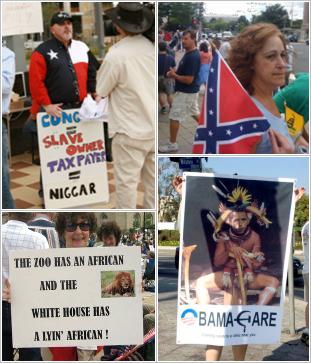
Teabaggers to target Indians?

Charles Trimble:  Keeping a close watch on the Tea PartiersDuring the 2008 Presidential campaign I announced in a column that I was abandoning the Republican Party, in which I was registered for the past 25 years. I did so because the fearsome lunacy whipped up by the hateful speeches against candidate Obama concerned me. In that column I wrote the following:

“Over the past year, I have seen that the Republican Party taken over by a wave of fearful, hateful and strident bigots. I now consider myself an Independent for Barack Obama. But what I have seen in recent political rallies for McCain and especially those for Governor Sarah Palin, frightens me for Senator Obama’s life and for our country in very dangerous times. I hear the voices of fear–fear of a black man to serve as our national leader; and I see the faces of hate that such irrational fear generates. They are the voices and faces of hate that we read about and saw in photos in the 1960s, with white men and women screaming hate-filled, racist epithets at courageous black children being escorted by soldiers into their first day of a public school.”
And:At their riotous Tea Party gatherings many dress up in colonial tricorn hats and wave “Don’t Tread on Me” flags as well as Old Glory, and they call their members patriots. This all brings to mind the saying of British author Samuel Johnson that patriotism is always the last refuge of scoundrels. We should expect at any time to see some of these folks dressed up as Indians, which the colonials did in 1773 when they turned Boston Harbor into a tea pot–a cowardly act to disguise their own identities and put the blame on the real First Americans.

These are the same kinds of people that will bring their pent up resentments to the party, and we should expect that they would ultimately set Indian treaty rights and tribal sovereign immunities and jurisdiction in their sights for destruction. We need to keep our eyes on them.
Comment:  Trimble and correspondent DMarks must be attending different political rallies. Trimble sees the right-wingers' hate and fear while DMarks doesn't.

The Arizona branch of the Tea Party movement is already targeting Mexicans who are predominantly Indian. And of course Americans of Hispanic descent who dare to speak Spanish or apply for government aid. It's no stretch to think they'll target American Indians next. Just wait till they learn how much the Cobell settlement will cost them.

You can be sure there's a huge overlap between paper-checkers, birthers, teabaggers and people like Jim Marino who want to curtail tribal sovereignty. I'd venture to say they're the same people but with varying degrees of craziness. It's all about their fear of cooties--i.e., of contamination by undesirables who will dilute their white power.

For more on the Tea Party movement, see Poll Proves Teabaggers Are Racists and Any Excuse to Hate Obama. For more on Trimble's views, see Gun Nuts vs. Indians and Trimble Apologizes for "Victimhood" Insults.

April 13, 2010

Indians inspired More's Utopia

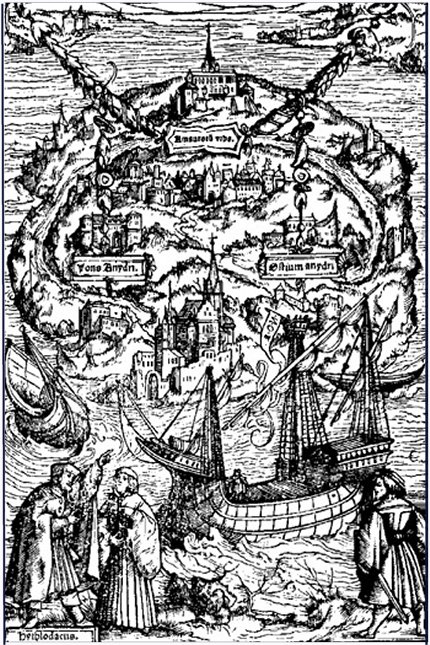
Charles Trimble:  Decolonization and Native communitiesLegal scholar Felix Cohen, in his great book of essays titled “The Legal Conscience,” tells us that the great English philosopher and martyr Thomas More was inspired by contemporary reports of Amerigo Vespucci describing an idyllic native society he found in the New World. Shipwrecked in 1497 off the coast of what is now Brazil, Vespucci and his crew were rescued by Native people and treated with great kindness. It was from those accounts that Thomas More created the ideal society he called Utopia, described in his book of the same title.

After five centuries of conquest and occupation by European powers, little of that ideal world remains in the western hemisphere, except perhaps in some undiscovered tropical village along the Amazon. What remains of any semblance of traditional culture exist in enclaves of poverty surrounded by development and wealth. The poverty in these enclaves is the result of many decades of injustice--massive land theft, forced removal, and physical and cultural annihilation. This has left tribes in alien and much-reduced homelands unsuitable for the economic systems and lifeways that had sustained them for centuries, where they are wholly dependent upon their occupiers.
More connections between More's Utopia and Indians:

Utopia (book)[T]he communistic life style of a Utopian is a strange one coming from a rich landowner, though perhaps influenced by the Spanish colonization of the Americas, which was bringing to European ears tales of ideal civilizations at about this time.Thomas More's Magician: A Novel Account of Utopia in Mexico (Phoenix Paperback Series)This is the story of Vasco de Quiroga who used Thomas More's UTOPIA as the inspiration for building a functioning utopian society in sixteenth century Mexico. It is the story of a communist society that predated Communism and the world's first welfare state. The social structure of Quiroga's 'pueblo-hospitales' was grounded in the family, had an economy based on agriculture, and the politics was run through communal consensus given a voice by regular elections.

Toby Green uses this gripping slice of history to enquire into how feasible the utopian ideal is, especially when matched with our contemporary emphasis on the individual.
Roger Williams, Thomas More, and the Narragansett Utopia

Bartolome de Las Casas and Thomas More's Utopia

Comment:  Trimble goes on to say he's never seen descriptions of Indian "utopias" and wonders if Indians can return to a traditional "utopia" society. I think I have seen such descriptions. They usually apply to tribes that were smaller and more peaceful, not larger and more warlike.

And no, I don't think tribes can return to a utopian lifestyle based on traditional ways. Nor do I think that's necessarily a good goal. My ideal is to integrate traditional values of community, conservation, and thinking ahead into modern society. To create sustainable economic, political, and social systems that can provide for the world's people.

For more on the subject, see Indians Gave Us Enlightenment and Hercules vs. Coyote:  Native and Euro-American Beliefs.

Below:  "Woodcut by Ambrosius Holbein for a 1518 edition of Utopia. The lower left-hand corner shows the traveler Raphael Hythlodaeus, describing the island."

March 30, 2010

Guardian Angels = Sioux tradition

Charles Trimble:  Guardian Angels come to Indian CountryWhen I read the Indianz.com article that the first Guardian Angels chapter in Indian Country is starting on the Fort Peck Reservation in Montana, my reaction was, “How appropriate; a traditional Akicita approach to the problem of policing Indian country.”

In Sioux camps in olden times, the police that kept order were the Akicita (pronounced ah-KEE-chee-tah). These were men who were selected for their generosity, leadership, and most of all, their bravery. These men were of the warrior societies, the elite among the men.

Life in the camps on the Plains required much discipline on the part of individuals and families. There was no place for troublemakers who disturbed the peace by their behavior and by their disrespect for laws and authority. With families that were troublemakers, we are told, akicita warriors might call out the male head of the tiospaye, and humiliate him, sometimes whipping him from their horses with their quirts. A family that persisted making trouble, or trashing the campsite, would be ostracized to live away from the camp, and sometimes even to be expelled from the camp completely. This would doom that family because other camps would know that they were forced to wander because they were troublemakers, and nobody wanted troublemakers.

As with much of our traditional cultures, that discipline has been lost. There is little respect, even for elders. Neighbors’ yards and gardens regularly are trashed. In one village on the Pine Ridge Reservation, gangs are mounted and do their mischief on horseback, causing much damage to property. Gangs and drugs are a growing problem on reservations all across the Northern Plains.
Comment:  For more on the subject, see Guardian Angels on the Rez.

March 15, 2010

Restoring traditional Indian names

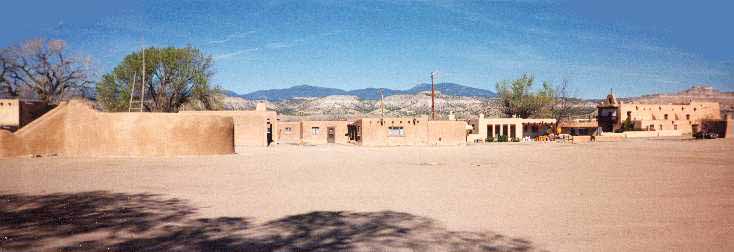
Charles Trimble:  Tribes reclaim their traditional namesThe tribal council of the Pueblo Santo Domingo in New Mexico recently decided unanimously to change the tribe’s name back to that by which they identified themselves for centuries. They are now officially known as the Kewa Pueblo.

This is as it should be--a giant step toward decolonization or decolonialization. It’s a step taken over recent years by the Sicangu Lakota, who had been known for so many years as the Rosebud Sioux; and those known as Pima are now Tohono O'odham, the Desert people, as they called themselves from time immemorial. And the people of Winnebago are once again the HoChunk, and the Omaha have reclaimed the traditional spelling U-Mo'n-Ho'n.

We must ask ourselves, why was it that the Europeans especially wanted to change the tribal or clan names of the peoples they encountered in the New World, and on all other continents? Surely, it wasn’t just the inability of the European invaders to spell the names so the indigenous peoples and their landmarks could be recorded in their reports back home.

Why was the highest mountain on planet Earth renamed from its Tibetan name of Qomlangma to Mount Everest, after an obscure 19th Century Surveyor General of British colonial India? Or why was Denali Peak, which was named for the Athabascan people of Alaska renamed McKinley, after the 25th President of the United States? What does it signify to them? Conquest? Possession? Superiority?
Trimble suggests the answer to his own questions:Most of the reservation homelands were named to facilitate administration on the part of colonial overseers--the so-called Indian Office of the late 19th Century. The tribe or group of tribes adapted to those names to facilitate delivery of rations and annuities guaranteed under treaty. However, the replacement of traditional names with new Anglo designations may also have been done as a step to break the tribal structure and disappear their people into the mythical melting pot as Manifest Destiny demanded.

To force Indian nations to take on an alien tribal name in English was cruel enough; but often the tribe had to take the name of the military outpost that was built to keep them in virtual bondage. Fort Sill Apache; Fort Peck Assiniboine-Sioux; and Three Affiliated Tribes of Fort Berthold, are examples. Others had to adopt the name of the Christian church imposed on their village, such as Santa Ana, San Juan, San Ildefonso, and Santa Clara Pueblos.
Comment:  I think the answers to Trimble's questions--"Conquest? Possession? Superiority?"--are yes, yes, and yes.

I'm not sure Euro-Americans renamed places as a conscious effort to "break the tribal structure." Rather, they probably didn't know or care that the Indians had their names. They probably treated the Indian names as incomprehensible noise.

Trimble's "superiority" may come closest to the mark. Americans had the racist presumption that they were the only people who mattered. That the Indians' thoughts and feelings were like a dog's: irrelevant and inconsequential.

Many Americans still think this way, as countless debates over Indian mascots and Hollywood movies prove. "We're stereotyping Indians?" they say. "Who cares? We're white people and they're not."

For more on the subject, see Renaming Mt. Diablo and Renaming British Columbia.

Below:  The central plaza at San Ildefonso, with the round kiva at left and the old church at right.

January 11, 2010

Gun nuts vs. Indians

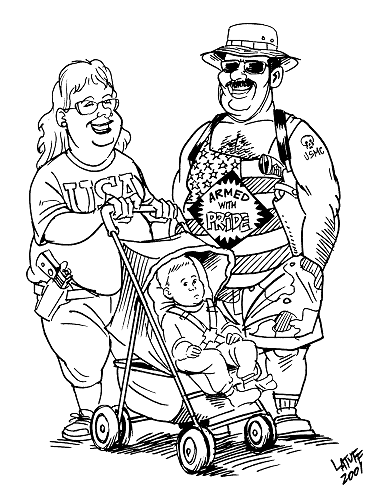
Charles Trimble:  Frontier mentality continues with guns[T]he most frightful and dangerous market is represented by paranoid yahoos who see enemies around every corner and behind every tree. These are people who are driven by fear--mostly fear of minorities whose rights they have trampled over the years, and fear of their own government’s every action to secure human and civil rights and opportunity for those minorities.

In the original American colonies and later the ever-expanding frontier, hunting was important to survival; but it was fear of Indians mostly that there was at least one blunderbuss in every home. And this persisted down through the years. Even as late as 1973 when the American Indian Movement occupied the village of Wounded Knee, many whites in a wide area surrounding Pine Ridge and other reservations drove around in their pickup trucks displaying racks of weaponry in the rear windows. Although it has always been in manly vogue to carry hunting rifles in the pickups, some of these were assault rifles that wouldn’t have left enough carcass for much of a venison dinner.

In frontier of the late 1830s there was great danger along the Oregon Trail and other routes westward. At demarcation points from Kansas City north to Omaha, booklets were being sold to the emigrants preparing for the trek; warning of Indian raids and giving advice on protecting against them; and, of course, selling guns to them. Gun sales boomed.

History tells, however, that Indians were no great threat if the pioneers would behave and stick to their routes.
And:Fresh shallow graves could be found all along the trail, as death was ever present. But most deaths came from drowning at river crossings, from wagon accidents, snakebites, and the dreaded Cholera that resulted from drinking the human and animal-fouled water. The biggest killer, however, was firearm accidents, those very same weapons sold to the immigrants to protect them from marauding Indians.

The same scare tactics used back then to sell weapons are being used today, much for the same purpose. Reports tell of a new arms mania, with gun shows overflowing, gun factories going flat out in production, and annual sales of guns in the U.S. reaching over $3 billion. Reportedly, Smith and Wesson stocks are up 115%, and Sturm/Ruger stocks are up 85%. Cabela’s arms sales are up 70%.

The following opening sentence of one report, however, causes me the greatest concern: “Barack Obama’s victory in November sent weapons sales shooting upward.” That report noted a major factor being fear that the new President would outlaw all guns. I would hate to guess what the other factors might be.
But Trimble guesses anyway:At least publicly, none dare mention Obama’s race in their attacks on him, but there can be little doubt that it is a prime factor among many of those critics.Comment:  Good guess. In the olden days, fear of Indians motivated gun sales. Now it's fear of other minorities--especially blacks, Latinos, and Muslims. Grab your guns because "they" are coming to get "us." First "death panels," then death camps, and finally a Communist/Nazi/fascist/Muslim dictatorship!

For more on guns, see A Well Regulated Militia... and Some Arguments for Gun Control. For more on conservative thinking, see Right-Wingers Foment Hate and Hate Abounds in "Post-Racial" America.

Below:  American "heroes"...


...and "villains."

November 08, 2009

How to consult with 564 tribes

Charles Trimble:  Down from the summit:  What now?Although it should warm up attitudes in the bureaucracy, this new consultation process probably won’t be an invitation to meet with a Department Secretary or agency head for most problems that any individual tribe may have with federal programs or policy. It certainly isn’t a promise of ongoing consultation with the President, “Yo, Barack; I’m coming into DC next week, how about a heads of state summit between you and me over lunch?”

And although the government-to-government relationship is between the Federal government and each of the individual tribal nations, not any collective group of those nations, the sheer number of the sovereign tribal entities probably demands some sort of alliance or collective entity representing the tribes. This is important for avoiding conflicting requests for policy changes, and for keeping some semblance of unity in the causes.

This issue was taken up in 1993, when NCAI leaders urged the Congress and Administration to authorize the study of arrangements that would improve tribal consultation with both entities. The NCAI had proposed formation of a Inter-Departmental Council on Indian Affairs (IDCIA), to consult with the Administration; and a National Native American Advisory Commission (NNAAC), to advise Congress.
Comment:  Trimble has a good point. One-on-one government relations would be difficult if not impossible to implement. There has to be some sort of group mechanism.

But one council or committee for the executive branch and one for the legislative branch doesn't seem like enough. How about a series of regional committees for regional issues such as land or water rights? And a series of subject-oriented committees for tribes with subject-oriented issues: criminal justice, healthcare, gaming, etc.? These committees would have the power to negotiate on behalf of the tribes. Once they negotiated a policy, the committee would take it back to the tribes for a vote.

I'm sure there are a slew of negotiating bodies already. The difference is empowering them to negotiate officially. Perhaps with an arbiter such as a special court, with Native and non-Native judges, to rule on any disputes.

For more on the subject, see Obama's Memo to His Cabinent and Obama at the Tribal Summit.

October 05, 2009

Trimble apologizes for "victimhood" insults

Charles Trimble:  A Fighting Sioux womanRecently I wrote a column about the Fighting Sioux mascot controversy that has been raging at the University of North Dakota for much too long. My words were critical, in fact insulting, to some Native people who are offended by the mascot and are demanding that the University discontinue its use. I wrote of them that they are “perpetually-offended purveyors of over-sensitivity and victimhood.”

I did not picture any of them individually as I wrote that description, and later as I described them as a “sulking and sour minority;” I generalized and smeared them all. That kind of smearing is easy when you don’t have to visualize individuals you’re writing about. It’s just “them,” the “troublemakers.”

I received a fair amount of e-mail, and some blog comments, most of them favorable, or agreeing with me. But I received one that hurt. It was not a mean letter, but a powerful one. It was from the daughter of a person I had met many years ago in our common fight for Indian rights--a person I had great respect for and fondness for. I should have known that she’d be up there at UND in midst of the fray, because she’s a fighter, a warrior. And if I had pictured her as one I would be describing, it would have been different, or I would have written nothing at all. Indeed, if I had pictured any of them individually I would not have written as I did.

Her name is Waste’Win Young, daughter of my long-time friend Phyllis Young, and she’s a member of the Standing Rock oyate. Like her mother, she’s a fighter for Native peoples, and a tough lady, a real Dakota, a true Fighting Sioux. With her approval, I am including some of what she wrote. Here’s what she has to say:

My name is Waste'Win Young. I am a citizen of the Standing Rock Oyate. First and foremost, I am “ina” (mother) to my two sons Zuya and Wakicunze. I am also an alumna of the University of North Dakota Class of 2001. As a young woman I grew up reading your columns and always felt quite proud that your words could illuminate a lot of our people's stories.

However, today when I read your column. I literally felt sick to my stomach. In my view point, you went from being a champion of our people's issues into someone who never attended UND, who was easily bought by the neon green of the jerseys and pretty logo.

I’m so disappointed that I can barely fathom where you got your reasoning and your hurtful words that in no way reflect my journey at UND.

As a young Lakota/Dakota I attended the University of North Dakota (1997-2001). I graduated after five years with two degrees in English Language/Literature and American Indian Studies. I have worked for the Standing Rock Nation since 2003. I am the Tribal Historic Preservation Officer.

I have a lot of love for my oyate regardless of politics--and that’s what this nickname issue is--politics. I think it’s extremely unfair and unreasonable for you to make assertions about this issue. Especially when you have not attended school there and have not heard Standing Rock's alumni side.

I think that after five years of living in Grand Forks that my story, my experience should carry a little weight to it. I was just a young girl attending college, trying to get her degree.

I’m appalled to see that this issue has succeeded in turning us against each other. It's not okay for White kids, Black kids, Asian kids to act like "Fighting Sioux." It’s not ok for them to have parties and dress up as Indians. As educators, it's certainly not okay to turn the other cheek. I applaud my peers and professors who have persevered through pervasive ignorance, racism year after year. It’s not just good-old-college fun. It’s not native students being whiny--it’s me as a native mother telling you to "knock that shit off and I mean it." It’s a really simple notion.

Once that nickname is retired we WILL be emancipated. We won’t have that leash around our necks to be the white man's good Indian. I have always respected my elders and I respect your view point. But don’t call us names. We have a right to be heard. We are the ones who lived it, earned that feather, and came home. Never judge a person until you have walked a mile in their moccasins.
Comment:  For more on the subject, see Fighting the "Fighting Sioux" and Team Names and Mascots.

October 04, 2009

Protesting mascots = victimhood?!

Trimble:  The Fighting Sioux name should stand

By Charles E. Trimble[T]hose legions of perpetually-offended purveyors of over-sensitivity and grumpy victimhood should just let it go. Go home and allow the students to get back to doing the work for which they and their families have chosen the institution, even despite its nickname (if that had even entered their minds).

And I don’t object to the adjective “Fighting” as part of the name. A descriptive that would mightily offend me would be, let’s say, the “Whining Sioux,” as the actions of some of our super-sensitive relatives might suggest. But Fighting Sioux is very apropos and quite noble.

We are allowing a sulking, sour minority to stop a nation, the Standing Rock, from exercising its sovereignty by conducting a referendum on the subject. And we are allowing them to demean the results of the referendum conducted by the people at Spirit Lake. All because it would embarrass them if the people, the oyate, voted their right to allow the use of the name. Expressed or not, you got their answer: “Who are the oyate, and what do they know?”

If they get their way and the name is jettisoned, it will not be the end of anybody’s world. However, neither will it make a whit of difference in the physical, mental or emotional welfare of our people. Those children of our tribesmen who walk the UND campus will not breathe any freer than before; they will not have been emancipated.

Instead, they will have hammered into place the first shackle to chains that can hold them back, the chains of victimhood. And victimhood is what this is all about. It is not pride, and it is certainly not a show of confidence in the strength of our cultures.
Comment:  Whenever Trimble talks about victimhood, he sounds like an idiot.

Why protest mascots? Why protest any form of stereotyping, discrimination, or racism? Heck, why protest any crime committed against your well-being? If you're being raped or pillaged, lie back and enjoy it. According to Trimble, protesting your treatment means putting on the "chains of victimhood."

I'm amazed when a seemingly educated person can't connect the dots between stereotyping and more concrete forms of mistreatment. Really, how many times to I have to quote people saying they think Indians are savages who no longer exist? If several hundred isn't enough, how about a thousand? Ten thousand?

The key question Trimble can't seem to fathom is: Where do people get these ideas from? From watching Senator Ben Nighthorse Campbell on C-SPAN? From seeing Sam Bradford win the Heisman Trophy? From reading a novel by Louise Erdrich or Sherman Alexie?

No, they get these ideas from stereotypes, dummy. They see names and images such as the "Fighting Sioux" and conclude they represent reality. Half-naked Lakota warriors used to roam the Plains, but now they're gone. All that's left is a cartoon of what they once were.

And the consequences, which Trimble also can't fathom? Indians are gone, so no need to respect their tribal sovereignty. Indians are gone, so no need to honor their treaties. Indians are gone, so no need to fund the programs they were supposed to get for their land.

Duhhh.

Experts get what Trimble doesn't

You can read several dozen experts implying Trimble doesn't know what he's talking about in The Harm of Native Stereotyping:  Facts and Evidence. Here are a few representative ones:Beginning with Wild West shows and continuing with contemporary movies, television, and literature, the image of Indigenous Peoples has radically shifted from any reference to living people to a field of urban fantasy in which wish fulfillment replaces reality.

Dr. Cornel Pewewardy (Comanche/Kiowa), "Why Educators Can't Ignore Indian Mascots"
I have committed my life to dealing with harmful and negative stereotypes and educating students on my reservation of their culture, traditions, ceremonies and spirituality. As Native people, we experience layer upon layer of stereotypes and images that dehumanize. Eurocentric curriculum and children's literature reinforce stereotypes of the "vanishing Indian," "romantic Indian," "militant Indian" or "drunken Indian." I have seen firsthand how these images, along with poverty or low socioeconomic status, generational trauma and other issues of reservation life contribute to low self-esteem in Native students.

Denise K. Lajimodiere, "VIEWPOINT: Racism at Protest Shames UND," Grand Forks Herald, 4/12/06
Almost every Indian person I know of has been horribly impacted by the imposition of the all-pervasive "categorical" stereotypical classification upon their basic sense of humanity--so much so that I feel quite safe in declaring that all Indian people suffer a unique form of self-esteem deficiency based solely on the widespread mayhem that Indian stereotypes have caused us since before the Boston Tea Party.

Melvin Martin (Lakota), "Identifying Indians with Stereotypes," 2/28/09
The last time Trimble talked about racism, he noted how deeply it had affected him. I thought he might've got a clue from somewhere. But now he's telling today's and tomorrow's Indians to ignore the racism around them. If it bothers you, you have a victim mentality. Toughen up and get over it like a macho Lakota warrior. Real Indians don't cry, they accept pain like a stone-faced mountain. They cross their arms and bear it like a stoic wooden Indian.

For more of Trimble's apologies for America's history of racism, see Trimble on Victimhood and Trimble to Indians:  Get Over It.

Below:  "How! Me mighty Sioux, not crybaby victim. Stereotypes no bother'um me. Me live'um in teepee, hunt'um buffalo...no need'um government handouts."
August 18, 2009

Trimble can't forget past racism

Trimble:  Confronting racism can be so satisfying

By Charles E. TrimbleAnother time we had taken the mail truck from our home in Wanblee to Martin, S.D., where we would then go to Pine Ridge by bus. In Martin, my mother went to a drug store to get some medicine she could only get from a pharmacist.

We stood at the counter with several other people, all whites, and waited to be served. All the others were being waited on, and new people coming into the store were being served immediately. My mother was seemingly being ignored, but stood patiently waiting.

I was very young, perhaps 5 years old, and was getting impatient. “Mama, let’s go,” I said, “they’re not going to wait on you.” She just patted me aside and assured me that she would be waited on in time. Twice more I said, “Mama, let’s go, they are not going to wait on you.” Finally, I began to cry as I grew more frustrated, and I said loudly, “Let’s go, mama, these bastards are not going to wait on you!”

She took me outside and scolded me to never do that again, that I had embarrassed her. Then she went back into the store, and I could see that she was finally being waited on, undoubtedly getting an earful on how she should raise her kids to be more polite.

There are other stories of such racism that we faced, but I tell these for a specific purpose. I have found that when a person has faced racism and discrimination, he can never forget it, it stays with him always. Seeing my mother treated with such disrespect and rudeness, only because of her race, was worse than being discriminated against myself. It burned into my soul, and it will never go away.
Comment:  This is an excellent example of how racism can affect a child. All the talk of "sticks and stones" can't change the anguish or shame a youngster may feel.

Of course, Trimble is also the one who wrote that Indians should get over their feelings of victimhood. Is he changing his position? If he isn't, he should apply his own words to his childhood memory. "Get over the trauma," Trimble.

To reiterate, I don't think Trimble really should "get over" his past. I'm just using his story to show how foolish his previous position was. It's stupid to tell people to forget things they can't forget.

For more on the subject, see Most Racist Place in America? and Highlights of the US Report to the UN on Racism.

July 01, 2009

Standing Bear place mats

Trimble:  Custer, the plastic iconHere in Nebraska not long ago, McDonald’s gave out place mats with the story of the Trial of Standing Bear, that heroic Ponca chief who fought his way back to his Nebraska homeland after enduring the tribe’s forced march to Oklahoma only months before. His trial here, brought by helpful attorneys and a newspaper publisher, and even with the passive help of General George Crook, marked the federal court’s decision that an Indian is a “person” for the purpose of Habeas Corpus. The argument that an Indian was not a “person” under the law was used by the Army to deny Standing Bear’s citizen rights of a trial, and to force his people on a second trail of tears back to Oklahoma. That court decision allowed the chief to stay in his homelands, and it set a precedent for all Indian people. The place mat story, given away with all meals by McDonald’s, was beautifully illustrated and proved popular with kids and parents.

So I tend to think that McDonald’s is not a bastion of racism and part of the vast conspiracy that I facetiously describe above. All corporate advertising departments have some person that will come up with an idiotic idea that will offend someone or some group; and this is apparently what happened with McDonald’s.
Comment:  At the end of his column, Trimble suggests we shouldn't waste time on the Custer toy. He's implicitly chastising Kevin Abourezk and Tim Giago, who wrote columns denouncing the toy. But Trimble's column is longer than their columns were. Isn't it a bit ironic to waste time writing a column telling other people not to waste time writing columns?

Anyway, for more on the Custer toy, see McDonald's Response on Custer Toy and Melvin Martin on Custer Toy. For more on Standing Bear, see Standing Bear Breakfast and Celebration and Standing Bear, Pop Icon.

June 04, 2009

The Indians Won by Martin Cruz Smith

Another alternative-history novel shows us how Native defeat wasn't inevitable:

Charles Trimble:  After Custer, still fighting battlesI recall a book that came out in paperback in the 1960s called “The Indians Won,” by Martin Cruz Smith, who went on to write several best sellers. He tells of Indian Country nationwide being greatly inspired by the Custer battle, and starts on the premise that the Lakota and Cheyenne had not broken up into traditional hunting bands that winter. Financed by a group of European investors, who were resentful of rising U.S. influence, the united tribal front was supplied with weapons, canned foods, and blankets. Secure in their unity, they stayed together to meet and defeat avenging waves of U.S. troops.

With the world’s attention on them, the Sioux/Cheyenne/Arapaho forces appealed to tribes throughout the country, which brought together a massive united front, forcing the U.S. to sue for peace--on the Indians’ terms. This leads to the founding of an Indian nation on the Great Plains, the entire center of the U.S. from Mexico to Canada. The United Indian nation had urban industrial and economic centers, but maintained the rest of their country free of development for their traditional lifeways. Ultimately they developed “the Bomb,” and used it effectively as a deterrent.
Plus, a limerick:A Colonel by the name of George Custer,
With all the troops he could muster,
Rode down on the Sioux
And got himself slew;
Said Crazy Horse, “Serves you right, Buster!”
Comment:  Again and again we see how Indians could've achieved some semblance of independence. The key requirement was strength in numbers--i.e., unity.

For more on the subject, see The Best Indian Books.

May 22, 2009

Trimble on "subtitled" Indians

Trimble:  More Indian namesIn recent times, the custom of conferring Indian names has been strained by Indians of marginal blood quantum, as well as wannabes. This is especially true with some self-styled leaders who want their audiences, especially the whites, to know they are reading an Indian author or reading about a genuine Indian leader. These are called subtitled Indians; those who always include their Indian name, often in Italics, under their European surnames.

Some of these people will seek out a tribal elder or holy man to give them a name, and will often ask for or suggest a name they would like to have, most of the time one with romantic or heroic connotation--like Brave Warrior or Flying Eagle. Others might ask for a name that has significance to the person’s profession, or to the position of leadership in which he sees himself. Seldom are the selected names those of the much respected, but not especially romantic, surnames of great leaders like Rain in the Face or Young Man Afraid of his Horses.

Women are seldom guilty of this practice. Some, like Cherokee Princess Pale Moon in Washington, D.C., take on the name perhaps for professional purposes. Otherwise, the growing number of outstanding women authors, journalists, political leaders, social activists and artists are seldom listed with an Indian subtitle.
Comment:  Trimble is talking mainly about Indians who adopt romantic "subtitles." But Indian wannabes do this constantly. As I've noted before, they always choose a name with a "romantic or heroic connotation"--usually involving an eagle, wolf, hawk, or bear.

For more on the subject, see "Funny" Indian Names.

April 20, 2009

The Burro of Indian Affairs

Charles Trimble:  Recalling the Burro of Indian AffairsI had drawn earlier cartoons featuring the Burro of Indian Affairs, and even considered writing and illustrating a children’s book about it. The book was to be a parable on the federal government and its ways of controlling Indian people. In the tale, the animals on the prairie lived the good life, although they had to be resourceful to stay alive, to find food, and to keep from becoming food. But they understood their ecology, and existed for many centuries. Their ecosystem worked well, and all were happy.

However, along comes a burro, and saddled on each side of his body is a large wicker basket--“paniers” as they are called in Europe. And these baskets were full of goodies. The Burro distributed these goodies to everybody, and all the animals were happy. The Burro was kind to them, and promised to return. He returned again and again, bringing his goodies each time. Feeling that they would no longer had to forage for food, and no longer had to fear becoming food, the animals became fat, sluggish and helpless. Dependency set in.

The Burro told them that he needed pasture land for his family and other burros, and that in gratitude the animals ought to give him some of their land. After all, since he was providing all the food, they really didn’t need all that land. So, thankful for his largesse, they gave him land. But soon, he needed more, because more burros where coming to live with him. And reluctantly, they gave him more.

Pretty soon, the Burro started making the animals do tricks for their goodies. Then he would cause dissension among them by withholding goodies from some and giving extra goodies to others. The animal nation became a zoo of disorganization and chaos. Political parties formed and split the community, and fought relentlessly over goodies, which were now delivered fewer and farther between, sometimes not at all. The animal leaders fought each other for the Burro’s favor, so that their followers would have more food. Finally the animals started dying of poor diets, drinking too much, and killing each other and killing themselves.
Comment:  Good satire, but an obvious message. Yes, I think we can all agree that government bureaucracy is bad. The solution isn't to eliminate such programs, but to reform them so tribes have local control of the resources.

For more on Trimble, see Lakota Republican for Obama and Trimble on Victimhood.

Below:  Trimble is a good cartoonist also.

April 05, 2009

What Crazy Horse looked like

Trimble:  What did Crazy Horse look like?No photograph claimed to be that of the great Lakota chief has ever been authenticated. And varied reasons are given as to why the great chief is supposed to have refused to allow his picture to be taken. The usual reasons, of course, are variations of Crazy Horse;s reply recalled by Indian agent Valentine McGillicuddy when he urged the chief to pose for a picture: "His invariable reply to my request was, 'My friend, why should you shorten my life by taking from me my shadow?"'

A strong case made by Tom Buecker, curator of the Fort Robinson Museum near Crawford, Neb., is that one good reason no photo was ever taken is that, for all but a short time in his life, Crazy Horse was never in the vicinity of a photographer. Right up to his death, Crazy Horse could never be called a "hang around the fort" type.
No photos exist, but a drawing does:Descriptions of Crazy Horse's facial and physical features are abundant, both from Lakotas and a few whites who knew him well. These are included in letters, transcripts of interviews and in books based on those primary sources, and all are consistent in their descriptions. These descriptions generally help disprove the claims of authors and some respected historians that any photo purported to be that of the great leader is the real thing.

Sometime prior to 1940, Oglala Lakota artist Andrew Standing Soldier rendered an ink and watercolor sketch based on descriptions of old men and women who knew Crazy Horse personally. Standing Soldier created extremely accurate portrayals of Lakota life in the 1930s and 1940s, as well as of historic events. Of his Crazy Horse portrait, relatives and close friends of the war leader reportedly pronounced it an excellent likeness.
Comment:  For more on the subject, see Giago's Photo Isn't Crazy Horse and Seeking Crazy Horse Photo.

Below:  Sketch by Andrew Standing Soldier.

March 16, 2009

Giago to start another newspaper

Charles Trimble comments on journalist Tim Giago's plans to start another Native newspaper:

Charles Trimble:  Never ending Wounded Knee storyTim has dusted off his big black cowboy hat and is saddling up to hunt down scoundrels who offend his own unique sense of justice and truth. As of April 1st, he will be publisher and editor of a new weekly newspaper, to be called the Native Sun News. The new journal, after it is up and running, will likely be sold to a tribal government as have the last several newspapers he has launched (all the while decrying the propensity of tribal governments to suppress freedom of their newspapers).

Spinning his business venture into a humanitarian crusade, he tells what motivates him to this risky decision, and again it’s those tyrannical tribal governments. In announcing his new business, Giago says, “For too many years tribal governments have run roughshod over their members without recourse. Indian Country needs a watchdog, one that does not fear turning over a rock to see what is under it.” This from the man who dedicated scores of column inches in his editorials and weekly “Notes from Indian Country” to lionizing OST President Dick Wilson and his goons who trampled human rights and Lakota people throughout the Pine Ridge Reservation in the 1970s. His other hero was Navajo chairman Peter MacDonald, who shut down the Navajo Times newspaper precisely for looking under rocks.

Amid the economic demise of newspapers nationwide, Indian country should be concerned about the Native press, and we should support Indian newspapers by advertising in them and subscribing to them. And I wish the best to any man or woman with the courage to begin another Indian newspaper in this harsh economic climate. Nonetheless, having seen members of my family on the receiving end of many attacks without recourse by Giago’s defunct Lakota Times, I cannot help but feel that we are in for a new wave of self-serving sanctimony and unending editorial attacks on those he considers critics, detractors or enemies.
Comment:  I guess Giago and Trimble aren't BFFs. <g>

I don't have a problem with editorial attacks on critics, detractors, or enemies. But I don't waste time on old sparring partners--e.g., Jim Sondergeld (right-wing fanatic), Mark Waid (comics writer), or Russell Bates (Kiowa sci-fi writer). After kicking their butts all over the map, I've moved on.

I don't recall Giago's columns from 10 or 20 years ago and I didn't read anything earlier. As Trimble notes, a lot of them are about AIM or boarding schools. Others are about mascots or gaming.

This isn't exactly a problem, but gaming, the newest of these topics, is 20 years old. Even if you limit yourself to the intersection of Native America and pop culture, as I do, there are several new topics every day. What does Giago think about these things?

Giago says he won't put the Native Sun News on the Internet. I'm guessing he'll reverse that decision or the newspaper will fail. Maybe both.

Below are some previous postings on Giago and Trimble. Note that Giago the "liberal" endorsed McCain while Trimble the "conservative" endorsed Obama. That's one point for Trimble, at least.

Giago's photo isn't Crazy Horse
Giago endorses McCain
Giago still undecided
Giago on Trimble's victimhood
Trimble on victimhood
Trimble to Indians:  Get over it
Giago vs. Gray on the candidates
Giago in Newspaper Hall of Fame
Giago notices casino benefits

For more on the subject, see Native Journalism:  To Tell the Truth.