Showing posts with label Lakota. Show all posts

May 06, 2016

Artist inserts himself in ledger paintings

An odd story about non-Native artist Scott Seekins. Among other things, he does ledger-style paintings and inserts himself into the scenes:

Scott Seekins' Great Sioux Uprising series draws ire from Native community

By Erica RiveraOver the weekend, backlash ignited on the show’s Facebook event page, where the header image, drawn in the style of ledger art, features Seekins in his signature white suit, hands raised. He is standing before a Native man on horseback who wears a headdress and is armed with a bow and arrows. A white soldier lies bleeding from the head on the ground, gun in hand.

In the discussion section of the event page, commenters have accused Seekins of cultural appropriation, calling the exhibition “problematic” and “tone-deaf.” Several people have requested via Facebook, email, and phone that the gallery cancel the show.
Gallery under fire over use of Native American imagery

Seekins says his doppelgänger is bearing witness to history. Others say he's glorifying himself at the expense of his subjects.

A couple of weeks later, the criticism continued:

“This is art about genocide” Native community pushes back against Scott Seekins

I agree with the critics. The paintings already "bear witness" to historical events. Seekins's insertion of himself doesn't improve the message or add value. A modern white guy sees a 150-year-old battle...so what?

February 23, 2016

My Chrononauts script

Here's my submission for Mark Miller's script competition for his Chrononauts comic-book series. Since I didn't win, I've changed the names to avoid copyright issues. Here's a four-page story starring the Time Jerks.

PAGE 1

Panel 1/ A convertible sports car bursts through a fiery circle of light. Dark-haired Grizzle frantically drives while light-haired Forst rides shotgun. Behind them, faintly visible in the glare, Zulu warriors hurl spears at them.

The car has emerged onto a broad grassy plain. In the background are small groves of trees and a low line of bluffs. A few Plains Indian tipis stand in the distance on the right. A couple of dark-haired people and their animals—horses and dogs—look at the commotion.

1. TITLE: Time Jerks

2. SUBTITLE: Two white guys romp though history in search of fame and fortune.

3. CAPTION: 1876

4. FORST: Zulus are as tough as their reputation.

5. GRIZZLE: Yeah, recruiting drive didn’t go so well.

6. CREDITS:

Story: Rob Schmidt
Art: __________
Colors: __________

Panel 2/ Still dodging a few spears, the car plows into a group of tipis. Indians in a mix of Western clothing and buckskins scatter.

7. FORST: Whoa, watch where you’re going!

8. GRIZZLE: Gotta get out of range.

Panel 3/ An overhead shot shows the car zooming past the first campsites of a huge Indian gathering. It’s an obstacle course of tipis, cooking fires, and people and animals. To the north, a river flows below the bluffs.

9. FORST: Where are we?

10. GRIZZLE: Not sure. Didn’t have time to set the coordinates.

11. FORST: Slow down! You’re gonna hit someone!

Panel 4/ The Indians regroup and attack the car as it barrels through the camp. On foot and on horseback, they shoot at the intruders with rifles and bows. Bullets and arrows fly past.

12. FORST: Speed up! Speed up!

13: SOUND F/X: zip zip zip

PAGE 2

Panel 1/ A half-naked warrior leaps onto the car’s hood. With a knife in his mouth, he creeps toward Grizzle and Forst.

1. FORST: Get him off us!

Panel 2/ Grizzle yanks the steering wheel. The car swerves and strikes a tipi, ripping it from its moorings. Surprised, the Indian goes flying in the other direction.

Ahead, just visible in the distance, is a large buffalo hide stretched on a wooden frame.

2. GRIZZLE: Satisfied?

3. FORST: These people … are we changing their history?

Panel 3/ Grizzle and Forst glance behind them. Like a scene from an old Western, angry warriors pursue them on horseback.

4. GRIZZLE: Either we’re creating a parallel timeline or we’re rewriting our own.

5. GRIZZLE: Won’t know which unless we go back to the future.

6: SOUND F/X: yi yi yi yi yi!

Panel 4/ The car slams into the buffalo hide, which envelops the front half of car, blocking the guys’ view.

7. GRIZZLE: Which I don’t plan to—

8. FORST: LOOK OUT!

Panel 5/ As the hide falls away, Grizzle and Forst find warriors surrounding them with weapons aimed to kill. The guys raise their hands in surrender.

9. WARRIORS: Spies! Thieves! Fat takers!

10. GRIZZLE: Whatever they’re speaking, our translators are handling it.

11. FORST: Hey, we’re after fame and fortune, not “fat.”

PAGE 3

Panel 1/ As women and children watch, the warriors lead Grizzle and Forst through the camp. With their hands tied in front of them, the guys try to talk to their captors.

1. FORST: Not spies or thieves. We’re, uh, messengers.

2. GRIZZLE: Never thought I’d say this, but ... take us to your leader.

Panel 2/ The warriors push them through a flap into a big, dimly lit tipi. On the far side, sitting on hides, are a middle-aged Sioux and his advisers. The Indians look unhappy to see white men.

3. FORST: Is that … Sitting Bull?

4. GRIZZLE: Looks like it.

5. FORST: Then this must be Little Big Horn.

6. GRIZZLE: And Custer’s about to attack.

Panel 3/ Grizzle and Forst stand before Sitting Bull and the other Sioux leaders.

7. SITTING BULL: Who are you and where did you come from?

8. FORST: We, uh, flew down from the sky.

9. GRIZZLE: Yeah, uh, on the back of a thunderbird.

10. SITTING BULL: You speak nonsense. Why are you here?

11. GRIZZLE: We come with, er—

Panel 4/ Face to face with Sitting Bull, Grizzle has a bright idea.

12. GRIZZLE: A warning from the spirits.

13. GRIZZLE: Beware the Long Hair. Though you will be victorious, many will die. The white man will hunt you until you have vanished like the buffalo.

Panel 5/ Warriors lead Grizzle and Forst away as Sitting Bull and his men discuss what to do with them.

14. ADVISER #1: They’re lying, of course.

15. ADVISER #2: Kill them and take their scalps.

16. SITTING BULL: No, tie them up. I may have questions for them later.

PAGE 4

Panel 1/ Just outside the tipi, Forst kicks one of the guards in the gut. Grizzle raises his arms to shield himself from another guard slashing at him with a knife. He positions his hands so the blade slices through his bonds.

1. FORST: Didja hear that?

2. GRIZZLE: Let’s get outta here!

Panel 2/ They run for their car as Indians chase them. With his hands still tied, Forst ducks as a warrior tumbles over him. With his bonds unraveling, Grizzle straight-arms another warrior.

3. FORST: Why aren’t they shooting at us?

4. GRIZZLE: Camp’s too crowded! Go!

Panel 3/ With Indians in hot pursuit, the guys leap into their car. Grizzle guns the engine and the wheels spin in a cloud of dust. A circle of light shimmers into existence before them.

5. FORST: Back to your place in Manhattan?

6. GRIZZLE: Yeah, Lucky Luciano’s girl is waiting.

7. SOUND F/X: rrrrRRWRR—

Panel 4/ In the background, the car sits in front of Grizzle’s luxurious mansion. Grizzle and Forst relate their adventures to men in pinstriped suits and women in flapper outfits. Perhaps a black butler stands by with a tray of refreshments.

8. CAPTION: 1929

9. FLAPPER: Were they all barbaric and savage-like?

10. FORST: Actually, they weren’t too bad—

11. GRIZZLE: Considering we invaded their home.

Filling the foreground is a copy of the New York Herald newspaper—on a table or in a henchman’s hands. Part of the front page is visible: the headlines, a drawing, and a chronology in one or two columns. The main headline is big.

12. HEADLINES:

Custer dead at 90
Former president dies in bed

The photo is a drawing of General Custer as seen in photographs just before Little Big Horn. The chronology reads:

His Career in Politics

1876: 7th Cavalry routs Sioux as they break camp
1877: Custer persuades Geronimo to surrender in Ariz.
1879: Custer is proclaimed “The Hero of the West”
1880: Custer runs for president against Garfield, wins
1882: “Learn and Earn” program launched for Negroes
1883: Chinese riot at So. Pacific Railroad ceremony
1884: Custer wins second presidential term
1885: Assassination attempt against Custer fails
1886: France starts to build Statue of Victory for U.S.
1888: Custer wins unprecedented third presidential term
1890: U.S. annexes Panama to begin work on canal
1891: First Hawaiian War ends in stalemate
1892: Custer wins fourth presidential term
1894: Sequoyah admitted to the Union as 45th state
1896: Col. Theodore Roosevelt killed in attack on Cuba

13. CAPTION: End.

For more on the subject, see White Male Privilege in Chrononauts.
August 13, 2015

Manson = West Virginia Sioux?

The only interesting part of short-lived Marilyn Manson controversy was the notion that he might be a Sioux from West Virginia. Here's a discussion of this on Facebook:...except he's not Sioux. http://www.geni.com/people/Marilyn-Manson/6000000026205220786He may be talking about a family legend undocumented in any genealogy. That's pretty much the case with every wannabe.Yeah, Sioux in West Virginia?If he means a Siouan culture rather than actual "Sioux," his claim isn't totally impossible:

Virginia's First People--Culture--LanguageWhen Europeans and Africans began arriving in what is now Virginia, they met Indian people from three linguistic backgrounds. Most of the coastal plain was inhabited by an Algonquian empire, today collectively known as Powhatan. The southwestern coastal plain was occupied by Iroquoians, the Nottoway, and Meherrin. The Piedmont was home to two Siouan confederacies, the Monacan and the Mannahoac.One-drop rule?Rob Schmidt, there are a couple of points in his tree where something like that *could* have happened, and the closest one to him means that he *might* be something like 1/1024 but leagues past unenrollable and no-culture-present.I think he'd claim the ubiquitous Cherokee if he were just making this up. That's why I suspect he's repeating a family legend.

Yes, his "Sioux ancestry" would've been so long ago that he'd be 99.9% white. In which case he'd have no business claiming to be part Native. You're like the whitest person on the planet if only one in 1,024 of your ancestors is nonwhite.One drop rule, though. Problem is, this is the first he's spoken about it, he's mis-spoken about it, and he does not normally claim it or follow his culture. Kinda hard to claim you are if you know nothing about it.Right, that's one possibility. Another possibility is that someone told him Sioux and West Virginia and he's too ignorant to know that doesn't make sense.Rob is right, a few times I came across a family getting "Siouan" confused with Sioux.I think a few people in the Virginia area claim to be Monacan. If someone told him that's a "Sioux" tribe, it could explain the discrepancy.

April 09, 2015

Carter's backstory in Hogan's Heroes

More on the Drums Along the Dusseldorf episode of Hogan's Heroes.

If a white-looking guy like Sgt. Andrew Carter seems an unlikely Sioux Indian, a piece of fan fiction creates a plausible backstory for him:

So Sioux Me

By Atarah Derek

Hogan's men tease Carter and he responds:"Come on, Carter, are you sure you won't 'elp us with the rain dance?" Newkirk implored.

LeBeau paused in his dancing and whooping to add, "Or you can show us how to hunt buffalo like you used to do in North Dakota. Hey, you lived in one of those, eh...how do you say, tipi, non?"

Carter rolled his eyes. "I told you guys, the Sioux don't really do rain dances. We do grass dances, fancy dances and medicine dances, but not rain dances. And no, I didn't live in a tipi. Sure, I helped set up a lodge at a powwow one time, but I didn't live in it. Well, not for more than one night, anyway. And if you guys bothered to ask what it was like living so close to the reservation, I'd be glad to tell you, but you're obviously not interested. So just let me finish Schultz's present, for Pete's sake."

Sgt. Kinchloe intervenes:"Guys, just knock it off already. Don't you think you've given Carter enough grief? So he's Indian. So what? I'm black, but you don't seem to be concerned about that. Why is Carter any different?"

Newkirk and LeBeau looked down at their shoes and stuffed their hands in their pockets.

"You know, you're absolutely right, Kinch," Newkirk said. He turned to Carter. "You know we don't mean nothin' by it, don't you, mate?"

"Oui, we're sorry, Carter," LeBeau added.

Carter shrugged. "Aw, it's not a big deal, really. I know you'd never mean to hurt my feelings. And it's really not the worst I've gotten. Not by a longshot."

"White folks back home make fun of you for being part Indian?" Kinch asked.

"No, not really," Carter said. "Most people don't know I'm a quarter Sioux until I tell 'em. Actually, the worst teasing I ever got was when my brother and I would visit our cousin on the reservation. He had some friends who were real bullies."

Years ago, some bullies challenged Carter and his brother Tommy:The teens laughed. The oldest boy lobbed his basketball at Tommy, hitting him hard enough in the chest to send him stumbling backwards. The little boy landed hard on his rear. The shock was enough to evoke a trembling lip as Tommy whimpered.

"Hey, you leave my brother alone!" Andrew snapped, helping Tommy up.

"What are you gonna do, whitey?" the oldest boy challenged. "Tell the Indian grandma you made up?"

"Yeah, you're no Indians," the third member of the gang said with a snarl. "You don't belong on the rez."

Carter's father told him how to how to handle such situations:Andrew's father sighed. "Folks are gonna find any reason to be cruel, son. And sometimes they're cruel even to one of their own. Problem is, you and your brother don't look very Indian, so folks on the rez won't always believe you when you say you are. But you can't let them get to you. You gotta be proud of who you are. No matter what anyone says. And if they make fun of you, ignore them until they're ready to be set straight. Lots of folks are just ignorant. They don't know better. You gotta be ready to teach them."

Andrew nodded. "I'll never forget I'm part Lakota. And I'll be proud of it always."

LeBeau and Newkirk get the message:"We're sorry for making fun of you," LeBeau said to Carter. "We were really out of line."

Carter smiled. "Heck, I forgave you a long time ago, Louis. I know you guys never really mean anything by it."

"Still a matter of principle, though," Newkirk said. He sat up straight and held up his right hand. "And I swear on me honor that I'll never mock you for bein' Indian again."

"Oui, that goes for me too," LeBeau said.

"Thanks, guys," Carter said.

Excellent fanfic, Atarah. The only thing I might've done differently is tie in Carter's love of explosives to this story. He's buying fireworks, the Indians bully him, so he gets revenge by lighting a firecracker under them. This "sparks" his lifelong interest in blowing things up.

Below:  Carter about to (mis)fire an arrow at a German truck.

April 08, 2015

Little Deer in Hogan's Heroes

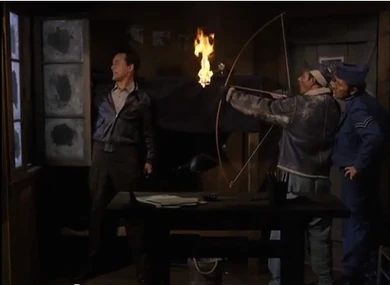
It's a little-known fact that the 1960s comedy Hogan's Heroes featured an American Indian among its characters:

Here's the show if you don't know it:

Hogan's HeroesHogan's Heroes is an American television sitcom set in a German prisoner of war (POW) camp during World War II. It ran for 168 episodes from September 17, 1965, to April 4, 1971, on the CBS network. Bob Crane starred as Colonel Robert E. Hogan, coordinating an international crew of Allied prisoners running a Special Operations group from the camp. Werner Klemperer played Colonel Wilhelm Klink, the incompetent commandant of the camp, and John Banner was the inept sergeant-of-the-guard, Hans Schultz.And here's the episode that identified Technical Sergeant Andrew J. Carter as a Sioux Indian:

Hogan's Heroes: Season 3, Episode 30
Drums Along the Dusseldorf (30 Mar. 1968)A German truck carrying an experimental jet fuel is the latest target for Hogan and his men. But when all efforts to sabotage the shipment fail, Carter gets down to business with the remaining weaponry at hand--a bow and arrow.You can watch the whole episode here:


Analysis

When Carter gets a letter from home addressed to "Little Deer Who Goes Swift and Sure Through Forest," he reveals that he's a quarter Sioux. The others tease him unmercifully with stereotypical comments.

Fortunately, the teasing isn't mean-spirited. Rather, it comes across as the usual good-natured banter you'd expect from insensitive soldiers.

Carter scowls at the stereotypes, which helps the audience understand they're not true. It becomes clear that no one thinks less of Carter or treats him differently because he's an Indian.

Sgt. Schultz also is filled with stereotypical ideas about Indians. But he's happy to meet an Indian like the ones he's seen in the movies. He eagerly wears the headband Carter gives him.

Col. Klink pretends not to care, but even he tries on the headband in the end. This German fascination with Indians is more than plausible. Although the episode doesn't say so, Schultz and Klink may have grown up reading Karl May's books and dreaming about cowboys and Indians.

Carter's archery is explained as something he learned back home. Since he was a Boy Scout, he could've learned it from either side of his heritage. It's not a stereotypical "he's an Indian so he must know how to shoot an arrow."

I'm not sure 1960s audiences would've known all the stereotypes were false. Or that they would've believed Carter was an Indian. But it was a dramatic change to present an Indian as a regular guy who didn't wear "leathers and feathers." Even more, as someone who wasn't a dark-haired and dark-skinned "other." Who could, and did, pass for white.

Source

Where did the writers get the idea to make Carter an Indian? Probably from the fact that Larry Hovis, the actor playing him, was an Indian:

Larry HovisOn the Hogan's Heroes series, his character, Sgt. Carter, was suppose to be a Sioux; in reality, Hovis was a member of the Yakima nation. In one TV show, Alice, he played a Native American detective who arrests a fake Native American.

For more on the subject, see TV Shows Featuring Indians.

February 15, 2015

Battle of Little Bighorn in Twilight Zone

I saw this Twilight Zone episode for the first time a couple of years ago.

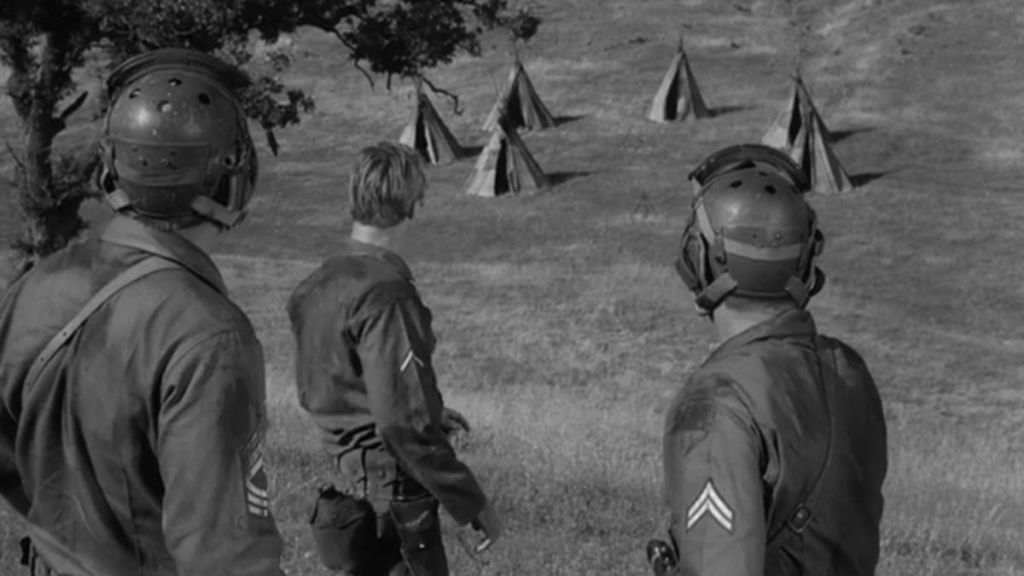
The 7th Is Made Up of Phantoms[T]hree United States Army National Guard soldiers (MSgt. William Connors, Pvt. Michael McCluskey, Cpl. Richard Langsford) are an M3 Stuart tank crew participating in a war game being conducted near the Battle of Little Bighorn, the site of Major General George Custer's last stand. Their orders coincide with the route of Custer and his men. As they follow the route, they hear strange things such as Indian battle cries and horses running. As nobody is there, the men examine the possibilities. Connors wonders if they've somehow gone back in time. When they return, Connors reports to his captain what occurred and is reprimanded. The following day the trio goes out and again begins to experience strange phenomena. The captain contacts them via radio and orders them to return to base when Connors tries to explain what is happening. Connors breaks contact and the captain sends his lieutenant and two men to bring them in. However, the tank crew abandon their tank and continue on foot with their side arms and rifles. They find a group of teepees and McCluskey goes to investigate; he soon returns with an arrow protruding from his back. The men climb a ridge where they see a battle taking place below. They join it and are never seen again.

Later, the captain enters the Custer Battlefield National Monument. A soldier reports that all they found was the abandoned tank. The two of them notice the names of their missing soldiers on the monument with the names of Custer's men. The captain states that it was a pity the missing soldiers couldn't have taken the tank with them to the battle.


Comment:  Alas, this episode doesn't include any Indians. Not even Latinos, Italians, or Greeks dressed as Indians.

The captain has the best line when he says to Connors:And if you meet any Indians...if you meet any Indians, will you take it very slow? Because they're all college graduates and they're probably running tests on the soil.So we know the episode has a somewhat modern sensibility. And kudos for including two black soldiers, including Greg Morris (soon to star in Mission: Impossible).

But a few odd things:

  • The "group" of tipis consists of six of them--no Indians, horses, campfires, or anything else. In reality, the Indian camp had some 2,000 lodges. I know that was beyond the budget of The Twilight Zone, but this is ridiculously small.

  • McCluskey approaches the "village," is out of sight a few seconds, and then appears and calmly ascends the slope. Only then do the others realize he has an arrow in his back.

    This is silly on several fronts. Why would Indians shoot an arrow in the confines of a tipi rather than, say, use a knife? Why would they attack a lone, unarmed stranger at all? How did it happen without a single outcry or shout of pain? Why did the Indians let McCluskey go? How is he able to function with an arrow in his back? And why is there no arrow the next time he's shown?

  • A reviewer agrees:

    The Twilight Zone: “The 7th Is Made Up Of Phantoms”/“A Short Drink From A Certain Fountain”It’s not much of a village; just a cluster of maybe a dozen teepees, with no living being in sight. McCluskey (the young one of the three) takes it at face value and offers to go scout the area. Now, this doesn’t make a whole lot of sense: it’s broad daylight, there’s no cover, and the three men are already standing no more than a couple hundred yards from the “village.” By this point, Connors and the rest believe that they’re on the trail of General Custer on his last doomed assault against the Sioux, and they’ve decided they’re going to join up with Custer and the others and fight alongside them. So if they believe enough to consider that the Native Americans are real, and that they’re dangerous, why would McCluskey go wandering over without any real reason or protection?

    He gets an arrow in the back for his troubles (although for once, this isn’t immediately fatal), and it’s ridiculous, but it’s also deeply creepy in a way that a more conventionally structured sequence would not have been. We never see a single Native American throughout the episode, just the effects of their passing, and as unfortunate as the story’s politics are (it’s weird to see something these days that treats “fighting alongside Custer” as a worthwhile and heroic goal), that lends the whole half hour a general air of creepiness that makes it compelling even when the writing fumbles.
    The last stand

    Actually, the soldiers haven't decided anything yet. They stumble over a ridge and see the battle in progress. They check their weapons before Connors shouts:All right, fellas...let's do it!This leads to the key point:

  • The soldiers are excited by the battle they see off-screen and say so--but they don't say which side they're eager to join. Would they have been thrilled to die within minutes like the rest of Custer's regiment? Or would they have preferred to help the Indians kill their fellow Americans?

    If the Indians stripped the soldiers of their gear, leaving only their dog tags, the soldiers would've looked like anyone else. Those who surveyed the battle site would've assumed they were part of Custer's troops. So their choice isn't clear.

    I guess the names on the monument imply they joined Custer. It's just funny that no one is willing to say it.

    An earlier exchange offers an alternative and shows the episode's ambivalence:LANGSFORD: All right, Connors. Okay, let's say, let's say that you're right. Let's say that this thing is happening just like you said it is. Let's say that we're gonna follow this trail, just like, uh--well, just like they did it, huh?!

    LANGSFORD: Now what I wanna know is, what's gonna happen next?

    CONNORS: We're gonna wind up at a massacre. That's what.

    LANGSFORD: You gonna stop it?

    CONNORS: Yeah. Stop it, or ... join it.
    In 1963, when this episode was made, people were beginning to realize that the Indians were right and Custer was wrong. Perhaps Serling or someone understood it would sound bad to cheer the killing of Indians. So they filmed the episode but left out any references to aiding or opposing Custer.

    Anyway, I agree this episode is flawed. The producers spent too much time on the opening and not enough on the ending. They should've handled the Indian "village" differently--said it was an outlying camp, and shown arrows fired from afar and missing the soldiers.

    Most important, they should've said which side the soldiers were joining. Either way, it would've made for a provocative message. Viewers could've learned a lesson about doing the right thing...or the wrong thing.

    P.S. You can see images from the episode here:

    The 7th is Made Up of Phantoms--Quotes and Sound Clips

    Below:  McClusky foolisly goes to scout the Sioux "village."

  • January 08, 2015

    "Heyoka" beer offends Lakota

    Half Acre Changes Name of Heyoka Brew After Complaints by Native Americans

    By Patty Wetli and Mark SchipperHalf Acre has renamed its Heyoka India Pale Ale brew after receiving complaints from members of the Native-American Lakota people.

    The brewery's founder Gabriel Magliaro said the name change for the "hugely popular beer" was motivated by outreach from "dozens" of members of the Lakota community who found use of the word in this context offensive.

    "I’m not sure who exactly got word of it in the community, but it was a pretty effective initial onslaught of reaching out to us in a lot of different ways," Magliaro told DNAinfo. "We were able to have a lot of very positive conversations, and it was actually just as much positive feedback ... [as] there was initial concern or negative comment."

    Magliaro says he was originally drawn to the Lakota word out of "fascination" with "the contrarian aspect" of the spirit it represents.
    Chicago Brewery Renames 'Heyoka' Beer to 'Senita' Following Talks With AIM

    By Simon Moya-Smith"What a heyoka is ... is a healer," a Lakota elder who asked to remain anonymous told ICTMN. The elder requested to be unidentified because heyokas--thunder beings--are, themselves, publicly unidentifiable, he said. They cannot tell people they are heyoka.

    "Nobody is supposed to know who we are. That's why we wear the mask," he said. "[We] see the world with different eyes. [We] don't walk in balance; [Heyokas] walk out of whack because [they are] tasked with seeing the world as it is--out of whack. ... The word translates to 'sacred clown'."

    Walter "Greywolf" Ruiz told The Chicago Tribune that to name a beer 'Heyoka' is highly offensive given the impact of alcoholism in Indian country since Europeans first introduced alcohol to North American indigenous communities.

    "Heyoka is a very, very important figure and very sacred," Ruiz told Josh Noel of the Tribune. "Considering the devastation alcohol has caused for [N]ative people, it was a slap in the face. It was like naming a beer after the pope, or Jesus beer."
    Comment:  Another failed attempt to link Indians who represent wildness and savagery with alcohol.

    If it isn't obvious, being contrary is a mild form of being wild. It's the same sort of counterculture, anti-authority message embodied in Indian-skull t-shirts and hipster headdresses. Be bold and contrary and drink Heyoka India Pale Ale, even though you're not supposed to!

    An extra demerit for the Heyoka container art that shows cacti. Lakota and cacti? No, the Lakota don't live out in the desert, far from civilization, where they practice their contrary cultures and religions.

    August 09, 2014

    Natives protest Nugent in Sturgis

    Michael Ballard Owner of Full Throttle Saloon in Sturgis Says He Won't Invite Ted Nugent Back To Lakota-land

    By Somos IndependentsTed Nugent is banned from performing at the Sturgis, South Dakota Full Throttle Saloon Bar moving forward.

    Michael Ballard who has a net worth of $5 million dollars and owner of Full Throttle decided profits over principles in Lakota country in Sturgis, South Dakota. Pretty cheap and pathetic if you ask me. Even though he is a millionaire and could have done the right thing aside from the $150,000.00 he had his eyes on with the Ted Nugent concert, he is on record via Lakota Territory News TV where he states:

    Nugent has made headlines recently after two casinos canceled concerts with him, citing racist remarks. The Full Throttle Saloon had Nugent on the schedule for the main stage Wednesday night. Local Native Americans gathered around the Saloon with signs to protest him.

    James Swan, president of The Urban Warrior Society, says he's protesting Nugent over accusations that Nugent called natives 'unclean vermin.' "Ted Nugent, you're a slob. You're an evil, horrible being, and Native Americans don't want you to like us," said Swan. "We don't want you to wear our head dress, we don't want you to act like you're native, because you're not."
    Smells Like Ted Nugent: Rocker Criticizes 'Stinkyass' Native Protesters

    By Christina RoseProtesters came to Sturgis from almost all of the reservations in South Dakota, including Pine Ridge, Rosebud, Cheyenne River, Standing Rock, Crow Creek and Lower Brule as well as Rapid City. It went well, according to Doug Bissonette, Lakota, who drove up from Pine Ridge to attend. “It turned out pretty good, a lot of bikers gave us the thumbs up," Bissonette said. "The owner said he kind of regretted it (hiring Nugent) and wouldn’t do it in the future.”

    Indeed, Full Throttle owner Michael Ballard stated that had he known sooner about the protest and comments Nugent has been making, he wouldn’t have booked him. But for financial reasons, the show would go on. "I can't turn around and walk away from $150,000," Ballard told KOTA. "I mean that's the nuts and bolts of it. Now that we're made aware of it, we'll listen to it next time."

    The only reported negative incidents at the protest occurred when a jeep went by the protest and occupants called out, “FU!” to the protestors. “That and a couple of guys tried to come out of the concert to come after us, I think they were drunk,” Bissonette said.

    James Swan, Lakota, founder of the United Urban Warrior Society of Rapid City, South Dakota, said people came from Wisconsin, as did a couple from Hawaii who were caravaning their way from Bear Butte, a sacred place of prayer that stands imposingly just two miles outside of Sturgis.

    “There was a really good turnout,” Swan said. “My message to Nugent was, he is not welcome in Indian country. We asked him to quit wearing a headdress, and running around in a loincloth. Wearing the headdress and using foul language, it’s disgracing us. He just doesn’t get it, he said nobody minds if he wears the Green Bay Packers t-shirt.”

    June 21, 2014

    Obama's #PrezRezVisit

    Trending in Indian Country: "PrezRezVisit" Gained National Attention

    By Vincent SchillingOn June 13, As President Barack Obama and the First Lady Michelle Obama made their way to visit the Standing Rock Sioux Tribe in North Dakota and meet with Tribal leaders, ICTMN and Indian country took the #PrezRezVisit hashtag Twitter Ball–and ran with it.

    Within hours of first introducing the hashtag on Thursday, via a tweet by this correspondent @VinceSchilling, Thousands and thousands tweeted about the excitement, cautious optimism and speculation about President Obama and the First Lady’s visit.

    Shortly before President Obama was to land in North Dakota, the #PrezRezVisit hashtag had gained such steam and recognition, The Washington Post’s Abby Phillip reported on the “cautious hope” Native Americans were expressing.

    “[O]nline, Native Americans have been determined to keep the conversation alive. More than 5,000 tweets with the #PrezRezVisit hashtag have been sent out so far, after the trend was started Thursday by Indian Country Today correspondent Vincent Schilling,” Phillips wrote in The Washington Post.

    Immediately after posting of the tweet, Indian country and supporters jumped into action on #PrezRezVisit which only gained traction as the time for the President’s and First Lady’s arrival loomed closer. Within hours, the hashtag was trending in such places as Chicago, Philadelphia and Canada.

    In addition to attention from The Washington Post, MSNBC’s Ed Show also dedicated a segment to Obama’s visit and the popularity of the #PrezRezVisit Hashtag.
    Comment:  Rather than cover this visit in Newspaper Rock, I tweeted and retweeted about it using the #PrezRezVisit hashtag.

    The event didn't generate a lot of hard news. Most of the news value was in the announcer's poking fun at the Obamas and their interacting with the Lakota, especially the children. Twitter was a great tool for that.

    April 23, 2014

    Pointing with Lips is "powerful"

    Press Release: Rez Sensation Pointing with LipsNative American publishing collective Blue Hand Books has announced that Dana Lone Hill’s sensational fiction novel Pointing with Lips, A Week in the Life of a Rez Chick, debuts on Amazon.com and Kindle in early March 2014.

    Her first book is already creating a rez sensation with Indian Country media:

    “Dana Lone Hill is a powerful new voice from Lakota Country that has so often been confined to historical stereotype or painted in a contemporary setting with a one dimensional brush. Dana shatters those shackles and forms a deeply personal, raw and moving narrative that takes the reader deep into contemporary life on Pine Ridge Indian Reservation, one of the world’s most complex and engaging societies.” –Steven Lewis Simpson director of the Native films Rez Bomb, A Thunder-Being Nation & The Hub.

    “With so much literature out there attempting to portray authentic Native life, it is refreshing to have a work written from the perspective of someone who has actually lived it. This book is essential reading for those attempting to understand the life of Native people living in America.” –Brandon Ecoffey, editor, Native Sun News

    “It is rare that you come across a new voice as authentic as Dana Lone Hill. She writes with passion and determination about a side of America that few will ever see. But Lone Hill takes you there with emotion and raw power. Pointing With Lips is a startling debut.” –Paul Harris, The Guardian

    “Pointing with Lips by Dana Lone Hill just might be one of the best books I’ve come across—if not the best. A beautiful, entertaining, relatable, inspirational, and so-much-more read, Lone Hill’s poetic yet readable wording makes you feel as if you’re sitting attentively across from her, gripping a cup a coffee waiting for more.” –Patricia Stein, Urban Native Magazine

    “As her publisher, we are so thrilled for Dana and her first book depicting the Pine Ridge Indian reservation in South Dakota and the realities of living there,” Trace DeMeyer, founder of Blue Hand Books, said. “This book is a triumph for Dana and for her reservation relatives. It’s so real you forget its fiction, and that’s really good fiction.”
    “Pointing With Lips” by Dana Lone Hill

    By Sara Jumping EaglePowerful. I read the whole book in two days. I did not want to put it down. I laughed out loud and I cried. This book surprised me at every turn, kept me guessing. The main character of the book, Sincere, and her family, the “Strongheart” and “Rain on Shield” families, are in some ways–my family, my relatives, my friends–they are in some ways–me. The book, in an exciting and entertaining way, led discussions through a myriad of contemporary American Indian issues, discussions regarding the realities of Indian life. These are issues Indian families face every day–portrayed in a way which is not sugar coated, shown with a mean Indian woman reality. We can enjoy the rez humor we know and love, the crazy stories that are so “out there” as to be true, including those rez nicknames such as “Boogie” and “Two Times.” This rez humor that helps us live and survive the pain of a world where weekly funerals and years per life lost dominate, the humor that shows that hope lives even while acknowledging the reality of shortened life spans due to health disparity and socioeconomic poverty culture. One of my favorite lines of the book seems to say it all–“maybe I was born pissed.”Native Sun News: Dana Lone Hill depicts rez life with debut book

    By Brandon EcoffeyFinding books about Native people is fairly easy. They are a dime a dozen. Finding a book written about Native people written by someone from an actual Indian reservation is a rarity. A book titled Pointing with Lips by Dana Lone Hill hopes to fill that void.

    The debut release from Lone Hill is a fictional story set on the very same Pine Ridge Indian Reservation where she was born and raised. The book portrays the life of a single Oglala mother struggling to raise her children amidst the chaos, struggle, and beauty that accompanies being a resident of the reservation.

    “The inspiration (for the book) definitely came from two best friends of mine. We would sit around and watch seasons of Sex & The City and talk about having a rezzed out version of the show,” said Lone Hill.

    The author who has written for several publications across the world including Native Sun News, The Guardian, Last Real Indians, LA Progressive, and her blog justarezchick has had the privilege of interacting with many people from multiple cultures. Thus creating an image of reservation life that was both authentic and understandable by the larger population was important factor in the formulation of the plot.

    February 05, 2014

    White men don't understand America

    An excellent quote from Ota Kte aka Chief Luther Standing Bear, Oglala Lakota:The white man does not understand the Indian for the same reason that he does not understand America. He is too far removed from its formative processes. The roots of the tree of his life have not yet grasped the rock and soil. The white man is still troubled with primitive fears; he still has in his consciousness the perils of this frontier continent, some of its vastnesses not yet having yielded to his questing footsteps and inquiring eyes. He shudders still with the memory of the loss of his forefathers upon its scorching deserts and forbidding mountain tops.

    The man from Europe is still a foreigner and an alien. And he still hates the man who questioned his path across the continent.

    But in the Indian the spirit of the land is still vested; it will be until other men are able to divine and meet its rhythm. Men must be born and reborn to belong. Their bodies must be formed of the dust and their forefather's bodies.

    December 17, 2013

    Chamberlain rejects Lakota honor song

    Chamberlain board again rejects Lakota honor song

    It may be performed at an assembly, superintendent says, but not at graduation

    By Nick Lowrey
    The Chamberlain School Board for a second time has voted against allowing a Lakota honor song to be played during the district’s high school graduation ceremony.

    The seven-member board voted 4-2 with one member abstaining for conflict of interest.

    District Superintendent Debra Johnson said that she and Chamberlain High School’s principal, Allen Bertram, have been working to devise an all-school assembly to be held each spring that will include an honor song for seniors.

    “We will have an honor song at our school, but it won’t be at graduation,” Johnson said.
    OUR VIEW: Arguments thin against honor song for IndiansAfter students this May petitioned the board anew on the question, trustees rejected the proposed three-minute song, 6-1. Board president Rebecca Reimer argued that most schools with large Indian populations allow either a “feathering” ceremony (where graduates wear ceremonial feathers) or an honor song, but not both, and that the district has done and continues to do more for Indian students than any other minority group over the years; and board member Casey Hutmacher said he did not see how a song not in English “honors everybody.”

    Then, in November, the board revisited the issue and again rejected it, this time 4-2, citing language differences and length of the existing graduation program, as well as concerns that authorizing the song would give the appearance of favoring one culture over another.

    None of these arguments seems particularly germane or compelling.

    “Because we have never done it” is a clichĂ© non-argument. The feathering ceremony, new this year, was held for Indian students earlier and separate from Chamberlain High’s baccalaureate, so it should not be linked to this discussion. Worry that an added three-minute song would cause the graduation time schedule to become unwieldy seems thin. And, finally, to imply that the Lakota language is somehow a foreign tongue that has no place in a Western American school, even in a wholly positive application, is, at best, petty. Lakota was spoken here before whites arrived; it is an inescapable, and valuable, part of the American historical experience. Surely, we can find it in our hearts to be enriched and not threatened by a Lakota honor song.

    Possibly the most pertinent statement in this entire controversy was from board president Reimer, who said the issue is not about students, academics or even the song. “It’s about control and power. It’s about control and power,” she said, twice. “I’m extremely disappointed in a handful of people.”
    Is Racism Behind Banning of Honor Song From Graduation Ceremonies?

    By Christina RoseA history of racism lurks in the shadows of Chamberlain, South Dakota’s past, and many see the Chamberlain School District’s refusal to allow the Honor Song to be played at graduation (again) as evidence of that continuing disrespect.

    A letter from 1954 has resurfaced, written by then Mayor Herschel V. Melcher, who wrote that the people of the city of Chamberlain are opposed to “having Indians in our schools or living in the unsanitary conditions about the city.” “We have no intention of making an Indian comfortable around here, especially an official,” Melcher wrote.

    Attached to the letter is a resolution refusing to allow tribal offices in the town. The resolution was signed by Commissioners O.L. McDonal, Frank G. Knippling, Willard A. Wilin, and R.C. Martin. The letter was in opposition to relocating the Indian Office from Fort Thompson, South Dakota to Chamberlain.

    No one involved in the quest for the Honor Song believes that the entire town of Chamberlain is as blatantly racist as it was more than half a century ago. However, there is a prevailing assumption that the tug-of-war over a song to honor all students is at least partly due to the racist history of the town.
    Comment:  For more on the subject, see Crow Creek Sioux Boycott Chamberlain and Tribe Threatens Boycott Over Honor Song.

    Below:  "Students and supporters of last year’s Honor Song gathered outside the Chamberlain Armory in front of the graduation procession and played the Honor Song for the graduates. They will do so again this year." (James Cadwell)

    November 17, 2013

    Loup-Noir

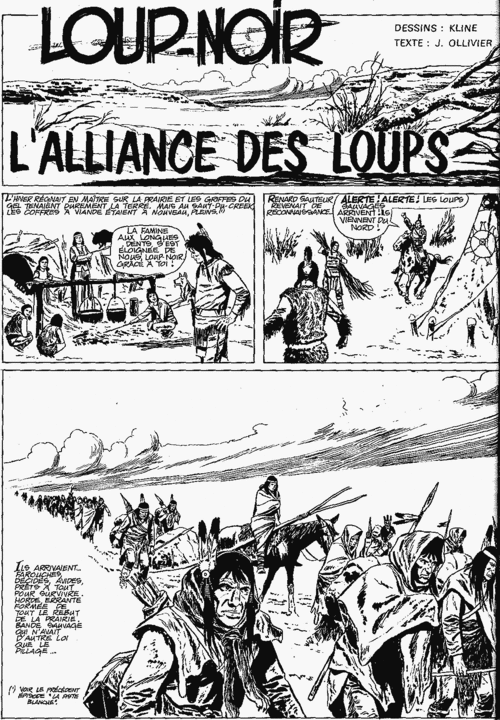
    A French comic book featuring Indians:

    Black Wolf is definitely an orphan

    By BdzoomEight years after the death of Jean Ollivier, the creator of the "Black Wolf" series (published in Pif-Gadget) is its graphical father, Roger Chevallier alias Kline, who died on 16 May [2013].

    Kline
    Roger Chevallier
    (3 June 1921-16 May 2013, France)
    In 1960 he commenced working for Vaillant, where he drew series like 'Davy Crockett' (until 1969) and 'Loup-Noir' (1969-1980), both written by Jean Ollivier.

    In other words, writer Jean Ollivier and artist Kline created "Black Wolf." Ollivier died eight years ago and Kline died recently, making Black Wolf an "orphan."

    The first sample of Loup-Noir looks okay. But in the second sample, is that a Northern Plains youth running from a Central American jaguar? Um, I don't think so.

    November 11, 2013

    Crazy Horse play lacks drama

    Crazy Horse, Custer and no drama

    By Marcus CrowderIt’s tempting to call Jon George’s new play, “Crazy Horse and Custer,” a dramatic reading with costumes and props. That would imply the world premiere at the Sacramento Theatre Company’s intimate Pollock Stage was in fact dramatic. It is not.

    Of course, the characters Crazy Horse, who tells us that his name literally translated really should be “His Horse Is Crazy,” and Col. George Armstrong Custer, who allows he graduated last in his class at West Point, have intertwined legacies that culminated in the famous Battle of the Little Bighorn in June 1876 in eastern Montana Territory.

    Like a diorama come stiffly to life in the progress of the play, they give laborious accounts of their divergent backgrounds, which ultimately lead to the shared destiny.

    Playwright George seems intent on humanizing these outsized figures of American history, but the two-character production is so static and the nominal story so still that you could attend a tax code lecture with more animation. The author in a playbill message writes that he has written “neither myth nor is it history,” but “an entertainment.” If only it were so. Despite the best efforts of actors Louie Leonardo as Crazy Horse and Kirk Blackinton as Custer, the production boxes the audience into two long autobiographical stories with no conflicts, revelations or resolutions.

    The actors are rarely on the stage together but instead address the audience directly, speaking from beyond the grave as if to set the record straight about what we don’t know about them.

    Leonardo has the tougher job as he is saddled with the stoic, humorless Crazy Horse, who painstakingly recounts his life as a young mystic and warrior in training, a man “who could explain the unexplainable to those who could not.”

    The extant legend of Crazy Horse is that of a visionary whose supernatural aura was a protection in battle. George transposes this into a more studied behavior calculated to unnerve adversaries.

    He also informs us there is no room for criticism because he has “consciously reconstructed to fit the needs of my fancy.” There is also a heavy message coda about the sad fates of American Indians tacked on to the end. Can we say it is a long, dull slog regardless of his best intentions?

    Crazy Horse mostly wants to be left alone as an existential thinker and thoughtful observer of the superficial beings around him. The “white man” comes in for lot of condemnation, but Crazy Horse’s American Indian peers don’t really measure up in his estimation, either.
    Comment:  There's no reason Crazy Horse should be stoic and humorless, of course. Most Indians aren't like that.

    Nor is there any reason for him to disparage his own people. This seems like a white man's conceit: that Indians are defeated and downtrodden today so a historical play should reflect that.

    But as Cutcha Risling Baldy said in her review, today's Indians aren't defeated and downtrodden. After centuries of injustice and oppression, they're on the road to recovery.

    Sure, Crazy Horse might be upset that they aren't hunting buffalo or fighting the white man to the death. But he might be proud that they've survived and adapted.

    Since he himself surrendered to the US Army, I suspect he wouldn't judge his people harshly. He did what he had to do and so have they.

    Below:  "Louie Leonardo, left, is Crazy Horse and Kirk Blackinton is Custer in Jon George’s new play Crazy Horse and Custer, running through Dec. 15 at the Sacramento Theatre Company’s Pollock Stage."

    November 09, 2013

    Lots of Lakota documentaries

    A rant I posted on Facebook three months ago:

    Hey, documentarians: How about visiting a rez besides Pine Ridge and reporting on the beauty, culture, dances, kids, and basketball there?

    Right now the tally seems to be roughly Pine Ridge 7, Navajo 3, other 564 tribes zero.

    Let the discussion begin

    This led to a discussion with my Facebook friends:Although I agree, more coverage of the healthy aspects of the people is important, I don't feel we've seen enough of the continuing negative impact of this society on the natives.I'm all for looking at mainstream society's impact on Native nations. My point is that there are many, many ways to do that besides the obligatory visit to Pine Ridge.Yeah!!I think I'm watching the third PBS special in a row whose theme is, "Native Americans have a rich culture and history, but we know little about them. To remedy this, we decided to visit Pine Ridge...."

    It's the 2013 version of the century-old stereotype that Indians are all about chiefs, warriors, tipis, and buffalo. Uh, no.

    Heck, put the names of the 566 tribes in a hat and pick one at random. Anything but the umpteenth article/video/Johnny Depp drive-by.

    What's up with Lakota docs?

    If you didn't know anything about Indians until you visited Pine Ridge, and now you're all about helping the Lakota, I have to wonder about your motives. You're ignoring about 98% of the story by focusing your attention in one place.Anyone who wants to film a documentary on Indians really ought to come to AZ. We have "urban" reservations (three, at least, right by Phoenix), and last week I was up north in the White Mountain Apache reservation, which is in a beautiful forested area. Of course, we have the Navajo completely surrounding the Hopi reservation, which I always thought was odd. Plus, of course, there are several Indians who go to Norah's school who don't live on reservations. It's a smorgasbord!Right, although I think the Navajo Nation is also overrepresented. But if you want a lot of tribes in one region, try Oklahoma, Arizona, or New Mexico. Or Southern California.If someone wants to see modern Native Americans, the story can be found in one or all of the 39 Nations/tribes in Oklahoma. As I always say, the best kept Native secrets are in Oklahoma.For more on the subject, see Bridge the Gap and Born to Explore and Pine Ridge Gets Media Attention.

    November 08, 2013

    Natives protest Crazy Horse play

    'Crazy Horse and Custer' Play Opens Saturday Amidst Protests

    By Christina RoseThe theatrical production of “Crazy Horse and Custer” opens Saturday in Sacramento, California, and will be accompanied by drumming, protests and prayers. The Sacramento Theatre Company has received emails and calls from innumerable sources criticizing the play. The theatre says the play has been modified and many of the issues have been addressed.

    The new version of the play was reviewed and while there have been changes, some of the original problems still exist.
    To be specific:The script changes that have been made do not change the main fact of the play: Crazy Horse is still dead and the scaffold is still on the stage. First and foremost, Crazy Horse’s family insisted that Crazy Horse cannot be a spirit, and while he no longer comes down from the scaffold, he still admits on stage that he is dead. Because of this, the family said there could have been no further dialogue.

    ICTNM’s previous reporting of this story raised the ire of activists and provoked strong emotions in Terry Marie Varela, a Sacramento resident and enrolled Oglala Lakota, who is a member of the San Francisco Idle No More. She has set up a Facebook page for the protest called Raising Our Voices Against Native Exploitation.

    Varela was most offended by Crazy Horse’s repeated reference to Lakota ways as superstitions.

    The new version of the script no longer references Lakota ways as superstitions, but it still speaks condescendingly of the Lakota people. By saying things like, “We fought foolishly as always.” Crazy Horse and the Lakota are referred to as “savages” by Custer, which surely reflects Custer’s language. However, there is little balance in historical facts from a Lakota perspective and the misrepresentation of spirituality is rife even throughout the new script.

    Tom Gillies, a Sacramento man, attended a preview of the show and said, “The author was lazy.”

    At the end of the play, Crazy Horse calls Custer, “A compelling man,” giving him more respect than he has shown his own people throughout the show.

    “The whole play was bookended by a bad feeling at the beginning and at the end,” Gillies said. “I went in there with a neutral view, and I wanted to be convinced it wasn’t a piece of crap, and it was.”


    In Which I Go See "Crazy Horse And Custer" So You Don't Have To--a play review (-- for Crazy Horse --)

    By Cutcha Risling BaldyI thought I could actually be surprised about this play because I--am an optimist. People surprise me all the time. But, as my disclaimer comes to a close I will end with this--

    I went to see the play “Crazy Horse and Custer” at the Sacramento Theatre Company on November 6, 2013. The play was still in preview. I bought my own ticket. I had an open mind. The theatre people were nice enough to hold the start of the show to wait for us as we came running through the doors. I sat next to my good friends in an uncomfortable seat and the theater was intimate, the space was interesting, the mood was excited. The lights dimmed, the music started, I sat through two full hours… and in the end I must say, in all honesty, I left--offended.
    To be specific:Custer wasn't my problem in this play. Crazy Horse wasn't the problem in this play. The writing was a problem. Having Crazy Horse call Custer a “compelling man” (UGH) and not a “psychotic, homicidal, genocide inflicting war criminal" who, would he have survived to become President (because, yeah, yeah, Custer, you would have been President, blah, blah, blah) would have continued his reign of terror against Native people, just because--he’s an asshole, that’s a problem.

    And an even more significant problem is that we go through two acts of this play and there is very little, if any (I can’t think of any) mention of the genocide of Native peoples. We hear from the beginning about the mutilation of white soldiers at Little Big Horn by Lakota people, but nothing about the murdering, raping, torturing, starving, war against Indian peoples.
    And:I suppose the one thing I can’t get out of my head, that thing I woke up the next day repeating was the last line of the play. At the very end of the play Crazy Horse is left on stage alone and he pulls back a curtain to reveal the Pine Ridge Reservation, supposedly, maybe, the “modern” Pine Ridge--a trash filled, barren, wasteland. Crazy Horse cries. He says “The Lakota have nothing.” He calls this place the “pitiful remnants” with pennilessness, depression, and “despair of an empty life.”

    And he says “The Lakota are finally defeated.”

    Before he turns his back on us and mutters. “It is better to be dead.”

    It is better to be dead.

    Did this play, did this author, did Crazy Horse just tell me, a living, breathing, singing, dancing, loving, laughing, joking, mothering Native woman that it is better to be dead than the Native person that I am? Did Crazy Horse just tell me, he would rather be dead, than to be a part of the living, breathing, singing, dancing, loving, laughing, joking, mothering, fathering, grandparenting, Lakota people?
    Comment:  Writer Christina Rose consulted with me before finishing her article. I suggested contacting Cutcha Risling Baldy.

    Below:  The playwright's note.

    September 28, 2013

    Cowboy shoots Indian on billboard

    Billboard at 19th and Baltimore causing controversy

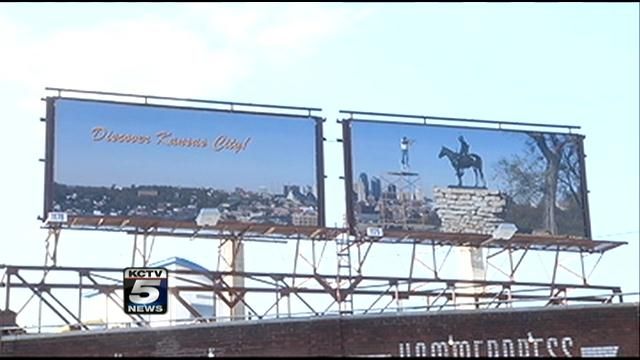
    By Laura McCallisterA billboard is getting a lot of attention at 19th Street and Baltimore Avenue.

    A local artist posted a picture of a man standing on scaffolding and pointing a rifle at Kansas City's famous statue called The Scout. The actual statue is about 10 feet tall, was created by Cyrus E. Dallin and depicts a Sioux Indian on horseback surveying the landscape.

    It overlooks downtown Kansas City.

    A number of groups are calling the artwork offensive to Native Americans.
    More on the statue:

    The Scout (Kansas City, Missouri statue)The Scout is a famous statue by Cyrus E. Dallin in Kansas City, Missouri. It is more than 10 feet tall, and depicts a Sioux Indian on horseback surveying the landscape. The Scout was conceived by Dallin in 1910, and exhibited at the 1915 Panama–Pacific International Exposition in San Francisco, where it won a gold medal. On its way back east, the statue was installed on a temporary basis in Penn Valley Park. The statue proved so popular that $15,000 in nickels and dimes was raised to purchase it through a campaign called "The Kids of Kansas City." The statue was dedicated in 1922 as a permanent memorial to local Indian tribes.

    Comment:  Before we even get to the billboard, The Scout has a few problems:

    1) Missouri wasn't part of the Sioux's historic range.

    2) A Sioux Indian doesn't honor the local tribes because the local tribes aren't Sioux. That's like having a statue of a Norwegian to honor the French.

    3) The Indian is half-naked, which he might be in summer, but not in winter. Portraying him this way emphasizes his savagery--how different he is from "us," who wear clothes all the time.

    4) The Scout resembles another Indian sculpted by Cyrus Dallin: Massasoit. Indeed, it could be the same Indian. A Sioux scout shouldn't resemble a Wampanoag chief.

    The billboard

    On to the billboard. The shooting image implies that the Indian is anonymous, an enemy, someone who's less than human and deserves what he gets. Would anyone raise a billboard showing a cowboy shooting a black man? Then why is it considered acceptable to depict shooting an Indian?

    Answer: Because Indians hold a unique place in our national mythology as "the other." They're our arch-nemesis: the human "wolves" we tamed to "found" America. As with Elmer Fudd or Wile E. Coyote, they exist only to provide sport for us--or so we think. We can imitate, mock, and insult because we consider them cardboard characters from history, not real people.

    September 12, 2013

    Native movies of note--September 2013

    Editorial: Film provides true look into reservation communityPride and Basketball is a documentary that highlights the role that basketball plays for the community of Lame Deer, Mont. located on the Northern Cheyenne Reservation, as told from the perspective of current players, past greats, and community members. Pine Ridge: Venice ReviewThe Bottom Line
    A familiar style of magic-hour ethnography yields some entrancing and unflinching visions of American margins.
    ‘Bury My Heart With Tonawanda’ selected for two film festivalsIt is the story of a young man with Down syndrome who escapes while being transported to a home for the insane in the late 1800s and finds his way into Western New York’s Native American community.

    September 03, 2013

    Hoka! Coffee on Pine Ridge

    HOKA! Coffee is a-brewing on the Rez

    By David MichaudSome people are lucky enough to find a job that stimulates their passions, Sharice Davids just happens to be one of those people.

    Sharice’s recently created a coffee company on the Pine Ridge Indian Reservation. Taking inspiration from the Lakota language she decided to name her company Hoka! Coffee.

    “I made a list of things I am passionate about and there were just a few things on it–economic development in Indian country, martial arts and coffee,” said Davids.

    To this point in time Hoka! has been attempting to spread their name throughout the reservation by making appearances at various events. The first event Hoka! appeared at was the OLC graduation pow wow and after that they attended Oglala Nation Pow Wow, with great results.
    Comment:  For more on Native coffee businesses, see Chukchansi Coffee Company and Tribal Grounds at Mitsitam Coffee Bar.

    Below:  "Sharice Davids poses in front of her booth at the Oglala Nation Pow wow."

    September 02, 2013

    Lewis and Clark in Drunk History

    Drunk History: There's Nothing Funny About Violence Against Native American Women

    By ElissaI’ve recently grown to love Drunk History. There’s nothing like the narration of a filter-free lush on the brink of a blackout to underscore the absurdity of Our Nation’s History, the kind that becomes fables in our young heads as soon as we’re old enough to memorize facts from textbooks. Drunk History is a Comedy Central series that presents drunken storytellers—comedians and other personalities—recounting historic events, with which historical reenactments are paired.

    I was curious to see what Drunk History would do with the story of Lewis and Clark’s journey in the recent “Nashville” episode, which aired on August 27. As a lecturer of American Indian Studies at the University of Washington, I teach classes on literature and film, most recently a class on the representations of Native characters in the Twilight Saga.

    The Drunk History treatment of the story of the Lewis and Clark Expedition was appalling. Yes, Drunk History has established a track record of using “mature” language—the people are wasted. They swear. Yes, the storytellers fudge the facts—that’s part of the point, and serves as a reminder that history is created by a massive chorus of voices, those with facts behind them and those without. But in narrating the Lewis and Clark segment, Alie Ward and Georgia Hardstark crossed a line from ribald to reprehensible.
    Some specifics:The Native people have arrived on screen inexplicably pumped for a fight. We know these guys are “(beep)holes” because they’re partially unclothed, which is pop culture parlance for savage. The Lakota Chief shows up (fully clothed, so we know he’s no barbarian), played by Pakistani-American actor Kumail Nanjiani. Do the producers mean to make a comment by casting a non-white, non-Native actor in this role?

    We’re told that “each of Lewis and Clark’s men got like four wives, for the night—like hookers.” “Like, I’m gonna check out these old hooker wives.” “And sure enough, everyone on the expedition, they got (beep) crazy STD’s.” The Native men are cast as pimps, the women as whores, and the white adventurers are just there to enjoy the bounty.

    Ward and Hardstark continue to narrate as Nanjiani reappears in the role of another Native man, this time donning the iconic headband in place of the headdress. Both pieces of costuming have been used throughout cinema’s history to erase the cultural distinctions among individual tribes, stripping us of our individuality and reinforcing a false notion of “pan-Indian” unity.
    Comment:  For more on Lewis and Clark, see Review of A Blackfeet Encounter and Manifest Destiny Comic Book.