Showing posts with label AIM. Show all posts

December 27, 2013

Carter Camp dies

1973 Wounded Knee Warrior Carter Camp has Walked On

By Levi RickertAmerican Indian Movement warrior and Wounded Knee ’73 veteran Carter Camp walked on Friday, December 27, 2013 in White Eagle, Oklahoma on the Ponca Indian tribal land. He was 72.

Carter, a tribal citizen of the Ponca Tribe of Indians of Oklahoma, died of complications of cancer which he suffered from for about a year, according to his brother, Dwain, who spoke with the Native News Online on Friday night.

Camp was thirty-two years-old and a major participate during the siege of Wounded Knee in 1973.

Prior to the 1973 Wounded Knee, Camp headed the Oklahoma AIM chapter. He participated in the takeover of the Bureau of Indian Affairs building in Washington, DC in November 1972.
In Memory Carter Camp, Ponca

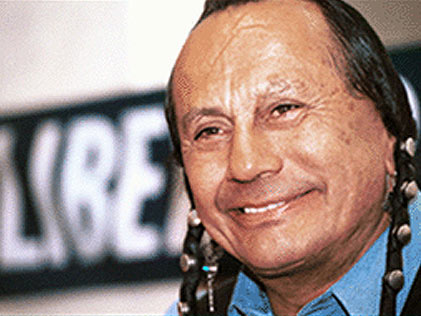
Below:  "Carter Camp on right with Russell Means and Nicole Panter at Wounded Knee in 1993." (Nicole Panter)

October 28, 2013

AIM protests "Redskins" in Denver

'Redskins' Are Set to Lose as Public Awareness Grows

By Carol BerryColorado activists confronted Washington fans and players with signs, handouts and slogans as they protested the name “Redskin” at the Denver Washington NFL football game yesterday. The activists blasted the Washington team’s name as racist and outdated as they marched outside Sports Authority Field at Mile High.

“We are here today to tell Washington owner Dan Snyder that his brand of racism might fly in D.C., but when the team comes to Denver, it is going to get push-back from Native people and our allies,” said Glenn Morris, leader of the American Indian Movement.'

The AIM, Idle No More and Denver activists protested against the team’s mascot with loud chants, “Hey, Dan Snyder, you can’t hide, you are on the racist side.”

Dozens of red signs calling on the Washington team to “Change the Mascot” were held aloft for the players to see as they walked by an area outside the stadium that was packed with police.
'It's always been about the hatred of Indian skin': Native Americans, allies protest Washington Redskins in Denver

By Simon Moya-SmithHundreds of people rallied in Denver on Sunday to protest the name of the Washington Redskins and to send a message to team owner Dan Snyder that the nickname is derogatory to Native Americans.

Two Native American organizations, American Indian Movement Colorado and Idle No More Denver, began the demonstration Sunday morning as the team prepared to kick-off against the Denver Broncos.
And:Tink Tinker of the Osage Nation and a professor of American Indian Cultures and Religious Traditions at the University of Denver, told the crowd that the issue demonstrates a history of racism toward Native Americans.

"It's always been about the hatred of Indian skin," he said.
So much for the asinine claim that white liberals are manufacturing this controversy and leading Indians by the nose. Why don't you walk to an AIM member and say it to his face? "You don't care about racism against your people. You're just doing this to be politically correct."

Whenever conservatives claims liberals are behind the name-change movement, which has been going on for decades, they're either ignoramuses or liars. Probably both.

Pelosi agrees with Obama

Meanwhile, House minority leader Nancy Pelosi is the latest high-profile person to come out against Washington's ethnic slur of a nickname:

Redskins should change name, Pelosi says

By Mike LillisRep. Nancy Pelosi believes the Washington Redskins should find a new name.

In an interview with The Hill, the California Democrat said it “probably would be a good idea if they change the name.”

The House minority leader is the latest politician who has embraced a name change. President Obama earlier this month said he would “think about changing” the team name if he owned the football team.

October 11, 2013

Activists: Vikings stadium should ban "Redskins"

New Vikings stadium may give leverage to opponents of 'Redskins' name and logo

By Tim NelsonA long-simmering controversy over the name of the Washington, D.C., NFL franchise is heading toward the Twin Cities.

Native American groups and supporters say the construction of a new Minnesota Vikings stadium offers a chance to put new pressure on the NFL to rethink the Washington Redskins name and logo.

Opponents, however, aren't appealing directly to the NFL, the Vikings or the Redskins. Instead, they want the state board building Minnesota's new stadium to ban the word Redskins on publicly owned signs or address systems at the new facility as well as one last time in the Metrodome when Washington plays here Nov 7.

"There are literally a score of federal, state, county, municipal laws in effect that all prohibit the offensive R word, just like the N word, from being used in an environment where the public assembles," said Alan Yelsey, an activist who helped make the request to the Minnesota Sports Facilities Authority.
Dispute over Washington Redskins name, logo flares up in Minnesota

By Associated PressMSFA Chair Michele Kelm-Helgen told the Star Tribune the board heard and understood those concerns when they were raised at last week’s meeting but that it’s too early to make a move.

“The NFL has very specific rules about what happens when teams play in our facility, and that’s what we’re looking at with the NFL and our attorneys,” she said. “At this point, I’m not even sure what our options would be.”

Stadium authority spokeswoman Jenn Hathaway said the board may have a formal response next week.
AIM Minneapolis Will Protest When Redskins Play Vikings November 7On October 14, two affiliated AIM (American Indian Movement) groups, the AIM of Twin Cities and AIM Patrol of Minneapolis, released a statement condemning the use of the name "Redskins" by the Washington NFL team, and soon thereafter announced plans for a public protest when the team comes to town for a matchup with the Minnesota Vikings.

For information on the protest, which will occur on Thursday, November 7, visit the event's Facebook page. You can also follow related developments from the Facebook page for AIM of Twin Cities & AIM Patrol of Minneapolis.
Meanwhile the Oneida campaign continues:

Group pushing for Redskins name change will air radio ads in Dallas ahead of Sunday’s game

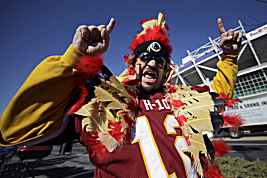
Here's why Indians and other activists oppose mascots:  "Washington Redskins fan Dave Lysinger poses for photographers in the parking lot of FedEx Field before an NFL wild card playoff football game against the Seattle Seahawks in Landover, Md., Sunday, Jan. 6, 2013." (Matt Slocum/AP)

May 24, 2013

I'm Not Your Indian Anymore

I'm Not Your Indian Anymore: The AIM in PhotosNow open at All My Relations Gallery in Minneapolis is an exceptional new photographic exhibit, I'm Not Your Indian Anymore.

At the gallery, the American Indian Movement Interpretive Center presents a photographic history of the American Indian Movement. This show features the photographs of Roger Woo, Dick Bancroft and Keri Pickett. Historical materials from the AIM archives are also being presented.
Comment:  "I'm Not Your Indian Anymore" is a great title. It means Indians declaring that they weren't going to fulfill the white man's fantasies anymore. They weren't going to be myths, legends, strangers, foes, targets, victims, mascots, sidekicks, etc. They were going to establish their own identity beyond their age-old role as savages standing in the way of "progress" and Manifest Destiny.

For more on AIM, see 40th Anniversary of Wounded Knee II and Russell Means Was a Fighter.

February 27, 2013

40th anniversary of Wounded Knee II

Gunfire, Chants Mark Wounded Knee Anniversary

By Kristi EatonA Pine Ridge Indian Reservation resident who found herself in the middle of the 1973 Wounded Knee occupation said Wednesday amid ceremonial gunfire and chants that little has changed since the fatal standoff.

Faith White Dress was on the Pine Ridge Indian Reservation 40 years ago when about 200 members of the American Indian Movement and their supporters huddled in houses, some with guns, to protest alleged corruption within the tribal government. Two Native Americans were killed, an activist went missing and a federal agent was wounded.

White Dress and others gathered Wednesday to remember the fatal 71-day standoff. During gunfire to mark the anniversary of the start of the occupation, she said the Oglala Sioux Tribe is still struggling.

"Unemployment is so high and the oppression is still so bad," she said. "I don't think it's going to take violence. It's going to take a gathering to determine how to bring jobs here. We need libraries. We need more of our children to have a better future."

Hundreds of people walked from nearby villages to the site of the occupation, drumming and chanting. Once at the site, the same place where in 1890 soldiers slaughtered an estimated 300 Native American men, women and children, AIM and their supporters continued to drum and chant and fire off gunshots into the air.

This year's events include memorials for AIM's charismatic leader, Russell Means, who died in October at age 72 after batting throat cancer. This is the first anniversary of the occupation since Means' death.

About 200 people gathered at a high school on Pine Ridge for the second of four planned ceremonies to honor Means. Friends, family and colleagues recalled Means as a man who taught his people how to stand up for themselves.

"He was articulate ... a proud Lakota," said Oglala Sioux president Bryan Brewer. "Today he is a version of our modern day Crazy Horse."
Ceremonial Walk Commemorates Wounded Knee Anniversary

By Derek OlsonForty years ago, the American Indian Movement took over the village of Wounded Knee. Protesters spoke out against what they called a corrupt tribal government and discriminatory federal practices. On Wednesday, a number of events marked the anniversary including a walk to the spot where it all took place.
Shortly after 9 a.m. on Wednesday, a group of people gathered in the village of Porcupine on the Pine Ridge Indian Reservation.

"Today, we are here to commemorate the activities that occurred in 1973," AIM supporter Edgar Bear Runner said.

It's one of four groups walking to Wounded Knee. For those in Porcupine, it's an eight mile journey in a wind making it feel much colder than 30.

"Despite the cold temperatures, we walk in their honor and in their memory," Bear Runner said.
Pride and heartbreak in anniversary of occupation

Why Wounded Knee II matters

AIM–Wounded Knee II, 40 years later

By Chase Iron EyesSo, AIM is not a legacy; AIM is living. AIM is because of the Native Youth Council, NYC was because of Treaty Councils, Treaty Councils were because of Warrior Societies, Warrior Societies were because of great men like Sitting Bull and Tecumseh and the Peacemaker, great men were because of great women. Since contact our spiritual movement has taken many pan-Indigenous forms and will never die. When we come together we literally shake the world. Tribal Colleges are because of AIM, Language revitalization is because of AIM, Indigenous Education is because of AIM, Ceremony is out in the open because of AIM, Native Youth Movement, HonorEarth, IEN, LRI, Owe Aku, IdleNoMore, and all the grassroots movements we rely on are because AIM fired warning shots to the world that Indigenous peoples are on the rise. All of our movements are constantly evolving into other forces.

It is clear to me that Indigenous peoples should take their place in leading and working with all of humanity. Race is of course a human construct as we are surely all indigenous meaning coming from the universe with spiritual covenants to the land and each other. We are in a state of emergency right now with the Keystone XL pipeline, the petro-backed banking system bound to collapse, drinking water being wasted and poisoned for the benefit of the greedy carbon economy. uranium mining in our territories, sacred sites facing destruction and so on. This I believe to be our role as Indigenous peoples: to share our beautiful world with that of the purported colonizer. They came here to feed an insatiable greed for riches and self but I think they were sent to learn how to respect sacred sites, the land, the water, other humans, other world views, other beings, to learn what true civilization looks like. So let’s honor today and make the most of every day. We are all seeking a spiritual revolution.
Comment:  For more on AIM, see Russell Means Was a Fighter and AIM Leads March for Traversie.

December 29, 2012

Palestinians endorse Idle No More

Palestinians Endorse Idle No More

By Gale Courey ToensingAmerican Indians and Palestinians have supported each other’s struggle since at least the 1970s when the American Indian Movement hosted a delegation of leaders from the Palestinian Liberation Organization.

“What the American Indian Movement says is that the American Indians are the Palestinians of the United States, and the Palestinians are the American Indians of the Middle East,” the late great Indian leader Russell Means said many times. So it is no surprise that Palestinian activists are coming out in support of Idle No More.

In little more than two weeks since the December 10 launching of the Idle No More movement by First Nations in Canada oppose a Senate omnibus budget bill that leaves them with no power over their lands and resources, dozens of organizations and hundreds of individuals supporting Palestinian liberation and human rights have endorsed the Palestinians in Solidarity with Idle No More and Indigenous Rights statement of support of the continuing Native protest that has spread across Canada, the U.S., some European countries and into the Middle East. Palestinians in Solidarity with Idle No More and Indigenous Rights calls for justice, dignity, decolonization and protection of the land, waters and resources.

“We recognize the deep connections and similarities between the experiences of our peoples–settler colonialism, destruction and exploitation of our land and resources, denial of our identity and rights, genocide and attempted genocide,” the statement says. “As Palestinians, we stood with the national liberation movement against settler colonialism in South Africa, as we stand with all liberation movements challenging colonialism and imperialism around the world. The struggle of Indigenous and Native peoples in Canada and the United States has long been known to the Palestinian people, reflecting our common history as peoples and nations subject to ethnic cleansing at the hands of the very same forces of European colonization.”

The statement goes on to recognize that the Indigenous resistance movement in Canada “includes struggles against the ongoing theft of indigenous lands, massive resource extraction and environmental devastation (including tar sands and pipelines), the continuing movement of survivors of the genocidal residential school system, and movements to demand an end to the colonial and gendered violence against Indigenous women.”
Comment:  For more on the Indian-Palestinian connection, see Critics Slam Harjo's Trip and LaDuke on Gaza:  We Are Israel.

October 25, 2012

Russell Means was a fighter

After Russell Means's death, many people reminisced about his life. The following postings typify what they said:

Russell Means: By No Means a Perfect Man, Yet He was Our Strong Voice

By Levi RickertThough he walked on early Monday morning from complications of cancer, the tenacious spirit he possessed will live on in many modern warriors who still have a lot of work to do to make this country a better place for American Indians.

Make no mistake about it, Means was a confrontational American Indian warrior. He was one who did not like to back down. Sometimes in leadership, circumstances dictate action. Such was the case when the American Indian Movement arrived at the Bureau of Indian Affairs building in Washington with the Trail of Broken Treaties caravan with a twenty-point position paper. Having been promised a meeting with BIA officials, they felt double-crossed when there would be no meeting. Late in the afternoon, Means and Dennis Banks decided to "occupy" the building when they were told the police were on the way to remove the American Indian Movement members. The confrontational occupation drew national attention to living conditions of American Indians and broken treaties.

The fight inside of Means became his calling card. The tenacity Means possessed led the Washington Post to call him the "…biggest, baddest, meanest, angriest, most famous American Indian activist of the late 20th century."

This same tenacity allowed him to fight cancer vigorously after he was first diagnosed in July 2011. Perhaps, a person with lesser will would have given up earlier, as do many people. Even while living with a life-threatening illness, Means realized there is still much work that needs to be done to improve American Indians lives - even with the advent of casinos and other tribal enterprises. There are still way too many American Indians suffering in the United States. Russell Means understood this to the end of his life on this earth.

This sheer fight he had on the inside is what made Means great and perhaps will become his lasting legacy.
Indian Country Reacts to Russell Means’ PassingMichael Mann, director of “Last of the Mohicans”

The Wall Street Journal did an interview with Mann and asked him: What were your thoughts when you found out he had passed away?

“Well, I knew it was coming about a week ago. Because there had been an email exchange with his wife. He wanted to get back and die at Pine Ridge…First of all he was way too young. 72 is young. Way too young to pass away,” Mann told the Journal. “He’s an iconic person. He’s lived through so much…What this guy stood for, the courage he had, and who they took on, in the 60, 70s and 80s—[American Indian activist Leonard] Peltier is still in prison. It’s a struggle that’s 400 years old. And Russell was fighting that battle every day of his life.”

Robert Chanate, a member of the Kiowa Nation

Says Means “led from the front and took the same risks as anyone else. Whether that meant going to jail, standing vigil in uncomfortable weather or carrying out tasks while exhausted, Russell Means wasn’t one to skip out on us. Many times we’d complete a rally and Russell would jump in his van to travel to a different state so he could fulfill another request for his support.”

Glenn Morris, of the American Indian Movement of Colorado

“In recognition of one of the primary, visionary leaders in beginning the contemporary work of international indigenous peoples’ liberation, of which we are all beneficiaries. Without Russell, it is doubtful that many of us who do this work would have had the honor of continuing to defend our peoples in this way. Indigenous leaders, ranging from Rigoberta Menchu Tum, to Subcomandante Marcos to Evo Morales, have said that their work was inspired and motivated by the words, actions and example of Russell Means. May we all remember the historic contributions of Russell Means to the freedom and self-determination of all indigenous peoples, everywhere.”
Russell Means, Lightning and Sexiness: The Toughest Indian in the Whole Wide World

By Gyasi Ross regardless of questions about his approach, he was a warrior that worked diligently and passionately for the betterment of Native people. He loved Native people profoundly. He knew that we deserved better, but we had to demand better.

I see Russell Means as the Indigenous equivalent of Malcolm X. See, the truth is that Native people needed (and still need) the fiery doppelganger of thoughtful, mainstream organizations like National Congress of American Indians in the same way that Martin Luther King, Jr. needed Malcolm X and Stokely Carmichael. Whereas National Congress of American Indians speaks politely and eloquently, using big words and paperwork to demand that the United States give Native people our just due, Russell Means was the person with the chip on his shoulder that would simply smack those dirty thieves in the mouth and take as much of that “just due” as he could. The truth is that these approaches need each other—they are not at odds. Neither approach is perfect, but both approaches are needed for Native peoples’ success and survival.

Symbiotic. Both necessary. Complementary.

Russell Means was loud. And eloquent. And flawed. And dangerous. And sexy. He made the image of a huge Native male being politically active something acceptable, even ideal. He wasn’t a bookworm that people could easily ignore—he spoke loudly, and powerfully—so much confidence in himself that those that were threatened by him just wished that they’d hear some bad news about him someday so they could stop hearing about him. “Y’know that Russell Means was in a plane crash…” Never happened; heck, he even whooped cancer for a long time. Sexy. Long hair, leather jackets, brown skin—he was the image of a Native person that all of us have, whether it’s politically correct to say so or not. Men wanted to be him, women wanted to be with him—the Indigenous James Bond. At a time of lagging self-esteem for Indigenous people, where we were taught to believe, after 500 years of ugly genocide, forced assimilation and conquest, that everything “Native” was ugly, dirty, evil, stupid, he made “looking Indian” cool again.

He made being Native sexy. Imperfect, but a start to reclaiming our collective sense of self-worth.

Every single Native person on this continent owes him a debt of gratitude. Thank you Russell Means—the toughest Indian in the world.
Comment:  For more on Russell Means, see Means Has Cancer Again and Means Releases New Book Online.

October 22, 2012

Russell Means dies

Russell Means, Indian activist, actor, dies at 72

Means died early Monday at his ranch in in Porcupine, S.D., Oglala Sioux Tribe spokeswoman Donna Solomon said.Russell Means, a former American Indian Movement activist who helped lead the 1973 uprising at Wounded Knee, reveled in stirring up attention and appeared in several Hollywood films, has died. He was 72.

Means died early Monday at his ranch in in Porcupine, S.D., Oglala Sioux Tribe spokeswoman Donna Solomon said.

Means, a Wanblee native who grew up in the San Francisco area, announced in August 2011 that he had developed inoperable throat cancer. He told The Associated Press he was forgoing mainstream medical treatments in favor of traditional American Indian remedies and alternative treatments away from his home on the Pine Ridge Indian Reservation.

Means was an early leader of AIM and led its armed occupation of the South Dakota town of Wounded Knee, a 71-day siege that included several gunbattles with federal officers. He was often embroiled in controversy, partly because of AIM's alleged involvement in the 1975 slaying of Annie Mae Aquash. But Means was also known for his role in the movie “The Last of the Mohicans” and had run unsuccessfully for the Libertarian nomination for president in 1988.
Russell Means, Who Clashed With Law as He Fought for Indians, Is Dead at 72

By Robert D. McFaddenStrapping, and ruggedly handsome in buckskins, with a scarred face, piercing dark eyes and raven braids that dangled to the waist, Mr. Means was, by his own account, a magnet for trouble — addicted to drugs and alcohol in his early years and later arrested repeatedly in violent clashes with rivals and the law. He was tried for abetting a murder, shot several times, stabbed once and imprisoned for a year for rioting.

He styled himself a throwback to ancestors who resisted the westward expansion of the American frontier. With theatrical protests that brought national attention to poverty and discrimination suffered by his people, he became arguably the nation’s best-known Indian since Sitting Bull and Crazy Horse.

But critics, including many Indians, called him a tireless self-promoter who capitalized on his angry-rebel notoriety by running quixotic races for the presidency and the governorship of New Mexico, by acting in dozens of movies — notably in a principal role in “The Last of the Mohicans” (1992) — and by writing and recording music commercially with Indian warrior and heritage themes.

He rose to national attention as a leader of the American Indian Movement in 1970 by directing a band of Indian protesters who seized the Mayflower II ship replica at Plymouth, Mass., on Thanksgiving Day. The boisterous confrontation between Indians and costumed “Pilgrims” attracted network television coverage and made Mr. Means an overnight hero to dissident Indians and sympathetic whites.

Later, he orchestrated an Indian prayer vigil atop the federal monument of sculptured presidential heads at Mount Rushmore, S.D., to dramatize Lakota claims to Black Hills land. In 1972, he organized cross-country caravans converging on Washington to protest a century of broken treaties, and led an occupation of the Bureau of Indian Affairs. He also attacked the “Chief Wahoo” mascot of the Cleveland Indians baseball team, a toothy Indian caricature that he called racist and demeaning. It is still used.

And in a 1973 protest covered by the national news media for months, he led hundreds of Indians and white sympathizers in an occupation of Wounded Knee, S.D., site of the 1890 massacre of some 350 Lakota men, women and children in the last major conflict of the American Indian wars. The protesters demanded strict federal adherence to old Indian treaties, and an end to what they called corrupt tribal governments.
Comment:  For more on Russell Means, see Means Has Cancer Again and Means Releases New Book Online.

May 21, 2012

AIM leads march for Traversie

Hundreds protest alleged mistreatment of Native patient

By Holly MeyerHundreds of Native Americans demanded justice on Monday from Rapid City Regional Hospital for a Lakota man who said the initials KKK were carved into his chest during surgery.

Vern Traversie, a legally blind member of the Cheyenne River Sioux Tribe, alleges that he was scarred with the abbreviation associated with the Ku Klux Klan during open-heart surgery at Regional Hospital in August 2011. An online video in which Traversie talks about the scars recently went viral among the Native American community.

In protest of Traversie’s alleged treatment, about 300 Native American demonstrators, led by American Indian Movement activist Dennis Banks, marched with police escort down Fifth Street on Monday from a rally in Memorial Park to another in the parking lot of the hospital.

“We can’t let this day go by without getting some answers from this hospital,” said Banks to the crowd assembled at the edge of the hospital’s parking lot. “It can’t be that way.”
Hundreds Descend on Rapid City Hospital in Support of Cheyenne River Elder

By Patti Jo KingNearly 700 protestors from Native communities across the United States, and members of the American Indian Movement met in Rapid City, South Dakota the morning of May 21 to march in support of Vernon Traversie, a Cheyenne River tribal member.

Traversie, a blind, 68 year old, who underwent double bypass heart surgery at Rapid City Regional Hospital (RCRH) on August 26, 2011, was left with a bizarre pattern of wounds on his abdomen, well below and on the lower left and right sides of his surgical wound.

Those who have personally seen the wounds describe them as horrific–claiming they resemble deep burns in the shape of three ‘K’s.’ According to Cheyenne River tribal member Cody Hall, a friend of Traversie’s, the wounds resemble brandings.

“This looks like a hate crime,” Hall, who organized the rally, said in a phone interview with Indian Country Today Media Network. Hall said the point of the rally was to raise awareness of the many incidences of underlying racism against Native people that have occurred in Rapid City over the years. The group also wants to support Traversie in his struggle to deal with this recent incidence.
Native Americans rally over surgical scars that some say show letters KKK; others have doubtsHundreds of people marched Monday in support of a man who says the letters KKK were carved into his stomach by a surgeon at a South Dakota hospital.

A YouTube video featuring 69-year-old Vern Traversie, a Lakota man who lives on the Cheyenne River Reservation, has gone viral in Native American communities. In it, Traversie shows a photo of his abdomen. Though he himself is blind, Traversie says he was told by others that the scars left after his heart surgery make out the hateful letters, and he is outraged.

The problem is, not everyone sees it. Like those spotting the Madonna in a water stain, Traversie’s advocates are staunch believers. Those who aren’t include police who investigated his allegations and hospital officials.

Rapid City police say they conducted an investigation but found no evidence of a crime. Craig Saunders, a cardiologist at Barnabas Hospital in Newark, N.J., said incision marks can take many different shapes, depending on where the doctor needs to get into the body. Saunders, who did not operate on Traversie, said surgical tape also can leave scarring and lesions depend on the make-up of the person’s body.
A Statement From Cheyenne River Sioux Elder Vern Traversie on the Violation of His Patient Rights

Photos:

Vern Traversie Rally For Justice (May 21, 2012)

Comment:  We still don't know if Traversie was intentionally "branded." Or if the haphazard cuts were supposed to spell something.

But I thought surgery was supposed to involve one or two neat incisions. My question is how a patient gets dozens of cuts over his torso. Seems to me someone is guilty of incompetence if not malfeasance.

For more on the subject, see Indians Rally for "KKK" Victim and Lakota Man Branded with "KKK"?

April 28, 2012

Means at Wounded Knee conference

Old divisions flare as AIM leaders reunite

Wounded Knee siege of 1973 still raw topic

By Peter HarrimanOld hatred dies hard.

Many of the archetypal survivors of the 1973 Wounded Knee occupation met again Friday at Augustana College’s Center for Western Studies for the 44th annual Dakota Conference.

They were joined by a second generation in Denise Maloney, daughter of slain Indian activist Anna Mae Aquash. Maloney addressed the gathering via Skype. Also there was John Trimbach, son of FBI agent Joseph Trimbach. John’s book, “American Indian Mafia,” denigrates the American Indian Movement’s key leaders, including Russell Means, Dennis Banks and Clyde Bellecourt.

The three AIM icons attended conference sessions throughout the day. Means gave the keynote address Friday evening.
And:Trimbach called the AIM leaders “liars, thieves and killers.” He said much of Means’ book, “Where White Men Fear to Tread,” was “hot air,” but added, “I believe Russell when he said he and Dennis Banks could make people disappear.”

Like Banks, Means did not joust with Trimbach. Indeed, he was out of the room during much of the attack Trimbach directed at him. But Means had his own criticism of the conference and offered his own view of what the Wounded Knee occupation and AIM accomplished.

He called the conference “a South Dakota academics’ mutual masturbation society. It’s exactly the way South Dakota wants Indian history to be interpreted.”

Means said the international attention drawn to the lengthy Wounded Knee occupation was the spark that “brought about the international political sophistication of Indian people.

“I went up and down this hemisphere looking for that spark. I thought I found it in Nicaragua, but I was wrong. I thought I found it in the Northwest Territories, but I was wrong,” he said.

Then he said he looked to his own Oglala Lakota tribe at Pine Ridge.

Trimbach said academic history is complicit in perpetuating an incorrect view of AIM, “the most falsified movement in American history.” Means criticized a lack of a definitive academic history of AIM. He said it was a foundation of the effort of tribes in the 20th century to assert sovereignty.

“If you want to be sovereign, you have to act sovereign,” he said.
Native Sun News: Conference opens wounds of Wounded Knee

By Karin EagleAn incident more representative of the mixed bag of emotions the conference stirred up occurred during a discussion Means participated in that led to questions posed by Stew Magnuson, author of “The Death of Raymond Yellow Thunder: And Other True Stories from the Nebraska-Pine Ridge Border Towns,” which highlights the racial tension found around the reservations in South Dakota.

Magnuson, who participated in the conference as a keynote speaker during the first night’s dinner presentation, questioned Means about Ray Robinson, a black civil rights activist who traveled to Wounded Knee in 1973.

Robinson has never been heard from or located since.

Means responded by standing and addressing Magnuson: “I’m going to tell you this–no charges from 1974 to 2002. Did anyone hear of Ray Robinson? Did anyone ever shoot him, stab him, beat him or disappear him?”

“It was a generation later that the badmouthing of Wounded Knee continues,” Means said. “You and people like you are to perpetuate this erroneous image you have of who we are. And I’m sick and tired of you bringing up these false accusations based on what? Nothing!’”

Means further expressed his anger that AIM has been repeatedly associated with Robinson’s disappearance.
Means: Sovereignty benefits U.S.

By Peter HarrimanIn a rambling 90-minute address Friday evening that wove personal history with highlights of the American Indian Movement, famed AIM leader and activist Russell Means on reiterated themes he advanced earlier in the day at Augustana College’s annual Dakota Conference, which focused on the 1973 Wounded Knee occupation.

In a keynote address in a packed Reconciliation Chapel, Means said AIM and its occupation of Wounded Knee in 1973 ignited a spark of Indian sovereignty.

He also maintained that will work to the benefit of the U.S. in general.

Means said when he led a delegation of traditional tribal people to Washington, D.C., and created the Republic of Lacotah in 2007, claiming he was severing tribal ties with U.S. treaties and restoring traditional tribal governments, he was carrying out his greatest personal legacy from Wounded Knee.

“I hope young people latch on to this. I know someone will. Some student 20 or 30 years from now,” will see the significance of the sovereignty initiative in that, Means said.

“Continually allowing of your government to violate the Constitution of the United States of America on a daily basis with us has caught up with you, hasn’t it?” Means said of government failings in living up to tribal treaty obligations.

“Your representatives don’t care. Your Supreme Court is political, not judicial. Your president is a quasi-king.

“You’re the new Indians,” he said, throwing his arms wide. “Welcome aboard.”
Comment:  Judging by the article, Means isn't clear on how Indian sovereignty will benefit Americans. I guess he's saying it provides an alternate model that isn't a corrupt failure.

But many tribes use a standard chairperson/council/court system of checks and balances, just like the US. And many tribal governments are supposedly corrupt or at least unresponsive to the people.

I wonder which tribal governments does Means consider the ideal? Other than his own nonexistent Republic of Lakotah, that is.

For more on the subject, see Wounded Knee II's Positive Effects and Controversy in Wounded Knee.

March 18, 2012

Artists depict Wounded Knee

Artists depict Wounded Knee massacre, occupationFogg is one of nearly 25 artists—both Native and non-Native—from around the country displaying their artwork at Augustana College's Center for Western Studies in Sioux Falls as part of a first-of-its-kind art exhibit and show.

"Interpretations of Wounded Knee 1973 and 1890" is meant to help foster understanding and build stronger relationships between Natives and non-Natives as the 40th anniversary of the Wounded Knee takeover approaches, said Timothy Hoheisel, director of Outreach and Promotion at The Center for Western Studies.

In 1890, the U.S. Army killed Miniconjou Lakota chief Spotted Elk, also known as Big Foot, and 300 of his followers, including women and children, on the banks of the Wounded Knee Creek.

"I didn't do anything to Jerry Fogg. My ancestors basically killed his ancestors," said Hoheisel, referring to the 1890 massacre. "By us coming together with this exhibit, there's a chance for reconciliation."

The exhibit is a prelude to the annual Dakota Conference, which brings together professional and amateur historians and researchers to present papers on a particular topic relevant to Northern Plains history. The theme for this year's conference is "Wounded Knee 1973: Forty Years Later." The event, scheduled for April 27-28, is bringing together all sides from the occupation—former American Indian Movement members, federal agents and prosecutors, and journalists and bystanders who witnessed the uprising.
One example of the art:In one oil-on-canvas painting—titled "Still Hanging on the Res" by artist Bruce Preheim of Vermillion, S.D.—Christ, a feather atop his head, is shown crucified.

"We crucify Christ every day by not dealing with Native American disparity and rights," Preheim wrote in his artist description of the piece.
Comment:  For more on Wounded Knee, see Why Wounded Knee Matters and 25th Annual Ride to Wounded Knee.

February 26, 2012

Banks receives lifetime achievement award

Dennis Banks Receives Living Legends Award

By Levi Rickert Dennis Banks, Ojibwe, will receive the Living Legends Award tonight in Washington DC for his contributions as a co-founder of the American Indian Movement and his ongoing committed to the well being of the American Indian community.

This year's theme of the awards ceremony is "Am I My Brother's Keeper?"

“We seek to honor people who have made contributions to bettering humanity,” said Doreen Hines, the executive director of Human Symphony Foundation, the non-profit organization that gives out the awards.

Past awardees include: Congressman John Lewis, journalist Juan Williams, Olympic gold medalist Tommie Smith, peace activist Leymah Gbowee and several others.

“We purposely sought out an American Indian to honor,” commented Markus Williams, artistic director of Living Legends Awards.

“After I did research on Dennis Banks, I knew he deserves this honor.”

"So much of what was taught about civil rights involved black and white issues, obviously there were other groups in this country that needed their civil rights. Dennis Banks did that for American Indians," continued William.
Comment:  For more on the subject, see Longest Walk 3--Reversing Diabetes and Means Receives Lifetime Achievement Award.

February 19, 2012

AIM play stirs controversy

10-minute play about AIM stirs controversy in Mpls. Indian community

By Sheila ReganA 10-minute play by Navajo playwright Rhiana Yazzie was at the center of a controversy within the local Native American community. The play focuses on two fictional characters in 1968--the year that the American Indian Movement (AIM) was founded--and several real-life people are mentioned, including AIM co-founder Clyde Bellecourt.The problems:In a draft of the play one of the characters, Moon, calls out for help because he and the other character are handcuffed to a light pole by the police and left there--Yazzie said it is based on a real incident that happened in 1971. Moon calls out for Bellecourt, calling him "Belly Court."

According to Bellecourt, his objections to the play stem from the fact that it doesn't talk about the great things that the AIM movement accomplished. "It makes jokes about me and my brother," he said. The play, he said, "doesn't talk about hope, or about all of the accomplishments of the movement." He also didn't like that the two characters "talked like they are drunk," and also used foul language.
The outcome:Yazzie said she is baffled by the objections. "This play is so pro-AIM and so pro-Indian," she said. "The fact that Clyde is even protesting it shows there's a deeper vanity or vendetta or personal hurt that he was going after."

In the end, Bellecourt and AIM decided against a protest, and allowed the History Theatre to use the AIM logo. Bellecourt was satisfied with the changes to the script, he said, and didn't want the American Indian actors in the show to lose their pay. In addition, a two-page history of the AIM movement was distributed by the ushers, according to Bellecourt.
Comment:  For more on AIM, see AIM Interpretive Center Planned and Means Receives Lifetime Achievement Award.

December 28, 2011

AIM interpretive center planned

Center to focus on the American Indian Movement

By Randy FurstMore than 100 American Indian women, men and children had plenty to talk about when they gathered in an upstairs office on Plymouth Avenue in Minneapolis on July 28, 1968:

Mistreatment by police, judges and landlords. Longstanding treaty violations. A staggering dropout rate among Indian youth from the public schools.

The meeting was called by Dennis Banks, George Mitchell, Harold Goodsky, Annette Oshie, Florence Holmes and Clyde Bellecourt.

Bellecourt, then employed as an engineer at a power plant, was elected chair of the new organization that became the American Indian Movement.

Soon, AIM chapters sprouted in cities and reservations across the United States. The group earned worldwide attention for its 1972 occupation of the Bureau of Indian Affairs headquarters in Washington and the 1973 armed standoff at Wounded Knee, S.D. Its role in establishing several enduring Indian-focused institutions is less well-known.

Now, 43 years after AIM’s first meeting, some of the old guard and others who embrace its legacy want to create an interpretive center to tell the movement’s story.

“If we don’t tell it, Garrison Keillor or some other non-Indian will tell it,” says Bellecourt, 75, with a smile, admitting he has nothing against Keillor.

The American Indian Movement Interpretive Center would be housed in a vacant 19th century mansion at 1208 5th St. SE. once owned by lumberman Henry Frey. More recently, the mansion was used for auxiliary classroom space by the Heart of the Earth Survival School, which was in a separate building across the street.

Heart of the Earth shut down in 2008 after its executive director embezzled more than $1 million from the school. The school building was sold and razed and the $1.2 million in proceeds are being used to advance the interpretive center project.

The center would have interactive exhibits and archival material including photos, video and audio and a place for youths and elders to gather. It also would serve as a resource for students at the University of Minnesota. The center has already hired the architectural team of Karen Gjerstad and Robert Roscoe and a work crew to begin renovation of the Frey mansion. An office for the project has been opened nearby.
Comment:  For more on AIM, see Means Receives Lifetime Achievement Award and Occupy Denver Joins Columbus Protest.

Below:  "Clyde Bellecourt in the planned American Indian Movement Interpretive Center (David Joles)

November 14, 2011

Means receives lifetime achievement award

Russell Means Receives Red Nation Film Lifetime Achievement AwardRussell Means received the "Oyate Wayanka Po Win Lifetime Achievement Award" at the 8th Annual Red Nation Film Festival gala last Monday in Los Angeles, California.

Means, who was diagnosed with terminal cancer of his esophagus in July, attended the gala event with his wife, Pearl.

Since July Means has undergone extensive tomotherapy, an intensity modulated radiation treatment, at the Sunridge Medical Wellness Center in Scottsdale, Arizona. In addition, Means has participated in several traditional Indigenous ceremonies provided by Oglala and Navajo medicine men.

Means gained international fame as one of the most prominent American Indian Movement leaders during the 1970s. Since then, he has worked for American Indian rights and human rights throughout Indian Country and in other spots around the world.

In the early 1990s, Means became a Hollywood actor. Since 1992, he has appeared in "The Last of the Mohicans," "Pathfinder," "Natural Born Killers," "Windrunner: A Spirited Journey," "Thomas and the Magic Railroad." His served as the voice of Chief Powhatan in "Pocahontas" in the hit 1995 Disney movie.
Comment:  For more on Russell Means, see Means Is "Riddle Wrapped in Enigma" and Means's Tumor Has Shrunk.

Below:  Russell and Pearl Means.

October 10, 2011

Occupy Denver joins Columbus protest

Columbus Day Protest Widens

By Carol BerrySmoldering and flaming, copies of two documents that initiated the destruction of Native cultures went up in smoke to loud cheers October 8, as opponents of the Columbus Day Parade in Denver widened their attack to include Wall Street, the Keystone XL pipeline, sacred sites desecration, and other manifestations of the Columbian legacy.

Burned were a Papal Bull approving the subjugation of Natives and the theft of their lands, as well as a copy of Johnson v. McIntosh, which in 1823 concocted a legal basis for the seizure of Indian lands.

It was street theater worthy of Denver’s earlier Columbus Day Parade protests, which have included the pouring of ceremonial blood in the streets, dolls representing infants killed by invading Spaniards, burnt tipis and other creative expressions of outrage.

The parade protest is almost a Denver tradition. Beginning in 1989 with about 50 dissenters, only three years later the number had swelled to more than 1,000 who, following the red banner of the American Indian Movement (AIM), shouted at parade participants for honoring Columbus, a man they called a mass murderer and slave trader.
Occupy Denver endorses Colorado American Indian Movement's indigenous proposal

By Patricia CalhounGlenn Morris, the University of Colorado Denver associate professor who's in the forefront of the Columbus Day protests, was back at the Capitol with fellow Colorado American Indian Movement members on Sunday, to meet with reps of Occupy Denver and ask them to sign on to AIM's platform.

Many Occupy Denver members "did participate with us in our protest of the Columbus Hate Speech Parade," Morris reports, "and many of them came to the Four Winds American Indian Center to share a meal with us" on Saturday. And after an hour of discussion and debate, he says, the Occupy Denver General Assembly unanimously endorsed the Colorado AIM-initiated indigenous proposal.
An excerpt from the document:An Indigenous Platform Proposal for "Occupy Denver"

In observing the "Occupy Together" expansion, we are reminded that the territories of our indigenous nations have been "under occupation" for decades, if not centuries. We remind the occupants of this encampment in Denver that they are on the territories of the Cheyenne, Arapaho and Ute peoples. In the U.S., indigenous nations were the first targets of corporate/government oppression. The landmark case of Johnson v. McIntosh (1823), which institutionalized the "doctrine of discovery" in U.S. law, and which justified the theft of 2 billion acres of indigenous territory, established a framework of corrupt political/legal/corporate collusion that continues throughout indigenous America, to the present.

If this movement is serious about confronting the foundational assumptions of the current U.S. system, then it must begin by addressing the original crimes of the U.S. colonizing system against indigenous nations. Without addressing justice for indigenous peoples, there can never be a genuine movement for justice and equality in the United States. Toward that end, we challenge Occupy Denver to take the lead, and to be the first "Occupy" city to integrate into its philosophy, a set of values that respects the rights of indigenous peoples, and that recognizes the importance of employing indigenous visions and models in restoring environmental, social, cultural, economic and political health to our homeland.
Columbus Day must go

As usual, there were reports of several other Columbus protests around the country. Here's one of them--ironically, in Columbus, Ohio:

Columbus’ discovery mourned

Rename holiday Indigenous People’s Day, protesters say

By Quan Truong
With the Santa Maria replica as a backdrop and near a Christopher Columbus statue at City Hall, a small group of people gathered yesterday to pray and mourn.

“Why do we have statues of Christopher Columbus, which represents the worst of our culture and the worst of our people?” shouted Bob Fitrakis, a political-science professor at Columbus State Community College.

Fitrakis was one of about a dozen who spoke yesterday, when Columbus Day is observed, by the replica on the Scioto River. Most had some Native American lineage.

“We wanted a different perspective. ... We also wanted to expose the myths, the lies and the trauma this discovery has brought many people,” said Mark Stansbery, with the Community Organizing Center, a nonprofit that rallies for various human-services causes.

Stansbery called the boat behind him “a symbol of occupation, exploitation and slave trade.”
Comment:  Sooner or later this worthless holiday will be gone along with the offensive mascots and stereotypes. Replacing it with Native American Day would be a good idea.

For more on Columbus, see Textbooks Neuter Columbus Critiques and Columbus the Pedophile.

Below:  "Sky Roosevelt-Morris, 20, Shawnee/White Mountain Apache burning a Papal Bull and copy of Johnson v. McIntosh during the Columbus Day Parade protest in Denver on October 8." (Carol Berry)

Means is "riddle wrapped in enigma"

Notes from Indian Country:  The enigma of AIM leader Russell Means

By Tim Giago (Nanwica Kciji)In 1976 while the United States was celebrating its 200th birthday, Means looked at the Mount Rushmore National Memorial through the eyes of an oppressed people and labeled it “The Shrine of Hypocrisy.” He added, “And I intend to blow out the candles on America’s birthday cake.”

Along with Dennis Banks and Vernon and Clyde Bellecourt, Means co-founded the American Indian Movement. They began their adventures by tailing the police cars in Minneapolis armed with cameras and watching for any sign of the outrageous actions that police department was inflicting upon Native Americans. The Movement soon caught the eye of Native Americans everywhere and AIM became the point-man for the feelings of us all.

But somewhere along the way the Movement turned to violence beginning with its November 1972 takeover of the Bureau of Indian Affairs building in Washington, D. C. where irreplaceable and valuable records vital to the lives of so many Native Americans were trashed and destroyed.

Several more acts of violence ensued over the coming years including the takeover, trashing and murders that took place inside of the occupied buildings at Wounded Knee. I, along with many other Native Americans lost heart and faith in AIM after that, but I still held a deep admiration for Russell Means through it all because I believe his intentions were genuine, but somehow his followers just got out of hand. AIM really had no credentials for membership and it attracted a wild assortment of members seeking thrills more than social justice along with those who sincerely believed in its goals. It also attracted several FBI informants which eventually led to the murder of Anna Mae Pictou Aquash near Wanblee, South Dakota on the Pine Ridge Reservation when the AIM leadership suspected her of being such an informant.

Like the enigma he was, Means often went from the practical to the ridiculous, but he always held the courage of his convictions. He sincerely believed that it was his goal in life to crush the bureaucracy that covertly impoverished and attempted to annihilate the cultures of his people.
Comment:  For more on Russell Means, see Means's Tumor Has Shrunk and Banks Visits Ailing Means.

September 07, 2011

Banks visits ailing Means

Dennis Banks Visits an Ailing Russell Means

By Levi RickertDuring the 1970s, Dennis Banks, Ojibwa, and Russell Means, Lakota, emerged as two of the American Indian Movement's most recognizable leaders. Some could argue they have been the most visible and vocal American Indian leaders during the past half-century.

Over the ensuing decades, both men have remained fighters for American Indian rights.

Both men were together again in New Mexico last week Thursday, as Means is in the fight for his life. In July he was diagnosed with esophagus cancer and elected not have surgery which would have required removal of a major portion of his tongue.

Banks flew to Albuquerque and traveled to visit to see Means at his rural home near San Jose, New Mexico.

“He is a fighter. He is in the battle with cancer and seeking alternative healing,” Banks told the Native News Network Friday evening.

“He is still very strong--strong-minded, and robust as ever,” Banks continued.
Comment:  For more on the subject, see Russell Means Has Terminal Cancer and Longest Walk 3--Reversing Diabetes.

April 25, 2011

AIM vs. Fort Laramie

War and Consequences:  The American Indian Movement Vs. The National Park Service at Fort Laramie

By Richard West SellarsI arrived at the entrance to the park just after opening time on a mild mid-January day and encountered a grim, tense park official with a high-powered rifle and holstered pistol—the fort was locked down! Guarding the closed entrance gate, he informed me that the American Indian Movement (AIM) had threatened to burn down Fort Laramie. Alarmed by their threat, the superintendent had closed the fort for the day as federal law-enforcement officers rushed to the park from duty stations in the general area. He alerted the Wyoming Highway Patrol and the Service’s regional office in Omaha, and ordered that park rangers fire no shots unless in a life-threatening situation. I recall that, aside from my presence in an official capacity, the only visitor allowed in the fort that day was a lone German tourist.

One of the Service’s primary westward expansion parks, Fort Laramie dates from the 1830s and 1840s, when many promoted America’s conquest of the West as the nation’s “Manifest Destiny,” ordained by Providence. The fort is located along the Laramie River, near where it joins a much larger river, the North Platte—waters that flow through parts of a vast area known as the Northern Plains: high, open grasslands stretching from about northeastern Colorado and northwestern Kansas all the way into Canada.

And here I was, just out of graduate school, intent on a quiet scholarly career—when suddenly I found myself out on the Northern Plains, threatened by an Indian attack. It seemed strange that a high-profile, activist organization like AIM had targeted this isolated historic military post. I spent the day with distracted park staff, taking a close look at the fort’s historic buildings, parade ground and other features, while warily surveying the surrounding area, where serious trouble could suddenly appear.

Provoked by the long history of federal policies destructive of Indian rights, AIM had made its threat by phone the night before. The park’s defensive response was not without justification, as AIM had recently participated in the Indian occupation of Alcatraz Island in San Francisco Bay. In the late summer of 1972, it had joined a coalition of Indian groups in an auto-caravan along The Trail of Broken Treaties, from the West Coast to Washington, D.C. There, only two months before threatening Fort Laramie, AIM led the takeover of the Bureau of Indian Affairs headquarters.

Earlier, it had confronted the National Park Service itself, demonstrating at Mount Rushmore National Memorial in South Dakota’s Black Hills, where it viewed the memorial’s fame gigantic, sculpted presidential heads as symbols of pernicious government policies, past and present. The government’s violation of agreements made at Fort Laramie in the late 1860s constituted a primary motive behind AIM’s protests.
Sellars explains why AIM's protest of Fort Laramie was justified:The various officers' and enlisted men’s quarters, the bakery, trading store and bar—even two guard houses and the ruins of a latrine—all tell the story of daily army life. And a tour of the fort brings one in repeated contact with rooms (eight of them in the lieutenant colonel’s quarters alone, and approximately double that number in Old Bedlam) where army life is interpreted primarily through middle-class Victorian furnishings.

But to me, these domestic spaces draw attention away from the military’s purpose in maintaining a base of operations near the Laramie and North Platte rivers, how it went about achieving that purpose, and the resulting impacts on Indian life and culture. Instead, they focus the visitors’ attention on the soldiers, their families, and domestic comforts at Fort Laramie. A little nostalgia may be all right, but it should not be the main course. But with restorations such as Old Bedlam and the captain’s and lieutenant colonel’s quarters, the National Park Service has transformed this once-abandoned fort into a showcase of domestic life at a Northern Plains military post.

Surely, though, beyond Park Service interpretation, it was the very existence of Fort Laramie that provoked AIM’s anger: the old fort, preserved and proudly displayed by yet another arm of the United States government—a reminder of broken treaties and the Indians’ disastrous loss of their traditional life-ways, tied closely to seasonal movement of the buffalo. But had AIM leaders actually shown up and bothered to take the ranger-led tour of the fort, they would have been even more irritated. As just one example, visitors who take the current tour that winds through the buildings, along the parade ground and past various interpretive signs will encounter comments about the army’s installation of birdbaths and indoor plumbing in the 1880s, but no mention is made of the army’s impact on Indian life-ways, on their tribal culture and independence. At the very least, AIM’s threats signaled that not every American was pleased with Fort Laramie. But was the National Park Service paying attention?

Apparently not. In 1987, roughly 14 years after AIM’s initial threat, the park completed its last, and one of its most ambitious, restoration and refurnishing efforts, affecting about half of the two-story, 273-foot-long enlisted men’s cavalry barracks. It is this structure that most symbolizes the military’s final, determined drive to subdue the Indians—in current lingo, its “shock and awe” against Northern Plains tribes. The army built the barracks in 1873-1874 to accommodate a hundred or more additional cavalrymen, thereby strengthening its mounted forces to strike the enemy: those Indians who refused to accept confinement on their reservation or abandonment of traditional hunting areas.

But what one sees today in the barracks, refurnished to its 1876 appearance, is mainly where the soldiers ate and slept. The south half of the barracks building is restored downstairs as a mess hall, kitchen, and related rooms—and upstairs as sleeping quarters (long dormitory bays) with about 50 reproduction nineteenth-century iron army bunks in precisely aligned rows that can be viewed through a clear Plexiglas barrier. At the foot of the bunks are wooden military footlockers, with overcoats and horse tack hanging on walls nearby, and rifles in “arms racks” close at hand. Except for historic army heating stoves, probably once used at the fort, all furnishings are modern reproductions. (The north half of the barracks building, where more cavalry troops were quartered, accommodates the park’s library, museum collections, and other functions.)

The ultimate purpose of the 1870s cavalry barracks—to house reinforcements for the final suppression of Northern Plains Indians to make way for white occupation—is only implied. Instead, the interpretation features the furnishings, in addition to commentary (and even a song) about unappetizing meals fed to the soldiers. Overall, the messages conveyed by Fort Laramie’s restored buildings, and most notably at the cavalry barracks, fall into the category of "American Innocence," in that they reveal no substantive connection with consequences of the army’s military actions on the plains. National innocence is a conceit with which AIM and most other Indians likely have never agreed.
Comment:  Unfortunately, this problem is common throughout America. Not only at our national parks and monuments, but everywhere. We omit Indians and our history of killing them in the media and the public discourse. Or we sanitize this history by "honoring" Indians on logos and packages and in pageants and parades.

You can almost feel the attempt to whitewash our collective responsibility. "Look at the noble Indian!" the stereotypical images seem to be saying. "Think how mighty and brave he was, not how we cheated and robbed him. Remember the good times and forget the bad. Otherwise we might have to do something about the problems we created, and we can't have that."

Of course, you should never threaten to burn down historic buildings. At least for philosophical reasons. AIM should've tried a long-term publicity campaign rather than a one-time threat. The threat apparently didn't change anything; it was so ineffectual that no one even remembers it.

For more on Indians and national parks, see Tribal Perspectives in Glacier Exhibit, Before There Were Parks, and Democracy in Burns's National Parks.

Below:  "'Old Bedlam,' the officers quarters at Fort Laramie National Historic Site, has been beautifully restored, but how well does it interpret history?" (Kurt Repanshek)

February 21, 2011

Wounded Knee II's positive effects

Wounded Knee occupation had positive effects

By Charles TrimbleWhat caught me in the Chaat Smith/Warrior book is this statement in the Preface: “We came to write “Like a Hurricane” out of a profound dissatisfaction with the existing narratives of this crucial period in Indian and American history, one that we believe too often saw Indian people as mere victims and pawns. Our focus is not on the U.S. government’s failed policies or on police repression, but on how Indian people, for a brief and exhilarating time, staged a campaign of resistance and introspection unmatched in this (20th) century. It was for American Indians every bit as significant as the counterculture was for young whites, or the civil rights movement for blacks.”

This, to me, is what Tim Giago continues to miss--the widespread exhilaration among Indian people, and the significance of their resistance and revolution. During WKII I was able to witness some of it when I went to Pine Ridge as NCAI Executive Director to offer media and political assistance to the tribal government (which was essentially President Dick Wilson). Although I was disheartened by what I saw happening in what was left of tribal government there, I also saw and heard a new sense of pride among the Lakota people, and much praise for AIM.

I have never been a supporter of AIM, or an apologist for their actions. But, I do have an appreciation for what they meant to do and what they did, in fact, accomplish.

There was indeed much destruction at Wounded Knee during WKII, by AIM occupiers as well as federal and Goon forces. Dewing’s book provides BIA financial estimates of the losses and damage to the homes that were occupied by the militants, in many cases at the invitation of local people. And he also includes BIA estimates on recovery of household items that were missing. Nothing that I have read or heard gives credence to Giago’s telling of AIM occupiers evicting families, looting their homes, then setting them afire when they left. Even the burning of the Gildersleeve’s trading post, it appears, was the result of an accident with a kerosene lamp, when the village’s electricity was cut off by the Federal siege. It was not a torching of the building.

Back in 1981, Giago had a different view of WKII. In his book, Dewing wrote the following: “Looking back on Wounded Knee II from the perspective of ten years, Tim Giago, editor of the Lakota Times, saw some positive outcomes. According to Giago, the confrontation focused national attention upon the ineptitude of the BIA and the Interior Department. ‘It caused the Indian people themselves to demand changes within these bureaucratic structures and put bureaucrats on notice.’ Giago also said the encounter made reservation inhabitants more aware of whom they selected to fill elected office.”
Comment:  For more on the subject, see AIM's Misdeeds Too "Complex" to Cover? and Debate Over Wounded Knee.