Showing posts with label Moby Dick. Show all posts

July 08, 2013

America = Captain Ahab

In a Nation in Decline, a Lust for Hatred

By Chris HedgesThe most prescient portrait of the American character and our ultimate fate as a species is found in Herman Melville’s “Moby Dick.” Melville makes our murderous obsessions, our hubris, violent impulses, moral weakness and inevitable self-destruction visible in his chronicle of a whaling voyage. He is our foremost oracle. He is to us what William Shakespeare was to Elizabethan England or Fyodor Dostoyevsky to czarist Russia.

Our country is given shape in the form of the ship, the Pequod, named after the Indian tribe exterminated in 1638 by the Puritans and their Native American allies. The ship’s 30-man crew—there were 30 states in the Union when Melville wrote the novel—is a mixture of races and creeds. The object of the hunt is a massive white whale, Moby Dick, which, in a previous encounter, maimed the ship’s captain, Ahab, by biting off one of his legs. The self-destructive fury of the quest, much like that of the one we are on, assures the Pequod’s destruction. And those on the ship, on some level, know they are doomed—just as many of us know that a consumer culture based on corporate profit, limitless exploitation and the continued extraction of fossil fuels is doomed.

“If I had been downright honest with myself,” Ishmael admits, “I would have seen very plainly in my heart that I did but half fancy being committed this way to so long a voyage, without once laying my eyes on the man who was to be the absolute dictator of it, so soon as the ship sailed out upon the open sea. But when a man suspects any wrong, it sometimes happens that if he be already involved in the matter, he insensibly strives to cover up his suspicions even from himself. And much this way it was with me. I said nothing, and tried to think nothing.”

We, like Ahab and his crew, rationalize madness. All calls for prudence, for halting the march toward environmental catastrophe, for sane limits on carbon emissions, are ignored or ridiculed. Even with the flashing red lights before us, the increased droughts, rapid melting of glaciers and Arctic ice, monster tornadoes, vast hurricanes, crop failures, floods, raging wildfires and soaring temperatures, we bow slavishly before hedonism and greed and the enticing illusion of limitless power, intelligence and prowess. We believe in the eternal wellspring of material progress. We are our own idols. Nothing will halt our voyage; it seems to us to have been decreed by natural law. “The path to my fixed purpose is laid with iron rails, whereon my soul is grooved to run,” Ahab declares. We have surrendered our lives to corporate forces that ultimately serve systems of death. Microbes will inherit the earth.

In our decline, hatred becomes our primary lust, our highest form of patriotism and a form of eroticism. We are made supine by hatred and fear. We deploy vast resources to hunt down jihadists and terrorists, real and phantom. We destroy our civil society in the name of a war on terror. We persecute those, from Julian Assange to Bradley Manning to Edward Snowden, who expose the dark machinations of power. We believe, because we have externalized evil, that we can purify the earth. We are blind to the evil within us. Melville’s description of Ahab is a description of the bankers, corporate boards, politicians, television personalities and generals who through the power of propaganda fill our heads with seductive images of glory and lust for wealth and power. We are consumed with self-induced obsessions that spur us toward self-annihilation.
Comment:  For more on Indians and Moby Dick, see Queequeg the Indian? and Tashtego in Moby-Dick.

July 31, 2011

Queequeg the Indian?

Encore’s lavish new ‘Moby Dick’:  There whale be blood

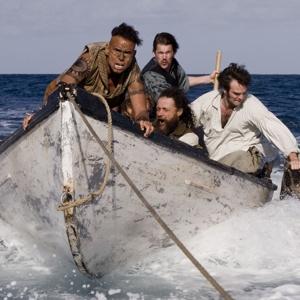
By Hank StueverEncore, that glorious waster of weekend afternoons on cable’s desolate seas, has finally decided to show something besides an endless loop of “Dumb and Dumber.” For its first offering, it’s bringing out “Moby Dick,” a lavish, exciting, well-acted and admirably thorough movie adaptation of Herman Melville’s 1851 classic.And:Charlie Cox, a charming British actor, plays a serviceably doe-eyed Ishmael, the young narrator who longs to join a whaling vessel. Arriving in Nantucket (having rescued the young slave Pip from a brutal master), Ishmael winds up on Ahab’s doomed Pequod with his other new friend, Queequeg the Indian, played with revitalized depth by Raoul Trujillo.Comment:  One slight problem with this: Queequeg wasn't an Indian. As Wikipedia notes:Queequeg is a native of a fictional island in the South Pacific Ocean named Kokovoko or Rokovoko. The island is the home to his primitive tribe, who practice cannibalism, in particular devouring the flesh of enemies slain in battle.I don't know if the TV show or writer Stuever made the error. I'm guessing it was Stuever. He saw a savage cannibal and assumed it was an Indian.

On the other hand, the character Tashtego is really an Indian. He's played by Billy Merasty, a Canadian Native, in this movie. Nice of Encore to use two Native actors rather than none.

For more on the subject, see Raoul Trujillo as Queequeg.

January 18, 2010

Tashtego in Moby-Dick

Someone reminded me that Queequeq isn't the only indigenous character in Moby-Dick. The crew includes an actual Indian, Tashtego:

TashtegoTashtego is described as a Native American harpooneer. The personification of the hunter, he turns from hunting land animals to hunting whales. Tashtego is the harpooneer on Stubb's boat.

Next was Tashtego, an unmixed Indian from Gay Head, the most westerly promontory of Martha’s Vineyard, where there still exists the last remnant of a village of red men, which has long supplied the neighboring island of Nantucket with many of her most daring harpooneers. In the fishery, they usually go by the generic name of Gay-Headers.

—Moby-Dick, Ch.27
Tashtego--Character AnalysisTashtego is a Native American from Gay Head, the westernmost point of Martha’s Vineyard, an island off the coast of Massachusetts. In Moby-Dick, he is presented as having inherited his hunting prowess as part of his tribal heritage.

Despite the (positive) racist stereotype behind this assumption (the idea of the "noble savage"), Tashtego’s character also illustrates the frustrating illogic of racism and racial hierarchies. As the harpooneer on Stubb’s whaling boat, it is Tashtego who strikes the first whale that we see killed in the novel--but the credit for the hunt and the kill goes entirely to Stubb.

It is also Tashtego who sights Moby Dick at the same moment that Captain Ahab does at the end of the novel--but Ahab insists he saw the White Whale first, denying Tashtego the promised reward of the gold doubloon.
Comment:  I don't recall if Melvilled described Tashtego as a savage, but people have pictured him as one. Wearing warpaint...in a whaling ship? Going naked except for a loincloth...on the windy, stormy sea? A hawk-man...the Indian as a predatory animal? (For another example of this, see Twilight.)

For more on the subject, see Raoul Trujillo as Queequeg and The Best Indian Books.

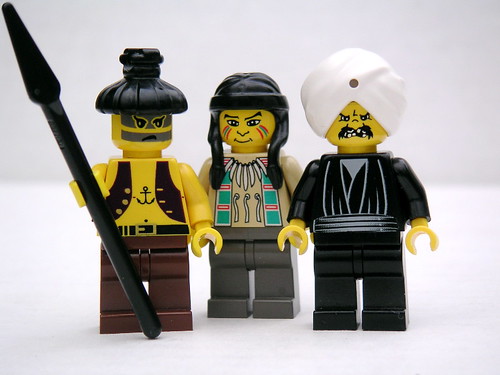
Below:  Queequeg, Tashtego, and Fedallah.


George Klauba, Tashtego, 2003, acrylic on panel.


Mark Milloff, Quequeeg Rescues Tashtego From the Head of a Whale, oil on canvas, 1986.

January 14, 2010

Raoul Trujillo as Queequeg

Raoul Trujillo (Apache/Ute) is playing Queequeg in a new TV movie version of Moby-Dick. Here's the lowdown on the character:Queequeg is a fictional character presented in the 1851 novel Moby-Dick by U.S. author Herman Melville. He is the first principal character encountered by the narrator, serves as the chief harpooner aboard the Pequod, and plays an important role in many of the events of the book, both in port and during the whaling voyage. Although a "savage" cannibal, he is described with great sympathy and much admiration by Ishmael, by whom he is befriended early in the book.

Description

Queequeg is a native of a fictional island in the South Pacific Ocean named Kokovoko or Rokovoko. The island is the home to his primitive tribe, who practice cannibalism, in particular devouring the flesh of enemies slain in battle. Queequeg claims that the only case of indigestion he has suffered was after a feast in which fifty slain enemies were eaten. He displays no shame regarding the practice, describing his people in a matter-of-fact fashion. In port he prefers a diet of rare red meat, but will settle for whatever is on the menu, such as clam chowder.
Comment:  Needless to say, making Queequeq a cannibal is stereotypical. But that's not why I posted this.

This will be a high-profile role for a Native actor. It's good to see Natives benefiting, rather than losing out, from nontraditional casting for once.

But as with Barbarian Princess, the role really should go to a Pacific Islander. The Fijian below looks more like Dwayne "The Rock" Johnson, which isn't surprising since Johnson is Samoan.

Below:  Native Fijian in a 1930s postcard.


Raoul Trujillo as Queequeg:


For more on the subject, see The Best Indian Movies and TV Shows Featuring Indians.