Showing posts with label capitalism. Show all posts

June 02, 2014

Poverty = foreign country

Poverty is a "Foreign Country" on the American Screen

Can we admit that poverty is as American as apple pie?

By Lynn Stuart Parramore
The movie Beasts of the Southern Wild is a travel film. You, the viewer, are invited to take a tour of a foreign country. The rituals are curious: The people cook with blowtorches. They coast the bayou on trash-heap floats. The landscape is fantastical, populated with mythic figures and beasts that seem to bubble up from the unconscious.

The uncanniness of the film is that this Louisiana landscape is not a foreign land, as its title mockingly suggests. This is home. This is America—a place where 46.5 million people live at or below the government-defined poverty line, which, for an individual, means surviving on less than twelve thousand bucks a year. We live in a time when we’re supposedly overcome with information, and yet we find next to nothing in popular culture about what’s going on with the half of us who are in or near poverty.

Rural poverty is nearly invisible on the screen. The film that usually calls it to mind is Deliverance, a thriller in which the nightmare of inbred mountaineers is as threatening as that of any gun-toting gangsters from Menace II Society. (Actually more so: “Squeal like a pig!”)
And:During the Great Depression, poverty was our poverty, America’s poverty, something we could all relate to. Charlie Chaplin was our Little Tramp, our everyman. The carry-over of that collective experience of poverty brought us “The Waltons” and gave us treacly reminders of a time when being poor was not a mark of shame. By the 1980s, television simply announced the problem of poverty solved: if you were black and virtuous, you got to be a Huxtable. If you were black and undeserving, the ghetto was your natural domain. If you were white, you never moved beyond reasonably comfortable working-class. Mostly you were upper-middle-class, if not rich. Voila! Meanwhile, actual poverty increased for people in America, both black and white.

TV and film both influence and shape public perception, and the go-to explanation for economic hardship is still the idea of a “culture of poverty,” which says that people are poor because their families are messed-up and they don’t want to work. (It’s interesting to imagine what the hard-working, righteous James and Florida Evans of “Good Times” would have said to Paul Ryan: here’s a glimpse!)

Commercial products have to resonate widely with the public, or they don’t get sold. It's still popular to look down on the poor or even gleefully mock them. (In the U.K., the smash TV hit "Benefits Street" depicts welfare recipients as fraudsters and losers.) But post-financial-crisis Americans may be more open now to depictions of poor people who are poor not because they are bad, but because they are confronted with enormous social and economic plutocratic forces. The Hunger Games is a start: the corrupt state makes a bold appearance as the force that messes up Katniss Everdeen, though the pitiless market is largely absent.
Comment:  The lack of minorities in movies and TV is tied to our cultural hatred of poverty. Which comes from our American exceptionalism that began with the Pilgrims.

This belief that we're God's chosen ones means that we don't enslave or kill others. We don't start wars or torture our opponents. And we don't accept poverty, hunger, or illness in our midst.

If any of these problems occur, it's because of a few rotten apples. Better yet, it's because people were weak, greedy, and selfish. We blame the victims so we don't have to blame ourselves.

For more on the subject, see Republicans Hate Government Aid for Minorities and Republicans Want Poor People to Die.

May 14, 2014

The billionaires' crybaby club

Billionaires’ crybaby club: Someone get these whiners a bottle!

An epidemic of self-pity among the wealthy raises questions about the mental health of the top of the top 1 percent

By Joan Walsh
Does being super-wealthy make you extra susceptible to self-pity today? That’s the only conclusion we can draw from an epidemic of self-pitying American billionaires decrying their persecution by “despots,” and the “Kristallnacht” of rising concern about income inequality, over just the last few months.

Charles Koch is the latest to fall victim to what funnier folks than me have labeled the WATB syndrome, with a whiny op-ed in the Wall Street Journal. “Collectivists” in government, Koch writes – “those who stand for government control of the means of production and how people live their lives,” i.e. Democrats — “strive to discredit and intimidate opponents.” It gets worse: “They engage in character assassination. (I should know, as the almost daily target of their attacks.)”

I’m worried about Charles Koch. For one thing, with all his billions, he couldn’t find a better ghost writer? His silly op-ed, with its alarmist Marxist clichés and fusty Schopenhauer references, would have been dismissed as an April Fool’s joke if published just one day sooner. It came the same day as the Supreme Court’s McCutcheon decision, which only increased its ridiculousness.

But Koch’s self-pity and persecution complex is downright unhealthy. He clearly suffers from the same malady as Tom Perkins, who delusionally compared rising political concern about income inequality to “Kristallnacht” for the rich. Newspaper-destroying real estate mogul Sam Zell, who cosigned Perkins, is also a victim, complaining the super-rich “are getting pummeled because it’s politically convenient to do so,” when in fact “the 1 percent work harder.”

Self-pity sufferer Ken Langone of Home Depot even warned Pope Francis that Catholic billionaires might stop contributing to the church because of the pope saying the “exclusionary” culture of the rich made some of them “incapable of feeling compassion for the poor.” Langone had earlier joined self-pitying mogul Leon Cooperman to admonish President Obama for “new lows in polarizing rhetoric…aimed at successful people in the business sector.”

Maybe we need a public health campaign to warn billionaires about the dangers of self-pity: stress, anxiety, depression, isolation and illness. The authors of “47 Steps to Stress Management” say that “the effect of self-pity on the body is similar to chronic anxiety.” A widely quoted 2003 study of self-pity in the Journal of Personality found:
Paul Krugman slams the ‘parade of billionaires whining’ because people are criticizing them

Comment:  Many people have criticized the billionaire crybabies for whining about Nazism and evil when we try to raise tax rates to their historic levels. These postings are just the tip of the iceberg.

For more on the subject, see Rich People Are Sociopaths and Conservative Christian Persecution Fantasies.

Below:  Tom Perkins.

January 20, 2014

The radical Martin Luther King Jr.

The radical MLK we need today

As the nation rediscovers poverty, it’s time to replace the safe, airbrushed icon with the revolutionary he was

By Joan Walsh
[H]ere’s one of King’s most famous, resonant quotes about capitalism, from his August 1967 speech: “Where Do We Go From Here?” (I like this version, because it’s punctuated by his SCLC audience’s replies):What I’m saying to you this morning is communism forgets that life is individual. (Yes) Capitalism forgets that life is social. (Yes, Go ahead) And the kingdom of brotherhood is found neither in the thesis of communism nor the antithesis of capitalism, but in a higher synthesis. (Speak) [applause] It is found in a higher synthesis (Come on) that combines the truths of both. (Yes) Now, when I say questioning the whole society, it means ultimately coming to see that the problem of racism, the problem of economic exploitation, and the problem of war are all tied together. (All right) These are the triple evils that are interrelated.Labels don’t matter, but solutions do. Rather than remembering King solely as a civil rights leader, we must reclaim him as a radical advocate of economic justice, looking to lead a multiracial movement of poor people to complete the unfinished business of the civil rights movement. As King put it plainly, “What good does it do to be able to eat at a lunch counter if you can’t buy a hamburger?” Post-integration, too many black people couldn’t sit down at integrated lunch counters and buy a hamburger; 50 years later, too many people of every race have the same problem.

We are ready for the radical King now. President Obama, perhaps belatedly, has declared income inequality “the defining issue of our time.” Even poverty seems back on the agenda. The man who may be doing the most to advance these issues right now isn’t a politician or a rabble rouser; it’s Pope Francis, who’s been hailed by everyone from Obama to Paul Ryan (Ryan gets him wrong) as helping us make the issue of poverty central to our politics. “If Dr. King were alive today, he would be in Rome visiting Pope Francis holding a joint press conference to summoning the world to aid the poor eradicate poverty,” Clarence Jones says. The president promises he’s going to the Vatican to meet the new pope, and that’s a start.

For now, though, all these years later, King’s allies and inheritors are still fighting fires in a burning house. It’s time to rebuild the house with room for everyone, and keep it safer from the fiery danger of injustice.
MLK's vehement condemnations of US militarism are more relevant than ever

His vital April 4, 1967 speech is a direct repudiation of the sophistry now used to defend US violence and aggression

By Glenn Greenwald
King argued for the centrality of his anti-militarism advocacy most eloquently on April 4, 1967, at Riverside Church in New York City--exactly one year before the day he was murdered. That extraordinary speech was devoted to answering his critics who had been complaining that his anti-war activism was distracting from his civil rights work ("Peace and civil rights don't mix, they say. Aren't you hurting the cause of your people, they ask?"). King, citing seven independent reasons, was adamant that ending US militarism and imperialism was not merely a moral imperative in its own right, but a prerequisite to achieving any meaningful reforms in American domestic life.

In that speech, King called the US government "the greatest purveyor of violence in the world today," as well as the leading exponent of "the deadly Western arrogance that has poisoned the international atmosphere for so long" (is there any surprise this has been whitewashed from his legacy?). He emphasized that his condemnations extended far beyond the conflict in Southeast Asia: "the war in Vietnam is but a symptom of a far deeper malady within the American spirit." He insisted that no significant social problem--wealth inequality, gun violence, racial strife--could be resolved while the US remains "a nation that continues year after year to spend more money on military defense than on programs of social uplift"--a recipe, he said, for certain "spiritual death". For that reason, he argued, "it should be incandescently clear that no one who has any concern for the integrity and life of America today can ignore the present war." That's because:"If America's soul becomes totally poisoned, part of the autopsy must read Vietnam. It can never be saved so long as it destroys the deepest hopes of men the world over."Working against US imperialism was, he said, "the privilege and the burden of all of us who deem ourselves bound by allegiances and loyalties which are broader and deeper than nationalism and which go beyond our nation's self-defined goals and positions." For King, opposing US violence in the world was not optional but obligatory: "We are called to speak for the weak, for the voiceless, for victims of our nation and for those it calls enemy . . . ." The entire speech is indescribably compelling and its applicability to contemporary US behavior obvious. I urge everyone who hasn't already done so to take the time to read it.
Comment:  For more on Martin Luther King Jr., see Sanitizing Martin Luther King Jr. and King on Indians and Genocide.

October 16, 2013

Indigenous nations fight corporate power

Indigenous Nations Are at the Forefront of the Conflict With Transnational Corporate Power

By Kevin Zeese and Margaret FlowersOn Monday, October 7, 2013, indigenous nations and their allies held 70 actions throughout the world proclaiming their sovereignty. The call to action was issued by Idle No more and Defenders of the Land to coincide with the 250th anniversary of the British Royal Proclamation of 1763, which was the first document in which an imperial nation recognized indigenous sovereignty and their right to self-determination. As we wrote last week, treaties with First Nations are not being honored, and even the United Nations Declaration on the Rights of Indigenous Peoples does not adequately recognize the sovereignty of indigenous peoples.

In Canada, where the Idle No More movement was founded, an attack is being waged by the Harper government on the rights of the First Nations. A bill referred to as C-45 weakens laws that protect the land and allows transnational corporations to extract resources from First Nations' lands without their consent. Idle No More was founded on December 10, 2012 (the anniversary of the Universal Declaration of Human Rights), when Chief Theresa Spence began a hunger strike to protest C-45 on an island across from the Canadian Parliament.

The Idle No More (INM) movement has grown exponentially during the past year to become a worldwide movement. At its core, the INM taps into issues that are essential to all people. INM is a struggle against transnational corporations that collude with governments to allow the exploitation of people and the planet for profit, and it is a struggle for a new economic paradigm. INM is also about facing up to the horrific history of the way that colonizers have abused and disrespected indigenous peoples so that there can be reconciliation and justice and so that the peoples of the world can coexist peacefully. And INM is about the recognition that indigenous peoples are stewards of the Earth and must lead the way to protect the Earth and teach others to do the same.

Throughout the year, there have been teach-ins, round dances, flash mobs and rallies to raise awareness of the ongoing racist and exploitative treatment of indigenous nations as well as the continued decimation of their land to extract resources. There have been long walks, rides and canoe trips to call for healing of the Earth and for the recognition of indigenous sovereignty. And there have been blockades and other nonviolent direct actions to stop further degradation of the planet. INM has already achieved some successes.
Below:  "January 9, 2013. The Idle No More protests reach Moncton (Canada), as about 200 people march on City Hall in support of First Nations rights." (Stephen Downes/Flickr)

July 08, 2013

America = Captain Ahab

In a Nation in Decline, a Lust for Hatred

By Chris HedgesThe most prescient portrait of the American character and our ultimate fate as a species is found in Herman Melville’s “Moby Dick.” Melville makes our murderous obsessions, our hubris, violent impulses, moral weakness and inevitable self-destruction visible in his chronicle of a whaling voyage. He is our foremost oracle. He is to us what William Shakespeare was to Elizabethan England or Fyodor Dostoyevsky to czarist Russia.

Our country is given shape in the form of the ship, the Pequod, named after the Indian tribe exterminated in 1638 by the Puritans and their Native American allies. The ship’s 30-man crew—there were 30 states in the Union when Melville wrote the novel—is a mixture of races and creeds. The object of the hunt is a massive white whale, Moby Dick, which, in a previous encounter, maimed the ship’s captain, Ahab, by biting off one of his legs. The self-destructive fury of the quest, much like that of the one we are on, assures the Pequod’s destruction. And those on the ship, on some level, know they are doomed—just as many of us know that a consumer culture based on corporate profit, limitless exploitation and the continued extraction of fossil fuels is doomed.

“If I had been downright honest with myself,” Ishmael admits, “I would have seen very plainly in my heart that I did but half fancy being committed this way to so long a voyage, without once laying my eyes on the man who was to be the absolute dictator of it, so soon as the ship sailed out upon the open sea. But when a man suspects any wrong, it sometimes happens that if he be already involved in the matter, he insensibly strives to cover up his suspicions even from himself. And much this way it was with me. I said nothing, and tried to think nothing.”

We, like Ahab and his crew, rationalize madness. All calls for prudence, for halting the march toward environmental catastrophe, for sane limits on carbon emissions, are ignored or ridiculed. Even with the flashing red lights before us, the increased droughts, rapid melting of glaciers and Arctic ice, monster tornadoes, vast hurricanes, crop failures, floods, raging wildfires and soaring temperatures, we bow slavishly before hedonism and greed and the enticing illusion of limitless power, intelligence and prowess. We believe in the eternal wellspring of material progress. We are our own idols. Nothing will halt our voyage; it seems to us to have been decreed by natural law. “The path to my fixed purpose is laid with iron rails, whereon my soul is grooved to run,” Ahab declares. We have surrendered our lives to corporate forces that ultimately serve systems of death. Microbes will inherit the earth.

In our decline, hatred becomes our primary lust, our highest form of patriotism and a form of eroticism. We are made supine by hatred and fear. We deploy vast resources to hunt down jihadists and terrorists, real and phantom. We destroy our civil society in the name of a war on terror. We persecute those, from Julian Assange to Bradley Manning to Edward Snowden, who expose the dark machinations of power. We believe, because we have externalized evil, that we can purify the earth. We are blind to the evil within us. Melville’s description of Ahab is a description of the bankers, corporate boards, politicians, television personalities and generals who through the power of propaganda fill our heads with seductive images of glory and lust for wealth and power. We are consumed with self-induced obsessions that spur us toward self-annihilation.
Comment:  For more on Indians and Moby Dick, see Queequeg the Indian? and Tashtego in Moby-Dick.

March 08, 2013

World Bank supports genocide

Profiting From Genocide: The World Bank's Bloody History in Guatemala

By Cyril MychalejkoThe World Bank and the Inter-American Development Bank (IDB) supported genocide in Guatemala and ought to pay reparations, according to a recent report by Jubilee International.

This well-documented accusation surfaces as the Central American nation becomes the first country in the Americas to try a former president for genocide and crimes against humanity in a domestic court. But the prosecution of war criminals and the accusations against International Financial Institutions (IFIs) have so far done little to protect vulnerable communities from the ongoing expansion of mining, oil and other economic interests invading their territories and violating their human rights.

"Generating Terror," the Jubilee Debt Campaign’s report issued in December, examines how international lending and debt by IFIs such as the World Bank and the IDB helped legitimize Guatemala's genocidal regimes of the late 1970s and early 1980s and essentially subsidized their terror campaigns.

"The lending of Western States and banks and the multilateral banks they control (importantly including the World Bank, International Monetary Fund (IMF) and Inter-American Development Bank) was an important element in sustaining the long period of military rule which followed the coup against President (Jacobo) Arbenz in 1954," the report states. "Particularly worrying, however, is the very dramatic increase in lending that coincided with the highest waves of terror, which reached genocidal proportions in the late 1970s and early 1980s."

Jubilee's report uses the Chixoy Hydroelectric Dam project as a case study.

"Communities threatened by new similar projects should not let their rights be violated because these projects result in the destruction of the social fabric and even in death," said Juan de Dios, a Mayan Guatemalan who since 2005 has been spearheading, along with others, the formal Chixoy Dam Reparations negotiation process with the government of Guatemala on behalf of all the Chixoy Dam-harmed communities.

The World Bank and IDB initially agreed to fund the project with the murderous military regime of Fernando Romeo Lucas García in 1978. Between 1978 and 1989, the banks lent $400 million for the project. Between March 1980 and September 1982, there was a series of planned massacres carried out against the Mayan Achi villagers of Rio Negro in the area of Guatemala where the dam project was constructed, resulting in the murder of 440 men, women and children.

These massacres effectively "relocated" the village of Rio Negro to make way for the Chixoy Dam flood basin, and were part of a scorched-earth counterinsurgency campaign targeting the country's indigenous population. According to the United Nations, this amounted to a genocide resulting in more than 200,000 murders, more than 45,000 people "disappeared" and other war crimes such as torture and rape.
Comment:  This article mentions the Maya a couple more times. What it doesn't say explicitly is that the victims are Indians. Or that these assaults are a continuation of 500 years of Euro-Christian attempts to conquer, subjugate, and control indigenous people.

For more on the subject, see Guatemalan Dictator Charged with Genocide and Reagan Aided Atrocities Against Indians.

Below:  Luis A. Moreno, President of Inter-American Development Bank.

March 05, 2013

Indian country mourns Hugo Chavez

Venezuelan president Hugo Chavez died of cancer Tuesday. He didn't get as much praise as, say, Elouise Cobell or Russell Mean, but many Indians noted his passing. Here are some reasons why:

Hugo Chavez Steps Up for Native Americans and the Poor

By Tim GiagoAlthough major oil corporations like Exxon had reaped more profit last year than at any time in their history, they declined the invitation to lend a helping hand to the poor people of America. Hugo Chavez stepped in to fill the gap. What motives would prompt him to do this? Certainly it would not help him politically, at least not in America where one of this Nation's top religious figures, Pat Robertson, called for his assassination.

Some of the very poor Indian tribes like the Chippewa Cree of the Rocky Boy Reservation in Montana, the Cheyenne River and the Oglala Sioux Tribes in South Dakota needed the funds in order to keep their people from freezing to death and accepted the donation from Mr. Chavez willingly. Where was the rich casino owning tribes? Busy counting their money I would guess.

There is an old saying out here that goes, "You will know me better when you walk a mile in my moccasins." Hugo Chavez is a member of an indigenous tribe in Venezuela. He has been called "Indio" and worse while growing up as the child of very poor parents. He has walked in the moccasins of the indigenous people.

In America it is very easy to hate someone who verbally attacks the president of the United States. Chavez has never held his tongue even amongst his own people or in criticizing other nations in South America. I am told that he was appalled when the major oil companies in America did not step forward to help their own poor and low-income people when called upon to do so. He saw this as the kind of colonialism he has grown to despise.

Chavez is not alone in his mistrust of America. In fact, America's status is at an all-time low in many Central and South American countries. Chavez did not create this situation and he is not above using it as a tool to annoy Bush and his administration.

Hugo Chavez is a controversial figure to America, especially amongst its politicians. But he has done much to improve the living conditions, the health care and the educational opportunities for his own people in Venezuela, especially for the very poor and the indigenous.
Hugo Chavez’s economic miracle

The Venezuelan leader was often marginalized as a radical. But his brand of socialism achieved real economic gains

By David Sirota
Chavez became the bugaboo of American politics because his full-throated advocacy of socialism and redistributionism at once represented a fundamental critique of neoliberal economics, and also delivered some indisputably positive results. Indeed, as shown by some of the most significant indicators, Chavez racked up an economic record that a legacy-obsessed American president could only dream of achieving.

For instance, according to data compiled by the UK Guardian, Chavez’s first decade in office saw Venezuelan GDP more than double and both infant mortality and unemployment almost halved. Then there is a remarkable graph from the World Bank that shows that under Chavez’s brand of socialism, poverty in Venezuela plummeted (the Guardian reports that its “extreme poverty” rate fell from 23.4 percent in 1999 to 8.5 percent just a decade later). In all, that left the country with the third lowest poverty rate in Latin America. Additionally, as Weisbrot points out, “college enrollment has more than doubled, millions of people have access to health care for the first time and the number of people eligible for public pensions has quadrupled.”

When a country goes socialist and it craters, it is laughed off as a harmless and forgettable cautionary tale about the perils of command economics. When, by contrast, a country goes socialist and its economy does what Venezuela’s did, it is not perceived to be a laughing matter–and it is not so easy to write off or to ignore. It suddenly looks like a threat to the corporate capitalism, especially when said country has valuable oil resources that global powerhouses like the United States rely on.

For a flamboyant ideologue like Chavez, that meant him being seen by the transnational elite as much more than an insignificant rogue leader of a relatively small country. He came to be seen as a serious threat to the global system of corporate capitalism.

That, of course, is considered a high crime by the American political illuminati–a high crime prompting a special punishment.

As evidenced by the treatment of everyone from Martin Luther King to Michael Moore to Oliver Stone to anyone else who dares question neoliberalism and economic imperialism, that punishment is all about marginalization–the kind that avoids engaging on substance for fear of allowing the notion of socialism to even enter the conversation in the first place. Instead, the non-conformist is attacked and discredited with vapid invective and caricature, becoming a cartoon villain whose ideas, performance and record are ignored before they can be considered on the merits. He becomes, in other words, the Hugo Chavez we so often saw in American political ads.
But:

Venezuela: Chávez’s Authoritarian Legacy

Dramatic Concentration of Power and Open Disregard for Basic Human Rights Hugo Chávez’s presidency (1999-2013) was characterized by a dramatic concentration of power and open disregard for basic human rights guarantees.

After enacting a new constitution with ample human rights protections in 1999–and surviving a short-lived coup d’état in 2002–Chávez and his followers moved to concentrate power. They seized control of the Supreme Court and undercut the ability of journalists, human rights defenders, and other Venezuelans to exercise fundamental rights.

By his second full term in office, the concentration of power and erosion of human rights protections had given the government free rein to intimidate, censor, and prosecute Venezuelans who criticized the president or thwarted his political agenda. In recent years, the president and his followers used these powers in a wide range of prominent cases, whose damaging impact was felt by entire sectors of Venezuelan society.

Many Venezuelans continued to criticize the government. But the prospect of reprisals–in the form of arbitrary or abusive state action – forced journalists and human rights defenders to weigh the consequences of disseminating information and opinions critical of the government, and undercut the ability of judges to adjudicate politically sensitive cases.
Comment:  I've reported more on Bolivia's Evo Morales, but Chavez had similar attitudes toward America, capitalism, democracy, and indigenous rights.

For more on their anti-Western attitudes, see Bolivia's Coke to End with Maya Calendar and "Hopenhagen" Turns into "Nopenhagen."

August 01, 2012

Bolivia's Coke to end with Maya calendar

Bolivia Set To Banish Coca-Cola To Mark Mayan End Of Capitalism

By Anderson AntunesFor most Americans, Bolivia is a third world South American country last robbed by Butch Cassidy and the Sundance Kid. However this impoverished nation is making headlines due to its Minister of External Affairs recent announcement that the Coca-Cola Company, one of the world’s largest corporations, is to be booted out of there by year’s end.

David Choquehuanca, the minister in question, explained that Coca-Cola will be expelled from Bolivia on the same day that the Mayan calendar enters a new cycle–December 21. According to Choquehuanca, the date marks the end of capitalism and the start of a culture of life in community-based societies. In order to celebrate that, Bolivia’s government is already planning a series of events that will take place at the Southern Hemisphere’s Summer Solstice on La Isla del Sol, one of the largest islands in Lake Titicaca.

“The twenty-first of December 2012 is the end of selfishness, of division. The twenty-first of December has to be the end of Coca-Cola and the beginning of mocochinche (a local peach-flavored soft drink),” Choquehuanca told reporters at a political rally for Bolivia’s president, Evo Morales. “The planets will line up after 26,000 years. It is the end of capitalism and the beginning of communitarianism,” he added.

It’s already been rumored that Venezuela’s president, Hugo Chavez, will follow suit, encouraging his country to ditch the American beverage for soft drinks produced locally.
Bolivia Expels Coca-Cola Company: Foreign Minister Predicts End Of Capitalism After Mayan 'Apocalypse'In what is being called a "symbolic rejection of US capitalism," Bolivia has announced that it will be marking the end of the Mayan calendar with the expulsion of the Coca-Cola Company from the country.

"December 21 of 2012 will be the end of egoism and division. December 21 should be the end of Coca-Cola,” Bolivian foreign minister David Choquehuanca said earlier this month, according to Russian news agency, RT.

This is a significant move for Bolivia--who will join Myanmar, North Korea and Cuba as the only countries in the world that are coke-free, Yahoo! News notes.

Unlike the doomsayers who have predicted the apocalypse to occur on Dec. 21, Choquehuanca said he is optimistic that the end of the Mayan calendar will usher in a new and more progressive era--one that will see "the end of hatred and the beginning of love."
Comment:  As with every other prediction based on the Maya calendar, I'm guessing this ban will have no effect on capitalism in Bolivia or elsewhere. Indeed, I counterpredict that the end of the Maya calendar cycle on Dec. 21 will have no effect on anyone or anything.

For more on 2012, see Maya Mural Contradicts "Doomsday" Myth and Maya Teleconference Debunks 2012 "Apocalypse."

Below:  Bolivia's Foreign Minister David Choquehuanca. (AFP/Getty Images)

June 25, 2012

Capitalism must evolve to survive

Money to Burn

By Ruth HopkinsWhere has the current economic system gotten us? The U.S. is the wealthiest country on the globe, yet depression is reportedly being diagnosed at epidemic levels. Life expectancy rates are dropping. Levels of obesity and related illnesses like diabetes and heart disease nationally, and in Indian country, worsen. The gap between the rich and poor continues to grow. Our last ‘Deep Recession,’ which we haven’t completely cleared, has been reclassified by expert economists as another Great Depression. The housing market remains weak. Unemployment rates remain high. Western countries, and America especially, is burning through nonrenewable resources and fossil fuels at an alarming rate. Free-market capitalism is dependent on continual growth, and the exclusion of a population segment to thrive--or as one sycophant told me, “someone has to be the ditch digger.” We’re set up for failure. If money is a God, he’s a trickster.

Pre-reservation era, the Oceti Sakowin had a closed economy, termed Autarky. Such an economic system is independent and self-sustaining, allowing a community to thrive without outside aid. It worked because we observed the traditional values of generosity and cooperation, and everyone contributed. No one was left destitute. Many Tribes also observed gift exchange as a means of economic development, where the voluntary exchange of gifts created and circulated wealth among members of the community. We also bartered.

As Tribal peoples, returning to Autarky may be possible--especially in a closed community like a Native commune. However, such a system would be difficult to implement on a national level, barring a major catastrophe that leaves mainstream society with no choice.

It’s been suggested that the U.S. should engage a hybrid model of capitalism, similar to France, England or Germany. Such a system would create larger entitlement programs and allow for greater economic regulation, thereby providing some financial equilibrium to all members of society and guarding against extremes. Right-wing republicans are petrified of losing deregulated, free market capitalism, so they call any sort of attempt to modify our economy ‘socialism.’ How MacCarthyesque. Even so, there’s no denying that our economic system much evolve if the country is to stay afloat.
Comment:  For more on Indians and capitalism, see 150th Anniversary of Homestead Act and Occupiers Join National Day of Mourning.

May 20, 2012

150th anniversary of Homestead Act

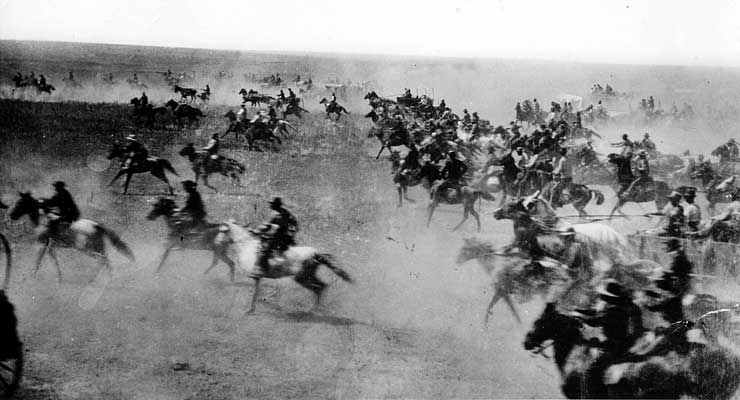
U.S. marks 150th anniversary of Homestead Act offering free landThe United States on Sunday marks the 150th anniversary of President Abraham Lincoln signing the Homestead Act, the law that gave away 270 million acres of land and transformed the vast American interior.

Representatives from 30 states will take part in a ceremony at the National Monument of America in the Nebraska town of Beatrice, representing the states where nearly 2 million people each received 160 acres of free land under the program.
And:Not everyone benefited from the Homestead Act. Engler said the law accelerated the removal of Native Americans from some states, especially across the Plains. With few exceptions, they were not allowed to homestead until 1924, when Native Americans were able to become U.S. citizens.

The act was in effect for 123 years. Homesteading ended in the continental United States in 1976. It ended in Alaska in 1986. In addition to the American West, homesteading took place in the South because land confiscated from plantation owners after the Civil War was deemed public land. Texas had no homesteading because it did not have federal public land.

Engler said the Homestead Act contributed to the expansion of the U.S. economy, spurred immigration and advanced transportation and communications networks.
Nothing to celebrate

The "not everyone benefited" paragraph is the only negative thing in the article about the Homestead Act. Here's a less benign view:

The Subsidy of History

History can't be done a priori.A considerable number of libertarian commentators have remarked on the sheer scale of subsidies and protections to big business, on their structural importance to the existing form of corporate capitalism, and on the close intermeshing of corporate and state interests in the present state capitalist economy. We pay less attention, however, to the role of past state coercion, in previous centuries, in laying the structural foundations of the present system. The extent to which present-day concentrations of wealth and corporate power are the legacy of past injustice, I call the subsidy of history.

The first and probably the most important subsidy of history is land theft, by which peasant majorities were deprived of their just property rights and turned into tenants forced to pay rent based on the artificial “property” titles of state-privileged elites.

Of course, all such artificial titles not founded on appropriation by individual labor are completely illegitimate.

As Ludwig von Mises pointed out in Socialism, the normal functioning of the market never results in a state of affairs in which most of the land of a country is “owned” by a tiny class of absentee landlords and the peasant majority pay rent for the land they work. Wherever it is found, it is the result of past coercion and robbery.
In particular:The Homestead Act of 1862, an apparent exception to this general trend, was really just another illustration of it. The majority of land, rather than being claimed under the terms of the Homestead Act, was auctioned to the highest bidder. Even for land covered by the Act, according to Howard Zinn, the $200 fee was beyond the reach of many. As a result, much of the land was not homesteaded on Lockean principles at all, but initially went to speculators before being partitioned and resold to homesteaders. And compared to the 50 million acres covered by homestead legislation, 100 million acres were given away as railroad land grants during the Civil War—free of charge! In other words, the privileged classes got the gravy, and ordinary homesteaders got the bone.Comment:  In this case, of course, the "peasant majorities" were Indians.

Much of today's concentrated wealth began with government subsidies to railroads, ranchers, miners, and drillers. So our "free market" economy has always been a crock. The country was "built" by elitists using government power to enrich themselves at the expense of Indians and other Americans.

For more on the subject, see:

Ayn Rand, racist
Land theft in My Little Pony
Jefferson's Indian removal policy
Capitalism killed the Indians
Great Plains in Years of Dust

November 25, 2011

Occupiers join National Day of Mourning

In solidarity, Occupy group joins with Native Americans

By Brian R. BallouAbout 30 Occupy Boston protesters traveled from their encampment in Boston’s Financial District to join the National Day of Mourning here yesterday, lending their support to a Native American demonstration held each Thanksgiving.

The organizers of the event recognized the Occupy members, telling them Native Americans are participants in the same struggle.

“When a hand is reached out in friendship like that, we want to support in-kind,” said Mahtowin Monroe, an organizer with the United American Indians of New England who spoke to a crowd of about 200 assembled on Cole’s Hill, overlooking the Plymouth Rock tourist attraction.

“Their cause is really straightforward, as is ours: One percent of the population holds [much] of the wealth in this country, and people’s benefits are getting slashed and people are losing their homes,” said Moonanum James, co-chairman of the United American Indians of New England. “On our reservations, we are mired in the deepest poverty. The idea is to have some equality in this country . . . economic equality.”
Comment:  We've seen Indians and Occupiers find common cause in Occupy Denver Joins Columbus Protest. And Indians criticize Occupiers in Occupiers Aren't Decolonizers. I hope Indians continue to join the protests while critiquing them as needed.

For more on the Occupy movement, see Occupy Toronto Exposes Anti-Indian Racism and Indians Occupy Umatilla Tribal Center.

Below:  "Jeremy Harper (center) was one of a group of about 30 protesters from the Occupy Boston encampment who marched with the Day of Mourning gathering." (Yoon S. Byun/Globe Staff)

November 05, 2011

Will Rogers on Wall Street

Will Rogers on Occupy Wall Street

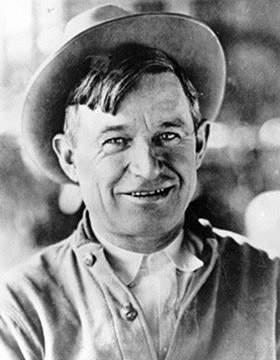
By Steve Russell“It’s all right to let Wall Street bet each other millions of dollars every day but why make these bets affect the fellow who is plowing a field out in Claremore, Oklahoma?”

My all time favorite Cherokee, Will Rogers, wrote that in 1924. Today, most of the fellows plowing fields in Claremore, OK, are still Cherokee—but a lot fewer of them own the land they are plowing.
And:“When a party can’t think of anything else they always fall back on Lower Taxes. It has a magic sound to a voter, just like Fairyland…” Will Rogers wrote that in 1924, not 2000, and in the same year he expressed the only thing that will get us out of this even if we do, as Occupy Wall Street demands, quit allowing unlimited gambling with other people’s money:

“People want JUST taxes, more than they want lower taxes. They want to know that every man is paying his proportionate share according to his wealth.”

Maybe I’m biased by my Cherokee genes, but any man who could write that in 1924 deserves our attention today.
Comment:  As we can see, Occupy Wall Street's message is nothing new. Pundits have been noting the evils of capitalism since the beginning. For instance:I hope we shall crush in its birth the aristocracy of our moneyed corporations which dare already to challenge our government to a trial of strength and bid defiance to the laws our country.Thomas Jefferson, letter to George Logan, Nov. 12th, 1816For more on Will Rogers, see Play About Will Rogers's Courtship and Will Rogers = Jon Stewart.

November 01, 2011

Kiowa Libertarian seeks office

Libertarian aims to get on ballot

His party will need more than 51,000 signatures of state residents

By Dylan Goforth
With the 2012 presidential election on the horizon, a Libertarian candidate from Oklahoma is getting started. But his first order of business is getting his party on the state ballot.

The candidate, R.J. Harris of Norman, said during a recent visit to Muskogee that it’s clear that the country is ready to see a third-party candidate in office. But for a Libertarian candidate to appear on the Oklahoma ballot, the Oklahoma Libertarian Party needs to collect more than 51,000 signatures by March 1.
And:A Kiowa, Harris said both his and the party’s message has been well received in the Native American community. He said cities such as Muskogee can play a key role in the process of granting ballot access to the Libertarian Party.

“What we find is that many people’s beliefs align with the Libertarian Party, but they’re so entrenched in the idea that they have to be a Democrat or a Republican that they don’t know it,” he said. “If people in Muskogee feel they may be interested, they can take control, sign the petition and tell others about the party.”
Comment:  Russell Means ran as a Libertarian too. What these people don't seem to realize is that free markets and a lack of government oversight is what destroyed the Indians in the first place.

For more on Indians and libertarianism, see Ayn Rand, Racist, Stossel:  Indians Are Biggest Moochers, and Capitalism Killed the Indians.

October 18, 2011

Occupy Albuquerque renamed

Occupy movement in New Mexico finds new name out of respect for Native Americans

By Nicolas MendozaIn response to concerns over the term “Occupy Albuquerque”, the protest movement has renamed itself “(Un)occupy Albuquerque.” The decision was made in a general assembly meeting of protesters at the University of New Mexico campus.

As the New Mexico Independent reported last week, some of the ’99 percenters’ objected to the association of the word ‘Occupy’ with what one Daily Kos contributor called “…five-hundred years of forced occupation of [Native American] lands, resources, cultures, power, and voices by the imperial powers of both Spain and the United States. A big chunk of the 99 percent has been served pretty well by that arrangement. A smaller chunk hasn’t.”

The ‘Occupy’ movement has emphasized its opposition to those in the top 1 percent of the country’s income distribution, as well as the financial sector, which in recent decades has drastically increased its share of the total national income.

But this emphasis has meant that many other societal tensions and grievances that have traditionally preoccupied left-wing and anti-establishment movements, such as those of the Native American community and other racial minorities, have not been a significant focus of the ’99 percenters.’
Comment:  I anticipated this result when I posted Indians Say "Unoccupy America."

Occupy Wall Street's theme goes something like this: "We the people, the 99% of Americans who aren't super-rich, are occupying Wall Street, home of the other 1%. We want the 1% to give up the reins of power--to unoccupy Wall Street and leave, metaphorically speaking."

"Unoccupy" also works for a Native-oriented protest. Unoccupy America doesn't literally mean "pack your bags and go back where you came from, rich white Americans." It means unoccupy the statehouses and boardrooms where you control all the power. Let the 99% rule--you know, the way a democracy is supposed to work.

Therefore, "Unoccupy" might be a clearer message than "Decolonize" for Indians. "We were here first, so stop occupying our space and telling us what to do. We demand the right to control our own destinies."

For more on the subject, see Critiquing the "Decolonize" Posters and Occupiers Aren't Decolonizers.

Below:  Albuquerque.

October 11, 2011

Occupiers aren't Decolonizers

Decolonization and Occupy Wall Street

By Robert DesjarlaitAs evidenced by their proposed list of demands, the Occupy Wall Street movement has no intentions of recognizing indigenous concerns or demarginalizing indigenous peoples in the United States. And that’s because the mindset of the majority of occupiers is an intergenerational extension of a colonized mindset. In her Foreword to The New Resource Wars, Winona LaDuke provides insight into the colonized mindset. Regarding “Industrial society, or as some call it, ‘settler society,’” LaDuke writes:In industrial society, ‘man’s dominion over nature,’ has preempted the perception of Natural Law as central. Linear concepts of ‘progress’ dominate this worldview. From this perception of ‘progress’ as an essential component of societal development comes the perception of the natural world as a wilderness. This, of course, is the philosophical underpinning of colonialism and ‘conquest.’”

This way of thinking is also present in scientific systems of thought like ‘Darwinism,’ as well as in social interpretations of human behavior such as ‘Manifest Destiny,’ with its belief in some god-ordained right of some humans to dominate the earth. These concepts are central to the…present state of relations between native and settler in North America and elsewhere.
The “settler society” that LaDuke refers to isn’t from the historical past. It is present in non-indigenous society today. It is the mentality of this “settler society” permeates the mindset of the Occupy Wall Street movement. Their demands aren’t about decolonization. Rather, their demands are about wanting a share of the profits, profits that come from the rape and plunder of the earth and our indigenous homelands.

This isn’t to say that the Occupy Wall Street movement lacks merit. Economic inequities, corporate greed, the mortgage crisis, the unequal distribution of wealth are legitimate concerns. But those concerns have nothing to do with neither decolonization nor environmental justice. As such, the 99% slogan is not inclusive of the myriad of environmental problems that plague both indigenous and non-indigenous peoples in the United States.
On the other hand, a Native activist explains why he's joined the Occupy movement:

Why I Am Occupying Wall Street

By John BirdJust when it seems all is lost, hope revives, and the eternal flame of hope for justice roars back to life from an unexpected direction, unexpected source. For me the Occupy Wall Street movement is that new hope. What I see in the Occupy Wall Street movement with its focus on economic justice which is entwined with social justice, growing and strengthening and merging with the environmental movement is the beginning of new hope. Not just for Native Americans, but for all Americans and all citizens of the world. Our Indigenous philosophies have always told us we are all related, we are all connected, we are all in this together.

This movement, with its growing alliances of economic justice, social justice, and environmental justice activists will be formidable if they hold. Climate change, endless wars, and a yearning for freedom beyond a future of corporate serfdom seems to be driving and strengthening new opportunities and alliances. Sunday, the Occupy Denver assembly unanimously adopted a 10 point platform put forth by the Colorado Chapter of the American Indian Movement.

Correctly, the movement blames both Wall Street and Washington for orchestrating the upward shift of money, assets, resources, and power to the governing elite, the 1%. This collusion perpetuates, expands, and institutionalizes poverty for the masses, where most Indigenous people reside. Poverty and war are social justice issues, deeply entwined with economic justice. Now,with the merging of environmental justice into this movement and the proper identification of the real source of injustice, the collusion between Wall Street and Washington, there is real hope for real change.

I have come to the conclusion that Barack Obama, who sold himself to the hopeful masses as the face of hope and change is severely hindered in that he, like his predecessors and too many members of congress, Republicans and Democrats alike, are beholden to the Wall Street masters and their money. I think this movement has a real chance precisely because it refuses to be co-opted and, like so many of the American people, it no longer trusts Democrats or Republicans. Correctly, it acknowledges that both parties who dominate our political system are similarly corrupted by the same greed and lust for power that rots Wall Street at its very core. People are taking to the streets now because they realize that change will not come solely from the ballot box.

In my community organizing work, I sometimes heard a saying. “It does not matter on which boat your ancestors came here, we are all in the same boat now,” to which I would add: “even if your ancestors did not come here in a boat, we are all in the same boat now.” The window of opportunity to bend the course of history back towards justice is once again opening. It will not stay open long. Let us, Native Americans and all others who have not given up hope for a world based on real economic, social, and environmental justice, not squander this opportunity. It may very well may be our last.
Comment:  I agree with Bird that waiting for Obama to change things is a waste of time. He needs a kick in the butt almost as much as the Republican Tea Party does.

If I were a Native, I'd recognize both these views. On the one hand, it's unlikely that a white, middle-class movement will put indigenous issues at the forefront. On the other hand, this may be the best chance Natives get to push an agenda that helps them.

So I'd say skipping the protests and joining them uncritically are both sub-optimal approaches. If I were a Native, I'd join the protests but try to shape and channel them from within.

For more on the subject, see "Decolonize Wall Street" and Indians Say "Unoccupy America."

May 06, 2011

Aboriginals to be "weaned from government teat"

Times will be changing for all First Nations

By Tom SewidIn 2006 I wrote an article in a Campbell River Newspaper called, "THE INDUSTRY OF MEETINGS MUST END". I chastised my fellow Aboriginals about how they were using meetings as a personal financial revenue generator, while creating nothing. I also warned them of the future.

The article alluded to how one day a Conservative majority government was inevitable. May 2, 2011 we finally saw this come about, and Prime Minister Stephen Harper is sure to skin Indian and Northern Affairs Canada to the bone. Indians dependent upon the social structure of this agency, or spoiled by the funds they accumulate being an aboriginal privy to funds via I.N.A.C., are over very soon.

I for one am so relieved knowing that those spoiled Indian's who drive around in their Escalade's going to meeting after meeting compiling mass amounts of honorarium while doing nothing, are soon to be a thing of the past. It's the educated with degrees, and aboriginal entrepreneurs that are now going to set the path for our aboriginal community's to prosper by. The time to create, prove, and use what one has readily at hand is now coming about once again. Kind of like the old days where we prospered by hard work, and used what was close at hand, instead of relying upon hand outs.

I look at it as the majority of Aboriginals of this country finally being weaned from the government teat. Many shall now have to create, prove their worth in order to stay in council, keep their seats on boards, or organizations in order to generate a pay cheque. The day of a fat cheque just because you showed up for a meeting are over, and I know it's only going to make the strong, stronger, and the weak fade away. This is good, for the weak honorarium monger have been nothing but anchors hanging off the bows of the Aboriginals that want to prosper via their toil. These people are the modern day suppressors of their own people, for in their sloth, they hold back the people they represent, and keep them in poverty.
Comment:  I don't know much about the "industry of meetings" Sewid refers to. But this op-ed seems offensive if not downright racist. Even if the writer is Native himself.

Look how he goes from a few Indians amassing honorariums at meetings to "the majority of Aboriginals of this country finally being weaned from the government teat." Those are two different and almost unrelated subjects. And does Sewid really want to claim that most Indians are weak, lazy, welfare "queens" who don't want to work? Unless he has the facts to back that up, how is that not a racist assertion about an entire ethnic group? (Hint: Poverty alone doesn't prove that the poor are weak and lazy. Only ignorant conservatives think that.)

Sewid might've had a case if he'd said that some Aboriginal politicians enrich themselves by going to meetings without doing anything. And that some Aboriginal people rely on welfare rather than getting jobs.

Of course, he'd need to provide some context. Some non-Aboriginal politicians enrich themselves by going to meetings without doing anything. And some non-Aboriginal people rely on welfare rather than getting jobs. In short, there's nothing particularly unusual about the behavior of some Aboriginals. There are good and bad people in every group.

But that's not what Sewid said. He indicted only Indians--as if they're the only problem he can see in his narrow sights. By discriminating against one racial group in his criticism, Sewid's op-ed is arguably racist.

Of course, this kind of language is hysterical in the context of American and Canadian politics. The US tax burden is lower than it's been since 1958. Politicians pass tax cuts for the rich while cutting services for the poor. Billion-dollar corporations are paying $0 in taxes. But Sewid is whining about lazy, good-for-nothing Indians? How about lazy, good-for-nothing whites who sit around the pool sipping martinis while "earning" money from trust funds, stock appreciation, and tax loopholes?

For more on the stereotype of welfare Indians, see Commissioner:  Indians Should Get Off the Rez and Fox Special on Indian "Freeloaders."

March 30, 2011

Lumbees prove government doesn't work?!

John Stossel and my pleasure jolts

By Barry FarberNow here comes John Stossel, fellow WND columnist, over the weekend of March 26 with one of the best pieces in television history: "Freeloaders," a Fox News special delivering stomp-down proof that Indian tribes that are not recognized as tribes by the government and get no federal handouts are more successful than those on the federal dole. Stossel visited the Lumbee tribe of North Carolina, whose members get nothing from the government. They're generally successful in business. Many live in luxury mansions. In contrast, the Indians embraced by the feds live in what look like tar-paper shacks.

In boxing, John Stossel's interview with Elizabeth Homer, who used to be the government nanny of the recognized tribes, would have been canceled as a mismatch or halted on a TKO early in Round 1. She was pitifully unable to defend government stewardship over Native Americans as anything but the failure of socialism.
Comment:  Too bad Homer (whom I've interviewed before) isn't a kick-butt debater like me. Here's what she should've said:

1) One example of anything is statistically meaningless. Compared to 565 federally recognized tribes, the Lumbee case is irrelevant. It's an anecdote, not a fact.

2) I'm guessing Stossel didn't do more than talk to one or two Lumbees and drive through one or two Lumbee neighborhoods. There's zero evidence that he examined the lives of 55,000 Lumbees in any meaningful way.

3) Stossel provide no context for his claims. The important context is this: Many unrecognized tribes in rural locations are as poor as recognized tribes. And many recognized tribes in urban locations (the Mashantucket Pequots, Mohegans, Seminoles, Shakopee Mdewakanton Sioux, San Manuel, Morongo, Agua Caliente, Pechanga, Viejas, Chumash, et al.) are as rich as their non-Indian neighbors.

What's the key information in this paragraph? Tribes in rural locations are poor because no jobs are nearby. Tribes in urban locations are (relatively) rich because jobs are nearby. The Lumbees are well-off because they live in North Carolina's booming Triangle region (Raleigh, Durham, Chapel Hill), not because self-reliance has made them strong.

For more on the subject, see Trahant Agrees About Termination Agenda, Fox Special on Indian "Freeloaders," and Stossel:  Indians Are Biggest Moochers.

January 03, 2011

Review of WARLORD OF MARS #1

Dynamite Entertainment is reviving John Carter of Mars in a new comic book. I decided to get the first issue because:

  • I've read all of Edgar Rice Burroughs's John Carter novels.

  • I recently wrote about Barsoom = Indian Territory and Stereotypes in A Princess of Mars

  • The story covered Carter's pre-Mars days and I wanted to see how Dynamite would handle it.

  • It cost only $1.00.

  • The main story invents a scene not in A Princess of Mars. Carter and his partner Powell are in an Arizona saloon when some ex-Union soldiers enter. They call the Confederates and their leaders cowards, but Carter ignores them. But when the Yankees insult Carter's beloved Virginia, he shoots them dead.

    Rob's reactions

    That was a great bit when I saw it in The Trouble with Tribbles 33 years ago. But it's a little unoriginal now.

    Carter is supposed to be a dignified, aristocratic gentleman. He's one of the last people who would fight his inferiors over an insult. And he wouldn't start shooting them when they hadn't shot first.

    The artist is drawing Carter to look much like Wolverine without the tufts of hair. His personality is Wolverine-like too. This Carter apparently will go into a berserker rage whenever he's provoked.

    Unfortunately, that's a total misreading of John Carter. It would be like portraying Sir Lancelot, James Bond, or Jean-Luc Picard as a barroom brawler. It has nothing to do with the original character except the name.

    The Indian aspects

    Alas, the Apache don't make an appearance in this issue. The Yankees call them "redskins" at the beginning so readers will know these white men are crude and rude. Near the end, Carter and Powell discover Indian scalps on the soldiers' horses. White men bad! Indians (possibly) good! That's different from the approach in the original novel, at least.

    Carter concludes by saying, "We'll have to be careful now. Apaches aren't going to be too pleased to see any more white faces." Yeah, because Carter and Powell plan to trespass on their land and take their mineral resources without permission. Who would be pleased at that?

    So some things haven't changed. John Carter still has a ridiculously inflated sense of white privilege and entitlement. Like a 2-year-old, he thinks that whatever he can find and see is his. He doesn't recognize the concept that other people have possessions and rights just like him.

    In that sense, he's a typical American. In the clash between sovereign Indian nations and selfish American greed, the latter wins.

    Anyway, I'd say WARLORD OF MARS #1 isn't even worth a dollar. You can safely skip this comic.

    For more on the subject, see America's Cult of Self and Capitalism Killed the Indians.

    December 05, 2010

    America's cult of self

    American Psychosis:  What happens to a society that cannot distinguish between reality and illusion?…

    By Chris HedgesThe virtues that sustain a nation-state and build community, from honesty to self-sacrifice to transparency to sharing, are ridiculed each night on television as rubes stupid enough to cling to this antiquated behavior are voted off reality shows. Fellow competitors for prize money and a chance for fleeting fame, cheered on by millions of viewers, elect to “disappear” the unwanted. In the final credits of the reality show America’s Next Top Model, a picture of the woman expelled during the episode vanishes from the group portrait on the screen. Those cast aside become, at least to the television audience, nonpersons. Celebrities that can no longer generate publicity, good or bad, vanish. Life, these shows persistently teach, is a brutal world of unadulterated competition and a constant quest for notoriety and attention.

    Our culture of flagrant self-exaltation, hardwired in the American character, permits the humiliation of all those who oppose us. We believe, after all, that because we have the capacity to wage war we have a right to wage war. Those who lose deserve to be erased. Those who fail, those who are deemed ugly, ignorant or poor, should be belittled and mocked. Human beings are used and discarded like Styrofoam boxes that held junk food. And the numbers of superfluous human beings are swelling the unemployment offices, the prisons and the soup kitchens.

    It is the cult of self that is killing the United States. This cult has within it the classic traits of psychopaths: superficial charm, grandiosity and self-importance; a need for constant stimulation; a penchant for lying, deception and manipulation; and the incapacity for remorse or guilt. Michael Jackson, from his phony marriages to the portraits of himself dressed as royalty to his insatiable hunger for new toys to his questionable relationships with young boys, had all these qualities. And this is also the ethic promoted by corporations. It is the ethic of unfettered capitalism. It is the misguided belief that personal style and personal advancement, mistaken for individualism, are the same as democratic equality. It is the nationwide celebration of image over substance, of illusion over truth. And it is why investment bankers blink in confusion when questioned about the morality of the billions in profits they made by selling worthless toxic assets to investors.

    We have a right, in the cult of the self, to get whatever we desire. We can do anything, even belittle and destroy those around us, including our friends, to make money, to be happy and to become famous. Once fame and wealth are achieved, they become their own justification, their own morality. How one gets there is irrelevant.
    Comment:  "Those who lose deserve to be erased" is the standard American view of, and justification for, the vanishing Indian, of course. Our (circular, illogical, idiotic) thinking goes: "We won because we're right and we're right because we won."

    I've written about this subject many times before. The examples range from A Latin View of American-Style Violence to Victor or Victim:  Our New National Anthem? In these postings I've noted the connection between greed and selfishness--core American values--and conquest and genocide.

    It wasn't a coincidence that the Euro-American lust for gold and land led to the near-extermination of the Western Hemisphere's peoples. Rather, it was the inevitable outcome. When one side deems success the only thing that matters, the other side becomes expendable. The winner takes it all; the losers are eliminated. Figuratively in reality shows but literally in American history.

    The conquest of America was a perfect example of free-market libertarianism in action. Without government constraints, settlers moved onto Indian land and declared it theirs. When the Indians fought back, "self-reliant" Americans cried for government protection. The government pacified the Indians for them while they boasted about what rugged individualists they were.

    "Cult of self" goes way back

    "Flagrant self-exaltation" existed before the European invasion of the Americas, of course. It arguably goes back to the Bible and the idea of "chosen people." We can trace this attitude from the Book of Genesis to the latest reality show:

    "God made man in his own image" => "Dominion over all things" => Divine right of kings => "Shining city upon a hill" => Manifest Destiny => American exceptionalism => "Me" generation => Cult of self.

    While we were anointing ourselves angels, we also had to anoint some demons to help define our self-image. So we've created a long list of heathens, savages, and barbarians to justify our self-proclaimed greatness. The lists includes Indians, blacks, Mexicans, Mormons, Catholics, immigrants, Asians (the "yellow peril"), Jews, labor unions, socialists, communists, atheists, secularists, feminists, gays, terrorists, Muslims, et al. The trend continues with the attacks on Obama, who's sort of the ultimate evildoer (black/Muslim/foreigner/socialist/terrorist) to many Americans.

    For more on the subject, see Gray vs. Brown Americans, Culture War Over Who's American, and Bigots Protest Brown-Skins on 9/11.

    December 03, 2010

    Conservatives hate Wikileaks and Indians

    This week's controversy concerns Wikileaks' release of thousands of confidential diplomatic documents. Showing their disdain for free speech, due process, and the rule of law, conservatives have responded by calling for the death of Julian Assange, founder of Wikileaks.

    Questions we wouldn't be asking in a sane world

    By Dan GardnerWhy is it that most people in the United States and elsewhere are not disturbed in the slightest that, despite abundant evidence, American officials who apparently committed heinous crimes in the war on terror will not be investigated and held to account, while Wikileaks founder Julian Assange, who apparently did nothing illegal this week, is hunted to the ends of the Earth? And how in hell is it possible that when a former president of the United States of America admits he authorized the commission of torture—which is to say, he admits he committed a major crime—the international media and political classes express not a fraction of the anger they are now directing at the man who leaked the secrets of that president’s administration?

    I marvel at that paragraph. It would have been inconceivable even 10 years ago. Murder treated as a legitimate option in political discourse? Torture as acceptable government policy? No, impossible. A decade ago, it would have been satire too crude to be funny.

    And yet, here we are.

    The question in the Commons Wednesday was prompted by the televised comments of Tom Flanagan, political scientist and former chief of staff to Prime Minister Stephen Harper. “I think Assange should be assassinated, actually,” Flanagan said Tuesday.

    This was the hard-right id laid bare. The day before, Sarah Palin said much the same. Explicitly or implicitly, so did many others, including journalist Bill Kristol, Congressman Pete King, blogger John Hawkins, and the editorial board of the Wall Street Journal.
    Flanagan scorns Indians too

    Not coincidentally, Flanagan is also prejudiced against Indians. Here's a report on him from October 2004:

    The Man Behind Stephen Harper

    The new Conservative Party has tasted success and wants majority rule. If Tom Flanagan and his Calgary School have their way, they’ll get it without compromising their principles

    By Marci McDonald
    Consternation rumbled across the country like an approaching thunderhead. For aboriginal leaders, one of their worst nightmares appeared about to come true. Two weeks before last June’s federal election, pollsters were suddenly predicting that Conservative leader Stephen Harper might pull off an upset and form the next government. What worried many in First Nations’ circles was not Harper himself, but the man poised to become the real power behind his prime ministerial throne: his national campaign director Tom Flanagan, a U.S.-born professor of political science at the University of Calgary.

    Most voters had never heard of Flanagan, who has managed to elude the media while helping choreograph Harper’s shrewd, three-year consolidation of power. But among aboriginal activists, his name set off alarms. For the past three decades, Flanagan has churned out scholarly studies debunking the heroism of Métis icon Louis Riel, arguing against native land claims, and calling for an end to aboriginal rights. Those stands had already made him a controversial figure, but four years ago, his book, First Nations? Second Thoughts, sent tempers off the charts.

    In it, Flanagan dismissed the continent’s First Nations as merely its “first immigrants” who trekked across the Bering Strait from Siberia, preceding the French, British et al. by a few thousand years—a rewrite which neatly eliminates any indigenous entitlement. Then, invoking the spectre of a country decimated by land claims, he argued the only sensible native policy was outright assimilation.
    And:Who are these men—for they are, without exception, men—in Harper’s backroom brain trust, collectively dubbed the “Calgary School”? Flanagan won his conservative spurs targeting the prevailing wisdom on the country’s native people—what he calls the “aboriginal orthodoxy.” Others like Rainer Knopff and Ted Morton—Alberta’s long-stymied senator-elect—have built careers, and a brisk consulting business, taking shots at the Charter of Rights, above all its implications for the pet peeves of social conservatives: feminism, abortion, and same-sex marriage.

    But what binds the group is not only friendship, it’s a chippy outsiders’ sense of mission. In a torrent of academic treatises and no-holds-barred commentaries in the media, they have given intellectual heft to a rambunctious, Rocky Mountain brand of libertarianism that has become synonymous with Western alienation.

    That neo-conservative agenda may read as if it has been lifted straight from the dusty desk drawers of Ronald Reagan: lower taxes, less federal government, and free markets unfettered by social programs such as Medicare that keep citizens from being forced to pull up their own socks.
    Comment:  The second article refers to Flanagan's "principles." That probably was a typo. There's no principle that encompasses less federal government but more federal government when it comes to controlling Indians. If conservatives like Flanagan weren't hypocrites, they'd support sovereign Indian nations as a pure expression of local government.

    There's also no principle that encompasses due process of the law and conservative favorites such as warrantless wiretapping, imprisonment without trial, foreign renditions, torture, and assassination. Any conservative who brays about the "rule of law" while supporting these practices is a goddamned hypocrite.

    I ripped into Flanagan back in 2001 for my Stereotype of the Month contest. He was the January-February 2001 loser for this entry:

    Ottawa News claims "treaties...have little relevance" today

    As I said, it isn't a coincidence that Flanagan hates social programs, tribal sovereignty, and the free flow of information. Indeed, he exemplifies what today's conservative/libertarians believe:

  • Blind faith in free markets despite their frequent failures.

  • Lower taxes for the rich, less federal government except for military spending and corporate welfare, and markets designed so businesses can rob and cheat consumers legally.

  • Opposition to feminism, abortion, and same-sex marriage--all of which they should champion if they believe in individual freedom unfettered by government.

  • Disdain for blacks, Indians, and other minorities who won't assimilate into mainstream society and become "white"--again a violation of individual choice.

  • Attacks on free speech and the media, science, and art when they discomfit the military-industrial complex. In other words, supporting government and big business at the expense of people--once again, a violation of their so-called principles.

  • If there's a common theme here, it's that white male Christians have come to dominate the world with tactics ranging from conquest to genocide. Today's conservative/libertarians are dedicated to keeping these people in power. Opposing social programs, tribal sovereignty, and the free flow of information are all part of their agenda.

    Wikileaks reveals conservative hypocrisy

    I could do a whole posting on what the Wikileaks scandal says about the conservative hatred of America's ideals. To keep things manageable, I'll simply link to the best postings I've read on the subject. Specifically, on conservatives' hypocrisy:

    WikiLeaks reveals more than just government secrets

    The moral standards of WikiLeaks critics

    Foreign Press Says What America’s Won’t:  Sarah Palin is a Traitor

    And their invention of phony controversies while real problems go unaddressed:

    News Flash:  123 Americans Dead, No WikiLeaks Connection

    From WikiChina

    Plus my own snarky contributions to the debate:

    I imagine conservative teabaggers are cheering Wikileaks because they hate the US government and its coercive power over people. Right?

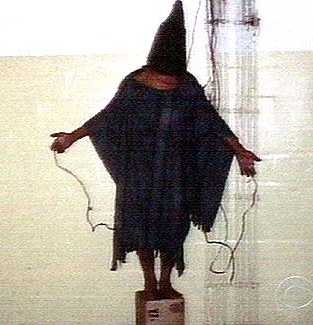
    Psst! Here's a secret Wikileaks missed: President George W. Bush authorized waterboarding, a recognized form of torture. Pass it on.

    Wikileaks = crime against humanity. Preemptive invasion of Iraq, Guantanamo Bay prison camp, legalized torture, Patriot Act...not so much.

    For more on the subject, see Tea Party Guide to American History and Tea Party Believes in Taking.

    Below:  Wikileaks bad, torture good!