I haven't watched the episode, but the odds of Mr. Ed wearing a headdress and talking like Tonto are good.
Showing posts with label Cherokee. Show all posts
Showing posts with label Cherokee. Show all posts
July 28, 2016
Cherokee Ed in Mr. Ed
Cherokee EdWhen Ed discovers that he is of Cherokee descent, he refuses to participate in the Pioneer Parade. Unfortunately for Wilbur, he has already promised Carol's Dad that Ed would do it as a favor for him. Comment: The horse is Cherokee? Wow, that sounds like a huge problem.
I haven't watched the episode, but the odds of Mr. Ed wearing a headdress and talking like Tonto are good.
I haven't watched the episode, but the odds of Mr. Ed wearing a headdress and talking like Tonto are good.


June 14, 2016
Rain dance in Gilligan's Island
Some Native stereotyping from a popular 1960s TV show:
"Gilligan's Island": Water, Water Everywhere (TV Episode 1965)
Episode aired 2 January 1965The castaways desperately try to find a new water source as they have completely exhausted their current water supply. Gilligan’s Island Transcript
Episode #14, “Water, Water Everywhere”EXT. JUNGLE - DAY
Mrs. Howell wears a headband with a feather in it. Her dress looks vaguely native American, but she has accessorized it with a broach and pearls.
MRS HOWELL
I can't understand it, Thurston. All that nonsense about a divining rod to bring water.
MR HOWELL (O.S.)
Yes, I know. Totally unscientific.
MRS HOWELL
Are you ready?
Mr. Howell enters dressed in a Cherokee ceremonial headdress.
MR HOWELL
Yes, any time you are, my dear. One, two, three.
The Howells perform a "rain dance."
HOWELLS
Ha!
Mr. Howell and Mrs. Howell look to the sky.
MR HOWELL
Rain!
Mr. Howell looks at his dry palm and then back up at the sky.
MR HOWELL (cont'd)
You're not listening.
MRS HOWELL
I don't understand it. It worked last year in Yellowstone Park for the Cherokees. 
Comment: I don't remember the line about the Cherokees. The show may have eliminated it during filming.
The fact that it's in the script makes the stereotyping worse. Clearly the writers didn't know the difference between Plains and Cherokee Indians, or anything.
"Gilligan's Island": Water, Water Everywhere (TV Episode 1965)
Episode aired 2 January 1965
Episode #14, “Water, Water Everywhere”
Mrs. Howell wears a headband with a feather in it. Her dress looks vaguely native American, but she has accessorized it with a broach and pearls.
MRS HOWELL
I can't understand it, Thurston. All that nonsense about a divining rod to bring water.
MR HOWELL (O.S.)
Yes, I know. Totally unscientific.
MRS HOWELL
Are you ready?
Mr. Howell enters dressed in a Cherokee ceremonial headdress.
MR HOWELL
Yes, any time you are, my dear. One, two, three.
The Howells perform a "rain dance."
HOWELLS
Ha!
Mr. Howell and Mrs. Howell look to the sky.
MR HOWELL
Rain!
Mr. Howell looks at his dry palm and then back up at the sky.
MR HOWELL (cont'd)
You're not listening.
MRS HOWELL
I don't understand it. It worked last year in Yellowstone Park for the Cherokees.
Comment: I don't remember the line about the Cherokees. The show may have eliminated it during filming.
The fact that it's in the script makes the stereotyping worse. Clearly the writers didn't know the difference between Plains and Cherokee Indians, or anything.
November 11, 2015
1/64 Cherokee in Modern Family
I'm not watching Modern Family anymore, but I saw a commercial for this week's episode, The More You Ignore Me. In it, Phil Dunphy says this as he runs to his car:I may be 1/64 Cherokee but I'm also 63/64 crazy white guy! Comment: Wow, they're really going to the Cherokee well on this show. Following 1/16 Cherokee in Modern Family, it's the second time someone's claimed to be Cherokee.
There's nothing wrong with this, exactly. Phil could well be 1/64th Cherokee by blood. More likely, someone told him his great-great-great-great grandmother was Cherokee and he swallowed the story uncritically. Which is how it goes about 63/64ths of the time.
But the show has tried this gimmick twice, which makes the writers seem a little thoughtless and unoriginal. Not to mention desperate. Have they been listening to the critics who have pointed out how white the show is? Except for Gloria, who's a fiery Latina stereotype?
What better way to inject some color--literally and figuratively--into their white-bread characters? Many people claim to have Cherokee ancestors who are difficult if not impossible to verify. It's a cheap way to imply a character isn't as white and privileged as he seems.
If Phil is 1/64th Cherokee, you're supposed to feel 1/64th more sympathy for him, or something. The show can then proceed without confronting a single issue of race or culture. It's the TV equivalent of checking a box on a job application. "For the sake of the diversity police, we checked the ethnicity box for Phil this week. Done!"
For more on Modern Family, see History Class in Modern Family.
September 28, 2015
Review of Time Spike
Time Spike (The Ring of Fire)Captain Andrew Blacklock was overseeing the change of shifts at the state of Illinois’ maximum-security prison when the world outside was suddenly ripped. They thought it was an earthquake until they found that the Mississippi river had disappeared, along with all signs of civilization. Then the sun came up—in the wrong direction. And a dinosaur came by and scratched its hide against the wall of the prison . . .
Something had thrown the prison back in time millions of years. And they were not alone. Other humans from periods centuries, even millennia apart had also been dropped into the same time. Including a band of murderous conquistadores. But the prison had its own large population of murderers. They couldn’t be turned loose, but what else could be done with them? Death walked outside the walls, human savagery was planning to break loose inside, and Blacklock and the other men and women of the prison’s staff were trapped in the middle. Native aspects
The "time spike" phenomenon sends people from every era of southern Illinois back through time. They include:
"Primitive" Indians from the prehistoric Mound Builders The entire city now known as Cahokia Hernando de Soto and his band of conquistadors Cherokee refugees on the Trail of Tears and the US soldiers escorting them
Only a few of the Cherokee refugees get any significant time. They're reasonably well-fleshed out. Everyone else is one-dimensional, alas. The "primitive" Indians are scared and overwhelmed by the more modern people. The Cahokia residents (mentioned, not shown) are religious fanatics. The conquistadors are psychopathic butchers. And the Cherokee refugees include an incredibly stealthy tracker and an incredibly sensitive healer.
In short, everyone except a few exceptions is a type. The modern-day characters are almost all three-dimensional, while the characters from the past aren't.
There's also a Cherokee inmate who was wrongly convicted. He's mostly three-dimensional too, but he's especially crafty and good at surviving. I don't know if this is a subtle nod to his Native ancestry or not, but it's a shame there are no average Indians. They're all way above or below average.
As for the rest of the book, Time Spike is good overall. It deals realistically with the problems of being sent back in time with only the supplies and skill-sets on hand and 2,000 prisoners behind bars. Only toward the end does it let down a little. Most of the conflicts get settled with guns and violence, not with the intelligence and foresight seen earlier.
Rob's rating: 8.0 of 10.

Something had thrown the prison back in time millions of years. And they were not alone. Other humans from periods centuries, even millennia apart had also been dropped into the same time. Including a band of murderous conquistadores. But the prison had its own large population of murderers. They couldn’t be turned loose, but what else could be done with them? Death walked outside the walls, human savagery was planning to break loose inside, and Blacklock and the other men and women of the prison’s staff were trapped in the middle.
The "time spike" phenomenon sends people from every era of southern Illinois back through time. They include:
Only a few of the Cherokee refugees get any significant time. They're reasonably well-fleshed out. Everyone else is one-dimensional, alas. The "primitive" Indians are scared and overwhelmed by the more modern people. The Cahokia residents (mentioned, not shown) are religious fanatics. The conquistadors are psychopathic butchers. And the Cherokee refugees include an incredibly stealthy tracker and an incredibly sensitive healer.
In short, everyone except a few exceptions is a type. The modern-day characters are almost all three-dimensional, while the characters from the past aren't.
There's also a Cherokee inmate who was wrongly convicted. He's mostly three-dimensional too, but he's especially crafty and good at surviving. I don't know if this is a subtle nod to his Native ancestry or not, but it's a shame there are no average Indians. They're all way above or below average.
As for the rest of the book, Time Spike is good overall. It deals realistically with the problems of being sent back in time with only the supplies and skill-sets on hand and 2,000 prisoners behind bars. Only toward the end does it let down a little. Most of the conflicts get settled with guns and violence, not with the intelligence and foresight seen earlier.
Rob's rating: 8.0 of 10.
September 24, 2015
Cherokee actor in solar commercial
Here's a commercial starring Cherokee actor Rob Vestal. It's the first time I can remember a commercial featuring a modern Native actor in a role that isn't specifically Native.
“Just the Facts” Solar Water HeatingSoCalGas can help you convert your residential or commercial property to a solar water heating system so you can save energy, save on your monthly bill and take advantage of special rebates and tax incentives. You could qualify for rebates from $4,366 (homeowners) up to $800,000 (for businesses). Visit http://SolarWaterHeating101.com/ for details.
Comment: Natives have appeared in commercials going back to the battles over Proposition 5 and 1A in California almost 20 years ago. Since then, they've occasionally touted their casinos or their history and culture--usually to build support for their casinos. But this ad has nothing to do with anything Native, which makes it rare if not unique.
For more on Rob Vestal, see Off the Rails at Native Voices and Review of Teaching Disco.
“Just the Facts” Solar Water Heating
Comment: Natives have appeared in commercials going back to the battles over Proposition 5 and 1A in California almost 20 years ago. Since then, they've occasionally touted their casinos or their history and culture--usually to build support for their casinos. But this ad has nothing to do with anything Native, which makes it rare if not unique.
For more on Rob Vestal, see Off the Rails at Native Voices and Review of Teaching Disco.
August 20, 2015
Review of Underground
Back in 2009, this comic book got some press:
UndergroundUNDERGROUND is a graphic novel from IMAGE COMICS. Written by Jeff Parker, drawn by Steve Lieber, and colored by Ron Chan, the story follows Park Ranger Wesley Fischer as she tries to save Stillwater Cave--and then has to save herself. Going 'Underground' With Parker & Lieber
By Zack SmithNewsarama: Steve, Jeff: Underground! What's it about and who's in it?
Jeff Parker: Wesley Fischer is our main character, she works for the State Parks system as a Ranger, though her first love is caving. She's a fairly recent immigrant to the town of Marion, where she pulled a lot of strings to get stationed so she could explore the Stillwater Cave there.
The cave has been closed to the public for years for safety reasons, and there's a growing movement in the town to develop it as a show cave, like a sister to Mammoth Cave, to bring some tourist dollars into the area.
Wes is against this because she doesn't want the cave system compromised--there's already been a fair amount of damage to it over the years. But the local entrepreneur Winston Barefoot is putting his considerable weight behind the venture, and an inspector from the state is coming to look into the matter.
The problem is that some of Winston's men have taken the initiative to get the cave ready for development to hurry things along.
NRAMA: Tell us about Wesley and the other main characters.
SL: Wesley is a park ranger and environmentalist, not necessarily in that order. She's smart, athletic and concerned, but not looking to be any sort of hero. But the cave is a fragile ecosystem, and she's committed to keeping it pristine.
Seth Ridge is a park ranger too. He's part Cherokee and unlike Wes, he has deep roots in the town. For him, the cave was a place to hang out with his buddies as a kid. He and Wes hooked up for the first time the night before the story starts, and they aren't really sure where they stand with each other. 
Some reviews of Underground:
This Comic Is Good--Underground
A Year of Cool Comics---Day 82
Native aspects
The story is set in Marion, Kentucky. Since it's in the far west of the state, near Illinois, I don't think many Cherokee lived there. They did spend the winter of 1838-1839 there during the infamous Trail of Tears.
Anyway, several characters seem to be part Native:
Winston Barefoot mentions his "Cherokee heritage" in one panel and runs a store filled with Indian kitsch. Seth Ridge says his mother was Native. Ridge is a Cherokee name and Barefoot is evidently supposed to be Native too.
Barefoot and Ridge both have reddish skin, though it comes and goes. Barefoot's henchman Harden also has this skin color, as does the chief ranger, occasionally. Harden and the ranger may be Native or part Native too.
Alas, Underground makes no use of this Native background. No Native legends of the underground or anything. It's kind of a missed opportunity.
At least there's nothing stereotypical, so that's good.
As for the rest of the series, it's competently done but nothing you need to read. The characters spend one issue mostly dangling by ropes and another creeping through a water-filled passage. If you're into caving or want a change of pace, check it out.

Underground
By Zack Smith
Jeff Parker: Wesley Fischer is our main character, she works for the State Parks system as a Ranger, though her first love is caving. She's a fairly recent immigrant to the town of Marion, where she pulled a lot of strings to get stationed so she could explore the Stillwater Cave there.
The cave has been closed to the public for years for safety reasons, and there's a growing movement in the town to develop it as a show cave, like a sister to Mammoth Cave, to bring some tourist dollars into the area.
Wes is against this because she doesn't want the cave system compromised--there's already been a fair amount of damage to it over the years. But the local entrepreneur Winston Barefoot is putting his considerable weight behind the venture, and an inspector from the state is coming to look into the matter.
The problem is that some of Winston's men have taken the initiative to get the cave ready for development to hurry things along.
NRAMA: Tell us about Wesley and the other main characters.
SL: Wesley is a park ranger and environmentalist, not necessarily in that order. She's smart, athletic and concerned, but not looking to be any sort of hero. But the cave is a fragile ecosystem, and she's committed to keeping it pristine.
Seth Ridge is a park ranger too. He's part Cherokee and unlike Wes, he has deep roots in the town. For him, the cave was a place to hang out with his buddies as a kid. He and Wes hooked up for the first time the night before the story starts, and they aren't really sure where they stand with each other.
Some reviews of Underground:
This Comic Is Good--Underground
A Year of Cool Comics---Day 82
Native aspects
The story is set in Marion, Kentucky. Since it's in the far west of the state, near Illinois, I don't think many Cherokee lived there. They did spend the winter of 1838-1839 there during the infamous Trail of Tears.
Anyway, several characters seem to be part Native:
Winston Barefoot mentions his "Cherokee heritage" in one panel and runs a store filled with Indian kitsch. Seth Ridge says his mother was Native. Ridge is a Cherokee name and Barefoot is evidently supposed to be Native too.
Barefoot and Ridge both have reddish skin, though it comes and goes. Barefoot's henchman Harden also has this skin color, as does the chief ranger, occasionally. Harden and the ranger may be Native or part Native too.
Alas, Underground makes no use of this Native background. No Native legends of the underground or anything. It's kind of a missed opportunity.
At least there's nothing stereotypical, so that's good.
As for the rest of the series, it's competently done but nothing you need to read. The characters spend one issue mostly dangling by ropes and another creeping through a water-filled passage. If you're into caving or want a change of pace, check it out.
July 12, 2015
Andrea Smith the white savior
Tribes Blast ‘Wannabe’ Native American Professor
The Cherokee Nation is denouncing scholar-activist Andrea Smith for falsely claiming to be a member of the tribe. Beyond untrue, the ethnic fraud is a painful reminder of their past.
By Samantha AllenIn her public statement, Smith downplayed the fact that she is not enrolled in the Cherokee Nation: “My enrollment status does not impact my Cherokee identity or my continued commitment to organizing for justice for Native communities.”
But according to Patti Jo King, a Cherokee historian and Interim Chair of American Indian Studies at Bacone College who says she privately conversed with Smith about her claims of Cherokee identity in 2007, it is Smith’s deception—not her enrollment status and not her advocacy—that constitutes the central issue.
“She’s trying to switch the argument around here,” King told The Daily Beast in a phone interview. “We are not talking about her scholarship here. We are not talking about her commitment to Indian people.”
King also shared more details about the 2007 conversation in which she and Richard Allen, a Cherokee policy analyst, met with Smith to discuss her claims of Cherokee identity. During that conversation, Smith told King and Allen that her mother had told her that she was Cherokee. According to Cornsilk’s timetable, however, Smith would have already received confirmation that she was not Cherokee twice by that time.
King added that Smith was “very humble” during that meeting but now seems determined to continue claiming Cherokee identity in spite of the criticism she has received in the past week.
“This infringes on our rights of self-determination, self-identity, and sovereignty,” King said. “We are the best experts of our own culture and we have the sovereign right to decide who our members are, just like any nation.” Cry Me a River, Andrea Smith
By Terese Marie MailhotWatching two Native academics come to a consensus about Andrea Smith is like watching two eagles fight. No, wait, I mean egos. After Andrea Smith was outed for the second time as being non-Native, several Native academics leapt to save her from scrutiny. “Focus on more positive things,” they said. “Let’s not criticize her, because she’s done so much good for the community.” I’m done with that discourse. It’s time to be upset. White people can all-to-easily say they’re Indian, while claiming to be black is a cultural anomaly, ala Rachel Dolezal. It is with this in mind that I can say Andrea Smith is far more insidious a character than Dolezal.
For years Smith has been conjuring her fake spirit animal to cry wolf, acting like she’s one of the many Indian women who face violence and subjugation. It’s a little too generous to say Smith was led to believe she was Indian. I mean, good lord, nobody told me I was an Indian. When my mom found out we were part Irish, she read a bunch of Irish literature, we made soda bread, and then called it a day. We couldn’t get in touch with our Irish roots, because by lineage, blood, and community, we were too Indian. So Indian my mother put the Irish flag on regalia. So Indian, my mother argued Irish people should be called Indigenous because, just like us, they were exploited by the Europeans. How was Smith lead to believe she was Indian? Did she grow up in an Indian community? Nope. Are either of her parents Indian? Nope. She, like most white people who think they’re Indian, was told she was part Indian. She took that and ran with it. Ran hard. Like, took that loose mouthed claim to lineage, and made a career out of it.
Trust me, I empathize with people removed from their culture. The sixties scoop is a real issue for many Native people throughout North America. If you’re unfamiliar, it was a period in which the government could scoop up Indian children from their communities, then place them up for adoption in Canada and the US. That’s real: for the people disconnected from their cultures, and for the people who could not find their real parents. I empathize with Native people shut out from their culture, but don’t confuse their stories with that of Smith. She’s hella white, and she tried to save us. Can we call her what she is: a white savior.
Native academic communities are far too kind. I’ve seen endless blog posts and editorials empathizing with Smith. Even defending her, saying she’s done so much good. No. Her deceit affected the ethos of every institution she worked for. Her criticism of government funding was coming from a dangerous space, where she never had to rely on government funding to feed her children or protect her sisters. She’s a fake. Her work was based around her identity, and scholars have the audacity to say how she identifies isn’t worth noting. Andrea Smith and the battle over sovereigntyIn the book, “Becoming Indian: The Struggle over Cherokee Identity in the Twenty-first Century” by Circe Sturm, anthropologist Michael Lambert, a citizen of the Eastern Band of Cherokee Indians described Cherokee identity politics as a “battle over sovereignty”:
"One of the terrains on which this is being fought is that of how we define “Indian.” The current effort to define Indian as a racial/cultural group is an effort to extinguish Indian sovereignty. The only way for Indian nations to defend and expand their sovereignty is to make exclusive claim to defining who is Indian and what it means to be Indian. If Indians have sovereignty, then culture, behavior, and belief should have nothing to do with who is or is not Indian. After all, we wouldn’t deny someone’s Germanness because they hate sauerkraut, nor would we have the audacity to recognize someone as German simply because they love it. German is what German does. Indian is what Indian does…
What does this have to do with non-enrolled Cherokees identifying as such? I see the basis of claims to Indian identity to be political acts. This is, and has been, a battle over sovereignty. One who bases their claim to Indian identity on any basis other than sovereignty is not taking a pro-Indian position.”
By rejecting the idea that enrollment or citizenship in an Indian Nation is a factor in who is or is not Indian, Andrea Smith is taking an anti-Indian position. That is a direct attack on tribal sovereignty. No matter what Smith says, she is not acting in our best interest. She is not our friend and she is not seeking justice for us. Instead, she's forced us to a national stage where we must defend our tribal sovereignty, and once again, battle to protect one of the only things we Cherokees have left--our identity. Comment: Andrea Smith is really the same issue as mascot lovers, German hobbyists, and hipsters in headdresses. These people proclaim themselves Indians so they can become wild, savage, and free. So they can be tribal and indigenous rather than corporate or processed or homogenized. It's all about feeling different and special rather than the same as everyone else.
The problem is that if everyone's an Indian, no one's an Indian. It washes away the actual history of tribal sovereignty and government-to-government relations. It turns generations of subjugation and oppression into a feel-good party of rainbows and fairy dust.
This is why people have complained about the "melting pot" metaphor. Wannabes are helping Natives melt into a homogenized stew of white gruel with bits of flavoring. The result is a bland "we're all Americans but some of us have funny names and costumes," which is vastly different from thousands of unique Native cultures with millennia of history.
For more on the subject, see Cornsilk: Smith "Is Not a Cherokee" and Andrea Smith Defends Herself.
The Cherokee Nation is denouncing scholar-activist Andrea Smith for falsely claiming to be a member of the tribe. Beyond untrue, the ethnic fraud is a painful reminder of their past.
By Samantha Allen
But according to Patti Jo King, a Cherokee historian and Interim Chair of American Indian Studies at Bacone College who says she privately conversed with Smith about her claims of Cherokee identity in 2007, it is Smith’s deception—not her enrollment status and not her advocacy—that constitutes the central issue.
“She’s trying to switch the argument around here,” King told The Daily Beast in a phone interview. “We are not talking about her scholarship here. We are not talking about her commitment to Indian people.”
King also shared more details about the 2007 conversation in which she and Richard Allen, a Cherokee policy analyst, met with Smith to discuss her claims of Cherokee identity. During that conversation, Smith told King and Allen that her mother had told her that she was Cherokee. According to Cornsilk’s timetable, however, Smith would have already received confirmation that she was not Cherokee twice by that time.
King added that Smith was “very humble” during that meeting but now seems determined to continue claiming Cherokee identity in spite of the criticism she has received in the past week.
“This infringes on our rights of self-determination, self-identity, and sovereignty,” King said. “We are the best experts of our own culture and we have the sovereign right to decide who our members are, just like any nation.”
By Terese Marie Mailhot
For years Smith has been conjuring her fake spirit animal to cry wolf, acting like she’s one of the many Indian women who face violence and subjugation. It’s a little too generous to say Smith was led to believe she was Indian. I mean, good lord, nobody told me I was an Indian. When my mom found out we were part Irish, she read a bunch of Irish literature, we made soda bread, and then called it a day. We couldn’t get in touch with our Irish roots, because by lineage, blood, and community, we were too Indian. So Indian my mother put the Irish flag on regalia. So Indian, my mother argued Irish people should be called Indigenous because, just like us, they were exploited by the Europeans. How was Smith lead to believe she was Indian? Did she grow up in an Indian community? Nope. Are either of her parents Indian? Nope. She, like most white people who think they’re Indian, was told she was part Indian. She took that and ran with it. Ran hard. Like, took that loose mouthed claim to lineage, and made a career out of it.
Trust me, I empathize with people removed from their culture. The sixties scoop is a real issue for many Native people throughout North America. If you’re unfamiliar, it was a period in which the government could scoop up Indian children from their communities, then place them up for adoption in Canada and the US. That’s real: for the people disconnected from their cultures, and for the people who could not find their real parents. I empathize with Native people shut out from their culture, but don’t confuse their stories with that of Smith. She’s hella white, and she tried to save us. Can we call her what she is: a white savior.
Native academic communities are far too kind. I’ve seen endless blog posts and editorials empathizing with Smith. Even defending her, saying she’s done so much good. No. Her deceit affected the ethos of every institution she worked for. Her criticism of government funding was coming from a dangerous space, where she never had to rely on government funding to feed her children or protect her sisters. She’s a fake. Her work was based around her identity, and scholars have the audacity to say how she identifies isn’t worth noting.
"One of the terrains on which this is being fought is that of how we define “Indian.” The current effort to define Indian as a racial/cultural group is an effort to extinguish Indian sovereignty. The only way for Indian nations to defend and expand their sovereignty is to make exclusive claim to defining who is Indian and what it means to be Indian. If Indians have sovereignty, then culture, behavior, and belief should have nothing to do with who is or is not Indian. After all, we wouldn’t deny someone’s Germanness because they hate sauerkraut, nor would we have the audacity to recognize someone as German simply because they love it. German is what German does. Indian is what Indian does…
What does this have to do with non-enrolled Cherokees identifying as such? I see the basis of claims to Indian identity to be political acts. This is, and has been, a battle over sovereignty. One who bases their claim to Indian identity on any basis other than sovereignty is not taking a pro-Indian position.”
By rejecting the idea that enrollment or citizenship in an Indian Nation is a factor in who is or is not Indian, Andrea Smith is taking an anti-Indian position. That is a direct attack on tribal sovereignty. No matter what Smith says, she is not acting in our best interest. She is not our friend and she is not seeking justice for us. Instead, she's forced us to a national stage where we must defend our tribal sovereignty, and once again, battle to protect one of the only things we Cherokees have left--our identity.
The problem is that if everyone's an Indian, no one's an Indian. It washes away the actual history of tribal sovereignty and government-to-government relations. It turns generations of subjugation and oppression into a feel-good party of rainbows and fairy dust.
This is why people have complained about the "melting pot" metaphor. Wannabes are helping Natives melt into a homogenized stew of white gruel with bits of flavoring. The result is a bland "we're all Americans but some of us have funny names and costumes," which is vastly different from thousands of unique Native cultures with millennia of history.
For more on the subject, see Cornsilk: Smith "Is Not a Cherokee" and Andrea Smith Defends Herself.
July 10, 2015
Cornsilk: Smith "is not a Cherokee"
An Open Letter to Defenders of Andrea Smith: Clearing Up Misconceptions about Cherokee Identification
By David CornsilkIt appears the Andrea Smith apologists are doing everything they can to divert attention from the one thing about her that is important right now, whether or not she is Cherokee. They want to make it about her work, not so. They want to make it about her complexion, not so. They want to make it about blood quantum, not so. Some have even suggested it is about jealousy, not so. The factual basis of all grievances against Andrea Smith, and others like her, begins and ends with whether or not she can prove Cherokee ancestry.
These people don’t know real Cherokees, our history, culture, language and genealogies. They cannot speak intelligently to the question of her authenticity because they have no baseline, which is why they use diversionary tactics. Why would they know real Cherokees when all they see are fakes?
In the 1990s, Andrea Smith sought me out as a Cherokee genealogist, on two separate occasions, to see if she had any connections. My research into Smith’s ancestry showed that her ancestry was not connected to the Cherokee people. In the subsequent years, many have challenged her identity including representatives of the Cherokee Nation. In those ensuing years, she has had ample opportunity to come forth with proof of her Cherokee claims. Instead, she has admitted to not being Cherokee or promised to stop claiming Cherokee; but perhaps because the foundation of her work as a ‘woman of color’ depended upon making others believe her claim she would back paddle and like a drug addict, fall off the truth wagon. As far as I can tell, nothing has changed in the evidence of her ancestry that would lead me to believe she is or even might be of Cherokee descent.
Smith’s supporters don't like to be shown so lacking in knowledge of all things Indian; unwilling to admit they got duped by Smith. They are fully invested in her web of lies that they are willing to throw tribal sovereignty and self-determination under the proverbial bus. If they adore Smith's work, more power to ‘em. But do not let your love of one person's work blind you to the dangers false claims of Indian identity carry within it. Andrea Smith and all those like her are nothing more than the latest incarnation of settler colonial violence. Their apologists and collaborators are nothing new either. And:When I say someone has no Cherokee ancestry, it's not just that they or their ancestors are not enrolled. It's much more complex than that. In my past job as a Cherokee genealogist, I would look at the rolls and documents of course. But I also examine the wider extended family to see if there is any kinship to Cherokees on the roll during the ancestral time frame and in the tribe now.
When Cherokees left the tribe or chose not to enroll, that was a decision at a specific moment in time. They would be on previous rolls. And most importantly, other members of the extended family, aunts, uncles, siblings, parents, grandparents and cousins would be among the tribal members and on the various rolls and records. Just like white Americans find kin in Europe whose ancestors remained, real Cherokees who can't enroll today have relatives in the tribe. Andrea doesn’t. Not a single Cherokee citizen living today claims her or her family. Either she emerged as a fully formed Cherokee Indian and we must recalibrate our creation story; or the reality is, she isn’t Cherokee.
Andrea Smith isn't just missing from our tribe, but every generation back to the genesis of America, all of those relatives I mentioned are also MISSING.
That fact speaks loud and clear that not only is Andrea Smith not enrolled, SHE IS NOT A CHEROKEE! Not Honoring Her AgreementsDespite her agreements with Richard Allen and Patti Jo King in 2007 and with Steve Russell in 2008 (all Cherokee citizens) to no longer publicly identify as Cherokee, Andrea Smith has continued to accept speaking engagements and PR as a “Cherokee intellectual” and has continued to identify herself in her publications as an Indigenous, woman of color scholar and activist. It is possible that in some cases a host institution, department, or program, or a press, has copied her bio material from an outdated website. But a simple email or phone call from her would have clarified matters. Here are a few of the dozens of examples since 2008. Comment: For more on the subject, see Andrea Smith Defends Herself and Native Scholars Demand Academic Integrity.
By David Cornsilk
These people don’t know real Cherokees, our history, culture, language and genealogies. They cannot speak intelligently to the question of her authenticity because they have no baseline, which is why they use diversionary tactics. Why would they know real Cherokees when all they see are fakes?
In the 1990s, Andrea Smith sought me out as a Cherokee genealogist, on two separate occasions, to see if she had any connections. My research into Smith’s ancestry showed that her ancestry was not connected to the Cherokee people. In the subsequent years, many have challenged her identity including representatives of the Cherokee Nation. In those ensuing years, she has had ample opportunity to come forth with proof of her Cherokee claims. Instead, she has admitted to not being Cherokee or promised to stop claiming Cherokee; but perhaps because the foundation of her work as a ‘woman of color’ depended upon making others believe her claim she would back paddle and like a drug addict, fall off the truth wagon. As far as I can tell, nothing has changed in the evidence of her ancestry that would lead me to believe she is or even might be of Cherokee descent.
Smith’s supporters don't like to be shown so lacking in knowledge of all things Indian; unwilling to admit they got duped by Smith. They are fully invested in her web of lies that they are willing to throw tribal sovereignty and self-determination under the proverbial bus. If they adore Smith's work, more power to ‘em. But do not let your love of one person's work blind you to the dangers false claims of Indian identity carry within it. Andrea Smith and all those like her are nothing more than the latest incarnation of settler colonial violence. Their apologists and collaborators are nothing new either.
When Cherokees left the tribe or chose not to enroll, that was a decision at a specific moment in time. They would be on previous rolls. And most importantly, other members of the extended family, aunts, uncles, siblings, parents, grandparents and cousins would be among the tribal members and on the various rolls and records. Just like white Americans find kin in Europe whose ancestors remained, real Cherokees who can't enroll today have relatives in the tribe. Andrea doesn’t. Not a single Cherokee citizen living today claims her or her family. Either she emerged as a fully formed Cherokee Indian and we must recalibrate our creation story; or the reality is, she isn’t Cherokee.
Andrea Smith isn't just missing from our tribe, but every generation back to the genesis of America, all of those relatives I mentioned are also MISSING.
That fact speaks loud and clear that not only is Andrea Smith not enrolled, SHE IS NOT A CHEROKEE!
July 09, 2015
Andrea Smith defends herself
My Statement on the Current Media Controversy
By Andrea SmithTo the academic and social justice organizing communities which I have been part of for many years, and to whom I am indebted:
I have always been, and will always be Cherokee. I have consistently identified myself based on what I knew to be true. My enrollment status does not impact my Cherokee identity or my continued commitment to organizing for justice for Native communities.
There have been innumerable false statements made about me in the media. But ultimately what is most concerning is that these social media attacks send a chilling message to all Native peoples who are not enrolled, or who are otherwise marginalized, that they should not publicly work for justice for Native peoples out of fear that they too may one day be attacked. It is my hope that more Indigenous peoples will answer the call to work for social justice without fear of being subjected to violent identity-policing. I also hope the field of Native studies might attend to disagreement and difference in a manner that respects the dignity of all persons rather than through abusive social media campaigns.
Out of respect for the dignity and privacy of my family, and out of concern for the damage that these attacks have had on my students, colleagues, and organizing communities, I will direct my energies back to the work of social justice. A right-wing site helpfully parses Smith's language:
Alleged fake Native American prof responds to charges (sort of) in blog post
By Dave Huber“I have always been, and will always be Cherokee,” Smith writes. “I have consistently identified myself based on what I knew to be true. My enrollment status does not impact my Cherokee identity or my continued commitment to organizing for justice for Native communities.”
The “consistently identified myself” sounds a lot like what Rachel Dolezal said. And note the use of the past tense: “what I knew to be true.” Comment: For more on the subject, see Native Scholars Demand Academic Integrity and Smith's Defenders Denounce "Identity Policing".
By Andrea Smith
I have always been, and will always be Cherokee. I have consistently identified myself based on what I knew to be true. My enrollment status does not impact my Cherokee identity or my continued commitment to organizing for justice for Native communities.
There have been innumerable false statements made about me in the media. But ultimately what is most concerning is that these social media attacks send a chilling message to all Native peoples who are not enrolled, or who are otherwise marginalized, that they should not publicly work for justice for Native peoples out of fear that they too may one day be attacked. It is my hope that more Indigenous peoples will answer the call to work for social justice without fear of being subjected to violent identity-policing. I also hope the field of Native studies might attend to disagreement and difference in a manner that respects the dignity of all persons rather than through abusive social media campaigns.
Out of respect for the dignity and privacy of my family, and out of concern for the damage that these attacks have had on my students, colleagues, and organizing communities, I will direct my energies back to the work of social justice.
Alleged fake Native American prof responds to charges (sort of) in blog post
By Dave Huber
The “consistently identified myself” sounds a lot like what Rachel Dolezal said. And note the use of the past tense: “what I knew to be true.”
July 07, 2015
Native scholars demand academic integrity
The Andrea Smith controversy continues to simmer:
Fake Cherokee?
By Scott JaschikThe issue is both important and sensitive to many Native American studies scholars. Leaders in the field stress that they believe that outstanding scholarship has been done by people with a variety of backgrounds, Native American and other. But many also say that there is a particular obligation in this field--when the number of Native American scholars with prominent university positions is so small and when Native Americans have been misunderstood by scholars for generations--to be open about one's background.
"All scholarship should be based on integrity and that integrity includes honesty and transparency," said Winona Wheeler, president of the Native American and Indigenous Studies Association, associate professor indigenous studies at the University of Saskatchewan, and a member of the Fisher River Cree Nation. "One of the significant tenets of indigenous studies as a discipline is that we strive to [situate] ourselves with our research. So it's really important in the discipline that we advise our readers somehow about the place that we're coming from." And:The American Indian Studies Program at the University of Illinois at Urbana-Champaign, where Smith had a postdoctoral fellowship, in 2010 issued a statement called "Identity and Academic Integrity."
Robert Warrior, director of American Indian studies at Illinois, said that Smith didn't prompt the statement, but that the reports about her were "a topic of discussion throughout our development of it. We knew about the ethical issues regarding her claims to Cherokee descent at that point."
The Illinois statement said in part: "We recognize the importance of being able to identify ourselves clearly and unambiguously. Too often, we realize, American Indian studies as a field of academic inquiry has failed to live up to its potential at least in part because of the presence of scholars who misrepresent themselves and their ties to the Native world. While we do not in any way want to suggest that only Native scholars can do good scholarship in Native studies, neither do we want to make light of the importance of scholars who work in this field being able to speak with clarity about who they are and what brings them to their scholarship and creative activity." Open Letter From Indigenous Women Scholars Regarding Discussions of Andrea Smith
By various authorsWe call first and foremost for accountability to the communities in which we claim membership. This is not a call for the punitive or the exclusionary. This case evokes people’s fears and vulnerabilities about very real histories of disenfranchisement, expulsion, discrimination, and normative policing in Indian Country and beyond. Thus it bears repeating: our concerns about Andrea Smith do not emerge from statist forms of enrollment or non-enrollment, federal recognition or lack thereof. They are not about blood quantum or other biologically essentialist notions of identity. Nor are they about cultural purity or authenticity, or imposing standards of identification that those who would work for or with indigenous communities must meet.
Rather, our concerns are about the profound need for transparency and responsibility in light of the traumatic histories of colonization, slavery, and genocide that shape the present. Andrea Smith has a decades-long history of self-contradictory stories of identity and affiliation testified to by numerous scholars and activists, including her admission to four separate parties that she has no claim to Cherokee ancestry at all. She purportedly promised to no longer identify as Cherokee, and yet in her subsequent appearances and publications she continues to assert herself as a non-specific “Native woman” or a “woman of color” scholar to antiracist activist communities in ways that we believe have destructive intellectual and political consequences. Presenting herself as generically indigenous, and allowing others to represent her as Cherokee, Andrea Smith allows herself to stand in as the representative of collectivities to which she has demonstrated no accountability, and undermines the integrity and vibrancy of Cherokee cultural and political survival. Her lack of clarity and consistency in her self-presentation adds to the vulnerability of the communities and constituents she purports to represent, including students and activists she mentors and who cite and engage her work. This concerns us as indigenous women committed to opening spaces for scholars and activists with whom we work and who come after us. And:Smith’s self-acknowledged false claims and lack of clarity on her own identity perpetuate deeply ingrained notions of race—black, white, and Indian—that run counter to indigenous modes of kinship, family, and community connection. When she and others continue to produce her as Cherokee, indigenous, and/or as a woman of color by default, they reinforce a history in which settlers have sought to appropriate every aspect of indigenous life and absolve themselves of their own complicity with continued dispossession of both indigenous territory and existence.
The stories we tell have consequences, and the harm that some stories produce goes beyond their individual context. One of the devastating consequences of Smith having served as the often singular representative of indigeneity in a variety of academic and activist social justice contexts is damage to strategic alliance building, especially between indigenous and non-indigenous women of color. Accountability to communities, kinship networks and multiple histories is part of the difficult work scholars of indigenous and critical race studies must be willing to undertake to ensure that our work combats rather than reinforces or leaves untouched the intricate dynamics of heteropatriarchal racist colonialism. Comment: For more on the subject, see Smith's Defenders Denounce "Identity Policing" and "Cherokee" Activist Isn't Cherokee.

Fake Cherokee?
By Scott Jaschik
"All scholarship should be based on integrity and that integrity includes honesty and transparency," said Winona Wheeler, president of the Native American and Indigenous Studies Association, associate professor indigenous studies at the University of Saskatchewan, and a member of the Fisher River Cree Nation. "One of the significant tenets of indigenous studies as a discipline is that we strive to [situate] ourselves with our research. So it's really important in the discipline that we advise our readers somehow about the place that we're coming from."
Robert Warrior, director of American Indian studies at Illinois, said that Smith didn't prompt the statement, but that the reports about her were "a topic of discussion throughout our development of it. We knew about the ethical issues regarding her claims to Cherokee descent at that point."
The Illinois statement said in part: "We recognize the importance of being able to identify ourselves clearly and unambiguously. Too often, we realize, American Indian studies as a field of academic inquiry has failed to live up to its potential at least in part because of the presence of scholars who misrepresent themselves and their ties to the Native world. While we do not in any way want to suggest that only Native scholars can do good scholarship in Native studies, neither do we want to make light of the importance of scholars who work in this field being able to speak with clarity about who they are and what brings them to their scholarship and creative activity."
By various authors
Rather, our concerns are about the profound need for transparency and responsibility in light of the traumatic histories of colonization, slavery, and genocide that shape the present. Andrea Smith has a decades-long history of self-contradictory stories of identity and affiliation testified to by numerous scholars and activists, including her admission to four separate parties that she has no claim to Cherokee ancestry at all. She purportedly promised to no longer identify as Cherokee, and yet in her subsequent appearances and publications she continues to assert herself as a non-specific “Native woman” or a “woman of color” scholar to antiracist activist communities in ways that we believe have destructive intellectual and political consequences. Presenting herself as generically indigenous, and allowing others to represent her as Cherokee, Andrea Smith allows herself to stand in as the representative of collectivities to which she has demonstrated no accountability, and undermines the integrity and vibrancy of Cherokee cultural and political survival. Her lack of clarity and consistency in her self-presentation adds to the vulnerability of the communities and constituents she purports to represent, including students and activists she mentors and who cite and engage her work. This concerns us as indigenous women committed to opening spaces for scholars and activists with whom we work and who come after us.
The stories we tell have consequences, and the harm that some stories produce goes beyond their individual context. One of the devastating consequences of Smith having served as the often singular representative of indigeneity in a variety of academic and activist social justice contexts is damage to strategic alliance building, especially between indigenous and non-indigenous women of color. Accountability to communities, kinship networks and multiple histories is part of the difficult work scholars of indigenous and critical race studies must be willing to undertake to ensure that our work combats rather than reinforces or leaves untouched the intricate dynamics of heteropatriarchal racist colonialism.
July 02, 2015
Smith's defenders denounce "identity policing"
As the criticism of "Cherokee" activist Andrea Smith unfolded, her defenders also took to the Internets. The first "criticism" I saw was mild:
No, Andrea Smith is not the “Native American Rachel Dolezal”
By Erica Violet LeeYes, if it is true that Andrea’s claims to heritage were entirely made up, it is a betrayal. Pretending to be Indigenous is not okay, regardless of your intentions. Accepting the astounding number of public engagements she has done over the years (and payments for these events) on the basis that one is a Cherokee scholar is unthinkably harmful and displaces countless Indigenous women scholars. For this reason I support the many Indigenous scholars I know that have worked to bring this particular case to light and demanded accountability; many of them important, senior women scholars who make spaces in the academy for young Indigenous women like me. But:Moving forward, how do we best deal with this situation?
Rather than tearing down any one woman, support the already-existing immense body of work of Indigenous scholars, particularly, that of Indigenous feminists and Indigenous women. Support the work of Indigenous feminists whose work is useful for our communities. It's not one or the other. We can tear down Smith's wall of denial while supporting the work of genuine indigenous scholars. In fact, nudging Smith out of the limelight does exactly that. It frees up time and space for us to examine other people's work.
Jealous of Smith?
But then Smith's defenders got serious with their accusations:
Statement from Tawna Barnett-Little (Muscogee Creek/Seminole)All academics have shortcomings and it amazes me that you choose to attack Andy’s identity as her shortcoming and take it to this level. That’s the best you could do in finding something to call her out on? How pitiful. Why not go after her scholarship, her arguments? Oh yeah, because they’re brilliant! And her work is used in both grass roots organizing spaces and academic settings. Testimonies of Indigenous female rape survivors have asserted Andy’s work to be healing and empowering. Andrea and her sister Justine have both been extraordinarily positive voices in my life as well as other members of my family. This also rings true during times of hardship when their words have been encouraging and they have been physically present in our lives…..oh, remember that I said I’m a FULL-BLOOD (black haired-brown skinned-Indian looking individual unlike the rest of these insecure-in-your-identity-academic-mixed-bloods who I would not have criticized until you decided to exercise identity policing) which means that Andrea does hang out with Native People, contrary to previous blogging claims that she does not hang around other Natives. Many others can attest to that as well.
As we say in Muscogee, “mistvlke fekcahke owet fullet owes” (they are going about in a jealous way). I guess if my academic scholarship was lacking, I might also develop jealousy toward Andrea Smith. So, attacking her identity on grounds of not having an enrollment card and “misrepresenting herself” is an easy target eaten up by non-grass roots Indigenous Peoples and is something that only mainstream whites and insecure Natives seem to care about. It is obvious that these attackers do not know Andrea and her personal family challenges, particularly those surrounding her lineage. Trying to survive in academia can be brutal in Native Studies arenas where everyone wants to be Indianer-than-thou. I am altogether compassionate toward her claim/misunderstanding about enrollment in the Cherokee Nation. That doesn’t dismiss her exceptional work, commitment to social justice and desire to end global oppression. Andrea does not claim to be a Cherokee cultural or language expert and these attackers evidently have fooled folks into thinking they are somehow culturally and linguistically superior to Andy in their Native identity. Wow, that’s a joke! Andrea has not used her Cherokee identity as a way to promote herself; rather, she identifies with what she was told her identity is growing up and she participates in social justice advocacy--for people other than herself. In fact, she went to law school to defend those who cannot defend themselves. Andrea has made INCREDIBLE personal sacrifices for her family and herself in order to fight for justice, and anyone that attempts to discredit her clearly does not get the whole picture. The virtues of my Muscogee People (vnokeckv, eyasketv, mehenwv, kvncvpkv) do not support this kind of hateful behavior. It sounds like most of these attackers are without traditional teachings from their respective nations; they have yet to learn how to live on this earth. Why not go after Smith's scholarship? Because her scholarship and her identity are two separate issues. Duh.
If I ever heard of Smith before this controversy, I don't remember it. I'm not Native, "traditional," or academic, so there's nothing for me to be jealous of. I criticize people who lie and dissemble because lying and dissembling is wrong.
For the umpteenth time, no one is saying a word about Smith's work or her advocacy. We're talking about her identity problems such as the "misunderstanding" about being an enrolled Cherokee.
More important things to do?
Why Realness Fails Us in Native Studies
By Chris FinleyIn the shadow of the Rachel Dolezal scandal, mostly non-Cherokee Indigenous academics have raised an alarm about Andy Smith’s identity once again. I want to point out that it is mostly tenured faculty that are doing this. I want to know why you have an investment in Andy’s identity in particular. Indian identity has always been heavily policed. Usually it was the settlers trying to undo us, but in this case, it is ourselves. This is the part that makes me truly sick. There isn’t a settler in sight but there is a massacre occurring. It isn’t only Andy who is hurt and scared by this discussion. I know if my identity was held up to a microscope or even a magnifying glass, I would fail spectacularly. I don’t speak my language, I don’t make it home much, I don’t eat venison because I’m a vegetarian (total Indigenous failure!), I don’t even like camping, I haven’t had sexual relations with an Indian in over 5 years, and I never wear turquoise jewelry. Sure, I’m enrolled, but as an Indigenous person my identity is always scrutinized and measured. (People often ask me for my blood quantum or specific questions about my cultural practices.) As a Native woman, my identity and civility are always under attack. Native men in the academy do not have their identities and work scrutinized as much as Native women do.
Andy Smith has done more for Indigenous people than I ever will and this is not because I think she blocked me but I just never had the energy she had to dedicate every waking moment to ending oppression. To me the question or desire should not be for a self-confession from Andy about what went wrong or what she is or is not, because I think her actions speak louder than that. My desire is for Indigenous people to stop tearing each other apart and to stop attacking someone who really tried to do some good. Why didn’t so many people call out Kevin Costner when he was adopted by the Rosebud Nation and then built a casino and that was not about sovereignty or decolonization. I tell you, I saw Andy go through her tenure battle at Michigan and the institution would have never treated a white woman that way, but it most certainly would have done so to a Native feminist. And:For us to forsake Andy for not being Native when we have a white president of Native American and Indigenous Studies is very hypocritical. Why let white people run Native Studies? Does that make us less Native? I don’t think so but maybe it does. We have real things to worry about, theorize, and love. And this debate does not get us there. It is not a caring debate. The debate relies on those who want to be Native informants who tell all the other non-Natives that Andy is not Cherokee or Native like this means something really deep. To me, it doesn’t. When I found out there wasn’t a Santa Claus, I got over it.
This is not the most important thing happening in Native America, nor should it be.
This is NOT about Andy, but this is about us and how we deal with this shit. I call postings such as this "Fifty shades of defending wannabes."
Wow, I am so sick of the "more important things" argument. If you're in academia, you're automatically not doing anything truly critical. "Chris Finley is a queer Native feminist finishing her PhD in American culture at the University of Michigan"...and that's what we should be doing instead of criticizing Andrea Smith? Because getting a PhD is the key to saving Native lives?
Finley and her ilk are thinking, writing, and teaching about long-term issues, which is fine and dandy. But don't tell us you're holier than thou--e.g., saving children from burning fires--and we're not. Academics, journalists, entertainers, and artists all contribute to the furtherance of Native culture and history in their own ways. Talking about wannabes who co-opt Native identity is one of those ways.
Working for Big Brother?
Statement from Klee Benally (Diné/Russian-Polish)Off social media most of the day and now back to a witch hunt against fierce feminist author and friend, Andy Smith. While I’m not privy to all that’s been published, so far I’ve read tequilasovereign’s (aka Joanne Barker) tumblr and a couple others. tequilasovereign’s statements eerily evoke cointel-pro badjacketing rather than Indigenous feminism. Reading it I couldn’t help ask myself, what interests are served via this pillory?
When Ward Churchill’s identity was called into question it clearly served a conservative agenda. My position then was that his identity is between him and the creator and an issue for his family and Nation to address internally through their own cultural process. After all, the primary issues regard accountability, colonialism, and white supremacy. I still maintain that his political contributions shouldn’t be uncritically thrown out when challenged with the colonial institution of “blood-quantum.”
Accountability on Indigenous terms figures quite different than putting someone on a social media blast. Certainly ethnic fraud should be critically addressed regarding Indigenous (mis)representation but is this the proper way and venue to address matters that have such serious implications? Perhaps we should also consider the standard set by Cherokee Nation of Oklahoma’s shit politics regarding anti-black dis-enrollments? It’s further concerning how the logic of this applies to non-Federally recognized Indigenous Peoples too, what are the standards for Indigenous academic purity there?
This isn’t to excuse redface, but to recognize that quantum/enrollment issues are more complex than the Dolezal matter (her own family put her on blast, which is quite different than what’s playing out with Andrea Smith), just check the Pechanga or Pala issues for reference: http://losangeles.cbslocal.com/…/casino-tribe-outcasts-cla…/ Churchill's and Smith's identities are between them and their creator? Is that also true of Iron Eyes Cody and all the German hobbyists and hipsters in headdresses? They're Native if they say they are?
In other words, Benally is excusing redface. Anyone and everyone can pretend to be Native if they feel like it. If my heart and soul tell me I'm Cherokee, I am.
Unfortunately for Benally, Smith isn't being accused of having a too-low blood quantum, or of violating the Cherokee Nation's standards. She's accused of having no Cherokee heritage whatsoever. No blood ties, no community ties, nothing. So spare us the histrionic talk about how the System and the Man are trying to oppress poor Andrea the wannabe.
Sticking to Smith's fraud
Another commenter pushed back against these accusations, noting how people were trying to change the subject from Smith's misdeeds.
On the Politics of Distraction
By Joanne BarkerMy point is that expecting Andrea Smith–or anyone else–to be honest, to have integrity, in how they identify themselves and their work is not the same thing as policing their/her identity through the standards of racial authenticity. No one I know has ever asked her what her racial quota is or whether or not she can produce her CDIB.
Equating “identity policing” with the expectation of integrity with how someone presents themselves as Native is part of the trouble–anticipating that kind of racialized equivalence is exactly why Cherokee people and Native scholars who have known about Smith’s fraud for 7 to 24 years have never come forward. And:I share this because in the blogosphere of reactions to what seems like new information about Smith for a lot of people, people are speaking as if those of us who have known, who have tried to think out loud about the issues in the last few days and weeks, are spiteful and mean-spirited and hateful people. That has not been my experience. The Native feminists and NAIS allies, UCSC alum and others, who have known and who are just beginning to speak up about the issues are compassionate, generous, empathetic, and smart and have been genuinely distressed about Smith–and for Smith’s health and well-being–and what the right thing is to do and to say for years and years and years. It has required a lot of spiritual, emotional, professional, and intellectual energy to work through. And we are only just beginning.
My challenge to everyone is to stay focused. There are too many distractions in conversations about these issues–too many accusations of papergenocide, lateral violence, cruelty. They have seemed, to me, disingenuous. A way to refocus the question and alleviate Smith of any kind of responsibility or accountability. You know, it wouldn't affect me one iota if I found a nonwhite ancestor in my family tree. Why should it? It literally would have nothing to do with my present circumstances or plans.
Therefore, I don't understand why people would go around touting a rumor or a lie for years. Why don't they just save us the trouble and check themselves into a psychiatric institute? Because clearly they have unresolved issues and need help.
For more on Indian wannabes, see Vague Ancestors Aren't a Free Pass and Rachel Dolezal = Indian Wannabe.
No, Andrea Smith is not the “Native American Rachel Dolezal”
By Erica Violet Lee
Rather than tearing down any one woman, support the already-existing immense body of work of Indigenous scholars, particularly, that of Indigenous feminists and Indigenous women. Support the work of Indigenous feminists whose work is useful for our communities.
Jealous of Smith?
But then Smith's defenders got serious with their accusations:
Statement from Tawna Barnett-Little (Muscogee Creek/Seminole)
As we say in Muscogee, “mistvlke fekcahke owet fullet owes” (they are going about in a jealous way). I guess if my academic scholarship was lacking, I might also develop jealousy toward Andrea Smith. So, attacking her identity on grounds of not having an enrollment card and “misrepresenting herself” is an easy target eaten up by non-grass roots Indigenous Peoples and is something that only mainstream whites and insecure Natives seem to care about. It is obvious that these attackers do not know Andrea and her personal family challenges, particularly those surrounding her lineage. Trying to survive in academia can be brutal in Native Studies arenas where everyone wants to be Indianer-than-thou. I am altogether compassionate toward her claim/misunderstanding about enrollment in the Cherokee Nation. That doesn’t dismiss her exceptional work, commitment to social justice and desire to end global oppression. Andrea does not claim to be a Cherokee cultural or language expert and these attackers evidently have fooled folks into thinking they are somehow culturally and linguistically superior to Andy in their Native identity. Wow, that’s a joke! Andrea has not used her Cherokee identity as a way to promote herself; rather, she identifies with what she was told her identity is growing up and she participates in social justice advocacy--for people other than herself. In fact, she went to law school to defend those who cannot defend themselves. Andrea has made INCREDIBLE personal sacrifices for her family and herself in order to fight for justice, and anyone that attempts to discredit her clearly does not get the whole picture. The virtues of my Muscogee People (vnokeckv, eyasketv, mehenwv, kvncvpkv) do not support this kind of hateful behavior. It sounds like most of these attackers are without traditional teachings from their respective nations; they have yet to learn how to live on this earth.
If I ever heard of Smith before this controversy, I don't remember it. I'm not Native, "traditional," or academic, so there's nothing for me to be jealous of. I criticize people who lie and dissemble because lying and dissembling is wrong.
For the umpteenth time, no one is saying a word about Smith's work or her advocacy. We're talking about her identity problems such as the "misunderstanding" about being an enrolled Cherokee.
More important things to do?
Why Realness Fails Us in Native Studies
By Chris Finley
Andy Smith has done more for Indigenous people than I ever will and this is not because I think she blocked me but I just never had the energy she had to dedicate every waking moment to ending oppression. To me the question or desire should not be for a self-confession from Andy about what went wrong or what she is or is not, because I think her actions speak louder than that. My desire is for Indigenous people to stop tearing each other apart and to stop attacking someone who really tried to do some good. Why didn’t so many people call out Kevin Costner when he was adopted by the Rosebud Nation and then built a casino and that was not about sovereignty or decolonization. I tell you, I saw Andy go through her tenure battle at Michigan and the institution would have never treated a white woman that way, but it most certainly would have done so to a Native feminist.
This is not the most important thing happening in Native America, nor should it be.
This is NOT about Andy, but this is about us and how we deal with this shit.
Wow, I am so sick of the "more important things" argument. If you're in academia, you're automatically not doing anything truly critical. "Chris Finley is a queer Native feminist finishing her PhD in American culture at the University of Michigan"...and that's what we should be doing instead of criticizing Andrea Smith? Because getting a PhD is the key to saving Native lives?
Finley and her ilk are thinking, writing, and teaching about long-term issues, which is fine and dandy. But don't tell us you're holier than thou--e.g., saving children from burning fires--and we're not. Academics, journalists, entertainers, and artists all contribute to the furtherance of Native culture and history in their own ways. Talking about wannabes who co-opt Native identity is one of those ways.
Working for Big Brother?
Statement from Klee Benally (Diné/Russian-Polish)
When Ward Churchill’s identity was called into question it clearly served a conservative agenda. My position then was that his identity is between him and the creator and an issue for his family and Nation to address internally through their own cultural process. After all, the primary issues regard accountability, colonialism, and white supremacy. I still maintain that his political contributions shouldn’t be uncritically thrown out when challenged with the colonial institution of “blood-quantum.”
Accountability on Indigenous terms figures quite different than putting someone on a social media blast. Certainly ethnic fraud should be critically addressed regarding Indigenous (mis)representation but is this the proper way and venue to address matters that have such serious implications? Perhaps we should also consider the standard set by Cherokee Nation of Oklahoma’s shit politics regarding anti-black dis-enrollments? It’s further concerning how the logic of this applies to non-Federally recognized Indigenous Peoples too, what are the standards for Indigenous academic purity there?
This isn’t to excuse redface, but to recognize that quantum/enrollment issues are more complex than the Dolezal matter (her own family put her on blast, which is quite different than what’s playing out with Andrea Smith), just check the Pechanga or Pala issues for reference: http://losangeles.cbslocal.com/…/casino-tribe-outcasts-cla…/
In other words, Benally is excusing redface. Anyone and everyone can pretend to be Native if they feel like it. If my heart and soul tell me I'm Cherokee, I am.
Unfortunately for Benally, Smith isn't being accused of having a too-low blood quantum, or of violating the Cherokee Nation's standards. She's accused of having no Cherokee heritage whatsoever. No blood ties, no community ties, nothing. So spare us the histrionic talk about how the System and the Man are trying to oppress poor Andrea the wannabe.
Sticking to Smith's fraud
Another commenter pushed back against these accusations, noting how people were trying to change the subject from Smith's misdeeds.
On the Politics of Distraction
By Joanne Barker
Equating “identity policing” with the expectation of integrity with how someone presents themselves as Native is part of the trouble–anticipating that kind of racialized equivalence is exactly why Cherokee people and Native scholars who have known about Smith’s fraud for 7 to 24 years have never come forward.
My challenge to everyone is to stay focused. There are too many distractions in conversations about these issues–too many accusations of papergenocide, lateral violence, cruelty. They have seemed, to me, disingenuous. A way to refocus the question and alleviate Smith of any kind of responsibility or accountability.
Therefore, I don't understand why people would go around touting a rumor or a lie for years. Why don't they just save us the trouble and check themselves into a psychiatric institute? Because clearly they have unresolved issues and need help.
For more on Indian wannabes, see Vague Ancestors Aren't a Free Pass and Rachel Dolezal = Indian Wannabe.
July 01, 2015
"Cherokee" activist isn't Cherokee
Meet the Native American Rachel Dolezal
Andrea Smith is a Native American activist and academic hailed for her Cherokee heritage. One small problem: She’s not Cherokee.
By Samantha AllenAndrea Smith—an associate professor at University of California, Riverside, the founder of INCITE! Women of Color Against Violence, and a leading Native American studies scholar and activist—may not, in fact, be a Cherokee woman, despite repeatedly presenting herself as such since at least 1991.
I first saw Andrea Smith in 2013 when she delivered a keynote at the Southeastern Women’s Studies Association (SEWSA) conference and, although her program bio did not explicitly mention that she was Cherokee, she was widely understood by conference goers to be a Native American speaker.
After all, she was the author of Conquest, a landmark text about state-sanctioned acts of violence against Native American women, she had been involved with the Chicago chapter of the organization Women of All Red Nations (WARN), and when she was denied tenure by the University of Michigan, students and faculty rallied around her, suggesting discrimination on the basis of her Native American descent.
She had a long history of speaking as a Native American woman on issues affecting Native Americans. Her tenure controversy, in particular, was legendary in academic circles. At the time, Inside Higher Ed referred to her as “[a] Cherokee,” adding that “she is among a very small group of Native American scholars who have won positions at top research universities.”
But that’s not so, as David Cornsilk—a research analyst who did genealogical work for the Cherokee Nation in the late 1980s and has operated his own practice, Cherokee Genealogy Services, since 1990—can attest. He confirmed to The Daily Beast that Smith reached out to him twice during the 1990s to research her own genealogy. There was no evidence of Cherokee heritage either time. Some details on Smith's history of claiming to be Cherokee:
Rachel Dolezal and Andrea Smith: Integrity, Ethics, Accountability, Identity
By AnonNDNAbout two weeks ago, Annita Lucchesi (Southern Cheyenne) posted a comment on her tumblr page entitled “Andrea Smith is not Cherokee.” In Lucchesi’s biography for an article she wrote for Last Real Indians in honor of Loretta Saunders, it says, “Annita Lucchesi is a Southern Cheyenne survivor of sexual and domestic violence. She is a graduate student in the Critical Culture, Gender, & Race Studies department at Washington State University, and also works at the National Indigenous Women’s Resource Center, which is dedicated to reclaiming the sovereignty of Native nations and safeguarding Native women and their children.” Her comment on tumblr about Smith begins:
“Andrea Smith is not Cherokee. omg. this is not new information. this is what bugs me about how Natives are treated by non-Natives in academia!!! most Native scholars that are connected to their cultures/communities have questioned her for a very long time. but non-Natives get so comfortable using their one token go-to Native Feminist to quote that those questions don’t get heard or understood.”
And:Within a few days, a new tumblr page appeared: andreasmithisnotcherokee. With multiple Cherokee and other sources and primary and secondary documentation dating back to 1991, the page tracks a 24-year history of Smith misrepresenting herself as an enrolled Cherokee citizen, of being confronted on the validity of her claims and agreeing with the Cherokee Nation to no longer publicly identify as Cherokee, and of subsequently allowing others to misrepresent her as a Cherokee intellectual and activist.
Smith’s admissions to multiple Cherokee people in 1993, 2007, and 2008 that she has no lineal descent claims as a Cherokee is as striking as the fact, as noted on tumblr, that, “To date, no member of the Redbirth Smith family or any other Cherokee family has acknowledged Andrea Smith’s claims of descent/belonging.”
In the two weeks since Lucchesi’s posts, the twitter and Facebook flurry, and the appearance of andreasmithisnotcherokee, not a single national media outlet or professional institution or association to which Smith is a member has remarked on Smith’s case. And neither has Smith responded–to refute, to acknowledge, to apologize. In fact, it appears that all she has done in response is to close her twitter account (@andrea366, though one she seems to be affiliated with @NativeChristian remains active) and her Facebook account (Andy Smith).
[Insert the sounds of crickets here.] Rachel Dolezal Outs Andrea Smith Again; Will Anybody Listen This Time?
By Steve RussellBack in 2008, I signed a petition favoring her tenure at the University of Michigan and subsequently published a column here saying the same thing and saying why. I did not recant my opinion that she has produced serious scholarship when she was outed as not Cherokee about a month later because I do not believe ethnicity can be or should be a condition for academic employment.
Still, fraud is fraud, and professors are to some degree, whether we like it or not, role models. When I had personal contact with Andrea Smith, I came away with the same impression many people have had after personal contact with Rachel Dolezal: this is a deeply disturbed person.
How can you be an Indian without knowing which of your relatives is Indian? How can you be an Indian with no ties to an Indian community? How can you “mistake” whether or not you are tribally enrolled?
By seeking grants and honoraria and academic positions as a Cherokee, she does harm both in the sense of denying these things to real Cherokees and in the sense of representing a Cherokee culture about which she knows little. Still, I can sense that she wants to be Cherokee as desperately as Rachael Dolezal wants to be black.
When the dust settled over the outing of Andrea Smith half a dozen years ago, she had agreed to quit representing as Cherokee and several Cherokees, myself included, agreed to quit harping on the fraud already committed.
Years later, I found out she never quit playing Cherokee and, worse, her sister Justine joined what is beginning to appear to be a family scam, reportedly going so far as to submit a Cherokee Registry card with her name and somebody else’s number on it to a prospective academic employer. Two prominent Native Americans accused of faking their Cherokee heritage: “They’re just trying to make a buck off of us”
An artist and a scholar are both under fire for claiming to be Native American, which furthered their careers

Why it matters
Four Words for Andrea Smith: 'I’m Not an Indian'
By David ShorterAndrea Smith surely thinks she is Cherokee; or she did at some point. She has been asked repeatedly to either stop claiming Cherokee identity or to either authenticate her claims through a reliable kinship, through ties to a specific family, or through the Cherokee Nation’s official process for enrollment. And she’s smart enough to know that in many tribal cultures, identity is not who you claim but who claims you. She has done incredible theoretical work in the academic field of Indigenous Studies and has even been recognized internationally for her broad and groundbreaking anti-violence coalition building. So does it matter that she did all of that in Red Face?
Yes it does.
Andy Smith did not just appear out of an egg, as a fully formed “woman of color” advocate, validated as an Indigenous scholar, and a Nobel Peace Prize nominee. She got there by grabbing the microphone, keeping others away from it, and deciding to speak both “as” and “for” a group of people. While writing my ethnographic works, I do sometimes speak “for” Yoemem; but I’ve also gone to great lengths to simply translate and when possible, amplify Yoeme people’s claims. But, I’ve never spoken “as” a Yoeme person.
For every scholarship she received as a Native person, for every honorarium she has received as an Indigenous speaker, for her book sales that a publisher sold as coming from a “Cherokee” author, those recognitions came at the expense of some student who wasn’t funded, some speaker who wasn’t invited, or some book by an Indigenous author that wasn’t bought.
She spent years cultivating relationships with other powerful women of color to ensure her insider status. And as I personally know, she pushed others out of her way by not only playing an insider, but also playing the gatekeeper. One only needs to visit this Tumblr page (http://andreasmithisnotcherokee.tumblr.com/) to see her strategic use of “we” when talking about Indigenous experiences and “them” when talking about colonizers. Andy and I both went to a graduate program, History of Consciousness, a place that excelled at theorizing the strategies of exactly such representations within social movements.
Lisa Aldred wrote a great scholarly article that methodically shows why people want to be Indian. In “Plastic Shamans and Astroturf Sun Dances,” she demonstrated that non-Indians are unconsciously motivated to become or affiliate as Indigenous because doing so alleviates them of their guilt about colonization. This essay is powerful in the classroom because it shows the sheer power of this motivation, from headdresses, to sweat lodge tourism, to the entire market for anything smacking of Indian spirituality. Honest Injuns*: Policing Native Identity in the Wake of Rachel DolezalFor many of us, we’ve fought tooth and nail to hold onto our Native identity in the face of oppression. So woe unto the person who gains some kind of notoriety after claiming to be Native without also providing indisputable tangible proof. Just ask Ellie Reynolds, a conservative lapdog who was outed as a non-member with no lineage by the Oglala Sioux tribal government back in May after using her “Oglala Sioux Native American” background as a platform to speak in support of the use of Indian mascots. Or ask Elizabeth Warren. Or Andrea Smith (after reading that link, make sure to read this one AND this one). And:You’re Native? Back it up.
Blogger tequilasovereign (Joanne Barker, Lenape) wrote about this very subject of indigenous identity back in April. From “13 Observations in 3 Parts: Anti-Racist Feminist Allies and the Politics of Indigeneity,” Barker asserts:If you say you are Indigenous, you should be able to identify who your nation/tribe/band is (Cherokee, Tlingit, etc.) and who your family/clan is (by name). This identifies you within a set of relationships but also within a set of responsibilities to/within the nation/tribe/band you claim. These responsibilities are political, ceremonial, and social.
If you cannot identify your nation/group/tribe/band, then you should have a transparent explanation (adoption, for instance).
Because of the histories of misrepresentation of Indigeneity in territorial dispossession and violence, there are deep ethical responsibilities in identifying oneself as Indigenous. I couldn’t agree more. Comment: For more on Indian wannabes, see Vague Ancestors Aren't a Free Pass and Rachel Dolezal = Indian Wannabe.

Andrea Smith is a Native American activist and academic hailed for her Cherokee heritage. One small problem: She’s not Cherokee.
By Samantha Allen
I first saw Andrea Smith in 2013 when she delivered a keynote at the Southeastern Women’s Studies Association (SEWSA) conference and, although her program bio did not explicitly mention that she was Cherokee, she was widely understood by conference goers to be a Native American speaker.
After all, she was the author of Conquest, a landmark text about state-sanctioned acts of violence against Native American women, she had been involved with the Chicago chapter of the organization Women of All Red Nations (WARN), and when she was denied tenure by the University of Michigan, students and faculty rallied around her, suggesting discrimination on the basis of her Native American descent.
She had a long history of speaking as a Native American woman on issues affecting Native Americans. Her tenure controversy, in particular, was legendary in academic circles. At the time, Inside Higher Ed referred to her as “[a] Cherokee,” adding that “she is among a very small group of Native American scholars who have won positions at top research universities.”
But that’s not so, as David Cornsilk—a research analyst who did genealogical work for the Cherokee Nation in the late 1980s and has operated his own practice, Cherokee Genealogy Services, since 1990—can attest. He confirmed to The Daily Beast that Smith reached out to him twice during the 1990s to research her own genealogy. There was no evidence of Cherokee heritage either time.
Rachel Dolezal and Andrea Smith: Integrity, Ethics, Accountability, Identity
By AnonNDN
“Andrea Smith is not Cherokee. omg. this is not new information. this is what bugs me about how Natives are treated by non-Natives in academia!!! most Native scholars that are connected to their cultures/communities have questioned her for a very long time. but non-Natives get so comfortable using their one token go-to Native Feminist to quote that those questions don’t get heard or understood.”
Smith’s admissions to multiple Cherokee people in 1993, 2007, and 2008 that she has no lineal descent claims as a Cherokee is as striking as the fact, as noted on tumblr, that, “To date, no member of the Redbirth Smith family or any other Cherokee family has acknowledged Andrea Smith’s claims of descent/belonging.”
In the two weeks since Lucchesi’s posts, the twitter and Facebook flurry, and the appearance of andreasmithisnotcherokee, not a single national media outlet or professional institution or association to which Smith is a member has remarked on Smith’s case. And neither has Smith responded–to refute, to acknowledge, to apologize. In fact, it appears that all she has done in response is to close her twitter account (@andrea366, though one she seems to be affiliated with @NativeChristian remains active) and her Facebook account (Andy Smith).
[Insert the sounds of crickets here.]
By Steve Russell
Still, fraud is fraud, and professors are to some degree, whether we like it or not, role models. When I had personal contact with Andrea Smith, I came away with the same impression many people have had after personal contact with Rachel Dolezal: this is a deeply disturbed person.
How can you be an Indian without knowing which of your relatives is Indian? How can you be an Indian with no ties to an Indian community? How can you “mistake” whether or not you are tribally enrolled?
By seeking grants and honoraria and academic positions as a Cherokee, she does harm both in the sense of denying these things to real Cherokees and in the sense of representing a Cherokee culture about which she knows little. Still, I can sense that she wants to be Cherokee as desperately as Rachael Dolezal wants to be black.
When the dust settled over the outing of Andrea Smith half a dozen years ago, she had agreed to quit representing as Cherokee and several Cherokees, myself included, agreed to quit harping on the fraud already committed.
Years later, I found out she never quit playing Cherokee and, worse, her sister Justine joined what is beginning to appear to be a family scam, reportedly going so far as to submit a Cherokee Registry card with her name and somebody else’s number on it to a prospective academic employer.
An artist and a scholar are both under fire for claiming to be Native American, which furthered their careers
Why it matters
Four Words for Andrea Smith: 'I’m Not an Indian'
By David Shorter
Yes it does.
Andy Smith did not just appear out of an egg, as a fully formed “woman of color” advocate, validated as an Indigenous scholar, and a Nobel Peace Prize nominee. She got there by grabbing the microphone, keeping others away from it, and deciding to speak both “as” and “for” a group of people. While writing my ethnographic works, I do sometimes speak “for” Yoemem; but I’ve also gone to great lengths to simply translate and when possible, amplify Yoeme people’s claims. But, I’ve never spoken “as” a Yoeme person.
For every scholarship she received as a Native person, for every honorarium she has received as an Indigenous speaker, for her book sales that a publisher sold as coming from a “Cherokee” author, those recognitions came at the expense of some student who wasn’t funded, some speaker who wasn’t invited, or some book by an Indigenous author that wasn’t bought.
She spent years cultivating relationships with other powerful women of color to ensure her insider status. And as I personally know, she pushed others out of her way by not only playing an insider, but also playing the gatekeeper. One only needs to visit this Tumblr page (http://andreasmithisnotcherokee.tumblr.com/) to see her strategic use of “we” when talking about Indigenous experiences and “them” when talking about colonizers. Andy and I both went to a graduate program, History of Consciousness, a place that excelled at theorizing the strategies of exactly such representations within social movements.
Lisa Aldred wrote a great scholarly article that methodically shows why people want to be Indian. In “Plastic Shamans and Astroturf Sun Dances,” she demonstrated that non-Indians are unconsciously motivated to become or affiliate as Indigenous because doing so alleviates them of their guilt about colonization. This essay is powerful in the classroom because it shows the sheer power of this motivation, from headdresses, to sweat lodge tourism, to the entire market for anything smacking of Indian spirituality.
Blogger tequilasovereign (Joanne Barker, Lenape) wrote about this very subject of indigenous identity back in April. From “13 Observations in 3 Parts: Anti-Racist Feminist Allies and the Politics of Indigeneity,” Barker asserts:
If you cannot identify your nation/group/tribe/band, then you should have a transparent explanation (adoption, for instance).
Because of the histories of misrepresentation of Indigeneity in territorial dispossession and violence, there are deep ethical responsibilities in identifying oneself as Indigenous.
June 28, 2015
Vague ancestors aren't a free pass
Sherman Alexie offered a great quote on Indian wannabes. It was partly a response to the Rachel Dolezal controversy swirling in the air:
Blow-Your-Mind Quotes On Race By Sherman Alexie And Tonya MosleyAfter this, one of you white people is going to come up to me, and you're going to say, "My great-grandmother was something." You're going to say it to me. Even though I am pre-mocking you. You are so deaf to your own privilege that you're not even hearing me right now saying this to you.
I have Scottish ancestors. I would never go to Scotland, walk up to somebody Scottish and say you know what, you and I have a lot in common. Someone asked what she should do if she really was part-Native--1/8th, 1/16th or whatever--and wanted to join in. Couldn't she go up to Alexie then?
My response:
First I'd document your Native ancestry so people couldn't question it. And I wouldn't lead with it in a conversation. Sherman Alexie doesn't need to know your ancestry to acknowledge you.
In my case, I have no Native ancestry. I don't ask or expect people to accept me because I have a Native great-grandma somewhere. Rather, I demonstrate my awareness of Native history and culture through my writings and postings. Then people can accept me or not as they choose.
I'd say the people who start off talking about their great-grandmas are just trying to get approval or attention. Problem is, they haven't earned a place at the "Native table."
They should listen, study, and learn about Natives first. Then people like Alexie will acknowledge them--because they've earned it.
Someone else had a similar response:Alexie does not need to give cookies to people who trot out their family myths to him, who primarily identify and live as non-Indigenous.
A vague ancestor does not confer being Native on a person. Why are folks not embracing OR redeeming their mostly white ancestors? I have a Scandivanian ancestor, whose last name I hold, but I do not run around claiming to be a Viking. That is not my experience. Being Native is not a costume one can put on when it's convenient. Don't be co-opting Native identity while you divorce yourself from our struggle. More on the subject
Then I tweeted this comment:
A Cherokee ancestor isn't a free pass to a secret society of Natives. Your beliefs and actions are what gain you admittance, not your blood.
Followed by:
A Native great-grandma is one of dozens of ways you can start a conversation about becoming a Native ally. Like a white person who grew up on a rez. Or Richard Nixon's playing for a Native football coach. Or my doing Native comic books.
Then you can spend a decade or so looking, listening, and learning. And then you may be qualified to join a conversation on Native issues.
But no, your possibly mythical ancestor doesn't let you bypass all the work and become an instant Native. If Johnny Depp and Elizabeth Warren didn't get a free pass, neither do you.
So don't trot out your legendary great-grandma and expect to join the club. Nobody wants you because of a relative who may or may not exist.
Some related thoughts:
Fake Black Folks, Fake Indians, and Allies: The Native Roots of the Rachel Dolezal Saga
For more on Rachel Dolezal, see Rachel Dolezal = Indian Wannabe and Churchill, Depp, Warren, and Dolezal.

Blow-Your-Mind Quotes On Race By Sherman Alexie And Tonya Mosley
I have Scottish ancestors. I would never go to Scotland, walk up to somebody Scottish and say you know what, you and I have a lot in common.
My response:
First I'd document your Native ancestry so people couldn't question it. And I wouldn't lead with it in a conversation. Sherman Alexie doesn't need to know your ancestry to acknowledge you.
In my case, I have no Native ancestry. I don't ask or expect people to accept me because I have a Native great-grandma somewhere. Rather, I demonstrate my awareness of Native history and culture through my writings and postings. Then people can accept me or not as they choose.
I'd say the people who start off talking about their great-grandmas are just trying to get approval or attention. Problem is, they haven't earned a place at the "Native table."
They should listen, study, and learn about Natives first. Then people like Alexie will acknowledge them--because they've earned it.
Someone else had a similar response:
A vague ancestor does not confer being Native on a person. Why are folks not embracing OR redeeming their mostly white ancestors? I have a Scandivanian ancestor, whose last name I hold, but I do not run around claiming to be a Viking. That is not my experience. Being Native is not a costume one can put on when it's convenient. Don't be co-opting Native identity while you divorce yourself from our struggle.
Then I tweeted this comment:
A Cherokee ancestor isn't a free pass to a secret society of Natives. Your beliefs and actions are what gain you admittance, not your blood.
Followed by:
A Native great-grandma is one of dozens of ways you can start a conversation about becoming a Native ally. Like a white person who grew up on a rez. Or Richard Nixon's playing for a Native football coach. Or my doing Native comic books.
Then you can spend a decade or so looking, listening, and learning. And then you may be qualified to join a conversation on Native issues.
But no, your possibly mythical ancestor doesn't let you bypass all the work and become an instant Native. If Johnny Depp and Elizabeth Warren didn't get a free pass, neither do you.
So don't trot out your legendary great-grandma and expect to join the club. Nobody wants you because of a relative who may or may not exist.
Some related thoughts:
Fake Black Folks, Fake Indians, and Allies: The Native Roots of the Rachel Dolezal Saga
For more on Rachel Dolezal, see Rachel Dolezal = Indian Wannabe and Churchill, Depp, Warren, and Dolezal.
May 18, 2015
DeLanna Studi's dream project
Actress DeLanna Studi is working on her dream project--namely:
Trail of Tears Road Trip: And So We Walked
A father/daughter journey along the Trail of Tears, retracing the footsteps of their family.As a Cherokee citizen, actress and writer, I have always wanted to travel in my ancestors’ footsteps along the Trail of Tears and find a way to share this legacy and the impact it has on all of us. This June, my father and I will travel the Northern Route collecting stories and insights of the communities along the way. It’s a tale about a road trip, family, heritage, and an inside perspective on a forgotten part of our shared American history. You can read more about the trip, and watch it unfold, here:
And So We Walked: An Artist's Journey Along the Trail of Tears
Comment: I posted the Indiegogo link a few times, and put together the following graphic in Photoshop:

Not a bad job, if I do say so myself.
For more on the Trail of Tears, see Review of How I Became a Ghost and Review of Heape's Trail of Tears.
Trail of Tears Road Trip: And So We Walked
A father/daughter journey along the Trail of Tears, retracing the footsteps of their family.
And So We Walked: An Artist's Journey Along the Trail of Tears
Comment: I posted the Indiegogo link a few times, and put together the following graphic in Photoshop:
Not a bad job, if I do say so myself.
For more on the Trail of Tears, see Review of How I Became a Ghost and Review of Heape's Trail of Tears.
October 24, 2014
Non-Cherokee tattoos honor Cherokee ancestors?
Santana Moss explains his new Native American-themed tattoo
By Dan SteinbergSantana Moss got a new tattoo on his leg. It’s kind of large. And pretty evocative.
“S/o to my Boi @tattzbyd for coming up to bless me wth this Cherokee mural representing my ancestors,” Moss wrote on Instagram.
Chad Dukes asked Moss for further details this week on his 106.7 The Fan program.
“I’ve been wanting to do another tattoo for like the last 10 years,” Moss explained, mentioning his Miami-based tattoo artist, tattzbyd. “He does great work. So I’ve been like ‘I want him to do something for me, i just don’t know what.’
“And one day it just clicked,” Moss went on. “You know, I’ve heard so much about my mom’s side—she [has] a lot of Cherokee Indians in the family, starting back with my grandmother and her mom and their mom—so I just wanted to do something honoring them. And it came about, and I told him what I wanted—look up some chiefs, look up this and that. And he just put a little mural together for me and he went to work on my leg.”
I heard about Moss’s tattoo because @RedskinsFacts—the team-funded name-defense organization—tweeted about it approvingly. And that will obviously have some people wondering if Moss’s tattoo relates to the NFL franchise. Dukes asked Moss if he was worried about people making that connection.
“Don’t bother me; I won’t bother you,” Moss said. 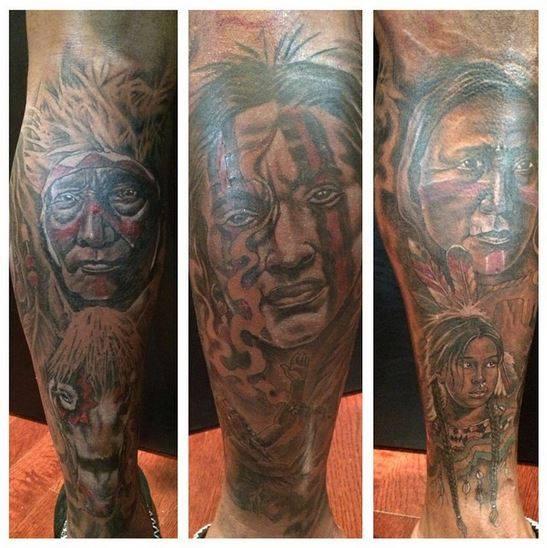
Comment: Adrienne Keene of Native Appropriations tweeted the following in response:
Dr. Adrienne K. @NativeApprops
Hey Santana Moss, this ish isn't even REMOTELY "Cherokee": http://www.washingtonpost.com/blogs/dc-sports-bog/wp/2014/10/22/santana-moss-explains-his-new-native-american-themed-tattoo/ … WILL IT EVER STOP? Plains stereotypes =/= Cherokee.
Dr. Adrienne K. @NativeApprops
Absolutely hilarious this was promoted on @redskinsfacts. So typical of their "facts"...claiming respect/honoring but lacking basic research
And a comment from Dinah on Facebook:Really? He 'pays tribute' through images that aren't remotely Cherokee? THIS is why we fight this crap! His instructions were: "Look up some chiefs, look up this and that." Glad he's so deeply committed to researching and understanding his supposed Cherokee ancestors.
The stereotype here, of course, is that all Indians are interchangeable or the same. Wrong.
Analysis
From what we can see, the images may have come from romanticized paintings by non-Natives. For instance, by Kirby Sattler, who is infamous for inspiring Johnny Depp's crow head.
I say paintings because modern Indians generally don't paint stripes on their faces. And old photographs usually aren't this detailed and aren't in color.
There's also a painted horse, which undoubtedly comes from a Plains tribe. The Cherokee don't have any tradition of painting their horses.
I'd have been impressed if the tattoos included Sequoyah, John Ross (in suit and tie), Will Rogers, Wilma Mankiller, et al. Because these are among the most famous Cherokees in history.
But they didn't wear feathers and leathers, didn't paint their faces. They don't look primitive or uncivilized. They wouldn't suggest how "cool" and "tribal" Moss is. And that was Moss's real goal: not to honor actual Cherokees, but to link himself to savage warriors.
He may have Cherokee blood--although everyone from Elizabeth Warren to Johnny Depp claims that and they're usually wrong. But I'd still call him a wannabe. He's trying to become Indian just as a mascot lover does--by appropriating and imitating someone else's culture.
By Dan Steinberg
“S/o to my Boi @tattzbyd for coming up to bless me wth this Cherokee mural representing my ancestors,” Moss wrote on Instagram.
Chad Dukes asked Moss for further details this week on his 106.7 The Fan program.
“I’ve been wanting to do another tattoo for like the last 10 years,” Moss explained, mentioning his Miami-based tattoo artist, tattzbyd. “He does great work. So I’ve been like ‘I want him to do something for me, i just don’t know what.’
“And one day it just clicked,” Moss went on. “You know, I’ve heard so much about my mom’s side—she [has] a lot of Cherokee Indians in the family, starting back with my grandmother and her mom and their mom—so I just wanted to do something honoring them. And it came about, and I told him what I wanted—look up some chiefs, look up this and that. And he just put a little mural together for me and he went to work on my leg.”
I heard about Moss’s tattoo because @RedskinsFacts—the team-funded name-defense organization—tweeted about it approvingly. And that will obviously have some people wondering if Moss’s tattoo relates to the NFL franchise. Dukes asked Moss if he was worried about people making that connection.
“Don’t bother me; I won’t bother you,” Moss said.
Comment: Adrienne Keene of Native Appropriations tweeted the following in response:
Dr. Adrienne K. @NativeApprops
Hey Santana Moss, this ish isn't even REMOTELY "Cherokee": http://www.washingtonpost.com/blogs/dc-sports-bog/wp/2014/10/22/santana-moss-explains-his-new-native-american-themed-tattoo/ … WILL IT EVER STOP? Plains stereotypes =/= Cherokee.
Dr. Adrienne K. @NativeApprops
Absolutely hilarious this was promoted on @redskinsfacts. So typical of their "facts"...claiming respect/honoring but lacking basic research
And a comment from Dinah on Facebook:
The stereotype here, of course, is that all Indians are interchangeable or the same. Wrong.
Analysis
From what we can see, the images may have come from romanticized paintings by non-Natives. For instance, by Kirby Sattler, who is infamous for inspiring Johnny Depp's crow head.
I say paintings because modern Indians generally don't paint stripes on their faces. And old photographs usually aren't this detailed and aren't in color.
There's also a painted horse, which undoubtedly comes from a Plains tribe. The Cherokee don't have any tradition of painting their horses.
I'd have been impressed if the tattoos included Sequoyah, John Ross (in suit and tie), Will Rogers, Wilma Mankiller, et al. Because these are among the most famous Cherokees in history.
But they didn't wear feathers and leathers, didn't paint their faces. They don't look primitive or uncivilized. They wouldn't suggest how "cool" and "tribal" Moss is. And that was Moss's real goal: not to honor actual Cherokees, but to link himself to savage warriors.
He may have Cherokee blood--although everyone from Elizabeth Warren to Johnny Depp claims that and they're usually wrong. But I'd still call him a wannabe. He's trying to become Indian just as a mascot lover does--by appropriating and imitating someone else's culture.
September 05, 2014
Native aspects of Deep Shadow
Deep Shadow (Doc Ford)From Publishers Weekly
Starred Review. At the start of bestseller White's outstanding 17th Doc Ford thriller (after Dead Silence), two low-life ex-cons, King and Perry, are on the lam after killing a family of five in a burglary. They end up in Doc's neck of the woods, or rather his neck of the swamp, in central Florida. Doc; his boat-bum hipster pal, Tomlinson; troubled Indian teen Will Chaser, who played a key role in Dead Silence; and Arlis Futch, a crusty old fisherman, have arrived at a small lake, which they intend to search for Batista's treasure plane, which disappeared in 1958 while flying the ex-dictator's looted booty out of Cuba during the Castro takeover. King and Perry, who are as bad as they come, quickly take control of the others, forcing Doc and friends to continue diving in the lake, after which the pair plan to kill them all. Throw in a giant, mysterious swamp creature with an appetite for cattle, horses, and divers, and you've got a nail-biter that's virtually impossible to put down.
Surprisingly Disappointing
By Gregory K. Brill on June 12, 2010
Having been a fan of the Doc Ford series for years, I was excited to get my hands on the latest installment. I was greatly disappointed by the time I was four chapters in, and the disappointment continues throughout the book. The vast majority of the story takes place along the shore or beneath the surface of a sink hole lake somewhere near Orlando. Unfortunately, this book lacks the character development of both antagonists and protagonists that one has come to expect from Randy Wayne White. White, who is known for his vivid and captivating descriptions of the Florida lifestyle, culture, and locations, simply falls flat in this book. Well over two-thirds of the book take place along a linear timeline in and around the lake. What is even more surprising is that White spends a tedious amount of time trying to establish the dire straits that his friends Tomlinson and Will are in when trapped by an underwater landslide and then seems to forget that sense of urgency (they only have 15 minutes worth of air lefft )over the next several CHAPTERS). The book lacks the character development, story line, or use of the qualities of Doc Ford that once made these books a "first buy." Bottom line for this story...this book does not fit into the Doc Ford series, and if you are a fan...wait for this one to come out on the sale rack!! Book review: 'Deep Shadow' by Randy Wayne White
By Shawna SeedDeep Shadow is the 17th Doc Ford book, and a long-running series poses certain challenges. Too much back story bores longtime readers; too little renders a book inaccessible to new ones.
White sketches out Ford and Tomlinson economically--he's had plenty of practice. The exposition gets clunky for Chaser, a carryover character from the last novel. If he reappears a third time, perhaps White will have him down pat. After being buried alive in Dead Silence and trapped underwater in Deep Shadow, however, Chaser may want to skip the next installment.
The least dynamic characters are the ex-cons. The hero astutely assesses their personalities and plays the two crooks against each other, but readers may find the pair indistinguishable. The swamp creature, however--now there's an interesting and surprisingly plausible villain.
In the end, White's strength is not the nuanced development of each character but his ability to ratchet up the action to keep readers turning the pages. And readers will keep turning the pages, if only to find out the answer to the novel's burning question: What is that thing? Comment: Deep Shadow has a couple of Native aspects:
1) Will Chaser, the Cherokee youth from a troubled home. At first he's surly and uncommunicative, but he loosens up when Ford lets him scuba-dive. When he and Tomlinson are trapped underwater, he takes charge while Tomlinson drifts off in a New Age cloud.
Chaser isn't particularly stereotypical, but he isn't well-drawn either. He's kind of an average character all around.
He does have some bizarre ability to sense things (vibrations? lifeforces?) in the land around him. I think this ability appears in a flashback and doesn't play a role in the present-day story. It's odd to give him a pseudo-superpower and it's odd that he never uses it.
2) The creature's lair is a small underground cavern connected to the lake. A pre-Columbian Indian is buried there along with some of his artifacts or "treasure." Chaser and Tomlinson have to pass through this cavern before they escape, so the book gives us a bit of Florida Native lore.
Anyway, I agree with the negative review above. Deep Shadow was no page-turner. It's the sort of potboiler you might read in an airport if you had nothing better to do, but no more. Rob's rating: 7.0 of 10.
Starred Review. At the start of bestseller White's outstanding 17th Doc Ford thriller (after Dead Silence), two low-life ex-cons, King and Perry, are on the lam after killing a family of five in a burglary. They end up in Doc's neck of the woods, or rather his neck of the swamp, in central Florida. Doc; his boat-bum hipster pal, Tomlinson; troubled Indian teen Will Chaser, who played a key role in Dead Silence; and Arlis Futch, a crusty old fisherman, have arrived at a small lake, which they intend to search for Batista's treasure plane, which disappeared in 1958 while flying the ex-dictator's looted booty out of Cuba during the Castro takeover. King and Perry, who are as bad as they come, quickly take control of the others, forcing Doc and friends to continue diving in the lake, after which the pair plan to kill them all. Throw in a giant, mysterious swamp creature with an appetite for cattle, horses, and divers, and you've got a nail-biter that's virtually impossible to put down.
Surprisingly Disappointing
By Gregory K. Brill on June 12, 2010
Having been a fan of the Doc Ford series for years, I was excited to get my hands on the latest installment. I was greatly disappointed by the time I was four chapters in, and the disappointment continues throughout the book. The vast majority of the story takes place along the shore or beneath the surface of a sink hole lake somewhere near Orlando. Unfortunately, this book lacks the character development of both antagonists and protagonists that one has come to expect from Randy Wayne White. White, who is known for his vivid and captivating descriptions of the Florida lifestyle, culture, and locations, simply falls flat in this book. Well over two-thirds of the book take place along a linear timeline in and around the lake. What is even more surprising is that White spends a tedious amount of time trying to establish the dire straits that his friends Tomlinson and Will are in when trapped by an underwater landslide and then seems to forget that sense of urgency (they only have 15 minutes worth of air lefft )over the next several CHAPTERS). The book lacks the character development, story line, or use of the qualities of Doc Ford that once made these books a "first buy." Bottom line for this story...this book does not fit into the Doc Ford series, and if you are a fan...wait for this one to come out on the sale rack!!
By Shawna Seed
White sketches out Ford and Tomlinson economically--he's had plenty of practice. The exposition gets clunky for Chaser, a carryover character from the last novel. If he reappears a third time, perhaps White will have him down pat. After being buried alive in Dead Silence and trapped underwater in Deep Shadow, however, Chaser may want to skip the next installment.
The least dynamic characters are the ex-cons. The hero astutely assesses their personalities and plays the two crooks against each other, but readers may find the pair indistinguishable. The swamp creature, however--now there's an interesting and surprisingly plausible villain.
In the end, White's strength is not the nuanced development of each character but his ability to ratchet up the action to keep readers turning the pages. And readers will keep turning the pages, if only to find out the answer to the novel's burning question: What is that thing?
1) Will Chaser, the Cherokee youth from a troubled home. At first he's surly and uncommunicative, but he loosens up when Ford lets him scuba-dive. When he and Tomlinson are trapped underwater, he takes charge while Tomlinson drifts off in a New Age cloud.
Chaser isn't particularly stereotypical, but he isn't well-drawn either. He's kind of an average character all around.
He does have some bizarre ability to sense things (vibrations? lifeforces?) in the land around him. I think this ability appears in a flashback and doesn't play a role in the present-day story. It's odd to give him a pseudo-superpower and it's odd that he never uses it.
2) The creature's lair is a small underground cavern connected to the lake. A pre-Columbian Indian is buried there along with some of his artifacts or "treasure." Chaser and Tomlinson have to pass through this cavern before they escape, so the book gives us a bit of Florida Native lore.
Anyway, I agree with the negative review above. Deep Shadow was no page-turner. It's the sort of potboiler you might read in an airport if you had nothing better to do, but no more. Rob's rating: 7.0 of 10.
April 23, 2014
Cherokee whistleblower in Good Wife
In the All Tapped Out episode of The Good Wife (airdate: 4/20/14):Florrick/Agos takes on the case of an NSA whistleblower, only to learn that the agency has been monitoring the firm as well as Alicia’s personal life. At a hearing, the NSA refuses to discuss the whistleblower's job performance, claiming it's classified. The Florrick/Agos lawyers counter:
The Good Wife: All Tapped Out“If the NSA refuses to be forthcoming about my client’s wrongful demotion, then we will be forced to file a civil rights claim, in federal court.” Nice. Fight bureaucratic stupidity with more stupidity. “On what grounds?” Garvey grumbles. “This was an act of discrimination against a man of a protected class.” What, Froines grumbles. “Mr. Dellinger. What nationality are you?” “Irish, Dutch, and, ah, Cherokee.” Now that is convenient. Froines can’t believe it. Because clearly it’s okay for him to hide behind legal protections that don’t apply to him, but it’s an outrage if someone else does it? “How much Cherokee?” he demands.
“This nation has discrimination laws in place to protect citizens like my client, a proud descendant of the Cherokee nation of … Oklahoma,” Clarke nods firmly. Cary smiles to himself that wonderfully secretive Cary smile. “This is absurd,” Garvey glowers through his glasses. “Their claim is an obvious pretext which Mr. Dellinger will surely lose.” Maybe so, Cary shrugs. But these cases become part of the record. “You know, the public record?” Clarke adds. “The record open to the public?” Ha ha ha ha ha! I love them. I mean, this is all a steaming pile of horse manure, but I’m glad somebody knows how to shovel it. Garvey wants a recess, and the twitchy, nervous little judge grants it in his nervous little baby voice. Clark permits himself a tiny smile of satisfaction. Comment: I'm guessing the threatened lawsuit would go nowhere fast. It might get thrown out before it even went to trial.
But it's good to see a TV show acknowledge Native issues, even obliquely. Like Castle, The Mentalist, and a few other shows, The Good Wife is aware that Natives still exist.
The Good Wife: All Tapped Out
“This nation has discrimination laws in place to protect citizens like my client, a proud descendant of the Cherokee nation of … Oklahoma,” Clarke nods firmly. Cary smiles to himself that wonderfully secretive Cary smile. “This is absurd,” Garvey glowers through his glasses. “Their claim is an obvious pretext which Mr. Dellinger will surely lose.” Maybe so, Cary shrugs. But these cases become part of the record. “You know, the public record?” Clarke adds. “The record open to the public?” Ha ha ha ha ha! I love them. I mean, this is all a steaming pile of horse manure, but I’m glad somebody knows how to shovel it. Garvey wants a recess, and the twitchy, nervous little judge grants it in his nervous little baby voice. Clark permits himself a tiny smile of satisfaction.
But it's good to see a TV show acknowledge Native issues, even obliquely. Like Castle, The Mentalist, and a few other shows, The Good Wife is aware that Natives still exist.
April 16, 2014
Warren "hurt" by Cherokee controversy
Elizabeth Warren: ‘I was hurt, and I was angry’
By MJ LeePerhaps the most hurtful and high-profile attack thrown against Warren by Brown had to do with her heritage.
At the height of the 2012 campaign, it was reported that Warren had listed herself as having Native American roots at Harvard University. Soon, there was a “full-blown campaign frenzy,” Warren recalls, with Republicans demanding that she prove her Native-American roots and accusing her of getting her job at the elite university by making false claims about her personal background.
Caught off-guard, Warren admits that she “fumbled” when reporters first asked her about the controversy.
Things only got worse when the Brown campaign asked whether her parents had lied to their children about her family. “He attacked my dead parents,” Warren writes. “I was hurt, and I was angry.”
Brown’s allegation that Warren had used her background to get ahead “simply wasn’t true,” she writes. “I was stunned by the attacks.”
Warren devotes a section of her book—called “Native American”—to this controversy, explaining that she had simply grown up learning about her Native American background from her family and that as a kid, she had never questioned her family’s stories or asked for documentation.
“Everyone on our mother’s side—aunts, uncles, and grandparents—talked openly about their Native American ancestry,” she wrote. “My brothers and I grew up on stories about our grandfather building one-room schoolhouses and about our grandparents’ courtship and their early lives together in Indian Territory.” Hits on ancestry claims angered Elizabeth Warren
New book recounts controversy
By Bob McGovernU.S. Sen. Elizabeth Warren recounts in her new autobiography that she was “hurt” and “angry” by news reports that there was no documentation to support her claims of her family’s Cherokee heritage in the 2012 Senate race, according to a published report.
“What really threw me, though, were the constant attacks from the other side,” Warren wrote, according to Politico.com, which received an advance copy of Warren’s book, “A Fighting Chance,” due to be released April 22.
“I would almost persuade myself that I was starting to get the hang of full-throttle campaigning and then—bam! Out of left field, the state Republican Party, or the Scott Brown campaign, or some blogger, would launch a rocket at me,” Warren wrote.
The Herald first reported that Indian tribes had no record of membership by Warren, and that genealogists were unable to confirm any Native American heritage. It later emerged that Warren had listed herself as a minority in the nation’s leading directory of law professors for a period of a decade as she moved up in academia, and she was ultimately cited by Harvard University as a minority hire. 
Facts contradict claims
Cherokee women want to meet Elizabeth Warren on book tour
To get Warren to understand why they are hurt and angry that she assumed, then discarded, Native American identity.
By William A. JacobsonWarren will be launching a nationwide book tour. Someone who wants to meet Warren is Twila Barnes.
Barnes is the Cherokee Genealogist whose groundbreaking genealogical research exposed the falsehood to Warren’s claims. Barnes and her team of Cherokee genealogists traced Warren’s family lines back to the early 1800s and documented that Warren’s family not only was not Cherokee or other Native American, but also that they never lived as such. Elizabeth Warren History of 'Minority Status' Listings at Odds with New Book's Claims
By Michael Patrick LeahySenator Elizabeth Warren (D-MA) writes in her new book, A Fighting Chance, scheduled for release on Tuesday, that "I never asked for special treatment when I applied to college, to law school, or for jobs." But a mountain of factual evidence contradicts that assertion.
As far back as 1986, while she was still a professor at the University of Texas Law School, Senator Warren consciously requested special treatment by falsely self-identifying as a "Minority Law Teacher." Her request for special treatment began with information she provided that was published in the 1986-1987 Association of American Law Schools (AALS) Directory of Faculty. And:"Why would Elizabeth Warren, who never suffered an ounce of discrimination on the basis of her alleged Native American status, whose parents, grandparents, great grandparents, and great great grandparents also suffered no such discrimination, feel justified in claiming such status, which she must have known would accrue to her benefit even if such benefit were not provable?" Jacobson asked.
Breitbart's Pollak reported in May 2012 that despite Senator Warren's claim she wanted to "meet other people with tribal roots," she never attended or participated in a single event sponsored by Harvard University's Native American Program (HUNAP) at Harvard Law School before or after she landed a job there. Comment: Boo-hoo! Warren's feelings were hurt!
Well, so were the feelings of the Natives who tried to interview her, to get her to talk about the controversy. She refused every overture to explain her alleged Cherokee ancestry. So no one should feel sorry for her.
Apparently she wrote an entire chapter on the subject, but literally said nothing new. She was simply repeating her family stories, she says again, with no curiosity about whether they were true or not. One has to wonder if someone this thoughtless has the right temperament to be senator...or president.
It's extremely well-known throughout Indian country that people claim Cherokee ancestry with little or no evidence. But Warren the "Native" is as naive and ignorant as a child about this problem. Like every Indian wannabe of the last century, she never considered genealogy or DNA to verify her claims. She was happy just "playing Indian."
But that's not the only issue. She didn't just acknowledge her alleged Native roots. She actively claimed to be Native for decades. She used it in her professional career.
You normally can't do that unless you're enrolled in a tribe. If you're not enrolled, perhaps you can do it if you're substantially Native by blood--e.g., one-fourth or more. Neither of these conditions applies to Warren.
So why did she claim to be not merely of Native heritage, but flat-out Native? And why has she stopped making the claim? Why isn't she proudly declaring herself Native at every opportunity if she is, indeed, proud of being Native?
These are the type of questions Warren can't or won't answer. And that's why critics won't let her get away with her flimsy claims.
For more on Elizabeth Warren, see Delaune: Politicans Ignore Native Concerns and My Thoughts on Brown vs. Warren.

(Apologies for whoever misspelled "determined" in this image.)
By MJ Lee
At the height of the 2012 campaign, it was reported that Warren had listed herself as having Native American roots at Harvard University. Soon, there was a “full-blown campaign frenzy,” Warren recalls, with Republicans demanding that she prove her Native-American roots and accusing her of getting her job at the elite university by making false claims about her personal background.
Caught off-guard, Warren admits that she “fumbled” when reporters first asked her about the controversy.
Things only got worse when the Brown campaign asked whether her parents had lied to their children about her family. “He attacked my dead parents,” Warren writes. “I was hurt, and I was angry.”
Brown’s allegation that Warren had used her background to get ahead “simply wasn’t true,” she writes. “I was stunned by the attacks.”
Warren devotes a section of her book—called “Native American”—to this controversy, explaining that she had simply grown up learning about her Native American background from her family and that as a kid, she had never questioned her family’s stories or asked for documentation.
“Everyone on our mother’s side—aunts, uncles, and grandparents—talked openly about their Native American ancestry,” she wrote. “My brothers and I grew up on stories about our grandfather building one-room schoolhouses and about our grandparents’ courtship and their early lives together in Indian Territory.”
New book recounts controversy
By Bob McGovern
“What really threw me, though, were the constant attacks from the other side,” Warren wrote, according to Politico.com, which received an advance copy of Warren’s book, “A Fighting Chance,” due to be released April 22.
“I would almost persuade myself that I was starting to get the hang of full-throttle campaigning and then—bam! Out of left field, the state Republican Party, or the Scott Brown campaign, or some blogger, would launch a rocket at me,” Warren wrote.
The Herald first reported that Indian tribes had no record of membership by Warren, and that genealogists were unable to confirm any Native American heritage. It later emerged that Warren had listed herself as a minority in the nation’s leading directory of law professors for a period of a decade as she moved up in academia, and she was ultimately cited by Harvard University as a minority hire.
Facts contradict claims
Cherokee women want to meet Elizabeth Warren on book tour
To get Warren to understand why they are hurt and angry that she assumed, then discarded, Native American identity.
By William A. Jacobson
Barnes is the Cherokee Genealogist whose groundbreaking genealogical research exposed the falsehood to Warren’s claims. Barnes and her team of Cherokee genealogists traced Warren’s family lines back to the early 1800s and documented that Warren’s family not only was not Cherokee or other Native American, but also that they never lived as such.
By Michael Patrick Leahy
As far back as 1986, while she was still a professor at the University of Texas Law School, Senator Warren consciously requested special treatment by falsely self-identifying as a "Minority Law Teacher." Her request for special treatment began with information she provided that was published in the 1986-1987 Association of American Law Schools (AALS) Directory of Faculty.
Breitbart's Pollak reported in May 2012 that despite Senator Warren's claim she wanted to "meet other people with tribal roots," she never attended or participated in a single event sponsored by Harvard University's Native American Program (HUNAP) at Harvard Law School before or after she landed a job there.
Well, so were the feelings of the Natives who tried to interview her, to get her to talk about the controversy. She refused every overture to explain her alleged Cherokee ancestry. So no one should feel sorry for her.
Apparently she wrote an entire chapter on the subject, but literally said nothing new. She was simply repeating her family stories, she says again, with no curiosity about whether they were true or not. One has to wonder if someone this thoughtless has the right temperament to be senator...or president.
It's extremely well-known throughout Indian country that people claim Cherokee ancestry with little or no evidence. But Warren the "Native" is as naive and ignorant as a child about this problem. Like every Indian wannabe of the last century, she never considered genealogy or DNA to verify her claims. She was happy just "playing Indian."
But that's not the only issue. She didn't just acknowledge her alleged Native roots. She actively claimed to be Native for decades. She used it in her professional career.
You normally can't do that unless you're enrolled in a tribe. If you're not enrolled, perhaps you can do it if you're substantially Native by blood--e.g., one-fourth or more. Neither of these conditions applies to Warren.
So why did she claim to be not merely of Native heritage, but flat-out Native? And why has she stopped making the claim? Why isn't she proudly declaring herself Native at every opportunity if she is, indeed, proud of being Native?
These are the type of questions Warren can't or won't answer. And that's why critics won't let her get away with her flimsy claims.
For more on Elizabeth Warren, see Delaune: Politicans Ignore Native Concerns and My Thoughts on Brown vs. Warren.
(Apologies for whoever misspelled "determined" in this image.)
March 23, 2014
Cher in a headdress, again
Cher Turns Back Time on opening night of Dressed to Kill tour in Phoenix
By Jess WilsonThe 67-year-old singer proved she's still got it when she bounded onto the stage in a replica leotard from her 1989 Heart of Stone tour.
Several wardrobe changes included a gold gladiator-style frock with a long blonde wig, and a full Native American-style get-up. 
Activist Gray Wolf posted this photo along with his comments:WELL HERE WE GO AGAIN! seems like this should have been stopped a long time ago but here she is "honoring" Native people with her insulting and disrespectful "Native" inspired outfit! ... I already see the defense of Cher by those who "love" her...even to the point of saying this is no big deal because she did it before and no one said anything about it so I guess that makes it okay now? people seem to forget that Native people have NOT had a voice for quite some time and now that we have found it, WE PLAN TO USE IT! Others chimed in:Cher is an American singer. She was born Cherilyn Sarkisian. Her father, John Paul Sarkisian, was born in California, to Armenian parents; he worked as a truck driver. Her mother, Jackie Jean Crouch, was of English and German, with more distant Irish, Dutch, and French, descent. Cher is also stated to have Cherokee Native American ancestry on her mother’s side, but no Cherokee Native American ancestors are documented on any publicly available genealogies of Cher.
If she were "part" Native which I sincerely doubt, then she should KNOW better than to disrespect Native culture with such an insulting outfit! The defense of such behavior usually comes from those that do not have a clue as to what Native culture and tradition is really all about!
I don't understand the comments saying this is honoring anyone. When the cultures and traditions in question are being grossly distorted and sexualized, isn't that pretty much the same thing as saying wearing blackface is a compliment?
Tsalagi (Cherokee) do not wear headdress....So this would still be appropriation of culture as her culture has no headdress or war bonnet....Come on folks....LOL Cher on NativeCelebs
I posted the photo on the NativeCelebs page and got more comments, some of which I answered:That is why they lost, because they could not run fast enough in outfits like this.. And because they picked the wrong side. Don't forget they did pick a side in the beginning seems this is ALWAYS over looked. I hope you're kidding, Courtney. No Indian wore an outfit like this one, especially not in battle.
Y'all understand that Cherokee is a completely different culture from Lakota and other Plains Indians, right? The argument that she's Cherokee so she can wear a Plains headdress is ridiculous. It's like saying she's Greek so she can wear a kilt or she's Scottish so she can wear a toga.
The fact that people think there's only one "Native culture" and they all wear headdresses is the problem, not the solution. If this is your argument, you're part of the problem too. Quit arguing that all Indians are the same and learn the differences!So much hate in this world quit bitching and do something to inform people. We're doing that. We're informing anyone who doesn't know it that Plains costumes like this are stereotypical. That there are hundreds of tribes and most of them didn't and don't wear headdresses. That anyone who thinks there's one "Native culture" and Cher is part of it is ignorant and needs to learn the facts.Come on, Cher loves all Indian People, she has done so much for Natives all around this country! Such as what? Examples? As far as I know, she's never lifted a finger to do anything with her alleged Cherokee heritage.NATIVECELEBS: Perhaps focus on educating the general (non Native) public about Native cultures and traditions in a good way without name calling and hatred. Educate them about what you have learned from your elders. We didn't call Cher names. Your mistake if you think otherwise.
And there's no "hatred" involved in criticism. It's like saying 2+2 = 4, not 5. Correcting math problems isn't hateful and neither is correcting false or misleading stereotypes.
That's something you've never understood, which is too bad. Pointing out mistakes so people do better next time is positive. It's a matter of explaining and educating, which most people understand are necessary steps for change.
And since 99% of our postings are positive even by your definition, we aren't about to apologize for the 1% that you consider "negative." We've posted 10-15 supportive items every day for several years straight, a record no one else can match. Until someone else does even better, we don't need anyone telling us how to be positive.
P.S. Anyone who's saying Cher is half Native is sadly mistaken. 1/16th or less would be closer to the mark. Which means she's like every other Indian wannabe: not Native.
For more on the subject, see Cher in a Headdress.
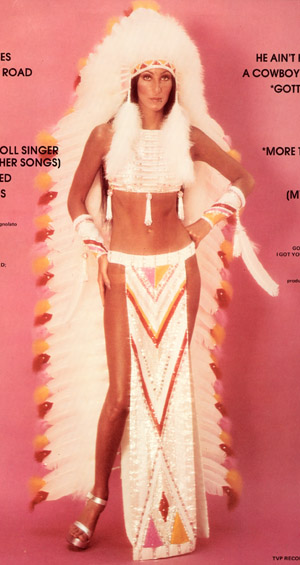
By Jess Wilson
Several wardrobe changes included a gold gladiator-style frock with a long blonde wig, and a full Native American-style get-up.
Activist Gray Wolf posted this photo along with his comments:
If she were "part" Native which I sincerely doubt, then she should KNOW better than to disrespect Native culture with such an insulting outfit! The defense of such behavior usually comes from those that do not have a clue as to what Native culture and tradition is really all about!
I don't understand the comments saying this is honoring anyone. When the cultures and traditions in question are being grossly distorted and sexualized, isn't that pretty much the same thing as saying wearing blackface is a compliment?
Tsalagi (Cherokee) do not wear headdress....So this would still be appropriation of culture as her culture has no headdress or war bonnet....Come on folks....LOL
I posted the photo on the NativeCelebs page and got more comments, some of which I answered:
Y'all understand that Cherokee is a completely different culture from Lakota and other Plains Indians, right? The argument that she's Cherokee so she can wear a Plains headdress is ridiculous. It's like saying she's Greek so she can wear a kilt or she's Scottish so she can wear a toga.
The fact that people think there's only one "Native culture" and they all wear headdresses is the problem, not the solution. If this is your argument, you're part of the problem too. Quit arguing that all Indians are the same and learn the differences!
And there's no "hatred" involved in criticism. It's like saying 2+2 = 4, not 5. Correcting math problems isn't hateful and neither is correcting false or misleading stereotypes.
That's something you've never understood, which is too bad. Pointing out mistakes so people do better next time is positive. It's a matter of explaining and educating, which most people understand are necessary steps for change.
And since 99% of our postings are positive even by your definition, we aren't about to apologize for the 1% that you consider "negative." We've posted 10-15 supportive items every day for several years straight, a record no one else can match. Until someone else does even better, we don't need anyone telling us how to be positive.
P.S. Anyone who's saying Cher is half Native is sadly mistaken. 1/16th or less would be closer to the mark. Which means she's like every other Indian wannabe: not Native.
For more on the subject, see Cher in a Headdress.
March 20, 2014
Johnny Depp, white man
Every time I mention Johnny Depp on the NativeCelebs page in Facebook, people claim he's Native. No, he isn't. Let's put this myth to rest once and for all.
First, let's see what Depp has claimed. Because his claims are the only source for his alleged Native ancestry.
Inside the Actor's Studio
BRAVO TV--September 8, 2002JL: Now a question that has come up more frequently than I would have expected on this stage. Do you have any Native American ancestry?
JD: Yeah, apparently, yeah. My family comes from Kentucky. They've been there for many … you know … many, many generations. And my grandma … my great-grandmother … was … had a lot of Cherokee blood. Johnny Depp wants 'The Lone Ranger' to back off Tonto: Why is the f–––ing Lone Ranger telling Tonto what to do?'
By Anthony BreznicanTonto’s treatment especially bugged him because Depp had always been told his family was part Indian. “I guess I have some Native American somewhere down the line,” he says. “My great grandmother was quite a bit of Native American, she grew up Cherokee or maybe Creek Indian. Makes sense in terms of coming from Kentucky, which is rife with Cherokee and Creek.” And...that's it. If any statements of his ethnicity exist other than these, I can't find them. Two flimsy claims, period.
How flimsy? Well, he's been told. He guesses. "Apparently."
In other words, he has no evidence whatsoever that he's Cherokee. No facts, no documentation, nothing. All he's doing is repeating family stories just like every other Indian wannabe in America.
What do real Indians think of wannabes who claim Cherokee heritage--exactly as Depp has done? Most Indians scorn these people as fakes and poseurs. Some examples of what they think:
Ask an Indian: How to Spot American Indian Wannabes and A Counterfeit Culture: Too Many Cherokees to Count
...My Grandmother Was a Cherokee Indian Princess...
I Hate All Dem Fake Ass Wannabe Cherokees Out There
Of Wannabes and Indians
The truth about Depp
Apparently Depp took a DNA test at some point. Alas, that and some genealogical research offer zero evidence that he has any Native ancestry.
Johnny Depp
By EthnicEthnicity: English, along with smaller amounts of Irish, Northern Irish (Scots-Irish), Scottish, Welsh, French, Dutch, Belgian (Flemish), German, as well as 3/2048 African.
Both of Johnny’s parents, as well as all of Johnny’s grandparents, great-grandparents, and great-great-grandparents, were born in Kentucky. Johnny Depp has stated, on several occasions, that he has or likely has Native American ancestry (of varying tribes, most often Cherokee). It does not appear that this Native American ancestry has been documented. All of Johnny’s grandparents and great-grandparents are listed as “White” on United States Censuses. No verified Native American ancestry has been produced for Johnny Depp. The Cherokee Princess Phenomenon, and Other Tall Tales of the West
By Ehud WouldAnother such case to recently garner national media attention is that of Harvard Law professor and Democratic Senator, Elizabeth Warren: she, like the majority of White Americans today, claims some Cherokee background. But the New England Historical Genealogical Society found no evidence of any American Indian lineage in her.
Actor Johnny Depp has apparently made public claims of Cherokee and/or Creek Indian heritage, but all genealogical and DNA research of his line has proven otherwise; he was found to possess no Indian blood whatsoever. He was quite disappointed to find that he was just a vanilla White man. That would seem to be conclusive. Until Depp provides hard evidence that one of his ancestors was Cherokee, the facts indicate they were white. Which mean he's white too.
Dissembling helps Depp's career
If Depp isn't Native, why hasn't he said so plainly? Because it would hurt his mystique...and more important, cost him money. He couldn't get street cred for following in Marlon Brando's footsteps, and couldn't play potential blockbuster roles like Tonto.
Some thoughts on Depp's flimsy claims and why he keeps them in circulation:
Disney Exploiting Confusion About Whether Depp Has Indian Blood
By Angela AleissThe actor has said he hopes to fix years of Indian misrepresentations in Hollywood and has repeatedly stated that his great grandmother had mostly Cherokee blood.
But Native American leaders and educators are not buying it. They question Depp’s claims of Cherokee heritage, particularly the studio’s attempt to keep it ambiguous.
“Disney relies upon the ignorance of the public to allow that ambiguity to exist,” says Hanay Geiogamah, Professor of Theater at UCLA’s School of Theater, Film and Television. Geiogamah (Kiowa/Delaware) was a consultant for Disney’s Pocahontas and served as producer and co-producer for TBS’ The Native Americans: Behind the Legends, Beyond the Myths aired in the 1990s.
“If Depp had any legitimate blood of any tribe, Disney would definitely have all the substantial proof of that already. It’s not that hard to establish tribal connections,” Geiogamah says.
Richard Allen, Policy Analyst for the Cherokee Nation in Tahlequah, Oklahoma, agrees. He says that many celebrities have claimed Cherokee heritage—often based upon family stories they’ve heard—but like Depp they never try to verify it. “They all tell me they have high cheekbones,” Allen says. An Open Letter to Johnny Depp's Tonto
By Natanya Ann PulleyIs Johnny Depp Native American or Native enough? Does he, like so too many others, have a distant Indian princess in his lineage? He’s said his great grandmother is Creek or Cherokee. Creek or Cherokee. He’s not sure which—this Creek-or-Cherokeeness of him amounts to one line on his Wikipedia page. Can casually embracing being part of this-or-that tribe somehow carry us forward? For more on Johnny Depp, see Johnny Depp Looks Indian? and Johnny Depp, Cherokee?
First, let's see what Depp has claimed. Because his claims are the only source for his alleged Native ancestry.
Inside the Actor's Studio
BRAVO TV--September 8, 2002
JD: Yeah, apparently, yeah. My family comes from Kentucky. They've been there for many … you know … many, many generations. And my grandma … my great-grandmother … was … had a lot of Cherokee blood.
By Anthony Breznican
How flimsy? Well, he's been told. He guesses. "Apparently."
In other words, he has no evidence whatsoever that he's Cherokee. No facts, no documentation, nothing. All he's doing is repeating family stories just like every other Indian wannabe in America.
What do real Indians think of wannabes who claim Cherokee heritage--exactly as Depp has done? Most Indians scorn these people as fakes and poseurs. Some examples of what they think:
Ask an Indian: How to Spot American Indian Wannabes and A Counterfeit Culture: Too Many Cherokees to Count
...My Grandmother Was a Cherokee Indian Princess...
I Hate All Dem Fake Ass Wannabe Cherokees Out There
Of Wannabes and Indians
The truth about Depp
Apparently Depp took a DNA test at some point. Alas, that and some genealogical research offer zero evidence that he has any Native ancestry.
Johnny Depp
By Ethnic
Both of Johnny’s parents, as well as all of Johnny’s grandparents, great-grandparents, and great-great-grandparents, were born in Kentucky. Johnny Depp has stated, on several occasions, that he has or likely has Native American ancestry (of varying tribes, most often Cherokee). It does not appear that this Native American ancestry has been documented. All of Johnny’s grandparents and great-grandparents are listed as “White” on United States Censuses. No verified Native American ancestry has been produced for Johnny Depp.
By Ehud Would
Actor Johnny Depp has apparently made public claims of Cherokee and/or Creek Indian heritage, but all genealogical and DNA research of his line has proven otherwise; he was found to possess no Indian blood whatsoever. He was quite disappointed to find that he was just a vanilla White man.
Dissembling helps Depp's career
If Depp isn't Native, why hasn't he said so plainly? Because it would hurt his mystique...and more important, cost him money. He couldn't get street cred for following in Marlon Brando's footsteps, and couldn't play potential blockbuster roles like Tonto.
Some thoughts on Depp's flimsy claims and why he keeps them in circulation:
Disney Exploiting Confusion About Whether Depp Has Indian Blood
By Angela Aleiss
But Native American leaders and educators are not buying it. They question Depp’s claims of Cherokee heritage, particularly the studio’s attempt to keep it ambiguous.
“Disney relies upon the ignorance of the public to allow that ambiguity to exist,” says Hanay Geiogamah, Professor of Theater at UCLA’s School of Theater, Film and Television. Geiogamah (Kiowa/Delaware) was a consultant for Disney’s Pocahontas and served as producer and co-producer for TBS’ The Native Americans: Behind the Legends, Beyond the Myths aired in the 1990s.
“If Depp had any legitimate blood of any tribe, Disney would definitely have all the substantial proof of that already. It’s not that hard to establish tribal connections,” Geiogamah says.
Richard Allen, Policy Analyst for the Cherokee Nation in Tahlequah, Oklahoma, agrees. He says that many celebrities have claimed Cherokee heritage—often based upon family stories they’ve heard—but like Depp they never try to verify it. “They all tell me they have high cheekbones,” Allen says.
By Natanya Ann Pulley
Subscribe to:
Posts (Atom)