Showing posts with label Turok. Show all posts

January 03, 2011

Alternatives to Dark Horse's TUROK

In Review of Dark Horse's TUROK, I said what I thought was wrong with the new Turok comic book. But suppose Jim Shooter came to me and said he had a great idea for a new Turok series. It was based on a group of "bad savages" chasing Turok and Andar the "good savages." Rather than just saying "no, it's stereotypical," could we make it work?

Answer: Yes, of course.

For starters, I don't see why TUROK has to be set in pre-Columbian times. If you want, you can ignore the advent of Europeans and do the same stories. But setting it after 1492 means you can send conquistadors, monks, and other Europeans down the rabbit hole. Why should indigenous people be the only ones chomped by dinosaurs?

Use two real tribes

Okay. Instead of the horrible cliché of the bloodthirsty Mesoamericans (see Apocalypto), use two actual Indians tribes who are traditional enemies. Then they'll have a real, credible motive for fighting each other.

For instance, the Lakota and the Crow. Turok and Andar are Lakota who were trying to steal the Crow's horses. The Crow caught them in the act and a few of them chased our heroes down the tunnel.

You wanna stick with pre-Columbian times when there weren't any horses? Okay, Turok and Andar are Lakota who were trying to steal the Crow's women so they could keep them or trade them. The Crow caught them in the act, etc.

To make it (even) more interesting, Andar the Lakota was trying to steal horses or women from Turok the Crow. Turok and his men caught Andar in the act, chased him down the tunnel, etc.

But wait, you say. Turok and Andar are the good guys. They can't be shown stealing anything. It would mean they're not noble savages. Not...perfect!

Response: First, traditional Indians would consider these legitimate acts of war, not crimes. They might punish someone who stole their property, but they wouldn't be morally shocked and outraged. Rather, they'd admire the perpetrators for their courage and daring--for doing what they would've done in the same place.

Besides, comics companies have made millions off of anti-heroes such as Wolverine, the Punisher, and Deadpool. What's wrong with adding a little moral complexity to Turok's and Andar's cardboard characters? As with Wolverine, maybe they'll grow from selfish savages into self-sacrificing samurai. And make Dark Horse some money in the process.

What would enemies do?

Once our heroes are in the Land of the Lost, what next? In the present TUROK comic, murderous Aztecs hunt Turok for revenge or bloodlust or because they're there, I guess. Cardboard characters don't have to have real motivations. In my version, the Lakota and Crow find they have a lot in common compared to the dinosaurs and beast-men and other creatures they meet. They have to overcome their age-old differences and work together to survive.

Maybe the Lakota and Crow are enslaved for a time and learn that enslaving others isn't as justifiable as they thought. As a result, maybe they decide to lead a revolt against the lost land's slavemasters. Or maybe they're appalled to see all the barbarian kingdoms fighting and killing each other. Maybe Turok becomes this land's Hiawatha and forms a league of nations united under one law.

There you go. I've just taken Turok's limited premise and made it several times more interesting. If Shooter wants, he can still tell his one-dimensional stories of "evil" Indians chasing "good" Indians. But now he also can tell stories about rich characters who learn and grow.

This is why I'm trying to publish comics, kiddies. I think I can come up with better ideas than someone's who's been in the business 45 years. Who's been an editor-in-chief at several companies. If you need my help on TUROK, Jim, give me a call.

For more on the subject, see Shooter on Dark Horse's TUROK and 3.5 Arrowheads for Dark Horse's TUROK.

P.S. I'd give TUROK only 2.5 or 3 arrowheads on the five-arrowhead scale. And a couple of those would be for the attractive art.

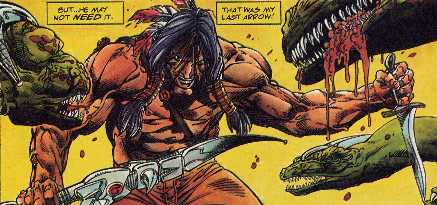
Below:  A previous version of Turok.
January 02, 2011

Review of Dark Horse's TUROK

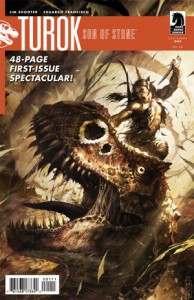
I recently read Jim Shooter's new comic book starring Turok, Son of Stone. It was about what I expected from the comments in Shooter on Dark Horse's TUROK.


Turok himself is a generic Indian. His appearance, almost identical to his look in his 1954 debut, is fine. As Shooter said, he's a "warrior wise and strong. He's not particularly interesting.

His background, such as it is, is also generic. He's traveled across the American continent. He knows a few Indian words, including one in Ojibwe. He has a steel knife and axe he got from a Viking. He had no other tribal or cultural markers--nothing except generic talk of spirits and shamans.

His initial adventure is also generic. He saves the boy Andar from the evil Aztecs. Turok and Andar flee down a mystical tunnel to the Land of the Lost with the bad guys in hot pursuit. After a couple of attacks and escapes, Turok comes face to face with--wait, you've probably never heard this one before--a scantily-clad high priestess and her dark-skinned minions.

Those evil Aztecs

The big problem here isn't Turok, it's the evil Lord Maxtla and his men. They're portrayed as renegades, too cruel and barbaric even for the Aztecs. But since they're the only Aztecs I think we'll see, it's fair to treat them as representative.

Naturally, the comic portrays these Indians with the usual indicators of evil: bones, piercings, warpaint, earrings, necklaces, claws, plates, and the ever-popular shaved heads. No evil Indian ever goes unadorned. It's important to look like a scary demon or skeleton 24/7, even when no one else is around. Imagine going to the mess hall with your fellow evildoers and not looking like a vision from hell!

Maxtla is the evillest of the evil because he wears a dinosaur or crocodile skull over his head. Never mind that this headgear occurs only in bad comic books and jungle movies, or that it would interfere with his peripheral vision and hearing during combat. Scary people wear scary skulls...case closed!

There's plenty wrong with this portrayal of Aztecs, but most readers won't notice the flaws. Among them:

  • Aztec emperors usually didn't lead military expeditions. Rather, they sat in magnificent palaces and tended to administrative affairs while lackeys and slaves pampered them. Generals lead soldiers, not monarchs.

  • Maxtla and his small band of followers are supposedly seeking Aztláan--i.e., "paradise." What will they do when they find it? Meekly join it as common laborers until they prove their worth?

    When they find themselves in dinosaur land, they decide they'll conquer that too. Right, because a few dozen Aztecs can do pretty much anything. They could conquer Europe if they happened to wind up there.

    In reality, they might be able to conquer a small tribe or two, but any substantial civilization would quickly crush them. It's ridiculous to portray them as sticking to their psychotic goals no matter where they go or what they do. It means they're cardboard, cartoon villains, not worthy adversaries.

  • The sacrifice issue

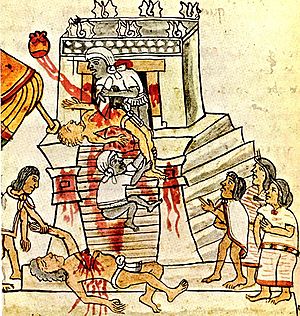
  • The Aztecs wouldn't perform a ritual sacrifice on the ground in the middle of nowhere. These sacrifices occurred in ceremonial plazas on top of pyramids for a host of religious, geographical, and astronomical reasons. A few Wikipedia quotes hint at how complex the matter was:

    Human sacrifice in Aztec cultureA strong sense of indebtedness was connected with this worldview. Indeed, nextlahualli (debt-payment) was a commonly used metaphor for human sacrifice, and, as Bernardino de Sahagún reported, it was said that the victim was someone who "gave his service."

    Human sacrifice was in this sense the highest level of an entire panoply of offerings through which the Aztecs sought to repay their debt to the gods. Both Sahagún and Toribio de Benavente (also called "Motolinía") observed that the Aztecs gladly parted with everything: burying, smashing, sinking, slaying vast quantities of quail, rabbits, dogs, feathers, flowers, insects, beans, grains, paper, rubber and treasures as sacrifices.
    And:A great deal of cosmological thought seems to have underlain each of the Aztec sacrificial rites. The most common form of human sacrifice was heart-extraction. The Aztec believed that the heart (tona) was both the seat of the individual and a fragment of the Sun's heat (istli). To this day, the Nahua consider the Sun to be a heart-soul (tona-tiuh): "round, hot, pulsating."And:[T]he strong emphasis given to human sacrifice may have stemmed from the great honour Mesoamerican society bestowed on those who became an ixiptla--that is, a god's representative, image or idol. Ixiptla was the same term used for wooden, stone and dough images of gods.And:Most of the sacrificial rituals took more than two people to perform. In the usual procedure of the ritual, the sacrifice would be taken to the top of the temple. The sacrifice would then be laid on a stone slab by four priests, and his/her abdomen would be sliced open by a fifth priest with a ceremonial knife made of flint. The cut was made in the abdomen and went through the diaphragm. The priest would grab the heart and tear it out, still beating. It would be placed in a bowl held by a statue of the honored god, and the body thrown down the temple's stairs.

    Before and during the killing, priests and audience (who gathered in the plaza below) stabbed, pierced and bled themselves as autosacrifice (Sahagun, Bk. 2: 3: 8, 20: 49, 21: 47). Hymns, whistles, spectacular costumed dances and percussive music marked different phases of the rite.


    Exactly none of this appears in Shooter's TUROK. None of this complex cosmology is equivalent to: "Butcher the innocent victim because we're evil and our evil gods demand blood!" This is why people think Indians were uncivilized: because the media fails to show the civilization.

    Conclusion

    Alas, TUROK gives us little but stupid stereotyping. Turok the noble savage is the exception to the rule: that most Indians are savage beast-men with no goal except fighting and killing. Shooter and company have "successfully" reinforced a century-plus of Native stereotypes.

    Ironically, the reprint of Turok's 1954 debut shows the original series was less stereotypical. Here Turok's and Andar's speech is somewhat stilted, and Andar sometimes grunts "ugh." But there are no huge swaths of savagery on display--just a man with good hunting and survival skills.

    For more on human sacrifice, see Human Sacrifice in Aztec Pantheon and Human Sacrifice "Prevalent" Among Indians?
  • October 21, 2010

    Shooter on Dark Horse's TUROK

    Native American Warrior Kills Dinosaurs in TUROK Revival

    By Chris ArrantNrama:  Can you tell us about the landscape Turok is in here—is it the Lost Lands of lore?

    Shooter:  Lost Land, Timeless Land, whatever. That’s what we call it. Turok doesn’t know the name of the place. To him it’s just “here.” It’s one continuum removed from where we are. It’s Earth in the Cretaceous Period—except that the same phenomenon that swept Turok and Andar to this place has also swept in people and things from many other times and places. To say it’s fantastic is selling it short. The opportunities are limitless.

    Nrama:  People know Turok, but can you tell us about Andar?

    Shooter:  He is the son of the Chief of a Chiricahua band. His father sacrifices his own life to buy time for his son—and Turok—to escape Aztec raiders. Honor demands that Turok take the boy as his own son, finish his education and upbringing—Turok owes that to the spirit of the boy’s father. Chiricahua are forbidden to speak their own names, so Turok gives the boy the name “Andar,” which in the secret tongue of Shamans means “Strong Roots.”

    Nrama:  What can people expect with this first issue—what’s the story?

    Shooter:  Here’s the promo blurb I wrote:

    “Blood for the Sun” Part 1—“Out of Time”

    The American Southwest, 1428. Turok, Son of Stone, a wanderer, a warrior wise and strong, rescues young Andar, son of a Chiricahua chief, from death at the hands of raiders from a great city to the south. Pursued by the ruthless King Maxtla and his host, Turok and Andar seek refuge in a vast cavern—and then, a force beyond comprehension sweeps them all away to a savage, timeless land where nightmares and miracles abound, where dinosaurs thunder and rampage. Maxtla sees opportunity—power to be had, a new world to seize—but first, the prisoner who slipped his grasp must be recaptured and ritually sacrificed. Hunted by he who would be God-King in a world of monstrous beasts, with danger and death at their heels, Turok and Andar encounter an even deadlier threat—the fearsome Panther People and their mysterious, mesmerizingly beautiful Goddess, Aasta.

    Nrama:  They’re facing against the Aztecs and a ruler named King Maxtla, as well as the Panther People. Can you tell us about these adversaries?

    Shooter:  Here’s how “Mescalero,” an escaped, Nadahéndé slave explains the Aztec and Maxtla:

    In fact, Maxtla was the Divine Emperor of one of the Aztec peoples, famous for being utterly ruthless. He murdered his brother, for instance, to become Emperor. In 1428, three other Aztec peoples suffering under his oppression rose up against him. Some say he was captured and ritually sacrificed, but some say he escaped and fled north with a small, elite force. There begins the story. Maxtla is heinous even by Aztec standards—and to them, ritual sacrifices of countless people was normal, part of the price that must be paid to keep the sun rising. There is also good evidence that they were cannibals.
    Comment:  The Panther People are a lost African tribe who will one day become the Zulus. So TUROK has savage blacks and savage Indians. Are there any savage white people in this series, or are minorities the only savages?

    At least Shooter seems to have researched African tribes for his proto-Zulu people. Has he researched the Aztecs too? Were they really "utterly ruthless"--in politics, business, and family life? Or is this a stupid stereotype? Are we really supposed to believe that because the state religion involved human sacrifice, every Aztec individual was a murderer and cannibal? Did Aztec children cut their rivals' throats so they could win at marbles or hopscotch?

    Meanwhile, Turok is a "warrior wise and strong." In other words, a noble savage. Does he have a single flaw that makes him more than a cardboard cutout? Not according to this interview. If Turok is anything other than an Indian Boy Scout (you know: trustworthy, loyal, helpful, friendly, courteous, kind, obedient, cheerful, thrifty, brave, clean, and reverent), it isn't obvious.

    Also, the idea of a "lost land" with people and creatures from many eras has been done many times. But I don't think it's ever been done successfully. It's a gimmick, like stunt casting, not an engine for serious storytelling. Romans! Cavemen! Nazis! Pirates! Knights! Samurai! Aliens! With big dome heads! Seen it! Before!

    For more on the subject, see 3.5 Arrowheads for Dark Horse's TUROK and Firehair, Joshua Brand, and Turok.

    October 14, 2010

    3.5 arrowheads for Dark Horse's TUROK

    Dark Horse is publishing a new version of TUROK that sounds much like the old versions:

    Turok, Son of Stone #1

    By Ben GilbertMy knowledge of Turok is limited, aside from reading a few issues of the Valiant comic from the nineties, so this issue did a good job of introducing the character and explaining how he wound up in the Land of the Lost, so to speak. Shooter’s script is action-heavy but overly talky, and he inserts the obligatory T-Rex sneak attack scene that seems to be in every comic with dinosaurs in it nowadays.And:Overall, this comic should please longtime fans of Turok, but it doesn’t really do much to hook new readers in. Turok and Andar really don’t show much personality aside from the usual mentor/sidekick dynamic, and the villains are your standard bloodthirsty tribesmen. The dinos have been pushed to the background so far but should become more prevalent as the series continues.Comment:  I guess the Land of the Lost scenario worked in the 1950s, but it doesn't seem like enough to captivate today's readers. I'd say the premise should be updated, as Valiant's Turok series tried to do. Put Turok in the future and have him fight intelligent dinosaurs, or something.

    For more on the subject, see Top Five Native Heroes and All About Turok.

    P.S. The arrowhead rating system is stereotypical, of course.

    December 04, 2008

    Firehair, Joshua Brand, and Turok

    A fanboy reviews three Native-themed comics--SHOWCASE #87, SHAMAN'S TEARS #1, and TUROK, DINOSAUR HUNTER #0--and finds two recurring themes.

    Of Neglected Traditions:  Comics Starring Native American Heroes & Thanksgiving1. Each issue boasts a tradition vs. progression diatribe, specifically between two characters that epitomize either side of the conflict. Firehair versus the Shaman. Josh versus his mother. Turok versus his apprentice.

    2. Similarly, each issue contains a definitive element of the supernatural, often contrasted by science, as if Native American culture is a source or beacon for all earthen spiritual phenomena.
    Comment:  You probably could find the "tradition vs. progress" debate in the vast majority of Native-themed comics set in the post-Columbian era. This debate has been an issue ever since Euro-Americans began forcing Indians to fight or switch, which happened soon after their arrival.

    You probably could find supernatural elements in the vast majority of Native-themed comics also--especially superhero, fantasy, and horror comics. I don't know if Indians are more religious than non-Indians, but they may wear their religion on their sleeves.

    In other words, they may talk about religion more and relate it more to the world around them. This makes them seem more spiritual, which leads to the usual fiction about shamans, evil spirits, and burial grounds.

    For more on the subject, see Comic Book Featuring Indians.

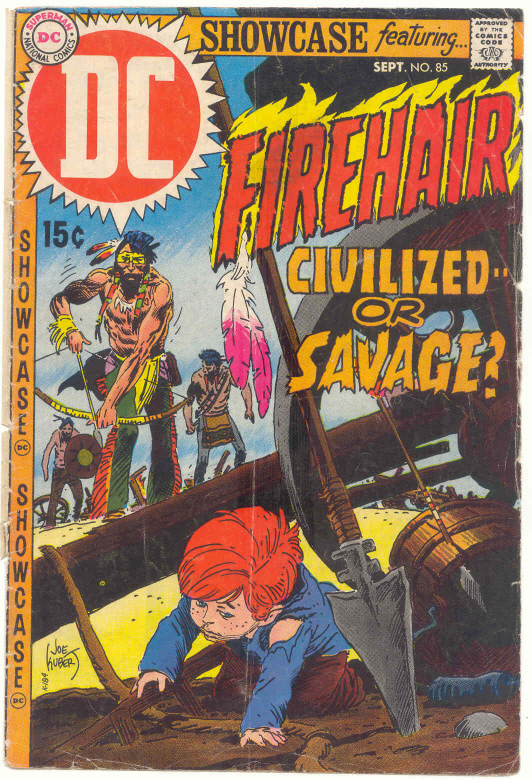
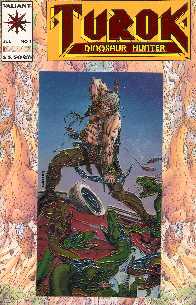
    Below:  SHOWCASE #85 and TUROK #1 (not the issues reviewed).

    October 23, 2008

    Top five Native heroes

    The top five Native American characters in comics

    Darcey McLaughlin--Geek WorldThe creative forces behind most comics are mainly white men, and they brought to their works clichés and outright prejudices when it came to the presentation of minority characters.

    Native North Americans were no different in how they were treated by most comic book creators, and often fell into the typical stereotype of the savage Indian, particularly during the boom in popularity of western comics during the 1950s. Even when creators thought they were doing good, Natives were often portrayed as clichéd characters with names and powers that are defined by their heritage.

    In fact, there is a great book called Native Americans in Comic Books by Michael A. Sheyahshe that takes a critical look at the role of Natives in comics. Well worth the read.

    Still, there are some great Native characters out there that many people may not know about. So today I thought we'd take a look at five of those characters.
    McLaughlin's top five and why they're on his list:Shaman

    What's interesting about Shaman is initially he rejects the idea of magic of the Shaman, refusing to follow in his grandfather's footsteps. It is only after personal tragedy that he embraces his mystic heritage, eventually finding himself fighting alongside super-heroes.

    Sarah Rainmaker

    She is modern in appearance and a typical modern woman. She is an unabashed liberal always taking up one cause or another, and she is presented as bisexual, although the creators were often criticized for doing this simply for the enjoyment of young male readers.

    Forge

    In the world of comics this former member of the X-Men is unique in that he is a native character without a clichéd name or powers. In fact Forge is a mutant with a super-human ability to invent mechanical devices. Forge is another character who throws off the ways of his ancestors, forgoing magic for technology.

    Dawnstar

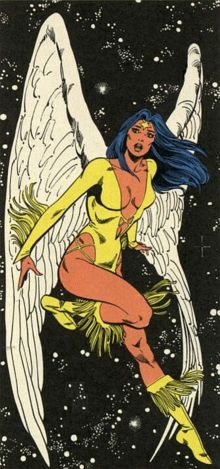
    Strikingly beautiful with long raven black hair and large white wings, Dawnstar is from a colonized planet called called Starhaven. She has the ability to fly (hence the wings) but can also survive in deep space without the use of technology.

    Turok

    Most people likely know Turok through the video games that have been released, and many likely don't realize he started out as a comic book character.
    Comment:  Clearly McLaughlin is going for the "most original" or "least stereotypical" characters, not simply the ones he thinks are "coolest" or "best." With that in mind, let's consider his list.

    McLaughlin's first four choices are supportable for the reasons he gives. But I don't think many people would include Turok.

    Fighting dinosaurs rather than cowboys, Indians, or supervillains doesn't make Turok less of a stereotypical warrior. He's a key figure in the history of Native comics, but he's not stunningly original. He's an Indian version of the savage hero in a "lost world"--e.g., Tarzan or Conan.

    On the other hand, I think most people would include Danielle Moonstar. Despite her convoluted powers and history, her characterization has generally been rich.

    Many people also would include Tim Truman's Scout. But I wouldn't because I consider him a variation on the stereotypical warrior.

    Another top five

    Here's an alternative top five for you and McLaughlin to consider. I'll limit myself to superhero-style comics and exclude my own Peace Party.

    Wyatt Wingfoot
    Tom Kalmaku
    Moonstar
    Arak
    Black Crow

    If we add Scout and Daredevil's associate Echo, that gives us twelve. I'd also include American Eagle, except he's appeared only once in his revamped incarnation.

    If you forced me to pick a second five, I'd probably go with Shaman, Forge, Echo, American Eagle, and someone else. Perhaps the little-known Super Shamou. Scout, Rainmaker, and Dawnstar might make my second ten, and Turok might make my third ten.

    In any case, I suspect that most people who endeavored to pick a top five would draw heavily from this baker's dozen of characters.

    For more fan favorites, see Loren Javier's Favorites and Comics Picks and Pans. For those who limited themselves to Marvel or X-Men characters, see Poll on Marvel's Native Superheroes and Most Popular Native X-Men. For more on the subject in general, see Comic Books Featuring Indians.

    June 12, 2008

    Some doubts about Turok

    Adam Beach to Star in Live-Action "Turok" MovieWell, now here is a comic/video game hero I didn't expect to see any time soon. Adam Beach revealed to MTV that he plans to star in a live-action Turok movie. This year, the character landed his own animated film, Turok: Son of Stone, which Beach provided the voice for. Though it seems to have garnered little attention, it hasn't daunted Beach from wanting to tackle the character again.

    Video game movies rarely do well, even if they do have their origins in comic books, and it isn't clear which Turok they are going with. However, a Native American hunting dinosaurs and an evil cyborg is just so crazy, it might work--and as I have always liked Beach, I will root for his dream project.
    Comment:  Video-game movies tend to fail because they're pure action. This kind of movie appeals only to a limited number of fan-boys.

    Most adults, especially women, have little desire to see men vs. monsters via CGI. I'm guessing Turok won't work if that's all it has to offer.

    If your pseudo-scientific story has strong themes and characterization, you may end up with a hit like Jurassic Park. If not, you'll end up with a schlocky movie such as Raptor or Pterodactyl that no one's ever heard of.

    For more on the subject, see The Best Indian Movies.

    June 11, 2008

    Beach to play Turok

    EXCLUSIVE:  Adam Beach To Star In Live Action Turok MovieIn recent years we’ve seen Iron Man, Hulk, and Batman all revamped and re-imagined for the big screen, with Thor, Captain America, and even Ant-Man, Deadpool, and Nick Fury not far behind. Is there a comic character, no matter how obscure, that hasn’t been tapped yet for a feature length transition?

    Maybe the most important one of all, grinned “Flags of our Fathers” star Adam Beach, revealing exclusively to MTV News his plans to star in a live-action “Turok” movie.

    “We just finished the animated movie and now we’re going into the feature film movie [which should lens] hopefully in a couple years. We’re about to set up meetings to develop a script and put it out there,” Beach enthused. “I’ll have to beef up, and be a good guy, and save the world!”
    And:Beach, who is of Saulteaux decent, calls the opportunity to play a Native America superhero “a dream.”

    “He’s the first Native American superhero that I ever looked up to,” he said. “He basically [comes from] a family where they’re protecting our universe from an alternate universe that wants to take it over. He uses his wits, and his might, and his special bow and arrow to take over the world.”
    Comment:  Turok the most important superhero of all? I don't think so. He'd be lucky to make it onto a list of the 100 most significant superheroes in comics history.

    In most incarnations of the Turok story, Turok didn't save the world, much less "take it over." He merely saved the denizens of a "lost world" (i.e., a valley or pocket dimension) from rampaging dinosaurs. Saving 6 billion people vs. saving 600 or 6,000...slight difference.

    It sounds as though Beach wants to make an unsubtle, action-oriented version of Turok. Which is too bad. This is an opportunity to counteract the stereotype of Indians as savage warriors. Instead, the movie may reinforce it.

    I talked to Beach briefly about my writing a script for him. Undoubtedly he's forgotten about it and will go with an experienced screenwriter. Which again is too bad. I'd do Turok as a sophisticated, sci-fi-oriented, time-travel story that would blow other movies out of the water.

    For more on the subject, see The Best Indian Movies.

    May 20, 2008

    Which Turok was the best?

    Snark Free Corner for 5/12

    by Brian CroninThe original Gold Key stories featuring Turok had the great Gaylord Du Bois and Paul S. Newman writing the stories (particularly Newman), but they were fairly straightforward tales.

    The early Valiant issues had a nice twist, while keeping the whole “hunting dinosaurs” bit, it also had various other weird anomalies in the Lost Land. However, while the series did feature Tim Truman for awhile and a young Rags Morales, otherwise, it did not have creators at the same level as a Newman.

    The final Valiant series was created by Fabian Nicieza, and it remakes Turok as a modern-day Native American who gets caught up in his destiny to be the next dinosaur hunter. It was a fun story, and it spawned a very popular video game.

    So which series was the best?
    Comment:  I can't answer the question because I've read only one or two Turok comics.

    For more on the subject, see Comic Books Featuring Indians.