Yesterday I wrote about the Maya sacrifice in an episode of The Simpsons. If you're like me, you may wonder about the alternatives. Was the only choice to portray the Maya badly or not to portray them at all? Or was there a way to do the bit without insulting them?
Answer: Yes, of course. You can make fun of any situation without resorting to offensive ethnic "jokes."
The execution
First, lose the human sacrifice. It's too sensational and not a fair representation of Maya culture.
Moreover, it isn't necessary for the "humor" about the calendar's end. The show postulates that sacrificing the wrong person doomed the Maya. Instead, have somebody discover the future "doomsday" while looking at the stars, telling fortunes, or whatever.
If you want to present Maya culture, find something else to showcase. For instance, talk about the lack of domesticated animals. Or the slash-and-burn agriculture. Some archaeologists believe the Maya caused their own demise by cutting down the trees and depleting the soil. So have the Maya boast about how their civilization will last forever because they're such good ecological stewards.
If you have to do a sacrifice, turn it into a joke by executing a non-Indian. It could be anyone. For example: Columbus, Custer, Thor Heyerdahl (for speculating that the Maya came from Africa), Mitt Romney, Kim Kardashian, Tim Tebow, or Matt Groening.
The destruction
If you insist on doing the already-tired "doomsday" scenario, do something original. Have the destruction caused by Egyptian, Greek, and Norse gods because they like to smash things. Or by the Christian, Jewish, and Muslim gods arguing about whether they're one God or three different gods.
Have a modern Maya Indian running around contradicting what everyone believes. He or she could say, "No! We didn't predict this! There's not supposed to be any harm or damage! 2012 is supposed to be a period of reflection and renewal, not death and destruction!"
That way, you could have all the colorful smashing, but the Maya wouldn't be responsible for it. They'd explicitly not be responsible for it. This version would be just as funny, but it wouldn't stereotype the Maya and their gods as murderous savages.
Sunday's episode of The Simpsons (airdate: 10/8/12) opened with a Maya sequence about--what else?--the "end" of the calendar in 2012. You can see it here:
Appearances
The characters all have tan skin, meaning they're supposed to be Indians, not white folks playing Indian. The art, architecture, writing, calendar, and numerical references (baktun) are reasonably accurate, especially for a cartoon.
With a few exceptions, the characters' appearances are good too. But Marge is wearing some sort of slinky savage-girl costume. A few of the others have too much skin showing. The working classes may have gone half-naked in the heat, but I think the elite mostly covered themselves.
Moe, Chief Wiggum, and the other officials have masks painted over their eyes. This kind of look seems more like a movie fiction than a reality. It serves to make the officials seem scary.
The execution
For starters, the Aztecs were the ones known for human sacrifice, not the Maya. Human sacrifice was relative rare among the Maya, so focusing on this makes their civilization seem more barbaric than it was.
Though Mayor Quimby says a prisoner is to be sacrificed to appease the gods, this is a gross simplification of the complex Maya religion. As Wikipedia explains:
Sacrifice in Maya cultureBlood, and by extension the still-beating heart, is the central element in both the ethnography and iconography of sacrifice, and its use through ritual established or renewed for the Maya a connection with the sacred that was for them essential to the very existence of the natural order. Julian Lee’s observation that the Maya "drew no sharp distinction between the animate and the inanimate" and the remarks by Pendergast and others that sacrifices "ensouled" buildings and idols indicates a social meaning, as Reilly suggests, most akin to Transubstantiation--a literal rather than symbolic transformation on which the fate of the world and its inhabitants depended.Moe is led off to be sacrificed in place of Homer. An executioner cuts off his head with a curved broadsword. I'm not sure anyone was sacrificed this way. From what I've read, most sacrifices were thrown into cenotes (wells), had their hearts cut out, or were shot with arrows. Showing a decapitation with Moe's head bouncing down the stairs is somewhat more gruesome than the reality.
The destruction
Using a clever Maya slide-rule, Professor Frink calculates that the calendar will end in 2012. We flash-forward to the present where three Maya gods smash everything.
First, I'm not sure the Maya gods even exist in human form. My impression is that they're more like forces that take on aspects of humans or animals. In other words, amorphous shapeshifters, not beings with a standard appearance like Zeus or Odin.
More important, no one has claimed the Maya or their gods would themselves cause the "prophesied" destruction. The Maya supposedly predicted the end, but it's not as if they wanted it to happen. They're the messengers, not the instigators. If the world were to end in 2012, it would happen via a natural cataclysm, not a godly temper tantrum.
Finally, as I've noted before, the world's ending in 2012 is a myth:
The calendar rollover signifies, at most, a symbolic turning point in history. If anything did happen, it would be a process of change and renewal, not destruction. For instance, if people started to care about climate change, it would "destroy" the old mindset of greed and selfishness.
So the Simpsons' scenario is doubly wrong. It implies the Maya expect the world to end and, worse, are causing it to end. Neither claim is true.
This destruction conveys the same idea as past centuries of stereotypes: that Indians are savage barbarians with no regard for life. That they exist primarily to crush, kill, and destroy things. That despite their art and architecture, they're little more than animals in human guise.
That's stereotypical if not racist. Many Maya Indians would disagree with this characterization of their ancestors. They're alive and well and some of them probably watch The Simpsons.
The Maya sequence gets points for starting off with a decent depiction of the culture. It loses those points and more for presenting a human sacrifice. And worse, for fabricating the meaning of the calendar's end. For portraying the Maya deities as cruel and inhuman enough to destroy life on earth. The Old Testament God may be a genocidal maniac (see the Flood), but Native gods aren't.
Tapping into the growing awareness of the Maya's alleged end date, Saturday Night Live (airdate: 1/7/12) offered a skit on the Maya calendar. It would've been excellent example of non-stereotypical humor except for a couple of blunders.
The good
The setting--stone walls on either side with a jungle in the background--was reasonably accurate.
The faux Indians' appearance was impressive. The "Indians" weren't dressed in Plains headdresses and buckskins. They weren't half-naked savages in loincloths. They weren't wearing elaborate gold- or jewel-encrusted robes.
What they were wearing was modest brown costumes, presumably made of skins, with a hint of Maya style. This is about what I'd expect your average ancient Maya to wear. Not a peasant's loincloth or an emperor's robe, but something in-between. Something plain and nondescript.
The stone calendar was a good facsimile of the real thing. Fred Armisen, the "Maya" who supposedly invented it, said it was the most accurate calendar ever. He even uttered what sounded like real Mayan terms when pointing out the calendar's features.
They made jokes about being late, lusting for women, and the hassle of carving stone. Again, this is about what you'd expect your average ancient Maya to talk about. There was nothing wise, "natural," or spiritual about their comments, which is what we've come to expect from TV Indians.
The bad
Based on all the above, this would've been an excellent skit about Indians. But two jokes brought it back down to mediocrity.
When Fred Armisen's character explains how the calendar works, Charles Barkley's character suggests a simpler system: five days named "Monday," "Tuesday," and so forth, with two rest days called a "weekend."
I believe the Maya used a base 20 system for their calendar. Presumably they knew their own number system by heart, so the new calendar wouldn't have been difficult for them.
It's pure Eurocentrism to imply our calendar is simple and sensible while theirs was needlessly and foolishly complex. I suspect it isn't even true. Suppose you have to meet someone in eight weeks or eighty days. Can you state the meeting date off the top of you head? Without looking at a calendar, that is, or doing a few minutes of calculations? Under a base 20 system, coming up with the date would be easy.
The ugly
At the end, Barkley's character says they're going to sacrifice a virgin. The idea that the Maya and other indigenous cultures sacrificed virgins is almost pure stereotyping. Here's what the Maya actually did:
Sacrifice in Maya cultureSacrifice was a religious activity in Maya culture, involving either the killing of animals or the bloodletting by members of the community, in rituals superintended by priests. Sacrifice has been a feature of almost all pre-modern societies at some stage of their development and for broadly the same reason: to propitiate or fulfill a perceived obligation towards the gods.
Animal sacrifice and bloodletting were a common feature in many Maya festivals and regular rituals. Human sacrifice was far less common, being tied to events such as ill fortune, warfare and the consecration of new leaders or temples. The practice was also far less common than in the neighboring Aztec societies. The Maya people would sacrifice their prisoners. The prisoners were most often from neighboring tribes.To reiterate the key points: Most of the sacrificing wasn't humans. The humans who were sacrificed were mainly political prisoners. And they were sacrificed for deeply held religious reasons, not as some sort of cruel joke.
Yes, it's possible the Maya did sacrifice a few virgins. If so, the practice doesn't come close to representing the whole culture. It's more of an exception than a rule.
So Saturday Night Live portrayed the Maya as normal, good-humored, and inventive...then undercut it by ending on the human sacrifice note. Takeaway message: the Maya were bloody barbarians who made weird stone calendars and murdered people. A skit that could've been great ended up being merely okay.
Still, it was a nice try, and perhaps better than anything SNL has done featuring Indians. Keep it up and don't lapse into obvious stereotypes, people.
I recently read Jim Shooter's new comic book starring Turok, Son of Stone. It was about what I expected from the comments in Shooter on Dark Horse's TUROK.
Turok himself is a generic Indian. His appearance, almost identical to his look in his 1954 debut, is fine. As Shooter said, he's a "warrior wise and strong. He's not particularly interesting.
His background, such as it is, is also generic. He's traveled across the American continent. He knows a few Indian words, including one in Ojibwe. He has a steel knife and axe he got from a Viking. He had no other tribal or cultural markers--nothing except generic talk of spirits and shamans.
His initial adventure is also generic. He saves the boy Andar from the evil Aztecs. Turok and Andar flee down a mystical tunnel to the Land of the Lost with the bad guys in hot pursuit. After a couple of attacks and escapes, Turok comes face to face with--wait, you've probably never heard this one before--a scantily-clad high priestess and her dark-skinned minions.
Those evil Aztecs
The big problem here isn't Turok, it's the evil Lord Maxtla and his men. They're portrayed as renegades, too cruel and barbaric even for the Aztecs. But since they're the only Aztecs I think we'll see, it's fair to treat them as representative.
Naturally, the comic portrays these Indians with the usual indicators of evil: bones, piercings, warpaint, earrings, necklaces, claws, plates, and the ever-popular shaved heads. No evil Indian ever goes unadorned. It's important to look like a scary demon or skeleton 24/7, even when no one else is around. Imagine going to the mess hall with your fellow evildoers and not looking like a vision from hell!
Maxtla is the evillest of the evil because he wears a dinosaur or crocodile skull over his head. Never mind that this headgear occurs only in bad comic books and jungle movies, or that it would interfere with his peripheral vision and hearing during combat. Scary people wear scary skulls...case closed!
There's plenty wrong with this portrayal of Aztecs, but most readers won't notice the flaws. Among them:
Aztec emperors usually didn't lead military expeditions. Rather, they sat in magnificent palaces and tended to administrative affairs while lackeys and slaves pampered them. Generals lead soldiers, not monarchs.
Maxtla and his small band of followers are supposedly seeking Aztláan--i.e., "paradise." What will they do when they find it? Meekly join it as common laborers until they prove their worth?
When they find themselves in dinosaur land, they decide they'll conquer that too. Right, because a few dozen Aztecs can do pretty much anything. They could conquer Europe if they happened to wind up there.
In reality, they might be able to conquer a small tribe or two, but any substantial civilization would quickly crush them. It's ridiculous to portray them as sticking to their psychotic goals no matter where they go or what they do. It means they're cardboard, cartoon villains, not worthy adversaries.
The sacrifice issue
The Aztecs wouldn't perform a ritual sacrifice on the ground in the middle of nowhere. These sacrifices occurred in ceremonial plazas on top of pyramids for a host of religious, geographical, and astronomical reasons. A few Wikipedia quotes hint at how complex the matter was:
Human sacrifice in Aztec cultureA strong sense of indebtedness was connected with this worldview. Indeed, nextlahualli (debt-payment) was a commonly used metaphor for human sacrifice, and, as Bernardino de Sahagún reported, it was said that the victim was someone who "gave his service."
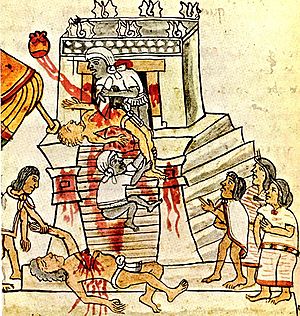
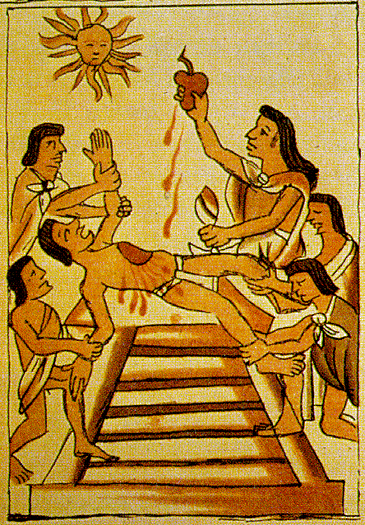
Human sacrifice was in this sense the highest level of an entire panoply of offerings through which the Aztecs sought to repay their debt to the gods. Both Sahagún and Toribio de Benavente (also called "Motolinía") observed that the Aztecs gladly parted with everything: burying, smashing, sinking, slaying vast quantities of quail, rabbits, dogs, feathers, flowers, insects, beans, grains, paper, rubber and treasures as sacrifices.And:A great deal of cosmological thought seems to have underlain each of the Aztec sacrificial rites. The most common form of human sacrifice was heart-extraction. The Aztec believed that the heart (tona) was both the seat of the individual and a fragment of the Sun's heat (istli). To this day, the Nahua consider the Sun to be a heart-soul (tona-tiuh): "round, hot, pulsating."And:[T]he strong emphasis given to human sacrifice may have stemmed from the great honour Mesoamerican society bestowed on those who became an ixiptla--that is, a god's representative, image or idol. Ixiptla was the same term used for wooden, stone and dough images of gods.And:Most of the sacrificial rituals took more than two people to perform. In the usual procedure of the ritual, the sacrifice would be taken to the top of the temple. The sacrifice would then be laid on a stone slab by four priests, and his/her abdomen would be sliced open by a fifth priest with a ceremonial knife made of flint. The cut was made in the abdomen and went through the diaphragm. The priest would grab the heart and tear it out, still beating. It would be placed in a bowl held by a statue of the honored god, and the body thrown down the temple's stairs.
Before and during the killing, priests and audience (who gathered in the plaza below) stabbed, pierced and bled themselves as autosacrifice (Sahagun, Bk. 2: 3: 8, 20: 49, 21: 47). Hymns, whistles, spectacular costumed dances and percussive music marked different phases of the rite.
Exactly none of this appears in Shooter's TUROK. None of this complex cosmology is equivalent to: "Butcher the innocent victim because we're evil and our evil gods demand blood!" This is why people think Indians were uncivilized: because the media fails to show the civilization.
Conclusion
Alas, TUROK gives us little but stupid stereotyping. Turok the noble savage is the exception to the rule: that most Indians are savage beast-men with no goal except fighting and killing. Shooter and company have "successfully" reinforced a century-plus of Native stereotypes.
Ironically, the reprint of Turok's 1954 debut shows the original series was less stereotypical. Here Turok's and Andar's speech is somewhat stilted, and Andar sometimes grunts "ugh." But there are no huge swaths of savagery on display--just a man with good hunting and survival skills.
In the public's mind, the biggest Aztec "achievement" is human sacrifice. Naturally, the Aztec Pantheon exhibit at the Getty Villa addresses this. For instance, there's this reference from the Florentine Codex:The Festival of Toxcatl
Every spring a war captive of superior physical beauty was chosen to impersonate the god Tezcatlipoca (Smoking Mirror).
Worshipped like a deity, the captive was adorned in precious clothing and given wives and servants in a yearlong rite that culminated in his sacrifice to the god.Comment: The exhibit mentions human sacrifice half a dozen times. In each case, the context is that it's a religious ritual to appease the gods.
The "Festival of Toxcatl" is one example. We consider this practice strange, even repellent, but it has nothing to do with barbaric bloodlust. The Aztecs had elaborate mythological beliefs that required human sacrifice.
Demonstrating their sincerity, they also practiced bloodletting on themselves. Again, this is because the gods demanded it. They didn't want to make bloody spectacles of themselves, they had to do it.
Killing people irrationally
In my mind, it's not much different from our modern practice of bombing villages in Vietnam or Iraq. There's no rational foundation to believe these countries threatened the US, yet we bombed them without regard for civilian deaths. The people who did the killing had an irrational, quasi-religious faith that what they were doing was God's will. That it would bring peace and prosperity to their homeland.
Well, the Aztecs also believed that killing people would bring peace and prosperity to their homeland. Dropping enough bombs Sacrificing enough captives would ensure victory over the enemies who threatened their dominance.
In one place, the exhibit links human sacrifice with state-sponsored terrorism, but it doesn't elaborate. Even that is couched in terms of appeasing a war god, I believe. I don't think there's any case where the Aztecs simply said, "No god has ordered us to sacrifice this person. There's no religious justification for killing him. We're doing it for secular reasons: to frighten our enemies, and because we like it."
The Florentine CodexNo source is more valuable for understanding Aztec civilization than the Historia general de las cosas de Nueva España (General History of the Things of New Spain), familiarly known as the Florentine Codex after its location in the Biblioteca Medicea Laurenziana in Florence. For this exhibition, the Florentine Codex returns to the New World for the first time in over four centuries.
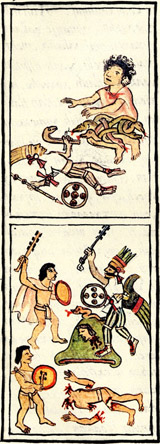
The codex is illustrated with over 2,400 images describing Aztec religion, rituals, agriculture, commerce, and crafts.The Birth of HuitzilopochtliWhen the mother goddess Coatlicue (Serpent Skirt) was magically impregnated, her daughter Coyolxauhqui led 400 brothers against her.
The god Huitzilopochtli sprang from Coatlicue's womb fully armed, defeated his siblings, and decapitated Coyolxauhqui, whose dismembered body fell to the base of Coatepec (Serpent Mountain).Comment: I believe the exhibit said the Aztecs had more than 150 deities. 150! Christianity barely manages three: God, Jesus, and Mary.
The Aztec religion was much more complex than Christianity, as the Huitzilopochtli story hints. Yet the Spanish demonized it as simple devil worship. How typical.
Aztec divinities vs. Greco-Roman gods
Moreover, as one exhibit panel noted, the Aztec deities weren't like the Christian or Greco-Roman gods: majestic white guys sitting on thrones in the sky. They were more like "spirit forces" that animated the living world.
So it's incorrect to even call them gods. Although the exhibit uses the term "gods" as shorthand, it alternates this with the more appropriate "divinities."
Since they were more akin to forces than beings, the Aztec divinities were more fluid in nature. They readily changed shape from human to animal to some other aspect of nature (sun, moon, storm, fire, etc.).
The exhibit has several statues and drawings of Aztec "gods" with their faces emerging from the mouths of animals (jaguar, snake, bird, etc.). This was meant to indicate the divinities changing from animal to human form.
The Europeans couldn't come close to understanding this, so they reinterpreted it based on their own myths. A "god" who appeared to be wearing a jaguar's head and Hercules wearing a lion's head...same thing! Like Hercules, the god must've slain a mighty predator to prove what a mighty man he was.
It's a good example of how the Western and indigenous worldviews diverged. Which is why I titled my posting on the subject Hercules vs. Coyote: Native and Euro-American Beliefs. A big, brawny man vs. a small, brainy animal--that sums up the difference in a nutshell.
Gruesome Practices of Ancient AmericansCivilization arose independently in the new world, evidence that the trajectory of human development was firmly pointed in that direction. I wonder why mass human sacrifice was so prevalent in Native American cultures. I note that the adolescence of human civilization was marked by despotism and bloodshed everywhere and always. It took a long time for us to mature, if indeed we have or ever will.
But I also note that this gruesome confirms, in an odd way, the natural human inclination to think in terms of justice and reciprocity. What were the ancient Cahokians trying to do, by slaughtering so many men and woman, and sacrificing so much bounty? Increase the aura of their upper class, to be sure. But they were also trying to bargain with the gods. In return for all this virgin blood, you big spirits need to make the crops grow and our enemies diminish. It is terrible to say so, but only a basically moral animal could think that way.Some responses by me and Al Carroll:"Absent for the most part from the religions of the American Indians was the near universal practice of animal and human sacrifice to placate the gods. 'North America had almost no sacrifice, even of animals. Mother Earth did not demand it.'"
--Lewis M. Hoppe, Religions of the World, 1976 (quote from Ruth Underhill, Red Man's Religion, 1965)
Posted by: Rob Schmidt | Aug 7, 2009 7:41:48 AM
I wonder where you got the idea that "mass human sacrifice was so prevalent in Native American cultures." Can you cite a source for this claim?
Besides the Aztecs, Maya, and Cahokians, which Native cultures practiced human sacrifice? These are only three of the thousands of cultures that existed in the Americas. Unless you can list several hundred Native cultures that practiced human sacrifice, your argument fails.
Posted by: Rob Schmidt | Aug 7, 2009 7:47:19 AM
You point to a grand total of two sites. Imagine pointing to Auschwitz and Buchenwald and making the same claim, "Why was genocide so prevalent among Europeans?"
I also didn't see any sign that these sites were of sacrifices. They could've been executions of criminals or captives seized in war. (Which doesn't justify them. I'm personally opposed to the death penalty for anything other than the most heinous war crimes.)
But obviously you think in stereotypes. Indian dead = human sacrifice. Never mind that human sacrifice was common in Europe during the Spanish Inquisition. Never mind that lynching has every feature of human sacrifice except cannibalism, including the collecting of body parts for trophies.
Any good scholar would look at all possible explanations. Obviously you want a reason to imagine Indians are barbaric.
Posted by: Al Carroll | Aug 8, 2009 9:53:50 AMComment: Go to the original posting to see the whole debate. Feel free to post your thoughts there as well as here.