As the Pechanga Casino tweeted:Pechanga Casino @PechangaCasino Nov 9
Pechanga was mentioned on @TheSimpsons last night on @FOXTV! #Pechanga #simpsons #thesimpsons #fox #foxtv
The context is this:
Episode Fact File: Friend with Benefit[T]his Sunday, November 8th, 2015, Fox aired “Friend with Benefit,” the 6th episode of Season 27, and the 580th episode to date.
Episode Description:
Lisa makes a new pal at school named Harper, whose internet billionaire father becomes buddies with a different Simpson: Homer. Soon, though, Lisa becomes worried that Harper is a little too entitled.
Plot:
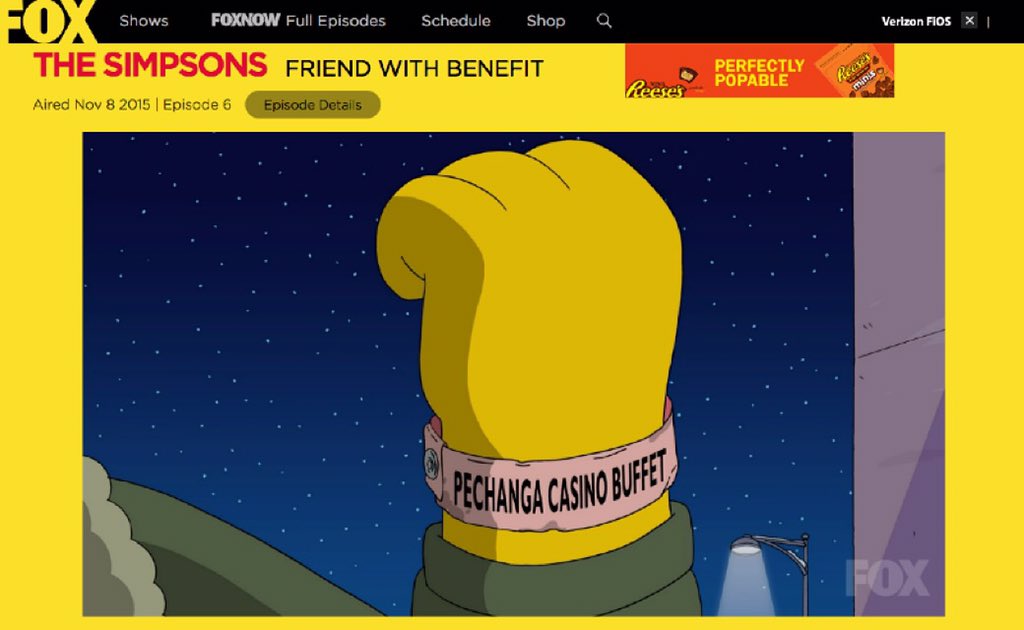
At night, Homer gets angry about the [self-lifting] chair, complaining that he never gets the finest things in life. That’s when Lisa asks him to take her to an Australian boy band concert with Harper, as her father has bought the seats. Feeling unconfident, he takes Lisa to the show.When the concert runners give Homer a wristband, he shows the one he already has. Apparently the producers have a thing for Pechanga, as they mentioned it in Pechanga Muffins in The Simpsons.
Sunday's episode of The Simpsons had the following plot:An Assemblywoman brought in by Lisa to stop Mr. Burns' fracking operation ends up falling for him as much as he does for her.Some detailed plot reviews:
When Burns spurns his paramour to prevent heartache, he finds his mansion under attack:BURNS: Killdozers.
BURNS: Whatever are you doing, man?!
WORKER: We're tearing down this place and putting up a recycling center/Native American history museum/condor sanctuary. (screeching)
BURNS: Hmm. A project this bloated and ill-thought out could only be the work of an angry liberal.
BURNS: (gasps) Maxine!Unfortunately, the museum line was accompanied by a shot of half a dozen Indians: a half-naked Plains chief and his warriors. Needless to say, Indians don't look like that these days. Even at the opening of a Native history museum, they'd be dressed in suits and ties.
You might see these outdated outfits at a German "hobbyist" gathering, where they love stereotypical traditional Indians. But in the US, about the only place you'd see a group like that is in a Western movie production. Indians simply don't dress like that anymore.
Yesterday I wrote about the Maya sacrifice in an episode of The Simpsons. If you're like me, you may wonder about the alternatives. Was the only choice to portray the Maya badly or not to portray them at all? Or was there a way to do the bit without insulting them?
Answer: Yes, of course. You can make fun of any situation without resorting to offensive ethnic "jokes."
The execution
First, lose the human sacrifice. It's too sensational and not a fair representation of Maya culture.
Moreover, it isn't necessary for the "humor" about the calendar's end. The show postulates that sacrificing the wrong person doomed the Maya. Instead, have somebody discover the future "doomsday" while looking at the stars, telling fortunes, or whatever.
If you want to present Maya culture, find something else to showcase. For instance, talk about the lack of domesticated animals. Or the slash-and-burn agriculture. Some archaeologists believe the Maya caused their own demise by cutting down the trees and depleting the soil. So have the Maya boast about how their civilization will last forever because they're such good ecological stewards.
If you have to do a sacrifice, turn it into a joke by executing a non-Indian. It could be anyone. For example: Columbus, Custer, Thor Heyerdahl (for speculating that the Maya came from Africa), Mitt Romney, Kim Kardashian, Tim Tebow, or Matt Groening.
The destruction
If you insist on doing the already-tired "doomsday" scenario, do something original. Have the destruction caused by Egyptian, Greek, and Norse gods because they like to smash things. Or by the Christian, Jewish, and Muslim gods arguing about whether they're one God or three different gods.
Have a modern Maya Indian running around contradicting what everyone believes. He or she could say, "No! We didn't predict this! There's not supposed to be any harm or damage! 2012 is supposed to be a period of reflection and renewal, not death and destruction!"
That way, you could have all the colorful smashing, but the Maya wouldn't be responsible for it. They'd explicitly not be responsible for it. This version would be just as funny, but it wouldn't stereotype the Maya and their gods as murderous savages.
Sunday's episode of The Simpsons (airdate: 10/8/12) opened with a Maya sequence about--what else?--the "end" of the calendar in 2012. You can see it here:
Appearances
The characters all have tan skin, meaning they're supposed to be Indians, not white folks playing Indian. The art, architecture, writing, calendar, and numerical references (baktun) are reasonably accurate, especially for a cartoon.
With a few exceptions, the characters' appearances are good too. But Marge is wearing some sort of slinky savage-girl costume. A few of the others have too much skin showing. The working classes may have gone half-naked in the heat, but I think the elite mostly covered themselves.
Moe, Chief Wiggum, and the other officials have masks painted over their eyes. This kind of look seems more like a movie fiction than a reality. It serves to make the officials seem scary.
The execution
For starters, the Aztecs were the ones known for human sacrifice, not the Maya. Human sacrifice was relative rare among the Maya, so focusing on this makes their civilization seem more barbaric than it was.
Though Mayor Quimby says a prisoner is to be sacrificed to appease the gods, this is a gross simplification of the complex Maya religion. As Wikipedia explains:
Sacrifice in Maya cultureBlood, and by extension the still-beating heart, is the central element in both the ethnography and iconography of sacrifice, and its use through ritual established or renewed for the Maya a connection with the sacred that was for them essential to the very existence of the natural order. Julian Lee’s observation that the Maya "drew no sharp distinction between the animate and the inanimate" and the remarks by Pendergast and others that sacrifices "ensouled" buildings and idols indicates a social meaning, as Reilly suggests, most akin to Transubstantiation--a literal rather than symbolic transformation on which the fate of the world and its inhabitants depended.Moe is led off to be sacrificed in place of Homer. An executioner cuts off his head with a curved broadsword. I'm not sure anyone was sacrificed this way. From what I've read, most sacrifices were thrown into cenotes (wells), had their hearts cut out, or were shot with arrows. Showing a decapitation with Moe's head bouncing down the stairs is somewhat more gruesome than the reality.
The destruction
Using a clever Maya slide-rule, Professor Frink calculates that the calendar will end in 2012. We flash-forward to the present where three Maya gods smash everything.
First, I'm not sure the Maya gods even exist in human form. My impression is that they're more like forces that take on aspects of humans or animals. In other words, amorphous shapeshifters, not beings with a standard appearance like Zeus or Odin.
More important, no one has claimed the Maya or their gods would themselves cause the "prophesied" destruction. The Maya supposedly predicted the end, but it's not as if they wanted it to happen. They're the messengers, not the instigators. If the world were to end in 2012, it would happen via a natural cataclysm, not a godly temper tantrum.
Finally, as I've noted before, the world's ending in 2012 is a myth:
The calendar rollover signifies, at most, a symbolic turning point in history. If anything did happen, it would be a process of change and renewal, not destruction. For instance, if people started to care about climate change, it would "destroy" the old mindset of greed and selfishness.
So the Simpsons' scenario is doubly wrong. It implies the Maya expect the world to end and, worse, are causing it to end. Neither claim is true.
This destruction conveys the same idea as past centuries of stereotypes: that Indians are savage barbarians with no regard for life. That they exist primarily to crush, kill, and destroy things. That despite their art and architecture, they're little more than animals in human guise.
That's stereotypical if not racist. Many Maya Indians would disagree with this characterization of their ancestors. They're alive and well and some of them probably watch The Simpsons.
The Maya sequence gets points for starting off with a decent depiction of the culture. It loses those points and more for presenting a human sacrifice. And worse, for fabricating the meaning of the calendar's end. For portraying the Maya deities as cruel and inhuman enough to destroy life on earth. The Old Testament God may be a genocidal maniac (see the Flood), but Native gods aren't.
An old episode of The Simpsons has a Native reference I hadn't noticed before:
Brother's Little Helper"Brother's Little Helper" is the second episode of the 11th season of The Simpsons. It aired on October 3, 1999. The title refers to an early Rolling Stones song, titled "Mother's Little Helper," which is about stressed housewives abusing prescription drugs.
Plot
Principal Skinner introduces a fire safety skit to the students. When Ned Flanders catches on fire, the fire department tries to extinguish him. It doesn't work because Bart is pulling a prank with the fire hose, though water crashing out of the gym saves Flanders anyway. Skinner has Homer and Marge come to the school, where they learn Bart has been diagnosed with Attention Deficit Disorder (ADD). Principal Skinner tells Marge and Homer that Bart must take a radical, untested new behavioral medicine called Focusyn or Skinner will have to expel him.
After several failed attempts by Homer (including naming several celebrities on drugs, such as Motley Crue's Tommy Lee, sitcom actress Brett Butler, and actor/comedian Andy Dick, and offering Bart taffy laced with several Focusyn pills sticking out), Marge convinces Bart to take the medication. His behavior immediately improves. He begins paying attention in school and being respectful to his parents (even tutoring a Navajo boy in his spare time). However, side effects soon occur, as Bart becomes paranoid that Major League Baseball is spying on the town using satellites. The doctors recommend that Bart go off Focusyn, but he refuses. Before anyone can stop him, he swallows several handfuls of Focusyn and runs away.Comment: In a brief scene, Bart asks a Navajo boy the meaning of the "Humpty Dumpty" nursery rhyme. The boy comes up with a correct answer.
in Sunday's episode of The Simpsons, titled Flaming Moe (airdate: 1/16/11), Moe convert his bar to a "gentleman's club" for gay men. At one point, one dancing man says another glides like an "Arapaho Ghost Dancer."
This reference comes out of the blue and goes right back into the blue. It's offbeat, if not weird, and not particularly funny. But it shows that the Simpsons' writers are willing to look outside the box for their cultural references. And it continues last season's streak of four Simpsons episodes with Native references.
'The Simpsons' challenges Pechanga's muffinsPechanga took the joke in good humor, and as a challenge. Days later there were pictures on the Pechanga blog of a dinner-plate-sized blueberry muffin created by executive pastry chef Jean-Marie Verhoeven. The giant muffins are on sale for $25 in the food court cafe.Pechanga's Response to 'The Simpsons'When ‘The Simpsons’ aired their latest episode Sunday mentioning Pechanga and our blueberry muffins, we were excited to say the least.
But our VP of Food & Beverage, Dennis Khanh, and Executive Pastry Chef Jean-Marie Verhoeven wanted to show them that we really do have the largest blueberry muffins.
You can order one now at Caffe Cocoa (located in our food court) for $25.Comment: This is a good example of how tribes should respond to and interact with the popular culture. By doing so, they gain a spot of positive and free publicity.
Sunday's episode of The Simpsons (airdate: 3/28/10) featured yet another reference to Indians. Here's the story:
The Greatest Story Ever D'ohedNed Flanders invites the Simpson family to join him a church retreat to Jerusalem. Homer is unappreciative of the culture, until a tour guide starts taking him around the city and Homer deludes himself into thinking he is the Messiah.When the Americans arrive in Jerusalem, Homer convinces them that a breakfast buffet is more interesting than the city's sights. The following exchange occurs:MRS. LOVEJOY: These blueberry muffins are bigger than the ones we had at Pechanga.
REV. LOVEJOY: Finally, something you like better than Pechanga.Comment: As long-time readers know, I work for a Pechanga Indian on the PECHANGA.net website.
This is a minor reference, to be sure, but it's notable for several reasons:
It's the fourth Simpsons reference to Indians this season, which isn't a record but is pretty good.
This makes three nonstereotypical references in a row: no chiefs, teepees, or other Plains stereotypes.
This also makes three references in a row to tribes other than the usual ones: Lakota, Cherokee, Navajo, or Apache.
It's a rare instance of a real tribe's being mentioned by name. It's all the more unusual because the tribe is one of two or three dozen in Southern California. I can't recall any instances of a network entertainment series naming a tribe south of the Chumash in Ventura County.
It's possibly the first mention of Pechanga in any network entertainment series.
It's a reference to a gaming tribe without some snide or stereotypical comment about Indian casinos.
Clearly someone on the staff is trying to include Native references in The Simpsons this year. Let's hope it continues.
Sunday's episode of The Simpsons (airdate: 3/21/10) featured another reference to the Hopi:
KoyaanisqatsiIn the Season 21 Simpsons episode Stealing First Base, Homer takes Bart to see an Itchy and Scratchy film called Koyaanis-Scratchy: Death Out of Balance, which parodies and is named after Koyaanisqatsi: Life Out of Balance.Comment: Last week gave us the Hopi Project in The Simpsons. Someone on the writing staff is paying a lot of attention to Hopi themes.
I haven't seen Koyaanisqatsi yet, but it's in my Netflix queue. I'll get to it eventually.
THE SIMPSONS "Postcards from the Wedge" Season 21 Episode 14Episode Synopsis: When Bart fails to turn in his homework, Mrs. Krabappel sends a letter home about Bart's behavior. Despite Bart's best efforts to intercept it, Homer reads the letter, and he and Marge visit Principal Skinner for a parent-teacher conference. Furious, Homer punishes him, but Marge takes a more sympathetic approach. When Bart realizes he can pit Homer and Marge against each other to his benefit, his scheming reaches new heights in the all-new "Postcards from the Wedge" episode of THE SIMPSONS airing Sunday, March 14 (8:00-8:30 PM ET/PT) on FOX.
Comment: The Simpsons strikes again with another bit of Indian lore.
The homework in question is an assignment to build a model of a Hopi pueblo. You can see what happens from the 0:34 to the 1:17 mark in the video.
For a cartoon, I'd say the depictions of Hopi culture are reasonably accurate. This is a good example of how you can use Indians in humor without making them the butt of the humor. It also demonstrates that it's not necessary to use Plains stereotypes to make Indians recognizable.
Sunday's episode of The Simpsons (airdate: 2/14/10), titled Boy Meets Curl, had a Winter Olympics theme. Here's the story:After discovering their love of curling Marge and Homer try out for the Olympic team and actually make it to the 2010 Vancouver Games. Meanwhile, in Vancouver, Lisa develops an addiction to collecting Olympic pins.The episode had a few Native bits:
One of the Olympics pins we see close up is a disc of Pacific Northwest-style art--perhaps a moon symbol.
The Simpsons encounter the medicine woman from The Simpsons Movie. She and Homer engage in some impromptu throat-singing that sends them into an altered state of consciousness. He thanks her for her help; she demands that he pay her bill.
Bart and Lisa discuss her pin addiction in front of a totem pole.
In the Lost Verizon episode of The Simpsons (airdate 10/5/08), Springfield's favorite family ends up in Peru.
The story involves Bart's new cellphone and its GPS "tracking chip." As a recap explains:When Lisa catches her parents spying on Bart, she informs him of the violation of his civil rights. To get revenge, Bart puts the tracking device on a bird. Believing he has runaway, the rest of the Simpson family tracks Bart using the family laptop. Lisa quickly realizes what’s up when she sees the bird outside of the Shelbyville bird sanctuary. After finding out the bird is flying south to Machu Picchu, a spot Lisa has always wanted to see, she opts to keep her mouth shut and enjoy the trip.
When the rest of Bart’s family reaches Machu Picchu, an exhausted Marge falls asleep sitting in front of a giant stone idol. She dreams it comes to life and relates to her a valuable lesson about letting future generations learn from the world and not walling them off from dangers which might actually end up teaching them something useful. When Marge awakens, they begin the 4,000 mile trek back to Springfield.Comment: There's more good than bad in the Simpsons' trip to Machu Picchu. Let's take a look.
Good: The depiction of Machu Picchu looks surprisingly realistic. It blows away anything in The Emperor's New School.
Good: Homer mentions the sun god Viracocha, although he calls him "Wirakocha the trickster god." I don't know if Viracocha had any trickster attributes, but at least the mention is respectful.
Bad: The aforementioned stone idol resembles Viracocha. But the Inca didn't make stone idols, and I'm pretty sure there's no stone idol at Machu Picchu.
Good: Marge has a dream in which the idol comes alive and tells her about Inca history. This involves an even more realistic depiction of traditional Inca life. These few seconds offer possibly the best depiction of the Inca ever in a cartoon.
Bad: The idol starts his lecture with a falsehood. He claims the Inca built walls around their sites to keep their children safe--to protect them from danger and "knowledge."
Actually, I think the Inca generally did not build protective walls around their sites. I think the precariousness of Inca sites is one of the things that startled the Europeans who found them.
Good: The idol's point is that the Inca were insular by nature and this led to their defeat by the conquistadors. I'm not sure how insular you can be if you rule a far-flung empire. But it's true the Inca were woefully unprepared for the Europeans' arrival. If they had had more foreign contacts, they might not have lost so easily.
So the idol's assessment of the Inca culture is negative but perhaps realistic. That's why I've tentatively deemed it good.
Bad: As they depart, the Simpsons inadvertently leave Maggie behind. The final scene shows her standing on a monument, in Inca regalia, holding an axe. With torches flicking and drums beating, the Inca bow to her.
Although this is obviously meant to be a joke, the whole "Indians worship the white person as a god" thing is still a troubling stereotype.
All in all, this cartoon scenario is a better-than-average portrayal of Indians. As is often the case with The Simpsons, it's two steps forward and one step back.
Just plain silly
When they return, Marge says they've been gone two weeks and have driven 3,700 miles.
Let's assume the Simpsons have updated their shots and passports. And have enough money for gas, food, and lodging. These are both ridiculous assumptions for this inept family, but never mind.
If they drove 12 or more hours a day, they might be able to make it from the US to southern Peru in a week. But the round trip would be more like 10,000 than 3,700 miles.
In fact, the 3,700 figure is so far off that I wonder where the creators got it from. Did they mistakenly assume the Inca lived next door to the Maya?