April 15, 2015

1911 protest against Hollywood stereotypes

More from The Only Good Indian: The Hollywood Gospel by Ralph and Natasha Friar:

Native protests against racism and stereotyping continued during the 1909-14 "deluge" of movies. For instance:CUT TO
The Capitol Building in Washington, D.C., 1911. There is a demonstration on the steps. We see several Native Americans, in full tribal regalia, angrily talking to government officials and newsmen.

For the first time Native Americans voiced their strong objection to their portrayal in films. To emphasize their case, the Shoshoni, Cheyenne, Arapahoe, and Chippewa took their case to Congress and threatened to go directly to President Taft if no action was taken.
Spoiler alert: Nothing much came of these protests. Maybe some commission tasked to investigate the situation, but that's about it.

But the point isn't the outcome, it's the attempt. Natives recognized and disliked Hollywood's bastardization of their cultures from the beginning.

They didn't stoically accept their fate as they vanished into the mists. They stood on the steps of Congress and demanded action.

April 14, 2015

"The deluge" of Indian movies

More from The Only Good Indian: The Hollywood Gospel by Ralph and Natasha Friar.

It's hard to say what the first Native-themed movie was. The offerings ranged from shorts of one or two reels to full-length films. There were documentaries, dramatizations, and feature films. Domestic- and foreign-made films.

And of course many of them haven't survived. So we don't know exactly what they were.

But there were a smattering of films from 1898 to 1908. Then came "The Deluge--1909-1914."

It started with perhaps 50 Native-themed films in 1909. Then:In 1910 at least 100 Indian films were released....No aspect of things Indian was left unexplored.

In 1911 close to 200 Indian pictures were released.

In 1912 production of Indian films was down to approximately 150.

In 1913 studios released over 100 Indian films.

In 1914 the Great War started in Europe....Criticism of Westerns had been building and, by now, everyone said they were out of style. Yet close to 150 Indian films were made during this year.
As the book indicates, all these films were unoriginal and predictable, not to mention false and stereotypical. But that many films meant they had to cover a huge variety of subjects and tribes.

The 1910 list included movies ostensibly featuring Apache, Arapaho, Cheyenne, Sioux, Iroquois, Navajo, Zuni, Seminole, and Ute Indians. Which is about eight or nine more tribes than you'll see in mainstream Hollywood movies in 2015.

April 13, 2015

Indian movies created Hollywood

From The Only Good Indian: The Hollywood Gospel by Ralph and Natasha Friar:

The industry began in New York with Thomas Edison and his competitors. But seven companies formed the Motion Picture Patents Co, aka the "Trust," to maintain total control of the film industry. The book continues:In 1909, movie companies had to contend with the ever increasing pressure of the Patents Co., compelling them to shoot in places further away from New York.For example, one company had to sneak out of New York City to the small town of Neversink in the Catskills to make an Indian movie.

But sunny California was beckoning. Among other ways, with a sign that said: "Welcome to Los Angeles! The Moving Picture Paradise! 350 Good Shooting Days out of 365!"Soon there were over a dozen companies located in Hollywood and the majority of them were shooting Westerns. In 1911, The Moving Picture World commented: "Los Angeles and vicinity have acquired their reputation in the production of Western and Indian pictures. Here, of all places, is the ideal location for the production of such films."From that I conclude that America's fascination was a primary factor in the creation of Hollywood. Without Indians, the film industry might've grown up anywhere, fragmented into little fiefdoms. Kind of as it is now with filming going on in LA, Vancouver, Georgia, Louisiana, New Mexico, Toronto, and so forth.

April 12, 2015

"Exhibited as a savage"

I recently read The Only Good Indian: The Hollywood Gospel by Ralph and Natasha Friar. Published in 1972, it's a good history of Indians in Hollywood until that point. It focuses on movies, as most books of this type do. It's especially strong on the Wild West and traveling medicine shows that preceded the movies, as well as the early years of the movie industry.

I'll post a few fun facts from the book to pass the time. And to keep my blog streak going, since I don't think I've missed a day since I started.

Today's excerpt from the book shows how Indians have protested media stereotypes almost since the beginning:At the 1913 conference of the Society of American Indians, a Sioux, Chauncey Yellow Robe, was one who spoke out:Is there anyone here that will tell me that the Wild West Show is a good thing for the Indian?...What benefit has the Indian derived from these Wild West Shows? None....[T]he Indian Bureau under our government is constantly encouraging the Indian to degenerate by permitting hundreds of them to leave their homes for fraudulent savage demonstrations before the world....We see the Indian. He is pictured in the lowest degree of humanity. He is exhibited as a savage in every motion picture theatre in the country.

April 11, 2015

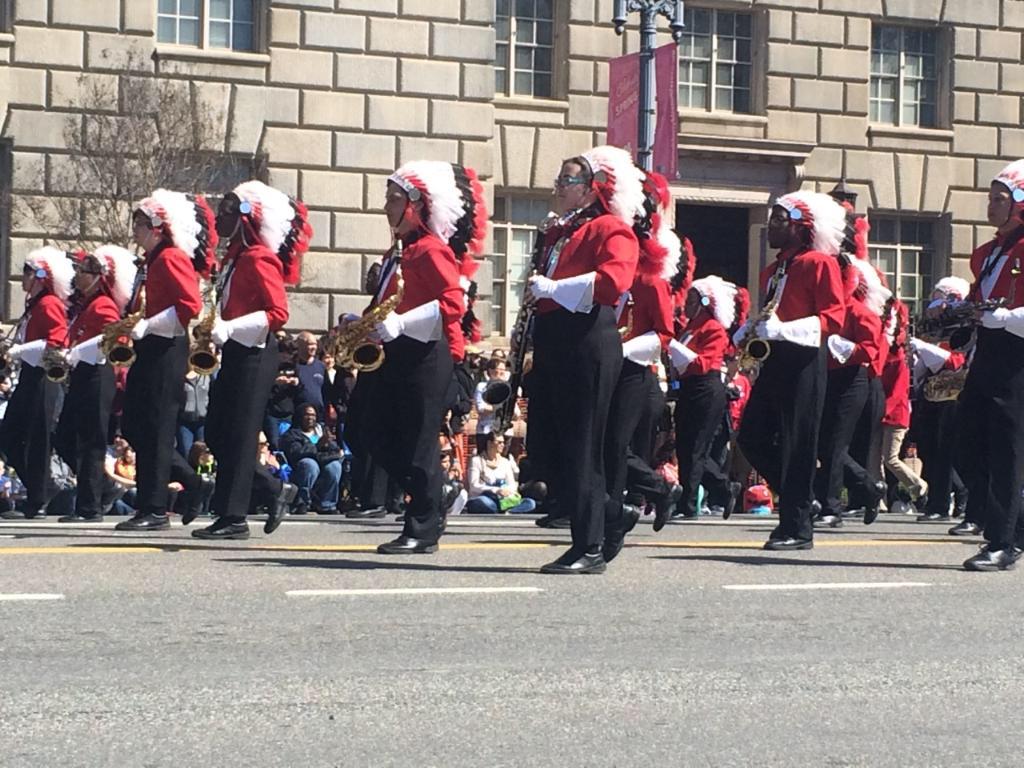
Biloxi High School stereotypes Indians

Photos and videos such as these appeared in social media today, setting off a protest that still continues.


Biloxi High School Band and Boosters
BHS Band in the parade. You guys did fantastic!

You get the idea. Hundreds of "Biloxi Indians," the school's team name, marching in stereotypical Plains headdresses.

Indian Country Today was one of the first media outlets to condemn this stereotyping. It reported a few days later:

Mass Display of Non-Natives in Headdresses--and No, It's Not Coachella[A] reader alerted us to another mass display of non-Natives in headdresses, at the opposite end of the continent. In Washington, DC, the National Cherry Blossom Festival concluded on Saturday with a parade that featured dozens of headdresses. The wearers weren't hipsters, or new-age hucksters, or supermodels -- they were high school students from Mississippi. The Biloxi High School marching band, which supports the school's teams, the Biloxi Indians, took part in the parade wearing their typical uniform, which includes a feather headdress.

It's not one mascot wearing a feather headdress, or a drum major or majorettes in the headdresses. It's every member of the band. You can see some less-than-sharp photos of the parade on the Biloxi High School Band and Boosters Facebook page, but there are better ones on the Biloxi Public Schools page, which is where we found the images below.

It's one thing for adults going to a music festival to wear headdresses. Let's face it, there are jerks in this world who aren't going to respect other people or their cultural traditions. But this is engrained disrespect. This is a uniform that everyone in the band must wear. If you want to play the trumpet and represent your school, you have to wear an item that is sacred in many Native cultures. If you want to support your team--the Indians remember--with your musical talents, you have to dress in a way that upsets many real-world Indians. Are these teenagers aware that they're trivializing something that many American Indians hold dear? Are Biloxi High School administrators aware that many Native Americans will be deeply offended by the manner in which they show their school pride?

We'd like to believe that people are born respecting each other, and that cultural insensitivity (and more extreme forms of prejudice and bigotry) are learned behaviors. Teenagers are fertile minds, they're learning behaviors every day. What are these boys and girls being taught about respect for Native people?

April 10, 2015

Oxbow Indians in Backstrom

I recently watched another episode of Backstrom--this one featuring Indians:

Backstrom Recap: Enemy of My Enemies

By Rachel Cruz“Backstrom” Season 1 Episode 7 “Enemy of My Enemies” aired on Thursday, Mar. 5, 2015 at 9:00 p.m. on FOX. The SCU is specifically asked to help in the case of a pipeline bombing, but Backstrom isn’t so keen on the sheriff there.For starters, Sabine the eco-terrorist is revealed to be part Jewish and part Coquille Indian. Backstrom the insensitive lout calls her a Jewish Indian the rest of the episode.

Backstrom guesses she's hiding on the Oxbow Indian Reservation. Coquille is a real Indian tribe, but the Oxbow reservation is fictional. Here are the facts:

Coquille Indian TribeThe Coquille Indian Tribe is the federally recognized Native American tribe of the Coquille people who have traditionally lived on the southern Oregon Coast.

The Confederated Tribes of Siletz, based in Siletz, Oregon, recognize the Coquille people as one of the tribes that make up their confederation.[5] The Confederated Tribes of Siletz continue to live on the Siletz Indian Reservation. In addition, by an Act of Congress in 1996, the Coquille Tribe now has reservation area totaling 6,512 acres (26 km2).
So Sabine's people live in southwestern Oregon, not in the Portland area. But she could hide on a reservation near Portland where the police don't have jurisdiction. In short, the setup is plausible.

Good job naming a real tribe--something most TV shows don't do. Yet locating the action on a fictional reservation so the tribe couldn't object. More shows should use this approach.

Oxbow Indians show up four times in this episode, mainly as background:

1) Backstrom and Officer Moto go barreling onto the reservation in search of Sabine. Tribal officer Jessie Rocha (Adam Beach) immediately shows up and orders them to put down their guns. Backstrom and Moto don't respond. A bunch of Native men appear and Rocha says they're deputies. Backstrom and Moto don't respond. One deputy approaches Moto and Moto swings at him, beginning a brawl. Backstrom's father Blue appears and stops the fight.

Every step of this conflict happens much too quickly. In reality, the city police probably would check in with the tribal police. The tribal cops would agree to catch the terrorist with the city cops' help.

Even if Rocha comes on too strong, Backstrom is in the wrong. Moto is especially in the wrong for attacking a tribal deputy on tribal land. I'm not sure many tribes would excuse that.

Blue's Native approach

2) Backstrom's subordinate Niedermeyer is trying to talk Blue into reconciling with his son. They see Rocha take some young Native hooligans away for tribal justice, which means rehabilitation and restoration rather than punishment. Niedermeyer asks what Blue thinks of this and Blue says it seems better than anything the white man has come up with.

When Backstrom sees a photo of Blue shaking hands with Rocha, he's enraged. Presumably because he's a right-winger who thinks jailing people is the only solution to crime. Blue comes off as a peacemaker to Backstrom's warmonger.

3) Blue contacts Backstrom to suggest they cooperate. When Backstrom arrives, Blue is doing a sweat with Niedermeyer and some Indians.

Backstrom says his father is untrustworthy and a liar. He notes how Blue pistol-whipped him when he was a boy. Blue says he was wrong but Backstrom was trying to get his gun. Backstrom storms off. So far Blue has seemed reasonable and Backstrom unreasonable.

4) The anti-government industrialist lands a seaplane on the Oxbow reservation lake to spirit Sabine away. Backstrom and his cops arrive and surround them, but Sabine threatens to blow them all up. The Oxbow cops arrive and everyone points guns at each other. Blue arrives and persuades Sabine to surrender.

Backstrom claims Sabine is his prisoner, not Blue's. He says he deserves the capture because he drove her out of hiding. Blue counters that he knew where to find her in the end. They ask Rocha and he sides with Blue.

Backstrom claims this is an example of Blue's perfidy and the others agree, but I don't buy it. For one thing, Blue talked Sabine into surrendering, which was the toughest accomplishment in this case. For another, Backstrom was out of his jurisdiction, again. When you're basically trespassing on foreign soil, you don't get to claim a prisoner or anything like that. You do as you're told because you're an outsider.

Backstrom didn't like Blue's triumph, but Blue didn't break any rules. I'd say he won fair and square--by using his brains, not his brawn. He earned the victor with his Native approach to policing--working with people rather than trying to dominate them.

Besides, Blue gave Backstrom a chance to cooperate and Backstrom rejected it. Backstrom deserves what he got. So it's silly for everyone to act as if Backstrom's anger at Blue is justified. Based on this episode, it isn't.

Conclusion

If you ignore Backstrom's bigotry, Enemy of My Enemies is a good Native-themed episode. There's nothing too stereotypical about the Indians or their actions. The story's flaws aren't related to them.

Indeed, the Indians seem superior to Backstrom the typical white man. He's so angry that he can't deal with Blue or Rocha, so he doesn't get to share in their success. That's what he gets for being a racist and sexist pig who thinks he's better than everyone.

April 09, 2015

Carter's backstory in Hogan's Heroes

More on the Drums Along the Dusseldorf episode of Hogan's Heroes.

If a white-looking guy like Sgt. Andrew Carter seems an unlikely Sioux Indian, a piece of fan fiction creates a plausible backstory for him:

So Sioux Me

By Atarah Derek

Hogan's men tease Carter and he responds:"Come on, Carter, are you sure you won't 'elp us with the rain dance?" Newkirk implored.

LeBeau paused in his dancing and whooping to add, "Or you can show us how to hunt buffalo like you used to do in North Dakota. Hey, you lived in one of those, eh...how do you say, tipi, non?"

Carter rolled his eyes. "I told you guys, the Sioux don't really do rain dances. We do grass dances, fancy dances and medicine dances, but not rain dances. And no, I didn't live in a tipi. Sure, I helped set up a lodge at a powwow one time, but I didn't live in it. Well, not for more than one night, anyway. And if you guys bothered to ask what it was like living so close to the reservation, I'd be glad to tell you, but you're obviously not interested. So just let me finish Schultz's present, for Pete's sake."

Sgt. Kinchloe intervenes:"Guys, just knock it off already. Don't you think you've given Carter enough grief? So he's Indian. So what? I'm black, but you don't seem to be concerned about that. Why is Carter any different?"

Newkirk and LeBeau looked down at their shoes and stuffed their hands in their pockets.

"You know, you're absolutely right, Kinch," Newkirk said. He turned to Carter. "You know we don't mean nothin' by it, don't you, mate?"

"Oui, we're sorry, Carter," LeBeau added.

Carter shrugged. "Aw, it's not a big deal, really. I know you'd never mean to hurt my feelings. And it's really not the worst I've gotten. Not by a longshot."

"White folks back home make fun of you for being part Indian?" Kinch asked.

"No, not really," Carter said. "Most people don't know I'm a quarter Sioux until I tell 'em. Actually, the worst teasing I ever got was when my brother and I would visit our cousin on the reservation. He had some friends who were real bullies."

Years ago, some bullies challenged Carter and his brother Tommy:The teens laughed. The oldest boy lobbed his basketball at Tommy, hitting him hard enough in the chest to send him stumbling backwards. The little boy landed hard on his rear. The shock was enough to evoke a trembling lip as Tommy whimpered.

"Hey, you leave my brother alone!" Andrew snapped, helping Tommy up.

"What are you gonna do, whitey?" the oldest boy challenged. "Tell the Indian grandma you made up?"

"Yeah, you're no Indians," the third member of the gang said with a snarl. "You don't belong on the rez."

Carter's father told him how to how to handle such situations:Andrew's father sighed. "Folks are gonna find any reason to be cruel, son. And sometimes they're cruel even to one of their own. Problem is, you and your brother don't look very Indian, so folks on the rez won't always believe you when you say you are. But you can't let them get to you. You gotta be proud of who you are. No matter what anyone says. And if they make fun of you, ignore them until they're ready to be set straight. Lots of folks are just ignorant. They don't know better. You gotta be ready to teach them."

Andrew nodded. "I'll never forget I'm part Lakota. And I'll be proud of it always."

LeBeau and Newkirk get the message:"We're sorry for making fun of you," LeBeau said to Carter. "We were really out of line."

Carter smiled. "Heck, I forgave you a long time ago, Louis. I know you guys never really mean anything by it."

"Still a matter of principle, though," Newkirk said. He sat up straight and held up his right hand. "And I swear on me honor that I'll never mock you for bein' Indian again."

"Oui, that goes for me too," LeBeau said.

"Thanks, guys," Carter said.

Excellent fanfic, Atarah. The only thing I might've done differently is tie in Carter's love of explosives to this story. He's buying fireworks, the Indians bully him, so he gets revenge by lighting a firecracker under them. This "sparks" his lifelong interest in blowing things up.

Below:  Carter about to (mis)fire an arrow at a German truck.

April 08, 2015

Little Deer in Hogan's Heroes

It's a little-known fact that the 1960s comedy Hogan's Heroes featured an American Indian among its characters:

Here's the show if you don't know it:

Hogan's HeroesHogan's Heroes is an American television sitcom set in a German prisoner of war (POW) camp during World War II. It ran for 168 episodes from September 17, 1965, to April 4, 1971, on the CBS network. Bob Crane starred as Colonel Robert E. Hogan, coordinating an international crew of Allied prisoners running a Special Operations group from the camp. Werner Klemperer played Colonel Wilhelm Klink, the incompetent commandant of the camp, and John Banner was the inept sergeant-of-the-guard, Hans Schultz.And here's the episode that identified Technical Sergeant Andrew J. Carter as a Sioux Indian:

Hogan's Heroes: Season 3, Episode 30
Drums Along the Dusseldorf (30 Mar. 1968)A German truck carrying an experimental jet fuel is the latest target for Hogan and his men. But when all efforts to sabotage the shipment fail, Carter gets down to business with the remaining weaponry at hand--a bow and arrow.You can watch the whole episode here:


Analysis

When Carter gets a letter from home addressed to "Little Deer Who Goes Swift and Sure Through Forest," he reveals that he's a quarter Sioux. The others tease him unmercifully with stereotypical comments.

Fortunately, the teasing isn't mean-spirited. Rather, it comes across as the usual good-natured banter you'd expect from insensitive soldiers.

Carter scowls at the stereotypes, which helps the audience understand they're not true. It becomes clear that no one thinks less of Carter or treats him differently because he's an Indian.

Sgt. Schultz also is filled with stereotypical ideas about Indians. But he's happy to meet an Indian like the ones he's seen in the movies. He eagerly wears the headband Carter gives him.

Col. Klink pretends not to care, but even he tries on the headband in the end. This German fascination with Indians is more than plausible. Although the episode doesn't say so, Schultz and Klink may have grown up reading Karl May's books and dreaming about cowboys and Indians.

Carter's archery is explained as something he learned back home. Since he was a Boy Scout, he could've learned it from either side of his heritage. It's not a stereotypical "he's an Indian so he must know how to shoot an arrow."

I'm not sure 1960s audiences would've known all the stereotypes were false. Or that they would've believed Carter was an Indian. But it was a dramatic change to present an Indian as a regular guy who didn't wear "leathers and feathers." Even more, as someone who wasn't a dark-haired and dark-skinned "other." Who could, and did, pass for white.

Source

Where did the writers get the idea to make Carter an Indian? Probably from the fact that Larry Hovis, the actor playing him, was an Indian:

Larry HovisOn the Hogan's Heroes series, his character, Sgt. Carter, was suppose to be a Sioux; in reality, Hovis was a member of the Yakima nation. In one TV show, Alice, he played a Native American detective who arrests a fake Native American.

For more on the subject, see TV Shows Featuring Indians.

April 07, 2015

Redskins OAF divides and conquers

Speaking of Phil Gover, as I did in yesterday's Redskins posting, he wrote a fine op/ed about the corrupting influence of Redskins OAF:

Daniel Snyder's ‘Gifts’ to Natives Undermine and Corrupt

By Phil GoverThis is exactly why Snyder’s foundation exists.

It exists to zoom-in and highlight the divisions within our communities and to remove the joy from the small things that bring us together. It does its work by forcing people to make a choice between their dignity and temporary relief from the trappings of poverty. In doing so it preys upon people’s biggest weaknesses and worst fears, turns communities against each other, and even turns cousin against cousin.

I’m struck by the layered cynicism of Snyder’s philanthropic enterprise. The first layer is an assumption about non-Native people–that by creating a foundation in the midst of crisis one can hand-wave the negative press away. That argument goes like this: “The Redskins couldn’t possibly be a racist name–look at all the good work they do in Indian country.” This is probably enough to boost the confidence of some name supporters whose resolve is flagging. No need to examine exactly what the foundation does–its existence is proof enough. This is philanthropy as a public relations response to crisis management, which is another way of saying it’s not philanthropy at all. I work in the non-profit world, and have met with donors big and small and the literal heart of a philanthropist is a love of humanity and the desire to grow people. Philanthropy in Indian country is real and it isn’t found in the heart of a man who finds “pride, courage and intelligence” in the social equivalent of a fraternity blackface party.

The second layer of cynicism concerns all of our communities. Snyder started his enterprise by submitting a survey across Indian country asking what tribes needed. It’s clear now that Snyder was talking about things. He didn’t ask for it, but here is my answer to that survey question: We need better schools and better school leaders. We need more Native men and women with college and professional degrees. We need counselors to help our children understand why suicide isn’t an answer. We need police to stop murdering our men in the street. We need to end the food deserts that make poor health a destiny. We need shelter and protection for our battered women and education for our men who learned that beating someone is the way to get them to love you. We need our Native children everywhere to be affirmed and celebrated not mocked and stung by a silent, invisible racism. We need non-Native people to care about the disasters happening all around them.

Snyder’s foundation only offers things. And long after that sponsored rodeo is over, that playground falls into disrepair or those passenger vans break down, the truth is that you’ll still be poor, and Snyder will have gotten what he wanted: the veneer of support from some in Indian country, the satisfaction of distracting his own supporters, the opportunity to move on with his life and give his fans the blessing to do this.
Comment:  For more on Redskins OAF, see Navajo President Sits with Snyder and Redskins OAF Seeks Zuni Art.

April 06, 2015

Paiute leader impeached over Redskins OAF

Redskins OAF, the Redskins charitable foundation, is back in the news. As usual, not in a good way:

Utah Paiute tribal leader accused of taking bribes from Washington Redskins, facing impeachment

By Ashton EdwardsA Utah Paiute tribal leader accused of taking bribes from the Washington Redskins and is now facing impeachment.

According to official documents, Gari Pikyavit Lafferty, the tribe’s highest-ranking elected official, is accused of accepting gifts from Dan Snyder’s team and the Original Americans Foundation (OAF), a non-profit formed by Snyder for his outreach efforts with Native American tribes.

The documents state Lafferty allegedly accepted a Robert Griffin III-signed football and allowed the team to pay for her trip to Washington to see the Sept. 25, 2014 game against the Giants without telling tribal leaders.
Paiute Tribal Leader Faces Impeachment For Taking Redskins Gifts

By Dave McKennaThe gifts, the council wrote, "could be considered bribery."

After the trip, Lafferty supported a deal with OAF to provide at least two vans to the tribe, as the debate over whether to cooperate with Snyder's foundation raged throughout Indian Country.

The Paiute tribe is small—in an interview last fall, Lafferty estimated there were "around 900-plus members" divided up in five sub-tribes, called "bands"—and located in remote areas of Utah. But the tribe looms large in Snyder's life in recent years. Among its members is Phillip Gover, one of the five plaintiffs in Blackhorse v. Pro Football Inc., the lawsuit seeking to have Snyder's "Redskins" trademarks canceled by the U.S. Patent and Trademark Office. (Pro Football Inc. is the corporate name of the Washington Redskins.)


A day later, Lafferty was impeached:

Utah Tribe Impeaches Chairwoman For Taking Redskins Bribe

By Dave McKennaThe full statement:

The Tribal Council of the Paiute Indian Tribe of Utah has unanimously voted to remove Gari Pikyavit Lafferty as chairwoman, because of actions that include taking personal gifts for herself and her family without council approval, and failing to act upon council direction.

“The role of a tribal official is to act to make the tribe better, but the actions of Gari Lafferty since she took office have served neither the Paiute Indian Tribe of Utah nor its elected council,” said Vice Chairwoman Jeanine Borchardt. “Gari Lafferty’s actions served only her self-interest. We are deeply saddened in taking this action.”
Comment:  For more on Redskins OAF, see Navajo President Sits with Snyder and Redskins OAF Seeks Zuni Art.

April 05, 2015

America constructed to erase Indians

Dichotomy of Declaration of Independence Highlights the Bi-polar Character of USA

By Mark CharlesAs a Native man one of the excuses I often hear for people’s ignorance regarding Native issues is “there are no Native Americans in my context.” I tell them, “Yes. That was by design. Your nation was intentionally constructed so you would never have to be faced with the reality that there were people here prior to Europe’s colonization.”

This is why our schools teach that America was “discovered.” It is why American Indian reservations were created. It is why the apology to Native peoples in 2009 was buried in an appropriations bill and never publicly mentioned by the White House or Congress. And it is why the professional football team located in our nation’s capitol continues to utilize the mascot “Redsk*ns.”

The United States of American has gone through incredible lengths to keep the public narrative regarding the indigenous peoples of this land in mythical terms. Because, the moment we stop being caricatures and become human, our nation must face the uncomfortable reality that the only reason it ever stated “All men are created equal” is because it has an incredibly narrow definition of who is actually human.
Comment:  For more on the subject, see Tarantino: "Indians Have More or Less Disappeared and How Euro-Americans "Vanished" Indians.

April 04, 2015

Carmen Moore in Arrow

Here's a Native guest-star role that I saw but didn't even realize at the time:

‘Arrow’: H.I.V.E. Will Play a Major Role in Season 4If there’s one thing the writers of the CW’s Arrow joyfully revel in–it’s pulling the rug out from under their audience. They’ve proven they can write in twists that fans didn’t see coming from miles away–but they’ve also show they’re not afraid of the long-haul with some of their story threads and supporting characters. In fact, one of the more interesting storylines the writers have had going from the very first season even, yet keep surrounded with secrecy and conspiracy, is the murder of John Diggle’s (David Ramsey) brother by Floyd Lawton a.k.a. Deadshot (Michael Rowe).

While the writers killed off Lawton just a few episodes ago in “Suicidal Tendencies,” they didn’t do so without progressing the story along even further–when audiences at long last got to see the moment when Deadshot was approached by H.I.V.E. to kill Andy Diggle. Not much was said about the criminal organization in the scene, and the woman from H.I.V.E. was an unknown character–so fans have been left to wonder when they might finally get to learn the truth behind all this conspiracy.
Comment:  The actress looked vaguely familiar to me, but I was too busy pondering the plot to think about her. It's Carmen Moore, of course, as someone pointed out.

I don't think I've ever seen her in a network TV show, since she's Canadian and doesn't do much Hollywood work. That may be why I didn't recognize her--because I didn't expect her or any Native in a superhero-spy story.

One fan speculated:My best is that the mystery woman is either Talia al Ghul or Lady Shiva. Either one will be just fantastic.Either one would be a big role for a Native actress. She'd undoubtedly appear in several episodes, not just one.

April 03, 2015

Daily Cavalier mocks black student's arrest

A University of Virginia newspaper "satirized" a black student's arrest with an April Fools' Day story about a Native student's arrest:

People are outraged at UVA newspaper's April Fools' issue satirizing a black student's bloody arrest

By Peter JacobsUniversity of Virginia students are calling on the school's student newspaper, The Cavalier Daily, to apologize for a seemingly insensitive April Fools' Day article.

The Cavalier Daily's April Fools' Day front page is dominated by a story with the headline "ABC agents tackle Native American student outside Bodo's Bagels," which appears to satirize the controversial arrest of UVa student Martese Johnson last month.

The story's tagline reads "Students decry 'Trail of Schmears' as marginalization of minorities reaches new low," a reference to the "Trail of Tears" that followed the US government's Indian Removal Act of 1830.

The student newspaper has since apologized for the article.
UVA's Latest Nightmare: Bad Racist 'Satire,' An Even Worse Apology

By Jia TolentinoHere’s a closer look at the first one, which “satirizes” the racism that led to Martese Johnson’s police brutalization and night in chains. Note the names of the imaginary Native American students in the piece (“Dances With Wolves,” “Strong Buffalo,” “Rabbit in the Grass,” “Insect Humming”)—which mainly offend me because the jokes are so painfully fucking weak.

I too am deeply concerned by the fact that what’s actually satirized here is not police brutality but the idea of a sincere institutional response, on the part of administration or students. This is racism so stupid it doesn’t know it’s racist—by far, the most troubling kind.

The most interesting part of this incident is this letter from The Declaration, another campus publication:

An Open Letter to The Cavalier DailySatire is a radical comedic tradition wherein the abuses of the overculture are deconstructed and critiqued. This comprehensive deconstruction is what makes stuff like The Colbert Show (sweet angel, rest in peace) and The Onion work where other attempts at satire fall flat—they make clear the issues that plague society-at-large.

This means that good satire at UVa should speak to the not-so-hidden truths that undercut student life: Greek culture’s gaping wound at UVa’s nucleus; the entitlement complex shared by a majority-white student body; the fetishistic hero-worship of Our Mr. Jefferson; the awkward, elephantine disparity between rich students and poor students; the racism, pervasive and terrifying, woven tightly into this school’s very fabric.

It seems so simple, really, a slice of Culture 101 you’d expect UVa students to have studied long before they entered the university: the “bad guys” look stupid because they are; readers and viewers laugh, duh, but they also question why those “bad guys” are in power in the first place!

As the student publication with the “richest history” and the most influence on grounds, the Cav Daily shouldn’t need this lesson, but when its annual “satirical issue” frames damaging racial stereotypes as funny and trivializes blatantly the marginalized groups satire is supposed to work for, not against, it makes two things clear: 1) UVa works for the overculture, “The Man,” the lived-in, overarching structure that tells you it’s okay to reframe acts of erasure and violence as comedy and call it a day, and 2) UVa is home to a cadre of students who are dumb as hell and didn’t do their homework for Intro to Comedy and Society: or, How to Be a Decent Human Being.
Comment:  This excellent commentary applies to every attempt to "satirize" racism by using stereotypes--chiefs, teepees, braves, buckskins, tomahawks, etc.--uncritically. That is, by simply emulating a racist work but claiming you're doing it "ironically," to mock the stereotypes.

Again, in satire, "the abuses of the overculture are deconstructed and critiqued." Simply displaying examples of abusive racism or stereotyping isn't deconstructing or critiquing them. A "satire" isn't a satire unless you actively attack the target of your ire.

For more on the subject, see Stereotyping Explained to South Park Apologists and The Dudesons, Polish Jokes, and Minstrel Shows.

April 02, 2015

Apology not accepted!

I posted something about the racist fraternity video and how it indicts society, not just individuals. The corollary is how worthless an individual apology is compared to a society-wide change. Here's more on the subject:

Dear White Racists, Apology Not Accepted!

Frat boy Levi Pettit isn't sorry. Neither is the Bloomsburg U's baseball player who called 13-year-old Little League phenom Mo'Ne Davis a "slut." So why are we expected to forgive them?

By Stacey Patton
This reflexive, near-obsessive push for insta-forgiveness just perpetuates the problems of deeply entrenched racism. The rush to appease “White fragility,” to protect the zone of White comfort, denies the transformative possibilities that might result in actual racial reconciliation and justice. By not letting the perpetrator fully experience the consequences of their attack, we deny them the opportunity to take full responsibility for their actions. By rushing the victim to respond, we deny them the full, true range of their emotions and psychological response to such to evil acts.

And by fast-forwarding the whole situation back to the comfort zone of the status quo, where racism is the unacknowledged norm, we deny everyone the opportunity to evolve and do better. Nobody acknowledges the real, ongoing damage. And we keep going back to square one where everyone is playing a role designed to prevent progress because it’s too uncomfortable and frightening to even consider disrupting the pattern, no matter how harmful and backwards it proves to be.

There is an almost religious, or Evangelical rush to “forgive,” to absolve the perp ASAP. But this forgiving doesn’t free anybody—not the perp, not the victim, not those who observe the dynamics at play. It just feeds the status quo, and bolsters the public agreement to ignore the truths, trivialize the trauma and minimize the realities of racism, thus ensuring more of the same.

Sometimes I think that Black people should be more like Jewish people, who don’t even pretend to turn the other cheek, and who, when attacked publicly, never talk about forgiveness or absolution of anti-Semites. They have schooled us all to be crystal clear: When they say “never again,” they mean it, without exception, and they would never consider shouldering either the blame or the responsibility for the anti-Semitism aimed their way. That’s something I can understand and respect. But of course if Black people embraced that kind of love and self-preservation, even as we stand at risk for extermination, we’d be called reverse racists.

Instead, Black people too often fall into the role of soothing hurts, smoothing jagged edges, healing everyone’s pain but our own. When we embrace the type of response from Mo’Ne Davis, we are praised for “taking the high road,” “being the bigger person,” showing class, and grace, and moral superiority.

But we are never supported, defended, protected or perceived to have a personhood worthy of upholding.

And the racists who attack us—why do they always claim they had no idea that their language of choice and symbols (watermelons, monkeys, nooses, or calling Black children “cunts” and “sluts”) could possibly be construed as problematic?

When they’re caught, they play dumb, they deny any possibility of ill intent or awareness. And their apologies routinely contain the ultimate caveat: “I’m sorry if you found it offensive.”
Comment:  For more on the subject, see "It Feels Good" to Be White and Whites Too Fragile to Discuss Race.

April 01, 2015

Stereotypes threaten academic achievement

Professor affirms effects of Indian mascots

By Jack RooneyStephanie Fryberg, a visiting professor of psychology at the University of Washington, presented her research Tuesday on the psychological effects of American Indian sports mascots, which affirmed these types of social representations depress the self-esteem of American Indian students.

Fryberg’s lecture, titled “From Stereotyping to Invisibility: The Psychological Consequences of Using American Indian Mascots,” highlighted several studies she and her colleagues have performed.
And:All of the studies, though, concluded that essentially any American Indian mascot representations harmed the self-esteem of American Indian students, Fryberg said.

“Consistent with the past two studies, it turns out that being exposed to any one of these mascots decreased achievement-related possible selves,” she said. “So what it means is if they saw the Indian mascot, then any possible selves they had related to achievement in school were depressed.”


Indians and blacks too

Some related research on stereotypes:

Stereotype Threat Widens Achievement GapSteele, Aronson and Spencer, have examined how group stereotypes can threaten how students evaluate themselves, which then alters academic identity and intellectual performance. This social-psychological predicament can, researchers believe, beset members of any group about whom negative stereotypes exist.

Steele and Aronson gave Black and White college students a half-hour test using difficult items from the verbal Graduate Record Exam (GRE). In the stereotype-threat condition, they told students the test diagnosed intellectual ability, thus potentially eliciting the stereotype that Blacks are less intelligent than Whites. In the no-stereotype-threat condition, the researchers told students that the test was a problem-solving lab task that said nothing about ability, presumably rendering stereotypes irrelevant. In the stereotype threat condition, Blacks--who were matched with Whites in their group by SAT scores--did less well than Whites. In the no stereotype- threat condition--in which the exact same test was described as a lab task that did not indicate ability--Blacks' performance rose to match that of equally skilled Whites. Additional experiments that minimized the stereotype threat endemic to standardized tests also resulted in equal performance. One study found that when students merely recorded their race (presumably making the stereotype salient), and were not told the test was diagnostic of their ability, Blacks still performed worse than Whites.

Spencer, Steele, and Diane Quinn, PhD, also found that merely telling women that a math test does not show gender differences improved their test performance. The researchers gave a math test to men and women after telling half the women that the test had shown gender differences, and telling the rest that it found none. When test administrators told women that that tests showed no gender differences, the women performed equal to men. Those who were told the test showed gender differences did significantly worse than men, just like women who were told nothing about the test. This experiment was conducted with women who were top performers in math, just as the experiments on race were conducted with strong, motivated students.
Stereotypes found to affect performance on standardized testSteele's theory is that stereotype vulnerability, the unsettling expectation that one's membership in a stigmatized group will limit individual ability, may be at the root of lower grades and SAT scores for African Americans. Stereotype vulnerability raises interfering anxiety during testing or classroom situations, Steele wrote. The same dynamic also could explain why highly skilled women at the university level drop out of programs in math, engineering and the physical sciences, he added.

"Surprisingly, you don't have to believe in the stereotype to be vulnerable to it," he pointed out to his audience at the APA convention.

"Everyone in a collective knows the stereotypes about a given target group, including the group members themselves, and everyone knows that everyone knows," Steele wrote in a paper prepared for the convention. "Thus the predicament of 'stereotype vulnerability': The group members then know that anything about them or anything they do that fits the stereotype can be taken as confirming it as self-characteristic, in the eyes of others, and perhaps even in their own eyes. This vulnerability amounts to a jeopardy of double devaluation: once for whatever bad thing the stereotype-fitting behavior or feature would say about anyone, and again for its confirmation of the bad things alleged in the stereotype.
Yes, it makes sense that any kind of stigmatizing--e.g., "You're a girl, so you have to try harder"--would increase anxiety and decrease performance. So there's no rational way to spin a racist stereotype as an "honor" that helps Native children. It would be like encouraging me with an 18th-century image of a dirt-poor farmer in an log cabin.

How would that relate to my experience in the 21st century? Try harder and I can be a dirt-poor farmer too?

If a school had a program that honored real live Natives, that might be different. But few if any schools have that.

This point could generate a whole article. An article ripping the idea that centuries-old images are supposed to help Natives in general and Native students in particular.

It obviously wouldn't work if you showed black students pictures of half-naked African spearchuckers. How exactly is the Native case different?


Be all that you can be, African Americans! Aim for the stars!

Anthropological Association Takes a Stand in Native American Mascot Debate

By Rob StottThough the American Anthropological Association has been a vocal proponent of indigenous rights throughout its history, the group had remained quiet on the Native American mascot debate. That changed last week when AAA released a statement on the issue.

Anthropologists have joined a long line of groups to call on professional and college sports communities to rethink their use of Native American mascots and nicknames. Except in instances where tribes or key stakeholders have been consulted (see Florida State University and San Diego State University), sports organizations should “denounce and abandon the use of American Indian” imagery, the American Anthropological Association said in a statement [PDF] released last week.

“While these organizations may feel they are honoring Native Americans, many in that community view it to be a degrading and painful symbol of racism,” Monica Heller, AAA president, said in the statement. “Research has established that the continued use of American Indian sports mascots harms American Indian people in psychological, educational, and social ways. Frankly, I don’t see where the honor is in that.”
Comment:  For more on the subject, see The Harm of Native Stereotyping: Facts and Evidence.

March 31, 2015

"You damn redskin!"

'You Damn Redskin!' Surviving a Racist Attack

By Dennis G. ChappabittyDuring the usual jabbering I’d said I was a Comanche Indian headed back to my final year of college. As we drove, the driver said they’d been drinking beer and needed to pull over. We pulled off near an old deserted town called Silver City, north of Drumright, Oklahoma. After driving far down the road, I asked, “Why not stop here and pee?” They said, “No, we’re going further down.”

My Indian gut told me something was not right. The car stopped and the young men all got out while I stayed in the middle of the back seat. After they took care of their business, one of them said, “Hey, why don’t you get out?” I said, “No, I don’t have to.” Then one of them said in a loud, angry tone, “You will get out, now!” With no choice, I slowly got out of the car while they all stood on the right side of the road all looking at me with squinting hateful eyes and clinched fists.

I sensed movement to the right and behind me. I quickly turned and ducked as one of them swung a bottle of beer toward the back of my skull. When I ducked, he hit the car door and the bottle shattered. The battle for my survival was on.

I took several punches to my body as they all closed in shouting “You damn redskin, we’re going to kill you!” I fought back with full force and we all fell down in the roadside ditch full of tall weeds. While down, the kicking and punching continued over and over as I moved away from the car and farther down the ditch.
Wichita North Redskins

"Remarks by Clem Ironwing, Sioux, during a public Mascot/Identity Committee hearing."

By Matthew Richter
The following remarks were made by Clem Ironwing, Sioux, November 11, 1996, during a public hearing called by the Mascot/Identity Committee. Denied a seat on the Committee, Mr. Ironwing, an elder, was given three minutes standing alone on the school stage in front of three television stations, local radio stations and the Wichita Eagle newspaper in front of an audience of 250 to explain why it is not right for the school to continue using this mascot. His remarks follow:

"The word Redskin was taught to me at a very young age, and this is the meaning it has for me.

"I am a Native American. I grew up on an Indian reservation. As a child, the United States Government and the Catholic Church came into our homes, took us away from our families, and forced us into Catholic boarding schools. There was no choice to be had in this matter, you had to go. The Catholic Church with the blessings of the United States Government took it upon themselves to determine that we were savages, and needed to be transformed to fit into their society.

"When my hair was cut short by the priests, I was called a 'redskin' and a savage. When I spoke my native tongue, I was beaten and called 'redskin.' When I tried to follow the spiritual path of my people, I was again beaten and called a 'redskin.' I was told by them to turn my back on the ways of my people, or I would forever be nothing but a dirty 'redskin.'

"The only way 'redskin' was ever used towards my people and myself was in a derogatory manner. It was never, ever, used in a show of respect or kindness. It was only used to let you know that you were dirty and no good, and to this day still is."

March 30, 2015

Pioneer Girl impugns Little House

The true story of Laura Ingalls Wilder and her "little house on the prairie":

Pioneer Girl by Laura Ingalls Wilder review–gritty memoir dispels Little House myths

Full of theft, alcoholism and violence, the novelist’s unvarnished account of her childhood is a darker, more vicious affair

By Sarah Churchwell
For most of Laura’s childhood, she lived in close proximity to drunks, rapists, horse thieves, adulterers and more than one murderer, including perhaps a brush with a notorious family of serial killers.

Nor was the Ingalls family’s progress a simple westward expansion, as the novels more or less report it: Wilder deliberately simplified their back-and-forth journeys across the midwest in order to create the impression of westward progress, an image in keeping with her theme of nation-building. In fact, the Ingallses retreated east more than once, while the self-styled “pioneers” were land-grabbing as fast as they could: manifest destiny was a giant get-rich-quick scheme. The family emerges as far more opportunistic, even on occasion unscrupulous, than the whitewashed novels would have us believe. Charles Ingalls knew that he was in Indian Territory illegally, while his wife’s brother Tom went to the Badlands on an ill-fated and illegal search for gold. The family snuck away from debts on at least one occasion, making their escape in the middle of the night. The fundamental drama in the novels comes not from conflicts within the family, but with the external forces of government, Indians and nature. Of the three, the last is the one we are most apt to sympathise with today; the attitude of the settlers to the Indians makes for uncomfortable reading (“Treaties or no treaties, the land belongs to folks that’ll farm it. That’s only common sense and justice,” one neighbour declares). It is an attitude that the Ingallses and their relatives clearly shared; many of their actions were in flagrant violation of treaties.

The most extensive difference between the two accounts is Wilder’s decision to excise an entire interlude in Iowa from the novels. The family’s retreat to the east undermined her triumphalist tale of westward progress, but their time in Iowa also featured some of the family’s grimmest experiences. They lived in a hotel adjacent to a saloon, which is hard to imagine the fictional Ma Ingalls permitting; the decision was a mark of their “financial desperation,” as the editor of Pioneer Girl notes. There were bullet holes in a wall, made by a drunken man shooting at his wife; another dragged his wife around by her long hair, carrying a lamp that was pouring kerosene; Charles Ingalls intervened to keep them all from being burned to death.
Comment:  For more on Little House on the Prairie, see Little House = Libertarian Fable and Little House Celebrates Land Theft.

March 29, 2015

California's 4th-grade mission mythology

Lying to Children About the California Missions and the Indians

By Deborah A. MirandaAll my life, I have heard only one story about California Indians: godless, dirty, stupid, primitive, ugly, passive, drunken, immoral, lazy, weak-willed people who might make good workers if properly trained and motivated. What kind of story is that to grow up with?

The story of the missionization of California.

In 1769, after missionizing much of Mexico, the Spaniards began to move up the west coast of North America in order to establish claims to rich resources and before other European nations could get a foothold. Together, the Franciscan priests and Spanish soldiers "built" a series of 21 missions along what is now coastal California. (California's Indigenous peoples, numbering more than 1 million at the time, did most of the actual labor.) These missions, some rehabilitated from melting adobe, others in near-original state, are now one of the state's biggest tourist attractions; in the little town of Carmel, Mission San Carlos Borromeo de Carmelo is the biggest attraction. Elsewhere, so-called Mission décor drenches Southern California, from restaurants to homes, apartment buildings, animal shelters, grocery stores, and post offices. In many neighborhoods, a bastardized Mission style is actually required by cities or neighborhood associations. Along with this visual mythology of adobe and red clay roof tiles comes the cultural storytelling that drains the missions of their brutal and bloody pasts for popular consumption.

In California schools, students come up against the "Mission Unit" in 4th grade, reinforcing the same lies those children have been breathing in most of their lives. Part of California's history curriculum, the unit is entrenched in the educational system and impossible to avoid, a powerfully authoritative indoctrination in Mission Mythology to which 4th graders have little if any resistance. Intense pressure is put upon students (and their parents) to create a "Mission Project" that glorifies the era and glosses over both Spanish and Mexican exploitation of Indians, as well as enslavement of those same Indians during U.S. rule. In other words, the Mission Unit is all too often a lesson in imperialism, racism, and Manifest Destiny rather than actually educational or a jumping-off point for critical thinking or accurate history.


I can confirm that my California school had a "mission" unit. I was in 5th grade, but it was a joint social studies class with grades 3-5 (experimental school). We divided into teams and made some sort of cutout missions, but nothing as good as these.

What's up with constructing missions, anyway? What about the White House, the Alamo, or Sutter's Mill? Why is a mission the only historical building constructed by California students?

Someone could make the case that this veers too far into state-sponsored religion. I mean, you could read the Bible or reenact a Catholic ceremony and claim it was for learning about California's mission era. Constructing a mission isn't much different.

For more on California's missions, see Indoctrinating Students About Missions.

Below:  Happy-go-lucky Indians Preaching and Farming at Mission Dolores by Anton Refregier. Former Rincon Annex Post Office, San Francisco, California.

March 28, 2015

Ratings belie anti-diversity argument

Another response to the Deadline Hollywood article points out that diversity isn't just good morally. It's good financially, leading to better ratings and more revenue for broadcasters.

As Multicultural TV Shows Succeed, Some Wonder if Diversity has Gone Too Far

By Jeff YangHunt warns that like prior TV flirtations with diversity, this progress could be temporary. Yet the numbers—the only things that matter in Hollywood—show that this time, something different may be happening. Out of the scripted shows with all-white leads introduced this past season, just one—a reboot of “The Odd Couple”—seems guaranteed a renewal. Meanwhile, nearly every series centered on diverse characters looks like a solid return, for two reasons.

The first is that they’re expanding network audiences in ways that reflect the new demographic reality. Analyses provided by Nielsen show that the three most-watched non-event shows among 18-49 year old Asian Americans as of February were “Fresh Off the Boat,” “Fresh Off the Boat” and “Fresh Off the Boat”—and it’s not even close, with Asian Americans being twice as likely to watch FOTB as any other scripted program. A full third of all 18-49 year old African Americans watch “Empire” each week, making it more popular than the Super Bowl in that demographic. And 17 of the top 25 shows among 18-49 year old Hispanics are on Univision—the Spanish-language network that regularly draws bigger audiences than Fox and NBC.

The second is that it’s these shows aren’t just catering to their communities. Asian Americans make up as much as 20% of FOTB’s audience—but the other 80% is non-Asian, and they’re what is keeping the series competitive against juggernauts like “The Voice” and “NCIS.”

Ultimately, points out UCLA’s Hunt, “we live in a diverse society, and people want to see stories that reflect that. We’re curious about other groups’ experiences. It shouldn’t come as a shock that white households don’t only want to see shows with just white people.”
Comment:  For more on the subject, see Where Are the Native TV Shows? and Deadline Hollywood on TV Casting.

March 27, 2015

Where are the Native TV shows?

Where are the mainstream TV shows about American Indians?

By Yohana DestaOn television screens, American Indian characters are virtually invisible.

Despite the recent TV diversity breakthrough (see: Black-ish, Fresh Off the Boat, Jane the Virgin and the record-breaking Empire), native people as a whole are still largely left out of the picture on the small screen. They make cameos in subplots (e.g. Unbreakable Kimmy Schmidt, House of Cards), but don't get the reins to their own series.

Where are the shows dedicated to this country's American Indians?

Though there have been some recent attempts (The Red Road from Sundance has been panned by critics), there has yet to be a popular, mainstream series starring American Indians as a whole in the U.S.

"We’re one of the few ethnic groups they don’t know what to do with," actor Michael Horse tells Mashable. "America sees us as an antiquated culture."
Non-Native Travis Holt Hamilton is trying to do a sitcom based on his movie More Than Frybread:For now, Hamilton still has to work independently, because studios are hesitant about Native stories. He remembers taking a recent film workshop where an instructor bluntly told him why his script wouldn't work.

"As soon as I said Native, the instructor stopped me [and said] 'Not to be rude, but Hollywood’s not really interested in Native films,'" he recalls.

When it comes to TV, Hamilton says Canada far surpasses the U.S. The country has the Aboriginal Peoples Television Network, or APTN, a channel devoted to its Aboriginal community. Aside from fictional TV shows, it also produces documentary and news shows.

A similar U.S. attempt is the First Nations Experience, or FNX, launched with PBS affiliate KVCR in 2012. The network is only available in a few states.

Another U.S. attempt is the Red Nation Television Channel, an online channel devoted to Native content, founded by actor and filmmaker Joanelle Romero. It launched in 2006 and now boasts 10 million viewers, according to the site's About page. When it first opened, the website crashed due to an overwhelming number of visitors.
Comment:  For more on the subject, see Deadline Hollywood on TV Casting and TV Starts to Reflect America.

Below:  Jonathan Joss in Parks and Recreation.