Showing posts with label IndiVisible. Show all posts

May 12, 2011

Thoughts on IndiVisible

As I said, I saw IndiVisible at the California African American Museum Tuesday. The exhibit consisted of a 1) smallish gallery with a couple dozen vinyl panels supplemented by paintings, photos, newspaper clippings, and works of art, and 2) a side room noting some joint civil-rights struggles.

I didn't know what to expect, but IndiVisible was a comprehensive survey of black-Indian relations since 1492. If the exhibit omitted anything significant, I didn't notice it. You could've picked up a lot of the information by reading Newspaper Rock or a good book, but IndiVisible provided an excellent introduction to the subject.

Here are my notes on what you can see and learn from IndiVisible:

  • Prefacing the exhibit were photos of black Indians living in California and the West. They were taken by Valena Dismukes, an aquaintance, and included James Howard Scott, another acquaintance.

  • A drawing titled An Account of the Regular Gradation in Man (1799) by Dr. Charles Wright, which sought to prove that blacks and Indians were more animal-like.

  • Bartolomé de las Casas, who championed the Indians against Columbus, thought the Spanish should replace Indian slaves with African slaves. Until he actually saw the Portuguese slave trade in action, that is. Wow...talk about your blind spots. If you have to see the cruelty of slavery to realize it's wrong, you're not exactly a deep thinker.

  • Estevanico, the black slave who was one of the first non-Indians to cross America.

  • Mo'Pak, a painting that represents the union of Native and African themes, by Maceo Leatherwood.


  • Illustrations showing the marked similarity between a Fulani village in Guinea, Africa, during the 1500s and a Timucua Indian village in Florida, 1564.

  • A photo of an Olmec head suggesting that Africans visited America before Columbus. With a note saying this theory is widely disputed.

  • A panel on identity featuring Crispus Attucks, Radmilla Cody, and Jimi Hendrix.

  • Lots of potential controversies

  • Mildred Loving, a black woman with Indian blood married to a white man. Her case went to the Supreme Court and led to the legalization of interracial marriage.

  • Info on tribal blood quantum and the "one drop" rule that classified blacks.

  • The Shinnecock, Pequot, and Wampanoag tribes and their struggles because people often see them as blacks rather than Indians.

  • The Cherokee Freedman controversy: Chief Chad Smith vs. Marilyn Vann.

  • The Walter Plecker letter that reclassified Virginia's Indians as Negroes.

  • A 1913 letter requesting separating waiting rooms at a train station in Pembroke, North Carolina, for whites, Negroes, and Cherokee Indians.

  • The Lumbee Indian rout of the Ku Klax Klan in 1958.

  • "Chief Buffalo Child Long Lance," an actor who starred in the movie The Silent Enemy. He only pretended to be a Blackfoot chief but, ironically, he was qualified to be a Lumbee Indian.

  • Two versions of a Kickapoo delegation petitioning Emperor Maximilian for land grants in Mexico. A photograph shows a dozen people with clothes ranging from cowboy- to Indian-style and dark features indicating their black/Indian heritage. A painting of the same delegation shows only six people wearing traditional Indian clothes with pale skins and almost Caucasian features. The African influence is completely missing.

  • The Buffalo Soldiers.

  • Modern-day issues

  • Mary Ann Martin Green, a Californian who was raised as an African American but eventually embraced her Native heritage. She became the only adult member of the Augustine Band of Cahuilla Indians and, the text blandly notes, opened a casino. What the text doesn't mention is that this is the prototypical case of someone's "discovering" he or she is an Indian and becoming wealthy on that basis.

  • Professor Jack Forbes, now deceased, who was a pioneering academic on black/Indian relations.

  • The 1960s: "United in common struggle...risen up together to fight oppression." And "Civil Rights, Sovereign Rights."

  • A photo of "Barack Black Eagle," Obama's name as an honorary Crow Indian.

  • A Black Panther newspaper featuring articles on Indians titled "Persecution of Nevada Indians" and "Rebirth."

  • A panel on black/Indian issues elsewhere in the Americas: Afro-Bolivians, the Taino resurgence, and the Miskito struggle.

  • "Native Resistance and African American Solidarity"

    As the title indicates, this room covered black and Indian protests of the last few decades. It contained the following displays:

  • The Alcatraz Proclamation of 1969 and the Black Panther Party's Ten Point Plan side by side, showing the two documents' similarities.

  • The Longest Walk in 1978 with an appearance by Muhammad Ali.

  • The Longest Walk 2 in 2008 with Congressman John Conyers Jr., Dennis Banks, Harry Belafonte, Dick Gregory, Danny Glover, and Darryl Hannah.

  • Fasting for Freedom in 1984: Three Native prisoners fasted for 50 days for the right to practice their religion. Angela Davis spoke for them.

  • Wounded Knee II in 1973: Ralph Abernathy joined Russell Means and Dennis Banks, with a visit by Angela Davis.

  • The No Extradition Rally for Dennis Banks in 1976, with Kathleen Cleaver of the Black Panther Party speaking.

  • Conclusion

    All in all, IndiVisible was an illuminating exhibit, especially if you think blacks and Indians are distinct peoples with distinct histories. I can see how this exhibit would be controversial if your image of an Indian was a pure-blooded Lakota. Even some Indians reject black Indians because they're prejudiced against blacks.

    Fortunately, as most Indians do, I've tried to be inclusive. As I said in Separate Nations for Blacks, Indians? when I disputed the great Vine Deloria Jr., the two groups have much in common. As I said in Indians "Win" Oppression Olympics, everyone concerned with social justice should fight racism and stereotyping together.

    For more on IndiVisible, see IndiVisible Is "Long Overdue" and IndiVisible Causes Divisions. For more on black Indians, see People Can't Be Black and Indian? and Powwow Dance Excludes Unregistered Indian.

    Below:  Marilyn Vann, the Cherokee Freedmen, and Chad Smith.
    May 11, 2011

    IndiVisible at CAAM

    I saw this exhibit at the California African American Museum Tuesday:

    IndiVisible: African-Native American Lives in the Americas
    March 17-May 15, 2011
    From the Smithsonian comes an important and enlightening traveling banner show about the intersection of American Indian and African American people and cultures. IndiVisible: African-Native American Lives in the Americas explores historical and contemporary stories of peoples and communities whose shared histories are woven into the fabric of American identity, but whose presence has long been invisible to many in the U.S. The exhibition sheds light on the dynamics of race, community, culture and creativity, and addresses the human desire to belong. With compelling text and powerful graphics, the show includes accounts of cultural integration and diffusion as well as the struggle to define and preserve identity. CAAM will supplement this traveling banner show with objects.

    IndiVisible: African-Native American Lives in the Americas was developed, produced, and circulated by the National Museum of the American Indian, the National Museum of African American History and Culture, and the Smithsonian Institution Traveling Exhibition Service, with generous support from Akaloa Resource Foundation and the Latino Initiatives Pool, administered by the Smithsonian Latino Center.

    Sampling of works on display.

    Adolphus “Doc” Cheatham
    Of Cherokee and Choctaw heritage, Doc Cheatham was a journeyman trumpeter and vocalist who received many awards in recognition of his remarkably long career. Here, he joins trombonist Vic Dickinson and alto saxophonist Earle Warren during an appearance at the Overseas Press Club in New York.

    “Edmonia Lewis: Wildfire,” by America Meredith (Cherokee), 2007
    Born in New York to an Ojibway mother and a Haitian father, Edmonia Lewis ca. 1844-1911) was the first African American woman to gain international acclaim as a sculptor. Finding the racial climate in America unbearable, Lewis moved to Rome in 1866.

    Jimi Hendrix, The Royal Hall, London, February 18, 1969
    Hendrix, who spoke proudly of his Cherokee grandmother, was one of many famous African Americans in the 1960s who cited family traditions linking them to Native ancestry.

    Radmilla Cody, Miss Navajo Nation, and her grandmother, 2006
    Radmilla Cody became Miss Navajo in 1997. Although she proved her cultural knowledge, her selection was controversial in the Navajo community because of her heritage.
    I also walked around Exposition Park and its collection of museums and other attractions. For some photos of my excursion, see:

    Exposition Park--May 10, 2011

    For more on IndiVisible, see IndiVisible Is "Long Overdue" and IndiVisible Causes Divisions.

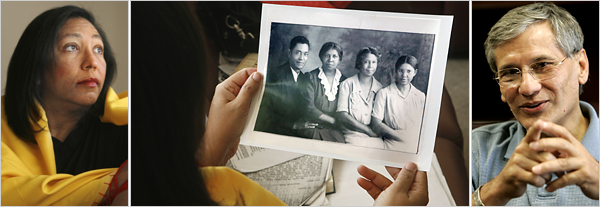
    Below:  Radmilla Cody.

    April 29, 2010

    IndiVisible is "long overdue"

    Exhibition on African-Native Americans long overdue

    By Edith BillupsBooks like “Africans and Native Americans: The Language of Race and the Evolution of Red-Black Peoples” by Jack D. Forbes, pointed out that free Africans reached the shores of the Americas as traders and settlers long before Europeans brought African slaves to the Americas in chains. Noted scholar Dr. Ivan Sertima’s “They Came Before Columbus” argues that historical, archaeological and even botanical evidence shows proof of African contact with the New World in Pre-Columbian times.

    More recent evidence depicts how the relationships become more complex with the institution of slavery and the Indian Wars that pitted black soldiers against Indian tribes. While documents show the intermarriage of blacks and American Indians, African-Native slave narratives tell the stories of slaves held captive by American Indian tribes. Other times, white settlers held both American Indians and blacks captive.

    However, according to Rex Ellis, associate director for cultural affairs for the National Museum of African American History and Culture, and a co-collaborator with NMAI, “While there has been excellent scholarship on the subject, the story of African-Native people is one that has not been fully explored in a wide public forum, until this exhibition. It is a story that while painful at times, needs to be told.

    “African-Native Americans are inextricably bound, and they no longer wish to hide. Whatever the consequences, they want people to know who they are.”
    Comment:  For more on the subject, see IndiVisible Causes Divisions and IndiVisible Responds to Freedmen Issue.

    Below:  Penny Gamble Williams and Thunder Williams.

    February 28, 2010

    IndiVisible causes divisions

    Indivisible:  Exhibit re-ignites Indian Wars in Boston

    By Winchin ChalaLate last year, the Smithsonian National Museum of the American Indian (NMAI) opened an exhibit “Indivisible.” As with the museum itself, the reaction is mixed. One unexpected result is the animosity and controversy it has created among the Massachusetts tribe, the Chappaquiddick of the Wampanoag Nation.And:There are no longer any full-blooded Chappaquiddick. Among the actual roll of about 200, each member can claim to be Chappaquiddick or part this or that, thus it is impossible to label the Chappaquiddick Tribe as a whole as “African-Native-American” as the exhibit “Indivisible” does. The Sagamore Seawolfe reports, “We embrace all of our members. And we do have some members who we know have African roots, but no one has ever mentioned being African-American-Indian until recently, after the Indivisible exhibit went up. My family and I and many other members of the Chappaquiddick do not have any connection to being African or share in the dual experience of being ‘African-American-Natives.’ Many of us do not know why we are included in the exhibit ‘Indivisible.’ We were never approached about it.”Comment:  For more on the subject, see Native Roots of Hendrix and the Blues and IndiVisible Responds to Freedmen Issue.

    November 22, 2009

    IndiVisible responds to Freedmen issue

    Maybe Your Great-Grandmother Really Was Cherokee

    A new exhibit at the National Museum of the American Indian traces black-Native American relations from the 1500s to the present.

    By Kenneth J. Cooper
    Overall, African-Native American relations are cast in positive terms, a perspective that feels right. It’s certainly the view of most black folks, based on all those family stories, true or not. The Cherokees of today are out of step with the tolerant, humanist traditions of Native Americans who historically “adopted” people of other races and treated them as equals.

    The exhibit traces the contacts between African Americans and Native Americans from the 1500s to the present, leading to the interracial unions that produced “Black Indians.” Some big-name people with that mixed heritage pop up: Crispus Attucks, Langston Hughes, Zora Neale Hurston, Jimi Hendrix and John Hope Franklin.

    On a broader scale, so much mixing of red and black occurred that the bloodlines of some tribes became racially “indivisible.” They include the Lumbee of North Carolina, the casino-owning Mashantucket Pequot of Connecticut, the Mashpee Wampanoag of Massachusetts, the Seminole of Florida and then Oklahoma. “Most Native peoples on the Atlantic seaboard,” the curators conclude, “have African-American and white ancestry.”

    A visitor gets a clear sense that the leaders of the National Museum of the American Indian, which collaborated with the Museum of African American History and Culture, wanted to put the conflict over the tribal rights of Cherokee Freedmen into a broader perspective.
    Comment:  For recent news on the Freedmen issue, see Glover Supports Freedmen, Cherokee PR or Propaganda, and Obama Opposes Punishing Cherokees. For more on the IndiVisible exhibit, see Preview of IndiVisible and IndiVisible at the NMAI.

    October 27, 2009

    Preview of IndiVisible

    Story of Americans with Native and black ancestry stirs deep emotions

    By Kara BriggsAn exhibition opening this fall at the Smithsonian’s National Museum of the American Indian explores the identity of people whose ancestry is both African American and Native American.

    “IndiVisible: African-Native American Lives in the Americas” is an exhibition of 20 banners bearing photographs and text. It will be shown at the museum in Washington from Nov. 10 through May 31, 2010. A symposium on the topic of the exhibition will be held at 3 p.m. Nov.13 at the museum.

    Guest curator Thunder Williams, a Washington, D.C., radio talk show host, is Carib Indian, African and European. “The exhibition touches a deep interest in African American communities because of their links with Native America,” he said. Published accounts estimate that 60 percent of African Americans may share Native American ancestry, he said.

    “People in the U.S. tend to be black or white, linear thinkers,” Williams said. “We have been indoctrinated by a race-centered system where vestiges of the ‘one-drop’ of black blood rule persist. When I acknowledge my Carib Indian and European ancestors, it is not a disclaimer of my African heritage. I am all of them, my blood is indivisible.”
    Comment:  For more on the subject, see Black-Indian History on Display.

    Below:  "Relatives and friends celebrate the 21st century wedding of Jessie Little Doe, a member of a family from the Mashpee Wampanoag Nation of Cape Cod, Mass. At Mashpee, age-old family ties determine tribal identity, which transcends skin color." (Photo courtesy Jessie Little Doe)

    July 31, 2009

    IndiVisible at the NMAI

    Upcoming Exhibitions in Washington, DCThis 20-panel banner exhibition focuses on the interactions between African American and Native American people, especially those of blended heritage. It also sheds light on the dynamics of race, community, culture, and creativity, and addresses the human desires of being and belonging. With compelling text and powerful graphics, IndiVisible includes accounts of cultural integration and diffusion as well as the struggle to define and preserve identity. Stories are set within the context of a larger society that, for centuries, has viewed people through the prism of race brought to the Western Hemisphere by European settlers.

    By combining the voices of the living with those of their ancestors, IndiVisible provides an extraordinary opportunity to understand the history and contemporary perspectives of people of African and Native American descent. The exhibition is accompanied by a 160-page publication and 10-minute media piece.
    Comment:  For more on the subject, see Black-Indian History on Display and The Feel-Good National Museum.

    Below:  "Portrait of Jimi Hendrix in Seattle, 1967." (Douglas Kent Hall/ZUMA/Corbis)