Showing posts with label rich Indians. Show all posts

June 14, 2013

Top three Native stereotypes

The top 3 stereotypes or beliefs that people have when they walk in to my Native American Studies courses or #FileThisUnderReasonsWhyITeachNAS

By Cutcha Risling BaldyThe top 3 stereotypes or beliefs that people have when they walk in to my Native American Studies courses--

#3: Native Americans are poor because they want to be poor because that’s how they get all the free stuff from the government that the government gives them.

#2.5 Native Americans who are not poor have casinos. Those casinos make them so rich that they buy the government off to give them things.

#2 If you go to a reservation you will get shot. Or beat. Or shot and beat. Or somebody will be mean to you. They will probably be mean to you and then shoot you.

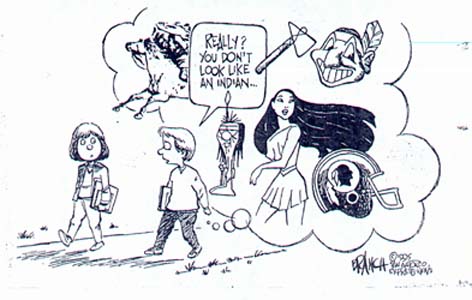
#1 Everything you need to know about Native peoples you can learn by watching Disney’s Pocahontas
Comment:  Let's rephrase these a bit, like so:

1) Movies about noble or murderous savages are realistic portrayals of Indians.

2) Reservations are cesspools of crime, poverty, despair, and hopelessness.

3) Indians don't pay taxes, live off welfare, and get everything free--either from the government or casinos.

In this form, I could support these as the top three Native stereotypes. They sum up the perceptions most Americans have about Indians.

For more on the subject, see Comanche Chairman Justifies Tonto's Stereotypes and Mithlo's TEDx Talk on Stereotypes.

August 25, 2011

Tribal infomercials in Oklahoma

The new trend:  Tribal infomercials

By S.E. RuckmanTurn on the TV in Oklahoma and in between shows, you may catch the latest version of The Indian World Turns. These spots are not public television specials or soap opera reruns, either.

Thanks to Indian gaming revenues, business savvy tribes are investing in short clips (I loathe to call them commercials) that quickly educate, expand or redefine a tribe’s profile. Commercials usually plug a product so that term could loosely fit.

These clips are like the newest fad in our tribal neighborhood. One tribe started them, others followed while those without them make fun or save their money to get one. When done well, they do garner attention that augments a general pride in our fellow tribesmen.

Media perception is a powerful thing and Indian Country is no less susceptible to the onslaught of subliminal and obvious messages. On the surface, these tribal snapshots seem a triumph; who better than the tribes themselves to say that the old ideas of Indians as passive-aggressive children of Destiny are outdated?

One of the pitfalls of these commercialized efforts is that new Indian stereotypes are often perpetuated by these well-meaning messages. Stereotypes are potent forms of identification and can mistakenly mislead like grandma as wise cook or those with glasses as smart.
Comment:  Ruckman is vague about what stereotypes the infomercials are promoting. All she (?) says is this:Now we deal with another misnomer, Rich Indians Who Get a Check Every Month.I haven't seen these Oklahoma commercials, but I've seen similar commercials in California. The California commercials go out of their way not to say or show anything about gaming. If you went by the ads, you'd never know the tribes ran casinos. They're all about building, strengthening, partnering, sharing, and caring. I.e., tribes as good citizens helping their local communities.

If the commercials promote any stereotype, it's the stereotype of the wise, sensitive Indian. Traditionally these Indians are elders, but the ads usually use well-groomed Indians in their 30s and 40s. It's a passing of the baton to the new generation--a modern young group of wise, sensitive Indians.

Of course, Oklahoma's ads may be different. If they are, they'd be wise to take the California Indians' approach. Talk about caring and sharing, not gaming and casinos.

For more on the subject, see San Manuel's PR Strategy and People of the Pines Documentary.

Below:  A scene not seen in a typical tribal infomercial.

January 15, 2010

Banker:  Young Indians receive $50K

Correction:  American Indian Teens Don’t Get $50K When They Turn 18

By Lizz CarrollEarlier this week, DiversityInc received complaints from some American Indian readers because of our video interview with Margot Copeland, executive vice president and director, Corporate Diversity and Philanthropy at KeyBank, No. 50 on The 2009 DiversityInc Top 50 Companies for Diversity® list. In the video, discussing the bank’s efforts at financial literacy for traditionally under-represented communities, she stated: "We have initiatives around the Native American community. Many of the young people receive $50,000 when they turn 18 because of the treaty signed in the 1800s."

DiversityInc received seven comments from readers who said this had to be an error. We have researched Copeland’s statement, and spoken with her, and are issuing a correction. And we apologize for not checking the facts before airing the video.

For the record, Copeland did not intend to mislead anyone or further any stereotypes.

"My humble apologies to all if I misspoke,” she said. “I attended a conference in San Diego in 2006, which offered an off-site visit to a nearby tribal community. One of the speakers, who was a tribal leader, did use the $50,000 figure during his presentation, but I certainly should have verified the same before repeating the comment. I should have not left the impression that this practice was broadly applied."
Comment:  The article goes on to explain that some casino tribes establish trust funds for minors--holding their gaming income for them until they turn 18. The San Diego tribe Copeland was talking about was probably Viejas or Sycuan.

So, one tribe...or "many of the young people." Money from gaming...or money from a 200-year-old treaty. That the well-educated Copeland misheard and misstated the facts shows the pervasiveness of the myth that Indians are unfairly rich from government handouts.

For more on the subject, see The Essential Facts About Indians Today.

July 11, 2008

The myth of the rich Indian

Here's another good statement of how stereotypical perceptions of Indians affect bread-and-butter issues:

Palermo:  We can sway perception and policy[M]any remain concerned about the nationwide, public perception of American Indians, particularly the notion that, thanks to tribal government gaming, indigenous Americans are no longer economically and socially disadvantaged.

There is a nagging fear the "myth of the rich Indian" is prompting Congress, federal policy makers and bureaucrats with the U.S. Department of Interior and BIA to ignore the nation's trust responsibility for the more than 2.4 million citizens of more than 560 federally recognized tribes and Alaska Native villages; promises etched in treaties made in exchange for Native lives and lands.

American Indians still lag far behind non-Indians in every socio-economic category, from income to health care to housing to education. The impact of government gaming has been limited, according to the National Indian Gaming Commission, with 63 of 387 tribal gaming operations generating 71.5 percent of the revenues in 2006. Most tribal casinos are marginal enterprises providing jobs, but nowhere near the rivers of cash flowing from Foxwoods Resort, Mystic Lakes and other more lucrative operations.
Comment:  How many instances of equating Indians with casinos have I noted in my writings? Lots. They happen most often in TV shows--Wonderfalls, Numb3rs, Law & Order: Criminal Intent, Veronica Mars, CSI: Miami, King of the Hill, The Simpsons, South Park)--but also in movies (Next Stop Wonderland), books (Not Enough Indians), comic books (SCALPED), and comic strips.

Let me reiterate the point: There's a constant drumbeat of media linking Indians to casinos...implying they're rich, greedy, and corrupt...and suggesting they no longer need or deserve the treaty benefits owed them by the federal government. These perceptions lead government officials to ignore Indians.

What about all the media products, commercial products, and sports mascots that portray Indians as chiefs and warriors of the distant past? Don't these counteract the perceptions of Indians as rich casino owners? Not really. In fact, one could argue that these stereotypes contribute to the "rich Indian" myth.

How so? The prevailing view is that Indians flourished on the Plains in the 19th century, then tragically vanished. I.e., that Indians no longer exist today--or that they exist in a debased and degenerate form without ties to their traditional cultures. Hence today's Indians are little more than frauds and hucksters playing on America's guilt to get rich at the public's expense. They're not decent and honorable people with millennia of historical and cultural continuity who are struggling to survive in the modern world.