Showing posts with label Cape Wind. Show all posts

April 28, 2010

Salazar approves Cape Wind

Cape Wind wind farm approved

By Patrick CassidyAfter nearly a decade of debate that divided the Cape and Islands, U.S. Interior Secretary Ken Salazar approved the proposed Nantucket Sound wind farm yesterday, heralding it as the start of a new era in national energy policy and a precursor to the spread of turbines along the East Coast.

“Cape Wind will be the United States' first offshore wind farm,” Salazar said in a room crowded with reporters and officials at the Statehouse in Boston.

Renewable energy advocates praised the decision as a milestone for the offshore wind energy industry. Opponents immediately decried it as political pandering and they threatened a new round of lawsuits to block the plan by Cape Wind Associates LLC to build 130 wind turbines in the Sound.

Objections have come from a well-funded opposition group, local Indian tribes and powerful politicians, including the late U.S. Sen. Edward M. Kennedy, whose Hyannisport family compound overlooks the Sound. But Salazar said he found the benefits of the project outweighed any potential negative effects.
The Native aspect:Local Wampanoag tribes have been among the opponents.

The Mashpee Wampanoag and the Wampanoag Tribe of Gay Head (Aquinnah) contend that the 440-foot-tall turbines will interfere with important sunrise ceremonies and damage ancestral burial grounds submerged beneath the Sound.

The state's top historic official and the federal Advisory Council on Historic Preservation have both argued against the project saying it would damage views from historic properties and potentially damage archeological sites.

Salazar said yesterday he deeply respected the Indian tribes' views. But in yesterday's documented response to the advisory council's recommendation that he reject Cape Wind, he said that he did “not fully embrace all of the views expressed by the Advisory Council,” including the contention that the review of historic impacts was “tentative, inconsistent and late.”
Wampanoags rebut the critics' charges:The Mashpee tribe has raised concerns about the project for the past six years but the consultation process mandated by federal law was not followed, Cedric Cromwell, chairman of the tribe, said in a statement.

“While we strongly support renewable energy, and appreciate that Secretary Salazar will be reopening the government to government consultation, no amount of mitigation will change the fact that this is a site of great historical and cultural significance for our tribe, and is inappropriate for this project.”

The tribes have called the decision a “litmus test” for promises made by Obama's administration to American Indian tribes.

Cape Wind will be required to set aside a “substantial” amount of money for the purposes of addressing the tribe's concerns, Interior Deputy Secretary David Hayes said. The amount was not clear yesterday because the official record of the decision was not posted on the Interior website last night.

Both tribes have previously refused a $1 million offer by Cape Wind to secure their support.
Salazar approves Cape Wind

By Gale Courey ToensingThe Mashpee Wampanoag Tribe of Cape Cod and the Wampanoag Tribe of Gay Head (Aquinnah) on Martha’s Vineyard have vigorously opposed the project. The wind energy plant would obscure their view of the rising sun in ceremony, and the Sound, which was once dry land, is where their ancestors lived and were buried. Both nations have urged the secretary to require Cape Wind to relocate the project a few miles further offshore where they would be out of sight.

Massachusetts’ Office of the State Historical Preservation Officer determined that the proposed Cape Wind site is a traditional cultural property and in early January, the National Park Service said Nantucket Sound is eligible for listing in the National Register of Historic Places as a significant traditional, cultural, historic and archaeological property. In early April, the Advisory Council on Historic Preservation issued a seven-page report of its findings and recommendation to deny permits to Cape Wind Associates.

Salazar said he understood and respected the views of the tribes and ACHP, but noted that as secretary of the Interior, he must balance broad, national public interest priorities in his decisions. “The need to preserve the environmental resources and rich cultural heritage of Nantucket Sound must be weighed in the balance with the importance of developing new renewable energy sources and strengthening our nation’s energy security while battling climate change and creating jobs.”

The Wampanoag Tribe and Alliance to Protect Nantucket Sound, a grassroots environmental group, have promised to file suit against the federal government’s decision.
Comment:  I seem to recall a few critics claiming the Wampanoags were in it for the money and didn't care about preserving their sites and sights. Those claims appear to be false.

The Obama administration's record of choosing non-Indian interests over Indian interests when they're in conflict remains intact. When can we expect Obama to say yes to Indians and no to other Americans...ever?

For more on the subject, see Wampanoag Disputes Cape Wind Claim and Salazar Tours Cape Wind Site.

Below:  "This simulation of the Cape Wind wind power factory in Nantucket Sound shows a view of the project from the Centerville bridge." (Photo courtesy Alliance to Protect Nantucket Sound)

February 19, 2010

Wampanoag disputes Cape Wind claim

Tribe member challenges sun rite in letter to Salazar

Wampanoag man’s claim may aid wind farm

By Beth Daley
The already twisted Nantucket Sound wind farm saga just got a bit stranger: A Wampanoag tribal member says it is "fabricated cosmology" that his tribe performs sun ceremonies that need an unobstructed view of the Sound - as the tribe has claimed in a campaign to halt the energy project off Cape Cod.

But the tribe member made the allegation only after his law firm was recently hired by the developers of the Cape Wind project.

Jeffrey Madison, a Martha’s Vineyard lawyer, wrote in a Feb. 9 letter to US Interior Secretary Ken Salazar that his father and grandfather were both tribe medicine men. "I am stating to you with complete honesty and knowledge that I never participated in, witnessed, or even heard of a sacred spot on the horizon that is relevant to any Aquinnah Wampanoag culture, history or ceremony. Nor did I see, or hear, either my father or grandfather conduct such ceremony," he wrote.

Madison also submitted a petition to Salazar with eight signatures of other Wampanoag tribe members, saying they did not believe the wind turbines would "materially interfere with any significant cultural activity."

Critics of the project immediately challenged Madison’s assertion be cause the firm he works for, Wynn & Wynn, was hired about two months ago to help strike a compromise with the tribes.
Comment:  For more on the subject, see Salazar Tours Cape Wind Site and NPS Rules Against Wind Turbines.

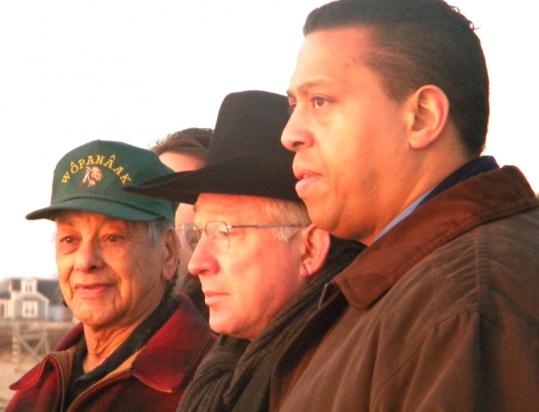
Below:  "Interior Secretary Ken Salazar (center) joined Wampanoag leaders at sunrise on Feb. 2 for what they called a traditional rite. One Aquinnah Wampanoag member has questioned the authenticity of that rite."

February 03, 2010

Salazar tours Cape Wind site

Interior Secretary Ken Salazar tours proposed Cape Wind site

By Christine McConvilleHundreds of Cape Wind fans and foes braved the afternoon’s bone-chilling temperatures today to lobby Interior Secretary Kenneth Salazar about the project.

Today, Salazar was on Cape Cod and out on Nantucket Sound to see firsthand the proposed location of the controversial Cape Wind project.

Salazar spent the early part of the day in Mashpee with members of the Mashpee Wampanoag Tribe.

He participated in a 6 a.m. sunrise ceremony on a spit of land at Ponponesset Beach, and then met at tribal headquarters with Cedric Cromwell and Vernon “Silent Drum” Lopez.

Later, Salazar and his staff traveled to meet with members of the Wampanoags’ Aquinnah tribe on Martha’s Vineyard.

Tribal Chairman Cheryl Andrews-Maltais said she took Salazar to sites where tribal members greet the sun, and look at the shoals.

The tribes say Cape Wind will interfere with ancient burial grounds and tribal spiritual practices, which include worshipping the sun at daybreak.

“It’s the wrong project, in the wrong place, at the wrong time,” she said.

“There are plenty of places for wind turbines, but only one shoal,” she said.

Salazar then went on a nearly three-hour boat cruise with members of the national media.
Comment:  "I'm shocked," said Salazar after the tour. "It's just a big ol' empty ocean. There are no cliff dwellings or burial mounds. I didn't even see any pottery sherds or arrowheads."

Salazar took several years' worth of food and clothing on the cruise with him. "The dangers of three-hour tours are well known," he told reporters. "One minute you're putt-putting around the harbor, the next you're shipwrecked on a desert island thousands of miles away."

For more on the subject, see NPS Rules Against Wind Turbines and Wampanoag vs. Wind Turbines.

Below:  Mary Ann, the Skipper, Gilligan, the Professor, Ginger, and Mr. Howell. "Interior Secretary Ken Salazar, second from left, on Nantucket Sound Tuesday, flanked by officials of Minerals Management Service and the Interior Department." (Joanne Rathe/Boston Globe)

January 04, 2010

NPS rules against wind turbines

For Cape Cod Wind Farm, New Hurdle Is Spiritual

Two Massachusetts Indian tribes have objected to the Cape Wind project, saying it would block their unimpeded view of the sunrise.

By Abby Goodnough
In a new setback for a controversial wind farm proposed off Cape Cod, the National Park Service announced Monday that Nantucket Sound was eligible for listing on the National Register of Historic Places, guaranteeing further delays for the project.

Known as Cape Wind, the project is the nation’s first planned offshore wind farm and would cover 24 square miles in the sound, an area roughly the size of Manhattan. The park service decision came in response to a request from two Massachusetts Indian tribes, who said the 130 proposed wind turbines would thwart their spiritual ritual of greeting the sunrise, which requires unobstructed views across the sound, and disturb ancestral burial grounds.
And:In seeking the historical designation, the Wampanoag tribes—whose name translates to “people of the first light”—said their view to the east across Nantucket Sound was integral to their identity and cultural traditions.

“Here is where we still arrive to greet the new day, watch for celestial observations in the night sky and follow the migration of the sun and stars in change with the season,” wrote Bettina Washington, historic preservation officer for the Aquinnah Wampanoag, in a letter to federal officials.

Supporters of Cape Wind have pointed out that the Aquinnah Wampanoag’s land is on the western side of Martha’s Vineyard, which does not face Nantucket Sound. But in its ruling, the National Park Service nonetheless said the sound was significant to both tribes.

“The sound is part of a larger, culturally significant landscape treasured by the Wampanoag tribes and inseparably associated with their history,” wrote Janet Snyder Matthews, who was the keeper of the National Register of Historic Places until she left the park service in December.

The tribes also argued that the wind turbines, which would be 440 feet tall, could destroy long-submerged tribal artifacts from thousands of years ago, when the sound was dry land. Such artifacts could “yield further confirmation of our cultural histories,” Ms. Washington wrote.
National Park Service says Nantucket Sound eligible for special protections

By Andrew MigaThe Wampanoag—the tribe that welcomed the Pilgrims in the 17th century and is known as "the people of the first light"—practice sacred rituals requiring an unblocked view of the sunrise. That view won't exist if the Cape Wind project's 130 turbines, each over 400 feet tall, are built several miles from the Cape Cod shore across a 25-square-mile swath of federal waters. The turbines would be visible to Wampanoag in Mashpee and on Martha's Vineyard.

Tribal rituals, including dancing and chanting, take place at secret sacred sites around the sound at various times, such as the summer and winter solstices and when an elder passes. The tribes also say their ancestors' remains are buried on Horseshoe Shoal, where the turbines would be built.
Comment:  For more on the subject, see Wampanoag vs. Wind Turbines.

November 30, 2009

Wampanoag vs. wind turbines

YOUR VIEW:  Respect Wampanoag opposition to Cape Wind

By Gerard R. BourassaI commend the Wampanoag for their efforts to block the construction of 130 wind turbines on historic and picturesque Nantucket Sound. We should not lightly dismiss these American Indians' claims that the project would impede their ability to properly practice certain religious rituals that require them to have an unobstructed view of the sunrise.

Furthermore, we should be more sensitive to their concerns that erecting the wind turbines would disrupt sacred burial grounds. In general, I am supportive of wind turbines. Anything that promotes clean energy and makes us less dependent on fossil fuel and therefore on other countries is certainly a positive concept. However, in this case, the religious rights of the People of the First Light who have called this area home for more than 12,000 years should take priority.

Although I know that no malice is intended toward the Mashpee and Aquinnah Wampanoag tribes by the proponents of the Nantucket Sound wind turbines, one can't help but think that this episode is just the latest manifestation in long history of incidents in America of gross disrespect and utter disregard for the spiritual rituals and religious sites of the indigenous.

It's a shameful history that spans centuries from the "Pilgrim fathers" desecrating the graves of the natives when the former arrived in the "New World" to modern day non-Indian charlatans trying to get rich by counterfeiting sacred Native American sweat lodge ceremonies.
Comment:  I'm not sure the Wampanoag are declaring Nantucket Sound a sacred site. I think they're declaring their unobstructed view of the ocean and the rising sun part of a sacred ceremony.

Even so, they're getting into some tricky territory. Can a group declare its view of the land or ocean a First Amendment right? It can try, but I doubt any US court will uphold such a right.

For a somewhat related case, see Comanches Kick Army's Butts.