Showing posts with label Oxford mound. Show all posts

December 16, 2011

Oxford mound is moved

Moving ground:  Work crews begin relocating mound behind Oxford Exchange

By Patrick McCreless
History was on the move in Oxford Thursday.

Dump trucks loaded with stones from atop a hill behind the Oxford Exchange transported their cargo to a site across Leon Smith Parkway Thursday. The move fulfilled part of an agreement between Oxford and a federally recognized American Indian tribe—an agreement the city needed to proceed with a construction project at the site. It also represented the end of a nearly three-year-long controversy regarding the city’s treatment of an alleged ancient Indian stone burial mound.

Fred Denney, Oxford’s city project manager, confirmed Thursday that the transport of rocks from the hill to an adjacent site near the city’s proposed sports complex was part of Oxford’s memorandum of agreement with the Muscogee Creek Nation in Oklahoma, the U.S. Army Corps of Engineers and the Alabama Historical Commission.
Comment:  I gather we're talking about a mound of stones atop the mound of dirt. The vagueness about what the word "mound" refers to has bedeviled us--or at least me--since this story began.

I guess this outcome counts as a compromise, since city officials aren't literally destroying the mound. Doesn't moving it ruin its sacred character and archaeological value, though? If you moved Stonehenge to Kansas, would it still qualify as a Druidic place of worship or an important prehistoric site? I don't think so.  Seems to me the tribe lost and is making the best of a bad situation.

For more on the Oxford mound, see Tribe Agrees to Oxford Mound's Removal and Preserving the Oxford Mound.

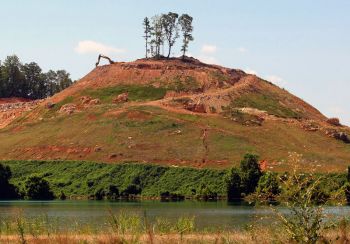
Below:  "The mound is down after work crews Thursday began the process of moving it across Leon Smith Parkway." (Bill Wilson)

June 30, 2011

Tribe agrees to Oxford mound's removal

Oxford has go-ahead to restart sports complex and remove stones from nearby moundWith the blessing of an American Indian nation, Oxford can now restart its long-delayed sports complex project and possibly develop a controversial hill behind the Oxford Exchange–as long as certain conditions are met.

After months of negotiations, Mayor Leon Smith signed a memorandum of agreement with the Muscogee Creek Nation in Oklahoma as well as the U.S Army Corps of Engineers and the Alabama Historic Preservation Office, giving the city permission to restart its sports complex project–possibly as early as next week.
And:As part of the agreement, the city must remove stones from a hill behind the Oxford Exchange shopping center nearby and use them to build a new mound near where the remains were found at the sports complex construction site. Once constructed, the Muscogee are content to allow the city to do whatever it wants with the hill behind the Exchange.

Oxford city project manager Fred Denney said there is a chance the hill could be developed into commercial property, but it would be up to the mayor and the Oxford City Council to make that decision.
Comment:  So the solution is to destroy the site (the mound or pile of stones)? And to rebuild it elsewhere where it has no spiritual meaning or scientific value?

Why not just throw the stones away and drop a random pile of stones elsewhere? Because that's what this "solution" sounds like.

For more on the subject, see Preserving the Oxford Mound and Oxford Mound Is Gone?

Below:  Finally, we have a clear picture of what this story is about. There appears to be a couple of piles of stones on top of the hill. Calling either the piles or the hill a "mound" is confusing since "mound" could refer to either one.

"The stone mound sits atop a hill behind the Oxford Exchange." (Trent Penny/The Anniston Star)

November 23, 2010

Preserving the Oxford mound

Another report on the Oxford mound controversy from last year:

Oxford working to preserve Indian artifacts at construction site

By Patrick McCrelessIt is hard to notice until you are literally standing on top of it.

But a grass-covered, centuries-old manmade mound does indeed exist at Davis Farm in Oxford–its slope plainly visible by anyone standing at the site looking south.

It and other American Indian artifacts on the property have withstood the test of time, and though Oxford is trying to build a multi-million dollar sports complex nearby, the city is ensuring that history will be preserved.

During its last meeting, the Oxford City Council hired engineering firm Goodwyn, Mills and Cawood to negotiate a mitigation plan with the U.S. Army Corps of Engineers and the Alabama Historic Preservation Office to restart construction of the sports complex.
And:The next step toward restarting the project includes the creation of a mitigation plan to protect the remains, the mound and any other American Indian artifacts found at the site. Once the plan is made, all parties involved will sign a legal contract to abide by the plans’ rules.

Details on what the plan would entail were not available as of Monday.

“But there will be a burial treatment plan in place and it will specify exactly what will take place from the time it is discovered,” said Perry said.

The mound was one site marked out of bounds for the city several years ago. It and another nearby site, which some archaeologists suspect was once the location of an ancient village, were fenced off by the city when the sports complex project began.

One of those archaeologists, Harry Holstein, professor of archaeology at Jacksonville State University, claimed in January that someone had destroyed the mound.

After revisiting the site Monday with Goodwyn, Mills and Cawood representatives and a representative from the Historic Preservation Office, Holstein recanted his previous claim and said he was confident the city would protect it and other Indian sites.

“I’m positive it’s there and they are going to save it,” Holstein said.
Comment:  This issue remains a confusing one. It involves a hill, a stone mound on the hill, other sites on the hill, other sites on a nearby hill or mound, etc. Articles have discussed all of this under the single label "mound"--as in "the mound is threatened" and "they're digging up the mound."

Holstein was a prime contributor to this confusion with his claim that the mound was gone. Now he's recanted his claim. Next time, professor, don't say anything unless you've got incontrovertible evidence. Preferably a personal inspection of the site in question.

And everyone, learn to explain things better. When someone describes the hill, mound, and site(s) clearly, it'll be the first time. People across the nation joined a virtual movement to save the "mound," but I'm not sure anyone knew what they were fighting for.

For more on the subject, see Mayor Lies About Oxford Mound and Activists Protest Mound's Destruction.

Below:  The hill or mound in question, with some excavation visible.

March 13, 2010

Oxford mound is gone?

The latest on a story I noted last year:

When Scholarship and Tribal Heritage Face Off Against Commerce

By Campbell RobertsonOverlooking the Interstate and an outdoor shopping mall here stands a sad little hill, bald but for four bare trees and a scattering of stones.

That the stones are there is beyond argument. But everything else about them—whether somebody put them there, how long they have been there and what should be done with them—became a matter of fierce debate last summer and has continued to yield surprising twists into recent weeks.

The latest episode in the very long history of the Oxford stones began last June, when an excavator showed up on the hill. The city was planning for the construction of a Sam’s Club nearby and intended to use dirt from the hill for the area where the store would sit.

Then a local archaeology professor began making phone calls.

The professor, Harry O. Holstein of nearby Jacksonville State University, had concluded that a stone mound at the top of the hill was constructed by American Indians more than a thousand years ago, and in 2003 he recorded it in a state archaeological registry. The possibility of its being destroyed, Dr. Holstein said, made him sick.

“I’m not against development,” he said. “But some things should just be saved.”

As it happened, the city had already commissioned a study of the stone mound by the Office of Archaeological Research at the University of Alabama, which works on a contract basis for such projects. The report, signed by the office’s director, Robert A. Clouse, found the mound to be “definitively cultural” in origin, as opposed to having been created by a natural process like erosion.

But in a recommendation that raised objections from the Alabama Historical Commission, the report concluded that the site was not likely to be archaeologically significant, given that few artifacts and no human remains had been found. The city plowed ahead.

But then the debate over the endangered mound became public. For weeks, it was a recurrent feature on the front page of The Anniston Star, the local newspaper, as well as the subject of protests, a petition, a Twitter campaign and a Facebook group.

Many of the archaeologists and some of the American Indians who lobbied to keep the stone mound acknowledge that its original purpose is a matter of speculation. That, they say, is all the more reason to preserve it.

But when the often delicate ambiguity of scholarship and tribal heritage come up against the vigorous drive for new business and development, especially in a growing town like Oxford, it does not always make for much of a fight.

The historical commission called the stone mound the largest of its kind in Alabama, but there was little the panel could do to protect it, as it sat on land owned by the city. (A bill is currently making its way through the Legislature that would provide more protection for American Indian burial sites—but it is still unclear if that, in fact, is what the stone mound was.)

Sitting in an office crowded with Bear Bryant football memorabilia, Leon Smith, the mayor of Oxford since 1984, was not keen to discuss the issue further. “You’re not going to hear much from me,” he said. “I’m done with Indian stuff.”

Mr. Smith, who says he is half American Indian though he is unsure of what tribe, said he was satisfied by Dr. Clouse’s work—which, he added, was not obligated by law but still cost the city $67,000. Nevertheless, the bad publicity made further excavation impossible last summer.

Eventually, the city made a deal with a local landowner to use his dirt for the Sam’s Club site, and by August the controversy appeared to be ebbing.

But in late January, at an Oxford City Council meeting, Dr. Clouse disclosed the findings of a follow-up report.

That study, which many had not known about, was performed in July in the full heat of the controversy. In it, Dr. Clouse’s conclusions could hardly have changed more drastically.

“It does not appear,” he wrote in the second report, “that this stone mound was constructed by human activity.”

Archaeologists around the state were surprised and angered.

“The consensus of my colleagues,” said Cary Oakley, who held Dr. Clouse’s current position for 28 years, “is that this particular evaluation is seriously flawed.”

Keith Little of Tennessee Valley Archaeological Research, who has visited the mound, suggested that the word “consensus” was not strong enough.

“I’ve been an archaeologist in Alabama since the 1970s,” he said. “And I’ve never seen archaeologists so united on one subject.”

Worse, he said, the stone mound was apparently demolished during Dr. Clouse’s examination, making any further study impossible.

Dr. Clouse, in an e-mail message, declined to discuss the issue.

The tension between history and progress has continued as Oxford has developed other areas in the city. This has led to some surreal disagreements, including a recent debate about whether the city had leveled the remnants of an ancient, Indian-built earthen mound to make room for a planned sports complex.

“It is gone, all of it,” Dr. Holstein said, standing in what appears to be a relatively flat, grassy field.

No, it is not gone, Mayor Smith said, but simply cannot be seen unless someone knows exactly where to look.
Comment:  This article raises several questions that need answering:

1) So the "mound" in question isn't the large dirt mound featured in every photo of the subject? It's only a small stone mound on top of the large dirt mound?

Why hasn't any story made this clear until now? What are the dimensions of this small stone mound?

True, the small stone mound may be significant regardless of its size. But a 10-foot mound may be ten times more significant than a one-foot mound. And a 100-foot mound may be ten times more significant than a 10-foot mound. Distinguishing the small stone mound from the large dirt mound and knowing its extent are two important aspects of the story.

Some of the old stories do refer to the stone mound and the underlying hill as two separate things. But what portion of the hill is the stone mound in question? One percent? Ten percent? Fifty percent? Or...?

Without a clear idea of where one object ends and the other begins, people will assume the stone mound is the entire hill. This is especially true since the dirt hill is studded with loose stones. It's perfectly natural to assume "stone mound" refers to most or all of the hill.

I'm pretty sure most of the activists trying to save the mound thought exactly that. I've never heard one say, "We don't care about the big dirt hill. Only the small stone mound at the top matters." Every article, including this one, should've made the distinction clear.

Why the flip-flop?

2) Why did Clouse change his opinion 180 degrees? Doesn't someone want to speculate?

Did he make gross mistakes in his first report? Not according to other archaeologists. Was he paid off by the city or developers? I'd say the reporter should've raised this issue even if no one was willing to discuss it.

3) Dr. Holstein says the small stone mound is gone, but Mayor Smith says it's still there. One of them is wrong, so can't we figure out which one? Have Smith or a third party identify the mound's supposed location. Get Holstein and Smith together and reconcile their stories. Etc.

It's almost ridiculous to end the story with this uncertainty about whether the mound still exists. Really, it's a stone structure in plain sight. People have been talking about it for almost a year. But no one can tell us how big it is or whether it's still there? Insane!

For more on the subject, see:

Chambliss leads virtual protests
Twittering about Oxford mound
Mayor lies about Oxford mound
Activists protest mound's destruction

Below:  Not the mound in question. Rather, the large dirt mound that may or may not have a small stone mound at its top.


August 20, 2009

Chambliss leads virtual protests

Mound controversy spans the Web:  American Indian site in Oxford now on Facebook, Twitter

By Dan WhisenhuntCarolyn Chambliss, who says she lives in Tuscany, Italy, founded a Facebook group and cause related to the issue. Facebook is a social networking site connecting friends and acquaintances based on numerous affiliations. The Facebook group is called, "Stop Sacred Burial Mounds from becoming a Sam's Club"; the cause, "Save Sacred Mounds from Destruction/Boycott Sam's Club."

There are more than 7,000 members between the two groups, formed about one month ago, and the protest is also active on Twitter, another social networking site where people communicate by posting short messages.

Chambliss hopes these "virtual protests" will lead to "a real paradigm shift in Americans' perception of Native Americans." She's also discussed raising money for the preservation of the mound, which she would put into a trust.

"We did a Twitter blast," Chambliss said. "All through the world we blasted Sam's Club and we got immediate results and people started talking about it in Oxford because of this virtual protest."
Comment:  I think online protests were responsible for shutting down the Bright Young Things' "Indian Summer Camp" within a few hours. It's possible one or two Facebook postings--the ones I saw--were enough to squelch the event. If so, that demonstrates the power of social media.

For more on the subject, see Mayor Lies About Oxford Mound and Activists Protest Mound's Destruction.

P.S. Chambliss just moved back to Minnesota from Italy.

July 30, 2009

Twittering about Oxford mound

Natives use Twitter to showcase sacred site

By Rob CapricciosoA growing number of Native American Internet users are turning to the popular social media Web site, Twitter, to get the word out on issues of traditional and cultural importance.

One of the most recent examples of the phenomenon is the vast amount of energy many users have spent raising awareness of the desecration of a stone mound in Alabama created by American Indians approximately 1,500 years ago.

The hill, which many Native Americans from several tribes use for prayer and make pilgrimages to each year, is being torn down in order to provide fill dirt for a new Sam’s Club store, which is a partner of Wal-Mart.

Sam’s Club officials have tried to alleviate concerns, saying the city of Oxford is overseeing the moving of the dirt, but they have also acknowledged knowing that many people are concerned about the situation. Still, store officials have not asked for the destruction to end.

At the same time, the multi-billion dollar company has received assurances from Oxford Mayor Leon Smith that the city isn’t really damaging anything of significance.

But Smith’s claims go against the findings of researchers who have said the hill and structures on it are of traditional importance to various tribal members. A city-commissioned study has even found tribal artifacts in the clay that composes the mound.

As the bulldozers started digging, all kinds of information about the sacred site began to be distributed online by Native activists from coast to coast. Facebook and MySpace pages, as well as other Web sites, have sprung up in dedication to the issue, with some now having thousands of group members.

Of those who have gone online to raise awareness, many have found Twitter to be an especially effective messenger.
Comment:  My friend Carolyn Chambliss is a leader in this Twitter movement, so I've been following her actions closely.

For more on the subject, see Activists Protest Mound's Destruction and Sam's Club vs. Indian Mound.

Below:  "This mound, which many tribes find sacred, is being torn down to provide fill dirt to a new a Sam’s Club in Oxford, Ala. Opponents have been using Twitter to get the word out about the desecration." (Photo courtesy Ginger Ann Brook)

Mayor lies about Oxford mound

Smith says controversial mound was put at top of hill by natural forces

By Dan WhisenhuntMayor Leon Smith claimed Tuesday that a stone mound at the center of a simmering controversy was put there by natural forces, though an archaeological study commissioned by the city says it was almost certainly man-made.

In addition, Smith and City Project Manager Fred Denney now say the hill's dirt is not being used as fill for a Sam's Club. Denney said he never said it was, even though he had confirmed it in multiple previous interviews.

Public documents also show this is the city's plan for the hill underneath the mound.

Located behind the Oxford Exchange, the hill has been the object of protest by American Indians upset by the city's actions. When a story about the hill's origins was first printed in late June, Smith and Denney said it had been used for smoke signals and said the site was insignificant.
More of the mayor's prevarications:Smith's office e-mailed a press release with his most recent comments to The Star Tuesday afternoon before Oxford's City Council meeting. In it, he says the city will keep an expert on hand as recommended by the report's authors, even though he insists the mound is the result of "natural phenomena."

He also says none of the rocks and soil associated with the mound will be used as fill for the Sam's project. He also said "no construction activities are planned for the hill and associated stone mound," a statement contradicted by another part of the letter, which says the city needs the expert on hand "during the course of development activities."

After Tuesday's meeting Smith could not provide a clear answer about why work crews have been seen on top of the mound, but he said they were not getting dirt from it.

"Not one spoonful of dirt has been carried down," he said.
Comment:  When politicians start changing their stories like this, it's a good sign that they're feeling the heat.

For more on the subject, see Activists Protest Mound's Destruction and Sam's Club vs. Indian Mound.

July 26, 2009

Activists protest mound's destruction

A Facebook photo album shows the ongoing destruction of the ancient Indian mound in Oxford, Alabama.

Photos from Stop Sacred Burial Mounds from becoming a Sam's Club

It's a shame that we haven't shamed Oxford's officials into stopping the destruction yet. But the level of activism gives hope. Carolyn Chambliss has recruited more than 1,000 people to her Facebook group, and a few dozen people are protesting the destruction in person.

For more on the subject, see Indians 1, Oxford and Walmart 0 and Sam's Club vs. Indian Mound.

July 12, 2009

Indians 1, Walmart and Oxford 0

A followup to Sam's Club vs. Indian Mound tells us why this mound and mounds in general are important:

Walmart and the Mound Builders

By Heather PringleWhen the first Europeans arrived in America, they marveled at a mysterious landscape of immense mounds and earthworks that rose along many parts of the eastern woodlands. In their arrogance, they could scarcely believe that ancestors of the Native Americans had designed and constructed these huge earthen monuments. So they sat down with their bibles and scoured historical records for clues to the makers. Were the Mound Builders actually Phoenicians? Toltecs? Perhaps a lost tribe of Israel?

Scholars hotly debated the issue, and eventually the Smithsonian Institution established its own Division of Mound Exploration, hoping to crack the mystery. After years of meticulous study, Cyrus Thomas, head of the Division, announced in 1894 that “the links directly connecting the Indians and the mound-builders are so numerous and well established, that archaeologists are justified in accepting the theory that they are one and the same people.”

Since then, I am sorry to say, the intense public interest in prehistoric mounds has largely dissipated. Indeed as archaeologists learn more and more about the rich variety of mound-building cultures, from the Poverty Point people to the Hopewell, fewer and fewer people take any notice. We seem, somehow, to have misplaced our sense of awe and wonder. And perhaps this is why politicians in Oxford, Alabama, recently gave a private contractor the right to level a major prehistoric mound for fill dirt for the foundation of a new big box store—Sam’s Club, owned by Walmart.

Local archaeologists and Native Americans are up in arms about this. As Jacksonville State University archaeologist Harry Holstein pointed out in one article, “There is substantial ethnographic and archaeological evidence from similar stone mound sites throughout the eastern United States that these stone mounds, walls and effigies atop mountains, ridges and plateaus were built to commemorate deceased loved ones and important events and bury sacred offerings.”

But when the opponents voiced their deep concerns about the destruction of the mound, Oxford’s mayor and city project manager apparently shrugged them off. According to a report in a local paper, The Anniston Star, Mayor Leon Smith claimed the mound was used for little more than sending smoke signals. I find this a bizarre and belittling claim, one that flies in the face of scientific evidence on mound-building cultures and the ceremonial way in which they often raised these impressive earthen edifices.
Walmart and the Mound BuildersReply posted by Harry O. Holstein (July 6, 2009, 5:58 am):

The Archaeological Resource Laboratory of Jacksonville State University conducted a Phase I survey on some property that was going to be (now is) developed by the City of Oxford in 2006. Recorded 14 multicomponent sites and revisited 13 previously recorded ones along Choccolocco Creek just south of Oxford. Recommended preservation on several including, 1Ca196, a Mississippian earthen temple mound. Oh , by the way this ceremonial site may be the 16th Century De Soto Expedition Spanish contact site of Ulibahali. Leon Smith, Mayor of Oxford was not happy with our recommendations. We also at the time informed them (Oxford officials) about the large (42 feet x 18 feet x 6 feet) stone mound atop the hill behind the new Sam’s Club and of its prehistoric importance. The City said it would not touch the stone mound. So much for words!!! The bad news is there are several other multicomponent sites, slave house sites, and a NRHP 1850s Plantation house across the street from the hill and development and Oxford has its eyes on it next for development. I have suggested this area be turned into a welcome center, museum and rest area for I-20 (which lies within sight of Indiana I Farm House). Suggestion again has fallen on deaf ears by the City of Oxford! I too wish those in power would have more insight to preserve rather than destroy the past!!!

Harry Holstein, PH. D.

Carolyn Chambliss (Italy) wrote:

Yes the Mayor and the city council was not only dishonest but broke their promises to the The Archaeological Resource Laboratory of Jacksonville State University who gave an excellent argument for not only preserving the site, but expanding it to include a possible museum. Culture in exchange for crushing Big Box capitalism. It's really appalling how the Mayor and the City council, just ignored all this and went ahead anyway in pure Andrew Jackson style. The good news is that old ethno-centric way of doing things totally failed. In the age of social media activism--they can't get away with colonialism style ignorance. Big Brands like Walmart can't afford to have a media feeding frenzy either.
Stop Sacred Mound from becoming a Sam's Club's WallFlora Dayrider wrote:

This is something that all native groups are fighting, two years ago we had a gravel crushing company come onto our reserve...no one even knew about it, the disrupted the trees and people offerings. We took chances and blocked the road, others did the same until they left. These are our sites and we need to protect them. The mainstream media isn't going to pick up on this so make some noise people! Send messages to the city council and mayor, send stuff to the media in the area, take lots of photos and document what you can. If they know that this is a bigger issue it will make them think twice.

Mark Davis (Birmingham, AL) wrote:

I am responsible for the protest in Oxford, Alabama, to save this mound. It took from June 24 to today to get the machines off the mound and stop what they doing. This took a lot out of people and a lot of time, but as of today, the contractor has ordered ALL men and machines off the mound and they cannot remove any more "fill dirt" from it. I myself have gotten 20 hours of sleep since this started. We will be moving our attention on another piece of land, 320 acres that contains a temple Mound, this area also was the largest Indian Town in the southeast.

Mark Davis
Director
Alabama American Indian Movement
Comment:  No word from Davis on whether they've halted the digging temporarily or permanently. Let's hope it's the latter.

These days, AIM is doing a lot of work protesting Native stereotypes and preserving Native sites. I wonder what AIM's critics would say about that.

As with the artifact looting in Utah, there's no excuse for this kind of destruction. Preserving our past should have priority over developing and building, especially something as ephemeral as a Sam's Club.

P.S. For those who haven't learned how to spell, punctuate, or capitalize correctly, I made minor changes to the comments.

For more on the subject, see No Time for Indian Monuments and US Ignores Indian Sites at Risk.

July 11, 2009

Sam's Club vs. Indian mound

Goodbye Indian Mounds, Hello Sam’s Club

By Dan WhisenhuntA stone mound on a hill behind the Oxford Exchange created by American Indians 1,500 years ago will soon disappear.

And whether Oxford's taxpayers wanted it or not, they paid for its destruction.

Workers hired by the city's Commercial Development Authority (CDA) are using the dirt from the hill as fill for a new Sam's Club. The project has angered American Indians who, along with a Jacksonville State University archaeology professor, say the site could contain human remains.

Oxford Mayor Leon Smith and City Project Manager Fred Denney say it was used to send smoke signals.
Comment:  Smith and Denney are being ridiculous to justify their demolition of an Indian mound. There's no way anyone could prove Indians used an ancient site to send smoke signals.

Not surprisingly, there's a tight financial relationship between Mayor Smith, the CDA, and business developers. That may be why everyone's so eager to dig up the mound.

Even if the mound is just dirt with no important artifacts, I'd say preserve it. Get the dirt from somewhere else. Mounds are an important reminder that Indians once owned the land.

For more on Indian mounds, see Mound Builders Live Again and Cahokia Mound vs. Garbage Mound.

Below:  "A backhoe removes dirt atop a stone mound created by Native Americans 1,500 years ago in what is now Oxford, Ala." (AP Photo/Stephen Gross, The Anniston Star)