Showing posts with label Pe' Sla. Show all posts

February 06, 2013

Wounded Knee for sale

Native Sun News: Wounded Knee site put up for sale at $3.9M

By Brandon EcoffeyWounded Knee, the site of one of the most horrific and tragic events in all of American history, is being offered up for sale by its owner.

The family of James A. Czywczynski, owners of two 40 acre sites of land where the slaughter of approximately 300 Lakota men, women, and children took place on Dec 29, 1890 has agreed to sell the land for $3.9 million.

“It is time for our family to sell the land. We would really like to see the land returned to the Lakota people and that is why I am giving them an opportunity to purchase the land before I open it up to others for sale,” said Czywczynski. “I could offer it up for public auction like the Runnels did with Pe’ Sla, but I would prefer that the Lakota people be the ones to purchase it,” he added.
And:The site does not include the mass gravesite where the members of the United States 7th Cavalry piled the bodies of those who were murdered that day. However, the parcels of land do include the immediate surrounding area where the massacre took place and the area surrounding Porcupine Butte (the site of KILI radio is not included). It does include the site of the original Wounded Knee Trading Post.

The Czywczynski family has owned the property since 1968, when they purchased the property from the Gildersleeves who had owned the property prior.

During the 1973 occupation of Wounded Knee by the American Indian Movement, Mr. Czywczynski had his home, all of his personal belongings, the trading post he owned (including all of the artifacts inside), and several vehicles destroyed. At the time he and his family were returning from a high school basketball game and were told by the United States Marshall Service that he could not return to their home that night.

The losses the he incurred during the occupation have been included in the $3.9 million offering.
History for sale? Man seeking $3.9 million for site near Wounded Knee memorial

By Daniel Simmons-RitchieElected tribal officials said the Oglala Sioux Tribe is interested in purchasing what is considered sacred ground to the tribe but not at a price that far exceeds its actual value.

"I think the tribe should take all necessary action to purchase the land but at a reasonable price. I understand it's a historic site but that shouldn't be a means to take the tribe for a huge amount,” said Garfield Steele, who represents the Wounded Knee District on the tribal council.

Kevin Yellow Bird Steele, who also represents Wounded Knee, said the property is inflated to the point of insult and is an attempted exploitation of a dark chapter in U.S. history.

"As a representative of Wounded Knee District, I'm totally appalled," he said.

According to Shannon County records, the property has an appraised value of $7,000.

Czywczynski, however, cites a second event that brought national attention to Wounded Knee when explaining his asking price for a piece of property in a rural outpost on the reservation.

The asking price, he said, includes compensation for the damage done to his property in 1973 when the American Indian Movement and others occupied the community of Wounded Knee for 71 days in a violent standoff that drew national attention.
Some background on Czywczynski's purchase of the land:

Charles Trimble: Attempting to profit from hallowed grounds

Comment:  It's kind of ridiculous to ask $3.9 million for land worth $7,000. It's a shame Czywczynski lost so much, but he should sue the people responsible. Why should anyone pay millions of dollars to make up for pain and suffering they didn't cause?

For more on Wounded Knee, see Fire Totals Wounded Knee Museum and Pine Ridge Needs Tourism.

November 30, 2012

Tribes buy Pe' Sla for $9 million

Tribes Reach $9 Million Goal and Purchase Sacred Site of Pe' Sla

By Vincent SchillingIn a historic culmination of events leading up to the Pe’ Sla purchase deadline of November 30, the Great Sioux Nation, or Oceti Sakowin has managed to raise the $9 million necessary to secure the sacred land in the Black Hills of South Dakota. In a private affair between the Reynolds family and representatives of the Great Sioux Nation, the contracts have been signed and the land is now in the hands of the nation.

According to Rosebud Sioux Tribe Chairman Cyril “Whitey” Scott, the purchase is a done deal. “I can tell you that Pe' Sla, the sacred land on behalf of the Oceti Sakowin, is secured. The $9 million was secured, Pe' Sla has been purchased.”

In an interview with Chairman Scott minutes ago, he read the only official statement released by the Great Sioux Nation and said anything stated before his comments have been “unofficial.”

“The historic requisition of Pe’ Sla started today in Rapid City, South Dakota. The Rosebud Sioux Tribe, the Crow Creek Tribe, and the Shakopee Mdewakanton Sioux Tribe community gathered in a historic assembly of the United Tribes.
Tribes raise $9M to buy sacred South Dakota landAfter months of high-profile fundraising that drew celebrities' attention and dollars, a group of Native American tribes has raised $9 million to buy a piece of land in South Dakota's Black Hills that they consider sacred, an official with an Indian land foundation said Friday.

The Indian Land Tenure Foundation president Cris Stainbrook told The Associated Press that the tribes raised enough money to purchase the land from its current owners. The foundation was one of several groups and organizations leading the effort to buy the land.

Stainbrook said the deal should be finalized Friday, which was the deadline for the tribes to raise the money.

The land, known as Pe' Sla, went up for sale after being privately owned. Members of the Great Sioux Nation have been allowed to gather there every year to perform rituals. The site plays a key role in the tribes' creation story, and members fear new owners would develop it.
Comment:  For more on Pe' Sla, see Celebs Raise Funds for Pe' Sla and Sioux Need $9 Million for Pe' Sla.

November 14, 2012

Celebs raise funds for Pe' Sla

Hollywood and Hip Hop Unite to Help Save Lakota Sacred Site

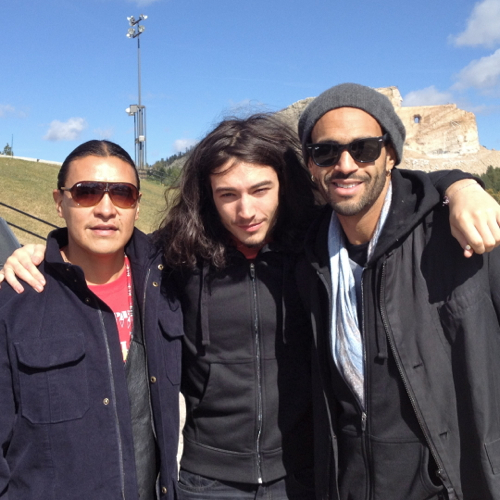
By Georgianne NienaberHollywood and hip hop have joined forces in a final push to save the Lakota sacred religious site Pe'Sla from the auction block. Ezra Miller, now starring in The Perks of Being a Wallflower, and producer Sol Guy went to South Dakota to meet with Standing Rock tribal member Chase Iron Eyes in early October. The result is a nine-minute documentary that is featured on the Pe'Sla fundraising site, hosted by Last Real Indians.

Fundraising has come a long way since August, when 1,942.66 acres of privately-held land containing sacred sites was offered for sale in South Dakota. Still, a final deadline of Nov. 30 looms, and the tribes face a $2 million shortfall. Pe'Sla, located in the Black Hills of South Dakota, is the epicenter of the creation story of the Lakota, Dakota and Nakota nations. Tribal elders and spiritual leaders conduct ceremonies essential to their culture and beliefs there.

The story to save Pe'Sla is a narrative of people coming together to support an idea that the sacred is essential. Private donations raised $388,000 and the Sioux Nation united to contribute $6 million, putting the public auction on hold. People offered pennies to hundreds of dollars as the struggle to protect the holy from development touched hearts around the world.

At approximately three minutes into Sol Guy's documentary, Chase Iron Eyes, founder of Last Real Indians, passionately explains what he calls the "powerful narrative" of Pe'Sla. For the first time since the Battle of the Little Big Horn, the great Sioux Nations "have come together." The lesson of Pe'Sla is that there is power in unity and it is time to stop writing about native people as helpless and hopeless. This show of solidarity between the Sioux Nation and people around the word is a vindication of the sacred; a testimony to the tenacity of indigenous people as they struggle to survive in the face of seemingly impossible obstacles.


More celebs help tribes' push for sacred SD land

By Kristi EatonMore celebrities are backing an online campaign to raise money so that Native American tribes in South Dakota can purchase land they consider sacred.

P Diddy and Bette Midler are the latest big names to throw their support behind a fundraising effort to buy nearly 2,000 acres of pristine prairie grass in the Black Hills of South Dakota.

Three days after the campaign began, P Diddy tweeted: "Help save the Sioux Nation! Click here," and linked to the website. Midler also lent her voice, tweeting: "Incredible story re the Sioux Sacred Grounds. Donate what you can."

More than $18,000 had been raised as of Sunday afternoon—$6,000 flowed in immediately after P Diddy's tweet. The campaign will last through Nov. 30, when the tribes of the Great Sioux Nation must have $9 million in order to purchase the land.
Comment:  For more on Pe' Sla, see Sioux Need $9 Million for Pe' Sla and Rosebud Signs Deal for Pe' Sla.

October 09, 2012

Indians connect via social media

Reporting From The Rez

By Derek OlsonFor years, the lives and struggles of people on the Pine Ridge Indian Reservation have generated international interest. Now, thanks to social media, people on the reservation are sharing their own stories and getting a worldwide response.

With a billion users around the world, Facebook is changing the way people communicate. That's particularly true in Pine Ridge.

"Several years ago, we didn't have that technology so we were isolated from hearing about what's going on in the world as well as the world knowing what goes on here," community organizer Andrew Iron Shell said.

Iron Shell has been organizing community members on Pine Ridge for decades.

"A small room of 20 people was an outstanding phenomenon to have show up at a meeting," Iron Shell said.

But a couple years ago, Iron Shell's son had an idea.

"My son who was then in high school told me, 'You know, Dad, you're doing community meetings and trying to gather the people, but they're all on Facebook,' Iron Shell said.

"I seen my dad trying to get the meetings and everything arranged and I thought it would help," Iron Shell's son, Terrell Catt, said.

Now, the community organizer has close to 5,000 friends on the social network. He uses the site to share information and news stories that he thinks are relevant.
Comment:  For more on the subject, see Online Fundraising to Save Pe' Sla and Firth Video Generates Protest E-Mails.

October 03, 2012

Sioux need $9 million for Pe' Sla

Sioux Racing to Find Millions to Buy Sacred Land in Black Hills

By Timothy WilliamsThe Black Hills, the rolling range of mountains that rise out of the badlands of western South Dakota, are considered sacred to the Sioux, who for 150 years have fought on battlefields and in courtrooms for the return of the land.

And so the Great Sioux Nation exulted this summer when a long-sought parcel in the mountains called Pe’ Sla by the Lakota was put up for sale and a bid from the Sioux was accepted by the family that had controlled the land since 1876, the year that Gen. George Armstrong Custer died not far to the west at Little Bighorn.

But now, anxiety has replaced optimism as more than a half-dozen Sioux tribes, which include some of the nation’s poorest people, race to come up with the $9 million purchase price before the deadline next month.

Not only poverty stands in the way, but also the charged history: many Sioux ask why they should have to pay for land that already belongs to them, given numerous treaties broken by the United States and a landmark federal court decision in 1979 that called the government’s seizure of the Black Hills one of the most dishonorable acts in American history.

“It’s like someone stealing my car and I have to pay to get it back,” said Tom Poor Bear, the vice president of the Oglala Lakota Tribe in South Dakota.
More on the story:

The Fate of Pe’ Sla Purchase–Sioux Nation Working to Raise $9 Million, Tribal leaders Meeting in Rapid City Today

Great Sioux Nation Comes Together in Historic Gesture of Unity in the Name of Sacred Pe’Sla

Comment:  For more on the subject, see Rosebud Signs Deal for Pe' Sla and Rally for Pe' Sla Purchase.

September 10, 2012

Rosebud signs deal for Pe' Sla

Tribe signs deal for Black Hills land

Sioux would share sacred site

By Steve Young
More than 1,940 acres of land in the Black Hills considered sacred to the Great Sioux Nation appear to be heading back to the ownership of the tribes after almost 140 years in private hands, several tribal officials say.

Vernon “Ike” Schmidt, executive director of the Rosebud Sioux’s Tribal Land Enterprise department, confirmed Monday that his tribe had signed a contract to purchase the land two miles north of Deerfield Lake called Reynolds Prairie—known to the Sioux as Pe’ Sla (pay-schlaw).

Rosebud President Cyril Scott told the Associated Press that his tribe had put down $900,000 as an earnest deposit and must pay the remaining $8.1 million of the agreed-upon $9 million purchase price by Nov. 30.

“We have a lot of hurdles to cross with reviewing the title policy and doing all the title work, and getting an environmental assessment,” Schmidt said. “But we feel we’re in the driver’s seat.”
Comment:  For more on the subject, see Rally for Pe' Sla Purchase and Tribes May Buy Pe' Sla.

September 07, 2012

Rally for Pe' Sla purchase

Unity rally draws support for Pe Sla purchase

By Kristina BarkerOn Wednesday, nearly 250 activists—Native Americans of all ages, with a smattering of non-Natives—marched from the Memorial Park band shell to Omaha Street, stepping to the beat of a drum and holding aloft posters reading "The Black Hills Are Not For Sale." At Omaha Street, they lined up along the street for several minutes before heading back to the band shell.

The poster was designed by Shepard Fairey, the same artist who created the iconic red and blue "Hope" poster for the 2008 campaign of then-presidential candidate Barack Obama.

Several speakers at the rally called on supporters to bind together as one and spread the word of the land sale.

"We are one people with one mind and mother, and that's the Earth, and we have to protect it," said Tom Poor Bear, vice president of the Oglala Sioux Tribe.
RC Rally Celebrates Acquisition Of Pe' Sla

By Derek OlsonEarlier this week an agreement was reached between area tribes and a family selling a tract of sacred land in the Black Hills known as Pe' Sla.

On Wednesday night, people gathered at Rapid City's Memorial Park to give thanks for Pe' Sla, which was nearly sold at auction nearly two weeks ago.

"People believe in the Bible, Adam and Eve, and how God created them. We believe in Pe' Sla," Cheyenne River Sioux Council Representative Robin LeBeau said.

"My heart beats very good that the Reynolds family is supportive on how we feel towards our sacred Black Hills and how much it means to us," Oglala Sioux Tribal Vice President Tom Poor Bear said.
As the headline above ("Celebrates Acquisition") indicates, people are talking as if this is a done deal. Not really, as another article explains:

Pe’ Sla Purchase: Not Out of the Woods Yet

By Vincent SchillingAccording to Debra White Plume, a resident of Pine Ridge, information stating Pe’ Sla has been saved is not entirely correct.

“Somehow the word is being put out there that we won and that Pe’ Sla has been saved. That message is wrong,” said White Plume.

According to her, the initial process in that the Oglala Sioux Tribe asked a federal agency to intervene and the Black Hills were taken off public auction, was correct, however, after working with Last Real Indians (LRI) the tribes only made a down payment.

In previous releases, stated amounts collected to help with the purchase of the sacred site included $1.3 million put up by the Rosebud Sioux Tribe and LastRealIndians.com, headed by attorney Chase Iron Eyes, which has raised more than $326,000. The funds were combined for the earnest offer made to the Reynolds family.

The down payment, according to White Plume, has not yet sealed the deal.

“The remainder of the purchase price still has to be paid to the Reynolds family, which is in about 21 days or so,” said White Plume. “So LRI is still raising funds to pitch in with the tribes. Until that final amount of money is paid in full, the land has not been returned to the Lakota people.
Comment:  This article also suggests an answer to the previous question: Why did the Reynolds family halt the auction? Because the Oglala Sioux Tribe called or threatened to call a federal agency. Presumably to inform it of a treaty or legal violation of Native rights.

For more on the subject, see Tribes May Buy Pe' Sla and Pe' Sla Auction Canceled.

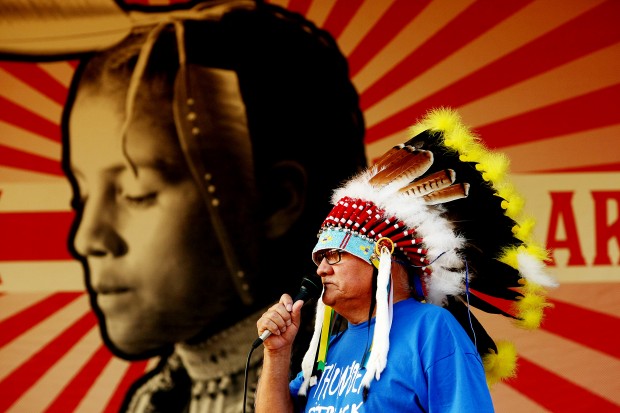
Below:  "Chief Black Spotted Horse speaks to the crowd gathered Wednesday evening at the Memorial Park band shell." (Kristina Barker/Rapid City Journal)

September 03, 2012

Tribes may buy Pe' Sla

Indians declare victory in their effort to buy the sacred Pe' Sla site:

Sioux Leaders of Pe’ Sla Land Movement in S.D. Announce Deal Between Tribes and Land Owner and Call for Unity Among Reservations; Celebration Rally Planned for Rapid CityLast Saturday, at a press conference in Eagle Butte, South Dakota, Lakota leaders of the movement to secure the Lakota pilgrimage site Pe’ Sla for the Sioux Nation announced that the tribes will purchase the 2000 acres of sacred land in the Black Hills. After several weeks of intense fundraising, the nine tribes raised enough to make a deal with the current owners of Pe’ Sla, Leonard and Margaret Reynolds—though details of the arrangement are still being negotiated. The fundraising effort on the part of the Sioux tribes was begun by Attorney Chase Iron Eyes, and the negotiations were carried out in part by Cheyenne River Tribal Councilwoman Robin Lebeau. Both leaders spoke on Saturday. Saturday’s action was organized by Last Real Indians and the Lakota People’s Law Project, two organizations operating in South Dakota that support the return of the Black Hills to the Sioux.Sioux are victorious in effort to restore Black Hills land to the tribes. Fund-raising continues

But a later article suggests the announcement may be premature:

Tribe pays on Black Hills land

But money doesn't necessarily mean sale, Rosebud Sioux say

By Steve Young
The Rosebud Sioux Tribe is making an earnest payment on land it considers sacred in the Black Hills, though tribal officials say that doesn’t mean a deal to buy it is imminent.

Alfred Walking Bull, a communications specialist for the tribe, said Tuesday that Rosebud has met the financial threshold to make an earnest payment on some or all of the 1,940 acres for sale two miles north of Deerfield Lake.

“A lot of people have taken this as a sign that the tribe is going to be able to buy the land,” Walking Bull said. “We don’t know that yet. It’s really too early to declare victory. We have met the conditions to be at the negotiating table. It would be premature to say the land is going to be ours.”

The owners of the ranchland known as Reynolds Prairie had planned to auction the property in five separate tracts Aug. 25 in Rapid City, but canceled the sale before it happened with no explanation. Leonard and Margaret Reynolds of Hill City would not comment about news of an earnest payment by Rosebud.
Comment:  For more on the subject, see Pe' Sla Auction Canceled.

August 22, 2012

Pe' Sla auction canceled

Auction cancelled for SD land considered sacred

The planned auction of nearly 2,000 acres of land in South Dakota's picturesque Black Hills that is considered sacred by American Indian tribes has been cancelled, though it wasn't immediately clear why.

By Kristi Eaton
The planned auction of nearly 2,000 acres of land in South Dakota's picturesque Black Hills that is considered sacred by American Indian tribes has been cancelled, though it wasn't immediately clear why.

Brock Auction Company planned to auction five tracts of land owned by local residents Leonard and Margaret Reynolds on Saturday. But a message on the auction house's website Thursday said it has been cancelled at the land owners' direction.

The auction house and Margaret Reynolds declined comment, and tribal officials were left wondering what had happened.

"There are a lot of things we don't know at this point," Rosebud Sioux Tribe spokesman Alfred Walking Bull said. "If there was a change of heart, we're definitely thankful for that. We're hoping for the best. We can take a breath right now."
An update on all the efforts to save Pe' Sla, which still may be sold:

Fight for Lakota's Sacred Pe' Sla Brings Miracles

By Georgianne NienaberTwo weeks ago, the sale of Pe'Sla seemed inevitable, but 4,991 people on the fundraising site and 2,100 people on Facebook are saying "no," that this sale is not morally or spiritually correct. Good people from around the world are standing up and saying that the robbery of native sacred land must stop. The moral line has been drawn in the sand because of the idea that good people can stop this and return the land to the Lakota.

Sarah Jumping Eagle, a pediatrician and member of Lastrealindians, wrote about the importance of the public campaign to raise $1,000,000. The total now stands at $234,000. Some of that was raised on reservations. The Turns Around Wacipi (pow-wow) Blanket Dance held at the home of the Fort Peck Assiniboine and Sioux Tribes in Poplar, Montana, raised $150--money from the poorest of the poor, trying to buy back what was stolen from them.Our Pe' Sla Campaign team goal of $1 million is intended to supplement the contributions of the 7 Council Fires of the Great Sioux Nation. Yet, we also know that most of the bands of the Great Sioux Nation are made up of communities that are currently living in the poorest counties in the nation. What if your church was for sale? What if Bethlehem or Jerusalem or your Mosque was threatened by destruction or an auction? What would you do? Help us save our sacred lands!! Pe' Sla! The Center--The Heart of All That Is!The Wakpala of South Dakota, on the Standing Rock Sioux Reservation, raised $300.03 with a blanket dance during their traditional Wakpala Wacipi. "The elders in the community, the Uncis and Lalas (Grandmas and Grandpas) were brought to tears to see their children and grandchildren working to get our sacred lands back," reports Chase Iron Eyes of the Standing Rock Sioux Tribe.

International media is beginning to pick up on this story. You can read about it in the Guardian, the Associated Press, and on CBS and ABC news. In addition, the Lakota have gained a powerful ally in the United Nations High Commission on Refugees (UNHCR), which issued a statement from Geneva yesterday.


The UN expert's position:

UN human rights expert calls on US to consult with indigenous people over land saleA United Nations independent expert today called on the United States Government and authorities in the state of South Dakota to start consultations with indigenous people on a land sale that will affect a site of spiritual significance to them.

Five tracts of land in the Black Hills area in South Dakota are scheduled to be auctioned on Saturday. The tracts lie within a site sacred to the Lakota, Dakota and Nakota peoples, known as Pe’ Sla, said the UN Special Rapporteur on the rights of indigenous peoples, James Anaya, in a news release issued by the Office of the UN High Commissioner for Human Rights (OHCHR).

According to Mr. Anaya, the indigenous communities are concerned that the sale of the land will result in restrictions to their access and the use of Pe’ Sla for ceremonial purposes. They are also concerned that it may lead to a road development project that would diminish the cultural and spiritual integrity of their sacred site.

“I call on all concerned parties to engage in a process of consultation to find ways in which to resolve these concerns,” Mr. Anaya said. “I believe such dialogue is necessary in order to help heal the historical injustices endured by the Lakota, Dakota and Nakota peoples and to allow them to maintain their cultures and traditional practices for future generations.”
People don't know why the Reynolds halted the sale, but they have their suspicions:

Sale of the Sacred: How Pe’ Sla May Test Uncharted Waters of UNDRIP

By Lise Balk KingThe highly publicized auction of 1,940 acres in the Black Hills of South Dakota known to the Oceti Sakowin as Pe’ Sla, The Heart of Everything that Is, has been cancelled. The Reynolds family, “owners” of this property for the last 136 years (since the Gold Rush of 1876 pushed the Great Sioux Nation out of the Black Hills) has decided to make the land sale a private matter.

Neither the family nor the auction company has given a reason for the change, but one can offer a guess. Perhaps it was the thousands of tweets, the scores of news stories, and the hundreds of thousands of dollars raised in an unprecedented fundraising campaign to buy the land back for the tribes by LastRealIndians.com. Or the threat of sale day becoming a major media draw, complete with prayer circles and protesters both near and far.

But the final straw may have been yesterday’s announcement by the United Nations Special Rapporteur on the Rights of Indigenous Peoples, strongly suggesting consultation with tribes on the impending sale.

On December 16, 2010, President Obama announced the United States’ support for the United Nations Declaration on the Rights of Indigenous Peoples (the UNDRIP), an aspirational document adopted by the UN General Assembly in 2007. And in May of this year, the UN Special Rapporteur on the Rights of Indigenous Peoples, Prof. James Anaya, made his first official visits to Indian Country–the first of any UN special rapporteur. His tour included consultations in Arizona, Alaska, Oklahoma, Oregon, and South Dakota, where he visited the Black Hills and the Rosebud Sioux Tribe. His official analysis and recommendations included restoring some land to Native American tribes, and he specifically suggested returning portions of the Black Hills. It was a prescient statement.

The UNDRIP has not yet been tested here in the United States, and the fight for Pe’ Sla may provide the first such opportunity. While it is true that US property laws make legal the land grab that created this country (aka Manifest Destiny), international human rights regimes recognize the inherent moral and legal obligations to the indigenous inhabitants.
Comment:  A good guess is that the Reynolds family is feeling the heat. We'll see how this story plays out.

For more on the subject, see Online Fundraising to Save Pe' Sla.

August 17, 2012

Online fundraising to save Pe' Sla

This may be the biggest story in Indian country at the moment.

Sioux tribes take to the Internet to buy back sacred land

By Arturo GarciaMembers of the Sioux Nation are attempting to raise $1 million dollars to buy back a section of South Dakota land known in their culture as “the Center and heart of everything that is.”

About 2,000 acres of land in the state’s Black Hills is scheduled to go up for auction next week, including what’s known to the Sioux as Pe’ Sla. A local auction company posted that 1,942 acres of the land, known as Reynolds Prairie, after the family who owns it, is slated to go up for bid on Aug. 25.

The Rosebud Sioux Tribe has teamed up with the Native American blog Last Real Indians for an online fundraising campaign that began Monday, with an Aug. 23 deadline. As of Friday afternoon, the campaign had accrued just over $59,000.

“It’s not like a resistance movement or a militant thing,” Last Real Indians’ Chase Iron Eyes told Raw Story. “We have to protect these things. That’s what we’re on this Earth for.”
Black Hills Auction: The Auction of the Sacred

By Winona LaDukeAs Lakota scholar Chase Iron Eyes explains, “…Pe’Sla, to the Lakota, is the place where Morning Star, manifested as a meteor, fell to Earth to help the Lakota by killing a great bird which had taken the lives of seven women; Morning Star’s descent having created the wide open uncharacteristic bald spot in the middle of the forested Black Hills. (On American maps, this is called, Old Baldy) …The Morning Star placed the spirits of those seven women in the sky as the constellation “Pleiades” or “The Seven Sisters.”

This is, the “Center of the Heart of Everything that is… one of a small number of highly revered and geographically-cosmologically integral places on the entire planet….” Sacred places, recognized under federal judicial review, Presidential Executive Order (1996) and international law are to be protected.

On August 25, the Center of the Heart of Everything that is, will come up in on the auction block a Rapid City’s Ramkota Inn, destined to be diced into a set of 300 acre tracts, proposed for ranchettes, and a possible road through the heart, (and more divisions) of what has been, until now, a relatively un-desecrated sacred site. “We didn’t even know it was going to be sold,” Debra White Plume from Manderson tells me.” We heard nothing about it until we saw the auction announcement”.

The Brock Auction Company of Iowa and South Dakota in mid July announced, offering the Reynolds Ranch, noting, “This story begins in 1876 just 2 short years after General George Armstrong Custer led his historic expedition through the then almost unknown Black Hills in the Dakota Territory….In 1876 Joseph Reynolds filed his first claim & homesteaded … “Reynolds Prairie!” He was followed by 3 more generations …” Brock promotes the property noting, in some solace for potential buyers, “… As you sit in quiet solitude, with only the whispering of the wind gently easing through the pines, let your mind wander back in time & imagine the Native Americans, the Homesteaders & Pioneers who passed across this land that is now a part of yours & your families legacy forever!…” Some Lakota find this ironic, perhaps.
Exclusive Truthout Interview: Sioux Spiritual Leader Speaks Out on Land Sale at Sacred Site

By Jason Coppola"Our creation story comes from the Black Hills, from the heart of Mother Earth. We came up from the caves which are connected under our Black Hills, and we received several very sacred places to do ceremony," said Looking Horse.

"Pe' Sla is one of these central ceremonial places. This is where our existence comes from. Pe' Sla is where Morning Star came down to help the people, because we are star people," he said.

"Sundance happens at Pe' Sla," said Looking Horse. "Other ceremonies that our spiritual leaders must perform happen at Pe' Sla."

The Sundance ceremony, one of seven sacred ceremonies given to the Lakota by Pte San Win, is a closely guarded practice, but Iron Eyes explained that it is one of sacrifice and renewal: participants re-enact the sacrifice of a spirit, Inyan, who spun himself and sacrificed himself until his blood became water. The ceremony ensures that nature's process of renewal continues so that, for example, water, plants, and animals remain abundant.

"At Pe' Sla we give energy, as the whites call it; that is what our ceremonies do," said Looking Horse. "We humans have power, but we don't know it. We can send energy to the universe and it comes back to us. We can change the environment. People must understand that we have power, and if we are to live, we have to have faith and belief through our spiritual ways and our sites. All indigenous do this with energy."

"We need to come together to protect Pe' Sla," said Looking Horse. "All tribes, even though we went to war with each other at times, in our history. Yes, we went to battle with other tribes, but when either brought out spiritual bundles or was conducting ceremonies, nobody attacked. We actually worked together in spiritual ways because these were given by the Great Spirit to all his children here."
Comment:  I've been following this story, but I wasn't necessarily going to report on it. But once the tribes started raising fund on the Internet, I figure it became a pop-culture story.

At the very least, it shows the power of social media once again. This crusade started as a handful of postings on Last Real Indians and other blog sites--shared on Facebook. Then Indian Country Today and Indianz.com began posting stories on it with more reach. Then the major alternative press sites picked up, and finally it hit the mainstream media (the Associated Press).

Is there anything social media can't do? I'd love to see activists make a concerted effort to get rid of Chief Wahoo or the Washington Redskins. I bet we could shame them out of existence if we tried.

For more on sacred sites, see "Hunger Strike for the Peaks" and Weed Killer Sprayed on Indian Mound.