Showing posts with label Sikumi. Show all posts

June 08, 2016

Review of Sikumi (On the Ice)

Sikumi (On the Ice) by Andrew Okpeaha MacLean | Short Film

Sikumi (On The Ice)

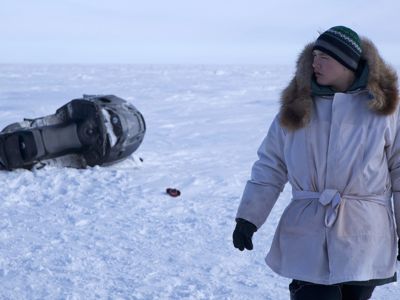
Sikumi (on the ice)"An Inuit hunter drives his dog team out on the frozen Arctic Ocean in search of seals, but instead, becomes a witness to murder. Winner of the Jury Prize for Short Filmmaking at the 2008 Sundance Film Festival."

Hearing that Sikumi or “On the Ice” had won awards I was very excited to watch this movie. My expectations were really high, what could it be, what could it be. What turned out was a touch disappointing. It’s a nice little movie no doubt, but an award-dinner at Sundance…that can’t be right.
Comment:  I agree with this opinion. I've seen enough Native shorts to say Sikumi is one of the better ones, but the best?

And I believe it won over all films, not just Native films. Best Short Film Shot Under Harsh Conditions, perhaps. But not Best Short Film overall.

For more on Sikumi, see National Distribution for On the Ice and AIFI's 2011 Winners.

February 17, 2012

National distribution for On the Ice

Film with novice Eskimo cast opens in theaters

By Rachel D'OroTwo Inupiaq teenagers from a remote Arctic town find themselves at the center of a tragic killing brought on by a crystal meth-fueled fight during a seal hunt in the frozen North. The childhood best friends try to cover up the death but struggle to elude suspicions, forcing them to confront the limits of friendship and forgiveness.

The fictional dilemma is the heart of "On the Ice," a thriller filmed in Barrow in 2010 with novice Inupiat actors. The 2011 Sundance Film Festival entry will make its theatrical premiere today in New York and in Anchorage and Fairbanks, then expand to cities including Los Angeles, Chicago, Seattle and San Francisco.
And:For the filmmakers, it was important to capture the setting. It was crucial to cast Inuit people as Inuit people.

"I didn't want to cast Japanese people or Korean people, which is what I grew up watching," said its New York-based director and screenwriter, Andrew Okpeaha MacLean. "It's just like, no way. That has to stop."
Comment:  Once again, if you want to cast Native actors, you can do it. It just requires extra work, which Hollywood's racist studios aren't willing to do.

For more on On the Ice, see AIFI's 2011 Winners and Hip-Hop Culture in Alaska.

Below:  Josiah Patkotak plays Qalli in "On the Ice."

November 14, 2011

AIFI's 2011 winners

American Indian Motion Picture Award WinnersThe 36th American Indian Film Festival ended Saturday with presentation of this year's winners with the American Indian Motion Picture Awards Show at the Palace of Fine Arts.

The American Indian Motion Picture Awards Show, recognizing excellence in USA American Indian and Canada First Nations cinematic achievement, making the annual awards show one of the most prominent Indian Country and Native Cinema showcases.

Outstanding performances varied across the talent venue, on awards night including: Blues singer/songwriter Derek Miller, Punk/Indie band Miracle Dolls, Hip Hop/ R&B duo The Battiest Brothers, comedian JR Redwater, and violinist Swil Kanim.

This year's winners are listed below:

BEST FILM--Shouting Secrets, Korinna Sehringer, Director

BEST DIRECTOR--Andrew Okpeaha MacLean, On The Ice

BEST ACTOR--Chaske Spencer, Shouting Secrets

BEST ACTRESS--Michelle St. John, Every Emotion Costs
Comment: Follow the link to see the full list of winners.

For more on the subject, see The Best Indian Movies.

June 20, 2011

Hip-hop culture in Alaska

An interview with the director of On the Ice makes some interesting points about the culture of Alaska's Native youth:

On the Ice Director Andrew Okpeaha MacLean Examines Tradition vs. Hip-Hop Culture in Alaska

By Jen YamatoThat juxtaposition between tradition and modernity is fascinating, even in the opening scenes alone. You show your teenage protagonists performing traditional dances, then hitting a house party with hip-hop playing and kids freestyling. How did you familiarize yourself with that generation of kids and their lifestyle?

I have a million cousins up there—I’m related to half of the town. So basically I was watching my cousins growing up, and they’re like ten or fifteen years younger than me. Seeing what they’re doing, what they’re going through, and how the pace of things has picked up so much. How much the stakes have risen. The drugs are harder and it’s easier to sort of lose your way, but at the same time it’s easier to find it. There’s a deeper level of pride that they have in themselves within the culture. They’re forced to stake their identity in a way—they go on Facebook, they join native groups, they reach out to each other and proclaim themselves in a way that I found really interesting. And they use things like hip-hop for that. I have cousins of mine who were just making demo tapes, rapping, they’re appropriating a style, a kind of identity that they want. They kind of want to be like Lil Wayne or Jay-Z or something like that, but at the same time they don’t. They use that, and instead of trying to rap about stuff that’s really not a part of their lives, they’re proclaiming their pride in who they are and where they’re from through hip-hop. I found that interesting and it was one of the real launching points for my approach to the feature.
And:[T]he inciting incident in On the Ice comes out of these teenagers having these weapons that are meant for sustenance and for hunting, and becoming overcome by the macho confrontational swagger prevalent in hip-hop culture.

Absolutely. And I remember thinking about that in writing. I read a news article when I was in the stages of writing about it, and it was a police chief in Newark or something talking about why violence happens. What he was saying was that violence doesn’t happen over big things. People don’t get killed over millions of dollars or huge love stories or anything like that these days, it’s about somebody giving someone a wrong look, and then it escalates. It’s this culture of not backing down, and it’s related to exactly that, this kind of macho, no-compromise, “You disrespect me? I’m gonna come at you harder.’” Then you’re gonna come at me harder, then I’m gonna come at you harder, and eventually somebody dies from it. That’s where the violence in On the Ice comes from. It starts over nothing. It just erupts because of that kind of unwillingness to step back and evaluate—which is really antithetical to the traditional culture up there, which is very nonviolent.
Comment:  Read the article for more on how MacLean made On the Ice, chose its actors, etc.

For more on the subject, see On the Ice Challenges Stereotypes and On the Ice Wins in Berlin.

April 27, 2011

On the Ice challenges stereotypes

Answering Back

Andrew Okpeaha MacLean Captures Life on the Ice

By Paulette Beete
All of MacLean's films to date have been set, at least in part, in Barrow and its surrounding landscape. As is true with all hard-to-reach places, the inhabitants of Alaska's North Slope remain a mystery to outsiders, and much of their characterization in popular culture is half-truth verging on caricature. MacLean's filmmaking is a reflection of his desire to let people know what being an Eskimo is really like. "We're in a kind of strange position that everybody in the world has heard of Eskimos. Most people have some kind of strange notions--they rely on stereotypes they've heard….We're like a punch line or something. Nobody really knows us. I want to make art that is reflective of a more genuine aspect of our experience."

He added that there is an implicit political angle to his filmmaking. "In the Arctic right now, we've got this avalanche of information and narrative and stories that just piles into our lives from the dominant Western culture. Movies, television, Internet, Facebook, music…I want to start answering that back. I want to start making people listen to us for a change. I've seen a million movies about you guys, now here's a movie about us that you have to sit and watch."
Comment:  For more on the subject, see On the Ice Wins in Berlin and Mixed Reviews for On the Ice.

Below:  "Director Andrew Okpeaha MacLean, working on his film On the Ice."

March 26, 2011

On the Ice wins in Berlin

'On the Ice' honored at the Berlin International Film Festival

By Mike DunhamSpeaking of Eskimo stars--Andrew Okpeaha MacLean's Barrow drama "On the Ice," which features an Inupiat cast, continues to rake in worldwide attention and major awards.

It received the Crystal Bear award for best debut film at last month's Berlinale--the Berlin International Film Festival. The Berlinale is considered that city's largest cultural event and a major forum for the international film industry. Some 19,000 cinema professionals (and 4,000 journalists) were accredited to the festival.
Comment:  For more on the subject, see Mixed Reviews for On the Ice and Preview of On the Ice.

Below:  "On the Ice team Andrew Okpeaha MacLean (writer/director), Josiah Patkotak (actor), Frank Qutuq Irelan (actor) and Cara Marcous (producer) are shown shortly after getting the Crystal Bear award at the Berlin International Film Festival." (Martin Sensmeier)

January 24, 2011

Mixed reviews for On the Ice

On the Ice

By Justin ChangA drama that should feel as elemental as its setting comes across as stilted and unconvincing in "On the Ice." Even d.p. Lol Crawley's starkly beautiful lensing of the arctic tundra can't prop up this poorly motivated saga of two teenage boys who find themselves with a dead body on their hands. A rare film set among the Inupiaq people of northern Alaska, writer-director Andrew Okpeaha MacLean's debut feature is already the beneficiary of high-profile Sundance and Berlin berths and will likely enjoy additional fest-circuit exposure as an ethnographic slot-filler. Commercial prospects look otherwise frigid.

Developed through the Sundance Institute's Native filmmakers program, pic is billed in the production notes as "a story that can happen anywhere," which is part of the problem. While "On the Ice" offers a unique immersion in the language and customs of the Inupiaq culture in MacLean's hometown of Barrow, Alaska, the harrowing moral journey it serves up--part "A Simple Plan," part Cain and Abel--feels artificially applied to these rural environs, rather than emerging organically from regional specifics.
Sundance Review:  On the Ice

By John DeForeIts sense of place is transporting. But many of the film's performances are as chilly as the Arctic Circle wind, and its deliberately laid-out suspense beats fail to catch fire. Arthouse appeal is modest, but many fest auds will embrace the view it offers of a people who have not abandoned old traditions even as mainstream American culture leaves its mark.

The Bottom Line: Alaska-set drama about a momentous secret holds cultural interest but can't sustain much tension.
Sundance Review:  On the Ice Tails Off

A decent premise, but not enough solid acting.

By Aaron Peck
On the Ice touches on an emotional level during its first half up until the murder happens. After that it turns into a pseudo-murder mystery, which has Qallie's dad trying to figure out what really happened. There are times where we wonder, "How did he really know to do that or look there?" I imagine it all boils down to fatherly wisdom, or perhaps the story just needs to move forward. Sadly, the story becomes extremely predictable, and the young actors here just can't pull off the dramatic material. It's a shame, because On the Ice had a lot of promise.

Grade: C
Comment:  For more on the subject, see Sundance Incubates Native Film and Preview of On the Ice.

January 17, 2011

Preview of On the Ice

Meet the 2011 Sundance Filmmakers | “On the Ice” Director Andrew Okpeaha MacLean

By indieWIREIn the isolated, frozen town of Barrow, Alaska, Iñupiaq teenagers Qalli and Aivaaq have grown up like brothers in a tight-knit community defined as much by ancient traditions as by hip-hop and snowmobiles. Early one morning, on a seal hunt with their friend James, a tussle turns violent, and James is killed. Panic stricken, terrified, and with no one to blame but themselves, Qalli and Aivaaq lie and declare the death a tragic accident. As Barrow roils with grief and his protective father becomes suspicious, Qalli stumbles through guilt-filled days, wrestling with his part in the death. For the first time in his life, he’s treading alone on existential ice.

In this utterly engrossing, suspenseful feature-film debut by award-winning short filmmaker Andrew Okpeaha MacLean, the snowy Arctic plains embody Qalli’s lost innocence, while the claustrophobic town mirrors his entrapment, as he trudges through layers of deceit and the gauntlet of how to be a friend and a man. [Synopsis courtesy of Sundance Film Festival]
And:Reaching a bigger audience…

About ten years ago I was living at home in Barrow, Alaska, writing and directing plays with a small theater company I co-founded with a cousin of mine. We put in a lot of work into the pieces, and I’m proud of them, but Barrow has a pretty small audience base (the population 5000 or so). Film seemed like a way to tell stories that were relevant to me and my culture while reaching out to more than the 400-500 friends and relatives who would come to our plays.

A short leads to a feature…

“On the Ice” has a pretty interesting history. It’s based on my short film “Sikumi,” which means ‘on the ice’ in the Iñupiaq language. “Sikumi” was at the 2008 Sundance Film Festival where it won the Jury Prize in Short Filmmaking. I wrote the short as a writing exercise when I had writers block while working on a script based on an event from my grandfather’s life. So some of the characters have their roots in real people, but they’ve changed a lot along the way. “On the Ice,” the feature, is very different from “Sikumi,” the short. The characters are younger, and the story is more contemporary because I wanted to highlight some of the challenges facing kids in small arctic communities like Barrow.
Comment:  For more on the subject, see 11 Native Films at Sundance and Sikumi the Feature Film.

May 08, 2010

Sikumi on YouTube

Last year I mentioned Sikumi as one of the films helping to preserve Native languages. Now here's the full story on it:

Barrow film honored at Sundance festival

Inupiaq-language drama can be viewed online today

By Sarah Henning
The 15-minute film is about a seal hunter named Apuna who witnesses a murder on the sea ice. Because anonymity doesn't exist in Barrow, Apuna knows both the killer and the victim.

"He has to struggle with doing the right thing, or caving in to the friend who committed the crime," said Brad Weyiouanna of Barrow, who played Apuna.

Because the town is small and isolated, MacLean said, it was an ideal microcosm for exploring how one person's actions can affect an entire community.

"It's actually a fairly universal story, but set through Andrew's lens," said film producer Cara Marcous of New York City. "I think he's telling what is really a moral decision story, in real time. I think it's specific in its portrayal of this culture, but it also connects with people regardless of where they're from."

To MacLean's knowledge, "Sikumi" is the only feature film entirely shot in the Inupiaq language. (A 2002 full-length feature from Canada, "Atanarjuat" or "The Fast Runner," used dialogue in Inuktitut, a related Inuit dialect.)
Sikumi (On the Ice)“Sikumi (On the Ice)” does not possess a single ounce of fat. It moves quickly and crisply, with the three actors brilliantly establishing their tragic roles with rapid yet subtle depth–particularly Weyiouanna, who stoically makes the uncomfortable transition role of witness to a crime to judge and jury for the guilty man. Special kudos are in order for Cary Fukunaga, who turns the barren Alaskan environment into a haunting yet beautiful landscape that seems like a natural setting for a trial of man’s soul.

MacLean is of Inupiaq heritage, making him among the relatively few Native Alaskan filmmakers to receive wide attention for his work. “Sikumi (On the Ice”) premiered at Sundance, but hopefully it will not getting detoured into the Native American film festival ghetto–it is a work of great intelligence and artistry that demands to be seen by as many people as possible.
Sikumi (On The Ice)Filmed by DP Cary Fukunaga in wide shots that seem to swallow up the principal characters, or in impressionistic close-ups of dogs, knives and blood, Sikumi is certainly stark, and yet there is room even in this cold, austere backdrop for the warmth of the human spirit, so that the short can end with a vision that all at once encompasses man's tiny insignificance in a hostile universe, and yet redefines and affirms the very values of humanism. Many films of much longer duration struggle to capture so powerfully or so clearly so complex a moral paradox.Official site

Watch the whole 15-minute film here:


Rob's thoughts

  • What stands out for me is the quality of Sikumi's cinematography and editing. It seems very professional--not what you'd expect in someone's first movie.

  • The same applies to the acting. There's little of the hamminess or obviousness you see in a novice production.

  • The use of the Inupiaq language isn't that big a deal, since there isn't that much dialog. It's not as if anyone utters long speeches full of complex ideas.

  • The talk of a "trial of the soul" or a "moral paradox" seems overblown. Every crime and medical show on TV offers equally compelling dilemmas.

  • The story and the dialog are timeless. They could've occurred 10, 100, or 1,000 years ago. But the appearance of binoculars, rifles, and a radio place Sikumi in the modern era.

    It's good to see a traditional story in a modern setting. The implication is that the Inupiaq language and culture endure. Physical details may change, but beliefs and values are eternal.

    Basically I'd say Sikumi is a small gem of a movie. I wouldn't call it a stunner or a masterpiece, but it's better than most short films of its type. Watch it when you have 15 minutes to spare.

    For more on the subject, see Sikumi the Feature Film and The Best Indian Movies.
  • Sikumi the feature film

    Inuit Actors Sought For Full-Length "Sikumi"

    By Mike DunhamAndrew MacLean, whose short film “Sikumi” (“On the Ice”) has won awards at the Sundance Film Festival and elsewhere, will hold auditions in Anchorage starting today for an expanded version of the movie. Prior acting experience is not needed.

    Producer Cara Marcous said that the upcoming movie will be MacLean’s first full-length feature film. It takes the premise of the short film—a murder and the conflict faced by a witness to reveal what he knows—and transplants it to modern times, with the action set in contemporary Barrow.

    The lead characters, two adult men in the short version, will become teenagers in the new movie. And where the first “Sikumi” featured all-Inupiaq dialogue, the full-length rewrite will use English, “Because almost everyone in Barrow today speaks English,” she said.

    So being “comfortable acting in English” is a requirement. Also, Marcous added, “all the character are Inupiaq so we’re only casting for Inuit people,” ages 16-70.
    Comment:  Uh, the original Sikumi was set in "modern times," so that won't have to change.

    A couple points worth noting here:

  • Setting the story in Barrow and using Inuit actors will make the story more authentic. Glad to see MacLean and Marcous get it.

    Although the two leads in Sikumi are adults, their success suggests that it won't be impossible to find teenage Inuit actors. Which is why MacLean and Marcous are seeking such actors in Anchorage, Alaska's biggest city.

    Too bad the producers of The Last Airbender didn't take the same approach for their Inuit-based characters. Despite their much bigger budget, they put out a Hollywood casting call for Caucasians and others. In other words, they didn't make a real effort to cast Airbender authentically.

  • A short film is how the acclaimed Frozen River got started also. This seems to be a good way for filmmakers to go. Make a five-, 10-, or 15-minute version of your film on a shoestring budget. Then use that as your calling card to raise awareness and seek investors. Prove that you have the talent and vision and (one hopes) the money will come.

    For more on the subject, see Sikumi on YouTube and The Best Indian Movies.

    Below:  "Barrow: Award-winning director Andrew MacLean plans to film his full-length feature in his home town."