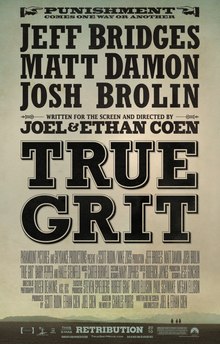
The story starts in the town of Fort Smith, Arkansas. It proceeds into Indian Territory or Choctaw Territory--namely, the southeast portion of Oklahoma.
A couple of problems with that. For starters, the movie's version of Indian Territory is almost totally devoid of humans or human habitation. The lone Indian on horseback...a crazy old coot in a wolf skin...the outlaws...and that's about it.
The Choctaw were considered a nation for a century before this story. When they were forced to move to Oklahoma, they established themselves like the neighboring Cherokee. They had a government, towns, homes, schools, churches, newspapers, and so forth and so on. Some lived in mansions and owned slaves.
Here are some tidbits from Wikipedia on the Choctaw during and after the Civil War:
Former slaves of the Choctaw Nation were called the Choctaw Freedmen. After considerable debate, the Choctaw Nation granted Choctaw Freedmen citizenship in 1885. In post-war treaties, the US government also acquired land in the western part of the territory and access rights for railroads to be built across Indian Territory.
The improved transportation afforded by the railroads increased the pressure on the Choctaw Nation. It drew large-scale mining and timber operations, which added to tribal receipts. But, the railroads and industries also attracted European-American settlers, including new immigrants to the United States.
Beginning in 1894, the Dawes Commission was established to register Choctaw and other families of the Indian Territory, so that the former tribal lands could be properly distributed among them. The final list included 18,981 citizens of the Choctaw Nation, 1,639 Mississippi Choctaw, and 5,994 former slaves, most held by Choctaws in the Indian/Oklahoma Territory.
The Indian Appropriations Bill of 1889 included an amendment by Illinois Representative William McKendree Springer, that authorized President Benjamin Harrison to open the two million acres (8,000 km²) of Oklahoma Territory for settlement, resulting in the Land Run of 1889. The Choctaw Nation was overwhelmed with new settlers and could not regulate their activities. In the late 19th century, Choctaws suffered almost daily from violent crimes, murders, thefts and assaults from whites and from other Choctaws.
New Mexico isn't Arkansas
To make matters worse, Indian territory wasn't even filmed in Indian territory. I noticed this right away. The landscape didn't look like the rolling hills and forests of Oklahoma and Arkansas. It looked like the mountainous high desert of New Mexico, which is where it was filmed.
Why 'True Grit' wasn't filmed in Arkansas
By Max Brantley
Cole Haddon: Following that up, did shooting some pretty damn iconic Western landscapes pose additional challenges?
Ethan Coen: You know what? That’s one thing that’s not faithful to the novel. The landscape is a total cheat, but we kind of thought people will think it’s a Western, and some things you just can’t mess with. People want that.
Joel Coen: The whole pictorial idea of the movie would have been much different in a place like Arkansas. The honest answer is it kind of becomes this mishmash of different considerations that go into where you’re shooting and how you want to treat the landscape. They’re a little hard to sort out after the fact, but it’s everywhere from the practical to just what does the movie actually want to be about.
Now we see the whole picture. The Coen brothers included a few Indian characters only to dismiss them as laughable and inconsequential. They're 2010's equivalent of the drunk Indian wobbling down the street or the mysterious Indian sitting alone on a bluff.
The empty landscape and New Mexico film location reinforce this message. The land was wild and waiting to be tamed. Men like Rooster Cogburn rode in with guns blazing, killed the bad guys, and made the West safe for democracy. America was there to be developed and civilized and great white men like Cogburn did it.
So True Grit is pro-America propaganda just like so many old Westerns were. The above is what most Americans were taught in school, and what most of them believe. They don't question this quasi-religious dogma because it's everywhere: from holiday celebrations to public monuments to award-winning movies. You have to spend years of reading and thinking to overcome this brainwashing, yet most people don't even realize it's happening.
Other than these flaws, True Grit was entertaining and well-done. I'm not sure I would've nominated it for the Best Picture Oscar, but I'm not sure I wouldn't have either. Rob's rating: 8.5 of 10.
For more on True Grit, see Melvin Martin on True Grit and Hanged Indian in True Grit.
For more on America's mythical history, see:
"6 Ridiculous Lies About Indians"
What conservatives consider "objective history"
How America became cowboy country
Movies convey "America's master narrative"
Below: Rooster Cogburn faces four outlaws in an oddly empty "Indian territory."