Showing posts with label housing. Show all posts

December 21, 2011

"OMG" reporting about Attawapiskat

Covering the Crisis: Can Mainstream Media Attention Help Attawapiskat Long-Term?

By Martha Troian[A]lready some are questioning why it took two months for Canadian media to take notice, even after the community declared a state of emergency. Moreover, as CBC News noted earlier this month, the ministry of Aboriginal Affairs and Northern Development (AAND) has known about the conditions for quite some time. Moreover, deplorable conditions on aboriginal reserves have been well documented for decades, as television journalist Peter Mansbridge noted when he interviewed Assembly of First Nations National Chief Shawn A-in-chut Atleo on the CBC News program One on One recently.

“I’ve been in this business for over 40 years,” he said during the broadcast. “One of the first stories I covered was a community like that. But this was in Manitoba.”

So why is it being covered as if it were a sudden disaster?

One of those questioning how media responded is Duncan McCue, creator of an online guide for journalists called Reporting in Indigenous Communities (RIIC), based out of the University of British Columbia School of Journalism.

“It took an MP with a camera, who went on to self-publish an article to get anybody’s attention,” he said. “Even then, mainstream media didn’t listen.”

McCue was referring to the now-famous November 21 article and video (“What if They Declared an Emergency and No One Came?”) published on Huffington Post by Charlie Angus, the Member of Parliament for Timmins–James Bay, which is what sparked the media frenzy.

But at the same time that it brought much-needed attention to the issue, Angus’s column also set the tone for how the crisis has been covered, McCue said.

“Someone made an interesting comment on the RIIC Twitter page that there is an awful lot of ‘OMG’ going on in the reporting,” he said, adding that journalists are focusing only on the atrocious living conditions described by the media. “There has been less of a focus on some of the systemic problems that have led to that and some of the context that is necessary.”

Kevin Carter is originally from the Hollow Water First Nation in Manitoba. Now living in Saskatchewan, he has been following the story through mainstream media television, newspapers and a few small aggregated news sites. He said he’s disappointed in what he has seen so far.

“Right now [the coverage] is just about shaming Harper and the Canadian government,” he said. “There are some very real housing issues here, but this is still just the flavor of the month. Everybody will get kinda tired of it after a while, and then it will go away.”

As the coverage blossomed in early December, Carter tweeted, ‘Love the media and twitter outrage on #Attawapiskat but this will pass like it has before.’”
Comment:  For more on Attawapiskat, see Attawapiskat Triggers "Welfare" Stereotypes and Blaming the Victim at Attawapiskat.

Below:  "Attawapiskat Chief Theresa Spence got a standing ovation after speaking before a Special Chiefs Assembly at the Assembly of FIrst Nations."

December 13, 2011

Attawapiskat triggers "welfare" stereotypes

Depressing rerun for anti-native stereotypes

By Brent WesleyLazy. Incompetent. Dead weight. Basically, a burden on the taxpayers. Harsh descriptives for anyone to swallow, yet it’s par for the course for First Nations in this country. Especially when a major issue hits mainstream news like the state of emergency in Attawapiskat First Nation over inadequate housing.

The James Bay community in Northern Ontario made the declaration in late October, yet people in the community have lived in makeshift houses since 2009. Some residents are facing the onslaught of a third winter without proper homes. And in Ontario’s Far North, winter is harsh and unforgiving, It’s a situation that can tug at the heart strings of most people. But when Aboriginal Affairs Minister John Duncan exercised his ministerial right to put the community under third-party management, suddenly the spotlight was on band finances. Where has the money gone?

Others have done a good job of breaking down the numbers, so I won’t dwell on it. Rather, as a First Nation person, the public backlash has weighed heavy. Instead of compassion, First Nations were suddenly generalized and told we don’t know how to fend for ourselves. Funny, considering I have an education, have a job, own a home and I’m raising a family. But wait, “you’re okay, I like you. It’s those other Indians I don’t like.” Words I have actually heard before.

I can’t imagine the toll the backlash has taken on the people of Attawapiskat. But sometimes the weight of the outside world isn’t very apparent in the day-to-day lives of people living in remote isolated communities. Life is a struggle to survive. Poverty. Social and health issues. Expensive food. Lack of potable water. The list goes on. Yet, the onslaught of voices can penetrate the thickest barrier. Suddenly, everyone is an expert and knows what’s best. And more often than not, that advice tends to focus on the usual uninformed, misguided diatribes of “get a job” or “take care of yourselves and stop depending on taxpayer money.” And even the most well-intentioned advice can be unwarranted.

Why does it bother me? Because it’s the same old attitude that has brought on the problems that exist and fester in every corner of Indian country. Father knows best. And you best heed his advice. Paternalistic attitudes and policies that have done more harm than good. Basically we are being told, “those Indians can’t take care of themselves so we best step in and make things right.”

On a personal level I’m deeply offended that government and certain segments of the Canadian public would even think of stepping in. In the case of Attawapiskat, the community reached out for help. Instead, they were told “you don’t know what you’re doing so move aside.”

Well, frankly, the community does know what it’s doing. It has stable leadership. It’s one of the rare communities to post its financials online. It has emergency management plans in place. It has operated a school for years without a proper building. No one is looking at those positives.

But like almost every other First Nation in Canada it operates on limited financial resources for health, education, infrastructure and housing. To compound that, it is stuck dealing with the bureaucratic juggernaut that is Aboriginal Affairs, one of the federal government’s largest ministries. It’s a lot to ask of any competent leader to deal with. But it’s the reality of First Nations.
Comment:  A couple of things here:

1) Americans, and I guess Canadians, apply the "lazy, incompetent, dead weight" stereotypes to all minorities, not just Indians. As we've discussed in postings such as:

Republican Jesus™
Rubio:  Entitlements "weakened" us
Didier:  Stop "protecting the weak"
Why Americans hate welfare

2) In the Indians' case, these stereotypes are closely related to the "uncivilized" and "savage" stereotypes. The idea is that Indians can't handle business or government because they're too primitive and barbaric. Like cavemen who time-travel to the present, they're incapable of comprehending modern society. They're like apes or wolves in human clothing: pretending to be people, not real people.

For more on the Attawapiskat crisis, see Blaming the Victim at Attawapiskat and Home Renovator Tackles Housing Crisis. For more on Indians as welfare recipients, see Candidate:  Indians Spend "Handouts" on Drugs and Chickaloon Indians = Leeches?

Below:  The "crying Indian" stereotype, again.

December 06, 2011

Blaming the victim at Attawapiskat

Here's a commentary on the responses to the the Attawapiskat housing crisis. As I said, the crisis itself isn't a pop-culture issue, but the responses to it may be.

Don't blame bands for reserve housing woes

By Doug CuthandOttawa's reaction--and that of Prime Minister Stephen Harper in particular--has been appalling.

Rather than face the issue and try to find some kind of resolution, the prime minister complained that about $90 million has been spent by his government in the past six years and he sees little to show for it. Then the colonial office walks in and places the First Nations government under thirdparty management, which is a form of receivership.

It's easy to play blame-the-victim if people don't examine the facts. The $90 million spent over last six years constitutes the band's federal transfer payments. These cover costs for education and community and social development, and are accounted for in the band audits posted on its website since 2005.

It amounts to an average $15 million a year. This is comparable to other reserve communities of a similar size. The funds are closely regulated and can only be spent in certain ways.

The latest audited statement available on the Indian Affairs website is for the 2010-11 fiscal year. That year, the federal expenditures were $15,946,810 and included $403,986 available from the Canada Mortgage and Housing Corp. for housing.

According to Statistics Canada, in 2001, the First Nation had a population of 1,290. The annual expenditures for the band were $15,861,724, and $159,748 was available for housing.

In the past decade, the population has grown to about 1,800, a 40 per cent increase. When such paltry amounts are put toward housing, it is no wonder that houses have become overcrowded and run down. If the overall federal contribution had kept pace with the population growth, it should be in excess of $22 million this year.

Attawapiskat is an isolated, fly-in community. The only way to transport building materials is by expensive air freight or a few months by winter road. This makes everything, including food, gasoline and basic transportation, more expensive. A standard two-or three-bedroom house will cost between $200,000 and $250,000.
Comment:  So the $403,986 allocated for housing in 2010-2011 could buy one or two houses. Meanwhile, the population has grown from about 1,300 to 1,800 in ten years, or 50 people a year. Fifty new people a year in 1-2 new houses...sounds like overcrowding to me.

In short, the conservative "blame the victim" response to poverty is wrong again. Give the tribe enough money to build the 10 or 20 houses needed each year, then tell us whether they're dumb savages or not.

For more on the subject, see Home Renovator Tackles Housing Crisis.

December 03, 2011

Home renovator tackles housing crisis

A big stories in Indian country this month has been the housing crisis on Attawapiskat reserve in northern Ontario. It's going through the usual spin cycle. Politicians are shocked that poverty still exists in Canada. Indians say they aren't getting enough funding to build decent houses. Critics say the tribal government is responsible for wasting money.

There's more than a whiff of racism surrounding the issue. The non-Indians didn't care enough to do anything until the media proclaimed it a crisis. Their attitude seems to be that giving money to Indians is like pouring it down the drain. You know, because Indians are uncivilized savages who haven't learned how to take care of themselves.

I haven't posted anything on this because it's not really a pop-culture issue. But this story is enough to justify a posting:

Stop building junk on reserves, says renovator Mike Holmes

Holmes on Homes host offers easy fixes for First Nations housing crisis

By Janet DavisonFor Canada's most famous—and outspoken—home renovator, the solution to the First Nations housing crisis is remarkably simple.

"When I heard years ago the problems they were having, to me it was like, 'Oh, OK, this is easy. Why isn't anyone else doing it?'" Mike Holmes, star of HGTV's home renovation show Holmes on Homes, said in an interview.

"We need to stop building crap. It's as simple as that."

Holmes teamed up with the Assembly of First Nations in 2010 to create a pilot project on the Whitefish Lake First Nation west of Sudbury, Ont., to build energy-efficient, environmentally friendly homes and other infrastructure. The ongoing project also aims to develop trade skills for people living on reserves.

While recent attention has focused on the grim living conditions on the Attawapiskat reserve in northern Ontario, the First Nations housing crisis extends far beyond just the James Bay community and has gone on for years.

For Holmes and others who want to move past the politicking and fingerpointing consuming much of the public debate around the issue, solutions lie in the willingness to embrace ideas others may want to dismiss out of hand.

Maybe we can make better choices about building materials that may initially be more expensive but last longer and won't burn or be susceptible to mould.

Maybe we can consider buildings not based on a wood frame, such as steel shipping containers converted into comfortable homes.

And so on.
Comment:  For more on Native housing, see Modern Housing, Traditional Style.

Below:  "Steel shipping containers are being used to house workers at Ontario Power Generation's Lower Mattagami hydro project. The containers will later be turned into housing for the Moose Cree First Nation." (Courtesy Steve Marshall)

November 11, 2009

Modern housing, traditional style

Pueblo living gone mod

Ohkay Owingeh project garners award for combining contemporary and traditional touches—and for solving a housing crisis through creative fundraising

By Ana Maria Trujillo
Rounding up architects and contractors from outside the pueblo, she knew she wanted everybody on the team to get a taste of Ohkay Owingeh. "We did an orientation, where I took them to the pueblo and showed them the boundaries of the reservation and our tribal lakes. I showed them everything I could possibly find," Duran said. "If they were going to work with us, they really needed to understand who we were and what we're about."

Duran also had public dialogue with community elders and other community members to ask them about what it was like to live in the pueblo and to get their ideas about the new community.

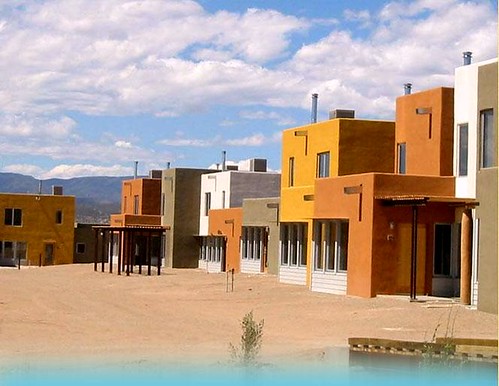
The design that came out of all those events was something that reflected traditional pueblo living—attached units divided around two plazas, one oriented to the solstice and the other to the equinox, which is a feature, Duran said, that was part of the original pueblo. The 40-unit development offers one-, two-, three- and four-bedroom apartments. Six hornos (outdoor ovens) are available for tenants to use throughout the property. A community meeting space, playground, computer room, weight room, business center and laundry facility are available to residents. Residents must be members of the tribe, and if a nonmember wants to move in with a member, he or she must get approval from the Tribal Council. Rent for the units ranges from $204 to $576 a month, Apodaca said.
Comment:  Great idea to build modern homes in a traditional style. Other tribes should try the same approach if and when it's practical.

Below:  "Tsigo bugeh Village in Ohkay Owingeh has features of traditional pueblo living, including attached units divided by two plazas, one oriented to the solstice and the other to the equinox. Also, six hornos are available for the development's residents to use."