Showing posts with label sovereignty. Show all posts

September 18, 2014

"Nation to Nation" treaty exhibit

NMAI To Open New Exhibit Exploring Native and U.S. Relations

By Madeline McGillSince its opening, the National Museum of the American Indian (NMAI) has dedicated itself to the promotion of native identity and cultural understanding. Now celebrating the 10th anniversary of the D.C. museum, it is launching an ambitious exhibit this September that seeks to highlight the role of treaties between the United States and Native Nations.

Upon opening September 21, 2014, the exhibit “Nation to Nation: Treaties Between the United States and American Indian Nations,” will explore the Native diplomats and leaders who crafted some of the earliest agreements with the Founding Fathers.

Amongst the many artifacts expected to be on display, the exhibit will feature 8 prominent National Archive treaties from the approximately 374 ratified between the United States and Native Nations. These treaties will trace a timeline of diplomacy from first meetings to present, touching at the core of how U.S. and Native relations have impacted culture and development.

On September 8th, the NMAI welcomed the arrival of the Treaty of Canandaigua from the National Archives and Records Administration. Enacted between the Haudenosaunee (also known as the Six Nations or the Iroquois Confederacy) and the U.S., this treaty was signed by George Washington in 1794 to establish peace, friendship, and affirm land rights to the Haudenosaunee in modern day New York State.
Treaties Exhibit Ushers in 10 Years of American Indian Museum

By Bridget BowmanThe National Museum of the American Indian will open its first exhibit exploring the contentious issue of treaties between the U.S. government and Indian Nations next week.

“This exhibit is a tangible reminder of the federal government’s relationship with sovereign tribal nations of this country,” Senate Indian Affairs Chairman Jon Tester, D-Mont., said Thursday. “It’s also a reminder of the moral and legal obligations that the United States has to honor and uphold our treaties with Indian country.”

Tester addressed a group gathered at a day-long symposium at the museum discussing the exhibit. “Nation to Nation: Treaties Between the United States and American Indian Nations” opens Sept. 21, which is the 10th anniversary of the opening of the museum. The exhibit will continue until the fall of 2018.

Museum Director Kevin Gover said during a preview Tuesday that the display was years in the making and came at the request of a number of tribes and members of Congress.
Comment:  Some people live-tweeted comments during the day-long symposium discussing the exhibit. Here are the ones I retweeted:

Senator Jon Tester @SenatorTester · Sep 18
This exhibit is a tangible reminder of the federal government's relationship with the sovereign tribal nations. #NationToNation

Debbie Reese @debreese · Sep 18
Clinton: Early treaties re friendship became vehicles for land dispossession. #HonorTheTreaties #NationToNation

Mark Trahant @TrahantReports · Sep 18
Clinton: 1868 Ft Laramie, Lakota had won, US suing for peace. "If conquest" brings rights "we should be speaking Lakota."

Mark Trahant @TrahantReports · Sep 18
Clinton: IRA spurred "sovereign to sovereign" relationship req'g consent and negotiation. "Treatymaking is back." #HonorTheTreaties

Debbie Reese @debreese · Sep 18
Gover: Want to put concept of Native sovereignty into American's knowledge of American Indians. #NationToNation #HonorTheTreaties

Debbie Reese @debreese · Sep 18
Harjo: American's don't realize treaties are AMERICAN, too, made by American govt with Native Nations. #HonorTheTreaties #NationToNation

Debbie Reese @debreese · Sep 18
Gover: With tribes managing resources themselves, resources (salmon) are making comebacks. Good for all. #NationToNation #HonorTheTreaties

Debbie Reese @debreese · Sep 18
Listening to Macarro highlights (for me) how disgusting it is that California schools focus on missions. #NationToNation #HonorTheTreaties

Debbie Reese @debreese · Sep 18
Deloria: Task is to teach students that history matters to the present and future. #NationToNation

Debbie Reese @debreese · Sep 18
Cladoosby: Has US kept its word? George Washington made promises he didn't keep. #NationToNation #HonorTheTreaties

Debbie Reese @debreese · Sep 18
Cladoosby: "Sometimes I think we are more patriotic, maybe because we were on this land first, we love her more" #NationToNation

Mark Trahant @TrahantReports · Sep 18
"We can love this country despite the incredible, painful history ... despite promises not kept," Brian Cladoosby. #HonorTheTreaties

Debbie Reese @debreese · Sep 18
Gover: Congress apology to Am Indians, sponsored by Brownback, was buried, but signaled US beginning to acknowledge history

Mark Trahant @TrahantReports · Sep 18
Kevin Gover: NMAI act is an apology; yes US did these things. Thus the oppty to tell Native story and for US to listen. #HonorTheTreaties

Debbie Reese @debreese · Sep 18
Gover: History is being mis-taught in formal education systems in US. All of us have to un-learn those things. #NationToNation

Debbie Reese @debreese · Sep 18
Gover: Justice is achievable because Indians never give up. We always insist on a just outcome. #NationToNation

Debbie Reese @debreese · Sep 18
Harjo: Arguments that 'too much time has passed, therefore, move on' is bogus argument. Treaties matter. No end date. #NationToNation

You can see all the tweets on the symposium by searching the #NationToNation and #HonorTheTreaties hashtags in Twitter.

For more on treaties, see Myth of the Level Playing Field and Tamara Johnson Ad Sparks Outrage.

July 13, 2014

Myth of the level playing field

Conservatives often claim that racism is a thing of the past. That all races today are playing on a "level field." Here's a good takedown of that myth.

The level playing field myth

By âpihtawikosisânFirst, this [level playing field] argument invariably begins by acknowledging Europeans behaved very naughtily towards Indigenous peoples and that racism has certainly factored into that behaviour. Clark even mentions provincial and federal governments, so he does not contain these bad things in the distant past directly following Contact. Starting with this position allows one to recognize the racism and abuse inherent in the Residential School system, for example, while ignoring how contemporary Aboriginal child welfare policies are linked to that system.

However, in acknowledging the past but cutting it off from the present, there is a strong implication that at some point, Canada got itself sorted out and began dealing fairly with Indigenous peoples. The exact date of this occurrence is never mentioned, so the driving events that led to ‘the change’ vary greatly in the opinions of those making this claim. The idea is that policies and actions taken in the past were driven by inexcusable racism, whereas policies of today, if they fail Indigenous people, fail because of incompetence rather than malice or structural design.

This is a central pillar of the western liberal myth of a level playing field: recognizing that Indigenous peoples have legitimate grievances stemming from awful things that were done in the past, but that the advent of a modern democracy means that we are now all equals and we have an obligation to behave as such.

What this part of the argument always relies upon is the implicit notion that any remaining problems faced by Indigenous peoples stem from an inability for people living in Canada to commit to a standard of “equal citizenship and equality before the law.” This charge will be levied at First Nations leadership and Canadian politicians both. There is little need then to understand how historic injustice has molded and shaped conditions today, and continue to find structural expression within the Canadian context. There is even less need to deconstruct how ongoing injustices are inextricably rooted in that history. Instead, a bright line is drawn between the past and the present we could all be living in if only everyone embraced liberal democracy wholeheartedly.
Another posting has a complementary theme: how "human" or "equal" rights are different from indigenous rights. In other words, how Natives don't necessarily want or need a level playing field.

Human rights or Aboriginal rights?

Reflections on the UN Declaration on the Rights of Indigenous Peoples

By Peter Kulchyski
When I did read it closely, I found that the UN DRIP is a seriously flawed legal instrument. While it offers some specific language around Aboriginal rights issues, the DRIP reflects a notion that all this time Indigenous peoples around the world have been looking for human rights rather than Aboriginal rights. And the difference between these is not merely academic. Human rights, a product of the late 18th-century Enlightenment, are rights and freedoms that human beings enjoy inasmuch as they are human. They tend to be used to protect individuals and tend to be invoked in urban contexts. Everyone, on principle, has access to them. They reflect a universalizing notion of humanity and involve equal rights and freedoms that, at a minimum, all humans should enjoy. This includes Indigenous peoples inasmuch as they, too, are human.

Aboriginal rights, by contrast, are rights that only certain people, Indigenous peoples, have, by virtue of being Indigenous. In effect, Aboriginal rights reflect a notion of cultural particularism. Indigenous cultures have become threatened as colonialism left many Indigenous peoples as a minority in their own homelands. We do not all have Aboriginal rights, nor should we. Aboriginal rights stem from the struggles of Indigenous peoples. In a way, they could be seen as a specific form of customary rights, rights that developed over time through repeated practice of an activity, rather than abstract rights that reflect a notion of how all people are the same. Aboriginal rights have tended to be asserted in rural contexts and to emphasize social collectives.

This distinction is an important one, as human rights can be used in justifying attacks on Aboriginal rights. We saw this happen in 1968-69 with the White Paper, a set of policy proposals developed by the federal government that would have done away with the Aboriginal and treaty rights of Indigenous peoples in Canada by ensuring that they would become “equal” with all other Canadians. A human right to equality became the battering ram that threatened to destroy Aboriginal rights. Indigenous peoples in Canada fought a bitter but eventually successful struggle, momentously defeating the White Paper (at least as an official policy).
Kulchyski adds:In fact, most of the speeches that celebrated the passing of the DRIP tended to discuss it as an “extension” of the UN Universal Declaration of Human Rights. Extending universalism is tantamount to assimilation: it is the precise approach that Indigenous peoples have been fighting against for hundreds of years.Comment:  Natives are the original owners of the land, not a Johnny-come-lately minority that needs to embrace the Euro-American system of "equality." They belong to political entities that have government-to-government relationships with the US and Canada. As such, they have additional rights beyond a mere equality under the law.

It's wrong to pretend these political relationships don't exist, especially since they're enshrined in the US Constitution. If you don't like what the Constitution says, go ahead and amend it. Otherwise, keep your ignorant opinions to yourself.

For more on tribal sovereignty, see End Race Based Law Inc. and GOP Activist: "Sovereignty Is Bunk."

January 17, 2014

End Race Based Law Inc.

The initial report about the "Got Land?" shirt controversy relied on quotes from Michelle Tittler. It described her thus:Tittler, from Vancouver, is a co-founder of a non-profit political organization called End Race-Based Laws, or ERBL Inc.Sounds more or less benign, right? Well, Native activists got into a Twitter war with Bonnie Allen of CBC, who published the article:

Tanya Kappo ‏@Nehiyahskwew Jan 17
#CBC interviewing a woman who spews vile hatred at First Nations is like asking the KKK in the 60s their opinion on civil rights. #GotLand

Bonnie Allen ‏@bonnieallenCBC Jan 17
@cmyrden when there are allegations of harassment, I try to find out who might be behind it and why. It's what journalists do.

Coty S ‏@cytolysis Jan 17
@bonnieallenCBC @cmyrden journalists also properly disclose these groups for what they are, which is not 'political activists'

Sandy MacDonald ‏@SandyMacDon4ld Jan 16
@bonnieallenCBC Thought you might be interested in the hate group run by your "Got Land?" interviewee:
https://www.facebook.com/ENDRACEBASEDLAW/posts/445849455517293:0

Bonnie Allen ‏@bonnieallenCBC Jan 16
@SandyMacDon4ld I'm well aware of her campaign. That's why we interviewed her.

âpihtawikosisân ‏@apihtawikosisan Jan 17
@bonnieallenCBC @RMComedy @SandyMacDon4ld Hear that hate groups? CBC will give you a free platform if you've got an anti-Native campaign.

Bonnie Allen ‏@bonnieallenCBC Jan 17
@SandyMacDon4ld I was referencing her campaign to email & phone the school division; journalists MUST speak to people. That's our job.

Martin Lukacs ‏@Martin_Lukacs Jan 17
@bonnieallenCBC @apihtawikosisan @RMComedy journos should also critically couch interviews. Identify that she promotes racism & hate.

Taiaiake Alfred ‏@Taiaiake Jan 17
.@bonnieallenCBC Does @CBCNews give equal air time to Holocaust deniers & neo-Nazis when doing stories on Israel? Of course not. #hypocrite

âpihtawikosisân ‏@apihtawikosisan Jan 17
The idea that it is somehow balanced journalism to get a virulent racist on one side and a 13 year old native child on the other, is FUCKED.

Rachel Ann Snow ‏@RachelAnnSnow Jan 17
@bonnieallenCBC @apihtawikosisan @RMComedy then put in Tittler's full background and vested interests - do your due diligence.

Tittler's record

What racism and hatred are the activists talking about? Well, they uncovered Tittler's Facebook page:

End Race Based Law inc."END RACE BASED LAW" is a dedicated to the discussion and process of reopening the Constitution to abolish race based law. One Nation, One law for all.A long thread on the shirt controversy.

A Google doc that shows someone with the same last name--perhaps her husband or father--owns an oilsands company. Many Natives are vehemently opposed to harming the environment by dredging the oilsands.

A sentencing record for what looks like harassment--fear of injury/damage by another person--by Tittler of others.

For all we know, Tittler may be the only member of End Race Based Law. If she files a complaint with Canada's human rights commission, I guess it's news even if she's a lone crank.

But her critics have a point. What qualifies her to be the spokesperson for anyone who has a problem with the shirt? And "co-founder of a nonprofit" is much too mild for someone who sounds like other anti-Indian activists. I.e., someone who wants to end tribal sovereignty and eliminate tribes as separate entities.

Incidentally, journalist Suzette Brewer notes the basic problem with the notion of ending "race-based laws":For the Record: Federal Indian Law is NOT race-based. It's treaty based--the treaties that were signed giving Indian tribes access to health care and education, among other things, when they were forced to give up their lands. These organizations are very real and their language has started filtering into Supreme Court decisions.By "these organizations," Brewer means the conservative Christian groups who fought to remove Baby Veronica from her biological father. Like ERBL, these groups want to end tribal sovereignty so they can divide, conquer, and Christianize Indians.

September 10, 2013

Baby Veronica case violates sovereignty

UN official issues statement on Veronica

By Michael OverallDrawing international attention to the ongoing custody battle, a UN official demanded Tuesday that Oklahoma respect Baby Veronica’s “human rights as a child and as member of the Cherokee Nation.”

State and federal authorities should consider Veronica’s best interest before making a final custody decision, said James Anaya, the United Nations special rapporteur on the rights of indigenous peoples.

“Veronica’s human rights as a child and as member of the Cherokee Nation, an indigenous people, should be fully and adequately considered in the ongoing judicial and administrative proceedings that will determine her future upbringing,” Anaya said in a statement from Geneva.

The Oklahoma Supreme Court is considering an appeal from the girl’s biological father, who has been ordered by courts both in Oklahoma and South Carolina to hand the girl over to her adoptive parents.
Indian Country Needs a Red Line in Sand Against Assaults on Sovereignty

By Jay DanielsHow sad that the Adoptive Couple may one day have to tell this little Cherokee girl that they challenged her in court. It’s under the guise of their challenging the biological father, but the case name is Baby v. Adoptive Couple. How would you feel to find out that you are one of the most significant Indian court cases in history and the plaintiff was your adoptive parents? The adoptive mother made a statement to a journalist recently “We beat the Cherokee Nation.” Was their intent to beat the Cherokee Nation, or to adopt the baby? That’s the history of Native Americans. It’s not so much that non-Indians believe they are right in their fight, but they love the feeling when they can take something away from us. They enjoy sitting back after it’s over and being able to say “We beat them.” Classic confrontation and it’s still happening today.

There are assaults on our casinos, smoke shops, water rights, unwanted mining on our trust lands or close proximity to reservations, lack of adequate supervised development of oil fields, taxation issues around the country, etc. We are given a bone here and there while they attempt to backdoor Indian Country by eroding our inherent right and sovereignty. We are forced to focus on winning a battle but sometimes losing the war. It’s one step forward and two steps backwards. Never able to completely move ahead because we are forced to move behind in key issues not only affecting tribes today but potentially drastic implications down the road for all of Indian Country.
Comment:  For more on Baby Veronica, see Oklahoma Governor Orders Extradition for Brown and Christian Adoption Groups Stereotype Indians.

February 16, 2013

Natives criticize NCAI's annual address

Jefferson Keel's State of the Indian Nations AddressThe following is National Congress of American Indians President Jefferson Keel’s 11th Annual State of the Indian Nations Address from this morning in Washington, D.C.:

Members of the National Congress of American Indians, members of the Administration and the 113th Congress, tribal leaders, tribal citizens, my fellow Americans.

As President of the National Congress of American Indians, and as one of more than 5 million American Indian and Alaska Natives of the 566 federally-recognized tribal nations and many state-recognized governments of Indian country, it’s an honor to speak to you today.

Native Americans are as diverse as America itself—an array of cultures, each with its own rich heritage, its own proud history.

And all of our vibrant threads, our stories and traditions, our struggles and triumphs, are woven into the fabric of America.

Every day, we are reminded of how far we’ve come, and the great journey we have ahead of us. And though we’ve walked dark roads, and overcome great challenges and tragedies, our future holds great promise.

Today, Indian country is strong.
Keel repeated the "look how far we've come" theme several times. He offered a series of glowing success stories, then reluctantly backtracked a bit to admit there were still problems. It was definitely a "cup half full" kind of speech.

It seemed like a typical political speech to me. You don't expect any political leader, whether it's Obama or Keel, to dwell on the negative. But this time Natives are speaking up against the whitewashing of Indian country's problems.

Who Does NCAI Represent?

By Ruth HopkinsThis past Thursday, Jefferson Keel, President of the National Congress of American Indians, delivered the 11th Annual State of the Indian Nations Address.

Mr. Keel gave a standard political speech. I’m sure it appeased wealthy tribes and mainstreamed Natives. However, I found myself asking what Indian country the NCAI represents, because I hardly recognized the one he described.

Yes, Indian Country is strong--thanks to the tenacity and fortitude of our people. Still, that strength should not mitigate the dire straits some Tribes still find themselves in, nor is it an excuse not to posit real solutions for the most serious issues we face.

In the Northern Plains, there was a blizzard last week. Reservation schools closed, but reopened their doors as soon as possible. When discussing the reasoning behind opening schools despite bad weather, an administrator said a major motivation for keeping their doors open is because they know that for some of the children, the meals they get at school will be the only nutritious food they get all day.

That is the reality for many Native families, especially those living on reservations. While it’s terrific that Mr. Keel’s tribe contributes billions of dollars to their local economy, there are thousands of Natives in this country who are struggling just to survive--and it’s not that they aren’t trying to do better. There are still a lot of barriers preventing Natives from escaping poverty. Unemployment remains to be a major factor, and those who are able to find work often do so for pennies.
And:NCAI was established to fight the federal government’s assimilation and termination policies, but I thought the tone of Mr. Keel’s speech didn’t reflect that. Most disturbing to me was Mr. Keel’s take on energy.

He said, “Our nations have enormous potential. Tribal lands boast almost 25 percent of America’s on-shore oil and gas resources, and one-third of the West’s low-sulfur coal. And yet, they represent less than 5 percent of current national energy production. Why? Because of leasing restrictions.”

While I realize that not every Native person practices their cultural values, I can assure the NCAI that hundreds of thousands of Natives in Indian country still do, and turning the lands where are ancestors lie in eternal repose into a toxic desert just to extract oil and gas in order to inflate Tribal leaders’ bottom lines flies in the face of every traditional teaching our grandparents instilled in us.

As a Native woman, I’m proud of Indian country’s success stories, but if we continue to ignore the harsh realities many Tribes face, we won’t last. Further, it’s a mistake to emulate the western class system, where the rich individual fails to acknowledge the struggles of their poorer brothers and sisters.
On Jefferson Keel's State of Indian Nations Address

By Charles KaderThe prevailing focus on securing our reservation communities falls in lockstep with the contemporary federal "keep you from yourself" big government mindset. While I agree with the stated concern about violence against women, I would go at the cause of the negatively expressed self-esteem issues that lead to the violence against Native women, not just the symptom of domestic violence itself. A nearly-broken people and its own battered collective will is attributable to both colonialism and federal pedanticism of how to live the American dream.

The focus on non-native prosecution in domestic violence cases via tribal court is again a good start but the exercise also shows the current and continued impotence of these same tribal courts as more of a novelty than an effective institution. The United States Congress reluctance to empower the tribal courts in specific ways shows the underlying fear that eventually an arrest warrant will be issued for American political figures involved in graft within Indian country, and then the real sovereign thumb-wrestling match will be on. Even as we hear “nation to nation” expressed throughout this address.

Mr. Keel also whitewashes the United Nations Declaration on the Rights of Indigenous Peoples signatories’ list affiliation by the United States. This American participation occurs at the minimum level of commitment for the U.N. Declaration, and only when doing so does not undermine the existing United States remedy for Native issues, i.e. the American legal system, among other presuppositions. The NCAI President seems to express that the United States acceptance of the U.N. Declaration alone is enough to do some of this political lifting, including amazingly enough, in the realm of border tribes and American immigration policies that directly affect these tribes. I have to see how that will work for sure, especially pertaining to the border spanning Akwesasne Territory as a community that I am familiar with.
Elephants in Indian Country’s Living Room: Responding to NCAI’s State of Native Nations Address

By Dina Gilio-WhitakerTo be in a position of leadership—at least for NCAI’s president Jefferson Keel—is to be in the role of a politician, and that means taking predictably centrist positions (at least publically) to appease as wide an audience as possible. In this case it means articulating problems that still remain in Indian country while simultaneously not appearing to bite the hand that feeds you ($8.4 billion flows through Indian country every year in the form of grants, contracts and services). This is the fine line Mr. Keel was walking in his recent State of Native Nations address. I can appreciate the precarious nature of the job; however, not risking a brutally critical stance inevitably means glossing over some pretty crucial issues. These are the elephants in Indian country’s living room that few public leaders—Indian or federal government—care to address.

Mr. Keel characterizes Indian country as “strong” but strong is a relative term. Compared to a hundred years ago when our nations were at their weakest, yes, we are stronger. But compared to two or three hundred years ago when many tribal nations were still well intact and some didn’t even have contact with Europeans yet, we are still reeling from the catastrophic affects of colonization.

Nations struggling to revive moribund languages, have Eurocentric governmental structures based on values that are contradictory to traditional tribal values, are forced to pay taxes on resources from their own lands or have no land bases at all—to say nothing about rampant social disorders like teenage suicide and drug and alcohol addiction—are not in positions of strength.

At best, they can be said to be in the process of regaining strength. It somehow seems okay for tribal leaders to publically talk about problems related to cultural breakdown, but when it comes to calling out the ways the U.S. asserts domination over our nations without permission, they predictably stop short. What are they afraid of?
NCAI President Jefferson Keel Falls Into Traps

By Peter d'ErricoWhen President Jefferson Keel referred to the "trust relationship" in his State of Indian Nations address to the National Congress of American Indians (NCAI), he fell into a common trap: he presumed several things that are not true.

The first and biggest presumption is that the so-called "trust relationship" is a two-way street. President Keel said the "unique nation-to-nation relationship tribes enjoy with the United States" is "a relationship of mutual respect, mutual obligation and mutual trust." Unfortunately, both history and law show that this statement is false.

The "unique" aspect of the relationship between Indians and the U.S. is that the U.S. considers itself inherently superior to Indian nations. Inherently—by definition—according to the U.S. Supreme Court, Indian nations cannot be equal to the U.S. because the U.S. assumes the role of the Christian "discoverer," empowered by the Popes to take and subdue all non-Christian lands and peoples.

That principle—if you can call religious supremacy a "principle"—was laid down in 1823, in the case of Johnson v. McIntosh. The court ruled that the U.S. had "a right to take possession" of Indian lands "notwithstanding the occupancy of the natives, who were heathens"!

When the Cherokee Nation went to the U.S. Supreme Court in 1831 to challenge the state of Georgia for its assault on Cherokee people and lands, the court referred to the uniqueness of the relationship between the U.S. and the Indians. It said, "The condition of the Indians in relation to the United States is perhaps unlike that of any other two people in existence." How so? "They occupy a territory to which we assert a title independent of their will…."

So much for the "unique relationship." It's not something an NCAI president ought to celebrate.
Comment:  I believe this is the seventh State of the Indian Nations address. I'm not sure I've ever seen someone criticize or even react to the speech before.

I wonder if this is a reflection of the increased activism reflected in Idle No More and other Native protests. Perhaps younger Natives are tired of waiting around for the elders to address the problems in Indian country.

For more on the subject, see Women March on Valentine's Day and Young People Lead Idle No More.

Below:  Jefferson Keel.

January 04, 2013

Harper to meet with chiefs

Harper agrees to meet with First Nations leaders after weeks of protests

By Jason Fekete and Tobi CohenPrime Minister Stephen Harper has agreed to meet with aboriginal leaders on Jan. 11 to discuss their ongoing treaty concerns and to soothe rising tensions.

Earlier this week, Assembly of First Nations National Chief Shawn Atleo asked Harper and Gov. Gen. David Johnston to meet with chiefs on Jan. 24—the one-year anniversary of Harper’s summit in Ottawa with aboriginal leaders—to help end ongoing hunger strikes and address lingering treaty issues.

Attawapiskat First Nation Chief Theresa Spence has been on a hunger strike since Dec. 11 in hopes of forcing Harper into talks with aboriginal leaders. Spence said a late-January gathering was not satisfactory and demanded on Thursday that the prime minister meet with her within 72 hours.

A spokesperson for Spence said Friday she will continue her hunger strike until the Jan. 11 meeting, which she is expected to attend.

After days of mounting tension and protests, Harper issued a written statement Friday confirming he is willing to see the aboriginal leaders next week.

“The government and First Nations committed at the (2012 Crown-First Nations) Gathering to maintaining the relationship through an ongoing dialogue that outlines clear goals and measures of progress and success. While some progress has been made, there is more that must be done to improve outcomes for First Nations communities across Canada,” Harper said. “It is in this spirit of ongoing dialogue that, together with (Aboriginal Affairs) Minister (John) Duncan, I will be participating in a working meeting with a delegation of First Nations leaders coordinated by the Assembly of First Nations on January 11, 2013. This working meeting will focus on two areas flowing from the Gathering: the treaty relationship and aboriginal rights, and economic development.”
Comment:  From what I know about politicians in general and Harper in particular, we can expect him to try weaseling out of this commitment. Already there are rumors that he may attend only the opening ceremony, then hand off the meeting to his ministers.

That isn't what the Indians want, of course. As sovereign nations, they expect Canada's head of state to meet their heads of state. Whether that'll happen or not remains to be seen.

For more on Idle No More, see Arguments Against Idle No More and Idle No More vs. Chiefs.

Below:  "Attawapiskat Chief Theresa Spence talks with her family as she continues her hunger strike in a teepee on Victoria Island in Ottawa in this Dec. 25 file photo." (Cole Burston/The Canadian Press)

December 29, 2012

Idle No More's goals

Idle No More Gaining Momentum and Forming Plan of Action“Idle No More calls on all people to join in a revolution which honors and fulfills Indigenous sovereignty and which protects the land and water. Colonization continues through attacks to Indigenous rights and damage to the land and water, which affects all people,” an Idle No More press release states. “Idle No More calls on all of us to repair these violations, live the spirit and intent of the treaty relationship, work towards justice in action, protect Mother Earth, and create sustainable, healthy communities.”And:“There have always been individuals and groups who have been working towards these goals–Idle No More seeks to create solidarity and further support these goals, and particularly encourages youth to become engaged in this movement, as the leaders of our future,” the press release states. “[Idle No More] also recognize that there may be backlash, and encourage people to stay strong and united in spirit.”

The group, in an effort to unify its fronts, have released a plan of action:

-- Support and encourage grassroots to create their own forums to learn more about Indigenous rights and responsibilities to Native nationhood via teach-ins, rallies and social media.

-- Build relationships and create understanding with allies across Canada.

-- Take steps to contribute to building relationships with international agencies such as the United Nations to raise awareness to the conditions indigenous people have been subjected to and assert sovereignty in the international arena.

-- Acknowledge and honor the hard work of all grassroots people who have worked, and continue to work towards these goals and are the true inspiration.
Those are rather broad, amorphous, and unquantifiable goals. They may take decades to achieve to everyone's satisfaction.

A column makes similar points:

Lakritz: Idle No More long on rhetoric, short on action

By Naomi LakritzThe Idle No More movement should be specific about what they’re demanding. Otherwise, they’re doomed to go the way of the Occupy movement, which engaged in rhetoric akin to that emanating from the Idle No More folks, but in the end, faded away because they couldn’t delineate precisely what results they wanted to see happen.

On Idle No More’s website, a woman named Tami Starlight alluded to this problem when she wrote in part: “Indigenous actions have been taking place since first contact. We need to build our own capacity as nations and confront the colonial systems we are all mired in. Rallies are just that—rallies. The same with petitions. Most have no bearing on anything and are not legally binding ... Promoting the false sense of accomplishment is problematic at best.”

Idle No More’s action plan states: “Support and encourage grassroots to create their own forums to learn more about Indigenous rights and our responsibilities to our Nationhood via teach-ins, rallies and social media. Build relationships and create understanding with allies across Canada. Take steps to contribute to building relationships with international agencies such as the UN to raise awareness to the conditions Indigenous people have been subjected to and assert our sovereignty in the international arena. Acknowledge and honour the hard work of all grassroots people who have worked, and continue to work toward these goals—you are our inspiration.”

These are not goals. This is talk. And talking should not be mistaken for action. Or, as another online poster commented below Starlight’s post: “What is the Plan beyond the points above? We need one.”
Lakritz goes on to blame Natives for their own problems. I don't agree with that, in general, but she has a point about the lack of specific goals.

More specifics

A later posting is a bit more specific:

First Nations chiefs contemplate “breach of treaty” declarations, indefinite economic disruptions

By Jorge BarreraFirst Nations leaders have discussed plans to launch country-wide economic disruptions by the middle of January if Prime Minister Stephen Harper doesn’t agree to hunger-striking Attawapiskat Chief Theresa Spence’s demand for a treaty meeting, APTN National News has learned.

During three days of meetings and teleconferences, chiefs from across the country discussed a plan setting Jan. 16 as the day to launch a campaign of indefinite economic disruptions, including railway and highway blockades, according to two chiefs who were involved in the talks who requested anonymity.

“The people are restless, they are saying enough is enough,” said one chief, who was involved in the discussions. “Economic impacts are imminent if there is no response.”

Chiefs were still finalizing details of their plans Monday evening and it remained unclear to what extent their discussed options would translate into the official position.

Assembly of First Nations National Chief Shawn Atleo is expected to write Harper a letter outlining the chiefs’ position.

Spence launched her hunger strike on Dec. 11 to force a meeting between Prime Minister Stephen Harper, Governor General David Johnston and First Nations leaders to discuss the state of the treaties. Spence said in a statement issued Monday that the aim of the meeting was to “re-establish” the treaty relationship and finally put First Nations people in their “rightful place back here in our homelands that we all call Canada.”
And:During the discussions, some First Nations leaders suggested individual communities and treaty regions issue “breach of treaty” declarations beginning Jan. 1 and leading up to Jan. 16. Aside from blockades, chiefs discussed stepping up rallies at MP’s offices, continuing letter campaigns and launching Twitter bombs.

“All we are doing is reasserting our own sovereign right and inherent right within this treaty,” said a second chief, who was also involved in the discussions. “The time has come that they need to see we are a sovereign entity, we have and always will be because of the relationship of treaty that was entered into by the Crown and numerous nations.”
"Re-establish the treaty relationship" is a big goal too, but it's more finite and measurable than the previous goals. It's matched by a relatively clear threat: to issue "breach of treaty" declarations and back them up with more rallies, blockades, and other disruptions of everyday life.

Finally, here's a much clearer statement of Idle No More's grievances and objectives:

Idle No More: What do we want and where are we headed?

By Pamela PalmaterThe Idle No More movement is part of a larger Indigenous movement that has been in the making for several years now. Indigenous activists all over the country have been monitoring the political and legal scene in Canada at both the federal and provincial levels and making a concerted effort to help inform First Nation community members and leaders about any potential threats. We noted a clear assimilation agenda that emerged within the Conservative government and we started planning on how we could address that if Prime Minister Harper insisted on putting his plan into action.

We of course worked very hard to try all the usual channels to address our growing concerns, which included lobbying, letter-writing, testifying before Senate and Parliament, endless meetings with MPs, Senators, Ministers and others--all to no avail. The Harper government was not interested in talking to us, let alone consulting or getting our consent. Harper decided instead to use the Assembly of First Nations as his primary vehicle to call all the shots. Harper's government set the agenda, they drafted the joint action plans and they alone decided what was and was not on the table. In other words, Harper managed to bully his assimilation plan onto the First Nation agenda with hardly a squeak of opposition at the political level.

At the co-called Crown-First Nation Gathering (CFNG) last January 2012, Harper promised First Nations his government would not unilaterally amend or repeal the Indian Act. After the CFNG, he broke that promise and proceeded with an aggressive legislative agenda that will include upwards of 14 bills that will devastate our First Nations in various ways. It is the White Paper 2012 with a twist--instead of it being a policy, like the 1969 White Paper, which wanted to assimilate Indians, Harper's plan will be law. This is the spark that ignited the Idle No More movement into action.

We always knew action would be required at some point, but the legislation posed an imminent threat and required immediate mobilization. That is how a movement was born. In the early days, some were calling the Idle No More movement, some calling it an Indigenous rights movements, but we all agreed that we needed to immediately oppose Harper's assimilatory legislative agenda. So many of the early activities included teach-ins which helped explain the legislation's potential impacts on First Nations and more importantly, what we could do to oppose it.

Early protests started out as opposing the massive omnibus Bill C-45, but later came to include the whole suite.
And:When asked what do we want, that question can be answered in two parts:

(1) In the short term, Canada must withdraw the suite of legislation impacting First Nations, amend those omnibus bills which threaten our lands and waters, and restore the funding that was cut to our First Nation advocacy organizations and communities;

(2) In the long term, Canada must set up a Nation to Nation process whereby First Nations and Canada can address many of the long outstanding issues related to the implementation of treaties and sharing the lands and resources.

Ultimately, we want to be free--free to govern ourselves as we choose; free to enjoy our identities, cultures, languages and traditions--i.e., to live the good life as we see fit. This means Canada must respect our sovereignty and get out of the business of managing our lives. Given that Canada has worked hard to put us in the situation we are in, Harper will have to come to table with some good faith and offer some solutions to address the current crisis facing many of our communities in relation to the basic essentials of life--water, sanitation, housing, and education. If Harper can do no more than appear at a meeting on January 24th as requested by the AFN, our most vulnerable citizens will not see justice.
Withdraw the legislation and set up a nation-to-nation process...now those are concrete goals.

For more on Idle No More, see Racism Against Idle No More and Idle No More in Los Angeles.

December 10, 2012

School board member questions tribal sovereignty

School board member Henden questions tribal sovereignty

By Richard WalkerNorth Kitsap School Board member Scott Henden said he can't accept the Suquamish Tribe’s sovereignty. And his views contributed to the postponement Nov. 8 of an interagency agreement regarding the Suquamish Tribe’s Chief Kitsap Academy, a school that offers the district’s Native students culturally based classes for which they can earn college credit.

The agreement is between the Tribe, which operates the school; the school district, which shares students and resources with the academy; and Olympic College, which awards credit for classes taken.

Henden expressed concern about language in the agreement referring to Suquamish as a “sovereign nation.” He also expressed concern about a reference to Suquamish’s “sovereign immunity,” which relates to a tribal government’s immunity against many lawsuits unless immunity is waived by the Tribe or Congress abrogates it.

Henden first asked for a definition of sovereignty. “I know that’s something important to them. I’d like to know what that means in more detail … I’m not sure I understand the words they’re using. When they talk about sovereignty, what do they mean there? I really want to know, and what are we teaching our kids?” After some discussion, he stated, “I need to do some reading of my own. I guess I want to understand the issue better.” But then he went on to detail his views of sovereignty.

“I understand they are federally recognized. I understand the, at least in part, the issue of Native abuse over the years. I won’t say I understand it totally by any means, but at least in part I understand some of their issues,” Henden said. “I have a problem understanding [in] any kind of English where those words go together and it means what we have. I don’t see them as a sovereign nation. Norway is a sovereign nation. And I don’t see why we need to agree to that so that we can have a contract with them.

“If they are a sovereign nation, they’re self-sufficient, they’re self-funded, they’re self-protected and there are some things that go with it, at least in my mind. If somebody can give me something other than that in the dictionary that shows that putting those two words together means what we have, I’d be glad to see it.

“They’re federally recognized, they have some immunity to govern themselves and those kind of things, I agree with that, but I can’t agree that they’re a sovereign nation. I’m not willing to do that.” He added, “If we want to say, ‘We recognize you’re [a] federally registered tribe,’ or something like that, I don’t have a problem. But I wouldn’t approve this contract with that language in there the way it reads.”

Superintendent Patty Page advised Henden, “They are recognized as a sovereign nation,” to which Henden replied, “I cannot put those two words together by any kind of reasonable definition and say this fits. I mean, it doesn’t work for me. So, if a part of this thing is we have to include that, can we just include anything we want about their abilities or past? This isn’t part of this agreement. This is politics. Let’s leave the politics out of it. If we want to provide a program for Native kids to learn, that’s great. I’m totally in favor of that. I’m not in the politics side.”
And:School board President Dan Weedin said the issue of sovereignty and sovereign immunity should not be “a deal breaker,” noting that the contract does not cost the district money and is “something that is good for kids.”

Henden responded, “Here’s why it’s important to me. They have these things where they’ll put one student in a classroom, and they’ll change some data and one student will not know that everybody else has agreed to agree to something that is not true. And in my mind, this statement is not true. And it would be against my morals to say something is true and agree to it in a contract, and know very well it’s not, for me.”

Weedin defended Suquamish’s sovereignty, saying, “It is true, based on what the federal government has said. The federal government has acknowledged that the Suquamish Tribe is a sovereign nation. If you want to disagree with what their definition is, that’s fine, but the federal government has stated this, so I guess I’m thinking it’s true.”

Henden: “The federal government spends 16 billion dollars—trillion dollars—that they don’t have, so—.”

Weedin: “That has nothing to do with them defining something. You can go off on a whole lot of tangents on the government, but what they’ve done is they’ve defined it and said it’s a sovereign nation, so whether they spend money that they don’t have has nothing to do with this.”

Henden: “It might have something to do with their judgment.”

Weedin: “We’re not making judgments on their judgment. We’re talking about what is law.”
Comment:  The thinking behind Henden's "thinking" is pretty obvious. A few points:

  • Henden claims it's "politics" to include tribal sovereignty but not politics to leave it out? Wrong. It's political either way.

  • Henden equates tribal sovereignty with the "past," which means he doesn't want it in the present. He doesn't want tribes to be on an equal footing with states, he wants them to be inferior.

  • He also equates tribal sovereignty with treaty rights, which isn't exactly true. Tribes would have sovereign status even if they hadn't signed treaties. Indeed, some of them didn't sign treaties.

  • He's obviously upset about how much the federal government spends on tribes. That may be his primary motivation: to cut spending and make poor people suffer. Board president Weedin rightly pointed out that the spending level has nothing to do with whether tribes are sovereign. Treaties are what obligate the spending, not sovereignty.

  • Finally, Weedin is simply right on the facts. Tribal sovereignty is recognized in the Constitution just like freedom of the press and the regulation of commerce. You can argue about how these things are interpreted and implemented, but you can't argue with the fact of their existence.

  • For more on tribal sovereignty, see GOP Activist:  "Sovereignty Is Bunk" and Americans Support Tribal Sovereignty.

    Below:  I suspect this is part of why Henden opposes tribal sovereignty: because it means acknowledging that America was built on stolen Indian land.

    September 20, 2012

    Court upholds tribal payday loan companies

    Will John Suthers Drag Down Romney's Presidential Hopes?

    By Phil LinsalataAmong the many reasons Colorado Attorney General John Suthers could drag down Mitt Romney's presidential hopes--Suthers covets a position running Romney's Department of Justice--is the loss Suthers sustained in an epic seven-year lawsuit that was both outrageously expensive and ill-advised from the start.

    Suthers waged his lawsuit against two Native American tribes, earning him pariah status with the well-funded Native American lobby throughout the country.

    A guaranteed loser

    Suthers sued the Santee Sioux Tribe of South Dakota and the Miami Tribe of Oklahoma to block the tribe's online loan operations in Colorado--a battle that anyone with even the most basic understanding of the law and longstanding legal precedents could see was a guaranteed loser.

    Suthers may have skipped class the day his law professor discussed the federal doctrine of Tribal Immunity, which prevents states from enforcing regulations against congressionally recognized sovereign tribes.

    Suthers didn't just lose the case; he and his office got spanked. Officially.

    Presiding judge scolds, sanction Suthers

    Suthers' team blundered in the case so badly that his lead staffer in the case was ultimately sanctioned and fined $12,500 by the presiding judge for wrongly having one defendant arrested and jailed on a warrant issued by Colorado and executed in Missouri, where Colorado was found to have no authority in the first place.
    Comment:  I don't know much about these particular companies, but payday loans are morally questionable in general. Nevertheless, it's good to see a court uphold tribal sovereignty for any reason, even if the cause is dubious.

    For more on the subject, see Americans Support Tribal Sovereignty and "Rent-a-Tribe" Payday Loan Companies.

    June 02, 2012

    GOP activist:  "Sovereignty is bunk"

    GOP activist targeting tribal sovereignty again

    By Shawn VestalIs the Washington state Republican Party taking another misguided run at tribal sovereignty?

    They are, if Bob Eberle and his fellow Skagit County Republicans have anything to say about it.

    Eberle lives on the Swinomish Indian Reservation on Puget Sound. He supports a Skagit County GOP platform that included a plank calling for federal intervention in tribal elections, forcing them to allow nonmembers to vote. He presents the notion as simple and inoffensive, a matter of fairness, and not an assault on the right of tribes to govern themselves. But the truth is that Eberle and his fellow travelers don't believe in the right of tribes to govern themselves at all.

    "This business about the Indians having sovereign authority is a bunch of bunk," he said. "They adhere solely to laws passed by the U.S. Congress."

    Eberle said he hopes the state GOP--which is convening now in Tacoma--will adopt the plank, though the last time he and his fellows took on tribal sovereignty it didn't go so well. In 2000, Eberle and John Fleming--a longtime opponent of tribal sovereignty who also lives on the Swinomish reservation--supported an even farther-reaching attempt to eliminate tribal sovereignty, including a provision that the government compensate people like Eberle and Fleming for the denial of their constitutional rights.

    At the time, Fleming said that if tribes couldn't be persuaded to just go along with the idea, "the U.S. Army and the Air Force and the Marines and the National Guard are going to have to battle back."

    This was a little too crazy for the GOP back then. Mainstream Republicans tripped over themselves backing away from the thing following a national controversy. Even Slade Gorton, no friend to tribal sovereignty, opposed it.
    Comment:  Eberle says he has nothing against Indians. As long as they're indistinguishable from whites, that is. If they maintain their own governments, cultures, and religions--i.e., the things that make them Indians--then he has a problem with them.

    In other words, he's a typical conservative bigot.

    If tribes gave him the right to vote, you can bet he'd find something else to complain about. There's never a point where these people say enough. That's why we had the termination era--because nothing less than eliminating tribes would satisfy these people.

    These crybabies came crawling out of the woodwork when Indian gaming was taking off 10-15 years ago. We haven't heard much from them since. Are they making a comeback, or is this an isolated case?

    For more on tribal sovereignty, see What If US Honored Treaties? and Americans Support Tribal Sovereignty.

    May 03, 2012

    Eagle killing divides tribes

    Killing of bald eagles divides Native American tribes

    By Laura ZuckermanA plan by a Native American tribe to kill two bald eagles for use in a religious rite has drawn the ire of a fellow tribe, which says it doesn't want any eagles sacrificed on the Wyoming reservation they share.

    An attorney for the Eastern Shoshone tribe told Reuters on Thursday that killing bald eagles on the Wind River Indian Reservation in Wyoming would violate its religious beliefs, threaten tribal sovereignty and was "unacceptable."

    "To the Eastern Shoshone, the eagle is our messenger to the creator. There's a very spiritual relationship between eagles and the creator, and to harm eagles in any way is unacceptable," the tribe's attorney general, Kimberly Varilek, told Reuters.

    The other tribe, the Northern Arapaho, hopes to capture the eagles on the 2.2 million-acre reservation rather than on public lands elsewhere in Wyoming as spelled out in a federal permit.

    The fact that two tribes do not share the same beliefs about the handling of a bird sacred to both speaks to the complexity of two sovereign nations inhabiting a single reservation.
    Comment:  For more on the subject, see Fox News Protests Eagle Killings.

    February 01, 2012

    What if US honored treaties?

    A columnist speculates on what would happen if the US lets its Indians tribes be truly independent nations.

    What if Tomorrow the Treaties Were Honored?

    By Wizipan GarriotAlmost every discussion is about why the treaties need to be honored, but I’ve only heard one other person ever ask, “What if tomorrow the treaties were honored?”

    In all honesty, as things stand today, we would most likely descend into chaos, and the United States and United Nations would have to be called back in to provide food, and safety. We’d be back to relying upon the Government for everything. Here’s how, and why.

    Imagine one Monday morning the leadership of the U.S. Government making a series of courtesy phone calls to the elected leadership (remember this is the only official leadership the government honors) of the tribes comprising the Oceti Sakowin (Great Sioux Nation). The officials, not quite sure of who to contact, call everyone as there is no phone number, fax number, mailing address, or website for them to find contact information for the Great Sioux Nation. The Secretary of State of is hung up on by one tribal receptionist. Letters are then faxed saying “the full terms of the 1868 treaty will be honored, and that in the spirit of true nation-to-nation relations the U.S. Government would like to commence meetings with the following leaders to discuss logistics: the President of the Great Sioux Nation; the person in charge of immigration, so we can negotiate the rights of U.S. citizens living within the boundaries of the Great Sioux Nation; the person in charge of mail delivery and service; the person in charge of education; the chief official responsible for law enforcement; the lead trade representative to discuss trade negotiations….” The letter goes on in a similar fashion requesting meetings to make various domestic and international agreements. Word spreads quickly and tribal leaders’ phones are inundated. Everyone is talking and some begin proclaiming themselves the rightful leaders by birth, because someone gave them a bonnet, because they were elected by the people, or simply because. It is decided a meeting needs to be held, but with so many interests at stake it is difficult deciding who should be invited, run the meeting, be allowed to speak, etc. Finally, it is decided that everyone should be allowed to have a voice and fully express themselves. At the same time, corporate leaders and trade representatives from other countries are clamoring for meetings to ensure continuation of business or to be the first to strike new business deals. The meeting goes on for two weeks straight, and tempers ebb and flow as those who do not embody the 7 virtues of the Canunpa demand to be heard, creating strife.

    Meanwhile, resources and services begin to be stretched thin. Without agreements for delivery of goods to stores and supermarkets, and even fuel, alarm starts to set in. In panic, store owners raise prices, and some lawyers even begin to question whether the U.S. dollar is valid within the Great Sioux Nation. Because there is yet to be official leaders to negotiate continuation of treaty rights to health education and welfare, basic services such as law enforcement, health care, and education begin to suffer as police officers, doctors, and teachers have no mechanism to be paid and must volunteer their services. Interstate 90 is lawless as there are not enough tribal police officers to patrol the entire boundaries of the Great Sioux Reservation.

    Still the meetings go on past two weeks…. Things really start to deteriorate.
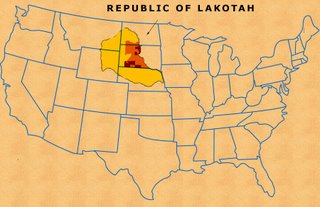
    Comment:  Good points. Which is why a stunt like Russell Means's Republic of Lakotah was such a joke. If the US acknowledged his "country's" sovereignty, he couldn't handle it. His republic would immediately collapse into chaos.

    Granting true sovereignty would take a generation or more of negotiations, I imagine. It would require solutions to everything from defending the independent nation from foreign attack to maintaining the interstate roads. It could be done, but it wouldn't be easy.

    Therefore, the best bet is that it'll never happen. The US can't manage large-scale projects like the Panama Canal, the moon landing, or climate change anymore. And this would be roughly equivalent to that.

    For more on treaties, see US = "Baby Country" and Conservatives Want to Nullify Laws, Indians.

    January 10, 2012

    When Indians make bad decisions

    Here's a case that's gotten a fair amount of publicity:

    Indian family protection law central to emotional custody battle

    By George Howell and Greg BotelhoFor the first few moments of her life, Veronica was with her birth mother.

    For the next two years, she was with her adoptive parents.

    And for the last week, the toddler has been with her biological father, over 1,000 miles away from the only home she'd ever known.

    It's been a long, complicated journey for young Veronica--one made possible by a federal law meant "to protect the best interests of Indian children" that, in the process, has tugged at the heartstrings of all involved.

    The story began in 2009, when Veronica's biological mother and father, Dusten Brown, signed a legal document agreeing to put the girl up for adoption. Brown's attorney, Shannon Jones, says that her client signed the waiver but didn't quite understand it.

    Soon after the girl was born, Brown--a U.S. Army soldier--headed off on a 1-year deployment. It was then that the baby moved on as well, to the Charleston, South Carolina, home of Matt and Melanie Capobianco.

    It was an open adoption, family friend Jessica Munday said. That meant the girl's birth mother could and did maintain a relationship with the girl.

    But Brown, the biological father, wasn't on board. Four months after Veronica's birth, he began legal proceedings seeking custody of her.

    "My client has been fighting for custody of his daughter since shortly after her birth," Shannon Jones, Brown's Charleston-based lawyer, said by e-mail. "He loves this child with all his heart."

    Brown appeared to win that battle late last year. On New Year's Eve, he arrived in South Carolina, picked up Veronica from her adoptive parents, and headed west to his home in Oklahoma.
    This isn't really a pop-culture item, but I thought the following take on Brown's actions was interesting:

    A Fight, A Fight, an Indian and a White! Of Childhood Chants and Indian Child Welfare

    By Gyasi RossI started to think about how many times, in fancy Skin meetings, when Natives make silly/harmful decisions and then defend it under the auspices of “sovereignty.” And we don’t question it publicly, and Indian people look at us shocked if we do question it (just like we never questioned the little Indian kid fighting at my elementary school) simply because it’s an Indian or an Indian Tribe making the decision. That, evidently, is enough to make it “right” in our eyes. Sovereignty trumps all.

    Still, sometimes it’s fair to question whether “Respect our sovereignty” is really code for “Don’t question my stupidity” and whether “Respect our sovereignty” means “I really don’t have a good explanation for this decision, so simply don’t question me because I’m Indian.”

    What if the Indian is wrong?

    Personally, I think we owe Indian people more than that; I think Indians should be treated like everybody else—like adults. Why shouldn’t we be held to the same standards as everybody else? I mean, I’ve been around Natives my whole life, and the ones that I’m around don’t need any special treatment—they’re incredibly capable all by themselves. They don’t want special treatment. Likewise, it’s insulting to the dad’s intelligence to say that he was so oblivious that he didn’t understand the consequences of his signing literally dozens of pieces of paper to give his child away. I think we owe it to Indian people to hold us to the same standards as everybody else and say, “Yes, Indian dad, you are just as competent as anyone else in this country and therefore you must live with your decisions. Like a big boy.” I hope there’s more to the story than what I’ve read—I pray that there’s a principled reason to get behind and support the Native dad and say “he was right” in this unfortunate controversy, and not that he’s simply doing this because he can. Sovereignty is good for Indians. ICWA is good for Indians. But sometimes we have to think critically about the consequences of even good things.
    Comment:  We see some of this in the gaming area. Tribes disenroll members or oppose other tribes' casinos without having to explain themselves. It would be better if they did explain themselves--if the reasons for their actions were transparent.

    If we decide that Brown was wrong to change his mind, then what? Do we rewrite the law to prevent situations such as this one? I don't know. But certainly we should think about it as Ross has done.

    For more on child welfare, see Why the Indian Child Welfare Act Exists.

    December 18, 2011

    Palestinians and Indians "invented"?

    Along with Rick Perry bashing gays, we recently heard Newt Gingrich bashing Palestinians.  He claimed they were an "invented" people--with no right to statehood, presumably.

    Several postings rebuked Gingrich for his ignorance of Middle Eastern history.  Here's the best one I've read so far:

    Newt Gingrich: ignoramus, cheat, cynic or all three?

    By Uri Avnery
    From its very beginning, the Zionist movement has denied the existence of the Palestinian people. It's an article of faith.

    The reason is obvious: if there exists a Palestinian people, then the country the Zionists were about to take over was not empty. Zionism would entail an injustice of historic proportions. Being very idealistic persons, the original Zionists found a way out of this moral dilemma: they simply denied its existence. The winning slogan was "A land without a people for a people without a land."

    So, who were these curious human beings they met when they came to the country? Oh, ah, well, they were just people who happened to be there, but not "a" people. Passers-by, so to speak. Later, the story goes, after we had made the desert bloom and turned an arid and neglected land into a paradise, Arabs from all over the region flocked to the country, and now they have the temerity--indeed the chutzpah--to claim that they constitute a Palestinian nation!

    For many years after the founding of the state of Israel, this was the official line. Golda Meir famously exclaimed: "There is no such thing as a Palestinian people!" (To which I replied in the Knesset: "Mrs Prime Minister, perhaps you are right. Perhaps there really is no Palestinian people. But if millions of people mistakenly believe that they are a people, and behave like a people, then they are a people.")

    A huge propaganda machine--both in Israel and abroad--was employed to "prove" that there was no Palestinian people. A lady called Joan Peters wrote a book (From Time Immemorial) proving that the riffraff calling themselves "Palestinians" had nothing to do with Palestine. They are nothing but interlopers and impostors. The book was immensely successful--until some experts took it apart and proved that the whole edifice of conclusive proofs was utter rubbish.
    And:Nationalism is a relatively recent historical phenomenon. When a community decides to become a nation, it has to reinvent itself. That means inventing a national past, reshuffling historical facts (and non-facts) in order to create a coherent picture of a nation existing since antiquity. Hermann the Cherusker, member of a Germanic tribe who betrayed his Roman employers, became a "national" hero. Religious refugees who landed in America and destroyed the native population became a "nation." Members of an ethnic-religious diaspora formed themselves into a "Jewish nation." Many others did more or less the same.

    Indeed, Newt would profit from reading a book by a Tel Aviv University professor, Shlomo Sand, a kosher Jew, whose Hebrew title speaks for itself: When and How the Jewish People was Invented?

    Who are these Palestinians? About a hundred years ago, two young students in Istanbul, David Ben-Gurion and Yitzhak Ben-Zvi, the future prime minister and president (respectively) of Israel, wrote a treatise about the Palestinians. The population of this country, they said, has never changed. Only small elites were sometimes deported. The towns and villages never moved, as their names prove. Canaanites became Israelites, then Jews and Samaritans, then Christian Byzantines. With the Arab conquest, they slowly adopted the religion of Islam and the Arab culture. These are today's Palestinians. I tend to agree with them.

    Parroting the straight Zionist propaganda line--by now discarded by most Zionists--Gingrich argues that there can be no Palestinian people because there never was a Palestinian state. The people in this country were just "Arabs" under Ottoman rule.

    So what? I used to hear from French colonial masters that there is no Algerian people, because there never was an Algerian state, there was never even a united country called Algeria. Any takers for this theory now?

    The name "Palestine" was mentioned by a Greek historian some 2,500 years ago. A "Duke of Palestine" is mentioned in the Talmud. When the Arabs conquered the country, they called it "Filastin", as they still do. The Arab national movement came into being all over the Arab world, including Palestine--at the same time as the Zionist movement--and strove for independence from the Ottoman Sultan.

    For centuries, Palestine was considered a part of Greater Syria (the region known in Arabic as "al-Sham"). There was no formal distinction between Syrians, Lebanese, Palestinians and Jordanians. But when, after the collapse of the Ottoman Empire, the European powers divided the Arab world between them, a state called Palestine became a fact under the British Mandate, and the Arab Palestinian people established themselves as a separate nation with a national flag of their own. Many peoples in Europe, Asia, Africa and Latin America did the same, even without asking Gingrich for confirmation.

    It would certainly be ironic if the members of the "invented" Palestinian nation were expected to ask for recognition from the members of the "invented" Jewish/Israeli nation, at the demand of a member of the "invented" American nation, a person who, by the way, is of mixed German, English, Scottish and Irish stock.
    Comment:  Pundits have noted that many nations in Africa, Asia, and eastern Europe didn't consider themselves states until they became states in the 20th century.  No one has given a reason we should consider the Palestinians different from other people.

    I've noted the similarities between the Palestinians and Indians before.  This is another area they have in common.  Right-wingers routinely claim that recently recognized tribes were "invented" to foist gaming on us.    Indeed, if they're fighting Indian rights as a whole, they claim all Indian "nations" were invented.  Not that Indians didn't exist, but that they weren't sovereign entities with well-defined governments or territories.  They were just primitive nomads wandering aimlessly like animals.

    Steve Newcomb explains the root of this thinking:

    In the chapter “Francisco de Vitoria and International Law” Anghie points out that Vitoria dealt with such topics as divine and natural law, sovereignty and culture, particularism and universalism. With these elements Vitoria conceptualized an international jurisprudence, and in the context of that thinking Vitoria treated idealized Spanish practices as “universally binding,” and hence binding on the Indians.Anghie says that “Indians are excluded [by Vitoria] from the realm of sovereignty, and Indian resistance to Spanish incursions becomes aggression which justifies the waging of a limitless war by a sovereign Spain against non-sovereign Indians.“ The “crucial issue,” according to Anghie, is the basis of the decision that the Indians were not sovereign: “Vitoria bases his conclusions that the Indians are not sovereign on the simple assertion that they are pagans.” In other words, Vitoria’s judgment was that the Indians were not sovereign because they were not Christians.Never mind that the Founding Fathers recognized Indian tribes as foreign nations and their rulers as kings.  And signed treaties with them exactly as if they were sovereign entities.  These right-wingers are so intellectually dishonest they don't even mention the word "treaty."

    Clearly they don't consider tribal sovereignty a historic fact.  To them, it's a plot to take America away from the white Christians who founded it and give it back to the heathens and savages who wasted it.  And that's what pseudo-Zionists like Gingrich think about Palestinian statehood.  It's a plot to take Israel away from the white Jews who founded it and give it back to the Muslim heathens and savages who wasted it.  

    In short, liberals who support indigenous rights for Indians and Palestinians are basically fighting a cultural war against the Biblical God.  The same Bible-based bigotry motivates the hatred of Indians and Palestinians.

    America the invention

    Comparing the Palestinians to Africans, Asians, eastern Europeans, or American Indians is one thing.  But why stop there?  The most telling comparison is between Palestinians and Americans.  Consider:

  • They were part of another empire for a century or two.

  • They spent decades establishing their own institutions and identities.

  • They finally got fed up and declared their independence as a sovereign state.

  • Which act of invention am I describing:  the founding of an American or Palestinian state?  What's the difference between the two?

    If anything, America is the much bigger "invention."  The British had no claim to North America before they invented one out of thin air.   Unlike the Indians and Palestinians, they hadn't occupied the land for thousands of years.  

    When the British did establish a foothold, they thought of themselves as colonists and subjects of the British Empire.  The idea of an American identity didn't occur to them until the last few years of colonization.  Indeed, the American nationality didn't exist until the Founders invented it on July 4, 1776.

    So the Palestinian aspirations for statehood are just like the American aspirations for statehood.  And Gingrich is a stupid idiot for not understanding this.


    November 28, 2011

    Americans support tribal sovereignty

    Zogby Poll Finds Support for Tribal Sovereignty

    By Rob CapricciosoResults from a new poll by the IBOPE Zogby International polling firm indicate that an overwhelming majority of the American public supports tribal sovereignty—the well-established concept that tribes have the right to govern themselves.

    The poll, released in mid-November, found that 88 percent of the U.S. public supports a component of sovereignty for Native American tribes. The survey found that the overwhelming majority of respondents supported honoring longstanding treaties between the government and tribes.
    Comment:  The survey was commissioned by the Native American Lending Alliance (NALA), which represents tribal payday loan companies. These companies are in trouble with the law for (mis)using sovereignty to shield themselves from scrutiny. That makes the survey's findings a little suspect.

    For more on tribal sovereignty, see Cherokee Nation Risks Everyone's Treaties and "Rent-a-Tribe" Payday Loan Companies.

    October 31, 2011

    American Eagle in FEAR ITSELF

    FEAR ITSELF was Marvel Comics' big crossover event this year. Here's all you need to know about it from Wikipedia:The story's antagonist is the God of Fear, a supervillain who sows doubt and fear among the superheroes of the Marvel Comics Universe.

    The anthology miniseries Fear Itself: The Home Front explores how events of "Fear Itself" affect the ordinary citizens of the Marvel Universe.
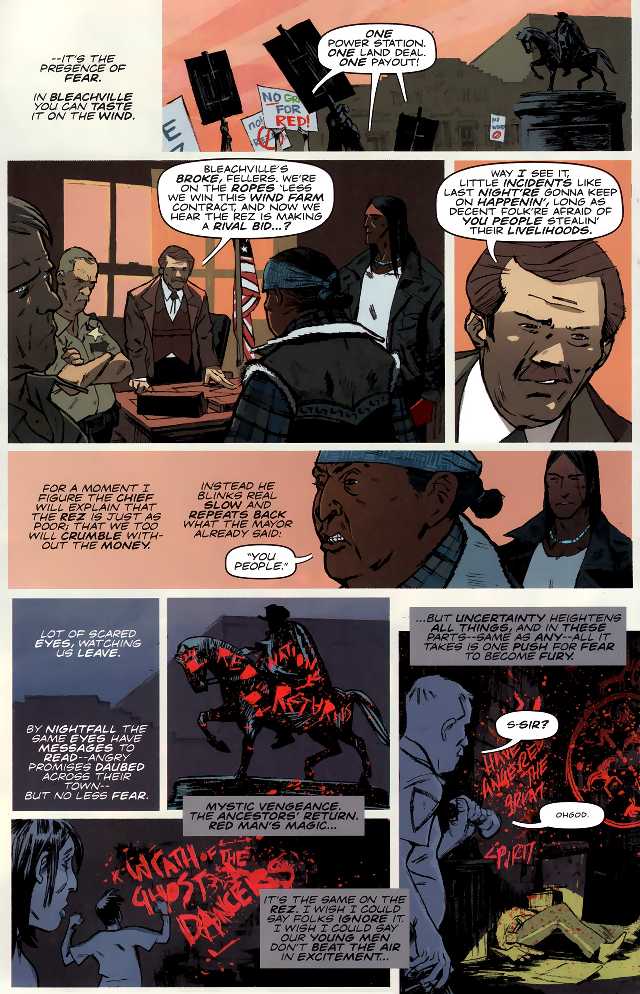
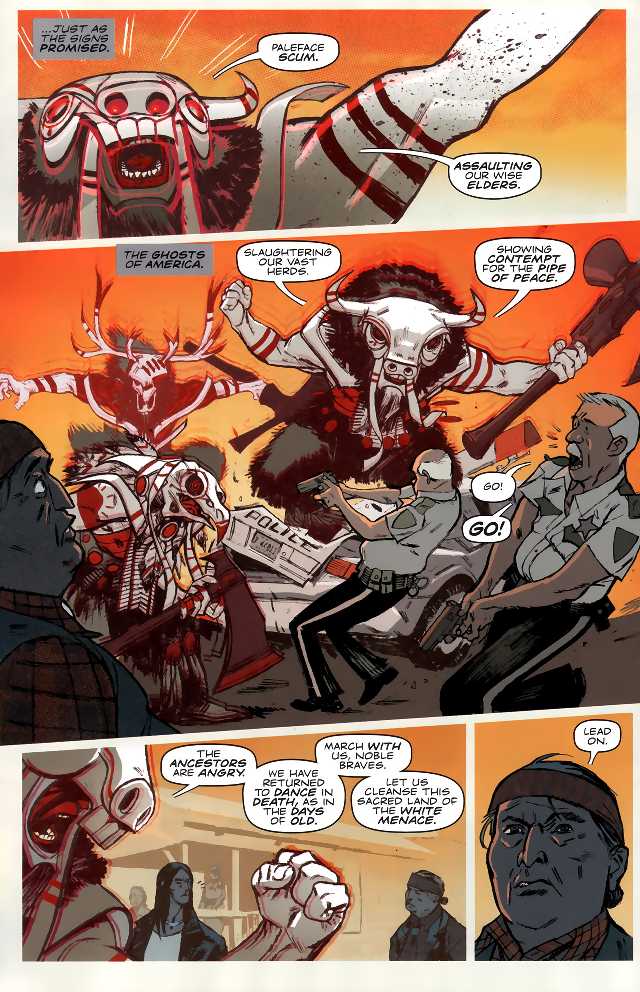
    Issue #5 of THE HOME FRONT mini-series features American Eagle, the Navajo superhero, in a seven-page story titled "Red/White Blues." (Clever title.)


    The plot is dense for a short story:

    **spoiler alert**

    The Navajo Nation is vying with a nearby town to host a wind farm. Tensions between the two sides are running high when the sheriff's deputies find the sheriff dead and scalped. The deputies storm onto the rez and accuse the Navajos of murder.

    Just then, three animalistic "spirits" appear to lead the Indians to "cleanse this sacred land of the white menace." Because of their mistakes and stereotypes, American Eagle deduces that the spirits are white men in disguise. The mayor hired them to get the Indians killed and win the wind-farm contract.

    As one critic said, this story is "mildly entertaining but a little preachy." A couple of things are nice. American Eagle is the voice of reason, and his powers are mostly implied. Also, he unmasks the phonies by noting their ignorance of Indians, an obvious bit I'm not sure anyone has done before.

    The use of mistakes and stereotypes isn't a problem because they're part of the plot. They prove that the dumb white guys are indeed dumb white guys. But the story has a lot of other problems that most readers won't notice. They turn what could've been a fine story into an average one.

    Mistake after mistake

  • The mayor negotiates with a Navajo called the Chief who's wearing a traditional bandana around his head. But the Navajo Nation has a president, not a chief, who oversees a nation of 300,000 people. He probably wouldn't negotiate a business deal with the mayor of Bleachville, a small town. He'd send an official in charge of business development instead. And whoever did the negotiating, the person probably would wear a business suit, not work clothes.


  • The mayor utters the phrase "you people," which sends the Chief into a rage. In a few hours, Navajo youths are spray-painting angry messages on walls and statues. But "you people" is far too mild a slur to set off a race riot. Young men wouldn't get excited over that. They also wouldn't care much about the possible loss of a wind-farm contract.

  • The sheriff's murder packs a slew of mistakes into just four panels. For starters, I don't think the Navajo traditionally scalped anybody. If they did, it hasn't happened in more than a century. The deputy who found the body obviously hasn't watched many TV shows featuring Indians. If he had, he'd know the scalping is probably a frame-up.

  • I'm pretty sure the sheriffs have no authority on the Navajo Nation. If a Navajo living on the rez committed a crime off the rez, I believe the FBI would get involved. In any case, the deputies have no reason to suspect any of the 300,000 Navajos. With zero evidence, they should be canvassing the neighborhood for witnesses, because the murderer could be anybody.

    The deputy who storms onto the rez and punches the chief in the face is flatly ridiculous. After assaulting a head of state, the deputy almost certainly would lose his job and pension. He'd probably go to jail, if not a psych ward.

    Moreover, his stated goal, to haul in "a list of known troublemakers," is a violation of the Fourth Amendment. He might get away with that in a small town with no legal oversight...but on a reservation? There's no way he could remove Navajos from their territory without arrest warrants, and probably not even then. Indeed, I suspect the Navajos would be well within their rights to arrest the deputy for assault and battery.

    The deputy could've asked the Navajo tribal police for help...but they're nowhere in sight. The writer seems unaware that the Navajo have their own law enforcement system. This is a nation, buddy, not a few Indians huddled in blankets.

    "Finish the reservation"?!

  • Then there's the bogus plan of the mayor and his stooges pretending to be "spirits." It looks like perhaps a dozen Navajos follow the stooges as they threaten to go on a rampage. The Chief eventually states the stooges' real goal: "to lead my people into a massacre, to finish the reservation."


  • Huh? Does the Chief mean that white people would kill the "marauding" Indians? There's no way he could gather most or all of the Navajos to march against the white man. And there's no way that killing the actual number of marchers could "finish the reservation."

    Or does the Chief mean the angry "spirits" and Indians would discredit the Navajo Nation and "finish" it that way? The answer is still no. Even if the marchers terrorized the region with WMDs, they'd have little or no effect on the other 300,000 Navajos. They wouldn't do a thing to threaten the Navajo Nation's sovereign status.

    Besides, the spirits launched their attack in the border town, not on the rez. A wind-farm company would look at the situation and see mayhem in both locations. It would shift its operations elsewhere and both sides would lose.

    So the mayor's plan is flatly ridiculous, again. And so is the writer's knowledge of Indians. We're talking about 300,000 people spread over three states, not 30 people in trailers. "Finish the reservation"? You'd have to launch a full-scale invasion of Dinetah to overthrow the Navajo government and "finish the reservation."

    Conclusion

    Despite the glossy art, the story reads like something out of the Silver Age. A small band of Indians led by a chief...evil white men trying to discredit the "savages"...it's all been done before. In the 1960s, the prize would've been oil or uranium and the story would've had a veneer of relevance. In the 1950s, the story would've been a traditional Western and the prize would've been a gold mine.

    So...nice try, but no cigar. Memo to Marvel: Don't write about politics, business, or law enforcement on the rez unless you know something about it. Give me a call if you need some advice.

    For more on American Eagle, see Assistants Do American Eagle and American Eagle Triumphant.

    October 06, 2011

    Cherokee Nation risks everyone's treaties

    In The Treaties in Our Dreams, columnist Steve Russell makes a point about the Cherokee Freedmen case that occurred to me too. Namely, that it's dangerous for an Indian tribe to abrogate one of its own treaties.

    Russell notes a particular danger. Courts have ruled that tribes are political entities, not racial entities. But the Cherokees have argued that the Freedmen aren't Indians unless they have at least one Cherokee ancestor. The Freedmen counter that they're Indians by treaty and by 150 years of participating in Cherokee life.

    Here's how Russell puts it:Remember the position of the modern Indian fighters: every program that benefits Indians, all of Title 25 of the US Code, is racial discrimination against white people. Our response to that is the distinction between “race” and citizenship that the Cherokee Supreme Court has trashed without analysis. This distinction is what has kept money flowing to Indian country over the objections of the Indian fighters.

    The danger is obvious that the Congressional Indian fighters could use the Cherokee case as a wedge against all appropriations to tribes, even those required by treaty. Circumstances have changed, you see, and “race discrimination” cannot be tolerated.
    Comment:  Excellent point. If the Cherokees insist that only people with Indian "blood" can be tribal members, the "Indian fighters" may go along. They may use that assertion to claim that every treaty and law that favors Indians is discriminatory. Then they could overturn two centuries of Indian law and wipe out the tribes as sovereign entities.

    For more on the subject, see Minority-on-Minority Freedmen Battle and Deal Restores Freedmen Citizenship.

    September 26, 2011

    "Rent-a-tribe" payday loan companies

    Payday lending bankrolls auto racer's fortune

    A joint investigation of iWatch News and CBS News
    By David Heath
    Scott Tucker used stealth to become a millionaire. Now the mysterious businessman from Kansas is spending his fortune to become a famous auto racer.

    Though Tucker has not won any premier races outright, his publicity machine already compares him to NASCAR superstar Jimmie Johnson. It produced a slick documentary of his team’s third-place finish at a Daytona race which played at film festivals and aired on the Discovery Channel. A glowing Wall Street Journal profile last year dubbed Tucker as "Racing’s One-in-a-Million Story."
    But:What Tucker doesn’t publicize: he is an ex-convict who runs a controversial business that regulators in at least five states have tried to shut down for violating their laws. Hiding behind a labyrinth of shell companies and operating from the ether of the Internet, Tucker’s businesses make payday loans over the Web even in states where they are outlawed. He offers quick cash to people desperate enough to borrow money from a faceless Web site, even signing over access to their bank account to total strangers. And he charges nearly 800 percent interest on loans that take months to pay off.

    iWatch News found that some of Tucker’s tactics are common among businesses operating on the fringes of the law. By setting up a confusing array of shell companies and selling over the Internet, businesses are often able to frustrate state investigators trying to figure out simply who’s who.

    But Tucker’s most innovative tactic has given businesses a new, powerful tool for eluding state authorities. The tactic has survived major court challenges, but the practice is so questionable that even storefront payday lenders–hardly known as paragons of business probity­–denounce it as unethical.

    Tucker has partnered with a number of small Indian tribes to provide his payday lending business with the cloak of tribal sovereign immunity. Under federal law, tribes are equal to states as sovereign powers. So they are immune from being sued in state court.

    Tucker says his payday lending businesses are now owned by the Miami and Modoc tribes of Oklahoma as well as the Santee Sioux of Nebraska. However, iWatch News found evidence in court and public records showing that Tucker secretly runs the payday lending business from his offices in Overland Park, Kan.

    Lawyers in the Colorado attorney general’s office described Tucker’s tactics as a “web of deceit.” Others refer to it as “rent-a-tribe.”
    Below:  "Payday lender turned racecar rookie, Scott Tucker." (Level 5 Motorsports/Flickr)


    Complaints Filed Against Miami-Area Tribal Payday Loan Companies

    By Lori FullbrightAn investigation of tribal-owned payday loan companies operating in Oklahoma finds that 30 percent of all the payday loan complaints filed at the Better Business Bureau are against seven companies, all located east of Tulsa in Miami.

    Why are these companies exempt from state and federal guidelines?

    These seven payday loan companies operate almost entirely on the Internet. The Better Business Bureau has received more than 2,000 complaints against them. Companies MTE Financial Services, 500 FastCash, Instant Cash USA and Cash Advance Network all have the same address, and the BBB traced that address to a Casino and Smoke Shop owned by the Modoc Indian Tribe.

    Ameriloan, United Cash loans, and USFastCash all have the same address and the BBB found it is the offices for the Miami Nation Indian Tribe.

    "The fact the tribe supposedly owns the company is not the problem. It's the business practices," said Rick Brinkley of the Better Business Bureau.

    "A tribe can own a company and never generate a complaint, but what makes this unique is because the tribe does own it, state and federal laws do not apply."
    Comment:  I wouldn't support any violations of the tribes' sovereign rights. But I wish tribes would police these payday loan businesses or, better yet, shut them down.

    For more on the subject, see Native Coalition Defends Payday Loans and Payday Loans Violate Native Values.

    Below:  "The exterior of Miami Nation Enterprises, which has an online payday lending business that has sovereign status beyond the reach of state regulators." (David Heath/iWatch News)