Showing posts with label Kevin Gover. Show all posts

September 18, 2014

"Nation to Nation" treaty exhibit

NMAI To Open New Exhibit Exploring Native and U.S. Relations

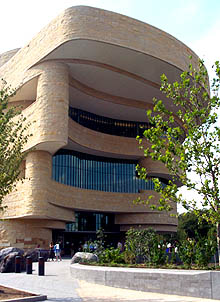
By Madeline McGillSince its opening, the National Museum of the American Indian (NMAI) has dedicated itself to the promotion of native identity and cultural understanding. Now celebrating the 10th anniversary of the D.C. museum, it is launching an ambitious exhibit this September that seeks to highlight the role of treaties between the United States and Native Nations.

Upon opening September 21, 2014, the exhibit “Nation to Nation: Treaties Between the United States and American Indian Nations,” will explore the Native diplomats and leaders who crafted some of the earliest agreements with the Founding Fathers.

Amongst the many artifacts expected to be on display, the exhibit will feature 8 prominent National Archive treaties from the approximately 374 ratified between the United States and Native Nations. These treaties will trace a timeline of diplomacy from first meetings to present, touching at the core of how U.S. and Native relations have impacted culture and development.

On September 8th, the NMAI welcomed the arrival of the Treaty of Canandaigua from the National Archives and Records Administration. Enacted between the Haudenosaunee (also known as the Six Nations or the Iroquois Confederacy) and the U.S., this treaty was signed by George Washington in 1794 to establish peace, friendship, and affirm land rights to the Haudenosaunee in modern day New York State.
Treaties Exhibit Ushers in 10 Years of American Indian Museum

By Bridget BowmanThe National Museum of the American Indian will open its first exhibit exploring the contentious issue of treaties between the U.S. government and Indian Nations next week.

“This exhibit is a tangible reminder of the federal government’s relationship with sovereign tribal nations of this country,” Senate Indian Affairs Chairman Jon Tester, D-Mont., said Thursday. “It’s also a reminder of the moral and legal obligations that the United States has to honor and uphold our treaties with Indian country.”

Tester addressed a group gathered at a day-long symposium at the museum discussing the exhibit. “Nation to Nation: Treaties Between the United States and American Indian Nations” opens Sept. 21, which is the 10th anniversary of the opening of the museum. The exhibit will continue until the fall of 2018.

Museum Director Kevin Gover said during a preview Tuesday that the display was years in the making and came at the request of a number of tribes and members of Congress.
Comment:  Some people live-tweeted comments during the day-long symposium discussing the exhibit. Here are the ones I retweeted:

Senator Jon Tester @SenatorTester · Sep 18
This exhibit is a tangible reminder of the federal government's relationship with the sovereign tribal nations. #NationToNation

Debbie Reese @debreese · Sep 18
Clinton: Early treaties re friendship became vehicles for land dispossession. #HonorTheTreaties #NationToNation

Mark Trahant @TrahantReports · Sep 18
Clinton: 1868 Ft Laramie, Lakota had won, US suing for peace. "If conquest" brings rights "we should be speaking Lakota."

Mark Trahant @TrahantReports · Sep 18
Clinton: IRA spurred "sovereign to sovereign" relationship req'g consent and negotiation. "Treatymaking is back." #HonorTheTreaties

Debbie Reese @debreese · Sep 18
Gover: Want to put concept of Native sovereignty into American's knowledge of American Indians. #NationToNation #HonorTheTreaties

Debbie Reese @debreese · Sep 18
Harjo: American's don't realize treaties are AMERICAN, too, made by American govt with Native Nations. #HonorTheTreaties #NationToNation

Debbie Reese @debreese · Sep 18
Gover: With tribes managing resources themselves, resources (salmon) are making comebacks. Good for all. #NationToNation #HonorTheTreaties

Debbie Reese @debreese · Sep 18
Listening to Macarro highlights (for me) how disgusting it is that California schools focus on missions. #NationToNation #HonorTheTreaties

Debbie Reese @debreese · Sep 18
Deloria: Task is to teach students that history matters to the present and future. #NationToNation

Debbie Reese @debreese · Sep 18
Cladoosby: Has US kept its word? George Washington made promises he didn't keep. #NationToNation #HonorTheTreaties

Debbie Reese @debreese · Sep 18
Cladoosby: "Sometimes I think we are more patriotic, maybe because we were on this land first, we love her more" #NationToNation

Mark Trahant @TrahantReports · Sep 18
"We can love this country despite the incredible, painful history ... despite promises not kept," Brian Cladoosby. #HonorTheTreaties

Debbie Reese @debreese · Sep 18
Gover: Congress apology to Am Indians, sponsored by Brownback, was buried, but signaled US beginning to acknowledge history

Mark Trahant @TrahantReports · Sep 18
Kevin Gover: NMAI act is an apology; yes US did these things. Thus the oppty to tell Native story and for US to listen. #HonorTheTreaties

Debbie Reese @debreese · Sep 18
Gover: History is being mis-taught in formal education systems in US. All of us have to un-learn those things. #NationToNation

Debbie Reese @debreese · Sep 18
Gover: Justice is achievable because Indians never give up. We always insist on a just outcome. #NationToNation

Debbie Reese @debreese · Sep 18
Harjo: Arguments that 'too much time has passed, therefore, move on' is bogus argument. Treaties matter. No end date. #NationToNation

You can see all the tweets on the symposium by searching the #NationToNation and #HonorTheTreaties hashtags in Twitter.

For more on treaties, see Myth of the Level Playing Field and Tamara Johnson Ad Sparks Outrage.

February 07, 2013

NMAI symposium on racist mascots

Before the symposium

The Director of the Indian Museum Says It’s Time to Retire the Indian Motif in SportsWhen Kevin Gover was a kid growing up in Norman, Oklahoma, college students at the nearby University of Oklahoma had begun protesting the school’s mascot. Known as “Little Red,” the mascot was a student costumed in a war bonnet and breech cloth who would dance to rally crowds. Gover, who today is the director of the American Indian Museum, says he remembers thinking, “I couldn’t quite understand why an Indian would get up and dance when the Sooners scored a touchdown.” Of Pawnee heritage, Gover says he understands now that the use of Indian names and imagery for mascots is more than just incongruous. “I’ve since realized that it’s a much more loaded proposition.”

On February 7, joined by a panel of ten scholars and authors, Gover will deliver opening remarks for a discussion on the history and ongoing use in sports today of Indian mascots.

Though many have been retired, including Oklahoma’s Little Red in 1972, notable examples—baseball’s Cleveland Indians and Atlanta Braves, and football’s Washington Redskins—continue, perhaps not as mascots, but in naming conventions and the use of Indian motifs in logos.

“We need to bring out the history, and that’s the point of the seminar, is that it’s not a benign sort of undertaking,” explains Gover. He’s quick to add that he doesn’t regard the teams’ fans as culpable, but he likewise doesn’t hesitate to call out the mascots and the names of the teams as inherently racist.
Racist Stereotypes in Sports to be Discussed at NMAI Thursday

At the symposium

Redskins name change demanded at Smithsonian forum

By Annys ShinThe symposium on “Racist Stereotypes and Cultural Appropriation in American Sports” was a day-long assault on the use of Native Americans as sports mascots. It was a thorough prosecution, delivered by a dozen or so mostly academic speakers before an audience of more than 300 people.

The speakers took issue with the standard defense offered by past Redskins owners that the name is a way of honoring Native Americans.

“Honors like that we don’t need,” said Robert Holden, deputy director of the National Congress of American Indians.

The name was intended to honor one man, former head coach William “Lone Star” Dietz, said Linda Waggoner, a lecturer at Sonoma State University in California. As the story goes, in 1933, co-owner George Preston Marshall renamed the then-Boston Braves the Redskins after Dietz, who adopted the identity of a Lakota man as part of his persona. The Redskins name followed the team to Washington.

Waggoner said Dietz may not have been Sioux at all but initially passed himself off as so to avoid military service.

Several speakers discussed how demeaning the term is considered. Manley Begay recalled being taunted as a “dirty redskin.”

“Those words have stayed with me,” said Begay, co-director of the Harvard Project on American Indian Economic Development and one of the plaintiffs in a 1992 lawsuit challenging the Redskins trademark.
After the symposium

Patrick Pexton: Listening to Native Americans

By Patrick B. PextonThe Post recently published a spate of columns, by different writers, calling for the local National Football League team’s nickname to be changed to avoid its racist overtones. You know, the red and gold team led by Robert Griffin III.

Meanwhile, on Jan. 28 The Post pulled from publication a short high school sports story about the girls swim team at Holton-Arms School in Bethesda, the Panthers. It was held because the photo that went with the story showed the girls, who dress in a different theme each meet to encourage team spirit, wearing face paint and feathers—seemingly Native American warrior garb.
And:I talked to Native American groups and individuals this week, too, about the football team’s name, and about the swimmers in their garb. I’m not sure words can properly convey the depth of feeling I heard from them.

Wearing face paint and feathers, many Native Americans feel, is a taking of their cultural and religious traditions. The paint and feathers have distinct meanings for each tribe and nation, and they often are worn only because an individual has earned them through tests, deeds and ceremonies of which white culture has little knowledge or appreciation.

The best analogy I could come up with is the way we treat U.S. military uniforms and insignia. It is against federal law for a civilian to wear the uniform of a U.S. soldier, sailor, airman or Marine for personal gain. Similarly, within the military, if you wear a medal or insignia that you didn’t earn, it is a crime under military law.
And:As for RGIII and his teammates, Harjo and every other Native American I spoke to see the team name as racist. It hearkens to the early European settling of this country, when French and British authorities put bounties on the heads, or skins, of Native American men, women and children.

“Every major national Native American organization has declared that the name of the pro football team in our nation’s capital is the most offensive thing native peoples can be called in the English language and has called for it to be changed,” she said.

“It’s okay if others aren’t offended by it,” she added. “They should respect that we are offended and that this is something they can do something about—in our world where we can do little about most things, this is something we can actually do something to fix. They should care about it even a tiny bit because we care about it so much.”
Redskins: The Clock Is Now Ticking on Changing the Name

By Dave ZirinIt’s an awkward fact of life in Washington, DC, that we are home to both the Smithsonian’s National Museum of the American Indian and the Washington Redskins. One attempts to preserve the Native American cultures that weren’t eradicated by conquest; the other is both a symbol and result of the same eradication. These two worlds collided this past week when the museum hosted a day-long symposium about Native American sports nicknames. In a packed auditorium, panelists and audience members took the local team to task, calling their name “ugly,” “offensive” and “a racist slur.” Former Colorado Senator Ben Nighthorse Campbell, the only Native American senator in US history, said from the stage, ”If you want [your mascot] to be a savage—use your own picture.” Not one person either in the audience or the crowd defended the use of "Redskin,” because, as one fan of the team said to me, “it really is defending the indefensible.”

Despite repeated requests from the museum, the Redskins refused to send anyone to make the case publicly that the name is anything other than a self-evident slur. Like their owner, the ham-fisted, rabbit-eared Dan Snyder, they celebrate the moniker only when no one is present to challenge them. Since purchasing the franchise in 1999, Snyder has maintained that the name "Redskins” was a “tribute,” as former team Vice President Karl Swanson said, “derived from the Native American tradition for warriors to daub their bodies with red clay before battle.” This is not an argument they felt confident making at the Smithsonian because the laughter would have cracked the Capitol dome. The team name was the brainchild not of an anthropologist who advised on the fierce honor of the “red-clay warriors” but of team founder, segregationist and Dixiecrat George Preston Marshall.

Senator Campbell said that he asks people, “How would you feel if the team was called the Washington Darkies?” George Preston Marshall would have felt euphoric because he adored minstrel shows and fetishized the confederacy. As Thomas G. Smith wrote in his book Showdown: JFK and the Integration of the Washington Redskins, when Marshall proposed marriage to his future wife Corrine, he did so “amidst fragrant honeysuckle while a group of African American performers [dressed like house-slave extras from Gone with the Wind] sang ‘Carry Me Back to Old Virginny,’” a song that speaks lovingly of how slaves love to see affection between their “Massa and Missus.” The Redskins were named for the minstrelsy Marshall adored and, as the southernmost team in the league at the time, to appeal to Dixie. They were also, surprise, the last team in the NFL to integrate.

If you know this background, it’s risible to hear NFL Commissioner Roger Goodell say, “I think Dan Snyder and the organization have made it very clear that they are proud of that name and that heritage, and I think the fans are, too.” There is nothing to be proud of in this “heritage,” unless your tastes tend toward the antebellum South. In a league that’s 70 percent African-American yet couldn’t seem to find any coaches or executives of color to hire this off-season, the Redskins are also a reminder, as William Faulkner wrote, that “The past is never dead. It’s not even past.”
Comment:  Patrick Paxton is the Washington Post's ombudsman. His commentary is another sign that people are starting to take this issue seriously.

Note that I compared wearing headdresses to medals in Hipster Medals Instead of Headdresses. Glad to see someone else recognized the validity of the comparison.

For more on the Washington Redskins, see Rob Quoted on Washington Redskins, Indians Are "Whiners," Not Warriors? and "Redskins" Approaching a Tipping Point?

October 08, 2011

NMAI celebrates Standing Bear

"We Are a People: The Ponca Journey" Coming to National Museum of the American IndianThe Smithsonian 's National Museum of the American Indian presents "We Are a People: The Ponca Journey," a free two-day festival featuring music, dance, play readings, a film screening and panel discussions with the Ponca Nation of Nebraska Friday, October 7, from 11 am-10 pm and Saturday, October 8, from 10:30 am-5 pm.

In 1879, a full 75 years before the Supreme Court issued its monumental decision in Brown v. Board of Education, a Ponca chief named Standing Bear stood up, extended his hand, and made a speech:

“This hand is not the color of yours, but if I pierce it, I shall feel pain. If you pierce your hand, you also feel pain. The blood that will flow from mine will be of the same color as yours. I am a man. The same God made us both.”

Standing Bear's argument convinced the federal judge to declare for the first time in the nation's history that Native Americans are "persons" under federal law, a declaration that contradicted decades of Indian policy.
Kevin Gover, director of the National Museum of the American Indian, wrote:Last night, Supreme Court Justice Sonia Sotomayor came to the museum for the opening reception of the Ponca festival. She gave a lovely speech about the significance of the Standing Bear case (in which Chief Standing Bear was found to be a "person" under federal law). The Poncas then honored her with a song composed for Standing Bear many years ago. Indians have such a great sense of history and ceremony.Comment:  For more on Standing Bear, see NEA Award for "Native Daughters" Project and Standing Bear's Increasing Exposure.

July 30, 2011

Red Shirt vs. Gover

An excerpt from Steve Russell’s new book, Sequoyah Rising:The Cherokee were not the only Indian peoples seduced by the ideology of color prejudice. Some kind of nadir was reached in 2002 by a Lakota—if not of racism, then of shortsightedness. Author and former adjunct professor at Connecticut College Delphine Red Shirt, writing in the Hartford Courant in 2002, opined that she was offended by Connecticut’s definition of “Indian”:

Why? Because I am an Indian. I grew up Indian, look Indian, even speak Indian. So it offends me to come east and to see how “Indian” is defined in this state that I now call home.

What offends me? That on the outside (where it counts in America’s racially conscious society), Indians in Connecticut do not appear Indian. In fact, the Indians in Connecticut look more like they come from European or African stock. When I see them, whether they are Pequot, Mohegan, Paugussett, Paucatuck or Schaghticoke, I want to say, “These are not Indians.” But I’ve kept quiet.

I can’t stay quiet any longer. These are not Indians.…

There are no remnants left of the Indigenous Peoples that had proudly lived in Connecticut. What is here is all legally created. The blood is gone.
And:Kevin Gover, the Pawnee former assistant secretary for Indian Affairs on whose watch during the Clinton Administration some of the objects of Red Shirt’s dudgeon were recognized, replied in the pages of Indian Country Today:

As I understand her position, Connecticut Indians are not Indians because they do not look like her, do not act like her, do not speak like her, do not—well, you get the picture. (They also do not have cool names like hers, but she forgot to mention that.) Expect to see Ms. Red Shirt trotted out every time some white people want to say something ugly about Indian people but dare not do so because they would be labeled as racists.

I think we brown-skinned, black-haired Indians had better be careful about what we say about New England Indians. There are fewer and fewer full-bloods among us. If being Indian means looking a certain way, then most tribes are only two or three generations from extermination.

The New England Indians did what they had to do to survive. They intermarried and accommodated the overwhelming presence of non-Indians. Yet they persevered and maintained themselves, some of them, as distinct social, political and cultural communities. Are they the same as the Indians who greeted the English and Dutch settlers in the 17th century? Of course not. But then few if any tribes closely resemble their pre-Columbian ancestors.
Comment:  I reported on Red Shirt's column when she wrote it in December 2002. I included the responses of Kevin Gover, Steve Russell, and others. As you can see for yourself, they're still right and she's still wrong.

For more on tribal identity, see Tribes Need Citizenship Tests and "Minimal Bloods" = Greedy White People?

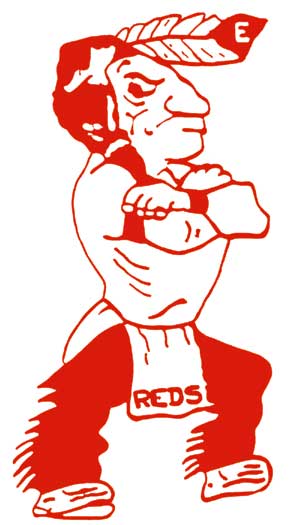
Below:  Kevin Gover.

May 21, 2011

Gover summarizes Native stereotypes

Kevin Gover, NMAI director, gives a good overview of Indian mascots and stereotypes. He starts with how most Americans learn about Indians.

Native Mascots and Other Misguided Beliefs

By Kevin GoverOnly a very small percentage of the population has devoted extensive study to Native history, art, and culture, so their understandings are formed based on the limited information they have received from two sources: the formal education system in the United States and the popular media culture in the United States.

My own experience contending with the information I was given while growing up in Oklahoma is instructive. Native history and culture was only rarely touched upon while I was in elementary school and junior high school. Though I had, of course, more than the usual interest in these subjects, I can recall only the occasional reference to American Indians, almost always accompanied by a photo of Indian people standing on a rocky hillside dressed in feathers and buckskin. I learned nothing about the history of Native people prior to contact with Europeans, save the few pages in my Oklahoma history book dedicated to the Spiro Mounds, a Caddoan-Mississippian archaeological site in eastern Oklahoma. It was as though what pre-existed Columbus’s arrival in America was uninteresting and unimportant.

Like most young people of my generation, I absorbed an odd set of information about Native history after contact with Europeans. In grade school I learned that “In fourteen hundred and ninety-two, Columbus sailed the ocean blue. He sailed, and sailed, and sailed, and sailed to find this land for me and you.” I learned of the friendly Indian Squanto who taught the Pilgrims to grow corn; of the Indian “princess” Pocahontas who saved Captain John Smith from death at the hands of her evil father; of Sacajawea, the intrepid “squaw” who guided Lewis and Clark through the Rocky Mountains; of the massacre of the gallant General Custer by savage Sioux at Little Big Horn.

Things improved somewhat in junior high school, where we did learn that all of Oklahoma had once been designated Indian Territory and of the removal of the “Five Civilized Tribes” from their homes in the southeast. But we moved quickly on to more important matters such as the land rushes, the discovery of oil, the establishment of Oklahoma Territory and the entry of Oklahoma as the forty-sixth state. I don’t recall being told that all of this involved the abrogation of treaty promises that Oklahoma would belong to Indians forever.

Meanwhile, at the movies and on television, westerns were thriving. Even while knowing these stories were fictional, they wore on me. The Indians were semi-naked, mono-syllabic, and fierce (quite unlike the many Indians I knew as family and friends). The white people were smart, ethical (the heroes, anyway), and only reluctant users of violence. The racial message was consistent and powerful: Indians were stupid and violent, though noble in their savagery, and white people were civilized, principled, and heroic.
Then he sums up the messages received:Taken together, the messages my generation received from our formal education and the popular culture were clear. Indians were interesting only in terms of their engagement with non-Indians. A good Indian was one who assisted white people in establishing civilization in the American wilderness. Native women were especially likely to see the virtues of white civilizers and assist them in their efforts. Native men, being violent and dim, resisted civilization ferociously but futilely. (Note that they were not portrayed as resisting the taking of their property and the ruin of their way of life; they were resisting “civilization” itself.) Above all perhaps, contemporary Indians were not relevant. Indians were figures of the past. It would be entirely fair for a non-Indian student in, say, Ohio to conclude that Indians simply ceased to exist. This is a powerful set of ideas being delivered over and over. They made growing up as an Indian child harder than it had to be.Gover notes the flaws found even in recent movies:Even the movies in which Indians are heroes too often engage in the old stereotypes. The large blue Indians of “Avatar” and the Indian werewolves of the popular “Twilight” series may be heroes, but note the spectacular violence of which they are capable. Note as well the addition of new stereotypes that evolved in the late twentieth century: Indians as pristine environmentalists and, even better, magic Indians.And how mascots send a similar message:Native mascots are primary offenders in perpetuating these stereotypes. Consider why a franchise or university might choose a Native image to represent its team or teams. We are told that they are meant to honor Native American qualities such as bravery, strength (physical, not mental), endurance, and pride. Certainly Native people had and have those qualities in varying degrees, though I do not believe that they had or have them in greater quantity than other peoples. And why is it that Native people are not chosen to represent positive human qualities such as intelligence, piety, generosity, and love of family? I suppose the answer is that we are far less interesting to mascot makers when revealed to be ordinary human beings, with all the virtues and failures of other human beings.Comment:  Let's reiterate the key points here. First, the source of Native stereotypes, which I've stated hundreds of times:[T]heir understandings are formed based on the limited information they have received from two sources: the formal education system in the United States and the popular media culture in the United States.And the implicit message of every chief, warrior, and mascot representing a old-fashioned Indian:Indians [are] stupid and violent, though noble in their savagery, and white people [are] civilized, principled, and heroic.Exactly.

For more of Gover's positions, see Gover on Indians and Jews and Movies Teach "Racist Assumptions."

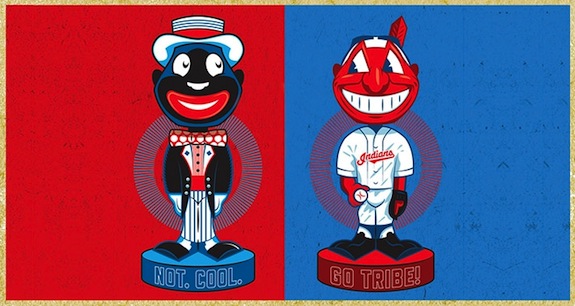
Below:  "Me lik'um this essay. It heap good medicine."

May 12, 2011

Oneida Nation gives another $1 million to NMAI

Oneida Indian Nation donates $1 million to Museum of the American Indian

By Matt PowersOneida Nation Representative and CEO of Nation Enterprises Ray Halbritter and members of the Nation’s Council presented a $1 million check to Kevin Gover, director of the Museum of the American Indian in Washington, D.C. on Wednesday morning.

The OIN made a $10 million pledge in 2004 and has given $7 million since that time. The money goes into general funds for the museum.

“Even during difficult economic times, we understand that preserving our history and teaching future generations about our past remains our most solemn responsibility,” said Halbritter.

Gover said the museum would not exist without the generosity of people across the country.
Oneida Indian Nation presents $1 million donation to National Museum of the American Indian

By Alaina PotrikusFounded in 1846 and now the world’s largest museum and research complex—with 19 museums and galleries, the National Zoological Park and nine research facilities—the Smithsonian, with its reputation and longevity, will be a strong component of the tribe’s goal of public education, Gover said.

“We can use it to tell a different story—a new, more complete story than has been told to the American people in the past,” he said.

“That ignorance and misunderstanding almost always works to the disadvantage of Indian tribes,” Gover continued. “Resolving that by filling out the narrative is a service we can provide to the Indian people.”

The museum’s fourth floor, which was named for the Oneida Nation’s donation, is home to a 19-foot bronze sculpture depicting an Oneida leader and an Oneida woman, Polly Cooper, along with George Washington is titled “Allies in War, Partners in Peace.”
Comment:  For more on the NMAI, see NMAI Plans "Complete Reinstallation" and NMAI = Greatest Story Never Told.

March 15, 2011

NMAI plans "complete reinstallation"

Shows That Defy Stereotypes

By Lee RosenbaumEveryone who visits a museum display about American Indians "wants to see feathers, tepees and horses," Kevin Gover, director of the National Museum of the American Indian, lamented recently in his Washington office. But new installations at NMAI's New York facility, as well as at the Denver Art Museum and Brooklyn Museum, are out to prove, in Mr. Gover's words, that "Indians are not what you think they are."

The effect of these stereotype-busting displays is sometimes jarring, especially because the canon now includes contemporary art. Today's curators want visitors to view Indian artworks not as quaint ethnographic artifacts, but as vital expressions of a living culture, spanning prehistory to the present.
And:Unlike the offerings in Brooklyn and Denver, the permanent-collection displays at the NMAI, part of the Smithsonian Institution, don't indulge the public's appetite for fully assembled painted tepees. The introductory gallery in the definitive "Infinity of Nations," a 10-year permanent-collection installation that recently opened at the NMAI's New York outpost, also defies public expectations about headgear: It omits the resplendently feathered, full-length warrior bonnet in favor of an array of 10 fanciful examples of headgear—everything from a conical wooden Yu'pik (Alaska) hunting hat decorated with carved-ivory sea mammals to a Yoeme (Mexico) dance headdress topped by a realistically rendered deer's head with antlers.

Curated by Cécile Ganteaume, with multimedia commentary by tribe members and scholars, "Infinity of Nations" takes visitors on an in-depth journey from South America to the Arctic, with engagingly presented information about objects, cultures, individual artists and historical figures. It ends with a contemporary section featuring 18 artists. Washington's NMAI also accords prominence to contemporary art in curator Rebecca Head Trautmann's wide-ranging, thematically organized "Vantage Point" show (to Aug. 7), displaying 31 works it acquired over the past seven years.
I haven't seen the "Infinity of Nations" display, but it sounds like the right approach. Display a variety of headdresses to show that Indians didn't wear only the Plains chief's warbonnet. Showcase Native cultures from the length and breadth of the Americas to make people aware how diverse they were and are.Unlike other museums that are ramping up their consultations with tribal communities, the NMAI plans to rely more strongly on its own expertise. (It is already largely staffed by American Indians, including its director, a member of the Pawnee and Comanche tribes.) The objective is to make its presentations "more consistent in voice and more cogent in narrative," Mr. Gover explained.

For the first time, he disclosed plans for a complete reinstallation of the Washington museum, beginning in 2014. The new approach he described may deflect the harshest attack directed at the inaugural displays by some American Indians—that the depredations and atrocities suffered by indigenous people at the hands of white invaders were soft-pedaled. New displays will likely focus on several provocative themes, according to Mr. Gover, a lawyer with scant background in art or museums. Among them: the devastation of the indigenous population "on the order of 90% to 95%"; the role of contact with Europeans as "the definitional event that shaped the modern world."

References to "massacre" and "genocide" may be included, if deemed appropriate by the curators, said Mr. Gover, who succeeded director W. Richard West Jr. three years ago. "You don't have an American Indian museum without discussion of dispossession and death on a scale unknown in human history," he declared.

This approach may put the Washington museum even more at odds with those art lovers who found the inaugural installation too political and polemical. And it would move the museum even further from its origins as a showcase for the trove assembled by Heye.

Perhaps more critically, it is not certain how a heightened focus on injustice and grievances will be viewed by the amateur art critics who meet just down the road—members of Congress who oversee the Smithsonian and currently appropriate some 60% of the NMAI's operating budget.

"I don't think it is controversial," Mr. Gover said of his new approach. "Two years ago, Congress passed an apology resolution. . . . I think the country has never been more ready for this."
I don't know which critics "found the inaugural installation too political and polemical." I read a lot of reviews and most people thought the NMAI was too positive, bland, and uncontroversial. You can read what they said in The Feel-Good National Museum of the American Indian.

I agree with the critics, so I support the "complete reinstallation" of the NMAI's exhibits. I think they should talk about massacres and genocide and even (gasp!) use those words. You don't have to hit people over the heads with these subjects, but to ignore them isn't good either.

True, conservative politicians won't like this approach. They've proved they can't handle the truth about America's history. Liberals may have to fight for the NMAI, but if I were in charge, I'd do it. It's long past time for Americans to deal with their ancestors' crimes against Indians.

For more on the subject, see Rothstein:  Ethnic Stories Cry "Me"! and NMAI = Greatest Story Never Told.

August 06, 2010

Gover on Indians and Jews

Voices on Antisemitism—A Podcast Series

Kevin Gover
Director, National Museum of the American Indian
There certainly are places and times where what happened to Indians very closely resembles Jews in Europe during World War II. Everything from systematic killing—the hunting of them and their murder—to the use of propaganda to fire up the public to engage in that conduct. And so the Holocaust is something that we study and that we need to understand in order to really understand the Native American experience as well.And:By training I'm a lawyer and practiced law for a number of years in Washington DC and New Mexico, entirely representing Indian tribes in the United States. And one of the things that struck me, in my law career, was how many of the lawyers from the '30s, '40s, and '50s who were representing Indian tribes, when it wasn't a popular thing to do, were Jewish. And, in fact, everyone would agree that the greatest lawyer in our field in history was Felix Cohen. He wrote the Handbook of Federal Indian Law.

And Cohen actually readily drew the analogy between the treatment of Native Americans and the treatment of Jews in Germany. He's famous for a quote where he said: "Like the Jews in Germany, the Indian marks the shift from fresh air to poison gas in our political atmosphere, and our treatment of the Indian, more than our treatment of any other minority, marks the rise and fall in our democratic faith." And, I mean, those are incredibly powerful words that always stuck with me from the moment I saw them. So, Cohen certainly had a very broad political consciousness and associated the treatment of German Jews with the treatment of Indians in the United States.
Comment:  For more on the subject, see Bosque Redondo = Model for Auschwitz, Educating Tony About Genocide, and Teaching the Two Holocausts.

February 07, 2010

Movies teach "racist assumptions"

Do Disney Movies Misrepresent Native Americans?

By Shawndrea CorbinDisney is one of the world's most beloved crafters of classic fairy tales, but is it possible for "harmless" children's stories to cause irreparable damage to an entire people?

According to Kevin Gover, director of the National Museum of the American Indian Smithsonian Institute, the answer is 'yes.'

In his lecture "Will the White Man's Indian Ever Die?" Thursday evening at ASU's Tempe campus, Gover discussed how centuries of distorted Native American images in art, cinema and advertising have left majority of Americans with a highly misconstrued image of American Indians.

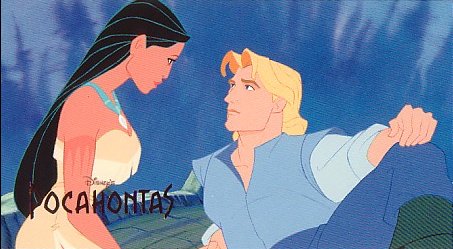
According to Gover, Disney's portrayals of Native Americans in films such as "Pocahontas" and "Peter Pan" have greatly harmed the Native American image by feeding inaccurate stereotypes to young children.

Gover said that although these Disney films weren't made with intentional malice, young children who view them have no available source to put into context for them that the Native American images they see in films, such as "Peter Pan," aren't true.

"Images are memorable, powerful and very hard to shake," Gover said.

Gover said that even the most adored American Indian characters such as Pocahontas represent inaccurate stereotypes. He stated that Pocahontas represents the theme of the "self-sacrificing Indian" who is willing to give up her life for the "better ways of the White civilization."

Gover elaborated on the transition of the Native American image through popular American culture. The themes of Native American images presented by Gover ranged from the noble and somber "Indian Chief," the "violent savage" and the "disappearing Indian" leading up to today's "mystical Indian."

To demonstrate the popular concept of the "mystical Indian," Gover showed images from the popular film "Twilight: New Moon," in which Native Americans belonging to the Quileute tribe have the ability to transform into wolves. According to Gover, this romanticized "magical" concept of Native Americans can also be seen in the primitive blue creatures of the mythical planet Pandora in the recent film "Avatar."

"These images are teaching us all racist assumptions about Native Americans," Gover said.
Comment:  Thanks to Gover for saying what's obvious to some of us. Namely, that Avatar and New Moon aren't the remedy for Pocahontas and Peter Pan. That all these films fill impressionable children with half-truths or lies. That movies are a primary source for the Native stereotypes in our culture.

For more on the subject, see Modern Indians Anger Museum Goers and The Best Indian Movies.

Below:  "Rescue me from my primitive magical life, noble white man!"

January 25, 2010

Modern Indians anger museum goers

Gover addresses 'White Man's Indian' in Canby lectureGover said that Indians are damaged by allowing others to define them, which continues to this day.

"It puts us in a box," Gover said. "I'm stunned by the number of people who are angry when they come to the museum and see it is about Indians who are still here, rather than Indians who used to be. They think modern Indians aren't real Indians because we're not like we were when Columbus set foot here."

Gover uses artists as an example.

"Any Native artist using modern media for their work is criticized," Gover said. "People say, 'That's not Indian art.' Even though it's an Indian making a statement about Indians. The media the artist chooses to use becomes disqualifying. It's crazy, and it's insulting.

"It's like saying it isn't legitimate unless it is the same way you were doing things in 1492," he said. "They wouldn't ask it of anyone else. They wouldn't say, 'You can't be a White man unless you're wearing knickers and tails. It's unique to Indians."

Being defined by others extends to sports mascots, where Indians are "honored" for their bravery.

"Why don't they honor us for being smart, creative, for all kinds of different things?" Gover asks. "Why choose the one? It tells us that you're stereotyping. You can't be Indian unless you're brave, whatever that means. It's ridiculous. It's just a tiny part of what Indians were and are."
Comment:  The most interesting point here is the first one: how attendees get mad when the NMAI doesn't fulfill their expectations of stereotypical Indians. I suspect this anger plays a larger role than we realize.

For instance, when you tell people their Indian mascots are stereotypical, what do they do? Do they actually think about it, do some historical research, try to justify the stereotypes somehow? No, they lash out. They tell you they're "honoring" Indians, that you're being too "sensitive," that it's just "harmless fun."

In other words, they don't engage in the actual issues. They turn an intellectual question into an emotional one. "We love our mascot! We've had it forever! You're not taking it away from us!"

Essentially they're reacting like little children when you tell them they can't have a toy or a pet. The typical spoiled brat doesn't take it calmly; he screams and throws a tantrum. Whatever "reason" the whiner comes up with is illogical and insufficient. It amounts to nothing more than "I want it!"

For more on the subject, see Team Names and Mascots.

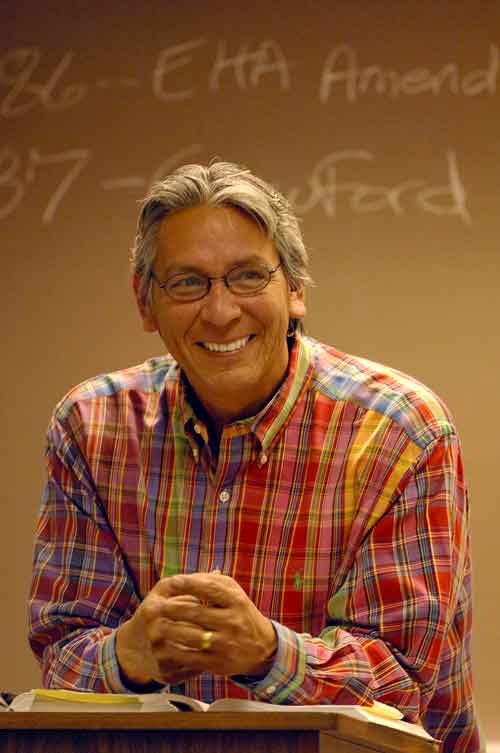
Below:  Kevin Gover, an example of a modern Indian who angers non-Indians.

September 14, 2007

Is Gover qualified?

Questions arise about NMAI choiceThe first of two essential qualifications is the ability to raise funds in an Indian country environment now highly attuned to business and administrative ethics. Gover's placement may have derailed any, if not all, potential for tribal support. Stated Cobell, "What this means is that the Smithsonian has hired someone to head this important museum who has literally thumbed his nose at Indian people--some of the poorest people in the nation." Question number one: Why would tribal leaders, who have worked so hard to fight for justice and lift their peoples out of poverty, donate to the NMAI when its director was found in contempt over the mishandling of Indian trust accounts for thousands of impoverished American Indians?

The second of two essential qualifications is experience in administering a large and complex museum. Gover has no experience in the museum field, much less experience guiding any museum approaching the scope and scale of the NMAI. It is here, were Indian country to swallow, hook, line and sinker the storyline that this is a good thing, where skepticism necessarily emerges. Question number two: Why is it better that Gover possess no museum qualifications whatsoever?
Why Kevin Gover is the new NMAI directorIn 1997, the United States Senate confirmed Kevin Gover as the U.S. Interior Assistant Secretary for Indian Affairs. He was the seventh person and among the youngest ever to serve in that office, which is a sub-cabinet position and the highest office for American Indian policy in the federal government. As Assistant Secretary, he was the policy head of the nationwide Bureau of Indian Affairs. His responsibilities included oversight of Haskell Indian Nations University, the Southwest Indian Polytechnic Institute, and more than 180 other Indian schools. He also oversaw the work of the Indian Arts and Crafts Board and its three museums in Anadarko, OK, Browning, MT, and Rapid City, SD.

For the past four years, Prof. Gover has been teaching federal Indian law, legal method and process, administrative law, and the history of federal Indian policy at the Sandra Day O'Connor College of Law at Arizona State University, the home of one of the best, if not the best, Indian law program in the United States. He is also co-Executive Director of the American Indian Policy Institute at ASU. His dedication to Indian education and his experience in academe will serve him well as embarks at the helm of NMAI, a distinguished educational platform for presenting the history and rights of Native American nations and people to a global audience.

September 13, 2007

Cobell slams NMAI choice

New Indian museum director pick criticized

Gover part of suit filed in 1996 against the Interior Dept.Kevin Gover, the Smithsonian Institution's choice to head the National Museum of the American Indian, is drawing fire because of his involvement in a lawsuit that alleges the federal government lost millions of dollars belonging to thousands of Indians.

Elouise Cobell, a member of Montana's Blackfeet tribe and the lead plaintiff in the class action lawsuit, said Wednesday she is outraged that Gover has been chosen to be the museum's new director. Gover is now a professor of law at the Sandra Day O'Connor College of Law at Arizona State University.

September 12, 2007

Gover to head NMAI

Former Interior Official To Lead Indian MuseumThe Smithsonian Institution yesterday named Kevin Gover, a lawyer and former Interior Department official with no museum experience, to succeed W. Richard West as director of the National Museum of the American Indian.

Gover, an Oklahoma Pawnee and former assistant secretary for Indian affairs at the Interior Department, is a former law partner of West, the museum's founding director. His office at Interior oversaw the Bureau of Indian Affairs, historically one of the most contentious agencies in the federal government.
Why he was chosen:Burke said Gover was chosen over 10 candidates because "he has a strong presence, is committed to Indian country and the value and role of the museum in that community." West said Gover's lifelong work with Indian nations qualified him for the job. "He is a dedicated, competent public servant," West said. "He has good standing with the native community itself. He is a public figure who is well known and whose service to the native community is clear."

Suzan Shown Harjo, a writer and prominent voice for Indian rights, endorsed the selection. "I think he is perfect. He is very analytical about systems, management, how to run things. There is so much going on at the museum and he knows how to sort out priorities," she said.
Gover will take helm at NMAI on Dec. 2

Comment:  See The Feel-Good National Museum for the initial reactions to the museum.