Showing posts with label Twilight. Show all posts

March 10, 2013

"Old-timey prejudices" in movies

Cracked.com reviews prejudice in the movies. The top two items apply to Indians.

5 Old-Timey Prejudices That Still Show Up in Every Movie

By J.F. Sargent#2. If It's a Blockbuster, the Star Better Be White (or Will Smith)

Quick: name a horror movie where one of the good guys is black. Well, hell, that's easy. One of the ship's crew in Alien was black, and some of the soldiers in Aliens. Danny Glover was the cop in Saw, Carl Weathers was one of the squad in Predator. Lawrence Fishburne in Predators. Hell, there are lots of them.

Now count how many of them survived to the end.
And:So What's the Deal?

Even in the 21st century, with a black president and posters of black athletes adorning bedroom walls all across the world, white audiences still prefer to watch white characters.

It would be easy to argue that the box office numbers are skewed because, say, Fellowship of the Ring was simply a better movie than Big Momma's House. But you can get the same results from focus groups with everything else being equal. In this 2011 study, white undergraduates were given the synopses of 12 made-up romantic comedies. Along with the summaries, they got cast pictures and fake IMDB pages, which were manipulated so that each movie had six versions of the cast; an all-white cast, an all-black cast and four different versions in between.

Same plot, same characters, same everything--just different cast members. And unfortunately, the whiter the cast, the higher the likelihood of the students wanting to see the movie.

So how does this play out in real movies? Black characters end up in supporting roles, instead of being well-developed characters. They're just there so we can "judge the other (white) characters by how they treat them." In other words, we certainly don't root for racist characters, and we'll boo racist stereotypes. But our open-mindedness usually stops at the point of actually paying to see a black leading man. Other than Will Smith.
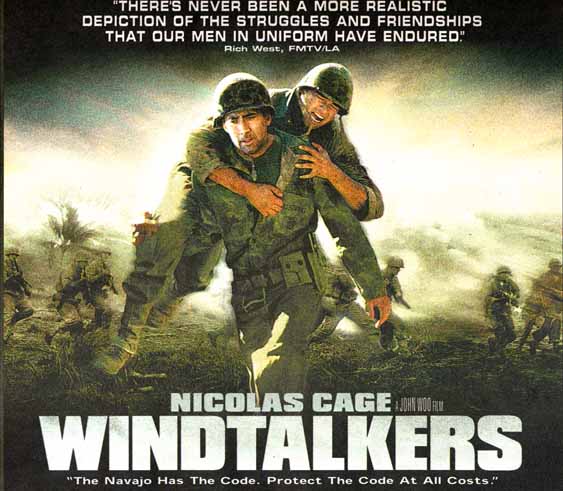
Below:  A movie about Navajo codetalkers starring a white guy.


And the top old-timey prejudice:#1. We Still Don't Care About History That Doesn't Involve White People

We're not exactly blowing your mind when we say that 300 had some slight historical inaccuracies when it came to the race of its heroes, or that Jesus was not exactly the European-looking Superman we're used to seeing in movies, paintings and bumper stickers.

What's weirder is when the movie pretends to be about the triumph of a minority character, but instead spends all its time talking about the white people who save him. Like in The Blind Side, which was supposed to be about Michael Oher, a poor black kid who ended up being adopted by a wealthy white family and going to college on a football scholarship. The movie is, of course, all about the white family. Michael Oher is just a thing that needs to be taken care of, not an actual character.
And:So What's the Deal?

Money. Once again, it's money. To get white people in the theater seats, the story has to revolve around white people.

And the phenomenon isn't even limited to stereotypes--Stuck, a movie about an African-American woman who is convicted of murder, had to cast a white woman in the lead role to get financed because, as one casting director pointed out, "It's about getting the movie done. Everyone is looking to make their money back." And as we already covered, black actresses don't bring in money. Giving white actresses cornrows, on the other hand, apparently will.

Or take The Help, a story about how the American civil rights movement affected the home lives of privileged white college graduates who have a book deal. That wouldn't really be a problem (you don't always have to tell the biggest story) if it weren't for the fact that it's one of the very few big-budget movies made about the civil rights movement. Ever. And just like Mississippi Burning, Ghosts of Mississippi and Driving Miss Daisy, the story is told from a white perspective.
Comment:  These two items--movies starring white guys and movies about white guys--are overlapping and interrelated, not separate and distinct. But that's okay.

Movies such as Think Like a Man and Karate Kid prove that minority-led movies can succeed. The lack of such movies is Hollywood's fault.

Studios could create minority stars by putting them in small-budget movies and building them up. Or by putting them in franchise movies such as The Lone Ranger, The Hunger Games, Transformers, etc. No one's gonna skip a blockbuster movie because the lead character happens to be a minority.

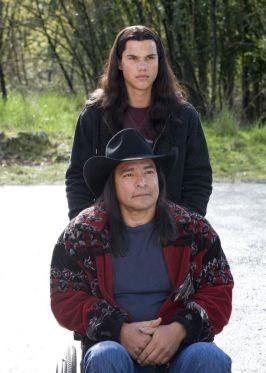
Avatar and Twilight remain two great examples of this. No one went to see Avatar because Sam Worthington played the lead role. And no one skipped Twilight because (they thought) Taylor Lautner was an Indian. The movies would've been equally successful with minorities playing these roles.

That Hollywood doesn't do this is because it's fundamentally conservative and racist. As I've said many times before.

For more on the subject, see Bottom-Line Argument Is Racist and Patel's Struggle Shows Hollywood's Racism.

Below:  Someone audiences managed to overcome their alleged antipathy toward minorities.
February 13, 2013

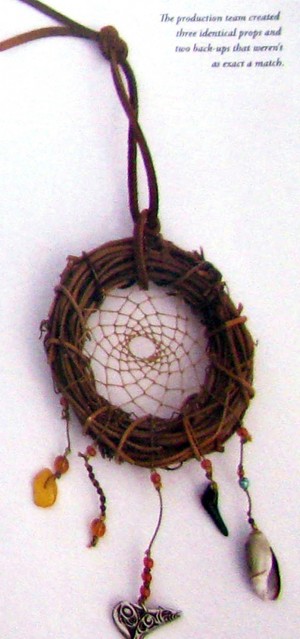
Dreamcatcher in New Moon

Catching Up: ‘Twilight’ gave Pamela Whitehorse's business a big boost

By Gena KittnerFirst Pamela Whitehorse had her dream catcher featured on the silver screen. This spring, a larger version will grace a wall in the new Dejope Residence Hall on the UW-Madison campus.

“I think that one will be the biggest dream catcher I’ve made,” said Whitehorse, who lives in Stoughton. “I’m really excited about that.”

Whitehorse’s dream catchers became popular when a small one was featured in the worldwide blockbuster “New Moon” in 2009 as part of the wildly successful “Twilight” saga of novels by Stephenie Meyer.

In the movie, Jacob (the American Indian werewolf) gives Bella (a human who loves the vampire Edward) a dream catcher to thwart her recurring nightmares caused by heartbreak over losing Edward. The gift—not part of the book—appears in a few scenes throughout the movie.
Comment:  This is a small but telling example of how badly movies portray Indians. Dreamcatchers originated with the Ojibwe in the Great Lakes region. They have nothing to do with the Quileute tribe of Washington.

The only reason they're identified with Indians in general is because they've become commercialized trinkets for tourists and New Agers. A Quileute Indian might have one in his house, but only because it made a nice decoration. It wouldn't be part of his cultural tradition; he wouldn't assume it had magic powers or use it to catch nightmares.

In other words, the whole thing is phony baloney. It's the "mystical" equivalent of assuming every Indian has a drum, flute, peace pipe, bow and arrow, tomahawk, etc. It would be like assuming every white person has a rabbit's foot with the power to bring the owner good luck.

We don't assume that most white men have magical talismans around their necks or in their pockets. But we do assume that of most Indians. Both assumptions are ridiculous, but Hollywood treats the latter as if it's real, not a bedtime story.

For more on dreamcatchers, see Indians in Bailey at the Museum and Paul Frank's Racist "Powwow."

December 20, 2012

Pelletier arrested for drugs, drunkenness

'Twilight' actor arrested at LAX for alleged public drunkenness"Twilight" actor Bronson Pelletier was arrested this week on suspicion of being drunk at LAX just days after he was charged with possession of cocaine and methamphetamines in West Hollywood, officials said Wednesday.

Pelletier, 25, was arrested Monday at Los Angeles International Airport for public intoxication after he boarded an aircraft and was determined by the flight crew to be an unruly passenger, LAPD officials said. Pelletier was booked at 2:15 p.m. and released seven hours later.
Actor Bronson Pelletier dismisses public urination claims“Twilight” actor Bronson Pelletier has denied reports he was caught drunkenly urinating in public at the Los Angeles International Airport on Monday, insisting the incident “did not happen.”

The Canadian star was allegedly removed from a plane at the terminal after airport police received a call about an unruly passenger, and he was ordered to wait for another flight later in the day as he was too intoxicated to fly.
Comment:  For more on the travails of Twilight actors, see Bronson Pelletier Assaulted and Kiowa Gordon Arrested in DUI Case.

October 25, 2012

Wolf Pack sequel to Twilight?

‘Twilight’ Could Live On, in Wolfpack-Focused SequelsOn November 16, The Twilight Saga: Breaking Dawn—Part 2 will hit theaters, and with it the final chapter in the Twilight series of movies will unfold.

Right?

Maybe not. According to a report at MovieHole.net, Lionsgate and Summit Entertainment, Twilight‘s production companies, are looking to extend the Twilight story beyond the original four books written by Stephenie Meyer.

MovieHole’s Clint Morris cited an unidentified source who said that the studio was looking at a variety of options: a “TV show or film spin-off, merely set in the same world as the one in the movies but not featuring the main trio, is being seriously considered.” The source added that the werewolves of the Quileute Tribe, known as “the Wolfpack,” are “one area of interest.”

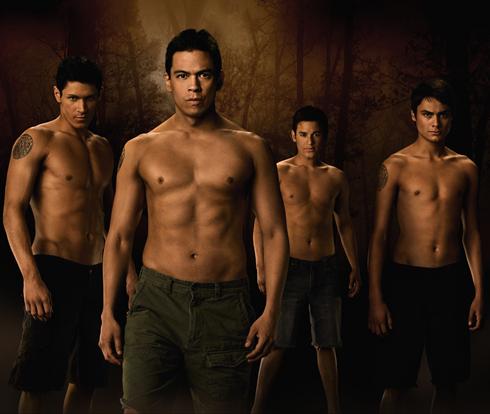
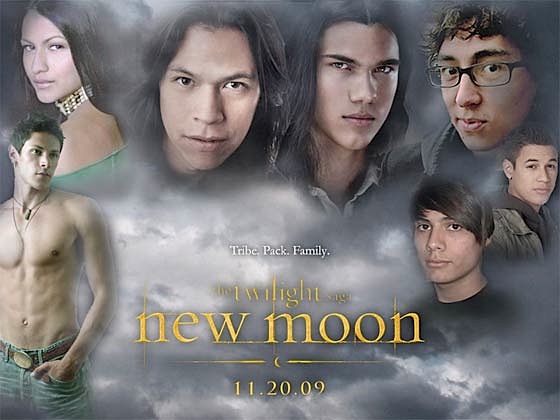
Aside from the fact that the upcoming Twilight Saga: Breaking Dawn—Part 2 will complete the story as told in the books, there would be another, more-relevant challenge to continuing the main Twilight storyline: Getting all the film’s big stars together again. So zooming in on just one part of the story makes sense. Whether a Wolfpack-focused movie or TV show would include Taylor Lautner among the Wolfpack of the Quileute rez (played on screen by Native actors Chaske Spencer, Kiowa Gordon, Alex Meraz and Bronson Pelletier) would remain to be seen.
Comment:  If they do a WolfPack movie or TV show, how much do you wanna bet that they recast the parts with hot young non-Native actors?

For more on Twilight, see Beach Calls Out Wannabe Actors and No Indians in Breaking Dawn Posters.

October 12, 2012

Shamanism series seeks Native authenticity

Alyson Noel’s ‘Soul Seekers’ Young Adult Series Destined for Big Screen, with Native ActorsSoul Seekers, a series of young-adult novels by Alyson Noel, may be coming to a theater near you, and will feature Native actors in key roles if Arnold Rifkin has his way.

Rifkin is co-founder (with actor Bruce Willis) of Cheyenne Enterprises, which has optioned screen rights on the series of books. The storyline follows protagonist Daire Santos, a 16-year-old girl who has visions and premonitions—and who soon enough discovers she is a Soul Seeker, able to move between the world of the living and that of the dead. Daire explores her powers while living in Enchantment, New Mexico, and some of the supernatural touches in the series are pulled from American Indian lore.

“I did a lot of research into Shamanism and Native American spirituality to create the world of the Soul Seekers series,” Noel said, according to a story at Deadline.com. “In using these ancient practices and ideas as a jumping off point for the mystical world of the books, I tried to portray them in an authentic way and to do so with reverence. After meeting with producer Arnold Rifkin, and learning first hand of his personal passion for these themes, I have no doubt that he will do the same.” The report said that Rifkin is “determined to cast the films with Native American actors when appropriate.”
Comment:  Good of Rifkin to insist on Native actors. We'll see if the studios and investors let him have his way.

But Noel's lack of specificity is troubling. Which tribe is she honoring, since the various Navajo, Apache, and Pueblo tribes are different?

As far as I know, none of New Mexico's tribes practiced shamanism. If Noel used a generic or unnamed tribe, I wouldn't say that's reverent. It's like revering Indians via a mascot: revering the fantasy rather than the reality. It's usually inauthentic rather than authentic.

Of course, the Twilight Saga went the other way by naming a particular tribe: the Quileute. It blew it by falsifying many aspects of Quileute life. For example, the Quileute don't live in small wolf packs with an alpha male as their leader.

The best solution is to pick a tribe and portray it accurately. If no tribe in the area practices shamanism, set the story somewhere else or drop the shaman aspect. Attributing shamanism to the wrong tribe is like attributing it to the wrong religion: Christianity, Judaism, Islam, etc. That every tribe practices shamanism is false and stereotypical.

For more on the subject, see Truth vs. Twilight and Twilight Ruining Indians' Reputation?

Below:  "Cover art for 'Fated,' the first book in the Soul Seekers series by Alyson Noel."

September 12, 2012

Kiowa Gordon to share Hualapai heritage

Kiowa Gordon, Twilight "Werewolf," to Share His Hualapai Tribal Heritage by Hosting Fans on His Native Land at Grand Canyon WestKiowa Gordon, a Hualapai Tribal member and part of the Twilight series' "Wolf Pack," has joined with Hualapai Tourism to offer his fans an up close and personal meeting while they enjoy the beauty of Grand Canyon West. Since playing Embry Call in New Moon, Eclipse and Breaking Dawn, Gordon's celebrity has grown rapidly but he hasn't lost the connection to his Hualapai roots. "I love my fans, I love my heritage. I take great pride in being Hualapai. Rafting the Colorado River and visiting Grand Canyon West will be a great opportunity to show my fans firsthand the beautiful land that my people come from," said Gordon.

On September 28th, Gordon will make an appearance at the Hualapai Lodge on Historic Route 66 at 7 P.M. He will take photos and sign autographs for anyone that eats at the Diamond Creek Restaurant that day (fans to show receipt for photo). On September 29th, Gordon will take the Hualapai River Runners trip (the only one-day Grand Canyon whitewater rafting adventure) with visitors that reserve for that day. Seats are limited and a few fans using the code "KG12" while booking in advance will have the chance to be on the same raft as Gordon. Fans will also get an autographed photo when using the code.
Comment:  For more on Kiowa Gordon, see Kiowa Gordon Talks Music and Movies and Actors Turn Out for Breaking Dawn.

July 10, 2012

Tribal tourism without cultural explotation

A good article describes how tribes in general and the Quileute in particular "reap the economic benefits of tourism without falling prey to cultural exploitation."

A big old 'Twilight' welcome

Washington's Quileute Tribe has seen a rush of visitors since it became known as the progenitors of the popular vampire series' werewolf pack. How they're dealing with the vampire-mania.

By Bryn Nelson
When the Twilight craze first erupted, the Quileute lacked a public relations contact and events coordinator. Ann Penn-Charles, a community leader who helps run the weekly drum and healing circle, says producers of the first movie randomly called villagers in hopes of securing permission to film a scene on First Beach. (It was ultimately shot on the Oregon coast instead.) The producers eventually visited La Push to get a better sense of the community. Tribal Secretary Naomi Jacobson says their ideas of Quileute kids were upended when they visited her cousin's home. "They didn't expect them to be modernized teenagers with iPods and Wii," she says.

Five years have passed since then, though, and the village has adjusted. Jackie Jacobs, the tribal publicist since 2009, has recruited several Twilight actors to visit the school and appear at the annual Quileute Days celebration in July. This festival has become the reservation's biggest tourist draw, and summer stays at the resort now require booking months in advance. When Jacobs asked some kids about how La Push has changed, she got a matter-of-fact response. "You definitely have to look now when you're crossing the street," they told her.

In the resort's main office, handcrafted basket earrings, drums, and decorative canoe paddles share display space with autographed pictures of movie stars. Centuries ago, the Quileute and other coastal tribes bred fluffy dogs for woven dog-hair blankets. Both the breed and art form are lost, though Penn-Charles and her mother knit woolen hats adorned with animals and geometric shapes. They too have adapted to the Twilight fans; one girl commissioned four purple-and-white "Team Edward" yarn hats last summer.

"The economic factor is big for our people who still do their arts and crafts," says Penn-Charles. In the summer, some of the tribe's youngsters sell handmade charm bracelets, rocks painted with wolf paw prints, and "La Push" and "Quileute" stickers, earning enough money to buy back-to-school clothing and supplies.

Group tours offer traditional meals served at the beach—crunchy biscuit-like "buckskin bread" and salmon cooked on sticks—along with the chance to sit around a bonfire and hear traditional stories. The outings—usually arranged through a new events coordinator—have generated much-needed income, and provided new ways for traditions and tales to be passed down to the next generation.
Comment:  I like the note about how ignorant the producers were about modern Native teenagers. I wonder where they got the idea that these teenagers would be unsophisticated, primitive, clannish--like animals in human form. Oh, yeah...from Stephenie Meyer's Twilight books, which portrayed them as an isolated band of wolf people.

For more on Twilight and tourism, see Quileutes Welcome Twilight Fans and Twilight Fans at Quileute Days.

Below:  "La Push's First Beach."

June 12, 2012

Kiowa Gordon talks music and movies

Kiowa Gordon of the Twilight Saga Wolf Pack Talks Music and MoviesKiowa Gordon, Hualapai, is best known for playing Embry Call in the Twilight Saga movies. He appeared in the last three, and will also be in The Twilight Saga: Breaking Dawn, Part 2, the final installment, due to be released in November.

But acting is just one of his two passions—the other is music. After four years of concentrating on acting, and oh-by-the-way appearing in some of the biggest blockbusters of all time, he’s getting back to music; last week, he released his first single, “Taking Back My Summer,” recorded under the alias Nature Baby. It can be found on Soundcloud and iTunes. To keep up with his artistic pursuits, follow him on Twitter @CircaKiGordon.
And:What’s happening for you on the acting front? One film we’ve been hearing about is The Lesser Blessed—can you give us some scoop on that film and the character you play?

The Lesser Blessed is based off the novel by Richard Van Camp and adapted to film by Anita Doran. It’s a story centered on a First Nations teenager named Larry Sole, played by Joel Evans, who is trying to find his place in the modern world. I come in and show Larry the way. It’s set in the Northwest Territories and we filmed in Sudbury, Ontario. I play Johnny, he’s a bad boy. Johnny likes to get into scuffles and hook up with chicks. Johnny also likes to eat cheeseburgers and smoke cigarettes, but it’s Johnny’s responsibility to take care of his little brother Donny because his mom is an escort and his dad doesn’t live with them. Johnny is pretty screwed up in the head.

There will be a final Twilight movie in the fall. How does it feel to be at the end of that run?

It’s bittersweet. I’m ready to move on and start new projects. Both in film and musically.
Comment:  For more on Kiowa Gordon, see Actors Turn Out for Breaking Dawn and Kiowa Gordon Arrested in DUI Case.

Below:  "Kiowa Gordon as Johnny from The Lesser Blessed Tumblr page: lesserblssed.tumblr.com."

January 04, 2012

Beach calls out wannabe actors

Getting "Native" with Adam Beach

By RachealCBC's winter season is about to start and they asked me to come in and chat with some of their stars. Adam Beach is a familiar face on both sides of the border, with am impressive resume ranging from North of 60 to Flags of Our Fathers; yet somehow the first thing I ask him about is Twilight.

People talk a lot about Taylor Lautner, being this young leading man who's also a native actor...

Adam quickly cuts me off.

"Well, it's very controversial, cause he isn't native. And there's speculation of a couple of other "native" actors who aren't native. And for me, when it comes to the demographic of native actors and filmmakers, there's a very small percentage. And when you take a movie that has a worldwide success and you're not hiring native talent, you're really pointing fingers at them saying "you're not good enough. You're not worth playing yourselves. We're going to hire a non-Indian to make you guys look good." And I don't believe that they're taking any of the steps that I've been struggling and striving to do in the past 15 years. It kinda makes me feel that Hollywood has no intention to change when it comes to changing that perspective and demographic of minorities in film and television."

Wow. This is not the conversation I expected to get into. On the other hand, it does bring up a nagging question: there are some people who would say that it's colour-blind casting and they're just hiring the appropriate person for that role. I mean, I'm Irish and there's always non-Irish people playing Irish. So how do you ride that balance between colour-blind casting and the need to embrace history and heritage?

"Well, you know, you're not going to see me try and play Martin Luther King. You're not going to see me try and play Irish folk. I stay in my group. I'm not going to play someone of Latin descent, 'cause that's just not my priority. When you look at the demographic of Native peoples and their struggles, to get out of the poverty that they're in, it's important that we maintain a certain honesty of who they are as a people. Especially when you're dramatizing them in this traditional way, and make a story that they're werewolves and shape shifting, and for them it's a direct message to the consciousness of a people that's been stripped of their identity, because of residential schools and land claims, and they're still doing in this medium of film and television.

"But they decided to take a few of the native actors and give them very minimal parts. It's unfair. And you know, I understand; like you demonstrated, when it comes to playing Irish, as long as you look white, it works. I understand that. But when you look at the portrayal of native people throughout Hollywood, they were always non-Indian and we're at a time where it doesn't have to be that any more, especially when they've so distorted our image and made us the victim, the alcoholic, the killer, the one that was raping and pillaging, when it was the other way around.

"For me, you're not going to be able to stop the Hollywood studio machine. All I could do is stop it within my circle. So I will not do anything where they're not representing in the right way."
Comment:  I imagine the other actors Beach is referring to include Tinsel Korey, Julia Jones, and Boo Boo Stewart. Not to mention Johnny Depp and Brandon Routh.

Someone on Facebook raised the inevitable counterargument. Since people are just acting, why can't anyone play anyone? Beach covered this point in his comments, but here's my response:

Adam could've gone further. Not only wouldn't he choose to play Martin Luther King, he'd never get the chance. Nor would he get the chance to play JFK, Columbus, or Superman. As I discussed in my blog:

Adam Beach as Superman?

When Adam gets cast as, say, Albert Einstein, then we can talk about casting Tinsel Korey and other non-Natives as Quieute werewolves or whatever. Until that happens, color-blind casting--aka choosing the "best actor for the role"--is a Hollywood myth. In general, whites are cast to play whites and whites are cast to play Natives.

For more on casting issues, see Gyasi Ross on Breaking Dawn and Taking Issue with Rene Haynes.

December 17, 2011

Video on Native werewolves

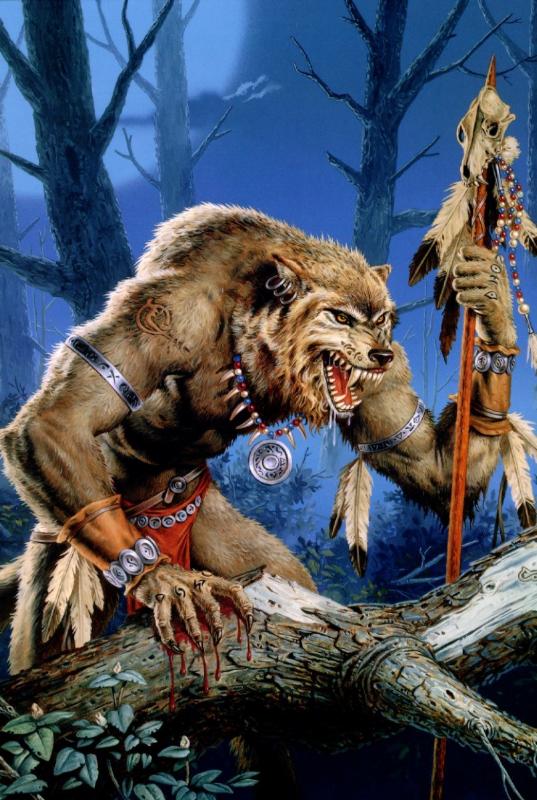
A video shows Indians shapeshifting into wolves in several movies and TV shows.  It notes how stereotypical this is; it links Indians to the past and makes their alleged "savagery" explicit.

Native American Horror Show

No doubt we could come up with more examples of Indians changing into wolves.  For instance, in the TV series Smallville.  And that doesn't include all the examples of Indians changing into Wendigos and other monsters and demons.

For more on Indians and werewolves, see PEACE PARTY Political Cartoon: Twilight and Indians as Werewolves and Spacemen. For more on the subject in general, see Native Things that Go Bump in the Night.

November 23, 2011

"Multi-ethnic" Jones on Twilight

Julia Jones:  “It’s very exciting for us to have a contemporary Native American culture be portrayed in ‘Twilight’”

By Brandy“I’m very proud to play a Quileute; the tribe is incredible. I’ve been there to the reservation,” she said during the recent press day for “The Twilight Saga: Breaking Dawn–Part 1” at the tony Four Seasons Hotel.

“I think it’s very exciting for us to have a contemporary Native American culture be portrayed in the ‘Twilight’ movies. I think it’s done amazing things.”
And:“I’m part Chickasaw and Choctaw, but I’m a multi-ethic person. That’s just a part of my identity. I’ve been playing Native roles for a long time, a very long time. And it (‘Twilight’) has been a really rewarding experience in a lot of ways, because there’s a lot to show. It’s an opportunity to portray a group of people who are not portrayed very frequently and very accurately at all in the media. And I cherish that. I think that there should be more roles for Native actors in contemporary pieces, and it’s an important part of who I am,” she said.

“That’s the beauty of these characters who happen to be Native American. These characters are so multi-layered and multi-dimensional, it’s about their struggle and it’s about who they are as people and their essence, as opposed to primarily falling into these stereotypes of what people think Native Americans are. And that really hasn’t been done very much.”

She doesn’t think it’s fair to say that mainstream movie-goers are only interested in American Indian characters if they are supernatural heroes.

“They haven’t had enough exposure to Native American characters to say ‘I’m only interested if they change into wolves,’ and I think that’s too bad,” she said. “I think there are wonderful stories, and it’s an incredibly important part of our history as a country. And they’re just not told because there’s so little presence in mainstream America.”
Comment:  A few things here:

  • One, The Twilight Saga barely presents any "contemporary Native American culture." The movies have given us a clan of werewolves who tell stories around a campfire. Stories that are fabrications of Quileute history and culture with hardly an ounce of truth.

  • From what I've seen and read, the werewolves don't do much except rush to Jacob's defense and attack vampires. Do the movies show anything of the Quileutes' government, business, education, social programs, or religion that isn't fabricated? Not that I'm aware of.

  • Two, her last statement contradicts her first one. The contemporary portrayals in the Twilight movies have done "amazing things"...but movie-goers are interested only in supernatural Natives because they haven't seen anything else. So the "amazing things" apparently don't include changing anyone's perceptions of Indians.

  • That's because the Twilight movies have reiterated decades of Indians stereotyped as magical shamans and shapeshifters. And more subtly, decades of Indians as secondary characters and sidekicks--antagonists rather than protagonists. If you're looking for a movie that stars Indians and portrays them as real human beings, try Dances with Wolves or Smoke Signals. Because the Twilight Saga isn't it.

    Who's an Indian, again

  • Three, note that Jones correctly refers to herself as "multi-ethnic," not Native. Which she's done in at least one other interview. But then she tries to fudge the issue by talking as if she's a Native actress.

  • Unless I'm mistaken, Jones is only a tiny bit Chickasaw and Choctaw. That puts her in the same position as everyone else I've criticized. Twilight's non-Native actors:Taylor Lautner, Julia Jones, Boo Boo StewartOther non-Native actors--e.g.,Johnny Depp, Brandon Routh, Lynn CollinsOther non-Native singers, models, and starlets--e.g.,Miley Cyrus, Jessica Simpson, the KardashiansFor new readers, I'll repeat the criteria I outlined in "Actual Indian" Defined. You're an Indian if:

    1) You're enrolled in a federally recognized tribe. That trumps any amount of "Indian blood" you may have. Indeed, a tribe may enroll someone who's pure white or black by "blood."

    2) You have a significant amount of "Indian blood"--at least 1/4 and preferably 1/2 or more. Which happens to be the minimum amount required by most tribes. When you get down to the Johnny Depp level--1/8 or less--you're talking about a single great-grandparent who probably had no influence on your life. That makes you a non-Indian with a small amount of Indian blood, not an Indian.

    3) You grew up or live in a Native community that accepts you as one of their own. I'm talking about a real Native town, village, or reservation, not a made-up community such as "Hollywood Indians in Los Angeles." A place where you've learned enough of the culture and history to fit in with the others.

    As far as I know, everyone listed above fails these tests, including Jones. Therefore, I consider them all non-Indians with a small amount of Indian blood, not Indians. When I say I want Native actors in Native roles, I mean people who meet these criteria, not people like Depp, Lautner, or Jones.

    For more on Breaking Dawn, see Gyasi Ross on Breaking Dawn and Truth vs. Twilight.

    November 22, 2011

    Gyasi Ross on Breaking Dawn

    Gyasi Ross offers some snarky comments about Breaking Dawn in his first column for Indian Country Today Media Network:

    Breaking Dawn on a New Series for Indians

    By Gyasi RossWhat better way to start off a new column in Indian Country Today Media Network than to talk about an Indian boy who is hopelessly for—against the weight of supernatural forces, no less—the love of a white girl? What can be more “Indian” than that?

    It’s about as natural as an Indian turning into a werewolf (he probably should’ve turned into a little poodle because I think white girls love carrying those around in their purses and petting them heavily).
    And:Still, I replied, “If I really wanted to see some Indians running around without their shirts on fighting over women and turning into wild animals, I would go to one of the bars surrounding the host hotel at one of the large fancy Indian conferences. You wanna see real theatrics and tension—go there!” That was just an excuse, of course—I just don’t know how a straight man could justify watching that many consecutive minutes of pretty men walking around looking intense. What’s really scary—definitely not the vampires or the werewolves—is the prospect that I might really like the gratuitous amounts of abdominals—that would cause so much confusion to my sense of self!And:More, there are real, actual Indians in the movie (and a few fake ones too)—a rarity, and certainly something to be thankful for and to support. GO SUPPORT YOUR LOCAL INDIAN ACTORS!!! Still, if the makers could make this movie slightly less, well, estrogenic, I’d love to go support the actors in this movie. As it is, I’d have to wear a trenchcoat and sunglasses and fedora to watch it lest someone think that I’m into movies about teenage necrophilia/bestiality.Comment:  Nice to hear some original thoughts beyond the usual "How wonderful that Native actors are getting a chance to play savage beasts modern-day Indians." Oops, I made a snarky comment too! <g>

    For more on the subject, see Taking Issue with Rene Haynes and Actors Turn Out for Breaking Dawn.

    November 19, 2011

    Indians as werewolves and spacemen

    If natives can play Twilight werewolves, why not spacemen, too?

    By Drew Hayden TaylorFirst of all, the natives are the werewolves, who conveniently provide a roadblock (or blockade, for cultural accuracy) for the young lovers, Edward and Bella. The werewolves want to kill the vampires, making them essentially the enemies, the black hats (or furs, as the case may be). The vampires and the werewolves are the Capulets and the Montagues from Romeo and Juliet, or the Jets and the Sharks from West Side Story.

    There's a particularly shocking scene in the previous movie where one of the werewolf braves hugs his girlfriend and we see she has a large gash down the side of her face–evidently due to her out-of-control boyfriend.

    The same character, in full werewolf mode, later attacks our heroine Bella, who is saved at the last moment by Jacob Black (Taylor Lautner). Ten minutes later, when they meet again, the young native man just shrugs, grins at her and says, “Sorry.” For obvious reasons, this image concerns me a little.
    And:Still, in keeping with the changing face of the public aboriginal person, I have for years been trying to get an anthology off the ground–a collection of native science-fiction stories, from the best aboriginal writers in the country. But I always get the same response: “Native science fiction? Isn't that an oxymoron?”

    The public believes that native people are mired in the past. It's Indians and buckskin, not natives and rocket fuel; Plains Cree and buffalo, not Haida and black holes. Other than Chakotay from Star Trek: Voyager, who else can they see dreaming that impossible dream?

    Yet my friends who are aboriginal writers are all excited by the idea–Joseph Boyden, Lee Maracle, Richard Van Camp, Eden Robinson, etc. I even had a brief conversation with famous U.S. Chippewa/Métis author Louise Erdrich several years ago about it, and she told me that she had written a science-fiction story once but was unable to sell it. The market evidently thinks that native people don't write science fiction, but we heartily disagree.
    Comment:  Glad to see Taylor echoed a point I've made before: that when Twilight's werewolves oppose Edward the heroic vampire, they're essentially villains. Or at least anti-heroes. Defending their own people and attacking the bad vampires doesn't make up for interfering with Edward and Bella.

    For more on the subject, see Are Good Native Werewolves Okay? and White Vampire Yes, Indian Werewolf No.

    "No Natives in science fiction" seems to be Drew Hayden Taylor's pet peeve. He wrote about this in an article I posted in No Natives in Science Fiction? Alas, he was wrong then and he's still wrong. Things aren't as bad as he makes them out to be.

    November 18, 2011

    Taking issue with Rene Haynes

    A interview with Rene Haynes, perhaps the leading casting director in Native filmmaking.

    Picking the Twilight Wolfpack, and Others—a Conversation With Rene Haynes

    By Vincent SchillingIn 2009, Haynes became part of the casting team for the Twilight Saga films New Moon and Eclipse, and had a hand in selecting young Native actors for films that were destined to be among the highest grossing motion pictures of all time. The actors selected for the quartet of shape-shifting Indians known as the “Wolfpack”—Chaske Spencer, Alex Meraz, Bronson Pelletier and Kiowa Gordon—have an unprecedented opportunity to raise the Native profile in Hollywood. Expectations are high for today’s opening of The Twilight Saga: Breaking Dawn, Part 1, predicted by BoxOfficeMojo to make as much as $148 million over the course of the weekend.What this paragraph doesn't say is that Haynes came in after the huge controversy surrounding the studio's hiring of non-Native Taylor Lautner for the role destined to be a career-maker. And Haynes presumably was responsible for hiring non-Natives Tinsel Korey, Julia Jones, and Boo Boo Stewart as well as the Wolf Pack. Only half (four of eight) the young roles went to Native actors: a mediocre .500 average.

    Then there's this Q&A with Haynes herself:What are some of the bad things or things that are still difficult?

    We still have the naysayers—individuals with a chip on their shoulders who tend to condemn a project, in a very public way, before even trying to find out the truth behind the intent of the filmmakers. It’s very rare these days for a Native film project not to employ technical and cultural advisors. The people who make trouble usually do not manage to halt a project, but they do give producers and studios a reason to question the idea of financing another Native project in the future. Remember, this is such a competitive business in all aspects, and particularly for funding. If producers and financiers have a choice, they are likely to choose the more commercial and less difficult vehicle. This doesn’t help all the Native filmmakers who are seeking financing for their own projects. I totally support someone’s right to speak out against a perceived wrong, I just would encourage a full investigation into the facts before making public condemnations. There are always going to be diplomatic ways to make a positive change.
    Wow, what a mess. Just about every sentence of this response is riddled with errors and omissions. Let's examine it.

  • "We still have the naysayers—individuals with a chip on their shoulders who tend to condemn a project, in a very public way, before even trying to find out the truth behind the intent of the filmmakers."

  • Your guesstimate of the "naysayers'" motivation is flatly ridiculous. Fighting for social justice isn't remotely connected to having a chip on one's shoulder.

    The filmmakers' intent is generally irrelevant. What matters is what they do--whom they hire, what they put on the screen, etc.--not what they "intended."

  • "It’s very rare these days for a Native film project not to employ technical and cultural advisors."

  • When we're questioning a film's casting, the use of technical and cultural advisers is irrelevant. Nice try to change the subject, but no sale.

    But I'll play along. Are these advisers from the tribes in question? In the case of Twilight's characters, the Quileute Nation? If not, then so what? A Lakota or Apache adviser doesn't know any more about Quileute culture and history than I do.

    When movies do hire advisers, these people often rubber-stamp the creators' decisions so they can continue working in the industry. Or so I've heard. If a movie ever hired advisers who'd condemn a movie for its mistakes and stereotypes, I haven't heard of it.

    We saw a roundup of Twilight's mistakes in Truth vs. Twilight. If an adviser had pointed out these problems, would the producers have changed the movies? No? Then who cares about the advisers? They're useless when a studio has its mind(s) set on a stereotypical depiction of Indians.

    Big trouble but no halting?

  • "The people who make trouble usually do not manage to halt a project, but they do give producers and studios a reason to question the idea of financing another Native project in the future."

  • If the so-called troublemakers never halt a project, then what's the problem? Some studio exec has to rethink and rejustify his questionable decisions? Well, boo-hoo, you big baby!

    You're inventing a straw-man argument here. "Troublemakers" threaten every project even though they never harm a project? I guess they should just stop protesting and shut up, right? Thanks for regurgitating the studios' justification for ignoring protests and continuing on their racist ways.

    Ironically, the article begins with Haynes's big breakthrough: Dances with Wolves. Natives got cast because Kevin Costner insisted on it--an internal demand equivalent to our external demands. He didn't finesse or compromise the issue, he used his star power to lay down the law. (Too bad Johnny Depp doesn't have the same moral convictions.)

    Not surprisingly, the movie was a success because of its authentic casting. Again, this was because of Costner's impolite demands, not Haynes's polite diplomacy. Someone stood up to Hollywood's whites-only mentality and forced an unwanted change.

  • "Remember, this is such a competitive business in all aspects, and particularly for funding. If producers and financiers have a choice, they are likely to choose the more commercial and less difficult vehicle."

  • Yeah, like Jonah Hex and Cowboys and Aliens. And unlike Dances with Wolves, which must've seemed like a sure recipe for failure. Hurray for studio execs and their colossal ignorance of how to make successful movies. Including successful movies with Indians, as my list of flops indicates.

  • "This doesn’t help all the Native filmmakers who are seeking financing for their own projects."

  • The casting protests didn't hurt Twilight's success. And Twilight's success using Native actors helps prove the market for Native films using Native actors. So where's the next blockbuster franchise featuring Indians? Other than The Lone Ranger starring non-Native Johnny Depp, I'm not seeing it.

    All we have here is a loose string of faulty "logic." Troublemakers harm Native films. Some Native film was harmed somewhere, although it sure as hell wasn't Twilight. Despite Twilight's huge success, studios are reluctant to invest in Native films.

    And that's because of troublemakers who can't stop a film like Twilight, not the studios' inherent racism? Studios are avoiding the next money-making blockbuster starring Natives because they're afraid of a few protests? Uh-huh, sure they are.

    "Full investigation" before speaking out?

  • "I totally support someone’s right to speak out against a perceived wrong, I just would encourage a full investigation into the facts before making public condemnations."

  • One, the public doesn't have the ability to investigate a studio's internal processes from the outside. Don't blame us for not getting the complete picture. Blame the studios for not giving us the complete picture.

    Oh, wait...they pay your salary, so you can't criticize them for their failure to communicate. Never mind.

    Two, what if we do have the complete picture--as we did in the Taylor Lautner case? He absolutely was not the only actor who could've played Jacob Black. He's been roundly criticized for his dubious acting skills throughout the series. Half the Native actors in his range could've done a better job.

    So when we're right, is it okay if we speak up? And will you speak up also for the Native actors you supposedly care about? Oh, wait...see the previous comment about who pays your salary. Never mind.

  • "There are always going to be diplomatic ways to make a positive change."

  • Such as? Give us some examples of how outsiders who aren't involved with a movie can "make a positive change." Which of these techniques have you yourself tried for movies you weren't involved with? How did they work for you?

    As you may imagine, I think this is a lot of hot air. Protests worked in the Twilight casting case, so why should we try less effective techniques? When you come up with an alternative that would've produced the same results--more Native actors--write an instruction guide for us. Until then, you're just mouthing platitudes.

    Sheesh. These uncritical defenses of Hollywood's racism and stereotyping really slay me. Can you tell?

    For more on the subject, see:

    Minorities buy more movie tickets
    Hollywood:  Poor people are losers
    "We can't find the talent"
    Hollywood ghettoizes Native actors
    Patel's struggle shows Hollywood's racism
    Dismissing the pro-Airbender arguments
    Hollywood's cultural conservatism
    Hollywood's "liberals" are bigots

    Below:  "Veteran actor Gil Birmingham, who appears in 'Twilight Saga' films, with casting director Rene Haynes."

    November 17, 2011

    Truth vs. Twilight

    Seattle's Burke Museum has created a website to present, well, "The Truth vs. Twilight." The stated purpose:In collaboration with the Quileute Tribe, this site seeks to inform Twilight fans, parents, teachers, and others about the real Quileute culture, which indeed has a wolf origin story, a historic relationship with the wolf as demonstrated in songs, stories, and various art forms, as well as a modern, multi-dimensional community with a sophisticated governance system. We also hope to offer a counter narrative to The Twilight Saga’s stereotypical representations of race, class, and gender, and offer resources for a more meaningful understanding of Native American life and cultures.All the site's critiques are worth reading, but I particularly liked these sections:

    Racial and Class Stereotypes in TwilightTwilight pits vampires (the Cullens) against the wolf pack (the Quileute boys) in many ways as Meyer and Summit Entertainment highlight racial and class discrepancies between the two groups.

    Those "Hot" Indians

    Jacob, played by Taylor Lautner, may be a teenage heartthrob, but his continual depiction without a shirt shows how over sexualized, exoticized, and macho the fictional Quileute wolfpack is. Meyer describes the sexual, exotic Jacob as having “russet skin…bare-chested, wearing nothing but a pair of old cut-off jeans” (Eclipse, 183, 215). Likewise in the movie New Moon, Bella confronts a shirtless Jacob and his new tattoo, as he stands literally hot and steamy in the rain. Later in the film, as Bella gains more access to the wolf pack, the overly virile, meathead behavior that characterizes the Quileute boys becomes more apparent—out of sheer rage, Paul phases into a wolf and violently brawls with Jacob the wolf, and later at Emily’s house the boys bicker impolitely at the dinner table.

    The Classy Cullens

    In comparison to the Cullens (with their beautiful mansion, fine clothes, and luxury cars) the Quileute wolf pack and their modest homes, tattered clothes, and lack of shoes seem to represent the lower end of the class continuum. In all of the movies, Jacob shows up at Forks High School to whisk away Bella, curiously never seeming to attend a school of his own. Lack of education aside, the movie Eclipse reduces the esteemed responsibility of Billy Black’s tribal council leadership to the telling of ghost stories around a campfire. Furthermore, The Twilight Saga labels Quileute society with infidelity and broken family structures; Sam’s rise to alpha male stems from the necessity to be unlike his deadbeat dad, and Embry’s wolf “gene” comes from his Makah mother’s illicit affair with an uncertain but married Quileute father (Eclipse, 418). While many of these traits—being poor, uneducated, and having ubiquitous and dysfunctional relationships—are common among all groups of people, The Twilight Saga reinforces these shortcomings as synonymous with the Quileute, and in essence, all Native Americans.
    Seems to me some people didn't get it when I made similar points in my critiques. Which still mystifies me. The Indian werewolves are poor, working-class stiffs. The white vampires are rich elitists with fancy houses and cars. But you don't see a racial message in the huge disparity between whites and Indians?! Open your eyes, people!

    For more on the subject, see Sexism in Twilight Saga and (More) Racism in Twilight Saga.


    Cultural Theft in TwilightThe Quileute wolf pack is integral to the Twilight story, yet the Quileute Tribe has not received any of the billions of dollars of profit garnered by Stephenie Meyer, Summit Entertainment, and the many retail companies selling Twilight merchandise. Those profiting have avoided any legal claims, but the misrepresentation and misappropriation of Quileute culture causes deep ethical concerns.

    Redefining a Culture on Her Terms

    The most salient offense of misrepresenting Quileute culture is Meyer’s fabrication of a fictional origin story. In Eclipse, Billy tells of Kaheleha, “the first great Spirit Chief in [Quileute] history,” who used magical animal shape shifting powers to defend Quileute land (Eclipse, 245). The true Quileute origin story differs greatly, wherein Qwati transforms the first Quileute people from wolves.

    Such an incorrect representation of Quileute origins is tantamount to altering the creation story of the Judeo-Christian world, and unlike the common knowledge of Genesis, it is a further affront in this instance because the Quileute origin story is relatively unknown. In presenting a real tribe to the far reaches of Twilight’s mass popularity, Meyer has unjustly rewritten Quileute identity into that of magical werewolves.

    Everyone Profits Except the Quileute

    Summit Entertainment and the ensuing merchandising surrounding The Twilight Saga add insult to Meyer’s injury, not only in visually manifesting and reinforcing the misrepresentation of Quileute traditions, but also in misappropriating Native art in the wolf pack tattoo.

    The tattoo, seen on the sculpted shoulders of all the wolf pack boys in the Twilight movies, may not be grounds for visual copyright, as Summit Entertainment hired Canadian artist Lesza Snowdon to design the tattoo, but it does exemplify abuses of cultural appropriation. After visiting La Push and hearing a story about twinning wolves representing strength and solidarity, production designer David Brisbin passed the story on to Snowdon who then featured two wolves in the tattoo.

    In addition to appropriating Quileute stories to create the narrative symbolic to the tattoo, Snowdon artistically appropriates Native graphic arts in her tattoo design. Particularly drawing from the Haida form-line style, the tattoo not only takes from Quileute oral traditions, but also does a disservice to all Northwest Coast tribes as it confuses and alters their rich and varied visual culture.

    With the pervasiveness of Twilight merchandise at retailers like Dazzled by Twilight, Nordstrom, and Hot Topic, the tattoo has become visually synonymous with the Quileute, all without any approval given or royalties earned by the actual tribe.
    A blog summarizes the rest of the site:

    Tribe takes on ‘Twilight’ silliness: We ‘do not turn into wolves’Among other things the site wants visitors to know:

  • Vampires don’t exist, and Quileute people cannot transform into wolves.

  • Contemporary Quileutes date much like other modern Western people, meaning no “imprinting.”

  • “Twilight’s” portrayal of the Quileute wolfpack as “over-sexualized, exoticized, and macho” beings is culturally insensitive, especially when compared to the refined vampires.

  • The “clumsy and weak” heroine Bella Swan isn’t doing women any favors.
  • For more on the subject, see Quileute Exhibit Says "We're Not Werewolves" and Fans Still Ignorant About Quileutes.

    November 15, 2011

    Actors turn out for Breaking Dawn

    Wolfpack and Other Native Actors Again in Spotlight With Release of New Twilight FilmThe Twilight Saga: Breaking Dawn, Part 1, the latest installment of the Twilight series, had its Hollywood premiere Monday night, and members of the Wolfpack—shape-shifting Quileute Indians played by Chaske Spencer, Kiowa Gordon, Bronson Pelletier and Alex Meraz—joined co-stars Kristin Stewart, Robert Pattinson, and Taylor Lautner on the black carpet. Native actors Gil Birmingham, Booboo Stewart, and Julia Jones, who also play Quileute tribe members, were also on hand.More photos from the premiere:

    Gil Birmingham
    Chaske Spencer
    Alex Rice
    Alex Meraz
    Bronson Pelletier and Kiowa Gordon

    Comment:  The first link includes lots of photos and videos of the actors.

    Note: Some of us don't consider Booboo Stewart or Julia Jones Native actors.

    For more on Twilight, see No Indians in Breaking Dawn Posters and Twilight Video Game?

    Below:  "Gil Birmingham and Chaske Spencer at the 'Twilight Saga: Breaking Dawn, Part 1' premiere."

    September 22, 2011

    No Indians in Breaking Dawn posters

    'Breaking Dawn' to be released on November 18The much-awaited fourth and last installment of the 'Twilight' series, 'Breaking Dawn-The Twilight Saga', is set to hit the screens worldwide November 18.

    The first look of the film, produced by Summit Entertainment and starring Robert Pattison and Kristen Stewart, shows the fascinating, eternal love between Edward and Bella Swan.

    Another image shows Jacob (Taylor Lautner) in the foreground, standing proudly with the Quileute tribe and reflecting his agonizing desire to protect Bella.
    Comment:  Actually, the poster shows a wannabe and wolves. No actual Indians are visible.

    This is a nice example of how society renders Indians invisible. First Stephenie Meyer turned a real tribe into a fictional wolf clan. Then the filmmakers cast a non-Native in the primary role. Finally, the poster-makers decided that predatory beasts are the best way to represent Indians.

    For more on Twilight, see Rick Mora in a Wolf Hat and Twilight Ruining Indians' Reputation?

    August 24, 2011

    Twilight video game?

    ‘Twilight’ Star Bronson Pelletier Talks About The ‘Twilight’ Video Game—Are YOU Excited?Hollywoodlife.com talked to Bronson Pelletier, who said there might be a ‘Twilight’ video game in the works!

    Twi-hards rejoice! Just because the second installment of Breaking Dawn has wrapped, that doesn’t mean the saga of Bella and Edward is finished. Hollywoodlife.com talked to Bronson Pelletier, one of the smoking hot werewolves in the film, at the Roxbury Aug. 23 and he discussed the possibility of a Twilight video game.

    “I did a cyber scan not too long ago and I am pretty sure they are going to make a video game pretty soon,” Bronson told us at the Deus Ex Human Revolution Launch by Break.com.

    We’re pretty excited to hear about the possibility of our favorite vampire empire entering the cyber world and are dying to know what elements the game will feature. Bronson said he’d like to see it as a battle game with the ultimate showdown between the vampires and werewolves.
    Comment:  No, I'm not excited. I might've been excited if a Native actor had played Jacob Black, who gets most of the werewolf screen time. Once again, though, most of the fame went to a non-Native.

    The ultimate showdown between vampires and werewolves? So the mostly white vampires who secretly control the world battle a small tribe of savage Indian werewolves. Sounds like a metaphor for America's sorry Native history to me.

    For more on the subject, see Vampires = Imperialists in Eclipse, Race in Twilight Movie, and White Vampire Yes, Indian Werewolf No.