Showing posts with label video games. Show all posts

September 12, 2016

Red Rock Tomahawk video game

Game review: Flick'em Up, Red Rock Tomahawk: Don't mess with the Native Americans

By Ryan MorgeneggFlick'em Up is a game all about the pieces. In the box, a gamer gets the added scenery of three forests, a totem pole, a red rock mountain and one tipi. There are five native American figures, two bows, six arrows, a Tomahawk, a Gatling gun and six bullets.Comment:  Tipis, totem poles, and tomahawks in one setting? That's stereotypical.

By the time of the Gatling gun--1861 and after--Natives were using rifles as much as bows and arrows. The whole idea of modern soldiers fighting primitive warriors is stereotypical.

January 02, 2016

Demon spirits in Totem Topple

A description of the new Totem Topple game for Nintendo:Build your totem pole up into the sky and stars beyond in Totem Topple, a fresh twist on the tower defence genre!

Wolves, bears, deer and more--stack different totem heads on your tower, each with their own strengths and weaknesses. Add protective wings and arrow-firing bird beaks to fend off the demon spirits trying to knock your totem pole down!
And a review:

Totem Topple Review

By Alex SeedhouseThe publisher over promises in saying that Totem Topple presents “a fresh twist on the tower defence genre,” falling way short of achieving such admirable ambition. Players are tasked with defending a totem pole from demon spirits hell bent on knocking it down, which is certainly a concept that most won’t have come across before. But the underlying game mechanics lack refinement, resulting in an experience that overwhelms in the challenge hidden by its otherwise simplistic facade.

The structure is easy enough to understand, with players left to steadily construct their totem pole by selecting from beak, wing and head components. These fire arrows, grant protection and increase your totem’s height respectively, and managing your resources to create them becomes a focal challenge. Supplies are earned through defeating demon spirits, and the cycle completes in which you either strengthen your defences or rapidly move to replace anything that has been destroyed.


Comment:  The reviewer doesn't mention any problems with basing a game on a totem pole, but I will.

1) The game treats the totem pole as a decorative object, an accessory, not as important part of Native culture and religion. I don't know if Natives would consider poles sacred or not, but they may be akin to Christian icons or paintings. You generally wouldn't turn those into angry games.

2) The nasty faces, sharp beaks, and black color of the totem pole suggest that Native culture is dark and violent. Actually, the totems on a pole represent clan stories and origins. They aren't meant to scare people.

3) I guess the "demon spirits" are the little round objects with eight spikes. Those actually look like sun symbols. In any case, they reinforce the idea that Native religion is demonic and evil, with deadly forces lurking in every shadow. Actually, Native religions are no worse than Christianity, with Satan influencing every decision. They're probably a lot better, on average.

For more on totem poles, see Miss Canada in a Totem-Pole Loincloth and Cultural Appropriation of Totem Poles.

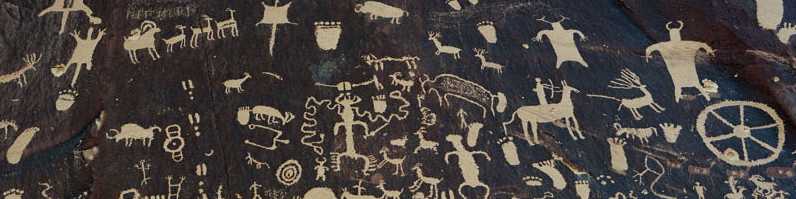
Below:  I'm not sure what this human pterodactyl has to do with Totem Topple. Is it supposed to be a thunderbird? Whatever it is, it's scary!

January 05, 2015

"Explorer fallacy" in roleplaying games

Five Destructive Myths Perpetuated by Roleplaying Games

By Oren Ashkenazi3. The Explorer Fallacy

Western culture has a bit of a fetish for explorers. We idolize them, from Marco Polo to Lewis and Clark. It’s no surprise, then, that so many of our roleplaying games focus on exploring new lands. PCs are always forging new paths through primal forest or being the first to set foot on an alien world. The problem is that, all too often, we have a completely incorrect idea of what exploration was like.

The vast majority of people we think of today as explorers were traveling through places where people already lived. They weren’t conquering untamed wilderness; they were asking for directions and buying supplies from the locals. The successful ones relied as much on diplomacy as navigation or survival.

Why does this matter? First of all, it’s pretty self-centered to say a place was discovered only when someone from our own culture got there. Far more importantly, the explorer myth pushes an idea of these new lands being effectively uninhabited. When natives are mentioned at all, they are documented more as part of the terrain than as actual residents. This is dehumanizing, and it justifies claiming a land’s resources for ourselves. After all, no one was really living there.

In roleplaying games, we’ve established an elaborate framework to justify the explorer myth. It’s amazing how the ‘evil’ races are used as obstacles to be overcome rather than neighbors that deserve respect. Orcs have a culture and society, yet no one bats an eye at intruding into their lands in search of treasure. We have the luxury of knowing that orcs can’t be reasoned with. They are inherently bad, so we don’t have to feel guilty about whatever we do to them. They are often referred to as a ‘savage’ race, inferior to civilization.

July 01, 2014

Stereotypical Deadskins video game

Is This Fun? 'Deadskins' Game Promises Scalp-Taking Zombie IndiansA video game designer is seeking funds for "Deadskins," a proposed console game that many Natives will no doubt find troubling.

The story begins with the mysterious massacre of a tribe by a supernatural being or beings. Then, as described at the game's Kickstarter page:

Using the powers and secrets of your elders, you must journey on a vision quest to repair the Spirit World and heal Mother Earth. Quickly become a warrior and fight a psychedelic battle against a man who has forgotten that he has died. He is a man known as the Dead Skin walker. And his power over the dead, was strong enough to punch a hole through to the land of the living, sending many lost spirits in search of revenge.

Ancestral spirits begin to rise from the earth and mount war parties of the Undead. This ravenous group of zombies attack everything they see and they quickly become many like the stars. They are DEADSKINS; a crazed and bloodthirsty tribe of the undead. Mounted on zombie beasts, the demonic warriors begin to cross over to the land of the living and curse all creatures they encounter.


Writer Dani Miller explains why the Deadskins game is a bad idea:

“Deadskins”--Genocide as Entertainment

By Danielle MillerDominant white culture will never seem to get over its unhealthy obsession with depicting Native Americans as dead and extinct. Cultural objects are whitewashed by acts of appropriation, celebrities and even the general public continues to wear imagery of dead Natives. This perpetual pattern to insult to Native American culture has become so intrinsic that I’m beginning to believe it is an unspoken element of capitalist identity and policy.

What does this say about American culture that it is so inundated with imagery which symbolically subjugates populations who have been oppressed and survived through attempted genocide? It speaks to the success colonization has had on indoctrinating our “color blind” “post racial” society into ongoing imperialism in such a matter that celebration of genocide is normalized. It speaks to the continued genocide that many are complicit in; from perpetuation of stereotypes through erasure, the pillaging of cultural identity through cultural appropriation to blatant exploitation of native resources. Ultimately these seemingly shallow “issues” of stereotypes have causation with statistics and realities of colonial violence.

Many mitigate dead Native depictions by saying well “they just look cool.” But the effects of erasure through Dead Native stereotype are explicit every time someone rejects a real living Native American’s identity by saying: “You don’t “look” like an Indian” or, “I thought all the Indians were dead.”
Comment:  For more on the message of dead Indians, see "Dreamcatcher and Skull" Clothing Line and Kanye's T-Shirts Feature Indian Skulls.

For more on Indians as zombies and vice versa, see "Zombies Are the New Indians" and What the Zombie Trend Means.

April 17, 2014

Video game encourages killing Indians

Racist Game Justifies Murder of Mexicans and Indians

By Simon Moya-SmithA mobile game that pits a white, 19th Century sheriff-like figure—one who brandishes a pair of pistols—against stereotypical images of Mexicans and Indians has prompted opposition by both Native American game developers and educators.

The game, designed for iOS and Android systems, is aptly titled “Clash of the West Cowboys Shootout.” The objective of the player, or “Black Jack Ketchum,” is to kill or leap over the Mexicans and Indians in his path. For $1,000, which comes in the manner of bags of money and gold bullion peppered across the ground, the player can upgrade to “Buffalo Bill,” who brandishes a shotgun in place of Ketchum’s six-shooters.

In the game description, the Mexicans, who are illustrated as both lanky and corpulent, and the Indians, who are portrayed as dull-eyed and dopey, are referred to as “a gang of criminals who are violently committing crimes.”

Elizabeth LaPensée, an Anishinaabe and Métis game developer and researcher, said the game “couldn’t [be] more racist” and that it justifies the historical murder of Mexicans and Indians.

“Games like these portray Native people as fodder to be killed,” she said. “They’re representing them as lazy, as evil, because they justify the shootout by saying that these ‘Indians’ are in a gang and that their acts are making the situation.”
Comment:  For more on stereotypical video games, see No Doubt Video = Custer's Revenge and Angry Patriots and Pinheads.

January 01, 2014

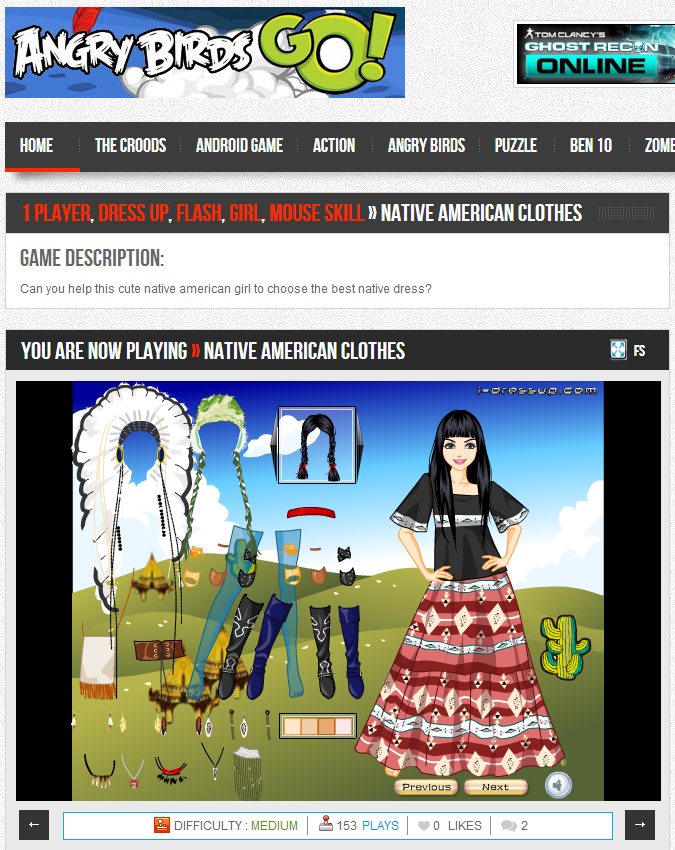
"Native American Clothes" in Angry Birds Go!

You've heard of the Angry Birds phone app. Apparently Roxio, the maker of Angry Birds, has put out a whole bunch of games under the Angry Birds Go! banner.

One of these is an electronic version of a paper doll called Native American Clothes:Game description:

Can you help this cute native american girl to choose the best native dress?
The image below gives you a good idea of the game:


On the positive side:

  • Only a few of the dresses are "traditional." Most are modern with a few Native or Western touches.

  • The same applies to the accessories such as footwear and jewelry.

  • Only one of her hairstyles, the braids, is "Native." The rest are varied.

  • The four skin colors range from cream to tan. There's no assumption that she must have brown skin--or worse, pinkish-red skin.

  • On the negative side:

  • One of her accouterments is a Plains headdress traditionally worn only by revered male chiefs.

  • The background shows teepees and cactus against green hills--no modern civilization in sight.

  • Stereotypical flute music plays unless you turn it off.

  • An initial map displays about 20 reservations--all in the West between the coast and the Mississippi. The only item I could identify with one tribe, the skirt shown above, is from Florida's Seminoles, who aren't on the map.

  • The overall impression is that there's only one kind of Native, one culture, and one style of dress. In short, the game is painfully generic.

    As my comments suggest, "Native American Clothes" could be better, could be worse. I wouldn't recommend it to anyone, but all the "Pocahotties" in buckskin skirts could learn something about what today's Indians wear.

    September 21, 2013

    "Whiteskins" in football video game

    Why I Created the 'Washington Whiteskins' in a Football Video Game

    By Owen GoodYou can see the team here, on PlayStation 3, and here for Xbox 360. You can download it to your console by going into TeamBuilder and searching for the nickname "Whiteskins." It's the only created team on NCAA 14 by that name.

    I took a while to post this because I was apprehensive about being publicly identified with the project. I mean, this is offensive. It's basically a racist caricature. Then I realized that's the point. Anyone who has a problem with "Whiteskins" should have a problem with Redskins—and vice versa. If you find this crass, juvenile or hostile or a stubborn, arrogant way of arguing a complicated issue with a decades-long presence in American life, well, guess what: "Redskins" stands for the same thing.

    And no, I would not create the Blackskins, if asked, because while it sounds cool to throw that out as some kind of argumentative sidebar, insulting a second ethnic minority to call attention to the grievances of the first is generally not an effective means of raising awareness. This satire also draws on the prerogative one has to make jokes about his own ethnic background. And yes, thank you, I know Notre Dame's teams are called the Fighting Irish. It is hardly cultural appropriation when Irish Catholicism forms a huge portion of that university's culture. The only tolerable edge case, if you really want to split hairs, would be a school like The University of North Carolina at Pembroke, whose original enrollment was limited to American Indians, and whose athletic teams are known as the Braves.

    Will people use "Whiteskins" in their NCAA Football Dynasties? Will they download and share the teams? Will they play unranked games with the good old flesh-and-red online? I don't know.
    Comment:  For more on the Washington Redskins, see Satirizing Redskins with Blackskins and Satirizing Redskins with Whiteskins.

    August 17, 2013

    Math games based on ND tribes

    Former Jamestown College prof bases games on N.D. tribes

    By Charly HaleyAnnMaria De Mars says her math skills have helped her enjoy a great life.

    So now, the former Jamestown College professor is working on a way to teach math to children while incorporating Native American history, as told by the natives themselves.

    And she wants it to be fun.

    As the CEO of 7 Generation Games, based in Santa Monica, Calif., De Mars has been working with members of North Dakota’s Spirit Lake and Turtle Mountain reservations to develop computer games that take students on virtual journeys where they have to incorporate math skills into the life of Native Americans hundreds of years ago, before European colonization.
    Comment:  For more on Native video games, see Upper One Games and Native Values in Assassin's Creed 3.

    June 22, 2013

    Upper One Games

    Indigenous-owned game company making titles on culture

    By Greg ToppoAs they searched over the past few years for investment opportunities, members of the Cook Inlet Tribal Council of Alaska checked out everything from real estate to funeral homes. But each time she heard the details, President and CEO Gloria O'Neill would say to herself, "That's just not doing it for me. We have to do something really connected to our youth."

    This week at the annual Games for Change Festival, they revealed where they're putting their money: video games.

    The council's homegrown startup, Upper One Games, LLC, will produce commercial and educational titles "to engage young people in fresh, vibrant ways" using games that teach about culture. Upper One will be the first indigenous-owned video game company in the USA, its founders say.

    Its name a play on "The Lower 48," how Alaskans refer to most of the rest of the USA, Upper One will partner with New York-based E-Line Media, with plans to release its first two titles next year: a commercial "cinematic platform" game and a digital history curriculum modeled after Historia, a series of tabletop games developed by a pair of Texas middle-school teachers.
    Comment:  For more on Native-themed video games, see Native Values in Assassin's Creed 3 and Kachina Video Game.

    January 28, 2013

    Native values in Assassin's Creed 3

    An analysis goes deeper into Assassin's Creed 3's Native history and culture than previous postings have done:

    Indigenous Representations in Assassin’s Creed III

    By Beth Aileen DillonFeminine Strength: Kaniehti:io (Connor’s Kanien’kehá:ka mother) is an intelligent, suspicious, and tactical woman who helps to free enslaved “Natives,” arranges alliances across Indigenous nations, and saves the life of Haytham Kenway (by being totally badass and strong herself).

    Ubisoft does still occasionally get iffy, like the Clan Mother who gets too close to the “Mystic Savage” trope in her shamanistic powers and tone. However, given the Assassin’s Creed series’ science fiction time traveling storyline, the elder’s knowledge of the “portal” adds an element to the growing recognition of Indigenous science fiction.

    The game generally has an anti-colonialist tone. Kaniehti:io rightfully doesn’t trust Haytham. Even the non-player characters question their role, such as a British soldier who comments about the expedition: “Slap a fancy name on something and all is excused.” Interestingly, the game is mindful of (what to the Anishinaabe is known as) Weendigo nature of the colonizers—Weendigo being a spirit of endless consumption that can enter someone prone to that way of being and mount to cannibal nature. As a youth, Connor predicts of westward expansion: “In time they will swallow us whole.” Haytham, being self-reflective, states, “We’re cruel and desperate creatures, set in our conquering ways” and acknowledges his own “desire for more, and more, and more.” Kaniehti:io worries about the “same dark hunger” being passed down in her son.

    Overall, the game balances the bloodiness necessary for a game about assassination with Indigenous ways of knowing, such as when Connor points out when hunting, “We must return nature’s kindness with our own.”

    Props to Ubisoft and Aboriginal Territories in Cyberspace for these strides.
    Comment:  For more on Assassin's Creed 3, see Assassin's Creed 3's Mohawk Advisers and Noah Watts as Mohawk Assassin.

    November 27, 2012

    Assassin's Creed 3's Mohawk advisers

    A columnist interviews the two Mohawk consultants who helped develop the Mohawk portions of the Assassin's Creed 3 video game. The following may be the most interesting section:

    The Awesome Mohawk Teacher and Consultant Behind Ratonhnhaké:ton

    By Michael VenablesVenables: What kind of cultural guidelines did you set down for Ubisoft to allow Ratonhnhaké:ton in Assassin’s Creed 3 to appear as a member of the Kanien’kehá:ka in appearance, speech and beliefs? Was this a community process that involved Nation elders in deliberation?

    Teiowí:sonte: For the most part, I was able to provide advice independently, drawing from my own knowledge of our history and culture. However, for things I was not completely sure about, I did my research and asked around our community.

    Certainly, a big part of why I was recruited was to ensure that Ubisoft did not produce anything that would be considered culturally offensive to our people. That said, ideas were often bounced off of me to ensure that Ubisoft was culturally sensitive and accurate. For example, when some of the writers were thinking about a segment which used ceremonial masks, I immediately advised them not to incorporate something so spiritually private to our people. No doubt, our people would have been quite upset about something like that in the game and probably would have presented a stern opposition against the game.

    To their credit, Ubisoft went above and beyond to ensure that the rich and distinct culture of the Kanien’kehá:ka (Mohawk) Nation was accurately portrayed in the final product, to the best of their ability.

    Venables: Do you have any further thoughts on your contribution to helping the Kanien’kehá:ka Mohawk Nation share its culture with the world, in a video game?

    I believe that having a Kanien’kehá:ka protagonist appear in a such a popular game franchise such as Assassin’s Creed 3, makes our nation relevant again to people who might think we are but a shadow of the past. It puts us on the map again and makes our culture accessible.

    There are a lot of unfortunate stereotypes or unfounded romanticisms about Native Americans in contemporary society and popular culture today, including racial ignorance. I believe most people in the world today amalgamate the vast and distinct cultures of each indigenous nation into a sort of pan-Indian cliché, which does a big disservice to these cultures who work hard to protect and strengthen their distinct identity as a sovereign people against tough odds.

    Assassin’s Creed 3 takes the time to give its audience an accurate glimpse into Kanien’kehá:ka culture, by incorporating our true language, our songs, and our historical experience during an era that depended greatly upon Native American alliances. This accessibility may inspire someone to learn more about the various Native American cultures in North America and their contributions to the world today. For example, most people just don’t know how much of a significant role the Kanien’kehá:ka (Mohawk) and other Iroquoian peoples played in the American Revolution and the geopolitical landscape we live in today.

    Whether they learn something as simple as how not all Native Americans lived in tepees, or something more significant such as how the Haudenosaunee (Iroquois Confederacy) constitution inspired the creation of the US Constitution; it would be worth it.
    Comment:  For more on Assassin's Creed 3, see Noah Watts as Mohawk Assassin and Assassin's Creed 3 Misrepresents History.

    Below:  "Assassin's Creed 3 concept art." (Ubisoft Entertainment)

    November 19, 2012

    Noah Watts as Mohawk assassin

    Full circle

    Actor Noah Watts gets into the game

    By Alex Sakariassen
    Watts has racked up quite a resume in the intervening decade. He guest starred on a series of hit TV shows including "CSI: Miami," "Ringer" and "Sons of Anarchy." He played Native American characters in a number of independent films. The stage has even called him back; he played the lead role in the Southwest Repertory Theatre's rendition of The Indolent Boys, and traveled to London's inaugural Origins festival in 2009 to reprise a role from a 2008 "Native Voices at the Autry" production.

    For Watts, work has a way of bringing him back to his roots. His latest film is yet to be released, an independent film titled The Last Beyond shot entirely in Watts' hometown of Livingston. The movie is set during the Depression and Watts portrays the Native protagonist Joe Running Elk. The last project Watts worked on in Montana was his first, The Slaughter Rule, meaning The Last Beyond has brought him full circle. Watts considers himself a part of a cadre of Native American writers, directors and actors who, over the past 12 years or so, have exercised increasing control over how their people are represented in popular entertainment.

    "It's a huge honor to be part of the group that's breaking these boundaries, stepping forward and saying, 'We have a right to tell our stories, and we have a right to direct our stories, and we want to act in our own [stories],'" Watts says. "We need to control our image in the media and not let some other third party control it for us, tell us who we are, tell everyone else who we are."

    Watts spent much of the past summer at Ubisoft's headquarters in Montreal, voicing the role of Mohawk protagonist Connor Kenway and conducting facial- and motion-capture work for in-game cinematics. Watts says he relied on memories of his Crow upbringing to inform how he carried himself as Kenway.

    "I just tried to think about certain people in my life who were on that side of my family, the Native side," Watts says. "How they carried themselves, how they talked, how they moved. I was so happy that a game of this caliber, this size, would even consider using a Native American as the main protagonist."
    Comment:  For more on the subject, see Assassin's Creed 3 Misrepresents History and Reviews of Assassin's Creed 3.

    November 18, 2012

    No Doubt video = Custer's Revenge

    A Native American Expert on No Doubt’s Controversial Video and Cultural Appropriation

    By Paul HiebertWith mounting accusations of Native American cultural appropriation happening these days—Lana Del Rey, Khloe Kardashian, Ke$ha, and Urban Outfitters, among others, have all dabbled and been scolded—the No Doubt video seems to have brought the discussion to a tipping point. But, in comparison to some of the other stuff out there, is the video worth getting upset about, or is it just some silly fun that happens to rely on the clichéd Cowboys and Indians genre? To help make sense of what constitutes cultural appropriation as opposed to a cultural hybrid, an homage as opposed to an act of exploitation, we spoke with Professor N. Bruce Duthu, Chair of the Native American Studies Program at Dartmouth College and a member of the United Houma Nation of Louisiana.

    What were your initial thoughts after seeing the music video for the first time?

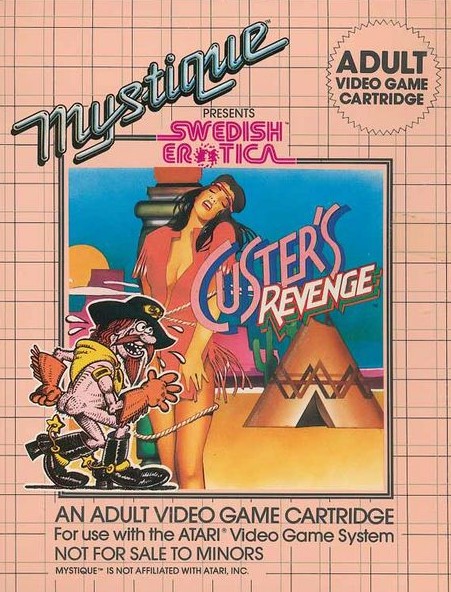
    The main concern I had was with the objectification and sexualization of a person depicted as a Native American woman. The whole tying her up and so forth, together with the provocative lyrics, is a timeworn trope. It made me think of a video game launched in the early ’80s by Atari called Custer’s Revenge. The object of the game is to navigate your character, which is General Custer, through a barrage of arrows as he makes his way toward a Native woman tied to a stake. The goal is for him to have forcible sex with the woman. I present this to my class in the context of a long, sad history of the sexualization of Native women, who face the highest rates of sexual violence of any discrete group of women in the entire US. I’ve written on this subject and had a piece published in The New York Times. So seeing Gwen Stefani tied up as a Native woman with lyrics that say, “Go ahead and look at me/Do you think I’m looking hot?” was just pretty revolting.

    What other aspects of the video did you find disturbing?

    Well, the video continues the tradition of popular media treating Native culture as if it’s part of the public domain, as if one can simply go into this reservoir of stereotypical images and draw from it without any kind of limitation or concern. When lands have been lost and cultures have been decimated, one of the last things left to be appropriated from Native cultures is their very dignity. And this is what videos like this do—they exhume and exploit and pull away whatever shreds of dignity may be left. It reflects our historical amnesia.

    I know some people think this is overreacting and Native people are just whining again. But for those who find this a waste of time and don’t understand Native cultures as living, breathing, thinking societies that are worthy of people’s respect, it’s pretty hard to have a serious conversation about concerns such as the return of Native land. So if the attitude still exists that Native cultures don’t mean anything, don’t count, don’t deserve respect, it’ll translate into destructive action.

    And I do give credit to No Doubt for their response. You don’t make a video like that on the cheap, so for them to yank it was a big deal. I applaud them for responding very promptly and thoughtfully, and basically saying: “Look, we did it, we made a mistake and we’re yanking it.” So kudos to them.


    No Doubt's 'Looking Hot' Controversy: Does Anyone Win?

    By Alicia Diaz DennisMany of the video's defenders have made the argument that rock and roll as we know it would not exist were it not for cultural appropriation. One commenter on The Guardian's recent criticism of the video scoffed, "If being inspired by art or imagery from other nationalities is now a taboo, then much of the music, film, TV, painting and literature any of us have ever loved is also a taboo."

    "There's a certain level of cultural borrowing that's okay, and natural, and going to happen no matter what, especially in the realm of art and music," Keene explains. She notes that some artists have incorporated aspects of indigenous cultures into their work respectfully: Earlier this year, Nelly Furtado featured Native hoop dancers Tony and Kevin Duncan (Mandan/Hidatsa/Arikara/San Carlos Apache) in her music video for "Big Hoops (The Bigger the Better)," for example. But this was different.

    "It was them taking the images out of context and mashing together different stereotypes of Native people," Keene says. "The other issue was it implied violence against Native women, because Gwen's tied up for a lot of the video with two cowboys pointing guns at her. And because violence against Native American women is such an epidemic in the U.S., that's definitely not an image that you want to be promoting."

    The implications of sexual violence were not lost on Angela R. Riley, the director of the American Indian Studies Center at UCLA, who posted a lengthy open letter to the band a few days after the video was taken down. In addition to noting that no one from UCLA had been consulted on the video, Riley pointed out some horrifying statistics about the violence American Indians face, including the fact that approximately one in three American Indian and Alaska Native women will be raped in their lifetimes.

    Keene can't believe no one involved didn't realize what they were doing was wrong. "Not one person was vocal enough to say, 'Hey, we have a problem and we probably shouldn't be doing this,' that to me is amazing. Because you know it's not just the band and the director who come up with the concepts and put them into action."
    Comment:  For more on the subject, see What's Wrong with No Doubt's Video and No Doubt's Looking Hot Video.

    Below:  The cover of Custer's Revenge.

    Assassin's Creed 3 misrepresents history

    Assassin’s Creed III video game distorts historyAssassin’s Creed III is set in 1765, and promotional material describes how, as “a Native American assassin, (you) eliminate your enemies with guns, bows, tomahawks, and more!” To suggest indigenous peoples rallied to the side of the colonists in their fight for freedom grotesquely twists the facts.

    A contributing factor to the American Revolution was the Royal Proclamation of 1763, which established the important precedent that indigenous peoples had certain rights to the lands they occupied. The Declaration of Independence, in contrast, complains that King George III sided with “the inhabitants of our frontiers, the merciless Indian Savages.”

    Whose side would the “Native American assassin” really have been on? Think about it.

    The War of 1812, in some respects a sequel to the Revolutionary War, offers some insight. “First Nations fought shoulder-to-shoulder with the British in this important conflict,” Assembly of First Nations National Chief Shawn Atleo said last month, as the federal government presented 48 First Nations with commemorative medals and banners to honour the participation of more than 10,000 First Nations and Métis warriors in the fighting.
    Good point. I believe the Oneida were the only tribe to side with the rebel Americans against the British. And George Washington was the one who burned Native villages, not the redcoats. Pretending that the freedom-loving Indians sided with the freedom-loving Americans is a gross distortion of history.

    It's just a [fill in the blank], again

    Not everyone agrees:

    Globe And Mail's Assassin's Creed 3 Editorial Spawns Mockery, #GlobeEditorial Meme"Assassin's Creed III is set in 1765, and promotional material describes how, as 'a Native American assassin, (you) eliminate your enemies with guns, bows, tomahawks, and more!' To suggest indigenous peoples rallied to the side of the colonists in their fight for freedom grotesquely twists the facts," the editorial writes.

    Yes. A video game where one plays a member of a secret order of assassins that can share the historical memories of one's ancestors "twists the facts."

    Wait until the editorial writer finds about the other entries in the hit series. We hear that in one of them you have to go after the Pope and in another you kill Christian crusaders.

    The editorial has been openly mocked on Twitter with the hashtag #GlobeEditorial, with many reminding the editorial writer that video games are just that—games.
    And Aunt Jemima ads were just Aunt Jemima ads. Since everyone knows advertisements aren't real life, I wonder why we ever got rid of them. What harm could they have done?

    The obvious retort is: Where do you think most people learn about Natives and other minorities, if not from the media? Once again there's no answer and pro-Native activists win the debate.

    Indians weren't relentless killers

    Assassin's Creed 3 also has a more subtle problem:

    Has Pop Culture Moved Beyond Cowboys And Indians?Over five million people in the U.S. claim some form of Native American identity, according to the U.S. Census Bureau. As part of Tell Me More's series on Native American Heritage Month, host Michel Martin speaks with author Anton Treuer about America's first people and how they're reflected in pop culture.

    MARTIN: So when you look at that, I'm interested in how you respond to that.

    TREUER: I have a mixed reaction. You know, I saw the ads for "Assassin's Creed," the newest edition, which has the Native American assassin as the protagonist. And I was watching and a couple of my older kids were watching when the ad came out. And their first year action was: Cool, there's an Indian who's kicking everybody's butt. And I thought at least we're not being put down as, you know, victims. But on the other hand, this is a game that depicts really one dimension of the native historical experience--the history of, you know, dealing with violence.

    Granted, you're not going to be playing "Assassin's Creed" to get a nuanced understanding of history, but at the same time it may be the only intersection point that a lot of people have with Native culture among certain age groups. So I think it's a, you know, it's a double-edged sword. I do appreciate the fact that they brought in Native language consultants. They tried to engage and use Native-language material. They took great care with the representation of the historic Mohawk Village for the brief parts that it appears in the gaming material. So, you know, I know that they're trying to show at least authenticity--even if they're showing a one-dimensional side of Native culture.
    Comment:  For more on the subject, see Reviews of Assassin's Creed 3 and Assassin's Creed 3's Mohawk Origin.

    October 28, 2012

    Reviews of Assassin's Creed 3

    The American Revolution: The Game

    Assassin’s Creed III is a thrilling, hyperdetailed journey to the Colonial era. There are also aliens.

    By Erik Sofge
    [I]f there's a driving moral imperative in AC3, it's not a flag-waving desire for independence from a distant, fickle imperial power. It's the desire to defend those original Americans, specifically the Mohawks and Iroquois in the Northeast, who watch this white man's conflict unfold. The game's hero is a Mohawk (he's half-white but raised in and accepted by the Mohawk community), and inhabiting his point of view allows you to watch long-standing, formalized tribal alliances shatter as groups align with the Brits and the colonists. But whoever wins, it's clear—the Native Americans are going to lose, and lose everything.

    While everyone in the entertainment industry claims to be culturally sensitive when dealing with Native Americans, Ubisoft Montreal didn’t just go through the motions. The game’s makers filtered every relevant plot point and line of Mohawk-language dialogue through Thomas Deer, the cultural liaison for the Kanien’kehá:ka Onkwawén:na Raotitióhkwa Language and Cultural Center in the Mohawk territory south of Montreal. The studio hired an additional consultant to deal with translation—that time-honored Hollywood tradition of having old-timey Native Americans speak to each other in heavily accented English is notably absent in AC3. When the studio wanted to add background chatter to a village scene, Deer set them up with a local immersion school in his territory, where they could record Mohawk children playing during recess.

    It's hard to express the cumulative impact of all that seemingly spot-on Mohawk language and culture. Sure, the hunting sequences are videogamey and oversimplified, and the recurring visual of a Native American driving a hatchet into a white man’s brains isn't the most obvious path toward reversing centuries of racist stereotyping. But even so, AC3 manages to be not only one of the best, most visceral examinations of the history of the Revolutionary War. It’s also possibly the first mainstream look at Native American history that isn't pandering or offensive.

    Assassin’s Creed III is no dry history lesson. It's possible to enjoy this game and not care one bit about the fact that Boston is modeled on period maps and on topological data that nails down the elevation of every hill and down-sloping street. You can certainly stalk targets through old New York City without considering the research that went into recreating the distinctive flat Dutch facades that concealed gabled rooftops. And you may well get more excited about the game's present-day crisis, which involves aliens and the world's impending, fiery doom. Yes, AC3 is filled with history, but it's also a swashbuckling sci-fi rip-snorter.


    New 'Assassin's Creed' has Native American roots

    By Mike SniderThe pair of Assassin's Creed games stretches the standard for what constitutes a video game hero. Most remain white and male, even though some games such as Mass Effect allow the look of the main character to be customized.

    Not only is Connor the only non-white main character in a console game this year, "Assassin's Creed III is the only game I can think of with a substantive primary role for a Native American character," says Arthur Gies, reviews editor for Polygon.com. It is also a "step in the right direction for a high-profile title" such as Liberation to have a mixed-race female lead, he says. Ubisoft's one-two Assassin's punch is, Gies says, "subversive, for sure."

    Integration wasn't solely at the heart of the design decision to give Connor Native American bloodlines, says Alex Hutchinson, creative director for Assassin's Creed III. Where previous Assassin leads relied heavily on knives and swords, Connor wields a tomahawk, battle-axe and bow and arrow, as well as firearms. "It gave us a bunch of gear that maybe wouldn't be appropriate for an English or French person in this setting," Hutchinson says.

    About the heritage of Connor and Aveline, who happen to cross paths in Liberation, he adds, "it just puts your brain in a different space of not just, 'When are we?' but 'Who are we?' What would this person do in this situation?"
    And:A new lead character and new entry point could be driving interest in the game, Gies says. "I think the Revolutionary War setting is going to get an awful lot of attention, and initially could lead to great sales."

    The franchise is popular enough that a live-action movie is in the works. "It's clear Ubisoft has a hit series in its portfolio," says Dan Hsu, GamesBeat editor-in-chief for VentureBeat.com. "Assassin's Creed is an ideal marriage of a great, marketable name, iconic imagery with its mysterious and cloaked protagonists, and a made-for-gamers theme. Who wouldn't think it's cool to be an assassin?"
    ‘Assassin’s Creed III’: A Critical Success, and a Cultural MilestoneThe high marks for the game, both as a game and as a window onto history, make clear what many Native gamers and moviegoers have thought all along: That it’s possible to make good entertainment without dragging out the same tired stereotypes.

    And perhaps abandoning those stereotypes is one of the touches that is the difference between a good game and a great one.

    Could we see more game manufacturers looking to explore producing Indian titles with an authentic feel? Todd Martens thinks so—as he writes in his review for the L.A. Times, “this game makes it clear that there’s plenty of rich Native American gaming story lines yet to create.”
    Comment:  There have been mainstream movies and documentaries that weren't "pandering or offensive." And video games games that starred Native characters. So Assassin's Creed III isn't anything new in that regard.

    But it's notable for showing how a Native-themed entertainment product can succeed. It's a big-budget affair that respects cultural and historic accuracy. And it's getting a big marketing push from Ubisoft.

    If someone put that much money into a Native superhero, sci-fi, or thriller adventure, it also would succeed. That's how you do it folks: write a good accessible story, give it an authentic look and feel, and pay close attention to details.

    For more on Assassin's Creed 3, see Assassin's Creed 3's Mohawk Origin and Assassin's Creed 3's Native Heritage.

    October 14, 2012

    Kachina video game

    Debbie Reese writes about a children's video game in her Americans Indians in Children's literature blog:

    Ben Esposito's "Kachina"IndieCade, or, the International Festival of Independent Games was held last week, October 4-7, 2012.

    Ben Esposito's "Kachina" (which I gather is still in development) was designated as a 2012 Official Selection. Here's a screenshot from the website:
    Here's what the description says. See, in particular, the text I put in bold:

    Kachina is a physics-based toy that evokes Katamari Damacy's sense of order & scale mixed with Windowill's childlike wonder. Drawing as readily from Hopi folklore as it does Bruce Springsteen, Kachina invites you to play with the creatures and artifacts of North American mythology.
    Reese sums up what's wrong with this game:Esposito and the IndieCade people who selected it as an Official Selection must not know that teepees and totem poles have nothing to do with the Hopi people. They obviously have no idea what kachinas mean to the Hopi people, and they also likely have no idea that calling the religious traditions of an Indigenous people "folklore" is derogatory.Comment:  We should note that Hopi isn't the only tribe with kachinas. The Zuni and few other Pueblo tribes have them as well.

    Looking at the video of the game, there seems to be no Native content besides the teepee and totem pole. No kachinas, which is good, since the Hopi undoubtedly would object. No other artifacts. Maybe a couple of animals.

    Basically, it looks like there's no justification for the "Kachina" name. Or for the summary implying the game has substantial Native content. The Native concept appears to be a gimmick to make the game seem more educational and meaningful than it really is.

    For more on Native video games, see Assassin Creed 3's Mohawk Origin and Evolution Video Game Features Lakota.

    October 05, 2012

    Assassin's Creed 3's Mohawk origin

    Assassin’s Creed III’s Native American Hero Had A Very Hard Life

    By Evan NarcisseThis teaser for Assassin’s Creed III is different from the blitz of video we’ve been getting as the threequel nears release. In the clip, you see a bit of Connor’s life from before he became an Assassin. The scenes of him running through the forest look beautiful but get harshly contrasted when he comes home and find his village and loved ones burning to the ground.

    Those moments really drive home how Connor is a different type of lead character for the next Assassin’s Creed. He doesn’t come from a life of ease like Ezio and wasn’t born into the Assassin’s order like Altair. And the fact that his catalyst for becoming an Assassin is tied into the tragic history of Native American in the United States will likely make his story more poignant.
    Comment:  For more on the subject, see Assassin Creed 3' Native Heritage and Video Game Features Mohawk Assassin.

    September 23, 2012

    Evolution video game features Lakota

    Gaming company to release Native American-themed gameA new gaming company in Germany called Scorpius Forge will be introducing a new series of games called Evolution that incorporates historical references and nature to create positive and interactive learning experience.

    Native Americans is the first installment of the game series that takes place in 18th century Lakota Sioux territory. The player takes control of a 6-year-old boy who learns how to fish, hunt and ride horses. The game focuses heavily on living conditions, environmental effects, culture and rites of the Lakota.

    Each hour of gameplay adds a year to the character’s life. The player can develop skills as a warrior, start a family and contribute to the community. Although the character can die, his skills can be passed to his descendants and the game will restart on a higher level with difficult challenges.

    The game, scheduled for release in December, will be available on iPhone, iPad and iPod Touch.
    Comment:  The focus on the Lakota of the past is a bit unfortunate. Modern Indians from a variety of tribes could learn these skills too.

    Even if it focuses on the past, the game could include a modern framework. You know, modern Indians want to learn traditional skills, so they consult an elder who tells stories about the past. Then the game goes into flashback mode.

    But for what it's doing, the game sounds good. Sounds like it portrays Indians the way video games should portray them. Namely, as people with sophisticated skills and beliefs, not as savage killing machines.

    For more on Indians in video games, see Assassin Creed 3' Native Heritage and "Native Representations in Video Games."

    September 05, 2012

    Angry Patriots and Pinheads

    Elections 2012: The Election Played as a Video Game

    By Mark TrahantThe birther movement–the far-fetched idea that President Barack Obama is not a natural born American–has moved to a new platform, the video game, Angry Patriots and Pinheads. According to the company’s website, the game uses “a Revolutionary War cannon to launch patriotic characters or the “Angry Patriots” at socialist politicians, actors, musicians, other mainstream pinheads as well as a variety of ‘jack asses’ stationed throughout the board.”

    One such character is Elizabeth Warren. The promotional video shows Warren wearing feathers. She is asked by a Kenyan-flag-waving Obama, “Liz, So are you Cherokee?” The tag line says she proclaimed her 1/32 Cherokee Heritage (a story debunked here by Indian Country Today Media Network).
    Comment:  Just be clear, the "angry patriots" aren't the same people as the "pinheads," as you'd expect. These angry patriots are fighting the people they consider pinheads.

    Apparently the game uses stereotypes to make its racist points. Warren is a pretend Indian and Obama is a Kenyan. No doubt women are shrill, gays are effeminate, and Muslims are terrorists.

    If the game-makers think they're being clever or funny, they're mistaken. Dressing up as Indians started before the Boston Tea Party 239 years ago. I believe cartoonists have been sticking white men in leathers and feathers ever since. To reiterate a centuries-old "joke" is pathetic, not original or insightful.

    For more on Elizabeth Warren, see Elizabeth Warren Ducks Native Delegates and Warren:  Conservatives Back Cherokee Protesters.

    July 29, 2012

    Bora and Upa in Dragon Ball

    Correspondent "Not Who" sent me another item about an anime and video game:In Dragon Ball, another very popular anime, there is actually a "tribe" of Indians who make several appearances through the show and the two series following.

    BoraBora is a tall, muscular man who resides in the Sacred Land of Korin with his son Upa, in a tepe at the base of the Korin Tower.
    UpaUpa is a member of the native tribe who serves as the guardians of Korin Tower. His father, Bora, is the chief of the tribe.Sacred Land of KorinThe Sacred Land of Korin (聖地カリン) is a village located at the base of Korin Tower. It is where Bora and Upa live.

    Comment:  Again, these characters look like your standard generic Indians. I don't see anything distinguishing them from thousands of other fantasy Indians. Locating them in a fictional world unconnected to any land or culture only compounds the problem.

    For more on Indians in video games, see Assassin's Creed 3's Native Heritage and Justin Rain in Transmedia Defiance.