Showing posts with label Standing Bear. Show all posts

December 04, 2012

Staged reading of Waaxe's Law

Newseum Presents Staged Reading of 'Waaxe's Law'The Newseum will host a performance of "Waaxe's Law" in the museum's Walter and Leonore Annenberg Theater on Wednesday, Dec. 12, 2012, at 7:30 p.m.

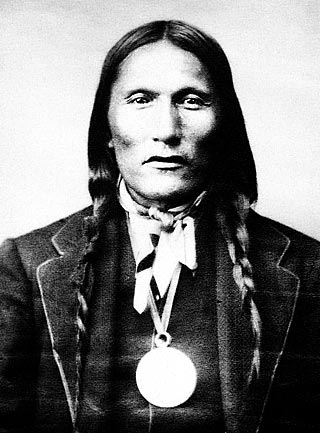
In 1879, a Ponca Indian chief stood up, extended his hand, and made one of the greatest arguments for equality under the law in the history of the United States. Chief Standing Bear demanded that a federal court afford him the same rights as whites under the law, despite the fact that his skin was a different color.

Cherokee playwright and attorney Mary Kathryn Nagle wrote "Waaxe's Law," a play that tells the story of the forced removal of the Ponca tribe to present-day Oklahoma and Chief Standing Bear's subsequent journey for justice—a journey that resulted in the first federal court decision declaring Indians to be "persons" under the law. Although Chief Standing Bear won his fight for equality in 1879—a full 75 years before the Supreme Court issued its decision in Brown v. Board of Education—very few Americans know of his story or the freedoms he won for Native Americans.

"The Ponca tribe of Nebraska would not be where we are today if it was not for Chief Standing Bear; in fact, we may not even exist if it were not for this great chief. 'Waaxe's Law' is more than a play; it is a part of our tribe's history," says Rebecca White, chairwoman, Ponca tribe of Nebraska.
Comment:  Is Standing Bear the most famous Indian ever? Not yet, but it may only be a matter of time until he is.

For more on Standing Bear, see NMAI Celebrates Standing Bear and Standing Bear's Increasing Exposure.

October 08, 2011

NMAI celebrates Standing Bear

"We Are a People: The Ponca Journey" Coming to National Museum of the American IndianThe Smithsonian 's National Museum of the American Indian presents "We Are a People: The Ponca Journey," a free two-day festival featuring music, dance, play readings, a film screening and panel discussions with the Ponca Nation of Nebraska Friday, October 7, from 11 am-10 pm and Saturday, October 8, from 10:30 am-5 pm.

In 1879, a full 75 years before the Supreme Court issued its monumental decision in Brown v. Board of Education, a Ponca chief named Standing Bear stood up, extended his hand, and made a speech:

“This hand is not the color of yours, but if I pierce it, I shall feel pain. If you pierce your hand, you also feel pain. The blood that will flow from mine will be of the same color as yours. I am a man. The same God made us both.”

Standing Bear's argument convinced the federal judge to declare for the first time in the nation's history that Native Americans are "persons" under federal law, a declaration that contradicted decades of Indian policy.
Kevin Gover, director of the National Museum of the American Indian, wrote:Last night, Supreme Court Justice Sonia Sotomayor came to the museum for the opening reception of the Ponca festival. She gave a lovely speech about the significance of the Standing Bear case (in which Chief Standing Bear was found to be a "person" under federal law). The Poncas then honored her with a song composed for Standing Bear many years ago. Indians have such a great sense of history and ceremony.Comment:  For more on Standing Bear, see NEA Award for "Native Daughters" Project and Standing Bear's Increasing Exposure.

June 21, 2011

NEA award for "Native Daughters" project

UNL professor to receive civil rights award

By Mark AndersenSlowly, but deliberately, earn the trust of Native American people, never promise the impossible, and "let native people participate in their story as fully as possible," said author and journalist Joe Starita.

Then, stand aside.

"Get out of the way of the narrative," he said of his writing. "Let their story come to the reader as directly as possible without my fingerprints."

Starita hopes to do the same in Chicago on July 1, by accepting a civil rights award from the National Education Association on behalf of Native women whose vital histories mostly have been neglected.

"As a teacher and writer, Joe Starita shares the unsung achievements of Native Americans," said association President Dennis Van Roekel. "His books are a must-read to better understand Native Americans, their heritage and their contributions to American life and history."

Starita is the author of "I Am a Man: Chief Standing Bear's Journey for Justice," the 2010 One Book--One Lincoln selection, and "The Dull Knifes of Pine Ridge: A Lakota Odyssey," a 1996 Pulitzer nominee.

It is native women who as poets, leaders, teachers, warriors and mothers have kept their culture going, Starita said.

"A nation is not conquered until the hearts of its women lay on the ground," he said, quoting a Northern Cheyenne proverb.

"I want to accept this award on behalf of all the Winona LaDukes, Wilma Mankillers, Vida Stablers and Judi gaiashkiboses."
Comment:  In addition to the main subject, a few things are worth noting here:

  • That I Am a Man was read citywide in Lincoln, Nebraska.

  • That The Dull Knifes of Pine Ridge was a Pulitzer nominee.

  • How to earn the trust of Natives when you're a non-Native writing about them.

  • For more on the subject, see Standing Bear's Increasing Exposure and Nebraskans to Read Standing Bear Book.

    May 21, 2011

    Standing Bear's increasing exposure

    Last year I covered the fifth annual Chief Standing Bear Breakfast. This year's breakfast occurred Friday. An article describes it and some of the exposure Standing Bear has received in recent years.

    Lakota author:  Remember your ancestors, your past

    By Kevin AbourezkMarshall, a Lakota author, told more than 500 people at the sixth annual Chief Standing Bear Breakfast on Friday that it's important for all people to remember the sacrifices of their ancestors, including Ponca Chief Standing Bear. In 1879, Standing Bear made history after being declared a person before the law during a trial in which the U.S. government tried to prosecute him for leaving his tribe's Oklahoma reservation.

    The story of Standing Bear has inspired an opera, a trilogy of plays by New York writer Christopher Cartmill and an award-winning book, "I Am a Man," by Lincoln author Joe Starita. Next year, the University of Nebraska Press plans to publish a children's book about Standing Bear written by Lakota author Virginia Driving Hawk Sneve, said Judi Morgan gaiashkibos, executive director of the Nebraska Commission on Indian Affairs.

    On Friday, Christine Lesiak of NET said her documentary, "Standing Bear's Footsteps," will air locally and will run nationally next year on PBS. She shared portions of it Friday, including interviews with Starita and gaiashkibos' daughter, Katie Morgan, an attorney in Washington.

    "Ultimately, there will be people outside of Nebraska who will know who Standing Bear is," Lesiak said.
    Comment:  I described how popular Standing Bear has become in Ma-chu-nah-zha: I Am a Person. Obviously the trend is continuing. If Americans haven't heard of Standing Bear yet, they will eventually.

    For more on Standing Bear, see Nebraskans to Read Standing Bear Book and Standing Bear Place Mats.

    Below:  "Ponca Chief Standing Bear was part of a landmark case that helped determine the rights of Natives. Standing Bear later was the first Native admitted to the Nebraska Hall of Fame."

    September 13, 2010

    Nebraskans to read Standing Bear book

    Readers choose local author for One Book--One Lincoln

    By Cindy Lange-KubickThis year, for the first time, readers were the decision-makers in the final selection for the city's annual community-wide reading event, One Book--One Lincoln.

    And readers knew just what they wanted Lincoln to read: "I Am a Man: Chief Standing Bear's Journey for Justice," by Joe Starita.
    And:The University of Nebraska-Lincoln journalism professor's non-fiction work, published in 2008, chronicles the Ponca chief's fight for his people's land and freedom.

    "This excellent book is essential reading for anyone interested in the history of the West, or of America," author Ian Frazier wrote in praise of Starita's second work of non-fiction.
    Comment:  For more on Standing Bear, see Standing Bear Breakfast and Celebration and Standing Bear = Enemy Combatant.

    July 01, 2009

    Standing Bear place mats

    Trimble:  Custer, the plastic iconHere in Nebraska not long ago, McDonald’s gave out place mats with the story of the Trial of Standing Bear, that heroic Ponca chief who fought his way back to his Nebraska homeland after enduring the tribe’s forced march to Oklahoma only months before. His trial here, brought by helpful attorneys and a newspaper publisher, and even with the passive help of General George Crook, marked the federal court’s decision that an Indian is a “person” for the purpose of Habeas Corpus. The argument that an Indian was not a “person” under the law was used by the Army to deny Standing Bear’s citizen rights of a trial, and to force his people on a second trail of tears back to Oklahoma. That court decision allowed the chief to stay in his homelands, and it set a precedent for all Indian people. The place mat story, given away with all meals by McDonald’s, was beautifully illustrated and proved popular with kids and parents.

    So I tend to think that McDonald’s is not a bastion of racism and part of the vast conspiracy that I facetiously describe above. All corporate advertising departments have some person that will come up with an idiotic idea that will offend someone or some group; and this is apparently what happened with McDonald’s.
    Comment:  At the end of his column, Trimble suggests we shouldn't waste time on the Custer toy. He's implicitly chastising Kevin Abourezk and Tim Giago, who wrote columns denouncing the toy. But Trimble's column is longer than their columns were. Isn't it a bit ironic to waste time writing a column telling other people not to waste time writing columns?

    Anyway, for more on the Custer toy, see McDonald's Response on Custer Toy and Melvin Martin on Custer Toy. For more on Standing Bear, see Standing Bear Breakfast and Celebration and Standing Bear, Pop Icon.

    May 14, 2009

    Standing Bear breakfast and celebration

    Standing Bear events to take place FridayThe Chief Standing Bear Breakfast and State Commemoration Celebration will take place Friday.

    This year’s activities celebrate the 130th anniversary of the landmark legal ruling in Standing Bear’s favor that declared Natives as “persons” under the law.

    The Nebraska Commission on Indian Affairs and the Chief Standing Bear Planning Committee are hosting the events.

    Nearly 500 guests, including government dignitaries and tribal leaders, are expected to attend the sold-out breakfast at 7:30 a.m. Friday at Embassy Suites.
    Comment:  For more on the subject, see Ma-Chu-Nah-Zha: I Am a Person.

    May 13, 2009

    Ma-chu-nah-zha: I Am a Person

    What's Happening:  Standing Bear comes to life

    By John KeenanRoxanne Wach was moved when she heard the words of Standing Bear spoken aloud in a Nebraska courtroom.

    "I can’t begin to express the power of the words," said the director of "Ma-chu-nah-zha: I Am a Person," which was being performed Tuesday afternoon in the special proceedings courtroom of the Roman L. Hruska U.S. Courthouse in Omaha.

    The performance is one of a series of events marking the 130th anniversary of the trial of Standing Bear, the Ponca chief who won a landmark case in an Omaha courtroom that recognized him as a person, with certain rights under the law.
    Comment:  Wow...Standing Bear has gotten an amazing amount of press in the last few years. He's appeared in almost a dozen media projects: books, plays, an opera, etc.

    To give you some idea of his popularity, this is the 19th posting with his name in Newspaper Rock. Here's how often some other well-known Indians have appeared:

    Squanto:  8
    Major Ridge:  8
    John Ross:  7
    Red Cloud:  10
    Wovoka:  2
    Chief Joseph:  9
    Cochise:  14
    Quanah Parker:  3
    Charles Eastman:  15
    Will Rogers:  13

    For more on Standing Bear, see Standing Bear = Enemy Combatant, Former Governor Writes About Indians, and Standing Bear, Pop Icon. For more on plays in general, see Native Plays and Other Stage Shows.

    Below:  "Standing Bear, portrayed by Eduardo Millan, in the play Ma-Chu-Nah-Zha: I am a Person."

    March 08, 2009

    Standing Bear = enemy combatant

    Author compares Ponca Chief to Gitmo inmatesA new book about Standing Bear addresses the importance of habeas corpus in the Ponca chief’s historic court case. The case, Standing Bear v. Crook, legally established that “an Indian is a person.”

    “This story resonates loud and clear in our world right now in 2009,” said Joe Starita, author of “I am a Man.” “Standing Bear had to be considered an enemy combatant of his time, and yet, as the enemy combatant of his time, he got access to the federal court through a writ of habeas corpus, something that the enemy combatant 130 years later can’t do.”

    At a book signing Jan. 25, Starita said his book does not reference U.S. military action in the Middle East or the controversial prison in Guantanamo Bay, Cuba. However, habeas corpus is as central to Standing Bear’s story as it is for many complaints against detainment of enemy combatants at Gitmo.
    Comment:  For more on the subject, see Defeating Apaches = Defeating Terrorists and America's Concentration Camps.

    November 16, 2008

    Former governor writes about Indians

    Students ask former Oklahoma Gov. Frank Keating the write questions"The Trial of Standing Bear” is Keating’s third book for children. The chief of the Ponca Tribe went to court in 1879 against the federal government and won recognition of Indians as individuals.

    Keating, 64, was invited to read the book, which was released earlier this month, to three second-grade classes gathered last week in the library at Wilson Elementary School.

    Because "Standing Bear” is more complex than his earlier books, Keating went through the book and told the story of how the Poncas were ordered in 1877 to move from Nebraska to Indian Territory in an area near Ponca City. Many got sick and died, including Standing Bear’s 12-year-old son. When he and 29 others returned a year later to bury the boy, they were arrested and Standing Bear became part of a legal case claiming his constitutional rights were violated.

    Keating, who earlier has written about Will Rogers and President Theodore Roosevelt, writes next about former Presidents George Washington, Thomas Jefferson and Abraham Lincoln.

    He said he likes the challenge of writing in a simple, concise way that children can comprehend.

    Keating, governor from 1995 to 2003, said the idea of writing came to him when Mike Wimmer, an artist who created Christmas cards for him, told him he was looking for an author for a book on Will Rogers that he was illustrating. Keating suggested himself as the writer.
    Comment:  For more on Standing Bear, see First Civil Rights Activist and Standing Bear, Pop Icon. For more on Native-themed books, see The Best Indian Books.