Showing posts with label spying. Show all posts

November 02, 2013

Decades of spying on minorities

Activists of Color Lead Charge Against Surveillance, NSA

By Rania KhalekPanelist Fahd Ahmed, legal and policy director for the South Asian-led social justice organization Desis Rising Up and Moving, argued that mass surveillance is the predictable outgrowth of programs that have targeted marginalized communities for decades.

"Just by the very nature of [the United States] being a settler-colonialist and capitalist nation, race and social control are central to its project," Ahmed said. "Anytime we see any levels of policing--whether it's day-to-day policing in the streets, surveillance by the police or internet surveillance--social control, particularly of those that resist the existing system, becomes an inherent part of that system."

But, he warned, "These policies are not going to be limited to one particular community. They're going to continue to expand further and further" because "the surveillance has a purpose, which is to exert the power of the state and control the potential for dissent."

Seema Sadanandan, program director for ACLU DC, acknowledged the collective resentment felt by people of color who are understandably frustrated that privacy violations are only now eliciting mass public outrage when communities of color have been under aggressive surveillance for decades.

"The Snowden revelations represent a terrifying moment for white, middle-class and upper-middle-class people in this country, who on some level believe that the Bill of Rights and Constitution were protecting their everyday lives," Sadanandan said. "For people of color from communities with a history of discrimination and economic oppression that prevents one from realizing any of those rights on a day-to-day basis, it wasn't a huge surprise."

But Sadanandan argued that NSA surveillance still "has particular concerns for communities of color because of their unique relationship to the criminal justice or social control system, a billion-dollar industry with regard to, for example, border patrol or data mining as it's applied to racially profile." Sadanandan warned that NSA surveillance more than likely would strengthen that system of control.
For Communities Of Color, Mass Surveillance Is All Too Familiar

By Josh LevyOn Oct. 26, thousands of people from across the U.S. attended the Stop Watching Us rally--the biggest domestic protest against surveillance to date. The event showed off a diverse grassroots coalition consisting of more than 100 organizations, including the ACLU, the Council on American-Islamic Relations, Demand Progress, Free Press, Generation Opportunity and Young Americans for Liberty.

But while the NSA was the rally's official target, many of the speakers discussed events that predate the agency's post-9/11 spying programs. In fact, the mass surveillance of innocent people has been a problem for years.

Communities of color, immigrants and Muslim Americans have experienced the destructive effects of surveillance--in all its forms--for decades. In the 1950s and '60s, the FBI spied on leaders like Martin Luther King Jr. to try to discredit and destroy the civil rights movement. Anti-immigrant policing policies have empowered law enforcement throughout the U.S.--but especially in the Southwest--to target Latinos, who are subject to sweeping deportations and a prejudicial criminal justice system.

Similarly, police in New York City and elsewhere use stop-and-frisk practices to racially profile African-Americans and other people of color. And since 9/11, the FBI has infiltrated Muslim-American communities, particularly in New York.

Edward Snowden's revelations about the NSA's programs shocked us all. But given that millions have lived with these kinds of unconstitutional intrusions for years, we need to recognize that the surveillance state operates online and offline and affects everyone.
Comment:  For more on the subject, see:

First Nations = political threat?
United Police State of America
Mounties spied on Natives

Below:  "Protesters march against NSA mass surveillance in Washington, DC, on Saturday, October 26, 2013." (Rania Khalek)

January 08, 2012

First Nations = political threat?

A columnist reacts to the news that the Mounties have spied on Canada's First Nations.

CSIS and me: What First Nation activities are NOT considered a potential threat to Canada?

By Pamela PalmaterThe First Nations Strategic Bulletin (FNSB) which came out in Dec. 2011 explained how after the Conservatives came to power, the RCMP created the Aboriginal Joint Intelligence Group (JIG), partnering with the ENERGY and PRIVATE SECTOR to spy on First Nations. First Nations like Six Nations, Tyendinaga and others were all targeted. The JIG was run by RCMP Criminal Intelligence Branch and the RCMP National Security Criminal Investigations (NSCI) which deal with: "threats to national security and criminal extremism or terrorism."

Most shockingly was that FNSB also reported that the RCMP shared their surveillance reports with private businesses and that private businesses shared information with the RCMP about First Nations.

The irony of the situation is so outrageous. It was Canada and its Indian agents that were hostile and subversive to our peoples--not the other way around. It is we who have premature deaths, worse health, less education, less employment and less access to land and resources. It is we who continue to suffer the inter-generational effects of their colonial laws and policies which STILL exist today.

Can you get any more hostile that the over-apprehension of our children from our communities at three times the rate of residential schools? Or that some of federal prisons are populated100 per cent by Indigenous inmates or that the Indian Act still provides for our legislative extinction dates?
Comment:  For more on the Mounties' activities, see Mounties Investigate Cowichan Protesters. For more on the problem in the US, see United Police State of America.

December 08, 2011

United Police State of America

Welcome to the United Police State of America

By Gale Courey ToensingWhile people in Tahrir Square and elsewhere around the world are putting their lives on the line in order to free themselves from the grip of military rule and create democratic societies, the U.S. Senate has moved America in the opposite direction, passing a bill that gives the military unprecedented power to seize suspected terrorists, including American citizens, anywhere in the world, including on U.S. soil, and keep them locked up indefinitely without charge or trial.

The $662 billion National Defense Authorization Act of 2012, S. 1867 (NDAA) was approved in the Senate on Thursday, December 1 by a vote of 93-7. After passing the measure, the Senate incorporated it into the related House bill—H.R. 1540—which passed in Congress on May 25 by a vote of 322-96. Since Congress does not have the authority under the Constitution to initiate appropriations, the bill now returns to Congress for reconciliation.

Opponents of the bill say it violates the due process rights of the U.S. Constitution and gives states too much power. When the House version of the bill passed last spring Indigenous Peoples worried that the legislation could be used against them for asserting their rights to self-determination and sovereignty or for protecting their lands and resources against exploitation by governments or corporations.

President Obama opposes certain provisions of S. 1867 and has promised to veto it, but the overwhelming support for the bill in Congress means it could easily override a veto.
Toensing notes some of the recent "Indians = terrorists" stories in the news. For instance:

Mounties spied on Natives
MPP compares Caledonia to London riots
Indigenous reistance = "terrorism"?
Indians, terrorists = US enemies
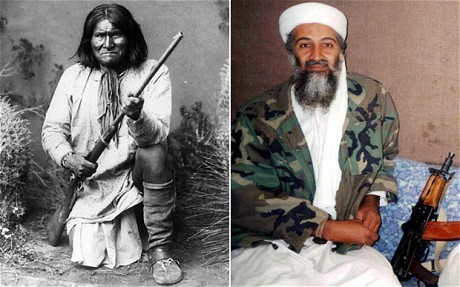
Obama:  Bin Laden was "Geronimo"
US considers Aboriginal groups threats
Seminoles compared to al Qaeda

Then draws the obvious connection:Indigenous opponents of the new defense bill say they have reason to worry about the expanded government powers, particularly the suppression of their free speech in direct actions to protect their lands. They point to the case of four Mapuche men in Chile involved in the struggle for their land rights who were swept up in the country’s Pinochet-era “counter-terrorism” law and sentenced to 20 and 25 years in prison in what appears to be trumped-up charges under the anti-terrorism legislation. “What is happening in Chile isn’t justice; it’s a pantomime, because under the anti-terrorism law, there is absolutely no way justice can be done,” said José Venturelli, spokesman for the European Secretariat of the Ethics Commission against Torture.

Governments have long connected indigenous peoples with terrorists. In 2008, former New York Republican Assemblyman David Townsend, a politician with a long history of opposing Indian sovereignty, attempted to link American Indian nations’ tobacco sales to terrorism, targeting the Oneida Indian Nation of New York. Townsend sent a flier to constituents in Oneida and Oswego counties, making the extraordinary claim that “cigarette smuggling rackets originating on New York’s Indian reservations are transferring huge sums of money to Middle East terror groups.” He cited a report called “Tobacco and Terror: How Cigarette Smuggling is Funding our Enemies Abroad” that purported to connect the sale of untaxed tobacco products on Indian reservations to Hezbollah, Hamas and al-Qaeda, but provided little substantive evidence to support the claim.
Anonymous Warns Senate Over Endless Detention Bill: ‘Expect Us!!’

By Gale Courey ToensingThe hacktivist group Anonymous, famous for hacking former Alaska Gov. Sarah Palin’s e-mails, among other things, has issued a warning to the U.S. Senate for passing a bill that brings the United States closer to military rule and further from democracy: “US SENATE: Expect us!!”

The Senate passed the National Defense Authorization Act on December 1 in a bipartisan vote of 93-7. The bill gives the military the unprecedented power to seize suspected terrorists anywhere in the world, including American citizens on U.S. soil, and keep them locked up indefinitely without charge or trial. Indigenous Peoples worried that the legislation could be used against them for asserting their rights to self-determination and sovereignty or for protecting their lands and resources against exploitation by governments or corporations.

The controversial bill has alarmed and outraged many who say it violates the due process rights of the U.S. Constitution and takes the country one step further on the wrong path toward tyranny. The bill also enraged Anonymous, a nebulous Internet community that opposes censorship and oppression. The group’s latest video is a “Message to the American People” and begins with the salutation, “Dear brothers and sisters. Now is the time to open your eyes!”
Comment:  I guess Indians reservations weren't enough like concentration camps. Now we want the authority to throw Indians and other alleged "terrorists" in concentration camps for realsies? Nice.

For more on the subject, see America's Concentration Camps.

Below:  "In this file photo made June 27, 2006, reviewed by a U.S. Department of Defense official, U.S. military guards walk within Camp Delta military-run prison, at the Guantanamo Bay U.S. Naval Base, Cuba."

December 05, 2011

Mounties spied on Natives

Mounties spied on native protest groups

By Tim Groves and Martin LukacsThe federal government created a vast surveillance network in early 2007 to monitor protests by First Nations, including those that would attract national attention or target “critical infrastructure” like highways, railways and pipelines, according to RCMP documents.

Formed after the Conservatives came to power, the RCMP unit’s mandate was to collect and distribute intelligence about situations involving First Nations that have “escalated to civil disobedience and unrest in the form of protest actions.”

The documents, obtained through access to information requests, include an RCMP slideshow presentation from the spring of 2009, which says the intelligence unit reported weekly to approximately 450 recipients in law enforcement, government, and unnamed “industry partners” in the energy and private sector.

A RCMP spokesperson told the Toronto Star the unit was never considered “permanent” and that last year it was “dismantled” at least at headquarters. But the Mounties can’t say if the work is continuing in the field.
Comment:  "Civil disobedience and unrest"? That would be shocking if it weren't completely legal in most democracies.

Note the nexus of stories we've seen recently. Across the US and Canada, the Occupy movement is standing up for the 99% against the 1%. Similarly, people have protested the Keystone XL pipeline and the alternative Enbridge pipeline supported by big business and the government.

In response, the powers-that-be are doing everything from attacking lawful assemblies with pepper spray and batons to passing a law allowing the indefinite detention of US citizens suspected of "terrorism." Unless Obama vetoes this legislation, expect to see Indians and other protesters in Guantánamo Bay eventually.

For more on the subject, see MPP Compares Caledonia to London Riots and Indigenous Resistance = "Terrorism"?

Below:  "The RCMP unit’s mandate was to collect and distribute intelligence about situations that have “escalated to civil disobedience and unrest in the form of protest actions.” (Lars Hagberg/The Canadian Press)

March 23, 2010

Art show about FBI and Indians

Art and activism collide

‘Freedom of Information: The FBI, Indian Country, and Surveillance’

By Staci GolarThree poets and over 15 visual artists will explore the complex and often violent relationship between Native Americans and the Federal Bureau of Information in the art show, Freedom of Information: The FBI, Indian Country, and Surveillance. Their works will examine the volatile times of the 1960s and 1970s, when the FBI’s COINTELPRO program sought to crush Indian activism, up to the present where technology allows intrusion into our personal lives to a previously unimaginable degree.What it's about:This art show will explore the personal experiences of artists who have been incarcerated, threatened, attacked, or spied upon by the FBI, but also artists who have worked with the FBI as prosecutors and who have been helped by the FBI in investigations. Artists explore the effect of these experiences on their personal lives. We also examine how, due to technological advances, surveillance has become utterly ubiquitous and even accepted in today’s world. Now most photographs and videos are taken by machines, not human beings. What does this lack of privacy mean to us individually and collectively? How does it change our behavior? And where ultimately will it lead us?Some of the participants include poets:
  • Suzan Shown Harjo (Cheyenne and Hodulgee Muscogee), president of the Morning Star Institute in Washington, D.C., a founding trustee of the National Museum of the American Indian, and an award-winning writer.

  • John Trudell (Santee Dakota), poet, national recording artist, actor and activist. Trudell worked with the American Indian Movement (AIM) serving as Chairman of AIM from 1973 to 1979.
  • And artists:
  • Leonard Peltier (Turtle Mountain Chippewa/Lakota), lithograph prints. The most prominent political prisoner in the United States, Peltier is currently in Lewisburg, Pennsylvania.
  • Comment:  For more on government oppression, see CIA Suppressed Sainte-Marie's Music. For more on Indian activism and AIM:

    AIM's misdeeds too "complex" to cover?
    Debate over Wounded Knee
    Controversy in Wounded Knee