November 19, 2013

Colleges ban peace pipe, invite Churchill

LA colleges ban ‘peace pipe’ but invite fake Indian to campus event

By Charles C. JohnsonKowtowing to pressure from left-wing groups, liberal arts colleges in Southern California have banned a tradition of passing a peace pipe at homecoming football games—at the same time that the schools brought fake Indian and mass-murder supporter Ward Churchill to campus.

Pomona and Claremont McKenna College in eastern Los Angeles County have exchanged a Native American peace pipe every football game since 1959, but Mike Sutton, director of athletic and physical education, announced an end to the tradition last week.

“The issue of the inappropriate use of the Peace Pipe as a trophy was not a topic of conversation until October when members of the CMS (Claremont McKenna-Mudd-Scripps) and PP (Pomona-Pitzer) Athletic leadership met with students who are members of our Indigenous Student Alliance (ISA),” Sutton said in an email.

“The Peace Pipe’s retirement rests on the spiritual context of this religious tradition,” Sutton wrote. “If a group holds an object as sacred whether a pipe, a cross or a menorah, our values here at the college and the other colleges as well lead us to respect that object.”

But while the colleges maintain a position of honoring Native Americans by removing the tradition, they didn’t object to having Ward Churchill on campus Nov. 14 to denounce U.S. “colonialism.”

Churchill is described as an “American Indian scholar/activist,” though in fact the United Keetoowah Band of Cherokee Indians in 2005 announced that it had no record indicating his tribal affiliation was genuine.
Comment:  Peace pipes weren't a tradition among Southern California's Indians. And neither college has an Indian mascot to provide a rationale for the ritual. So yes, it should go.

Johnson says the colleges bowed to "pressure from left-wing groups." Two paragraphs later he identifies only one source of pressure: the Indigenous Student Alliance (ISA).

As usual with conservative idiots, Johnson tries to smear opposition to racism and stereotyping as liberal hand-wringing and "political correctness." Then he demolishes his own claim by admitting that Native students are behind the protest.

Johnson might have a point about the schools' inconsistency, but he ignores a key factor. The Claremont Colleges consist of five campuses, not one. They must have thousands of school officials and faculty members, and tens of thousands of students.

An athletic department's decision has little or nothing to do with a speakers' bureau decision. Expecting them to be consistent would like expecting the US Congress, the Maryland state legislature, and the DC city council to be consistent. Sure, it would be nice, but they're different bodies with different processes and priorities.

I agree that Churchill's identification as an "American Indian scholar/activist" is problematical, but is that really what bothers Johnson? I doubt it.

Judging by his comments, Johnson objects to Churchill primarily because of his "little Eichmanns" speech. If Churchill was identified correctly as a "scholar/activist involved in American Indian issues," would Johnson still care? I think he would, which would make him, like so many other conservatives, a free-speech hypocrite.

Pocahotties show depth of microaggressions

A Native professor responds to the issues raised in Tanning Salon Promotes Indian "Color":

Dousing the Pocahottie Stereotype

By Dwanna L. RobertsonRecently, a tanning salon advertisement touted that Indians not only brought corn to the first Thanksgiving, they brought “sexy color.” After complaints (one of which was mine), the ad was taken down from Club Sun’s Facebook page and an apology of sorts was given. And herein lies the problem. Ads like these and society’s inadequate understanding of their inappropriateness show the depth of microaggressions, normalized racism, and internalized oppression that American Indians struggle with on a daily basis.

Larry Andrews, the VP of Sales for Club Sun, gives a glaring example of microaggression mentality. Andrews complained to the local TV station about people becoming offended and accused people of just looking for things to “stir the pot.” Andrews argues that people should look for more positive things so that the holiday season will be better. In other words, people are just overly sensitive and looking for things to be negative about.

Andrews dismisses our feelings or experiences by claiming the company’s actions were innocent. When Natives speak out or speak up against innuendos and slights or mascots, we're often told we're being too sensitive or it was just a joke. In other words, we're always trying to make some big deal out of nothing. Microaggressions are often unintentional, but they still have real consequences.

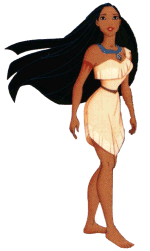
David Arnett, the marketing director for Club Sun, explained to a local TV station that he’s “Native American” and “proud of my heritage and skin tone.” The ad was meant to be “simply a play” on Arnett’s own sexy color. But the picture was not of Arnett or even a man. Instead, it was the typical “Pocahottie”—a stereotype of a sexualized Indian maiden. Normalized racism comes in the form of stereotypes about hyper-sexualized Native women. Arnett might not know that this image originated with Columbus’s Second Voyage and how dangerous it continues to be for Native women.
Comment:  For more on Indian women as sex objects, see University Bans Offensive Halloween Costumes and Native Regrets "Naughty Native" Costume.

November 18, 2013

Opponents taunted with "Trail of Tears" sign

A High School Football Team Taunted A Rival Team Named The Indians With A “Trail Of Tears” Banner

Update: The school later apologized.

By Ryan Broderick
This photo was posted on Tumblr over the weekend. It was taken at McAdory High School in McCalla, Ala.

The blogger who posted the picture, fiftyfourfortyorfight, wrote that as of Sunday the school has not addressed it and that local media hasn’t covered either.

Last night, this sign went up at a McAdory High School football game.

I am absolutely disgusted that this sign was allowed to go up, and that it was not stopped by school administrators, and that after this, no one has mentioned it.

The school and the students have shown no remorse for the sign (as expected) and the students have claimed ignorance and/or that it was just a “joke”.

Sorry, but the Indian Removal Act of 1830 and the death of thousands of Native Americans is not a joke.
High School Football Team Taunts ‘Indians’ Opponent With ‘Trail Of Tears’ Banner

By Travis WaldronSchool officials apologized Sunday in a statement on the McAdory web site.

“This was not condoned by the school administration, the Jefferson County Board of Education or the community,” McAdory principal Tod Humphries said in the statement . “The person who would normally be responsible for approving such signs is out on maternity leave, and I take full responsibility that arrangements were not made to have the signs pre-approved before the ballgame. Please accept our sincere apologies to the Native American people and to anyone who was offended by the reference to an event that is a stain on our nation’s past forever.”

Humphries said the school’s social studies and history teachers would re-teach or review lessons on the 1830 Indian Removal Act that created the Trail of Tears.

This incident, though, is the epitome of the basic problem with the prevalence of Native American imagery in sports. When we turn Native Americans into mascots, we put them in a class with the Philly Phanatic or generic Bulldogs and Tigers rather than remembering that they are a people who have survived—and are still dealing with the effects of—real atrocities and terrible policies that aren’t in any way similar to the outcome of a high school football game.
Principal Apologizes for ‘Trail of Tears’ Banner, Makes It a Teaching Moment

By Vincent SchillingMonday, McAdory High School Principal Tod Humphries issued an apology on the school’s website and today he reached out to ICTMN. He said he wanted to ensure the public he felt remorseful about the incident and that the sign was a mistake, not malicious.

“I knew when the sign popped up that it was a mistake. The woman that oversees this was on maternity leave, but I know this is not an excuse. I don’t know what else to say other than it was wrong,” Humphries said.

“That is not what we are. The adults in the audience and in the stands understood immediately when the sign went up that it was wrong. I know this perception is not out there right now, but it is not who we are.”

Humphries expressed concern that his school would be seen as a stereotypical Alabama “redneck” school that did not care about the history of Indians. Humphries says nothing could be further from the truth and that the school is extremely diverse.

“We are a very diverse school, with 40 percent African-American, 15 percent Hispanic, rich and poor and everybody gets along. We are probably the most diverse school in our district. Our school is also very family oriented,” Humphries said.

“Most people in the South are part Native American. If you asked our classes who has Native American ancestry, about half the class will raise their hands. The Creeks were here—the Cherokee and the Scots-Irish came in here and intermarried. Most of us here have Native American blood, however ignorance can still slip in about the history of us,” said Humphries.

Humphries also said the moment, though difficult, was an opportunity for teaching.

“We are going to take buses and travel Friday to Gadsden, Alabama to visit the Native American man who has a Indian Removal Act Museum,” Humphries said. “We will be taking the cheerleaders and the student government.”


Natives respond

Cherokee Nation responds to offensive Trail of Tears referenceCherokee Nation Principal Chief Bill John Baker issued the following statement.

Ironically, the Cherokee Nation is commemorating the 175th anniversary of the start of our Trail of Tears this year. About 16,000 Cherokees began the trek to Oklahoma from our homelands in Alabama, Georgia, Tennessee, North Carolina, South Carolina and Kentucky, but only 12,000 lived through the harsh conditions that winter.

The Trail of Tears was arguably the most horrific period in the Cherokee Nation’s history and among the worst atrocities ever sanctioned by the United States government.

The legacy of that terrible era has had a profound effect on generations of tribal citizens, and still lingers today.

This unfortunate display shows how much improvement is still needed in the understanding of Native peoples, our triumphs and our challenges, both historical and modern.

We hope this becomes an opportunity for administrators at McAdory High School, and at schools all across the United States, to teach our young people not only the terrible history behind the Indian removal era, but also the resilience of tribes across the nation.
Trails of Tears Lesson: Anti-Semitism, Gay Hatred, Native “Learning Opportunity?”

By Linda SacksIt is unbelievable to write off the genocide known as the Trail of Tears as a “learning opportunity.” This cheerleading squad glorified the horrific massacre of my ancestors for the sake of sports and the 2nd round of playoffs.

Despite its form and despite the ignorance claimed, they directly praised and glorified the murdering of a people group that still exists…my family and all that comprise the Nations of Cherokee, Chickasaw, Choctaw, Seminole, and Creek. We, natives, are not something of the past and a history lesson.

McAdory, you say, “sorry” and “reteach?” What exactly are you teaching them?

When it comes to sports, political correctness is applied selectively. What if the words “rape” and “murder” were used? These terms are used to describe how awful the opponent suffered on the playing field or court, expressing the brutality of which one team “destroys” another. Anyone in the sports world can testify to this, as do I, therefore finding the cheerleaders’ actions not guilty of ignorance, but fully charged with the lack of conscience for Native American people.
“Trail of Tears” Signs Mocking Genocide at Multiple High Schools Point to Epidemic of Racism and Insensitivity Against Native Americans

By Danielle MillerHow could anyone think that mocking genocide is acceptable in any context? I don’t understand how thought processes can be so disconnected. Football games are not a place where racism gets to be excused. People certainly wouldn’t allow anyone to mock 9/11, Hiroshima, or the Holocaust. If there was a sign about lynching at a football game it wouldn’t be a joke. Even some black people with the shared history of oppression defend the issue and basically deem Native Americans unimportant. Why is the genocide and continued marginalization of Native Americans considered to be a “joke”? Has America devolved back to the era of Assimilation and Termination of Natives?

Why are all these administrators and educators ALLOWING this to happen? Clearly there must be institutional racism taking place. Schools also handle this situations terribly with apologies which put the blame on those victimized by racism. Their apologies are always something along the lines of: “We’re sorry YOU were offended. We will reteach about the Trail of Tears.” Great for you to emphasize that WE are offended, rather than taking responsibility. The acts of racism themselves are far more harmful than being “offended” or calling them out will ever be. Obviously repeating a lesson will not help the situation, if its colonized content was part of the reason this occurred in the first place.

It appears that America is harboring subconscious, engrained racism towards Native Americans; their actions are showing it. No matter what excuse or intentions they claim to have. If you act racist, you are perpetuating racism, period. The new racism is the denial of racism. People believe if they defend racism and deny that it is racist, it justifies them in whatever they do. That is completely absurd. If you are dehumanizing or marginalizing a race of people, congratulations--you are being racist! That is a fact, not an opinion!
Comment:  Not everyone emphasized the point, but again, the opposing team's nickname was the Indians. These "Indians" received this death-dealing threat because of their stereotype-inducing identity. "We're gonna kill you, fake Indians, just like we did the real Indians!"

This incident is a good example of what happens when we treat Indians as mascots and other stereotypical figures. No one treats the Jewish Holocaust lightly anymore, but Indians are still something of a national joke.

They're the silly savages who got in the way of progress. We smile at their antics: the leathers and feathers, the whoops and dances, the painted faces and birds on the heads. They're like Elmer Fudd against Bugs Bunny or the Coyote against the Roadrunner: potentially deadly but in reality hapless.

When Americans wear phony headdresses or laugh at a "Trail of Tears" sign, they're not taking Indians seriously. They're not recognizing the Indians' pain or even acknowledging their existence. Therefore, it's not surprising that Americans also ignore Native issues--whether it's climate change, the effects of sequestration, or violence against women. Why would anyone bother to care when the people affected are only cartoon characters?

Zuckerberg's "Chief Running Site"

Mark Zuckerberg's Newest Immigration Advocate: "Chief Running Site"

By Sam BiddleMark Zuckerberg's pet lobbying group has a new CTO, Darius Contractor. Like any friend of Zuck's, Darius has an extensive back catalog of Facebook tags, including one in which he's dressed as an American Indian, standing before a "God Bless America" banner in front of a door on which a border crossing warning sign hangs. Immigration reform was a natural next step.And speaking of images, here are some: the pictures below are from an October 2006 costume party, around the time when Contractor was first employed at Bebo, the notoriously failed social network that fluffed his CV enough to be tapped for CTO today.

Comment:  For more on non-Indians in headdresess, see ESPN's Seminole Minstrel Show and H&M Removes Faux Headdresses and


November 17, 2013

Loup-Noir

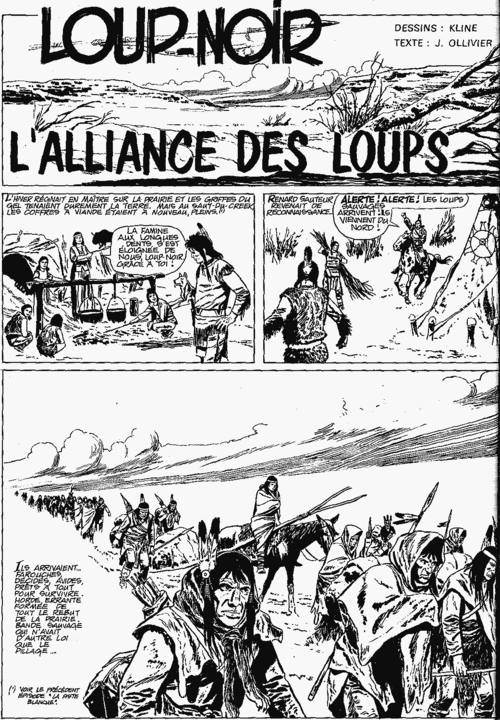
A French comic book featuring Indians:

Black Wolf is definitely an orphan

By BdzoomEight years after the death of Jean Ollivier, the creator of the "Black Wolf" series (published in Pif-Gadget) is its graphical father, Roger Chevallier alias Kline, who died on 16 May [2013].

Kline
Roger Chevallier
(3 June 1921-16 May 2013, France)
In 1960 he commenced working for Vaillant, where he drew series like 'Davy Crockett' (until 1969) and 'Loup-Noir' (1969-1980), both written by Jean Ollivier.

In other words, writer Jean Ollivier and artist Kline created "Black Wolf." Ollivier died eight years ago and Kline died recently, making Black Wolf an "orphan."

The first sample of Loup-Noir looks okay. But in the second sample, is that a Northern Plains youth running from a Central American jaguar? Um, I don't think so.

November 16, 2013

"Rock Your Mocs" Day

Friday was "Rock Your Mocs" Day in much of Indian country. Here's the scoop:

Showing pride through moccasins

San Juan College rocks their mocs

By Noel Lyn Smith
When Sherrie Benally put on her moccasins Friday morning, her 4-year-old daughter asked for a pair to wear to school.

Benally was surprised by her daughter's request but assured her that Santa Claus would deliver a pair. Benally said that moment made her proud because her daughter is taking pride in Navajo culture.

Celebrating Native American traditions was one reason 21-year-old Jessica "Jaylyn" Atsye, of Laguna Pueblo, started Rock Your Mocs in 2011. Via a social media campaign, Rock Your Mocs encourages people to wear moccasins one day a year in honor of Native Americans' cultures.

Atsye focused on moccasins because their usage is shared among tribes.

In a press release, Atsye said she hoped the day "will reach even further worldwide and inspire cultural pride for Native Americans wherever they may be as well as anyone who would just like to participate."
Native pride at heart of 'Rock Your Mocs' campaign

By Susan Montoya BryanElementary school students in western New Mexico are wearing their moccasins. So are students at Northern Arizona University, Purdue and the University of Michigan.

On the Cherokee Nation, there's a waiting list for Friday's moccasin-making class. And on a military base in Afghanistan, a soldier ties a beaded cross around her boot to symbolize her moccasins.

Friday is "Rock Your Mocs" Day.

Coinciding with Native American Heritage Month in the U.S., the social media campaign started by New Mexico student Jessica "Jaylyn" Atsye has gone global.

The 21-year-old Laguna Pueblo member says the idea was simple--to set aside one day each year to wear moccasins to celebrate the cultures of Native Americans and other indigenous people.
Get Ready to Rock Your Mocs! 20 Photos of Native Footwear Worn Proudly

It's Rock Your Mocs Day! Mocs Are Being Rocked [20 More Pictures]


Not well thought out?

But not everyone agrees with the idea of Rock Your Mocs:

"Rock Your Mocs" event spurs debate

By Michael McKayThe email immediately caught the attention of Elizabeth Winkler, an associate professor in the English Department.

Winkler, who identifies as Cherokee, said the presentation of the email “was not well thought out.”

Winkler sent back a message to Pillow and copied all faculty and staff saying, “A bunch of white people wearing moccasins honors diversity. Take a walk in my shoes… Seriously?”

Other faculty and staff sounded off on the event or the constant amount of emails, perpetuating a large stream of replies.

After participating in the email exchange, Victoria LaPoe, an assistant professor for the school of Journalism and Broadcasing, said that she feels that the “Rock Your Mocs” isn’t the most constructive way to talk about Native American culture.

“You should go spend time in the culture, spend time with natives, and I’m not saying that people on the email list weren’t doing this—but there needs to be a healthy debate.”
Comment:  So a professor feels "Rock Your Mocs" isn't the most constructive way to talk about Native culture? Well, it's not the least constructive way either.

I'd say it's fine as a one-day event. It's better than cheering an Indian mascot, certainly.

As the above articles indicate, I don't think the day is supposed to be a big educational effort. It's more about Indians demonstrating that they still exist and showing pride in their cultures.

Meanwhile, I tweeted the following:

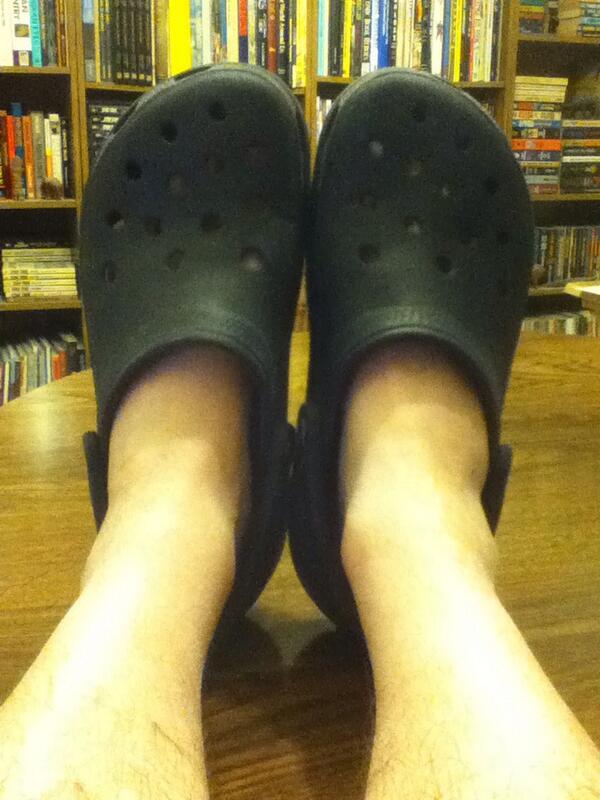
I heard today is Rock Your Crocs Day so I wanted to join in the fun. #rockyourcrocs

November 15, 2013

Racist attempts to ban True Diary

Yet another attempt to ban Sherman Alexie's The Absolutely True Diary of a Part-Time Indian:

Montana Community Unites to Save Sherman Alexie Book From Being Banned

By Adrian JawortAbout 150 people—half of whom were Natives—crowded into a Billings, Montana School District 2 boardroom in overwhelming support of Sherman Alexie’s critically acclaimed 2007 novel, The Absolutely True Diary of a Part-Time Indian on Monday, November 11.

Three parents spoke on behalf of those wanting the book removed from the 10th-grade required reading list. Objecting to the books “vulgar” use of inappropriate words and phrases, Gail Supola says the book has no educational value in regards to Native Americans and only perpetuates negative stereotypes against them.

Supola says about the media spotlight surrounding her, “During this whole process my words have been misconstrued greatly. I want to ensure that every parent and child is given the option or alternative—whereas known as a choice—about what they have to read without being afraid of persecution.”

Supola’s sentiments, however, were stifled by those of Alexie’s supporters, who waited up to two hours to speak on the book’s behalf. Afterwards, the school board unanimously agreed to keep the book in the required curriculum.
And:Student Bryce Curry—a friend of Chad’s—said although he’s white, the story provided a window to him into the lives of Native Americans as it cleared up misconceptions and prejudices locals have.

“You know the parts that are ‘controversial’ and ‘offensive’? They’re meant to be offensive for a reason: to show that yes, prejudices do happen. The racism and prejudices Natives face is real. It’s not in the past, it’s in the present, and will remain in the future unless we openly discuss it in classrooms and show why it is wrong.”
Montana's Institutional Racism Behind Calls to Ban Alexie's Book

By Adrian JawortTo herself, Supola’s actions are undoubtedly the opposite of racist and a noble public service. And while Supola is entitled to her opinion about the pertinence of the book as an educational tool, going against her opinion is the heavy fact Alexie’s book has cleaned house in awards, including winning the 2007 National Book Award for Young People’s Literature.

However, to fully ingest my accusation of “institutionalized racism” against my own beloved state‘s people, one only needs to go back just a few years ago and look at the contents of a book that was also actually banned in 2007 from a Laurel, Mont. high school’s curriculum: Blackfeet author James Welch’s American Book Award winning Fools Crow. Coincidentally, Laurel is just 15 miles from Billings.

Although Fools Crow is historical fiction, it was described by Dee Brown of Bury My Heart At Wounded Knee fame as “the closest we will every come to understanding what life was like for a western Indian.” The book details the life of a Blackfeet man living in Montana in the post-Civil War era in which Plains Indians faced a transition of whites encroaching on their territory along with the continued wanton destruction of their lifeline that was the buffalo.

The book was not only challenged to be banned by Laurel parents, but high school students in Montana’s Bozeman and Helena towns who objected to the violence in it. Fools Crow details the Jan. 23, 1870 Marias Massacre in which a non-hostile Blackfeet camp was attacked and 173 men, women, and children were killed. Many more froze to death after their tipis were burned.

The camp was already weakened from a recent smallpox epidemic, and was made further defenseless by the fact most of the able bodied men were out hunting. Chief Heavy Runner was gunned down first while trying to approach the 200 U.S. cavalrymen with a paper showing he had friendly relations with the whites.

One student claimed the book left disturbing images in his head, while his mother argued that children were already exposed to too much violence via other mediums like TV and movies.

While it was the violent descriptions that disturbed students and parents, it’d obviously be naïve not to talk, write, or read about that period of time in Montana history without marking that as pivotal among its first indigenous inhabitants. The people who wanted it banned obviously didn’t care about that, however.
Comment:  If it's not one thing, it's another. Funny how white people always find some reason to ban books by minorities.

Have they ever objected to a book by a white author and demanded the school replace it with a book by a minority author? I doubt it.

Even if they object to books with too much sex and violence, the goal is similar. They want to censor anything that contradicts the Euro-Christian myth of America as a "shining city on a hill" where goodness and purity reign.

For more on our cultural values, see America = Captain Ahab and America's Culture Based on Violence.

Below:  "Gail Supola, a mother upset by the selection of Sherman Alexie’s The Absolutely True Diary of a Part-Time Indian, addresses a packed boardroom. Supola is asking School District 2 to remove the novel from its required reading list and tighten up its classroom opt-out policy." (Larry Mayer/Billings Gazzette)

November 14, 2013

Burroughs's The War Chief

Because of the John Carter movie, there's been a renewed interest in the work of Edgar Rice Burroughs. In recent years, I've posted a few links about him and his ideas about race. For instance:

Burroughs the conservative racist
Review of Warlord of Mars #1

But while talking about Martians as analogues of Indians, I neglected a more direct link. Burroughs wrote a whole novel about the Apache:

The War Chief

SynopsisTHE WAR CHIEF is a realistic historical novel about life and death on an Apache reservation during the final years of the Apache wars until the death of Cochise and the surrender of Geronimo. The story focuses on Andy MacDuff, an infant kidnapped by the Apaches in a raid, adopted by Geronimo and renamed Shoz-Dijiji, or Black Bear. He is given a proper Apache upbringing, including initiation into all the rites and responsibilities of Indian Manhood. He excels at the crucial skills of hunting and warfare, shows himself to be strong and courageous, and soon is made a highly prized war chief. During his apprenticeship, Shoz-Dijiji falls in love with Ish-Kay-Nay, an Apache maiden, who, unfortunately is coveted by another Apache chief, Juh, who hates Shoz-Dijiji for being Geronimo’s favorite. Burroughs’ great respect for the West and compassion for the exploitative treatment of the Indians the hands of the treacherous pin-dah-lickoyee (“white eyes”) is manifested throughout this honest, vivid, and sympathetic portrait of the West that does credit to both the Indians and Edgar Rice Burroughs.Project Gutenberg has posted the whole story online if you want to read it:

Title: The War Chief

Author: Edgar Rice Burroughs
* A Project Gutenberg of Australia eBook *
CHAPTER 1

GO-YAT-THLAY

NAKED but for a G-string, rough sandals, a bit of hide and a buffalo headress, a savage warrior leaped and danced to the beating of drums. Encircling fires, woman-tended, sent up curling tongues of flame, lighting, fitfully, sweat-glistening shoulders, naked arms and legs.

Distorted shadows, grotesque, mimicking, danced with the savage and his fellows. Above them, dark and mysterious and weirdly exaggerated by the night, loomed the Grampian Hills.

Rude bows and arrows, stone-shod spears, gaudy feathers, the waving tails of animals accentuated the barbaric atmosphere that was as yet uncontaminated by the fetid breath of civilization--pardon me!--that was as yet ignorant of the refining influences of imperial conquest, trained mercenaries and abhorrent disease.
But wait...it's a trick! These are the Scottish ancestors of the white men who will soon invade the land of Go-yat-thlay (Geronimo). How they came to have a buffalo headdress, I don't know, but the point is that they reek of savagery.

A few paragraphs later we meet Geronimo as he spies on a covered wagon:Go-yat-thlay had never before seen this wagon, but he had seen its dust from a great distance; he noted its volume and its rate of progress, and he had known that it was a wagon drawn by two mules, for there was less dust than an ox-drawn vehicle would have raised, since oxen do not lift their feet as high as horses or mules, and, too, its rate of progress eliminated oxen as a possible means of locomotion. That the wagon was drawn by mules rather than horses was but a shrewd guess based upon observation. The Apache knew that few horses survived thus far the long trek from the white man's country.

In the mind of Go-yat-thlay burned a recollection of the wrongs that had been heaped upon his people by the white man. In the legends of his fathers had come down the story of the conquests of the Spaniards, through Coronado and the priests, three-hundred years before. In those days the Apache had fought only to preserve the integrity of his domain from the domination of an alien race. In his heart there was not the bitter hatred that the cruelty and injustice and treachery of the more recent American invaders engendered.
So Burroughs treats the Indians decently. He makes a point of saying white men are just as savage as Indians.

But the story centers on a white man raised as an Apache. Needless to say, he becomes a great chief and woos a beautiful "princess." No doubt he's a classic "white Indian" who acts as savior of the savages.

War Chief comic strip

I was reminded of The War Chief when I saw the following images on Facebook:


Apparently, Edgar Rice Burroughs Inc. is producing "All New Weekly Comic Strips" of Tarzan, Pellucidar, Carson of Venus, and other Burroughs properties. With all the talent involved, I imagine they're pretty good.

November 13, 2013

Review of Houdini Pie

Back in 2010, the author of the novel Houdini Pie sent me a copy to review. I previewed it and read it, but I didn't have time to post about it until now.

The book is based on the legend of the "Lizard People" of Los Angeles. Which is why I posted something about that subject recently.

Houdini PieBook Description

BOOTLEGGING, BARNSTORMING and a Hard-Rock BOONDOOGLE. Los Angeles, 1934: Based on a true chapter of California history, Houdini Pie explores the depths to which a family, and a city, will sink when hard luck comes knocking and there's nothing left to lose. Young Hal Gates is a celebrated pitcher for an upstart rural ball club, and the son of a notorious booze smuggler who vanished at the end of Prohibition. At his lonely mother's urging, and with the desperate backing of the municipal powers-that-be, he teams up with a crackpot geologist to mine for a mythical Hopi treasure trove buried miles beneath the downtown streets. The deeper they tunnel the more Hal learns about loyalty, treachery, hunger and hope, and mostly--in ways he never would have imagined--about love.

Editorial Reviews

Michel's narrative voice [is] a perfect and enlightening use of 30's slang and patois, a condensation of all those movies we've all watched. This is a funny funny book--exhilirating and smart and sophisticated. Michel is a born storyteller, and lord knows, we need more writers like that. A guaranteed pleasure. --Lewis Buzbee

Michel successfully captured the era in his story and was studious enough to insert historical events that would help to mesh the story with the time period. --Bookventures Book Club

Witty, whimsical, wonderfully unpredictable, Paul Michel's wildly entertaining first novel simply shines. Houdini Pie is a fat, succulent slice of story-telling at its best. --A. Manette Ansay, author of Blue Water and Good Things I Wish You

Paul Michel's Houdini Pie is an old fashioned romp filled with colorful characters, an implausibly plausible plot and sheer story-telling verve. Think Treasure of the Sierra Madre grafted onto Chinatown grafted onto The Natural, and the fruits are a rich, and entertaining, Houdini pie. --C.J. Hribal, author of The Company Car and The Clouds in Memphis
The author's take

Michel's own site gives you another take on the book:

Houdini Pie“Houdini Pie” is a novel based on historical facts, about the efforts of a group of hapless entrepreneurs to mine for the mythical treasure of a tribe of ancient Hopi Indians under the streets of urban Los Angeles during the Great Depression. The city was in such dire straits that the City actually granted permits for the exercise, which was covered in the press—a mine shaft hundreds of feet deep right in the downtown core. The story’s real life ending is incomplete, as the project was abruptly stopped, and its chief architect essentially disappeared without (presumably) finding a lick of treasure. So go the news accounts.

The novel picks up where the historical record leaves off. It's a tale of desperation, loyalty and love among a group of mostly fictional figures who populate the more-or-less factual tale. It follows particularly the family of Halley (“Hal”) Gates, a young man named after the comet that filled the sky at the time of his birth in 1910. Hal’s deadbeat father Charlie is a successful bootlegger during the 1920s. He leaves Hal’s home town of Oxnard when Prohibition ends. In Charlie’s absence Hal becomes a reluctant accomplice to the treasure hunt, in fulfillment of a promise to his abandoned and unbalanced mother. He also becomes a successful baseball player on a rag-tag barnstorming team that takes on the more legitimate clubs of the popular Pacific Coast League, and he falls in love with the daughter of a psychic who becomes a focus of the treasure-hunters’ desperation as the plot unfolds. Eventually competing crews are hunting for the gold, and Hal and his family are caught in the middle, along with a host of characters that includes a peripatetic Hopi chief and his mysterious trouble-making daughter, who have their own interest in the myth of the buried treasure.
This summary is revealing. I kind of expected the story to be focused on the search for the Hopi treasure (first paragraph). But it's really about a sprawling set of characters for whom the treasure is only a plot device (second paragraph).

So it's not really a Native-themed novel, except tangentially. But a few points are worth mentioning.

The Native aspects

As Michel's site notes, there are two Native characters: "a peripatetic Hopi chief and his mysterious trouble-making daughter."

Chief Greenleaf is the more interesting of the two. He shows up mysteriously and does little besides sit and smoke. It's a welcome change from the usual wise elder who spouts greeting-card platitudes.

Of course, the Hopi tribe, a collection of independent villages, never had a single chief. Even now, their Westernized tribal government is led by a chairperson, not a chief.

Also, "Greenleaf" isn't a Hopi name.

If I were Michel, I would've explained that "Chief" was an honorary title or a nickname. I also would've given him a real Hopi name and said "Greenleaf" was a translation or a nickname.

Greenleaf's daughter is more two-dimensional--a sexy Indian temptress who seduces Hal. Given that the Hopi were traditionally conservative and isolationist, this character is highly implausible. It would be like an Amish woman leaving her farming community, moving to New York City, and sleeping her way to the top. It could happen, but it's extremely unlikely.

In short, she's more of a stereotypical Indian princess than anything else. She's one of the book's weaker elements.

Typical Hopi woman from the early 20th century (photo by Edward S. Curtis):


My impression of the chief's daughter:
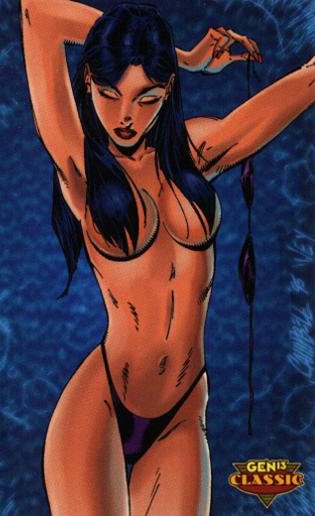


Greenleaf doesn't offer many details about the "Lizard People" or their underground lair. He does say they were people who could change shape. This is more plausible than talking lizard-men, and it's consistent with Native legends.

I won't say how Houdini Pie ends, but it's a bit unsatisfactory. I guess there was no good way to end the book without a major rewrite of Los Angeles history. And that would've turned the book into science fiction, not a rogue's tale.

Still, it's a good book, if not a great one. Rob's rating: 8.0 of 10. Check it out if you're curious.
Oneida Indians thank Obama re "Redskins"

Oneida Indians thank Obama for comments on Redskins

By Erik BradyOneida Indian Nation representative Ray Halbritter, the public face of a campaign against the Washington pro football club's team name, thanked President Barack Obama for speaking out on the issue during a meeting at the White House Tuesday.

Halbritter's comments were met with applause from leaders of a dozen tribes who spoke with the president about a range of economic development issues important to Indian Country, from job creation to increased access to capital to jurisdictional challenges.
Below:  "Native American leaders on Tuesday presented President Obama with a jersey from Cooperstown (N.Y.) High School, which last year changed its mascot from Redskins to Hawkeyes. The Oneida Indians, who are leading a push to persuade the Washington NFL team to change its name from Redskins, had donated $10,000 to help cover the cost of new uniforms for the Cooperstown Hawkeyes." (Erik Brady/USA TODAY Sports)


Obama skirts 'Redskins' controversy at tribal conference

By Ben WolfgangAfter making waves last month by suggesting the Washington Redskins’ name may be offensive to Native Americans, President Obama avoided the issue entirely during a Wednesday speech to tribal leaders gathered in Washington.

In his brief remarks, the president instead touted his health care reform law, energy development on tribal lands and his administration’s efforts to reduce the above-average poverty rates seen in many tribal communities.

Mr. Obama also spoke in broad terms about the U.S. must continue to strengthen its bonds with Native Americans, stressing that they must have the same opportunities all other Americans enjoy.

“It falls to us to keep America the place where no matter where you come from, what you look like, you can always make it as long as you try as long as you work hard,” Mr. Obama said at the tribal conference, held at the Interior Department’s headquarters in Washington.
Hitting 'em where it hurts

Tribes want Congress to ban Redskins’ trademark

By Rob HotakainenWhile the controversy has smoldered for decades, getting rid of the team name has emerged as a top legislative priority for leaders of the nation’s 566 federally recognized tribes, who’ve asked for Obama’s help in getting Congress to intervene.

They want Congress to strip the Redskins of the team’s name trademark, hitting it in the wallet. That would prevent the team from holding exclusive rights to sell any shirts, caps or other merchandise that uses the “Redskins” name.

“The explicit support of President Obama and his administration would assist in this important effort,” the National Congress of American Indians said in a briefing book given to tribal leaders for Obama’s annual White House Tribal Nations Conference on Wednesday.

The tribes are pushing a bill called the Non-Disparagement of Native American Persons or Peoples in Trademark Registration Act of 2013, sponsored by Delegate Eni Faleomavaega, a Democrat from American Samoa, along with 19 co-sponsors. It would amend the Trademark Act of 1946 and wouldn’t permit any future trademarks that use the term. The bill has little chance of passing anytime soon, having been referred to a committee but not even receiving a hearing.


Congress Punts on Redskins Name

By Hannah HessCapitol Hill efforts to force Washington’s National Football League franchise to change its name remain stalled, even as President Barack Obama welcomes tribal leaders to the White House this week to launch the administration’s Council on Native American Affairs.

Democrats representing large swaths of the team’s fan base are split on whether Congress should use its power to force the franchise to change its name, which supporters say is not intended to denigrate anyone. Del. Eleanor Holmes Norton, D-D.C., has been leading the charge against the moniker, which she deems a “disparaging” ethnic slur, even voicing her opposition on ESPN. She and Maryland Rep. Donna Edwards, whose district is home to the team’s FedEx Field, both support a bill aimed at changing the 81-year-old name.
More calls for change

NAACP Calls on Washington Football Team to Change its Name

Association renews it request to replace offensive “Redskins” team nameThe NAACP has renewed its request for NFL owner Daniel Snyder to change the name of his team from the Washington “Redskins”. The NAACP has called for this change since 1992 when its national board of directors passed a resolution demanding all sports teams discontinue the use of teams names and mascots that stereotypes the American Indian people.

“For more than two decades, the NAACP has called for an end to the use of the racially-inflammatory name of the Washington Football Team, as well as other sports’ team names that degrade American Indians,” stated Roslyn M. Brock, Chairman of the NAACP Board of Directors. “This year we have joined with our friends in the American Indian community and are renewing our call for Washington’s football team to replace this offensive name.”

“It is disappointing that this derogatory moniker remains embedded in one of our nation’s premier sporting teams,” stated NAACP Interim President and CEO Lorraine C. Miller. “We stand alongside all American Indians who are calling for Washington owner Daniel Snyder to change his team’s name.”
Dakota Man Exposes Vile History of 'Redskins'

By Rachael Johnson“It was only five generations ago that a white man could get money for one of my grandfather’s scalps,” writes Dallas Goldtooth on a Facebook post. “At this time…it was “Redskin” that was used to describe us.”

To the left of Goldtooth’s words, a newspaper clipping from 1863 advertises a reward, “The State reward for dead Indians has been increased to $200 for every red-skin sent to Purgatory. This sum is more than the dead bodies of all the Indians east of the Red River are worth.”


Carbone: Washington Redskins’ Name Insults Every Native American

By Gerald CarboneIndian removal and African slavery are America’s twin holocausts. We prefer to forget these inconvenient truths of our history, to blot their stains from the historical record. We rewrite history in cultural touchstones that portray Indians as foolish savages or stealthy warriors like the one pictured on the Redskins logo. But in our willful ignorance of Indian history we overlook the great contributions the Americas have made to civilization.

Yes, some Indians made and make great warriors; they also were and are great farmers and civil engineers. Indians in the Americas developed 60 percent of crops now in cultivation: corn, potatoes, tomatoes, squashes, and beans. On the Mississippi River they built a city of 20,000 in 1200, 500 years before London reached that threshold.

As Americans we should honor, not obliterate, the history of our land and the shared histories of its people. Reducing people to a stereotype stamped onto a football helmet is not an honor; it is an insulting attempt by a dominant culture to redefine a diverse, accomplished people in order to white-wash an American Holocaust.

Indians and non-Indians, all of us as people, deserve better.

November 12, 2013

"Dreamcatcher and skull" clothing line

Indigenous Appropriation and ‘Dead Indians’: An Open Letter to Raised by WolvesTansi,

I just came across your line through Hypebeast this morning and wanted to let you know that your 'skull and dreamcatcher' t-shirts and hoodies—whatever allusions you think you might be making to Romulus, Remus and Mowgli—are yet another instance of an insidious form of cultural appropriation that continues to be offensive to our people. It’s played out aesthetically, politically and, in case you need a reminder, it contributes to the false mythology that our people are dead and dying.

Unfortunately for your brand you now join a long list of other contemporary appropriators, from Paul Frank to Yeezy, that puts you in poor company. Our people are not dead skulls for you to drape your appropriated Indigenous iconography on—or a set of Pendleton-inflected patterns to be lifted to lend a ‘folkloric’ element to your aesthetic.

I’m saying: don’t be that guy. It’s tired, it’s disrespectful, and it’s not helping anyone but you. I ask that you remove the t-shirts from your line and discontinue their use.

And if you need some further reference, check the hard work that good people like my brother DJ NDN from A Tribe Called Red and sister Adrienne K. from the NativeAppropriations blog have been doing to fight the ongoing theft and misuse of our peoples’ cultures.

Peace.

Ekosi,
Jarrett


Jarrett Martineau
Frog Lake First Nation
Indigenous Nationhood Movement
#NationsRising


Comment:  I'd love to hear the people who made or wear this shirt explain its appeal. What exactly is the message they're trying to send?

I assume the dreamcatcher serves the same purpose as a feather bonnet. It signifies a non-Western tribal culture with strange, exotic beliefs. In other words, it contradicts the mainstream view of things. It's counter-culture.

And the skull? It could suggest that tribal ways are savage and scary--so adults and other "squares" should beware. Or it could suggest that tribal ways are dead--but they have the ability to haunt us, to turn our dreams into nightmares.

Either way--Indians are savage or Indians are dead--the message is negative and stereotypical. I don't see how you could spin this shirt as pro-Native. That's probably why no one has done it--because it's not possible.

More dead Indians

Here's another example of Indian bones used as a cool accessory:

Tribal Beat Drummer T-shirt


Someone sent this link to me. She said she was so frustrated with these "Indian skull" shirts that she was giving up.

I said I wouldn't try to battle these shirts one by one. There may be dozens if not hundreds of them.

Better to criticize one or two of them, as Native Appropriations, Beyond Buckskin, and others have done. And let the message that this practice is wrong spread virally via social media.

For more on the subject, see Kanye's T-Shirts Feature Indian Skulls and Indian Skulls in Headdresses.

November 11, 2013

Crazy Horse play lacks drama

Crazy Horse, Custer and no drama

By Marcus CrowderIt’s tempting to call Jon George’s new play, “Crazy Horse and Custer,” a dramatic reading with costumes and props. That would imply the world premiere at the Sacramento Theatre Company’s intimate Pollock Stage was in fact dramatic. It is not.

Of course, the characters Crazy Horse, who tells us that his name literally translated really should be “His Horse Is Crazy,” and Col. George Armstrong Custer, who allows he graduated last in his class at West Point, have intertwined legacies that culminated in the famous Battle of the Little Bighorn in June 1876 in eastern Montana Territory.

Like a diorama come stiffly to life in the progress of the play, they give laborious accounts of their divergent backgrounds, which ultimately lead to the shared destiny.

Playwright George seems intent on humanizing these outsized figures of American history, but the two-character production is so static and the nominal story so still that you could attend a tax code lecture with more animation. The author in a playbill message writes that he has written “neither myth nor is it history,” but “an entertainment.” If only it were so. Despite the best efforts of actors Louie Leonardo as Crazy Horse and Kirk Blackinton as Custer, the production boxes the audience into two long autobiographical stories with no conflicts, revelations or resolutions.

The actors are rarely on the stage together but instead address the audience directly, speaking from beyond the grave as if to set the record straight about what we don’t know about them.

Leonardo has the tougher job as he is saddled with the stoic, humorless Crazy Horse, who painstakingly recounts his life as a young mystic and warrior in training, a man “who could explain the unexplainable to those who could not.”

The extant legend of Crazy Horse is that of a visionary whose supernatural aura was a protection in battle. George transposes this into a more studied behavior calculated to unnerve adversaries.

He also informs us there is no room for criticism because he has “consciously reconstructed to fit the needs of my fancy.” There is also a heavy message coda about the sad fates of American Indians tacked on to the end. Can we say it is a long, dull slog regardless of his best intentions?

Crazy Horse mostly wants to be left alone as an existential thinker and thoughtful observer of the superficial beings around him. The “white man” comes in for lot of condemnation, but Crazy Horse’s American Indian peers don’t really measure up in his estimation, either.
Comment:  There's no reason Crazy Horse should be stoic and humorless, of course. Most Indians aren't like that.

Nor is there any reason for him to disparage his own people. This seems like a white man's conceit: that Indians are defeated and downtrodden today so a historical play should reflect that.

But as Cutcha Risling Baldy said in her review, today's Indians aren't defeated and downtrodden. After centuries of injustice and oppression, they're on the road to recovery.

Sure, Crazy Horse might be upset that they aren't hunting buffalo or fighting the white man to the death. But he might be proud that they've survived and adapted.

Since he himself surrendered to the US Army, I suspect he wouldn't judge his people harshly. He did what he had to do and so have they.

Below:  "Louie Leonardo, left, is Crazy Horse and Kirk Blackinton is Custer in Jon George’s new play Crazy Horse and Custer, running through Dec. 15 at the Sacramento Theatre Company’s Pollock Stage."

Mazinbiige comic-book collection

Massive indigenous graphic novel collection set to display at U of M

By Jamie IsfeldThe University of Manitoba will put over 500 graphic novels from indigenous creators on display at Elizabeth Dafoe Library.

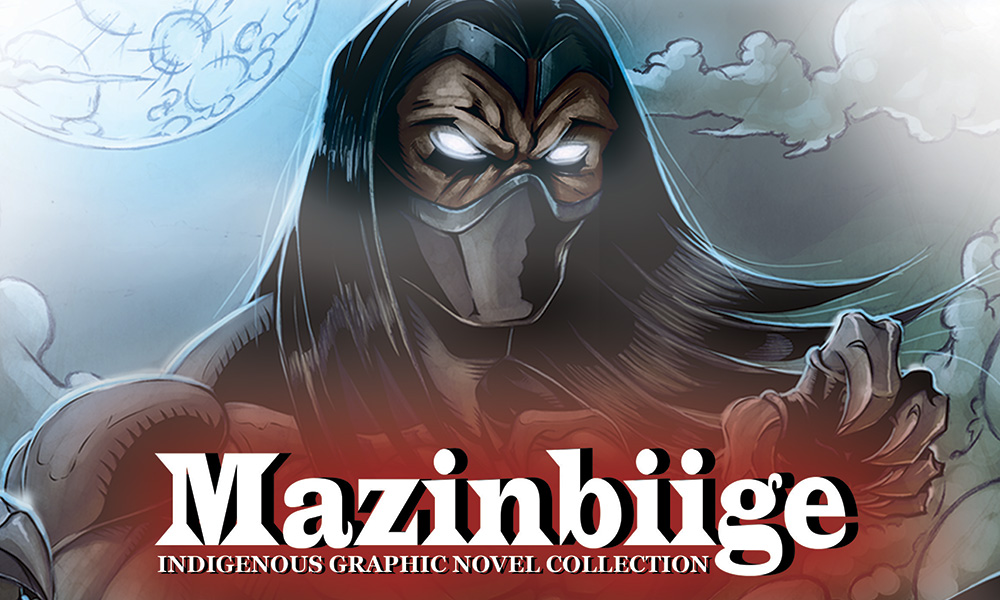
Mazinbiige: The Indigenous Graphic Novel Collection gathers works from hundreds of indigenous writers and artists.

There will be a special opening ceremony on November 13 at 2:00 p.m. to celebrate the collection, including an opening prayer, speeches, and an unveiling of the graphic art by Jay Odjick, an Algonquin writer and artist from the Kitigan Zibi Anishinabeg community.

One of the speakers, assistant professor Niigaanwewidam (James) Sinclair, regularly speaks about Indigenous issues. He held a course in 2012 called “Super Savages and Aboriginal Images in Graphic Novels.”
Comment:  I talked to James Sinclair and the library staff at the university. They asked for my help, which I provided by ordering comics for them online. I'm pleasantly surprised to see it getting a little publicity.

A couple of corrections:

1) Unless the librarians went on a buying spree since I helped them, I believe the majority of works are comic books, not graphic novels. One could say all graphic novels are comic books, but not all comic books are graphic novels.

2) Again, unless they went on a buying spree, most of the works are by non-Native writers and artists. A couple dozen Natives are working in the field, but they haven't produced that many volumes yet. Fifty, maybe, but not 500.

November 10, 2013

Wandering Bear in Curb Your Enthusiasm

For those unfamiliar with the HBO TV series Curb Your Enthusiasm, here's a description:

Curb Your EnthusiasmThe plots and subplots of the episodes are established in an outline written by David and the dialogue is largely improvised by the actors (a technique known as retroscripting). As with Seinfeld, the subject matter in Curb Your Enthusiasm often involves the minutiae of daily life, and plots often revolve around Larry David's many faux pas and his problems with certain social conventions and expectations, as well as his annoyance with other people's behavior. The character has a hard time letting such annoyances go unexpressed, which often leads him into awkward situations.Wandering Bear, an episode that first aired February 29, 2004, had a Native theme. I watched it a few years ago. Here are a couple of synopses:

Curb Your Enthusiasm: Wandering BearLarry (Larry David) and Jeff (Jeff Garlin) order a tape of "College Girls Gone Wild," and have it sent to Larry's office, so as to avoid embarrassment. Cheryl (Cheryl Hines) tells Larry about the poison oak in their backyard, and Larry decides to call Wandering Bear (Native American actor/activist Russell Means), who did some work for the Jeff and Susie (Susie Essman), for which he was never paid in full. Cheryl also complains that Larry hasn't had sex with her for a long time. She's no longer taking birth control, so Larry has to use a condom. Jeff comes to his rescue with some "Everlast" condoms, which promise that the user is "never gonna stop." Larry explains that he would prefer a condom called "Get it Over With." "How long do you think I wanna do that for?" he asks Jeff. "It gets boring." Larry somehow uses the condom incorrectly, which causes a surprising malady for Cheryl.Wandering BearWandering Bear is the eighth episode of Curb Your Enthusiasm Season 4. It is the thirty-eighth episode overall.

Description

Larry calls Native American plant expert Wandering Bear to get rid of the poison oak in their backyard. Cheryl stops taking her birth control so Larry needs to use condoms. As a result Larry doesn't want to have sex, but Jeff Greene gives him some condoms which have a numbing ingredient to make him last longer. Larry puts the condom on inside out and completely numbs Cheryl's vagina. Wandering Bear ends up discovering this and remedies Cheryl's problem.


Comment:  Overall, Wandering Bear's treatment of Natives was decent. Not perfect, but better than average.

True, the character's "Wandering Bear" name was phony. What, no first name such as Russell? And the drum that sounded whenever he shared his Native lore was blatantly stereotypical.

Other than that, though, he was a modern-day Indian. He spoke, dressed, and acted like a normal person. He was a landscape gardener in Beverly Hills, a job and location where you never see Indians.

His ability to produce an herbal remedy and calm a growling dog were sketchy. But they could stem from his outdoors work as a naturalist. The show veered close to implying he was a mystical medicine man, but didn't cross the line.

My grade for the show's Native bits: B or B+.

November 09, 2013

10 things Christians got horribly wrong

10 things conservative Christians got horribly wrong

Evangelicals and their ilk have used God to justify everything from Prohibition and segregation to slavery

By Amanda Marcotte
When Christians get political, they often do so because they believe that they have God on their side. This is true whether they are progressive or conservative, and throughout most of American history there have been both. (You’d think that the conflicting claims about what God wants would lead to more doubting, but here we are.) Looking over the long history of people claiming to be speaking for God’s wishes, it quickly becomes evident that Christians are frequently on the wrong side of history. Here are 10 things that American Christians of the conservative stripe got completely wrong when they were so sure they were speaking on God’s behalf.

1) Slavery. Both sides of the American slavery debate claimed to be speaking from profound Christian conviction. The Bible clearly has a positive view of slavery, something pro-slavery Christians routinely pointed out. Abolitionists took a broader, less literal view of the Bible. Unsurprising that this divide led to the South being, to this day, home of the most people who take a literalist, fundamentalist view of Christianity.

2) Women’s suffrage. Unsurprisingly, conservative Christianity was hostile to women’s suffrage, just as it’s been hostile to women’s progress every step of the way. Women’s “God-given” roles were routinely referenced in arguments against giving women the right to vote, such as when Susan Fenimore Cooper—daughter of James Fenimore Cooper–wrote in Harper’s that “Christianity confirms the subordinate position of woman, by allotting to man the headship in plain language and by positive precept.”

3) Evolution. From the second it became evident that the Biblical story of creation was wrong and life on earth evolved over millions of years of random mutation, many Christians were aghast and resisted the truth getting out as hard as they could. Because of this, there have been multiple times throughout history where Christians embarrassed themselves by being wrong in a dramatic courtroom setting. The Scopes monkey trial is the most famous, but the Dover trial of 2005 over the teaching of intelligent design in schools is up there in terms of sheer humor. The Republican-appointed judge even went so far as to describe the Christian conservative defenders of creationism as liars pushing a theory of “breathtaking inanity.”

4) Pain relief for childbirth.

5) Catholics.

6) Prohibition.

7) Segregation.

8) Contraception.

9) School prayer.

10) Marriage equality.
Comment:  Also, the genocide of America's Indians.

Read the article for the details on all ten areas of Christian culpability.

For more on the subject, see Obama = Trifecta of "Otherness" and Republicans Want to Restore Confederacy.

Lots of Lakota documentaries

A rant I posted on Facebook three months ago:

Hey, documentarians: How about visiting a rez besides Pine Ridge and reporting on the beauty, culture, dances, kids, and basketball there?

Right now the tally seems to be roughly Pine Ridge 7, Navajo 3, other 564 tribes zero.

Let the discussion begin

This led to a discussion with my Facebook friends:Although I agree, more coverage of the healthy aspects of the people is important, I don't feel we've seen enough of the continuing negative impact of this society on the natives.I'm all for looking at mainstream society's impact on Native nations. My point is that there are many, many ways to do that besides the obligatory visit to Pine Ridge.Yeah!!I think I'm watching the third PBS special in a row whose theme is, "Native Americans have a rich culture and history, but we know little about them. To remedy this, we decided to visit Pine Ridge...."

It's the 2013 version of the century-old stereotype that Indians are all about chiefs, warriors, tipis, and buffalo. Uh, no.

Heck, put the names of the 566 tribes in a hat and pick one at random. Anything but the umpteenth article/video/Johnny Depp drive-by.

What's up with Lakota docs?

If you didn't know anything about Indians until you visited Pine Ridge, and now you're all about helping the Lakota, I have to wonder about your motives. You're ignoring about 98% of the story by focusing your attention in one place.Anyone who wants to film a documentary on Indians really ought to come to AZ. We have "urban" reservations (three, at least, right by Phoenix), and last week I was up north in the White Mountain Apache reservation, which is in a beautiful forested area. Of course, we have the Navajo completely surrounding the Hopi reservation, which I always thought was odd. Plus, of course, there are several Indians who go to Norah's school who don't live on reservations. It's a smorgasbord!Right, although I think the Navajo Nation is also overrepresented. But if you want a lot of tribes in one region, try Oklahoma, Arizona, or New Mexico. Or Southern California.If someone wants to see modern Native Americans, the story can be found in one or all of the 39 Nations/tribes in Oklahoma. As I always say, the best kept Native secrets are in Oklahoma.For more on the subject, see Bridge the Gap and Born to Explore and Pine Ridge Gets Media Attention.

November 08, 2013

Natives protest Crazy Horse play

'Crazy Horse and Custer' Play Opens Saturday Amidst Protests

By Christina RoseThe theatrical production of “Crazy Horse and Custer” opens Saturday in Sacramento, California, and will be accompanied by drumming, protests and prayers. The Sacramento Theatre Company has received emails and calls from innumerable sources criticizing the play. The theatre says the play has been modified and many of the issues have been addressed.

The new version of the play was reviewed and while there have been changes, some of the original problems still exist.
To be specific:The script changes that have been made do not change the main fact of the play: Crazy Horse is still dead and the scaffold is still on the stage. First and foremost, Crazy Horse’s family insisted that Crazy Horse cannot be a spirit, and while he no longer comes down from the scaffold, he still admits on stage that he is dead. Because of this, the family said there could have been no further dialogue.

ICTNM’s previous reporting of this story raised the ire of activists and provoked strong emotions in Terry Marie Varela, a Sacramento resident and enrolled Oglala Lakota, who is a member of the San Francisco Idle No More. She has set up a Facebook page for the protest called Raising Our Voices Against Native Exploitation.

Varela was most offended by Crazy Horse’s repeated reference to Lakota ways as superstitions.

The new version of the script no longer references Lakota ways as superstitions, but it still speaks condescendingly of the Lakota people. By saying things like, “We fought foolishly as always.” Crazy Horse and the Lakota are referred to as “savages” by Custer, which surely reflects Custer’s language. However, there is little balance in historical facts from a Lakota perspective and the misrepresentation of spirituality is rife even throughout the new script.

Tom Gillies, a Sacramento man, attended a preview of the show and said, “The author was lazy.”

At the end of the play, Crazy Horse calls Custer, “A compelling man,” giving him more respect than he has shown his own people throughout the show.

“The whole play was bookended by a bad feeling at the beginning and at the end,” Gillies said. “I went in there with a neutral view, and I wanted to be convinced it wasn’t a piece of crap, and it was.”


In Which I Go See "Crazy Horse And Custer" So You Don't Have To--a play review (-- for Crazy Horse --)

By Cutcha Risling BaldyI thought I could actually be surprised about this play because I--am an optimist. People surprise me all the time. But, as my disclaimer comes to a close I will end with this--

I went to see the play “Crazy Horse and Custer” at the Sacramento Theatre Company on November 6, 2013. The play was still in preview. I bought my own ticket. I had an open mind. The theatre people were nice enough to hold the start of the show to wait for us as we came running through the doors. I sat next to my good friends in an uncomfortable seat and the theater was intimate, the space was interesting, the mood was excited. The lights dimmed, the music started, I sat through two full hours… and in the end I must say, in all honesty, I left--offended.
To be specific:Custer wasn't my problem in this play. Crazy Horse wasn't the problem in this play. The writing was a problem. Having Crazy Horse call Custer a “compelling man” (UGH) and not a “psychotic, homicidal, genocide inflicting war criminal" who, would he have survived to become President (because, yeah, yeah, Custer, you would have been President, blah, blah, blah) would have continued his reign of terror against Native people, just because--he’s an asshole, that’s a problem.

And an even more significant problem is that we go through two acts of this play and there is very little, if any (I can’t think of any) mention of the genocide of Native peoples. We hear from the beginning about the mutilation of white soldiers at Little Big Horn by Lakota people, but nothing about the murdering, raping, torturing, starving, war against Indian peoples.
And:I suppose the one thing I can’t get out of my head, that thing I woke up the next day repeating was the last line of the play. At the very end of the play Crazy Horse is left on stage alone and he pulls back a curtain to reveal the Pine Ridge Reservation, supposedly, maybe, the “modern” Pine Ridge--a trash filled, barren, wasteland. Crazy Horse cries. He says “The Lakota have nothing.” He calls this place the “pitiful remnants” with pennilessness, depression, and “despair of an empty life.”

And he says “The Lakota are finally defeated.”

Before he turns his back on us and mutters. “It is better to be dead.”

It is better to be dead.

Did this play, did this author, did Crazy Horse just tell me, a living, breathing, singing, dancing, loving, laughing, joking, mothering Native woman that it is better to be dead than the Native person that I am? Did Crazy Horse just tell me, he would rather be dead, than to be a part of the living, breathing, singing, dancing, loving, laughing, joking, mothering, fathering, grandparenting, Lakota people?
Comment:  Writer Christina Rose consulted with me before finishing her article. I suggested contacting Cutcha Risling Baldy.

Below:  The playwright's note.

Natives protest Yum Yum logo

Krispy Kernels snacks slammed over 'Little Indian' logo

Quebec potato chip company says loincloth-clad mascot is 'retro,' not racist“It's just like ‘look at that, I'm pretending to be an Indian,’” said Beljaars.

“You're just perpetuating racial stereotypes. You're just continuing to mock us by doing things like this.”

Beljaars said other members of the province's aboriginal community have contacted the company about the campaign, asking for the logo to be removed.

In response, Krispy Kernels released a statement saying the packaging is a nod to the founder of the potato chip, who was native.

The company said the caricature on the package is a return to the company's roots, and is not meant to be mocking.


A myth debunked: No, “yum yum” is not the Algonquin word for “potato”

By Don MacphersonYum Yum’s marketing director told TVA the mascot is based on a child’s drawing for a contest. It was chosen by the company’s founder, who was of aboriginal descent, to go with the name he had given the company, “which, I am told, means ‘potato’ in Algonquin.”

Really? The familiar expression “yum, yum” also happens to be the Algonquin word for “potato?”

That sounded too good to be true. So, doing my duty as a journalist to, er, dig up the truth about the “yum yum,” I sent an email to the Algonquin Anishinabeg Nation Tribal Council, which comprises Quebec’s seven Algonquin communities.

“That’s a good one,” replied Norm Odjick, the Algonquin council’s director-general. “I’ve never heard of ‘yum yum’ as the word for potato in Algonquin. For us it’s ‘padak’ for ‘potato,’ and ‘padakan’ for ‘potatoes.’ Another word that can be used is ‘opinig.’

“Thanks for your email. I needed a laugh today.”
Comment:  Let's go through the company's excuses:

It's a racist nod to the founder that looks nothing like the founder.

It's not meant to be mocking, but it's mocking anyway. It portrays real people as childish cartoon characters.

The claim that "Yum Yum" is an Algonquin word is false. Is the founder's aboriginal heritage also false?

Does the company have any other defenses for this insulting move? Because we haven't heard a legitimate one yet.

For more on the subject, see Yum Yum Revives "Little Indian."

Below:  "The original Yum Yum mascot was introduced in 1959 when the potato chip company was founded." (Krispy Kernels)

A Native boy who looks like a chipmunk or a beaver? And that isn't a complete mockery of Native people? Yeah, right.

November 07, 2013

Hundreds protest "Redskins" in Minnesota

Hundreds gather outside Mall of America Field to protest Redskins’ name

By Mark MaskeHundreds of protesters gathered outside Mall of America Field here Thursday to voice their objections to the Washington Redskins’ name before the team’s game against the Minnesota Vikings.

“We call this a walk, not a march, and this is a walk to raise the consciousness of people with regard to racism in sports,” said Alan Yelsey, who identified himself as an organizer for the American Indian Movement. “We’re certainly trying to change the name of the Washington team. That’s the focus. But you have a mix of people. You can see hundreds and hundreds of people from all walks of life here to look for respect for all people. And the name of the Washington team does not convey respect. It’s illegal and it damages children.

“So we’re here to make that case and raise the consciousness of fans who think they’re doing something to honor indigenous people when they’re actually doing the opposite. They’re harming the children of indigenous people.”

The group that gathered here Thursday evening was far larger than similar protests to the team name when the Redskins played in Green Bay and Denver earlier this season. (aerial photo) Yelsey said the group was “over 700, approaching 800 people” and was “right in the line with what we were expecting.” He called the reaction of people walking by on their way to the game “100 percent” supportive.
Hundreds rally outside Metrodome to protest 'Redskins'Krystal Hedemann, 34, of St. Paul, a member of the Leech Lake Band of Ojibwe, said it's time to get rid of what she called racist names in sports.

"I want my children to grow up in a world without racist names," Hedemann said.

Former Minnesota Gov. Jesse Ventura spoke to the crowd, saying he always tried to avoid saying "Redskins" when covering the team as a sports broadcaster.

"This name is wrong. It's just plain wrong," Ventura said. He asked what would happen if a sports team in Birmingham, Alama, was named "The Slaves" and had an African-American mascot.

"What kind of outrage would there be at that? Well, this is the same thing," Ventura said.
Hundreds Rally Against the Racist R-Word at Mall of America Field

Change the Name protesters march on Metrodome over 'R-word'


"Redskins" = "Little Red Sambo"

More voices for change at and around the rally:

Native American leader challenges D.C. NFL team: ‘Time for Little Red Sambo to go’

By Arturo GarciaAmerican Indian Movement co-founder Clyde Bellecourt renewed Native Americans’ call for a name change for Washington D.C’s professional football team on Friday, telling Democracy Now anchors Amy Goodman and Juan Gonzalez that if owner Dan Snyder knew the history behind the term “Redskins,” he would do just that.

“Let’s not forget, there’s over 2,000 high schools, colleges and universities throughout America have changed,” Bellecourt said in a panel discussion alongside sportswriter and activist Dave Zirin. “They said they would never change, never change their name, just like Dan Snyder, but they have changed. Every single one of them have changed. And [that] will happen to this Washington team.”

Both Goodman and Bellecourt pointed to a Thursday night protest at the team’s game in Minneapolis, Minnesota as evidence of the increasing public demand for Snyder to change his team’s name. Members of the Minneapolis City Council also publicly slammed the team name at a press conference the same day.

Bellecourt told the panel the protest drew thousands of participants, “some of them in their full regalia to show the beauty of our culture, went along with us, marched on the stadium, carrying banners that said, ‘The ‘R’ word is no different than the ‘N’ word. The ‘R’ word is no different than the ‘N’ word.’ Little Red Sambo has to go. Little Black Sambo is gone, and now it’s time for Little Red Sambo to go.”


Billy Mills: Redskins Name Calls to Mind 'Our Own Holocaust'

By Brian DaffronFrom your own personal perspective, what were your reasons for joining the Minneapolis protest?

I think my reason is because it’s time to change. It’s time for America to move on.

It’s time for those individuals and those teams who think they’re honoring us to recognize that we bring honor to ourselves and our tribal nations. In honoring our tribal nations, we bring honor to America. I think it’s time for the owner of the Washington Redskins, for example, to bring honor to himself--by changing the name of the Washington Redskins.

That’s not just the Washington team, but extending to other pro or college teams that have Native mascots?

Washington Redskins is among the most vulgar for us. You just look in the history books. In Minnesota and some of the other states, the tribes whose lands were in those states now, there were bounties paid. X number of dollars if you brought in a female scalp of a Redskin. X number of dollars if it were a child. X number of dollars if it were an adult man. That is part of our history, and that was part of the demise of 12 million to 23 million Indian people within the boundaries of the United States now. We have our own holocaust. We have to move beyond that.


Dayton says Washington's team name 'racist,' should change

By Baird HelgesonGov. Mark Dayton jumped into the controversy surrounding the Washington Redskins' name on Thursday, saying the NFL team’s name is “racist” and “offensive.”

“I believe the name should be changed,” the DFLer said at a news conference. “It’s antiquated and offensive in our present context.”

This is the latest flare up in a decades-long fight over the name, a racial description for indigenous people that many find offensive.

Dayton made the statement hours before Washington was set to take on the Minnesota Vikings at the Metrodome. American Indian Movement activists plan to host a rally to protest the arrival of team owner Daniel Snyder, who said he has no plans to change the name.
Still more voices for change

D.C. Council Votes Unanimously to Change the Name 'Redskins'The Washington, D.C. City Council voted unanimously to approve a resolution Tuesday urging the Washington "Redskins" to change their name. This is the second time in history that the D.C. Council has called on the team to abandon its name.The five faces of Shoni Schimmel"I would change the name of the Redskins mainly for the Native American people as a whole," Schimmel says. "It's about respect for the Native American race, especially to not promote the racism carried over from the past. It was racist to be called a 'redskin' back in the day, so what makes it OK today? There isn't a team called 'whiteskins' or 'blackskins'--how would that go over with the world?"Change the Mascot: Pressure Grows for NFL Team to Drop Redskins Name and Logo as Thousands Protest

Many Native Americans Back Push To Change Redskins Name

Meanwhile, here's a bit more about the "proud traditions" owner Dan Snyder is trying to defend:

That Time Nazis Marched to "Keep Redskins White"

November 06, 2013

Tanning salon promotes Indian "color"

Tanning Salon Is Super Thankful Native Americans 'Brought Sexy Color'In honor of Thanksgiving, a chain of tanning salons in Alabama and Florida has launched a holiday-themed ad campaign that is both offensively stupid and stupidly offensive. "The Indians brought more than just 'CORN' to the first Thanksgiving," reads the copy, "they brought SEXY 'COLOR'!" Ugh, the unnecessary quotation marks. Ugh, the insensitivity. Ugh, the idea of indoor tanning. I feel like I'm getting brain cancer.

Club Sun Color Studios offers women who have never heard about how artificial tanning ages your skin and makes you look like an underbasted turkey carcass by the time you're 30 the opportunity for big, big savings this Thanksgiving with this super rad promotion. In addition to both savings and melanoma and that weird cooked skin smell that emanates from tanning salons, the promotion is advertised by a sexy blonde pilgrim and a woman in a Sexy Indian Halloween costume-style getup brought together by the magic of bad photo editing and really, really idiotic cultural appropriation.

As you can see, Sexy Indian is also wearing authentic fringed stilettos, which historians agree is part of the traditional dress of Sexy Indians when they taught Sexy Pilgrims how to tan back in History Days. After the tanning sesh, Sexy Indian and Sexy Pilgrim had a traditional Sexy Girl-On-Girl Makeout To Get The Boys' Attention. Then, the traditional Thanksgiving pube waxing. Then, sexy genocide, and hundreds of years of sexy exploitation of the sexy Indian women's daughters and granddaughters by the descendants of the Sexy Pilgrim, the sexy scars of which still linger to this day in Sexy American culture.


Tanning salon forced to remove Thanksgiving-themed ad for Native American 'sexy skin color' after it is branded 'offensive and tasteless'Reactions to the image have been mixed, with some customers calling its portrayal of a Native American both racist and inappropriate.

'Very poor taste,' wrote one commenter on KansasCity.com. 'I guess anything for a buck now-a-days.'

Another wrote that the ad was 'completely unacceptable,' as well as 'offensive and tasteless.'
Tanning Salon Promotes 'Indian Color' In Misguided Thanksgiving PromoAs we've seen time and time again, having non-Native American woman dress up as "Indians" in fake fringes, beads and feathers is pretty much always racist and ill-advised, not to mention tacky. Stereotyping Native Americans' skin color, too? Also highly not recommended.Company apologizes...

Tanning salon’s Thanksgiving special: ‘Sexy color’ like Native Americans

By Lisa GutierrezWednesday night, the ad had seemingly disappeared from both the company’s website and Facebook page.

Club Sun’s marketing director David Arnett posted an apology.

“In response to the recent post from Jezebel.com., the ad I created showing a Native American and Pilgrim in costume was in no way intended to be offensive or racist,” he wrote. “I sincerely apologize if it offended anyone.

“I myself am Native American and I am very proud of my heritage and skin tone. The thought process behind the ad was simply a play on my own sexy 'color'. Again, I apologize for any offense and misunderstanding.”

Can’t wait to see what they do with those Christmas elves.
...but not really:

AL tanning salon drops Thanksgiving ad touting 'sexy color' of American IndiansVice President of Sales Larry Andrews says the company was promoting its business, which is color. He said that's why he and the owner approved the ad. Andrew believes it was simply taken out of context.

"I mean, it was a very innocent in-house flyer," Andrews told. "I think this day and time people look for something to complain about and something to stir the pot. If they would look for more positive things in life we'd have a much better Thanksgiving and holiday season."
Comment:  What's the context that makes a racist costume not racist? I sure hope it's not the tanning salon's play on the word "color." We took that into account and...sorry, the costume is still racist.

In fact, if the ad had included an authentic Wampanoag Indian dressed in a 1620s style, people might not have complained. Or not as much, anyway. They're complaining primarily about the stereotypical Pocahottie, not the "color" word or concept.

And what does its being an "in-house" ad have to do with anything? First, the company posted it on its Facebook page, which strongly suggests it was meant for public consumption. Second, racism "in house" is just as wrong as racism outside the house. It's wrong, period, wherever it occurs.

Finally, how much do you want to bet marketing director David Arnett has a tiny amount of Cherokee blood, or believes he has? That's a perennial excuse for racist behavior, and it's just as stupid here as elsewhere. Unless you're a member of a Wampanoag tribe, Arnett, you have no business stereotyping Wampanoag Indians.

For more on stereotypical Pocahotties, see Ireland Baldwin Tweets Indian Costume and University Bans Offensive Halloween Costumes.