Showing posts with label feminism. Show all posts

June 07, 2014

"Let It Go" in Frozen

Beyond the whitewashing in Frozen, I'm a bit confused about the movie's theme. I discussed it with a few Facebook friends:

So Elsa's big moment in Frozen is singing Let It Go. She's no longer afraid of anyone or anything. To prove it, she'll continue to hide away from everyone, alone in her ice palace, like Beast in Beauty and the Beast.

Great messaging, Disney! Let go of the past, and continue to hide like the monster you are, exactly as you did in the past.

Good thing she's no longer afraid of people. Because I'd hate to see what she'd do if she were afraid.

I'd say the plot was a hot mess, but it's more like a cold mess. For instance, Elsa has plunged the kingdom into winter. People are trying to save her or kill her...but no one has a clue how to undo the deep freeze.

Maybe killing her is the solution. Maybe not. The point is that no one knows, but they're acting as if they do.

But the humor is a lot of fun, and the rock version of Let It Go is nice. I give Frozen a weak 8.0 for the usual animation magic.I interpreted that moment very differently. Her parents had told her not to feel. She had tried to suppress her emotion. But that was impossible. Once she expressed herself, she felt free. She was glad to be able to let her emotions go and be herself.She let her emotions go for the duration of the song, yes. Then it was back to "conceal, don't feel."


What is Elsa's plan?

One Frozen article said the screenwriters came up with the idea of making Elsa and Anna sisters after years of development. I can believe that. It seems like an artificial and ill-considered choice, not something integral to the story.

Frozen: Two princesses, a wonderfully daft snowman, a loyal and adventurous reindeer—and yet, something’s missing …

Reasons Why I’m Not Supporting Disney’s Frozen

My advice: Go back to your earlier ideas. Even an evil snow queen might've worked better.

I read a few reviews in search of a good analysis. I didn't find one.

Most of them glided over the plot without discussing the psycho-social dynamics. Not to mention comparing these dynamics with those in the original story.

A psychologist with feminist leanings could have a field day taking this movie apart. It merits a college paper at least, if not a dissertation.

I think the same article said the screenwriters came up with Let It Go after coming up with the sister idea. Which figures, since the song doesn't fit. Its message:

"I've run away and hid myself because I'm a monster. I'm going to 'let it go' and finally become my true self. Then I'll continue to hide myself because I'm a monster."

After reading about 10,000 comic books, I think I know what happens when you "let it go" and embrace your powers. You return to society to confront those who doubted you. You become a hero to prove them wrong, or a villain to get revenge on them.

What you don't do is continue to hide because you're afraid, exactly as before. What is Elsa's plan after building herself a gorgeous ice palace? Is she gonna twiddle her thumbs and watch the ice melt for the next 50-60 years? Ridiculous.Don't forget the fact that she ran away and hid in a newly created hairstyle, dress, and high heels which are spectacularly unsuited for walking through her ice castle. Let It Go=I'm hiding and sulking, but Nyah Nyah, I look fabulous, so there.Right. We could go into several levels of analysis on just the "let it go" moment. Like what's the point of the palace, dress, hair, etc. when she's alone?

Is staring at herself in the mirror for 50-60 years enough to satisfy her? Then she's incredibly vain. Does it prove she's not a monster after all? Then she's incredibly deluded because no one can see her transformation.

She's built a palace to show off but refuses visitors, including her beloved sister. How is this different from a crazy person who finger-paints fictional worlds on the wall that no one else can comprehend? "I'm happy in my magic castle that no one else can see"...does that sound healthy?

What's next, since she's obviously still afraid of herself? Does she cut off her "offending" hands so she can't shoot ice rays anymore? Or does she just throw herself off a cliff?

I'd call mental services...stat. Her delusions of grandeur could quickly turn to manic depression and rage. Like, "If they think I'm a monster, I'll show them what a monster does!"Thank you. Yes. Write a piece on it. Feminist psychologist or not.This is it!

For more on the subject, see The Best Indian Movies.

November 27, 2013

The rage of angry white men

The Rage of the Angry White Male Continues Its Battle Against Equality

By Mark KarlinIs there hope that the ugly, hateful era of the angry white male might come to an end in the United States?

Michael Kimmel, author of Angry White Men: American Masculinity at the End of an Era, believes that the incendiary rage of many resentful white males will ultimately succumb to an altered cultural context.

"Angry white men rage for our attention, yes, but that era of assumed male entitlement to all the positions of power and wealth is coming to an end." Kimmel told Truthout. "Men can be dragged kicking and screaming into that inevitable future, or we can accept it and ask what it means for us."

Truthout recently interviewed Kimmel, who is a sociology professor and executive director at the Center of the Study of Men and Masculinities at Stony Brook University in New York.
And:You talk about the transition from anxiety to explosive emotional anger among the actual and perceived growing loss of entitlement and privilege among white males. You use the phrase, "the cultural construction of aggrieved entitlement." Does that translate to, "white males are mad as hell that women and minorities aren't kept in their place anymore by white men, and the white men are losing their jobs and patriarchal status as a result"?

Nicely put! Some white males are mad as hell not that minorities or gays or women aren't "kept in their place" anymore, but more that they feel that "they" are taking places that were "rightfully ours." Race (being white) and gender (being men) are the frameworks they use to describe what I think is actually a phenomenon that has more to do with class.

You dissect "The Rage of the American Working Man" in Chapter Six. Of course, the inevitable question is why is so much of that rage aimed at minorities instead of upward at primarily other white males who are exploiting them?

Good question, I ask myself this all the time. Sometimes, in my interviews, I felt like I was listening to a gendered version of Thomas Frank's book, What's the Matter with Kansas? as I listened to men blame those below them on the socioeconomic ladder for problems that were caused by those far above them. Such misdirection is massaged and manipulated. Men's anger is real--in the sense that they have often been badly done by. But just to say that it's a real feeling doesn't make it "true"--that is, it is not an accurate analysis of what caused their situation. Just remember that the anger of men who feel (or who actually have been) dispossessed can go to the right or the left. Timothy McVeigh or Tom Joad.
Comment:  For more on the subject, see Republicans Want to Restore Confederacy and "Defund Obamacare" = "Nigger, Nigger."

November 09, 2013

10 things Christians got horribly wrong

10 things conservative Christians got horribly wrong

Evangelicals and their ilk have used God to justify everything from Prohibition and segregation to slavery

By Amanda Marcotte
When Christians get political, they often do so because they believe that they have God on their side. This is true whether they are progressive or conservative, and throughout most of American history there have been both. (You’d think that the conflicting claims about what God wants would lead to more doubting, but here we are.) Looking over the long history of people claiming to be speaking for God’s wishes, it quickly becomes evident that Christians are frequently on the wrong side of history. Here are 10 things that American Christians of the conservative stripe got completely wrong when they were so sure they were speaking on God’s behalf.

1) Slavery. Both sides of the American slavery debate claimed to be speaking from profound Christian conviction. The Bible clearly has a positive view of slavery, something pro-slavery Christians routinely pointed out. Abolitionists took a broader, less literal view of the Bible. Unsurprising that this divide led to the South being, to this day, home of the most people who take a literalist, fundamentalist view of Christianity.

2) Women’s suffrage. Unsurprisingly, conservative Christianity was hostile to women’s suffrage, just as it’s been hostile to women’s progress every step of the way. Women’s “God-given” roles were routinely referenced in arguments against giving women the right to vote, such as when Susan Fenimore Cooper—daughter of James Fenimore Cooper–wrote in Harper’s that “Christianity confirms the subordinate position of woman, by allotting to man the headship in plain language and by positive precept.”

3) Evolution. From the second it became evident that the Biblical story of creation was wrong and life on earth evolved over millions of years of random mutation, many Christians were aghast and resisted the truth getting out as hard as they could. Because of this, there have been multiple times throughout history where Christians embarrassed themselves by being wrong in a dramatic courtroom setting. The Scopes monkey trial is the most famous, but the Dover trial of 2005 over the teaching of intelligent design in schools is up there in terms of sheer humor. The Republican-appointed judge even went so far as to describe the Christian conservative defenders of creationism as liars pushing a theory of “breathtaking inanity.”

4) Pain relief for childbirth.

5) Catholics.

6) Prohibition.

7) Segregation.

8) Contraception.

9) School prayer.

10) Marriage equality.
Comment:  Also, the genocide of America's Indians.

Read the article for the details on all ten areas of Christian culpability.

For more on the subject, see Obama = Trifecta of "Otherness" and Republicans Want to Restore Confederacy.

October 19, 2013

Patriarchal culture encourages violence

The Perils of Patriarchy for Men as Well as Women: Another Mass Shooting, Another Reason to Begin Discussing Violence and Gender

By Jeffrey NallViolence has long been the weapon of choice to assert one's self-worth within patriarchal culture and is often motivated to overcome perceived "dignity-denial" or dehumanization--denying one's moral status. Drawing on his research and direct experience with perpetrators of violence, psychiatrist James Gilligan notes that "the basic psychological motive, or cause, of violent behavior is the wish to ward off or eliminate the feeling of shame and humiliation ... and replace it with its opposite, the feeling of pride." In addition to feelings of profound shame, triggers for violence include a variety of factors including the feeling that nonviolent alternatives to restoring one's dignity are unavailable and the failure to feel "empathy, love and concern for others." These violence-abating feelings are linked to femininity, and men who embrace them are often chastised for weakness. And the devaluation of "feminine feelings" such as empathy increasingly marks broader social and governmental practices. As Henry Giroux has pointed out, Americans are increasingly encouraged to limit their compassion and to adopt such "masculine" hardness. This phenomenon is growing not only in terms of interpersonal relations, but also in social policy.

Bell hooks contends that the patriarchy is the "most life-threatening social disease assaulting the male body and spirit in our nation." Throughout its more than 4,000-year history, Western patriarchal culture has never meaningfully wavered from its advocacy of violence as the fundamental tool to resolve disputes, be it between nations or between individuals, and to establish support for claims of "manhood," a term that has historically been synonymous with "dignity" or inherent worth. As Gilligan explains: "Masculinity, in the traditional, conventional stereotypical sex-role of patriarchy, is literally defined as involving the expectation, even the requirement, of violence, under many well specified conditions: in time of war; in response to personal insult; in response to extramarital sex on the part of a female in the family; while engaging in all-male combat sports; etc."

Armed with the threat of shame and emasculation, patriarchy fosters the expectation and demand that males seek control over connection, silence their emotions or risk identification with the "inferior sex," and resolve major problems including profound internal turmoil by turning to force. They are to form identities based on the pillars of emotional detachment, stoic toughness and mental and physical exhibitions of dominance. This patriarchal model of masculinity does not encourage nonviolent emotional expression nor does it remind others that men's well-being requires such opportunities. Instead, "real" men are encouraged to act impervious and indifferent to physical and emotional pain. In practice, this means men are supposed to contain and shove down their feelings. But these feelings cannot be repressed forever. For this reason, anger is perhaps the most commonly glamorized and accepted form of manly emotional expression. Patriarchy's bargain with men deprives them of human wholeness, giving them anger--much of it socially condoned--as their defining quality and mode of expression.
Comment:  Masculine violence is what American culture is all about. We define ourselves by our macho heroes: the frontiersman, the cowboy, the soldier, the astronaut, the crimefighter, et al.

What someone said about Iraq:

Former Bush Official: We Went Into Iraq Because 'We Were Looking For Somebody's Ass To Kick': Report

applies to almost any problem or situation. From killing Indians to defending sports mascots, our goal is to prove ourselves the alpha male, the winner, the chosen one.

For more on the subject, see Zimmerman Verdict Shows America's Pathology and America's Culture Based on Violence.

April 03, 2013

Rejected student wishes she were Native

Pittsburgh Student Propagates Stereotypes in WSJ LetterAll Native American students get into college easily and for free, right? Hardly. But it’s a common misconception among the uneducated populace, many of whom also think all Indians are wealthy from casino money.

Case in point: On Saturday, March 29, the Wall Street Journal posted a letter titled “To (All) the Colleges That Rejected Me,” in which Taylor Allderdice High School senior Suzy Lee Weiss, who by her own admission offers “about as much diversity as a saltine cracker,” complains about not getting accepted into her dream college.

She blames this on colleges advising applicants to “Just be yourself.”

“That is great advice, as long as yourself has nine extracurriculars, six leadership positions, three varsity sports, killer SAT scores and two moms,” Weiss says.

She also points to her lack of diversity as a factor in her not being accepted.

“Had I known two years ago what I know now, I would have gladly worn a headdress to school. Show me to any closet, and I would've happily come out of it,” Weiss says. “I would've been any of the diversities: Navajo, Pacific Islander, anything. Sen. Elizabeth Warren, I salute you and your 1/32 Cherokee heritage.”

Besides egregiously insulting sacred spiritual regalia, Weiss’s comments belie the experience of Native college students, who work just as hard to get into college as their “saltine” counterparts.
Wall Street Journal gets a D in feminism

In two ridiculous recent stories, the paper brushes off women and their college aspirations

By Mary Elizabeth Williams
This just in from the Wall Street Journal: It’s so cute when girls want to go college. Bonus: That’s where the husbands are! The paper of record for rich white men has been taking an active interest in the matriculation habits of females of late, and the impression it would like you to have sure isn’t one that suggests anything resembling academic ambition or intellectual qualification.

First, there was the head-scratchingly nonsensical, Liz Wurtzel-level self-indulgent tantrum that the paper ran over the weekend, by high school senior Suzy Lee Weiss. Weiss’ qualifications for gaining the editorial real estate for an open letter “To (All) the Colleges That Rejected Me” in the Journal? Being the “sassy” sister of former Wall Street Journal editorial features editor Bari Weiss, and having a conniption that she “failed to get into the colleges” of her dreams.

Where did it all go so wrong for the younger Weiss sister? How were her dreams so thoroughly dashed? Weiss has a few theories. For starters, she writes, with a blithe lack of self-awareness, that “I bet if I’d had great SAT scores, they would have accepted me.”

She further complains that, had she known better, “I would have gladly worn a headdress to school. Show me to any closet, and I would’ve happily come out of it…. If it were up to me, I would’ve been any of the diversities: Navajo, Pacific Islander, anything. Sen. Elizabeth Warren, I salute you and your 1/32 Cherokee heritage.” And while she was at it, she would have gone to Africa to “scoop up some suffering child, take a few pictures, and write my essays about how spending that afternoon with Kinto changed my life.” If only she had done better on the SATs! Hint: yes. Nah, she just should have been a minority! Or at least touched one at some point!
Natives respond

A few Facebook responses to the first article:Moya-Smith pretty much sums it up. “Sadly, she’s the next generation of white ignorance.” Her statements shed more light on community service only being done to check off on an admissions to do list. So how do you weed through the ones that actually care and want change, from those who write what will get them in?

The last line is important: "Many called her racist, homophobic and lazy—though there was nary a mention of her misperceptions regarding Native heritage." And given the tone and context of her letter, I don't think she'll be stepping up to the plate to explore those misperceptions, let alone deconstruct them for the public.

Seems to me that this student isn't interested in higher education, or much of anything for that matter. She expresses no interests other than getting into a "name brand" school, as if being rejected to her top choice is some sort of apartheidism, akin to not being allowed to sit at the front of the bus, or not being admitted to a Fendi trunk show. What does she want to study? Why is that school so critical to her intellectual development? The ranter doesn't provide any justification for why she should have been admitted, other than she's satisfied the basic requirements. Sadly, she's approaching college admissions solely as a consumer. While it's true that she's young, and that students often experience a few paradigm shifts and even some radical transformations in college, these can happen at *any* college--and maybe it's more likely to happen for her at a school where she is forced to mingle and work with people she currently prefers to dismiss.
Comment:  For more on the subject, see Canadians Think Natives Are Well-Funded and Teenager Thinks Indians Get Free Ride.

March 27, 2013

Native Entertainment magazine exploits women

'Native Entertainment' Magazine Courts Controversy in Indian Country

By Adrian JawortFlipping through the pages of Native Entertainment magazine, you'll find a lot of risqué content that is absent, for the most part, from other Native-oriented magazines.

Since its premiere issue came out in February of 2009, the contemporary entertainment, music, and art magazine has cast a wide net, presenting articles and profiles on actors, rappers, and heavy metal bands, as well as less-expected material such as political pieces. One constant in every issue, however, is the photos of tattoos and sexy Native women."

It’s kind of a weird road we’re on, because we’re paving a new path," says Tito Gutierrez, Navajo, the magazine’s creator and editor who runs it out of his 2,000 square foot building in Albuquerque, New Mexico. "When we came out, we were the only magazine of our caliber."

"Everything before us was either scholastic-based or if there was a quote-Indian-unquote [focus], they had to jab a feather in there somewhere, or they were wearing some kind of turquoise, or something that said, 'Hey, I'm an Indian! Look at me!'"

Gutierrez rejects the notion that all Natives represented in media have to fit into an assumed, sometimes even exploited mold of what Natives should strive to look and act like. "We don’t want to culturally exploit anything," he says. "You’ll never find feathers or Indian religion; you’ll never find buckskin; you’ll never find pottery or turquoise."

As a result of paving a new path, Gutierrez has faced his strongest critics from within the Native community, who continually claim he’s exploiting Native women and "acting white" for having pictures of scantily clad women or an annual Sexiest Native Woman contest.

Gutierrez faults such critics as having racist double standards, saying those same people have no problem if African Americans or white people have similar magazines, or TV networks like BET or MTV, doing the same thing he’s doing. Critics of Native Entertainment, Gutierrez says, "have made a decision to say it’s OK when other races do it and they have no problem with it. But when a Native decides to do it, it’s somehow wrong?"

Gutierrez says Natives are real people who live in a real modern world, and they do rap or rock out and have a plethora of emotions and desires aside from the stoic caricatures that date to Hollywood westerns and the imagery of Edward S. Curtis. "We were the first to showcase all these crazy and supposedly 'forbidden' elements of who we are as a people," Gutierrez says.

The way Gutierrez sees it, whenever Natives try to do something that is "daring and bold," the loudest naysayers are always other Natives who feel they can dictate what Indians should or shouldn’t strive to be. For Gutierrez, it creates a self-enforcing stereotype. "That goes to what I call the 'Pocahontas syndrome,'" he says. "People are taught by Hollywood what to believe about who we are supposed to be and how we’re supposed to be."

Gutierrez says he has had no difficulty finding Native models who will show off their sex appeal--on the contrary, many tell him they are tired of the typical Native-themed photo shoots they are expected to do, whether it's wearing traditional attire or posing in front of a mesa. "We’re the go-to company for girls who want go beyond that," he says. "They’re excited to do something beyond what has already been done."

"Native women are just as intelligent and sexy as any other race, and so are the men," Gutierrez adds. But he says that he has noticed a trend of hypocrisy along gender lines: His "Sexiest Native Women" contests and issues have drawn fierce criticism online, but he says those same critics were happy to buy several copies of a "Sexiest Native Man" issue when it came out.
Natives respond

Some responses to this posting on Indian Country Today's Facebook page:I think it's a good move to pull away from stereotypes of Native mags, but then I do think that adding the scantily clad women to the pages is exploitation of another kind just to make money.

I don't like that they have to take their clothes off to get attention, either.

Just irks me, but it is a country of freedom of expression. Don't know what's worse exploiting our culture for money or making Native women another Pocahontas sex symbol. Just annoying. Good thing I don't have to support his cause or magazine. Won't be purchasing one no time soon.

Now Native women have become subjects of "objectification." Low blow to our women and culture.

Of course it creates a controversy, it's a whole new generation of not being taught by my grandparents about the facts and morals being taught by the elders. That generation was gone two generations ago!
Rob replies

Several major problems with Gutierrez's arguments:

1) "We don’t want to culturally exploit anything," he says. So instead he exploits women's bodies? Nice.

I wouldn't say using things like pottery or turquoise is exploiting them. But one way or another, Gutierrez is exploiting Natives.

2) Racist double standards? Feminists have been protesting magazines featuring scantily clad non-Native women for decades. It's no double standard to say this magazine is as unacceptable as those magazines for similar reasons.

3) Indians "have a plethora of emotions and desires aside from the stoic caricatures that date to Hollywood westerns and the imagery of Edward S. Curtis"? No kidding.

What this ignores is that the "sexy Indian princess" stereotype dates to the time of Malinche and Pocahontas. It's been around since the beginning. Replacing a 100-year-old stereotype with a 500-year-old stereotype is no improvement.

4) Whenever Natives try to do something that is "daring and bold"? That's a laugh. Again, exploiting the sexuality of Native women is one of the oldest ideas in American history. Putting Native women in demure buckskins--or better yet, the demure dresses they actually wore--would be far more daring and bold. Let's see you make money without exploiting Native women, brave boy.

"Pocahontas syndrome"?

5) Gutierrez criticizes the "Pocahontas syndrome," which I guess he defines as dictating what Natives should or shouldn't be. Why, because Pocahontas was known for being dictated to and fitted into a certain mold?

That's a total misunderstanding of her role in America's mythology. Actually, she's known for being the "good girl" Indian who saved John Smith. That quickly evolved into a romantic partner for Smith, and then an alluring young Native woman. In short, it's all about her Madonna/whore sexuality.

So Gutierrez is contradicting his "Pocahontas syndrome"...by having women dress up like sexy temptresses like our mythical version of Pocahontas? And that's daring because they're wearing modern clothes rather than buckskins? That's like a movie producer's saying, "We put our Arab terrorist in a suit rather than a robe and turban. Therefore, his portrayal is daring and bold, not a slight update on an extremely overused stereotype."

6) Gutierrez is literally tracking his buyers so closely that he knows when critics of the "Sexiest Native Woman " issue buy the "Sexiest Native Man" issue? Somehow I doubt it.

In short, I'm not impressed. Basically, Gutierrez is offering the same old excuse offered by every exploiter of women. "Our semi-naked women are empowering themselves. They're finally free to be everything they want to be.

"If they want to be sex objects rather than brain surgeons or rocket scientists, so be it. We're helping them achieve their goals."

For more on edgy Native magazines, see Urban Magazine Attracts Native Youth and Redskin = "Appalling, Offensive, and Disgusting."

This:


is a trend that began with this:


And continued through the centuries with things like this:

March 18, 2013

L. Frank Baum's mother-in-law

The recent Michelle Williams controversy has rekindled talk of the Indian-Oz connection. In that context, someone mentioned that L. Frank Baum's mother-in-law was a Native rights activist.

Hard to believe, but it's true. Here's the story:

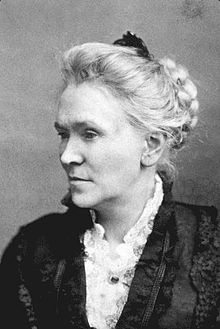
Matilda Joslyn GageMatilda Electa Joslyn Gage (March 24, 1826–March 18, 1898) was a suffragist, a Native American activist, an abolitionist, a freethinker, and a prolific author, who was "born with a hatred of oppression."

Gage became involved in the women's rights movement in 1852 when she decided to speak at the National Women's Rights Convention in Syracuse, New York. She served as president of the National Woman Suffrage Association from 1875 to 1876, and served as either Chair of the Executive Committee or Vice President for over twenty years. During the 1876 convention, she successfully argued against a group of police who claimed the association was holding an illegal assembly. They left without pressing charges.

Gage was considered to be more radical than either Susan B. Anthony or Elizabeth Cady Stanton (with whom she wrote History of Woman Suffrage). Along with Stanton, she was a vocal critic of the Christian Church, which put her at odds with conservative suffragists such as Frances Willard and the Woman's Christian Temperance Union. Rather than arguing that women deserved the vote because their feminine morality would then properly influence legislation (as the WCTU did), she argued that they deserved suffrage as a 'natural right'.

Gage was well-educated and a prolific writer—the most gifted and educated woman of her age, claimed her devoted son-in-law, L. Frank Baum.
And:Works about Native Americans in the United States by Lewis Henry Morgan and Henry Rowe Schoolcraft also influenced Gage. She decried the brutal treatment of Native Americans in her writings and public speeches. She was angered that the Federal government of the United States attempted to confer citizenship (including suffrage) upon Native Americans (who, Gage argued, opposed taxation, and generally did not seek citizenship) while still withholding the vote from women. She wrote in 1878:That the Indians have been oppressed--are now, is true, but the United States has treaties with them, recognising them as distinct political communities, and duty towards them demands not an enforced citizenship but a faithful living up to its obligations on the part of the government.

--"Indian Citizenship," page 2
In her 1893 work Woman, Church and State she cited the Iroquois society, among others, as a 'Matriarchate' in which women had true power, noting that a system of descent through the female line and female property rights led to a more equal relationship between men and women. Gage spent time among the Iroquois and received the name Karonienhawi--"she who holds the sky"--upon her initiation into the Wolf Clan. She was admitted into the Iroquois Council of Matrons.
Matilda Joslyn Gage: forgotten feminist

By Sally Roesch WagnerAs a child during the 1830s, she circulated anti-slavery petitions. Gage's entire life was spent within a thirty mile radius of Syracuse, New York, and her home, like that of her parents, was a station on the underground railroad. As a young wife and mother in 1850, Gage signed a petition stating that she would face the penalty of a six month prison term and a $2,000 fine rather than obey the newly enacted Fugitive Slave law, which made criminals of anyone assisting slaves to freedom anywhere in the United States.

During the 1870s, Gage wrote a series of controversial articles decrying the brutal and unjust treatment American Indians had received. Having already broken numerous treaties, the government was trying to force citizenship upon Native Americans, she argued, thus destroying their independent nation status, and further opening "wide the door to the grasping avarice of the white man." Gage, who was adopted into the wolf clan of the Mohawk nation and given the name Ka-ron-ien-ha-wi (Sky Carrier), wrote of the superior form of government practiced by the Six Nation Iroquois Confederacy, in which "the power between the sexes was nearly equal." This indigenous practice of woman's rights became her vision.

Gage never fragmented her beliefs about changing the world. To her, all freedoms hung together on the same thread and the struggle for them could not be separated. Still, there was one goal that became her life's work and that was the struggle for the complete liberation of women.
As for Matilda's daughter Maud, who married Baum:

Maud Gage BaumAberdeen, South Dakota (1888–1900)

Maud's two sisters and brother were in the Dakota Territory. Because Maud wanted to be near them, she insisted over Frank's vacillations that they move there. Maud, Frank, and her two sons moved to Aberdeen, South Dakota, on September 20, 1888, because Frank believed there would be better business opportunities in the West. Frank started a dry goods store, Baum's Bazaar, on October 1, 1888, to make a stable living for his family. However, because he granted too much credit to his destitute customers, his store went out of business.

The family moved to Chicago, and Frank found a job as a newspaper reporter.

Maud's mother Matilda frequently spent the winter at their house, as she did when Maud and Frank were residents of Aberneen. Maud cherished her mother's visits, especially when Frank traveled for his job.
Comment:  I posted about the connection between feminists and Indians in Women and Indians as Peacemakers and Indians Inspired Feminism. But I didn't realize Gage was Baum's mother-in-law.

So Baum was devoted to Gage the Native rights activist. She stayed with him and Maud during the Aberdeen winters.

This was when he wrote two virulently anti-Indian editorials for the Aberdeen Saturday Pioneer. I wonder what they said to each other the day after the editorials appeared.

For more on Baum and Indians, see Indians = Flying Monkeys? and Lakota Protest Baum's Editorials.

May 05, 2012

"Walk a Mile in Her Shoes"

Men don heels for abuse awareness

By Megan StephensonSome feeling sore, a dozen men staggered to the Suquamish House of Awakened Culture with heads held high, having just walked more than half a mile in bright red, high-heeled pumps.

“I think women shouldn’t wear them,” joked Jon James, a member of the Suquamish Warriors veterans group. James was one of the many men who participated in the Suquamish Tribe’s first “Walk a Mile in Her Shoes” event April 30.

Domestic violence and sexual assault is a problem for women everywhere, but studies show Native American women suffer at some of the highest rates in the country. According to a University of Oklahoma study, nearly three out of five Native American women have been assaulted by their spouses or intimate partners.

“It's a problem here, but one of those things people don’t talk about,” said Bennie Armstrong, another man who endured the heels. “Men on women, men on men, children, youth … If [we] can get men to buy in on this, its easier to talk about.”
Comment:  For more on violence against Native women, see Indians Sexualized Since the Beginning and Stolen Sisters CD Raises Awareness.

April 21, 2012

Women and Indians as "welfare queens"

What We Still Get Wrong About Women and Work

The question we should be asking is not whether domestic caregiving is more or less important than wage work—they’re both crucial, and crucially different.

By Michelle Chen
The distorted framing of the debate is captured in Mitt Romney’s contradictory comments about forcing mothers receiving public assistance into the labor force—in order to instill in them the “dignity of work.” This myopic binary between women of poverty and women of privilege reflects the evolution of the federal welfare state throughout the 20th century.

Poor women, who evidently lack dignity, must redeem themselves through work, while the apparently inborn dignity of their affluent counterparts allows them to embody feminine virtue by staying within the domestic sphere. And if they volunteer to climb the career ladder, they’re vaunted as supermoms.

Part of this mentality stems from a reactionary, often racialized construction of the “deserving” versus the “undeserving” poor. The argument is also steeped in the corrosive cultural assumption that poor women’s social value derives from their labor or reproductive capacity, not their humanity, intellect or relationships.

The counterpoint to Ann Romney’s domestic sainthood is the right’s fictional “welfare queen,” the unwed mother who supposedly leeches off the state with abandon and embodies corrupt, uncontrollable fertility.

And that’s where the “dignity of work” comes in, to discipline the unruly woman and keep her in her place, safely below the poverty line. Neoliberals like Newt Gingrich have sought to broaden the attack on poor women by advocating for the use of the child welfare as a punitive tool, sweeping kids into state custody to “rescue” them from disadvantaged mothers and their communities. So much for family values.
Comment:  Arguments about the "deserving" versus the "undeserving" poor also apply to blacks, Latinos, and other minorities. In the Native field, "bad" Indians are the ones who don't pay taxes, get checks from the government, and get rich via casinos without working. "Good" Indians are, well, the dead ones.

Seriously. Indians were brave and noble, we tell ourselves. But now they're corrupt and degraded. We worship the dead ones while scorning the live ones as fakes (not enough blood) or sellouts.

For more on Indians as welfare recipients, see Republicans Want to "Keep America America" and Attawapiskat Triggers "Welfare" Stereotypes.

October 24, 2011

Indians sexualized since the beginning

Blogger Stephen Bridenstine discusses the book Pocahontas and the Powhatan Dilemma by Camilla Townsend. He and Townsend note how Euro-Americans have sexualized Indian women since the beginning.

Portraying Pocahontas: or the Not-So-Modern Origins of the "Sexy Indian Princess"Indeed, it is the overview on New World literature available to the English colonists that makes Professor Townsend's book so compelling. It is in her description of these sixteenth century works that the origins of the “sexualized Indian” becomes so abundantly clear.

She writes of lurid tales of an exotic land spreading throughout Europe within the first few years of Columbus' arrival in the Americas. From the earliest illustrations, America was routinely depicted as a naked Indian woman, a metaphor not lost on the Spanish conquistadors who conquered the “virgin” lands of the New World. Even the English described the Indians in and around the failed Roanoke colony as sweet and welcoming, “devoid of all guile and treason.” (p. 28)

These works inspired hundreds if not thousands of Englishmen to risk their lives and money to journey to this land of “opportunity.” Native women were portrayed as not only accessible but willing. It was seen as practically divine mandate that these Englishmen sow their seed in the new world both literally and figuratively.

As Townsend writes:“There is no question that John Smith and his peers--those who wrote such books, and those who read them- embraced a notion of an explorer as a conqueror who strode with many steps through lands of admirers, particularly admiring young women...the colonizers of the imagination were men--men imbued with almost mystical powers. The foreign women and the foreign lands wanted, even needed, these men, for such men were more than desirable.” (p. 29)European men fabricated the “New World” into a perfect masculine fantasy where savagery and sexuality mingled together in a myriad of tantalizing forms.
This early image shows exactly what white men thought of Indian women. They were wild and wanton, like beasts swinging from trees. In other words, sexual animals in human form.


"Sexual savages" today

If this stereotypical belief ever abated, it's on the rise once again. With mass-produced outfits and mass-communicated ignorance, hordes of non-Indians are trying to release their "inner Pocahontas." They want to be wild and wanton, or at least convey that impression in a safe way. Why be a plain-vanilla white girl when she can be an exotic Indian princess--a sexual savage who may rip off her buckskins and ravage you at any moment? What red-blooded man wouldn't want a primal playmate like that?

Bury my heart on Halloween

By Sheena RoetmanFinally, the over-sexualization of Natives, particularly of Native women, acts as a double-edged sword in aiding not only the objectification of Native Americans (remember—Natives are just "T and A") but also to the objectification of women in general. Take, for example, recent box office Hollywood hits such as Twilight and Avatar. Both films eagerly embrace the stereotype of the "mythical Indian" and the "sexual Indian" and, in the case of Avatar, eagerly campaign for conquering any such person.

In fact, current trends in popular culture suggest that the public conscious views Native American culture as something of the past entirely. Scantily-clad pop singers parade around stage donning elaborate war bonnets and glittery face paint and stores such as Urban Outfitters and Forever 21 have encouraged this appropriation by mass-producing cheap replicas of sacred items and pandering the items as elements of costume in everyday dress for everyday people. In reality, objects such as war bonnets and dream catchers, and certain feathers, patterns, and colors, are just as sacred to their respective tribes as the Bible, Koran or Torah is to Christians, Muslims or Jews.

In the contexts of the treatment of Native Americans throughout history and in current media and pop culture, holidays that celebrate colonization and a continued policy of assimilate-or-annihilate tell a very different story than the one taught by public school history textbooks. Objectifying and appropriating cultures and peoples makes it easier for a society to justify certain atrocities committed against those cultures and peoples. Creating a public opinion that centers on the idea that Native Americans are something of the past makes it easier to disregard Natives altogether. Dressing up "Indian" on Halloween may seem relatively innocent, but the very fact that doing so is allowable in our society serves as part of a larger discourse.


"Pop artist Ke$ha regularly wears Native headdresses during performances."

Greenlighting rape and violence

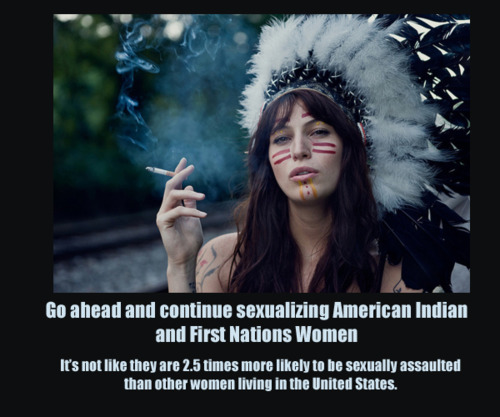
The consequences of this sexualization of Native women are sadly obvious:

Go ahead and continue sexualizing American Indian and First Nations Women

By blackwingeddove"Over the past decade, federal government studies have consistently shown that American Indian and Alaska Native women experience much higher levels of sexual violence than other women in the USA. xxData gathered by the US Department of Justice indicates that Native American and Alaska Native women are more than 2.5 times more likely to be raped or sexually assaulted than women in the USA in general. A US Department of Justice study on violence against women concluded that 34.1 per cent of American Indian and Alaska Native women--or more than one in three--will be raped during their lifetime; the comparable figure for the USA as a whole is less than one in five. Shocking though these statistics are, it is widely believed that they do not accurately portray the extent of sexual violence against Native American and Alaska Native women." --Amnesty International, Maze of Injustice: The Failure to Protect Indigenous Women from Sexual Violence in the USA (2007)

"The fact that Native women are most commonly assaulted by non-Native men is not surprising to me, but does add a historical slant to the idea of how harmful cultural appropriation can be for women. Historically, men have used the implied "natural" sluttiness of women of color as justification for rampant rape or not-really-consensual relationships with women of color, particularly Native women who came into contact with colonists." --Whitney Teal, One Woman's Costume Is Another Woman's Nightmare

Now can you see why my heart breaks and I feel sick every time I see an image of a naked or scantily clad woman in a headdress? This is not just about cultural appropriation. This is about a serious, scary, and continuing legacy of violence against women in Indian Country. These girls probably thought they were just being “counter-culture” or “edgy,” but by perpetuating the stereotypes of Native women as sexual objects, they are aiding and continuing the cycle of violence." --Adrienne Keene, Nudie Neon Indians and the Sexualization of Native Women
Comment:  For more on the princess stereotype, see Navajo Dallas Cowboys Cheerleader and Sexy "Indian" in New Girl.

July 25, 2011

Norwegian killer hates women

Norway Killer’s Hatred of Women

Anders Breivik used anger against women to cast himself as a crusader, believing feminism is destroying the West from the inside and creating space for Islamism, says Michelle Goldberg.Conservatives worried about the Islamization of Europe often blame feminism for weakening Western societies and opening them up to a Muslim demographic invasion. Mark Steyn’s bestselling America Alone: The End of the World as We Know It predicted the demise of “European races too self-absorbed to breed,” leading to the transformation of Europe into Eurabia. “In their bizarre prioritization of ‘a woman’s right to choose,’” he argued, “feminists have helped ensure that European women will end their days in a culture that doesn’t accord women the right to choose anything.”

This neat rhetorical trick—an attack on feminism coupled with purported concern about Muslim fundamentalist misogyny—is repeated again and again in Islamophobic literature. Now it’s reached its apogee in mass murderer Anders Behring Breivik’s 1,500-page manifesto, “2083: A European Declaration of Independence.” Rarely has the connection between sexual anxiety and right-wing nationalism been made quite so clear. Indeed, Breivik’s hatred of women rivals his hatred of Islam, and is intimately linked to it. Some reports have suggested that during his rampage on Utoya, he targeted the most beautiful girl first. This was about sex even more than religion.
And:[T]he right clings to the idea that feminism is destroying Western societies from the inside, creating space for Islamism to take cover. This politics of emasculation gave shape to Breivik’s rage. Thus, while he pretends to abhor Muslim subjugation of women, he writes that the “fate of European civilisation depends on European men steadfastly resisting Politically Correct feminism.” When cultural conservatives seize control of Europe, he promises, “we will re-establish the patriarchal structures.” Eventually, women “conditioned” to this new order “will know her place in society.” His mad act was in the service of male superiority as well as Christian nationalism. Those two things, of course, almost always go together.Comment:  I've written about this before. For instance, in:

Women and Indians as peacemakers
Conservative worldview = fear of cooties

Psychologically, what conservatives fear is to be soft and feminine. The whole point of conservatism is that the strong (white male Christians) should dominate the weak. Their "philosophy" amounts to social Darwinism...survival of the fittest...might makes right.

Blacks, Latinos, Indians, Muslims, and other minorities challenge this attitude in several ways. Chief among them are:

1) Minorities are, or seem to be, part of a poor underclass. They seem to values people, community, and church--i.e., humanistic things--over such Western abstractions as wealth, status, and power. Their continued existence is a threat to the established way of doing things. If wealth and power aren't the true measures of success, then what's the point of 2,000 years of Christian conquest and rule? Why not give up the trappings of power and go live simply and happily like an Indian "savage"?

2) White male Christians have victimized "others" throughout history: crusades, inquisitions, imperialism, slavery, genocide. The continued existence of minorities is a reminder that these Christians have utterly failed to live up to Jesus's ideals. That they're nothing but a pack of liars, cheaters, and hypocrites--worse than the minorities they've persecuted and killed. Rather than address this failure, conservatives want to eliminate the evidence of their crimes against humanity. So minorities must disappear or die.

Conservatives afraid of women

Women and gays challenge this attitude even more directly. If these people can do everything a strong, virile, self-reliant man can do, then what's the point of being a man? Rather than address this question, conservatives go into attack mode. "You're questioning our masculine superiority? Unacceptable! We'll either starve you of government services until you die (Republican Tea Party) or kill you ourselves (McVeigh, Breivik)."

In short, all the right-wing attacks--on government services, "death panels," Barack Obama's birth certificate, Michelle Obama's health programs, the New York City "mosque," immigration, gay marriage, Indian gaming, etc.--are part of the same overwhelming fear. Namely, that white male Christians will lose their positions of power and privilege in the world. That they'll be equal to everyone else, not better.

Alas, these conservative attempts to paint white male Christians as good and everyone else as bad are a constant. The whiny babies love to paint themselves as victims even as they continue to dominate the planet. For more on the subject, see:

Conservatives use "language of savagery"
Stossel:  Indians are biggest moochers
Fischer:  Natives had no morals
Bachmann fibs about America's founding
Right fright over UN declaration

Below:  White fears in a nutshell.

July 13, 2011

Callaloo founder responds to criticism

In a thread on Facebook, Marlon Singh, one of the founders of Callaloo, responded to the criticism the event has received:To the Native American Community:

I am receiving numerous emails in regards to the misrepresentation of six nation and north american native aboriginals. We in turn deeply apologise for this as it was not done with any malicious intent or specific purpose of demoralization of your culture.

Carnival is similar to halloween its a pagan festival in which different themes are picked differently each year be it space, greece, the romans or fantasy and fiction.

We picked the theme "NATIVE AMERICAS" because we work closely with members of the Cree and Ojibway community, we agreed and built and designed costumes together probably not copying identically native wear but putting a caribbean carnival twist to it.

RIGHT NOW WE HAVE CHANGED THE THEME FROM NATIVE AMERICAS TO CARIBBEAN NATIVES AND TAKEN DOWN NUMEROUS COSTUMES AND PRINTED MATERIAL,(CALLALOO.NET) WE HAVE ALSO CHANGED ALL NAMES ASSOCIATED WITH ANY INDIGINOUS NORTH AMERICAN CULTURE BUT IN TURN FOCUSED ON MY HOME COUNTRY WHICH I AM PART CARIB INDIAN,AGAIN WE APOLOGISE AND FOCUS NOT ONLY NOW BUT FOR FUTURE CARNIVALS TO CEASE AND DESIST IN DEPICTION OF ANY NORTH AMERICAN ABORIGINALS, WE HOPE WE CAN WORK IN PEACE AND HARMONY AND AVOID ANY CONFLICTS OR VIOLENCE DUE TO THIS IN THE FUTURE.

YOURS RESPECTIVELY,

MARLON
647-702-6169
My response:  Thanks for taking the time to respond, Marlon.

I'd say your theme change is a step in the right direction, but not nearly enough. You're still associating genuine Caribbean, Central American, and South American tribes with hyper-sexualized Native women. In short, you're still exploiting Natives as sex objects.

P.S. "Probably not copying identically native wear"? I think we can say "definitely not." I'm confident no traditional Native women have ever dressed like Las Vegas showgirls.

Other responses

Others were more gracious:I'm impressed with the fact that Marlon responded and is taking some steps to change the theme of their festival. Since Cree and Ojib First Nations people are involved with this I'm assuming they are not too upset. I've seen pictures of Brazilain Carnivals before and the women sure do dress very scantily. So to have a "Brazilian" style carnival with Native women dressed like Vegas Showgirls is definately offensive, but not the end of the world for sure. I'm more concerned with the "Plastic Shaman" like James Arthur Ray out there who are exploiting Indingenous ways for profit. Or White Eagle Medicine Woman with her "Prayer Formances" for $35 a head. I'd be interested to hear what your Cree & Ojib friend have to say on this subject Marlon. Again, thanks for at least caring!

The fact that Marlon took the time to acknowledge the issue publicly and did what they could to work with everyone's concern is really good, many others would not have done this.
A few more comments:

Singh and company have now removed the tomahawks and arrows from the home page. I'm glad our criticism is producing results. I'm sorry it was necessary.

It's not clear if Singh's Cree and Ojibway friends actually know the details of the event. And since Callaloo primarily stereotypes Caribbean and South American Indians, Canadian Indians aren't the main victims.

I believe Central America and the Caribbean are part of North America. So Singh is wrong when he says he's not doing anything with North American Native cultures. He's not doing anything with his impression of North American cultures, maybe, which means chiefs and teepees. But he's still stereotyping North American Indians.

Actually, it doesn't matter which Indians he chooses to stereotype. Or whether he's part of the culture he's stereotyping. Stereotyping is wrong, period. There are no free passes for images that objectify Native women across two continents. Nothing that contributes to the horrendous violence against women is acceptable.

For more on the subject, see Callaloo = Sexual Objectification and Callaloo Stereotypes "Native Americas."

Below:  "Tribal Princesses"...with a Plains tipi in the background. So much for disassociating Callaloo from North American cultures. It couldn't be much clearer that the whole event is an excuse to parade sexy savages.

July 09, 2011

Callaloo = sexual objectification

Before Callaloo changed its 2011 theme from "Native Americas" to "Caribbean Natives," I posted a note about it on Facebook:

This is why starlets such as Tinsel Korey, Julia Jones, and Janina Gavankar get Native roles while Irene Bedard gets abused. Namely, the sexual objectification of Native women.

This led to the following discussion with a woman on the NativeCelebs page:Brazilian and Caribean Culture is a whole different ball game than Hollywood. I don't think one has anything to do with the other. I used to dance Samba and make costumes. In Brazilian and Caribean culture women are proud of their bodies and show them off. And they are not all skinny models in those skimpy costumes. I support Irene Bedard and love her work. Her husband is a jerk. And yes Hollywood objectifies women. Why they are using the Native American theme here is beyond me. I would never have used it like that. The so-called mid-coastal costume is a mess. Most of the others are quite nice.This carnival is being held in Toronto, not Brazil. The theme is "Native Americas," not "Brazilian and Caribbean culture." And no Native women have ever dressed like this except in stereotypical displays: Hollywood movies, advertisements, fashion spreads, etc.

Korey and Jones not Native?

Someone else questioned my questioning of Korey and Jones. I continued:

My point isn't only about the actresses' origins. It's about having to be Hollywood beautiful to get a role.

Native actors often don't fit Hollywood's definition of what leading men and women should look like. So "minimal bloods" like Johnny Depp, Taylor Lautner, and Brandon Routh get the roles while genuine Native actors go hungry.

Hollywood derives its perceptions of Natives from stereotypes such as this carnival's. So when a studio does cast a "Native" woman, it's usually someone who fits the mold. Someone like Tinsel Korey, Julia Jones, or Janina Gavankar. Or Megan Fox, Lynn Collins, Mizuo Peck, or Nicola Peltz, to name other examples. As long as she looks hot and exotic, it doesn't matter whether she's Native or not.

Don't blame "carnival culture"?

My original correspondent added:There is huge Caribbean community in Toronto as there is in San Francisco. All I'm saying is Carnival Culture has nothing to do with Native America or Hollywood. Hollywood had their stereo types long before Carnival came to town. So don't blame Caribbean Culture for Hollywood's B.S. What I don't like about the Callaloo for 2011 is that the Native American theme is highly inappropriate due to the vast culture differences in how women see themselves. I got your point the first time around. My father was Santee Sioux and my first husband was from Belize so I have the ability to see both sides of this arguement thru my familiarity with both cultures. Now the point upon which we can agree is that when it comes to Natives Hollywood has had it very wrong for a very long time.Again, the carnival's theme is "Native Americas." This region stretches from Alaska to Tierra del Fuego. In no way is it synonymous with Brazil or the Caribbean. And Callaloo is explicitly calling the young women "Indians," not non-Indian Brazilians or Caribbeans.

Yes, "Hollywood had their stereotypes long before Carnival came to town." But each new instance of stereotyping confirms the false impressions in people's minds. That's why many of us oppose Native stereotypes: because they perpetuate the previous 500 years of harm.

In conclusion, this woman seemed to be agreeing and disagreeing with me simultaneously. Where we agreed, she was right. Where we disagreed, not so much. <g>

For more on the subject, see Callaloo Stereotypes "Native Americas" and Wild Indians in Guilt Free Zone.

Below:  Callaloo's "Amazon Warriors" (formerly known as "Asakiwaki Hunters"). I don't think going from a particular tribe to a general tribal term makes a difference, Callaloo. The problem is that no Indian looks like this.

July 08, 2011

Callaloo stereotypes "Native Americas"

Apparently Callaloo is some sort of Brazilian-style carnival, parade, or event held in Toronto every year.

CallalooMarlon & Jason Singh’s Callaloo presents “Caribbean Natives”

Join Callaloo for their 2011 Scotiabank Caribbean Carnival Toronto presentation of “Caribbean Natives.”


One slight problem: This year's theme was originally "Native Americas," not "Caribbean Natives." But we'll get to that.

The page header shows an Amazon Indian in mask-like paint, a hut, palm trees, and a tomahawk and arrow. I think you can see where this is going.

How does Callaloo "honor" Native people? With scantily-clad women pretending to be Indians, of course:

2011 Costumes

For example:


Brazilian Amerindians


Tribal Princesses


Lost City of the Aztecs

This image's former title was "Sacrificial Mayan Virgins," as you can tell from the image's URL. That tells you all you need to know about Callaloo's exploitation of Native women. They might as well name it "Sex/Rape Fantasy Objects to Boost Callaloo's Bank Account."

What's wrong with Callaloo

In Callaloo Parade and the Sexualization of Native American Women, the Beyond Buckskin blog presents another image from this year's Callaloo:


And explains why this is wrong. It quotes Adrienne Keene from her Native Appropriations blog:

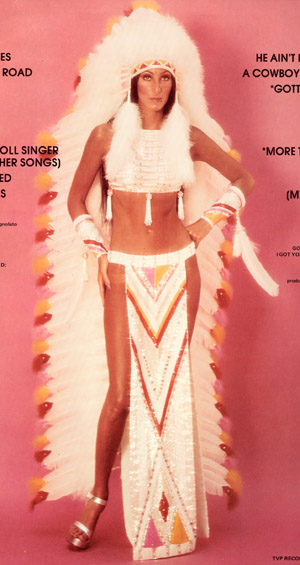
Nudie Neon Indians and the Sexualization of Native WomenNative women have been highly sexualized throughout history and in pop culture. There are any number of examples I can pull from, the "Indian Princess" stereotype is everwhere--think the story of Pocahontas, or Tiger Lily in Peter Pan, or Cher in her "half breed" video, or the land 'o' lakes girl, seriously almost any image of a Native woman that you've seen in popular culture. We're either sexy squaws (the most offensive term out there), wise grandmas, or overweight ogres. But the pervasive "sexy squaw" is the most dangerous, especially when you know the basic facts about sexual violence against Native women:

  • 1 in 3 Native women will be raped in their lifetime

  • 70% of sexual violence against Native women is committed by non-Natives

  • Now can you see why my heart breaks and I feel sick every time I see an image of a naked or scantily clad woman in a headdress? This is not just about cultural appropriation. This is about a serious, scary, and continuing legacy of violence against women in Indian Country. These girls probably thought they were just being "counter-culture" or "edgy," but by perpetuating the stereotypes of Native women as sexual objects, they are aiding and continuing the cycle of violence.
    Journalist Valerie Taliman adds:The fact that Native American and Alaska Native women have been dehumanized throughout US and Canadian history informs present-day attitudes. It helps fuel the high rates of sexual violence perpetrated against them and the high levels of impunity enjoyed by their attackers. One in three Native women will be raped in their lifetimes.Comment:  This year's Callaloo is basically a female version of the Irish "Indians" showband. It's wrong for the same reasons.

    Originally Callaloo meant to stereotype Natives throughout the Americas as belonging to one primitive culture of scantily-clad savages. Limiting it to "Caribbean Natives"--which stupidly includes Central and South America--isn't much of an improvement.

    For more on the Indian princess stereotype, see "Racism, Stereotypes, and the Digitized Indian" and Redbone Told to Wear Buckskin.

    Below:  Wrong then, wrong now.

    June 21, 2011

    NEA award for "Native Daughters" project

    UNL professor to receive civil rights award

    By Mark AndersenSlowly, but deliberately, earn the trust of Native American people, never promise the impossible, and "let native people participate in their story as fully as possible," said author and journalist Joe Starita.

    Then, stand aside.

    "Get out of the way of the narrative," he said of his writing. "Let their story come to the reader as directly as possible without my fingerprints."

    Starita hopes to do the same in Chicago on July 1, by accepting a civil rights award from the National Education Association on behalf of Native women whose vital histories mostly have been neglected.

    "As a teacher and writer, Joe Starita shares the unsung achievements of Native Americans," said association President Dennis Van Roekel. "His books are a must-read to better understand Native Americans, their heritage and their contributions to American life and history."

    Starita is the author of "I Am a Man: Chief Standing Bear's Journey for Justice," the 2010 One Book--One Lincoln selection, and "The Dull Knifes of Pine Ridge: A Lakota Odyssey," a 1996 Pulitzer nominee.

    It is native women who as poets, leaders, teachers, warriors and mothers have kept their culture going, Starita said.

    "A nation is not conquered until the hearts of its women lay on the ground," he said, quoting a Northern Cheyenne proverb.

    "I want to accept this award on behalf of all the Winona LaDukes, Wilma Mankillers, Vida Stablers and Judi gaiashkiboses."
    Comment:  In addition to the main subject, a few things are worth noting here:

  • That I Am a Man was read citywide in Lincoln, Nebraska.

  • That The Dull Knifes of Pine Ridge was a Pulitzer nominee.

  • How to earn the trust of Natives when you're a non-Native writing about them.

  • For more on the subject, see Standing Bear's Increasing Exposure and Nebraskans to Read Standing Bear Book.

    March 29, 2011

    Michelle Obama's mentors include Erdrich

    Michelle Obama books stars to mentor:  Hilary Swank, Geena Davis, Anna Deavere Smith, Michelle Kwan

    First Lady Michelle Obama to Host Mentoring Events with Renowned Women to Celebrate Women's History Month

    By Lynn SweetOn Wednesday, March 30th, First Lady Michelle Obama will host a special event during the annual celebration of Women's History Month at the White House. Mrs. Obama will bring together more than twenty accomplished women, each paving their way in a variety of fields, to serve as mentors and share their experiences with students in the Washington, D.C. metro area. These women will showcase the important role mentoring can play in the lives of young people as they encourage all students, particularly young women, to pursue their dreams.Comment:  The list includes "Louise Erdrich, Pulitzer Prize winning author."

    For more on Erdrich, see Louise Erdrich Wants PEACE PARTY and Bestselling Native Children's Books.

    December 12, 2010

    Disney's princesses grow up, a little

    The emancipation of the Disney princess

    The sweet simplicity of 1937's Snow White has given way to the no-nonsense, take-charge attitude of the 21st-century Rapunzel

    By Shelley Fralic
    The early Disney princesses (there are now 10 official princesses, in what has become a billion-dollar enterprise) were, in fact, portrayed as helpless gamines requiring rescue from peril and/or ruin by a handsome and brawny prince.

    The stereotyping began way back in 1937, when coquettish Snow White depended upon the kindness of dwarfs for eternal happiness, and she was followed by a simpy Cinderella and her dainty glass slipper in 1950 and then Sleeping Beauty's sweet, clueless Aurora, in 1959.

    It would be another 30 years, in 1989, before Disney introduced its next princess and, perhaps sensing the coast was clear after having ceded the inappropriate dream girl market to Barbie and her bodacious bosom, they debuted the sassy Ariel in The Little Mermaid.

    The tide had turned. Ariel was a stubborn redhead who defied her family and chose love over crustaceans and, ever since, the Disney princesses have been breaking the mould.

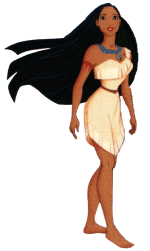
    In 1991, Belle romanced ugly in Beauty and The Beast. Jasmine was the sultan's daughter who rejected prearranged suitors in 1992's Aladdin. In 1995, Pocahontas gave up her prince to stay with the tribe. Mulan kicked serious Hun hiney in 1998, while Tiana was a waitress-cum-restaurateur in 2009's The Princess and The Frog. And now we have Rapunzel, who gets in and out of jams with a flick of her glowing ponytail and rescues her husband-to-be, a hapless buffoon who is nowhere near as charming as her sidekick chameleon Pascal or the palace steed Maximus.
    Comment:  I agree Disney's women have progressed over the decades, but I'm not as impressed as Fralic is. Let's review the recent record:

  • Ariel:  Sacrifices her undersea life to marry a prince.

  • Belle:  Accepts captivity and eventually marries a prince.

  • Jasmine:  Initially interested in Aladdin only because he pretends to be a prince. Eventually marries him.

  • Pocahontas:  Falls in love with John Rolfe in Pocahontas II and lives happily ever after.

  • Tiana:  Eventually transformed into a princess and marries a prince.

  • Rapunzel:  Eventually learns she's a princess and marries a prince.

  • The common denominator is that these women are defined by love, marriage, and (usually) royalty. If it seems "natural" for these movies to be romances, consider this: How many male heroes are defined by their relationships with women? A handful in a hundred? For every Edward Cullen, there's a Sherlock Holmes, Lone Ranger, Batman, James Bond, Captain Kirk, Luke Skywalker, Indiana Jones, Rambo, the Terminator, Harry Potter, Captain Jack Sparrow, Wolverine, Jason Bourne, Frodo, et al. I could go on and on listing male heroes who don't get married and live happily ever after in the end.

    About the only Disney women who break the "marriage or bust" mold are Meg (Hercules), Mulan, and Esmeralda (Hunchback of Notre-Dame). In other words, a minority of Disney's female characters. The majority may be "intrepid and brainy," as Fralic writes, but they don't have career plans that require them to stay single. Unlike the male characters, they don't have a higher calling beyond love.

    For more on the subject, see "Marriage or Bust" for Disney's Women.

    Below:  Seven of eight Disney women who married their Prince Charmings--some of them literally.

    November 10, 2010

    Native girls judged on "poise," makeup

    Indian beauty contests at Pendleton Roundup

    Part 4 of 4 part series

    By Jack McNeel
    The Pendleton Roundup is much more than bucking horses and bulls. Perhaps the farthest extreme from rough stock rodeo is a beauty pageant–and two such pageants are part of Roundup week in Pendleton.

    One contest, the Junior American Indian Beauty Pageant, is for girls from 5 to 13 years old. The American Indian Beauty Contest features young women from 14 to 22. An incredibly difficult job faced the judges, especially in the junior pageant where 98 contestants were entered, any one of which would have been a good choice. But the judges had to settle on just the top three.

    There’s a lot of preparation like any beauty pageant. The judging is based half on regalia and half on poise so the mothers and aunties work hard to prepare the girls. Some of the dresses and other regalia have been passed down from several generations while others are new, possibly made just for this event. Hair is combed and braided and ties frequently added. Makeup must be just so. Then there’s the walking and smiling and waving–all that is practiced before watchful eyes and with advice from the adults.
    And:Gabriella’s mother told how her daughter had been preparing for this since she was 1. “She loves doing this contest. It’s one of her favorite things to do. She got third in 2004 and 2008 and this was her last year of eligibility. She was really excited and nervous about it being her last year. She was one of the last ones of the top 10 called so she was really nervous and scared. When they called her she was surprised and happy. Then it kind of hit her and she was really emotional.” Eventually, when she’s old enough, Gabby would like to run for Happy Canyon princess.Comment:  The pageant's recognition of regalia is okay. But "poise"? What do braided hair and makeup have to do with poise? It seems this pageant is judging how feminine--how pretty and presentable--these girls are and mislabeling it "poise."

    The real problem is having a beauty pageant for girls as young as five. And getting them excited about it at age 1. This is why girls have body-image issues, people. It's why they become anorexic or bulimic. It's why some have sex and get pregnant as teenagers--to prove their worth as women. It's why others become depressed or suicidal--because they can't achieve the "glamorous" life of a beauty pageant winner.

    So many levels of foolishness here. Native cultures adopting the white man's ways. Native girls being taught to smile and wave like Barbie dolls. And journalists writing about beauty pageants uncritically.

    If you want to recognize Native regalia, great. Have a regalia contest that doesn't depend on hair, makeup, or poise. Honor the children who embody their culture without becoming stereotypical princesses.

    For more on beauty pageants, see Miss Universe Canada Finalist in a Headdress and Documentary About Hearing Radmilla.

    Below:  "Keahna Bill had her makeup applied by Crystal Pond, a Happy Canyon princess from 2006."

    November 03, 2010

    "Reservation hotties" and "welfare chicks"

    Members of aboriginal community voice concerns over pornographic websiteMembers of Winnipeg's aboriginal community are speaking out against a pornographic website featuring only native women. They believe the women featured on it are vulnerable and were targeted.

    Lisa Michell of the Women's Memorial March says the site furthers stereotypes of aboriginal women. The site advertises "casino girls," "reservation hotties" and "welfare chicks."

    CTV News is not naming the website.

    The website's creator, Florida resident Shim Mekbeb, says it's a niche website and the girls are willing.
    Comment:  I don't think women should sell themselves for money, but that's a separate subject. The problem here is the porn site's stereotypes. "Casino girls," "reservation hotties" and "welfare chicks" all sound like variations of the Indian princess or squaw. The women are sexy like princesses but slutty like squaws.

    And where did Mekbeb get the idea for this website? Gee, I can't imagine.

    Paris Hilton as a sexy Indian
    "Pocahontas" in Parenthood
    Miss Universe Canada finalist in a headdress
    Sexy "Indians" in hipster headdresses
    "Sexy squaws" at Neon Indian concert

    Etc.

    For more on the subject, see Indian Women as Sex Objects.

    Below:  "Lisa Michell of the Women's Memorial March said she believes vulnerable aboriginal women were targeted for the website."