December 09, 2007

Report on New Jersey

My three-day trip to New Jersey was a success. As usual, I looked for all the Indian connections I could find. There were a few.

Day 1 (Dec. 6)

Thursday I took a train to New York City and passed through several towns with Indian names. Among them were Watsessing (watschu, "hill," and assan, "stone") and Secaucus (sukit, "black," and achgook, "snake") of The Secaucus Seven fame. Based on a website I quickly scanned, something like a quarter of New Jersey place names have an Indian origin.

Note:  I didn't know it, but achgook ("snake") is part of the name Chingachgook from Cooper's The Last of the Mohicans. A website confirms it:Chingachgook offers little excitement. Etymologically it is a Unami Delaware word meaning "Big Snake," "ching," "big," and "achgook," "snake."So one of the first great Native heroes is named Big Snake. And Tonto is Spanish for "stupid." Nice.

Manhattan, of course, is the site of possibly the most (in)famous purchase in history. In case you hadn't heard, the "$24 for the island" story is a myth. The Dutch colonization of New York is built upon the stereotype of the gullible, childlike Indian.

I didn't see anything about Indians in my 2.5-hour walk from Penn Station to Central Park and back. But I did see statues of Roman goddesses, William Tecumseh Sherman, and Christopher Columbus along with liberators José Marti (Cuba) and José de San Martín (Argentina). New York celebrates the triumphs of white Europeans and Americans, even if it's at the expense of Indians.

That evening our program on Native Americans in comics went well. I showed my PowerPoint presentation and Michael Sheyahshe and I had a lively discussion with an audience of two dozen. Among the attendees were Jeff Stevens, publisher of the new Atlas Comics, and Arlene Hirschfelder, author of American Indian Stereotypes in the World of Children and Encyclopedia of Native American Religions. Hirschfelder says she's a huge fan of my website and uses it all the time for her research.

Day 2 (Dec. 7)

I toured the Montclair Art Museum the next day. The comics exhibit looked great. I didn't realize they had so many rare first issues: ACTION #1, CAPTAIN AMERICA #1, AMAZING FANTASY #15, etc.

More to the point, I think they covered all the high points of "comics and society." The major sociocultural issues of the last 70 years were all there: WW II, the A-bomb, the Cold War, Beatlemania, Vietnam, drugs, gender equality, minority rights, the environment, government corruption, famine relief...all the way to 9/11, the war on Iraq, and the suppression of civil rights. The exhibit didn't say much a longtime comics reader wouldn't know, but I bet it would be an eye-opener to a non-comics fan.

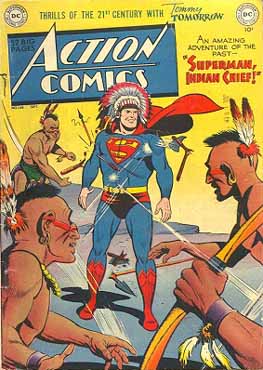
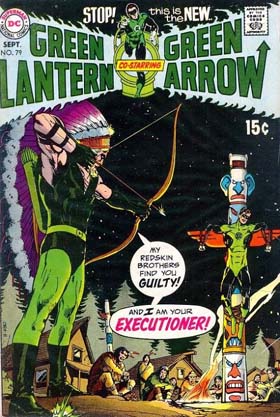
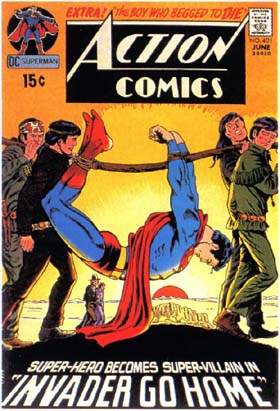
In addition to a display case featuring a dozen or so Native comics, they wove Native issues into the rest of the exhibit. There were the stereotypical comics of the 1940s and '50s with Superman, Batman, and Captain Marvel dressed as Indian chiefs. And there were the protest comics of the '70s such as GREEN LANTERN #79 and ACTION #401.

The rest of the museum was also interesting. Talk about eclectic: The collection is about 20% Native artifacts, 30% comics (temporarily), 20% modern American art (including some modern Native art), and 30% 18th- and 19th-century American art. The staff was having a strategy meeting while I was there, which is good, because I'm not sure who this museum would appeal to except me.

The rest of the time

I wish I could say my travel to and from New Jersey was as successful as my visit. But because of missed connections both ways, I spent most of two days traveling. My door-to-door times were

LA to Montclair: 14.5 hours
Montclair to LA: 12.5 hours

Ouch. That's 37 hours at my destination and 27 hours traveling to and from it. Not exactly a great visit-to-transit ratio. Today's travel tip: Allow at least two hours for any layover between flights, and always bring a book or a laptop.
Mascots = civil-rights issue

VIEWPOINT:  Logo issue mirrors past eventsAmerican Indian people, through their tribal councils, have passed resolutions opposing UND's nickname and logo. They have spoken. Their reasons include the misappropriation of sacred spiritual images and practices at sporting events; the reduction of complex tribal, cultural and linguistic issues to a Hollywood stereotype; the attribution of violent images to Indian people by identifying them as “fighting”; and Indian women, men and children become invisible when their cultures are represented only by historical images of male warriors.

UND's nickname and logo ignores the reality that a Dakota/Lakota/Nakota person might have been the last physician one saw at a medical clinic or the clerk at the local supermarket or the teacher at a child's school. They likely were not wearing feathers or looking for a fight.
The harm mascots cause:

American Indians in controlWhen I was at UND, I saw abuse and misuse and trivialization of the Sioux name that would turn your stomach, descriptions of which The Forum would not print, partly because The Forum likes the “Fighting Sioux” nickname, and uses it at every opportunity. Suffice it to say that, especially at the opposing schools’ homecoming parades I marched in, it was common to see displays of American Indians being killed, skinned, dragged, hung, and on and on, in ugly, grisly, and brutal ways. Bathroom humor was also popular. I’ll leave that to your imagination.

Imagine, too, if you can, and if you care to, how American Indians must have felt to see this. I have tried to imagine that. How would I feel, seeing cardboard cutouts of my honest, hardworking parents, or of my grandmother, gentle and honorable woman that she was, treated this way, dragged or spat on or worse? How Indians could have endured this is beyond me. I don’t think I could.

But it was not only other schools that were disrespectful. UND students themselves would ridicule Indian images as only bored college kids can. Don’t tell me it didn’t happen. I was there. I lived in the dorms, I was in the parades, I saw the antics, I heard the whoops, I heard the insults and the taunts.
Why mascots are a civil-rights issue (from the first article):If one were to watch certain episodes of the award-winning “Eyes on the Prize,” a PBS series on the 1960s civil rights movement, the interviews with people resistant to social change mirror arguments made by UND administration and members of the North Dakota State Board of Higher Education, i.e., tradition is the moral justification for discrimination.

In taped interviews in the series, local white citizens unabashedly defend their “right” to refuse service to African-Americans in their restaurants and strongly oppose federal efforts to integrate public accommodations.

If one were to read letters to the editor or newspaper chat rooms over the past few years regarding the issue of American Indian nicknames, the sentiment often parallels statements made by members of hate groups in the South in the 1960s. Those hate groups mocked and targeted civil rights workers and encouraged violence against them.
Comment:  For more on the subject, see Fighting the Fighting Sioux.

Hockey star wants to be role model

Reggie Leach turned his life around and wants to help kids stay on trackAlcoholism probably kept Reggie Leach out of the Hockey Hall of Fame, and he's determined to do whatever he can to help young people avoid the downward spiral in which he became trapped.

He was one of the first big-time First Nations hockey stars. A right-winger, he helped the Philadelphia Flyers win the Stanley Cup in 1975. He scored 61 goals in 1975-76 and won the Conn Smythe Trophy as playoff MVP after scoring 19 post-season goals. The Flyers were swept by the Montreal Canadiens in the final.
His past:Leach, of the Ojibwa tribe, grew up in Riverton, Man., as a member of the Beren's River First Nation. He was known as the Riverton Rifle for the booming shot that made him a top goal scorer.

In 934 regular-season NHL games with the Boston Bruins, California Golden Seals, the Flyers and the Detroit Red Wings, he scored 381 goals and assisted on 285. In 94 playoff games, he had 47 goals and 22 assists. He also played in the 1976 Canada Cup tournament.

There is no record of how many bottles he emptied along the way. The abuse cost him his first marriage.
His present:He got his life together and is among more than 30 former players in a Flyers alumni group. On Wednesday, Leach met with Bob Clarke in downtown Philadelphia to sign sticks and pucks that will be used to help raise funds during his forays back into Canada.
"I want to get more involved with First Nations youth," he explains. "I feel I can become a role model.

No honor among wannabes

Columnist:  Erosion of American Indian spiritual life takes a toll“The pipe, the sweat lodge, everything they’re doing now is trendy,” Anaya told a gathering of about 20 on the west side Monday night. “Native people are getting mad because they’re starting to make this way of life look cheap.”

Typically, Anaya said, a New Age spiritualist will know some of the sweat lodge details and perhaps a snippet of Lakota language. They’re all about trying to create a ceremony, not about treating it as a way of life.

“These people running these lodges, they see it a few times and they think they can do it,” he said.

These wannabes sometimes hand out certificates—“they start handing out (Indian) names like cigars,” Anaya said, derisively suggesting someone can become “Squeaking Squirrel Butt” overnight.

“They’re being charged for the name. There’s no honor, there’s no commitment,” he said.
Comment:  For more on the subject, see Indian Wannabes.

"Lost tribe" inspires glassblower

A glass act moving on

Switching to sculpture, artist also going to BajaAbout two decades ago, Kasper said, he was rafting down a river in the Grand Canyon when he heard a tale about the Anasazi, an ancient American Indian civilization that occupied the four corners of Utah, Colorado, Arizona and New Mexico.

He learned that the Anasazi disappeared and became a “lost tribe,” a notion that fascinates him. Six months ago, Kasper said, he returned to Palomar to study clay work so he could turn his fanciful vision of the Anasazi into art. His pieces have a wood or marble base with a thin metal pole supporting feet, bodies and heads made with clay, colorful feathers and beads. They can be seen on his Web site, billkasperstudio.com.
Comment:  The Anasazi weren't "lost." They migrated to nearby locations and evolved into today's Pueblo tribes.

Indian killed while movie filmed

Harjo:  Philadelphia Indian story--a 35-year memoryOn the evening of March 2, 1972, some 25 ironworkers were on their balcony, an open metalwork ledge and railing that ran the length of the hotel. They and residents on the other five balconies above them were watching a cops 'n' robbers chase scene being filmed in the alley below for a B-movie, "Folks in Blue," a Bagman Production.

After the director said "cut," someone threw a mattress off a top-floor balcony. It landed on the pavement, narrowly missing actors who had been there seconds earlier. Police officers yelled at the ironworkers on the first balcony about the mattress. Pointing above them, the ironworkers yelled back that they didn't throw anything. The yelling match escalated to name-calling, policemen ran up to the balcony and a fight ensued. When it was over, two ironworkers were in the hospital, more were in jail and one was in the morgue.

Nike manager is role model

Man behind Air Native embraces his cultureMcCracken, Native American business manager for Nike Corp., has succeeded on many business fronts. For now, he's best known as the man who put the kick into Nike Air Native N7, a shoe specifically designed for Native athletes--and aspiring ones.

“He's a native Montanan and someone who's really been successful working in that corporate world and still embracing his Native culture and Native values,” said Jerry Lamb, Montana's economic development specialist for tribes. “He's that role model we all need.”

December 08, 2007

NAPT shares Native stories

NAPT Unveils New Strategic Plan and MissionTo increase distribution of its audio and video products, Native American Public Telecommunications (NAPT) is introducing a new strategic plan and mission statement: "NAPT shares Native stories with the world." The organization has approved three new board members to help implement the ambitious plan.

"The Internet is playing a huge part in being able to share NAPT productions beyond public television and radio stations," said Shirley Sneve (Rosebud Sioux), NAPT executive director. "This is an exciting time for the organization and for Native people as we continue to use multiple sources of media to document and tell our stories."

NAPT plans to expand its original content by producing more audio podcasts and broadening its Native Radio Theater productions. NAPT also plans to unveil a new Web site in 2008 to uniformly present its products, AIROS and VisionMaker Video.
Tuning In...NAPT’s Upcoming Public Television ProductionsIn an open call, NAPT received 36 proposals requesting more than $3 million in funding. NAPT allocated $260,000 to filmmakers with funds from the Corporation for Public Broadcasting. Projects funded in 2007 include:

  • GRAB:  A feature documentary that explores the Grab Day culture in the villages of Laguna Pueblo, as told by one family as they prepare for the annual event.

  • Native Century:  Native Americans return from WWI to pursue freedom at home.

  • Power Paths:  An exploration of energy through the eyes of Native Americans as they reveal their quest to tap wind, solar, biomass and other power sources for their communities and cities across the country.

  • Sacred Stick:  An examination of the historical, cultural and spiritual aspects of lacrosse.

  • Waterbuster:  Fifty years ago, the U.S. Army Corps of Engineers systematically dammed and flooded Indian reservations along the Upper Missouri River, severing crucial ties in Native communities.
  • Ojibwa teens put on a show

    For youth on Ojibwa reserve, show much more than a performanceThe music of Timbaland is blasting inside the gym of the brand new school on this Ojibwa reserve of just under 400 people. About 20 teens in socks or running shoes are going through the hip-hop routine they've been diligently practising for the last few weeks. They turn and bend and break to the floor. They remember to smile as they throw out a hip or thrust a leg. These kids are impressive; they're moving in unison for the most part and everyone knows all the moves.

    In May, they will be doing this routine, and others yet to be created, on the stage of the Jane Mallett Theatre in the St. Lawrence Centre in Toronto, when a show that is much more than a performance comes to town. It's called Outside Looking In.
    What it's all about:The point of Outside Looking In is not just to entertain, but to enlighten. "There are so many misunderstandings between first nations people and Canadians," says Smith. "They don't know enough about each other. I wanted the show to be educational in some sort of way. I want people leaving to feel their lives have changed a little bit because of seeing the show."

    Smith's plans for the multi-media production that will be performed May 21 in the St. Lawrence Centre are ambitious. The students will dance their hip hop numbers while other segments of the show will feature professional dancers. Outside Looking In is envisioned as a unique show, at once a way of displaying the talents of the Lac La Croix youth and strengthening their own sense of identity.

    Seminoles under the microscope

    Federal watchdog examines Seminoles' gambling profitsA team from the National Indian Gaming Commission arrived this week at the headquarters of the Seminole Tribe as part of an ongoing investigation into the tribe's spending of gambling profits.

    The review will also examine findings uncovered in a South Florida Sun-Sentinel series published last week, said Phil Hogen, chairman of the commission, which regulates how tribes spend gambling profits.
    Possible corruption in a gaming tribe isn't what I'd call a pop-cultural issue. But the following letter puts a spin on it that makes it relevant to this blog.

    Why single out Seminole leader for spending questions?I think it's ironic and a little sad that the South Florida Sun-Sentinel has a half-page spread (picture) of the Seminole Tribe chairman's home. It looks to me like it is a fairly modest home with a metal roof. The Sun-Sentinel is aghast that he should live in such "splendor." It's adjacent to a truck parking lot and has no water view.

    Mitchell Cypress is the chairman of a billion-dollar corporation. I don't see you running pictures of the chairmen of Exxon or IBM or Home Depot and their palatial mansions. They take home millions/billions, and some have homes in five countries. If Mitchell Cypress were white, you would not have run this yellow journalism.
    Comment:  For some background on the subject, see The Facts About Indian Gaming.

    "We Welcome First Nations" with cash

    Businesses eye natives' settlement moneyThe sign said "We Welcome First Nations," and it stood outside a Regina car dealership for three days before complaints from the public forced the owner to take it down last week.

    The owner of AA Car World, who declined to give his name, said he was surprised by the negative reaction. His is just one of dozens of businesses trying to attract their share of the $1.9-billion being paid to survivors of residential schools, much of it destined to be spent on the Prairies and in the North.

    "The whole of Saskatchewan knows this is going on with the residential schools money," the owner said. "Fifty per cent of our business is with these cultures, and we were just trying to say, 'Welcome, come on in, look around, meet our staff.' We have a First Nations fellow on staff and he knows a lot of them from the different communities. But they felt we targeted them and that was unfortunate."

    Mohawks traffic in online gaming

    60 Percent of World's Online Gambling Runs Through Mohawk Controlled ServersCitizenLink.com and its focus on the family claims that 60 percent of the world's online gambling traffic is run through Mohawk controlled servers in the Kahnawake region just outside Quebec, Canada. Among those the website says Kahnawake is responsible for: Golden Palace, the online casino known for its elaborate stunts in paying streakers to run around the fields at major sporting events wearing only a Golden Palace tattoo. That online gambling website was recently fined $2 million, but the family action group feels that is not a strong enough penalty.

    Chad Hills, analyst for gambling research and policy at Focus on the Family Action, said the Internet gambling industry is “out of control,” and Canadian and American policymakers need to establish “clear policies or effective oversight for tribal gambling operations.”

    Apaches attack via the Web

    San Carlos community web attacksLeaders of the San Carlos Apache Indian Tribe have been under a website attack for the past two months. It is the website of the San Carlos Apache Moccasin which has been getting all of the attention lately.

    For a number of weeks now, some San Carlos residents have been sending e-mails criticizing such things as the annual pay raises tribal council members voted for themselves, the new vehicles, they voted to give themselves for personal use, and refusal of the San Carlos Tribal Council members to answer questions on how monies will be spent from a reported $48 million surplus for the new fiscal year.

    Maori "Oscar" for pop star

    Elton John given 'rare' Maori cloakNew Zealand Maoris have given Sir Elton John a specially-made bird feather cloak granted only to people of high rank.

    "It's the Maori equivalent to an Academy Award and (also means) the inclusion of Sir Elton John as an honoured member of Ngati Te Whiti" sub-tribe, said its chairman, Peter Love.

    December 07, 2007

    Romney's religious myths

    The Crisis of FaithMr. Romney filled his speech with the first myth—that the nation’s founders, rather than seeking to protect all faiths, sought to imbue the United States with Christian orthodoxy. He cited the Declaration of Independence’s reference to “the creator” endowing all men with unalienable rights and the founders’ proclaiming not just their belief in God, but their belief that God’s hand guided the American revolutionaries.

    Mr. Romney dragged out the old chestnuts about “In God We Trust” on the nation’s currency, and the inclusion of “under God” in the Pledge of Allegiance—conveniently omitting that those weren’t the founders’ handiwork, but were adopted in the 1950s at the height of McCarthyism. He managed to find a few quotes from John Adams to support his argument about America’s Christian foundation, but overlooked George Washington’s letter of reassurance to the Jews in Newport, R.I., that they would be full members of the new nation.

    He didn’t mention Thomas Jefferson, who said he wanted to be remembered for writing the Declaration of Independence, founding the University of Virginia and drafting the first American law—a Virginia statute—guaranteeing religious freedom. In his book, “American Gospel,” Jon Meacham quotes James Madison as saying that law was “meant to comprehend, with the mantle of its protection, the Jew and the Gentile, the Christian and the Mahometan, the Hindoo and infidel of every denomination.”

    The founders were indeed religious men, as Mr. Romney said. But they understood the difference between celebrating religious faith as a virtue, and imposing a particular doctrine, or even religion in general, on everyone. As Mr. Meacham put it, they knew that “many if not most believed, yet none must.”
    Comment:  Madison's words sound good. Too bad they didn't apply to Native people.

    Even now, Indians have to fight for their right to worship: on sacred sites held by the federal government, in ceremonies that use peyote, in prisons, etc.

    For a debate on the separation of church and state, see Where the "Wall" Came From.

    Scientists vs. tribes over bones

    Scientists protest Indian tribe control over ancient remainsScientists hoping to study the ancient skeleton known as Kennewick Man are protesting efforts on two fronts that they say could block them from examining one of the oldest and most complete ever found in North America.

    For the third time in four years, the scientists oppose a Senate bill that would allow federally recognized tribes to claim ancient remains even if they can't prove a link to a current tribe.
    Dueling views on the proposed legislation:If adopted, the proposed changes could "result in a world heritage disaster of unprecedented proportions" and "rob our descendants of the unique insights concerning the shared heritage of all people that physical anthropological studies of culturally unidentifiable human remains can provide," the American Association of Physical Anthropologists said in a statement.

    Supporters call such concerns overblown.

    They say the changes are intended to clarify the Native American Graves Protection and Repatriation Act, or NAGPRA, to ensure that federally recognized tribes can safeguard the graves of their ancestors.

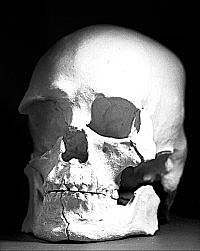
    Neither the Senate bill nor the draft regulations would affect the 9,300-year-old bones known as Kennewick Man, they said. The skeleton was discovered in 1996 along the Columbia River near Kennewick, Wash., and has been the focus of a bitter fight ever since.

    A federal appeals court ruled in 2004 that scientists can study the ancient bones, and teams of anthropologists and other analysts have begun poring over more than 300 bones and bone fragments at the Burke Museum of Natural History and Culture in Seattle, where the remains are housed.

    Folk festival fetes Buffy

    Sainte-Marie to be honouredWith a resume like that to recommend her, it's easy to see how Sainte-Marie came to be chosen the recipient of this year's Winnipeg Folk Festival Artistic Achievement Award, an honour that brings her to the Folk Fest's annual Winter Wassail tonight.

    But the award (which comes with a cash prize of $10,000) tends to go to someone who's contributed not just to folk music, but to the community as a whole. And in that regard, Sainte-Marie is also a perfect choice.

    She's been a tireless advocate for the rights of First Nations people, from the days of the burgeoning "Native American" movement right on through to the present. Her outspokenness led her to be blacklisted by then-U.S. president Lyndon B. Johnson in the '60s, a tactic that nearly put her out of business. But after a 16-year hiatus, she returned to music in 1992 with the album Coincidence and Likely Stories, using an early version of the Internet to comment on the plight of aboriginals through tracks like Bury My Heart at Wounded Knee and The Big Ones Get Away.

    Warriors honor warriors

    507th CSG uses Native American Indian Heritage Month to highlight Warrior EthosSoldiers in the 787th Combat Sustainment Support Battalion paid tribute during Native American Heritage Month with a friendly competition themed, "Honoring Warriors: Past and Present." The competition between the companies highlighted recognition, presentation, creativity and knowledge of the observance.

    While each company did an outstanding job researching and presenting their Native American Indian Heritage presentations, one company had a distinct advantage: Spc. Rochelle Bonillas. This is Bonillas' second time deploying with the 541st Transportation Company "Fuel Hogs," and she has only been in the Army for three years. As a vehicle driver, Bonillas has proven herself as a road warrior to the 541st TC. But as a Native American from the Mono tribe in Freno, Calif., she has also proven herself as a warrior to the people who matter the most in her life; her tribe.

    Using film to fight feds

    Shoshone Use Film, Courts to Fight Gold Mine on Sacred LandThe 32nd Annual American Indian Film Festival presented Western Shoshone grandmother Carrie Dann with the Eagle Spirit award for best overall contribution in American Indian cinema at an awards ceremony November 27. "Our Land, Our Life," the film that shows the Western Shoshones’ determined struggle to maintain their way of life, won the festival's Best Documentary award.

    "Our Land, Our Life," a 74 minute documentary directed by George and Beth Gage, details Carrie and Mary Dann's 30 year struggle to protect their traditional ways and ancestral lands from mining degradation in a battle that went to the U.S. Supreme Court and beyond to the United Nations with no relief as yet from the U.S. government.

    Native Picasso dies

    Norval Morrisseau, 75:  Famed native painterCopper Thunderbird has taken flight.

    Norval Morrisseau's death yesterday at Toronto General Hospital, at age 75 after a long and feisty battle with Parkinson's disease, won't end of the gritty story of the great Anishinabe painter once called "the Picasso of the north" who signed his canvases "Miskwaabik Animiki" or Copper Thunderbird.

    "I've always wanted to be role model," he told the Star several years back, his words slurred and barely audible even then. "I've always wanted to stay an Indian. I wanted the little kids to know that."

    William & Mary drops feathers

    College of William and Mary's logo sheds Indian feathers to comply with NCAAThe College of William and Mary's new logo sheds the two feathers that the NCAA deemed offensive to American Indians.

    The logo revealed Thursday updates the familiar "W&M" monogram and uses the school's more traditional colours of green and gold instead of the more recent green and yellow. The logo, in four similar designs, will be used by the athletic department and campus-wide on business cards, stationary and other items.

    December 05, 2007

    Off to New Jersey

    I'm off to the Montclair Art Museum in New Jersey for our program on Native comics books Thursday night. I'll be back Friday. Reports and pictures to follow.

    Review of GREEN LANTERN: LEGACY

    A look at a graphic novel that stars Tom Kalmaku, Green Lantern's Inuit sidekick.

    The back-cover copy:Fearless and strong-willed, he served the Green Lantern Corps for years. Jordan was also the Green Lantern Corps' ultimate downfall. In a failed attempt to save his home, Hal Jordan destroyed the Corps and betrayed everything they stood for.

    Now, it falls to Tom Kalmaku, Hal's best friend and confidant, to try to repair the damage done. Left only with a note with the words "Fix it" and the mysterious appearance of Hal Jordan's never-before-seen son, Tom must try to piece together the wreckage of Jordan's life, as well as the personal wasteland of his own.

    But there are a lot of people who don't want to see Hal Jordan's past come back to haunt them. Standing in Tom's way are the JLA, former Green Lanterns, and a dark warrior from the stars who has pledged to destroy all reminders of Hal Jordan's legacy.
    Green Lantern: Legacy--The Last Will & Testament of Hal Jordan (Paperback)A Well-Told, Touching Story, But Newer Readers Might Be Lost, December 14, 2002
    By Daniel V. Reilly (Henrietta, New York, United States)

    The book centers around former Jordan sidekick/Green Lantern wannabe/offensive racial stereotype Tom "Pieface" Kalmaku. (Can you believe there was actually a time when it was OK to call an Eskimo "Pieface"? Jeez!) He is wallowing in self-pity over the loss of his friend Hal; he's a destitute alcoholic, he's just lost his job, his wife, his kids...and now, out of nowhere, he's handed a child that is allegedly Jordan's, and a note from Hal reading "Tom- Fix it. Hal" Who is this kid? What does the note mean? What can one man do in a world of super-powered God-like beings? Tom is about to find out....

    The art is nice, the book is attractively designed, and the reappearance of my favorite ever Green Lantern (I won't spoil the surprise, poozer!) is much appreciated and very unexpected. Writer Joe Kelly even manages to end the book on a note of triumph, with a hint of a bright future for the Corps. My only problem is that if I weren't aware of the twisty Green Lantern continuity, I'd have been lost. The book just doesn't seem new-reader friendly. Who is The Spectre, and what does he have to do with Hal Jordan? Who is the big yellow guy that blew up Coast City? What did Hal hope to accomplish by killing off the Corps and the Guardians? I knew the answers to these questions, but a new reader wouldn't.

    Folks....at least read the book before you write a review..., February 9, 2005
    By R. SHARIFF "rayhans1282" (Jamaica, NY USA)

    The story picks up some time after Hal Jordan's death and is told from the POV of his ill-named sidekick "Pieface" aka Tom Kalmaku. Tom had been one of Hal's biggest supporters as well as one of his closest friends but the legacy that Hal left under his wake has destroyed Tom's faith and respect in Hal and has brought about self-loathing for even trusting Hal in the first place. He spends most of his days drunk and getting into fights at bars over insulting Green Lantern.
    Rob's review:  Reading the first third or so of LEGACY, I was prepared to say this is one of the best portraits of a Native character ever. Tom Kalmaku is a bitter, drunk washout just like your typical military veteran...but this time it's not stereotypical. Tom's angst is rooted in his unique position as a sidekick whose belief in his hero has been shattered.

    Even as he rages, you can see Tom isn't your (stereo)typical Native. He labels Hal Jordan a coward at a memorial service. His last job before he's fired is repairing a conveyor belt. He's written part of a book on his adventures with Green Lantern.

    Unfortunately, the rest of the book doesn't work quite as well. Tom becomes a passenger on the journey of Marty, Hal Jordan's "son." He doesn't act so much as react.

    As reader Reilly said, you have to know Green Lantern's history to follow the story. But even that isn't enough. Tom and Marty begin jumping in time and space with no warning or transition. Worse, you can't tell whether they're jumping in reality or only in Tom's mind.

    As a result, the story becomes somewhat muddled, though you can follow the central plot. It's convoluted and confusing for no good reason. Too bad, because this could've been a great Native epic.

    Nevertheless, Tom achieves redemption at the end. He wields GL's ring with spectacular results. It's perhaps the most "cosmic" Native moment in comics since Puma challenged the Beyonder in SECRET WARS II.

    Rob's rating:  7.5 of 10.

    The origin of Tom Kalmaku

    For someone conceived as a racial joke ("Pieface"), Thomas Kalmaku has come far. Here's the scoop on one of the first (perhaps the first) modern Native characters in comic books.

    Tom "Pieface" KalmakuYears ago, Thomas Kalmaku's father and a trapper named Jimmy Dawes discovered a gold mine in the far north. The two became partners and made a map of the area, which they split between them as a token of their partnership. Dawes returned to the United States to raise money to work the mine. The elder Kalmaku fell sick and died soon after, but not before passing the map to his son Thomas. Jimmy Dawes never returned.

    Kalmaku's Inuit Alaskan tribe was poor and needed the revenue that could be generated from the mine to survive. Tom went to Coast City, California to search for Dawes and took a mechanic's job at Ferris Aircraft Corporation to support himself and the tribe. While at Ferris, Tom picked up the nickname "Pieface" and worked closely with test pilot Hal Jordan. Tom and Hal would become the best of friends.

    Apparently, others knew of Tom's map, as his half was soon stolen. Jordan changed into his Green Lantern identity to help find both parts of the map. After the map-stealers were defeated, Tom donated the mine to his tribe.

    During a fist-fight Green Lantern had had with the map thieves, Tom noticed the similarity of Hal and the emerald warrior's right hook. Having inadvertently discovered Jordan's secret identity as Green Lantern, he offered to have his memory erased by the power ring. Jordan declined, and trusted Tom with the knowledge.
    Comment:  This is a recap of the story in GREEN LANTERN (first series) #2. It was retold in "A Piece of the Pie" in SECRET ORIGINS #36, which is where I read it. Even though "Pie" is only six pages long, the plot is all there.

    I didn't read much of the original GL series before Denny O'Neil and Neal Adams took it over. So I don't know much about Tom Kalmaku from firsthand experience. I believe the comics portrayed him as a smart-talking "grease monkey" with all the stereotyping that implies.

    But the character had depth from the beginning. And he's only grown in complexity since he's appeared in such comics as NEW GUARDIANS and GREEN LANTERN: LEGACY. He's arguably one of the best Native characters in superhero comics.

    The SECRET ORIGINS story highlights what makes Kalmaku so interesting. He learns engineering skills at an Alaskan Air Force base and uses them to support himself. Even while earning his keep, he focuses on what will benefit his Inuit people. He's a well-adjusted family man (at this point) with a loving wife and children. He thinks and speaks like any well-educated person (no rough "Injun" dialect like that given to Marvel's Thunderbird.) He notes the inappropriateness of his "Pieface" nickname but says he liked it better when Green Lantern wasn't politically correct. His journal-keeping marks him as perhaps the most overtly literate Native character in comics.

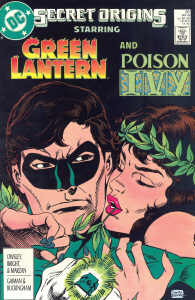
    Amazingly, the Kalmaku story is the least significant one in SECRET ORIGINS #36. The comic also recounts the well-known origin of Green Lantern. Even better, it explores the origin of Poison Ivy (a Batman foe) in a story written by Neil Gaiman (SANDMAN). This story doesn't go anywhere, but it's a gem of sharp writing. Compared to the usual superhero tale, it stands out like a sore (green) thumb.

    Considering you can get SECRET ORIGINS #36 in a back-issue bin for a dollar or two, it's a great buy. Rob says: Check it out.

    Shirt links logo, casinos

    Sioux logo T-shirt stirs controversyA T-shirt produced by a North Dakota business at tempting to poke fun at the UND Fighting Sioux logo controversy has inflamed tensions on an already sensitive issue.

    The shirt, which James town, N.D.-based Orriginals Inc. began printing about a week ago, includes the words: "No Sioux Logo No Sioux Casinos!" It also features UND's Indian head logo with the words: "Hostile and Abusive," and plots out the location of three casinos in North Dakota and South Dakota, which it describes as "Destructive and Addictive."

    "This is not a sentiment we are promoting, fostering or supporting in any way, shape or form," said UND spokesman Peter Johnson. "We just don't think there is any place for this type of thing in the dialogue we would like to have. It is not what the University of North Dakota is about."
    Comment:  The problem here is that there's no real link between the nickname and the casino. Both should be judged on their own merits.

    By creating a link where there is none, the shirt's purveyors are telling the tribes, "We don't care whether the nickname is right or wrong. We're going to pressure you to approve it with an attack on your casinos." Again, the conclusion is obvious: mascot lovers have zero respect for Indians and their beliefs.

    Below:  The t-shirt sans the "Fighting Sioux" logo.

    December 04, 2007

    Berkeley's Peter Pan protest

    With their heads in the treesIn the case of the "People's Perch"--as some are calling the yearlong Berzerkley tree-squat--never before has so much been done for a cause so trivial. The tree-sitters argue that in fighting to save some 100 trees, they are protecting "a healthy, functioning native oak ecosystem." One problem: The stadium property is not pristine wilderness. Most of those trees owe their existence to UC landscaping.

    "People call us crazy monkey hippies," one tree-squatter told The Chronicle's Carolyn Jones, "but this is the greatest thing I've ever done." Except the tree squatters have achieved nothing. Alameda County Superior Court Judge Barbara Miller issued an injunction that barred the university from felling the trees. The squatters could have walked away 11 months ago, and the trees would still be standing. It's lawyers, not aging adolescents swinging in the trees, who have kept UC chain saws at bay.
    More thoughts on the protest:Like young children, the tree-sitters have no sense of proportion. They can leave at any time. They eat and mix with others as they will. The worst they have to fear is five days in jail. Yet they equate their plight with that of Gitmo inmates?

    It's a Peter Pan protest. Activists go by kiddie names--Running Wolf, Redwood Mary, Midnight Matt. And they have a child's sense of what is important. In a world darkened by genocide, starvation and ignorance, they see fit to champion the cause of landscaped trees, which, by the way, UC has offered to replace on a 3-to-1 basis.
    On the other hand:

    UC Berkeley attacks tree sitters despite court rulings
    The tree sitters are still up in five oaks and a redwood in a grove of over three dozen old trees where UCB wants to build a parking lot and sports facility. In principle the scheme is bad enough; the wrong thing to do for the sake of educational integrity. But the University's legal trouble is that the City of Berkeley protects such trees by law. UCB administrators and their police force believe they are above both city law and the feelings and rights of the community's neighbors who love the rare native trees.

    This small grove is one of the last remnant ecosystems of California Live Oaks in the urbanized San Francisco Bay Area, and the University wants to destroy the grove for "progress" in its athletics program. Some neighbors and students (and a few imported Humboldt forest defenders) are saying "No!"--with mounting success.
    The Native angle:

    University Fences In a Berkeley Protest, and a New One ArisesThe highest platform belongs to Mr. Running Wolf. A regular presence at the city’s many marches and protests, he says he, too, is impressed by the stadium opposition.

    “This is remarkably unified,” he said. “You’ve got the affluent people living in the hills, who normally wouldn’t mix with the food-not-bombs people or the anarchists or the Native Americans or the environmentalists. It’s pretty wild.”
    Comment:  Whether this protest is worth the time and energy devoted to it is a good question. The tree-sitters could be protesting the war on Iraq or Native stereotyping instead. But it's useful to tell major institutions they have to follow the law, especially when it comes to protecting the environment.

    P.S. Running Wolf is a Native name, not a "kiddie" name. Whether it's a genuine Native name is another question.

    As you may recall, I reported on Running Wolf and his activities a few weeks ago.

    Lacrosse in The Only Good Indian

    Movie casts two Oneidas in roles

    Opening scene in "The Only Good Indian" likely to have nation lacrosse players.The scene will show a father and son tossing a lacrosse ball back and forth. Although the film was shot in Kansas, the actors are both Oneidas and their lacrosse sticks were made by an Oneida.

    The nation's involvement in the film came via executive producer James McDaniel, who played Lt. Arthur Fancy for eight seasons in the television drama "NYPD Blue." During shooting of the film, McDaniel said he noticed the lacrosse scene was all wrong.

    "I realized they had written the scene as if they had never heard of lacrosse before," said McDaniel, who played lacrosse in college at the University of Pennsylvania. "They were going to have it as two people playing a lacrosse game, and I said, no, that's not the way it's played."

    McDaniel logged on to the Lacrosse Hall of Fame Web site, which linked him to the Oneidas. He called the nation looking for authentic sticks and a couple of Oneidas to play the role of father and son.
    Comment:  Kudos to McDaniel for making sure the scene was as authentic as possible. But I'm a little confused by the description of this scene. Are the Oneidas playing generic Indians who have nothing to do with the rest of the story? Or is the boy the one who gets shipped to a boarding school in Kansas?

    If it's the latter, I wonder how many Indian children from the East Coast were sent to Midwestern boarding schools? Schools such as the Carlisle Indian Industrial School in Pennsylvania were much closer.

    I hope this isn't a stereotype. E.g., Indians play lacrosse, so let's put in a lacrosse scene, even if the actual Indian in the story wouldn't have played lacrosse.

    Stereotypes cause mistrial

    Jury's talk about Indians and alcohol gets man new trialA judge threw out an assault conviction against an American Indian after some jurors discussed stereotypes about the drinking habits of Indians during deliberations.

    Kerry Benally of the Ute tribe deserves a new trial because two jurors failed to honestly answer questions about their "preconceived notions" about Indians before trial, U.S. District Judge Dale Kimball ruled Nov. 20.
    Judge throws out assault conviction, says jurors showed bias

    Jury member says talk turned to American Indians' drinking habits during deliberationsAccording to an affidavit by Cano, the jury foreman told his peers that he had lived on or near a reservation. She said the foreman told them "When Indians get alcohol, they all get drunk," and that "when they do get drunk, they get wild or violent."

    A female juror appeared to agree by saying something about what happens when “they get drunk,” Cano wrote. Two other members of the jury talked about the need to send a message to the reservation--one allegedly saying his relatives in law enforcement had talked "about what happens when people mess with police officers and get away with it," according to Cano.
    Comment:  This is an excellent example of how stereotypes affect real life.

    "Chief" Lambert stereotyped Indians

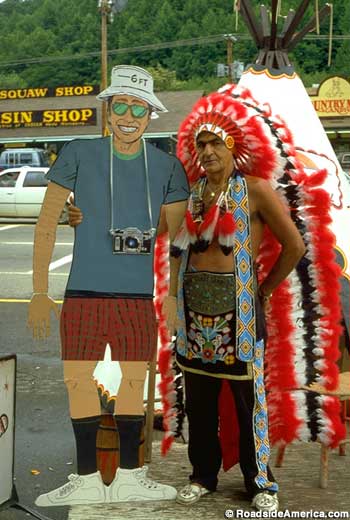
    Iconic Cherokee Chief Henry has diedLambert started “chiefing” in 1951 to support his family.

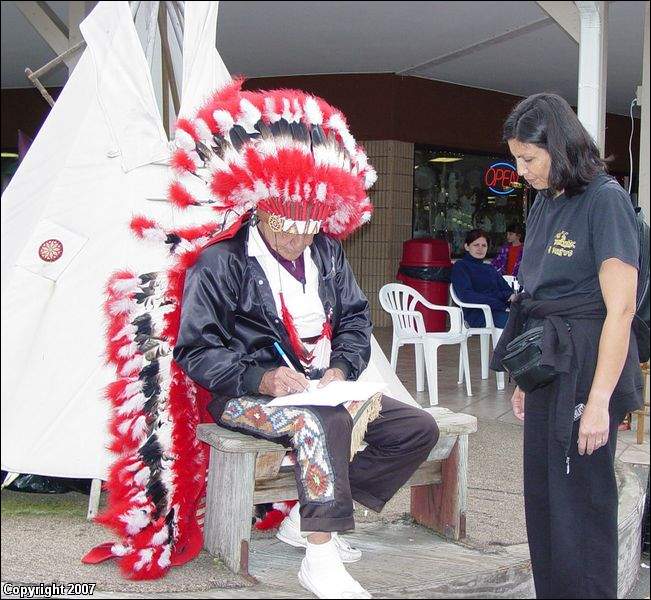
    His striking features, flowing headdress and enjoyment of the crowds brought generations of families back year after year to have their pictures made with him. He was probably the most photographed man in North Carolina, with the exception of the Rev. Billy Graham.

    His image still appears on postcards sold in Cherokee.

    Lambert never denied that the character he created was taken from Hollywood expectations of what an Indian should look like. He never promised to be authentic, only entertaining.

    “I wouldn't do anything else,” he said in a 1995 interview with the Associated Press. “Meeting people from all walks of life. Kids. Kids love seeing an Indian. Every little kid wants to be Pocahontas.”
    Comment:  "Iconic" in this context means stereotypical.

    The problem with this "chief" is the problem with mascots, Western movies, and many other Native stereotypes in the media. Namely, it tells people that all Indians are the same, located in the remote West, and mainly gone. That in turn has a profound influence on cultural attitudes and government policy.

    Stamps honor Indians

    Celebrating art, rituals of Native AmericansThe art of the Native American has been a popular subject for U.S. stamps. Over the years, the U.S. Postal Service has issued many stamps celebrating a variety of arts and rituals provided by the individual tribes.

    A 6-cent stamp, issued in 1970 in a block of four, marking the 100th anniversary if the American Museum of Natural History, portrayed a Tlingit chief in a Haida ceremonial canoe.

    Four sets of stamps in the American Folk Art series featured Native American art forms. They were a block of four 13-cent stamps in 1977, showing Pueblo pottery; four 15-cent stamps in 1980 showed Pacific Northwest masks; four 22-cent stamps in 1986 on the theme of Navajo weaving and headdresses of Plains tribes, pictured on five 25-cent booklet stamps in 1990.

    Yucca Mountain = environmental racism

    Nevada Indian dubs Yucca Mountain proposal 'environmental racism'An American Indian drew applause during a public hearing on a proposed national nuclear waste dump when he accused the Energy Department of "environmental racism."

    "Transportation of waste to Yucca Mountain would place a disproportionate burden upon the Western Shoshone nation and has not been addressed," Western Shoshone National Council member Ian Zabarte told a Monday hearing on environmental impacts and transportation plans for the repository in the Nevada desert.

    "It is environmental racism," he said.
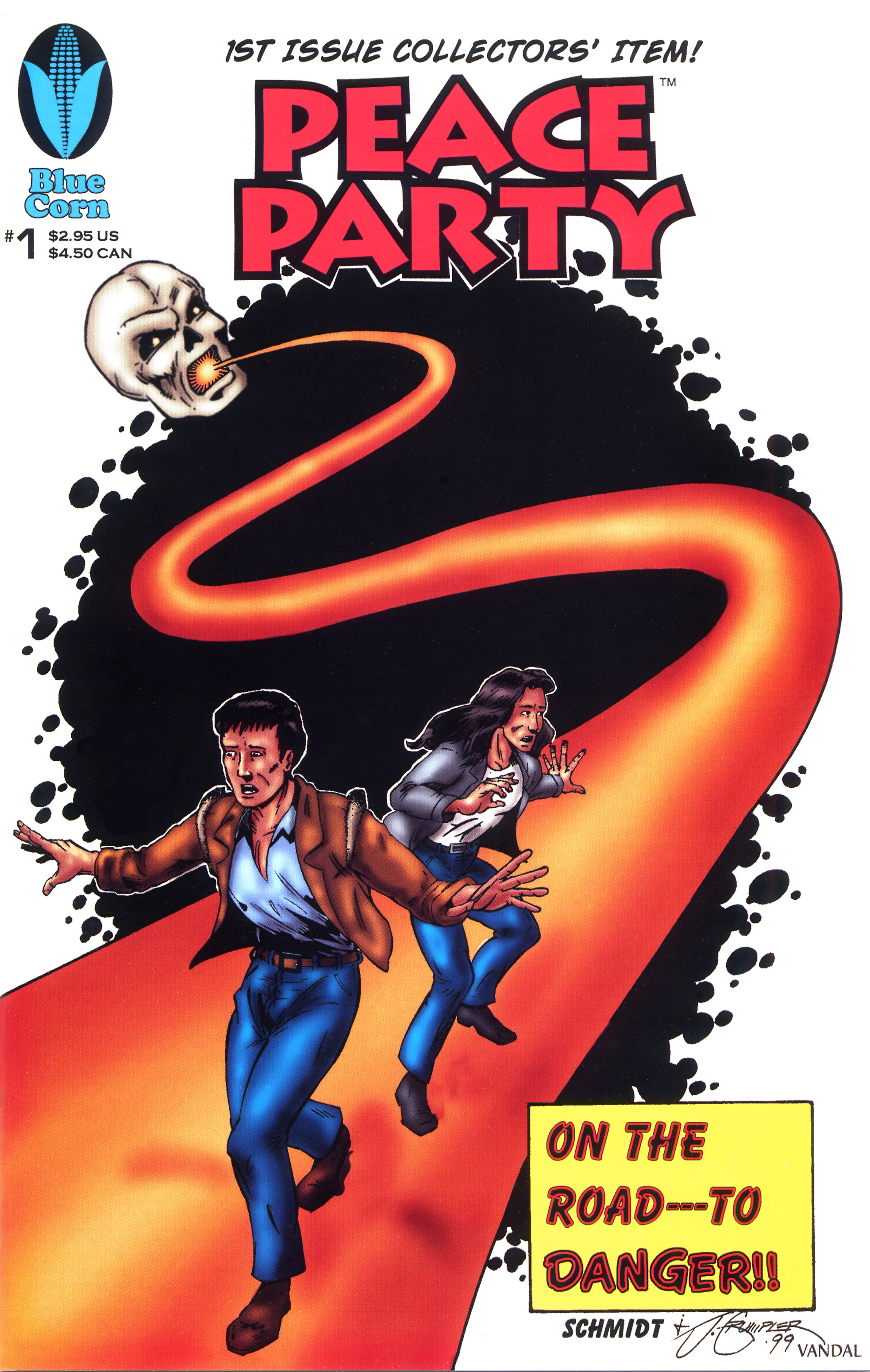
    Comment:  For more on the subject of Natives and Yucca Mountain, see PEACE PARTY vs. Toxic Waste.

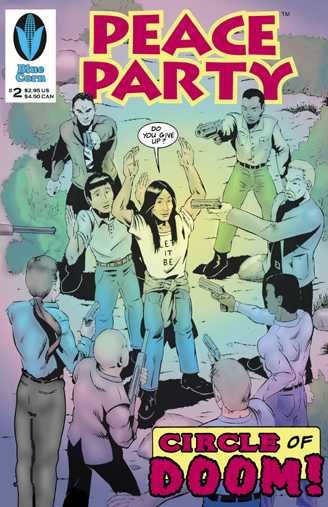
    New PEACE PARTY interview

    Schmidt's PEACE PARTYRob Schmidt's hoping to create a whole new generation of hero when he takes two Native Americans from the Hopi and Pueblo tribes and bestows great powers upon them. Schmidt believes he's filling a void in today's comics by presenting these characters in the pages of Peace Party, but will comic fans agree?

    December 03, 2007

    Bradford more American than Cherokee

    To the Cherokee Nation, Bradford is source of prideBradford is unavailable to the media except after OU games. He has said he is proud of his heritage but acknowledged that it has not been a force in his life.

    His father, Kent, an Oklahoma City insurance man who played line for the Sooners in the late 1970s, said his family has not closely followed its Indian culture. He has welcomed the chance to become more acquainted with his background, but ...

    "I'm just an American—hell, I'm an Oklahoman," said Kent Bradford, who said his "first powwow" will occur when Sam is honored at the Oklahoma City Indian Clinic at its spring powwow.

    That stance doesn't trouble Miller of the Cherokee Nation.

    "Citizens of our nation don't have to act a certain way or be a certain way; it's just like being a citizen of the United States," he said. "We can all be proud to be American citizens, but it's something that's not necessarily in the forefront of our minds every day, either. It's taken for granted."
    Comment:  I understand blacks and other minorities used to be excited whenever they saw one of their own on TV. It didn't matter if the person was a Stepin Fetchit or an Aunt Jemima--i.e., if the person was "authentic" or connected to the culture.

    But that was 40-50 or more years ago. Do Indians still feel that way? Judging by this article, apparently.

    We see this with the mascot phenomenon also. Many Indians still say it's the only "honor" they ever get so they'll take it. For instance, according to one study:

    When asked why they didn't mind being used as a mascot even if they felt it disrespectful, Fryburg said, students responded: "It's better than being invisible."

    An Emmy for Miramanee?

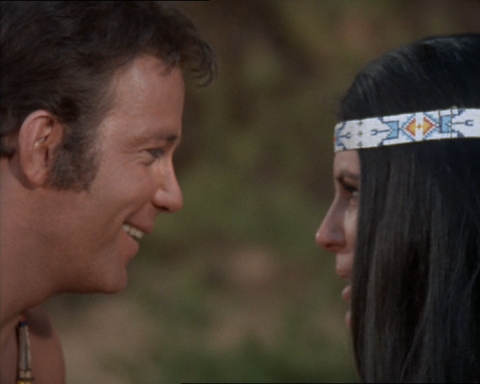
    I recently saw an episode of Gidget (1965) starring Sally Field, in which she falls in love with a photographer. The photographer was played by "Dan Travanty," whom I recognized as Daniel J. Travanti from Hill Street Blues. His girlfriend was a short-haired, cosmopolitan woman in a stylish suit--the type you see in all the 1960s shows playing a "career girl."

    When I saw the credits, lo and behold, it was Sabrina Scharf, the actress who played Miramanee on Star Trek's "The Paradise Syndrome." I never would've recognized this urbane woman as the Indian flower child. Even knowing it was her, it was hard to believe she could play such polar opposites and carry them off.

    The Penelope Peterson character on Gidget was Scharf's first acting role. According to IMDB.com, Miramanee was her 13th. In her 10-year career, she appeared in lots of popular shows of the era: The Man from U.N.C.L.E., I Dream of Jeannie, Hogan's Heroes, Mannix, Hawaii Five-O, etc.

    She also appeared in a few movies. Her biggest role may have been as Sarah in Easy Rider.

    Apparently Scharf played an Indian or part-Indian named Alkini Matthews in "Requiem for Craw Green," an episode of Daniel Boone. Perhaps that's where she got her "Indian" acting chops. Perhaps it's why she was chosen to play Miramanee.

    Other Sabrina Scharf trivia from IMDB.oom:

  • Became a California state senator.

  • Former Playboy Bunny at New York City Playboy Club.

  • Now works as a real estate developer in Los Angeles.

  • Great country for white property owners

    Founding Fathers Worked Miracles, Unless You Were Indian, BlackIn "American Creation," Joseph J. Ellis tries to find a middle ground between those who hail the founding of the U.S. as a divinely inspired birthing and those who focus on its failures--bipolar stances he calls "adolescent."

    Ellis's own telling is more triumphal than critical. His list of the American Revolution's five major achievements is breathtaking: the first successful war for colonial independence in the modern era, the first nation-sized republic, the first truly secular state, the first attempt to apportion sovereignty (i.e., the state and national governments) and the creation of the two-party system.

    Its two major tragedies will seem obvious to many, though probably not to the "divinely inspired" crowd: the failures to stop slavery and to find a place in the new nation for American Indians.

    These defeats seem to affect almost every aspect of our history. Many opposed a national bank out of fear that a central government strong enough to establish one could abolish slavery, Ellis tells us. The Louisiana Purchase, doubling the nation's size, showed there would be no saving the Indians east of the Mississippi and gave rise to the debate over slavery in the new territory, helping pave the way to the Civil War.
    Comment:  The Founding Fathers' failures were "adolescent"? How about "immoral," "un-Christian," or "inhuman"?

    For more on the Founders' shortcomings, see Fun 4th of July Facts.

    Navajos' graffiti-inspired clothing

    Diné designers go Hip HopThe couple's shared love of fashion, coupled with Begay's business sense, led to the launch of UN3EK SY5TEM in the fall of 2005. The name reflects the American Indian philosophy, Powless said.

    "The unique system represents every tribe," he said. "It represents the system they used to survive, how they struggled to keep their cultures, beliefs and traditions alive."

    The name also reflects Powless's interest in graffiti, he said, and it distinguishes the company from similar clothing names on the market.

    "It seems every graffiti artist uses the word unique," Powless said. "We wanted to stand out."

    That philosophy is apparent in all of the company's designs, Begay said. The selling point is the big, bold images on the T-shirts. The young designers also are expanding the line to include jewelry, skirts, dresses and shoes—all with a look Begay calls "edgy and fresh."
    Comment:  Is the company name "Un-three-ek"? No, it's "Uneek" as in "unique."

    It wouldn't have occurred to choose a name that's potentially confusing. That tells you how un-hip and un-edgy I am.

    Yeagley gets butt kicked

    December 1 Election ResultsThe unofficial results of the December 1st Comanche Vice Chairman election indicate there will be a runoff election to determine a winner. These results will become official after the protest period ends at 5pm Tuesday December 4 2007. The Comanche Business Committee must also certify the results.

    Ronald Red Elk
    46.10%
    520

    Sandra Gallegos
    27.66%
    312

    Sonya Tahchawwickah
    15.96%
    180

    David Yeagley
    10.02%
    113

    Spokane business gets makeover

    Fortune helps Sister Sky with small biz makeoverFortune Small Business went to the Spokane Reservation in Washington to help two sisters with a "makeover" of their growing business.

    Monica Simeon, 40, and Marina TurningRobe, 41, founded Sister Sky in 1999. The company sells natural bath and body products based on traditional recipes.

    By targeting tribal casinos and selling online, Sister Sky's revenues will top $550,000 this year, up from $225,000 in 2006. But Simeon and TurningRobe are worried that they can't keep up with the rapid growth and want to keep costs down.

    The FSB makeover team tells the sisters not to dilute their products by offering a low-cost line. The experts urge them to step back from the daily operations and make long-term plans. They also suggest small changes to the way the products are made and stored in order to speed up production and keep control of costs.

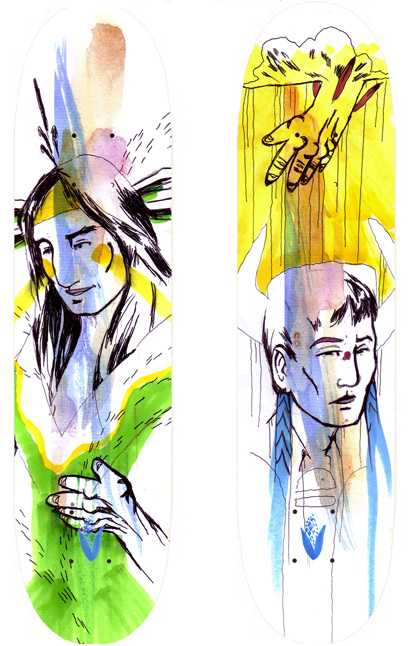
    The PEACE PARTY skateboards

    Check out these great board designs by Chandler Hayes. If you're into skateboarding (or the art of skateboarding), they should be available for purchase eventually.

    December 02, 2007

    Love/hate relationship with film

    Apodaca:  Hollywood tragicomedyThe film industry is arguably the most influential entity on the planet and is an almost universally accepted American icon. It shapes our views about almost everything, and American Indians are key players in the history and continuance of American film. The earliest commercial documentary films dealt with American Indians: "In The Land of the Headhunters" (1914) and "Nanook of the North" (1922). Natives found new work in rodeos and as movie actors and actresses as "Wild West" shows faded. American Indians appear in hundreds of movies from silent to talky. The careers of countless directors, producers and movie stars have been made through their associations with Indians and films. But how do Natives feel about film?

    American Indians hate film. The most feared person at any Native gathering is a person with a film or video camera. Tourists have to register their cameras at many reservations now or are requested to do so at pow wows. Anyone involved with film is suspect and Natives who help filmmakers are likely to be seen as quislings, traitors, selling out their own people. Film portrays American Indians as American playthings to be shot off horses, raped at night, left drunk at the curb and rendered helpless before new technology like guns. Nothing has dehumanized American Indians like film. Movie Indians have replaced real people in our popular understanding of America.

    On the other hand, American Indians love film. The answer to Indian problems can be found in Indian control of film, or so goes the popular sentiment. The fulfillment of many Native dreams is to be on the big screen, to be recognized in the street as a film star, to make the movie that will set all things straight, to finally gain justice through the use of film. The most honored person at the pow wow, school night gathering or cultural festival is the American Indian actor or actress who attends. American Indians look to film acting as a higher calling than that of president of the United States: We have had only one Native U.S. senator during a time when whole generations of actors have become national icons.
    Comment:  Let's reiterate what Apodaca said: "The film industry is arguably the most influential entity on the planet." And let's note what Chris Eyre said about the medium's significance: "Second to religion, I think movies have been the most damaging thing to Indians."

    I'm glad some people recognize the central role of film in shaping our perceptions of Indians. None of this "It's just entertainment" nonsense for them.

    A perfect Native film?

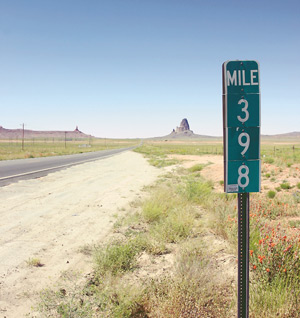
    'Mile Post 398' breaks new ground in Native filmmakingTo create a film depicting reality is truly a feat, and according to viewers and critics across North America, "Mile Post 398" is nothing less than perfect. With recent awards including Best Narrative Feature from the Fargo Film Festival 2007, Best Drama and Best Screenplay from the Tulalip Film Festival 2007 and Best Supporting Actor (Ernest David Tsosie III) from the American Indian Film Festival 2007, there is no denying that "Mile Post 398" has broken new ground and satisfied audiences in every way.

    Shonie and Andee De La Rosa, Dine' of Kayenta, wrote, directed and produced the film based upon their life experiences and the desire to create a film comprised entirely of Navajo cast and crew. Furthermore, the couple wanted to shoot the film entirely on location--the Navajo Nation.
    At least it avoids stereotypes:In the making of "Mile Post 398," Shonie said maintaining cultural accuracy was a way of showing respect to his community and heritage.

    "It's respect. It's respect towards our elders, respect towards our people. It reminds us where we come from."

    Throughout the film, Shonie explained, no Indian cliches are used. "There are no eagle screams, no pow wows--none of that."

    "I hope it opens more eyes to the fact that we're not about leathers and feathers and living in teepees," Junes said.
    Comment:  Is Mile Post 398 "perfect"? I doubt it. Judging by the descriptions and Shonie's work on D.C. Indian, I'm guessing it falls into the 7-8 range (on a scale of 1-10). I'll let you know for sure when I see it.

    The boarding school bomb

    A Painful RemembranceToledo maintains that Indian people today are suffering the aftershocks of colonization that have resulted in an internalized oppression. She points out that some recent generations of native people have willingly sent their children to government and Christian boarding schools, where they have experienced similar abuses.

    She notes that boarding schools effectively taught Native peoples to view themselves as a sub-class within White American society. “The curriculum was designed to make us into servants and, therefore, economically powerless,” she adds.

    This process indoctrinated Indians to believe that abandoning their traditional ways for a life of servitude was the best they could hope for; therefore sending one’s child to boarding school was providing the child a chance for survival.

    Toledo describes the shame and the disowning of individual and cultural reality as an example of the direct fallout from the “boarding school bomb.”

    She and her colleagues are convinced that without the internalized oppression experienced at the schools, Native communities would not have such high levels of violence now.

    “A definition or result of internalized oppression is ‘shame and the disowning of our individual and cultural reality,’” Toledo says. She notes that prior to the boarding schools, traditional native cultures did not have significant histories of violence especially against women and children.

    Native studies need Native teachers

    Opinion / Natives should teach programs on Native studiesPrevious student requests to create a Native studies program were answered only after Fort Lewis was hit with a national controversy, when a non-Native professor was found to have violated Native students' privacy and confidentiality.

    Professor Andrew Gulliford, then director of the Center for Southwest Studies, wrote about his Native students in a 2004 edition of American Studies International, a peer review journal. The piece was rife with stereotypes.

    I interviewed Fort Lewis Native professor Carey Vicenti during the controversy. Vicenti said campus attitudes toward Natives fell into place with Durango's frontier-chic attitude--where Natives make good props but don't receive respect.

    Modern racism consists of people who love Natives but don't believe Natives have the same intellectual capacity, the same career potential as themselves, he said.

    Gulliford, the white Indian expert, was removed from the directorship for his violations against Native students.
    Comment:  As a non-Indian who writes about Native stereotypes and other issues, I recognize the problem. That's why I try to quote and cite Indians as much as possible. I love Suzan Shown Harjo's analyses in Indian Country Today, for instance. I'd love it if more Natives wrote reviews and analyses so I didn't have to.

    Below:  One of the students unfairly characterized in Gulliford's paper.

    America's Stonehenge

    A Grassroots EffortThe Newark Earthworks, located about 30 miles east of Columbus, in the city of Newark, is the world’s largest set of geometric earthen enclosures. It was built nearly 2,000 years ago, between 100 B.C. and A.D. 500 by the Hopewell Indians using sticks, clamshells and baskets to sculpt millions of cubic feet of dirt into walls of earth forming a huge lunar observatory sprawling over several miles. Although the Earthworks was named a National Historic Landmark in 1964, the site has, until recently, languished in quiet obscurity. In the 1800s, many of the rambling mounds were destroyed by development and farming.

    Dr. Ray Hively, professor of astronomy, and Dr. Robert Horn, professor of philosophy at Earlham College in Indiana, discovered in the 1980s that the mounds aligned perfectly with the cyclical movements of the earth and moon. The Octagon, they maintain, aligns perfectly with the intricate 18.6-year cycle of the moon, making it twice as precise as Stonehenge as a lunar observatory.

    The National Park Service has the Earthworks on its short list to be sent to the United Nations for designation as a World Heritage Site. There are currently 851 World Heritage Sites designated by UNESCO, the United Nations Education, Scientific and Cultural Organization.
    Comment:  The Newark Earthworks aren't to be confused with Chaco Canyon, which is also called "America's Stonehenge."

    Photographer is among top 10

    Working in the light of home

    Photographer captures the beauty of Grand Portage"By virtue of living here, it gives you kind of an insight into a place that you really cannot gain any other way," said Novitsky, an enrolled Grand Portage Band member. "If you're someone like me who spent most of your time outside growing up, I think your subconscious makes mental note of these things. ... You know at different times of the year just how the light is going to hit the tree."

    What he knows and the skills that he has honed are earning him recognition for his photography. His photos have been published in regional magazines and are exhibited in the recently opened visitor center at the Grand Portage National Monument. He sells prints and calendars. In an online forum called Digital Image Cafe, he is among the top 10 photographers whose work most frequently wins the "Photo of the Day" contest. His Web site and blog are at www.travisnovitsky.com.
    Comment:  Awesome pictures, Travis, wherever you are.

    An evening of Native comics

    Rob Schmidt (Blue Corn Comics, PECHANGA.net) and Michael Sheyashe (Native Americans in Comic Books) will speak on Native comic books at the Montclair Art Museum on Thursday, Dec. 6, at 7:00 pm. They'll discuss how comics have misrepresented and stereotyped Natives through the years and how Native-developed comics are making a difference.

    For more information, download the official flyer [PDF].

    Rob says:  The Montclair is in northern New Jersey, only a few miles from New York City. If you're in the area, stop by and say hello.

    December 01, 2007

    "Chief" defended phony "chiefing"

    Chief Henry was face of tribal tourismIt was a few years ago, when the U.S. Commission on Civil Rights issued its condemnation of Native American-themed sports mascots. I was working at the Cherokee One Feather and just happened to have CNN on when the late Vernon Bellecourt, American Indian Movement activist and vocal Native-themed mascot opponent, appeared to discuss the condemnation. What caught my ear was his mention of my tribe as a supporter of the practice of objectifying Native-American culture.

    Wanting some clarification, I called Bellecourt. He referred specifically to the practice of “chiefing” where tribal members dress in Hollywood-inspired regalia to pose for photos with tourists.

    Bellecourt gave his side of this issue, but I needed an opposing viewpoint. Who better than the man who had attained the most fame in this practice, Henry Lambert, otherwise known as “Chief Henry”?

    The practice of chiefing is controversial even in a community known for tolerance of native stereotypes, and Chief Henry was often a target of criticism. Through my interview, I found him to be a genuinely kind and gracious person.

    After a straight-shooting defense of his profession, which allowed him to make a living, support his family and put five of his six children through college, he gave me a tour of his home, which was adorned with pictures of his family.
    Comment:  The article doesn't say what "Chief Henry's" defense was, but it implies it. "I'm just a working stiff putting my kids through college, so who cares if I stereotype millions of my fellow Indians?" In other words, "I'm doing what's best for me, so who cares how it affects anyone else?"

    Perhaps this explains why Henry was a phony chief and not a real chief. Somehow I don't see Tecumseh or Geronimo having this attitude. Not when it mattered, anyway. (Sitting Bull arguably did something similar when he performed in Buffalo Bill's Wild West Show, but by then his authority had dwindled.)

    Perhaps we could call this the hang-around-the-fort defense. There have always been Indians who sold out for a little money or status. Of course, they undoubtedly had to make a living and put their kids through college, just like Lambert.

    See The Big Chief for lots of examples of the "chief" stereotype.

    No Bury My Heart for Eyre

    Eyre Talks of New Movie, Hollywood StereotypesAs a filmmaker, he said, he has avoided creating movies that depict Native people as victims of manifest destiny, a theme too often explored by Hollywood.

    "It's a literally romantic notion to see Native people dying," he said.
    Some people didn't like his Skins:"People were really upset about the portrayal of Native Americans in that movie," he said.

    The difference between his portrayal of Rudy, the alcoholic brother, and other mainstream Hollywood portrayals of alcoholic Indians was that he showed Rudy as a human being, not just an alcoholic, he said.
    The movie he'd like to do: For his next film project, Eyre wants to tackle a comedy.

    "I'd like to do a re-make of 'Little Big Man,'" he said. "That was the best movie."
    Comment:  I had no problem with the negative portrayals in Skins. Why is that? Because the characters were three-dimensional human beings...unlike, say, the characters in SCALPED.

    Little Big Man wouldn't be my first, second, or third choice for a Native-themed movie to remake. It doesn't particularly need remaking. A remake of The Searchers, Cheyenne Autumn, or Buffalo Bill and the Indians would be better. Even Billy Jack (with a Native actor) would be better.

    Diamonds for Dogribs

    Rough Trade

    How Canada’s diamond bonanza is turning a gritty and secretive industry inside outKnown as K’awi K’awo, or “The Boss” in Dogrib, a title he earned while managing the local Hudson’s Bay trading post, Marion went on to become a three-time mayor of Rae and commissioner of the Territories before taking on his current position as manager of the Dogrib Nation Group of Companies, the band’s economic-development arm and vanguard of its newly emerging financial might.

    The group manages fourteen subsidiaries, including the only Aboriginal-run hydroelectric dam in Canada and the Territories’ sole private airport. Its first serious plunge into the business world, however, came with the advent of diamonds. Under special impact-benefit agreements reached with the two mines, both of which are located on traditional Dogrib lands, the corporation was given multi-million-dollar service contracts to haul ore, provide on-site sewage and road maintenance, and hire personnel.

    While profits are still meagre, more than 250 band members in Rae-Edzo are now employed, either through the corporation or directly by the mines. Marion estimates that welfare rolls have been cut in half, from eighty to forty percent. Many who once squeaked by on $10,000 a year in social assistance are now earning annual salaries of anywhere from $60,000 to $100,000. “It has fundamentally changed what they want out of life,” Marion says.

    Native writers on CD

    'Pulling Down the Clouds' unites many authors' voices

    Review"Pulling Down the Clouds: Contemporary Native Writers Read Their Work" is an anthology of works by various writers read by the authors themselves. It pulls together a portion of the Native Writers Series undertaken for nine nights during each of the last four years at the Smithsonian's National Museum of the American Indian in Washington, D.C.

    Tanya Thrasher, Cherokee and editor of the CD project, said that after four years of invitations to writers to read their work, "we have this amazing collection of audio recordings ... just the magnitude, just the power of every author and the talent they have."

    The result is a satisfying mixture of familiar universal stories with personal insights, a smattering of humor and even one song. The stories are told through the eyes of the authors or through their characters, like Momaday's empathetic envisioning of Sacagawea's thoughts as she traveled with Lewis and Clark; or the examination by Louise Erdrich, Turtle Mountain Band of Chippewa, of the wisdom told by wolves to a once-suicidal old man from her Anishinaabe heritage: "'We live because we live.' ... The wolves accept the life they are given."
    Comment:  For more on the subject of Native writing, see The Best Indian Books.

    Documentary on sacred sites

    In the light of reverence

    Keeping Native American sites sacredThe topic of discussion was “sacred sites”, which was aided by the PBS documentary In The Light Of Reverence, chronicling some of the struggles of the Lakota tribe in the Black Hills, the Hopi in Arizona, and the Wintu Indians in Mount Shasta, Calif.

    Many of these Native American tribes are battling the government and National Park Services to maintain their sacred ground upon which they pray, and carry out tribal ceremonies.

    Reece summed up the struggle with a quote from one of her textbooks: “Spirituality is the linchpin of all Native American culture.”

    Reece says their sacred culture is being threatened by the government’s plans to turn various Native American ceremonial sites into recreational sites for the public to enjoy. The film acknowledged that the holy grounds had three enemies.

    “They are on public land and private property, in use as mining sites and recreational facilities, and competing religions.”

    Ballet film says Indians can do anything

    'Water Flowing Together'

    Navajo ballet star takes a new documentary to Dinetah and the worldSoto, who is gay, told Indian Country Today that he asked Cates to make the film as an homage to his parents as well as to encourage closeted gays to come out. For Cates, whose 2001 book, "Indian Country," is a major work of photojournalism, the project was "a tribute to Jock, his family and the Navajo people, to whom I am grateful for a lifelong education." The two have shown the documentary at prestigious film festivals and on the Navajo Nation.

    "Reactions at Window Rock were so heartfelt," Soto said. "It meant a lot to me. The message? We can do anything." Showings of the award-winning movie, which is named after Soto's Navajo clan, include the National Museum of the American Indian on Nov. 27, Santa Fe Film Festival on Nov. 29 and PBS' "Independent Lens" on April 8, 2008. (For more, see www.waterflowingtogether.com.)

    "The Five Moons"

    Society Unveils Native American Ballerina SculpturesA group of larger-than-life bronze statues depicting Oklahoma’s five internationally acclaimed Native American ballerinas were unveiled Wednesday at 6 p.m. on the west lawn of the Tulsa Historical Society.

    Entitled “The Five Moons,” the sculptures portray Rosella Hightower, Moscelyne Larkin, Maria Tallchief and Marjorie Tallchief and Yvonne Chouteau, who was able to attend the unveiling. The project’s name is taken from the 1967 ballet “The Four Moons,” a production choreographed specifically for the ballerinas.