The white man often rules even in fiction ostensibly about Indians.
Mighty WhiteyQ: How many white males does it take to change a light bulb? A: One.
Anything you can do, he can do better. He can do anything better than you. Oh yes he can, especially if you happen to be of Asian, Indian, African, Aboriginal or Native American descent. It doesn't matter that you have spent your entire life living in the densest African jungle, being taught the ways of your ancestors since you were old enough to stand up--the moment Mighty Whitey arrives in your town (most likely as a prisoner of war, an orphan or a lost traveler), you might as well hang up your blowpipe and take up crochet because his European (and therefore superior) genetics have pretty much made you redundant.
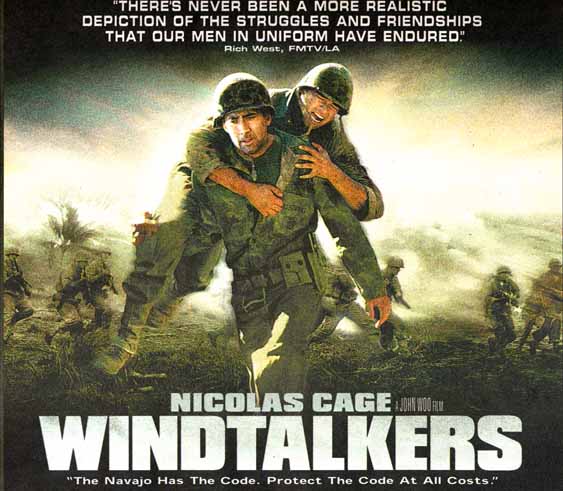
A common trope in 18th and 19th century adventure fiction, when vast swathes of the world were being explored and properly documented by Europeans for the first time, Mighty Whitey is a displaced white European, usually of noble descent, who ends up living with native tribespeople and not only learns their ways but also becomes their greatest warrior/leader/representative.Comment: Among the examples given in this posting are the Legion of Super-Heroes, Arak, Karl May's Old Shatterhand, Natty Bummpo in The Last of the Mohicans, Pathfinder, and Dances with Wolves. We could add several John Wayne movies, Windtalkers, End of the Spear, and Pirates of the Caribbean, among many other examples.
In comics, people have written about the phenomenon of "white Indians" (Firehair I, White Indian, Apache Kid, Green Arrow, Tomahawk, Scalphunter, Firehair II, et al.). I'd also point to perhaps the greatest (non-Indian) example in American literature: The Adventures of Huckleberry Finn.
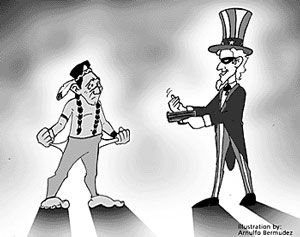
Below: Saving the Indian is the white man's burden...literally.
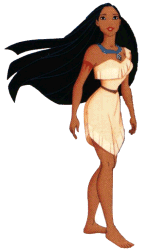
Being HeardThis brings me to another frustration I’ve had with the online fannish community. Visual Arts, whether popular media or illustrations. I love fairies, mermaids, amazons, all the visions imaginable of strong and beautiful women. I can’t tell you how many times I have wished I could draw and paint just so I could see some variation in the fannish art I see. Why can’t the fae queen have skin the color of warmed maple syrup and dark curls? There a reason all the native images are either some hottie male savage or the demure looking Indian princess?
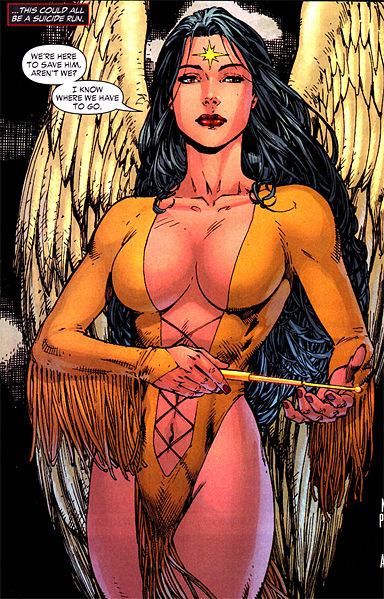
What the deal with this? Is there some need in art and literature to tame the wild savage or claim the spirited princess? Not all Indian women look like Disney’s Pocahontas. It’s time for the illustrators to look back upon and analyze the inspirations for their images. It’s time for the artists in the famish community to move forward from the old habits and stereotypes and create something new, something truly meaningful. Time for visual and written artists alike to consider the old habits and ingrained racisms. Who do these masturbatory fantasies truly serve, and more importantly who do they harm? I’ve presented these challenges to artist of all types when the opportunity presenting itself. I am hopeful that some of those conversations will bear results.Comment: These comments apply to our recent discussion about Dawnstar as well as to any discussion about Disney's Pocahontas.
The contest encourages young Native writers to explore their heritage in order to become positive forces in their communities, and is open to high school students from all tribes throughout the United States.
"We are pleased to give all Native American high school students throughout the United States the opportunity to participate in the contest this year, and we are inviting noted Native authors to join us in our effort," said Angela Ruth, executive director of Holland & Knight's Charitable Foundation. "We are grateful for the commitment of the National Museum of the American Indian in joining us to provide important opportunities to Native youth."Comment: I believe Holland & Knight earns much of its income from gaming tribes. Therefore, consider this another benefit of Indian gaming.
Coast Salish leaders commit to environmental action"Our objective here is to turn the tide on all the environmental destruction that the white society has heaped upon us over the past 150 years. Our objective is to speak with one voice as Coast Salish people, and to adopt action plans that will make a difference," said Tom Sampson of the Tsartlip First Nation in British Columbia.
Cladoosby also pointed out that over the past 150 years of environmental deterioration, there has been a philosophy that people must make as much money as they can without regard for the environment. Thus, he said, we have seen a destruction of the air, water and plants. "Mother Earth is not a commodity to be dominated and exploited, but rather a gift to be loved and respected."
"We're on a journey here that has no end," Frank said. "We're the only ones who are willing to do it. The other governments haven't done it. We are the Indian people, people of the land. We know what the problems are and we're trying to address them in an honorable way. If we have to take things into our own hands, that's what we will do," he said. "Action is needed right now if we are to have any hope to have a healthy environment for the future.
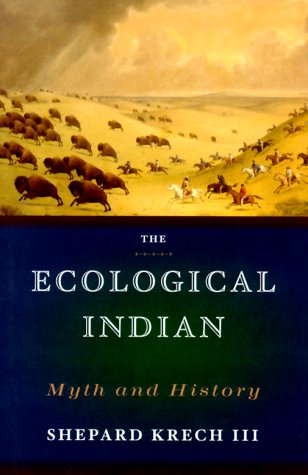
"We tell the truth. The U.S. government does not tell the truth. The Canadian government does not tell the truth. The states don't tell the truth. They lie to their people. They say, 'It'll scare the people and hurt the economy, so let's just lie to them.' Well, we won't lie to our people, and the other governments cannot fool us. We know where our trail is, and we've got to stay on that trail--together."Comment: With recent books such as The Ecological Indian by Shepard Krech III and Collapse by Jared Diamond, there's a growing backlash against the idea of Indians as the first environmentalists. But compared to today's Americans, they still look pretty good to me.
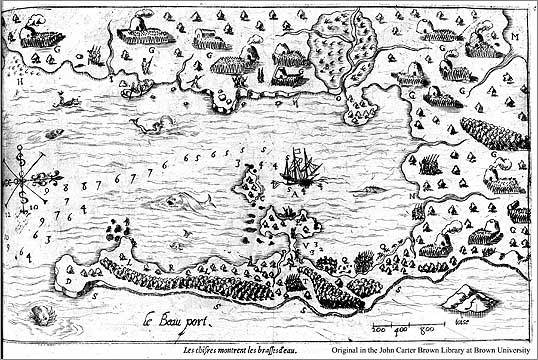
America's founding myth tells of the Puritans landing in wild, uncharted lands. Yet a French explorer had already mapped the territory in exquisite detail.By 1620, when the Pilgrims arrived on the Mayflower, Champlain had accomplished nearly everything for which he is famous. He had crisscrossed the Atlantic dozens of times (29 times before his death in 1635), he had penetrated deeply into the hinterland, and he had glimpsed--and named--most of the harbors, rivers, and capes that we rediscover every weekend of the summer. It is startling to return to his maps, and see the familiar contours of Cape Cod, Cape Ann, and Boston Harbor, all included as part of an American region that was anything but "New England." Given his natural inclination to roam, there is every reason to believe that Champlain might have started French settlements hundreds of miles to the south if he had been given more support from the French crown. As it was, he did a great deal more than most Americans realize to delineate the coastlines of Maine and Massachusetts, along with huge swaths of Vermont and New York.
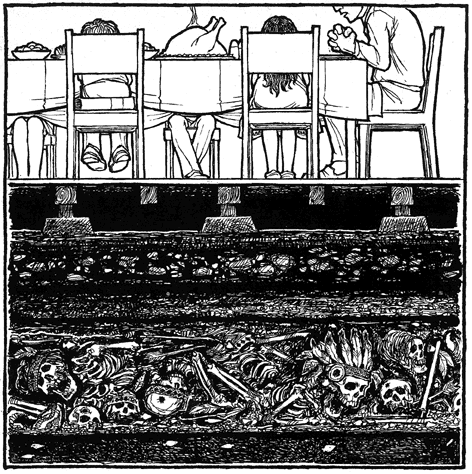
The richness of French history in North America has been neglected in recent generations, although there was once a time, not so many generations ago, when names like Champlain and Verrazano (who sailed for France, and named Rhode Island) were remembered with enthusiasm. It would not quite be right to call Champlain obscure--after all, he has an enormous lake named after him. But for most of us, he sits on a list of explorers and early settlers to be memorized somewhere around age 13, and then forgotten.Comment: This narrative undermines our national Thanksgiving Day myth. For more on the subject, see Ten Little Pilgrims and Indians.
Local duck decoy maker honoredA local Native American artist renown for his work making tule duck decoys and baskets will be honored at the upcoming Governor's Arts Awards in Las Vegas.
Mike Williams, a relatively new member of the Fallon Paiute-Shoshone Tribe, is being recognized for excellence in folk and traditional arts.
The latest budget decisions show how Americans' words don't match their actions.
Senators rip Bush tribal facilities budgetDespite widespread disrepair of schools, jails and health care facilities in Indian Country, the Bush administration requested only a fraction of the funding needed to fix the problems, senators of both parties said Thursday.
Senate Indian Affairs Committee Chairman Byron Dorgan, D-N.D., said there is a nearly $3 billion backlog in construction or repair of American Indian health facilities, a $1.8 billion backlog to repair or build schools and $6 billion to repair and construct jails.
He said administration officials told the committee that things are "swimmingly good" when they're actually depressing. "It's unbelievable to me," he said.Comment: In other news:
The House is considering the apology passed by the Senate. Everyone is very sad that the US did bad things to the Indians.
Politicians routinely swear to uphold the government-to-government relationship and treaty obligations between tribes and the US.
President Bush continues to pour millions of dollars a day down the drain in Iraq, the bloated defense budget, and tax cuts for the rich.
Millions of Americans "honor" Indians by attaching their names and likenesses to sports teams while doing nothing to change the situation above.
Here's an idea. The NCAI or a group of wealthy tribes could place an ad in the newspaper of every city or college with an Indian mascot. The ad's imagery would contrast "proud" and "noble" mascots with real Indians huddled in poverty-stricken homes. The message:
If you want to honor us, pass a resolution denouncing the Bush administration's budget cuts in Indian country. Demand that your Congressional representatives go on the record opposing illegal wars and immoral tax cuts that hurt Indians. If you don't do this, your claims about "honoring" us are false and hypocritical. If you're going to violate your treaty obligations to us and make us suffer, we don't need or want your phony "honor."
A campaign like this would garner a lot of media attention. It would raise the profile of Indian issues throughout America. It would use America's beloved mascots to make a point: that Americans don't honor actual Indians.
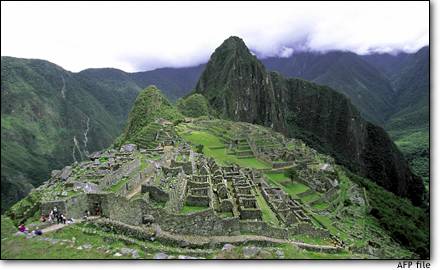
Rains thwart filming of Bond flick at Inca siteProducers for the upcoming James Bond movie "Quantum of Solace" said on Friday they have scratched plans to film near the Inca ruins at Machu Picchu--Peru's top tourist site--due to bad weather.
Filming for the 22nd Bond movie, starring Daniel Craig as the British super spy, had been set to start early this month in Cuzco, a city in southeastern Peru near the ancient Incan citadel.
"They decided not to come because of climatic conditions. They couldn't be sure it wouldn't rain and they have very tight time," said Margarita Morales, director of Iguana Productions, a Peruvian company hired to assist with filming.What the movie's about:"Quantum of Solace" stars Daniel Craig and Olga Kurylenko and follows the spy in a cross-continent quest to take revenge on a beautiful woman who betrayed him.Comment: The moviemakers could find Inca ruins elsewhere in Peru. But it sounds as if they're abandoning the Peruvian setting altogether.
Duluth's Native American history showcased at museumOnce it was discovered there was extensive gold in the area-–a vein made its way down from Dahlonega to here--gold fever started in the north Georgia hills. President Andrew Jackson decided he wanted the gold and began rounding up the Cherokee to drive them out, Morgan said.
In 1838 these once native settlers to the land set out on what became known as the Trail of Tears, one of the bloodiest events in America's short history. All Cherokee were forced to go to the western United States, losing more than 4,000 along the way.
"They had always marked trees as a way of communication, but they were now being used to hide the gold," said Morgan. "They hoped they could one day get the more than $50 million in raw gold that was buried. The Cherokee never knew when they would be forced to leave–-there was only enough time to grab some clothes and maybe a few other things."
Obama Draws Crowd of 1,500, Addresses Indian Issues in WyomingIn a question and answer session, Senator Obama was asked “What hope can I take back” to the Wind River Reservation, by Lander resident Michelle Skinner. She said the reservation is plagued by poverty and the twin scourges of alcoholism and methamphetamine addiction.
“I’ve talked to tribal leaders all over America,” Obama said, noting that Native Americans faced deeply rooted problems that have emerged from a tragic past. While problems can’t be erased overnight, he warned, Obama said he wanted to make sure that Native American health services are of the best quality, with a strong emphasis on disease prevention starting with children and pre-natal care.Comment: Actually, by reversing the Bush administration's budget cuts and fulling funding Indian programs, Obama (or Clinton) could start solving some problems overnight. Once this budget passed, improvements would begin happening in a matter of days or weeks.
Lack of traditional IDs might mean more airport hassleRon His Horse Is Thunder lives where his ancestors have lived for thousands of years, and the U.S. Interior Department keeps records of his family members that go back at least 100 years.
But he says that doesn't stop government security screeners from challenging his credentials whenever he attempts to board an airplane or enter a government building using his tribal identification card instead of a state-issued driver's license.
Indian tribes are sovereign entities and consider their ID cards equal to those issued by other governments.
Since the 9-11 terrorist attacks, however, Native Americans have found it increasingly difficult to use tribal cards to prove their identity, and it's about to get more difficult.
Coulter: A real apology means you won't do it againMany of the things Congress is considering apologizing for are still being done to Indians, Alaska Natives and to Native Hawaiians as well. Sadly, the United States, especially Congress, has never given up its insistence on treating Indian and Alaska Native nations with injustice and discrimination. This is not only wrong, but very bad public policy and wholly out of keeping with American values.
So what should Congress do? In addition to an apology, Congress should conduct hearings on these issues and adopt a resolution never again to take Indian or tribal property without due process of law and fair market compensation. The resolution should promise that Congress will never again terminate any American Indian tribe or its government and never again violate or abrogate a treaty with a Native nation without making full compensation and correcting all resulting harm to that nation. Congress must examine and change all federal laws, regulations and court-made law that deprive Indian nations and tribes of constitutional rights. Congress must pass legislation to assure that the government accounts fully for the Indian money and property it holds.
Native women speak out on the issue of stereotyping:"There seems to be very little mainstream awareness of Native Americans as contemporary people. Most people still think in stereotypes."
Louise Erdrich (Anishinaabe) "Many young Indians have some concept of their tribal identity, yet an outside ‘other’ constructs an alternative ‘Indian’ identity for them. How many of us have been told, ‘Funny, you don’t look Indian,’ or asked, ‘How come you don’t have black hair?’ or ‘Do you have a tipi in your backyard?’ or ‘I knew you were an Indian; you’re so spiritual!’ We are constantly barraged by images of the pretend, or the Hollywood Indian. If we don’t wear beads, feathers, or turquoise, then the non-Indian ‘other’ does not see us as authentically Indian."
A new graphic novel will feature Native writers and artists telling traditional tales.
Matt and Carol Dembicki Win the Day Prize for "Mr. Big" at SpaceMatt is currently compiling the Native American anthology Trickster. This entails working with more than 20 Native American storytellers and some of today's rising comic book artists around the nation. It is scheduled to debut at the Baltimore Comic Convention in September 2008. Additionally, Matt is collaborating with Carol on a supernatural thriller.
Mr. Big and Trickster are part of Little Foot Publishing, a company formed by Christian Beranek in 2006.
For more info please visit http://trickster-anthology.blogspot.com.
Red Lake students to launch cookbookWhen the Red Lake High School shootings brought tragedy to the community three years ago, many individuals and organizations sought ways to help the students and their families.
The members of General Mills’ American Indian Council, a group of employees with American Indian heritage from tribes around the country, donated $20,000 for a student project. The GMAIC members traveled to Red Lake to work with the students, and the result is “The Taste of Red Lake Cookbook.”Comment: For more on the shootings, see Culture Kills in Red Lake Tragedy.
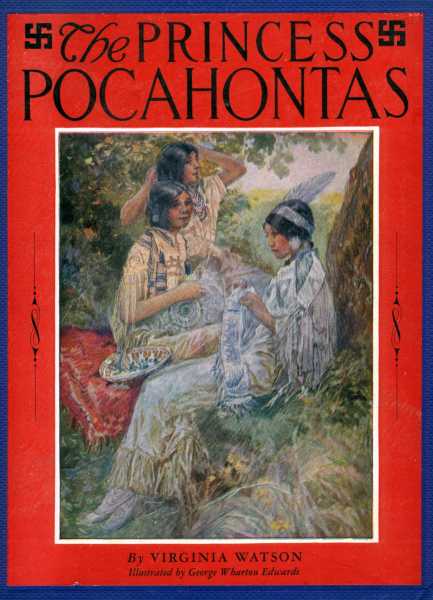
Virginia Watson wrote this fictional version of Pocahontas's life in 1916. Amazingly, it holds up well. I don't know anything about Watson and not much about the Powhatan Indians, but her rendition of their lives is persuasive. It's so rich and detailed that it almost feels like a documentary at times.
Because the copyright has expired, Project Gutenberg has posted the text of The Princess Pocahontas online. Read some of it--perhaps the first few pages--and I think you'll see what I mean.
Here's a representative passage--from Chapter VIII, when Smith first meets Powhatan:Powhatan sat in silence until Smith stood directly before him, and then he spoke:
"We have waited many days and nights to behold thee, wayfarer from across the sea."
Smith, looking up at him, saw a finely built man of about sixty years, with grizzled hair and an air of command. He smiled to himself at the strangeness of his fancy's play, but the air of this savage chieftain, this inborn dignity of one conscious of his power, he had seen in but one other person—Good Queen Bess!
"I too have listened to many voices which have told of thy might, great chief," he answered, speaking the unfamiliar words slowly and distinctly.
Then in the pause that followed the Queen of Appamatuck came forward and held out to Smith a bowl of water for him to wash his hands in. Pocahontas leaned eagerly forward to see whether the water would not wash off some paint from his hands, leaving them the color of her own, for might it not be, she had questioned Claw-of-the-Eagle, that these strangers were only painted white? But even after Smith had wiped his fingers upon the turkey feathers the Queen handed to him, they remained the same tint as his face.
At the command of Nautauquas, the slaves began to bring in food for the feast which preceded any discussion of moment. An enemy, be he the bitterest of an individual or of the tribe, must never be denied hospitality. Baskets and gourds there were filled with sturgeon, turkey, venison, maize bread, berries and roots of various kinds, and earthern cups of pawcohiccora milk made from walnuts. Powhatan had motioned Smith to be seated on a mat beside the fire, and taking the first piece of venison, the werowance threw it into the flames as the customary sacrifice to Okee. Then he was served again, and after him each dish was offered to the prisoner.Here's the short version of how the book fares as Native history:
The good
The Indians are all intelligent, articulate, and multifaceted. Pocahontas is believable as a bright, curious, and willful 13-year-old. She and the 27-year-old John Smith think fleetingly about the possibility of romance, but quickly dismiss it.
The bad
The book romanticizes Pocahontas as a "princess" even though she wasn't one. It dwells a bit too much on the tribe's warfare, torture, and "superstitious" beliefs. It glosses over Pocahontas's transition from pagan captive to dutiful Christian wife.
The ugly
Watson occasionally uses stereotypical terms to describe the Indians. Since she wrote the book in 1916, it may be a legitimate case of her thinking what everyone thought because she didn't know any better. Some examples:
Despite its flaws, this 1916 book does a better job of rendering an Indian culture than some books written almost a century later. Although it's fiction, it doesn't invent a romance between Pocahontas and Smith. Descendants of the Powhatan Indians may notice some historical inaccuracies, but none jumped out at me.
Women crossing three generations from Sweden's native Sami community share the skill of herding reindeer. However, the traditionally nomadic practice depends on the ability to migrate with the herd, and businesses and leisure activities have begun to block their routes.
'Killer Whale and Crocodile'
Two of the world's greatest wood carvers are brought together through a common relationship with gallery director Elaine Monds and museum curator Dr. Carol Mayer. Culture and artistic knowledge are eagerly exchanged between John Marston of British Columbia and Teddy Balangu of Papua New Guinea.
'Maria Tallchief'
Native American ballerina Maria Tallchief began dance lessons at age four in Oklahoma, left her Osage Indian Community to find stardom in the Big Apple and became nearly immortal by helping to establish the New York City Ballet while serving as muse for her husband/choreographer, George Balanchine.
'Miss Navajo'
Director Billy Luther follows Crystal Frazier through an unconventional beauty contest. Miss Navajo contestants are judged on their inner beauty, how fluent they are in Navajo and their proficiency in traditional tribal skills: frying bread, rug weaving and sheep butchering.
'Our Land, Our Life'
Carrie and Mary Dann, two elderly Shoshone sisters, have had a 30-year battle with the U.S. government over the rights to their own land, which has taken them to the Supreme Court and beyond.
'A Place Between: The Story of an Adoption'
Director Curtis Kaltenbaugh examines the life that he and his brother Ashok led as children who were removed from their Ojibwe mother in Manitoba and adopted by a white pastor and his family in Pennsylvania. At 30, he makes the bold decision to unite the two families and cultures for the first time.
'Tkaronto'
The centerpiece film finds two strangers staying in a Toronto home, one interviewing Native elders for a collective art series, the other being interviewed by TV producers who want to take advantage of his Native status for funding. They bond over their struggle to embody their heritage.
'Water Flowing Together'
The closing film follows ballet great, Jock Soto, from his early roots on a remote Arizona reservation through a career filled with triumphant performances to his emotional retirement from the New York City Ballet at age 40 in 2005.
'Weaving Worlds'
In its West Coast premiere, director Bennie Klain captures the intricate relationship between Navajo rug weavers, reservation traders and the balance between maintaining cultural traditions, economic survival and artistic validation.Comment: For more on Native-themed films, see The Best Indian Movies.
Native Superdelegates Mulling CandidatesAs two of 794 Democratic superdelegates, Frank LaMere and Kalyn Free are getting a lot of attention right now in a race that many expect superdelegates will play a key role in deciding at the Democratic National Convention in August.
The power to help decide their party's presidential nominee is a trust LaMere and Free aren't taking for granted.
LaMere is endorsing Obama.
Free said this week she remains undecided.
Both agree: The remaining presidential candidates' past work and rhetoric on Indian issues portend better times for Native people.Why LaMere supports Obama:"Hillary Clinton, to many Native people, represents the status quo, business as usual," he said. "Eighty percent unemployment at Pine Ridge should not be business as usual. High rates of suicide and diabetes on our reservations should not be the status quo."
Indian Country, he said, needs someone willing to think out of the box when it comes to finding solutions to Indian issues. For LaMere, that someone is Obama.
"He has generated a lot of excitement, and I believe he will be an agent of change, something that Native people can appreciate," he said.Comment: According to another article, there's a third Native superdelegate: Margarett Campbell, Montana Democratic Party vice chairwoman. She favors Obama but is officially neutral.
Autry museum getting $100 million makeoverPlans call for a renovated museum stripped of its post-modern, Mission-style decor with one-third more space, or 79,000 square feet.
In its place will rise a National Autry Center clad in gray, red Corten steel and sheets of channel glass--including its five-story tower--surrounded by native plants and trees.
After emerging from a "canyon walk" of native oaks and sycamores, visitors would enter the Autry from the south into a "convergence canyon" of soaring bent wood in what is now an open courtyard.
Hate won't vanish until we all helpMany people want to blame classism for impairing some Americans, but two recent studies show that racism remains the biggest U.S. monster.
Instead of joining together to fight this common foe, people feed the beast so that it continues to let some advance while forcing others into the dark corners of despair. It is an uncomfortable part of black history, but the problems won’t end unless they are exposed so they can be eliminated.
A fall FBI report on hate crimes lets people know that the problem is trending in the wrong direction. Bias-related criminal incidents jumped 7.8 percent from 2005 to 2006.
Race remains the biggest problem. The report said 51.8 percent of the 7,720 single incident cases were racial bias; 18.9 percent, religion; 15.5 percent, sexual orientation bias; 12.7 percent, ethnicity/national origin; and 1 percent was against people with disabilities.
I recently watched Doomsday 2012: The End of Days on the History Channel. It's based on the Maya calendar, of course, and includes references to Hopi prophecies. Here's a summary of the show:Will the world really end in 2012?
There are prophecies and oracles from around the world that all seem to point to December 21, 2012 as doomsday. The ancient Mayan Calendar, the medieval predictions of Merlin, the Book of Revelation and the Chinese oracle of the I Ching all point to this specific date as the end of civilization. A new technology called "The Web-Bot Project" makes massive scans of the internet as a means of forecasting the future... and has turned up the same dreaded date: 2012. Skeptics point to a long history of "failed doomsdays," but many oracles of doom throughout history have a disturbingly accurate track record. As the year 2012 ticks ever closer we'll speculate if there are any reasons to believe these doomsayers.
Watch and decide for yourself if it is true.You can watch the show here:
As you might have guessed, it's a mishmash of vague and unconvincing predictions, like something out of an Erich von Daniken book. In an era of world wars, atomic bombs, terrorist attacks, AIDS, and global warming, any apocalyptic claims sound plausible. They sound especially plausible if you string them together in a concerned voice without critical scrutiny.
Naturally, the documentary offers only a few skeptical voices near the end. For the most part, authors who are touting doomsday books get to speak without contradiction. Viewers have to read the small type and think about it before they'll realize the speakers are biased self-promoters, not impartial academics.
Analyzing the predictions
A couple of examples will demonstrate how Doomsday 2012: The End of Days makes its case.
1) The show claims that the Maya calendar predicted the exact date of Hernan Cortés's arrival in Mexico: March 5, 1519. Unfortunately, you won't find this alleged prediction anywhere on the Web--except in summaries of this show. Therefore, there's no way to verify if the calendar predicted what the show said it predicted.
Moreover, several websites claim Cortés arrived on March 4, not March 5. So even if the calendar did make a specific prediction, which we can't verify, the prediction was wrong. Oops.
2) The show claims that English prophet Mother Shipton predicted the colonization of America by name in the early 1500s. Let's ignore the fact that Shipton probably didn't exist--that her prophecies were published only in the mid-1600s, after the European colonization of America was underway. Let's look at what the show actually offered as evidence of her authority.
Shipton allegedly predicted that "virgins" would colonize a "virgin land." The show claims this is a reference to the colonization of Virginia. Several problems with that:
a) A "virgin land" isn't the same as "Virginia," so Shipton didn't predict the colonization "by name," as the show states. For all we know, her "psychic abilities" were tuned to the virgin land of Africa, Australia, or Antarctica, not Virginia.
b) The first permanent settlement in what would become the US mainland occurred in St. Augustine, Florida, in 1565--not in Virginia. It was preceded by the settlement of San Juan, Puerto Rico, in 1521 and some failed settlements in Florida. The doomed Roanoke in North Carolina was settled in 1585. There were Spanish settlements throughout the American Southwest that culminated in the establishment of Santa Fe in 1607 or 1608.
Jamestown also was founded in 1607. The next significant colony was Plymouth in Massachusetts in 1620. I believe New England was settled more rapidly than Virginia and became the center of the American colonies.
Therefore, equating the colonization of America with the colonization of Virginia is grossly misleading. They aren't close to being synonymous. If Shipton had predicted San Juan, St. Augustine, Roanoke, Jamestown, Santa Fe, and Plymouth in order, then I'd be impressed...but she didn't.
c) Except for maybe a few young men and women, the settlers at Jamestown weren't virgins. Oops.
d) Virginia wasn't virgin territory since it was inhabited by Indians. Oops.
How the show operates
This prediction gives you a good idea of how Doomsday 2012 operates. Shipton supposedly made an accurate prediction about the colonization of America. Therefore, we can believe her vague predictions about doom in the modern era--when men could fly through the air or travel beneath the sea. Her "accurate" predictions about doomsday thus bolster other equally "accurate" predictions about doomsday. Since the predictions "confirm" each other, we should worry about doomsday arriving on December 21, 2012.
Unfortunately, the two predictions I analyzed were wrong. They prove that you can't trust the Maya calendar and Mother Shipton, not that you can trust them. Since there's no proof that any of these prognosticators are accurate, you can safely ignore them.
In short, Doomsday 2012 didn't come close to making its case. I give it about a 6.0 of 10 for its failure to provide specifics and analyze them critically.
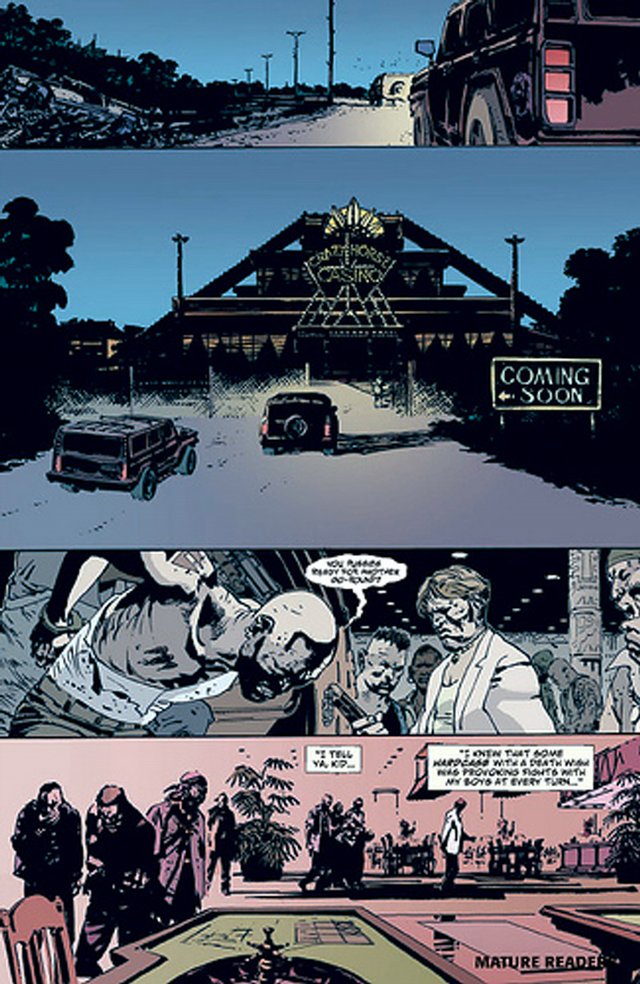
A look at the SCALPED comic book's portrayal of an Indian casino vs. the actual casino in the same location.
Since the Prairie Rose reservation in SCALPED is really Pine Ridge, this is the casino the fictional Crazy Horse Casino must emulate:
Expansion creates new Prairie Wind CasinoPrairie Wind Casino sits on the Pine Ridge Reservation in the middle of the prairie with no communities within sight--just a few scattered houses, a view of the Badlands, some range cattle and wild game. Most of the time, however, there is a lot of wind--hence the name.
It is not one of those megacasinos where the lights flash and traffic flows 24 hours a day, nor is it where the big entertainment tours stop, but it has an atmosphere that attracts people from the local area, mostly ranchers and tribal members. In season, tourists are routed to the casino.A bit of history:The Prairie Wind Casino got its start in 1994 with three mobile units that housed 75 slot machines. Next came a tent-like structure that was cramped with 250 slot machines and a small restaurant; offices had to be housed in the original mobile units.
After nearly two years of construction fraught with delays and controversy, the move to the new casino took place in March of this year and the hotel opened in June. Construction of the new casino cost $12 million and the hotel added an additional $4.8 million. Most of the funds came from a loan through the Shakopee Mdewakanton Sioux Community in Minnesota.A few facts: The new casino was built to hold 500 slot machines, but at present the casino still has only 250. That's the maximum number the state will allow any tribal casino under the current compacts. None of the tribally owned casinos in South Dakota have been given any indication that additional gaming devices will be increased.
From the carpeting to the decorative wall treatments, the casino exudes a welcoming atmosphere; and many people are able to carry on conversations while sipping a cup of coffee or a soft drink in comfortable chairs situated on the edge of the gaming floor. (Prairie Wind Casino is alcohol-free.)
The casino revenue is small compared to many other casinos, and any profit margin reflects the lower revenue income. Any extra revenue is used mostly to supplement tribal program funding, for health, education and environmental programs. The major benefit from the casino is that more people are employed in one of the areas of the country that is classified as one of the poorest counties in the nation. Those jobs at Prairie Wind make it one of the top employers on the reservation, in company with the tribal government, the IHS and OLC.Comment: This casino is mentioned in Frontline USA's report on Indians. That inspired me to do a little research. If writer Jason Aaron did any research into Indian gaming, he must've ignored what he found.
As you can see, Prairie Wind is totally unlike the fictional casino. It's a glitzy megacasino, with waitresses and showgirls in skimpy "chiefette" costumes and riches pouring into the corrupt government's coffers. The reality is far different.
This is a good example of how SCALPED stereotypes Indians. It imagines the worst-possible Indian gaming scenario, then pretends it's real. Readers who don't know anything about the subject will assume SCALPED's version is the norm.
Don't bother arguing that "it's only a comic book." This is where people learn about Indians: from the media. It's their primary source of information. If comics (and TV shows, and movies) all portray Indians getting rich from megacasinos, that's what people will believe.
To recap:
Actual casino: in existence since 1994, small-time, helps tribe.
SCALPED casino: started 2007, Las Vegas-style, enriches tribal leaders.
A discordant note
One interesting statistic from Frontline USA is that 70% of the customers at the Prairie Wind casino are Indians. The idea of Indian gaming is to take money from outside the tribe to help the tribe. Not to take money from within the tribe so a tribal bureaucracy can pay it back to the tribe.
If I were the tribe, I'd think about doing something about this. Limit the amount Indians can lose per day, month, or year. Give them some sort of pass for free or low-cost play.
That’s the same date the state of Nebraska celebrates Native American Day, though the state celebration is not a paid holiday for state employees.
Larry Dix, executive director of the Nebraska Association of County Officials, said he knew of no county in Nebraska that sponsors a paid holiday beyond the usual state and federal holidays.
He said that’s in part because county governments are considered extensions of state government. It’s also because of the cost involved in sponsoring a paid holiday, Dix said.
“It would be a taxpayer expense,” he said.
Thurston County board member Darren Wolfe said he thinks the board’s decision makes his county the first in the nation to sponsor a paid holiday recognizing Native people.
Setting The Story StraightThe colonial viewpoint expressed in Smith's journals has persisted in many forms. Today, many people view the Bay's native people as playing little more than brief supporting roles in the story of a developing nation.
"The first misconception is that these were bands of roving savages, boundless and thoughtless, chasing buffalo," Tayac said. "What Smith actually saw were very complex and dynamic societies, with highly subtle agricultural practices, a complex religion and an interesting balance between men and women."
A second misconception is that the Bay's native people are gone. Their communities lost thousands to death and migration after the Europeans arrived. But others survived and stayed in their homeland, opting to live at the edge of a racist society that largely ignored their existence. They often lived in rural enclaves, excluded from white churches and schools. In Virginia, the Racial Integrity Act of 1924 made it illegal for people to identify themselves as Indians. The act was in place until 1967.Comment: It's amazing that these misconceptions persist in 2008.
Let's recap: A hundred or so colonists invaded a land of 10 million Indians. They were so inept that they would've died if not for the natives' help. At any point the Indians could've turned Jamestown (or Plymouth) into another Roanoke, but they generously allowed the intruders to stay.
But the Indians played only a supporting role? Read a book such as The Princess Pocahontas or watch a movie such as The New World. For the first few decades of the 1600s, Virginia's story was all about the Indians.
Our cultural myopia continues. It's like saying the history of the solar system began in 1969 when man first walked on the moon. Or the history of Iraq began when we invaded it. "Hello, we're here to 'liberate' you. Did anything happen in the past few decades or centuries that might hinder this plan? No, don't bother answering, because it doesn't matter. We're proceeding regardless of what you say because we're Americans."
"I think (my film) 'Killer Whale and Crocodile' speaks to the power of art to connect different cultures on a deep level," said Campbell via e-mail. "The water imagery is ever-present, and to bring that powerful element to the desert I think is very compelling."
First-time director Gwendolen Cates uses art to communicate in her film, "Water Flowing Together," about gay Navajo ballet dancer Jock Soto.
"I was drawn to film because I wanted to be able to tell a story at more length, in more depth," said Cates, a photographer who lives in New York.
"Our Land, Our Life," examines the land rights of two Western Shoshone women as they struggle to continue their ranching tradition. Directed by George and Beth Gage, the film will be making its North American premiere in Palm Springs.
"We see (our) film as a call to action in many ways," the filmmakers e-mailed from Telluride, Colo. "We feel the Palm Springs area may be fertile ground for support for the issues raised by our film."Comment: For more on the subject, see The Best Indian Movies.
Sioux Indian receives Medal of Honor for heroism in Korea"On behalf of our grateful nation, I deeply regret that this tribute comes decades too late," Bush said at the White House medal ceremony. "Woody will never hold this medal in his hands or wear it on his uniform. He will never hear a president thank him for his heroism. He will never stand here to see the pride of his friends and loved ones, as I see in their eyes now."
But, Bush said, there are things the nation can still do for Keeble, even all these years later.
"We can tell his story. We can honor his memory. And we can follow his lead, by showing all those who have followed him on the battlefield the same love and generosity of spirit that Woody showed his country every day," the president said before a somber East Room audience that included three rows of Keeble's family members.Comment: The way to "show the love" for our soldiers is not to send them into wars unnecessarily and to bring them home when we do.
The Keeble story got a minute or two on this morning's CBS news. I'm wondering when was the last time an individual Indian got a minute of coverage on a major network. Did anyone report on Russell Means when he declared the Lakotas' independence? You might have to go back to Ward Churchill's being fired from the University of Colorado to find an example.
Colville members have 'One Heart for the People'The Colville Reservation now has a social Internet system in place that is probably unique in Indian country. Designed much like MySpace, this system--called "One Heart for the People"--is intended to inform and organize Colville members in a grass-roots effort to unify the tribal membership.
The system was originated and designed by Ben-Alex Dupris, a tribal member who left the reservation when he was 19 to pursue a career in Hollywood as a professional actor and dancer. He eventually left, but says he returned to Los Angeles whenever he needed to recharge. Now in his early 30s and knowledgeable about such things as open source software, cloud computing and social networking, he has returned to the reservation.
"I wanted to do something for the tribe. I was looking at all the problems our tribes are facing today, particularly in this technological gap. Indian people are already so far behind in a lot of different areas and I thought a social network would be a good way to start, not to just say hi to friends, but to organize people and inform them about everything from funerals to political events to local basketball games." In so doing it would also broaden computer knowledge among many who are still unfamiliar or uncomfortable with computers.
Siberian culture's words have echo in North AmericaA panel of respected linguists who met in Anchorage on Friday are hailing new research that links the Old World language of Ket, still spoken sparingly along the Yenisei River in western Siberia, and the sprawling New World family of Na-Dene languages--a broad grouping that encompasses the many Athabascan tribes in Alaska, along with the Tlingit and Eyak people, as well as Indian populations in western Canada and the American Southwest, including the Navajo and the Apache.
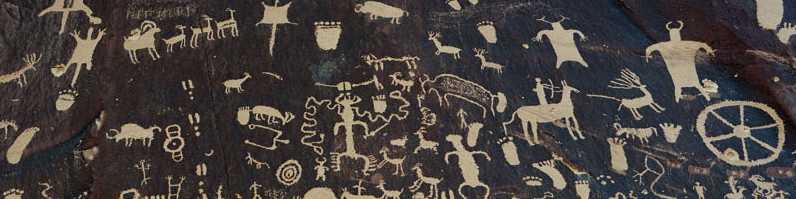
Other than Siberian Yupik, a regional Eskimo dialect that straddles the Bering Strait, a connection between North American and Asian language families had never before been demonstrated.Comment: For more on Native languages, visit Pictographs.
Signs would trace 'Potawatomi Trail of Death'A highway sign displaying the silhouette of a Native American family and an eagle is designed to point passersby to an often overlooked part of America's past.
"The Potawatomi Trail of Death was well documented but it was swept under the rug of history," said Shirley Willard, Fulton County Historian. "These signs will help people find the trail and understand what happened."
In 1838, 859 Potawatomi American Indians were forcibly led from their northern Indiana home near Twin Lakes to Kansas as part of government-sponsored removal campaigns of Indians to resettlement sites. Hardships of the journey lead to 40 deaths.
Tatanka issues challenge to Golden BoyA melee erupted in the middle of the six-man tag-team main event inside the VIP Casino Showroom on Saturday.
Native Blood and Tatanka earned the tag-team World Pro Wrestling championship belts after the team of Golden Boy Jerry Grey, the Might Heinrich Volkoff and Gino Santana were disqualified by the referee for interference.Comment: I'm a little confused. If Native Blood and Tatanka are the champions, does that mean they won a coin toss before the event? Or what, exactly? How do you determine the winners in a match that's staged and choreographed?
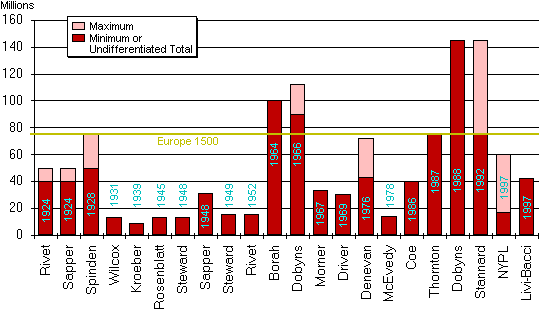
By Matthew WhitePopulation of the Western Hemisphere in 1492 according to various experts:(Possibly) The Twenty (or so) Worst Things People Have Done to Each Other:
1. 55 million Second World War, 20C 2. 40 million Mao Zedong (mostly famine), 20C 3. 40 million Mongol Conquests, 13C 4. 36 million An Lushan Revolt, 8C 5. 25 million Fall of the Ming Dynasty, 17C 6. 20 million Taiping Rebellion, 19C 7. 20 million Annihilation of the American Indians, 15C-19CSo the Indian holocaust was the seventh worst in history if you accept the low figure of 20 million pre-Columbian inhabitants. But looking at White's chart, the average estimate appears to be 50 or 60 million. If we go by only an average estimate, the Indian holocaust was the worst in history.
Judging by how much space he gives it, here's the crux of White's essay:Traditionally we add death by disease and famine into the total cost of wars and massacres (Anne Frank, after all, died of typhus, not Zyklon-B, but she's still a victim of the Holocaust) so I don't see any problem with doing the same with the American genocides, provided that the deaths occurred after their society had already been disrupted by direct European hostility. If a tribe was enslaved or driven off its lands, the associated increase in deaths by disease would definitely count toward the atrocity (The chain of events which reduced the Indian population of California from 85,000 in 1852 to 18,000 in 1890 certainly counts regardless of the exact agent of death, because by this time, the Indians were being hunted down from one end of California to another.); however, if a tribe was merely sneezed on by the wrong person at first contact, it should not count.
Consider the Powhatans of Virginia. As I mentioned earlier, Stannard cites estimates that the population was 100,000 before contact. In the same paragraph, he states that European depredations and disease had reduced this population to a mere 14,000 by the time the English settled Jamestown in 1607. Now, come on; should we really blame the English for 86,000 deaths that occured before they even arrived? Sure, he hints at pre-Jamestown "depredations", but he doesn't actually list any. As far as I can tell, the handful of European ventures into the Chesapeake region before 1607 were too small to do much depredating, and in what conflicts there were, the Europeans often got the worst of it.
Think of it this way: if the Europeans had arrived with the most benign intentions and behaved like perfect guests, or for that matter, if Aztec sailors had been the ones to discover Europe instead of vice versa, then the Indians would still have been exposed to unfamiliar diseases and the population would still have been scythed by massive epidemics, but we'd just lump it into the same category as the Black Death, i.e. bad luck.Comment: The obvious response is that Europeans didn't arrive with benign intentions. That changes the issue from "bad luck" to something more like manslaughter.
White wonders if we can blame the English for the deaths that occurred before they arrived. No, we can blame the Spanish for those deaths.
If an Aztec ship had sailed to Europe, only its sailors would've been exposed to disease. They would've died on the trip or developed antibodies and survived.
Final answer
I've answered White's charge several times before. You can find one such answer in Genocide by Any Other Name.... To quote myself:Europeans were guilty of directly killing or enslaving Indians...and they were guilty of, at best, depraved indifference toward the deaths they caused by infectious diseases.
Or to put it another way, how many doctors did they send or hospitals did they build when they saw the Indians dying? How many Indians did they treat medically the same as they treated their own people? If there's a tale of a Florence Nightengale type ministering to America's Natives, I'm afraid I missed it.
To extend my previous analogy, if you break into someone's house with a known killer as a partner, intending "only" to rob the house, and your partner kills 90% of the house's inhabitants while you stand by and watch, how guilty are you of those deaths?Answer: pretty guilty.
We could keep going with these analogies. If you lock someone in the basement and he dies of an infection from a scratch, are you guilty? If you forcibly remove someone from his house and he dies of pneumonia in the cold, are you guilty? Yes. I believe the crime would be involuntary manslaughter and the punishment would be 10 or more years in jail.
Longest Walk: Apology to Indians is diversionSimmons pointed out that when the original Longest Walk was making its way across the United States in 1978, a similar diversion was created to diffuse the impact of the walk at that time. Indian representatives came out and told the Long Walkers that their walk was not necessary because the anti-Indian legislation underway would be defeated without their march into Washington.
Now, 30 years later, another effort is underway to diffuse the impact of this Longest Walk.
“The United ‘Snakes’ of America thinks this would be enough for us,” Simmons said. “There are still problems across Indian country. We’re talking much more than just treaty rights.
“It goes beyond human rights and civil rights, we are talking about our natural rights since the beginning of time.
“Our traditional and spiritual leaders have been silenced for so long. The apology should be directed to them.”Comment: So the US apology was meant to diffuse the impact of the Longest Walk 2? What impact is that, exactly? It's not clear the walk is going to have any impact.
Will the walkers blame the apology if they fail to achieve their goals? If a few words can stymie their efforts, their efforts must not be worth much.
Actually, I suspect few of the representatives who voted for the apology have heard of the Longest Walk 2. If they have, I doubt it was uppermost in their minds.
In fact, I doubt they thought the apology would deter anyone from continuing to advocate change. One could argue that apologizing to people encourages them rather than discourages them.
I guess the marchers feel they need an opponent to march against. I'd say there are enough obstacles in and out of Congress without making the apology another one.
Below: Jimbo Simmons walks to Cave Rock in Nevada. Photo courtesy of Brenda Norrell.
In this 1998 romantic comedy, Philip Seymour Hoffman is a supposedly committed activist. At the beginning of the film, he leaves girlfriend Hope Davis to protest with the "Tantoonis" in Arizona. It seems this tribe is trying to protect some burial grounds from being flooded by a dam.
Later he returns, disillusioned. The Tantoonis saved their land only to build a casino on it. What's a card-carrying liberal to do, the movie implies, if even the noble Indian is a sellout?
Several problems with this scenario:
1) "Tantooni" isn't remotely like the name of an actual Arizona tribe. It sounds like something out of Star Wars or a Tarzan movie. The result is that the tribe seems more remote and exotic than it would be in reality.
2) There may be one or two cases where tribes have built casinos on or near burial grounds. There are 400-some cases where they haven't. In other words, the situation in Next Stop Wonderland is an extremely unlikely exception, not the rule.
3) So what if the Indians used the land to build a casino? Should they have let the dam flood it instead? One of the reasons for having land is to use it for the tribe's benefit. That includes ventures such as mining, tourism, or gaming--none of which are traditional Indian pursuits.
4) Hoffman's character was hopelessly naive if he didn't realize the tribe might use the land for a casino. In 1998, the idea of building Indian casinos was well established. If he cared about this outcome, he should've investigated it. Even if the tribe kept its plans secret, which is unlikely, the surrounding communities would've publicized the possibility of a casino.
In short, Next Stop Wonderland presents a minor but typical case of stereotyping Indians. The fictional Tantoonis live in the middle of nowhere, Arizona. Their existence is defined by protesting against progress. But they're no good at it; they need the white man's help to protect themselves from development. Once they achieve success, it turns out they're insincere and amoral. In fact, they're so greedy they'd build a casino on top of their ancestors.
Other than this brief exchange about Indians, the movie was good but not great. Rob's rating: 7.5 of 10.
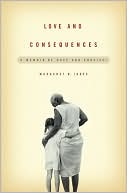
Sister blew the whistle on writer who said she was a foster child in South L.A., but really grew up with her family in Sherman Oaks.The gripping memoir of "Margaret B. Jones" received critical raves. It turns out it should have been reviewed as fiction.
The author of "Love and Consequences," a critically acclaimed autobiography about growing up among gangbangers in South Los Angeles, acknowledged Monday that she made up everything in her just-published book.
"Jones" is actually Margaret Seltzer. Instead of being a half-white, half-Native American who grew up in a foster home and once sold drugs for the Bloods street gang, she is a white woman who was raised with her biological family in Sherman Oaks and graduated from Campbell Hall, an exclusive private school in the San Fernando Valley.More on "Jones's" fictional upbringing:The review told of how "at 5, Margaret B. Jones, part white, part Native American, was taken from her suburban Southern California home after she came to school bleeding from what the teachers and social workers assumed was a sexual assault. She spent three years in foster care before landing with 'Big Mom,' a hard-working black woman raising four grandchildren in South Central Los Angeles. It didn't take Jones long to fall in with the Bloods."
The reviewer told of how the book described "Jones" selling drugs at age 12 because she was "eager to earn my own money toward the flame-red Nike Cortez with fat laces that everyone else wore, but even more excited to prove myself worthy of wearing the affiliated color and moving up the ranks."
The sacred mountain of the Taos Ski Valley is more than just a winter playgroundFor us, our experience with ski instructor Antonio Zuni on the slopes of Taos was the essence of New Mexico. Zuni, a Native American from the Tiwa tribe, hosted a "Meet the Sacred Mountain" tour in which he introduced visitors to the spiritual, native oral history of the area.
It was different from the tours we'd been on before, more of a living prayer or a celebration of life. It moved some to tears, and later, at dinner, the best way we could describe it was that it felt like we had gone to church.
"We are so different from a Vail or an Aspen," Zuni said. "We recognize and value that difference, not only in the ski area but in the different cultures that convene here, the magic of the mountain."
Through a poetry all his own, Zuni helped us experience the magic he feels every day.
"When most people feel the wind or the cold, they say, 'Oh it was a horrible day,' " he said. "Yet to me as a Native American, it's a wonderful day. When the wind comes off the peaks and you see it swirling around, most people notice the cold. But if you've grown up here, it's like the wind is coming off the hills and dancing right there before you.
"When the wind comes up on your face and splashes you with snow, think of it as Mother Nature giving you a big, fat wet one on the cheek. And when you ride up the lift and the trees bend and snow falls on you, it's the mountain clapping its hands and greeting you."
In retrospect, the colonization was brutal—not an intriguing experience to commemorate in front of a national and international audience as stated in the Dec. 21, 2007 editorial, "Signs of progress on our cuartocentenario."
The cuartocentenario won't address the impact of Spanish colonialism 400 years after the colonization and its ramifications on the Pueblo people today.
In 1620, by royal decree of the king of Spain, groups of pueblo governors and officials were instituted into a civil government that the Spaniards could control and assimilate into the Spanish institutions.
As pueblo people, we have never asked ourselves why we celebrate these Catholic feast days—to honor whom? Is it the legacies of Spanish colonialism? The impact of fear and brainwashing became a part of life. In order to continue to live and practice our traditional beliefs, the Spanish forced us to convert to Catholicism and gave the pueblos Spanish canes to reinforce this subjugation. A life of servitude to the Spanish sovereign and the Roman Catholic Church is still practiced today. These institutions were designed to make us servants through indoctrination, abandoning our free will for a life of servitude.Santa Fe was founded in 1607 or 1608, according to the following posting. Apparently the city has chosen 1608 as the date. Here's why the local tribes may not want to celebrate:
An Uncertain Founding: Santa FeJuan de Oñate established New Mexico as an entrepreneurial colony, one that was intended to make him a profit. The presence of the Pueblo Indians gave the colony a good financial basis, because Oñate was given the privilege of dividing the products of their pueblos among the military leaders of the colony, in an arrangement called encomienda. This gave the leaders an income that allowed them to each support a troop of armed militiamen and their horses, which would provide the protection of the new colony. Oñate expected to find the so-far-unlocated golden cities of Gran Quivira, and to make a huge profit from taking this gold and tracking down the mines from which it came. "I trust in God that I shall give your majesty a new world, greater than New Spain," he wrote to the viceroy. Such success had happened before in the eighty years between the conquest of Mexico and the conquest of New Mexico–Oñate confidently expected it to happen again, with himself and his followers as beneficiaries.Basically, Oñate turned the Indians into serfs at best, slaves at worst. But he's most (in)famous for what he did 10 years earlier:
Juan de OñateThat summer his party continued up the Rio Grande to present-day northern New Mexico, where he encamped among the Pueblo Indians. He founded the province of Santa Fé de Nuevo México and became the province's first governor. Gaspar Pérez de Villagrá, a captain of the expedition, chronicled Oñate’s conquest of New Mexico’s indigenous peoples in his epic Historia de Nuevo México (1610). Oñate soon gained a reputation as a stern ruler of both the Spanish colonists and the indigenous people. In October of 1598, a skirmish erupted when Oñate's occupying Spanish military demanded supplies from the Acoma tribe--demanding things essential to the Acoma surviving the winter. The Acoma resisted and thirteen Spaniards were killed, amongst them Don Juan Oñate’s nephew. In 1599, Oñate retaliated; his soldiers killed 800 villagers. They enslaved the remaining 500 women and children, and by Don Juan’s decree, they amputated the left foot of every Acoma man over the age of twenty-five. Eighty men had their left foot amputated.Comment: Oñate is a prime example of a European who knew he was doing evil but did it anyway. Whenever someone claims the Europeans didn't know any better, you can offer his crimes as a response.
Pen-pal program closes the 3,700-mile gap between third-graders in Lancaster and AlaskaIn a remote and tiny community in Alaska reside some Yupik Eskimo schoolchildren who are newly enamored of a certain Pennsylvania Dutch confection: the whoopie pie.
The third-grade students at Ignatius Beans School in Mountain Village, Alaska, have been corresponding since October with third-graders at Dayspring Christian Academy in Manheim Township.
The pen pals have traded tidbits about their young lives; they've shared their interests. And the Dayspring students sent their Alaskan pen pals whoopie pies.
Perhaps whoopie pies could be dispatched to people in other corners of the world, to create peaceful relationships and intercultural understanding. For they surely were a hit among the Mountain Village students, who belong to the Asa'carsarmiut tribe of Yupik Eskimos.
Mary Stauffer, the third-grade teacher at Dayspring who organized the pen-pal project, said the kids in Alaska have a treat of their own, which they call "Eskimo ice cream."
It has different ingredients—in some places, it's made with reindeer fat and seal oil, as well as snow—but in Mountain Village, it's made with whitefish, Crisco, sugar and berries (usually blueberries and salmonberries).The project is busting stereotypes about Alaskan Natives:Kristian Long said his pen pal has the same game system—PlayStation 3—as he does. "I was a little surprised," Kristian said. "I was like, 'huh?' "
It turns out that playing computer games and watching videos are activities many of the Alaskan and Pennsylvanian kids have in common.And:"They speak English," said Grace Stillman. "I thought they'd speak a whole other language."
Hunt said many of her students' elders speak Yupik, and her students study Yupik at school, but they mostly speak English.
Apology pleases, surprises Indian leadersTwo American Indian leaders in Montana say they are pleased and surprised at the Senate’s actions this week apologizing to American Indians.
The apology is an amendment to the Indian Health Care Improvement Act Reauthorization, which the Senate passed Tuesday by an 83-10 vote.
Both Robert “Tim” Coulter, founder and executive director of the Indian Law Resource Center in Helena, and state Sen. Carol Juneau, D-Browning, said they believe the apology is sincere.
However, both added that Congress needs to take the next step of changing ongoing policies that continue to harm Indians.
“I do think it’s a meaningful action by Congress to recognize for the last whatever 300 to 400 years of what has happened to American Indian people in the United States,” Juneau said.What needs to be changed:Many of these ongoing injustices would surprise American citizens, he said.
For example, the 2004 Congress confiscated a $145 million judgment fund belonging to nine Western Shoshone tribes, he said, and then distributed the money to individual tribal members.
That action impoverishes and undermines the tribe, and “fundamentally steals the property of the tribe,” Coulter said.
Congress continues to confiscate Indian land, he said. In the past few years, he said, it took land belonging to the Yurok Nation in California without providing compensation.
“Most people don’t believe it is happening, but it is,” he said.Comment: I'd be pleasantly surprised if Congress didn't apologize but did address the many injustices against Indians.
First, there is assimilation into the culture of the Bible Belt yahoos who govern Oklahoma: the culture that sends a fool to the Senate who claims global warming is a hoax; the culture that thinks allowing gay people to marry will raise the divorce rate among heterosexual couples; the culture that regrets the outcome of the War of Northern Aggression and denies the Tulsa race riots like Ahmadinejad denies the Holocaust. This is the missionary culture that finds virtue in ostentatious public prayer, Matthew 6:5-6 notwithstanding.
Second, there are Cherokees assimilated like me, and I know more of them than I can count without taking my shoes off. We leave the Nation in pursuit of an education or a career. We always say we intend to go back. Then we get a dose of realism and think maybe we will retire there, because it's always "home" in some sense.What does leaving the rez and joining the mainstream imply?I think there is a sense in which one can be "more Indian" or "less Indian," and it has nothing to do with blood quantum. If it did, I would long ago have had a transfusion to cure my problem with Cherokee verbs. It's a set of customs and values that get weaker with geographical distance. As the Choctaw philosopher Lee Hester says, white people care about orthodoxy while Indians care about "orthopraxy." With distance, we lose the practice of being Indian. Whether that is a function of time as well as distance, I cannot be reliably informed, but I hope not.
Without a doubt, many of my fellow outlanders will have kittens when they read this because they think they are Indian by blood rather than by practice. Maybe so, just like British royals. Lots of peoples have taken the position that virtue is inherited rather than accomplished, so the idea cannot be dismissed out of hand.Comment: Steve Russell has argued before that the Freedmen should be considered Cherokees. This article helps explain why. The Freedmen who live and participate in the Cherokee culture are arguably more Cherokee than assimilated Cherokees who live elsewhere.
Conway: Sovereignty is more than just a wordIn the Hartford proceedings, the board and the union said they "respect" tribal sovereignty. What their actions said was that while they respect tribal sovereignty in concept, they cannot tolerate the exercise of that sovereignty.
I couldn't help but contrast what I heard with the real words of presidential executive orders, congressional legislation and court decisions that support tribal self-determination and a commitment to deal with tribes on a "government-to-government" basis.
Those words are being ignored with devastating effects by the blind and blanket imposition of the National Labor Relations Act on Indian tribes and their gaming enterprises.
Some in Indian country have counseled against pursuing this challenge. They fear too much could be lost.
Yet there is no good choice for tribes. The imposition of the NLRA is unlike that of any other statute that is silent as to Indian tribes, because it inserts a third party into tribal employment without any acknowledgment of the profound impact that it has on tribal laws, institutions and structures. Does it mean that the tribe's labor relations law is void? How about the tribe's right to work law, the tribal employee review code, the tribal civil rights law or the tribal gaming law?For more on more the subject, see The Facts About Indian Gaming and The Facts About Tribal Sovereignty.
Tribe sues in fight for way of lifeLast week, the native village of Kivalina, Alaska, 70 miles north of the Arctic Circle, filed a global-warming lawsuit against Xcel Energy and 23 other major utilities and oil companies.
These 390 Inupiat Eskimos live on a narrow barrier island that used to be protected by Arctic ice.
Now that the ice has melted, their tiny and impoverished village is vulnerable to the crashing waves of the frigid sea.
The Army Corps of Engineers and the General Accounting Office estimate that it's going to cost between $95 million and $400 million to move their village.
The Eskimos want nine oil companies, 14 electric-power companies and one coal company to pay. The list of defendants is a who's who of carbon-dioxide emitters, including ConocoPhillips, Duke Energy, Exxon Mobil, BP and Chevron.
Archaeologist: State Looks To Provide More Access To Historic Sites"It was a fabulous site. We're looking at a city on celebration days, equinox days, that there could have been 5,000 to 8,000 Native Americans here from all over the area," said Mark Tolley of the Ancient Sites Conservancy.
For 500 years, the site was one of the most important ancient Native American villages in Tennessee.
"The big temple mound is a four-sided truncated pyramid. That means it's flat on the top, and there was a structure there," said Tolley.
Sandra Brown's The Switch is notable for being one of the few thrillers I've read with a Native American theme. I'm not talking about genre fiction such as Tony Hillerman's Joe Leaphorn/Jim Chee mysteries or Thomas Perry's Jane Whitefield novels. I'm talking about mainstream thrillers that aren't built around a Native protagonist In other words, books in which the author normally doesn't write about Natives but adds a Native theme for color.
Here's The Switch's plot from Publishers Weekly via Amazon.com:With some 60 novels, including 40-plus bestsellers already to her credit, it seems a sure bet that this new romantic thriller will not blemish Brown's phenomenal track record. On a whim, the same day she is artificially inseminated at a Dallas fertility clinic, Gillian Lloyd switches places with her identical twin sister, Melina, a professional celebrity escort assigned to chauffeur astronaut Col. Christopher Hart (or "Chief," as he is called by his NASA cohorts because his mother was a Native American). It's lust at first sight. Swept away by Chief, Gillian is caught up in a marathon frenzy of lovemaking in his hotel room. Slipping out in the wee hours of the night, she is found brutally butchered in her own bed the next morning. From an obscene blood-smeared scrawl on the bedroom wall, her sister realizes that the killing was related to Gillian's love tryst with the astronaut. Hours later, the killer, an employee at the fertility clinic, commits suicide. The resulting investigation connects him to Brother Gabriel, the charismatic, egomaniacal leader of a powerful TV religious cult who is mysteriously linked in turn to artificial insemination clinics nationwide. Determined to avenge Gillian's murder, Melina and Chief become the targets of professional assassins masquerading as FBI agents. Potential witnesses are murdered as the trail eventually leads the pair (now fighting to keep their hands off each other) cross-country to Brother Gabriel's mountain stronghold in the remote reaches of New Mexico. Displaying her talents for fast pacing and tricky plotting, Brown delivers one of her patented twists in the denouement, setting the scene for a breathy, rose-colored climax.Comment: A quick look at the book's Native aspects:
The good
Astronaut Christopher Hart (Comanche) resembles John Herrington: a no-nonsense, right-stuff kind of hero who's out of touch with his Native roots. He's believably torn over his internal conflict: whether to help his people or help himself.
The bad
Dexter Longtree (Apache), who wants Hart to join his advocacy group, is described as a stereotype: a profile as sharp a hatchet, as stone-faced as a mountain, etc. He utters pseudo-mystical remarks about how he knows Hart will seek him eventually.
The ugly
Not only does Hart go by the stereotypical nickname "Chief," but everyone, including the media, calls him "Chief" without question. No one notes that many Indians would consider this condescending and offensive.
Conclusion
As a thriller, The Switch was good but not great. The biggest problem was that every fourth or fifth line was a clunker--awkwardly written and revealing too much or not enough about the characters. Every time Hart and Lloyd tried to explain why they weren't going to the police or FBI for help, for instance, it fell flat.
Special Assistant to the President Timothy Goeglein must be about the 100th Bush administration official caught in a lie, scandal, or crime. But what's interesting here is the material he plagiarized.
Here's an excerpt:It can scarcely be challenged that the United States is part of the narrative of European history. It owes little or nothing to Confucius or Laotse or to Chief Shaka or to the Aztecs. At the margin it owes a bit to the American Indians, but not a great deal—corn, tobacco, some legendary material. But Europe is overwhelmingly the source. And some parts of Europe more than others: Our language, legal tradition, political arrangements derive, and demonstrably so, from England.
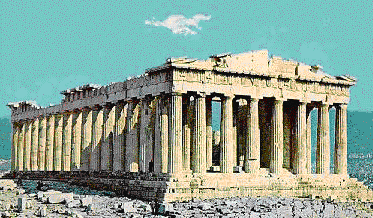
There have been many ways of answering the question, “What is Europe?” But a handy way to think of the matter is the paradigm of “Athens” and “Jerusalem.” In this paradigm, those terms designate both the two cities we have all heard of, and also two kinds of mind.
The tradition designated “Athens” is associated with philosophy and with critical exercise of mind. The tradition associated with “Jerusalem” is associated with monotheism.Comment: According to Jeffrey Hart, who wrote the original piece, our culture is primarily British. As evidence of this, Hart cites Athens and Jerusalem. Neither city is British and Jerusalem isn't even European (Western).
If both cities had been European, then what? Is Hart saying no one except Europeans could think philosophically or critically? Or that monotheism was somehow required for the founding of the United States? The first statement is demonstrably false and the second is worthless speculation.
And what's the relevance of thinking critically or believing in one god to our language, legal system, or political institutions? Nothing, judging by Hart's essay. He fails to make the connection between Jerusalem and Athens (or any other pair of cities) and Britain.
Britain was a monarchy when the colonists rebelled against it, so that's one huge "political arrangement" they didn't emulate. In fact, the nascent Americans derived many of their political and philosophical attitudes from Indians. Foremost among these were our beliefs in liberty and equality, neither of which was widespread in Europe.
Is this the ultimate marriage of Indian-style and old-school gaming? Check out the video and see.
Controversy Over Possible Casino in Vegas[I]f the deal goes through, the yet-to-be named casino would be the first indian owned casino on the Las Vegas strip. But it doesn't come without some controversy.
The future casino's plans can be found on 'You Tube' showing the public a glimpse of what could increase the Las Vegas strip by 75 acres. The plan is being fronted by a Washington tribe, the Muckleshoots who are well known for their business dealings around the Seattle area.
This promotional video on-line was produced by Ellis:Las Vegas, a management company that would run the casino if plans are finalized. It shows a state-of-the-art casino complete with a 9000 room hotel, world class indoor stadium, rodeo drive shopping mall, recording studio, and a large native american museum that would rival the Smithsonian.
According to Rolland Satland, the spokesman for the Muckleshoot tribe, the Fort Hall Business Council has already signed on to take part in the deal.
But according to Patricia Patterson, not every enrolled member of the Shoshone-Bannock tribe endorses the business venture. Patterson told NBC Newschannel 6 that quote "Tribal members should get the facts about the deal before they endorse the Las Vegas casino." She went on to say quote "We need to solve the problems in our own backyard before we get involved with deals outside of Idaho."Comment: This video supposedly presents a "soon to be tribal casino in Las Vegas with a Beverly hills theme." It's an excellent example of style over substance.
A new TV show, New Amsterdam, airs this Tuesday and Thursday. It's noteworthy because it uses an Indian as a plot device.
Immortal cop walks unusual beat in new Fox dramaAmsterdam (Coster-Waldau, who looks something like Jason Bateman's more-dashing brother) was a Dutch soldier who in 1642 stepped in front of a sword to save the life of a Native American girl during a massacre of her tribe. She thanked him by conferring upon him a spell that keeps him alive and ageless until he finds "The One," i.e. his soulmate.Is it any good?The premiere teleplay from Christian Taylor does a capable, if slightly workmanlike, job. Coster-Waldau paints a beguiling portrait of a brooding, conflicted, undeniably charismatic soul. His character is the second ageless protagonist to surface this season--the other being private eye/vampire on CBS' freshman drama "Moonlight."Comment: An Indian woman who casts a spell...hmm. At least it's a positive spell rather than a negative spell--i.e., a curse.
In addition to two immortals this season, we saw the Devil (Reaper) and a guy who brought people back to life (Pushing Daisies). Moreover, a robot (Terminator: The Sarah Connor Chronicles) and a reporter (Journeyman) traveled back in time to cheat death and keep people alive. In this TV season, one might say, death took a holiday.
Veterans disagree with new medalLeaders of several Navajo veterans organizations are opposing plans by Speaker Lawrence Morgan (Iyanbito/Pinedale) to create a Diné Medal of Honor and present it to all Navajo military personnel, past and present.
Navajo agency and chapter veterans' group commanders meeting Monday voted 34-0 not to support the plan.
On Jan. 17, Morgan announced in a press release that he and the council are looking for someone to design the medallion.
"This medallion will be for Diné warriors who have served and who are currently serving in the military," Morgan stated in the release.
Joshua Lavar Butler, spokesman for Morgan, said the council appropriated $75,000 last July to pay for the medallions.Comment: I guess the Navajo Nation has a lot of spare cash lying around. It must've solved all its pressing social problems already.
Bedard, Lacapa warm up Gallup's El Morro Theater with Friday performanceBedard, whose film credits include "Smoke Signals," "Lakota Woman," "Edge of America," and "The New World," performed music and poetry from her albums "Warrior of Love," "I.D. EP" and "Raven Boy."
The latter is her newest CD and is slated for a late March release.And: Bedard's eloquent speaking voice dominated the audience's attention as Wilson provided a lively guitar backup and Ortman blended the shrill sound of her violin.
The performance included "India & Pakistan," "Ideology," "Hooray 4 the Sun," and new songs "Arctic Fox," "Raven in the Midnight Sun," and "The Wolverine Secret."
Sherman Alexie will give World Touch Cultural Heritage Week keynoteA keynote presentation by novelist, poet and screenplay writer Sherman Alexie will kick off the 35th Annual World Touch Cultural Heritage (WTCH) Week, March 24-29, at the University of Minnesota, Morris. Alexie will speak at 7:30 p.m. Monday, March 24, in Edson Auditorium of the campus Student Center. A reception in the Student Center’s Oyate Hall Alumni Room will follow the presentation.
Alexie has been hailed as one of the best young writers of his generation. The New Yorker named him one of the top 20 writers for the 21st Century. A gifted orator, Alexie won the World Heavyweight Championship Poetry Bout four years in a row, from 1998 to 2001. In his lectures, he tells tales of contemporary American Indian life laced with razor-sharp humor, unsettling candor and biting wit.Comment: For more on Alexie, see All About Sherman Alexie.