Showing posts with label Healthy Aboriginal Network. Show all posts

January 24, 2014

Healthy Aboriginal Network's comic books

I haven't mentioned the Healthy Aboriginal Network in a while. They've been busy producing Native comic books.

Healthy Aboriginal NetworkWe create comic books on health and social issues for youth. The books we have in stock are listed below.

Financial literacy--The Game Plan. We all think we know what happens to our money--how much we make and where we spend it. And if we’re asked whether impulse buys and payday loans are a good idea, we all likely know that the answer is ‘no’. But making the right decision at the right time can be hard to do. Check out how money all finally makes sense to Jake once he relates it to his lacrosse aspirations.

Dog bites--The Gift. Dog bites are a real problem in some rural communities. Knowing what to do, but maybe more importantly what not to do, could help avoid a painful bite. It’s up to all of us to respect our relationship with dogs.

Residential school--Lost Innocence is a fictional story (but based on documented real life experiences of survivors) of a brother and sister's residential school experience in the 1930s. It's our longest book at 64 pages and has a truth and reconciliation theme.

Maternal child health--It Takes a Village. Our maternal child health book is about Lara, a young mom-to-be that is visited by Danis, a stranger. Danis teaches Lara the importance of eating healthy foods, avoiding alcohol, breastfeeding, keeping dad involved and bonding with your baby.

Sexual health--Kiss Me Deadly. A range of issues are covered in our sexual health comic book--from respect and communication in relationships, to pregnancy and sexually transmitted infections, two-spirit people and sexual health as a career or youth led project.

Integrating gang youth back into communities--Incarcerated youth were asked about their experiences with their gangs. Droppin' the Flag is the product of those discussions. When asked what we could change during the focus group testing process, gang youth said 'don't change a thing. That's the way it is.'

Youth in care--Lighting up the Darkness. Jenny returns to her community after living in the city with her aunt and uncle. While visiting family, she has a series of painful flashbacks to when she was a little girl. Jenny’s story is one girl’s struggle. But many youth will be able to relate to events in her young life.

Living with FASD--Drawing Hope is a collection of five stories, based on stories told by members of the Whitecrow Village community. The stories are about struggling in school, the importance of friendships and receiving support from friends and family.

Smoking prevention--River Run is the story of a group of youth that learn the traditional use of tobacco while on a canoe trip. One of the youth, who smokes, gets her world opened up along the way.

Sports/gang awareness--In Path of the Warrior, Cullen gets rolled out of his gang and is forced to reconnect with his family and community. Team sports and culture become his new support system.

Mental health--In Just a Story, Wendy doesn’t have any friends her age and feels overwhelmed at school. Her little brother is more social but he’s quick to lose his temper and get into fights. Something is clearly bothering them both. Good thing they’re open to getting help and breaking down the stigma of mental health.

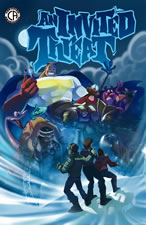
Diabetes awareness--An Invited Threat is about a family’s realization that the food they eat and make available to their community is not good for them. It’s about making healthy decisions now, rather than waiting until it’s too late.

Dropping out/staying in school--In Level Up, Terry is contemplating dropping out of school. But before he does, he’s asked to spend some time with his cousin Dave, a successful game developer. Rather than lecture Terry, Dave makes the importance of school relatable - he compares education to moving up a level in a video game.

Gambling awareness--In On the Turn is about a young woman that learns how to play poker at school. Peer pressure gets the best of her and she learns what it feels like to hurt someone she loves.

Youth health issues--Standing Together was HAN’s first comic book. It was created by youth, on the issues that they felt were important to their community. As it turns out, health authorities felt the same.
February 08, 2013

Posters and comic books for health

Using art to save lives

By Chris ComleyYellow dots circle about the woman, framing her against a murky background. Her arms rest idly by her sides as she gazes askance. The portrait “Grandmother,” by artist Hulleah Tsinhnahjinnie (a member of the Seminole, Muscogee, and DinĂ© tribes), is one of many pieces created by well-known Native American artists featured on public health posters throughout the nation.

The posters are part of a campaign by Native People for Cancer Control, based at the University of Washington, to raise cancer awareness and promote cancer-preventive measures to decrease health disparities in the Native community. By leveraging the appeal of art, a traditional tool for learning, the group hopes that the Native Art for Cancer Project will close what has been a persistent gap in public health.

“It’s a great way to start the conversation on cancer topics,” said Carrie Nass, program director for Partnerships for Native Health (PNH).
And:PNH also utilizes art as an interactive tool to raise awareness of public health issues through the Native Comic Book Project. The project teaches youth through comic books.

“To solve health disparities, you have to start with the kids,” said Corinna Tordillos (Northern Cheyenne and Tlingit), a senior majoring in biochemistry and American Indian studies who has been involved with PNH as a student assistant and as a researcher since her freshman year.

By actively engaging the students in the learning process, the project aligns itself with a traditional Native way of learning, thus increasing its effectiveness, said Robyn Pebeahsy (Yakama and Comanche), research assistant for the Native Comic Book Project.
Comment:  The Native Comic Book Project sounds like what the Healthy Aboriginal Network is doing in Canada. I wonder if the Washington people were inspired by the Healthy Aboriginal Network, or if they're working with them.

For more on comic books and health, see It's Up 2 You Available and CDC Books at NYC Con.

December 09, 2010

Van Camp's new comic books

Author Richard Van Camp blogs about the comic books he's written:

This week in comics and my rant on Jason Aaron's "Scalped"[G]reat news for our Aboriginal comic book company. Sean Muir, our publisher, continues to publish fantastic and important comic books that deal with hard hitting issues facing Aboriginal youth and all communities:

Here's our website: http://www.thehealthyaboriginal.net/

You can now read the first 12 pages of all our titles.

My first comic book, "Path of the Warrior," with artist Steve Sanderson is going into its second print run. This means we've sold 30,000 copies! If your organization would like to purchase some, please get in touch with me at vancamprichard(at)gmail.com

My new comic book, "Kiss Me Deadly" with artist Chris Auchter, should be out in February. It's about sexual health and it's hilarious. We're proofing it right now.

Our mission statement has always been "story first, issue second." What that translates to is if we're hired to write about diabetes prevention, we focus on the characters, plot, narrative first and deal with the issue through theme and positive action.
Comment:  The Healthy Aboriginal Network's mission statement expresses the right way to do Native comics. From what I've seen of their comics, they've generally succeeded.

For more on Van Camp and comic books, see Summing Up the Eiteljorg Event. For more on Van Camp's books, see Upcoming Film of The Lesser Blessed and Carl Brandon Society's Recommendations.

September 14, 2010

Review of JUST A STORY

Here's another comic book about a health issue from the Healthy Aboriginal Network:

JUST A STORYIn JUST A STORY, Wendy doesn’t have any friends her age and feels overwhelmed at school. Her little brother is more social but he’s quick to lose his temper and get into fights. Something is clearly bothering them both. Good thing they’re open to getting help and breaking down the stigma of mental health.

(Click on the link to see it in PDF form.)

And a guest review by Felicia Wetzig, who's working for Blue Corn Comics as an editorial assistant:JUST A STORY is a comic by Stephen Keewatin Sanderson about a young girl, Wendy, and her brother Adam. As a result of their troubled home life, neither can function in school--Wendy is so shy she can’t even answer questions in class, while Adam tries to solve all of his problems with violence. The story reaches a climax when Wendy writes a fictional story in class that she has used to characterize her own home life. Her teacher recognizes the problem and sends her to see the school guidance counselor. Eventually both children are able to overcome their problems and anger.

The scenario of a traumatic home life, and abusive parents causing children to struggle in school is, unfortunately, something many people can relate to, either having experienced it in their own life or knowing someone who has. The story however loses its realistic touch with an ending that seems too simple and fast. Are readers really supposed to believe that just by going to a school counselor both children suddenly have a normal school life? Unfortunately, the main problem--their parents--is never dealt with in any significant light. Treating the symptoms will not get rid of the disease, so in reality without help beyond the school guidance counselor, these children would have serious lingering problems.

Another possible drawback, is that the entire comic, although obviously aimed at aboriginals, never makes any mention of tribal connections. In fact, the main characters never reveal anything that may identify their race or ethnicity. On the upside, it goes along with the thought that Natives are just like everyone else so there is no need to linger on identity. After all, we would not expect a white character to identify himself so we know what category to place him in.

Artistically speaking, the sequence showing Wendy’s imagined version of her life is the most appealing section--beautifully drawn, and it works very well, but the rest of the comic could use some more work. Often the depiction of characters does not line up very well with the dialogue or the story line. On page 28, for example, when the teacher is explaining the writing assignment to the class she just looks completely dazed and confused.
Rob's review

Even though Steve Sanderson is drawing cartoon-like characters--big heads and eyes, stick limbs, three fingers per hand--I think the style works well. It emphasizes the wide-eyed innocence and fragility of our children.

Also good are the backgrounds, which Sanderson paints almost like watercolors. Though they show ordinary scenes--buildings, classrooms, fields--they create a three-dimensional world. You can imagine the kids moving through space and feeling dwarfed by their surroundings. This may not seem noteworthy, but too many comics focus on foreground images and don't give you a sense of place.

Alas, the comic indulges in one of my pet peeves: using too much space to tell the story. This story has 48 pages, but most of them have only four panels. It wouldn't have been hard to tell the same story in half the pages, which would've reduced the costs and made it cheaper for consumers.

The point of JUST A STORY is to encourage kids to talk about their problems. I'm not the target audience, but in that regard, I imagine it's a success. The comic might well give troubled kids a warm, fuzzy feeling about sharing their problems with sympathetic adults.

The talking solution

But as a piece of dramatic writing, it's a little light. We infer that the parents fight constantly because the kids say so, but the only clear evidence of it is an off-panel sound effect ("Crash"). There's too much telling and not enough showing.

Nor do the kids react strongly to this domestic situation. Adam pushes a boy who accidentally trips him, while Wendy merely acts shy and bites her fingernails. These things happen to many kids whether their parents are angry or not.

The story within the story is supposed to show us how bad the domestic situation is. A couple of problems with that. One, Wendy's story might be an exaggeration. Two, Wendy's reactions at home--crying every night--don't match her reactions at school--mild shyness and finger-biting. If biting her fingernails is Wendy's worst habit, does she really need counseling?

If I had written JUST A STORY, I probably would've given the kids several more problems at school. Then the fantasy sequence detailing their home life would've been more of a revelation. But perhaps health experts thought that showing the kids suffering would've been too intense for young readers. So Sanderson went with a mild version in which real adults don't do anything scary.

No doubt encouraging people to talk is a good thing. But the story's resolution is only a first step toward really resolving the problem. Getting the kids to open up won't matter much if their parents keep fighting. Maybe the next Healthy Aboriginal Network comic will explain what to do when you share your feelings but your parents still throw dishes at each other.

Anonymous Natives

Also, it's weird that there's not a single indicator that the kids are Native other than their dark brown skin. I guess British Columbia's government doesn't want to single out a particular tribe--which I consider a mistake. But not to mention any Native concepts or show any Native images? If JUST A STORY is for Native kids, it should give Native kids something to identify with.

And why do the fantasy versions of Wendy and Adam have lighter skin than the real-life versions? The implication is that princesses and princes can't have dark brown skin. This isn't the way to get brown-skinned kids to identify with the protagonists.

But overall, I think the lovely art and heartfelt message outweigh the criticisms. More to the point, I think JUST A STORY does what it sets out to do. If I knew kids who weren't talking about their problems, I'd try giving them this comic. And I wouldn't be surprised if it coaxed them to open up.

For more on the Healthy Aboriginal Network's comics, see:

Review of LEVEL UP
Residential-school comic-book videos
Gang-prevention comic-book videos

June 23, 2009

Review of LEVEL UP

Sean Muir of the Healthy Aboriginal Network send me a low-res PDF of LEVEL UP, another of their issue-oriented comic books. The subject this time: staying in school.In Level Up, Terry is contemplating dropping out of school. But before he does, he's asked to spend some time with his cousin Dave, a successful game developer. Rather than lecture Terry, Dave makes the importance of school relatable--he compares education to moving up a level in a video game.Rob's review

LEVEL UP was written and drawn by Steve Sanderson, who also did DARKNESS CALLS and AN INVITED THREAT. With his third comic, we're beginning to see a pattern. All three stories have a similar structure:

Kid has a problem. Elder tries to set him straight. Kid enters a fantasy world where he triumphs over a pop-culture menace. Kid applies the lessons he's learned and resolves his problem.

As usual, Sanderson's cartoony art is very good, and fitting for a youth-oriented comic. The only thing I question is making cousin Dave cross-eyed a few times for no good reason.

As usual, it's nice to see totally modern Natives living like everyone else. This is almost unheard of in Native-themed comics. If such comics are set in contemporary times, they're likely to feature an angry veteran, a downtrodden reservation, and casino. (See SCALPED for examples of these stereotypes.)

That's the upside of the Healthy Aboriginal Network's comics. But it also has a downside:

As usual, the organization's comic has nothing specific about a location, a tribe, or even an ethnic group. The only sign of Terry's being Native is calling his grandfather "Mosom," which I presume is a title of respect. Other than that, he could belong to any brown-skinned group--from Latino to Arab to Asian Indian.

As usual, I consider this a flaw--an example of weak storytelling. I believe the organization's position is that the government agency funding the comics requires them to be "generic." But I've seen no signs that the writers and editors have tested this misguided policy. Art is about pushing the boundaries, not doing what someone tells you to do.

Education = video game?

I think LEVEL UP is a bit less successful than Sanderson's previous efforts. Why does Terry want to drop out of school? Because he sees a rapper on TV and thinks he can emulate him, even though he has no skills. This seems like a plot you'd see on a five-minute cartoon or skit for preteens, not a serious story for young adults.

The video-game analogy doesn't work too well. First, Dave tells Terry that school is boring. Then Dave says going without math, science, and English is like going without armor, weapons, and powers in a video game. Terry's unarmed video-game surrogate proceeds to get wiped out by the enemy.

Then Dave switches gears. If you graduate from high school, he says, you get to go to college, where learning is fun and there are girls at parties. In fact, getting good grades and a diploma is like having a full complement of weapons and powers. Terry's now-armed video-game surrogate proceeds to vanquish the enemy and move to the next level.

To summarize, education is boring in high school but becomes fun in college, mainly because there are co-eds who like to party. That makes staying in school more appealing than being a rap star with a mansion, a car, and a girl in a hot tub. In fact, getting an education is exactly like blowing up bad guys in a video game, and that's a lot of fun.

I dunno...if the Healthy Aboriginal Network was aiming this simplistic message at preteens, it might be effective. But Terry is a high-schooler, which suggests the target audience is high-schoolers too. I'm not sure that LEVEL UP's simple message will impress kids that old.

So LEVEL UP is another comic book with modern but generic Natives. With an important but obvious message. In short, it's a mixed bag of a comic.

For more on the Healthy Aboriginal Network's work, see the Gang-Prevention Comic-Book Videos and Residential-School Comic-Book Videos. For more on the subject in general, see Comic Book Featuring Indians.

May 20, 2009

Residential-school comic-book videos

The Healthy Aboriginal Network (HAN) has posted the first draft of another comic book--this time on the residential-school scandal. Again:HAN is using YouTube to test the story outline and concept with online focus groups and to collect their feedback. The feedback will be used to develop the final draft of the comic which will be published in full colour for distribution.


Rob's reply

Another nice set of videos. I liked the art, especially the abstract trees, buildings, corridors, windows, and so forth. This looks like it might be a Jay Odjick production. Maybe add writing and art credits to the videos?

The cartoon style works for the characters too. The only thing I didn't like was the boy's cheek drawn at a right angle ending in a point. It's so unreal that it took my mind off the story.

I'm curious which age group is the intended audience for this comic. To me it reads like a pre-teen comic. If that's your goal...great, I think you've achieved it. You can ignore most of the comments that follow.

If you're aiming for a teen audience, I think you're underestimating them. Or maybe I'm overestimating them, but let's go with the first assumption. The story seems a bit too simple and straightforward to engage today's jaded teens.

My impression is that it will engage younger children but perhaps not older children. Which is okay if that's your goal. But my approach is always to aim high. Write the comic for older kids so they'll read it and so younger kids will aspire to read it. I was always intrigued by comics I couldn't quite understand, and I appreciated them all the more when I finally did understand them.

Anyway, it may be too late to make any kind of major changes. But this critique will tell you what I'm thinking, at least. If these thoughts don't influence this comic, they may influence the next one.

Although I'm advocating changes, I'm not necessarily suggesting you make the comic longer. I understand you have funding limitations. I'm suggesting you make it denser, with more going on in each panel. This also has the advantage of making it more interesting to older readers.

Specific comments

As always, I want more concrete cultural details. Giving the kids Native names is a good start. How about naming the year, province, city, or boarding school in which the story takes place? Give the priest and nuns names too.

As far as I can tell, you have three kids with proper names and no other specific details. This story could take place anywhere in Canada over a 25- or 50-year period. To me that's not good.

The opening scenes of playing in the forest seem too long to me. You could save some space there. And I thought Canadian lakes were supposed to be icy cold. Are these kids immune to the cold? And why are they jumping in with their clothes on?

The kids seem too generic to me. Plucky boy and girl and...what else? Can you name one or two traits that make each kid a unique individual rather than a plucky archetype? Because I can't, and that's a problem.

I'd consider having the kids refusing to go to the school and the priest having to drag them to the car. That's kind of a cliché--see Rabbit-Proof Fence for an example of this--but the way it is now, it lacks drama. Has the father heard how bad the boarding schools are, or is he ignorant about this? I can't tell from his attitude, and that's something we should know.

I'd consider having a scene where the kids' long hair is cut off. As it is, the story avoids a prominent source of trauma. This might be another cliché, but again, the introduction to the school is somewhat lacking in drama.

I'd suggest adding a whole layer of complexity to the school scenes. Instead of two boys and one girl, show four boys and two girls. One boy could be a bully/martinet type who wants to stay in school and get ahead. Another could be Peter the confidante--but give him an additional trait such as being a practical joker. Another could be a weak or sickly boy. As for the other girl, she could be a gossip/tattletale.

I'd suggest adding a similar layer of complexity to the adults. Right now the priest and nun are too blatantly villainous. Have a good priest as well as a bad priest or a good nun as well as a bad nun. I think a good nun who sincerely thinks she's helping the kids by smothering them with God's love would be more chilling (and interesting) than your Gestapo-style characters.

Kids think the darndest things

The kids seem like they're 8 or 9 years old. I guess they act in age-appropriate ways. But I kind of wish they were a few years older. Then they could have more complex thoughts that would engage readers like me more. Perhaps thoughts like these:I don't understand. They say Jesus loves me, but his woman keeps hitting me with a stick. What would she do if he didn't love me.

I must pray to the Creator xxx [proper name]. You are strong, o great one. Please come and battle the Christian god for me.

Our culture gave up slaves long ago because the Christians told us to. How odd that these Christians still keep slaves--us.
In other words, I'd like to see much more of a clash of cultures. The nun tells the boy to pray to God for forgiveness. How would a typical Native boy react to that? A response such as "I've failed you, father" is totally generic. I want something specifically Native and not generic.

The classroom scenes are another opportunity for a culture clash. Show the kids learning English, which would be a good thing. Since the residential schools did educate people, they weren't wholly bad. But while the kids are learning something useful, have them learn something useless, like--I dunno--the names of the countries in Africa. And the boy thinksWhat kind of school is this? I could be learning how to hunt and put food on the table. Or how to find herbs that cure illness. Instead the teacher is chirping like some crazy bird. I don't understand a thing she's saying.Again, think culture clash.

The great escape

The big escape is yet another opportunity for drama. Have the sickly boy die overnight. Have the tattletale snitch that the kids are about to escape. If the priest has molested the girl, make that more explicit (but not too explicit). Perhaps he's alluded to wanting her, which gives the kids another reason to speed up the escape.

Incidentally, is the bed the boy pushes on wheels? It looks too heavy for a kid to slam it into somebody.

Have the rotten nun be the one to grab the boy in the window. She deserves a kick in the face. (Sample dialog: "How dare you kick a woman of God?!" "If a ugly old bear grabbed you, wouldn't you kick it too?")

Have the jokester kid sacrifice himself so the boy and girl can escape. That's more dramatic than the way it is now (Peter's sick so he has to stay in bed). This story needs a sense of loss to make the boarding-school tragedy more real.

As it is, the whole Peter thing is too obvious. The first time he coughs you think, "Oh, okay...Peter obviously won't escape because he's sick." My version is less predictable. The sick kid dies--readers didn't know the boarding-school saga was so grim. And the healthy kid gets caught--readers were sure the jovial Peter would escape too. Surprise!

Again, see Rabbit-Proof Fence for an example. Two kids escape, but their friend is captured. Peter's whole life will be dramatically different than theirs. Yes, it's tragic, but that makes their escape all the sweeter. He doesn't have a chance, but they do.

For more on how horrific the residential schools were, see Irish Children Abused Too. For more on the Healthy Aboriginal Network's comics, see Gang-Prevention Comic-Book Videos and Comics Good for You.

May 19, 2009

Gang-prevention comic-book videos

Some comic-book videos from our colleagues in Canada:The Healthy Aboriginal Network's (HAN) first draft of their comic that deals with gang prevention and the positive impact of physical activity. HAN is using YouTube to test the story outline and concept with online focus groups and to collect their feedback. The feedback will be used to develop the final draft of the comic which will be published in full colour for distribution.


Rob's reply

I like almost everything about these videos. It feels like you have a good group of characters and plot elements--enough for a fine comic book.

A few comments--constructive comments, I hope:

  • The police chief's two-minute deadline to decide seems unrealistic. Wouldn't he give Cullen a day or something?

  • As you may know, I'm always seeking more specificity in Native storytelling. There's nothing specific to any Native culture here. Just semi-generic things like a talking circle and making drums.

  • I think it would enrich the story if you added some words or concepts from a specific culture. It doesn't have to be from a specific tribe, just a cultural group like the Ojibwe or Cree.

    I guess the counterargument is that you want the story to be universal. But universal means more general and less interesting. I don't think people are put off by more details. Just the opposite, I'd say: the more detailed it is, the more real it seems. Which makes it more interesting and involving to readers.

  • I suppose it's too late now for a major rewrite, but I'd say the story needs a subplot or two to add drama. It's a little too straightforward and earnest as it is. It wouldn't have to be anything hugely different; just a little twist to add suspense.

  • For instance, Cullen accidentally shot the baby and only Reggie knows he did it. Reggie doesn't just give Cullen the evil eye, he blackmails him to rejoin the gang. Cullen must decide whether he'll go back to the gang life or reveal himself as the shooter.

    Or it could be something about reuniting with Tina and his baby. For instance, when he was a gang member, she got a restraining order saying he couldn't see them. Now he's not only afraid, he's physically barred from approaching her. But when the community sees he's reformed, she reappears to him. Because he didn't expect this, the ending has more of an impact.

  • The only other thing I'd say is don't make Cullen too much of a square-jawed Superman. He's so tall and handsome that it's hard to take him seriously as a gangbanger. He already looks like a hero even when he's with the gang.

  • It's like putting John Wayne or Harrison Ford or Tom Hanks into a gang. I.e., it stretches credulity a bit. What about giving him a tattoo or a piercing or something? If Cullen looks like a gangbanger but then reforms, the transformation will be more sincere and affecting.

    For more on the subject, see Comics Good for Your Health and Comic Books Featuring Indians.

    June 20, 2006

    Comics to the rescue!

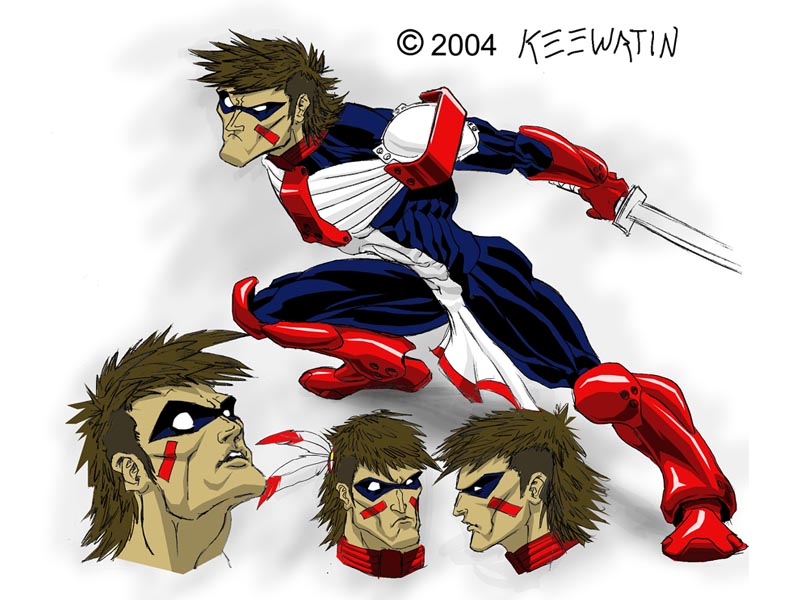
    Superhero flying to the rescue of native youthSuicide is a scourge among young aboriginals. But a new superhero, with eagle feathers in his hair and a red, white and blue suit that hugs his chiselled body, is flying in to the rescue.

    His name is Wesakechak, named after the mythical shape-shifter and protector in Cree legends. But he's been updated for the 21st century with a flying motorcycle, superhuman strength and put inside a comic book now being distributed across the country for aboriginal youth.