Quebec-made Ungava gin accused of cultural appropriation
Inuk Montrealer says company’s advertising, branding profit off Inuit culture
Canadian gin company's campaign accused of cultural appropriation
Ungava apologises to Inuit for offensive video showing cartoon characters paddling a canoe past igloos and a man’s voice is heard chanting
“Have you met the Ungava Inuits?” A response to Ungava Gin’s marketing campaign
Ungava gin apologizes for marketing miscue, but did the company learn anything?
Gin takes it on the chin as Inuit complain of images used in sales pitch
'The more I've looked into stuff, the more disgusted I got,' says journalist Ossie Michelin
Showing posts with label Inuit. Show all posts
Showing posts with label Inuit. Show all posts
September 16, 2016


January 10, 2016
Of the North triggers protests
Of the North film screening goes ahead despite petition from Inuit against it
Documentary is made from clips from internet sites including YouTubeA group of Quebec Inuit are trying to stop a controversial documentary from screening at future film festivals after a showing in New York City on Sunday.
Of the North by Montreal filmmaker Dominic Gagnon has come under fire for its depiction of Inuit communities.
Made of video clips from various websites including YouTube, the film contains scenes of people appearing drunk and wrestling on the floor. To make the film, Gagnon says he drew from around 500 hours of footage of the circumpolar region and stitched it together at his computer in Montreal.
A petition to have the film's screening cancelled at the Museum of the Moving Image has garnered closed to 1,200 signatures. Comment: For more on the subject, see The Best Indian Movies.

Documentary is made from clips from internet sites including YouTube
Of the North by Montreal filmmaker Dominic Gagnon has come under fire for its depiction of Inuit communities.
Made of video clips from various websites including YouTube, the film contains scenes of people appearing drunk and wrestling on the floor. To make the film, Gagnon says he drew from around 500 hours of footage of the circumpolar region and stitched it together at his computer in Montreal.
A petition to have the film's screening cancelled at the Museum of the Moving Image has garnered closed to 1,200 signatures.
November 27, 2015
KTZ copies sacred Inuit robe
KTZ fashion under fire for using Inuit design without family's consent
‘This is my great-grandfather’s sacred garment copied right down to the tee,’ says Salome Awa
By Sima Sahar ZerehiThe U.K.-based fashion label KTZ's fall 2015 men's collection includes a number of garments based on traditional Inuit designs and a sweater that appears to be a replica of a shaman's jacket, which a Nunavut woman says was used without her family's consent.
"I was in shock, I was furious, I was angry," said Salome Awa, who works as a morning show producer at CBC Nunavut.
"This is my great-grandfather's sacred garment copied right down to the tee."
It's the second year in a row that KTZ has been accused of copying a garment based on an indigenous design. Last year it came under fire for allegedly copying a dress from Bethany Yellowtail, a Northern Cheyenne/Crow designer from Montana. Twitter erupted with support for Yellowtail. Canadian retailer pulls 'stolen' sacred Inuit design from storesAfter our interview aired, we learned of a Canadian retailer that sells the KTZ sweater. The company is called CNTRBND and has stores in Toronto and Vancouver. They were selling the garment for $925 CDN.
Owner Christopher Casuga says he was personally offended when he saw the story. On Thursday, Casuga pulled the sweater from his sales floor and removed it from the company's website.
He says he didn't want to sell "anything that insinuates negativity toward native people. We want to make sure we are representing Canada in the best way possible."
On Friday, KTZ issued an apology to Awa. You can read the letter here. KTZ apology for copying sacred Inuit robe 'bittersweet'
'It's not right, they should have contacted us in the first place,' says Salome Awa
By Sima Sahar ZerehiA Nunavut woman whose great-grandfather's sacred shaman robe was copied without consent by U.K.-based fashion label KTZ, says an email apology offered to her by the design firm is "bittersweet."
"We sincerely apologize to you and anyone who felt offended by our work as it certainly wasn't our intention," stated KTZ in an email to Salome Awa this morning.
The label's fall 2015 men's collection includes a number of garments based on traditional Inuit designs, including a sweater that appears to be a replica of a shaman's jacket, belonging to Awa's great-grandfather, used without her family's consent.
"KTZ has always been inspired by and paid homage to indigenous cultures and tribes around the world," the apology said. Appropriation not a mistake
Was this appropriation an innocent mistake that happened because KTZ didn't know the parka's significance? Probably not.
In fact, probably the opposite. That is, KTZ probably knew of the coat and copied it precisely because it was famous.
Inuit shaman parka 'copied' by KTZ design well-studied by anthropologists
'It's the most unique garment known to have been created in the Canadian Arctic,' says Smithsonian researcher
By Sima Sahar ZerehiAn Inuit shaman's parka copied by KTZ, a U.K. design label, has been the subject of study for generations and is considered by experts as the "most unique garment known to have been created in the Canadian Arctic."
The fashion label's fall 2015 men's collection includes a number of garments based on traditional Inuit designs, including a sweater that has a pattern almost identical to that on a shaman's caribou skin parka that dates back to the early 1900s.
The design was used without the consent of the shaman's descendants in Nunavut. In response to a CBC News report last week, KTZ apologized to the family and pulled the sweater from its online stores.
The story has sparked interest in the origins of the parka and the meaning behind its symbolic designs.
Comment: For more fashion faux pas, see Jennifer Lopez Wears "Tribal" Outfit and KTZ Rips Off Native Designs.

‘This is my great-grandfather’s sacred garment copied right down to the tee,’ says Salome Awa
By Sima Sahar Zerehi
"I was in shock, I was furious, I was angry," said Salome Awa, who works as a morning show producer at CBC Nunavut.
"This is my great-grandfather's sacred garment copied right down to the tee."
It's the second year in a row that KTZ has been accused of copying a garment based on an indigenous design. Last year it came under fire for allegedly copying a dress from Bethany Yellowtail, a Northern Cheyenne/Crow designer from Montana. Twitter erupted with support for Yellowtail.
Owner Christopher Casuga says he was personally offended when he saw the story. On Thursday, Casuga pulled the sweater from his sales floor and removed it from the company's website.
He says he didn't want to sell "anything that insinuates negativity toward native people. We want to make sure we are representing Canada in the best way possible."
On Friday, KTZ issued an apology to Awa. You can read the letter here.
'It's not right, they should have contacted us in the first place,' says Salome Awa
By Sima Sahar Zerehi
"We sincerely apologize to you and anyone who felt offended by our work as it certainly wasn't our intention," stated KTZ in an email to Salome Awa this morning.
The label's fall 2015 men's collection includes a number of garments based on traditional Inuit designs, including a sweater that appears to be a replica of a shaman's jacket, belonging to Awa's great-grandfather, used without her family's consent.
"KTZ has always been inspired by and paid homage to indigenous cultures and tribes around the world," the apology said.
Was this appropriation an innocent mistake that happened because KTZ didn't know the parka's significance? Probably not.
In fact, probably the opposite. That is, KTZ probably knew of the coat and copied it precisely because it was famous.
Inuit shaman parka 'copied' by KTZ design well-studied by anthropologists
'It's the most unique garment known to have been created in the Canadian Arctic,' says Smithsonian researcher
By Sima Sahar Zerehi
The fashion label's fall 2015 men's collection includes a number of garments based on traditional Inuit designs, including a sweater that has a pattern almost identical to that on a shaman's caribou skin parka that dates back to the early 1900s.
The design was used without the consent of the shaman's descendants in Nunavut. In response to a CBC News report last week, KTZ apologized to the family and pulled the sweater from its online stores.
The story has sparked interest in the origins of the parka and the meaning behind its symbolic designs.
October 16, 2015
Greenland in Borgen
I never imagined the Danish TV show Borgen could have any Native content, but it does. Here's the scoop:
Borgen (TV series)Borgen is a Danish one-hour political drama television series. It tells the story of charismatic politician Birgitte Nyborg who unexpectedly becomes the first female Prime Minister of Denmark. "Borgen" ("the Castle") is the nickname of Christiansborg Palace, which houses all three of Denmark's branches of government: the Parliament, the Prime Minister's Office and the Supreme Court. The fourth episode involves the former Danish colony of Greenland and its Inuit population. Here's the basic plot:
TV Review: Borgen–“100 Days”Link TV’s Borgen continues with “100 Days.” Katrine (Birgitte Hjort Sørensen) gets some information from a leak within the military that the U.S. is using Thule Air Base in Greenland as a stop off while transporting illegal detainees. Katrine breaks the story on air. This is terrible timing for Nyborg (Sidse Babett Kundsen), looking for a positive to play up after one hundred days in office. But with characteristic tenacity, she not only visits Greenland, but takes up some of their causes as well. Below: A photo proves the presence of Muslim prisoners.

Native aspects
When the scandal breaks, Nyborg asks Greenland's premier Enok to meet her in Copenhagen:
'Borgen,' Episode 4: '100 Days'
By Maane KhatchatourianBirgitte is stuck when the U.S. refuses to reveal any information about the ordeal and she's forced to meet with the premier of Greenland, Jens Enok, to discuss the matter. But the premier knows what she's going to say before she opens her mouth. Greenland has been given the same song and dance for decades so Jens knows their meeting is nothing more than a futile ritual. He knows that the PM can't apologize because doing so would cause Denmark to lose face. And the PM certainly can't confront the U.S. The three countries are locked in their positions. "Greenland is no match for Denmark, just as Denmark is no match for the U.S.," he says. The young, charismatic Enok seems to be as astute as anybody on the show. When Nyborg takes their meeting seriously, he tells her it's a joke. They might as well drink their tea while they pretend to have a meaningful conservation.
Enok is played by Angunnguaq Larsen. Larsen is an Inuit actor from Greenland, so the casting is appropriate.
Looking for a way to celebrate her first 100 days in office, Nyborg surprises her advisers by suggesting a trip to Greenland:Feeling guilty about the U.S. cover up, Birgitte takes a trip to Greenland to offer them an explanation for her actions. She's greeted by a completely different Jens than the one who visited her a few days ago. "I can put on a happy face when I visit you, but I tell it like it is when you visit me," he says. Never mind the fact that Denmark had an entire town displaced in Greenland in order to build the air force where the CIA detainees landed, but he says their country has also been pushed aside for hundreds of years. He begs Birgitte to allow them to govern themselves at least to a certain extent. "It's hard for us to give you increased self-rule when nepotism, trade blinders, and corruption abound here," she says. As you can see from the last comment, Nyborg loses her cool and blames Greenland's problems on its people. Enok responds that they've been a colony 300 years but have had political power only 20 years. Nyborg and Denmark can't expect miracles.
Below: Enok and Nyborg talk.

Birgitte decides to extend her trip to learn more about the country. She finds out that 20 percent of Greenland's youth commit suicide. Jens says that the nation will soon die out if its people aren't given back their self-respect. On the plane ride back home, Birgitte tells Kasper that she wants to talk to the Americans, no doubt to reprimand them for the detainee ordeal (the U.S. president later cancels his trip to Denmark). When he questions her decision to upset the natural order, she says "You sell our politics. I make them. Get it?" He apparently hasn't learn his lesson, even after being fired. An emotional Birgitte later describes her conflicting opinions of the country to her husband. "It was magnificent. It was depressing. It was ugly. I think it's the most beautiful place I've ever seen, all rolled into one."
Thanks to Birgitte, Greenland is finally given a voice in its security matters and foreign affairs. For the first time in its history, the country leads the negotiations over the expansion of American control of the air force base on its territory. As with much of the series, this story line is based on real world events. In reality, Greenland passed a referendum in 2008 supporting greater autonomy. All in all, 100 Days is an excellent primer on how to do a Native-themed episode. It gives us a lesson about government-to-government relations between a Western power and its "domestic dependent nation." It suggests how historical trauma is passed down from generation to generation. That's more than you get in most TV shows featuring Natives.
Borgen (TV series)
TV Review: Borgen–“100 Days”
Native aspects
When the scandal breaks, Nyborg asks Greenland's premier Enok to meet her in Copenhagen:
'Borgen,' Episode 4: '100 Days'
By Maane Khatchatourian
Enok is played by Angunnguaq Larsen. Larsen is an Inuit actor from Greenland, so the casting is appropriate.
Looking for a way to celebrate her first 100 days in office, Nyborg surprises her advisers by suggesting a trip to Greenland:
Below: Enok and Nyborg talk.
Thanks to Birgitte, Greenland is finally given a voice in its security matters and foreign affairs. For the first time in its history, the country leads the negotiations over the expansion of American control of the air force base on its territory. As with much of the series, this story line is based on real world events. In reality, Greenland passed a referendum in 2008 supporting greater autonomy.
June 04, 2015
Review of Frozen Sun
I recently read this book:
Frozen Sun: A Nathan Active Mystery (The Nathan Active Mysteries)Blizzards, tundra, Eskimos, bush pilots, and bingo-loving grandmas enliven this literate ethnic mystery starring Alaska State Trooper Nathan Active, who has been assigned to the remote Arctic town of Chukchi. Though born an Inupiat Eskimo, Active was raised in Anchorage by white parents and has little knowledge of his native culture. During the long months he has spent in Chukchi, he has rallied against the icy weather and struggled to understand his two cultural identities, but he realizes how deeply he has been settling into the rhythms of community life when Grace Palmer, a local beauty queen, goes missing. The state trooper mounts a search that ultimately leads him halfway across Alaska—and gives him plenty of time to discover he is in love with Grace. Closing in on the answers, however, he discovers evidence that points to an agonizing situation: she is either dead, or she is a cold-blooded killer. Some official reviews:New York Times:
No one shows you the ugly side of Alaska the way Stan Jones does in his somber novels about Nathan Active, an Eskimo state trooper posted back to Chukchi, his native village in the Arctic Circle.
Kirkus Reviews:
That rare thing, a deftly plotted mystery that's also an irresistible love story. With it, Jones's Alaska series (Shaman Pass, 2003, etc.) takes a quantum leap forward.
Library Journal:
This third book in Jones's Alaskan series (White Sky, Black Ice; Shaman Pass) does not disappoint. The investigation turns Active's life upside down and reshuffles his beliefs.
International Noir Fiction:
Frozen Sun is, like the first two Nathan Active stories, a subtle, vivid, and effective crime novel that deserves a wide readership.
Fairbanks Daily News-Miner:
Early on, Jones offers this dead-on description of spring breakup: “The vanishing snow drifts were disclosing a winter’s worth of dog droppings, caribou bones, discarded trash bags, lost mittens, cigarette packs, and crumpled beer cans. He (Active) passed two ravens at work on the rear half of a tortoiseshell cat, the head and forelegs still frozen into a rotting snow bank.” Ah, the beauty of the Alaska we all know and love. And some Goodreads comments:As a mystery, the book is very weak, but is an interesting study of the psychology of character development.
The plot of this book generates little suspense so it's not exactly a page-turner, but the setting and characters are so interesting and unusual that it kept me reading avidly to the end.
Jones does a great job giving us a sense of the environment and the story line carries along easily.
Overall, another solid entry in the series. The setting and atmosphere are so immersive and wonderful that I will forgive a lot. I took Frozen Sun as more of a character study than a mystery. And more of a journey than a destination. I knew Nathan's obsession with Grace wasn't going to end well for his girlfriend Lucy, but I was curious how he'd get there.
And a semi-happy ending sealed the deal. If Nathan's situation had stayed the same, the story might have been disappointing. The promise of change helped make it work.
I liked Frozen Sun more than the Kate Shugak mystery I read. These books cover the same ground--"blizzards, tundra, Eskimos, bush pilots, and bingo-loving grandmas"--but the Shugak book spent too much time going on about the land and its people. Frozen Sun hit the sweet spot in terms of detail.
Since the series is supposedly improving, I'll give the fourth book a shot. Rob's rating: 8.5 of 10.
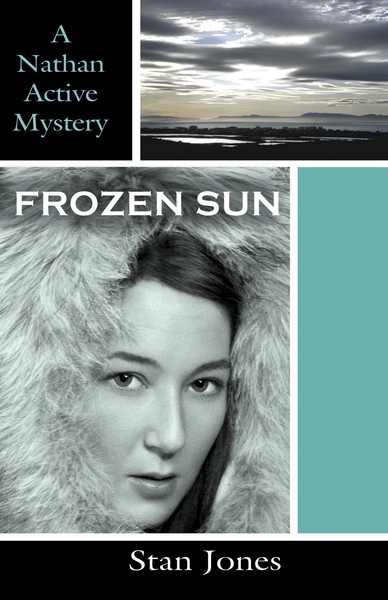
Frozen Sun: A Nathan Active Mystery (The Nathan Active Mysteries)
No one shows you the ugly side of Alaska the way Stan Jones does in his somber novels about Nathan Active, an Eskimo state trooper posted back to Chukchi, his native village in the Arctic Circle.
Kirkus Reviews:
That rare thing, a deftly plotted mystery that's also an irresistible love story. With it, Jones's Alaska series (Shaman Pass, 2003, etc.) takes a quantum leap forward.
Library Journal:
This third book in Jones's Alaskan series (White Sky, Black Ice; Shaman Pass) does not disappoint. The investigation turns Active's life upside down and reshuffles his beliefs.
International Noir Fiction:
Frozen Sun is, like the first two Nathan Active stories, a subtle, vivid, and effective crime novel that deserves a wide readership.
Fairbanks Daily News-Miner:
Early on, Jones offers this dead-on description of spring breakup: “The vanishing snow drifts were disclosing a winter’s worth of dog droppings, caribou bones, discarded trash bags, lost mittens, cigarette packs, and crumpled beer cans. He (Active) passed two ravens at work on the rear half of a tortoiseshell cat, the head and forelegs still frozen into a rotting snow bank.” Ah, the beauty of the Alaska we all know and love.
The plot of this book generates little suspense so it's not exactly a page-turner, but the setting and characters are so interesting and unusual that it kept me reading avidly to the end.
Jones does a great job giving us a sense of the environment and the story line carries along easily.
Overall, another solid entry in the series. The setting and atmosphere are so immersive and wonderful that I will forgive a lot.
And a semi-happy ending sealed the deal. If Nathan's situation had stayed the same, the story might have been disappointing. The promise of change helped make it work.
I liked Frozen Sun more than the Kate Shugak mystery I read. These books cover the same ground--"blizzards, tundra, Eskimos, bush pilots, and bingo-loving grandmas"--but the Shugak book spent too much time going on about the land and its people. Frozen Sun hit the sweet spot in terms of detail.
Since the series is supposedly improving, I'll give the fourth book a shot. Rob's rating: 8.5 of 10.
October 09, 2014
Natives in The Swarm
A couple of years ago I read the German sci-fi thriller The Swarm. It has a Native theme at its core and two Native characters. Here's the story:
The Swarm
A review by Georges T. DoddsIn The Swarm, Frank Schatzing postulates a situation where the sea, which we have been abusing for years, strikes back under the direction of an unknown living entity previously content to inhabit the trench depths--the Yrr. Whales begin attacking ships, hordes of jellyfish shut down the beaches of South America, and a strange new marine worm is destabilizing frozen methane in the sea bottom. The scientists are fascinated, the powerful want it stopped at any cost, and the little guy is being overwhelmed by tsunamis and poisoned sea-food. A global ecosystem shift is in the offing and while it's clear humans have a lot to do with it, it isn't clear they're going to survive it. The Swarm (novel)
Comment: The Native theme is the usual one: that all living things are connected. That we must live in harmony with nature rather than try to control it.
I don't know enough about scientific matters to critique the book technically, but the two Native characters are problematical. Let's look at them.
Leon Anawak
Leon Anawak is a young marine biologist specializing in whales. He ran away from home at age 12 because his father was drunk and abusive and his mother enabled him.
He's so ashamed of his past that he won't even admit being Native. Someone guesses he's Makah because the Makah hunted a whale and he might disapprove, but that isn't it.
For starters, his name sounds Inuit--like anorak--so Inuit would be a good guess. Presumably he looks Inuit also--a look somewhat different from American Indian. But no one makes the connection.
More important, his feelings of shame don't make sense. Why blame the entire culture rather than just his abusive family? Why not say, "I'm Inuit but I hate the place I came from?" It's just weird that he refuses to name his heritage as if that will somehow protect him. What does he think...that his fellow scientists will point and laugh at him because he's a Native from a bad home?
People used to deny that they were Native...but that was 50 or 75 years ago. I haven't heard anyone doing it recently. With all the social movements going on, Natives are reclaiming their traditions these days. As we've seen with the hipsters and other wannabes, it's "cool" to be Native now.
It seems author Schatzing has ignorant or outsider understanding of Native life. He thinks Natives are still downtrodden and any smart Native would repudiate his troubled past. But readers of Newspaper Rock know that just isn't so.
Anawak eventually visits his home in Cape Dorset, Nunavut, and learns it's experiencing a cultural renaissance. To him, this is a big shock. He's amazed that everyone isn't drunk and defeated-looking like they were two decades ago.
But Nunavut is in newspapers and on TV several times a week. You can read about it in blogs or on Facebook pages. Anyone with an Internet connection should know that things are changing among today's Inuit. It's implausible that a man who lives in Canada and uses a computer would be totally oblivious to the developments.
Jack "Greywolf" O'Bannion
Greywolf is half Native but does an Indian schtick for the tourists. He braids his hair, wears fringed outfits, camps out in tipis, and talks portentously about the spirits. Anawak accuses him repeatedly of being a fraud, a white man playacting as an Indian. In other words, a wannabe, though I don't think Anawak uses that word.
You occasionally see or read about people who act this way. They're usually white men who claim to be a tiny bit Cherokee, or European hobbyists who claim they know Native traditions better than modern Indians do.
What they usually aren't is half Native. Someone with that much "Indian blood" would be accepted in every US and Canadian tribe I'm aware of. Greywolf wouldn't have to pretend to be "Indian," he'd be Indian. Everyone except a few traditionalists--extremists who demanded full-blooded purity--would accept him as such.
Again, Schatzing's concept of Natives rings false. He understands how wannabes act--at least stereotypical wannabes who earn all the criticism from Natives. What he doesn't understand is that the wannabe label doesn't apply to people who are half Native.
Unless he was given up for adoption, someone like that grew up with a connection to a Native parent and his or her culture. If he wasn't enrolled automatically, he could easily join the tribe of his Native parent. You'd have to work hard to create a situation where someone half-Native by blood was totally disconnected from his past and acted like a white-man wannabe.
Reviews
The SwarmWhile Schatzing has assembled the tropes of disaster novels in a novel and thought provoking manner, and I learned things I didn't know about deep sea-beds, I had a great deal of difficulty in maintaining interest. It is not that there aren't some suspenseful sequences, but these are far outweighed by the rest. The Swarm by Frank SchätzingThe problem is that this hypothetically punchy little book is weighted down with hundreds of pages of soul-destroying characterisation and unnecessary scientific detail that is instantly undermined by Schätzing's failure to identify the moral centre of environmentalism, meaning that no matter how spectacular its imagery may be, it is still a dull, preachy, and spectacularly wrongheaded joke of a book. The Swarm by Frank SchatzingSchatzing's research here appears impeccable, though his extrapolations are purely fiction. Unfortunately what often happens is that such books become so complicated technically that they lose the common reader along the way, with the scientific process being emphasised at the cost of the characters. Frank Schätzing: The Swarm: A Novel of the Deep
I tend to agree with these reviews. The Swarm is a big, sprawling mess with implausible scenes and unnecessary diversions. It's trying to be a Michael Crichton-style thriller, but Crichton's books were always a taut 300-something pages. The Swarm is anything but taut at almost 900 pages.
If Schatzing had taken the same plot and characters but cut the length by 60-70%, it might've been a great thriller. As it is, it's merely good. Rob's rating: 7.5 of 10.

The Swarm
A review by Georges T. Dodds
Comment: The Native theme is the usual one: that all living things are connected. That we must live in harmony with nature rather than try to control it.
I don't know enough about scientific matters to critique the book technically, but the two Native characters are problematical. Let's look at them.
Leon Anawak
Leon Anawak is a young marine biologist specializing in whales. He ran away from home at age 12 because his father was drunk and abusive and his mother enabled him.
He's so ashamed of his past that he won't even admit being Native. Someone guesses he's Makah because the Makah hunted a whale and he might disapprove, but that isn't it.
For starters, his name sounds Inuit--like anorak--so Inuit would be a good guess. Presumably he looks Inuit also--a look somewhat different from American Indian. But no one makes the connection.
More important, his feelings of shame don't make sense. Why blame the entire culture rather than just his abusive family? Why not say, "I'm Inuit but I hate the place I came from?" It's just weird that he refuses to name his heritage as if that will somehow protect him. What does he think...that his fellow scientists will point and laugh at him because he's a Native from a bad home?
People used to deny that they were Native...but that was 50 or 75 years ago. I haven't heard anyone doing it recently. With all the social movements going on, Natives are reclaiming their traditions these days. As we've seen with the hipsters and other wannabes, it's "cool" to be Native now.
It seems author Schatzing has ignorant or outsider understanding of Native life. He thinks Natives are still downtrodden and any smart Native would repudiate his troubled past. But readers of Newspaper Rock know that just isn't so.
Anawak eventually visits his home in Cape Dorset, Nunavut, and learns it's experiencing a cultural renaissance. To him, this is a big shock. He's amazed that everyone isn't drunk and defeated-looking like they were two decades ago.
But Nunavut is in newspapers and on TV several times a week. You can read about it in blogs or on Facebook pages. Anyone with an Internet connection should know that things are changing among today's Inuit. It's implausible that a man who lives in Canada and uses a computer would be totally oblivious to the developments.
Jack "Greywolf" O'Bannion
Greywolf is half Native but does an Indian schtick for the tourists. He braids his hair, wears fringed outfits, camps out in tipis, and talks portentously about the spirits. Anawak accuses him repeatedly of being a fraud, a white man playacting as an Indian. In other words, a wannabe, though I don't think Anawak uses that word.
You occasionally see or read about people who act this way. They're usually white men who claim to be a tiny bit Cherokee, or European hobbyists who claim they know Native traditions better than modern Indians do.
What they usually aren't is half Native. Someone with that much "Indian blood" would be accepted in every US and Canadian tribe I'm aware of. Greywolf wouldn't have to pretend to be "Indian," he'd be Indian. Everyone except a few traditionalists--extremists who demanded full-blooded purity--would accept him as such.
Again, Schatzing's concept of Natives rings false. He understands how wannabes act--at least stereotypical wannabes who earn all the criticism from Natives. What he doesn't understand is that the wannabe label doesn't apply to people who are half Native.
Unless he was given up for adoption, someone like that grew up with a connection to a Native parent and his or her culture. If he wasn't enrolled automatically, he could easily join the tribe of his Native parent. You'd have to work hard to create a situation where someone half-Native by blood was totally disconnected from his past and acted like a white-man wannabe.
Reviews
The Swarm
I tend to agree with these reviews. The Swarm is a big, sprawling mess with implausible scenes and unnecessary diversions. It's trying to be a Michael Crichton-style thriller, but Crichton's books were always a taut 300-something pages. The Swarm is anything but taut at almost 900 pages.
If Schatzing had taken the same plot and characters but cut the length by 60-70%, it might've been a great thriller. As it is, it's merely good. Rob's rating: 7.5 of 10.
August 07, 2014
Escaping Alaska stereotypes the Inuit
Is This Reality TV Show as Racist as It Sounds?TLC's latest series, Escaping Alaska, is being compared to Breaking Amish. This time, though, the participants are five Alaska Natives (identified as "Eskimos") who have hatched a plan to leave their families and culture to experience life in the lower 48.
Escaping Alaska already has problems: The whole setup is contrived, and depends on the premise that leaving their culture and family is (as Nuala says in the clip above) "considered treason." The show's description at the TLC website says "Leaving an Inuit community for any earthly reason is the ultimate sin, so our cast members are lying about their true intentions, telling their community that they are going on a cultural/religious mission, and thus committing the highest treason." Facebook commenters have already seized upon this premise as utterly false, saying that young Alaska Natives leave home all the time. The notion of "shunning" may have been borrowed from Breaking Amish.
We are to believe that the five met on the internet and have lied to their parents about the nature of their journeys south. The "culture shock" that will play out is a little harder to trust when we know they have the internet in their Alaskan homes. One of the young ladies wants to be an actress--an Eskimo Jennifer Lawrence, she says. These kids haven't exactly been living under a rock. They're less backward than the Amish.
But viewers are supposed to see them as backward. Their dress is supposed to be funny. Their love of seal meat is supposed to be funny. Here's a clip where one of them, Qituvituaq, or "Q," discusses how he likes to "go on adventure hikes looking for mythological creatures."
Reality Check: 'Escaping Alaska' escapes reality, but other than that, it's an OK watch
By Emily FehrenbacherI missed the first episode of “Escaping Alaska,” but recently watched the second one. In this episode, the cast arrives in San Diego. They get off the plane wearing fur parkas, which was the first indicator that this show was staged, because later in the episode they have many reasonable outfits with them for a sunny California climate.
The cast later goes on a whale watching cruise, and a random, already-mic’d, horrible “stranger” approaches them. As they tell this woman about whaling and subsistence culture, she responds with complete disgust and ends up storming away. One of the two gentlemen in the cast follows her and they end up going on a date that night. I was so confused. I rewound to see if I had missed something. But I had not. In the real world you don’t end up asking out people who tell you that your way life is repulsive.
Here’s the thing: I don’t want to be the reality police. If we are judging the show on its entertainment value and not taking into account how accurately it portrays Alaska Native culture, the real-life online acting resumes of the people in it and some of the questionable filming locations, the show is totally watchable.
I found the five characters to be likable, regardless of their fabricated story arcs. One girl, Tamara from Noorvik, brings a poster of her idol, Jennifer Lawrence, and a pillow with a picture of her crush, Prince Harry, on her journey. Which is just adorable. And I will never be someone who badmouths a good fish-out-of-water storyline, especially when it involves a boyfriend back home (Mary from Tanana) and some good partying in the streets (during Mardi Gras).
But the show is also treading lightly on big, often wrenching issues--including the challenges facing rural Alaska Native young people as they make their way in the world and the disappearance of villages and traditional ways of life. In the end, it’s hard not to be the reality police when the subject matter is very real to many Alaskans. Comment: Let me see if I have Fehrenbacher's position straight. She's saying we should ignore the fact that 200 years of entertainment--from novels and plays to movies and TV shows--have taught us everything we know about Natives. We should ignore that Escaping Alaska will be most people's only exposure to Inuit people and culture.
When we ignore Escaping Alaska's stereotypes and the proven harm of stereotyping, she says, we can view the show as pure entertainment. And in that context--where you completely blind yourself to the real-world consequences--the show can be enjoyable.
Similarly, if you ignore the ongoing violence against Native women, you can enjoy a comedy about them as shrewish "squaws" who deserve a smack. If you ignore the hundreds or thousands of Native deaths, you can enjoy a comedy about Trail of Tears or Wounded Knee. It's all about overlooking the bad and focusing on the good.
Great argument, Emily! Do you have any other ridiculous rationales for excusing and enjoying racism?

Escaping Alaska already has problems: The whole setup is contrived, and depends on the premise that leaving their culture and family is (as Nuala says in the clip above) "considered treason." The show's description at the TLC website says "Leaving an Inuit community for any earthly reason is the ultimate sin, so our cast members are lying about their true intentions, telling their community that they are going on a cultural/religious mission, and thus committing the highest treason." Facebook commenters have already seized upon this premise as utterly false, saying that young Alaska Natives leave home all the time. The notion of "shunning" may have been borrowed from Breaking Amish.
We are to believe that the five met on the internet and have lied to their parents about the nature of their journeys south. The "culture shock" that will play out is a little harder to trust when we know they have the internet in their Alaskan homes. One of the young ladies wants to be an actress--an Eskimo Jennifer Lawrence, she says. These kids haven't exactly been living under a rock. They're less backward than the Amish.
But viewers are supposed to see them as backward. Their dress is supposed to be funny. Their love of seal meat is supposed to be funny. Here's a clip where one of them, Qituvituaq, or "Q," discusses how he likes to "go on adventure hikes looking for mythological creatures."
Reality Check: 'Escaping Alaska' escapes reality, but other than that, it's an OK watch
By Emily Fehrenbacher
The cast later goes on a whale watching cruise, and a random, already-mic’d, horrible “stranger” approaches them. As they tell this woman about whaling and subsistence culture, she responds with complete disgust and ends up storming away. One of the two gentlemen in the cast follows her and they end up going on a date that night. I was so confused. I rewound to see if I had missed something. But I had not. In the real world you don’t end up asking out people who tell you that your way life is repulsive.
Here’s the thing: I don’t want to be the reality police. If we are judging the show on its entertainment value and not taking into account how accurately it portrays Alaska Native culture, the real-life online acting resumes of the people in it and some of the questionable filming locations, the show is totally watchable.
I found the five characters to be likable, regardless of their fabricated story arcs. One girl, Tamara from Noorvik, brings a poster of her idol, Jennifer Lawrence, and a pillow with a picture of her crush, Prince Harry, on her journey. Which is just adorable. And I will never be someone who badmouths a good fish-out-of-water storyline, especially when it involves a boyfriend back home (Mary from Tanana) and some good partying in the streets (during Mardi Gras).
But the show is also treading lightly on big, often wrenching issues--including the challenges facing rural Alaska Native young people as they make their way in the world and the disappearance of villages and traditional ways of life. In the end, it’s hard not to be the reality police when the subject matter is very real to many Alaskans.
When we ignore Escaping Alaska's stereotypes and the proven harm of stereotyping, she says, we can view the show as pure entertainment. And in that context--where you completely blind yourself to the real-world consequences--the show can be enjoyable.
Similarly, if you ignore the ongoing violence against Native women, you can enjoy a comedy about them as shrewish "squaws" who deserve a smack. If you ignore the hundreds or thousands of Native deaths, you can enjoy a comedy about Trail of Tears or Wounded Knee. It's all about overlooking the bad and focusing on the good.
Great argument, Emily! Do you have any other ridiculous rationales for excusing and enjoying racism?
April 09, 2014
Humane Society doesn't oppose Inuit seal hunts
More on the story begun in "Sealfies" vs. Ellen's Selfie and continued in Throat Singer Threatened Over "Sealfie":
Humane Society says it doesn't oppose Inuit seal hunt
Donation to group by Ellen DeGeneres sparked #sealfie social media campaign"Commercial sealing advocates have long attempted to blur the lines between their globally condemned industry and the socially accepted Inuit subsistence hunt," Aldworth said in a statement Tuesday.
"Unlike Inuit sealers, commercial sealers almost exclusively target baby seals who are less than three months old. Inuit hunters kill seals primarily for meat," she said.
"Commercial sealers slaughter seal pups for their fur, dumping most of the carcasses at sea. Inuit sealers kill seals sporadically throughout the year, while commercial sealers often kill hundreds of thousands of seals in a matter of days or weeks."
Inuit have long maintained that any opposition to the seal hunt, commercial or otherwise, harms Inuit by destroying the market for seal furs. That's the reason Inuit launched a legal challenge against a European ban of seal products, even though that legislation included an exemption for seal products harvested by Inuit. 
Inuit Answer Hollywood With Sealfie Photo Booths, Giant Group PicThe war of images over the seal hunt is going as epic as a Hollywood movie.
The indigenous land claims group Nunavut Tunngavik Inc. (NTI) is running a photo booth on April 10 and staging a humongous group “sealfie” on Friday April 11 in protest of some celebrity activists' stance against the seal hunt. Meanwhile the Humane Society of the United States, which is the beneficiary of the donation generated by the famous photo tweeted from the Oscars by host Ellen DeGeneres, says it does not oppose the small, sustainable Inuit seal hunt, just the commercial one. The Inuit say that is not the point. They are using the attention to educate the world on their history and culture. And:For its part, the Humane Society of Canada says the Inuit have got it all wrong and are protesting something that the group never objected to.
“We have never opposed the Inuit subsistence seal hunt that occurs in Canada’s North,” said Humane Society International/Canada executive director Rebecca Aldworth in a statement on April 8. “Animal protection groups oppose the commercial seal slaughter, which occurs in Atlantic Canada and is almost entirely conducted by non-aboriginal people.”
But to put it in these terms is to completely misunderstand the significance of the seal hunt and the role it plays in Inuit relations with the world, NTI leaders said.
“Various animal rights groups now say they do not oppose the Inuit seal hunt because it is sustainable and humane and provides food and clothing for people,” said NTI CEO James Arreak in a statement. “It is true that Nunavut’s seal hunt is humane and sustainable. It is also a commercial harvest. Inuit sell sealskins and seal products.” Below: "About 30 people gathered in Iqaluit two weeks ago to shoot a pro-seal hunting #sealfie to protest a $1.5 million donation from funds raised by Ellen DeGeneres's Oscar selfie to the Humane Society of the United States, an organization that fights seal hunting." (Emily Ridlington/CBC)

Humane Society says it doesn't oppose Inuit seal hunt
Donation to group by Ellen DeGeneres sparked #sealfie social media campaign
"Unlike Inuit sealers, commercial sealers almost exclusively target baby seals who are less than three months old. Inuit hunters kill seals primarily for meat," she said.
"Commercial sealers slaughter seal pups for their fur, dumping most of the carcasses at sea. Inuit sealers kill seals sporadically throughout the year, while commercial sealers often kill hundreds of thousands of seals in a matter of days or weeks."
Inuit have long maintained that any opposition to the seal hunt, commercial or otherwise, harms Inuit by destroying the market for seal furs. That's the reason Inuit launched a legal challenge against a European ban of seal products, even though that legislation included an exemption for seal products harvested by Inuit.
Inuit Answer Hollywood With Sealfie Photo Booths, Giant Group Pic
The indigenous land claims group Nunavut Tunngavik Inc. (NTI) is running a photo booth on April 10 and staging a humongous group “sealfie” on Friday April 11 in protest of some celebrity activists' stance against the seal hunt. Meanwhile the Humane Society of the United States, which is the beneficiary of the donation generated by the famous photo tweeted from the Oscars by host Ellen DeGeneres, says it does not oppose the small, sustainable Inuit seal hunt, just the commercial one. The Inuit say that is not the point. They are using the attention to educate the world on their history and culture.
“We have never opposed the Inuit subsistence seal hunt that occurs in Canada’s North,” said Humane Society International/Canada executive director Rebecca Aldworth in a statement on April 8. “Animal protection groups oppose the commercial seal slaughter, which occurs in Atlantic Canada and is almost entirely conducted by non-aboriginal people.”
But to put it in these terms is to completely misunderstand the significance of the seal hunt and the role it plays in Inuit relations with the world, NTI leaders said.
“Various animal rights groups now say they do not oppose the Inuit seal hunt because it is sustainable and humane and provides food and clothing for people,” said NTI CEO James Arreak in a statement. “It is true that Nunavut’s seal hunt is humane and sustainable. It is also a commercial harvest. Inuit sell sealskins and seal products.”
April 03, 2014
Throat singer threatened over "sealfie"
Tanya Tagaq #sealfie provokes anti-sealing activists
'It's just complete harassment. It's not OK,' says the throat-singer and performerMusician Tanya Tagaq posted a picture of her baby next to a dead seal near her home town of Cambridge Bay, Nunavut, and got more than she bargained for in return.
"It became quite hurtful,” Tagaq said. “Right now, actually there's a woman who has my picture up on her Twitter and the things that people are saying about myself and my baby. It's just complete harassment. It's not OK."
Tagaq said she doesn't know the woman. She says the woman posted an online petition to have Tagaq's children taken from her.
Tagaq said she's not considering legal action against the online harassment. Inuit #SEALFIE trend sparks death threats for throat singer Tanya Tagaq
Comment: For more on the subject, see "Sealfies" vs. Ellen's Selfie.

'It's just complete harassment. It's not OK,' says the throat-singer and performer
"It became quite hurtful,” Tagaq said. “Right now, actually there's a woman who has my picture up on her Twitter and the things that people are saying about myself and my baby. It's just complete harassment. It's not OK."
Tagaq said she doesn't know the woman. She says the woman posted an online petition to have Tagaq's children taken from her.
Tagaq said she's not considering legal action against the online harassment.
Comment: For more on the subject, see "Sealfies" vs. Ellen's Selfie.
March 31, 2014
"Sealfies" vs. Ellen's selfie
'Sealfies' Protest Ellen DeGeneres's Anti-Seal Hunt Stance (TWEETS)Inuit are striking back against her with "#Sealfies," in which people tweet pictures of themselves in sealskin furs to counter DeGeneres's activism against what she calls "one of the most atrocious and inhumane acts against animals allowed by any government."
The protest was promoted early on by Alethea Arnaquq-Baril, an Inuk filmmaker from Iqaluit, Nunavut.
Though she considers herself an "Ellen" fan, she was disappointed when she requested that Samsung donate $1.5 million to the Humane Society of the United States (HSUS), an organization that is vocally opposed to the seal hunt, after she took the record-breaking "Oscars selfie" with one of the tech giant's phones.
In a blog post on Wednesday, Arnaquq-Baril encouraged people to take pictures of themselves wearing sealskins and to tweet them at DeGeneres's Twitter account with the "#Sealfie" hashtag.
Seal meat is a staple food for Inuit and they should have the right to make a living off their animals just like anyone else, she told The Canadian Press. And:The hashtag came amid revelations that Inuit go hungry more than any other indigenous people in a developed country.
The Council of Canadian Academies reported that 35 per cent of Inuit households in Nunavut don't have enough food to eat, while 76 per cent of preschoolers skip meals and 60 per cent have gone a day without eating. 
Inuit Flood Twitter With 'Sealfies' After Ellen DeGeneres Selfie Funds Hunt Haters
By David P. BallA month after Ellen DeGeneres tweeted her record-breaking celebrity-laden selfie during the Oscars on March 2—now surpassing 3.4 million retweets—Samsung's $1.5-million donation to an anti-seal hunting organization has sparked a new viral meme.
What started with a teenager’s video explaining Inuit lifeways to the star has morphed into a twitter hashtag answering “selfie” with “sealfie,” as social media–savvy Inuit—who have for millennia depended on seals for meat, clothing and trade—fire back with their own hashtag featuring photos of them garbed in seal fur coats, mittens, boots and shawls. DeGeneres, fans and Twitter followers were elated when Samsung pledged to donate copy for every retweet of DeGeneres's Oscars selfie to a charity of her choice. The trouble started when the star, who hosted the Academy Awards, designated $1.5 million for the Humane Society of the United States, an organization that campaigns strongly against the seal hunt in Canada.
The online trend was sparked after Iqaluit teenager Killaq Enuaraq-Strauss, 17, uploaded a March 23 video to YouTube imploring DeGeneres to reconsider her choice of the Humane Society of the U.S. as a designated charity for Samsung's post-Oscar donation.
“We do not hunt seals, or any animal for that matter, for fashion,” Enuaraq-Strauss said in the video. “We hunt to survive. If Canada were to ban the seal hunt, so many families would suffer, would face harsher forms of malnutrition, and wouldn't be able to afford proper clothing for the Arctic environment we live in. Even more so, another part of our culture would have been killed.”
The week in #sealfiesInuit and others across northern Canada have taken to social media to post #sealfies, or photos of themselves wearing, eating or hunting seals. It began as a protest against Ellen Degeneres’ decision to donate money from her Oscar #selfie to an organization that opposes the Canadian seal hunt. But the trend has emerged as a social phenomenon in itself—a mass collection of photographs that show how important the seal hunt is to Canadian Inuit and others. Comment: This is reminiscent of the debate over Makah whale hunting.
On the one hand, no animal should be killed cruelly and unnecessarily. On the other hand, what's the difference between whales, seals, cows, pigs, and chickens? Only vegetarians can claim not to be hypocritical on this issue.
The protest was promoted early on by Alethea Arnaquq-Baril, an Inuk filmmaker from Iqaluit, Nunavut.
Though she considers herself an "Ellen" fan, she was disappointed when she requested that Samsung donate $1.5 million to the Humane Society of the United States (HSUS), an organization that is vocally opposed to the seal hunt, after she took the record-breaking "Oscars selfie" with one of the tech giant's phones.
In a blog post on Wednesday, Arnaquq-Baril encouraged people to take pictures of themselves wearing sealskins and to tweet them at DeGeneres's Twitter account with the "#Sealfie" hashtag.
Seal meat is a staple food for Inuit and they should have the right to make a living off their animals just like anyone else, she told The Canadian Press.
The Council of Canadian Academies reported that 35 per cent of Inuit households in Nunavut don't have enough food to eat, while 76 per cent of preschoolers skip meals and 60 per cent have gone a day without eating.
Inuit Flood Twitter With 'Sealfies' After Ellen DeGeneres Selfie Funds Hunt Haters
By David P. Ball
What started with a teenager’s video explaining Inuit lifeways to the star has morphed into a twitter hashtag answering “selfie” with “sealfie,” as social media–savvy Inuit—who have for millennia depended on seals for meat, clothing and trade—fire back with their own hashtag featuring photos of them garbed in seal fur coats, mittens, boots and shawls. DeGeneres, fans and Twitter followers were elated when Samsung pledged to donate copy for every retweet of DeGeneres's Oscars selfie to a charity of her choice. The trouble started when the star, who hosted the Academy Awards, designated $1.5 million for the Humane Society of the United States, an organization that campaigns strongly against the seal hunt in Canada.
The online trend was sparked after Iqaluit teenager Killaq Enuaraq-Strauss, 17, uploaded a March 23 video to YouTube imploring DeGeneres to reconsider her choice of the Humane Society of the U.S. as a designated charity for Samsung's post-Oscar donation.
“We do not hunt seals, or any animal for that matter, for fashion,” Enuaraq-Strauss said in the video. “We hunt to survive. If Canada were to ban the seal hunt, so many families would suffer, would face harsher forms of malnutrition, and wouldn't be able to afford proper clothing for the Arctic environment we live in. Even more so, another part of our culture would have been killed.”
@TheEllenShow I am an Inuit seal meat eater, and my fur is ethical, humane. #sealfie vs. #selfie pic.twitter.com/tI4c3NxbEY
— Alethea/Aggiuq (@Alethea_Aggiuq) March 26, 2014The week in #sealfies
On the one hand, no animal should be killed cruelly and unnecessarily. On the other hand, what's the difference between whales, seals, cows, pigs, and chickens? Only vegetarians can claim not to be hypocritical on this issue.
June 23, 2013
Sanna: Goddess of the Sea
Here's an interesting project on Indiegogo:
Sanna: Goddess of the Sea
It's the stuff of Inuit Legend!Welcome!
My name is Ryan, and I would like to share with you a short comic book project I've been working on over the last year. It's based on the Inuit legend Sedna, or alternatively named Sanna: Goddess of the Sea. The story is a coming-of-age tale about a young Inuit woman who refuses to marry a mysterious suitor and her journey of personal and physical transformation.
This project is important to me because it is my first serious attempt at crafting a story through the medium of comics. I think it is especially important to Canada and the world that this aboriginal story be shared. My art directors have helped me through the hardest part of the process; visual development, layout, pacing, and penciling. Now I hope that you will back me for adding the inks, colors, and text. If you can help meet our financial goal you will help in bringing this project full-circle. Please check out the comic in the gallery. Comment: For more on the subject, see "Why Indigenous Literatures Matter" and Nanook Iluak in NORTHERN GUARD #1.

Sanna: Goddess of the Sea
It's the stuff of Inuit Legend!
My name is Ryan, and I would like to share with you a short comic book project I've been working on over the last year. It's based on the Inuit legend Sedna, or alternatively named Sanna: Goddess of the Sea. The story is a coming-of-age tale about a young Inuit woman who refuses to marry a mysterious suitor and her journey of personal and physical transformation.
This project is important to me because it is my first serious attempt at crafting a story through the medium of comics. I think it is especially important to Canada and the world that this aboriginal story be shared. My art directors have helped me through the hardest part of the process; visual development, layout, pacing, and penciling. Now I hope that you will back me for adding the inks, colors, and text. If you can help meet our financial goal you will help in bringing this project full-circle. Please check out the comic in the gallery.
May 28, 2013
Crowdsourcing for trip to ghost village
Crowdsourcing wins trip to Bering Sea ghost village
By Rachel D'OroAn Anchorage poet gets to realize her dream to visit the ghost of a remote western Alaska village where her Inupiat Eskimo ancestors once lived, thanks to funds she raised through crowdsourcing.
Joan Naviyuk Kane far surpassed her goal of $31,000 that she said is needed for a two-week visit for 20 descendants of people who once lived on King Island, a tiny community built on stilts across the jagged face of the island. One benefactor alone donated $32,000 to Kane's campaign on United States Artists, a fundraising site.
Altogether, Kane raised slightly more than $49,000 through the nonprofit's USA Projects.
"I'm still in disbelief," Kane, 35, said Tuesday. "I've been trying to wrap my head around it." Comment: For more on Alaska Native projects, see Kickstarter Campaign for Indigenous Kayaks.
Below: "In this photograph from Wednesday, May 15, 2013, in Anchorage, Alaska, photographs of Alaska's King Island and former residents of the Inupiat Eskimo village by the same name that was abandoned decades ago are seen. Anchorage poet Joan Naviyuk Kane, whose ancestors once lived there, is hoping to fund a visit to the crumbling ghost village for herself and other descendants of past residents through a crowd sourcing site." (Rachel D'Oro/AP)

By Rachel D'Oro
Joan Naviyuk Kane far surpassed her goal of $31,000 that she said is needed for a two-week visit for 20 descendants of people who once lived on King Island, a tiny community built on stilts across the jagged face of the island. One benefactor alone donated $32,000 to Kane's campaign on United States Artists, a fundraising site.
Altogether, Kane raised slightly more than $49,000 through the nonprofit's USA Projects.
"I'm still in disbelief," Kane, 35, said Tuesday. "I've been trying to wrap my head around it."
Below: "In this photograph from Wednesday, May 15, 2013, in Anchorage, Alaska, photographs of Alaska's King Island and former residents of the Inupiat Eskimo village by the same name that was abandoned decades ago are seen. Anchorage poet Joan Naviyuk Kane, whose ancestors once lived there, is hoping to fund a visit to the crumbling ghost village for herself and other descendants of past residents through a crowd sourcing site." (Rachel D'Oro/AP)
May 15, 2013
Kickstarter campaign for indigenous kayaks
Qayaq Co-Op Campaigns on Kickstarter for $25K To Build High-Tech, Indigenous Boats
When Traditional Culture Meets High-Tech Construction, The People Can Qayaq Forward
By Ralph RichardsonMore than 10,000 years ago, Eskimos constructed the first kayaks from stitched seal and other animal skins by stretching them across a wood or whalebone-skeleton frame. Called skin boats, they used them to hunt on the inland lakes, rivers and coastal waters of the Arctic Ocean, North Atlantic Ocean, Bering Sea and North Pacific Ocean.
Today, kayaking is one of the fastest growing sports in North America, with nearly 8 million active participants in the U.S. alone, up from 3.5 million just 10 years ago, according to the National Sporting Goods Association.
With its rising popularity, David Michael Karabelnikoff (Aleut/Athabaskan) noticed kayaking equipment was primarily being mass-produced. So, in August 2012, Karabelnikoff established Qayaq Co-Op with co-founders Julian Jacobes and Martin Leonard III.
The Co-Op’s mission is twofold, Karabelnikoff explains: To inspire a movement in Southeast Alaska to revitalize canoe building and paddling, while encouraging youth to learn science, technology, engineering and math (STEM), and to produce top quality kayaks that elite athletes would seek for their own use on the water. While the nonprofit embraces traditional Native craftsmanship, it also updates the kayaks, canoes, and skin boats with digital manufacturing and fabrication technology. Comment: For more on Inuit business, see Nunavut Resources Corporation Seeks Financing.

When Traditional Culture Meets High-Tech Construction, The People Can Qayaq Forward
By Ralph Richardson
Today, kayaking is one of the fastest growing sports in North America, with nearly 8 million active participants in the U.S. alone, up from 3.5 million just 10 years ago, according to the National Sporting Goods Association.
With its rising popularity, David Michael Karabelnikoff (Aleut/Athabaskan) noticed kayaking equipment was primarily being mass-produced. So, in August 2012, Karabelnikoff established Qayaq Co-Op with co-founders Julian Jacobes and Martin Leonard III.
The Co-Op’s mission is twofold, Karabelnikoff explains: To inspire a movement in Southeast Alaska to revitalize canoe building and paddling, while encouraging youth to learn science, technology, engineering and math (STEM), and to produce top quality kayaks that elite athletes would seek for their own use on the water. While the nonprofit embraces traditional Native craftsmanship, it also updates the kayaks, canoes, and skin boats with digital manufacturing and fabrication technology.
May 04, 2013
"Inuit chief" supports Washington Redskins
Native American Chief Talks About RedskinsSeveral months ago, Prince George’s County resident Stephen Dodson reached out to the Washington Redskins in an effort to share his perspective on the team name.
Dodson is a full-blooded American Inuit chief originally from the Aleutian Tribes of Alaska, and said he was tired of being spoken for as a Native American.
“People are speaking for Native Americans that aren’t Native American. Being a full-blooded Indian with my whole family behind me, we had a big problem with all the things that were coming out [of the discussion],” he said. “I think they were basically saying that we were offended, our people were offended, and they were misrepresenting the Native American nation.
“We don’t have a problem with [the name] at all; in fact we’re honored. We’re quite honored.”
As the eldest member of his blood line, Dodson represents more than 700 remaining tribe members and talked to Redskins Nation about the positive power of the Redskins’ name.
“It’s actually a term of endearment that we would refer to each other as,” he explained. “When we were on the reservation, we would call each other, ‘Hey, what’s up redskin?’ We would nickname it just ‘skins.’”
“‘Redskin’ isn’t something given to us by the white man or the blue eyes, it was something in the Native American community that was taken from us. [It’s] used also as a term of respect, because that’s how we were. We respected each other with that term.” Comment: This is the first time I've heard anyone claim "redskin" originated in Native communities or was considered a term of respect.
Dodson's example makes it sound like a mocking, insulting "term of endearment"--like "shorty" or "lamebrain" or "chief." If he thinks differently, he should try it on an Indian he doesn't know. And let us know the results.
Is Dodson a liar?
Dodson claims to be "a full-blooded American Inuit chief originally from the Aleutian Tribes of Alaska." Everything about this is suspect. Correct me if I'm wrong, but 1) I don't think Aleutians are Inuit and 2) I don't think the Inuit have "chiefs."
An Aleutian Facebook friend confirmed my beliefs:Inuit people don't reference themselves as chiefs, redskins, or Indians. Native American, yes. Our tribal governments are different from the Lower 48 tribes, because of the Alaska Native Land Claims Act. Aleuts and Inuit may have been related many centuries ago, but at the time of contact were two separate people with different languages and culture. A comment on this article on ICTMN offers a more plausible background on Dodson:Geddes Lindsay
I'd like to clear some stuff up here. I'm Stephen's uncle, he was raised by my brother, his eldest uncle, not his father. We are Aleut, not Inuit and he is 1/4, not full, as his mother, my sister, is only a half. Stephen isn't a "chief" but in the Air Force that was his nickname, as it was my brother's nickname in the Marine Corp. I'm not even sure Stephen has been to Alaska, to be honest about it all. I know my brother never went to Alaska while he was alive, none of my six siblings have, as far as I know. I have no problem with Stephen expressing his views or standing up for what he believes in, but let's keep it honest. We were all raised in the mid-west, in Oklahoma until my other sisters and I were forced to move to South Carolina to live with our sperm donor. I don't know if the person that wrote this interview embellished Stephen's stats or what, but the truth is as I have stated here. Stephen is a good man, a great father and I love him as a son. I know my brother loved him as a son because he adopted him as his own when our sister wasn't capable of taking care of him. I personally find the Redskins name offensive, but we don't always agree on things like this. I know some Indians that aren't offended by the Redskins name and more still that are. The fact remains that it is a racial slur and therefore wrong in my opinion. If this is true--and there's no reason to believe it isn't--Dodson lied to the writer or the writer lied to the readers. Perhaps they both did.
This wasn't just a simple misunderstanding. Dodson spun a whole tale about being chief of 700 people who live on a reservation somewhere. Or the writer could've invented the tale, but that doesn't seem likely.
Either way, Dodson's testimony is a fraud. He doesn't represent 700 Aleutians who are fine with "redskins." He doesn't represent anyone except maybe his family in South Carolina, Maryland, or wherever.
Redskins fib again
It seems the Washington Redskins fibbed once again to shore up the faltering support for their racist nickname. The liars can't buy an honest defense of "Redskins" so they have to invent one.
Assuming that anyone who represents Natives is full-blooded or a chief is a common stereotype. So is assuming that any Alaska Native must be Inuit. That the Washington Redskins repeated these apparent falsehoods is enough to earn them a Stereotype of the Month entry.
And a demerit to ICTMN for repeating the "Inuit chief" claim, even though it put the words in quotes. As another commenter noted:Did Indian Country Today attempt to verify Dodson's status as an Alaskan "chief" before writing the headline, which takes his word for that status? Indeed. ICTMN should've included at least one disclaimer similar to what I wrote: that the Inuit aren't Aleutians and don't have chiefs.
For more on the Washington Redskins, see Cooperstown Changes "Redskins" to "Hawkeyes" and Hundt: "Redskins" Is Indecent.

Dodson is a full-blooded American Inuit chief originally from the Aleutian Tribes of Alaska, and said he was tired of being spoken for as a Native American.
“People are speaking for Native Americans that aren’t Native American. Being a full-blooded Indian with my whole family behind me, we had a big problem with all the things that were coming out [of the discussion],” he said. “I think they were basically saying that we were offended, our people were offended, and they were misrepresenting the Native American nation.
“We don’t have a problem with [the name] at all; in fact we’re honored. We’re quite honored.”
As the eldest member of his blood line, Dodson represents more than 700 remaining tribe members and talked to Redskins Nation about the positive power of the Redskins’ name.
“It’s actually a term of endearment that we would refer to each other as,” he explained. “When we were on the reservation, we would call each other, ‘Hey, what’s up redskin?’ We would nickname it just ‘skins.’”
“‘Redskin’ isn’t something given to us by the white man or the blue eyes, it was something in the Native American community that was taken from us. [It’s] used also as a term of respect, because that’s how we were. We respected each other with that term.”
Dodson's example makes it sound like a mocking, insulting "term of endearment"--like "shorty" or "lamebrain" or "chief." If he thinks differently, he should try it on an Indian he doesn't know. And let us know the results.
Is Dodson a liar?
Dodson claims to be "a full-blooded American Inuit chief originally from the Aleutian Tribes of Alaska." Everything about this is suspect. Correct me if I'm wrong, but 1) I don't think Aleutians are Inuit and 2) I don't think the Inuit have "chiefs."
An Aleutian Facebook friend confirmed my beliefs:
I'd like to clear some stuff up here. I'm Stephen's uncle, he was raised by my brother, his eldest uncle, not his father. We are Aleut, not Inuit and he is 1/4, not full, as his mother, my sister, is only a half. Stephen isn't a "chief" but in the Air Force that was his nickname, as it was my brother's nickname in the Marine Corp. I'm not even sure Stephen has been to Alaska, to be honest about it all. I know my brother never went to Alaska while he was alive, none of my six siblings have, as far as I know. I have no problem with Stephen expressing his views or standing up for what he believes in, but let's keep it honest. We were all raised in the mid-west, in Oklahoma until my other sisters and I were forced to move to South Carolina to live with our sperm donor. I don't know if the person that wrote this interview embellished Stephen's stats or what, but the truth is as I have stated here. Stephen is a good man, a great father and I love him as a son. I know my brother loved him as a son because he adopted him as his own when our sister wasn't capable of taking care of him. I personally find the Redskins name offensive, but we don't always agree on things like this. I know some Indians that aren't offended by the Redskins name and more still that are. The fact remains that it is a racial slur and therefore wrong in my opinion.
This wasn't just a simple misunderstanding. Dodson spun a whole tale about being chief of 700 people who live on a reservation somewhere. Or the writer could've invented the tale, but that doesn't seem likely.
Either way, Dodson's testimony is a fraud. He doesn't represent 700 Aleutians who are fine with "redskins." He doesn't represent anyone except maybe his family in South Carolina, Maryland, or wherever.
Redskins fib again
It seems the Washington Redskins fibbed once again to shore up the faltering support for their racist nickname. The liars can't buy an honest defense of "Redskins" so they have to invent one.
Assuming that anyone who represents Natives is full-blooded or a chief is a common stereotype. So is assuming that any Alaska Native must be Inuit. That the Washington Redskins repeated these apparent falsehoods is enough to earn them a Stereotype of the Month entry.
And a demerit to ICTMN for repeating the "Inuit chief" claim, even though it put the words in quotes. As another commenter noted:
For more on the Washington Redskins, see Cooperstown Changes "Redskins" to "Hawkeyes" and Hundt: "Redskins" Is Indecent.
April 11, 2013
Stories in a New Skin
Hingston: U of A prof takes flexible approach to study of Inuit literature
By Michael HingstonThe cover of Keavy Martin’s Stories in a New Skin (University of Manitoba Press) depicts an Inuit man unzipping his face to reveal his true identity hidden underneath: a fox. It’s a lovely, striking image—drawn by Ningeokuluk Teevee in 2007, the same year it also appeared on the cover of an issue of The Walrus—and it reinforces a key part of the argument being made between the book’s covers.
“It really signals this idea of adaptation,” Martin, a professor of indigenous literature at the University of Alberta, says of Teevee’s illustration. “A lot of Inuit scholars emphasize adaptability as a crucial component of Inuit culture: to make do with whatever you have.”
You can see this principle at work in several areas of life in the North, from diet to shelter. But Stories in a New Skin takes a relatively new tack by applying it to the growing field of Inuit literature and literary criticism. Here, flexibility is essential because so many Inuit stories come in genres that don’t neatly conform to the ones southerners have grown accustomed to.
How, for instance, should we engage with old hunting songs, the details of which shift according to who’s doing the singing—not to mention who’s in the audience? Or what about iviutiit, which are a kind of insult-poem, designed to publicly embarrass others when they’ve done something wrong? Comment: For more on Inuit arts, see Inuit Poet Speaks at College and Inuit Sculptor at NMAI.

By Michael Hingston
“It really signals this idea of adaptation,” Martin, a professor of indigenous literature at the University of Alberta, says of Teevee’s illustration. “A lot of Inuit scholars emphasize adaptability as a crucial component of Inuit culture: to make do with whatever you have.”
You can see this principle at work in several areas of life in the North, from diet to shelter. But Stories in a New Skin takes a relatively new tack by applying it to the growing field of Inuit literature and literary criticism. Here, flexibility is essential because so many Inuit stories come in genres that don’t neatly conform to the ones southerners have grown accustomed to.
How, for instance, should we engage with old hunting songs, the details of which shift according to who’s doing the singing—not to mention who’s in the audience? Or what about iviutiit, which are a kind of insult-poem, designed to publicly embarrass others when they’ve done something wrong?
March 29, 2013
Google Street View in Nunavut
Google Street View braves Canadian Arctic to chart little-known territory
Iqaluit mapping expedition sees Google staff hike along remote city's snow-covered trails and risk wrath of polar bears
By Allan WoodsIt has charted the world's highest peaks, the ocean floor, the Amazon rainforest and even provided a glimpse into the hermit state of North Korea. But Google's mission to map the world has largely steered clear of the inhospitable Arctic.
Now, however, the search-engine firm is embarking on what might be the most significant update to centuries of polar cartography–and one it hopes will foster a better understanding of life on the permafrost for millions of web users. Google has flown a small team to Iqaluit, the largest town in the Canadian territory of Nunavut, armed with their warmest winter gear, a stack of laptop computers and a 18kg (40lb) backpack-mounted telescopic camera.
Helped by an Inuit mapping expert, and stalked by curious locals, the team spent four days trudging through the terrain and collecting the images and information that will give the isolated community on the tundra of Baffin Island what urbanites across the globe now take for granted.
The town of 7,000 people will go on display via Google's popular Street View application in July. Comment: For more on Google Maps, see Google Maps in Cheorkee and Unidentified Reservations in Google Maps.
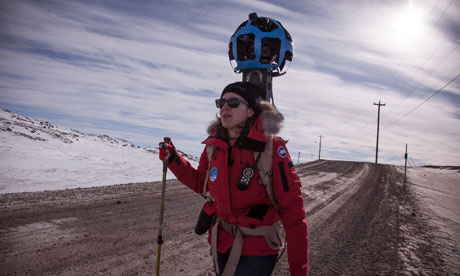
Below: "Google Street View's Karin Tuxen-Bettman treks across the Arctic tundra in Iqaluit."
Iqaluit mapping expedition sees Google staff hike along remote city's snow-covered trails and risk wrath of polar bears
By Allan Woods
Now, however, the search-engine firm is embarking on what might be the most significant update to centuries of polar cartography–and one it hopes will foster a better understanding of life on the permafrost for millions of web users. Google has flown a small team to Iqaluit, the largest town in the Canadian territory of Nunavut, armed with their warmest winter gear, a stack of laptop computers and a 18kg (40lb) backpack-mounted telescopic camera.
Helped by an Inuit mapping expert, and stalked by curious locals, the team spent four days trudging through the terrain and collecting the images and information that will give the isolated community on the tundra of Baffin Island what urbanites across the globe now take for granted.
The town of 7,000 people will go on display via Google's popular Street View application in July.
Below: "Google Street View's Karin Tuxen-Bettman treks across the Arctic tundra in Iqaluit."
January 15, 2013
50 Eskimo words for "snow"
There really are 50 Eskimo words for ‘snow’
By David RobsonAnthropologist Franz Boas didn’t mean to spark a century-long argument. Traveling through the icy wastes of Baffin Island in northern Canada during the 1880s, Boas simply wanted to study the life of the local Inuit people, joining their sleigh rides, trading caribou skins and learning their folklore. As he wrote proudly to his fiancee, “I am now truly like an Eskimo. . . . I scarcely eat any European foodstuffs any longer but am living entirely on seal meat.” He was particularly intrigued by their language, noting the elaborate terms used to describe the frozen landscape: “aqilokoq” for “softly falling snow” and “piegnartoq” for “the snow [that is] good for driving sled,” to name just two.
Mentioning his observations in the introduction to his 1911 book “Handbook of American Indian Languages,” he ignited the claim that Eskimos have dozens, or even hundreds, of words for snow. Although the idea continues to capture public imagination, most linguists considered it an urban legend, born of sloppy scholarship and journalistic exaggeration. Some have even gone as far as to name it the Great Eskimo Vocabulary Hoax. The latest evidence, however, suggests that Boas was right all along.
This debate has rumbled on partly because of a grammatical peculiarity of the Eskimo family of languages. Boas studied Inuit, one of the two main branches; the other is Yupik. Each has spawned many dialects, but uniting the family is a feature known as polysynthesis, which allows speakers to encode a huge amount of information in one word by plugging various suffixes onto a base word.
For example, a single term might encompass a whole sentence in English: In Siberian Yupik, the base “angyagh” (boat) becomes “angyaghllangyugtuqlu” to mean “what’s more, he wants a bigger boat.” This makes compiling dictionaries particularly difficult: Do two terms that use the same base but a different ending really represent two common idioms within a language, or is the difference simply a speaker’s descriptive flourish? Both are possible, and vocabulary lists could quickly snowball if an outsider were to confuse the two—a criticism often leveled at Boas and his disciples.
Yet Igor Krupnik, an anthropologist at the Smithsonian Arctic Studies Center in Washington, believes that Boas was careful to include only words representing meaningful distinctions. Taking the same care with their own work, Krupnik and others charted the vocabulary of about 10 Inuit and Yupik dialects and concluded that they indeed have many more words for snow than English does. Comment: For more on the subject, see 31 Eskimo Words for "Snow" and 100 Eskimo Words for "Snow"?

By David Robson
Mentioning his observations in the introduction to his 1911 book “Handbook of American Indian Languages,” he ignited the claim that Eskimos have dozens, or even hundreds, of words for snow. Although the idea continues to capture public imagination, most linguists considered it an urban legend, born of sloppy scholarship and journalistic exaggeration. Some have even gone as far as to name it the Great Eskimo Vocabulary Hoax. The latest evidence, however, suggests that Boas was right all along.
This debate has rumbled on partly because of a grammatical peculiarity of the Eskimo family of languages. Boas studied Inuit, one of the two main branches; the other is Yupik. Each has spawned many dialects, but uniting the family is a feature known as polysynthesis, which allows speakers to encode a huge amount of information in one word by plugging various suffixes onto a base word.
For example, a single term might encompass a whole sentence in English: In Siberian Yupik, the base “angyagh” (boat) becomes “angyaghllangyugtuqlu” to mean “what’s more, he wants a bigger boat.” This makes compiling dictionaries particularly difficult: Do two terms that use the same base but a different ending really represent two common idioms within a language, or is the difference simply a speaker’s descriptive flourish? Both are possible, and vocabulary lists could quickly snowball if an outsider were to confuse the two—a criticism often leveled at Boas and his disciples.
Yet Igor Krupnik, an anthropologist at the Smithsonian Arctic Studies Center in Washington, believes that Boas was careful to include only words representing meaningful distinctions. Taking the same care with their own work, Krupnik and others charted the vocabulary of about 10 Inuit and Yupik dialects and concluded that they indeed have many more words for snow than English does.
December 17, 2012
Funny Indian names in Soonchild
Tiger Lily isn't the only children's book that uses funny Indian names. Debbie Reese notes another in her American Indians in Children's Literature blog:
Russell Hoban's SOONCHILDUmmm... Russell Hoban, author of some terrific picture books, wrote this on page 6 of Soonchild:John came from a long line of shamans. His mother was Stay With It and his father was Go Anywhere. His mother's mother was Never Give Up and her father was Try Anything. His father's mother was Do It Now and his father's father was Whatever Works. His mother's grandmother was Where Is It? and his father's grandmother was Don't Miss Anything. His mother's grandmother was Everything Matters and his father's grandfather was Go All The Way. John's full name, by the way, is Sixteen-Face John. His wife's name is No Problem.
Want some more excerpts from this novel based on Inuit stories? Did you say 'hell no'?! That's what I'm saying. Comment: For more on "funny" Indian names, see "Stanksgiving" in Happy Endings and "Feather Tell-A-Tale."
Russell Hoban's SOONCHILD
Want some more excerpts from this novel based on Inuit stories? Did you say 'hell no'?! That's what I'm saying.
December 08, 2012
Inuit poet speaks at college
Inuit Poet dg nanouk okpik comes full circle at SKC
By Lailani UphamRays of light shine from her eyes, and her smile remains fixed with a beam of happiness that is felt across a room. Next, her airy, sweet, voice touches the hearts of each listener as the words of her poems are pictured in the minds of those assembled in a dimly lit theatre on the Salish Kootenai College campus last Wednesday afternoon.
Inuit poet and Institute of American Indian Arts instructor, dg nanouk okpik, captured a fairly large audience with readings from her newest book, “Corpse Whale.”
“I feel so grounded and so at home here,” she said as she opened up to the eager listeners.
Okpik attended SKC over 15 years ago and said she found a home away from home. She described feeling adrift when she first arrived on the campus of SKC. However, the SKC ambiance did not take long to help her find her calling.
Her first class was in Corky Clairmont’s, “Native American Images in Film.”
“It woke me up in such a way that I felt I had to finish college–and share my voice.” Her voice was her creative writings.
She said it was in that class she saw the images of Native Americans in the early years of film making that Native peoples were portrayed completely wrong.
She felt her gift of writing could be used to do what she knew she could do portray who her (tribal) people really are. Comment: A couple things worth noting here:
1) That the Inuit poet didn't think about Native stereotypes until she saw them in a college class. And then she opposed them.
2) That there are Inuit poets who are college-educated and return to their alma maters to speak. <g>
For more on Inuit artists, see Inuit Sculptor at NMAI and Artcirq Performs at Queen's Jubilee.

By Lailani Upham
Inuit poet and Institute of American Indian Arts instructor, dg nanouk okpik, captured a fairly large audience with readings from her newest book, “Corpse Whale.”
“I feel so grounded and so at home here,” she said as she opened up to the eager listeners.
Okpik attended SKC over 15 years ago and said she found a home away from home. She described feeling adrift when she first arrived on the campus of SKC. However, the SKC ambiance did not take long to help her find her calling.
Her first class was in Corky Clairmont’s, “Native American Images in Film.”
“It woke me up in such a way that I felt I had to finish college–and share my voice.” Her voice was her creative writings.
She said it was in that class she saw the images of Native Americans in the early years of film making that Native peoples were portrayed completely wrong.
She felt her gift of writing could be used to do what she knew she could do portray who her (tribal) people really are.
1) That the Inuit poet didn't think about Native stereotypes until she saw them in a college class. And then she opposed them.
2) That there are Inuit poets who are college-educated and return to their alma maters to speak. <g>
For more on Inuit artists, see Inuit Sculptor at NMAI and Artcirq Performs at Queen's Jubilee.
November 19, 2012
Tribes protest generic OxyContin
Minister won't interfere with generic OxyContin approval
Letter says no basis to withhold approval, but new licensing rules will applyFederal Health Minister Leona Aglukkaq has written her provincial and territorial counterparts to say she won't interfere in the regulatory approval process for a generic form of OxyContin.
Health Canada is adding new licensing rules to attempt to prevent abuse of the powerful painkiller. Manufacturers and/or distributors of the drug will have to report spikes in sales and changes in distribution patterns, in addition to the department’s current requirements to report loss and theft.
“It should not be up to politicians to determine which drugs should be approved for medical use,” she wrote. "While intentions may be noble in this instance, what stops future politicians from caving in to public pressure and allowing unproven, unsafe drugs on the market once political pressure starts to mount?"
"It's a recipe for disaster for politicians to get involved in approving drugs," the minister told reporters at a press conference in Ottawa on Monday morning. "If we start with OxyContin, what's next?"
Aglukkaq notes that there is no basis in the Food and Drug Act to withhold approval when a drug is considered safe for its recommended use based on its scientific review. "The law does not permit approval to be withheld on the basis of misuse," she wrote. Canadian government approves OxyContin generic, provoking outcry from tribes and provincesCanada’s federal government allowed the approval process to proceed Monday for the generic form of the highly-addictive painkiller OxyContin, a move that set off a quick outcry from the country’s provinces and aboriginal communities.
Health Minister Leona Aglukkaq rejected a plea from Canada’s provinces, which unanimously requested a delay of approval until regulators could examine the abuse of oxycodone. Ontario asked for a complete ban on the drug, which has caused widespread addictions in Canada’s rural and tribal communities.
Her refusal to get involved in the process opens the way for generic oxycodone to win approval in Canada after the patent for the brand-name OxyContin expires on Nov. 25.
“I am profoundly disappointed in minister Aglukkaq’s decision to ignore the threat to public safety posed by generic OxyContin and to allow it to enter the Canadian market,” Ontario Health Minister Deb Matthews said in a statement.
Matthews had warned that the “streets would be flooded” with the generic form of the drug if it is approved. Comment: As you may recall, Leona Aglukkaq is a conservative Inuk minister who's been involved in several controversies. Once again, she just happens to take a position that's anti-Native. What an odd coincidence that she never takes a pro-Native position.
Anyway, I'm not sure prohibition is the right answer in this case, or any case. But I'm not sure the government should approve the generic drug without planning for its harm to public safety. A middle position is probably best.
For more on Leona Aglukkaq, see Aglukkaq Blames Activists for Food Insecurity and Inuk Minister Cuts Aboriginal Services.

Letter says no basis to withhold approval, but new licensing rules will apply
Health Canada is adding new licensing rules to attempt to prevent abuse of the powerful painkiller. Manufacturers and/or distributors of the drug will have to report spikes in sales and changes in distribution patterns, in addition to the department’s current requirements to report loss and theft.
“It should not be up to politicians to determine which drugs should be approved for medical use,” she wrote. "While intentions may be noble in this instance, what stops future politicians from caving in to public pressure and allowing unproven, unsafe drugs on the market once political pressure starts to mount?"
"It's a recipe for disaster for politicians to get involved in approving drugs," the minister told reporters at a press conference in Ottawa on Monday morning. "If we start with OxyContin, what's next?"
Aglukkaq notes that there is no basis in the Food and Drug Act to withhold approval when a drug is considered safe for its recommended use based on its scientific review. "The law does not permit approval to be withheld on the basis of misuse," she wrote.
Health Minister Leona Aglukkaq rejected a plea from Canada’s provinces, which unanimously requested a delay of approval until regulators could examine the abuse of oxycodone. Ontario asked for a complete ban on the drug, which has caused widespread addictions in Canada’s rural and tribal communities.
Her refusal to get involved in the process opens the way for generic oxycodone to win approval in Canada after the patent for the brand-name OxyContin expires on Nov. 25.
“I am profoundly disappointed in minister Aglukkaq’s decision to ignore the threat to public safety posed by generic OxyContin and to allow it to enter the Canadian market,” Ontario Health Minister Deb Matthews said in a statement.
Matthews had warned that the “streets would be flooded” with the generic form of the drug if it is approved.
Anyway, I'm not sure prohibition is the right answer in this case, or any case. But I'm not sure the government should approve the generic drug without planning for its harm to public safety. A middle position is probably best.
For more on Leona Aglukkaq, see Aglukkaq Blames Activists for Food Insecurity and Inuk Minister Cuts Aboriginal Services.
Subscribe to:
Posts (Atom)