Showing posts with label environment. Show all posts

January 03, 2015

Scientific problems in Snowpiercer

More thoughts on the movie Snowpiercer, which I commented on in Inuit Woman in Snowpiercer and Ending in Snowpiercer.

Snowpiercer had some plot and character problems, but I'm interested in the scientific and technical problems at the moment, so let's go.

** spoiler alert **

  • It would've been nice to say how Snowpiercer crossed the oceans in its round-the-world journey before the Earth froze.

  • It would've been nice to say what Snowpiercer's energy source was. I presume it was nuclear-powered, but I don't think it was ever stated.

  • An ice age wouldn't stop earthquakes or volcanic activity from happening. I imagine a worldwide system of tracks could go only a year or two, at most, before something jolted the rails out of alignment.

  • I think the movie gave some bogus reason why the train had to keep moving. Something about perpetual motion, maybe.

    Even if we grant that condition, there's no reason it had to go at top speed. Going slower would use less energy and reduce the chance of accidents.

  • The train's rulers knew the outside temperature well enough to calculate that someone's arm would freeze in exactly seven minutes. Yet they didn't know the outside temperature was rising--enough so that people could survive outdoors. That's contradictory and therefore illogical.

    In fact, the train's rulers should've had scientists monitoring the conditions outside. And they should've been glad to stop the train and send people outside--perhaps as punishment. Operating the train with ongoing social inequalities was like sitting on a ticking bomb. Eventually the system would explode.

  • The "tailies" had to use the last two matches in existence to start fires. FYI, you can start fires without matches or lighters. For instance, you can strike rocks or rub sticks together.

  • The stolen children

    I forget about the kidnapped children for a while, which is a storytelling flaw. And I didn't buy the answer to their disappearance: that they were serving as manual replacements for broken parts.

    I thought the children were being taken to provide food--the Solyent Green cliché--or perhaps as slaves or pets. The replacement-part idea was unexpected, to be sure, but unbelievable.

    First, kids would last for only a few hours in those hot, cramped cubbyholes before they passed out. No way could they perform the same repetitive tasks for weeks or months.

    Second, the train must have millions of parts and materials that would wear out or break. It inevitably would require fixes that a human child couldn't manage. Like other self-contained vehicles--a ship, submarine, or starship--it would need mechanical engineers, machine-shop facilities, and probably a "docking port" where it could stop for repairs.

    To give a related example, suppose your car ran out of brake fluid, a spark plug broke, or the battery died. This isn't a Flintstones cartoon where an animal performs every function. No living creature could substitute for the mechanical failure.

    Overall, though, I enjoyed Snowpiercer. It deserves some Academy Award nominations and I hope it gets some. For its bold subject and style, I give it an 8.5 of 10.

    January 02, 2015

    Ending in Snowpiercer

    I wasn't satisfied with the ending of Snowpiercer, and neither were some others. A discussion of this ending:

    ** spoiler alert **

    Let’s Talk About the Ending of Snowpiercer

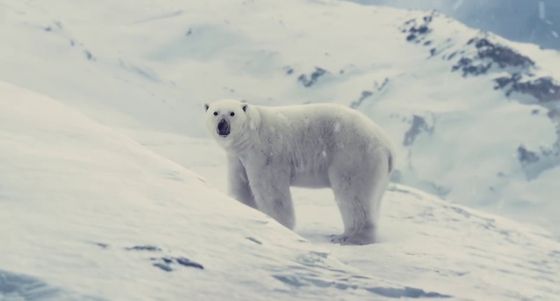
    By Lindsey WeberDirector Bong Joon-ho talked with Vulture about this very subject a few weeks back. His take? That the ending is optimistic. (Or is a happy ending just the magic of the movies?)They have no memory of what it's like to be on the Earth. For them to procreate, it's going to take a little time. So, for me, it's a very hopeful ending ... But those two kids will spread the human race ... I don't really feel everyone must die. I hope there were other survivors who lived through the avalanche, I just didn't have the means to shoot that ... You realize later on that the kids are the ones keeping this engine going, and this machinery intact. The engine is itself is on its way to extinction along with cigarettes, and other goods. Extinction is a repeated word throughout the film. But outside the train, life is actually returning. It's nature that's eternal, and not the train or the engine, as you see with the polar bear at the end.Obviously, he’s the director, it’s his movie, and he’s the definitive source on what he meant by the ending. But that doesn't mean fans haven't gone wild speculating about the scene’s inherent ambiguity. In one Reddit discussion thread, a slew of dystopian naysayers claim that, unless there are survivors elsewhere that Bong Joon-ho decided not to show on film, Tim and Yona are dead meat. "A girl and a kid that lived in a sheltered environment their whole life and don't know how to hunt or gather in the snow ... I give them a couple of days, tops," writes HappyZavulon. Many suspect they’d simply get eaten by the very animal being used as a symbol of hope. Suggests emareperiod: "The polar bear eats humans. One of the top 3 human eaters on the planet. Vicious human eater. They are dead. Dead, dead, dead, dead, DEAD."
    The Last Snowpiercer Review You Will Ever Need to Read

    By James Marshall CrottyThe plodding climactic showdown between Curtis and Wilford--spoiler alert!--could have been cut by ten minutes (not to make the film more "mainstream," as producer "Harvey Scissorhands" probably wanted, but because it just drags). And the ending--a shot of a twenty-something Korean clairvoyant/drug-addicted locksmith and a small black boy staring at a polar bear is supposed to have instant profundity--is a leaden letdown. We are left to presume that these two will survive in this suddenly warming world, and the new human species will be a marriage of these two disparate ethnic groups, but not until the little boy is old enough to consummate the union. Yes, odd, and logically preposterous. And not the only place where absurdities abound.

    Nevertheless, Snowpiercer is a thrilling, if extremely violent, train ride worth catching from an adventurous Korean director whose better work is clearly around the next bend.
    Rob's rewrite

    I agree that Snowpiercer's ending was too minimalist. Here's a new and improved ending:

    Nam wants to blow the door off the train, but Curtis convinces him it's too risky. Nam reluctantly gives up his dream.

    Curtis meets Wilford who explains how the train really works. Curtis is distraught at first, but then gets angry. He tells Wilford that the train's setup is obscene—that Wilford should divide the train's resources more equitably. Wilford laughs at him and orders something terrible—perhaps for his troops to kill the rest of the poor people.

    Enraged, Curtis gets the explosive and the match and blows up the train himself. Several cars in the middle topple into the abyss, and we see rich people dying. But most of the train simply derails and topples over.

    The train is a smoking ruin in the snow. It doesn't look as if anyone has survived. But then one figure emerges: Curtis, the ultimate survivor.

    Curtis looks over the damage he's wrought. It seems hopeless…but then people start emerging from the wreck. Some rich people, but more poor people. They're amazed to find it's not lethally cold; they can survive outside.

    Then Yona emerges with Timmy. They're the only survivors from Curtis's plucky band of rebels. You have a potential father, mother, and child—a classic family unit.

    They're taking stock when suddenly Wilford, bloody and battered, emerges too. He's furious that Curtis has destroyed his life's work. He attacks and they fight. With Yona's and Timmy’s help, Curtis wins.

    Rather than kill Wilford, Curtis does something dramatic like take Wilford's coat and tell him to return to the train if he can. Wilford struggles back but freezes on the way and is covered in falling snow.

    Led by Curtis, Yona, and Timmy, the straggling band of humanity climbs through the mountains. The survivors reach a valley—perhaps with smoke or steam rising from the earth to suggest volcanic activity.

    First they find plant life poking through the snow. Then they spot animal tracks. They see an arctic hare hopping through the snow, and perhaps a hawk circling overhead.

    Finally, they spot a human footprint. Someone has lived through the ice age outside the train. There's hope that humanity will endure.

    Is that a better ending than the actual one? Yes, I think so.

    A few notes

  • If you think Curtis needs to sacrifice himself, like Christ, to atone for his sins, no problem. Just have Edgar his second-in-command (disciple) survive. If necessary, kill someone in Edgar's place.

  • I'd also let Mason (Tilda Swinton) survive. It would be fun to see her shocked face as everything she knows is (literally) overturned. And it would send a message about reconciling the rich and the poor in the new world order where the class system no longer exist.

  • The polar bear wasn't the best sign of life to show. Never mind that polar bears don't live in the mountains. A bear could've scavenged leftover bodies and supplies for 17 years. It might be the last bear in existence.

    My ending implies a whole ecosystem survived. Which in turn implicates the folly of sealing oneself in a train, out of touch with reality. In short, my way is better.
  • January 01, 2015

    Inuit woman in Snowpiercer

    I watched the sci-fi movie Snowpiercer while I worked today. Here's the premise:

    SnowpiercerIn 2014, an experiment to counteract global warming causes an ice age that kills nearly all life on Earth. The only survivors are the inhabitants of the Snowpiercer, a massive train powered by a perpetual-motion engine that travels on a globe-spanning track. A class system is installed, with the elites inhabiting the front of the train and the poor inhabiting the tail.

    In 2031, the tail inhabitants prepare for the latest in a series of rebellions. Guards arrive periodically to deliver protein blocks for food, and take some of the children. During the guards’ next visit, Curtis Everett (Evans) leads the tail inhabitants in revolt, forcing their way through several train cars to the prison section. There, they release prisoner Namgoong Minsu (Song), the man who built the security system that controls the doors dividing each car, and his clairvoyant daughter Yona.
    ** spoiler alert **

    I was curious to hear a reference to an Inuit woman. Here are the details:

    SNOWPIERCER: bits I *love* about the film so far…Nam explains to Yona how the leader of the Seven is an Inuit woman who taught him about all the different kinds of snow there are, but he does not reveal that she is her mother. At least, that’s my belief. Think about it… When he’s at the window and begins to speak—”There’s a woman at the front…”—aren’t you just certain he’s talking about the woman he loves?And from Wikipedia:Go Ah-sung as Yona

    The 17-year-old daughter of Namgoong Minsoo. About her character's name, Ah-Sung said, "[Bong] couldn't think of any name for Yona; he just left her as "The Inuit Girl." I gave him Nastyona’s album, and he went "This is it!", adding, " It also matches the Biblical figure Jonah [pronounced Yona in some languages, including Korean] and had a right feel to it." Ah-sung described Yona as being, "[...] someone who was completely indifferent to Minsu’s ambition. Even if she knew, she wouldn’t have cared." Of Yona's background, Bong revealed, "Yona’s mother was the leader of the Frozen Seven’s revolution--because she was an Inuit. She was confident that she could endure the coldness. However, she went out too early."
    Comment:  So Yona is Inuit or half-Inuit by blood. Since she's a "train baby," though, she has no knowledge of the Inuit or their cultures.

    One can easily discern a nature vs. technology theme in Snowpiercer. The rich white people have enclosed themselves in a metal shell, cut off from human suffering and pain. The poor, brown people (even the Caucasian "tailies" are dark with grime) long for a better life that may exist outside the train.

    And an Inuit woman led the way. She was the first to think a Native approach--living in harmony with, rather than in opposition to, nature--would work.

    Although it doesn't state an indigenous message explicitly, the movie implies one. Namely, that technological solutions--seeding the atmosphere, running the train--have failed. It's time to step outside the Western comfort zone and experience the harsh realities of life.

    Below:  Yona and friend.

    December 11, 2014

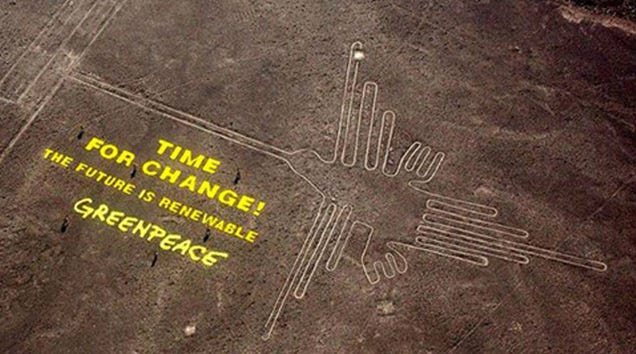
    Greenpeace damages Nazca site

    Peru Is Indignant After Greenpeace Makes Its Mark on Ancient Site

    By William NeumanAn expression of concern by the environmental group Greenpeace about the carbon footprint was marred this week by real footprints—in a fragile, and restricted, landscape near the Nazca lines, ancient man-made designs etched in the Peruvian desert.

    The Peruvian authorities said activists from the group damaged a patch of desert when they placed a large sign that promoted renewable energy near a set of lines that form the shape of a giant hummingbird.

    The sign was meant to draw the attention of world leaders, reporters and others who were in Lima, the Peruvian capital, for a United Nations summit meeting aimed at reaching an agreement to address climate change. The meeting was scheduled to end Friday but negotiations were expected to continue into Saturday.

    Greenpeace issued a statement apologizing for the stunt at the archaeological site, about 225 miles south of Lima. Its international executive director, Kumi Naidoo, flew to Lima, but the Peruvian authorities were seething over the episode, which they said had scarred one of the country’s most treasured national symbols.


    This Greenpeace Stunt May Have Irreparably Damaged Peru's Nazca Site

    By George DvorskyThe Peruvian government is planning to file criminal charges against Greenpeace activists who may have permanently scarred the Nazca Lines World Heritage Site during a publicity stunt.

    As The Guardian reports, the Nazca lines "are huge figures depicting living creatures, stylized plants and imaginary figures scratched on the surface of the ground between 1,500 and 2,000 years ago." The figures, which can only be seen from the air, are believed to have had ritual functions related to astronomy.

    The ground around the site is so sensitive and so sacred that Peru has even forbidden presidents and top officials to walk where the Greenpeace activists went. Peru's Deputy Culture Minister told the BBC: "You walk there, and the footprint is going to last hundreds or thousands of years." Tourists generally get to see the site from the air, or, on rare occasions, are equipped with special foot gear.

    "They are absolutely fragile. They are black rocks on a white background. You walk there and the footprint is going to last hundreds or thousands of years," said the minister. "And the line that they have destroyed is the most visible and most recognized of all."
    Greenpeace apologises to people of Peru over Nazca lines stunt

    Culture ministry says it will press charges against activists for damage to world heritage site as UN climate talks began in Lima

    By Dan Collyns
    Greenpeace has apologised to the people of Peru after the government accused the environmentalists of damaging ancient earth markings in the country’s coastal desert by leaving footprints in the ground during a publicity stunt meant to send a message to the UN climate talks delegates in Lima.

    A spokesman for Greenpeace said: “Without reservation Greenpeace apologises to the people of Peru for the offence caused by our recent activity laying a message of hope at the site of the historic Nazca lines. We are deeply sorry for this.

    “Rather than relay an urgent message of hope and possibility to the leaders gathering at the Lima UN climate talks, we came across as careless and crass.”

    Earlier Peru’s vice-minister for culture Luis Jaime Castillo had accused Greenpeace of “extreme environmentalism” and ignoring what the Peruvian people “consider to be sacred” after the protest at the world renowned Nazca lines, a Unesco world heritage site.
    Comment:  Why don't the space aliens return and fix it?!

    A tweet makes the problem plain:

    Donna Yates ‏@DrDonnaYates Dec 12
    FYI: this is the damage done to the Nazca lines by Greenpeace. Not minor. Not in someone's opinion. Look at that.

    May 09, 2014

    Krauthammer: Scientific consensus = "rain dance"

    Krauthammer: Climate Change Is 'Superstition' Like 'The Rain Dance Of Native Americans'

    By Catherine ThompsonCharles Krauthammer believes climate change is a mere superstition, just like the "rain dance of Native Americans."

    Appearing Tuesday on Fox News' "Special Report," the conservative pundit rejected the consensus of between 97 and 98 percent of scientists who believe climate change is real and is fueled by human activity.

    "It's always a result of what is ultimately what we're talking about here, human sin with pollution of carbon," Krauthammer said. "It's the oldest superstition around. It was in the Old Testament, it's in the rain dance of Native Americans--if you sin, the skies will not cooperate."
    Fox News devolves from climate denial to rejecting all science

    Witness the spectacular collapse of the right-wing mind

    By Lindsay Abrams
    As for the consensus of 97 percent of scientists who say man-made global warming is a real phenomenon, Will contends that “they pluck these things from the ether” (as Chait points out, the number actually comes from this report), while Krauthammer just dismisses the idea of a scientific consensus. “Ninety-nine percent of physicists convinced that space and time were fixed until Einstein working in a patent office wrote a paper in which he showed that they are not,” he says. “I’m not impressed by numbers. I’m not impressed by consensus.”

    Thus begins the point at which Krauthammer completely gives up on science, Chait writes:It is hard to dispute this except to note that Krauthammer here has taken a radically skeptical position not merely on climate science, but on all science. His argument implies that no scientific argument merits respect. Given the provisional and socially constructed peer pressure driving the consensus theory of aerodynamics, it is amazing that he is willing to travel in an airplane.
    Comment:  For more on climate change, see LaDuke Endorses Obama and First Stewards Symposium at NMAI.

    May 06, 2014

    Tributes to Billy Frank Jr.

    Billy Frank Jr.: Appreciating a Northwest civil rights legend

    By Joel ConnellyBilly Frank Jr., was once considered an outlaw, poacher and scofflaw, arrested some 50 times—starting at the age of 14—for “illegally” fishing in waters where he had his home on the Nisqually River.

    When his life ended Monday, at the age of 83, Frank had become a preeminent Washington civil rights leader, a Native American who replaced confrontation with cooperation in restoring the salmon runs that help define the Pacific Northwest.
    Tribal fishing activist led fight resulting in 1974 Boldt decision

    Billy Frank Jr., longtime chairman of Northwest Indian Fisheries Commission, dead at 83

    By John Dodge
    Billy Frank Jr., an iconic tribal leader and tireless advocate for treaty rights, healthy salmon runs and clean water, has died at age 83.

    The Nisqually tribal member was longtime chairman of the Northwest Indian Fisheries Commission and a key figure in the Indian fish-ins of the 1960s and 1970s, which led to the court ruling known as the Boldt decision.
    Billy Frank Jr., 1931-2014: ‘A Giant’ Will Be Missed

    By Richard Walker“We in Indian country, collectively, will have to pick up the mantle,” state Sen. John McCoy, D-Tulalip, said.

    A big mantle it is. In his 83 years, the Nisqually Tribe citizen defended treaty rights in the Northwest and indigenous sovereignty throughout Indian country, guided opposing sides to agreement on how to protect natural resources, helped bring down two dams on the Elwha River, produced an Emmy Award-winning series on Indian country. He chaired the Northwest Indian Fisheries Commission for 34 years, served as a trustee of The Evergreen State College for seven.

    Frank, whose honors included the Albert Schweitzer Prize for Humanitarianism, was as comfortable in the Oval Office as he was in a tribal chairperson’s office.

    “He was a giant in Indian country and we’re going to miss him,” McCoy said.
    Billy Frank, Jr. Remembered by President Obama and Other Leaders

    By Levi RickertStatement by the President on the Passing of Billy Frank, Jr.:

    “I was saddened to learn of the passing of Billy Frank, Jr. – Chairman of the Northwest Indian Fisheries Commission and a member of the Nisqually Indian Tribe. Billy fought for treaty rights to fish the waters of the Pacific Northwest, a battle he finally won in 1974 after being arrested many times during tribal “fish-ins”. Today, thanks to his courage and determined effort, our resources are better protected, and more tribes are able to enjoy the rights preserved for them more than a century ago. Billy never stopped fighting to make sure future generations would be able to enjoy the outdoors as he did, and his passion on the issue of climate change should serve as an inspiration to us all. I extend my deepest sympathies to the Nisqually Indian Tribe, and to Billy’s family, and to his many friends who so greatly admired him.”
    Comment:  For more on Billy Frank Jr., see Billy Frank Jr. Dies and Indians Named Conservation Heroes.

    May 05, 2014

    Billy Frank Jr. dies

    Legendary Billy Frank, Jr.–Fighter for Indian Fishing Rights & Environment–Walks On

    By Levi RickertBilly Frank, Jr., a tribal citizen of the Nisqually Tribe, who spent four decades fighting on behalf of Indian fishing rights and environmental, walked on this morning. He was 83.Billy Frank Jr., Nisqually elder who fought for treaty rights, dies

    By Craig WelchBilly Frank Jr., a Nisqually elder and fisherman who served for more than half a century as the charismatic voice of Northwest tribes fighting to exercise their treaty rights, died early Monday, tribal officials and his family confirmed Monday.Comment:  For more on Billy Frank Jr., see Indians Named Conservation Heroes and First Drum Awards Announced.

    April 09, 2014

    Humane Society doesn't oppose Inuit seal hunts

    More on the story begun in "Sealfies" vs. Ellen's Selfie and continued in Throat Singer Threatened Over "Sealfie":

    Humane Society says it doesn't oppose Inuit seal hunt

    Donation to group by Ellen DeGeneres sparked #sealfie social media campaign"Commercial sealing advocates have long attempted to blur the lines between their globally condemned industry and the socially accepted Inuit subsistence hunt," Aldworth said in a statement Tuesday.

    "Unlike Inuit sealers, commercial sealers almost exclusively target baby seals who are less than three months old. Inuit hunters kill seals primarily for meat," she said.

    "Commercial sealers slaughter seal pups for their fur, dumping most of the carcasses at sea. Inuit sealers kill seals sporadically throughout the year, while commercial sealers often kill hundreds of thousands of seals in a matter of days or weeks."

    Inuit have long maintained that any opposition to the seal hunt, commercial or otherwise, harms Inuit by destroying the market for seal furs. That's the reason Inuit launched a legal challenge against a European ban of seal products, even though that legislation included an exemption for seal products harvested by Inuit.


    Inuit Answer Hollywood With Sealfie Photo Booths, Giant Group PicThe war of images over the seal hunt is going as epic as a Hollywood movie.

    The indigenous land claims group Nunavut Tunngavik Inc. (NTI) is running a photo booth on April 10 and staging a humongous group “sealfie” on Friday April 11 in protest of some celebrity activists' stance against the seal hunt. Meanwhile the Humane Society of the United States, which is the beneficiary of the donation generated by the famous photo tweeted from the Oscars by host Ellen DeGeneres, says it does not oppose the small, sustainable Inuit seal hunt, just the commercial one. The Inuit say that is not the point. They are using the attention to educate the world on their history and culture.
    And:For its part, the Humane Society of Canada says the Inuit have got it all wrong and are protesting something that the group never objected to.

    “We have never opposed the Inuit subsistence seal hunt that occurs in Canada’s North,” said Humane Society International/Canada executive director Rebecca Aldworth in a statement on April 8. “Animal protection groups oppose the commercial seal slaughter, which occurs in Atlantic Canada and is almost entirely conducted by non-aboriginal people.”

    But to put it in these terms is to completely misunderstand the significance of the seal hunt and the role it plays in Inuit relations with the world, NTI leaders said.

    “Various animal rights groups now say they do not oppose the Inuit seal hunt because it is sustainable and humane and provides food and clothing for people,” said NTI CEO James Arreak in a statement. “It is true that Nunavut’s seal hunt is humane and sustainable. It is also a commercial harvest. Inuit sell sealskins and seal products.”
    Below:  "About 30 people gathered in Iqaluit two weeks ago to shoot a pro-seal hunting #sealfie to protest a $1.5 million donation from funds raised by Ellen DeGeneres's Oscar selfie to the Humane Society of the United States, an organization that fights seal hunting." (Emily Ridlington/CBC)

    April 03, 2014

    Throat singer threatened over "sealfie"

    Tanya Tagaq #sealfie provokes anti-sealing activists

    'It's just complete harassment. It's not OK,' says the throat-singer and performerMusician Tanya Tagaq posted a picture of her baby next to a dead seal near her home town of Cambridge Bay, Nunavut, and got more than she bargained for in return.

    "It became quite hurtful,” Tagaq said. “Right now, actually there's a woman who has my picture up on her Twitter and the things that people are saying about myself and my baby. It's just complete harassment. It's not OK."

    Tagaq said she doesn't know the woman. She says the woman posted an online petition to have Tagaq's children taken from her.

    Tagaq said she's not considering legal action against the online harassment.
    Inuit #SEALFIE trend sparks death threats for throat singer Tanya Tagaq

    Comment:  For more on the subject, see "Sealfies" vs. Ellen's Selfie.

    March 31, 2014

    "Sealfies" vs. Ellen's selfie

    'Sealfies' Protest Ellen DeGeneres's Anti-Seal Hunt Stance (TWEETS)Inuit are striking back against her with "#Sealfies," in which people tweet pictures of themselves in sealskin furs to counter DeGeneres's activism against what she calls "one of the most atrocious and inhumane acts against animals allowed by any government."

    The protest was promoted early on by Alethea Arnaquq-Baril, an Inuk filmmaker from Iqaluit, Nunavut.

    Though she considers herself an "Ellen" fan, she was disappointed when she requested that Samsung donate $1.5 million to the Humane Society of the United States (HSUS), an organization that is vocally opposed to the seal hunt, after she took the record-breaking "Oscars selfie" with one of the tech giant's phones.

    In a blog post on Wednesday, Arnaquq-Baril encouraged people to take pictures of themselves wearing sealskins and to tweet them at DeGeneres's Twitter account with the "#Sealfie" hashtag.

    Seal meat is a staple food for Inuit and they should have the right to make a living off their animals just like anyone else, she told The Canadian Press.
    And:The hashtag came amid revelations that Inuit go hungry more than any other indigenous people in a developed country.

    The Council of Canadian Academies reported that 35 per cent of Inuit households in Nunavut don't have enough food to eat, while 76 per cent of preschoolers skip meals and 60 per cent have gone a day without eating.

    Inuit Flood Twitter With 'Sealfies' After Ellen DeGeneres Selfie Funds Hunt Haters

    By David P. BallA month after Ellen DeGeneres tweeted her record-breaking celebrity-laden selfie during the Oscars on March 2—now surpassing 3.4 million retweets—Samsung's $1.5-million donation to an anti-seal hunting organization has sparked a new viral meme.

    What started with a teenager’s video explaining Inuit lifeways to the star has morphed into a twitter hashtag answering “selfie” with “sealfie,” as social media–savvy Inuit—who have for millennia depended on seals for meat, clothing and trade—fire back with their own hashtag featuring photos of them garbed in seal fur coats, mittens, boots and shawls. DeGeneres, fans and Twitter followers were elated when Samsung pledged to donate copy for every retweet of DeGeneres's Oscars selfie to a charity of her choice. The trouble started when the star, who hosted the Academy Awards, designated $1.5 million for the Humane Society of the United States, an organization that campaigns strongly against the seal hunt in Canada.

    The online trend was sparked after Iqaluit teenager Killaq Enuaraq-Strauss, 17, uploaded a March 23 video to YouTube imploring DeGeneres to reconsider her choice of the Humane Society of the U.S. as a designated charity for Samsung's post-Oscar donation.

    “We do not hunt seals, or any animal for that matter, for fashion,” Enuaraq-Strauss said in the video. “We hunt to survive. If Canada were to ban the seal hunt, so many families would suffer, would face harsher forms of malnutrition, and wouldn't be able to afford proper clothing for the Arctic environment we live in. Even more so, another part of our culture would have been killed.”

    The week in #sealfiesInuit and others across northern Canada have taken to social media to post #sealfies, or photos of themselves wearing, eating or hunting seals. It began as a protest against Ellen Degeneres’ decision to donate money from her Oscar #selfie to an organization that opposes the Canadian seal hunt. But the trend has emerged as a social phenomenon in itself—a mass collection of photographs that show how important the seal hunt is to Canadian Inuit and others.Comment:  This is reminiscent of the debate over Makah whale hunting.

    On the one hand, no animal should be killed cruelly and unnecessarily. On the other hand, what's the difference between whales, seals, cows, pigs, and chickens? Only vegetarians can claim not to be hypocritical on this issue.

    January 14, 2014

    Neil Young's Honour the Treaties tour

    Canadian rocker Neil Young began his Honour the Treaties tour Sunday and it set off a war of words.

    Neil Young blasts oilsands expansion, launches fundraising tour

    4 concerts to fund First Nations legal fight against oilsands projectsCanadian rocker Neil Young blasted the Canadian government, saying it's "completely out of control" when it come to the environment and oilsands expansion, as he kicked off his Honour the Treaties tour in Toronto on Sunday.

    The singer, speaking to reporters before his Massey Hall concert, said he supports First Nations in their fight against expanding oilsands projects in Alberta because of their destructive impact on the environment.

    "I see a government completely out of control, and money is number one. Integrity isn't even on the map," he said.

    Young said he toured one of 50 oilsands sites with his son and was shocked at "the ugliest thing I've ever seen. It`s the greediest, most destructive and most disrespectful demonstration of something that has run amok."


    Neil Young Plays 'Honor the Treaties' Anti-Tar Sands Benefit TonightTonight, at Massey Hall in Toronto, rocker Neil Young will play the first of four dates in support of Athabasca Chipewyan First Nation Legal Defense. The concerts aim to raise awareness of and money for the legal struggle against expansion of tar sands extraction in Alberta.Neil Young blasts Harper government for allowing development of Alberta oilsands

    Neil Young benefit tour inspires ex-oilsands worker

    Proceeds from 4 concerts to go to Athabascan Chipewyan First Nation's fight against oilsands expansion

    Jobs vs. environment

    Here's Neil Young and the tribes vs. the government and the oil industry:

    Feds respond to Neil Young anti-oilsands tour 75

    By Jessica HumeResponding to Neil Young's anti-oilsands tour, the Prime Minister's Office says the rocker and political activist should mind his own carbon footprint before opposing projects it says present First Nations with economic opportunities unprecedented in Canada's history

    "The resource sector creates economic opportunities and employs tens of thousands of Canadians in high-wage jobs, contributing to a standard of living that is envied around the world and helping fund programs and services Canadians rely on," Prime Minister Stephen Harper's spokesman, Jason MacDonald, told QMI Agency.

    "Even the lifestyle of a rock star relies, to some degree, on the resources developed by thousands of hard-working Canadians every day," MacDonald noted.
    Neil Young responds to criticism from Prime Minister’s Office

    By John R. KennedyIn the PMO’s statement, issued on Sunday after Young held a press conference in Toronto, a spokesperson said the federal government has defended Canada’s natural resource sector as a fundamental part of the country’s economy.

    “Our issue is not whether the natural resource sector is a fundamental part of the country,” Young said Monday in a statement. “Our issue is with the government breaking treaties with the First Nation and plundering the natural resources the First Nation has rights to under the treaties.”

    The government also said it “recognizes the importance of developing resources responsibly and sustainably and we will continue to ensure that Canada’s environmental laws and regulations are rigorous.”

    Young shot back: “When people say one thing and do another, it is hypocrisy. Our Canadian environmental laws don’t matter if they are broken.”

    The Toronto-born singer also took note of the PMO’s comment that “even the lifestyle of a rock star relies, to some degree, on the resources developed by thousands of hard-working Canadians every day.”

    Young countered: “If rock stars need oil is an official response, how does that affect the treaties Mr. Harper’s government of Canada is breaking? Of course, rock stars don’t need oil. I drove my electric car from California to the Tar sands and on to Washington DC without using any oil at all and I’m a rock star. My car’s generator runs on biomass, one of several future fuels Canada should be developing for the Post Fossil Fuel Age. This age of renewable fuels could save our grandchildren from the ravages of Climate related disasters spawned by the Fossil Fuel Age; but we have to get started.”


    Neil Young: Blood of First Nations People Is on Canada's Hands

    By David P. BallUndeterred by Prime Minister Stephen Harper's rebuke that Neil Young's “rock star” lifestyle made him unfit to criticize Canada's oil sands, at his Toronto concert on Sunday night the legendary Canadian musician substituted Harper's name into his song 'Pocahontas,' which describes massacres against Indigenous Peoples.

    “Stephen Harper, Pocahontas and me,” the 68-year-old singer crooned to 2,700 fans in Toronto at the first show of his fundraising tour to support Athabasca Chipewyan First Nation's legal battle to halt the oil sands' expansion, which they argue has caused cancer rates to skyrocket and contaminated their lands and waters. In the street outside Massey Hall, dozens held a round dance--a fixture of the Idle No More movement that has swept the country over the past year.

    Only hours earlier, the Canadian music veteran issued his strongest words yet against his country's energy boom. He cited the statistic that oil sands-affected aboriginal communities have a cancer rate that is 30 percent higher than the rest of the population, including rare forms of the disease linked to petrochemical pollution.

    “People are dying of cancer because of this,” he told reporters. “All the First Nations people up there are threatened by this ... The atrocities that happened--they are much bigger than we can describe.”

    He also called the oil sands the “greediest, most destructive and most disrespectful demonstration of something that has run amok.”
    Neil Young's anti-oilsands comments draw fire from industry

    Petroleum producers says rock star's rhetoric is uninformed and divisiveThe oil industry is speaking out about negative comments made by rock star Neil Young during his benefit tour to help an Alberta First Nation.

    "Mr. Young may represent that rock stars don't need oil, but we would represent that Canadians very much do need oil," said David Collyer of the Canadian Association of Petroleum Producers (CAPP).

    He said the industry is proud of the positive relationships it has built with First Nations across Canada.

    "Certainly from time to time there are barriers to effective collaboration and engagement between industry and First Nations—we recognize that and we acknowledge it," said Collyer.

    He said those differences relate to education, culture, unresolved land claims and views regarding economic benefits and opportunities.

    "However, what Mr. Young and his colleagues fail to acknowledge is that in many causes, and in the face of those challenges, we've had many significant successes," said Collyer, pointing to jobs, contracts, cultural programs and infrastructure development.

    He said oilsands companies contract with aboriginal organizations for up to $1.8 billion a year for goods and services.
    Background info

    Neil Young tour: 5 facts about the First Nation he's singing for
    Athabasca Chipewyan First Nation has spent millions in legal fees fighting oilsands development

    Petropolis, Film Being Shown At Honour The Treaties Tour, Posted Online (VIDEO)

    For more on the subject, see 4th Annual Tar Sands Healing Walk and Cameron Criticizes Oilsands "Curse."

    Below:  "Chief Allan Adam, left, and Neil Young en route to Winnipeg during the Honour the Treaties tour. This picture was posted on Young's Facebook page, where he writes, 'Here's the Chief and yours truly outside Broken Canoe Trading Post. Big flurries fill the air. Honour the Treaties.'"

    September 13, 2013

    Idle No More offers environmental narrative

    Naomi Klein: Green groups may be more damaging than climate change deniers

    The "No Logo" author explains how environmentalists may be more damaging to their cause than climate change deniers

    By Jason Mark
    You’ve said that progressives’ narratives are insufficient. What would be an alternative narrative to turn this situation around?

    Well, I think the narrative that got us into this–that’s part of the reason why you have climate change denialism being such as powerful force in North America and in Australia–is really tied to the frontier mentality. It’s really tied to the idea of there always being more. We live on lands that were supposedly innocent, “discovered” lands where nature was so abundant. You could not imagine depletion ever. These are foundational myths.

    And so I’ve taken a huge amount of hope from the emergence of the Idle No More movement, because of what I see as a tremendous generosity of spirit from Indigenous leadership right now to educate us in another narrative. I just did a panel with Idle No More and I was the only non-Native speaker at this event, and the other Native speakers were all saying we want to play this leadership role. It’s actually taken a long time to get to that point. There’s been so much abuse heaped upon these communities, and so much rightful anger at the people who stole their lands. This is the first time that I’ve seen this openness, open willingness that we have something to bring, we want to lead, we want to model another way which relates to the land. So that’s where I am getting a lot of hope right now.

    The impacts of Idle No More are really not understood. My husband is making a documentary that goes with this book, and he’s directing it right now in Montana, and we’ve been doing a lot of filming on the northern Cheyenne reservation because there’s a huge, huge coal deposit that they’ve been debating for a lot of years–whether or not to dig out this coal. And it was really looking like they were going to dig it up. It goes against their prophecies, and it’s just very painful. Now there’s just this new generation of young people on that reserve who are determined to leave that coal in the ground, and are training themselves to do solar and wind, and they all talk about Idle No More. I think there’s something very powerful going on. In Canada it’s a very big deal. It’s very big deal in all of North America, because of the huge amount of untapped energy, fossil fuel energy, that is on Indigenous land. That goes for Arctic oil. It certainly goes for the tar sands. It goes for where they want to lay those pipelines. It goes for where the natural gas is. It goes for where the major coal deposits are in the US. I think in Canada we take Indigenous rights more seriously than in the US. I hope that will change.

    August 30, 2013

    Standing on Sacred Ground

    Documentary Film, Standing on Sacred Ground, Premieres in ReddingStanding on Sacred Ground shares eight stories of indigenous communities around the world protecting their traditional sacred lands from government megaprojects, consumer culture, resource extraction, competing religions, tourists, and climate change. It was produced by the Sacred Land Film Project, sacredland.org, a project of Earth Island Institute.

    Pilgrims and Tourists in the Pastures of Heaven focuses on the indigenous shamans of the Altai Republic, Russia, and Northern California’s Winnemem Wintu Tribe who find common ground in defending ancestral burial grounds and protecting their sacred places. In both countries, communities are confronting changes from modernism, recreational land use, and resource development.

    Winnemem Wintu tribal members remember the exhumation of their relatives in the 1940s, to make way for the rising waters of Shasta Lake, the largest reservoir in California. They face an uncertain future and a second flood, if the US government’s plan to increase the height of Shasta Dam is approved by Congress. Dozens of sacred sites and burials would be affected by the increased water storage. Teenage girls grind herbs on a medicine rock during their coming-of-age ceremony on the banks of the McCloud River, as elders protest plans to enlarge one of the West’s biggest dams and forever submerge this touchstone of a tribe.
    Comment:  For more on the Winnemem Wintu Tribe, see Winnemem Wintu Oppose "Frankenfish" and Boaters Interrupt Winnemem Wintu Ceremony.

    August 10, 2013

    Tribes vs. activists on horse slaughter

    On Fate of Wild Horses, Stars and Indians Spar

    By Fernanda SantosIt seemed at first like a logical alliance for boldface names in the interconnected worlds of Hollywood and politics. Bill Richardson, a former governor of New Mexico, and the actor Robert Redford, a staunch conservationist, joined animal rights groups in a federal lawsuit to block the revival of horse slaughter in the United States, proclaiming that they were “standing with Native American leaders,” to whom horse slaughter “constitutes a violation of tribal cultural values.”

    Soon, though, the two men, who recently started a foundation to protect New Mexico’s wildlife, found themselves on a collision course with the Navajo Nation, the country’s largest federally recognized tribe, whose president released a letter to Congress on Aug. 2 asserting his support for horse slaughtering.

    Free-roaming horses cost the Navajos $200,000 a year in damage to property and range, said Ben Shelly, the Navajo president. There is a gap between reality and romance when, he said, “outsiders” like Mr. Redford—who counts gunslinger, sheriff’s deputy and horse whisperer among his movie roles—interpret the struggles of American Indians.

    “Maybe Robert Redford can come and see what he can do to help us out,” Mr. Shelly said in an interview. “I’m ready to go in the direction to keep the horses alive and give them to somebody else, but right now the best alternative is having some sort of slaughter facility to come and do it.”

    The horses, tens of thousands of them, are at the center of a passionate, politicized dispute playing out in court, in Congress and even within tribes across the West about whether federal authorities should sanction their slaughtering to thin the herds. The practice has never been banned, but stopped when money for inspections was cut from the federal budget.

    In Navajo territory, parched by years of unrelenting drought and beset by poverty, one feral horse consumes 5 gallons of water and 18 pounds of forage a day—sometimes the water and food a family had bought for itself and its cattle.
    Comment:  For another animal-rights story, see Cherokees Say 2 of 3 Zoos Aren't Horrible.

    Below:  "Horses trying to evade capture in New Mexico. Tens of thousands of them roam free in the West." (Diego James Robles for The New York Times)

    July 06, 2013

    4th annual Tar Sands Healing Walk

    Bill McKibben and Naomi Klein to join Canada's tar sands 'healing walk'

    Native elders to lead a spiritual gathering to heal land, air, water and all living forms harmed by world's largest industrial project

    By Stephen Leahy
    Hundreds of activists including Bill McKibben and Naomi Klein are going into the heart of Canada's tar sands this week–not to protest the destruction of the local environment, but to pray for the 'healing' of land and the people.

    Native elders from all over North America will lead people past lakes of tailings wastewater and massive infrastructure of the tar sands industry along the Athabasca River in Fort McMurray, Alberta.

    Organisers say the event, dubbed the Healing Walk, will be a spiritual gathering focused on healing the land, air, water and all living things harmed by the expansion of what is already the world's largest industrial project.

    "This is a sacred walk because it invites us all to begin a process of healing–healing the land from violence, healing ourselves from our dependence on an economy based on that violence, and healing our deeply imperilled democracy," said Naomi Klein, writer and author of bestselling "The Shock Doctrine" on why she is participating.
    Klein, DePape join hundreds in Tar Sands Healing Walk 3

    By Vincent McDermottOver 500 activists and environmentalists joined First Nations elders for a 14 kilometre Saturday morning prayer march through the oilsands, braving the acrid smell of sulphur and a cloud of dust for the fourth annual Tar Sands Healing Walk.

    Unlike last winter’s Idle No More protests--which featured road blocks, flash mobs and conventional protests--organizers say the Healing Walk is a spiritual exercise, where elders from several First Nations communities pray for the healing of land affected by oilsands development.

    “We are not anti-oil development, but let’s do it in a sustainable way that’s going to be good for the environment,” said Chief Allan Adam of the Athabasca Chipewyan First Nation, which is based in Fort Chipewyan, downstream from oilsands development.

    While Adam says he is not opposed to oilsands development--his community holds millions of dollars in industrial contracts with several major oil corporations and is the community's main source of employment--he spoke bluntly about the contempt for industry he says many aboriginal people have.

    “The pace and scale of this development also bring with them destruction, risk and devastation,” he said. “Do we say yes to jobs while sacrificing our ability to pass on our culture to the next generation? Are we OK to accept a pay cheque while we watch our land and water being turned toxic, preventing us from hunting and fishing? We will not be forced to sacrifice our culture and way of life.”
    Comment:  For more on the subject, see Moccasins on the Ground vs. Keystone XL and Longest Walk 4 Return to Alcatraz.

    Below:  "Mining trucks carry loads of oil-laden sand in Alberta, Canada." (Jeff Mcintosh/AP)

    June 17, 2013

    Moccasins on the Ground vs. Keystone XL

    Native Sun News: Moccasins on the Ground battles Keystone

    By Talli NaumanIn the wake of three public-school emergency preparation drills that cast Keystone XL Pipeline and uranium mining dissenters as “terrorists,” the grassroots Native American non-profit Owe Aku (Take Back the Way), announced its upcoming Moccasins on the Ground training would be held on the Cheyenne River Indian Reservation June 14-16.

    The teach-in would be the latest in a series to demonstrate means of peaceful resistance to the Canadian corporate proposals, said Owe Aku founder Debra White Plume, a Lakota grandmother from Manderson. White Plume told the Native Sun News that the dissenters are not a threat, rather “The KXL and uranium mining: That is what all communities need protection from," she said.

    The training in Bridger will focus “on skills, tactics, and techniques of nonviolent direct action, such as blockading heavy equipment,” in the event that the U.S. President Barack Obama approves a permit allowing the private fossil-fuel distribution project to proceed, Owe Aku International Justice Project spokesman Ken Lebsock said in a written statement.

    “An organized, prepared community is our best protection if President Obama chooses to issue the KXL permit,” White Plume added.
    And:Lebsock emphasized that the three-day training session in Bridger would consist of workshops on strategic media, street medic training, knowing legal rights in civil disobedience, building solidarity, human rights and the U.N. Declaration on the Rights of Indigenous Peoples, as well as Lakota sacred teachings on water.

    “Delegations are coming from the four directions to participate in this training, all people who want to learn are welcome,” says Vic Camp, organizer for Owe Aku.

    Among activist presenters expected are: White Plume and Camp; actress Tantoo Cardinal of Ft. McMurray, Canada; Winona LaDuke of Honor the Earth; Kandi Mosset of the Indigenous Environmental Network; Nina Waste of Idle No More, Manitoba, Canada; Bruce Ellison of the National Lawyers Guild, Alex White Plume of the Black Hills Sioux Nation Treaty Council; Faith Spotted Eagle of Treaty to Protect the Sacred, and Jo Red Sky of the Warriors Alliance.

    Trainers also were expected to include representatives of the Great Plains Tarsands Resistance, Texas Blockade, People’s Media Project of Chicago, Protect the Sacred of Ihanktowan Nation, Christian Peace Maker Team, Lakota Media Project, Deep Green Resistance and many other organizations and individuals.
    Comment:  In America, Indians, environmentalists, and anyone else who opposes "progress" (i.e., development) are "terrorists."

    For more on the Keystone XL pipeline, see Tribes Spurn Keystone XL Meeting and Natives Keep Protesting Keystone XL Pipeline.

    Below:  "Sara Jumping Eagle, Robin Lebeau, Faith Spotted Eagle, Tantoo Cardinal, Debra White Plume, Nina Waste, Winona Laduke, and Joy RedSky."

    May 25, 2013

    Native environmental health in The Return

    ‘The Return’ illustrates Native American environmental health story

    By Catherine ShenThrough imaginative storytelling and art, “The Return” conveys environmental health from a Native American perspective. A center within the UW School of Public Health worked with Native American tribes to create and publish the illustrated story as a 32-page comic book.

    One of the goals of this Native Tradition, Environment and Community Health Project was to find out how Native American ways of understanding the world and our place in it differ from the Western concept of environmental health. Surveys, interviews, and talking circles identified three core themes of Native environmental health: community, wellness, and inter-relationship.

    “The Return” was created from the findings. It is a dreamlike account of a Native woman and her baby, and tells how these three concepts are passed to the next generation.

    Michelle Montgomery, senior fellow in the UW Department of Bioethics and Humanities at the UW Center for Genomics & Healthcare Equality, and Nicholas Salazar, a student at the Institute for American Indian Arts in Santa Fe, N.M., developed the book. Montgomery is a tribal member affiliated with the Haliwa Saponi and Eastern Band Cherokee.
    Comment:  You can read The Return as a PDF here.

    For more on Native-themed comic books, see Bad Kids Go to Hell and Jonah Hex's Final Wife.

    May 22, 2013

    Native activist wins peace prize

    First Nations activist receives international peace prize

    Judy DaSilva is a key player in Grassy Narrow's decade-long logging blockadeA First Nations rights activist from Grassy Narrows is getting international recognition.

    Judy DaSilva received the Michael Sattler Peace Prize from the German Mennonite Peace Committee this week.

    In a news release Lorens Theissen van Esch of the German Mennonite Peace Committee said: "We want to award the prize to Judy DaSilva in order to honour the nonviolent resistance of the Grassy Narrows First Nation against the destruction of nature and for the preservation of their Indigenous culture."
    Comment:  For more on Native honors, see Muscogee Creek Codetalker Medal and 2013 NAMMY Winners.

    Below:  "Grassy Narrows First Nation activist Judy DaSilva received the Michael Sattler Peace Prize in Germany this week." (David Parsons)

    May 17, 2013

    Tribes spurn Keystone XL meeting

    Native American tribes challenge Obama over Keystone XL pipeline

    By Benjamin BrayfieldLeaders from 11 Native American tribes from South Dakota to Oklahoma walked out of a meeting with federal officials in Rapid City on Thursday to protest the proposed Keystone XL pipeline.

    They then issued a direct challenge to President Obama: Talk to us directly or not at all.

    The meeting was arranged amid mounting tension in Indian Country about the pipeline, which would pump oil from Canadian tar sands to Texas refineries. Although the pipeline would not go directly through any Native American reservation, tribes in proximity to its proposed path say it will encroach on their traditional lands and that the project is fraught with environmental risks.

    To help ease those concerns, representatives from the Department of State, which is deciding whether to approve the pipeline, agreed to meet with tribal leaders on Thursday morning in the Hilton Garden Inn in Rapid City.

    But before the talks could begin, tribal leaders walked out, upset that the government had sent what they considered low-level officials. In a press conference held by the tribes after the walkout, leaders took turns issuing angry statements against the project and the Obama administration.

    "I will only meet with President Obama," said Bryan Brewer, president of the Oglala Sioux Tribe, who added that was the only true way to conduct nation-to-nation talks.
    Sovereign Nations Walk Out of Meeting With U.S. State Department Unanimously Rejecting Keystone XL Pipeline

    By Jacob DevaneyThe State Department, still with "egg on its face" from its statement that Keystone XL would have little impact on climate change, sunk a little lower today as the most respected elders, and chiefs of 10 sovereign nations turned their backs on State Department representatives and walked out during a meeting. The meeting, which was a failed attempt at a "nation to nation" tribal consultation concerning the Keystone XL Pipeline neglected to address any legitimate concerns being raised by First Nations Leaders (or leading scientific experts for that matter).

    Climate Science Watch, The EPA and most people with common sense rebuked the State Department's initial report and today First Nations sent a very clear message to President Obama and the world concerning the future fate of their land regarding Keystone XL.
    Comment:  I don't know how realistic it is to expect a face-to-face meeting with President Obama. But it certainly sends a message about how seriously tribes take the pipeline.

    And were the tribes surprised by the "low-level officials" who attended? Wasn't the meeting and its participants arranged in advance with everyone's consent?

    So the walkout may have been more of a publicity stunt than a genuine reaction to the event. If so, it was a good one, earning the tribes some press.

    For more on the Keystone XL pipeline, see Natives Keep Protesting Keystone XL Pipeline and TransCanada Sponsors Powwow, Awards.

    March 27, 2013

    Native women walk the Mississippi

    Native American women walking length of river, raising pollution awareness

    By Jessica LarsenA modest copper bucket carries fresh, pure water from the headwaters of the Mississippi River.

    About 1 1/2 quarts of the clear liquid will finish its journey at the river’s end in the Gulf of Mexico.

    A group of Native American women are walking the length of the river—1,200 miles—in an effort to raise awareness about pollution.

    “The water effects all of us. We are all water,” said walker Sharon Day, an Ojibwe tribe member and executive director of the Indigenous Peoples Task Force. “We want people to recreate a relationship with the water, with themselves.”
    Walking the Water: Indigenous women walk the Mississippi to raise awareness of water pollution

    By Sharon Sander-PalmerIt was a very cold couple of days last week when an ambitious group of American Indian women made their way along the roads of Allamakee County with a very big goal--to walk the length of the Mississippi River from the headwaters in Minnesota to its mouth at the Gulf of Mexico.

    The walkers and their supporters left Lake Itasca State Park, MN March 1 after a traditional Ojibwe water ceremony where they collected a copper pail full of clear, fresh lake water which they are carrying the entire 1,200 miles to where the river empties into the Gulf at Venice, LA. It is here that they will pour the contents of the pail into the murky gulf waters, “giving the Mississippi River a drink of herself.”

    Mississippi River Water Walk leader, Sharon Day, is a member of the Ojibwe tribe and Executive Director of the Indigenous Peoples Task Force; an organization whose mission is to improve the health and education of indigenous people through a variety of programs. She lives just a block from the river in St. Paul, MN and has been involved in water issues in the past, being called upon to help with the process of making a spring in the Fort Snelling area of the Twin Cities a protected sacred site in 1998.

    In 2003, she joined Josephine Mandamin, a grandmother in her lodge, on her walk around Lake Superior to raise awareness of water pollution, and more recently took part in the Four Directions Walk also known as the Mother Earth Water Walk in 2011. It was after that walk, when she asked herself what she could do next, that the beginning of this current journey began.
    Comment:  For more on Native treks, see Nishiyuu Walkers Arrive in Ottawa and 175th Anniversary of Trail of Tears.

    Below:  "One of the members of the Mississippi River Water Walkers walking beside the Mississippi River along Highway 76 near Effigy Mounds National Monument carrying the eagle feather staff and copper pail of water collected at the Mississippi River headwaters at Lake Itasca, MN. The group's 1,200-mile walk to the Gulf of Mexico is to raise awareness of water pollution and protection of resources." (Sharon Sander-Palmer.)