Showing posts with label hockey. Show all posts

October 10, 2015

Montreal Alouettes stereotype Indians

Montreal Alouettes assailed for 'Cowboys and Indians' costume party

Critics say costume party smacks of cultural appropriation and promotes stereotypesA 'Wild Wild West' costume party attended by some Montreal Alouettes' football players last Monday in Montreal has sparked an online backlash from First Nations people and others who say it smacks of cultural appropriation and promotes stereotypes.

The issue came to light after Alouettes' linebacker Kyries Hebert appeared in photo posted to Instagram, decked out in face paint, a feather headdress, a bone-choker necklace and a suede loincloth. In the photo, a woman at his side sports a low-cut fringed dress and headdress, while both clutch the same hunting spear.

The costume promotes unhelpful stereotypes, said Jessica Deer, a columnist and reporter at the Mohawk territory of Kahnawake weekly, The Eastern Door.

"It just contributes to a one-dimensional representation of indigenous people, but there are so many different First Nations across Canada," she told CBC News Friday.

December 01, 2012

Spokane Chiefs host Native night

Hockey Night in Indian Country: Spokane Chiefs Host Native American Culture Night

By Jack McNeelThe Spokane Chiefs and Tri-City Americans were on the ice and the bleachers were nearly full with more than 8,300 hockey fans but this was Native American culture night and local tribes were well represented both in the bleachers and on the ice. Cheldon Ramos and his brother Quanah, Colville tribal members, skated onto the ice in full regalia carrying an eagle staff and eagle dance stick. Skating with them were D.J. Pacheco from Laguna Pueblo and James Porter, Jr. from the Kootenai Tribe of Idaho, each wearing their hockey gear.

Joining them were Imani Antone, Miss Coeur d’Alene Tribe and Little Miss Coeur d’Alene Tribe, Kathryn Matt. They wore beaded crowns and jingle dresses and dropped a ceremonial hockey puck onto the ice, the customary start of a hockey match.
And:The Coeur d’Alene and Kalispel tribes are already sponsors of the team and this game fell on a night when the Coeur d’Alene Tribe sponsored a bingo contest during the hockey match and gave away Chiefs’ jerseys and gift cards for the Coeur d’Alene Casino.

One of the Chiefs players, Todd Fiddler, is a Cree member from Saskatchewan. A few other Natives have played for the Chiefs in past years as well. Todd signed autographs following the game for roughly 150-200 people, mostly Native Americans. “They thought that was pretty neat,” Apple said.
Comment:  Looks like the Chiefs' logo is the letter "C" with stylized feathers. That's only a bit stereotypical, especially since two tribes sponsor the team.

For more on Indians and hockey, see Aboriginal Hockey TV Reality Show and Eight Native Players on Stanley Cup.

Below:  "Cheldon and Quanah Ramos, in regalia; DJ Pacheco, Laguna, and James Porter, Jr., Kootenai, players." (Jack McNeel)

July 05, 2012

Aboriginal hockey TV reality show

TV series shines light on aboriginal hockey players

Hit The Ice being filmed at arenas throughout Ottawa-GatineauA new reality television show being shot at arenas throughout Ottawa-Gatineau is giving young, talented hockey players from northern reserves the chance to train with big-league coaches and be seen by scouts.

It features longtime NHL player and coach John Chabot, an Algonquin man raised in Maniwaki.

He told CBC News aboriginal hockey players are often overlooked.
And:"They get to the bantam age and they're fantastic players, but then they're playing men's hockey, and then they get into the wrong things, they realize that their hockey thing's over, and they just get pushed to the wrong direction."

Hit the Ice will follow these players through training camp as they compete to be part of the team, learning skills and getting guidance from professionals along the way.

"It's going to reinvigorate them, I think," Chabot said.
Comment:  For more on Natives and hockey, see Eight Native Players on Stanley Cup and Hockey Team Chooses "Tomahawks" Name.

Below:  "Longtime NHL player and coach John Chabot is taking part in a new reality television show focusing on young, talented aboriginal hockey players." (CBC)

June 13, 2012

Eight Native players on Stanley Cup

The Great Eight: The Native Players Whose Names Are Etched on the Stanley CupAfter the Los Angeles Kings’ rout of the New Jersey Devils to win the Stanley Cup Monday night, two more players from Indian country had their names inscribed on the trophy. Lord Stanley’s Cup, the Holy Grail for hockey players, has been awarded to the NHL playoffs champion since 1926. Each season the names of the members of the championship club have their names etched onto the silver chalice. Now, the Kings’ rookie forwards Jordan Nolan, Ojibwe, and Dwight King, Métis, are among the honorees. We’ve counted six other Native players who have their names on the Cup: Are we missing anyone? Let us know!

George Armstrong, Ojibwe, Right Wing
Theoren Fleury, Métis/Cree, Right Wing
Grant Fuhr, Cree, Goalie
Reggie Leach, Métis, Right Wing
Chris Simon, Ojibwe, Left Wing
Bryan Trottier, Métis, Center
Comment:  For more on Natives and hockey, see Natives Help Kings Win Championship and Hockey Team Chooses "Tomahawks" Name.

June 12, 2012

Natives help Kings win championship

A Pair of Young Native Players Help the Los Angeles Kings to Their First Stanley CupIn February, the flailing Los Angeles Kings called up forwards Dwight King, Métis, and Jordan Nolan, Ojibwe, from their Manchester, New Hampshire farm team, looking for a spark. Last night, the Kings ended an improbable run by knocking off the New Jersey Devils, four games to two, to win the club’s first Stanley Cup.

Although it’s impossible to survive the grueling NHL playoffs, which requires winning four best-of-seven series to take the title, without solid veteran play and guidance, there’s a lot to be said for youthful enthusiasm—and legs. In a whirlwind, farm-fresh King, 22, and Nolan, 22, bolted out of the minors to deliver major success on hockey’s biggest stage. “Crazy things happen in hockey” King told ESPN, “and I just happen to be part of it right now.”

Few thought the “kids” were ready for the big leagues prior to the season, so both were sent to Manchester. One boisterous voice, team executive Jack Ferreira, disagreed. “He was the guy who was banging on the table in October, saying, “Get those (bleeping) guys out here. Get Nolan and King up here,”’ General Manager Dean Lombardi remembered. “It was, `What are you doing?’ Not only did he think the kids would make us better, but it was like a fit and a feel thing.” Ferreira’s uncanny instincts were proved right.
Comment:  For more on Natives and hockey, see Hockey Team Chooses "Tomahawks" Name and Blackhawks Aid Chicago's Indians.

Below:  "Jordan Nolan #71 of the Los Angeles Kings raises the Stanley Cup after defeating the New Jersey Devils in Game Six of the 2012 Stanley Cup Final at Staples Center on June 11, 2012 in Los Angeles, California."

May 24, 2012

Hockey team chooses "Tomahawks" name

‘Slapshot’ town embraces Indian nickname, logo

By Chuck HagaWhile the trend nationally has been for prep and collegiate sports teams to move away from American Indian-themed nicknames and logos, the new North American Hockey League Junior A team in Johnstown, Pa., announced Wednesday that it will be known as the Tomahawks.

The new logo, also unveiled Wednesday, is an Indian head over a crossed pair of cut-stone tomahawks.

Johnstown and its War Memorial Arena provided the setting for the classic 1977 movie “Slapshot” starring Paul Newman. The city was host to a NAHL team called the Johnstown Chiefs for 20 years until it moved to Greenville, S.C., in 2010.

The new name and logo provide links to the Chiefs, according to a statement from the team’s owners, who said they also chose “Tomahawks” and an Indian head logo “to symbolize the new team’s fighting spirit, exciting style of play and good sportsmanship,” according to a regional TV station’s report.

Thursday’s front page of the Johnstown Tribune-Democrat carried a photo of team captain Jason Spence wearing a jersey with the new logo. The story was headlined, “Back on the warpath.”
And:Eric Knopsnyder, web and multimedia editor for the Tribune-Democrat, covered the news conference. In a telephone interview, he said nobody asked whether the team had discussed the possibility of reaction against the use of American Indian imagery in the team name and logo.

“Nobody brought it up,” he said.

“We had the Chiefs for a long time, and there was no controversy. The logo then was an arrowhead. And toward the end, the last owner introduced a mascot, ‘Tommy Hawk,’ a guy in a costume with an oversized head.”

There was no indication the new team owners planned to revive the Tommy Hawk mascot.
A member of the Spirit Lake Sioux Tribe stated the obvious:“Racism against Native American appears to run deeper than it does with other minorities,” Longie said. “That could be because we are the least politically powerful. No one would consider using a mascot that represents black or Hispanic people.

“It also may be a push back for all the success we Native Americans across the country have had in getting educational institutions to stop using Native Americans as mascots.”


An indigenous response

On its Facebook page, F.A.I.R. (For Accurate Indigenous Representation) posted the following:We are NOT cool with this. Talk about going backwards. This North American Hockey Junior A team has just adopted a racist team name, logo, and all that goes with it.

We're going to ask our members to step up and be heard on this one.

North American Hockey League Junior A team in Johnstown, Pa., announced that it will be known as the Tomahawks.

They are in violation of the United Nations Declaration on The Rights of Indigenous Peoples. Articles 15 and 31. The U.S.A. is a signatory to this international Treaty.

"The Tomahawks’ first president, Rick Bouchard, is a UND graduate who played basketball for Coach Dave Gunther’s Sioux basketball teams in the late 1970s. His brother, Jim, is majority owner of the Tier II Junior A franchise."

Contact the NAHL:

North American Hockey League
5850 Town & Country Blvd.
Suite 301
Frisco, TX 75034
Telephone: (469) 252-3800
Fax: (214) 975-2250
E-Mail: Send a message to the NAHL
Web: www.nahl.com

Johnstown Tomahawks
Cambria County War Memorial Arena
326 Napoleon Street Suite 115
Johnstown, PA 15901-1704
814.536.GOAL (4625)
info@johnstowntomahawks.com
careers@johnstowntomahawks.com
JohnstownTomahawks.com
Comment:  Hard to believe that someone would choose an Indian mascot these days. This one tops the Fighting Sioux mascot in terms of being offensive and racist.

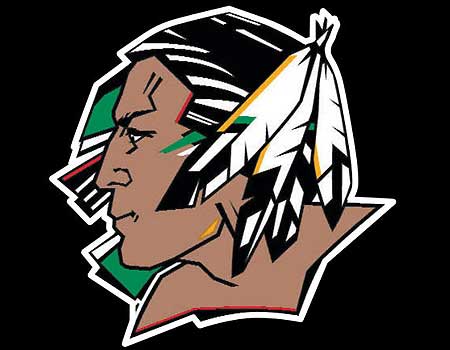
Not surprisingly, the owners are graduates of UND, home of the Fighting Sioux. It's pretty clearly they based their logo on the Fighting Sioux logo. No doubt they're trying to keep the "savage Indian" concept alive. And sending a message about how they won't buckle to political pressure.

For more on Indian mascots, see Oregon Bans Indian Mascots and NCAA Punishes UND for "Fighting Sioux."

November 16, 2011

Blackhawks aid Chicago's Indians

Indian Country Today reports on the Chicago Blackhawks' efforts to aid Indians. Among other things, the Blackhawks are helping to restore the Eternal Indian statue and renovate the American Indian Center. They recently honored Indian veterans before a game.

The key point:

Chicago Blackhawks Developing Real Connections to American Indian CommunitiesMost teams that use American Indian names and logos—the Washington Redskins, Atlanta Braves, Cleveland Indians, University of Illinois Fighting Illini, have earned the criticism they get. They pay lip service to respecting American Indians but rarely do they actually do anything to show that respect, like change their names, or develop real ties with Indian Country.

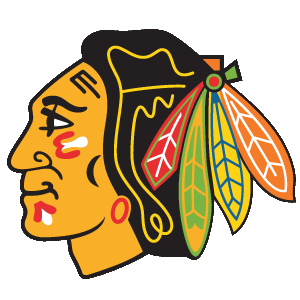
This is not the case for the NHL’s Chicago Blackhawks. Named after team founder Frederic McLaughlin’s U.S. Army battalion in World War I (which called itself the Black Hawks in honor of American Indians), the team has taken real measures to form a relationship with the American Indian community in Illinois.
Comment:  My previous posting on the statue said people call it "Black Hawk" but it's apparently nameless. Now this article calls it The Eternal Indian. Hmm.

Anyway, it's good to see one sports team with an Indian mascot to actually honor Indians. This demonstrates the hypocrisy of every other team that supposedly honors Indians.

For more on the Chicago Blackhawks, see "Chippewa Word" in Saturday Night Live and Blackhawks Mascot in The Dilemma.

Below:  "100-year old monolith The Eternal Indian." (Charles Osgood/Chicago Tribune)

June 20, 2011

Bruins celebrate at Foxwoods

World champion Bruins bring Stanley Cup to Foxwoods

'Big hockey fan' Butera joins festivities

By James Mosher
Several members of the Stanley Cup champion Boston Bruins hockey team visited Foxwoods Resort Casino on Saturday and brought the championship trophy with them. Foxwoods President and CEO Scott Butera, who is a “big hockey fan,” according to a spokeswoman, joined the party.

Stanley Cup MVP Tim Thomas, the goaltender who shut out the Vancouver Canucks 4-0 in the decisive Game 7 in Canada, was among the guests as was team captain Zdeno Chara, assistant Patrice Bergeron, Milan Lucic, Brad Marchand, and Shawn Thornton.

The Bruins visited the Shrine club at MGM Grand at Foxwoods and the High Rollers Luxury Lanes & Lounge in the Foxwoods Resort Casino portion of the entertainment complex.
Comment:  For more on Indians and hockey, see The Uluit: Champions of the North and Inuk Hockey Player Enters Rehab.

Below:  "Foxwoods President & CEO Scott Butera with Zdeno Chara (far left) and Shawn Thorton (middle)." (Brian Spinelli)

February 25, 2011

The Uluit: Champions of the North

From a press release:

The Uluit: Champions of the NorthArnait Video Productions and Rotating Planet are proud to announce the premiere of their TV series, The Uluit: Champions of the North, on APTN. Starting on March 7th.

The Uluit: Champions of the North is a five-episode documentary series about an all-female Inuit hockey team in Inukjuak, Nunavik, a northern Quebec town of 1500 people. Filmed over the course of one year, this remarkable group of mothers, daughters, grandmothers, sisters and friends come together for the love of the game where troubles are left on the sidelines. The Uluit, in addition to being star athletes, fiercely inspire and deeply impact their community serving as teachers, midwives, students and social workers.

The Uluit: Champions of the North provides a rare view into the victory as well as the struggle faced by a culture and community steeped in tradition yet living among the demands and changes of a modern world. Each episode weaves together intimate portraits of these diverse Inuit women embraced by the beauty of the land that surrounds them.
Comment:  For more on the Inuit in documentaries, see The Experimental Eskimos Trailer and Review of Arctic Passage: Ice Survivor.

December 30, 2010

Inuk hockey player enters rehab

Tootoo's rehab could help others:  motherThe mother of Nunavut-raised hockey star Jordin Tootoo says she hopes her son's decision to seek treatment for his alcohol abuse will encourage other northerners dealing with substance abuse to get help.

Rose Tootoo said she is pleased to see her son, a 27-year-old forward with the National Hockey League's Nashville Predators, stepping up to deal with his heavy drinking problem.
And:Jordin Tootoo became the first Inuk hockey player to play in the NHL when he made his debut with the Predators in October 2003.

This month, Tootoo voluntarily entered an in-patient care program through the NHL's substance abuse and behavioural health program, which is jointly run with the league's players union.
Comment:  For more on Native hockey players, see 9 Aboriginal NHL Players and Hockey Part of Native Culture.

October 16, 2010

Akwesasne Warriors in Federal Hockey League

Professional hockey comes to Akwesasne

Federal Hockey League inaugural season begins this month

By Sam Laskaris
Professional hockey is coming to Akwesasne, a small Mohawk community on the United States/Canada border.

The Akwesasne Warriors are one of six clubs that will compete in the inaugural season of the Federal Hockey League.

The new circuit, which is scheduled to begin play in late October, is considered one of the lower levels of pro hockey.

The Warriors, the lone Canadian entrant in the FHL, will play at the A`nowara`ko:wa Arena. The facility, nicknamed “The Turtle Dome,” is located on the Ontario side of Akwesasne.
Comment:  For more on the subject, see:

9 Aboriginal NHL players
Hockey part of Native culture
First Native pro mascot?
Book about Aboriginal hockey players
First Native team owner

June 09, 2010

"Authentic" chiefs from "Blackhawks" tribe

Adrienne Keene of the Native Appropriations blog notes another Blackhawks-related stereotype:

Vince Vaughn Encourages Cultural Appropriation (well, sort of)Vince Vaughn is shooting a new movie called "Cheating Hearts," and apparently some scenes take place at a Chicago Blackhawks game. The casting agency put a call out for extras--"Blackhawk fans"--and some of the participants were a little overly enthusiastic with the Blackhawks "regalia." ReelChicago.com describes the casting call:

An estimated 1,100 persons eager to be extras in the currently shooting Vince Vaughan movie, “Cheating Hearts,” turned out for Atmosphere Casting’s call last Saturday--most in full Blackhawks’ regalia and then some...

The majority took instructions to wear Blackhawks gear to heart, but a few went beyond jerseys and caps They came dressed as authentic Indian chiefs, Blackhawks, no doubt, wearing full feather head dresses to moccasins. Many others added hockey sticks and brooms to confirm their status as fans.

First of all, "authentic"? Not so much. Not at all. Also, "Blackhawks" are not a group of Indians, the team name is taken from Chief Blackhawk, of the Sauk/Sac Nation. But poor wording of the reporting aside, I'm not excited (to say the least) to see these guys in the background of the newest romcom.


Comment: The fans look like a cross between a circus clown and a Christmas tree. They may be the most garish clowns "chiefs" ever. They're on a par with the Mardi Gras Indians--but those "Indians" aren't trying to imitate Plains chiefs. These "Indians" are.

What's really bad is ReelChicago's description of these fans. According to this media source, the fans are dressed as "authentic Indian chiefs" from the "Blackhawks" tribe. Adrienne nicely told us what's wrong with that.

So a publication that presumably has the resources to check a fact didn't do so. ReelChicago's writers and editors apparently had no clue how inauthentic these "authentic" chiefs were. Had no clue where the name "Blackhawks" came from. As far as they're concerned, there's a Blackhawks tribe somewhere out on the Plains where people dress like a cross between a Pendleton blanket and a turkey.

No joking here

This is why I laugh when people defend stereotypes by saying they're a satire, spoof, joke, etc. These fans weren't joking when they dressed as comical Indian characters. The publication wasn't joking when it labeled their costumes "authentic." These people are truly as ignorant as they seem.

This bolsters the point Adrienne made in Blackhawks Foe Waves Severed Head. Namely, that presenting Indians as mascots encourages stereotypical thinking. In other words, Stereotypes Beget Stereotypes.

Even if the Blackhawks logo were accurate, which it's not, it gives people permission to think stereotypically. The permission goes like this: "We believe Indians are primitive people of the past, so you can believe it too. Dress up in stereotypes and you'll be just like our mascot. Millions of people will love you and no one will tell you you're wrong.

"Don't worry about Indians protesting you or calling you racist. They're all dead and gone. How do we know that? Because you can see it on our logo. Indians were half-naked savages and you don't see any half-naked savages running around, do you? Logically, they must be dead and gone or you'd see them in schools, at work, and on TV."
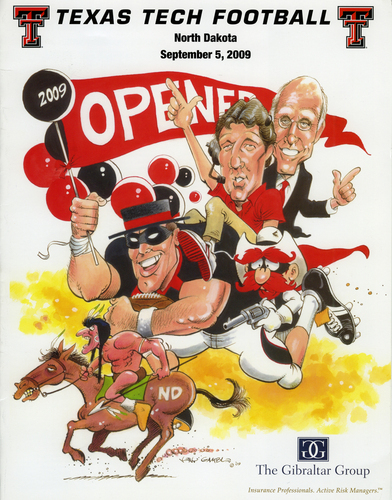


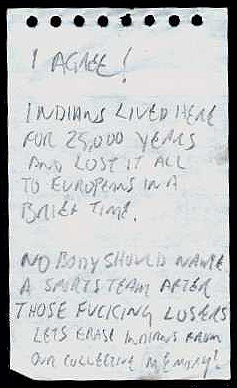
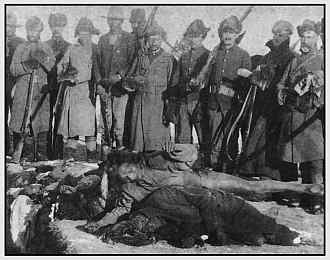
Message to sports fans: "If we can defeat one more half-naked savage, they'll all be dead and gone."

Media conveys respectability

This is yet another example of how the media conveys stereotypes to the public. ReelChicago has told us these costumes are authentic. The costumes fit our stereotypical notions of what Indians look like. Given ReelChicagos's "authentic" label, most readers will assume these characters represent real Indians. They'll pass this (mis)information to their families and friends. If Vince Vaughn hires these clowns, millions of movie goers will see them too.

Let's also note the media's "authority" factor. The New York Times, for one, considers itself the paper of record. It prints "all the news that's fit to print." When we read something in it or the Wall Street Journal or the Washington Post, we tend to believe it's true. Same if we see it on a major network or cable news broadcast.

None of us knows anything about global warming or Obama or the Octo-Mom from firsthand knowledge, but we think we do. Why? Because we've seen or read about it in the news. We don't expect major media outlets to broadcast blatant lies. We expect them to check facts, confirm rumors, and give us some semblance of the truth.

Newspapers won't print stereotypical photos or ads showing blacks as Uncle Toms and Aunt Jemimas, big-lipped idiots eating watermelons, or spearchucking savages in grass skirts. But they will print countless photos and ads showing sports mascots and product labels featuring Indians as stereotypical chiefs and warriors. This gives the stereotypes a veneer of respectability, authenticity, and truth. The New York Times wouldn't print it if it were an offensive stereotype, right?

Media circus of clowns

The ReelChicago label merely makes this implicit authority explicit. One way or the other, the media is telling us these stereotypes are "authentic." People believe what they see, especially when it's in an official source. When the media shows us a thousand stereotypical chiefs for every picture of a Sherman Alexie or Winona LaDuke, the stereotypes must dominate in people's minds.

This is how Americans "learn" about Indians, people. From the media...news and entertainment...everything from Cleveland Indians games to the Dudesons episode. That's one reason protests are inherently good: because they show people that real Indians live among us and don't resemble the stereotypes.

If you've got a better explanation for how people learn Native stereotypes, let's hear it. And don't give us any crap about Wild West shows or parents telling bedtime stories. Not unless you've got more than your worthless opinion to back it up, that is.

For more on the subject, see Blackhawks Foe Waves Severed Head and Blackhawks Know Nothing About Blackhawk. For more on the subject in general, see The Harm of Native Stereotyping: Facts and Evidence.

June 05, 2010

Blackhawks foe waves severed head

The Blackhawks hockey team is in the playoffs, so its logo is in the news. Here's a follow-up to the recent article on the subject. Adrienne Keene of the Native Appropriations blog found this item and nailed it:

Thanks for the severed head, you've proved my point.Game 4. Philly Flyers vs. Chicago Blackhawks. The Flyers score a goal, and VERSUS TV shows this guy. This guy, holding an impaled, severed, Indian head. On national TV.So disturbing, so graphic, and just what I wanted to wake up to on a Saturday morning. Truly sickening in the literal sense.

This proves it, without a doubt. Native American mascots are demeaning, stereotyping, and harmful to Native people. The Blackhawks logo is often touted as a "good" image--not evil or stupid looking, nothing like Chief Wahoo or the other blatantly racist images. But "good" image or not (and I still stand that no Indian mascot is a good mascot), clearly this demonstrates the danger when fans are given control over a mascot and image. There is no excuse for this man's actions.

That's one area mascot debates rarely cover--the actions of rival team's fans and how they affect Native people. When an entire arena is shouting things like "Beat the Indians!" "Scalp the Redskins!" "F*@! the Blackhawks!" Can you imagine how it would feel to be a Native person hearing those things?
And:We could also talk about how the TV station decided it was OK to air the image of this man, multiple times, or how the security at the arena let him through with that spear, and what those actions say about our society, or, per usual, draw the comparisons to other groups. Would a TV station air an image of a man carrying around an impaled Black head? Asian? Latino? No.Keene's conclusion:So, overall, I guess I can--in a twisted and sick way--thank that Flyers fan. Anytime anyone says there is no harm in Indian mascots, I'm sending them that picture.


Comment:  Two excellent points here. First, that the harm of stereotyping extends beyond the mascot and its immediate supporters. As the NCAA ruled, mascots create an abusive and hostile environment. Here's the proof of that claim.

Second, that tolerance for mascots and their associated problems--e.g., severed Indian heads--shows society's ignorance and (conscious or unconscious) racism. So the mascot problem is really the whole problem in microcosm. Mascots create and reinforce stereotypical beliefs...fans (mis)use and disseminate these beliefs...and society is conditioned to accept and tolerate them.

We could say the same about almost any example of prejudice. For instance, some racist decides Obama isn't an American. Thousands of people who are prejudiced or simply ignorant take up the "birther" chant. Suddenly a quarter of the country believes it because we're so conditioned to think of blacks as criminals and cheaters.

How racists "think"

People like this Flyers fan undoubtedly don't know what they're doing. Their "thinking" goes something like this: "The Founding Fathers were white men...Indians are savages...the Pope is Catholic. What's the problem here?"

To be specific, it goes something like this:

"A severed Indian head? So what? There aren't any Indians left, are there? They all died ages ago, right? I know this because I've seen the Blackhawks logo. I've never seen an Indian like that in real life, so they must all be dead."

For more on the subject, see Children and Dudesons Believe Stereotypes and Stereotypes Beget Stereotypes. For more on the subject in general, see Team Names and Mascots.

Below:  No, mascots don't encourage stereotypical thinking. Uh-huh, sure they don't.


May 30, 2010

Blackhawks know nothing about Black Hawk

Origin of a name:  Blackhawks name founded in history, controversy

Some of American Indian heritage hope playoff push offers teaching moment about Chief Black Hawk

By Ron Grossman
Cyndee Fox-Starr, whose father played in the 1950s for a local hockey team in full Indian headdress, is rooting for the Hawks but hopes the playoffs will provide a teachable moment.

"Maybe others will see we're a people, not mascots," said Fox-Starr, who is of Omaha and Odawa Indian parentage.

Fox-Starr is special events coordinator at the American Indian Center on West Wilson Avenue in Chicago, where it has been a season of mixed emotions. Some patrons and staff are hockey fans. Others who don't follow the sport are rooting for the home team out of civic pride—but with a tinge of sadness when they see the Indian-head logo on players' jerseys.

"I'm excited for the franchise," said Negwes White, 23, a youth worker at the center. "But I don't think Blackhawks fans have any understanding of our culture."

Blackhawks management's policy is not to comment on the issue. But in the team's clubhouse, the Blackhawk Indian logo is held sacred. No one steps on it, and it's kept illuminated. A few years ago, former coach Denis Savard backtracked on his use of the phrase "commit to the Indian" when trying to rally the team. But loyal fans repeat it with gusto.
And:Even Chicagoans of American Indian descent can be stumped by the question of who Black Hawk was and what he did.

"I don't know anything about him," said Alex Figueroa, 13. A member of the Taino tribe, he was shooting baskets with other young American Indians in an alley behind the Indian Center in Uptown. "We didn't learn about him in school."
And:Even though the Blackhawks' use of the logo has been more subtle, it troubles Fox-Starr when she sees fans wearing war bonnets. She is bothered when crowds at sporting events clap in Indian rhythms, which have a religious significance.

"Each drumbeat signifies a heartbeat," she said.
Comment:  Blackhawk players respect "the Indian" so much that they won't step on his image. Blackhawk fans chant "commit to the Indian." Their idea of "the Indian" is a orange-skinned "brave" in facepaint. They wear warbonnets and clap in some weird tribal rite to show their love of this "Indian."

Meanwhile, they don't have a clue about the real Chief Black Hawk. They're in love with a fantasy figure, a cartoon image, and they couldn't care less about real Indians. If a descendant of Black Hawk protested the mascot, they'd tell him to go to hell.

This is pretty much the mascot debate in a nutshell. Mascot supporters cherish their stereotypical notion of Indians as primitive people of the past. Like children and Dudesons, it's all they know about Indians.

In contrast, real Indians are a complete void to them: unknown, invisible, and not worth thinking about. So fans "honor" them by ignoring them. By preferring their romanticized, idealized Indians of yesteryear to the complex, conflicted Indians of today.

For more on the subject, see Team Names and Mascots.

P.S. Black Hawk is another Indian chief immortalized as a killer weapon system--the helicopter immortalized in Black Hawk Down.

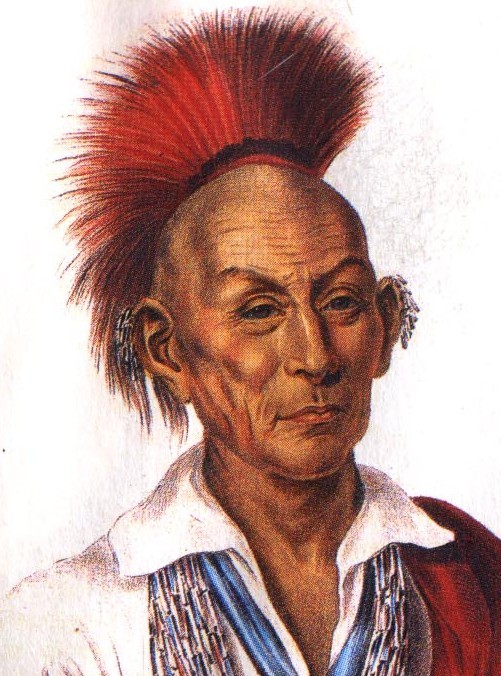
Below:  The real Black Hawk:


And the fictional one:

August 17, 2009

Musqueam design on Team Canada jerseys

New Olympic hockey jerseys feature First Nation designTeam Canada's new Olympic hockey jerseys feature the design work of Musqueam artist Debra Sparrow. Team Canada's new Olympic hockey jerseys feature the design work of Musqueam artist Debra Sparrow. (Hockey Canada)

The new Team Canada ice hockey jerseys featuring a West Coast First Nations design and a familiar swoosh were unveiled in Vancouver on Monday.

The jersey's design was a collaboration between Musqueam artist Debra Sparrow and Nike, the new official supplier of high performance sportswear for the 2010 Winter Games.

The jerseys feature a large maple leaf crest in the centre on either a red or white background. Inside the crest are smaller maple leaves representing the gold medal counts for Canada's men's, women's and ice sledge hockey teams, and a nod to the traditional Team Canada image of a hockey player and stick.

But the design also includes a thunderbird and an eagle—two powerful First Nations symbols—supporting and protecting the central maple leaf. A small Nike swoosh appears above and to the left of the maple leaf.

The jerseys will be worn by the men's, women's and sledge hockey teams representing Canada at the 2010 Winter Olympic and Paralympic Games in February and March in Vancouver, but will go on sale Monday for $135.

The previous Team Canada jerseys were rejected by the International Committee because they featured the logo of the Hockey Canada organization.
Native artist Debra Sparrow designs jersey

By Katie Rook"The center is an eagle and a thunderbird. The eagle is significant to all people: First Nations, non-First Nations.

"The eagle is an amazing spirit that represents not only freedom, but the strength to sore as high as you can go," she said.

A thunderbird is also included within the new logo and is considered the Keeper of the Skies, she said.

"He's responsible for the weather. In our myths he brings the thunder and the lightening."

Sparrow's intention was also to show those watching the Games that Canadian athletes are connected to a strong heritage.

"I honour all of those competitors who are coming here so that they know that there is a foundation here that is strong; that we stand on it," she said.
Comment:  For more on the subject, see Native Participation in 2010 Olympics.

May 24, 2009

9 Aboriginal NHL players

Native hockey stars shine in NHLThe rafters shake as 17,000 hockey fans cheer wildly every time Edmonton Oiler Sheldon Souray touches the puck in the opponents zone.

Known for his blistering shot from the point, and his punishing checks into the boards, the six-foot-four, 235-pound defenseman is arguably the most known and feared aboriginal player in the National Hockey League. With 23 goals this season, Souray is the second-highest scoring defenseman in the league.

Although aboriginal players are a rarity in the NHL, there are nine Native players currently spread amongst the 32 teams, and on that night Souray faced one of his peers.

Cody McCormick has spent the past five seasons with the Colorado Avalanche. A member of the Chippewa Mohawk Nation near London, Ontario, McCormick said he looks forward to facing other Native players, and hopes more will soon graduate to the big league.
And:Current Aboriginal NHL’ers

Aaron Asham, Metis, Philadelphia Flyers
Rene Bourque, Metis, Calgary Flames
Jonathan Cheechoo, Cree, San Jose Sharks
Vernon Fiddler, Metis, Nashville Predators
D.J.King, Metis, St. Louis Blues
Cody McCormick, Mohawk, Colorado Avalanche
Carey Price, Carrier, Montreal Canadiens
Wade Redden, Metis, New York Rangers
Sheldon Souray, Metis, Edmonton Oilers
Jordin Tootoo, Inuit, Nashville Predators
Comment:  For more on the subject, see Hockey Part of Native Culture and Book About Aboriginal Hockey Players.

Below:  Sheldon Souray.

May 04, 2009

Hockey part of Native culture

National hockey tournament showcases aboriginal talentSome of Canada's best junior hockey players are in Winnipeg this week to compete in the national aboriginal hockey championships.

More than 500 players—teen boys and girls—on 18 teams from across the country are taking part in the tournament, which is held in a different city every year. Participants are First Nations, Inuit and Métis and represent all 10 provinces and three territories.

A special tribute this year is being made to Manitoba hockey legend Reggie Leach, a winger who played for three NHL teams between 1970 and 1983.

Nicknamed the Riverton Rifle for his hometown of Riverton, about 110 kilometers north of Winnipeg, Leach still holds the NHL record for the most goals scored during a single playoff season. He scored 19 in 1976.

"I think that this tournament is great for young kids. It gives them an identity where they are one of the best native hockey players in the province, not only in Manitoba, but across Canada, and they're representing their province, which is great," said Leach, who is now a junior hockey coach for the Manitoulin Islanders of the Northern Ontario Bantam Hockey League.

He said hockey has become a huge component of contemporary native culture.
Comment:  For more on the subject, see Book About Aboriginal Hockey Players.

February 22, 2009

First Native pro mascot?

Cody Hall lands a ‘Nugget’ of a jobHall, 31, was planning to buy season tickets for the Rapid City Rush, a South Dakota-based expansion franchise in the Central Hockey League.

But then, after reading in his local newspaper that the squad was looking to hire a mascot, Hall, at the urging of some friends, auditioned and got the job.

“My friends were telling me, ‘You’ve got a real good personality and you’d be perfect for this,’” Hall said.

For his new position, Hall dons a donkey suit and is known simply as “Nugget.”

Besides receiving $100 a game to perform at each Rush home contest, Hall had appeared at more than 30 other events in the community by early February. These events range from children’s birthday parties to school visits to corporate gigs.
And:Hall, who is Sioux, said because of his new job he has also managed to connect with various other mascots who work for franchises in the National Hockey League, National Basketball Association and the National Football League.

Hall said he is frequently exchanging e-mails and talking on the phone with other mascots.

“It’s really crazy. I’ll get calls from guys all over the U.S. And they’ve really helped me out a great deal. They’ve told me what to do with some of my promotions and how to interact with people.”

Hall said he has yet to come across any other Native who works as a mascot for a professional sports franchise.

“I think this is kind of like a groundbreaking thing, especially being Indian,” he said. “We’re just two steps below the NHL.”
Comment:  I'm not sure the Rapid City Rush qualifies as a "pro" sport, but never mind.

As long as Hall isn't portraying a stereotypical Indian, there's no problem with his being a mascot.

For more on the subject, see Team Names and Mascots.

October 27, 2008

Book about Aboriginal hockey players

Book sheds light on First Nations playersWinnipeg's Don Marks isn't out to change the world.

"I'd be happy if I could change just a small corner of the world," says Marks, in Toronto yesterday to promote his book They Call Me Chief. It is billed as a story about aboriginal hockey players in the NHL. But Marks unfolds scenes of Canadiana that are as much about the human condition as they are about our national addiction to hockey.

His tales of Bryan Trottier and Theoren Fleury and George Armstrong are humorous and at the same time unsettling. He unveils a Canadian society that sees itself as being all-inclusive and at the same time one that fails to live up to those beliefs. And, he does it all without getting preachy. "As Canadians we love hockey and I'm telling these interesting stories but they lead to issues that we should be solving ... racism, poverty, treaty rights, self-government. The hook is the hockey but it's about so much more."

His hope, says Marks, is that people develop understanding and empathy for the First Nations. "Nobody is looking for charity. But we don't want some 68-year-old woman, hiking up her dress and hauling through six feet of snow in minus-40 degree winter to go have a whiz because that's what it's like in some places ... there's no running water. That shouldn't exist in a country as wealthy as Canada."
Comment:  For more on the subject, see The Best Indian Books.

July 16, 2008

First Native team owner

Blazing a Trail From a Reservation Into OwnershipStyres, a Mohawk, has lived on the reserve his entire life. He built his businesses here. They include the raceway and a partnership in a tobacco company that employs 200 people at its plant in Ohsweken, and more at a second plant near Berlin.

In May, Styres paid $5.5 million to buy a 60 percent controlling share of the Rochester Knighthawks of the National Lacrosse League, and an undisclosed price for the Americans. He says he thinks he is the first individual American Indian—known in Canada as First Nations people—to own a major professional sports franchise. The Mohegan Tribe owns the Connecticut Sun of the W.N.B.A.
Comment:  Uh, I don't think a team in the National Lacrosse League or the American Hockey League counts as a major professional sports franchise. It's more like a minor professional sports franchise.