Showing posts with label Blackhawks. Show all posts

February 17, 2015

Blackhawks logo in SNL's 40th anniversary

Indians appeared once in Saturday Night Live's 40th-anniversary show. Unfortunately, the appearance wasn't good:

SNL 40th Anniversary: Mike Myers and Native Imagery

By Adrienne KeeneI was excited to see a Wayne’s World sketch, because I am a nerd and use #partytimeexcellent as a personal catchphrase…and then noticed something about Wayne/Mike Myers:

Obviously, he’s wearing a Chicago Blackhawks Jersey. But notice the blanket he’s sitting on as well…totally “Native inspired.”

It got me thinking (duh). This screenshot pretty much encapsulates what most folks watching SNL think about Native peoples: mascots and artifacts. Both disembodied symbols that have minimal relation to contemporary Native communities or people. Both representing outsiders profiting from and exploiting our images and our cultures for their own economic gain. Both harkening to a very specific period of time in our cultures–back to the 19th century, when the “real Indians” were around.
These things matter. More than 23 million viewers saw this sketch. 23 MILLION. When we don’t have any counter-representations to show us as we actually are, the weight of these small moments adds up. I know most viewers wouldn’t have even thought twice about the problematic nature of this–but that’s why you have me, right? To scream from the rooftops that WE ARE MORE THAN ARTIFACTS AND MASCOTS? These things aren’t “honoring.” They’re demeaning and exploitative. Final answer.Comment:  Keene adds that the team owner's wife designed the Blackhawks logo while her husband named the team after his Blackhawk Division in World War I. Some people have used that origin as an excuse to keep the name: "The team isn't stereotypical because it's not named after an Indian."

Not directly, anyway. But that only undercuts the claim that the team, name, and logo "honor" Indians. As Keene notes, they're honoring a fictitious version of an Indian--what the owners think Sauk Chief Black Hawk looked like in their dreams. There's no legitimate Native basis for the name or logo.

Keene also tweeted this image:

Writing a quick post about SNL...remember "Native American Comic Billy Smith"? smh: http://www.hulu.com/watch/114928For more on the Blackhawks, see Blackhawks Fans Defend Stereotypical Logo and Severed Head Suggests Dead Indian. For more on Saturday Night Live and Billy Smith, see Native Doll in Saturday Night Live and Cobell Skit in Saturday Night Live.

July 24, 2013

Blackhawks fans defend stereotypical logo

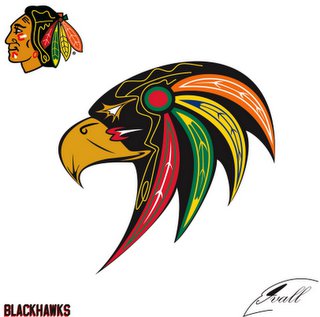
Some anonymous commenters took me to task for my Alternate Logo for Blackhawks posting in 2010. It was about this proposed mascot revamp for the Chicago Blackhawks hockey team:


Here's why I was right and they were wrong:Change the Blackhawk logo? Go ahead and try, you whiny little bitches. At your own peril, of course.It was merely a suggestion, dumbass. And you and your fellow fans are the only whiny babies here. I can still hear you crying over you mascot.Get your references correct. The Chicago Blackhawks are named after Chief Black Hawk of the Sauk tribe of Northern Illinois. He is the only individual in USA history to have a war named after him. The Chicago franchise of the NHL used his name (modified to one word) as a point of honor towards Black Hawk, and to all of the indigenous peoples of North America. So, remember the Blackhawks are not birds, but rather proud braves.Thanks for the info, Anonymous #3. Now tell me something I don't know. In fact, tell me something I didn't know before you were born, unless I miss my guess.

Wow...the stupidity of people who think mascot foes don't know every detail about the mascot they're criticizing. Breathtaking.

Here's a clue, bright boy: The team not only converted Black Hawk's name to one word, it pluralized it. There are no Indian "braves" or other Native groups named "Blackhawks." So your claim that the actual name refers to "proud braves" is false.

The plural "Blackhawks" is about as close to the singular Chief Black Hawk as a black bird would be. And Chief Black Hawk was named for--wait for it--a black hawk. Therefore, a black hawk is equally appropriate as the team's self-image.

Heck, it's more appropriate, since the orange-skinned cartoon logo looks nothing like Chief Black Hawk. The black hawk looks like the chief's namesake, while the cartoon logo looks like a circus clown. It's more of an insult than an honor to the real person.


If you want to honor the Sauk Indians, rename the team the Sauks. Or the Black Sauks, if you want to be clever. Again, the "Blackhawks" name honors the Sauk the same way a "Crazy Horses" name would honor the Lakota. Which is to say, not at all.

The ignorant "honor" claimOne thing no one seems to thing about, is a logo/mascot is a thing of pride. Native Americans should be as honored by the Blackhawks as those of Nordic decent are of the Vikings, or the Irish are of Notre Dame. No one names their team after something they hate, dispise, or intend to mock. The logo was chosen to represent the fierce will and determination shown by this country's proud indigenous people. To say its offensive to Native Americans is offensive to common sense.Actually, I've thought about and disputed that claim hundreds of times. You evidently haven't thought of or even read the responses to that tired, trite claim.

Here's one of many such responses:

Smashing People: The "Honor" of Being an Athlete

One obvious rejoinder is: Who are you to tell Indians they should feel honored? The fact that you're imposing your feelings on them because you consider yourselves superior is part of the problem. You "honor" Indians by telling them to shut up...charming.

More to the point, Natives are challenging the clownish logo more than the name. Get it? The logo, not the name, is offensive because it stereotypes Indians as primitive people of the past.

In fact, none of you have addressed this point: how Bozo the Blackhawk doesn't represent the Sauk chief or his people, much less today's Sauk Indians. Now that you chickens have ducked the issue, try addressing it. If you're not wetting your pants at the thought of the butt-kicking you'll get, that is.

For more on the Blackhawks, see Blackhawks Mascot in The Dilemma and "Authentic" Chiefs from "Blackhawks" Tribe.

November 16, 2011

Blackhawks aid Chicago's Indians

Indian Country Today reports on the Chicago Blackhawks' efforts to aid Indians. Among other things, the Blackhawks are helping to restore the Eternal Indian statue and renovate the American Indian Center. They recently honored Indian veterans before a game.

The key point:

Chicago Blackhawks Developing Real Connections to American Indian CommunitiesMost teams that use American Indian names and logos—the Washington Redskins, Atlanta Braves, Cleveland Indians, University of Illinois Fighting Illini, have earned the criticism they get. They pay lip service to respecting American Indians but rarely do they actually do anything to show that respect, like change their names, or develop real ties with Indian Country.

This is not the case for the NHL’s Chicago Blackhawks. Named after team founder Frederic McLaughlin’s U.S. Army battalion in World War I (which called itself the Black Hawks in honor of American Indians), the team has taken real measures to form a relationship with the American Indian community in Illinois.
Comment:  My previous posting on the statue said people call it "Black Hawk" but it's apparently nameless. Now this article calls it The Eternal Indian. Hmm.

Anyway, it's good to see one sports team with an Indian mascot to actually honor Indians. This demonstrates the hypocrisy of every other team that supposedly honors Indians.

For more on the Chicago Blackhawks, see "Chippewa Word" in Saturday Night Live and Blackhawks Mascot in The Dilemma.

Below:  "100-year old monolith The Eternal Indian." (Charles Osgood/Chicago Tribune)

February 05, 2011

"Chippewa word" in Saturday Night Live

In this week's Saturday Night Live (airdate: 2/5/11), Bobby Moynihan as Jersey Shore's Snooki visits Dana Carvey as the Church Lady. The Church Lady views everything about Snooki with disdain, including her name:"Snooki," of course. From the Chippewa word that means "drop your shorts, we don't have much time."Right, because any strange word like "Snooki" must be an Indian word. In particular, a short Indian word that stands for a long concept, such as "place where a thousand buffalo cross the stream without getting their feet wet."

It's a subtle way of reinforcing the message that Indians are different from the rest of us. And it's not as if the context is anything good. According to SNL, Snooki is as promiscuous as the Chippewa, who are so promiscuous they have a special word for sexual quickies.

Blackhawks logo

The show also opened with a Wayne's World segment featuring Wayne (Mike Myers) in a Chicago Blackhawks sweatshirt--same as in The Dilemma. Really? No one thought putting a stereotypical image of an Indian "brave" on screen for five minutes might not be a great idea?

Imagine if you broadcast an image of an African spearchucker or a greedy Jew for five minutes. Does anyone think no one would notice that? For the umpteenth time, it's the same thing, people.

For more on the subject, see Kesha Goes Tribal in Saturday Night Live and Indian Curse in Saturday Night Live.

January 15, 2011

Blackhawks mascot in The Dilemma

Indianz.com posted this picture from the new movie The Dilemma:


Comment:  Vince Vaughn and Kevin James are wearing Chicago Blackhawks jerseys. Note especially the crossed tomahawks or war clubs on the shoulders.

Black Hawk and his men probably painted themselves like this and used these weapons. But that was almost 200 years ago. It's as stereotypical as it would be to portray every American as Daniel Boone or Andrew Jackson.

Nice to see "liberal" Hollywood is still so sensitive to Native issues...not.

For more on the subject, see Alternative Logo for Blackhawks and Severed Head Suggests Dead Indians.

June 18, 2010

Alternative logo for Blackhawks

Someone alerted me to a Facebook page titled "This Should Be the Blackhawks Logo!" It contained this image:


Wow. That's an impressive piece of graphic design. It retains all the significant aspects of the present logo, but does them one better.

It's hard to imagine anyone would prefer the bland, smiling Indian to the bold, dynamic raptor. A good test would be showing the two logos to people who aren't familiar with the Blackhawks. I wouldn't be surprised if they chose the bird over the human 10-1.

Jolene adds:Just FYI--we did some small survey's with students and many said, "It is a black hawk and there should be no reference to an actual person at all. Changing the mascot from a made up pic to an actual hawk would be meaningful."

In fact one brilliant 6th grader said, "You know the Bears used to be the Cardinals then the Steel...." I was shocked he knew the history and made a connection that things can be changed very easily.
Comment:  So the first bit of anecdotal evidence confirms our suspicions: that people would be willing to switch mascots if given a better alternative. So what's the holdup? Change the logo and reap a whirlwind of favorable publicity and merchandise sales. It's win-win all around.

For more on the subject, see "Authentic" Chiefs from "Blackhawks" Tribe, Blackhawks Foe Waves Severed Head, and Blackhawks Know Nothing About Black Hawk.

June 12, 2010

Severed head suggests dead Indians

More on the sports fan with the severed Indian head. He's Jim Melchionna of Turnersville, N.J., and he waves the head at all sorts of sporting events.

Amazing tales of the Philadelphia fan with the impaled Indian head

By Greg Wyshynski"I'm a big Philadelphia Eagles fan, so I actually take the head to the Redskins games. It was never even meant to be for the Blackhawks," he said. "And when the Cowboys come to town, I put a cowboy hat on it and write 'Deadboys.'"

Cowboys, Deadboys. Redskins, Deadskins. And now Blackhawks, Deadhawks.


Apparently Melchionna dresses the generic head as an Indian when the opponents are "Indians." As you can see in one photo, he writes the phrase "Red Dead" on the head's cheek.

Activist Joni Taylor Tucker responds to the article by Wyshynski, who calls himself Puck Daddy:Here is what I posted on the Puck Daddy blog:

All you people--laughing, bitching, mocking, justifying, minimizing this guy's stunt are ALL racist BIGOTS. Helllooo...?! How can you not get it?

1. YOU all talk about native people as "things" and as IF they no longer exist--all I can say about that is you are all dumb asses. (But that is not ALL your fault--your schools and American society dumbs you down.)

2. Native people are NOT animals or things to be dehumanized and be used for the sake of fun and entertainment. THINK people--think! Put a depiction of YOUR preacher's or your grandma's head on that stick. And oh yeah--BTW make sure YOUR kid is sitting in the fan box when the guy runs by like a nut case and waves grandma's bloody head in their face.

3. Who are YOU to say "we are honoring" when MOST of the very people that you claim to be honoring tell you to STOP and say this is despicable? To say that you are just being self serving and making excuses for bigotry.

4. Instead of choosing to remain racist bigots--learn about how these racist acts impacts the well being of entire culture and that ALL children are injured by these bigoted acts disguised as so-called fun antics. Do a simple web search--"Native American mascots."

P.S. Dear Mr. Puck Daddy--Why in the world would you glorify this act by yet another article on your blog...are you glorifying bigotry too?
Comment:  "Puck Daddy" seems slightly disturbed by the head. I don't mind his writing another column about it, but he should've devoted less space to the fan and more to Native reactions to the head. Then it might've been a worthwhile article.

Indians analogous to cowboys?

In fairness, when the Dallas Cowboys are in town, Melchionna dresses the head as a cowboy. So he could claim be an equal opportunity offender.

But he would be wrong. As we've noted several times:

1) "Cowboy is an occupation, while "Indian" is an ethnicity. (I wonder how many thousands of times we'll have to make this point before the first sports fan gets it.)

2) The Indian is wearing a feather headdress from centuries ago. The Cowboy is wearing a hat that people wear everywhere today. One is stereotypical, the other isn't.

If the Cowboy was wearing a powdered wig from colonial times while the Indian was wearing an astronaut's helmet, then the headgear wouldn't be stereotypical. The Cowboy wouldn't look civilized while the Indian looked savage.

3) Indians have a history of being killed and even beheaded in America. Cowboys don't. The severed head suggests this history.

It's similar to a black head in a noose. Obviously, white people were hanged too, but not for racial reasons. The severed Indian head, like the noose, sends a message of racial hatred.

The bottom line

Bottom line is that our society hasn't denigrated cowboys or white men with stereotypical and racially charged messages. It has denigrated Indians, blacks, and other minorities with such messages. That's why the head is wrong.

And as we know, stereotypes beget stereotypes. I'm guessing most fans don't know that Indians are still alive, don't wear headdresses, and may attend sporting events. They think Indians are dead and gone because mascots and other stereotypical images have told them so.

Incidentally, I've got $100 that says Melchionna would agree with the people who think we're talking and teaching too much about race. That America is a level playing field for everyone and racism is pretty much a thing of the past. Anyone want to take the bet?

Note:  I edited Tucker's comments slightly to make them more readable.

For more on the subject, see "Authentic" Chiefs from "Blackhawks" Tribe and Children and Dudesons Believe Stereotypes.

Below:  "Kill the savage redskins! Better dead than red!"

June 09, 2010

"Authentic" chiefs from "Blackhawks" tribe

Adrienne Keene of the Native Appropriations blog notes another Blackhawks-related stereotype:

Vince Vaughn Encourages Cultural Appropriation (well, sort of)Vince Vaughn is shooting a new movie called "Cheating Hearts," and apparently some scenes take place at a Chicago Blackhawks game. The casting agency put a call out for extras--"Blackhawk fans"--and some of the participants were a little overly enthusiastic with the Blackhawks "regalia." ReelChicago.com describes the casting call:

An estimated 1,100 persons eager to be extras in the currently shooting Vince Vaughan movie, “Cheating Hearts,” turned out for Atmosphere Casting’s call last Saturday--most in full Blackhawks’ regalia and then some...

The majority took instructions to wear Blackhawks gear to heart, but a few went beyond jerseys and caps They came dressed as authentic Indian chiefs, Blackhawks, no doubt, wearing full feather head dresses to moccasins. Many others added hockey sticks and brooms to confirm their status as fans.

First of all, "authentic"? Not so much. Not at all. Also, "Blackhawks" are not a group of Indians, the team name is taken from Chief Blackhawk, of the Sauk/Sac Nation. But poor wording of the reporting aside, I'm not excited (to say the least) to see these guys in the background of the newest romcom.


Comment: The fans look like a cross between a circus clown and a Christmas tree. They may be the most garish clowns "chiefs" ever. They're on a par with the Mardi Gras Indians--but those "Indians" aren't trying to imitate Plains chiefs. These "Indians" are.

What's really bad is ReelChicago's description of these fans. According to this media source, the fans are dressed as "authentic Indian chiefs" from the "Blackhawks" tribe. Adrienne nicely told us what's wrong with that.

So a publication that presumably has the resources to check a fact didn't do so. ReelChicago's writers and editors apparently had no clue how inauthentic these "authentic" chiefs were. Had no clue where the name "Blackhawks" came from. As far as they're concerned, there's a Blackhawks tribe somewhere out on the Plains where people dress like a cross between a Pendleton blanket and a turkey.

No joking here

This is why I laugh when people defend stereotypes by saying they're a satire, spoof, joke, etc. These fans weren't joking when they dressed as comical Indian characters. The publication wasn't joking when it labeled their costumes "authentic." These people are truly as ignorant as they seem.

This bolsters the point Adrienne made in Blackhawks Foe Waves Severed Head. Namely, that presenting Indians as mascots encourages stereotypical thinking. In other words, Stereotypes Beget Stereotypes.

Even if the Blackhawks logo were accurate, which it's not, it gives people permission to think stereotypically. The permission goes like this: "We believe Indians are primitive people of the past, so you can believe it too. Dress up in stereotypes and you'll be just like our mascot. Millions of people will love you and no one will tell you you're wrong.

"Don't worry about Indians protesting you or calling you racist. They're all dead and gone. How do we know that? Because you can see it on our logo. Indians were half-naked savages and you don't see any half-naked savages running around, do you? Logically, they must be dead and gone or you'd see them in schools, at work, and on TV."


Message to sports fans: "If we can defeat one more half-naked savage, they'll all be dead and gone."

Media conveys respectability

This is yet another example of how the media conveys stereotypes to the public. ReelChicago has told us these costumes are authentic. The costumes fit our stereotypical notions of what Indians look like. Given ReelChicagos's "authentic" label, most readers will assume these characters represent real Indians. They'll pass this (mis)information to their families and friends. If Vince Vaughn hires these clowns, millions of movie goers will see them too.

Let's also note the media's "authority" factor. The New York Times, for one, considers itself the paper of record. It prints "all the news that's fit to print." When we read something in it or the Wall Street Journal or the Washington Post, we tend to believe it's true. Same if we see it on a major network or cable news broadcast.

None of us knows anything about global warming or Obama or the Octo-Mom from firsthand knowledge, but we think we do. Why? Because we've seen or read about it in the news. We don't expect major media outlets to broadcast blatant lies. We expect them to check facts, confirm rumors, and give us some semblance of the truth.

Newspapers won't print stereotypical photos or ads showing blacks as Uncle Toms and Aunt Jemimas, big-lipped idiots eating watermelons, or spearchucking savages in grass skirts. But they will print countless photos and ads showing sports mascots and product labels featuring Indians as stereotypical chiefs and warriors. This gives the stereotypes a veneer of respectability, authenticity, and truth. The New York Times wouldn't print it if it were an offensive stereotype, right?

Media circus of clowns

The ReelChicago label merely makes this implicit authority explicit. One way or the other, the media is telling us these stereotypes are "authentic." People believe what they see, especially when it's in an official source. When the media shows us a thousand stereotypical chiefs for every picture of a Sherman Alexie or Winona LaDuke, the stereotypes must dominate in people's minds.

This is how Americans "learn" about Indians, people. From the media...news and entertainment...everything from Cleveland Indians games to the Dudesons episode. That's one reason protests are inherently good: because they show people that real Indians live among us and don't resemble the stereotypes.

If you've got a better explanation for how people learn Native stereotypes, let's hear it. And don't give us any crap about Wild West shows or parents telling bedtime stories. Not unless you've got more than your worthless opinion to back it up, that is.

For more on the subject, see Blackhawks Foe Waves Severed Head and Blackhawks Know Nothing About Blackhawk. For more on the subject in general, see The Harm of Native Stereotyping: Facts and Evidence.

June 05, 2010

Blackhawks foe waves severed head

The Blackhawks hockey team is in the playoffs, so its logo is in the news. Here's a follow-up to the recent article on the subject. Adrienne Keene of the Native Appropriations blog found this item and nailed it:

Thanks for the severed head, you've proved my point.Game 4. Philly Flyers vs. Chicago Blackhawks. The Flyers score a goal, and VERSUS TV shows this guy. This guy, holding an impaled, severed, Indian head. On national TV.So disturbing, so graphic, and just what I wanted to wake up to on a Saturday morning. Truly sickening in the literal sense.

This proves it, without a doubt. Native American mascots are demeaning, stereotyping, and harmful to Native people. The Blackhawks logo is often touted as a "good" image--not evil or stupid looking, nothing like Chief Wahoo or the other blatantly racist images. But "good" image or not (and I still stand that no Indian mascot is a good mascot), clearly this demonstrates the danger when fans are given control over a mascot and image. There is no excuse for this man's actions.

That's one area mascot debates rarely cover--the actions of rival team's fans and how they affect Native people. When an entire arena is shouting things like "Beat the Indians!" "Scalp the Redskins!" "F*@! the Blackhawks!" Can you imagine how it would feel to be a Native person hearing those things?
And:We could also talk about how the TV station decided it was OK to air the image of this man, multiple times, or how the security at the arena let him through with that spear, and what those actions say about our society, or, per usual, draw the comparisons to other groups. Would a TV station air an image of a man carrying around an impaled Black head? Asian? Latino? No.Keene's conclusion:So, overall, I guess I can--in a twisted and sick way--thank that Flyers fan. Anytime anyone says there is no harm in Indian mascots, I'm sending them that picture.


Comment:  Two excellent points here. First, that the harm of stereotyping extends beyond the mascot and its immediate supporters. As the NCAA ruled, mascots create an abusive and hostile environment. Here's the proof of that claim.

Second, that tolerance for mascots and their associated problems--e.g., severed Indian heads--shows society's ignorance and (conscious or unconscious) racism. So the mascot problem is really the whole problem in microcosm. Mascots create and reinforce stereotypical beliefs...fans (mis)use and disseminate these beliefs...and society is conditioned to accept and tolerate them.

We could say the same about almost any example of prejudice. For instance, some racist decides Obama isn't an American. Thousands of people who are prejudiced or simply ignorant take up the "birther" chant. Suddenly a quarter of the country believes it because we're so conditioned to think of blacks as criminals and cheaters.

How racists "think"

People like this Flyers fan undoubtedly don't know what they're doing. Their "thinking" goes something like this: "The Founding Fathers were white men...Indians are savages...the Pope is Catholic. What's the problem here?"

To be specific, it goes something like this:

"A severed Indian head? So what? There aren't any Indians left, are there? They all died ages ago, right? I know this because I've seen the Blackhawks logo. I've never seen an Indian like that in real life, so they must all be dead."

For more on the subject, see Children and Dudesons Believe Stereotypes and Stereotypes Beget Stereotypes. For more on the subject in general, see Team Names and Mascots.

Below:  No, mascots don't encourage stereotypical thinking. Uh-huh, sure they don't.


May 30, 2010

Blackhawks know nothing about Black Hawk

Origin of a name:  Blackhawks name founded in history, controversy

Some of American Indian heritage hope playoff push offers teaching moment about Chief Black Hawk

By Ron Grossman
Cyndee Fox-Starr, whose father played in the 1950s for a local hockey team in full Indian headdress, is rooting for the Hawks but hopes the playoffs will provide a teachable moment.

"Maybe others will see we're a people, not mascots," said Fox-Starr, who is of Omaha and Odawa Indian parentage.

Fox-Starr is special events coordinator at the American Indian Center on West Wilson Avenue in Chicago, where it has been a season of mixed emotions. Some patrons and staff are hockey fans. Others who don't follow the sport are rooting for the home team out of civic pride—but with a tinge of sadness when they see the Indian-head logo on players' jerseys.

"I'm excited for the franchise," said Negwes White, 23, a youth worker at the center. "But I don't think Blackhawks fans have any understanding of our culture."

Blackhawks management's policy is not to comment on the issue. But in the team's clubhouse, the Blackhawk Indian logo is held sacred. No one steps on it, and it's kept illuminated. A few years ago, former coach Denis Savard backtracked on his use of the phrase "commit to the Indian" when trying to rally the team. But loyal fans repeat it with gusto.
And:Even Chicagoans of American Indian descent can be stumped by the question of who Black Hawk was and what he did.

"I don't know anything about him," said Alex Figueroa, 13. A member of the Taino tribe, he was shooting baskets with other young American Indians in an alley behind the Indian Center in Uptown. "We didn't learn about him in school."
And:Even though the Blackhawks' use of the logo has been more subtle, it troubles Fox-Starr when she sees fans wearing war bonnets. She is bothered when crowds at sporting events clap in Indian rhythms, which have a religious significance.

"Each drumbeat signifies a heartbeat," she said.
Comment:  Blackhawk players respect "the Indian" so much that they won't step on his image. Blackhawk fans chant "commit to the Indian." Their idea of "the Indian" is a orange-skinned "brave" in facepaint. They wear warbonnets and clap in some weird tribal rite to show their love of this "Indian."

Meanwhile, they don't have a clue about the real Chief Black Hawk. They're in love with a fantasy figure, a cartoon image, and they couldn't care less about real Indians. If a descendant of Black Hawk protested the mascot, they'd tell him to go to hell.

This is pretty much the mascot debate in a nutshell. Mascot supporters cherish their stereotypical notion of Indians as primitive people of the past. Like children and Dudesons, it's all they know about Indians.

In contrast, real Indians are a complete void to them: unknown, invisible, and not worth thinking about. So fans "honor" them by ignoring them. By preferring their romanticized, idealized Indians of yesteryear to the complex, conflicted Indians of today.

For more on the subject, see Team Names and Mascots.

P.S. Black Hawk is another Indian chief immortalized as a killer weapon system--the helicopter immortalized in Black Hawk Down.

Below:  The real Black Hawk:


And the fictional one: