Showing posts with label license plates. Show all posts

January 14, 2014

Oklahoma license-plate challenge dismissed again

Judge rejects minister's claim on Oklahoma plate

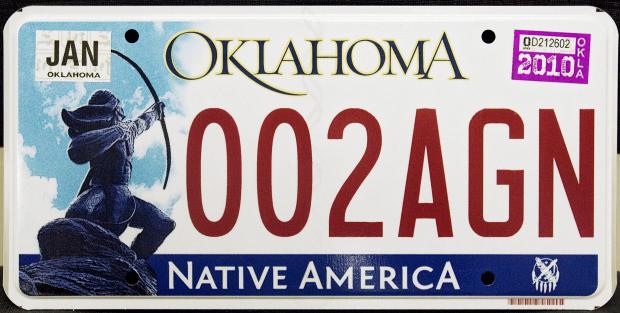
By Sean MurphyAn image on the Oklahoma license plate of a young Apache warrior shooting an arrow skyward doesn't convey an overtly religious message, a federal judge ruled Tuesday in rejecting the claim of a minister who said the image was an affront to his Christian beliefs.

U.S. District Judge Joe Heaton dismissed the claim filed against the state by Bethany pastor Keith Cressman.

The image was inspired by the late Chiricahua Apache artist Allan Houser's "Sacred Rain Arrow" sculpture, but there is nothing about it that suggests to the casual observer that the man is praying or that the arrow he is shooting is sacred, the judge wrote.

"Viewed by itself, all the disputed image involves is a depiction of a Native American shooting a bow and arrow," Heaton wrote. "There is nothing about the image that suggests he believes in one god, no god, or several."
Open Letter to pastor Keith Cressman of St. Mark’s United Methodist Church in Bethany, OklahomaDear Pastor Cressman,

I sincerely hope the God whom you preach will open your eyes and enable you to see absurdity of your claim. I am appalled by your lack of accord for cultural heritage of indigenous American population and I sincerely believe suing the state of Oklahoma for an innocent Native American symbol on its license plate is below pathetic.

I don’t know if you are aware that the very name of the state in which you live and preach is derived from the Choctaw words okla and humma, meaning “red people.” Do you plan to request changing the name of Oklahoma because it violates your own religious beliefs by reminding you of “pagan” religion?

I find it necessary to remind you of the fact that the land you live on was taken away from those okla humma people and that having Native Indian symbol on your state’s license plate is a symbolic way to show them due respect. After taking their land away from them and forcing them to live in reservations don’t you see that having their symbol on license plate is symbolic way of saying “sorry”? Why do you see it as a problem?

Did it ever occur to you that instead of pretending to be a victim due to your hurt feelings you might show some compassion for people who were taken to the brink of extinction by your ancestors?

I sincerely hope your God will forgive you your ignorance and lack of compassion.

Sincerely yours,

Jura Nanuk,
Founder & President of
Central-European Religious Freedom Institute
Comment:  For more on the subject, see Oklahoma License-Plate Lawsuit Reinstated and Oklahoma License-Plate Challenge Dismissed.

June 15, 2013

Origin of Oklahoma's license plate

Religious imagery of Oklahoma tag wasn't considered, senator says

By Sean MurphyState Sen. Clark Jolley sponsored the bill to create a new license plate five years ago to replace Oklahoma’s old tag that featured an Osage Nation shield that is also depicted on the state flag. Jolley also helped lead a panel to narrow the selection down to five finalists and said there wasn’t any thought given to the religious significance of the design.

“I don’t think any of us had any thought that this was some kind of great statement of religious significance,” said Jolley, R-Edmond. “I’m not an expert on Native American religious heritage. I just thought of a guy shooting an arrow into a cloud so that rain would fall.”

Charles Vargas, a member of the Chiricahua Apache Nation’s governing board, said the tribe’s ancestral lands ranged from what is now Arizona and New Mexico into the high plains of Oklahoma and that many tribe members are honored that the license plate features a Chiricahua Apache warrior.

“I think it’s very powerful imaging, and it’s used in a very positive manner,” Vargas said. “If it’s something the people want in that state, how could we deny that.”

Billy James, a 29-year-old student at the University of Oklahoma, said he has always liked the design of the license plate.

“I definitely like keeping the Native American history on the license plate,” said James, who is Catholic. “I think it’s a good reminder of where we came from. I think it’s a good representation of our state.

“I find the history of other people’s beliefs in no way offensive to my own beliefs.”
Comment:  For more on the subject, see Oklahoma License-Plate Lawsuit Reinstated and Oklahoma License-Plate Challenge Dismissed.

June 11, 2013

Oklahoma license-plate lawsuit reinstated

Appeals court rules man can challenge Oklahoma 'rain god' plate

The 10th U.S. Circuit Court of Appeals ruled 3-0 that a judge in Oklahoma City erred by throwing out the lawsuit of Keith Cressman, pastor of St. Mark's United Methodist Church in Bethany.

By Robert Boczkiewicz
An appeals court gave new life Tuesday to a lawsuit of a Bethany pastor who claims an American Indian image on Oklahoma's standard license plates violates his religious rights as a Christian.

The 10th U.S. Circuit Court of Appeals ruled 3-0 that a judge in Oklahoma City erred by throwing out the lawsuit of Keith Cressman, pastor of St. Mark's United Methodist Church in Bethany.
And:“Mr. Cressman's (lawsuit) states a plausible compelled speech claim,” the appellate judges wrote Tuesday in a 39-page decision, reversing Judge Joe Heaton's dismissal of the lawsuit.

“He has alleged sufficient facts to suggest that the ‘Sacred Rain Arrow' image on the standard Oklahoma license plate conveys a particularized message that others are likely to understand and to which he objects.”
Comment:  As noted in Oklahoma License-Plate Challenge Dismissed, the judge who dismissed the challenge was right to do so. I trust the judges will rule against Cressman again once they rehear the case.

September 24, 2012

License plate for Plymouth's 400th anniversary

Plymouth pushing license plate commemorating town’s 400th anniversary

By Emily SweeneyPlans are underway to produce a special license plate commemorating Plymouth’s 400th anniversary.

The limited edition plate design features a light-blue image of the Mayflower ship encapsulating a solid white silhouette of a Native American man. Along the bottom of the plate reads the simple slogan: “1620 Plymouth 2020.”

The organizers of Plymouth’s 400th-birthday celebration hope to get that logo and slogan on the bumpers of 3,000 vehicles over the next two years.

They will cost $40 apiece, and $28 from each plate fee will go toward funding the town’s 400th-anniversary celebration in 2020.
Comment:  It was smart of them to include an Indian in the design. Without one, there might've been a protest over a plate that seemed to celebrate colonization.

For more on the subject, see "6 Ridiculous Lies" About Indians and Thanksgiving in This Is America, Charlie Brown.

May 19, 2012

Oklahoma license-plate challenge dismissed

Back in 2009, I reported on a legal case in two postings:

Sacred Rain Arrow Is Religious?
Oklahoma Plate Violates First Amendment?

Now the courts have ruled. Fortunately, they upheld my position.

Okla. Man Establishment Clause Effort to Challenge Oklahoma’s Indian-Shooting-Arrow License Plate Fails


Here's plaintiff's argument against the license plate:His claims are based on the alleged effects of an image he alleges to be based on a sculpture called “Sacred Rain Arrow.” The image appears on the State of Oklahoma’s standard vehicle license plates. As described by plaintiff, the sculpture “depicts a young Native American shooting an arrow towards the sky with the hope of calling for rain from the ‘spirit world.’” It is based, plaintiff states, on a Native American legend in which a warrior went to a medicine man during a drought, convinced him to bless his bow and arrows and then shot his arrows into the sky, hoping to gain favor with the rain god. Plaintiff asserts that “the image depict[s] and communicate[s] Native American religious beliefs in contradiction to his own Christian religious beliefs.” Because the “message, connotation and purpose” of the sculpture and the license plate with its image are “antithetical to Cressman’s sincerely-held religious beliefs,” plaintiff alleges he cannot display the image on his vehicle. He “wants to remain silent with “images, messages, and practices that he cannot endorse or accept,” and does not want his car to serve as a billboard for them.And the court's response to him:Plaintiff assumes, with minimal discussion, that he is being required to disseminate an ideological message. Having examined the State’s standard license plate, which is described in the First Amended Complaint and a photograph of which is attached as Exhibit D to plaintiff’s preliminary injunction motion, the court disagrees.

The challenged image “depict[s] a statute of a Native American shooting an arrow into the sky.” Plaintiff argues that it communicates a message about Native American religion. ... However, plaintiff states in his amended complaint that he “learned that the image on the license plate was a depiction of a sculpture called ‘Sacred Rain Arrow’ by Allen Houser,” and “learned” that the sculpture was based on a Native American Legend. Nothing on the tag indicates that the image is based on a sculpture or that the arrow is sacred or the reason why it is being shot. While plaintiff clearly links the image to the sculpture and legend, nothing on the license plate, itself, makes or suggests that connection. It is only through further independent research of the sort plaintiff alleges he undertook, that a person would learn the underlying facts and circumstances which plaintiff alleges to constitute the offensive message.
Comment:  To give another example, suppose a government-run museum depicted Galileo's astronomical discoveries. These discoveries contradicted the Catholic Church's teachings about the Earth being the center of the universe. Someone could claim the government was taking a position against his Christian religion--declaring his church to be false.

But you'd have to delve into Galileo's and the Church's history to come up with that tortured reasoning. It isn't self-evident in a display of Galileo's factually true findings. Therefore, it doesn't rise to the level of establishing one religious belief over another.

A Christian cross would be a different story. That symbol has a religious meaning that's clear to the average person. That would rise to the level of establishing one religious belief over another.

The same would be true of a more obvious Native religious image. Perhaps a dancing kachina, and certainly a deity such as White Buffalo Woman or Gitche Manitou. The government hasn't and shouldn't put them on anything official.

In short, no one is saying Christianity is bad and Native religions are good. They're saying an overt religious symbol is unacceptable but art with subtle religious implications is okay.

So Cressman loses and rightly so. Better luck next time, fella.

For more on what Christians believe, see Christian Flyer Calls Lakota Rite "Satanic" and Library Blocks "Occult" Native Websites.
November 25, 2011

Indians oppose Buffalo Soldiers plates

Indian group objects to Buffalo Soldier plates

By Gary ScharrerFew of the specialty plates are controversial. Who could disparage the Texas bluebonnet?

A recent proposal to put a Confederate battle flag image on a license plate, however, provoked enough public backlash that the Department of Motor Vehicles board unanimously voted to reject it.

The board did approve a specialty license plate to recognize the Buffalo Soldiers, which formed in the late 1800s as part of the U.S. Cavalry that helped push this country's western expansion. The all-black cavalry helped fight Native Americans in the Indian Wars from 1867-1888.

Many Texas African-American leaders strongly opposed the Confederate flag license plate while supporting the Buffalo Soldiers recognition. The president of the American Indian Genocide Museum in Houston sees considerable irony in African-American leaders appealing to Gov. Rick Perry to oppose the Confederate specialty plate, which they warned would remind black Americans of a legalized system of involuntary servitude, dehumanization, rape and mass murder.

"I feel the same way about the Buffalo Soldiers. When we see the U.S. Cavalry uniform, we are forced to relive an American holo­caust," said Steve Melendez, a member of the Paiute Nation of Pyramid Lake and president of the American Indian Genocide Museum. "I think they are well-intentioned, but the message they are giving to me is offensive."
Comment:  Texas's "God Bless America" plate is also objectionable since it violates the First Amendment prohibition against government establishing religion.

For more on license plates, see Oklahoma Plate Violates First Amendment? and California's Indian License Plate.

August 09, 2010

Latgawa Indian wannabes

Legitimate claim or 'big fake'?

Latgawas draw a blank from Indian Affairs and ire of other tribes in their insistence on ownership of

By Damian Mann
The office of the Latgawa Indian tribe in Central Point is filled with what members call documentation of its legitimacy—even down to a gold shield proclaiming its wearer the marshal of the tribe's justice court.

Chiefs Grey Eagle, aka John Newkirk, and Red Hawk, aka Rick Davis, say they've got patrol cars that roam 100 square miles of their land in Southern Oregon, 12 helicopters on standby to fight wildfires and the ability to issue valid Latgawa driver's licenses and license plates.

They say they're hereditary owners of the land that includes Gold Ray Dam near Gold Hill, and they've threatened to sue Jackson County all the way to the U.S. Supreme Court for refusing to negotiate with them over its removal.

But the U.S. Department of the Interior's Indian Affairs hasn't heard of the Latgawas. And other tribes condemn the Latgawas as nothing more than a private group claiming to be Indians.
Comment:  Here's a clue about the Latgawas' legitimacy. Real Indians almost never have names like "Grey Eagle" or "Red Hawk." Having two "chiefs" with clichéd names is a big red flag.

Suggestion to Indian wannabes: If you want to convince us you're legitimate, choose real Indian names, not clichéd ones. Try a name that doesn't involve a majestic predator or a bold color. If you called yourself Spotted Deer, Hummingbird, or Rain Water, I'd be a hell of a lot less skeptical.

For what people who name themselves "Grey Eagle" or "Red Hawk" are thinking, see Indian Wannabes = Celebrity Wannabes. For more on Indian wannabes, see "Absentee Shawnee of Ohio" Wannabes and Anti-Government Extremists Pose as "Indians." For more on legitimate Indian names, see The Most Common Indian Names.

September 03, 2009

Oklahoma plate violates First Amendment?

Call the ACLUAs the American Civil Liberties Union ponders whether to sue the state for violating the constitutional prohibition against placing a Ten Commandments monument at the state Capitol, it may want to consider another such violation.

On Aug. 1, 2008, the Oklahoma Tax Commission approved a new license plate design featuring the "Sacred Rain Arrow" sculpture by the late Allan Houser. That art, now at Gilcrease Museum, has been described by a museum spokesperson as "depicting a young Apache warrior who was selected in a time of drought to shoot a 'rain arrow' into the sky, to bring his people's prayers to their gods so that they would get rain."

This interpretation comes from Apache literature, which describes the legend of a boy-god who shoots an arrow that kills a dragon, immediately after which, "storm clouds swept the mountains, lightning flashed, thunder rolled, and the rain poured." The religious symbolism of this sculpture is undeniable.

The commission missed the spiritual meaning imprinted on its new license plates. It probably never considered that the design promotes the polytheistic religion of a Native Americans tribe.

So, notwithstanding further action by the ACLU, as you drive around the state Capitol next year to admire the new Ten Commandments structure, especially the commandment that reads, "You shall have no other gods before me," just remember that somewhere on the rear-end of your vehicle is a grand tribute to polytheism.

Herb Van Fleet, Tulsa
Comment:  Wow, this is a stretch.

For starters, the "Apache literature" describes simple cause-and-effect (arrow triggers natural phenomena) with no references to the supernatural. There's also the issue of Houser's intent. He based the statue on a legend, but he may have intended a generic message such as hope or reaching for the sky.

More to the point, few people know about the statue's link to religion. Banning the plate would be like banning a Biblical phrase--"lion's den," "wages of sin," "good Samaritan"--from government documents. Even though many people wouldn't recognize the phrase's origin, someone might impute a religious meaning to it.

Apache = polytheistic?

I don't know if the Apache religion is truly polytheistic. Some Natives might say that the supernatural beings in their religion are all aspects of one "Creator" or "Great Spirit." Would Van Fleet feel better if an Apache assured him there's only one God?

But okay. I wouldn't want Oklahoma's license plate to indoctrinate Van Fleet the way conservative Christianity tries to indoctrinate everyone. If he'll agree to removing every mention of God from our coins, seals, statues, buildings, and the Pledge of Allegiance, I'll agree to removing Houser's image from the plate. Deal?

For more on the subject, see Indian Chosen for Oklahoma Plate and Allan Houser's Art.

May 06, 2009

California's Indian license plate

Beyond Personalized License Plates

By Debra Utacia KrolCalifornia’s tribes ... are too small for each one to have a separate plate. Instead of generating enough funds for a half-mile or so of rez road, California plans to issue an Indian license plate next year that will be available to any car registered in the state. A portion of the $70 per plate is intended to fund a new museum and cultural center near Sacramento.

Right now, the California State Indian Museum is located in back of Sutter’s Fort. That’s a place that doesn’t exactly hold warm, fuzzy memories for those of us who are still reeling from the California Gold Rush. A gorgeous new license plate adorning visitors’ cars in front of a nice new museum would be sweet. So would the message that the extinction of California Indians has been greatly exaggerated.
Comment:  For more on the subject, see Kentucky's Indian License Plate and Indian Chosen for Oklahoma Plate.