Showing posts with label Trickster. Show all posts

July 11, 2015

Review of Trickster

I posted several items about the Trickster anthology when it was published in 2010. Now I've finally read it.

Below are some dueling perspectives on it. First, the good news:

Trickster: Native American Tales: A Graphic CollectionTricksy
By E. R. Bird on November 23, 2010

Nowadays, you can read through a big publisher's full catalog for the upcoming season and not find a single solitary folktale gracing their lists. It's sad really. Maybe that's part of the reason that Trickster, as edited by Matt Dembicki, appealed so strongly to me. This isn't just a graphic novel and it isn't just a pairing of smart writers and great artists. Dembicki has come up with a way of collecting a wide variety of Native American folktales into a single source, done in such a way that kids will find themselves enthralled. When was the last time a book of folktales enthralled one of your kids anyway? It's remarkable. Not that it's a perfect collection (there are a couple things I'd change) but generally speaking I hope Trickster acts as a sign of good things to come.

Trickster is a great example of the graphic storytelling form...
By Donald M. Wood on May 31, 2010

Trickster has a great variety of artists that fit well with each of the different stories. I also think that this book is a great example of how graphic storytelling can reach a greater audience than just the core comic reader.

Each of the stories showcase a different aspect of the trickster persona that makes up a great deal of Native American lore and cautionary tales. The stories vary from cartoony versions of characters, storybook style illustration and fully painted tales.

The production quality of the book is beautiful,the artwork is well represented here. I highly recommend this book!

A Very Lively and Readable Book
By GraphicNovelReporter.com on June 21, 2010

Folkloric stories are powerful. They can be emotional, funny, uplifting, or scary. But they always have pull to them, and that's why they continue to haunt and entertain people.

While there are special classes in school that teach mythology and folklore, it isn't always easy to find a class on Native American stories. Unfortunately, these stories are often pushed aside just as Native American culture and history can so often get left out of textbooks. Trickster: Native American Tales--A Graphic Collection is a unique remedy for this. In the form of a comic book, it tells 21 Native tales about tricksters. The tales range in style and emotion: Some are straightforward, some are humorous, some are frightening. All of them are interesting.
More glowing reviews:

Trickster's starred reviews
Journal Sentinel reviews Trickster

On the other hand

Then there's the bad news. Readers on the Goodreads site gushed less and opined more:

Trickster: Native American Tales: A Graphic CollectionMiriam rated it 2 of 5 stars

On the one hand, I feel a little guilty giving this collection only 3 stars, because it is fabulous that they collected all these native american tales together and got various artists to illustrate them and paid for a high-quality heavy-paper glossy publication.

On the other hand, I feel a little guilt giving this collection as much as 3 stars, because man, it was pretty effing boring and the retellings were uninspired and most of the art was stunningly weak and cartoonish.

I am far from being an expert and I could easily come up with a more diverse, complex and interesting set of trickster tales. And I could relate them in a more interesting voice. Hell, I could even illustrate them better than most of these artists bothered to do. And since they actually make careers out of this I can only assume that the artists or the editor thought this over-simple, silly tone was appropriate to the subject matter. Wrong.

Seth Hahne rated it 1 of 5 stars

I frequently remark at the necessarily uneven tone of anthologies, with one story trumping another and the next falling far short of the bar set by the former. I expected this. What I hadn’t expected was for the bar to be set so low and for it to remain low for the book’s duration. These stories were almost* universally uninvolving and trite, offering no compelling reason to read further. It was only a personal need to perform my due diligence that pressed me to continue. Never a good recommendation for a book.

Almost exclusively, the writing in the book was limp. These stories of the Trickster (usually a coyote or rabbit or raccoon) were simply uninteresting. Perhaps they make a better oral tradition than a written one, but my feeling is that almost any of the stories could have been made more compelling with a steadier author’s hand. Many of the tales take forms similar to Kipling’s Just So Stories. How the alligator got his skin, how the rabbit got his tail, how the raccoon got short and fat, how the beaver stopped being an unbridled killing machine, et cetera. There’s meat there for some decent stories. Or at least some lame stories told interestingly. But it just never coalesces.

Samrat rated it 2 of 5 stars

Meh. I really wanted to like this, what with my fondness for native folklore and my work with a number of tribes, mostly in the northern Plains. It may be the graphic novel format alone, which I don't think I care for, or something else I can't put my finger on.

It felt shallow. This book could have really used a forward with information on the traditional role of the trickster and especially contexts with each story, at least a mention of the contributing tribe or region. A few of the comics just seemed inappropriately cartoonish and I wonder if the artwork was fully vetted--quite a bit of it seemed like Disney-Indian. (Much of the art and graphic design just wasn't to my personal taste, too. YMMV.) A tougher editor could have helped shape up some of these stories for the graphic novel format. There are just so many great collections of stories out there (for academic and popular audiences) that this one seemed like a hollow mish-mash with an adorable cover.

Raina rated it 3 of 5 stars

A collection of trickster tales from native tribes all over amerika.

I struggle with this one. On the one hand, it's a neat looking package. An awesome cover, glossy color images inside, with stories contributed by native americans and illustrations by comic artists. As an artifact, I think it's valuable in society.

But I'm not sure it's entirely effective. Many of the stories are extremely text heavy, and it's often hard to see the benefit the illustrations lend to the telling. Also, there's no extra information about where the stories come from, which areas of the country, what tribes, any kind of a context. There was one story set near Celilo Falls (on the Columbia River), and the dwellings were teepees. Maybe I'm ignorant, but I didn't think northwest Native Americans used teepees.
Rob's review

As you can surmise from my inclusion of negative reviews, I wasn't that crazy about Trickster.

I think I've read a book of Native trickster tales before. As with most anthologies, those tales were all over the map in terms of enjoyment. Same with these tales.

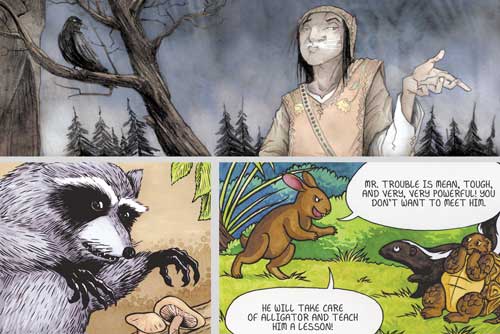
I'm not sure I can pinpoint the problem. In some cases the art was too childish or cartoonish. One reviewer complained about the "Ren-and-Stimpy style," which I'd concur with. In some cases the writing was too flat or uninspiring. Some stories were not begging to be told, or could've been told in a couple of pages rather than a dozen.

Examples:

  • A good Indian bets a bad Indian that he can build a bridge before the crow caws at dawn. The bad man cheats by showing the crow a burning torch.

  • How did the alligator get its mottled skin? Rabbit lit his home on fire and he got burned.

  • Coyote summons the eligible women to choose a bride, but one isn't a virgin so he turns them all to stone.

  • Those might be three-page stories in text form. They aren't necessarily improved by making them 3-4 times longer.

    Indeed, I would've tried to make the stories as short as possible. Three pages of text condensed to one of illustration might've been a quick but enjoyable read.

    For anyone who's read multitudes of fairy tales and fables, it's relatively easy to visualize an animal-based story. It isn't like a superhero or sci-fi saga where the visuals are almost required. Trickster's drawings are sometimes better than what you might imagine, but sometimes worse.

    Diverse or generic?

    I'd disagree with those who said Trickster's stories showcase the breadth and diversity of Native cultures. Most of the human figures are generic half-naked Indians in buckskins or loincloths and feathers. Few of the stories use more than a couple of Native words or concepts. Most could've taken place anywhere with coyotes, rabbits, wolves, ravens, raccoons, and so forth--which was most of America, originally.

    I think trickster tales are supposed to be universal in nature, and Trickster's stories generally are. So they're more like Aesop's Fables or Just So Stories than Native myths and legends. That limits their appeal to aficionados of Native literature.

    This is where introductions might've helped: by giving the stories some context. What was this particular culture like? Why was this animal a trickster and not that one? What was the point of the story? How did it resonate with the people who heard it?

    Summing it up, I'd probably recommend Trickster only to fans of Native-themed literature and comics. Rob's rating: 6.5 of 10.

    April 30, 2011

    Tim Tingle on Trickster

    Author Interview:  Tim Tingle

    By Marie PennyTim Tingle is a Choctaw author and storyteller who recently contributed to Trickster: Native American Tales-A Graphic Collection, a 2011 YALSA Great Graphic Novel for Teens book.

    I had the pleasure of speaking with this gifted speaker and writer and what follows is his thoughtful response to my questions:

    Were you familiar with the graphic novel medium before contributing to Trickster?

    Yes. I perform storytelling at schools and know that most middle-school students are excited by graphic novels. Many librarians have shared this with me, how they have seen reluctant readers flock to graphic novels. There is such an instant appeal with graphic novels. I also appreciate narrative-driven games. Some are very well-written, and game imagery often correlates with the imagery found in graphic novels.

    What did you think when Matt Dembicki contacted you to contribute to Trickster? (note: Dembicki states in his author’s note that some storytellers were reluctant to contribute due to uncertainty about the book’s intentions.)

    I was leap for joy happy! In addition to storytelling, I write books, and trying to pitch a book to a publisher is not always a simple process. So when someone contacts you directly, it is an honor! When I saw the others on board, including figureheads in the storytelling and literary community such as Joe Bruchac, there was no hesitation. Every tribe approaches their stories differently. My mentor, the Choctaw tribal storyteller Charley Jones says, “tell the stories,” but make sure the origin is acknowledged. The Choctaw tribe is very open, you don’t have to be Choctaw to tell the story, but you must respect the tribal origins. Matt Dembicki understood this, as well as the importance of the trickster tale.
    Comment:  For more on the subject, see Trickster Nominated for Eisner Award and How Trickster Got Its Cover.

    April 08, 2011

    Trickster nominated for Eisner Award

    Nominees Announced for 2011 Will Eisner Comic Industry Awards

    Nominations Span Full Range of WorksAmong this year's nontraditional "discoveries" by the judges are Seymour Chwast's adaptation of Dante's Divine Comedy (Bloomsbury), the "mocumentary" Finding Frank and His Friends by "Clarence 'Otis' Dooley" (Curio & Co.), the Native American anthology Trickster (Fulcrum), Lucidity Press's The Anthology Project, and cartoonist Dave Kellett's Literature: Unsuccessfully Competing Against TV Since 1953.Comment:  For more on the subject, see "2011 Notable Children's Books" and Trickster's Starred Reviews.

    March 05, 2011

    How Trickster got its cover

    Designing Fulcrum’s Book Covers:  An Inside Look at the ‘Trickster’ Cover Process

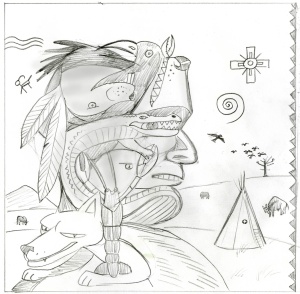
    How the Trickster graphic novel went from this proposed cover:

    MATT DEMBICKI, Author/Editor: The initial cover was designed and illustrated by Peter Kuper (Spy v. Spy, World War III), who is well known for using stencils and spray paint to render his illustrations. I asked Peter if he would be interested in illustrating one of the stories for the book, but his schedule was full at the time. He did say he could do a cover, though. Getting the right image for the cover was going to be a challenge. I told Peter about the various trickster beings in the book—coyote, rabbit, crayfish, etc. I didn’t want just a coyote or rabbit on the cover; I wanted something that would convey that this is a collection of a range of trickster beings. Peter took that and crafted a wonderful image, combining all those animals in an ingenious way to create another image. Although the illustration was wonderful, it was a little tight in terms of adding title text and such, and there wasn’t much room for a bleed area.To the final cover:

    MATT: I hated to let the Kuper cover go, but I agreed that this was the better image, given the circumstances. Any lingering doubts were quashed when I was at Book Expo America 2010, where the book debuted. Several folks stopped by the Fulcrum booth to thumb through the book simply because they were drawn in by the cover.Comment:  For more on the subject, see "2011 Notable Children's Books" and Dembicki Explains Trickster's Origin.

    January 17, 2011

    "2011 Notable Children's Books"

    2011 Notable Children's BooksEach year a committee of the Association for Library Service to Children (ALSC) identifies the best of the best in children's books. According to the Notables Criteria, "notable" is defined as: Worthy of note or notice, important, distinguished, outstanding. As applied to children's books, notable should be thought to include books of especially commendable quality, books that exhibit venturesome creativity, and books of fiction, information, poetry and pictures for all age levels (birth through age 14) that reflect and encourage children's interests in exemplary ways.

    According to ALSC policy, the current year's Newbery, Caldecott, Belpré, Sibert, Geisel, and Batchelder Award and Honor books automatically are added to the Notable Children's Books list.
    The notable books include:Saltypie: A Choctaw Journey from Darkness into Light. By Tim Tingle. Illus. by Karen Clarkson. Cinco Puntos, $17.95. (9781933693675).

    This picture book autobiographical vignette shows a modern Choctaw family enduring and supporting each other with love, courage and fortitude.

    Trickster: Native American Tales: A Graphic Collection. Edited by Matt Dembicki. Fulcrum Books, $22.95 (9781555917241).

    This collaborative effort by more than 40 writers and artists presents 21 Native American trickster tales in graphic novel format.

    Black Elk’s Vision: A Lakota Story. By S.D. Nelson. Abrams, $19.95 (9780810983991).

    This handsome, large-format volume combines archival photographs, original acrylic paintings and powerful first-person narrative to present the devastating story of the painful changes in life forced upon the Lakota people.
    Comment:  For more on the subject, see Dembicki Explains Trickster's Origin and The Best Indian Books.

    August 03, 2010

    Dembicki explains Trickster's origin

    In An Interview with Trickster's Matt Dembicki, Dembicki gives us some interesting tidbits. Here he is on the origin of his Trickster anthology:I have always had an interest in fairy tales, folk tales and mythology. My parents are Polish immigrants, so growing up I was privileged to hear many Eastern European tales not often heard in the U.S., in addition to stories popularized by the Grimm Brothers and Hans Christian Anderson. But it was “Little Trickster the Squirrel Meets Big Double the Bear”—a children’s book by Ken Kesey—that put Native American trickster stories on my radar. Then one day when I was at my local library, I was in the Native American section and I saw a copy of “American Indian Trickster Tales (Myths and Legends)” by Richard Erdoes and Alfonso Ortiz. The wonderful stories and spot illustrations in that book inspired me to test whether the stories could work in a sequential comic format. As I started to do some thumbnail layouts, I could see that it would make a great comics project, especially if contemporary Native American storytellers would provide their own trickster stories.As in Sacagawea Inspired Comic-Book Guy, we see the profound influence a single work can have on someone's life or career.

    And here's how Dembicki put the project together:It took a long time to gather this group of storytellers and artists. To find storytellers, I contacted universities, storytelling groups, museums and events that featured Native American storytellers. I also wanted to make sure there was a balance of geographic area among the storytellers, as well as a variety of trickster animals/being. Most people are familiar with rabbit and coyote as trickster animals—probably from watching the Warner Brothers cartoons—but there are other less-known but just-as-intriguing trickster animals, such as raven and raccoon. I also looked for a variety of styles among the artists, so each story could have a distinct look but fit within the overall feel of the book. Most of the artists I already knew or at least I was familiar with their works. I did make an effort to reach out to Native American artists as well and a handful did participate. Since the project didn’t offer payment up front—I started on the project before finding a publisher—it was harder to get artists to participate because of the time commitment to illustrate the stories. I was fortunate to find a good group of creators who found the project exciting and had faith in the book.Comment:  For more on the subject, see Journal Sentinel Reviews Trickster and Trickster's Starred Reviews.

    May 31, 2010

    Journal Sentinel reviews Trickster

    Graphic artists illustrate American Indian tales in 'Trickster'

    By Jim HigginsPairing 21 American Indian storytellers with graphic artists, editor Matt Dembicki has produced a spectacular color anthology of trickster tales.

    While Dembicki and his contributing artists have taken pains to respect the cultural integrity of the stories, their visuals never feel politically correct or preachy. Instead, reading this book creates the same excitement that discovering the Brothers Grimm or Italo Calvino's "Italian Folktales" does, only with pictures as well as words.

    "Trickster" will appeal to graphic novel lovers, folklore enthusiasts, storytellers, young adult readers and everyone interested in the many American Indian cultures.
    And:For a reminder that we are not dipping into the Western Romantic tradition here, read Eirik Thorsgard's "When Coyote Decided to Get Married," illustrated by Rand Arrington. Coyote's search for a bride shares elements with Cinderella's story, but the story's chilling ending makes it unlikely that Disney will be calling for an option any time soon.

    From the cartoonish artwork of Jerry Carr and Pat Lewis to the arty realism of Farritor, the illustrators offer a pleasing variety of approaches, styles and color palettes. Special visual nods go to Cherokee artist Roy Boney Jr. for his painterly desertscapes in "Horned Toad Lady & Coyote," and Paul Zdepski's hallucinatory Hawaiian demons in "Puapualenalena, Wizard Dog of Waipi'o Valley."
    Comment:  For more on the subject, see Trickster's Starred Reviews and Trickster on Amazon.com.

    Below:  Azban and the Crawfish is illustrated by editor Matt Dembicki.

    April 26, 2010

    Trickster's starred reviews

    'Trickster' reviewsSchool Library Journal (May 2010)
    (Starred review)

    More than 40 storytellers and cartoonists have contributed to this original and provocative compendium of traditional folklore presented in authentic, colorful, and engaging sequential art. The stories are drawn from a variety of Native peoples across North America, and so the trickster character appears variously as Rabbit, a raccoon, Coyote, and in other guises; landscapes, clothing and rhythms of speech and action also vary in keeping with distinct traditions. Realistic, impressionistic, painterly, and cartoon styles of art are employed to echo and announce the tone of each tale and telling style, making this a rich visual treasure as well as cultural trove. Contributors include well-known author Joseph Bruchac, Pueblo storyteller Eldrena Douma, cartoonist and Smithsonian Institution employee Evan Keeling, and many who have not worked in comics heretofore as well as cartoonists with no previous allegiance to telling Native stories with their art. The total package is accessible, entertaining, educational, inspiring, and a must-have for all collections.

    Booklist (American Library Association, May 2010)
    (Starred review)

    This graphic-format collection of Native American tales featuring an old folk favorite—the trickster—hits an impressive trifecta of achievements. First, it’s a wildly successful platform for indie-comic creators and an excellent showcase for their distinctive styles. From David Smith and Jerry Carr's heroic, animation-inspired “Trickster and the Great Chief” to the Looney Toons zaniness of “Rabbit’s Chocktaw Tail Tale” by Tim Tingle and Pat Lewis, there’s a bit of visual panache here for every taste. Second, with the exception of a stray X-Man or two and an obscure DC sword-and-sorcery character, this is the first graphic novel to really focus on Native American themes and events, a surprising absence that this book remedies with respect and imagination. Lastly, as Native American folklore is so directly tied to the culture’s spirituality, this proves the rare graphic novel that handles such issues without specifically attaching them to standard religious practices. With stories that vary in emotional tone, matching the ever-shifting appearance and character of the trickster himself and the lessons he teaches and learns, this collection is an ideal choice for dipping into over and over. A dandy read for those interested in history, folklore, adventure, humor, or the arts, and a unique contribution to the form.
    Comment:  The "obscure DC sword-and-sorcery character" is Arak. He's appeared in comic books but not graphic novels.

    Even if you exclude every Native character from Marvel or DC, at least a couple dozen graphic novels have focused on Native themes and events. Any reviewer who doesn't know this is woefully ignorant of the field.

    Anyway, Trickster sounds good. I'll be checking it out and you should too.

    For more on the subject, see Trickster on Amazon.com and Comic Books Featuring Indians.

    April 07, 2010

    Trickster on Amazon.com

    Trickster: Native American Tales: A Graphic Collection (Paperback)Product Description

    All cultures have tales of the trickster—a crafty creature or being who uses cunning to get food, steal precious possessions, or simply cause mischief. He disrupts the order of things, often humiliating others and sometimes himself. In Native American traditions, the trickster takes many forms, from coyote or rabbit to raccoon or raven. The first graphic anthology of Native American trickster tales, Trickster brings together Native American folklore and the world of comics.

    In Trickster more than twenty Native American tales are cleverly adapted into comic form. Each story is written by a different Native American storyteller who worked closely with a selected illustrator, a combination that gives each tale a unique and powerful voice and look. Ranging from serious and dramatic to funny and sometimes downright fiendish, these tales bring tricksters back into popular culture in a very vivid form. From an ego-driven social misstep in “Coyote and the Pebbles” to the hijinks of “How Wildcat Caught a Turkey” and the hilarity of “Rabbit’s Choctaw Tail Tale,” Trickster provides entertainment for readers of all ages and backgrounds.

    Along with compiling and editing the book, artist Matt Dembicki illustrated one of the featured trickster tales. Dembicki is the founder of D.C. Conspiracy, a comic creators’ collaborative in Washington, DC, and has won acclaim for his nature graphic novel, Mr. Big. He currently works as an editor for a higher-education association.
    Comment:  For more on the subject, see My Trickster Article and Q&A on Trickster.

    August 06, 2008

    Trickster cover

    Matt Dembicki has released the cover of the upcoming Trickster anthology. You can see it here.

    It's very Picasso-esque, which isn't my favorite style. It isn't what I would've chosen for the cover. (I like the cover of The Coyote Road much better.) But it's certainly interesting.

    For more on the subject, see Q&A on Trickster.

    July 01, 2008

    Response to Trickster article

    An e-mail from Trickster editor Matt Dembicki:Thanks, Robert! That piece sparked a good amount of media interest in one day. Journalista picked it up, which prompted a mention on several blogs as well as three calls from local newspapers, including the Washington Post. So, thanks, again!Comment:  Let that be a lesson to you. My resources (Newspaper Rock, Indian Comics Irregular, PECHANGA.net, etc.) and contacts are a good way to publicize your work.

    April 19, 2008

    The scoop on Trickster

    Trickster is a graphic novel-style anthology of Native trickster tales created primarily by Native writers and artists. In an exclusive Q&A interview conducted by e-mail, writer/artist Matt Dembicki and publisher Christian Beranek give us the inside story on their project.

    Let's start with a brief description: What is Trickster?

    MD:  Trickster is a comics anthology, comprising more than 20 Native American trickster stories. Each story is written by a Native American storyteller and illustrated by a comics artist of the writers' choosing. The stories cover a range of trickster types—from the more well-know creatures, such as the rabbit and coyote, to less-known characters, such as raccoons and personified spirits such as Moshup—as well as types of American Indian tribes and geographic area.

    What's your motivation for doing Trickster? What objectives do you hope to achieve?

    MD:  The premise is to compile some wonderful Native American stories into one book so the general public can appreciate stories unknown to many of them and to renew a general understanding and appreciation of the Native American culture.

    For the rest of the interview, go to Q&A on Trickster. See also this Trickster sneak peek.

    For more on the subject, see Comic Books Featuring Indians.