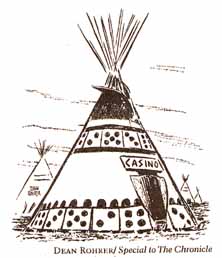
Saints & Strangers, the two-night National Geographic movie that aired last weekend, got a decent amount of publicity. Many noted how it presented the Native side of the "first Thanksgiving." But not everyone was happy with how it portrayed Indians.
By Alysa LandryLess than 60 seconds into the film, a band of whooping Natives descends on the pilgrims and the two groups exchange fire—bullets from one side and arrows from the other. The scene exhibits many of what the four Wampanoag tribal communities are calling “cultural, historical and linguistic inaccuracies” in the film.
“It’s completely irresponsible telling of history,” said Linda Coombs, director of the Aquinnah Wampanoag Cultural Center. “This is one of the most well-documented parts of history, but it is distorted for the purposes of sensationalism.”And:At another point in the film, the Wampanoag deliver to colonists the bloodied clothes of a child who had been lost, intimating that they had killed the boy because pilgrims had stolen their corn. That is grossly untrue, Coombs said.
“That’s an outright lie,” she said. “The Wampanoag took care of the lost child. When they returned him, he was happy and healthy and probably bedecked with beads. There’s nothing in history about knocking the kid on the head and bringing the bloody shirt to the colonists.”And:[S]traying from the Wampanoag language proved to be Nat Geo’s biggest film gaffe, Coombs said.
“Abenaki is not Wampanoag,” she said. “This is the stereotype of the interchangeable Indian. If you can’t find an Indian who does what you want, keep going until you find one who will. It doesn’t matter. Indians are generic.”Positive views
Perhaps not surprisingly, the Native actors defended the production.
By Vincent SchillingThere has been some criticisms of the film, but what do you think people are neglecting to notice in the face of making progress for Native actors?
Queypo: The history of the portrayals of Native people in cinema is terrible, there have been gross misrepresentations, often times romanticized and fictionalized caricatures, that have been perpetuated and accepted as truth by the mass public. But more and more, native filmmakers are coming up and telling their stories. Even non-native filmmakers are rising to the challenge and making efforts to explore Native characters and storylines with truth and integrity. That is progress.
Having strong Native actors who are bringing rich portrayals to their roles is progress. Seeing more Native language being utilized in film is progress. Progress is always happening. It may seem like it is never enough, but portrayals of Native people in film have advanced.“It Was Once in a Lifetime” Tatanka Means on NatGeo’s Saints & Strangers
By Vincent SchillingThere has been some criticisms of the film, but what do you think people are neglecting to notice in the face of making progress for Native actors?
Means: This story has never been told on screen before. It is a hard story to tell. It is a sensitive subject matter and time in our history. I don't think any film based on our history will ever be as perfect as we would like unless tribal nations write and produce it ourselves. I believe the world deserves to know more of the truth of what really happened. This movie is exposing some of those truths in a more gritty and less fabricated way than ever before on screen.“It Was a Gift” Native Actor Raoul Trujillo on NatGeo’s Saints & Strangers
By Vincent SchillingThere have been a lot of positive comments on social media--how does it feel to represent on such a large scale?
Trujillo: It's very powerful and something that makes you feel proud to represent culture and language of other people's but also to bring a humanity and multi dimensionality to historic real human beings as iconic as they are to us now.‘Saints & Strangers’ Review: Close Enough is Great
By George BrennanCalling her comments “insensitive and ill-advised,” Taunton Mayor Thomas Hoye Jr. called on the vice chairman of the Mashpee Wampanoag Tribe to apologize for her comments where she referred to opponents of Native Americans as “NIMBYs,” “skinheads” and “xenophobes.”
The emotional comments by Jessie “Little Doe” Baird came at a hearing at Taunton High School Tuesday night where the federal Bureau of Indian Affairs was preparing to hear public feedback to the Mashpee Wampanoag Tribe’s Draft Environmental Impact Statement for its proposed casino.
The tribe is seeking to have the BIA take 155 acres in Taunton into trust for a $500 million casino complex that will feature three hotels and a water park.
Shortly after Hoye asked for the apology, Baird issued one.
“On behalf of the Mashpee Wampanoag Tribe, I want to convey my sincerest apology to anyone who was offended by my comments at the DEIS hearing at Taunton High School,” Baird said. “No offense was meant toward casino opponents, the people of Taunton, or city officials. I was referring to the types of comments other tribes’ land-into-trust applications have received in the past. The comments were directed to the Bureau of Indian Affairs regarding the Land-in-Trust comment process, which lasts 45 days.”Dueling views
More on the story, including dueling views from the right and left:
By Frank LagaceMashpee Wampanoag Tribe Vice Chairwoman Jessie Baird’s letter is not an apology. The context of her remarks Tuesday were squarely aimed at casino opponents, were hateful and intentional. Her “apology” rings empty.
Furthermore, Mashpee Wampanoag Tribal Chairman Cedric Cromwell’s statement purporting to be an apology regarding the statements of Ms. Baird is an insult to the government and people of this city as well as this nation. This is literally one nation hating the citizens of another nation based on race and disagreement. If the Mashpee wish to reap the benefits as a sovereign nation, they must also suffer the consequences of their leadership’s hateful statements and failure to take ownership and responsibility of such. Would the vice president of the United States be excused for spewing racially offensive comments towards Native Americans, Jews, Muslims, Catholics or people of heritage from all other countries across the globe or because of disagreements? Would casting offensive comments toward an Indian tribe by a citizen of Taunton who opposes the Mashpee casino proposal be acceptable?
Ms. Baird’s use of hate speech regarding those of us trying to protect our homes and community of East Taunton with the explicit and provocative words of skinheads, xenophobes and NIMBYs during a federal hearing that goes on record via a recorded transcript is abhorrent to say the least. A true xenophobe is one who resorts to using such epithets, most alarmingly skinhead. Ms. Baird’s statement will be transcribed in a federal agency’s files. There is no way possible that her hatred can be misconstrued. It is documented in a transcript. It is irrefutable. Her hatred and racism is documented for history. Her speech is condemned in our society and certainly displays an underlying current of hatred and racism simply based on opposition to the Mashpee casino proposal. And an accusation of one being a skinhead is not taken lightly by law enforcement, the courts and the public at large. Nor is it taken lightly by this writer.Then there are the foes' alleged ties to a known hate group:
By Hal BrownComments made at a meeting by Tribal Vice Chairwoman Jessie “Little Doe” Baird provoked justifiable indignation and outrage (read letter to the Taunton Gazette) when she made them at a meeting in Taunton. According to The Enterprise:
“At a BIA hearing on the draft environmental impact statement for the proposed casino, Baird told the federal officials that they would hear comments from 'xenophobes, skinheads, NIMBYs, folks who were put off of reservation lands when their leases ended and probably every other hate group east of the Mississippi with every specious argument known to every single tribe that has followed this process since its inception in 1934.' ”
After the uproar, Tribal Vice Chairwoman Jessie “Little Doe” Baird said in a statement that “no offense was meant toward casino opponents, the people of Taunton, or city officials. I was referring to the types of comments other tribes’ land-into-trust applications have received in the past."
What was left out was a further explanation as to what I assume she was referring to. These types of past comments, none specified by Baird, fit the modus operandi of an organization called Citizens Equal Rights Alliance (CERA), which has been identified by some anti-bias organizations as an anti-Indian hate group. They go into high dudgeon when accused of being racist. I have no doubt that many of their members don't have a racist bone in their body, and don't fully grasp the reasons those in Indian Country consider their organization to be a hate group. You can read their website and see if you buy their denials.
When the Mashpee Wampanoag were attempting to open a casino in Middleboro, two members of CERA, one from Plymouth, and another from Carver, attended a number of meetings on the anti-casino side. As far as I know neither were actively involved in Casino-Facts, and although Casino-Facts never took me up on the challenge that they disavow CERA, I never had any indication that CERA as an organization or any of its members were anything more than interested bystanders. That being said, members of the tribe were very much aware that CERA had at least a presence in Middleboro during those tumultuous and divisive times.
The two individuals from CERA are still active in the organization, and represented Massachusetts at a recent conference in Bellingham, Washington in April of 2013.Comment: Baird used three terms, only one of which is linked to race. I don't think you can characterize her comments as "racist" when they apply to all races, including some whites who may be skinheads.
'Free Birds' Tells Wrong Story, InaccuratelyIt's probably unreasonable to expect an animated children's movie about the First Thanksgiving to tell anything but the well-known sanitized version of the tale. All in all, it would be best to avoid the subject altogether, since the story of Indians and Pilgrims sitting down to a turkey dinner in 1621 sows seeds of basic disinformation that many people carry into adulthood. It simply didn't happen the way it's taught to children, and what did happen puts a smileyface on a long and shameful history of conquest and genocide.
The plot of Free Birds, coming to a theater near you November 1, finds an oppressed population traveling back in time to 1621 to change the course of history and save future generations. No, it's not Native Americans--it's turkeys. The turkeys from the future band together with their ancestors and wage a Braveheart-style war on the Pilgrims. It's your standard anthropomorphic kid-flick wackiness, and if history has to be fudged to make it work then so be it.And:We haven't even mentioned Indians. There weren't any in the first trailer for the movie, and in the second they show up, briefly, in the final 20 seconds. One wears a large feather headdress and a bone breastplate, he has a partner and they're both riding horses. Wrong, wrong, and wrong.
The Natives who took part in the First Thanksgiving were Wampanoags. They didn't wear elaborate feather headdresses and they didn't ride horses. The Wampanoags shared a continent with the Cheyenne, Comanche and Lakota, but that doesn't make them interchangeable. Would it be OK to portray the Pilgrims as Italians? All white people from Europe are the same, after all. And then you could have these Pellegrini putting the turkeys in a pasta dish, which would allow you to rewrite the movie's puzzling tagline, "Hang On To Your Nuggets" (do people eat turkey nuggets?) as "Hang On To Your Meatballs."
Just a thought. Free Birds doesn't open for another three weeks, so perhaps there's time for some re-editing.Comment: I watched a commercial for Free Birds and didn't see anything about time travel. So I can't tell if it's a major or minor part of the movie.
Either way, the producers should've made an effort to get the Indians right. It wouldn't have been hard.
If the Plains Indians appear for more than a minute or so, I'd call this a serious offense. Once again, millions of people will see false and stereotypical images that warp their perceptions.
By Michelle TiradoTurner said what most people do not know about the first Thanksgiving is that the Wampanoag and Pilgrims did not sit down for a big turkey dinner and it was not an event that the Wampanoag knew about or were invited to in advance. In September/October 1621, the Pilgrims had just harvested their first crops, and they had a good yield. They “sent four men on fowling,” which comes from the one paragraph account by Pilgrim Edward Winslow, one of only two historical sources of this famous harvest feast. Winslow also stated, “we exercised our arms.” “Most historians believe what happened was Massasoit got word that there was a tremendous amount of gun fire coming from the Pilgrim village,” Turner said. “So he thought they were being attacked and he was going to bear aid.”
When the Wampanoag showed up, they were invited to join the Pilgrims in their feast, but there was not enough food to feed the chief and his 90 warriors. “He [Massasoit] sends his men out, and they bring back five deer, which they present to the chief of the English town [William Bradford]. So, there is this whole ceremonial gift-giving, as well. When you give it as a gift, it is more than just food,” said Kathleen Wall, a Colonial Foodways Culinarian at Plimoth Plantation.
The harvest feast lasted for three days. What did they eat? Venison, of course, and Wall said, “Not just a lovely roasted joint of venison, but all the parts of the deer were on the table in who knows how many sorts of ways.” Was there turkey? “Fowl” is mentioned in Winslow’s account, which puts turkey on Wall’s list of possibilities. She also said there probably would have been a variety of seafood and water fowl along with maize bread, pumpkin and other squashes. “It was nothing at all like a modern Thanksgiving,” she said.
While today Thanksgiving is one of our nation’s favorite holidays, it has a far different meaning for many Wampanoag, who now number between 4,000 and 5,000. Turner said, “For the most part, Thanksgiving itself is a day of mourning for Native people, not just Wampanoag people.”Comment: For more on Thanksgiving, see Students Hold "Anti-Thanksgiving" Potluck and 43rd National Day of Mourning.
Below: I presume this is a reenactment at Plimoth Plantation. It shows how a Thanksgiving painting should look. Key points: 1) Indians sit at the table as equal participants, since they outnumbered the Pilgrims. 2) The feast takes place indoors and people are fully clothed, since it's freezing cold in November.
By Christine McConvilleA Cambridge activist who says he’s sick and tired of living in a state whose official seal depicts a sword hanging over a Native American’s head has launched the most aggressive effort to date to force the Bay State to redo the 132-year-old image—but Indians and other advocates are distancing themselves from his audacious $24 million lawsuit.
“It’s unfair to the native peoples,” Daniel DeGuglielmo said about the Great Seal of the Commonwealth of Massachusetts. He wants a judge to force the state to stop using the seal on its flags, buildings and papers.
A Suffolk Superior Court judge on Jan. 5 dismissed his request for a temporary restraining order to force the state to remove the seal, and the flag that displays it, after the Attorney General’s Office successfully argued that DeGuglielmo failed to show he’s been significantly harmed by it.
But the judge hasn’t dismissed the lawsuit.Comment: I agree that Massachusetts should change its stereotypical state seal. But this lawsuit isn't the way to do it. It's bound to fail for several reasons, especially the issue of harm.
True, each stereotype hurts a little bit. But the seal isn't even a direct slur against Indians. It's only a vaguely implied threat.
I'd love to see DeGuglielmo prove the harm of that. With hard evidence, not a couple of Indians saying the seal "upset" them. I've got a large sum of money that says he can't do it.
In short, this lawsuit is frivolous. Try again with some other form of protest, DeGuglielmo.
Recently I watched The Mayflower Voyagers, the first episode of This Is America, Charlie Brown. Here's the scoop on the series:
This is America, Charlie BrownThis is America, Charlie Brown was an eight-part animated TV mini-series, depicting events in American history with characters from the Charles M. Schulz comic strip Peanuts. It aired from 1988 to 1989 on CBS. These eight episodes, originally released singly on videocassette, were released in a 2-DVD collector's set on June 13, 2006 by Paramount Pictures. However, the DVD set went out of print once Warner Bros. bought all rights to the Peanuts TV specials. No announcement as to if and when the DVD set will be reissued has been made.
Traditionally, these episodes have not been rerun on television, but one episode, "The Mayflower Voyagers," was paired with A Charlie Brown Thanksgiving (with which it was released on DVD) in 2008 by ABC, in order to fill the remaining half-hour once filled by He's a Bully, Charlie Brown. However, the special was edited to make room for Dancing with the Stars. It was again paired with the Thanksgiving special when it was broadcast on Thanksgiving Day 2010 and 2011.Naturally, I was curious how a Peanuts special would handle Indians and the Thanksgiving theme. Answer: Not too badly. The half-hour show could've been better, but it could've been worse.
Boarding and voyage
The first third tells of the colonists (including the Peanuts gang) boarding the Mayflower and crossing the ocean.
It begins with a few red-flag phrases:
"Columbus discovered America"
"Seeking religious freedom"
"Virtual wilderness"
The problems with the first and third phrases are obvious, but the second phrase deserves some explanation.
The show correctly notes that not all the voyagers were Pilgrims. Some, called Strangers, were seeking their fortune in the "New World." Some were indentured servants. But the latter groups aren't mentioned again. As usual, it's all about the Pilgrims.
The Pilgrims were seeking "religious freedom" to practice their brand of Christian absolutism. The Church of England had persecuted them because of their fanaticism--the kind that led Oliver Cromwell to behead people.
The Pilgrims didn't tolerate other religions and neither did the Church, so the Pilgrims had to flee. It would be more correct to say they sought a place where they could rule, since they didn't believe in religious freedom for all.
Landfall
The second third tells of the colonists arriving and trying to "settle" the land.
At Plymouth, they found "the land cleared by Indians, though no Indians were in sight." Wow...a lot of history hides behind that statement.
Remember how the show previously said America was a "virtual wilderness"? As soon as the colonists stopped, they found land already cleared and farmed by Indians. How does that square with the "untamed" myth? Answer: It doesn't.
Since the colonists didn't find any Indians there, they could've concluded the land was free for the taking. Or they could've concluded 1) Indians had owned and occupied the land before, and 2) they still might have claims on it. Obviously the colonists went with the self-serving first conclusion.
The show acts as if the colonists were mystified by the vacant land. Actually, I believe they found and dug up Indian graves and robbed took items from them. So they knew they were settling on an Indian village decimated by disease.
Indeed, they knew or should've known the history of the region. In particular, that the English had been sailing along the coast, trying to establish colonies, hunting and fishing, spreading disease, and in some cases, enslaving Indians. These intrusive actions had been going on for years.
With all that happening, the Indian village wasn't deserted for no reason. The English were beginning their incursions and the Indians were understandably wary. Again, the colonists might've thought of this before occupying the "empty" land.
The first winter
Unavoidably, the show deals with the harsh first winter. Since it's a children's show, it soft-pedals the resulting deaths. It talks of the "sick and dying," and "losing one or two people a day," but focuses on the Peanuts gang's efforts to tend the patients and keep the colony going. Graves are shown only briefly, in the distance.
The narration says, "By the end of February, two and a half months after landing, no Indians have been seen." And, "Half of the original 102 passengers have died. Only 20 adults and 30 children have survived."
In March, Samoset the Wampanoag Indian arrives. Among his positive traits, he's not carrying any weapons. He isn't half-naked; he's wearing buckskins. His skin is a slightly darker shade of beige, not reddish. He's wearing an appropriate headdress, not a Plains feather bonnet.
The only real problem is his big hooked nose. True, the other adults also have big noses, but without the prominent bumps. This seems a bit stereotypical to me.
Samoset says, "My people welcome you to the land." And, "This is land of Patuxet. They cleared it. All dead. Terrible plague."
Samoset brings Squanto, who tells his story in fluent English. He explains how the English captured him, took him to England, and taught him the language before he escaped and returned.
Unlike Samoset, unfortunately, Squanto is a half-naked brave. There's no snow on the ground, but it's still March in New England. I'm not sure, but I'm guessing most Indians wore shirts during the freezing winters.
Teaching the colonists
In the show's final third, the Indians help the colonists survive.
"Throughout March and April, Squanto teaches the heritage of his fathers." Specifically, he teaches the Peanuts gang how to plant maize. This begins the show's best sequence.
First Squanto says they must catch fish called alewives, which perplexes the gang. He tells them to plant corn when oak leaves are the size of a mouse's ear. They should dig the earth into six-foot squares. Form small hills of earth with 2-3 seeds in each. And place the fish around the seeds. "We call this food for the plants. It makes the soil better."
It's nice that the show devotes several minutes to this agriculture lesson. It demonstrates that the Indians really knew what they were doing, and the colonists didn't. The colonists might as well have been attempting nuclear physics. They would've died long before they discovered how to use fish as fertilizer.
Squanto introduces Massasoit, the sachem "who ruled the Indians of the region," to the colonists. Unlike Samoset and Squanto, he's short and squat. He has streaks of paint on his face--because chiefs wear warpaint when they're seeking peace, right? We can't tell if he's wearing a headdress or has scraggly strands of hair sticking up from his head. In short, he looks like an ugly cartoon chief.
Anyway, the narration says the two parties "signed a treaty of friendship and mutual assistance. A treaty that will last for over half a century."
That statement omits a lot. While the Wampanoag treaty did last that long, the Englishmen continued to encroach on Indian lands. They pitted tribe against tribe and fought or massacred anyone who opposed them.
So the treaty was far from the era's most notable achievement. Touting it is akin to covering up what really happened. It's like touting the Treaty of Versailles without mentioning World War II.
Summer and fall
Six months pass. In September and October, the land produces "the most bountiful harvest the Pilgrims had ever seen. Chief Massasoit brings 90 of his Indian tribe to join the Pilgrims for a feast of thanksgiving."
One woman is visible among the dozen or so Indians shown. I don't think any Wampanoag women attended. All the Indians are carrying food. The Pilgrims are seated at a table with more food on it, waiting. The food includes a turkey, which probably wasn't part of the meal.
This is a reasonably good rendition of the feast. The Indians did most of the food gathering and preparation. Outnumbered and weakened by disease, the colonists wait passively to be fed. Although the narrative doesn't say it, it seems the Indians are the driving force behind the feast.
At the feast, the colonists offer a moment of silence for the departed. Then someone says, "Thank you for giving us Samoset and Squanto, and the great chief Massasoit. And thank you, Chief, for our treaty of friendship. And we wish you many years of good health."
Despite my criticism of the flaws, the main points here are positive. The Wampanoag Indians are mostly portrayed realistically rather than stereotypically. The farming lesson conveys that the Indians are equal to the Englishmen, if not superior. The Indians are featured at the feast itself; it's not a Pilgrims-first event with the Indians in the background.
As a children's special, the The Mayflower Voyagers can't go too deeply into the death and destruction. From what I can tell, though, the history is reasonably accurate. While the show ignores some key points, it doesn't fawn over the Pilgrims at the Indians' expense.
If I were grading it, I'd give it a B. With a few changes, it could earn an A or A-.
By Mike ClaryAs tens of millions of Americans prepare to stuff themselves silly Thursday to mark one of the year's major holidays, some Native Americans see the day as an idyllic myth meant to cloak outrageous acts of cultural imperialism.
"I don't think most people understand what they are celebrating," said Cherokee descendant Danielle Tschuschke, 19, who heads a Native American student group at Florida Atlantic University in Boca Raton. "It is not a happy day for everyone."
Some Indian tribes around the nation mark the day as Un-Thanksgiving. In Massachusetts, where the Wampanoag greeted the colonists with tips on cold weather survival, the United American Indians of New England will hold its 42nd annual National Day of Mourning. The day is designed to "shatter the untrue glass image of the Pilgrims and the unjust system based on racism, sexism, homophobia and war."
About 100 FAU students learned that reality in a bait-and-switch history lesson last week sponsored by the Multi-Cultural Program. At the door of the student union meeting room, students lured in by the promise of a free Thanksgiving dinner were asked to sign what organizer Kristina Fritz said was a "food waiver." In fact, the waiver was a four-page document, written in an obscure Indian language, in which the signers gave up their property rights.
Once that was done, Fritz explained what each had signed. "There is a lot of sorrow in this holiday for Native Americans," she said, before adding, "and by the way there is no food."
When the students groaned, Fritz asked them how they felt. "Bamboozled," said Simone Hyman, 21, of Fort Lauderdale.Comment: Complaints about the "idyllic myth" of Thanksgiving are old hat by now. Which is why I haven't posted many this year.
But the "bait-and-switch history lesson" is an interesting experiment worth reporting on. As with many thought experiments, it helps make the historical problemz obvious to non-Indians.
Slow Food has much in common with Wampanoag traditionsDozens of hungry Islanders sat down to enjoy an eclectic potluck at the Chilmark Community Center last Saturday evening, October 22. The theme of the harvest dinner was connecting the modern Slow Food movement to the way food was hunted and gathered and prepared by the native Americans who first inhabited the Island, the Wampanoag people.
Traditional Wampanoag dishes such as venison stew and sea bass with sage stuffing were offered, along with a cornucopia of food grown or foraged on the Island.For the sake of comparison:
Slow FoodSlow Food is an international movement founded by Carlo Petrini in 1986. Promoted as an alternative to fast food, it strives to preserve traditional and regional cuisine and encourages farming of plants, seeds and livestock characteristic of the local ecosystem. It was the first established part of the broader Slow movement. The movement has since expanded globally to over 100,000 members in 132 countries. Its goals of sustainable foods and promotion of local small businesses are paralleled by a political agenda directed against globalization of agricultural products.Comment: For more on Native food, see Cooking Academy Has Native Culinary Department and The Gathering Place Cookbook.
By Laura Fedak PedulliThe 20-pound bronze head took Mr. Englund six months to complete, and the sculptor created a proud, angular face with high cheekbones and thin lips. Mr. Englund noted that representations of Metacomet often are ugly or unattractive, although his sculpture is a more dignified face of a man known for his bravery and ability to escape from colonist attacks. In the end, it was Captain Benjamin Church–with the help of Christianity-converted “Praying Indian” John Alderman–who killed Metacomet. His head was mounted on a pike and transported to Plymouth, where it stood for more than 20 years, Mr. Englund said.
“I wonder if I had been here [as a Wampanoag], whether I would have passed on defiance or acquiesce," mused Mr. Englund.
Details in Mr. Englund's sculpture are the product of his own research into the rise and fall of Metacomet. The feathers are pulled back on his head because Metacomet had worn them that way to avoid detection, Mr. Englund explained. Also, Metacomet is wearing a necklace of wolf teeth, another indicator of his bravery. In Metacomet's ear is a silver wire with a single earring attached, made from seashell. As a substance, seashell was so important to the area natives that the term Wampanoag actually translates to "seashell.”
Mr. Englund mounted the bust on a large solid oak base in recognition that Metacomet's capture occurred under an oak tree.
One noted trait of Metacomet and other pieces by Mr. Englund is the absence of eyes in the sockets. "Eyeballs block your entering into a piece," he explained. When approaching the statue, Metacomet's eyes seem to glint with the interaction of light on bronze.Comment: There's no picture of this statue, but the description is good. It sounds like the opposite of the approach Cyrus Dallin took with his stereotypical sculpture of Massasoit, King Philip's father.
By Michael ZielinskiThe United States Mint has announced the reverse design that will appear on the 2011 Native American Dollar. This series of circulating dollar coins features a different reverse design each year, representing the contributions and accomplishments of Native Americans.
The theme for the 2011 design is Diplomacy--Treaties with Tribal Nations. The selected reverse design specifically highlights the treaty between Supreme Sachem Ousamequin, Massasoit of the Great Wampanoag Nation, and Governor John Carver of the European settlers at Plymouth Bay.
The design features the ceremonial passing of the peace pipe after initiating the first formal written peace alliance.Comment: Like the reverse of the 2010 dollar, this is another fine design.
It highlights some little-known aspects of history: that the Wampanoag signed a treaty with the Pilgrims, and that they smoked peace pipes. We typically associate peace pipes with Plains Indians.
I guess the image depicts a Pilgrim handing the pipe to an Indian, which is a bit odd. Usually you think of Indians doing the passing and non-Indians doing the receiving. But if they were sitting in a circle, the passing could've happened that way.
It's nice that the Indian hand is more prominent and detailed. That conveys a key point: that Indians were active players in, even instigators of, diplomatic relations. They didn't just sit around waiting for white men to hand them a piece of paper to sign.
By Erin AilworthAt age 8, Patricia "Bright Star" McCallum helped bury Plymouth Rock.
That was in 1970, during the first National Day of Mourning, an annual protest by Native Americans of the recounting of the Thanksgiving holiday. Each year since, they have gathered on Cole’s Hill, overlooking Plymouth Rock, to recount their people’s history, and the arrival of the Pilgrims and other settlers—which they say resulted in the loss of their lands and harmed tribes.
And yesterday, as she gathered with a few hundred others in the chilly air to commemorate the 41st National Day of Mourning, McCallum recalled that first protest, which her mother helped organize after state leaders prevented Wampanoag leader Wamsutta Frank James from giving what they considered an inflammatory speech on Thanksgiving.
"I didn’t understand the power of it—not at the time," said McCallum, who is of Choctaw heritage. "I remember burying the rock and helping with that. And I remember feeling proud because I was with my people and it was our event."
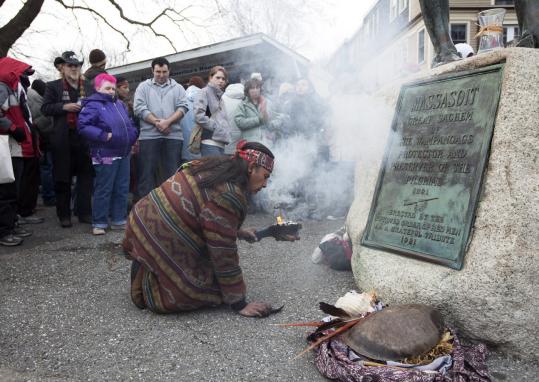
Around McCallum, protesters stood silently. Some watched Juan Gonzalez, who performed a prayer ritual beneath a statue of Wampanoag Indian leader Massasoit. Others listened as the day’s speakers urged everyone to remember their shared history and use its lessons to fight racism and oppression; help one another get better access to education and health care; and to keep watch over the environment.
"Every inch of this land is Indian land," Moonanum James, son of Frank James and co-leader of the United American Indians of New England, told the crowd. "We are here to unite people and to speak the truth. . . . We are like the dirt, like the sand, like the tides—we shall endure."Comment: For more on the subject, see Jolie: Thanksgiving = Murder and Thanksgiving Set the Tone.
Below: "Juan Gonzalez of Boston kindled a fire under the statue of Massasoit in a prayer ritual during the 41st National Day of Mourning in Plymouth yesterday." (Yoon S. Byun/Globe Staff)
Ink--A Tale of CaptivityInk--A Tale of Captivity is the Mary Rowlandson story. A new movie produced by Alice van Buren of Inkwell Santa Fe Productions. The Story: 1676 Boston--Taken by Indians, a preacher's wife becomes the first woman published in America.
Wes Studi is King Philip, the mysterious Wampanoag leader; Gary Farmer appears as the tratior Alderman.Trailer One: The Captivity Narrative--Mary Rowlandson (Angela Janda) reading from her captivity narrative.
Trailer Two: Captivity Scene--Mary Rowlandson (Angela Janda) with King Philip (Wes Studi) discussing the terms of her captivity.
The history in question:
Mary RowlandsonMary (White) Rowlandson (c. 1637–January 1711) was a colonial American woman who was captured by Indians during King Philip's War and endured eleven weeks of captivity before being ransomed. After her release, she wrote a book about her experience, The Sovereignty and Goodness of God: Being a Narrative of the Captivity and Restoration of Mrs. Mary Rowlandson, which is considered a seminal work in the American literary genre of captivity narratives.Comment: The trailers show a burning house, scalps nailed to a wall, King Philip riding a horse, and what looks like the interior of a tipi. I sure hope the movie doesn't have any mistakes or stereotypes.
Jessie Little Doe Baird will receive a $500,000 grant.
By Laura Collins-HughesJessie Little Doe Baird was overcome at the news that her 17 years of linguistic work—resurrecting the language the Wampanoag people spoke and wrote until at least the mid-1800s—had landed her a MacArthur Fellows "genius grant" of $500,000. The 23 recipients of this year's John D. and Catherine T. MacArthur Foundation grants, including five others from New England, were announced this morning.
When the foundation notified Baird, 46, a Mashpee linguist and the program director of the Wôpanâak Language Reclamation Project, two weeks ago of the fellowship, the honor brought her to tears. As far as she knows, her 6-year-old daughter is the only child since the 19th century raised from birth to speak Wampanoag (or, in that language, Wôpanâak).Comment: For more on the subject, see Alutiiq Anthropologist Is MacArthur Genius and The Making of Wounded Knee.
By Patrick CassidyAfter nearly a decade of debate that divided the Cape and Islands, U.S. Interior Secretary Ken Salazar approved the proposed Nantucket Sound wind farm yesterday, heralding it as the start of a new era in national energy policy and a precursor to the spread of turbines along the East Coast.
“Cape Wind will be the United States' first offshore wind farm,” Salazar said in a room crowded with reporters and officials at the Statehouse in Boston.
Renewable energy advocates praised the decision as a milestone for the offshore wind energy industry. Opponents immediately decried it as political pandering and they threatened a new round of lawsuits to block the plan by Cape Wind Associates LLC to build 130 wind turbines in the Sound.
Objections have come from a well-funded opposition group, local Indian tribes and powerful politicians, including the late U.S. Sen. Edward M. Kennedy, whose Hyannisport family compound overlooks the Sound. But Salazar said he found the benefits of the project outweighed any potential negative effects.The Native aspect:Local Wampanoag tribes have been among the opponents.
The Mashpee Wampanoag and the Wampanoag Tribe of Gay Head (Aquinnah) contend that the 440-foot-tall turbines will interfere with important sunrise ceremonies and damage ancestral burial grounds submerged beneath the Sound.
The state's top historic official and the federal Advisory Council on Historic Preservation have both argued against the project saying it would damage views from historic properties and potentially damage archeological sites.
Salazar said yesterday he deeply respected the Indian tribes' views. But in yesterday's documented response to the advisory council's recommendation that he reject Cape Wind, he said that he did “not fully embrace all of the views expressed by the Advisory Council,” including the contention that the review of historic impacts was “tentative, inconsistent and late.”Wampanoags rebut the critics' charges:The Mashpee tribe has raised concerns about the project for the past six years but the consultation process mandated by federal law was not followed, Cedric Cromwell, chairman of the tribe, said in a statement.
“While we strongly support renewable energy, and appreciate that Secretary Salazar will be reopening the government to government consultation, no amount of mitigation will change the fact that this is a site of great historical and cultural significance for our tribe, and is inappropriate for this project.”
The tribes have called the decision a “litmus test” for promises made by Obama's administration to American Indian tribes.
Cape Wind will be required to set aside a “substantial” amount of money for the purposes of addressing the tribe's concerns, Interior Deputy Secretary David Hayes said. The amount was not clear yesterday because the official record of the decision was not posted on the Interior website last night.
Both tribes have previously refused a $1 million offer by Cape Wind to secure their support.Salazar approves Cape Wind
By Gale Courey ToensingThe Mashpee Wampanoag Tribe of Cape Cod and the Wampanoag Tribe of Gay Head (Aquinnah) on Martha’s Vineyard have vigorously opposed the project. The wind energy plant would obscure their view of the rising sun in ceremony, and the Sound, which was once dry land, is where their ancestors lived and were buried. Both nations have urged the secretary to require Cape Wind to relocate the project a few miles further offshore where they would be out of sight.
Massachusetts’ Office of the State Historical Preservation Officer determined that the proposed Cape Wind site is a traditional cultural property and in early January, the National Park Service said Nantucket Sound is eligible for listing in the National Register of Historic Places as a significant traditional, cultural, historic and archaeological property. In early April, the Advisory Council on Historic Preservation issued a seven-page report of its findings and recommendation to deny permits to Cape Wind Associates.
Salazar said he understood and respected the views of the tribes and ACHP, but noted that as secretary of the Interior, he must balance broad, national public interest priorities in his decisions. “The need to preserve the environmental resources and rich cultural heritage of Nantucket Sound must be weighed in the balance with the importance of developing new renewable energy sources and strengthening our nation’s energy security while battling climate change and creating jobs.”
The Wampanoag Tribe and Alliance to Protect Nantucket Sound, a grassroots environmental group, have promised to file suit against the federal government’s decision.Comment: I seem to recall a few critics claiming the Wampanoags were in it for the money and didn't care about preserving their sites and sights. Those claims appear to be false.
The Obama administration's record of choosing non-Indian interests over Indian interests when they're in conflict remains intact. When can we expect Obama to say yes to Indians and no to other Americans...ever?
Below: "This simulation of the Cape Wind wind power factory in Nantucket Sound shows a view of the project from the Centerville bridge." (Photo courtesy Alliance to Protect Nantucket Sound)
In Marino: Tribes Are Too Large or Small I picked up where I left off last year with anti-Indian crusader Jim Marino. Let's continue Marino's butt-kicking education.
By Jim MarinoThat is why there are now more than 600 Indian tribes in this country, many with only a handful of members, some with only one or two and many with highly questionable, if any, fractional ancestry linking them to a real Indian.Actually, there are 564 federally recognized tribes, bright boy. Only a handful have a "handful of members."
Note that critics like Marino never quantify charges like this one. Either they don't know, or they don't want you to know, how they're lying about tribal size.
What Marino considers "highly questionable" shows his ignorance of the issues. Historically, tribal membership was based on culture, not biology. Tribes are returning to this practice because requiring a level of "blood quantum" is a sure route to extinction.Since the advent of federal programs providing grant monies to “Indian tribes” and particularly since the advent of Indian gambling, there have been many more groups claiming to be Indians and seeking federal acknowledgment as a “tribe” or “band” of Indians.True but misleading. I think a couple hundred groups have petitioned for federal recognition in the last couple of decades. About 10 or so have actually achieved it. So the recognition process is working and there's no huge influx of "phony" tribes, despite the scare tactics of critics like Marino.
The Pequot caseIn fact, Indian tribes like the so-called “Mashantucket Pequot Indians,” which started with “Skip” Hayward and a couple of relatives, parlayed a faux tribal recognition, into the billion-dollar-a-year “Foxwoods Casino” in Ledyard, Conn.The Pequots were recognized by an act of Congress in 1983. This was to settle a lawsuit and had nothing to do with gaming. The Indian Gaming Regulatory Act (IGRA) was still five years in the future.
Ronald Reagan signed the bill into law. So the recognition process was perfectly democratic even if it didn't take the usual route. If Marino didn't like the outcome then, he was free to vote against Reagan and his congressional representatives in 1984. (How much do you want to bet Marino was cheering for Reagan in 1984, not denouncing him as a sellout to Indian politics?)They have set as an enrollment criteria, a 1/32nd Indian ancestry or blood quantum and it is no wonder that these tribal members literally came out of the woodwork and the tribal enrollment now exceeds 700.Would Marino feel better if the Pequots had only seven or 70 members? Oh, wait...he already complained about tribes with only a "handful of members." What a transparently obvious hypocrite he is.
See Marino: Tribes Are Too Large or Small for a demolition of Marino's stupidity about tribal size.So there is no surprise that hundreds heretofore never heard of “Indians” and “Indian tribes,” are lining up for recognition and the right to own and operate lucrative gambling casinos, and hiring lobbyists and paying off politicians to grease the wheels of recognition in Washington.There's also no surprise that our government has insisted on a strict recognition process to prevent wannabe tribes from taking resources from real tribes. So far it's worked pretty well, which is why Marino is left with nothing but his pathetic scare tactics. "Hundreds" of tribes on the warpath--none with a chance of being recognized, but never mind. Marino wants you to be very afraid of this imaginary Indian uprising.
We're now about halfway through Marino's column and he's yet to find a single flaw in IGRA. Heck, he hasn't even mentioned IGRA since his opening paragraphs. So much for his title thesis that IGRA has gone awry. Marino is bashing tribes in general and gaming tribes in particular, not criticizing IGRA.
The Wampanoag caseLobbyists like the now disgraced and imprisoned Jack Abramoff, whose assistance was instrumental in obtaining recent recognition for the Mashpee Wampanoag is now seeking to build a casino on or near Cape Cod, Mass.Here's the actual story on the Mashpee Wampanoags. They've been fighting for recognition since 1974, or long before gaming was an issue. After 30 years of delays, they hired Abramoff's firm to speed up the process. They continued using two of Abramoff's associates after they left the firm.
Mashpee tribe got Abramoff boostMembers stress that the tribe's ties to Abramoff are small in comparison to what Abramoff allegedly did for other tribes. The Wampanoags said they paid the two lobbyists $50,000 when they worked at Abramoff's firm, a far cry from the millions of dollars paid by some other tribes to Abramoff and his associates. There has been no allegation of wrongdoing involving anyone in the tribe, Ferson said.And:The Mashpee Wampanoags cited the support of members of Congress when it subsequently sued the government for failing to act on its request for recognition in a timely manner. The case went to District Court Judge James Robertson, who denied the government's motion for dismissal.
That prompted the government to negotiate with the tribe, resulting in a pact to reach a preliminary decision by the end of March 2006. If that is granted, the government would give final approval by March 2007.So Marino criticizes the recognition process as being muddled and unfair. When the Wampanoags complain about the same thing, he criticizes them. Marino doesn't care whether the process is fair. He wants fewer Indians and Indian casinos whether they're legitimate or not.
Again, the recognition process existed before IGRA and has nothing to do with IGRA. The Wampanoag case, like the Pequot case before it, proves the point. Both tribes sought recognition long before they could conceive of profiting from gaming.
And let's reiterate that these are two tribes out of 564. What do their issues have to do with the hundreds of legitimate tribes who conduct legitimate gaming operations? You know, the tribes Marino never mentions because they don't help his anti-Indian crusade?
Interference bad, unless it's goodThis is a recent federally recognized Indian tribe, which was determined by a federal judge to lack the very criteria for recognition needed, in a case decided during the 1970s, when the tribe tried to take over acres of land around Mashpee, Mass., including the massive multi-million dollar New Seabury country club and resort development.Hysterical. When a federal judge intervenes in the recognition process, Marino is all for it--as long as the judge rules against the tribe. But if judges or legislators intervene in the recognition process to help a tribe, he's against it. Again, it's not the process he cares about, it's the outcome.
Marino the anti-Indian crusader is against increasing the number of recognized Indians. It doesn't matter whether recognition happens via the official process or not. "More Indians" = bad, according to Marino.Not only did Congress fail to clarify what constitutes an “Indian tribe” and who is an Indian when they enacted the IGRA, they also failed to clearly define what lands are the “Indian Lands” required by that Act, and which are the lands a tribe is required to have before they can build, own and operate any gambling casino.IGRA didn't need to clarify who's an Indian because the recognition process is reasonably clear. Most prospective tribes petitioning the government didn't get recognized before IGRA and haven't gotten recognized since IGRA. Despite Marino's scaremongering--Pequots! Wampanoags!--the system has worked for most tribes.
Recall that Congress approved of recognizing the Pequots. Who says the "clear definition" Marino wants would exclude rather than include the Pequots? Why does Marino think Congress would adopt a definition that invalidated its own decisions? If the definition encompassed the Pequots and other recently recognized tribes, then what?
This is blatant stupidity. The only clear definition Marino wants is "no more Indians." Don't let anyone else be recognized as Indians and eliminate some of the people presently recognized as Indians. Terminate the Indians before they rob us blind!
The practice of "reservation shopping"This failure has opened the door to real Indian tribes as well as highly questionable tribes alike, to buy or acquire fee land usually, with money furnished by non-Indian gambling investors, and then claim it is eligible “Indian Lands” on which they can build and operate a gambling casino and can do so wherever they believe there is a lucrative non-Indian gambling market to be had in the area. This has fostered a practice now called “reservation shopping!”True but again misleading. As with the "hundreds" of tribes seeking recognition but not getting it, dozens of tribes have sought to open off-reservation casinos. I believe only three have succeeded so far.
Politicians and local leaders are aware of "reservation shopping" and determined not to let it happen. There's no evidence whatsoever that the government is about to open up the country to off-reservation casinos. IGRA provides a process for taking "Indian lands" into trust and that process is working. That most tribes haven't opened off-rez casinos proves the point.
Once again, Marino is conflating an imaginary potential problem with actual flaws in IGRA. He's bashing real tribes who use the legal processes as well as phony tribes who "violate" these processes. Clearly he's prejudiced against Indians, period.
We saw this in his initial screed about "gaming" vs. "gambling." He didn't note that the commercial casinos of the American Gaming Association have championed this practice. In fact, he has nothing to say about the "evils" of non-Indian casinos in Las Vegas and elsewhere. Marino is attacking only Indian casinos and on the basis of race, which means he's a racist.
We are currently working with members of the Wampanoag Nation, including a woman you may know who goes by the name Yellowfeather, whose husband and several other tribe members are playtesting our simulation on King Philip's War. Squa-Sachem Yellowfeather is not opposed to the nature or publication of this game, and her consultations with MMP about this game are invaluable.
My understanding is that Squa-Sachem Yellowfeather is a direct descendant of Massasoit, and we are confident that the final-production version of this game will meet her approval and will be a fine addition to MMP's line of games.
What about giving other tribal groups in the region an opportunity to test the game and also give recommondations as we are not totally opposed to the game, but content and learning outcomes. Yellow Feather only represents one faction of the Wampanoag Nation as there are several (Pocassett, Wampanoad, Seekonk, Wampanoag, Nimpmuck, Wampanoag, Assonett Wampanoag, etc., Pequot, and the Narragansett Nation) each with there own concerns. Maybe you would be willing to organize a game demonstration held at the Rhode Island Council in a few weeks for the learders of these groups to help us understand more.
Thank you, Julianne JenningsAnother round
Youse's response:Ms. Jennings,
We are interested in demonstrating the game in Rhode Island and would love to meet the Rhode Island Council. We would welcome the input, and I am sure there would be a beneficial exchange of ideas. However, neither the designer nor the two active owners of MMP live anywhere near New England, and we all have day jobs and families with commitments that often interfere with our ability to travel. Additionally, MMP is a very small company with our only full time staff being the office help who answer phones, pack orders, arrange shipping, etc. The expense of a trip to RI, and the time away from our "day jobs", is prohibitive. Expenses such as additional pre-production copies were not included in our budget and so must be limited to those that have already been produced. We would gladly offer to demonstrate the game to those who have an interest if we could do so at our facility here in Maryland.
We welcome input from all areas, but game design and development cannot be conducted by committee. We cannot commit to including the particular views of anyone outside the design team, and I don't think that anyone can realistically expect us to obtain input from every tribe or faction who might be interested. As far as testing the game play is concerned, we are fairly happy with our current playtesting process and do not see the need at this point to expand that process. I hope you can understand that we do not want too many pre-production copies of the game floating around, especially if one considers the expense involved. If we run into any problems down the road, we will certainly consider your offer.
Thank you again for your interest. For what it is worth our intent is to educate with a historically accurate game, provide entertainment, and balanced competition between players. We believe that we have done so in a manner that is reasonably sensitive. We will be reviewing the game materials before final production with an eye towards content and accuracy of the events portrayed.
Sincerely,
Brian Youse
MMPJennings's follow-up message to her supporters:I am having conversations with MMP. I am taking the role of educator on this. I don't think we are going to stop the game, but creating dialog to make improvements maybe the best compromise as people do enjoy playing war games. If this game is truly an opportunity to teach about the conflict, I am concerned with content and learning outcomes. I have no reservations about the historical material they collected to make the game as this is widley available. However, I am concerned about certain language. Due to having conversations with MMP, they seem to be willing to remove the word "eliminate" for "captured and defeating King Philip and other leaders." By changing the words it supports our continued existence and that all tribes were not "eliminated," and that many have sought re-acknowledgement post war. Also, I want to add a piece in the instruction/educational manual about post war/slavery and the affects of "blood mixing." Many living "outside" Indian communities see this as a dilution of blood and culture, when in fact membership was always based on community and society.
I am arranging a visit to meet with them personally. I would like 2-3 leaders to join me in this campaign. This is an out of pocket expense, driven by the heart.
JulieComment: Glad to hear people are talking. Let's hope Jennings can get some learning outcomes into the educational manual, or whatever.
Also good to hear MMP consulted with one Indian while developing the game. But relying on one person is a little fraught with danger. Several tribes were involved in the war, and each has clans and factions. A few Native participants would've been better.
Also, MMP should avoid getting someone who doesn't like to be critical or rock the boat. And someone who isn't sensitive to stereotypical themes and language. I don't know if Yellowfeather is up to the job, but Jennings probably is.
Discuss first, then protest
As I said to Jennings or someone, this game isn't that big a deal to me. I see equally questionable things in the news several times a month. If I got as deeply involved in each controversy as she did in this one, I'd quickly burn out.
As I also said, I would've limited myself to a blogging and letter-writing campaign. A public rally against a game that's still in pre-production seems a bit much to me. I'm all about discussing and debating first and marching and boycotting last.
Julianne Jennings, who organized the event, offers some initial thoughts:We survived the rally.
We had about 75 people in attendance. Can't complain for such short notice.
We did receive lots of media coverage.
Hopefully it will get the ball rolling.
Indian Country Today, The Providence American, Providence Journal, and the Salem Gazett were all there.
Attendees were given the opportunity to voice their concerns.
Annawon Weeden, Wampanoag; Randy Noka, Narragansett; Sachem Seawolf from the Chappaquidick and the Eastern Medicine Singers drum group and many friends.
The event will run in papers in a few days.An article reviews the event:
In response to King Philip's War the Game, Julianne Jennings has posted some comments on her Facebook wall. The invitation to a protest refers to this.Ron Henries (Little Crow): This King Philip's war game is not a game, it's a tool to teach how to be anti-Indigenous People. It's a tool to teach there's an us and them. It's time for inventors like them to realize that they didn't conquer us before and they never will now. The Elders have taught me that as long as our mind hasn't been tainted then we haven't been conqured. The Great Mystery gave us our path to follow and to respect All of Creation. Regardless of the color of our skin we are all a part of the Great Mystery's Creation which includes all of life and we must not allow people who seem to promote division pollute our minds. Thanks for the invite and I hope to be there.
John Goff: Yeah, this thing is in SUCH bad taste, it boggles the mind. We've got to get an amazing protest going on Saturday...and I would love it if a "new" King Phillip could speak about "his" war...and I'm going to see if maybe I could attend to photograph & film...because this is not just a Narragansett or Wampanoag issue. It's not just a Providence and RI issue. It is evidence of (sorry to say) dominant culture IGNORANCE...and this century needs to be better than that.
Dr. Carolyn Fluehr Lobban: Trust me, there would be no Wounded Knee game.
Robert Mcvay: Great article. Schmidt uses Davis's piece as a springboard for many excellent critical observations. This is good stuff.
Ann Mione: Wow--I am speechless. Unbelievable. Excellent that a protest is planned.
Ed Chandler: And the Colonial mistreatment continues towards Natives! This time, for the sake of the almight buck! Shall it ever stop? Massive and immediate protest is the only course of action.
Karen Salvucci: This is "HORRIFIC"....I feel there is no common sense any more....You used a good example, John, using the Holocaust....Another would be a game of Plantation Owners in a game of Winning Slaves....When does this all end??....There are still many prejudices amoungst Americans today toward Native Americans and a game like this only reinforces it in the minds of not only the small-minded, but their offspring....Comment: I'm glad Jennings's friends are getting so riled up about this. Such problematical things occur every week, but people usually don't take them this seriously.
By Paul DavisA new board game that pits 17th-century Colonists against New England’s Indian tribes is sparking a 21st-century skirmish between the publisher and Native American leaders.
The game, called King Philip’s War, allows players to defeat Colonial or Indian forces in “a momentous example of New England frontier savagery,” says Multi-Man Publishing, a military game company in Millersville, Md.
The game features a New England map, dice, tokens and historic figures from the 14-month-long conflict, including King Philip or Metacomet, sachem of the Wampanoag Indian tribe, and Indian fighter and Little Compton resident Benjamin Church.
Publisher Brian Youse says the game mixes military strategy with history—and tells a story that many people outside of New England don’t know.
But tribal historians say it is in poor taste and perpetuates stereotypes of Native Americans as savages.
“It clearly demonstrates how—sadly—racism and misconceptions continue to exist in America, even in the 21st century,” says Rae Gould, tribal historic preservation officer for the Nipmuc Nation.
“I don’t know whether to laugh, cry or be angry,” adds John Brown, historic preservation officer for the Narragansett Indian tribe. “The message seems to be, it’s still OK to kill Indians.”
Colonial players win by gathering points or eliminating King Philip and other Indian leaders. Indian players win by accumulating points or seizing the settlements of Boston and Plymouth.
Game designer John Poniske, who teaches social studies at a Maryland middle school, created the game after reading an article about King Philip in the magazine Military History.
“I immediately saw the gaming potential in the historical situation,” says Poniske, who has designed games based on the Vietnam War, the Civil War and the teachings of Jesus.More objections to the game:But Paula Peters, a member of the Mashpee Wampanoag tribe, says the game “seems to trivialize a very tragic event in our history.”
As a boy, King Philip grew up in a world where he was free to practice his beliefs in his ancestral land, says Peters, marketing director for Plimoth Plantation.
But as an adult “he and his people were pushed out.”
During an earlier conflict in Mystic, Native women and children were burned in their beds, she says. “It was no game.”And:More than 5,000 people died in the war, more than three-quarters of them Indians. Half of New England’s towns were burned or pillaged. Philip was drawn, quartered and beheaded, and some Indian captives were shipped to the Caribbean as slaves.
“That a game would be based on this really bothers me,” says Peters. “Would we play a game called The Holocaust?”Julianne Jennings, a Nottoway Indian and adjunct professor at Eastern CT State University, offers some additional objections to the game:Most educators are myth-informed or mis-informed about Native American history. If they can't cut it in a classrooms, how is the game suppose to do it?
Even if the board game gives opportunity to have the colonists lose the war and allows for critical thinking, what next? Will the learning extend beyond the board game and help students understand what's happening in "Indian" country today...?
Comment: Good points. The game's creator is a social studies teacher who read about the war in a magazine, so how accurate is the game likely to be? Does it include any context--i.e., the 50 years of New England history leading up to the war? You know, the history chronicled here:
What if either side is faced with accepting defeat or massacring the other side in a surprise attack? Does the game present the "atrocities" mentioned above as a viable option? Does it encourage them? Should we really be teaching that conquering and killing people is the best way to achieve one's goals?
Inside the game
The game has a webpage, so we can begin to answer these questions. My impressions:
It appears the game concentrates solely on the war itself, with no pre- or post-history. If true, this means there's nothing about the colonists' greed before the war, and nothing about their cruelty after the war. The text notes that "6000 Indians were slain or captured, and sold into slavery" and "Metacomet himself was eventually ambushed, beheaded, and quartered," but this doesn't appear to be in the game itself.
Focusing only on the war makes it seem as if the invading and occupying forces were morally equivalent to the people defending their homes and way of life. They weren't. The Europeans were morally wrong, but the game doesn't seem to reflect that.
The text says massacres are one of the six outcomes when you roll the Battle Effects Die. So massacres happen at random via an (un)lucky roll. This bloodlessness means players won't learn who committed massacres or why they occurred in reality. Nor will they learn the consequences of mass murder. It'll desensitize them to the horrors of war, creating the impression that "these things just happen."
So if a massacre occurs next month in Brazil or Iraq or Tibet (to pick three hot spots)? Somebody rolled the dice and got a bad break. Too bad...now it's your turn. Roll again.
The game's objectives sound uneven:In King Philip’s War the Colonial player wins by eliminating the historical leaders of King Philip and Canonchet or being the first to accumulate 30 victory points. The Indian player wins by seizing the settlements of Boston and Plymouth, or by being the first to accumulate 30 victory points.Why should capturing two Indian leaders end the war? Does the developer think the Indians were fighting only because of a charismatic leader? That they were a bunch of children who couldn't act without a father figure to hold their hands?
Meanwhile, the Indians have to capture two major towns to win? Two towns vs. two leaders: How is that fair? What's the historical basis for saying the colonists would've fought until their biggest towns fell? Since this didn't happen in reality, how can the developer know whether the colonists would've given up sooner or later?
The colonists seem to have an easier objective. Which means there's a bias toward the colonists winning. Just because this happened in reality doesn't mean the game should promote that outcome.
Finally, there's the box cover, which shows only Europeans. They're dressed as brave soldiers and gathered around a Christian flag. That sends the message that the Europeans are the heroes and the Indians are the villains. That the game's "lesson" is how the Europeans defeated their savage enemies, not why the Indians had to fight an evil empire.
So the game seems questionable at best. I'm not sure any game featuring Europeans vs. Indians would be a good idea. Kids should learn America's genocidal history as a serious business, not as a game.