Showing posts with label buffalo. Show all posts

September 22, 2013

Relocation, lacrosse, and buffalo

Three recent Native documentaries of note:

Moses Brings Plenty: Representing for 'Urban Rez'Urban Rez is a documentary about the relocation program that President Eisenhower put into place in the early 1950s. Urban Rez helped me to understand and educate me about the relocation process.The Medicine Game Premieres September 24 on Public TelevisionTucked away in central New York State is the Onondaga Nation, a sovereign Native American community known to produce some of the top lacrosse players in the world. ... Enter the Thompson brothers–Jerome "Hiana" and Jeremy–who are driven by a single goal of beating the odds against them and playing lacrosse for national powerhouse Syracuse University.Scot who saved American buffalo subject of film“He realised that if you eliminated the buffalo, you eliminated the Native Americans, and that was the mindset of the American government. Scotty could not understand this because he had tremendous respect for the Native Americans.”Below:  Moses Brings Plenty.

July 20, 2013

Flying Buffalo Project

Struggling state park spreads awareness with kites

By Katherine MozzoneMontana artist DG House poses with her work. She's one of 20 Native American artists invited to create kites to fly over buffalo jumps as part of the Flying Buffalo Project.

House tells me, when she got the email, she was immediately on board.

"I'd never heard of that before. I've never heard of any Indian project, any native project involving kites," exclaims House.

House says, it's exciting to see her work on a kite but explains the greatest honor is to have a voice in history.

"When you see these kites flying, I'm hoping you'll remember these are real people, millions of buffalo were here, to remember, this is all reality, not just a story," says House.
Comment:  The park's name, buried in the story, is Madison Buffalo Jump State Park.

For more on buffalo jumps, see Torch Relay at Buffalo Jump.

May 19, 2013

Comanche LEGOs based on Lone Ranger

Indian Country Today's posting about actor Gil Birmingham (below) alerted us to the existence of a Comanche Camp LEGO set. Naturally, it' based on Johnny Depp's Lone Ranger.

The Lone Ranger--Comanche CampVisit the Comanche Camp with the Lone Ranger and Tonto!

Journey to the Comanche Camp with the Lone Ranger and Tonto! Visit Red Knee in the teepee with removable canopy and campfire. Check out the weapon rack then jump in the canoe and go fishing. Watch out for the scorpions as they launch a surprise attack from the rocky outcrop with the attack function! Includes 3 minifigures with weapons: the Lone Ranger, Tonto and Red Knee.

• Includes 3 minifigures with weapons: the Lone Ranger, Tonto and Red Knee
• Features teepee, weapon rack, canoe with oar, and rocky outcrop with scorpion attack function
• Teepee features small campfire, entrance flap and removable canopy
• Weapons include 2 revolvers, tomahawk, spear and a bow with quiver
• Also includes a fish, 3 scorpions and 3 bones
• Survive the scorpion attack!
• Go fishing in the canoe!
• Remove the teepee canopy and play inside!
• Teepee measures over 6" (16cm) high, 3" (10cm) wide and 4" (12cm) deep
• Canoe measures over 4" (12cm) long and less than 1" (2cm) high and wide
• Weapon rack measures over 1" (3cm) high, and less than 1" (2cm) wide and 1" (1cm) deep
• Rocky outcrop measures over 2" (7cm) high, 3" (10cm) wide and 2" (7cm) deep


If you're wondering who Red Knee is, here's an answer:

Yes, Gil Birmingham is in 'The Lone Ranger'--Here's the LEGO that Proves ItWhen ICTMN contacted a representative for Birmingham yesterday, hoping to verify that the actor is in the film despite his omission from the IMDB listing, she replied that yes, absolutely, Gil Birmingham is in this movie. He plays a character named Red Knee.

She further informed us that Birmingham has a figure in the Lone Ranger Comanche Camp LEGO playset alongside the figures based on Tonto and the Lone Ranger as played by Depp and Hammer.
Comment:  A brief discussion about this LEGO set with Kevin Gover, director of the NMAI:

Get your Johnny Crow-Head LEGOs while they last! Weapons! Canoe! Guy in buffalo hat! Scorpions! It's a totally authentic representation of Comanche culture!

Your kids will have fun learning about Indians for years! They'll want to pass these LEGOs on to their children too!How else are you going to get a Comanche canoe?

And the two-pole tipi. An engineering marvel!
I presume the tipi's cone could stand on its own without any poles. It might be interesting if you actually had to build your own tipi. You know, tie four poles--the Comanche standard--together and drape the covering around them. But I imagine that's not the case.

I presume the "weapons rack" is the item on the left that looks like a headless Indian. I guess there was no room for cooking utensils, tobacco pipes, or other nonlethal aspects of Comanche culture.

I'm not sure the Comanche had or used tomahawks, which are associated primarily with eastern tribes. Moreover, the original Tonto used guns, not a tomahawk or bow and arrow. If Johnny Depp's Tonto uses a tomahawk, that's another step backward.

Comanche buffalo hunting?

I'd guess the buffalo headdress was found only on the northern plains, not the southern plains or Texas. But I can't swear that the Comanche didn't wear such headdresses. Do you know anything about that, Kevin?

P.S. This could be a big-selling item in the NMAI's gift shop. I say go for it!They mighta had buffalo headdresses. Certainly had plenty of buffaloes.A plausible chronology says the Lone Ranger donned his mask in 1874. I don't think Texas had a lot of buffalo then.

Masked Men: A Chronology of the Lone Ranger and the Green Hornet

The buffalo were on their way to near-extinction by then. But I suppose there were enough left for someone to fashion a buffalo headdress.

Comanche history--Buffalo hunting

As for the canoe, I presume it's made of genuine birch bark from a Texas birch tree.

For more on Johnny Depp, see Lone Ranger Has Comanche Adviser and Depp's Tonto: True or False?

February 22, 2013

100th anniversary of buffalo nickel

On Its 100th Anniversary, a Look at the History of the Indian-Head Nickel

By Rick HerediaSo why all this press for a slaughtered beast? Black Diamond was, at the time of his slaughter, one of the most famous animals in the United States. Just two years earlier, in 1913, his image was stamped onto the reverse side of the Indian head nickel. The nickel—75 percent copper and 25 percent nickel—made its debut on Washington’s birthday, February 22, 1913, 100 years ago. In the decades that followed, it became an Indian country icon.

At least one newspaper, the National Labor Tribune, believed Black Diamond had been dealt a great injustice. “The buffalo which served as a model for the nickel coin has been put to death,” it said. “Republics are notoriously ungrateful.”

The occasion for the nickel’s debut was the groundbreaking for the National American Indian Memorial, the dream/scheme (and it turns out, pipe dream) of Rodman Wanamaker, scion of the Wanamaker department store chain. Plans called for the memorial to have a colossal bronze statue of an Indian, 60 feet high on a 70-foot base, one arm raised, two fingers forming a V, greeting ships carrying immigrants and others arriving in New York. A museum and a warrior on horseback were also part of the design. The statue and all the rest were to be erected at Fort Wadsworth on New York’s Staten Island, just south of the Statue of Liberty. Staten Island, named for the Dutch parliament, the Staten-General, originally belonged to Lenape Indians, who repulsed the Dutch three times before the invaders were able to establish a settlement there.

Now, in 1913, the island was being invaded again. On a cold, bleak, wet day, just after noon, the fort’s batteries fired a 21-gun salute announcing the arrival of President William Howard Taft. Waiting to greet Taft were members of his cabinet, New York’s governor, New York City’s mayor, naval and military detachments and officers, including Lieutenant General Nelson A. Miles, who had taken part in many of the U.S. Army’s campaigns against Plains Indians, had forced the surrender of Chief Joseph and spent exhausting months in the field chasing Geronimo.

On hand, too, patiently waiting in the mist, were more than 30 Plains Indian leaders and warriors, many of whom who had fought Miles and the U.S. Army. They were dressed in beaded buckskin and wore eagle feather headdresses. They included Plenty Coups, Drags The Wolf, Crane In The Sky, Little Wolf, Black Wolf, Wooden Leg, Red Arrow, Hollow Horn Bear and Two Moons.
And:A few months later, in July 1913, Wanamaker sent out the last of three expeditions to Indian reservations promoting citizenship and fealty to the U.S. At the time, many Americans—even those who said they respected Indians, such as Wanamaker—thought American Indians were a vanishing race. Wanamaker believed that assimilation was their best hope for survival. (This, despite the Bureau of Indian Affairs (BIA) findings that the Indian population was increasing. In 1890 the BIA counted 243,000 Indians. In 1900, that figure jumped to 270,000. In 1910, it stood at 305,000.)

Speaking at a press conference held when the citizenship expedition returned to New York in December 1913, Henry Roe Cloud, Winnebago, a Yale graduate known for his speaking skills, asked the question that must have been on the minds of many Indian leaders of the day. “Today, the American Indian finds himself in the midst of a great, complex civilization, and it is a national question whether this complex civilization will bear him down or be the means of his salvation,” Roe Cloud said, as quoted in The New York Times.

Once the nickel went into circulation, it was hammered. Critics complained that it lacked the grace and beauty of previous coins, including its predecessor, the Liberty nickel. But after 25 years, that coin had run its course, and treasury officials wanted to change the design. The New York Times said the new nickel was a “striking example of what a coin intended for wide circulation…should not be.” It said the coin was not pleasing to look at when shiny and new and “will be an abomination when it is old and dull.” One Times reader, H.P. Nitsua, said, “The new nickel is certainly a travesty on artistic effect,” and called the Indian’s feathers “barbaric headgear.”

The New York Sun called it an ugly coin.
Fortunately, the nickel had a happy ending:The coin had a run of 25 years, from 1913 to 1938, when it was replaced by the Jefferson nickel. More than 1.2 billion Indian head nickels were minted; their total currency value was more than $60.5 million.

The National Indian Memorial never did get built at Fort Wadsworth. Wanamaker couldn’t come up with the money and soon enough, World War I grabbed the headlines. But the Indian head—or buffalo—nickel, outlived its critics to become one of the most admired coins the U.S. ever produced. Many have called it beautiful, and it has become iconic. In the early 1970s, an image of the nickel, Indian head showing, appeared on a protest poster that read the only Indian America ever cared about.

It has been incorporated into many types of jewelry, from earrings to belts. It adorns T-shirts, jackets and other clothing and is the logo for coin shops and other businesses. It has been made into guitar picks and used to decorate the bolt-action rifles and rifle slings. The image has been tattooed onto backs and shoulders. One artist, Peter Rocha, created a striking four-foot-by-four-foot image of the nickel in Fairfield, California using more than 9,500 jellybeans provided by Jelly Belly (see Rocha’s work at JellyBelly.com).

Many of the nickels are sold on eBay. The American Numismatic Association displayed Black Diamond’s mounted head at its 1985 convention, writes author David Lange in his book, The Complete Guide to Buffalo Nickels. The ANA, headquartered in Colorado Springs, will celebrate 100th anniversary of the nickel during National Coin Week, April 21 to 27. Its theme will be Buffalo Nickel Centennial: Black Diamond Shines Again.

Perhaps the greatest testament to the nickel’s popularity and endurance has come from the U.S. Mint, which resurrected the nickel in the form of the $50 American Buffalo gold bullion coin. When it was first sold in 2006, the mint’s price was $800. As of January 2013, the cost was $960.
Comment:  This posting links the buffalo nickel to other bits of history: the proposed Indian statue on Staten Island, and the Wanamaker expeditions mentioned in my interview with Steven Lewis Simpson. All involved Rodman Wanamaker. It was a smaller world back then; anything involving America's Indian policy probably involved the same few people.

Let's discuss these items.

1) The Indian-head or buffalo nickel is much like a modern-day mascot. Twenty-three years after Wounded Knee, it was a way to "honor" Indians after their defeat. Americans came close to exterminating both Indians and buffalo, so this was a way to salve their consciences. "Look how brave and noble the Indian (and buffalo) was," the coin seemed to say. "Think about how they symbolized the strength and majesty of America. And not how we were slaughtering them just a few years ago."

2) The Staten Island statue would've served a similar purpose. "Look at the Indian welcoming people to America," observers might say. "The Europeans weren't invaders, they were guests. White men and Indians lived in peace and harmony (see our Pocahontas and Thanksgiving myths) until something went tragically wrong."

It would've been interesting if we'd had a giant status of an Indian instead of Liberty. I'm not sure if that would've been positive or negative. On the one hand, it would've become the most iconic Indian in the world. On the other hand, it would've whitewashed the white man's responsibility for breaking the treaties and stealing the land.

3)The Wanamaker expeditions did explicitly what the coin and proposed statue did implicitly. Namely, seal off the past and make America feel good about its conquests. People like Wanamaker wanted the Indians to assimilate and vanish from our history. We could remember them as noble warriors, but we were to forget they were sovereign entities with legal rights and natural resources. Indians were to become a comforting myth (again, like Pocahontas and Thanksgiving): the friendly guides who helped us "tame the wilderness." We wouldn't have had to trouble our consciences anymore.

Most of the Native stereotypes in our culture today--and there are millions of them--serve the same purpose. Whitewashing the past...salving our consciences...erasing our crimes. In other words, maintaining the status quo in which broken treaties and stolen land are the norm. It's all about confirming the white man's power and privilege to rule according to Euro-Christian standards.

All that from one little nickel.

For more on the buffalo nickel, see Indian Head Gold Dollars and Sports Logos = US Coins?

Below:  "Chief Two Guns White Calf, nickel model."

February 19, 2013

White buffalo at Fuel City

Native Americans object to use of white buffalo at Dallas gas station

By David SchechterThe Fuel City gas station gained attention this weekend for using a white buffalo to promote its business. Now it is facing criticism from Native Americans who say using the animal for commercial purposes is sacrilegious.

"He's exploiting this. He's exploiting our culture,” said Yolanda Blue Horse, a Native American activist.

To some Native Americans, the birth of a white buffalo symbolizes how their sacred ceremonies and prayers were handed down to them.

When Blue Horse and others in the local Native American community heard about this white buffalo, they felt Fuel City, a downtown Dallas landmark on Riverfront Boulevard, had gone too far.

Blue Horse called the owner to explain the problem about the animal named Lone Star.

"Our religion, really, ultimately is not to be used as a circus. It's not to be used as a sideshow and 'ooh, come look at what I got,' which is what his words were," she said.
Comment:  I'd say this depends on how Fuel City is using the white buffalo. If they gave it a Native name, said it was a Native symbol, encouraged people to pray to it for good luck, I'd say they were exploiting Native culture. But simply owning and displaying a white buffalo doesn't seem sacrilegious. I don't think Natives have any right to control or monopolize the use of white buffaloes in non-Native circumstances.

For more on white buffalo, see White Buffalo Died of Disease and White Buffalo the Play.

August 22, 2012

White buffalo died of disease

Authorities say white buffalo died of natural causes

By David SchechterAuthorities said an investigation into the death of a rare white buffalo shows the animal died from natural causes. Hunt County Sheriff Randy Meeks said Lightning Medicine Cloud and its mother, Buffalo Woman, died from a bacterial disease called Black Leg.

He also said neither animal had been skinned, contrary to what the owner of the ranch reported.

On Tuesday, Meeks closed the case but says his evidence contradicts statements by ranch owner Arby Little Soldier that Lightning had been skinned. In fact, law enforcement sources tell News 8, ranch personnel would have known the animal’s condition because they buried it in the first place.

“We have photographs indicating LMC was not skinned. The photographs depict skin and hair on the remains and the vet advised there was a lot of skin that was still left on the remains,” said Meeks.

Meeks also revealed Little Soldier waited six days to report Lightning’s death.

“Lightning Medicine Cloud was deceased at least six days and buried for three days prior to our notification. The remains were decomposed," Meeks said.
White Buffalo Was Not Murdered, Texas Authorities SayA bacterial infection commonly known as black leg is the suspected cause of Lightning Medicine Cloud’s death. According to a report at NewsOK.com, two more buffalo on the ranch have died since May. Texas A&M extension office veterinarian Terry Hensley told NewsOK.com that black leg spores will enter an animal’s body through the mouth or a wound, and can remain dormant for months or years. The animals are “healthy one day and the rancher finds them dead the next,” Hensley said. Hensley added that there is an approved black leg vaccine for cattle, but not for buffalo.

Contacted by WFAA before the announcement, Little Soldier said that Lightning Medicine Cloud was killed in what he feels should be regarded as a hate crime. Little Soldier has attracted attention for the $45,000 reward offer (there is an explanation for it at lightningmedicinecloud.com) and for reportedly naming Yolanda Blue Horse, who is part of Greenville’s American Indian community, as a suspect. The Sheriff’s Office said it would not file any charges against Little Soldier.
Sacred white buffalo--believed to have been ‘killed and skinned’--died from bacterial infection, say experts

Comment:  Wow. Assuming the latest reports are true, this must be one of the most bungled cases of reporting I've ever seen.

For starters, it seems Little Soldier was either lying to the press or deluding himself. He gave the impression that he found the calf's newly butchered carcass. You know, skin completely removed, raw meat visible, slash marks everywhere, blood and gristle on the ground, etc.

He also gave the impression that he called the police immediately and they confirmed the butchery. Or at least they didn't deny it.

Now it turns out he found a body with a substantial amount of skin left. Presumably the skin fell off because of the disease or decomposition. Are we to believe experienced ranchers couldn't tell the difference between skin falling off randomly and intentional butchering?

Then Little Soldier let the body rot for three days, buried it for three days, and then reported it to the police. Supposedly while he consulted with "elders." It doesn't sound like he was very concerned about finding the "killer." Did he seriously think the police would be able to do their jobs with a body that he'd handled, moved, buried, unburied, etc.?

No, it sounds more like he knew the calf died of natural causes but lied about it. And ordered his staff to lie too. How does a staff veterinarian not know the difference between intentional skinning and random decomposition?

It also sounds like Little Soldier used the natural death in a clumsy attempt to gain publicity and perhaps money. Perhaps even to frame a rival. I'm not seeing any explanation that makes more sense.

Everyone misreported the case

I'm not letting reporters off the hook on this one either. Did anyone ask to see photos of the body? Or construct a timeline of when it was discovered vs. when it was reported? Indeed, did anyone do any reporting in person?

Or did they simply take Little Soldier's word about what he found? I tell ya...if I called someone or someone called me about a case, I wouldn't just take their word for it. I'd ask for photos or confirm the story with the police, at least. You know, "Little Soldier claims his calf was killed and skinned. Is that true? Did you find it dead with its skin removed with knives?"

In short, how do you write the calf was found butchered and skinless when it was buried for days and still had part of its skin? Other than the fact of its death, the reporters got almost everything wrong. It's like writing about a "murder" without noting the victim was found hanging from the ceiling--an obvious sign of suicide.

Sheesh!

For more on the subject, see $45,000 Reward for White Buffalo Killer and Sacred White Buffalo Killed and Skinned?

July 29, 2012

Pix of my South Dakota trip

I plan to write some articles about my South Dakota trip in June. Meanwhile, here are my photos of the trip. I trust the captions will explain our experiences well enough.

Day 1

LAX to downtown Rapid City--June 24, 2012 (7 am-3:30 pm)

Prairie Edge Gallery--June 24, 2012 (3:30-5:30 pm)

Dinosaur Park--June 24, 2012 (5:30-6:30 pm)

Etta Mine--June 24, 2012 (6:30-7:30 pm)

Cemetery and Mt. Rushmore--June 24, 2012 (7:30-10 pm)

Day 2

Hotel and Scenic, SD--June 25, 2012 (morning)

Sheep Mountain--June 25, 2012 (morning)

Fossil-hunting--June 25, 2012 (morning)

Visitor center and Stronghold--June 25, 2012 (morning)

Red Cloud Indian School--June 25, 2012 (late morning)

Pine Ridge and Whiteclay--June 25, 2012 (early afternoon)

Wounded Knee--June 25, 2012 (afternoon)

Lakota War Pony Races--June 25, 2012 (afternoon)

Oglala Lakota College--June 25, 2012 (afternoon)

Lakota Prairie Ranch Resort--June 25, 2012 (late afternoon)

Thunderstorm--June 25, 2012 (early evening)

Day 3

Iron Mountain Road--June 26, 2012 (early morning)

Custer State Park and Wind Cave--June 26, 2012 (morning)

Into the cave--June 26, 2012 (early afternoon)

Hole in the Wall and Needles Highway--June 26, 2012 (afternoon)

Sylvan Lake and Rapid City--June 26, 2012 (late afternoon)

Day 4

Hunting geodes and finding Nemo--June 27, 2012 (morning)

Homestake Gold Mine and Terry Peak--June 27, 2012 (morning)

Spearfish Canyon and Deadwood--June 27, 2012 (early afternoon)

Bus tour and Boot Hill--June 27, 2012 (afternoon)

Walking in Deadwood--June 27, 2012 (afternoon)

Day 5

Black Hills Institute--June 28, 2012 (morning)

Gift shop and Crazy Horse Memorial--June 28, 2012 (morning)

On the Crazy Horse Memorial--June 28, 2012 (early afternoon)

Visitor center and gift shop--June 28, 2012 (afternoon)

Veranda and Lakota dancers--June 28, 2012 (afternoon)

Sculptor's studio and cultural center--June 28, 2012 (afternoon)

Nature Gates and Rapid City--June 28, 2012 (afternoon)

Day 6

Hotel and Memorial Park--June 29, 2012 (morning)

City of Presidents, part 1--June 29, 2012 (morning)

City of Presidents, part 2--June 29, 2012 (morning)

City of Presidents, part 3--June 29, 2012 (late morning)

City of Presidents, part 4--June 29, 2012 (early afternoon)

Fountains and park statues--June 29, 2012 (afternoon)

Rose garden and flight home--June 29, 2012 (afternoon)

Plus a few postings on related subjects:

Cultural center at Crazy Horse Memorial
Anti-suicide campaign at Lakota college
Hundreds of Sun Dances
Economic development on Pine Ridge

May 26, 2012

Bison to be "national mammal"?

Senators seek to name bison 'national mammal'

By Matthew BrownWestern lawmakers want to elevate the Plains bison to a status similar to that of the iconic bald eagle with legislation to declare the burly beasts America's "national mammal."

Bison advocates launched a "vote bison" public relations campaign Friday to coincide with the bill.

The National Bison Legacy Act introduced in the Senate is backed by lawmakers from Wyoming, Colorado, Nebraska, Kansas, New Mexico, North Dakota, South Dakota and Rhode Island.

The largely symbolic measure would provide no added protections for the estimated 20,000 wild bison in North America. And the bald eagle would still hold a somewhat loftier role as the national emblem, as declared by the Second Continental Congress in 1782.

But supporters said the bison legacy bill would afford overdue recognition to a species that has sweeping cultural and ecological significance. Bison—North America's largest land animal—already appear on two state flags and the official seal of the U.S. Department of Interior.

"The North American bison is an enduring symbol of America, its people and a way of life," said Wyoming Republican Sen. Mike Enzi, chief sponsor of the bill along with South Dakota Democratic Sen. Tim Johnson.
Comment:  For more on the buffalo, see White Buffalo the Play and $45,000 Reward for White Buffalo Killer.

May 16, 2012

White Buffalo the play

'White Buffalo' relives myth in time of need

By Lawrence B. JohnsonWhat is the power of myth, and what does the hand of God look like? Is absolution itself a miracle?

Playwright Don Zolidis comes at those cosmic questions from oblique angles in "White Buffalo," a portrait of belief and the human condition that receives a gritty, affecting world premiere at Purple Rose Theatre.

Life is hard for single mom Carol Gelling, who's broke with no options but to slug ahead on her ramshackle Wisconsin farm. Her rebellious 18-year-old daughter Abby just wants out. One thing they do share is their joy in a small herd of buffalo the family's had since before Carol's drug-besotted husband Mike bailed on them eight years ago.

But everything changes when a white buffalo is born in their barn. Sioux legend has it that such a rarity augurs the coming of universal peace, and as word gets out the curious begin to stream from everywhere to this field of dreams: Birth it and they will come.
Comment:  Given the recent death of a white buffalo calf, this is a timely play. But are any of the participants actual Natives? The review should've covered that point.

For more on the subject, see $45,000 Reward for White Buffalo Killer.

May 07, 2012

$45,000 reward for white buffalo killer

An update on the alleged killing of the white buffalo calf. Especially interesting are the details on how its mother was killed:

Reward for killer of rare white buffalo upped to $45,000

By Marty SabotaThe reward has increased ninefold to $45,000 in last week’s deaths of a rare white buffalo, considered sacred by its Lakota Sioux owner, and its mother on a ranch near Greenville.

Lightning Medicine Cloud and his mother, Buffalo Woman, were killed just shy of the white buffalo’s first birthday.

Arby Little Soldier, great-great-great grandson of Sitting Bull and owner/operator of the Lakota Ranch, said Monday that he found the calf slaughtered and skinned April 30 after returning to the North Texas town from an out-of-town trip to Oklahoma City.

"Someone who probably knew we were out of town killed him and stripped the meat," Little Soldier said. "I could tell it was him because of the white hair that was left on the head and tail."

He said the mother appeared ill Monday, but eventually fed, and he concentrated on taking care of her calf’s remains. He found her dead the next morning, "about a 20-foot radius from where she gave birth to Lightning."

He wasn’t sure how Buffalo Woman died, but speculated that she had been shot with a poisonous arrow because of a small mark. No arrow was found.

"I think it was a professional hit on the mom," Little Soldier said. "It was a slow death."

The Hunt County Sheriff’s Department, the Texas Rangers, the Bureau of Indians Affairs and other agencies are investigating the deaths.
Comment:  Someone suggested the calf was "merely" poached for its hide. And the mother was killed merely to get her out of the way so the poachers could butcher the calf. A few problems with this theory:

1) The calf was less than a year old, so its hide couldn't be very impressive. A full-grown white buffalo would've been better.

2) There are white buffaloes elsewhere that aren't world-famous religious icons. It's crazy to select a high-profile target when you don't have to.

3) This buffalo resided on the Lakota Buffalo Ranch and was the subject of an upcoming powwow. The killers must've known it was sacred to many Indians.

4) A tranquilizer would've worked as well as poison on the mother. In fact, it would've worked better, since the poison failed to incapacitate the mother immediately.

From all the available evidence, I doubt this was simply poaching with no thought of the calf's meaning to Indians. Like many people, I suspect it was an intentional hate crime. Skinning the primary "offender" (the white buffalo) and poisoning the secondary "offender" (its mother)--sounds like the approach you'd take if you hated Indians and their "pagan" religion.

For more on the subject, see White Buffalo Hunt in Texas, White Buffalo = Third of Its Kind? and White Buffalo Calf Born.

May 04, 2012

Sacred white buffalo killed and skinned?

Lightning Medicine Cloud, Sacred White Buffalo, Killed and SkinnedAccording to a Fox News report, the extremely rare and sacred white buffalo born last year has been found dead and skinned along with its mother.

Lightning Medicine Cloud, born May 12, 2011 on a stormy night at the Lakota Ranch in Greenville Texas, was a natural white buffalo—an extremely rare occurrence, happening an estimated once per ten million births. In June, a naming ceremony attracted over 2,000 visitors to the ranch, and a report on the proceedings cited beliefs held by some Lakota that the calf was the third white buffalo ever, and the first male in 150 years. Such a white buffalo is tied to the story of White Buffalo Calf Woman, and is the most sacred animal, perhaps the most sacred thing on the planet, to the Lakota people.
And:The owners of the Lakota Ranch have released the following statement to Indian Country Today Media Network (the original news report follows it):

To my fellow Native Brothers and Sisters in Indian Country,

Lightning Medicine Cloud, a true spiritual blessing was born at the Lakota Ranch on May 12, 2011. He now has joined his earth father and our heavenly father, and Lightning’s mother, Buffalo Woman, also went on to join her son one day after Lightning left the earth.

There is an internal investigation through Hunt County Sheriff and Homeland Security in process, and a $5,000 reward offered for any information leading to the arrest and conviction of those involved in the premeditated crime deaths of Lightning Medicine Cloud and his mother, Buffalo Woman. Thus far, the investigation has concluded that neither were killed by natural causes.
Comment:  I'm guessing the skinning part was a big clue that the buffalo didn't die of natural causes.

This sure sounds like a hate crime of some sort. I'd be amazed if the culprits claimed they picked these buffalo at random. They killed the mother as well as the calf, which suggests targeting these particular animals.

I wonder who might be guilty of the hate. Young hoodlums? Disgruntled ranchers or hunters? Or your garden-variety KKK/militia types who think anything other than Christianity is devil worship.

For more on the subject, see White Buffalo Hunt in Texas, White Buffalo = Third of Its Kind? and White Buffalo Calf Born.

March 17, 2012

Buffalo imported for The Vanishing American

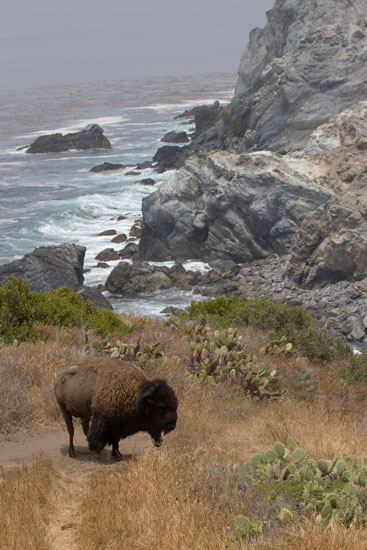
The Isle Where Buffalo RoamIn 1924, a film crew descended on California’s Catalina Island to shoot a silent Western called The Vanishing American. When the filming was finished, the crew members packed up and left. Legend has it, however, that they abandoned several of their extras. The castoffs—14 American bison—took up residence in the arid hills of this rocky island.

In the decades that followed, the bison did what bison do: The animals grazed and bred. Each spring a new batch of calves was born. By the late 1980s, some records suggest the herd had swelled to more than 500 animals (pdf). On this small island where no bison had ever lived before, these unlikely ungulates thrived.

The buffalo’s success, however, came at the expense of Catalina’s vegetation. The island, covering just 75 square miles, is home to more than 400 native plants, several of which are found nowhere else in the world. The free-roaming bison’s voracious appetite, sharp hooves, and penchant for scuffing out wallows—dusty depressions where the animals roll—took a toll on the grasslands. The bison and their shaggy coats also helped spread the seeds of non-native plants.
Comment:  I saw these buffalo when I visited Catalina as a boy.

It seems typical of Americans to do something like this without thinking about the consequences. Move the buffalo, kill the buffalo; move the Indians, kill the Indians. Who cares what happens next? That's somebody else's problem.

For more on the buffalo, see White Buffalo Hunt in Texas and Slaughtering Buffalo = Genocide.

March 07, 2012

White buffalo hunt in Texas

$13,500 to Kill Sacred White Buffalo in Texas—Can This Be True?American Indians across the internet are flocking to the website of Texas Hunt Lodge today—and not because they’re planning a hunting trip. No, they’re alarmed by a page on the site dedicated to the White Buffalo Hunt Package, which advertises a chance to kill a white buffalo for $13,500.

White buffaloes are sacred animals to the Lakota Sioux and other Native groups, and there aren’t a lot of the creatures around. When one was born last year in Greenville, Texas, it was an occasion for much rejoicing. An article in the British newspaper Daily Mail extensively covered the naming ceremony of Lightning Medicine Cloud. That report said that “Lightning Medicine Cloud, whose name is also a tribute to a white buffalo born in 1933, named Big Medicine, is thought—in Lakota Sioux tradition—to be the third of its kind ever born.”

It may be that not all white buffaloes are created equal, for there is a herd in Bend, Oregon, that contains 11 white buffaloes. Even so, it’s safe to say there aren’t a lot of them; an article on the herd from 2010 said that experts estimate that there are less than 50 white buffaloes in existence.

The sacredness of the white buffalo is linked to the story of White Buffalo Calf Woman, a Lakota prophet who brought the Lakota the Seven Sacred Rituals.


When I saw the first posting of this on Facebook, I immediately reposted it. After that, several others reposted it as well. The brief online protest led to this:

White Buffalo Hunt Causing Uproar Throughout Indian Country Will Stop

By Jack McNeel“We’re outraged,” James Swan remarks regarding the white buffalo hunt offered by a Texas hunting ranch. “We don’t have a problem with people having [white buffalo]. We just have a problem with people making big bucks killing them.”

Swan is a Cheyenne River Sioux tribal member and President and Founder of United Urban Warrior Society. “In our Lakota ways our creation story starts with the white buffalo. Over the centuries the white buffalo, to us, is a very sacred part of our culture and part of our spirituality. Our people didn’t have a written language. Everything was passed down through stories over the centuries and white buffalo was a center part of everything we do.”

The story on the white buffalo hunt was posted to Indian Country Today Media Network on Monday afternoon and kicked off a firestorm of Facebook activity. Late Tuesday, Aaron Bulkley, owner of Texas Hunt Lodge, which advertised the $13,500 buffalo hunt on its website, spoke with ICTMN about the matter. “We’ve had a ton of feedback from people since the white buffalo story came out, and I understand the white buffalo is sacred to Indians,” he said. “It’s been on the website for three years and all of a sudden people are excited about it. I do understand their point. I’m not saying I disagree with it or agree with it but I am going to take it off the website.”

Asked directly if he would be offering white buffalo hunts at all, he responded, “Not for white buffalo.”
Comment:  It's more correct to say the firestorm of Facebook activity triggered the ICTMN posting, I think. Either way, it's another example of a successful protest via social media. The number of victories we're achieving simply by publicizing things is truly amazing.

For more on the white buffalo, see White Buffalo in Popular Culture and White Buffalo = Third of Its Kind?

July 03, 2011

White buffalo political cartoon

Since Lightning Medicine Cloud is supposedly the "hope of all nations," here's an idea for a political cartoon:

Sacred white buffalo calf stands at podium at next tribal summit. Lectures lawmakers on sovereignty, trust relationship, Cobell settlement, overlapping crime jurisdictions, underfunded health services, off-reservation gaming, suicide rates, etc. Caption: "White buffalo offers hope to Indian country."

For more on the subject, see White Buffalo in Popular Culture and White Buffalo = Third of Its Kind?

July 02, 2011

White buffalo in popular culture

Wikipedia lists a couple dozen examples of white buffalo in the popular culture. For instance:The birth of a white buffalo is featured, as an omen of change, in the Season 3 X-Files episode, "Paper Clip."

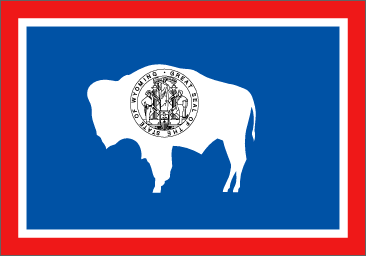
A white buffalo is featured in the flag of Wyoming

Ted Nugent wrote and performed a song called "Great White Buffalo"
Comment:  For more on Lightning Medicine Cloud, see White Buffalo = Third of Its Kind? and White Buffalo Calf Born.

For more on white buffalo in popular culture, see Pendleton's White Buffalo Blankets and White Buffalo = Marauding Indian.

July 01, 2011

White buffalo = third of its kind?

The reports on Lightning Medicine Cloud, the white buffalo calf, are saying it's the "third of its kind ever to be born." But who exactly determined this, and how? Who's in charge of authenticating and certifying white buffaloes, anyway?

According to Wikipedia--Individual white buffalo--a couple dozen white buffalo have been born in the last century. For example:Tupelo Buffalo Park and Zoo in Tupelo, Mississippi, owns a white buffalo bull named Tukota ("Too-ko-ta")

A male white buffalo named Spirit of Peace was born on April 17, 2005, on the Blatz Bison Ranch in Fort St. John, British Columbia. Spirit of Peace died on June 1 of the same year, probably as a result of his premature birth.

A female White Buffalo calf was born in Shelbyville, Kentucky, on June 3, 2005, at Buffalo Crossing, a buffalo ranch and tourist facility located. She was named Cante Pejute (Medicine Heart in the Lakota language) in a traditional ceremony led by Steve McCullough, a Lakota/Shawnee from Indiana.

A male named Blizzard was born in March 2006 on the farm of an anonymous rancher, who arranged to have the calf transported to Assiniboine Park Zoo in Winnipeg, Manitoba in recognition of his spiritual significance to aboriginal people.
So many white buffaloes to respect and cherish. Except for his website and Facebook page, what's so special about Lightning Medicine Cloud?

A number of questions come to mind. What if a white buffalo calf dies young--does it still count? What if it's a light beige rather than pure white? What if its fur turns brown when it grows up? What if it's an albino (missing pigmentation) rather than colored white "naturally"? What if it's not a pure-bred buffalo--if it has cattle genes?

For more on the subject, see White Buffalo Calf Born.

Below:  "A white buffalo at the Lee G. Simmons Conservation Park and Safari in Ashland, Nebraska. This animal is not a true white buffalo, being 1/16 Charolais cattle. It is expected that its coat will darken as it matures.

June 30, 2011

White buffalo calf born

Lightning Medicine:  Rare white buffalo calf named

By Linda Stewart BallThousands of people came from miles around Wednesday to see and honor a legend in the flesh—the white buffalo born in a thunderstorm on a northeast Texas ranch.

The rare white buffalo calf, regarded as sacred by the Lakota Sioux, was honored with Native American prayers, religious songs and the solemn smoking of a pipe in a special naming and dedication ceremony at the Lakota Ranch in Greenville, about 50 miles northeast of Dallas.

Flag-flying patriotism, a steady Native American drum beat and scorching heat provided the backdrop for the spiritual event that drew about 2,000.

The calf was named Lightning Medicine Cloud—a reference to the thunderstorm that marked the arrival of his birth as well as a tribute to a white buffalo born in 1933 named Big Medicine.
The incredibly rare sacred white buffalo who's one in TEN MILLION

By Oliver PickupWhite buffalo are considered to be sacred signs in several Native American religions, and thus have great spiritual importance in those cultures and are visited for prayer and other religious ceremonies.

Yesterday flag-flying patriotism, a steady Native American drum beat and scorching heat provided the backdrop for the spiritual event that attracted a crowd of about 2,200.

Lightning Medicine Cloud, whose name is also a tribute to a white buffalo born in 1933, named Big Medicine, is thought--in Lakota Sioux tradition--to be the third of its kind ever born.

In addition, he is thought to be the first male white buffalo calf born in 150 years.
Comment:  "He's the hope of all nations," said Arby Little Soldier. Let's hope that he's the hope. I'm worried that he may not be able to solve all our problems singlehandedly. (Single-hoofedly?)

But he's off to a good start. He's trademarked his name and started his own website.

He also has a Facebook page. No word on a Twitter feed yet.

For more on the subject, see Pendleton's White Buffalo Blankets and White Buffalo = Marauding Indian.

May 09, 2011

Slaughtering buffalo = genocide

Genocide by Other Means:  U.S. Army Slaughtered Buffalo in Plains Indian Wars

By Adrian JawortGeneral William Tecumseh Sherman, who had broken the back of the South during the Civil War with his ruthless March to the Sea, helped negotiate the Fort Laramie and 1867 Medicine Lodge treaties that were supposed to end U.S. hostilities with northern and southern tribes. But that’s when officers started thinking about a new strategy. Sherman knew that during the Civil War the Confederates’ means and will to fight were extinguished by his brutal—and brutally effective—”scorched earth” policy that decimated the infrastructure of the South. Why couldn’t the same strategy be applied to Indians and their buffalo? Greymorning said, “The government realized that as long as this food source was there, as long as this key cultural element was there, it would have difficulty getting Indians onto reservations.”

Isenberg said, “Some Army officers in the Great Plains in the late 1860s and 1870s, including William Sherman and Richard Dodge, as well as the Secretary of the Interior in the 1870s, Columbus Delano, foresaw that if the bison were extinct, the Indians in the Great Plains would have to surrender to the reservation system.” Colonel Dodge said in 1867, “Every buffalo dead is an Indian gone,” and Delano wrote in his 1872 annual report, “The rapid disappearance of game from the former hunting-grounds must operate largely in favor of our efforts to confine the Indians to smaller areas, and compel them to abandon their nomadic customs.”

“As a policy statement, I think that’s pretty clear,” Isenberg said. The Army had already used a similar strategy—In its 1863-1864 campaign against the Navajos, led by Colonel Kit Carson, the Army destroyed tens of thousands of sheep in a successful effort to subdue the Navajos.

There was one tactical flaw with this strategy: too many buffalo. But while it wasn’t feasible for the U.S. Army to kill tens of millions of bison, it was feasible for the Army to let hunters use their forts as bases of operation and stand by as they slaughtered the animals in staggering numbers. Another key strategy here was that the Army made no effort to enforce all those treaty obligations forbidding whites to hunt on Indian lands. Whites could needlessly kill a bison for “sport” but when an Indian killed cattle for food for his family because of the growing scarcity of bison, he was severely reprimanded.
Comment:  Starving people into submission--letting them die of hunger and its associated illnesses--is an example of genocidal behavior. The US was trying to wipe out the Indians and their way of life. If any survived to be herded into concentration camps, that was acceptable. But it was acceptable for them to disappear and die too.

Hence we say that America's policies were genocidal even if no document stated a goal of eliminating the Indians. This goal was implicit, not explicit.

For more on the genocide against Indians, see The South American Genocide and Reagan Aided Atrocities Against Indians.

Below:  "A pile of hides in Dodge City, Kansas, ready to be shipped back to the East Coast."

May 05, 2011

"Meandering jumble" in Last Buffalo Hunt

The Last Buffalo Hunt

By Dennis HarveyDocumentarian Lee Anne Schmitt says "The Last Buffalo Hunt" isn't about hunting buffalo, but rather "the image of the American West, questioning the authenticity of our myths and the foundations of our frontier ideology." That sounds good in press interviews, but what's onscreen is a meandering jumble that's unpleasantly vivid when portraying hunting tourism in modern-day Utah. Pic otherwise channels historical errata and vague disapproval toward a mythic West's degeneration. Hitting smugly superior notes at times, yet thematically opaque, docu will score further fest dates but struggle for broadcast exposure, partly due to graphic footage of animal gutting.And:Shots of cheesy audio-animatronic mannequins at historical "museums" (aka gift shops) and ever-waving Old Glory convey a sense not of the American Dream's sorrowful degradation, but rather of contempt for those being portrayed. That would be fine if Schmitt (whose producer Lee Lynch gets a co-creator credit) had the courage to actually lay out a directorial, even political perspective.

But "Hunt" feigns observational neutrality even as it chooses to amplify and exploit ugly behavior. Shot over six years' course, it suggests we're simply watching Albrecht's "last" hunting season and its aftermath instead. Once his thread ends, the shapeless pic needlessly extends itself with footage of another hunt someplace else, involving people never even identified.
Comment:  For more on the subject, see Native Documentaries and News.