Showing posts with label military. Show all posts

May 21, 2015

"Redskins" bad but helicopters okay?

On Facebook I shared a posting about the Washington Redskins and the US military. Although no longer available, it said something like:

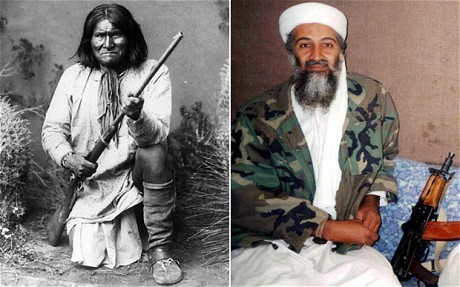
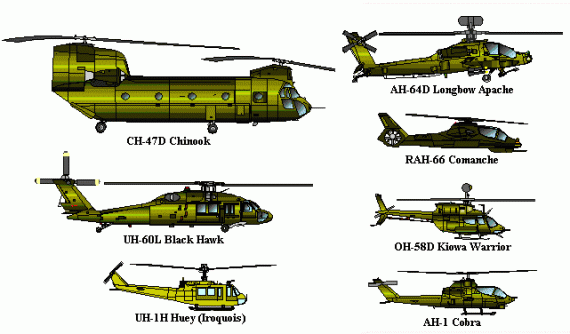
Why do Natives protest the Redskins name rather than the US military for naming items--Tomahawk missiles; Apache, Lakota, and Blackhawk helicopters; codename Geronimo--after them?

This led to a discussion of the subject:The military industrial complex is run by the same people that support the foul R-word, the same people that exploit others for their own wealth generation!

This is Apple/Oranges. The r-word is racist and it invokes racist behaviour.

Hold it, everyone. Here’s a white guy who offers an explanation about why we should feel honored by these names for military equipment. *Phew.* I feel much better after having him whitesplain it to me.

Everyone Relax—The Army’s Native American Helicopter Names Are Not Racist
Let the debate begin

Curiously, someone else posted the same article but put a different spin on it:You know a Native career soldier I know wrote this and posted this (not my position as I'm not a pro military type but wanted to share a perspective):

"No where is there a finer example of honoring a legacy than the moniker attached to the US Army's rotary wing fleet. Not only does the Army ask if the names can be used but they respectively utilize the proper names. They do not use slang or stereotypes. The first time I laid eyes on these aircraft I was instilled with pride and a sense of belonging. I thought to myself 'These guys get it. They respect me and my people's contribution to this enterprise.' I am honored by the lineage of these nomenclatures and honored to have been a small part of this warrior tradition. The US Army has had an intimate experience (for better or worse) with the history of my people and it is my pleasure to reciprocate the gesture. Sappers forward!"
My response: "Warrior tradition" = one-dimensional stereotype.

I "like" how this article basically confirms my point. Namely, that helicopters were named for a one-dimensional view of Natives:According to Bob Mitchell, the museum curator, Howze “envisioned the helicopter as a fast, mobile, stealthy machine on the field of battle using terrain and vegetation to an advantage similar to the Warrior Tribes.”"Warrior tribes" is redundant here since the Army seems to think all Indians are warriors.

Yet the same person continued to challenge me:It is undoubtedly something that is very important in Indian Country as they bring it up quite a lot. Hard for me to grasp due to oppressive nature of use of US Military abroad but it is what it is. 3 times the average rate of service.Yes, and many Indians take pride in being called "Redskins," too. That doesn't mean it's a good idea.

Many Indians also challenge the one-dimensional warrior image and call for a fuller understanding of Native cultures. I'm with them.Yes the R word is an offensive term whereas using tribal names is not. Also they choose to use correct names like Lakota for example not Sioux.

I am not saying I agree or disagree with any of this but know the thoughts of many folks in Indian Country over this and sharing that perspective.
Okay. I'm saying I disagree with it because it's stereotypical. I also disagree with the stereotypical choices made by filmmakers such as Johnny Depp and Adam Sandler.

Only names of tribes?The image you shared for one shows proper names from Indian Country being held in an equivalent manner to a racist term which is obviously not really comparable. Yes there is another debate good or bad to have about the context of the use of the other names. But if a helicopter was called Nigeria would that be as offensive as the N word?"Tomahawk" is a stereotypical weapon. "Blackhawk" and "Geronimo" are personal names. So this posting isn't just about using the names of tribes.

I think we can all agree that "Redskins" is the worst offense in this category, although I'd say calling a terrorist "Geronimo" is comparable. So? We can and do address lesser offenses all the time here.

If you really want to honor the widespread tendency of Natives to serve in the military, let's name helicopters after the Hopi, Creek, Tlingit, San Manuel, and Penobscot tribes. Why not, since their members have served at the same rates as every other tribe's?

Oh, but those tribes aren't known as fierce, deadly warriors. They aren't stereotypical enough. We want our hardware named only for ruthless killer Indians. Because we want to be as savage as they were.

In short, if this nomenclature is some sort of pan-Indian tribute, choose from the names of the 566 recognized tribes at random. By choosing only the tribes known for their savagery, the military is proving my point.Tomahawk is a form of battle axe and indeed there is another missile type called the Battleaxe missile. I would never imagine Kiowa and Blackhawk as being stereotypically savage and the others historically embodied strength. Apart from anything they are great sounding names. But yes as I said a lot of room for debate over the use of these names but the comparison in the image you shared to me seems rather manipulative.The Plains tribes in general, including the Kiowa, represent the stereotypical savage to most Americans.

The Comanche and Iroquois helicopters further demonstrate that the Army is honoring tribes known for aggression or violence, not just "strength" or "courage."

Strength, in particular, has nothing to do with fighting ability. Buddha, Jesus, and Martin Luther King were strong. Mothers who raise children in the face of adversity are strong. Let's name helicopters after them if we want to honor strength.

Other views

A few others chimed in:Gag. These are the same excuses used to justify the usage of Indians, and Redskins. Not okay for cars or helicopters or missiles or team names. #PeopleNotMascots

I completely agree, let them name some other people helicopters, missiles...etc.
We are not decals, toys and icons.
We are people and it is about time we are treated as such!
For more on the subject, see Indians in the Military.

Below:  Six copters named after tribes and one named after a snake.
May 10, 2015

Let's Honor the Real Warriors

Here's a piece I co-wrote to reiterate a point I've made before about Indian mascots.

Hey, Redskins Fans, Let's Honor the Real Warriors

By Ramone Romero and Rob SchmidtRecently Native American mascots have generated a lot of controversy. Apparently some Indians (67% according to a recent poll) don’t care for the honor this country has bestowed on them. This has sparked anger and conflict across the land.

We have a modest proposal to restore harmony to the sacred institution of sports mascotry. Rather than honor Indians, we should give the distinction to some heroes who unquestionably deserve it. A group of people we’ve never honored before as mascots.

We should give it to our troops.

Think about it: What other group so powerfully exemplifies courage, loyalty and fearlessness? What other group is more sports-like?
Below:  "The Louisville Snipers mow down their enemies in a hail of bodies."

January 29, 2015

Review of Code Talker

Code Talker: The First and Only Memoir By One of the Original Navajo Code Talkers of WWIIHe is the only original World War II Navajo code talker still alive—and this is his story . . .

His name wasn’t Chester Nez. That was the English name he was assigned in kindergarten. And in boarding school at Fort Defiance, he was punished for speaking his native language, as the teachers sought to rid him of his culture and traditions. But discrimination didn’t stop Chester from answering the call to defend his country after Pearl Harbor, for the Navajo have always been warriors, and his upbringing on a New Mexico reservation gave him the strength—both physical and mental—to excel as a marine.

During World War II, the Japanese had managed to crack every code the United States used. But when the Marines turned to its Navajo recruits to develop and implement a secret military language, they created the only unbroken code in modern warfare—and helped assure victory for the United States over Japan in the South Pacific.

Editorial Reviews

"From Guadalcanal through Bougainville to Peleliu, Nez relates a riveting tale of jungle combat and his personal struggle to adapt to civilian life following the most cataclysmic war in our nation’s history. Gripping in its narrative, Code Talker is history at its best." --Colonel Cole C. Kingseed, U.S. Army (Ret.), co-author of Beyond Band of Brothers

"A fascinating inside look at one of WWII’s most closely guarded secrets…This is an important book, a previously untold piece of our history." --Marcus Brotherton, author of Shifty's War

"You don’t need to be a fan of World War II literature to appreciate this memoir…a fascinating melange of combat in the Pacific theater, the history of the Navajo people and the development of a uniquely American code." --The Associated Press

"A unique, inspiring story by a member of the Greatest Generation." --Kirkus Reviews
Comment:  I just finished reading this for my Breaking the Code screenplay. Some thoughts:

I'd say "riveting" is an overstatement. Unlike some readers, I had no trouble putting the book down.

Code Talker is maybe 1/3 Nez's childhood, 1/2 the war, and 1/6 the rest of his life. So the bit about his "personal struggle to adapt to civilian life" is also an overstatement. That wasn't Nez's big issue. His real challenge, which I wouldn't call a struggle, was leaving the sheltered Navajo life for boarding schools and the big city.

The book is fine on Nez's childhood. Especially if you haven't read biographies of Southwestern Indians in the pre-war years, when contact with the white man was still rare. It's great on the war years, where you get a real sense of what soldiers had to endure in the Pacific. I'd say it rushes through the post-war years...but nobody's necessarily interested in that part of Nez's story, so it's okay.

My main cavaet is that nothing terribly dramatic happens. You want heartwrenching personal conflicts in stories like these. Nez overcoming the cruel boarding-school master! Nez overcoming the racist Marine sergeant! Nez in hand-to-hand combat with a deadly Banzai enemy!

Nothing like that happened. If Nez hadn't been at ground zero during the formation and deployment of the Navajo codetalkers, we might not care about his story. What he witnessed is the interesting part--but witnessing isn't quite as compelling as struggling oneself.

Those points aside, Code Talker tells you everything you'd like to know about the origin of the codetalkers. It's a must-read on that subject. And it's a solid entry in the broader category of Native memoirs.

Rob's rating: 8.0 of 10.

January 26, 2015

American Sniper = Indian killer

Caution! 'American Sniper' Is a Dangerous Movie

By Mateo RomeroThis is a tense war movie that looks great. But just underneath the film’s sexy veneer is a shockingly racist ideology of hate and death that is advanced by the white male sniper Chris Kyle.

Kyle is the ideological descendant of Custer and the Seventh Cavalry. He belongs to an elite white male cadre of swinging dick meat eaters who will solve the problems of invaded brown people with a bullet. Iraqi and Syrian combatants are called “fuckin’ savages.” Direct statements of racism and death may or may not reflect the realities of the modern U.S. military. But they do give rise to false dichotomies that dehumanize the enemy and make it kinda fun, cool and necessary to kill them.

For the moment, Sniper is the fave mascot of the reactionary right wing of white America. Its visual beauty softens the harsh fact that the movie glorifies death, racism, hatred, religious prejudice, sexism, colonialism and moral corrosion. It presents some great ideas about caring for and protecting the people of your tribe. If you’re a white Christian American, that is. Women, minorities, kids, Muslims need not apply. They’re part of the bullet-to-the-head fix.

Why is this film so important in its depiction of outdated and corrosive white conservative male values? Because it is a time of great change and social movement in the world. The time of white American male rule and hegemony is coming to an end. And American wingnuts don’t like it one bit.
Some of the problems in Kyle's book--from Debbie Reese's American Indians in Children's Literature blog:

"Injun" in Chris Kyle's AMERICAN SNIPERWhen American Sniper opened in theaters last week, I started to see reviews that pointed out Kyle's use of the word savage to describe Iraqis. That word has been used to describe American Indians. I wondered if Kyle made any connections between "savage" and American Indians in his book. The answer? Yes.

In his autobiography, Kyle uses "Injun" in two places. Here's what he said on page 267:Or we would bump out 500 yards, six or eight hundred yards, going deep into Injun territory to look and wait for the bad guys.And here's what he said on page 291:Our missions would last for an overnight or two in Injun country.See? He made connections between "savage" Iraqis and "savage" Indians.
Kyle's attitude = American imperialism

Many people have written about the problems in American Sniper. Here's the main one:

“American Sniper’s” biggest lie: Clint Eastwood has a delusional Fox News problem

The insanities and fantasies at the heart of "American Sniper" explain everything about the state of the 2015 GOP

By Sophia A. McClennen
Let’s start with the delusion. The film draws a direct link between the events of 9/11 and the war in Iraq, forgetting completely that the war in Iraq had nothing whatsoever to do with 9/11. Not one of the attackers that day was in any way connected to Iraq. Thus to connect 9/11 to Iraq is delusional. Not even the Bush administration made that overt a link—at the time they claimed they went to Iraq to keep the Iraqis from using weapons of mass destruction that were never found.

But that’s not the perceptions of many who watch Fox News. As the Program on International Policy Attitudes (PIPA) at the University of Maryland reported back in 2003: “Those who receive most of their news from Fox News are more likely than average to have misperceptions.” In their poll they found that 80 percent of Fox viewers held at least one of three Iraq-related misperceptions, more than any other news consumers, especially those that consume NPR and PBS.

The point is that the 9/11-Iraq link is delusional, but it is also a common link in public perceptions of those on the right who watch Fox News and clearly it is one that makes sense to Eastwood and those that think like him.

The second problem is the culture of violence. While the film tries to show Kyle wrestling at some level with some of his kills, he still very clearly divides the world into categories. As his father puts it in the film, there are wolves (those that want to kill you), sheep and sheep dogs (who have to protect the sheep from the wolves). Not only are there just three categories of life, but these categories are also defined solely by a logic of violence and aggression. In the film, Iraqis are almost all depicted as wolves, even women and children. Kyle’s first two kills are a young boy and his mother. But they posed a threat and thus needed to be killed. As Kyle later explains, he has no remorse over any of his kills, just over the lives he wished he could have protected.

At no point does the film consider the fact that the war was based on false justifications. At no point does it imagine that those in Iraq might have seen the U.S. soldiers as invaders in their homeland. At no point does it imagine that the violence suffered by our own soldiers could have been avoided if we simply hadn’t started the war to begin with. The logic of war is completely unquestioned, making this the most simplistic war film we have seen nominated for an Oscar in decades.

January 20, 2015

Operation Redwing

Speaking of Natives and nuclear bombs, here's another item on the subject:

Operation RedwingOperation Redwing was a United States series of 17 nuclear test detonations from May to July 1956. They were conducted at Bikini and Enewetak atolls. The entire operation followed Project 56 and preceded Project 57. The primary intention was to test new, second-generation thermonuclear devices. Also tested were fission devices intended to be used as primaries for thermonuclear weapons, and small tactical weapons for air defense. Redwing demonstrated the first US airdrop of a deliverable hydrogen bomb--test Cherokee.

All shots were named after various Native American tribes.
Comment:  This is yet another example of using Native terms to denote toughness, violence, or savagery. For more on the subject, see Indians in the Military.

Below:  Redwing Apache.

June 28, 2014

Native military names assuage guilt

A writer lays out the problem with using Native names for killer missiles and aircraft:

The U.S. military’s ongoing slur of Native Americans

By Simon WaxmanIn the United States today, the names Apache, Comanche, Chinook, Lakota, Cheyenne and Kiowa apply not only to Indian tribes but also to military helicopters. Add in the Black Hawk, named for a leader of the Sauk tribe. Then there is the Tomahawk, a low-altitude missile, and a drone named for an Indian chief, Gray Eagle. Operation Geronimo was the end of Osama bin Laden.

Why do we name our battles and weapons after people we have vanquished? For the same reason the Washington team is the Redskins and my hometown Red Sox go to Cleveland to play the Indians and to Atlanta to play the Braves: because the myth of the worthy native adversary is more palatable than the reality—the conquered tribes of this land were not rivals but victims, cheated and impossibly outgunned.

The destruction of the Indians was asymmetric war, compounded by deviousness in the name of imperialist manifest destiny. White America shot, imprisoned, lied, swindled, preached, bought, built and voted its way to domination. Identifying our powerful weapons and victorious campaigns with those we subjugated serves to lighten the burden of our guilt. It confuses violation with a fair fight.

It is worse than denial; it is propaganda. The message carried by the word Apache emblazoned on one of history’s great fighting machines is that the Americans overcame an opponent so powerful and true that we are proud to adopt its name. They tested our mettle, and we proved stronger, so don’t mess with us. In whatever measure it is tribute to the dead, it is in greater measure a boost to our national sense of superiority. And this message of superiority is shared not just with U.S. citizens but with those of the 14 nations whose governments buy the Apache helicopters we sell. It is shared, too, with those who hear the whir of an Apache overhead or find its guns trained on them. Noam Chomsky has clarified the moral stakes in provocative, instructive terms: “We might react differently if the Luftwaffe were to call its fighter planes ‘Jew’ and ‘Gypsy.’”
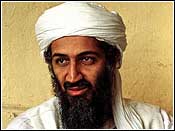
Comment:  The long debate over Osama bin Laden's codename is the perfect example of Waxman's argument. We didn't code-name him "Geronimo" because we were honoring him. We did it because we considered Geronimo a ruthless savage, killer, and terrorist--like Bin Laden.

We're saying the same thing with Apache helicopters, Tomahawk missiles, and the other deadly weapons and aircraft. The're pure lethal force with no saving grace such as intelligence or compassion. They do nothing but kill.

For more on the subject, see Indians in the Military.

August 29, 2013

Osage general was highest ranking Native

AF Heritage: Gen. Tinker still honored by native Indian tribe

By Randy RoughtonDuring the early days of World War II, an Army Air Corps major general, who was an Oklahoma native, and member of the Osage Indian tribe, was named to lead the air effort in Hawaii following Pearl Harbor.

Maj. Gen. Clarence L. Tinker managed to stay close to his tribe during his 30 plus years as a military aviator, and today, more than 70 years after his death, is still honored by that tribe.

Even after he became the Army’s highest ranking Native American, Tinker never lost his pride in his heritage, as he sometimes called home to his father George Edward Tinker, just to hear his native language.

Likewise, Tinker’s family and tribe never forgot him after his death in a mission over the Pacific in 1942–from his descendants to the Osage Nation, who still sing and dance to a song written as a tribute to Tinker, one of their most honored heroes.
Clarence L. TinkerOne-eighth Osage Indian, Clarence Tinker was born on November 21, 1887 near Pawhuska, Oklahoma in the Osage Nation. His maternal grandmother was half-Osage, with both her parents being children of the marriage of Osages with Arcadian Frenchmen from Louisiana. Tinker, the eldest son of George E. Tinker and Sarah A. Schwagerte, received his elementary education in Catholic institutions at Hominy and Pawhuska, Oklahoma, and the Elgin, Kansas public school. While growing up, he worked in the print shop of the Wah-Sha-She News, Pawhuska's first newspaper, which his father founded and published. Beginning in 1900 Tinker attended the Haskell Institute, the famous Indian school in Lawrence, Kansas, but withdrew before graduating.Eventually:After the Japanese attack on Pearl Harbor, Tinker was named Commander of the Seventh Air Force in Hawaii to reorganize the air defenses of the islands. In January 1942, he was promoted to Major General, the First American Indian in U.S. Army history to attain that rank. In June 1942, the Japanese began their assault of Midway Island. In the midst of the Battle of Midway, on June 7, General Tinker decided personally to lead a force of early model B-24s against the retreating Japanese naval forces. Near Midway Island his plane was seen to go out of control and plunge into the sea. General Tinker and eight other crewmen perished. His body was never recovered.Comment:  For more on Native military honors, see Warrior Women on CBS and First Female Native General.

August 27, 2013

Upside-down flag at Canadian powwow

Custer’s Army Don’t Need No More Scouts

By Matt RemleRecently, ripples were recently sent throughout Turtle Island, when Colby Tootoosis hung the Canadian flag upside down and carried it during the Manito Ahbee powwow’s Grand Entry. Reaction to the upside down flag were varied with many expressing support for his actions to the “to be expected” rants about disrespect of the flag and disrespect of veterans.

Personally, I loved it. It reminded me of the images from our AIM warriors who would fly the upside down United States flag during their rallies and demonstrations. And honestly, it made me wonder why it hadn’t been done before, but this article though is less about the flying of the Canadian flag upside down and Colby’s action, he himself sums it up best at http://lastrealindians.com/canadian-flag-hung-upside-down-in-a-powwow-grand-entry-by-colby-tootoosis/, but rather I would like to explore this skewed notion that we as Native peoples somehow owe any semblance of support for either the colonial governments of the United States or Canada.

It is rather well known that as Native peoples we serve in the Armed Forces at higher rates, per capita, then any other racial or ethnic group on both sides of the border. The standard explanation for this is that we need some sort of outlet to release our inner warrior, which in some cases might be true, but I seriously question this as the sole reason why we enlist at such high rates.

I suspect that poverty may play an equally, if not more so, important factor as one of the reasons why so many Native brothers and sisters enlist. After all, poor people of all races make up the vast majority of enlistees in the Armed services. According to the Department of Defense’s own data, in 2004 nearly two-thirds, 64 percent, of recruits to the military were from counties that have average incomes lower than the national median. And we know that poverty in Indian country on both sides of the border runs deep.

But questions about motivations for enlistment aside, the deeper question lies around what does it truly mean to defend our “homelands,” as is so often stated for reasons to go into military service, when the honest brutal reality is that assaults on our traditional lands, natural resources, sacred sites, water ways, and health of our communities (think the locating of hazardous and toxic waste facilities) comes not from some foreign enemy, but from the Canadian and United States governments and their corporate rulers.
Comment:  For more on Native protests, see 4th Annual Tar Sands Healing Walk and Moccasins on the Ground vs. Keystone XL.

Below:  "Cobly Tootoosis and upside down Canadian flag at the Manito Ahbee powwow."

May 03, 2013

Pala documentary nominated for Emmy

Pala Documentary About Tribe's History of Military Service in U.S. Nominated for Emmy AwardThe Pala Band of Mission Indians is proud to announce that their documentary, "Defending the Homeland: Native American Veterans in the United States Armed Forces," has been nominated for a 2013 Emmy Award by the National Academy of Television Arts & Sciences Pacific Southwest Chapter.

In the documentary, Chairman Robert Smith and members of the Pala Band of Mission Indians share intimate details of the Tribe’s history of military service in the United States Armed Forces.

"This documentary was dedicated to the many Pala Tribal members who made the ultimate sacrifice in service and we are proud it has been nominated for this very distinguished award," said Smith. "Our Tribe has a prominent tradition of participation in the United States military, so developing this documentary was a way for us to both preserve the stories of our courageous military leaders and share those stories with the world."

The documentary was nominated in the Military–Program/Special category. The Emmy Award winners will be announced on June 15 at the 39th Annual National Academy of Television Arts & Sciences Pacific Southwest Chapter Emmy Awards Ceremony in Las Vegas, Nevada.
Comment:  For more on Native documentaries, see Docudrama About Hominy Indians and LaDonna Harris as a "Maker."

January 21, 2013

Woman Warriors on CBS

Native American Women Warriors Receive Mainstream National Coverage on CBS

By Vincent SchillingThe Native American Women Warriors, an all Native American women’s color guard, consisting of female veterans from all branches of service, have received national and mainstream media coverage on their participation in the 2013 Inaugural festivities.

Over the past week, CBS and other news organizations have followed the NAWW group as they have made their way to Washington D.C. to participate specifically in the American Indian Society Inaugural Ball and Powwow and the Inauguration Parade of re-elected President Barack Obama.

The story will air at 6 p.m. EST on the CBS Evening News and will be the last story of the evening highlighted their week’s activities.

According to CBS correspondent Byron Pitts, “We were looking for a story to do about a group participating in the inaugural parade and the Native American women warriors seemed to be a perfect fit. It is a story that probably most Americans didn't know. I think one of my lines in the story was, 'all of them have different stories of struggle that led to great success.'"
How NAWW got started:

Native American Women Warriors Celebrate Inauguration While Raising Awareness for Native Female Veterans

By Vincent SchillingWhile jingle dresses generally have a bright mixture of colors and are adorned with jingle bells, those worn by BigMan and the other two female vets proudly displayed large emblems of their branch of service on their backs. When an elder, Camille Clairmont, noticed how their red, white and blue jingle dresses were decorated—with the women’s designation of unit and rank, as well as U.S. flags and Iraqi Freedom patches—she asked Mitchelene why they were not with the other color guards.

When BigMan explained that they were not official color guards, Clairmont told them “the dresses speak for themselves.” Meaning, they looked as if they belonged in the color-guard procession.

BigMan agreed, and the three women decided they would join the other color guards. The male color guards told them to go at the end of the line, behind all of the male veteran color guards. BigMan was at first discouraged but then realized their position in the rear of the line was not a dishonor, but rather, a special position, since they’d be the last color guards seen.

As the color guards entered the arena, the emcee announced, “History has been made today—in all my years as an emcee, there has never been an all-female Native American color guard, and so I have the privilege in announcing our first.” And through such accidents is history made.

After marching at the Denver powwow, BigMan decided to officially serve as an all-women Native color guard. She founded The Native American Women Warriors, a non-profit organization that seeks to address the needs of today’s modern military women. Her Women Warriors are also the first all Native American female color guard. They now regularly serve as a color guard at powwows, and travel all over the country for events honoring Native veterans.
Comment:  For more on the subject, see First Female Native Color Guard.

January 05, 2013

First female Native color guard

Mitchelene BigMan: Native American woman warrior

By Samara FreemarkWatch carefully during President Obama’s second inaugural parade this month, and you will see among the marching bands and the civic organizations a small group of women wearing bright blue dresses embroidered with the beading of their tribes and the insignia of their service. They are the Native American Women Warriors (NAWW), and they’re recognized as the country’s first all-female, all-Native American color guard.

NAWW was founded in 2010 by Mitchelene BigMan, a 22-year Army veteran and member of the Crow Nation. She served as a diesel mechanic at bases in Germany and Korea and did two tours in Iraq before retiring as a sergeant first class in 2009.

I called BigMan to ask about her time in the Army, why she founded the Warriors, and to hear what she thinks about the issues facing women and Native Americans in the military.
And:What was it like to be a Native American woman in the Army?

When I first got in, the Indian thing was hard. Some people must have thought we were extinct. They’d say, “You’re the first Indian I’ve ever met. Do you still live in teepees?” They thought, with us living on the reservation, we’re nomadic or something. They’d raise a right hand and say “How.” I was like, “How what? How I’m going to smack your teeth in because of the fact you’re making fun of me?” I was very defensive about my culture, my race. Still am.

As a female it was kind of a struggle especially since, being a mechanic, I was in a lot of all-male battalions. When I first joined up, the mindset at that time was that it was a man’s army. I ran a mechanics shop in Korea, and I would tell them, “This is the problem with your vehicle,” but they wouldn’t take my word on it. They’d take my private’s word because he was male. I was like, “Wait a minute, I’m in charge!” But they never gave me that sense of belonging.

We hear a lot about sexual harassment in the military. [The Department of Defense estimates that about 19,000 cases of sexual assault had occurred in the military in 2011.] Did you ever experience that yourself?

I experienced a lot of sexual harassment and I was raped. That happened in 1995. I was in officer’s school. I went to borrow a bat from my best friend—well, I thought he was my best friend. We both played on our company’s softball team at the time. When I walked in, the door swung shut; I didn’t catch it in time. But I wasn’t worried; he was my friend.

I didn’t make it out of that room. Well, I eventually did, but not the way I went in.
Native American Women Warriors post colors at Obama’s Dec. 5 tribal meeting

Comment:  For more on Indians in the military, see First Female Native General and Menominee Soldier in VP Debate.

Below:  "Native American Women Warriors founder Mitchelene BigMan of Lodge Grass, Mont. (center) joins NAWW officers Sarah Baker of Camp Lejeune, N.C. (left) and Julia Kelly of Billings, Mont., as they prepare to serve as color guard during the White House Tribal Nations Conference in December." (Photo by Getty Images)

November 10, 2012

First female Native general

General Excellence: First Female Native American General Officer Honored in Her Home State

By Wilhelm MurgRetired Major General Rita Aragon did not plan to join the United States military, but with her back against the wall it began a career that achieved multiple firsts and adds an induction into the Oklahoma Military Hall of Fame on November 9.

In 1979 she was the mother of two young girls, a schoolteacher who had just received her master’s, and her husband was killed in a motorcycle accident.

“I had no child support and no health insurance,” Aragon, Cherokee/Choctaw, said. “I was working three jobs: I was working at McDonald’s, I was working as a church secretary, and I was working at the school—and I still couldn’t make ends meet.” A friend recommended that she look into the National Guard. “I went in with a master’s degree as an airman basic; I had no rank, nothing, but it was the greatest thing that ever happened to my life.”

She went on to become the first woman to hold her current position, Secretary of Military and Veterans Affairs for the state of Oklahoma; the first female commander in the Oklahoma Air National Guard; and the first woman of Native American ancestry to become a general officer in the U.S. Armed Forces.
Comment:  For more on Indians in the military, see Menominee Solider in VP Debate and Penobscot Pilot Flies Obama's Helicopter.

October 12, 2012

Menominee soldier in VP debate

Elections 2012: A Bunch of Malarkey, the Debate Joe Biden Wanted

By Mark TrahantAs the conservative blogger Erick Erickson noted on Red State: “This debate changed nothing. I think Paul Ryan did a great job. But many Democrats will think Joe Biden did a great job. And I think most undecideds will have thrown their hands up in frustration half way through.”

Ryan did, however, mention American Indians, he cited a Wisconsin Menominee who’s serving in Afghanistan.

“When I went to the Arghandab Valley in Kandahar before the surge, I sat down with a young private in the 82nd from the Menominee Indian Reservation who would tell me what he did every day, and I was in awe,” Ryan said. “And to see what they had in front of them—and then to go back there in December, to go throughout Helmand with the Marines to see what they had accomplished—it’s nothing short of amazing.”

Indian Country Today Media Network live tweeted the debate and there was significant participation, as 120,357 accounts were “reached” by the hashtag #ICTMNDebate (save it, we’ll use it again on Tuesday).

On Twitter, @JustinLepscier posted: “Thank you @PaulRyanVP for supporting our troops and taking time to talk with a Menominee in Afghanistan! #ProudMenominee.” However @Astronomommy wrote, “Menominee County (which is also a reservation) always votes Democratic. #funfact.

Others immediately asked how Ryan could talk about Menominee while cutting programs critical to Indian country.
Comment:  For more on the presidential campaign, see Navajo Student Introduces Michelle Obama and GOP America = Strivers vs. Parasites.

April 19, 2012

Penobscot pilot flies Obama's helicopter

Marine Corps Major Flies Helicopters That Transport President Obama

By Gale Courey ToensingHis military biography says he was born in Bad Kreuznach, Germany, and raised as an Army brat, traveling the world. Now Maj. Paul Bisulca Jr., whose family moved frequently because of his Army career-officer father, is a member of an elite group of U.S. Marine helicopter pilots who fly the president of the United States wherever he needs to go.

Bisulca, a citizen of the Penobscot Indian Nation, was welcomed by the United South and Eastern Tribes (USET) as a modern warrior-hero on February 13 in Washington, D.C. and recognized for his accomplishments in an honoring ceremony among a group of veterans. The unassuming major, a member of Marine Corps Helicopter Squadron One, downplayed the event. “There was a recognition ceremony for accomplishments by Native Americans, and I was one of them, I guess,” Bisulca said. “I’m one of those Marine One pilots, you know, who land on the south lawn [of the White House] and fly him around, so that was what they were recognizing. That’s it in a nutshell.”
Comment:  For more on Indians and helicopters, see Lakota Celebrate Lakota Helicopter and Lakota Oppose Copters at Wounded Knee.

October 15, 2011

Afterword in Code Name: Geronimo

I finally saw the Code Name: Geronimo graphic novel in my local shop last week. I skimmed through it to see how it handled the huge "Geronimo" controversy from earlier this year. In the story, some soldier utters the word single word "Geronimo" minutes after the SEALs kill Osama bin Laden. it's not directly linked to bin Laden--or indeed, to anything. It's not clear in the story why the soldier says it.


Nice way to skirt the controversy...except the book includes an afterword by John M. Del Vecchio. Here are a couple of quotes on this afterword:There's even an essay addressing the use of the name "Geronimo," in the hopes of answering concerns from Native Americans about the book's title.

Finally, there's an afterword by John M. Del Vecchio, who famously wrote "The 13th Valley," one of the 2 or 3 finest novels of the Vietnam War; the content of this is bound to please some and anger others.
Yes. Del Vecchio takes the standard pro-military line that "Geronimo" was something other than a codename for bin Laden. He says it stood for Step G in the operation, one of several conflicting explanations offered by apologists.

Spin, baby, spin

This claim is as stupid as it was before. One, President Obama himself said bin Laden was "Geronimo." So did a couple other sources.

Two, who cares if the step to kill the world's greatest terrorist was named "Geronimo," not the terrorist himself? "We killed the terrorist named 'Geronimo'" is similar to "We killed the terrorist with the process named 'Geronimo.'" Either way, the operation links the name "Geronimo" to bin Laden.

Three, "Geronimo" could've been the codename for the killing process and the target of that process. So Del Vecchio's explanation is almost worthless. Until someone produces a document saying "Geronimo" was the step but not the target, it isn't worth discussing.

Del Vecchio's rationalization for this offense is also the standard pap. He says the "Geronimo" codename honored the bravery and determination of America's fighting forces. Yeah, and it's just an incredible coincidence that a "step" to kill a terrorist was named after an Indian many considered a terrorist.

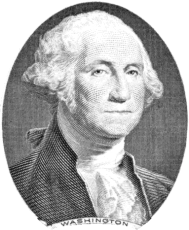
I'm sure the other "honorable" name considered for Step G was "George" for George Washington. Because he was an incredibly brave and determined warrior who fought against impossible odds too. And no one would object to linking George Washington's name with the world's greatest terrorist, right? Even though Washington terrorized and destroyed many Seneca villages--kind of like bin Laden.

Below:  Honoring our military by linking the kill step, but not the target, with a evil terrorist great American. I'm sure nobody could misunderstand this as a swipe against George Washington, Town Destroyer Father of Our Country.


Del Vecchio doesn't give any sources for his information, and it's contradicted by the evidence. I wouldn't be surprised if he had no firsthand information and is just repeating what he read somewhere. In short, until you can prove your case, spare us the spin, buddy.

What the publisher meant

That the publisher devoted an afterword to this controversy, while avoiding it in the story, shows what's really going on. We could sum up the afterword thusly:

"We realize that the Code Name: Geronimo is grossly insensitive, but it's a great marketing tool. As a sop to Native Americans, we'll throw in this afterword. We won't apologize for our insensitivity, but at least we'll acknowledge it. Readers will understand how we're trying to kiss up to the military while not totally giving Natives the finger."

For more on the subject, see Indians, Terrorists = US Enemies and How People Get Labeled "Terrorists."

July 13, 2011

Choctaw Defense

Choctaw company shows military commitment

By M.A. SmithLocated at the far end of McAlester with no signs or logos identifying its occupants sits an ordinary looking industrial factory and office complex. Many would never suspect this is home to a company that builds bomb components and other military equipment.

Choctaw Defense—one of the manufacturing businesses owned and operated by the Choctaw Nation—has manufactured missile components, trailers, heaters and other military equipment for over 20 years.

June 07, 2011

Indians, terrorists = US enemies

Legal Scholar Matthew Fletcher on Government Slurs of Indians and U.S. Law

By Gale Courey ToensingComing on the heels of the Geronimo/bin Laden Incident, what do you make of the government’s expropriation of indigenous history—using Geronimo as the code name for Osama bin Laden, and then citing the Jackson’s murderous actions against the Seminoles and Brits as a precedent for the prosecution of Al Qaeda suspects?

Generations of West Point officers learn about war from studying the “Indian wars,” and so it would make perfect sense for them to draw an analogy between Indians and al Qaeda. The military tradition is that the Indians were the bad guys, they were savage and engaged in non-traditional, even scary warfare, and that they had no rights under the U.S. Constitution. As such, they were fair game for anything—anything at all—the U.S. military wanted to do to them. Preemptive attacks on unarmed women and children like Wounded Knee, indefinite detention in concentration camps like Fort Sill, mass executions for trumped up war crimes like at Fort Snelling all of it legally justifiable from the point of the view of the military. Same is true in the Department of Justice, where in the days following 9/11, Bush Administration attorneys like John Yoo (now a Berkeley law professor) and Jay Bybee (now a Ninth Circuit judge) argued that the President needed no authorization from Congress to engage in torture, establish military jails and commissions to house and try al Qaeda suspects, etc., through extensive reliance on Indian war-related “precedents” involving self-serving legal opinions about the Modocs, the Seminoles, the Dakota at Fort Snelling, and others. It was Yoo and Bybee who authored so many of the so-called “torture papers” who first explicitly compared the Seminoles and other tribes to al Qaeda. The military prosecutors are just cribbing from them.
Comment:  This analysis nicely summarizes how the US military really feels about Indians. It's a good reason for discounting the talk about "honoring" Indians because they're brave and noble. Yeah, they're brave and noble...terrorists.

We killed them for terrorizing, scalping, and murdering us. Now that they're dead and (mostly) gone, we salute them for their terrorist-like abilities. If you want to frighten al-Qaeda, what better way than with an Indian missile or helicopter or codename? It takes a terrorist to scare a terrorist.

It's like honoring a grizzly bear or another deadly predator. When it's about to eat you, you don't "honor" it for its bravery and nobility. You shoot it and kill it. Once you skin it and turn it into a rug, then you honor it. It's brave and noble because it took you, someone even braver and nobler, to conquer it.

For more on the subject, see How People Get Labeled "Terrorists," Obama:  Bin Laden Was "Geronimo," and Seminoles Compared to Al Qaeda.

May 31, 2011

Goofy moments featuring Johnny Cloud

I think I mentioned Johnny Cloud, Navajo Ace, before. Here's a brief summary of this DC comic-book character:

Johnny CloudJohnny Cloud was named "Flying Cloud" by his father, a Navajo Indian Chief. Johnny was the victim of predudice growing up and as a lieutenant and fighter pilot in the U.S. Army Air Force. He singlehandedly killed a large number of Nazi planes. He was saved by his patrol leader, who was fatally wounded. His patrol leader's last wish was for Johnny to be his successor. He had a brillant career as leader of "the Happy Braves" and as "C-for-Cloud Flight."

Cloud appears three times in the following posting:

Twenty Goofy Moments from DC and Marvel's Silver Age War Comics

In OUR FIGHTING FORCES #128, Cloud fights a grudge match with Sharp Claw, an Indian ace for the Nazis (!).


In OUR FIGHTING FORCES #125, the Nazis use an "Indian trick"--a tree snare--from an unspecified tribe.


In OUR ARMY AT WAR #177, Cloud's father fought a German ace he called the "black hawk of death" in World War I. Incredibly, Cloud meets the same German in World War II.


So three of the 20 goofy moments involve Johnny Cloud. Which probably shouldn't be too surprising. Natives served in WW II in great numbers, but I'm not sure any of them were flying aces. The whole concept seems a goofy contrivance.

And I doubt any comic-book writers in the 1960s had more than a superficial knowledge of Indians. We should be grateful that Cloud was a relatively unstereotypical and three-dimensional character. He could've been a lot goofier.

For more on the subject, see Comic Books Featuring Indians.

May 26, 2011

Navajo fan used as veterans symbol

Warriors' shield

Diné‚ artist's design becoming a symbol for Native American veterans

By Cindy Yurth
Symbols are powerful things. The best ones capture people's imaginations and rally them to action.

For a Diné‚ artist living in Michigan, the fact that one of his designs is rapidly becoming a national symbol for Native veterans represents a high point in his career - a career that, 25 years ago, was dangerously on the skids.

"I've had stuff in a lot of Indian markets and won a lot of blue ribbons," said Ambrose Peshlakai, 56, of Baraga, Mich., who is Honagh‡anii (One Who Walks Around People Clan), born for Kinya'‡anii (Towering House Clan). "But the fact that my art is being used to help people, that's the real stamp of approval. That means I've arrived as a Native artist."
And:One day, thinking of his code talker uncle, Francis Thompson, Peshlakai set out to make a patriotic fan.

He bound two feathers together and painted an American flag on them, then wove a beadwork handle with a motif from the West Point Academy shield.

It was on display at the Hannahville (Mich.) Indian Community's headquarters when Richard Eubank, the national commander of the Veterans of Foreign Wars, happened to visit.

The work, which Peshlakai had titled "The Shield," immediately caught Eubank's attention. He had been trying to do more outreach to Native American veterans.

"Is there some way to reproduce it?" he asked Peshlakai. "Maybe as a poster?"

Peshlakai took the fan to a friend who had a photo studio. He photographed it and placed the image against red, white, blue and tri-colored backgrounds, then added the words "In Honor" at the bottom.

Eubank loved it, and when Peshlakai showed it to the Potawatomi tribal government, they did too. Eventually it was picked up by Tribal Umbrella, a collaboration of 12 local tribes and American Indian Health and Family Services that offers services in Michigan's Upper Peninsula.
Comment:  The fan is nice and the poster is nicer. But I'm not sure the fan would work as a symbol for Native veterans. The design is kind of intricate; it wouldn't reproduce clearly at small sizes. A stylized version of the fan might work better as a symbol.

For more on honoring Native veterans, see Photographing America's First Warriors and Codetalkers at the Stock Exchange.

Below:  "This poster using a feather design by Ambrose Peshlakai is being used in an outreach effort to Native Americans by the Veterans of Foreign Wars organization."

May 23, 2011

Mascots = strength through fear

An excellent essay from an occasional correspondent:

Indians still inspiring fear for White America

By Melvin MartinIndian sports mascots are dramatically akin to the colorful renderings of bears, tigers, wolves and even shark teeth that have appeared on a wide assortment of U.S. combat aircraft, naval vessels, and other forms of mechanized equipment since World War II. They are all starkly produced images (and names) designed to strike a deep sense of fear into the hearts and minds of enemy forces. And then, this very recent news article further acknowledges this particular U.S. military "tradition":

Non-Indian America has always feared the American Indian as the most singularly hostile and fearsome adversary on the battlefields of Manifest Destiny. And given the unending obsession with mascot images, non-Indians consider Indians worthy antagonists on a wide range of fronts--not only on cultural, but on political and socio-economic fronts as well.

The psychodynamics of fear are clearly at work here with this obsession and I can see why these mascots are so highly prized by those individuals and institutions who are so unwilling to relinquish them despite decades of highly organized protests against them. It is the basic symbology of the American Indian as a unique and profound source of strength derived through fear that provides these people with their sense of masculinity and "warrior-hood."

And in a society where even perceived notions of strength and power and most importantly, the ability to defeat one's enemies and opponents still prevails, associating oneself with war-like Indians provides an enduring security blanket of emotional support. If a "real man" can't act like a "savage" and journey back to the cave in reality, at least his apparel and team paraphernalia can make the trip for him.

In today’s popular American culture, traditional ideals of masculinity are under a constant state of attack. "White Privilege" is eroding with every passing day as minorities, women and gay people are advancing and gaining parity at all levels of society. In this environment, the all-American (essentially white) male is indeed a threatened species. And perhaps one of the last remaining bastions of this male superiority is the world of contact sports, where a man can still “be a man” in spite of the gay team member, the black head coach or the female team trainer or owner.

The American Indian sports mascot has never been an example of honoring the so-called “character” of the American Indian, nor is it a genuinely constructed system of methods by which to specifically target America's Native people for derogatory treatment. It is merely an ancient, worn-out and deeply dysfunctional process of appropriating the impressive legacy of overwhelming fear that the Indian, in the overall mindset of white America, still possesses to a remarkable degree.
Comment:  This essay pretty much says it all. I'd quibble only with the line about specifically targeting Indians for derogatory treatment. Mascots may not be a "genuinely constructed system of methods," but they act as if they were. They help produce the same results.

School administrators and students may not support mascots for this reason. Not consciously, at least. But unconsciously, this is what's going on. Mascot lovers intuitively "know" that they benefit from keeping white people up and minorities down. So they attack government, Obama, healthcare reform, immigrants, gays, mosques, and so forth and so on.

Keeping Indians and their treaties, land claims, and casinos in place is part of this agenda. If we present Indians as savage relics of the distant past, we don't have to deal with them today. As long as we ignore and dismiss them, we can "honor" or mock them (basically the same thing).

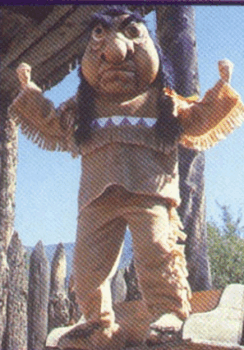
For more on Indian mascots, see Gover Summarizes Native Stereotypes and Warriors Mascot Done Right.

Below:  "You scared of me! You quake'um in fear, no score touchdown! That am big honor!"