Showing posts with label Choctaw. Show all posts

April 27, 2015

Vanilla Ice defends Ridiculous 6

Vanilla Ice Defends Adam Sandler’s ‘Ridiculous Six': It’s Not ‘Dances With Wolves’

By Alex StedmanAfter reports surfaced this week that a dozen Native Americans walked off the set of the comedy because of offensive jokes in the script, Vanilla Ice, who plays Mark Twain in the film, defended it to TMZ.

“It’s a comedy,” he said. “I don’t think anybody really had any ill feeling or any intent or anything. This movie isn’t ‘Dances With Wolves.’ It’s a comedy. They’re not there to showcase anything about anybody—they’re just making a funny movie, I think.”

“I don’t have anything to do with it,” he added. “I just play my part.”

Vanilla Ice also said he’s “part Choctaw,” so he sees both sides of the issue. The musician had previously worked with Sandler, appearing briefly in his 2012 film “That’s My Boy.”


Dances with Wolves wasn't a documentary, you dimwitted "musician." It was a piece of fiction, just like Ridiculous 6.

You've confirmed our point: that movies can and should be more authentic than your ridiculous trash. If Dances with Wolves can do it, so can Ridiculous 6.

Choctaw Nation citizens slam Vanilla Ice's shaky ancestry claimThis isn't the first time Vanilla Ice has claimed to be Indian. In a tweet from December 2013 that has since been deleted, he said he was "Chactaw" and that his grandmother was "full blood."

And last week, he posted a picture on Instagram from the set of the film in New Mexico. He boasted that he was with his "fellow Native's--Navajo, Apache, Comanche, Choctaw. Cherokee."

But citizens of the Choctaw Nation looked into the actor's heritage claims and found them to be without merit. Rachel Byington and Erin Pinder Spiceland researched his family tree and discovered that the "full blood" grandmother on his maternal side in fact was the descendant of German immigrants to the U.S.

"We think that Mr. Ice needs to study his family tree a little more, because we didn’t find a 'Chactaw Grandma' anywhere in it," Byington and Spiceland said in a press release.

"There’s a vast difference in self-identifying as a Native American person and being a member of a federally recognized tribe,” added Alicia Seyler, an attorney who also is a Choctaw citizen.
Comment:  For more on Adam Sandler, see Natives Brave to Protest Sandler and Sandler's Racist Ridiculous 6 "Jokes."

February 08, 2015

Review of Annumpa Luma

Comic's First Issue Tells of World War I Code-Talkers

By Charlie SherpaThe comic book "Tales of the Mighty Code Talkers," recently released by the Indigenous Narratives Collective, Austin, Texas, helps introduce readers to a rich history of Native American soldiers on 20th century battlefields.

The comic is written and illustrated by Arigon Starr. A series and/or collected volume of comics is planned.
Arigon Starr's ANNUMPA LUMA--CODE TALKER

By Debbie ReeseStarr's comic reaches back to World War I. In Annumpa Luma, she deftly provides readers with a solid chunk of history. The comic opens with Choctaw soldiers in the trenches. They're talking Choctaw to each other... and the idea of their language as a code begins to take shape. They wonder if anyone will be open to their idea, because in government boarding schools, they were punished for speaking their language. Meetings take place, a test is devised, and the code is implemented. This is all conveyed through the perspective of Corporal Solomon Louis. His reunion with his wife, when he returns home, is heartwarming.

On the final pages of her comic, Starr lists the names of the Choctaw soldiers, and says that in 2013, the Choctaw Code Talkers received the Congressional Gold Medal of Honor.
New Indigenous Superheroes Save the Day

Speaking tribal languages is just one superpower among heroes gracing the pages of comic books.

By Taté Walker
“One of the main goals, to be sure, is Native folks are at the center of these stories. They aren’t the sidekicks, not some shaman helping the hero,” Lee insists. “We want to make sure we’re representing in a way that is respectful, appropriate, and real, and comics is a medium where we can change a lot of the negative stereotypes that proliferate mainstream entertainment, because comics is where young people read. Native kids are searching for heroes who look like them… And here comes Captain Paiute, who screws up anyone who comes trying to hurt the rez–that’s his job.”

Information about Tales of the Mighty Code Talkers, Vol. 1, and other titles, including Captain Paiute, Pueblo Jones and Kaui (Indigenous Fairy Tales), can be found at the INC Comics website, www.inccomics.com. The group also invites and encourages indigenous writers and artists to join INC Comics. Inquiries can be made on the site’s Contact page.
Comment:  All this is good, but $5.00 is a steep price for a 12-page comic. You can find the information online in many locations--for instance:

Choctaw code talkers

Choctaw Indian Code Talkers of World War I

Choctaw Code Talkers Association

Choctaw Code Talkers

Therefore, I can't recommend the comic except for Native-comics aficionados like me. For most people, it's a pricey way to learn about the codetalkers.

January 30, 2015

Review of How I Became a Ghost

How I Became A Ghost (How I Became a Ghost Series)Told in the words of Isaac, a Choctaw boy who does not survive the Trail of Tears, HOW I BECAME A GHOST is a tale of innocence and resilience in the face of tragedy. From the book's opening line, "Maybe you have never read a book written by a ghost before," the reader is put on notice that this is no normal book. Isaac leads a remarkable foursome of Choctaw comrades: a tough-minded teenage girl, a shape-shifting panther boy, a lovable five-year-old ghost who only wants her mom and dad to be happy, and Isaac s talking dog, Jumper. The first in a trilogy, HOW I BECAME A GHOST thinly disguises an important and oft-overlooked piece of history.

Editorial Reviews

"The beginning of a trilogy, this tale is valuable for both its recounting of a historical tragedy and its immersive Choctaw perspective." KIRKUS, STARRED REVIEW --Kirkus Reviews, June 15, 2013

"...a thrilling caper . . . a recommendation for reluctant readers who like their history tinged with the otherworldly." RECOMMENDED --The Bulletin of the Center for Children's Literature

"Tingle, a Choctaw storyteller, relates his tale in the engaging repetitions and rhythms of an oft-told story . . . spare and authentic." --Dean Schneider, THE HORN BOOK MAGAZINE

2014 American Indian Youth Literature Award --American Indian Library Association, ALA

2014 Notable Social Studies Trade Book for Young People --National Council for the Social Studies & Children's Book Council

2014 American Indian Youth Literature Award --American Indian Library Association, ALA

2014 Notable Social Studies Trade Book for Young People --National Council for the Social Studies & Children's Book Council
Comment:  I read this book because of all the glowing notices it's received. Such as this one from Debbie Reese in her American Indians in Children's Literature blog:

Tim Tingle's HOW I BECAME A GHOSTAs the title suggests, Isaac is going to become a ghost, but this isn't a scary ghost story. Scary things do happen--this is a story about the forced relocation of a people, but it is more about the humanity of the people on that trail than it is about that forced relocation. How I Became A Ghost is about spirituality and community and perseverance. And laughter. There's some delightful moments in this story! Throughout, this story shines with the warmth that Tingle's storytelling voice brings to his writing. I highly recommend How I Became A Ghost. I have it on good authority that we'll hear more from Isaac. I look forward to it.True, it presents civilized Indians who live in a farming community in a Native nation that has treaty rights with the US. That's something if you're expecting the "half-naked grunting Indian men" of Little House on the Prairie.

But that's not enough to make it a good book. I'll have to go with some of the negative comments I found on Goodreads:I know this book was written for the 9-12 year age group, but I think Tim Tingle vastly underestimates the intelligence of that age group. They're kids, they're not stupid. I had a few problems with this book.

This is definitely a children's book, NOT a young adult book, so more advanced readers may be bored by the simple, minimalistic language.

I gave this 4 stars initially, but then just a little bit of research today revealed that some of the history is likely wrong, and that complicates things. There is a fantasy element anyway, but the shocking smallpox blanket scene seems to be entirely fictional.

Even though I think the kids would enjoy this WAW possibility, I just felt it was so exaggerated and unreal that I couldn't get into it. In this story of the Trail of Tears, Isaac is a Choctaw brave that can see ghosts and talk to them and has visions of when people will die. And he becomes friends with another brave that can turn into a leopard. Together they try to free a girl that has been kidnapped and forced to work for several cruel soldiers. This is a no vote for me.

Love the title, and I really wanted to love the book -- Not many kids' books about Indian relocation have passed my way. But I just couldn't get into this. I started reading it out loud to myself; it sounds almost like oral stories written down. As stories told 'live,' in an intimate group, I think it would be better. On the page, it has a stilted, boring feeling. I am not sure kids will stick with this one. Too bad.
The smallpox-blanket thing is disconcerting, and perhaps enough to disqualify the book as "history." It might be okay if Tingle had used the blanket gambit once--a bit of untold lore that might have been true. But it's a frequent issue on his Trail of Tears. The characters have to sniff out each blanket to determine if it's contaminated or not.

I think Tingle was trying for a Tom Sawyer/Huck Finn type of adventure with Choctaw protagonists and magical elements a la Twilight. And if someone without Mark Twain's abilities had rewritten Tom Sawyer for 9-year-olds, it might come out like this.

That's fine, but everyone's talking as if How I Became a Ghost is a great read for adults as well as pre-teens. With all the remarkable books out there, I wouldn't even recommend this to 9-year-olds unless they were deeply interested in Indians. To me, it's a Choctaw "Hardy Boys" starring Ghost Boy and Panther Boy, not a serious book for old(er) readers.

Rob's rating: 5.0 of 10. Great cover, though.

September 05, 2013

Highway stretch honors Choctaw codetalkers

Oklahoma highway stretch to honor Choctaw Code TalkersOklahoma is honoring a group of World War I Choctaw Code Talkers by renaming a stretch of highway near where many of the men lived.

The Choctaw Nation and the Choctaw Code Talkers Association are hosting a dedication ceremony for the event on Friday.

The state is renaming 55 miles of Highway 3 between Antlers and Broken Bow in their honor.

Fourteen of the 19 original Choctaw Code Talkers lived in the area and often walked along the highway, and many family members still live in the area.
Comment:  For more on the codetalkers, see Muscogee Creek Codetalker Medal and Radio Marathon for Comanche Codetalkers.

March 17, 2013

Choctaw helped starving Irish

A posting for St. Patrick's Day:

Choctaws helped starving Irish in 1847–this act shaped tribal cultureThe Choctaw people have a history of helping others–one of the best examples is the $170 that was given to the Irish in 1847 during the potato famine. To realize the beauty and generosity of this story, one has to understand what a challenging couple of decades this had been for the Indian people.

In 1831 the Choctaw Indians were forcibly removed from their ancestral lands in Mississippi to what is now known as Oklahoma. The Choctaws were the first of several tribes to make the trek along The Trail of Tears. The years during and immediately following this journey were very difficult for the tribal people. The winter of this particular Trail of Tears was the coldest on record–the food and clothing of the people were severely inadequate and transportation needs were not properly met. Many of the Choctaws did not survive the trip, and those that did not perish faced hardships establishing new homes, schools, and churches.

A few years after this long, sad march, the Choctaws learned of people starving to death in Ireland. The Irish were dying because although there were other crops being grown in their country, all but the potato were marked for export by the British rulers. The Irish poor were not allowed any other sustenance than the potato, and from 1845-1849 this vegetable was diseased. Only sixteen years had passed since the Choctaws themselves had faced hunger and death on the first Trail of Tears, and a great empathy was felt when they heard such a similar story coming from across the ocean. Individuals made donations totaling $170 in 1847 to send to assist the Irish people. These noble Choctaw people, who had such meager resources, gave all they could on behalf of others in greater need.

This charitable attitude resonates still today when crisis situations occur across the world. In 2001, tribal people made a huge contribution to the Firefighters Fund after the Twin Towers attack in New York City and have since made major contributions to Save the Children and the Red Cross for the 2004 tsunami relief and 2005 Hurricane Katrina and victims of the Haiti earthquake. Good works are not exclusive to humanitarian organizations and funds. The Choctaw Nation received the 2008 United States Freedom Award for the efforts made for the members of the National Guard and Reserve and their families. There are countless stories of Choctaw individuals and churches who have looked past their own needs to help their neighbors. “It is only right that the tribe share what God has so generously allowed us,” said Choctaw Chief Gregory E. Pyle.
Comment:  For more on Indians and the Irish, see Apache Pizza in Ireland and Natives Attack "Indians" Showband.

December 12, 2012

Choctaws visit Grand Ole Opry

Choctaw Tribe Visits Grand Ole OpryMississippi Band of Choctaw Indians' Chief Phyliss Anderson, and a group of traditional Choctaw dancers were guests at the Grand Ole Opry Dec. 8.

Chief Anderson and the dance group joined Marty Stuart, a Philadelphia native, on stage during two one-hour segments of the Saturday night show.

The appearance on stage at the Grand Ole Opry was a first for a Native American tribe.

Anderson presented Stuart and his wife, country music legend Connie Smith, with a beaded Choctaw medallion and a set of miniature Choctaw Christmas ornaments.

The dancers then performed the House Dance while Stuart sang “I Met My Baby at the Choctaw Fair.”
Comment:  For more on the Choctaw, see First Female Native General and Choctaw Company Makes Bathtubs.

November 10, 2012

First female Native general

General Excellence: First Female Native American General Officer Honored in Her Home State

By Wilhelm MurgRetired Major General Rita Aragon did not plan to join the United States military, but with her back against the wall it began a career that achieved multiple firsts and adds an induction into the Oklahoma Military Hall of Fame on November 9.

In 1979 she was the mother of two young girls, a schoolteacher who had just received her master’s, and her husband was killed in a motorcycle accident.

“I had no child support and no health insurance,” Aragon, Cherokee/Choctaw, said. “I was working three jobs: I was working at McDonald’s, I was working as a church secretary, and I was working at the school—and I still couldn’t make ends meet.” A friend recommended that she look into the National Guard. “I went in with a master’s degree as an airman basic; I had no rank, nothing, but it was the greatest thing that ever happened to my life.”

She went on to become the first woman to hold her current position, Secretary of Military and Veterans Affairs for the state of Oklahoma; the first female commander in the Oklahoma Air National Guard; and the first woman of Native American ancestry to become a general officer in the U.S. Armed Forces.
Comment:  For more on Indians in the military, see Menominee Solider in VP Debate and Penobscot Pilot Flies Obama's Helicopter.

October 03, 2012

Choctaw company makes bathtubs

Bathtubs to be made at ChoctawRibbon will be cut Thursday morning opening a new manufacturing facility on the Choctaw Indian Reservation where it will produce world-class products such as the Eco-Elite Series of walk-in bathtubs.

KemPosits LLC will utilize Light Resin Transfer Moulding to produce the bathtubs at its location in the Choctaw TechParc.

"It is my pleasure to welcome KemPosits here to our Choctaw TechParc," Tribal Chief Phyliss J. Anderson said.

"This new partnership has great potential for expanding job opportunities in a high-tech manufacturing setting. KemPosits brings with it a solid reputation and reinforces the tribe's commitment in diversifying our business portfolio through composite product manufacturing opportunities generated by partnering with KemPosits."
Comment:  A good example of how thoroughly modern and sophisticated most Indians are.

For more on the Choctaw, see School Project Features Choctaw Journals and Native Reflections on Dr. King.

August 12, 2012

Empty land in True Grit

Beyond its dismissive attitude toward Indians, True Grit has an even bigger problem.

The story starts in the town of Fort Smith, Arkansas. It proceeds into Indian Territory or Choctaw Territory--namely, the southeast portion of Oklahoma.

A couple of problems with that. For starters, the movie's version of Indian Territory is almost totally devoid of humans or human habitation. The lone Indian on horseback...a crazy old coot in a wolf skin...the outlaws...and that's about it.

The Choctaw were considered a nation for a century before this story. When they were forced to move to Oklahoma, they established themselves like the neighboring Cherokee. They had a government, towns, homes, schools, churches, newspapers, and so forth and so on. Some lived in mansions and owned slaves.

Here are some tidbits from Wikipedia on the Choctaw during and after the Civil War:At the beginning of the American Civil War, Albert Pike was appointed as Confederate envoy to Native Americans. In this capacity he negotiated several treaties, including the Treaty with Choctaws and Chickasaws in July 1861. The treaty covered sixty-four terms, covering many subjects, such as Choctaw and Chickasaw nation sovereignty, Confederate States of America citizenship possibilities, and an entitled delegate in the House of Representatives of the Confederate States of America.

Former slaves of the Choctaw Nation were called the Choctaw Freedmen. After considerable debate, the Choctaw Nation granted Choctaw Freedmen citizenship in 1885. In post-war treaties, the US government also acquired land in the western part of the territory and access rights for railroads to be built across Indian Territory.

The improved transportation afforded by the railroads increased the pressure on the Choctaw Nation. It drew large-scale mining and timber operations, which added to tribal receipts. But, the railroads and industries also attracted European-American settlers, including new immigrants to the United States.

Beginning in 1894, the Dawes Commission was established to register Choctaw and other families of the Indian Territory, so that the former tribal lands could be properly distributed among them. The final list included 18,981 citizens of the Choctaw Nation, 1,639 Mississippi Choctaw, and 5,994 former slaves, most held by Choctaws in the Indian/Oklahoma Territory.

The Indian Appropriations Bill of 1889 included an amendment by Illinois Representative William McKendree Springer, that authorized President Benjamin Harrison to open the two million acres (8,000 km²) of Oklahoma Territory for settlement, resulting in the Land Run of 1889. The Choctaw Nation was overwhelmed with new settlers and could not regulate their activities. In the late 19th century, Choctaws suffered almost daily from violent crimes, murders, thefts and assaults from whites and from other Choctaws.
Get the picture? This wasn't some untamed wilderness. There were almost 20,000 people dealing with government-to-government relations, debates over freed slaves, railroads, timber and mining industries, an influx of white settlers, etc. The land was full of activity, not empty.

New Mexico isn't Arkansas

To make matters worse, Indian territory wasn't even filmed in Indian territory. I noticed this right away. The landscape didn't look like the rolling hills and forests of Oklahoma and Arkansas. It looked like the mountainous high desert of New Mexico, which is where it was filmed.

Why 'True Grit' wasn't filmed in Arkansas

By Max BrantleyWhy didn't the Coen brothers film "True Grit" in Arkansas, where the Charles Portis novel on which it was based is set? Blogger Cole Haddon has the answer in an interview with filmmakers Ethan and Joel Coen:

Cole Haddon: Following that up, did shooting some pretty damn iconic Western landscapes pose additional challenges?

Ethan Coen: You know what? That’s one thing that’s not faithful to the novel. The landscape is a total cheat, but we kind of thought people will think it’s a Western, and some things you just can’t mess with. People want that.

Joel Coen: The whole pictorial idea of the movie would have been much different in a place like Arkansas. The honest answer is it kind of becomes this mishmash of different considerations that go into where you’re shooting and how you want to treat the landscape. They’re a little hard to sort out after the fact, but it’s everywhere from the practical to just what does the movie actually want to be about.
In short, they wanted to make an iconic Western. That means a Western of vast open spaces and stunning vistas. A Western of white people taming a land that is magically devoid of Indians. It means erasing the Indian ownership and occupation of the land because it doesn't tally with our Western mythology.

Now we see the whole picture. The Coen brothers included a few Indian characters only to dismiss them as laughable and inconsequential. They're 2010's equivalent of the drunk Indian wobbling down the street or the mysterious Indian sitting alone on a bluff.

The empty landscape and New Mexico film location reinforce this message. The land was wild and waiting to be tamed. Men like Rooster Cogburn rode in with guns blazing, killed the bad guys, and made the West safe for democracy. America was there to be developed and civilized and great white men like Cogburn did it.

So True Grit is pro-America propaganda just like so many old Westerns were. The above is what most Americans were taught in school, and what most of them believe. They don't question this quasi-religious dogma because it's everywhere: from holiday celebrations to public monuments to award-winning movies. You have to spend years of reading and thinking to overcome this brainwashing, yet most people don't even realize it's happening.

Other than these flaws, True Grit was entertaining and well-done. I'm not sure I would've nominated it for the Best Picture Oscar, but I'm not sure I wouldn't have either. Rob's rating: 8.5 of 10.

For more on True Grit, see Melvin Martin on True Grit and Hanged Indian in True Grit.

For more on America's mythical history, see:

"6 Ridiculous Lies About Indians"
What conservatives consider "objective history"
How America became cowboy country
Movies convey "America's master narrative"

Below:  Rooster Cogburn faces four outlaws in an oddly empty "Indian territory."

May 09, 2012

School project features Choctaw journals

Student relives Trail of Tears as her Choctaw great-great-grandmother

By Kayla BellSkylar Jones' project, "Chi Pisa Lachke: A Choctaw Goodbye," won first place among seventh-graders at the Texas Performance Standards Project District Showcase on Tuesday night. The showcase takes the place of the district's annual science fair, and charges gifted and talented, pre-AP and AP students with creating projects that touch on business, math, nutrition, weather and more.

Skylar chose a project about the rites of passage of a Native American or immigrant group. Her family had always talked about her Choctaw heritage, and she wanted to learn more.
And:As part of her project, Skylar imagined the journal entries of her great-great-grandmother in the past and created the persona of a Choctaw 100 years in the future. The future decedent, Zed Doil, would be an air-head kind of girl who never knew about her Choctaw heritage. But when she finds out, she wants to raise awareness of the plight of her people.

"That's also what I'm trying to do," Skylar said.
Comment:  For more on the subject, see Teaching Native History Through Art and Ethnic Studies "Is About Rehumanization"

Below:  "Skylar Jones, 12, right, and her mother, Beth, pack up her project in the gym of Liberty Academy so they can move to the Victoria Fine Arts Center for her presentation Tuesday during the district showcase of the Texas Performance Standards Project. Skylar's mother helped her complete her project, which traced her Choctaw heritage and examined both the past, present and a possible future of her descendants." (Angeli Wright)

January 15, 2012

Choctaw Martin Luther King Jr. parade

Choctaw Chief kicks off MLK festivities

By Charlotte A. GrahamAnderson said it’s an honor to participate in the parade and spend time with the citizens of Laurel and other cities in the area.

“We understand the struggle Dr. King went through,” said Anderson. “His struggles were the same struggles our tribe went through.”

Anderson said the MBCI had to struggle with the federal government for certain rights, just as African Americans did.

Anderson said “it’s people like Dr. Martin Luther King and Chief Phillip Martin” who have made it possible to enjoy some of the privileges they are enjoying today.

“The (Civil Rights) march may have ended in 1963, but the walk continues,” said Anderson. “The walk continues with you and me.”

Anderson urged those in attendance to keep King’s dream alive. She noted that it was the slain civil rights leader’s dream that all people would be seen by the content of their character, not by the color of their skin.”
Comment:  For more on King, see Bin Laden, Geronimo, and King and Sanitizing Martin Luther King Jr..

Below:  "Members of the Dr. Martin Luther King Jr. Parade Committee carry the official banner as they lead parade participants through the streets of Downtown Laurel Saturday."

July 29, 2011

Super dunker Kenny Dobbs

The Inspiring Bounce-Back Story of Super Dunker, Kenny Dobbs

By Bryan AbramsKenny Dobbs can fly. When he jumps with a basketball either in his hand or in his sights (many of his dunks have him chasing a ball in midair), he appears to be floating. He has mastered this ability after years of intense training, dissecting the physics and physiology of dunking with the focus of an artist—or a madman. After years of physical, mental and spiritual training, Dobbs is arguably the greatest dunker in the world, perhaps one of the greatest ever. His vertical leap is 48 inches, as good or better than NBA dunk champions Michael Jordan, Spud Webb and Vince Carter in their primes. He has traveled the world showcasing his talents, from south Florida to South America, from Rome to Romania as a celebrity dunker for both the NBA and Sprite. He displayed his dunking abilities at this year’s NBA All-Star Weekend, and was asked to be a featured talent in the biggest-selling basketball video game on the planet, NBA 2K12. This past May, he beat two of the best dunkers in the world by wowing judges at the Ball Up’s Air Up There Slam Dunk Contest in Los Angeles. One of those judges was 1992 NBA dunk champion Cedric Ceballos. Another was a doctor by the name of Julius Erving.

Kenny Dobbs can also change lives. He has traveled across the country to speak to and on behalf of kids on reservations as an employee of the Division of Behavioral Health Services for the state of Arizona. For three years he served as the chairman on the Arizona State Youth Advisory Council for Alcohol and Substance Abuse Prevention. He is currently serving as an ambassador’s for Nike’s N7 division and the Native American Basketball Invitational (NABI) Foundation. With NABI, Dobbs created the UpRise Youth Motivational Presentations to educate kids on Native lands. He knows that if you want to grab a kid’s attention, flying is a good way to do it.

Kenny Dobbs, member of the Choctaw Nation of Oklahoma, Phoenix resident, proud son, brother, father and husband, is 27 years old. And he is lucky to be alive.
Comment:  For more on Native basketball stars, see Nike Signs Tahnee Robinson and "Superstar" Native Basketball Player.

Below:  "Dobbs was headed down a very bad road until he lifted himself up by dunking a basketball. Now he’s trying to raise up Native youths around the world."

July 26, 2011

Braves haven't helped Choctaws

Mississippi Choctaw Sponsorship of Atlanta Braves Not Paying OffThe Mississippi Band of Choctaw Indians has spent millions to sponsor the Atlanta Braves since 2008, reported The Clarion-Ledger. And the payoff has proven minimal: less than 4 percent of customers are making the trip from Atlanta, Georgia to play their luck at the tribal casinos in northern Mississippi.

“That surprises me,” Beverly Martin, commissioner with the Harrison County Tourism Commission, told The Clarion-Ledger.
And:The Choctaw tribe inked the deal with the Braves in 2008, and at the time Denson said revenue from the casino had leveled off and he hoped advertising with the Braves would spike its attendance—an idea from the Titan Agency.

The Choctaws spent “eight figures” to sponsor Turner Field, said a business newspaper in Atlanta, according to the Ledger. Thus, “The Lexus Level” was renamed “The Golden Moon Casino Level.”
Comment:  Many Braves fans are conservative Christians who think it's okay to stereotype Indians as tomahawk-wielding savages. That they might not be fans of Indian casinos doesn't surprise me.

For more on the subject, see Potawatomi Casino vs. Atlanta Braves and Former Noc-A-Homa = (Oxy)Moron.

July 13, 2011

Choctaw Defense

Choctaw company shows military commitment

By M.A. SmithLocated at the far end of McAlester with no signs or logos identifying its occupants sits an ordinary looking industrial factory and office complex. Many would never suspect this is home to a company that builds bomb components and other military equipment.

Choctaw Defense—one of the manufacturing businesses owned and operated by the Choctaw Nation—has manufactured missile components, trailers, heaters and other military equipment for over 20 years.

July 03, 2011

"Choctaw princess" in Away We Go

Just watched the 2009 movie Away We Go. Here's the story:Verona De Tessant (Maya Rudolph) and Burt Farlander (John Krasinski) are in their early thirties and struggling to meet daily needs and build fulfilling lives as an anatomy artist and a salesman of insurance futures, respectively. When they learn they will soon become parents, they are confronted with the challenge of how--and where--to raise a child and build a happy family.

Six months into Verona's pregnancy, she and Burt visit their only family in the area, Burt's parents, Gloria and Jerry (Catherine O'Hara and Jeff Daniels), only to find that they have decided to move to Antwerp, Belgium, for two years a month before the baby is due to be born. Frustrated at Burt's parents' selfishness and ill-thinking, he and Verona see this as an opportunity to find somewhere else to raise their family.
To demonstrate how bad the parents' values are, Jerry glances lovingly at a small statue on a table behind him. It's a reclining maiden in bronze--less than a foot high and two feet long.

The following dialogue ensues:BURT:  What is that?

JERRY:  Oh! Magnificent, isn't it? I didn't think you'd notice. $12,000.

VERONA:  I can not believe it.

JERRY:  I know. She's a Choctaw princess, I'm told. I think it's important that we honor our Indian...ah...indigent people. Our ingenious...indigentuous people.
Comment:  We can't see the statue clearly. But I read that authentic bronzes by Frederic Remington sell for more than $75,000. I don't think he did a "Choctaw princess," but an original piece by a lesser artist might be worth $12,000.

The obvious joke is that Jerry is trying to be "correct" but doesn't know the word "indigenous." He spent $12K on a statue he can't even identify.

Less obvious is that a Choctaw princess, like a Cherokee princess, probably doesn't exist. And that there's nothing wrong with saying "Indian people."

Anyway, I thought Away We Go was an uneven movie that couldn't decide whether it wanted to be a comedy or a drama. This review sums up my feelings:

Away We Go Review

Rob's rating:  7.0 of 10.

For more on the subject, see The Best Indian Movies.

May 23, 2011

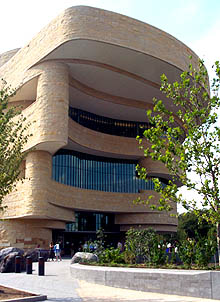
Choctaw Days at NMAI

Choctaw Days in the nation’s capitaln

By Lisa ReedThousands of people from around the world will soon have the opportunity to absorb the sights, sounds and culture of the Choctaw Nation of Oklahoma.

The Smithsonian’s National Museum of the American Indian (NMAI) and the Choctaw Nation are working together to provide a memorable experience for visitors and those who live in the Washington, D.C. area. The Choctaw Days event will be held June 22-25 during NMAI’s height of the tourist season when an average of 1,500 visitors come to the museum every day.

“We are honored to be the first American Indian tribe from Oklahoma to have a festival of this kind at the National Museum of the American Indian,” said Chief Gregory E. Pyle. “I remember when the museum opened on the National Mall almost seven years ago and I have visited NMAI numerous times since. It is a remarkable place, showcasing hundreds of tribes from South, Central and North America.

“We have assembled several of our best artists, dancers, singers and cultural experts. We know that we will have a different audience than we are accustomed to and want to ensure that they all understand just how special our tribe is,” he said.
Comment:  For more on the NMAI, see Oneida Nation Gives Another $1 Million to NMAI and NMAI Plans "Complete Reinstallation."

April 30, 2011

Tim Tingle on Trickster

Author Interview:  Tim Tingle

By Marie PennyTim Tingle is a Choctaw author and storyteller who recently contributed to Trickster: Native American Tales-A Graphic Collection, a 2011 YALSA Great Graphic Novel for Teens book.

I had the pleasure of speaking with this gifted speaker and writer and what follows is his thoughtful response to my questions:

Were you familiar with the graphic novel medium before contributing to Trickster?

Yes. I perform storytelling at schools and know that most middle-school students are excited by graphic novels. Many librarians have shared this with me, how they have seen reluctant readers flock to graphic novels. There is such an instant appeal with graphic novels. I also appreciate narrative-driven games. Some are very well-written, and game imagery often correlates with the imagery found in graphic novels.

What did you think when Matt Dembicki contacted you to contribute to Trickster? (note: Dembicki states in his author’s note that some storytellers were reluctant to contribute due to uncertainty about the book’s intentions.)

I was leap for joy happy! In addition to storytelling, I write books, and trying to pitch a book to a publisher is not always a simple process. So when someone contacts you directly, it is an honor! When I saw the others on board, including figureheads in the storytelling and literary community such as Joe Bruchac, there was no hesitation. Every tribe approaches their stories differently. My mentor, the Choctaw tribal storyteller Charley Jones says, “tell the stories,” but make sure the origin is acknowledged. The Choctaw tribe is very open, you don’t have to be Choctaw to tell the story, but you must respect the tribal origins. Matt Dembicki understood this, as well as the importance of the trickster tale.
Comment:  For more on the subject, see Trickster Nominated for Eisner Award and How Trickster Got Its Cover.

March 19, 2011

Choctaw Ms. Wheelchair Oklahoma

Ms. Wheelchair Oklahoma has high hopes of changing the future

By Skiler SchmitzFormer Durant resident Deanna Cheek was crowned Ms. Wheelchair Oklahoma on February 19, 2011, after spending 19 years of her life inside a wheelchair paralyzed from the waist down. Cheek recently said that she wants to use her new title to advocate, educate and show the world that there is absolutely no stopping her or other individuals with disabilities.And:Living in Durant, Cheek teamed up with her Native American Tribe, the Choctaw Nation, where she was able to attend more courses that geared her back into the work field and helped her become a part of the Oklahomans for Independent Living office in McAlester.

Over the years, Cheek has received some very high mentions from both President Bill Clinton and Oklahoma Governor Frank Keating for Oklahoma Disabled Employee American Award and American Disabled Employee Award.
Comment:  Who thinks of a blond woman in a wheelchair as an Indian? You do, now.

Below:  "Ms. Wheelchair Oklahoma Deanna Cheek said she was injured in a car accident in 1992 and has spent the past 19 years living with a wheelchair. She will be competing in August for Ms. Wheelchair America in Michigan."

March 03, 2011

Howe wins Festival of Words award

Howe coming home for 'Words' award

By Amanda FiteLeAnne Howe, an enrolled citizen of the Choctaw Nation of Oklahoma, will receive the Tulsa Library Trust's "American Indian Festival of Words Author Award" on Saturday.

"Oklahoma is my home and where I grew up, so this award means more to me than anyone will ever know," Howe said. "So much so, that I'm flying home to Oklahoma from Amman, Jordan, where I'm currently a William J. Fulbright scholar."

Howe is the Professor of American Indian Studies, English and Theatre at the University of Illinois at Urbana-Champaign.

Her first novel, "Shell Shaker" (Aunt Lute Books, 2001), received an American Book Award in 2002 from the Before Columbus Foundation. The book's French translation was a finalist for the Prix Medici Estranger, one of France's top literary awards.

"Evidence of Red" (Salt Publishing, UK, 2005), an introspective look at American Indian persistence and struggle, received the Oklahoma Book Award for poetry in 2006. Her second novel, "Miko Kings: An Indian Baseball Story" (Aunt Lute Books, 2007) was chosen by Hampton University in Virginia as their 2009-10 Read-in Selection.

Howe is also active in American Indian film productions, serving as co-producer with Jim Fortier for "Playing Pastime," a documentary about Indian baseball leagues in Oklahoma; and screenwriter and on-camera narrator of the PBS documentary "Indian Country Diaries: Spiral of Fire," which aired nationally in 2006.

Founder and director of WagonBurner Theatre Troop, she has written plays that have been produced in Los Angeles, New York City, New Mexico, Maine, Texas and Colorado. She has performed in her plays "Big PowWow," "Indian Radio Days," "The Mascot Opera," "Choctalking on Other Realities," and "Love Story."

In 2007, Howe appeared on "Jon Stewart's The Daily Show" on Comedy Central in a news segment about sports mascots titled "Trail of Cheers." (She says she's afraid this might be the pinnacle of her career, but with two books currently in the works, that's doubtful.)
Comment:  I think I've traded an e-mail or two with Howe. It's interesting to see all the things she's done.

For more on the subject, see The Best Indian Books and Native Plays and Other Stage Shows.

September 05, 2010

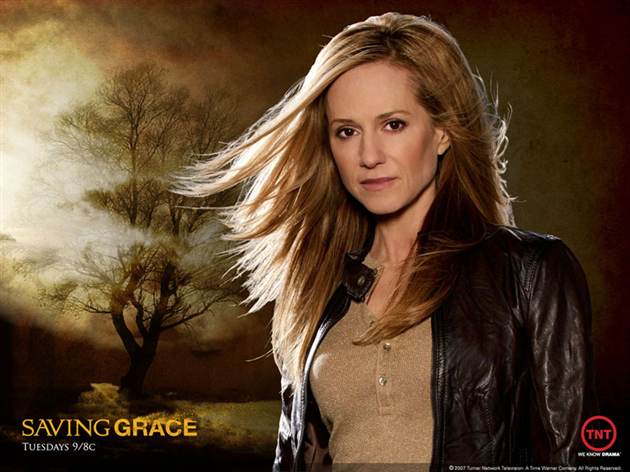
Saving Grace the Choctaw

In the Yeehaw, Geepaw episode of Saving Grace, Bobby Stillwater (Gregory Cruz) mentions his Indian and Mexican halves. Stillwater could've been speaking figuratively, but let's take him literally. He's half Indian and half "Mexican." What does that mean?

Well, it could mean that he considers himself half Indian and half non-Indian. But he may understand that his "Mexican half" is also part Indian. Perhaps he considers himself three-quarters Indian (half American Indian, one-quarter Mexican Indian, and one-quarter Mexican non-Indian).

I mention this because Geepaw (August Schellenberg) says he's a quarter more Indian than Stillwater. If Stillwater is half Indian, that could mean Geepaw is three-quarters Indian. If Stillwater is three-quarters Indian, that could mean Geepaw is a full-blooded Indian.

The latter scenario would agree with online descriptions of Geepaw as Grace's full-blooded Indian grandfather. But again, this isn't clear from the episode itself. It's not even clear that Geepaw is Grace's real grandfather rather than an "honorary" grandfather.

Grace's Choctaw roots

But in the next episode, Everything's Got a Shelf Life (the eighth of the first season), things become a little clearer. Grace confronts a black informant about whether he's telling the truth. The informant says he wouldn't lie to her because "I'm Choctaw, you're Choctaw."

This confirms the supposition of the previous episode. Holly Hunter's character is indeed supposed to be part Choctaw. We can even estimate how much.

First, a couple of points. Grace refers to her grandmother, Geepaw's wife, as Meemaw. We don't know anything about her. She could be anything from full-blooded Choctaw to white.

Jessica Walter plays Grace's mother. She doesn't look or act the slightest bit Indian. Let's assume she's a pure Anglo, as she appears. Presumably Grace is connected to Geepaw and Meemaw through her father, who is dead.

How much "Indian" is she?

With these assumptions we can establish the boundaries of Grace's "blood." If Geepaw and Meemaw are full-blooded Choctaws, then so is her father. That would make Grace half Choctaw by blood.

On the other hand, if Geepaw is three-quarters Choctaw and Meemaw is white, then Grace's father is 3/8 Choctaw. That would make Grace 3/16 Choctaw by blood.

So Grace could be anywhere from 3/16 to half Choctaw. Actress Holly Hunter doesn't look much like an Indian, so perhaps the lower estimate is more realistic. In any case, that may be enough "blood" for her to be an enrolled member of the Choctaw tribe.

In fact, Grace may be an enrolled Choctaw. In the first eight episodes, she hasn't said anything to preclude this possibility. No references to Indians as "them" rather than "us," for instance.

A cast of Choctaws?

The same would apply to Grace's five or six siblings. None of them looks the slightest bit Indian either. But unless they're half-brothers and sisters, they're all 3/16 to half Choctaw.

Perhaps this point will become clear in future episodes. I just think it's interesting that Grace could be an enrolled Choctaw Indian. If true, this would be a remarkable case: a lead character who's an Indian but nobody realizes it.

For more on the subject, see Yeehaw, Geepaw in Saving Grace and Gregory Cruz in Saving Grace.

Below:  Grace Hanadarko the blonde Choctaw Indian?