Showing posts with label South Dakota trip. Show all posts

November 09, 2014

Chris Korpi dies

Chris Korpi, an Indian gaming executive who had worked for several companies, died Saturday of a heart attack. He was one of the leading lights of Indian gaming and an all-around great guy, kind and generous to everyone he met.

As you may recall, I work at Pechanga.net and attend the Global Gaming Expo and NIGA conventions every year. Here's an interview I conducted with him:

Gaming Executive Leads Trips to Indian CountryNote: Chris Korpi, head of Native American relations at VizExplorer, died November 8, 2014. We mourn the loss of one of Indian gaming's greatest advocates and one of Indian country's greatest friends.

###

When Chris Korpi headed off to college in Rapid City, South Dakota, he knew next to nothing about Native Americans. He couldn’t imagine it was the beginning of a lifelong commitment to America’s first people.

After graduating from the School of Mines with a degree in geological engineering, he worked as a lobbyist and consultant for local politicians. Eventually they took jobs at Sodak Gaming, a predecessor of International Gaming Technology (IGT). When they asked him to join them, he agreed.

During stints at Sodak, IGT, Aruze, and Cadillac Jack, Korpi learned the business as a sales executive dedicated to Indian country. He recently joined BIS2, a San Diego-based maker of business intelligence software, as Assistant VP—Native American Relations and Business Development.

In any job, he’s one of the strongest advocates of Indian gaming. He “gets it”—that it’s about giving tribes the means to determine their own future.

As part of his work, Korpi occasionally leads educational trips to his old stomping grounds in South Dakota. We talked about his 2012 pilgrimage, which was sponsored by Cadillac Jack, and his philosophy toward Indian gaming.
I went on the 2012 trip with him and got to see that part of Indian country for the first time. You can read my reports and see my photographs here:

South Dakota trip

Photos

Here are some of my favorite pix of Chris:

Chris at Table Rock Beach. May 22, 2014.


Chris explains the geology of the Etta Mine near Mt. Rushmore. June 24, 2012.


At the Mountain View Cemetery near Mt. Rushmore. Chris points out the rose quartz--South Dakota's state stone--on a grave. June 24, 2012.


Chris explains things to our group on the viewing platform at Terry Peak. June 27, 2012.


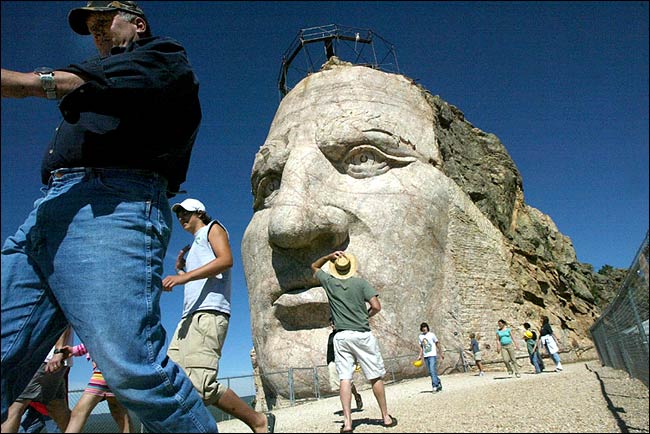
Chris and friends on the Crazy Horse Memorial. June 28, 2012.


Chris and Adam Beach at NIGA. May, 2014.


Victor Rocha with Chris--one of the handful of people who made Pechanga.net what it is today. April 3, 2012.


P.S. I imagine how Chris would respond to all the praise he's getting. "Thanks, but it's not necessary. I'm not anybody important. If you want to show your appreciation, donate your time or money to a worthy cause. There are people struggling all over the world--in Africa and right here in Indian country--who need your help."

That's the kind of guy he was. RIP, Chris.

July 29, 2012

Pix of my South Dakota trip

I plan to write some articles about my South Dakota trip in June. Meanwhile, here are my photos of the trip. I trust the captions will explain our experiences well enough.

Day 1

LAX to downtown Rapid City--June 24, 2012 (7 am-3:30 pm)

Prairie Edge Gallery--June 24, 2012 (3:30-5:30 pm)

Dinosaur Park--June 24, 2012 (5:30-6:30 pm)

Etta Mine--June 24, 2012 (6:30-7:30 pm)

Cemetery and Mt. Rushmore--June 24, 2012 (7:30-10 pm)

Day 2

Hotel and Scenic, SD--June 25, 2012 (morning)

Sheep Mountain--June 25, 2012 (morning)

Fossil-hunting--June 25, 2012 (morning)

Visitor center and Stronghold--June 25, 2012 (morning)

Red Cloud Indian School--June 25, 2012 (late morning)

Pine Ridge and Whiteclay--June 25, 2012 (early afternoon)

Wounded Knee--June 25, 2012 (afternoon)

Lakota War Pony Races--June 25, 2012 (afternoon)

Oglala Lakota College--June 25, 2012 (afternoon)

Lakota Prairie Ranch Resort--June 25, 2012 (late afternoon)

Thunderstorm--June 25, 2012 (early evening)

Day 3

Iron Mountain Road--June 26, 2012 (early morning)

Custer State Park and Wind Cave--June 26, 2012 (morning)

Into the cave--June 26, 2012 (early afternoon)

Hole in the Wall and Needles Highway--June 26, 2012 (afternoon)

Sylvan Lake and Rapid City--June 26, 2012 (late afternoon)

Day 4

Hunting geodes and finding Nemo--June 27, 2012 (morning)

Homestake Gold Mine and Terry Peak--June 27, 2012 (morning)

Spearfish Canyon and Deadwood--June 27, 2012 (early afternoon)

Bus tour and Boot Hill--June 27, 2012 (afternoon)

Walking in Deadwood--June 27, 2012 (afternoon)

Day 5

Black Hills Institute--June 28, 2012 (morning)

Gift shop and Crazy Horse Memorial--June 28, 2012 (morning)

On the Crazy Horse Memorial--June 28, 2012 (early afternoon)

Visitor center and gift shop--June 28, 2012 (afternoon)

Veranda and Lakota dancers--June 28, 2012 (afternoon)

Sculptor's studio and cultural center--June 28, 2012 (afternoon)

Nature Gates and Rapid City--June 28, 2012 (afternoon)

Day 6

Hotel and Memorial Park--June 29, 2012 (morning)

City of Presidents, part 1--June 29, 2012 (morning)

City of Presidents, part 2--June 29, 2012 (morning)

City of Presidents, part 3--June 29, 2012 (late morning)

City of Presidents, part 4--June 29, 2012 (early afternoon)

Fountains and park statues--June 29, 2012 (afternoon)

Rose garden and flight home--June 29, 2012 (afternoon)

Plus a few postings on related subjects:

Cultural center at Crazy Horse Memorial
Anti-suicide campaign at Lakota college
Hundreds of Sun Dances
Economic development on Pine Ridge

July 03, 2012

Anti-suicide campaign at Lakota college

Native Sun News: Lakota College students inspire hope for youth

By Karin Eagle“What does hope look like to you?”

The introduction to business class at Oglala Lakota College in Pine Ridge posed that question to hundreds of young Lakota people, then asked them to take a picture of their answers. The results were staggering to the organizers of the project, aptly named the Lakota Voice Project.

Jason Alley, creative director and principal of Message and board member of the Black Hills Chapter of the American Advertising Federation, both based out of Rapid City, approached the class with the challenge of developing an advertising campaign that could enact change in their community. The idea was simple, on the part of Alley: Let the class research, plan and develop the campaign with the mentorship of Alley and his group.

The class itself, comprised of Lakota college students, came to an almost immediate agreement that the suicide prevention movement should be the focus of the campaign. Hundreds of disposable cameras were handed out to reservation schools with that one question–“What does hope look like to you?”–as the only instruction.

This collection of photos will figure prominently in a suicide awareness campaign set to be launched in the fall by the Sweetgrass Project, the Oglala Sioux Tribe’s suicide prevention program.

The photographs were presented to the public on the evening of June 22 at the Little Wound Elementary School auditorium. The class participated in the creation of the displays, which featured larger-than-life banners with some of the more poignant photographs. Long streamers of photographs linked together in two-sided fashion formed the centerpiece.
Comment:  We stopped here June 25 during my visit to South Dakota. The place was almost deserted--perhaps because it was a Lakota holiday, or the spring term was over, or it was late in the day. Probably the holiday, I guess.

The point here is one I make all the time. If you're depicting life on the rez--e.g., Children of the Plains or SCALPED--by all means show us the dark side. Show us the poverty, crime, substance abuse, and suicide.

But don't show only that. Show that people are aware of the problems and fighting them. Don't show that they've given up and lost; show that they're trying to win.

For instance, I imagine there are dozens of efforts to combat the suicide epidemic. You can show a montage of anti-suicide efforts, or you can show one as an example and allude to the others. Whatever you do, show that the problems aren't beyond hope.

Artistically speaking, if you devote 50% of the time to the problem and 50% to the solution(s), I'd say that's fair. Children of Plains didn't quite meet that standard. It was more like 60-40 or 70-30.

SCALPED isn't anywhere in the ballpark. If it's ever shown a majority of its fictional population doing anything positive--participating in a Sun Dance, going to college, or battling suicide--I must've missed it. Its negative portrayal of rez life is badly stereotypical.

Showing only the negative side is an exmaple of "poverty porn." You're showing the negative to gain sympathy (Children of the Plains) or titillate the audience (SCALPED). What you aren't doing is presenting a realistic portrait of both sides.

A one-sided portrayal is stereotypical even if it's technically accurate. It may depict the problem accurately, but the problem is only half the equation. The missing half makes rez life look more ugly, depressed, and savage than it really is.

In other words, if you're not part of the solution, you're part of the problem. SCALPED's stereotypical depiction of rez life is a great example of this.

For more on the subject, see Economic Development on Pine Ridge and Kristof's Pine Ridge Column.

Below:  "From left, Pte Ska Win Poor Bear, Lyle Pilcher and Jason Alley discussing the Lakota Voice Project photo exhibit in Kyle June 22." (Karin Eagle)

July 02, 2012

Hundreds of Sun Dances

Hemispheric Journal: Lakota Country

By Jose BarreiroOnce again before Grandfather Sun, Tunkashila, with the Oglala relatives, the ceremony has come together. As they have for 16 years, on these wondrous plateaus of the southern Black Hills of the northern Great Plains, Uncle Joe American Horse, traditional chief and also former tribal president, his brother David American Horse, Grandma Beatrice Long Visitor Weasel Bear, respected headwoman Loretta Afraid of Bear, respected Pipe Carrier Tom Cook and the families of the American Horse/Afraid of Bear tiospayes, received brothers and sisters of the many directions.

The purpose was to pray, by dancing, by receiving each other in a good way. In a place where wild horse herds roam relatively free and is properly isolated, a ceremonial arbor set into the Four Directions is flanked by a large “shade” on poles and a dozen large tipis. This is home for four and more days to over sixty dancers, there to don the ceremonial skirt, red-tied bracelets of prairie sage on ankles and wrists, crown of sage tied in red cloth, dual eagle feathers, (“spikes” are favored) placed on the head, set to carry the ceremony as dancers of the sun. Below, “downstairs,” a second plateau half-mile away is camp for some two hundred family supporters of specific and groups of dancers, where more tipis and tents, an occasional RV, many trucks and cars, circle around a communal kitchen, staffed completely by volunteers, cooks and helpers.

There are many sundances each summer, perhaps fifty or more just at the Oglala-Lakota Reservation of Pine Ridge; hundreds, maybe thousands, across the Northern and Southern Plains, many more in Sun-appreciation ceremonies in the hemispheric Native Americas. While foundational precepts and structures are manifested wherever Native peoples salute or celebrate the sun, each sundance has its history, its specificity of culture and practice over its own ceremonial trajectory.
Comment:  I had no idea whether Indians held one or two or more Sun Dances each year on a reservation such as Pine Ridge. Now here's a number: Fifty or more on Pine Ridge alone; hundreds elsewhere on the Great Plains.

With the long history of Christianizing efforts in the area, I wouldn't have guessed Native religions were so active. Good to see that they are.

We had a hint of Sun Dance activity during my visit to South Dakota. We were scheduled to see the Thunder Valley ceremonial grounds, the location of a Sun Dance. It wasn't clear whether we were going to see the ceremony itself or just the grounds before or after the ceremony.

That didn't happen. I don't know if it was because June 25 turned out to be an official holiday on Pine Ridge and no one was available to escort. Or if the whole idea was more like wishful thinking than a solid plan.

At the end of the day, we stopped at the Pine Ridge home of Tony, one of our Lakota guides. I wasn't sure why, but someone said something about getting a glimpse of a Sun Dance, miles away, from his backyard. A storm came up and ruined any chance of that happening, though we may have seen a light from the Sun Dance.

On the way to the Wind Cave National Park the next day, we passed the place where Russell Means held a Sun Dance in previous years. In 2010 the rangers harassed him for holding the ceremony on public land. Holding the ceremony there was probably illegal, but Means claimed a First Amendment right to dance wherever he wanted. In 2011 the rangers changed their tune for some reason and helped Means.

Anyway, we couldn't see the actual site. It was around a bend.

For more on the subject, see Christian Flyer Calls Lakota Rite "Satanic" and Indians Had No Way to Worship God?!

Below:  "After the Sundance: Looking east at the Tree of Life."

June 28, 2012

South Dakota trip schedule (Day 5)

9:00 AM-12:00 PM
Tour of central Black Hills--Pactola and Sheridan Lakes and Black Hills Institute

1:00-4:30 PM
Crazy Horse Memorial--lunch and view from monument

4:30 PM
Return to Rapid City

6:30 PM
Farewell dinner--Dakota Steakhouse

For more on the subject, see South Dakota Trip Schedule (Day 4) and South Dakota Trip Schedule (Day 3).

June 27, 2012

South Dakota trip schedule (Day 4)

8:00–11:30 AM
Drive from Rapid City to Lead/Deadwood by way of Nemo Road

Stop at the Homestake Gold Mine scenic overlook

Drive to the top of Terry Peak for a view of five states

11:30 AM-1:00 PM
Drive through Spearfish Canyon

Picnic lunch next to Roughlock Falls

1:30 PM
Arrival in Deadwood--meet at Saloon #10

2:00-5:00 PM
Tour and free time in Deadwood

Ride to Boot Hill Cemetery for those who wish to see the graves of Wild Bill Hickok and Calamity Jane

6:00 PM
Dinner at Deadwood Social Club--above Saloon #10

8:00-9:30 PM
Return to Rapid City

For more on the subject, see South Dakota Trip Schedule (Day 3) and South Dakota Trip Schedule (Day 2).

June 26, 2012

Economic development on Pine Ridge

Economic Development Revs Up on Pine Ridge Reservation

By Stephanie WoodardSupporting them is an expanding infrastructure, with public transit throughout the 2 million-plus-acre reservation, good cell-phone coverage in most areas and wireless Internet widely available. Approval of a federally backed credit union is imminent, said Whitney O’Rourke, Oglala, of Lakota Funds, a community development financial institution in Kyle, South Dakota in northern Pine Ridge. There is currently no bank on the reservation, and off-reservation banks make few loans there because much of the land that might act as collateral is held in trust by the federal government or is tribally owned. That will make a credit union the game-changer, easing access to cash and encouraging business formation and homeownership.

“The reservation has 40,000 residents ready, willing and able to participate in the regional economy,” said Mark St. Pierre, chief executive officer of Wounded Knee Community Development Corporation (CDC). Set in Pine Ridge’s central Manderson Valley, a bucolic sweep of hills bounded by pale cliffs, Wounded Knee’s CDC is one of several community groups and nonprofits with seed grants and creative ideas. They’re where the real economic action is, says St. Pierre, with plans ranging from small businesses to housing, a critical need on Pine Ridge. His CDC is looking for funding to build a destination resort on the 600 acres it owns in Manderson Valley and a factory that would make high-end caskets, then expand to other types of millwork.
And:Pine Ridge may be ready to participate in the regional economy, but is the region welcoming them? asked St. Pierre, of Wounded Knee CDC. Pine Ridge and other South Dakota reservations already contribute generously to the state’s economy—too generously some say, as money arriving in Native communities is typically spent immediately in nearby border towns, without changing hands and producing income in reservation businesses first. “Keeping money on the reservation and supporting our mom-and-pop businesses is the big issue,” said Emma Featherman-Sam, Oglala, coordinator of Oglala Sioux Transit.

Even worse, much of the spending goes to down-market, predatory vendors, according to O’Rourke. She described payday lending as a terrible problem, along with deed and title loans, through which cash-strapped tribal members put up home and car documents in return for short-term loans at sky-high interest rates, as much as 650 percent. Border town stores sell goods at inflated prices, knowing reservation residents may not have gas money to drive further to find bargains, and alcohol sales in retail stores and bars ringing Pine Ridge—just beyond the dry reservation’s jurisdiction—further empty tribal members’ wallets. “The border towns have a parasite–host relationship with the reservation,” said Tilsen.

Other restrictions on Pine Ridge’s economy are more subtle: When visitors arrive at the Rapid City airport, rental-car companies provide maps of western South Dakota showing a narrow slice of the state along the western border, guiding tourists to state and national parks and neatly eliminating all the reservations. The same map is available in shiny, laminated form at the Badlands National Park visitor centers, a federal operation, where you can get a map of the adjoining Pine Ridge Indian Reservation only if you know to ask for it.

Though cultural tourism is widely considered the wave of the future, browsing South Dakota’s tourism website reveals little about the state’s reservations and their attractions, including pow wows year-round. Entering “Native American” into the search box pulls up assistance for tour companies wanting to organize coach trips to reservations and directions to off-reservation Crazy Horse Memorial—ways for outsiders to look at Native Americans, but little support for Native people’s own enterprises.

Simply finding the reservation can be more difficult than it needs to be; those heading from Rapid City to Pine Ridge will discover that major turnoffs are not well marked. “We’re working on that,” said Featherman-Sam. “We’re talking to the state about installing more signs.”
Comment:  I was there the day before this article was published. I can verify that the tourist map for western South Dakota doesn't cover the reservations, and the highway signs aren't great.

We lunched at the single Subway's in Pine Ridge--the one featured in 20/20's Children of the Plains. I asked Jayson Brave Heart, one of our Lakota guides, about businesses on the rez. He said there was a Taco John's, and added that a McDonald's or a laundromat would do incredibly well.

Why doesn't someone start such businesses? Brave Heart gave two main reasons. One, as the article notes, it's hard to get a loan for start-up capital. Two, the town lacks needed infrastructure such as water and electricity. In non-Native locales the government installs these things automatically, but in Pine Ridge they have to go through the BIA's bureaucracy.

So how did the Subway's get started? Brave Heart said the founder was a former BIA superintendent or some similar official. He was able to cut through the red tape, get a loan, and buy a franchise. Not because he was a better businessman, but because he had the connections and clout to get his way.

More attractions needed

As an outsider, even I could see some of the business problems. Pine Ridge is a couple of hours away from the state's biggest towns. There are few attractions between it and Rapid City, where people go to see Mt. Rushmore. When you drive to Pine Ridge, the highway is almost empty. There isn't enough traffic to support a major casino.

I can imagine things that would attract tourists. Work with the National Park Service to offer genuine Lakota tours of the Badlands. Arrange fossil- and rock-hunting expeditions with Lakota guides. Museums are interesting--to me, at least--so build a Museum of Lakota History and Culture. Buffalo are an integral part of the culture, so establish a buffalo ranch where people can see the animals up close. Show off places like the Red Cloud Indian School, which we saw, and the Tanka Bar manufacturing plant, which we didn't.

Wounded Knee is another site the Lakota could develop, but there you want to be careful. The site is small and tranquil, and the typical visitors center with gift shop and parking lot would overwhelm it. Perhaps the Lakota could raise some tourist attractions a mile or so away, out of sight of the site.

Once you have a few marketable attractions, the state will start to include the rez on its maps and signs. People will start visiting and looking for more things to do. This will create a feedback loop, with tourist spending generating jobs and businesses that in turn attract more spending.

Note: I'm sure the Lakota have thought of these things before. I'm not claiming to have any great ideas or insight here. I'm just sharing my naive perspective with readers who may be even more naive than I am.

Rob wrong about rez?

Incidentally, after visiting the rez I tweeted:To me, Pine Ridge looked like any small rural town. I didn't see the abject poverty seen by the likes of Diane Sawyer and Nicholas Kristof.A fellow non-Native traveler challenged me on this, suggesting I was ignoring the poverty and pain behind the facade. He wondered who I was to judge the reservation after a half-day visit.

I'm someone who's read thousands of articles on hundreds of reservations for two decades, that's who. Which gives me an advantage over youngsters who were in grade school when I began. But I'll explain my comment to him and anyone else who didn't get it.

First, let's set the scene. When you drive through Pine Ridge, the first thing you notice is a lot of trailers and portable homes. They're evidence of poverty, of course, but the structures look reasonably well-maintained.

What you don't see is decaying hovels with peeling paint or yards full of junkers and other trash. You know, the kind of "lunar" landscapes you find in ravaged inner cities and outer towns alike. Because of all the negative press, that's kind of what I was expecting.

Nor did I see crowds of idle Indians hanging out because they're unemployed. None of the drunks, whores, or hoodlums you might find in a typical issue of the SCALPED comic book. (There were a handful of apparent drunks in Whiteclay, but that's a different story.) The holiday may have had something to do with it, but I'd expect more loitering on a holiday, not less.

These things may exist somewhere on the rez, but I didn't see them. And we criss-crossed the area several times during our visit.

Things are bad, but...

Here's the point. I absolutely am not saying the poverty, crime, gangs, domestic violence, substance abuse, and suicide don't exist. When I think of small rural towns, on or off the rez, I suspect these things are going on.

What I'm saying is you can't drop in like Diane Sawyer, Nicholas Kristof, or me and get the whole picture at a glance. It's not as obviously bleak as portrayed in Children of the Plains or Kristof's column. Or in SCALPED, which presents the same kind of poverty porn.

I have no problem saying conditions on Pine Ridge are bad. But I side with the Native critics who claim things aren't as bad as they're portrayed by non-Native outsiders who look for the worst. We saw construction going on in town...a college about to graduate a class of students...and horse races where children rode proudly like their ancestors.

If I were going by the evidence of my eyes, I'd say the situation was inconclusive. I'd want more information before drawing conclusions. Unlike some observers, I wouldn't presume that a poverty-stricken reservation is mired in despair and hopelessness.

In short, any TV show, article, or comic book that doesn't capture the positive as well as the negative is a failure in my eyes. That's a point I have made and will continue to make until everyone gets it.

Any questions? For more on the subject, see Rez Life Avoids Poverty Porn and What Reservations Are Really Like.

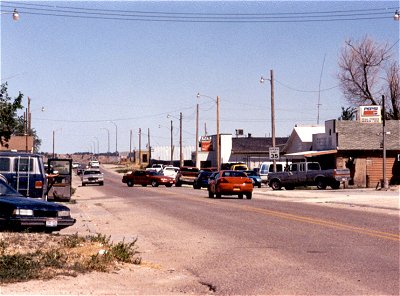
Below:  Whiteclay just south of the Pine Ridge border--perhaps the source of wholly negative reports.
South Dakota trip schedule (Day 3)

Morning
Iron Mountain Road

Custer State Park--buffalo herds and other wildlife

Afternoon
Wind Cave National Park

Needles Highway

6:00 PM
Return to Rapid City--dinner at Firehouse Restaurant

For more on the subject, see South Dakota Trip Schedule (Day 2) and South Dakota Trip Schedule (Day 1).

June 25, 2012

136th anniversary of Greasy Grass

Visiting South Dakota, we didn't realize the significance of the Battle of Little Bighorn anniversary. Several Plains tribes celebrate it as an official holiday.

That means the chairman of the Oglala Sioux Tribe (OST) wasn't there to greet us when we arrived in Pine Ridge. He and other tribal employees had taken the day off.

Some postings on the day's significance:

The 136th anniversary of the Battle at Little Big Horn

By Tim GiagoThe bumper stickers were born before the holiday.

They could be seen on cars coming and going from the Indian reservations in America. They read “Custer died for your sins,” or “Custer wore Arrow Shirts.” And then came the holiday in the 1970s.

The Indian holiday on June 25 marks the 136th anniversary of the thrashing of George Armstrong Custer’s Seventh Cavalry at the Little Big Horn, or Greasy Grass, as the Indians called it. On all of the Sioux Indian reservations in South Dakota it is a statewide holiday. The Cheyenne and the Arapahoe, also participants in the great victory, have also joined the celebration.

They celebrate the day their ancestors handed the United States Army one of its worst defeats in all of the so-called “Indian Wars.” The Indians called them the “White Man Wars.”
The Battle of the Little Bighorn is Still Relevant

By Chase Iron EyesThe battlefield is no longer only a physical fight to steal our lands, sever our ties to protect mother earth, eradicate our dignity, kill our languages, stop our ceremonies and purposefully and perpetually keep us in a subdued state of existence. Poverty is not an accident. The battlefield has largely shifted to the arena of our own minds.

Today our enemy is the corporate west and its institutions (legal, social, political, media, educational, etc.). These institutions that attempt to teach us that we were savage, that we were primitive, that skinny and white is beautiful, that women are objects, that we should value comfort, material products, ego, and consumer culture over sacrifice and our ceremonies. These institutions that ignore us yet demand that we work for them 8-12 hours per day for 60 years or until we retire, at the expense of our families, earth, and ceremonies.

These institutions and their perpetrators, Indian and non, seek to deny the truth that we are children of creation with the blessing and the burden to protect the earth and practice divine order in our ceremonies and life patterns as compelled by our spiritual dignity. I also would be remiss if I did not recognize that our own apathy, learned helplessness, and ego are also our enemies. The theatre of war may have changed to our hearts and minds, but the same lives are at stake.

We celebrate our unconquerable spiritual dignity today with the Cheyenne, Arapaho, and Lakota Alliance (Okaspe Yamni) in their country and in the homelands of Gall, Sitting Bull, Inkpa Duta, Rain in the face, Crazy Horse, American Horse, Big Road, and Black Elk to name a few of the Grandfathers that fought at the Greasy Grass and we remember all the others, including women such as Inyan He Wita (Rocky Butte) and Mary Crawler who fought as well.

We celebrate and choose to remember into the future, because that spirit is still alive and ready to meet any challenge in any battle.
Comment:  For more on the subject, see Custer Flag Auctioned to Help Indians and Why No Wounded Knee National Monument?

South Dakota trip schedule (Day 2)

8:45 AM
Badlands--Red Shirt Table and Cuny Table

10:00 AM
Red Cloud Heritage Center at the Red Cloud Indian School

11:00-11:30 AM
Drive through Pine Ridge and Whiteclay, Nebraska

11:30 AM
Lunch and meeting with tribal chairman

1:00 PM
Wounded Knee massacre site--with prayer

2:30 PM
Thunder Valley Ceremonial Grounds--Sun Dance

4:30 PM
Lakota Prairie Ranch Resort--dinner

For more on the subject, see South Dakota Trip Schedule (Day 1) and Off to South Dakota.

June 24, 2012

South Dakota trip schedule (Day 1)

7:00 AM–1:00 PM
Flight to South Dakota

3:00–5:30 PM
Prairie Edge Gallery

5:30–11:00 PM
Mt. Rushmore--lighting ceremony

Off to South Dakota

I'm off to South Dakota for my first visit ever to Lakota territory. It's a guided tour organized by Cadillac Jack, the slot-machine manufacturer. The sights we'll see include the Prairie Edge Gallery, Pine Ridge and Wounded Knee, Mt. Rushmore and Custer State Park, Deadwood, the Black Hills and the Crazy Horse Memorial. Should be an amazing trip!

I'll try to keep the blog up while I'm on the road, though it may be difficult. But look for lots of reports and pictures when I get back.

For some previous photo galleries, see Black & Gold Gala with Misty Upham and NIGA 2012 (Day 2).