Showing posts with label martial arts. Show all posts

August 05, 2013

Seminole match between disabled fighters halted

State stops controversial MMA fightA controversial Mixed Martial Arts fight between two fighters living with disabilities is canceled just minutes before the match.

One of the fighters has down syndrome and the other cerebral palsy. The state stepped in and shut it down claiming it was unsanctioned. On of the fighter's fathers say it's discrimination.

That fight was set to take place at the Seminole Casino in Immokalee. It's something both of these men told me on Friday was a dream come true. Now they are fighting to find a way back into the ring.

It was a fight that was supposed to be a first of its kind. One both Garrett Holeve, 23, and David Steffin, 28, had been dreaming of, but five minutes before the first punch, the state presented the promoter with a cease and desist letter.
Comment:  Just because tribes can do this kind of fight doesn't mean they should.

For more on Native martial arts, see Assiniboine Sioux in Fight Master and Walla Walla MMA Fighter.

July 10, 2013

Assiniboine Sioux in Fight Master

Native Sun News: Assiniboine Sioux man stars in 'Fight Master'

By David MichaudWhile he may be a star of the inaugural season of the Bellator MMA reality show Fight Master, Tim Welch will never forget where he comes from.

Welch is an Assiniboine Sioux who is an enrolled member of the tribe that hails from the Fort Peck Indian Reservation in Montana. While he is enrolled at Fort Peck he says that his family on his father’s side is from the Wolf Point Reservation, where many still live to this day.

Growing up as a wrestler in Montana it should come as no surprise to anyone that Welch decided to try his hand in MMA, starting like many others in the amateur ranks and working his way up.

“I thought I’d try it and did it for fun in college then found out you could be a professional so I had 10 amateur fights then my coach turned me pro at 19 and I made $1,000 and I couldn’t believe it,” said Welch.
Comment:  For more on Native martial arts, see Walla Walla MMA Fighter and Dog Soldier MMA.

July 07, 2013

Walla Walla MMA fighter

Native Sun News: Dan Henderson--The Walla Walla giant killer

By David MichaudThere may be no man in MMA history that could say they have had a career as successful as Dan “Hendo” Henderson.

Henderson is a member of the Walla Walla tribe of the Northwestern U.S., began his combat career early as he started wrestling at a young age. Growing up on a ranch outside Apple Valley, Calif., he learned exactly what hard work and toughness was; two traits that have defined his fighting career, as he has never been knocked out.

He has been competing at the highest levels of MMA for the past 15 years. He began his MMA career after wrestling on the world stage, which saw him become a two-time U.S. Olympic Alternate.

He currently holds more wins over fighters with championship titles in the biggest MMA organizations with 10, according to leading MMA news website MMAJunkie’s Dany Acosta, than any other fighter. To go along with all his past wins over former champions he is also currently ranked number 3 by the UFC in the 205 pound weight division.
Comment:  For more on Native martial arts, see Dog Soldier MMA.

June 28, 2013

Dog Soldier MMA

Matching martial arts to the culture

By Brandon EcoffeyMultiple strategies have been employed by neighborhood organizers throughout the years to empower communities.

For Vaughn Buffalo Bull Lodge, who lives and works the south side of Minneapolis, Mixed Martial Arts is the chosen tool used to keep kids off the streets and protect Native women from the sex trade.

“There were a number of reasons why we got started, but the biggest was that there was an outcry from the community about the abuse of our women in the city and the high rates of prostitution. It wasn’t necessarily a threat from within the Native Community, but from outside cultures moving in and literally kidnapping women,” said Vaughn. “I had to ask myself, well what can I do as a warrior to step up and make a difference? So with my background in Martial Arts I thought that a MMA gym could be a great place where community members especially our women could learn basic self-defense,” he added.

The gym that Vaughn runs flies under the banner of Dog Soldier MMA and is located at 2929 4th Ave S, Suite 104 in Minneapolis. In addition to self-defense for Native women the gym now provides multiple programs for all members of the community.
Comment:  For more on Native martial arts, see Muscogee Creek MMA Fighter and Lakota Black Belt to Teach Self-Defense.

June 26, 2013

Muscogee Creek MMA fighter

Nikki Lowe, Muscogee, enters fighting ring

By Brandon EcoffeyThe world of Mixed Martial Arts at one point in time was considered to be etched in the likeness of male barbaric hedonism.

Those times are long gone and today there are more women participating in the sport all across the country. It is not uncommon for mothers, models, and students to turn to the sport to improve their physical fitness and for some to use the sport as a way to quench a primal thirst for competition. It is however unusual when an individual is a mother, model, student and professional fighter at the same time. Meet Nikki Lowe.

“MMA is an art that is why they call it Mixed Martial Arts because it is about discipline,” said Lowe.

Originally from Ada, Ok, Lowe, an enrolled member of the Muscogee Creek Nation with Seminole and Chickasaw lineage as well. She now lives and trains in Albuquerque. The mother of two won her final amateur fight this past weekend at a King of the Cage event at the Ute Mountain Casino in Colorado.
Comment:  For more on Native martial arts, see Lakota Black Belt to Teach Self-Defense and Navajo Hosts Mixed Martial Arts.

March 21, 2013

Lakota black belt to teach self-defense

Lakota Black Belt Is Crowd Sourcing to Fund Arming Sisters, a Self-Defense Initiative Across Turtle IslandYoung Lakota woman Patricia (Patti) Stein is a self-described “veterinary nurse, artist, taekwondo junkie, nomad” and strong advocate for her people.

Two years ago, she decided to move to Egypt, where she began working with Tahrir Bodyguard, a civilian group that organized to keep protesters in Tahrir Square safer from sexual harassment, assault, rape and political attacks.

Through her experiences with Tahrir Bodyguard, Stein, who holds a black belt in Hapkido, realized she had the training and ability to help her sisters on Turtle Island by similarly teaching them potentially life-saving self-defense skills. “Here in the U.S. and Canada, Native females are targeted with sexual violence at a far greater percentage than the rest of the population,” Stein said in a video about the mission of her nonprofit Arming Sisters. “One in three Native American women will be raped in her lifetime,” she stressed.

Arming Sisters is Stein’s crowd-funded initiative that intends to empower Native women to fight back against sexual predators and abuse. Stein’s goal is to visit the 10 most populated reservations in the U.S. and 10 indigenous territories in Canada between July 1 and September 15. “Every stop in our travels will consist of a six hour compact women's self defense course given twice at each location,” Stein explains on the IndieGoGo campaign to raise funding for transportation, accommodations and operational costs. “Awareness, mentality, and sharing stories of strength will cover the first two hours, followed by four hours of application. Every woman will be able to walk away knowing ten simple moves that could save her life.”
Comment:  For more on violence against women, see A Red Girl's Reasoning and VAWA Passes Over Conservative Objections.

Below:  "Patricia Stein, a Lakota woman raised in 'small town North Dakota' who now lives in Egypt, has taught self-defense courses along the U.S. East Coast and in Cairo. She is campaigning for funds to return to the U.S. to visit 20 reservations and Native communities in 2.5 months to equip more Native women with the sklils to protect themselves from sexual and physical assaults."

September 23, 2012

Navajo hosts mixed martial arts

Navajo Nation hosts first MMA event in Window Rock

By Shondiin SilversmithThe capital of the Navajo Nation is about to play host for its first extreme sporting event as fighters from across the nation gather to compete in the mixed martial arts event "Warpath 3: Rise of Champions" this weekend at the Window Rock Sports Center.

"It's a Native American mixed martial arts professional and amateur event," said Tay Carroll, CEO of Cage LifeTM Sports and Entertainment, a Native American owned and operated professional MMA and entertainment company based in Albuquerque. "We are looking to promote up and coming Native American talent."

Carroll said Warpath was founded in 2006 with the intent of promoting local Native American fighters, but as they scouted for competitors no Native fighters could be found–until now that is.

"One of the biggest goals we have is helping the young Native American athletes find this sport and work toward that major goal of actually making it into the big time," he said.

A large part of the fight card is Native American, which is what makes Warpath 3 different from the first two, according to Carroll.

"This is the first time we've promoted a big card like this with all Native American competitors," he said adding that there are a total of 12 fights scheduled, including pro and amateur fights. Carroll said that two thirds of the fight card is Navajo fighters.
Comment:  The whole Warpath concept is stereotypical, of course. But I guess it's appropriate in this particular situation.

For more on Native martial arts, see Native Pankration Champion and Vilche the "Eskimo Warrior."

February 25, 2012

Navajo karate black belt

A Young Master: Meet Navajo Black Belt Alfred Duchaussee

By Lee AllenWalk softly…and carry a big 3rd degree black belt.

That works for 26-year-old Navajo Karate expert Alfred Duchaussee, currently a psychology student at the University of New Mexico.
And:Physically and mentally he challenged himself to improve focus, self-discipline and overall physical conditioning. In striving to be his best, he gained invaluable insights about life and in the process amassed a wall full of accolades: he won England’s Karate World Cup; took the Funakoshi Shotokan Karate International World Championship in his weight class nine times; he was the first American Indian ever to win a World Cup Golf Medal in Dominican Republic competition, and won one of the largest Karate tournaments in the United States last year, the prestigious Ozawa Cup Tournament in Las Vegas.

Duchaussee, who trained at the Olympic Training Center in Colorado, is also recognized by the Native American Sports Council, as one of the Top Ten Native American athletes of the present day. That small and exclusive group includes Joe Hipp (Blackfeet), the first Native American to challenge for the world heavyweight boxing championship; Notah Begay (Navajo/Pueblo), PGA’s first native American pro golfer; Seattle Mariners pitcher Bobby Madritsch (Lakota), and pro baseball player Kyle Lohse (Nomlaki Nation).
Comment:  For more on Native martial arts, see Native Pankration Champion and The Origin of Yaomochtia.

October 16, 2011

Native Pankration champion

Northwoods Teenager Makes Martial Arts History

By Lyndsey StemmA Northwoods 18-year-old is the youngest, and first Native American to win a world championship for the USA in the sport of Pankration.

Katie Maki got into martial arts by following in the footsteps of her big sister. Little did either of them know that Pankration, a form of mixed martial arts, would take Katie all over the world, and turn her into a world class athlete.
And:Coach Dave Sixel has trained Katie since she was a child. He lead Team USA in Serbia, where the team won a total of nine bronze, one silver, and five gold metals.

"As a team we ended up placing second in the world. Ukraine ended up taking the gold metal, USA the silver, and Russia the bronze," says Sixel.
Comment:  The article doesn't make it clear what medals Maki won and whether they were team or individual medals. If the Americans won "only" a silver medal as a team, they aren't world champions, of course. Only the first-place team members are world champions.

For more on martial arts champions, see Navajo Taekwondo Champion and Mixed Martial Arts Champion.

January 03, 2011

The origin of yaomachtia

Speaking of Aztecs, here's an update on the Update on Aztec Martial Art from last September. It's another e-mail from Manuel Lozano, the "founder of modern yaomachtia," the alleged Aztec martial art. Apparently the poor guy uses a computer with a malfunctioning shift key, but never mind.Dear Rob,

listen Rob, i have researched this lost forgotten art all over Mexico for the past 32 years, a famous Mexican Archeologist from a famous University in Mexico City initially helped me back in 1977 - 78

the word Yaomachtia is found in old Mexican history books, this term translates as the art of war, the word Yao means war in ancient Nahuatl, as far as machtia, this is a term with latin/roman/greek connotations meaning training, so it looks to me that this word was invented by the spanish, it doesn't sound full nahuatl

my research took to many places all over mexico to witness the little training that was left, but this training was with the knife, machete and several types of sticks, throughout these 32 years i found many scattered fighting techniques dealing with bladed weapons, stick weapons and wrestling techniques

there was also a special type of old wrestling techniques as verified in person
by the Mexican Wrestling Legend himself (Mil Mascaras - the man of a thousand masks) who is a personal friend of mine, i produced his first ever course on self-defense based on his personal wrestling experience

the old Mexican wrestling techniques is called (Chingadate) by the old school guys, Mil Mascaras is the last of the old guys that knows this ancient Mexican wrestling techniques

this (chingadate) term is a vulgar term used by the old guys, meaning to do somebody in if they mess with you - the (te) part of it has nothing to do with any japanese thing

(date) means to give you - chinga means to do you in

i have not made a big deal of it because i haven't wanted to, but now i know that i must as people that do not know me are saying ugly things about me and they do not know my life story

at present,

i teach private intensive courses to many private executive groups from all over Mexico

i have also taught at several Mexican Military bases many times

The ex U.S Mexican Ambassador appointed by our ex-President George Bush is a personal friend of mine as we were in High School together here in Brownsville, Texas at St. Joseph's Academy, he knows personally of my efforts since the early 1970's

i don't mean any disrespect to you Rob as i don't know you as you don't know me

but the Mexican martial art history comes in three eras, the pre-colonial, the colonial, and the modern

in order to complete my research i had to train in the european fencing arts, mainly spanish fencing called "La Verdadera Destreza", my teachers are Maestri de Armas Ramon Martinez and Jeannette Acosta Martinez who is the world's foremost authority in french foil fencing and small sword

Destreza was brought to Mexico by Spain's greatest teachers, and it was taught here in new spain (Mexico), duels were fought all over mexico as i have proof, so Mexico's martial arts have to include destreza, and ecole d' armes (french fencing) i know all of Mexico's martial history and i have written a book on it, all i need is the actual filming of the techniques and from there i will get the pictures for the book

i could talk all night about this subject, but please don't trust anything on the internet, a man of your intelligence should better that to trust anything out there by people who never even crossed the border, especially now with the drug wars going on 5 minutes from here, i'm 2 miles from the rio grande river

and as far as the term yaomachtia, i use it to pay tribute to Mexico's Aztec Culture which most of us have direct roots to, the art as i teach it includes pre-columbian exercises and movements as taught to me from many friends that i have all over mexico

i've been training for 37 years and 32 of those i have researched and trained in these blade, stick and fighting techniques from mexico

my martial art resume is included for you to see what i've done

Rob please do no trust everything you find on the internet, as it most all false, you should know that by now

if you want to set the record straight for your readers about me please do a good job, i will send you some fighting techniques with the machete for you to see

i have 3 intensive courses to teach in the next 2 months to special interest groups from mexico that are coming to learn Yaomachtia as taught by me, these are 5 days of training 8 hours each day, many groups from mexico are in line waiting to come train

if i have been disrespectful to you then i'm sorry but you have to understand that many people that write opinions of others on the internet are false and have no factual basis

they must have nothing else better to do in life,

the training i had in mexico has been for many years and all over mexico, i have witnessed many traditional celebrations that included martial art techniques all over rural mexico i even participated in some of these rituals

like i said, my new book is ready and all i need is the filming of the techniques for the book, and soon i will do that

presently i sell 3 courses;
1. Secret fighting Techniques - one book and 8 dvds
2. Mil Mascaras Advanced Self Defense
3. The Secret Martial Art Newsletter - published monthly (launched Jan. 2010)

let me know how i can help you

Sincerely,

Manuel Lozano
Founder of Modern Yaomachtia

P.S. I didn't even bother to check that link out at all it's all false, it seems that everybody has an opinion, i doubt they have ever spent 32 years researching in Mexico
Comment:  Umm, I sure hope someone is helping you write your book, Mr. Lozano. And on a computer with a fully functional shift key.

I trust Lozano just set the record straight for Newspaper Rock readers. Now we'll continue to set the record straight.

First, let's dispose of our previous argument. Lozano accused me of not doing enough research on yaomachtia. The only sources he alludes to are "old Mexican history books" and his own course materials, neither of which are available to me.

Therefore, I continue to assert that I did all the research necessary and possible. If "yaomachtia" exists only in some musty old tomes in a Mexican biblioteca, it's ridiculous to expect me to know about it. Only a handful of people in existence may have seen the word in print.

And what about the claim that "the word Yaomachtia is found in old Mexican history books"? It's nice, but I don't necessarily believe it unless I see. I suggest Lozano scan the pages containing the word and include them in his materials and on the Web. It would bolster his dubious credibility.

Etymology of "yaomachtia"

Lozano doesn't seem certain about the origin of his own word. Some research suggests that in the Nahuatl language, yao means "war" and machtia means "to teach." So "yaomachtia" could mean something like "war training."

But a few huge caveats to that:

1) "War training" could mean anything from exercising to preparing one's weapons to fasting before a fight. There's zero evidence that it refers to a martial art, which one dictionary defines as:any of the traditional forms of Oriental self-defense or combat that utilize physical skill and coordination without weapons, as karate, aikido, judo, or kung fu, often practiced as sport.2) "Yaomachtia's" existence in old Mexican books suggests it was invented by the Spanish, not the Aztecs. Supporting this this is the origin of the word machete:1598 (in pseudo-Sp. form macheto), from Sp. machete, probably a dim. of macho "sledge hammer," alt. of mazo "club," probably a dial. variant of maza "mallet," from V.L. *mattea "war club" (see mace (1)).So machetes seem to be a Spanish import from Europe that didn't exist until after 1598. Sure, the Aztecs used something called a macuahuitl, a wooden club with cuts in the side to hold the sharpened obsidian blades. It's sort of a club/axe/sword hybrid, but it isn't a machete. So a martial art involving machetes probably didn't exist in Aztec times.

Even the Nahuatl word "yaomachtia" doesn't mean the training was invented in Aztec times. It's easy to imagine an alternative explanation. For instance, a Spanish soldier sees a post-Aztec Indian exercising in the year 1600 or 1700 and asks him about it. The Indian says he's practicing "yaomachtia." The Spaniard says, "Great! I just invented a martial art that uses machetes. I'll call it 'yaomachtia' to honor your people."

Despite the name, yaomachtia could easily be a Spanish rather than a Native invention. Without more evidence, there's no way of knowing.

Conclusion

In short, there remains zero evidence that the Aztecs practiced a martial art similar to "karate, aikido, judo, or kung fu" in pre-Columbian times. Best guess is that Lozano heard the word "yaomachtia" and decided to apply it to various "bladed weapons, stick weapons and wrestling techniques" he encountered in Mexico. In other words, he has no documentation about what the original "yaomachtia" was; he invented the amalgamation of practices he calls "modern yaomachtia."

So everything I've said about "yaomachtia" has been correct, basically. End of story.

Incidentally, Wikipedia has this to say about Native martial arts:Native peoples of North and South America had their own martial training which began in childhood. Most groups selected individuals for training in the use of bows, knives, blowguns, spears, and war clubs in early adolescence. First Nations men, and more rarely some women, were called warriors only after they had proven themselves in battle. War clubs were the preferred weapon because Native American warriors could raise their social status by killing enemies in single combat face to face. Warriors honed their weapons skills and stalking techniques through lifelong training.Well, of course they learned how to use their weapons. In that sense, yes, they had martial arts. But again, there's zero evidence they had the kind of unarmed combat we usually mean when we refer to "martial arts."

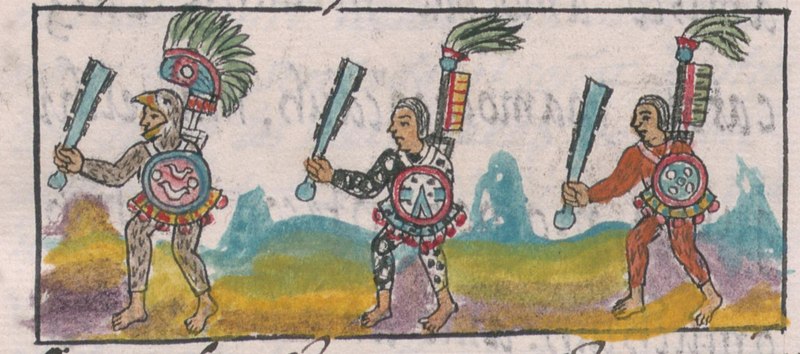
Below:  Aztec warriors practicing a martial art but not yaomachtia or an Asian-style "martial art."
November 08, 2010

Chippewa/Blackfeet fighter on Ultimate Fighter

From warrior to fighter: Dane ‘Red Horse’ Sayers

By Wilhelm MurgDane “Red Horse” Sayers, Turtle Mountain Band of Chippewas/Blackfeet, is an up and coming Mixed Martial Arts fighter currently featured on Spike TV’s reality show, “The Ultimate Fighter.” The show features two camps of fighters who live together for the duration of the show, bringing in the drama of a typical reality TV show, complete with interviews, but during the second half two fighters are pitted against each other for what usually turns out to be a grueling match.

Sayers was one of 28 men picked from an initial group of 600, each time they cut people from the list he was flown to another city where Spike executives would look at his fighting style and his personality.
Comment:  For more on Natives and martial arts, see Commission Shopping for Mixed Martial Arts and Update on "Aztec Martial Art."

September 15, 2010

Commission shopping for mixed martial arts

Athletic commissions have no say on MMA events on tribal lands

By Josh GrossWhen Congress passed the Boxing Safety Reform Act of 1996 and amended it four years later as part of the Muhammad Ali Boxing Reform Act, it ensured among many other things that boxing on Indian reservations would have to meet certain standards and licensing requirements. MMA does not fall under similar legislation, meaning a loophole exists that allows promoters to find willing partners for any kind of fights they please under any rules they choose.

This is how Miller became aware of Shine Fights, a Florida-based MMA promotional company which, after failing to receive licenses in Virginia and Oklahoma, partnered last Friday with the Otoe-Missouria Tribe for an eight-man, one-night tournament at the First Council Casino in Newkirk, Okla.
Comment:  For more on Natives and mixed martial arts (not to be confused with made-up martial arts), see Rezdog the Mixed Martial Artist and Martial Artist Yells War Cries.

Below:  "Tommy Morrison tested positive for HIV in 1996, but didn't need to take a blood test before fighting on a Native American reservation."

September 09, 2010

Update on "Aztec martial art"

Back in 2001, someone named Ruel Macaraeg created a website to "to test whether any of the supernatural powers claimed on behalf of ritual weapons can be validated under controlled scientific conditions." Macaraeg claimed that indigenous and other non-Western societies believed their weapons had magical powers. And that he could prove these people wrong.

As far as I know, his claim about what these societies believed is false. And it's impossible to prove a negative, so his plan was doomed to fail. But because he deemed non-Western societies primitive and superstitious, he earned a Stereotype of the Month nomination.

Correspondent Al Carroll, who brought Macaraeg to my attention, added this note:If you go to the index, you will find "Yaomachtia and the Aztec Empire." This is a martial arts instructor, Manuel Lozano, in Texas who uses what he claims are "Aztec martial arts."

I checked around. No such thing. The instructor later admitted he had picked it up in China. Still, the site owner, Ruel Macaraeg, claims Lozano is "enormously influential" and so will be included even though Lozano admits to being a fraud. Maybe you could include two nominations, one for Macaraeg and one for Lozano.
My response to this:I searched Google to verify that the only references to the alleged Aztec martial art of "yaomachtia," in millions of Web pages, are to "Master" Lozano and his own yaomachtia.com site.On a subsequent page, I debated yaomachtia with Macaraeg, but this is the gist of the story. That was the last I heard of yaomachtia...until now.

Lozano speaks up

Recently I received this e-mail from Lozano, whom I hadn't heard from before. Nine years after the fact, he wanted to set me straight:Dear Mr. Rob Schmidt,

I ran across your website and you mention my name and the martial art of Yaomachtia and you say so many things about and some Ruel Macuareg whoever he is.

I don't know either one of you and neither one of you know me. I don't appreciate your comments about me or this ancient martial art i teach.

Why don't you research correctly what you talk on your so-called website before you talk about it.

You don't know anything about the Pre-Columbian Martial Arts to be making your unbased comments.

Manuel Lozano
Had my research skills failed me? After nine years of indexing pages, was Google loaded with information on yaomachtia? It was time for an update on the subject.

Ask and ye shall receive

I Googled yaomachtia once again and sent Lozano this reply:>> I don't know either one of you and neither one of you know me. I don't appreciate your comments about me or this ancient martial art i teach. <<

Sorry, but I don't need to know you to comment on something I've seen in the media or on the Web.

>> Why don't you research correctly what you talk on your so-called website before you talk about it. <<

I did research the subject before talking about it. But I'll update the research now. Here we go:

http://es.wikipedia.org/wiki/Yaomachtia

Supposedly the Yaomachtia is an ancient martial art originating in Mexico that was created by the Aztecs. It means "lessons of war" in Nahuatl. There is no record about its use in ancient times, nor for present use.

http://www.allempires.net/yaomachtia-mexican-martial-arts_topic7823.html

I believe the guy in Texas teaching it was exposed as a fraud and disappeared. And I've heard it said the word is a modern invention.

It was indeed a martial formation but nothing like a martial art.

http://martialartsworldwide.yuku.com/forum/viewtopic/id/872

Yaomachtia, I'm thinking may not be authentic, or at least not completely authentic.

http://martialartsworldwide.yuku.com/topic/869

Yaomachtia is supposedly an Aztec system of martial arts. You can find out about it at: yaomachtia.com. But don't get your hopes up, unless your willing to shell out the money for the books and videos, you aren't going to find out much. I have repeatedly e-mailed "master" Lozano for more info on this art and he has never responded. I did a search for "yaomachtia" on the internet and came up with a message board for skeptics which claimed that "master" Lozano actually picked up the art of yaomachtia in China so it is not authentic.

The key point may be the first one. No record of yaomachtia in the past or present. So there's no information and nothing to research.

If you want to send me the missing evidence of yaomachtia's use in Aztec times, go ahead. Be sure to include authoritative sources for all your claims. Don't simply cite your own publications and videos. If the claims are credible, I'll update the page.

Rob
Comment:  There you go. Lozano got the update he wanted. I hope it was as satisfying to him as it was to me.

Needless to say, Lozano didn't respond to this e-mail. He has yet to provide a shred of evidence about yaomachtia's existence. The yaomachtia.com website is now defunct.

If Lozano comes across this posting next, my offer still stands. Go ahead and prove yaomachtia's existence to me. Put up or shut up. Until then, I'm still comfortable labeling it a "fictitious" martial art.

For more on the Aztecs, see Were the Aztecs "Murdering Animals?"

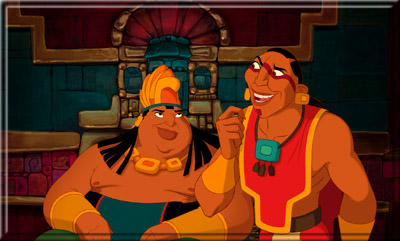
Below:  My impression of Macaraeg's impression of Aztecs: a primitive and superstitious lot. Courtesy of the movie The Road to El Dorado.

August 12, 2010

Jiu-jitsu club on Flathead reservation

406 Jiu-Jitsu Club molds modern warriors

By Adrian JawortThe school started in the Fall of 2008 and is the first Brazilian Jiu-Jitsu club on an Indian reservation in Montana, and perhaps nation as far as Brien knows. He recognizes there are a variety of Mixed Martial Arts schools on reservations throughout the nation. “But for me,” he said, “Brazilian Jiu-Jitsu is really the heart of it.”

Brien competes in MMA fights periodically, and usually wins quickly. “To me, MMA and Jiu-Jitsu are two different things. Jiu-Jitsu is what I do and it’s my hobby, it’s my sport, it’s a daily thing. MMA is the challenge for when I’m in the mood for it.”
Comment:  I'd be willing to bet that this is the first Brazilian Jiu-Jitsu club on any Indian reservation.

The headline reinforces an old stereotype, of course. Every Native athlete is apparently a warrior. Or perhaps every Native is a warrior. "Native receptionist is a phone warrior." "Native dental hygienist is a tooth warrior." Etc.

For more on the subject, see "Rezdog" the Mixed Martial Artist and Martial Artist Yells War Cries.

Below:  "Aaron Brien, shown here on the Crow Reservation, is the head of the 406 Jiu-Jitsu Club on the Flathead Indian Reservation." (Adrian Jawort)

August 08, 2010

Navajo taekwondo champion

Navajo taekwondo champ heads to Singapore

By Babette HerrmannWhen 16-year-old Jessie Bates began practicing taekwondo at the age of 5, it didn’t take her long to realize that she had found her passion in life; it’s one of those pivotal moments that few rarely reach at such a young age.

By the time she was 8, she felt confident, fast and interested in competition–the necessary ingredients in becoming a champion taekwondo fighter. Eight years later, Jessie’s hard work has earned her a spot on a team of six teens representing the United States at the Youth Olympic Games in Singapore, Aug. 14-26.
Comment:  For a related subject, see Navajo Woman Boxer.

Below:  "Jessie Bates, daughter of Chee Bates, is the fighter in blue. She has earned a spot on a team of six teens representing the United States at the Youth Olympic Games in Singapore, Aug. 14-26."

August 13, 2009

"Rezdog" the mixed martial artist

Brawler now fights for respect

Tribal member on rise in mixed martial arts

By Adrian Vore
Virgil Zwicker grew up fighting. He said he brawled pretty much every day. With guys on the San Pasqual Indian Reservation, where he lived. With guys from neighboring reservations. With gang members from Escondido.

“I wanted to fight all the time,” he said.

He scared people.

“I liked having the tough reputation,” said Zwicker, 27. “Some people were my friends because they feared me.”

Thinking back today to that fear, he said, “I hated that.”

Zwicker still fights, but not in the street. All his fights are as a professional mixed martial arts competitor with one of the top teams in the country. He'll take his 6-0 record into the ring tomorrow night in Ontario at the Citizens Business Bank Arena.

The arena will be filled with supporters, friends and family members who view Zwicker as a role model and source of pride for American Indians.

“The tribe looks at him today as an individual who has turned his life around. Kids look up to him,” said Michael Contreras, president of economic development for the San Pasqual Band of Mission Indians, Zwicker's tribe.

Zwicker lives in Valley Center with his wife, Carla; 2½-year-old son, Duke; and 1½-year-old daughter, Maniya.

His journey from brawler to professional athlete, respected member of his tribe and family man took him to Juvenile Hall, group homes, foster homes, Indian youth homes, the California Youth Authority and finally to state prison, where he experienced a spiritual awakening that changed his life and ended the street violence.
And:He fights under the ring nickname of “Rezdog,” in reference to the reservation. He steps into the ring to a grand entry song—“Crowhop” by the Black Lodge Singers—that's used at powwows.

“Once I hear the drums, I'm going to war,” Zwicker said. “I know I can't lose.”
Comment:  For more on the subject, see:

Martial artist yells war cries
Cage fighter doesn't like violence
Mixed martial arts champion
Up-and-coming martial artist

Below:  "Virgil Zwicker said he tries to instill pride and strength in the children on Indian reservations. 'I embrace my role as a fighter—a fighter for my community.'" (John Gastaldo/Union-Tribune)

May 26, 2009

Martial artist yells war cries

A heart pumping the blood of a warriorNative American athletes throughout Oklahoma are commonly known for a dynamic three-point shot or for scoring a record setting touchdown--but known for delivering a knockout karate kick?

Thomas “Thunderkick” Longacre, Muscogee and Absentee Shawnee by blood, is fast becoming the Native American icon in the world of Mixed Martial Arts (MMA).

With over 20 years of martial arts experience, the reigning X-treme Fighting League (XFL) lightweight MMA champion encompasses his Native American culture when preparing for a fight.
And:Longacre, 31, begins each fight journey with a prayer. He doesn’t pray for a win, instead he asks God for “The strength to fight my best and that no one gets seriously hurt.”

Then the war-cries begin.

Released from the depths of his soul, Longacre gives forth a warrior’s war cry. Not just one, but a continuous series of deep echoing, sometimes ear-piercing screams--a sound his opponent is definitely not expecting.

“After I pray, when I’m still in the dressing room, I begin the transformation into this warrior spirit. I want my opponent to know I’m bringing it. I want him to know I’m coming for battle. I’m coming to go to war,” says Longacre. “So I begin hollering louder and louder to make sure my opponent hears me. Then when he sees me, and I’ve got my game face on and I’m hollering directly at him, my opponent knows I’m definitely in the zone.”
Comment:  The war cries sound stereotypical. But I guess that's what actual Indian warriors did before and during their battles.

For more on the subject, see Cage Fighter Doesn't Like Violence, Mixed Martial Arts Champion, and Up-and-Coming Martial Artist.

October 11, 2008

Cage fighter doesn't like violence

Crowd loves pacifist cage fighter

Cage fight fans pack casinoAround 1,500 people packed the Spotlight 29 Casino Thursday for Apocalypse II: The Second Coming, the second caged, mixed martial arts fight night held here since August.

Nine professional fights and three amateurs bouts kept the crowd entertained for nearly three hours. Four of the matches featured fighters from the desert, including the huge crowd favorite, Mike “Tenchu” Mirelez.

A member of the Agua Caliente Band of Cahuilla Indians, Mirelez is a lifelong resident of the Coachella Valley and trains at Tru MMA in Palm Desert.

“I needed insurance for my 5-year-old boy, so I started fighting three years ago,” the 34-year-old Mirelez said.

Mirelez, whose professional record improved to 5-1 on Thursday, is something of an anomaly in the mixed martial arts world. He claims he doesn't like to brawl, and because of his nonviolent nature, refuses to throw elbows—one of the most devastating shots—at his opponents.

“I sure as hell don't do this for the recognition or the glory—I don't like fighting,” Mirelez said. “Every single time I go out there, it's nerve-wracking, because I'm not a violent person and I've got to figure out how I'm going to go in there and win.”
Comment:  For more on the subject, see Winning Through Nonviolence.

August 09, 2008

Mixed martial arts champion

Modern warriorRedcloud Anquoe carried the lessons of his Sioux, Kiowa and Cherokee ancestors with him as he followed the path that led to becoming a mixed martial arts champion. On July 19, Anquoe won the United States Muay Thai Association’s (USMTA) first World Native American Heavyweight Muay Chao Cherk championship belt at the Sac and Fox Casino in Shawnee, Oklahoma.

Anquoe’s fighting style is primarily based on his study of Jiu-Jitsu, the system of unarmed combat developed by Samurai in Japan to fight opponents who had weapons or were wearing armor, but he sees some similarities to Native American traditions. He said in fact, the Japanese people hold Native Americans in very high regard.

“The warrior tradition, it’s not that different,” he said. “It seems like it should be but it’s not.”