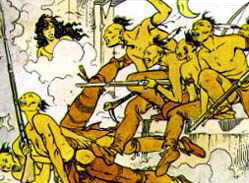
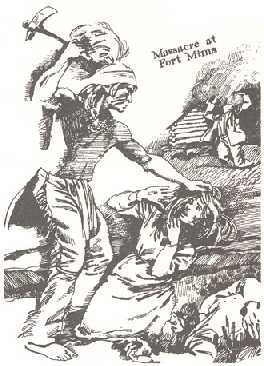
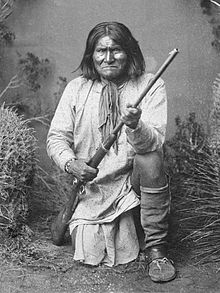
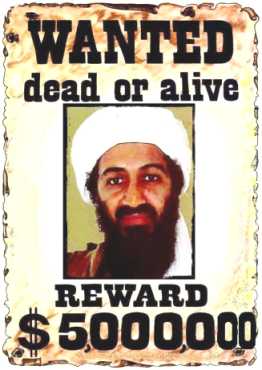
Showing posts with label warlike Indians. Show all posts

April 01, 2016

"Hostile tribes" illustration in Portland Monthly

An Apology From Portland Monthly

The combination of an illustration and a headline in our April issue caused justifiable offense.

By Zach Dundas
Recently, Portland Monthly published a short essay on the subject of school choice, accompanied by an illustration that adapted the standard school-crossing sign to show its stick-figure humans armed with arrow-like weapons. The headline—written by editors, not the freelance writer who contributed the body of the article—used the phrase “hostile tribes” to describe the social tensions arising from the issues discussed in the piece that followed.

Since the illustration and the article title appeared in our April issue and on our website, we have heard from numerous readers and Native American community leaders that this combination of words and images is offensive and derogatory, evoking negative stereotypes of Native Americans.

We erred in publishing this image and title, particularly in combination. We did not intend to offend any person or community, but in this case intention is beside the point. We have heard clearly that we caused pain, anger, and confusion among readers and communities we care about, and we are sorry.

As a first step, the image has been removed from the online version of the article, and the online headline has been changed. We’ll address the situation in print at the first opportunity afforded by our publication schedule, which will be our June issue.


Some thoughts from SorryWatch (!) on how well the Portland Monthly apologized:

Against all odds, another excellent apology, good heavens

July 31, 2015

Town cancels "Indian attack" race

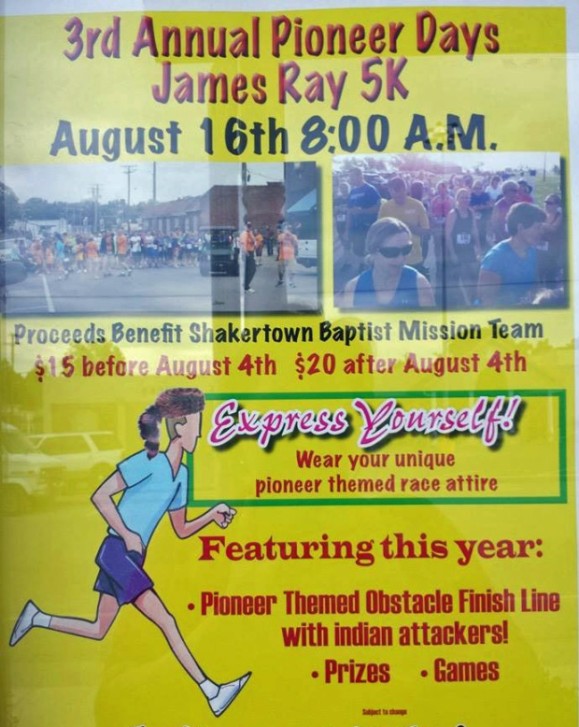
This week's Internet outrage came courtesy of a race in a Kentucky town:

Enter the James Ray 5K to be chased by Native American reenactors

By Larry VaughtIt’s not hard to find a 5K race in this area. Most weekends, especially at this time of year, there is at least one local road race.

However, it’s not every day you can find a 5K—or any race—where American Indians reenactors will chase you to the finish line. Yet that’s exactly what you’ll get Aug. 15 at the James Ray 5K—Indian Attack in Harrodsburg.

“It’s all part of the Pioneer Days weekend,” said race director Terry Wasson.

Last year the event wanted to come up with something to make its 3.1-mile event unique from other races. That’s how the idea of having American Indians reenactors chase runners near the finish line originated, and Wasson said it went over so well that the same plan is in place for this year’s race.

“We’re getting set up for this again,” she said. “The (American Indians reenactors) will chase runners, and it seemed to be something that everybody really enjoyed last year. It was a big hit and came off as unique as we had hoped it would.”

If that’s not enough, Wasson said there will also be a “fort” at the finish line for runners to go into to help portray what it was like for James Ray.


Internet doesn't approve

Ky. festival scraps “Indian Attack” from 5K

By Chris KenningMounting criticism has led a Harrodsburg, Ky. pioneer-themed festival to scrap plans for a 5K run featuring Native American reenactors who chase runners.

An online registration form for the “James Ray 5K--‘Indian Attack’” race suggests runners come in costume and tells them they “can either run or walk, but don’t be surprised if you encounter some obstacles and come under attack when Indians chase you to the finish!”

The Aug. 15 race is to be part of the annual Mercer County Pioneer Days celebration. Race director Terry Wasson did not respond to requests by the Courier-Journal for an interview, but she told the Advocate Messenger newspaper this week that the idea was “a big hit” last year that organizers decided to do it again this year.

But outrage began building online this week. On Thursday, the Indian Country Today Media Network quoted University of Montana Assistant Professor of Native American Studies Theo Van Alst as saying that “in the end, it’s a celebration of the Indian removal of the area.”
Goodbye, Redface Race: 'Indian Attack' Pulled From 5K Run Amid Mounting Pressure

By Simon Moya-SmithSeemingly in response to a tidal wave of opposition, county officials in Kentucky on Thursday pulled a controversial element from its annual 5K race that was widely accosted as racially offensive to Native Americans.

Until Thursday, the “James Ray 5K Indian Attack” race, slated to take place in Harrodsburg, Kentucky, was to include a group of Native American reenactors in redface and dressed in faux Native American garb. The 'Indians' were to chase runners into the safety of an imitation fort at the end of the race, according to reports. The race, which is named for celebrated Indian fighter General James Ray who relocated as a teenager to Kentucky from North Carolina, remains scheduled for August 15.

"All concerns expressed on the James Ray 5K have been heard and the race has been altered accordingly," county officials wrote on its Facebook page. "As stated, we have altered the race to address the concerns brought to our attention. That means there are no Native Americans chasing in the race."

On Thursday, social media was abuzz with responses to the race many considered racist.


Red-face race? “Indian Attack” 5K in Kentucky canceled after Internet clues city in to the sheer awfulness of the idea

Organizers of Harrodsburg's "Pioneer Days" apparently thought this was a good idea, despite it being 2015 and all

Indians on the warpath!

Adrienne Keene explains what's wrong with this event:

James Ray “Indian Attack” 5k: Family fun for everyone!

By Adrienne Keene“General James Ray came to Fort Harrod in Mercer County at age 14 or 15 in 1775 from North Carolina with a party led by Daniel Boone. He served as an Indian spy and hunter for Fort Harrod, served in the campaigns against the American Indians and served several years in the Kentucky Legislature. He also reportedly raced with Blackfish Indian warriors to sound a danger signal to the settlers.”

Question: is this a case of a grammar error or am I correct in reading that James Ray was an Indian hunter? Like, he hunted Indians? Wow. In any case he “served in campaigns against American Indians.” GREAT. LET’S CELEBRATE THAT DUDE.

I just want to break this down for you. A town in Kentucky, which I’m guessing is not a completely Native town, signally how they were physically killed and/or relocated (ie CHASED) out of that land, holds a “pioneer days” festival to “celebrate” that history, complete with a 5k named after a guy who’s job it was to kill Indians…and decided that the best way to “honor” that history was to have white people dress up as the worst Indian stereotypes and chase runners into a fort. And not one single person thought that was a bad idea. In fact, it was so great they did it again!

Speaking of doing it again, here are some choice quotes from the article last year (where the photo at the top comes from):

“Dressed as Native America warriors, Nick Laymon and Kayla Slone giggled as they waited to swoop down with a little extra “fuel” at the James Ray 5K’s finish line. Veins popped out of Laymon’s neck as he and Slone bellowed and shrieked, inspiring more laughter than fear as they chased runners all the way to the finish line.”

Always the “warriors”–what makes them warriors? Like, honestly. Always warriors and princesses. But the “veins popp[ing] out” of his neck? What’s the point of that detail? To make him seem more savage and war-like? Gross.
Comment:  To be clear, the town canceled only the "Indian attack" portion of the 5K. The 5K is still on, as far as we know, but without the reenactors in redface.

Judging by the links below, there's a boomlet of white folks dressing up as Indians in historical pageants. Is this really happening?

For more on redface, see Wyoming Pageant Features Whites in Redface and Ontario Camps Feature Mock Ceremonies.

February 25, 2015

Mound Builders band stereotypes Indians

I just heard of this band calling themselves The Mound Builders. Let's take a look:

Local band looks to ease community into the metal scene

By Kate LewisThe Mound Builders, a self-proclaimed “gumbo” band, combines metal, punk, stoner rock and even a little bit of blues into their one-of-a-kind sound. It’s unconventional, yes, but their diversity is where they feel their appeal lies.

Moreover, The Mound Builders, whose name refers to the ancient civilization that once inhabited the Lafayette area, is all about the local community. Lafayette is where they started almost six years ago, and it’s where they’ll always call home thanks to the area’s supportive music scene.
Here's who the Mound Builders really were:

Mound BuildersThe varying cultures collectively called Mound Builders were inhabitants of North America who, during a 5,000-year period, constructed various styles of earthen mounds for religious and ceremonial, burial, and elite residential purposes. These included the Pre-Columbian cultures of the Archaic period; Woodland period (Adena and Hopewell cultures); and Mississippian period; dating from roughly 3500 BCE to the 16th century CE, and living in regions of the Great Lakes, the Ohio River Valley, and the Mississippi River valley and its tributary waters. Beginning with the construction of Watson Brake about 3500 BCE in present-day Louisiana, nomadic indigenous peoples started building earthwork mounds in North America nearly 1,000 years before the pyramids were constructed in Egypt.The band's name might not be worthy of comment, but their choice of iconography is.

First, a straight ripoff of a Native thunderbird:


A post-apocalyptic Native, I guess. Along with his military gear, his extreme tattooing emphasizes his savage and warlike nature.


Another savage and warlike Native. Note that the mohawk from an Eastern Woodland tribe is inappropriate for a Southern Mound Builder.


And finally, savage Plains Indians on the warpath. Again, the headdresses and war ponies are inappropriate for Mound Builders. In fact, this pre-Columbian civilization didn't have horses.


I assume the last image comes from an old comic book. The painted style looks like something from Gold Key.

If there was any doubt that the band's "thinking" is stereotypical if not racist, this image confirms it. To them, "Mound Builders" are wild and savage--just like their metal band.

October 23, 2014

"Honoring" savage Indians since 1933!

Check Out All This Cool Vintage Redskins Gear!!!

Yikes.

By Jack Shepard
I found this super cool vintage Redskins sweatshirt in the back of my closet today and I thought it would be fun to have a look at all the awesome vintage Redskins gear that’s out there!


Comment:  Who knows? Maybe the first image is supposed a red-skinned potato.

On the bright side, it appears the team was an early supporters of gay rights, judging by the rainbow flags.

Here we see exactly what the Washington team has "honored" since it adopted the "Redskins" name in 1933. Namely, the stereotypical idea of Indians as half-naked, warlike savages.

With their menacing spears and tomahawks and scowls, they'll go on the warpath and kill anyone who opposes them. "Scalp 'em, swamp 'em, we will take 'em big score!"

This message is in the team's original fight song and it's in their merchandise. The whole concept of "Redskins" is racist and has been from the beginning.

May 29, 2014

CFO leaves racist phone message

AUDIO: Tribal chief blasts racist telecommunications CFO

By Susan FieldThe audio and transcription attached to this story contains offensive and vulgar language.

Saginaw Chippewa Tribal Chief Steve Pego on Wednesday denounced the chief financial officer of a telecommunications firm after the man left a Tribal employee a voice mail filled with racial slurs and a veiled threat that is under investigation by the Department of Homeland Security.

Pego also asked all Natives and minority groups to stand with the Tribe in denouncing Kirk Shewchuck of Lansing-based ACD.net, a telecommunications firm that offers fiber optic service, metro ethernet, telephone, hosted phone service, DSL, Datacenter and web hosting services.

Shewchuck left a voice mail May 20 for Saginaw Chippewa Tribal Planning Engineer Donald Seal regarding an easement in which ACD.net wanted to erect a cell phone tower, Tribal Spokesman Frank Cloutier said.

Because the land is in federal trust, the Tribe’s legal department instructed ACD.net to contact the planning department, Cloutier said.

Shewchuck apparently failed to properly hang up his phone after leaving a message for Seal, and racial slurs and vulgarity can be heard on the lengthy voice mail.

On the voice mail, the speaker, identified as Shewchuck, called Tribal members f**king Indians and said “let’s call them red men.”

Shewchuck is also alleged to have said “let’s sic the” Sault or Sioux Tribe “on you!” and “Let’s get a good old fashioned Indian war going!”

A man can be heard saying “woo woo woo woo” and laughing on the message, and later “you know what happens to you cell phone signals...I’ll turn it back on in a few minutes after you agree to...maybe they would like that.”
As someone said, this is what mainstream folks say about Indians when they think no one is listening. Forget all the polite talk you hear in mixed company, which is sanitized to sound respectable. This is the real deal: a window into the soul of racist America.

Apology attempts begin

Lansing firm wants to meet with chief over message; Tribe declines

By Susan FieldA representative of the Lansing-based firm accused of leaving racial slurs and vulgarities on a voice mail to a Saginaw Chippewa Tribal planning department employee said Thursday there was no malice on the part of the man who left the message.

Joe Ross, who said he is ACD.net’s public information manager, also said the telecommunication firm’s chief executive officer, Kevin Schoen, wants to meet in person with Tribal Chief Steve Pego to discuss “concerns” about the voice mail message.

Recorded after ACD.net Chief Financial Officer Kirk Shewchuck apparently did not hang his phone up properly, the message included racist slurs, swearing, threats to “sic” the Sault Tribe to start a “good old fashioned Indian war” and threats about scrambling cell phone signals at the Tribe’s Soaring Eagle Casino and Resort.

Shewchuck identified himself on the message he left for Tribal Planning Engineer Donald Seal when he called to discuss a proposed cell phone tower that the firm wants to construct on trust land, Tribal Spokesman Frank Cloutier said Thursday.

“There’s no malice on Kirk’s part,” Ross said. “We really want to talk to the chief.”

While Ross said he spoke to Cloutier about setting up a meeting, Chief Pego is not interested in sitting down with anyone from ACD.net.

Cloutier confirmed that he spoke to Ross and said that Tribal Council is currently discussing the issue with the Tribe’s legal department.

Tribal Council members are also contemplating going to Saginaw Chippewa Tribal Police because of the possible criminal content in the message related to jamming of cellphone towers, Cloutier said.
Comment:  This incident shows the connection between racial slurs and racist beliefs.

In the CFO's mind, "red men" and "f**king Indians" are synonymous. In particular, "red men" is an inferior subspecies of men. Indians aren't men, they're an odd red-colored variant. They're fake men, like cardboard cutouts, lacking the full-fledged reality of (white) men.

The CFO and his cohorts made this clear when they talked about starting an "Indian war" and made the "woo woo" sound. To them, Indians are warrior thugs who are good for nothing but fighting and killing. They're "red" not only because of their skin but because they paint themselves and end up covered in blood. They're barbarians who lack civilized
beliefs and values.

The same thinking applies to the ethnic slur and team name "Redskins." Indeed, there's a continuum of beliefs from "f**king Indians" to "redskins" to "red men." All are variations on a theme, which is Indians as subhuman savages.

Repeating these slurs instills the corresponding beliefs in people's minds. It's like brainwashing. When you hear "red men," "redskin," and "savage" over and over, you start to believe they're reality. A million people chanting the epithets can't be wrong. Indians must be primitive people of the past because every word and image in our society says so.

February 06, 2014

Warring Indians in Phoenix New Times

The Phoenix New Times recently published this article:

Proposed West Valley Casino Is Pitting Valley Indian Tribes Against One Another

Along with it came this image, which the New Times used on its cover:


Wow...stereotypical much? A headdress, tomahawks, a tipi, feathers, warpaint, and arrows. The first three have nothing to do with Arizona's Indians and are thus false as well as stereotypical.

And as Adrienne Keene tweeted:Not to mention the whole "angry warring Indian" vibe when it's an article abt a legislative disagreement. #stereotypesarerealyallExactly.

To understand the problem, imagine a comparable image: Obama and Republican House members in cowboy gear shooting guns at each other. Such an image might exist, and might tell us something about legislative politics. It wouldn't necessarily be offensive.

But most non-Native conflicts are not framed as murderous warfare with lethal weapons. And most Native conflicts are so framed. If you went solely by the images, you'd conclude that Indians are much more likely than non-Natives to resort to physical violence.

This image contributes to the ongoing vilification of Indians as brutes and barbarians. It's not only stupidly stereotypical to (mis)use Indian motifs from other regions. It's stupidly racist to single out Indians for the "savage" treatment.

February 09, 2013

Why The World Until Yesterday is wrong

Ever since Guns, Germs, and Steel, Jared Diamond has been writing about the history of civilization in general and indigenous people in particular. One critic says Diamond's latest book is fatally flawed.

Savaging Primitives: Why Jared Diamond’s ‘The World Until Yesterday’ Is Completely Wrong

By Stephen CorryJared Diamond’s new book, The World Until Yesterday, is completely wrong, writes Stephen Corry. Diamond argues that industrialized people (‘modern’) can learn from tribal peoples (‘traditional’) because they show how everyone lived until a few thousand years ago. Corry agrees that ‘we’ can learn from tribes, but counters they represent no more of a throwback to our past than anyone else does. He shows that Diamond’s other—and dangerous—message is that most tribes engage in constant warfare. According to Diamond, they need, and welcome, state intervention to stop their violent behavior. Corry argues that this is merely a political opinion, backed by questionable and spurious data. He sees Diamond’s position as one of supporting colonial ideas about ‘pacifying savages’ and says it is factually and morally wrong.Diamond makes two noteworthy claims that Corry disputes:

Tribal societies are staticIt is true that Diamond does briefly mention, in passing, that all such societies have “been partly modified by contact,” but he has still decided they are best thought about as if they lived more or less as all humankind did until the “earliest origins of agriculture around 11,000 years ago in the Fertile Crescent,” as he puts it. That is his unequivocal message, and the meaning of “yesterday” in his title. This is a common mistake, and Diamond wastes little of his very long book trying to support it. The dust jacket, which he must agree with even if he did not actually write it, makes the astonishingly overweening claim that “tribal societies offer an extraordinary window into how our ancestors lived for millions of years” (my emphasis).

This is nonsense. Many scientists debunk the idea that contemporary tribes reveal anything significantly more about our ancestors, of even a few thousand years ago, than we all do. Obviously, self-­sufficiency is and was an important component of the ways of life of both; equally obviously, neither approach or approached the heaving and burgeoning populations visible in today’s cities. In these senses, any numerically small and largely self-­sufficient society might provide something of a model of ancient life, at least in some respects. Nevertheless, tribal peoples are simply not replicas of our ancestors.

Britain’s foremost expert on prehistoric man, Chris Stringer of London’s Natural History Museum, for example, routinely cautions against seeing modern hunter-­gatherers as “living fossils,” and repeatedly emphasizes that, like everyone else, their “genes, cultures and behaviors” have continued to evolve to the present. They must have changed, of course, or they simply would not have survived.

It is important to note that, although Diamond’s thesis is that we were all once “hunter-­gatherers” and that this is the main key to them being seen as our window into the past, in fact most New Guineans do little hunting. They live principally from cultivations, as they probably have for millennia. Diamond barely slips in the fact that their main foodstuff, sweet potato, was probably imported from the Americas, perhaps a few hundred or a thousand years ago. No one agrees on how this came about, but it is just one demonstration that “globalization” and change have impacted on Diamond’s “traditional” peoples for just as long as on everyone else. Disturbingly, Diamond knows these things, but he does not allow them to spoil his conclusions.
Tribal societies are violentThe real problem with Diamond’s book, and it is a very big one, is that he thinks “traditional” societies do nasty things which cry out for the intervention of state governments to stop. His key point is that they kill a lot, be it in “war,” infanticide, or the abandonment, or murder, of the very old. This he repeats endlessly. He is convinced he can explain why they do this, and demonstrates the cold, but necessary, logic behind it. Although he admits to never actually having seen any of this in all his travels, he supports his point both with personal anecdotes from New Guinea and a great deal of “data” about a very few tribes—a good proportion of it originating with the anthropologists mentioned above. Many of his boldly stated “facts” are, at best, questionable.

How much of this actually is fact, and how much just personal opinion? It is of course true that many of the tribes he cites do express violence in various ways; people kill people everywhere, as nobody would deny. But how murderous are they exactly, and how to quantify it? Diamond claims that tribes are considerably more prone to killing than are societies ruled by state governments. He goes much further. Despite acknowledging, rather sotto voce, that there are no reports of any war at all in some societies, he does not let this cloud his principal emphasis: most tribal peoples live in a state of constant war.

He supports this entirely unverifiable and dangerous nonsense (as have others, such as Steven Pinker) by taking the numbers killed in wars and homicides in industrialized states and calculating the proportions of the total populations involved. He then compares the results with figures produced by anthropologists like Chagnon for tribes like the Yanomami. He thinks that the results prove that a much higher proportion of individuals are killed in tribal conflict than in state wars; ergo tribal peoples are more violent than “we” are.

There are of course lies, damned lies, and statistics. Let us first give Diamond the benefit of several highly debatable, not to say controversial, doubts. I will, for example, pass over the likelihood that at least some of these intertribal “wars” are likely to have been exacerbated, if not caused, by land encroachment or other hostilities from colonist societies. I will also leave aside the fact that Chagnon’s data, from his work with the Yanomami in the 1960s, has been discredited for decades: most anthropologists working with Yanomami simply do not recognize Chagnon’s violent caricature of those he calls the “fierce people.” I will also skate over Kim Hill’s role in denying the genocide of the Aché Indians at the hands of Paraguayan settlers and the Army in the 1960s and early 1970s. (Though there is an interesting pointer to this cited in Diamond’s book: as he says, over half Aché “violent deaths” were at the hands of nontribals.)

I will also throw only a passing glance at the fact that Diamond refers only to those societies where social scientists have collected data on homicides, and ignores the hundreds where this has not been examined, perhaps because—at least in some cases—there was no such data. After all, scientists seeking to study violence and war are unlikely to spend their precious fieldwork dropping in on tribes with little noticeable tradition of killing. In saying this, I stress once again, I am not denying that people kill people—everywhere. The question is, how much?

Awarding Diamond all the above ‘benefits of doubt’, and restricting my remarks to looking just at “our” side of the story: how many are killed in our wars, and how reasonable is it to cite those numbers as a proportion of the total population of the countries involved?

Is it meaningful, for example, to follow Diamond in calculating deaths in the fighting for Okinawa in 1945 as a percentage of the total populations of all combatant nations—he gives the result as 0.10 percent—and then comparing this with eleven tribal Dani deaths during a conflict in 1961. Diamond reckons the latter as 0.14 percent of the Dani population—more than at Okinawa.

Viewed like this, the Dani violence is worse that the bloodiest Pacific battle of WWII. But of course the largest nation involved in Okinawa was the U.S., which saw no fighting on its mainland at all. Would it not be more sensible to look at, say, the percentage of people killed who were actually in the areas where the war was taking place? No one knows, but estimates of the proportion of Okinawa citizens killed in the battle, for example, range from about 10 percent to 33 percent. Taking the upper figure gives a result of nearly 250 times more deaths than the proportion for the Dani violence, and does not even count any of the military killed in the battle.

Similarly, Diamond tells us that the proportion of people killed in Hiroshima in August 1945 was a tiny 0.1 percent of the Japanese people. However, what about the much smaller “tribe” of what we might call “Hiroshimans,” whose death toll was nearly 50 percent from a single bomb? Which numbers are more meaningful; which could be seen as a contrivance to support the conceit that tribespeople are the bigger killers? By supposedly “proving” his thesis in this way, to what degree does Diamond’s characterization differ significantly from labeling tribal peoples as “primitive savages,” or at any rate as more savage than “we” are?

If you think I am exaggerating the problem—after all, Diamond does not say “primitive savage” himself—then consider how professional readers of his book see it: his reviewers from the prestigious Sunday Times (U.K.) and The Wall Street Journal (U.S.) both call tribes “primitive,” and Germany’s popular Stern magazine splashed “Wilde” (“savages”) in large letters across its pages when describing the book.

Seek and you shall find statistics to underscore any conceivable position on this. Diamond is no fool and doubtless knows all this—the problem is in what he chooses to present and emphasize, and what he leaves out or skates over.
Comment:  Diamond repeats the claims about murderous indigenous savages popularized in books such as War Before Civilization. I criticized this book in Methodology of War Before Civilization and Indians in War Before Civilization. I'm glad to see that Stephen Corry's arguments tally with mine.

As Corry notes, many of the claims for warlike Indians come from Napoleon Chagnon's study of the Yanomami people. For more on that subject, see Review of Fierce People and The Yanomami Scandal.

Finally, for more on Diamond's work, see Diamond Wrong About Easter Island and Educating Tony About Genocide.

December 18, 2011

Were Indian tribes nomadic?

A perennial assertion of anti-Indians forces is that Indian tribes were nomadic.  These tribes wandered aimlessly like flocks of birds, grazing off the land like herds of animals.

The point of this assertion is obvious.  If the Indians were wanderers, they didn't own or occupy any land.  They had no rights to their territories and the associated natural resources.

It also becomes difficult to imagine them as "nations" with laws and governments.  Or as cultures with places of worship and ties to the land.  Wanderers supposedly have nothing permanent; their existence is a constant series of changes.

Therefore, goes this "thinking," their claims of sovereignty are suspect.  They have no more rights than the Euro-Americans who displaced them.  Finders keepers, losers weepers.

A little thought shows how stupid this "nomadic" myth is.  Consider some basic aspects of traditional tribal history and culture:

  • Pyramids
  • Mounds
  • Ruins
  • Cliff dwellings
  • Pueblos ("villages")
  • Lodges
  • Hogans
  • Longhouses
  • Plank houses
  • Totem poles
  • Sacred sites
  • Burial grounds

  • In addition, we know Pocahontas supposedly saved John Smith in a Powhatan village.  The Pilgrims settled on the site of a Patuxet village.  Lewis and Clark stopped at several Indian villages along their route.  Etc.

    The common theme here is permanence.  Almost everything we know about Indians says they settled and lived in one place.  Once you build a mound, longhouse, or totem pole, you probably don't carry it around with you.  Or leave it after you've invested so much time in it.

    There's really only one exception to this rule.  Namely, the tribes of the Plains and a few areas of the West--e.g.,  the Rocky Mountains and Great Basin.  These Indians are known for living in temporary camps of tipis, wickiups, and similar structures.  

    Unfortunately, these are the stereotypical Indians of American mythology.  For many people, they're the only Indians they know about.  The only ones who count.  Never mind that we're talking about only one or two cultural regions of a dozen on the North American continent.  To these people, Plains Indians = all Indians.

    Even for the Plains tribes, the "nomadic" label is dubious.  Some went from summer to winter camps and back, which isn't any more nomadic than a millionaire who moves from one mansion to another.  Some may have moved through a well-established cycle of different locations.  Some were forced to move by the incursion of other Indians or the white man.

    Unless a tribe moved voluntarily and randomly, I wouldn't call it nomadic.  I don't know of any studies on the subject, but I'd say "nomadic" applies to only a minority of the thousands of pre-contact tribes.  Possibly a small minority.

    For more on the subject, see Ayn Rand, Racist and Indians in War Before Civilization.

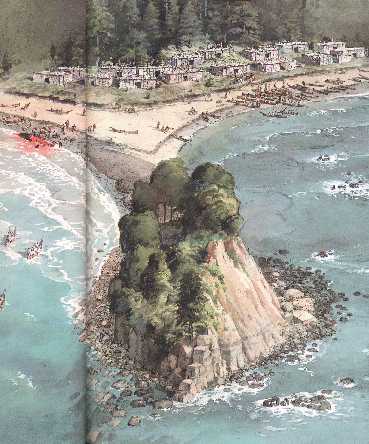
    Below:  A typical Pacific Northwest Indian village.

    December 17, 2011

    What did Indians fight over?

    A question:

    Conservatives claim Indians 1) fought bloody wars before the Europeans came, and 2) had no sense of territorial rights or ownership. So what were they fighting over: which tribe had the best dance moves?

    If you've got an answer, feel free to share it with us.  I'd love to hear all the answers that don't involve possession of the land and its resources.

    For more on warlike Indians, see "Geronimo" = Codename for Step "G"? and Cree Win Fort Battleford Battle.

    May 21, 2011

    "Geronimo" = codename for step "G"?

    A blogger has tried to deny that the US gave Osama bin Laden the codename "Geronimo." He writes:

    Fox News:  Osama's Code Name Not Geronimo

    By R. Cort KirkwoodIt looks like the Indians upset about the military's using the code-word Geronimo during the operation to kill Osama bin Laden can settle down and smoke the peace pipe.

    According to Fox News, the name of the famous Chiracahua Apache was not the code name for Osama. The news emerges in a long, dramatic story that details the raid. The mission to kill the world's most wanted man, Fox reports, nearly failed.

    But more importantly for Indians, the memory of Geronimo was not besmirched.
    The "Fox News account actually is an Associated Press account posted on the Fox News site. In any case, here's the key paragraph:

    Sources:  Navy SEALs Knew Bin Laden Mission Was One-Shot DealBack at the White House Situation Room, word was relayed that bin Laden had been found, signaled by the code word "Geronimo." That was not bin Laden's code name, but rather a representation of the letter "G." Each step of the mission was labeled alphabetically, and "Geronimo" meant that the raiders had reached step "G," the killing or capture of bin Laden, two officials said.And Kirkwood's response:In other words, the Indians upset about code name Geronimo went scalp-hunting for no reason.Wow, that "scalp-hunting" crack wasn't too racist or offensive. Let's ignore it for now and dissect Kirkwood's claim.

    Why Kirkwood is wrong

  • We have quotes from President Obama, CIA director Leon Panetta, and two others referring to "Geronimo" as a particular person, bin Laden. Why should we believe two unnamed officials over Obama and the others? Kirkwood doesn't say.

  • Who are these unnamed officials and what's their agenda? If they were responding to the "Geronimo" controversy, they probably wanted to portray the mission in the best possible light. They may have exaggerated or misstated the facts to protect the president.

  • This claim doesn't square with the other theories floated by the White House: that the name referred to the mission (not the target or step "G"). Or that the name was chosen at random. Is there any reason to think the officials aren't floating another false questionable theory?

  • The officials claimed "Geronimo" was a representation of the letter "G." But it's not clear if they also claimed "Geronimo" wasn't bin Laden's codename. That may be an interpretation by the Associated Press, not a claim by the officials. Maybe "Geronimo" represented the letter "G" and the target bin Laden. There's no reason it couldn't be both.

  • Naming the step "Geronimo" has the same problems as naming the mission "Geronimo." It's still an intentional choice, not some sort of unfortunate coincidence. It still associates Geronimo with modern history's most reviled terrorist. If the "step G" claim isn't a fabrication, most people won't hear about it or get it. All they'll remember is bin Laden = "Geronimo."

  • A commenter adds:Very strange explanation since the phonetic code for "G" is "golf," not "Geronimo." Not sure I'm buying that spin.Indeed.

    Kirkwood's racist language

    Speaking of agendas, Kirkwood is probably another conservative using the language of savagery to smear Indians. Check out the verbiage in his blog:

  • "Drums Along The Potowmack"

  • "In using Geronimo's name, Indians claimed, the White House went way off the PC reservation."

  • "Thus did the war dance begin."

  • "Such was the war cry...."

  • "Time For A Peace Treaty"

  • "Geronimo was not, contrary to smoke signals clouding up the Internet, the name for Osama."

  • "Depp, whose appearance suggests a man one arrow short of a full quiver...."

  • And the aforementioned:

  • "[T]he Indians upset about code name Geronimo went scalp-hunting for no reason."

  • Wow again. Every reference of Kirkwood's paints Indians as warlike. They beat their tom-toms, go off the reservation, do a war dance and war cry, send up smoke signals to rally others to war, and finally go hunting scalps. And they need a peace treaty to pacify them. Could it be any clearer that Kirkwood thinks Indians are savages?

    For more on the subject, see Advocates Criticize Codename at Hearing and Apaches Demand Apology for Codename.

    May 03, 2011

    Critics slam "Geronimo" codename

    Natives and non-Natives alike were quick to slam the US designation of Osama bin Laden as "Geronimo." Here are some of the many reactions from Natives:

    Ben Carnes:

    Osama bin Laden:  code-named GeronimoAs a Native man, I was genuinely stunned to learn the US had selected the name of a hero who fought to defend his people and way of life. We've been reduced to caricatures as mascots and entertainment in sports and media. Our Identity as Native people have been confiscated and labeled as "Native Americans" or "American Indians." Then to associate one of our icons of resistance is an insult. I can't even begin to imagine the horror felt by Geronimo's descendants or his people, the Chiricahua Apache. They were branded as Americans in 1924 before they were pardoned as prisoners of war, ironically.

    I felt a more appropriate name would have been "Custer" or "Columbus", both murderers, but this doesn't fit with their version of history. And you would think Obama, the president who campaigned for Native votes would have been more sensitive to this point when he said, "I'm on your side. I understand what it means to be an outsider. I know what it means to feel ignored and forgotten, and what it means to struggle. So you will not be forgotten as long as I'm in this White House...."
    Steve Newcomb:

    Geronimo Again?  The Indian Wars Continue Ad NauseamWhat the hell were they thinking? Why would the first African American President of the United States, as U.S. Commander in Chief, think nothing of U.S. military forces applying the code name “Geronimo” to Osama bin Laden during the reported assault against that long-sought enemy of the United States? Apparently, having an African American President in the White House is not enough to overturn the more than 200-year American tradition of treating and thinking of Indians as enemies of the United States.

    Question: Did President Barack Obama point out to his military brass that such a disrespectful use of Geronimo’s name was inappropriate? Probably not.
    Tom Holm and Suzan Shown Harjo:

    American Indians object to ‘Geronimo’ as code for bin Laden raid“I was celebrating that we had gotten this guy and feeling so much a part of America,” Tom Holm, a former Marine, a member of the Creek/Cherokee Nations and a retired professor of American Indian studies at the University of Arizona, said by phone Tuesday. “And then this ‘Geronimo EKIA’ thing comes up. I just said, ‘Why pick on us?’ Robert E. Lee killed more Americans than Geronimo ever did, and Hitler would seem to be evil personified, but the code name for bin Laden is Geronimo?”

    Suzan Shown Harjo, president of the Morning Star Institute, a Native American advocacy group based in Washington, has long fought against the use of Indian imagery in American life (including as the mascot of the Washington Redskins).

    She sighed when asked about the latest iteration of Geronimo.

    “It’s how deeply embedded the ‘Indian as enemy’ is in the collective mind of America,” she said. “To this day, when soldiers are going into enemy territory, it’s common for it to be called ‘Indian country.’”
    The Onondaga Nation Council of Chiefs:

    New York:  "We've ID'd Geronimo"--102 Years After His Death Geronimo Is Still Being Killed By U.S. ForcesThis is a sad commentary on the attitude of leaders of the U.S. military forces that continue to personify the original peoples of North America as enemies and savages. The use of the name Geronimo as a code name for Osama Bin Laden is reprehensible. Think of the outcry if they had used any other ethnic group's hero. Geronimo bravely and heroically defended his homeland and his people, eventually surrendering and living out the rest of his days peacefully, if in captivity, passing away at Fort Sill, Oklahoma in 1909. To compare him to Osama Bin Laden is illogical and insulting. The name Geronimo is arguably the most recognized Native American name in the world, and this comparison only serves to perpetuate negative stereotypes about our peoples. The U.S. military leadership should have known better.Loretta Tuell:

    Senate official:  Wrong to link bin Laden, GeronimoThe staff director and chief counsel for the Senate Indian Affairs Committee, Loretta Tuell, says it is inappropriate to link whom she calls "one of the greatest Native American heroes" with one of the most hated enemies of the United States.The NCAI:

    NCAI Releases Statement on Use of “Geronimo” as Name for Osama bin Laden Operation“To associate a Native warrior with bin Laden is not an accurate reflection of history and it undermines the military service of Native people. It’s critical that military leaders and operational standards honor the service of those who protect our freedom.”Non-Natives agree

    CBS News:

    Osama bin Laden is no GeronimoGeronimo was fighting for his land, and committed what U.S officials at the time might have called acts of terrorism, conducting raids on white settlers in Apache territory. U.S. officials said they could convict Geronimo and his fighters of murder, and exiled the outlaw Apache to Florida as a prisoner of war, never to return to his homeland.

    But bin Laden was in a completely different league. The al Qaeda leader was a mass murderer, out to destroy Western civilization, not primarily to protect his lands.
    Lise Balk King:

    Bin Laden Code-name “Geronimo” Is a Bomb in Indian CountryAs news of bin Laden’s death spread relief across America and the world, revelations that the assigned code name of Enemy Number One was “Geronimo,” a legendary Apache leader, caused shock waves in Indian communities across the country. It is being interpreted as a slap in the face of Native people, a disturbing message that equates an iconic symbol of Native American pride with the most hated evildoer since Adolf Hitler.

    The death of bin Laden is arguably the most important news story of the year, and embedded within it is a message that an Indian warrior, a symbol of Native American survival in the face of racial annihilation, is associated with modern terrorism and the attacks on 9/11.

    The “bin Laden is dead” news story will make thousands of impressions on the minds of people around the globe, and the name Geronimo will now be irrevocably linked with the world’s most reviled terrorist.
    Susan Hogan:

    Geronimo nothing like Osama bin LadenEarth to President Obama: The Apache Nation thinks you and the U.S. military are sorely in need of diversity training--and that’s putting it mildly.

    Tribal members are offended that the U.S. code name for the mission to capture Osama bin Laden was "Geronimo," an Apache hero whom they insist was never a terrorist.

    "It’s insulting and hurtful," said Vernon Petago, a member of the Jicarillia Apache Tribe at the northern tip of New Mexico. "What were they thinking? They applied a respected Apache leader’s name to the most despicable terrorist in the world."
    Comment:  These are only a day's worth of responses in the mainstream media. If you hung out on Facebook or Twitter, you probably could see a hundred times as many complaints.

    For more on the subject, see Why US Chose "Geronimo" Codename and Bin Laden Codenamed "Geronimo."

    May 02, 2011

    Bin Laden codenamed "Geronimo"

    Geronimo Is KIA

    By Todd "Turbo" WatsonFinally, NBC’s Chuck Todd informed us via Twitter this morning that Osama’s code name for this raid was “Geronimo,” and that the call came in as “Geronimo is KIA” (killed in action).

    There are some parallels between the renowned Apache leader and Bin Laden.

    Like Bin Laden, Geronimo was once surrounded by U.S. soldiers in the Robledo Mountains of southwest New Mexico, hidden in a cave from which he seemingly never came out. But somehow, he escaped, both from the cave, and from the clutches of U.S. soldiers.

    A story that is, of course, eerily reminiscent of Bin Laden being similarly trapped in caves in the mountains of Tora Bora in December 2001, from which he also escaped.

    But not this time.
    After Uncertainty, a Moment of Triumph in the Situation Room:  ‘We’ve IDed Geronimo’

    By Michael SchererMinutes later, more word came over the transom. “We’ve IDed Geronimo,” said a disembodied voice, using the agreed-upon code name for America’s most wanted enemy, Osama bin Laden. Word then came that Geronimo had been killed.Curiously, Time has changed the quote from "We’ve IDed Geronimo" to "Visual on Geronimo." To me this makes it even more clear that "Geronimo" was the target. Whether someone uttered the first quote, the second, or both, he was referring to bin Laden. Bin Laden was "Geronimo."

    Osama bin Laden codename "Geronimo"

    http://whitehouse.blogs.cnn.com/2011/05/02/osama-bin-laden-codename-geronimo/


    [The link showed nothing other than a cropped version of this photo and the single line of hypertext. The page was removed a few hours later and the link no longer works.]

    Osama bin Laden dead:  code name Geronimo

    As President Barack Obama and his team sat on tenterhooks in the Situation Room, the CIA director Leon Panetta broke the silence with the memorable words: "We have a visual on Geronimo."

    Comment:  The direct quote from Leon Panetta, following the other bits of evidence, seems conclusive. Bin Laden was codenamed "Geronimo."

    Which genius thought of this codename? I look forward to the next terrorist labeled "Chivington," "Custer," or "Jackson."

    As I said to Native journalist Rob Capriccioso, who's looking into the matter, "If you get a spokesperson, ask how many other racist codenames the US military has in its repertoire."

    There's absolutely no truth to the rumor that Ayman al Zahawiri, the new Terrorist no. 1, has been codenamed "Harriet Tubman," "Cesar Chavez," or "Malcolm X."

    Just wondering...will the first book or movie based on Bin Laden's death be called Codename: Geronimo? Or How the US Killed Geronimo: The Terrorist, Not the Indian?

    In related news, US Considers Aboriginal Groups Threats. The Pentagon thought about naming them after Indians. But then realized, "Wait a sec, they're already Indians."

    How about naming one of our sports teams the "Al Qaeda Terrorists"? Too soon?

    Eventually, we should "honor" them for valiantly fighting for what they believe in, right?

    I guess this explains why Obama didn't talk about national security at the first tribal summit. The whole "Bin Laden as Geronimo" thing might not have gone down well.

    I wonder if the US used Apache helicopters to kill "Geronimo." Another reason why Indian names don't belong in the military.

    There's no truth to the rumor that the next anti-American terrorist who tries to destroy the Union will be codenamed "Robert E. Lee."

    US backtracks on racist slur

    Now people are saying Operation Kill the Terrorist was codenamed Operation Geronimo. As if that's totally different, or better.

    The operation to finish off Al Qaeda will now be named Operation Martin Luther King Jr. Because it will bring peace to the world. Yeah, right!

    Too bad a thousand blogs already have reported that Bin Laden was codenamed "Geronimo."

    Here's what the mainstream media is now saying:

    Osama Bin Laden Operation Ended With Coded Message 'Geronimo-E KIA'

    By Jake Tapper, et al.The first indication for President Obama that Osama bin Laden had been killed came when a Navy SEAL sent back the coded message to Washington that said simply, "Geronimo-E KIA."

    Geronimo was the code name for the operation that sent two teams of 12 SEALS zooming by Blackhawk helicopters to a walled compound in Abbotabad, Pakistan, on Sunday to kill or capture the most wanted man in the world. Anxious White House officials weren't positive that they would find bin Laden in the fortress-like complex, that he might leave while the SEALS were en route.

    The first encouraging word came at the beginning of the raid when the SEALS recognized the man who had eluded a U.S. manhunt for a decade. They sent back the message, "Geronimo."

    After a 40-minute search of the compound, punctuated by firefights, bin Laden was dead, and the cryptic "Geronimo-E KIA" code sent relief through the White House. E stood for enemy and KIA for killed in action.
    So they named the terrorist mission as well as the terrorist "Geronimo"? So what?

    Even this carefully worded cover-up makes the point pretty clear. When the troops saw bin Laden, they responded with the code "Geronimo." When they killed bin Laden, they responded with the code "Geronimo-E KIA." Conclusion: Bin Laden was "Geronimo."

    But suppose they'd named only the mission "Geronimo"? The mission to kill an anti-American terrorist? I don't see how that would be significantly better. The offense is associating Geronimo with terrorism. The details don't matter.

    I suspect CNN is trying to cover its ass after reporting the "codename Geronimo" business. It's probably regurgitating spin from the White House.

    The official spin: "We thought: If we're going to kill someone, 'Geronimo' is a great codename. It has nothing to do with the target being a killer. See the difference? Americans are the bloodthirsty, murdering savages here, not bin Laden."

    Wow, thanks for making that clear, people. When someone is planning to execute someone else, "Geronimo" is a good codename to use. But that doesn't imply anything negative or stereotypical about Geronimo? R-i-i-ght.

    For more on the subject, see Obama Gets Osama! and Seminoles Compared to al Qaeda.

    May 01, 2011

    US considers Aboriginal groups threats

    U.S. considers ‘Native Canadian groups’ as possible terror threats:  embassy cables

    By Jorge BarreraThe U.S. has been keeping regular intelligence on potential security threats in Canada, including the activities of unnamed First Nations groups, according to two cables sent by the U.S. embassy in Ottawa and obtained by APTN National News.

    The cables, labelled “secret,” were given to APTN by whistle-blower website Wikileaks. They were in a batch of about 800 cables that were not part of this week’s larger release of U.S. State Department cables originating in Canada.
    And:Under the subheading “Demonstrations,” the information details the size, type and frequency of demonstrations, highlighting those targeting the U.S. and its domestic and foreign policies.

    “Human rights groups, small political protest/grass roots organizations and Canadian Aboriginal groups are prone to carrying out demonstrations aimed at the host government and sponsor anti-U.S. demonstrations,” reads the cable from 2009.
    Comment:  For more on the subject, see Seminoles Compared to Al Qaeda and Yesterday's Cherokees = Today's Muslims.

    October 21, 2010

    Cree win Fort Battleford battle

    Cree win war of words over ‘siege’ of Fort Battleford 125 years ago

    By Bob WeberThe Cree have finally won the “siege” of Fort Battleford–125 years after the battle was fought.

    Parks Canada has agreed to stop using the word “siege” in its posters and programming to describe the sometimes violent, sometimes tragic events at the frontier community during the Northwest Rebellion. An aboriginal historian had pointed out that while settlers gathered in the fort in fear, no attack ever came and there was no siege.

    “We don't want to use any wordings that could give people the wrong idea,” said Mark Calette, Parks Canada's supervisor of historic sites in southern Saskatchewan.

    For years, Parks Canada has re-enacted the fort's role in the Northwest Rebellion and advertised the confrontation on posters and other material as the “Siege of Fort Battleford.”
    Comment:  For more on the subject, see Siege Re-Enactment Is Unfair.

    October 12, 2010

    Capitalism killed the Indians

    Exposing the GOP's Shameful Historical Role in the Native American Genocide

    How the Native American extermination campaigns merged the dangerous forces of a standing army with the business/political interests of the Republican Party.

    By Thomas DiLorenzo


    How the situation started:The real culture of violence in the American West of the latter half of the 19th Century sprang from the U.S. government’s policies toward the Plains Indians. It is untrue that white European settlers were always at war with Indians, as popular folklore contends.

    Trade and cooperation with the Indians were much more common than conflict and violence through the first half of the 19th Century.

    Terry Anderson and Fred McChesney relate how Thomas Jefferson found that during his time negotiation was the Europeans’ predominant means of acquiring land from Indians. By the 20th Century, some $800 million had been paid for Indian lands.
    The first half of the 19th century gave us the War of 1812, the Black Hawk War, the Trail of Tears, and the Seminole Wars, so I'm not sure trade and cooperation were "much more common."

    Perhaps trade and cooperation were much more common in the 18th century. In the first half of the 19th century, it was more like 50% cooperation and 50% conflict. In the last half of the 19th century, it became almost 100% conflict.


    Civil War ended...what's next?

    How the situation changed after the Civil War:A standing army, according to Anderson and McChesney, “creates a class of professional soldiers whose personal welfare increases with warfare, even if fighting is a negative-sum act for the population as a whole.”

    The change from militia to a standing army took place in the American West immediately upon the conclusion of the War Between the States. The result, write Anderson and McChesney, was that white settlers and railroad corporations were able to socialize the costs of stealing Indian lands by using violence supplied by the U.S. Army.

    On their own, they were much more likely to negotiate peacefully. Thus, “raid” replaced “trade” in white–Indian relations. Congress even voted in 1871 not to ratify any more Indian treaties, effectively announcing that it no longer sought peaceful relations with the Plains Indians.
    Why the situation changed:On June 27, 1865, General William Tecumseh Sherman was given command of the Military District of the Missouri, which was one of the five military divisions into which the U.S. government had divided the country.

    Sherman received this command for the purpose of commencing the 25-year war against the Plains Indians, primarily as a form of veiled subsidy to the government-subsidized railroad corporations and other politically connected corporations involved in building the transcontinental railroads.

    These corporations were the financial backbone of the Republican Party. Indeed, in June 1861, Abraham Lincoln, former legal counsel of the Illinois Central Railroad, called a special emergency session of Congress not to deal with the two-month-old Civil War, but to commence work on the Pacific Railway Act.

    Subsidizing the transcontinental railroads was a primary (if not the primary) objective of the new Republican Party.
    And:Sherman wrote in his memoirs that as soon as the war ended, “My thoughts and feelings at once reverted to the construction of the great Pacific Railway. … I put myself in communication with the parties engaged in the work, visiting them in person, and assured them that I would afford them all possible assistance and encouragement.”

    “We are not going to let a few thieving, ragged Indians check and stop the progress [of the railroads],” Sherman wrote to Ulysses S. Grant in 1867. [See Michael Fellman’s Citizen Sherman: A Life of William Tecumseh Sherman.]


    How to eliminate the Indians

    The final solution to the "Indian problem":President Grant made his old friend Sherman the army’s commanding general, and another Civil War luminary, General Phillip Sheridan, assumed command on the ground in the West.

    “Thus the great triumvirate of the Union Civil War effort,” writes Sherman biographer Michael Fellman, “formulated and enacted military Indian policy until reaching, by the 1880s, what Sherman sometimes referred to as ‘the final solution of the Indian problem.’”

    What Sherman called the “final solution of the Indian problem” involved “killing hostile Indians and segregating their pauperized survivors in remote places.”

    “These men,” writes Fellman, “applied their shared ruthlessness, born of their Civil War experiences, against a people all three [men] despised. … Sherman’s overall policy was never accommodation and compromise, but vigorous war against the Indians,” whom he regarded as “a less-than-human and savage race.”

    All of the other generals who took part in the Indian Wars were “like Sherman [and Sheridan], Civil War luminaries,” writes Sherman biographer John Marszalek. “Their names were familiar from Civil War battles: John Pope, O. O. Howard, Nelson A. Miles, Alfred H. Terry, E. O. C. Ord, C. C. Augur . . . Edward Canby . . . George Armstrong Custer and Benjamin Garrison.” General Winfield Scott Hancock also belongs on this list.
    Not coincidentally, the second half of the 19th century is when the first inklings of mass media started appearing. Americans started seeing touring shows of paintings...dime novels...Wild West shows...and the first photographs. These featured cowboys and Indians prominently.

    Our national mythology of cowboys and Indians came about precisely because we were prosecuting a war against the Indians. Thus we cast ourselves as the brave, noble cowboy-soldiers in the mold of George Armstrong Custer and Theodore Roosevelt. This model would become enshrined in the national consciousness by Western movies starring John Wayne and other cowboy heroes.

    Meanwhile, we had to demonize the Indians so we had a "valid" reason to kill them. So we folded them all into a single set of Plains chief and warrior stereotypes. Because acknowledging that many tribes had signed treaties and were at peace with the US didn't fit the national narrative. And we started to demonize Indians with terms like "dirty," "thieving," "ragged," "degenerate," "vile," "bloodthirsty," and "murderous." Words that may have been neutral, like "redskin" or "squaw," started to become epithets.


    Propaganda needed to prosecute war

    The public had been divided on the Indian issue. The Indian Removal Act had passed by only one vote, and people were appalled at some of the Army massacres. The Nazi-style propaganda campaign swung public opinion against the Indians--just as it did the Jews half a century later. It made extermination seem like a sad but necessary choice.

    Even artists (authors, poets, painters) who were usually sympathetic to the underdog chimed in with paeans to the vanishing Indian. The liberal/romantic/sentimental view was that Indians were doomed to disappear as a result of inevitable "natural" forces. The conservative/pragmatic/business position was that we had to get rid of the Indians by hook or crook.

    Almost no one took the position that, hey, the Indians were here first, had a valid way of life, and signed treaties to guarantee their rights. Maybe we could practice what we preach and treat them with Christian kindness rather than destroy them as devils. You know, give them part of the country and coexist with them rather than kill them and take everything they own.

    How the extermination was carried out:Sherman announced his objective as being “to prosecute the war with vindictive earnestness . . . till [the Indians] are obliterated or beg for mercy.” According to Fellman, Sherman gave “Sheridan prior authorization to slaughter as many women and children as well as men Sheridan or his subordinates felt was necessary when they attacked Indian villages.”

    In case the media back East got wind of such atrocities, Sherman promised Sheridan that he would run interference against any complaints: “I will back you with my whole authority, and stand between you and any efforts that may be attempted in your rear to restrain your purpose or check your troops.” [Fellman’s Citizen Sherman]

    Sherman and Sheridan’s troops conducted more than one thousand attacks on Indian villages, mostly in the winter months, when families were together. The U.S. army’s actions matched its leaders’ rhetoric of extermination.

    As mentioned earlier, Sherman gave orders to kill everyone and everything, including dogs, and to burn everything that would burn so as to increase the likelihood that any survivors would starve or freeze to death.

    The soldiers also waged a war of extermination on the buffalo, which was the Indians’ chief source of food, winter clothing, and other goods (the Indians even made fish hooks out of dried buffalo bones and bow strings out of sinews).


    Genocide is as genocide does

    This puts the lie to everyone who has claimed genocide wasn't an "official" American policy. Sure, Congress didn't pass a Kill the Indians Act, but who cares? The people in charge--Grant, Sherman, Sheridan, et al.--established US policy by their words and deeds.

    They didn't need to pass a law to launch the Indian Wars. They did it by executive decisions and military orders. And their intent was plain: to figuratively or literally exterminate the Indians. To clear the land for railroads, ranchers, miners, settlers, and other "good Christian" capitalists.

    For more on the subject, see:

    Indian in the Living Room
    Muslims killed thousands, Christians didn't?!
    Review of Waterbuster
    Tim Wise on Ward Churchill
    America is Ground Zero to Indians

    Etc.

    Nanookwaffe in Family Guy

    In Sunday's episode of Family Guy, titled Welcome Back Carter (airdate: 10/10/10), Lois's mother Babs reminisces about how she met Lois's father Carter. They met as young adults at a beach resort for the rich.

    The timeframe is unspecified but it's meant to be the big-band era of the late 1930s and 1940s. One clue is that Carter sends Babs a tape of Jeepers Creepers, a 1938 song.

    Then Carter is drafted to fight a war with...Alaska. I dreaded to see what "enemy" the US would be fighting in Alaska, and sure enough, it was bad. Angry-looking Eskimos wearing parkas, waving rifles, and riding walruses...the Nanookwaffe.

    So the Eskimos are stupid and primitive because they're wearing parkas into battle. They're savage and warlike because they're attacking US soldiers. They're strange and exotic because they're riding walruses. And they're equivalent to Nazis, or employed by Nazis, because of the Nanookwaffe name.

    Why Eskimos?

    I guess creator Seth McFarlane invented a war because he didn't want to tie Family Guy to a specific timeframe. Nevertheless, this choice is an epic fail.

    If Carter is in his 60s or 70s, he would've fought in Vietnam. If he's in his 80s, he would've fought in the Korean War. (He's not old enough to have fought in World War II.) But, oooh, I guess that would've been too real for Family Guy.

    If you're going to fabricate history, why not a war with the blue-bloods of Virginia? The Jews of Florida? Or the surfers of California? Because those are "normal" states with "normal" people in them. There are no uncivilized savages like the Eskimos of Alaska.

    Why not a war with a real country: Canada, Mexico, France, Germany, or the USSR? Because people know that didn't happen. Or a fictional country in South America, Eastern Europe, or Africa--the usual locations for fictional countries? Because that would smack of xenophobia or racism.

    But I guess it's okay to make up a war with the Eskimos. Because there are only a few of them left and they don't watch TV in their igloos. Heck, they're too busy riding dog-sleds and harpooning seals to know anything about the modern world. They probably don't speak English and don't even realize they're part of the US now. Am I right?

    (For Geno the cowardly commenter, this is sarcasm, stupid.)

    What it tells us

    The Nanookwaffe appear on screen for only a second or so. But still, it shows
    the mainstream Hollywood mentality at work. "We need an enemy for Carter to fight," McFarlane or his writers probably thought. "Who can we pick without offending any pressure groups? How about the Eskimos? They're silly and comical and hardly exist anymore. They're more like legends--like Blackbeard, Paul Bunyan, or Bigfoot--than real people. Right?"

    McFarlane proceeded with this racist choice because, well, who would disagree with him? Almost everyone at Fox TV, in Hollywood, and in mainstream America would agree: Eskimos are primitive savages. Few if any of them exist anymore. They're too ignorant and backward to care how a TV show portrays them.

    This is a fine example of how America's myth-making process works. McFarlane has learned that Eskimos are primitive savages from thousands of depictions in the media. On his nationally televised platform, he repeats what he's seen and heard. And so a new generation gets the same message: Eskimos are primitive savages.

    Even when it's not portraying indigenous people, Family Guy contributes to this myth-making. "Normal" is a white middle-class family living in the suburbs with two parents, 2.4 kids, and a dog. There are no minorities on the show except Cleveland the buffoonish black and Mort the buffoonish Jew.

    Indeed, in Welcome Back Carter, the only minorities besides Eskimos are a Hispanic maid and her obese son, a black waiter, and an Asian sex object. It's pretty much pure racial (and racist) stereotyping.

    As the opening montage demonstrates, Family Guy is McFarlane's twisted homage to white-bread sitcoms such as Leave It to Beaver and The Brady Bunch. Compared to it, The Simpsons and King of the Hill are giants of multicultural diversity. In Family Guy, white people may screw up sometimes, but they always remain front and center as the norm.

    For more on Eskimos, see The Experimental Eskimos Trailer, "Eskimo Sisters" in Indian Headdresses, and Ólöf the Eskimo Wannabe. For more on Family Guy, see Indians in Family Guy.
    September 25, 2010

    Collier's 1938 Indian report

    “We Took Away Their Best Lands, Broke Treaties”:  John Collier Promises to Reform Indian PolicyJohn Collier’s appointment as Commissioner of Indian Affairs by Franklin Roosevelt in 1933 marked a radical reversal—in intention if not always in effect—in U.S. government policies toward American Indians that dated back to the 1887 Dawes Act. An idealistic social worker, Collier first encountered Indian culture when he visited Taos, New Mexico, in 1920, and found among the Pueblos there what he called a “Red Atlantis”—a model of living that integrated the needs of the individual with the group and that maintained traditional values. As Commissioner, Collier proposed a sweeping set of reforms to reverse the previous half century of federal policy. Although he could not win congressional backing for his most radical proposals, the Indian Reorganization Act of 1934 dramatically changed policy by allowing tribal self-government and consolidating individual land allotments back into tribal hands. His 1938 report as Commissioner of Indian Affairs combined a frank indictment of the broken promises of the past with an insistence that the Indian Service, since 1933, had made a “concerted effort” to rectify those past mistakes.What Collier wrote:In all our colorful American life there is no group around which there so steadfastly persists an aura compounded of glamor, suspicion, and romance as the Indian. For generations the Indian has been, and is today, the center of an amazing series of wonderings, fears, legends, hopes.

    Yet those who have worked with Indians know that they are neither the cruel, warlike, irreligious savages imagined by some, nor are they the “fortunate children of nature’s bounty” described by tourists who see them for an hour at some glowing ceremonial. We find the Indians, in all the basic forces and forms of life, human beings like ourselves. The majority of them are very poor people living under severely simple conditions. We know them to be deeply religious. We know them to be possessed of all the powers, intelligence, and genius within the range of human endowment. Just as we yearn to live out our own lives in our own ways, so, too, do the Indians, in their ways.

    For nearly 300 years white Americans, in our zeal to carve out a nation made to order, have dealt with the Indians on the erroneous, yet tragic, assumption that the Indians were a dying race—to be liquidated. We took away their best lands; broke treaties, promises; tossed them the most nearly worthless scraps of a continent that had once been wholly theirs. But we did not liquidate their spirit. The vital spark which kept them alive was hardy. So hardy, indeed, that we now face an astounding, heartening fact.
    Comment:  Collier wrote this only 48 years after Wounded Knee. If he could see past the stereotypes, both positive and negative, what's our excuse? We've had another 72 years of Native-themed books and movies, Native leaders and thinkers, Native museums and monuments, etc. Yet the average American is totally ignorant compared to Collier.

    For more historical documents, see "A Savage People" in 1996 Encyclopedia and 1923 Letter to Indians.

    Below:  "Wow, he's really just like us? He looks so different, so strange, so...savage."

    September 23, 2010

    Anthropology class in Community

    In the season premiere of Community, titled Anthropology 101 (airdate: 9/23/10), the students enroll in anthropology with instructor Betty White. Her classroom is lined with tribal artifacts, including scary weapons, masks, and skulls. She shows and demonstrates several weapons to the class. And she talks about her exploits with indigenous tribes in South America and elsewhere.

    Having taken a similar class in college, I'd say this depiction is false or misleading. Here's why:

    The emphasis on weapons makes the tribes look savage and warlike. Anthropologists may have done this in the past, but I don't think they'd do it today. It would be like using M-16 rifles and gas masks to exemplify America's culture.

    Anthropology is the study of cultures: both ancient and modern. I believe anthropologists emphasize the continuity between these cultures. They don't single out ancient tribes to show how "primitive" they were.

    A typical unit might compare marriage rites in today's US, India, and China with those of indigenous tribes. Given the expensive rigmarole associated with many American weddings, there'd be no pro-Western bias. To the objective anthropologist, our rites would seem as strange as any others.

    In the classroom climax, Jeff Winger argues that "respect" is a tribe's greatest tool. If he'd said something like "intelligence" or "adaptability," this might've been a good point. But respect is an odd quality to emphasize.

    But Betty White's character demolishes Jeff's argument. She demonstrates that the best tribal tool isn't one weapon, it's a combination of weapons (below). She puts together a ridiculous spear/bow/lasso contraption with a telescopic sight and chokes Jeff with it.


    In other words, a tribe's success depends on having the deadliest weapon. Civilized people think and talk while indigenous people attack and kill.

    Bottom line is that today's less judgmental anthropologists wouldn't put tribal artifacts on display. In fact, no one would put valuable artifacts on display in a community college. They'd quickly be stolen, broken, or defaced.

    The classroom setup obviously exists to make tribes look bad. Then the show can make the obvious point that Community's characters are just like a tribe. Some Greek drama probably was the first to make that point, but let's hear it for the hundredth or thousandth time.

    Way to go, Betty White and Community. Perhaps you and your Anthro class will put a better spin on tribal cultures in future episodes. But I wouldn't count on it.

    For more on the subject, see Minorities in First Wave Universe and Review of Fierce People.

    September 20, 2010

    Indians shoot arrows in New Yorker cartoon

    Gawker Zings New Yorker's 'Racist' Caption

    'You chose this as contest finalist?'

    By Mary Papenfuss
    Gawker is slamming a New Yorker cartoon that's part of the magazine's weekly caption contest as "pretty racist." The cartoon shows an apparent executive in a cowboy-like hat talking on the phone and crouched behind his desk as he's being fired at with arrows. The winning caption? "Quick, give them a casino." We're all "post-racial liberal elites here who love us some New Yorker cartoons," notes writer Adrian Chen. But "seriously, New Yorker cartoon editors? You chose this as a finalist? And, seriously, New Yorker readers, you voted for it?"

    Gawker suggests a caption that probably very nearly made the cut: "Dang redskins tryin' to steal my Blackberry!" Oh, the magazine probably intended an "ironic commentary on the half-hearted reparations Indians have received ... or something," Chen adds. "But still—it's just dumb."


    Comment:  Yep, this cartoon is pretty racist, all right. And don't blame the caption. That only adds an extra layer of racism: "The Indians are shooting arrows because they want a casino. They're so violent and warlike they can't get one any other way."

    The main racism is implying that today's Indians would try to kill someone for any reason. Whether it's a casino, a Blackberry, or frybread, the implication is wrong. It stereotypes Indians as primitive people of the past. As savages incapable of diplomacy, reason, or calm.

    And New Yorker readers are supposedly America's liberal elite. This demonstrates how pervasive Native stereotypes are. Even people who know (or should know) better are okay with Indians shooting arrows. It's like having a white man as president or a marriage between a man and a woman--i.e., something Americans have assumed to be true.

    For more on the subject, see Native Comic Books vs. Comic Strips.

    P.S. It would be difficult to salvage this racist cartoon, but how about this caption:

    "No, no Indians. Just angry white readers trying to make a point in an ironic way."

    September 09, 2010

    Update on "Aztec martial art"

    Back in 2001, someone named Ruel Macaraeg created a website to "to test whether any of the supernatural powers claimed on behalf of ritual weapons can be validated under controlled scientific conditions." Macaraeg claimed that indigenous and other non-Western societies believed their weapons had magical powers. And that he could prove these people wrong.

    As far as I know, his claim about what these societies believed is false. And it's impossible to prove a negative, so his plan was doomed to fail. But because he deemed non-Western societies primitive and superstitious, he earned a Stereotype of the Month nomination.

    Correspondent Al Carroll, who brought Macaraeg to my attention, added this note:If you go to the index, you will find "Yaomachtia and the Aztec Empire." This is a martial arts instructor, Manuel Lozano, in Texas who uses what he claims are "Aztec martial arts."

    I checked around. No such thing. The instructor later admitted he had picked it up in China. Still, the site owner, Ruel Macaraeg, claims Lozano is "enormously influential" and so will be included even though Lozano admits to being a fraud. Maybe you could include two nominations, one for Macaraeg and one for Lozano.
    My response to this:I searched Google to verify that the only references to the alleged Aztec martial art of "yaomachtia," in millions of Web pages, are to "Master" Lozano and his own yaomachtia.com site.On a subsequent page, I debated yaomachtia with Macaraeg, but this is the gist of the story. That was the last I heard of yaomachtia...until now.

    Lozano speaks up

    Recently I received this e-mail from Lozano, whom I hadn't heard from before. Nine years after the fact, he wanted to set me straight:Dear Mr. Rob Schmidt,

    I ran across your website and you mention my name and the martial art of Yaomachtia and you say so many things about and some Ruel Macuareg whoever he is.

    I don't know either one of you and neither one of you know me. I don't appreciate your comments about me or this ancient martial art i teach.

    Why don't you research correctly what you talk on your so-called website before you talk about it.

    You don't know anything about the Pre-Columbian Martial Arts to be making your unbased comments.

    Manuel Lozano
    Had my research skills failed me? After nine years of indexing pages, was Google loaded with information on yaomachtia? It was time for an update on the subject.

    Ask and ye shall receive

    I Googled yaomachtia once again and sent Lozano this reply:>> I don't know either one of you and neither one of you know me. I don't appreciate your comments about me or this ancient martial art i teach. <<

    Sorry, but I don't need to know you to comment on something I've seen in the media or on the Web.

    >> Why don't you research correctly what you talk on your so-called website before you talk about it. <<

    I did research the subject before talking about it. But I'll update the research now. Here we go:

    http://es.wikipedia.org/wiki/Yaomachtia

    Supposedly the Yaomachtia is an ancient martial art originating in Mexico that was created by the Aztecs. It means "lessons of war" in Nahuatl. There is no record about its use in ancient times, nor for present use.

    http://www.allempires.net/yaomachtia-mexican-martial-arts_topic7823.html

    I believe the guy in Texas teaching it was exposed as a fraud and disappeared. And I've heard it said the word is a modern invention.

    It was indeed a martial formation but nothing like a martial art.

    http://martialartsworldwide.yuku.com/forum/viewtopic/id/872

    Yaomachtia, I'm thinking may not be authentic, or at least not completely authentic.

    http://martialartsworldwide.yuku.com/topic/869

    Yaomachtia is supposedly an Aztec system of martial arts. You can find out about it at: yaomachtia.com. But don't get your hopes up, unless your willing to shell out the money for the books and videos, you aren't going to find out much. I have repeatedly e-mailed "master" Lozano for more info on this art and he has never responded. I did a search for "yaomachtia" on the internet and came up with a message board for skeptics which claimed that "master" Lozano actually picked up the art of yaomachtia in China so it is not authentic.

    The key point may be the first one. No record of yaomachtia in the past or present. So there's no information and nothing to research.

    If you want to send me the missing evidence of yaomachtia's use in Aztec times, go ahead. Be sure to include authoritative sources for all your claims. Don't simply cite your own publications and videos. If the claims are credible, I'll update the page.

    Rob
    Comment:  There you go. Lozano got the update he wanted. I hope it was as satisfying to him as it was to me.

    Needless to say, Lozano didn't respond to this e-mail. He has yet to provide a shred of evidence about yaomachtia's existence. The yaomachtia.com website is now defunct.

    If Lozano comes across this posting next, my offer still stands. Go ahead and prove yaomachtia's existence to me. Put up or shut up. Until then, I'm still comfortable labeling it a "fictitious" martial art.

    For more on the Aztecs, see Were the Aztecs "Murdering Animals?"

    Below:  My impression of Macaraeg's impression of Aztecs: a primitive and superstitious lot. Courtesy of the movie The Road to El Dorado.