Showing posts with label romanticized Indians. Show all posts

March 05, 2016

Approval sought for infantile mascot

Douglas county schools move forward on mascot issue

By Michael SullivanThree Douglas County school districts have decided to take the necessary steps to move forward with keeping their Native American mascots after a recent ruling made by the Oregon State Board of Education in January.

The state board ruled that Oregon public schools could keep their Native American mascots, pending approval from an Oregon tribe.

The ruling would allow Roseburg High School to remain as the Indians as long as the Cow Creek Umpqua Tribe agrees. The ruling also allows the Reedsport Community Charter School Braves and the North Douglas High School Warriors in Drain to seek approval from tribes to keep their mascots as well.

“Right now we have sent a proposed Memorandum of Understanding to the Cow Creek Tribe and their attorneys are looking at that and making changes to it,” said Roseburg Public Schools Superintendent Gerry Washburn.
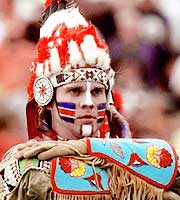
Comment:  Someone could write a whole article on schools that use infantilized Indian mascots.

The "Warrior" image above has the usual problems: a half-naked savage in an aggressive stance using warlike implements. In addition, the child is simultaneously 1) wild and untamed, and 2) a cute, cuddly plaything for his white masters. He's a defanged threat--like a wolf that's been neutered.

The school district might as well repeat the commonplace 19th-century tropes. White folks = the Great White Father who is wise and powerful. Indians = naive and helpless children who need a firm hand. Because that's what they're saying with this mascot.

And this is the mascot that the Cow Creek Umpqua Tribe is thinking of approving. It isn't a warrior, it's a child. It has nothing to do with Cow Creek culture, Oregon tribal culture, or Native American culture.

It's a pure fiction...yet somehow Cow Creek has the right to approve it? That shows you how corrupt the Oregon mascoting process is. If the system were concerned with shielding schoolchildren from racism, this racist stereotype would be disqualified automatically. There's no justification for it...none.

For more on the subject, see "Mohawk Indians" Seek Grand Ronde's Approval and Grand Ronde: We'll Decide About Mascots.

September 01, 2014

"Redskins" = Pan-Indian romanticism

Some thought pieces identify various problems with the Redskins name:

Why the ‘Redskins’ is a Racist Name

By Darren R. ReidWe should remember that there is a phenomenal amount of variety in the physical form and that many Native Americans do not fit the stereotypical portrait that is often used to depict them. Like the use of the phrase ‘Redskins’, [the logo] helps to impose upon a broad and varied group a type of physical ideal which, for a variety of reasons, can be damaging to those who do not match it. That might sound like a comparatively trivial point but consider that the logo fits into a broader pattern of non-Indians defining what it is to be an Indian, both in physical and cultural terms. That logo is a stereotype, an outsider’s imaginary idealisation of the physical attributes that came to mind when they were tasked with its creation. By perpetuating that logo, those ideas are being disseminated, passed on to others in such a way as they become an ingrained part of our cultural dialogue. It is not that the designer of that logo was responsible for the creation of the stereotype, but they did help to perpetuate it. The logo must be seen in the context of those fans who wear a sort of approximation of Plains Indian dress when they support their team. That dress, even if accurate, is not a toy for non-Indians to play with. Native Americans should use or not use that type of clothing as they see fit; they should define themselves, or not define themselves, through dress as they deem appropriate. It is not up to non-Indians to define an idealised image of what it is to a Native American. When Ted Nugent said that he was ‘more Indian than most Indians’ he was telling us much, much more about how some non-Indians view Native Americans than what it is to actually be a Native American. He was measuring himself against an imaginary yardstick, defined and perpetuated by outsiders for outsiders. Hunting with a bow and arrow does not make one more or less Indian, but by declaring that to be a relevant measure he was saying that, in his view, the idealised Indian is one who can be characterised by male hunters from centuries past, not, say, female activists concerned about how modern racial and gendered imagery impacts their lives and the prospects of their children. We should remember that race is not really about skin colour. It’s about power and the one thing that the ‘Redskins’ controversy has shown is that Native Americans have little of it compared to those people who would impose their view of what it is to be an Indian upon the world. Many Native Americans have protested vehemently against the name in the past few years but they cannot force a change on those people who are unwilling to let the name go.The Offensive Line

By KHLWe’re having the wrong conversation.

You may be forgiven for thinking that discourse surrounding the Washington DC football team is about mascots, but it isn’t. Not solely. This is not merely about a team’s name or its owner’s right to trademark it. It’s not about cherry-picked “facts”, outdated linguistic research, ego-driven pronouncements, or even Original American blood money. This is about structural violence. This is about racism and inequality, forced assimilation and cultural appropriation. This is about how images and words function as weapons of degradation within the real lives of Native people. This is about the ability to claim one’s own identity without it being negated and invalidated at every turn. This about staring down the barrel of genocide and surviving.

Ultimately, this is about a very complex system of events coalescing around loss. Loss of land and of language, loss of kinship and culture, loss of agency and sense of self. Loss of the right to say who we are and who we are destined to be. For successive generations, depictions not unlike those found at the center of the mascot debate have defined our people to the non-Indian world. We are continuously re-imagined by forces over which we not only lack control but over which we are denied control. And every diminution and act of microaggression, whether by lampoon or cultural theft, exacerbates the experience of historic trauma. They are daily papercuts that over time become gaping wounds whose flow of blood is slow to stem. And in terms of the health and wellness of our people, we are hemorrhaging.

No, this goes way beyond offense. The contumacy and hubris of Snyder, the NFL, and team supporters continues an historical pattern of sublimating the indigenous voice and its priorities. These entities assume an incontrovertible authority to tell Native people what should or should not define us, what we should or should not hold sacred, and that we must accept their slurs as honor not because they say it is so. Ultimately, they take from us the sovereign right to identify ourselves and our human potential, commodifying our images, our cultures, and our personhood. (And profiting nicely, too.) With all respect, it is not for non-Natives to tell us what we should think about these things. That is for us to determine. Genocide and the deep scars of colonization are not something you “get over.”
No, no, it’s Cooley.

By Gregg DealIdentity: Through reiteration in media, film, and pop culture, the identity of indigenous people does not belong to indigenous people, it belongs to those who have the power to create and shape it. The immediately recognizable stereotype has a specific look and feel (i.e. skin color, nose shape, stoic face, headdress) because this is what has been peddled to the American Masses since first contact. The need for a monolithic Pan-Indian feeds into the fetishization of Native Americans, specifically as it pertains to Romantic Nationalism. It neatly places all 566 tribes (there are and have been way more than that in this country’s history, by the way) into a single immutable image. The problem is, that’s not reality. And it is for this reason indigenous people are often met with statements like “You don’t look indian” and “do you live in a tipi” or a simple raising of the hand with the simple statement of “how”. While you may read that last statement as an exaggeration, I assure you it is not. Every Native person has heard this many times, and will likely continue to hear it, which takes me to the next point.

Institutionalized racism: Because of the aforementioned Pan-Indian and romanticism of Indigenous people, there has been a constant and ingrained slight towards Native people from the very beginning. Starting with the Mayflower, colonial settlers saw the Indians as inferior. That notion, fueled by thoughts of racial superiority, initiated years of genocide, decimation of cultures, and land theft. Under the banner of Manifest Destiny, Native people have been framed as impediments at best and subhuman at worst. Fast forward 500 years, it’s not hard to understand why the average American is so dismissive towards Native peoples. There has never been any reconciliation of this war of cultural imperialism. The history and culture of Native people is virtually unknown by most and is generally not taught or thought of as American history. Instead, we’re offered an ‘us and them’ proposition, isolating indigenous people from the rest of America. In discussing the civil rights movement of the 60’s and 70’s, there is little to no mention of the massive efforts and significant movements of Native people. Most think we simply disappeared or were absorbed into the American national fabric. When information is available, it is usually based on stereotypes, and presented with a dismissiveness and nostalgia rooted in romantic nationalism. America; land of the free, home of the brave! Not surprisingly, people are legitimately shocked when they hear that Indians are offended by the term ‘Redskins’.
Interchangeable Indians: Consent, Context, and the Contested ImageAmerican Indians simply don’t control the ownership and use of their own images as ridiculous as this sounds (and as it is). Any expression of Indianness that falls outside of the accepted stereotype is immediately subject to invalidation and critique. It is also the case that non-Natives reserve for themselves the right to adjudicate what and who is sufficiently Native and who is not. America feels that we must accept their words simply because they say them, never mind our realities.

Consider the debate about the Washington DC football team. Every opinion is considered valid except for the opinion of the people the issue directly concerns. Don’t like what they say? These days you can purchase the dignity of entire tribes with just a few dollars of Original American blood money and use them (as the team did in its propaganda video, “Redskin is a Powerful Word”) to justify a billionaire’s unjustifiable recalcitrance. Exploiting poor people. Sounds legit, right? In fact, should you express any opinion as a Native person that counters the expectation that’s been forced upon you, understand that the first line of critique will be an attack not on the validity of your complaint but rather an assault on your identity. Expect questions like, “how much Indian you are” or considerations of whether or not you are a “real” Indian, that then restrict the authority of your dissent. Native people don’t get to choose the barometer for any of those things; non-Natives do.

America likes its savages to be noble and stoic. Talking back subverts that paradigm and it makes people uncomfortable.
“Redskins” and the Power of Privileged Words

By Drew DixonIn a recent interview with Bill Moyers, Native American novelist and poet, Sherman Alexie said, “at least half the country thinks the mascot issue is insignificant. But I think it’s indicative of the ways in which Indians have no cultural power. We’re still placed in the past.” Calling for terms like “redskin” to fall from modern parlance and advocating for Native Americans are not two separate endeavors, in fact the former is critical to the latter. As long as we refuse to recognize how our words have served to silence the stories of the marginalized, we will continue to abuse them.

September 07, 2013

Cassie Edwards's "savage" romance novels

10 Steamy, Fantastically Ridiculous Romance Novels Starring 'Savages'In the grand history of literature written in English, Cassie Edwards is not even a footnote. But in the romance-novel genre, she would get her own chapter. And in the American-Indian-themed-romance-novel subgenre? Well, she wrote the whole damn book. Actually, she wrote at least 85 damn books in the American-Indian-themed-romance-novel subgenre. (Her total career output in all subgenres was at least 106 books, based on her page at Fantastic Fiction.)

Cassie Edwards, who has won the Romantic Times Lifetime Achievement Award and the Romantic Times Reviewer's Choice Award, was born in 1936 and is, as far as we know, alive and well. Her career, though, hit the skids when she was exposed in a serious plagiarism scandal. (Writing tip: If you want to make your Indian hero sound wooden and humorless, steal his dialogue from published nature writing.)

Those who enjoy romance novels say they are a distraction, an escape from the real world. Mindless entertainment--no better or worse, perhaps, than watching sports or playing video games. But mindless fun isn't the same thing as harmless fun--particularly when you're mindlessly hammering away at the same stereotype.

Of those at-least 85 books about ripped Indian men sweeping overwhelmed white women off their feet, at least 52 of them start with the word "Savage." That was kind of Edwards' thing: Books about Indian men and white ladies entitled Savage _____.

Does this strike anyone else as incredibly--savagely--wrong?

SAVAGE FIRES: Josephine Taylor Stanton gives up on love after a train wreck leaves her in a wheelchair. But when a handsome Indian chief named Wolf comes to help fight for the rights of his people, he loses his heart to this tender-hearted woman of courage and strength.


Comment:  Note that all the "Indians" resemble white Anglo-Saxon males. We wouldn't want white women consorting with someone who actually looks and acts like a minority!

For more on romanticized Indians, see The German Fetish for Indians and Avon Buys Generic "Brave" Statue.

March 23, 2013

The German fetish for Indians

More evidence that German hobbyists honor Indians the same way Americans "honor" Indians with mascots.

Germany's Obsession With American Indians Is Touching—And Occasionally Surreal

By Red HaircrowJürgen Michaelis, who lives near Dresden, was standing in front of the small, improvised tipi he keeps in his back garden, wearing a homemade deerskin suit and a matted black wig that had a lone blue feather stuck in it. “I’m 75 percent Indian but still German,” the retired locksmith told a writer for Der Spiegel, adding that his Indian name is The Lonely Man.

Michaelis is not the only German who likes to pretend he is an Indian. Hobbyism or Indianism, the desire to copy Native Americans is a puzzling and persistent passion for many Germans. Every year, there are dozens of pow wows arranged, managed and run by non-Natives at which, Der Spiegel reported, “thousands of Germans with an American Indian fetish drink firewater, wear turquoise jewelry and run around places like Baden-Württemberg or Schleswig-Holstein dressed as Comanches and Apaches.” There are several German Wild West theme parks like Eldorado, a popular vacation spot featuring staged cowboys vs. Indians or small reenactments of notable battles, as well as dancers performing choreographed sets that combine dance styles and forms.

Michaelis’s life as an “Indian” mostly consists of emulating Natives who roamed the Great Plains of North America over two centuries ago, and now that he’s retired, he spends the majority of his time making and selling Native-inspired trinkets and small leather goods to sell. Some Germans don’t limit their dress-up to their backyards. They periodically put away their mobile devices and other modern tools for the weekend and recreate tipi encampments, dress in animal skins and furs, prepare and cook food over an open fire and address one another by Indian-sounding names such as White Wolf, all while discussing their feelings of invoking the spirit of what it is to be an Indian. There are also websites like Tipis.org, which declares itself “dedicated to all the people around the world who have ever studied the American Indian tipi and wanted to live the life of freedom on the Plains that this structure represents.” Posted there are photos of Europeans who have abandoned their own culture, either permanently or occasionally, to “live like Indians”—or what they have rather fancifully imagined what living like an Indian entails. Some of these people actually roam the countryside wearing buckskin, living off the land and practicing their peculiar brand of American Indian religion.

An estimated 40,000 Germans pay dues at more than 400 clubs so that they can pretend to be Indians. Some of these clubs serve a dual purpose because it is illegal in Germany to fire a rifle, ride a horse or camp unless you belong to a registered club and engage in those activities on club premises. Some of the more popular ones are the Cheyenne Indian Club, Western Club Freising and the Wild West Club. The Cowboy Club of Munich, founded in 1913, is the oldest club of its kind in Germany, and regularly hosts events in which members dress up and act as they believe Indians did hundreds of years ago, insisting upon what they believe is authenticity, although they call themselves rote Indianer—red Indians. They organize pow wows; make, sell and trade handiwork; and drum, sing and dance. Some even take lessons on horseback riding or shooting a bow and arrow.

Krisztina Szabo, who was interviewed for Linda Holley’s book, Tepees, Teepees and Tipis: History and Design of the Cloth Tipi, told the author, “Our camp is always in summer, in July for two weeks. During this time we live in tipis, we wear only Indian clothes. We don’t use technology, and we try to follow Indian traditions. We have those [pretending to be] Lakota, Oglala, Blackfoot Blood, Siksika, Pawnee…and we go on warpath against each other day and night, anytime at all. In two weeks, every tribe can fight each other. We don’t know when somebody will attack or when they will come to steal our horses. And the battles are always exciting, too. I really enjoy them.”

Adults playing dress-up might seem vaguely comic, but these people are shockingly earnest in their love for Native culture, regardless of how poorly many of them understand it. Many even acknowledge that their events—and even their costumes—aren’t about Native American life as it is today, or even was 200 years ago. They just consider their dress-up to be good fun and do not mean to give offense.

Some champions of Native culture don’t find these hobbyists funny or benign. Susan Marcia Stan, who wrote an essay about the impact of Native misrepresentation in children’s literature says, “ ‘Playing Indian’…assumes that being Indian is something that can be put on or taken off at will and completely ignores the cultural heritage of Native people.”


The source for these imitations:Where did this obsession with Native Americans come from? You can thank (or blame) the novels of Karl May (1842–1912), the best-selling German author in history. Many of his most popular books were about a German explorer and wanderer who traveled through America’s Old West and eventually became blood brother to Winnetou, a fictional Apache warrior. This German explorer comes to be called Old Shatterhand, and with his Indian companion battles and overcomes evil of all kinds. Winnetou is the stereotypical figure for many Germans of what a “real” Indian is like: how they dress, speak (broken English) and behave. The country’s long fascination with Native Americans spiked in the 1960s, after several of May’s books were made into films.More Indian than real Indians?Berlin’s HeileHaus is a popular meeting spot for younger hobbyists. It once offered Native American healing, meditation, vision quests and ceremonies that are said to help people find their spirit guide, animal totem or even their secret Indian names. Through Google you’ll find pages of results for such New Age groups, some with their personal Indian shamans, leaders or someone who says they’ve studied with Indians and have now brought these teachings to Europe, often for a fee.

Julian Crandall Hollick is a writer who has interviewed many German and European hobbyists and aficionados. “These are intelligent men and women—computer programmers, truck drivers, interior decorators—for whom the American West offers another identity necessary for their mental stability, a means of going back into history to make sense of as world in which they often alienated; another way for Man to renew the search for identity and his relationship with Nature,” he has written. “Of course, many ordinary Europeans have now visited the [American] West. They know full well their dream is about an America that no longer exists, may never have existed. But they are content with the myth because it fulfills [personal] needs.”

For some it goes far beyond weekend fun or a chance to adopt certain Indian values or beliefs; these hobbyists don’t limit themselves to occasionally procuring authentic garments, decorative items and handicraft projects. Such is the case with the self-proclaimed chief, Gerhard Fischer, known as Old Bull, who heads the Karl May fan club, which hosts a festival on the author’s birthday. Fischer and his kind have romanticized long-gone Native Americans to a degree that they think “latter-day” Indians are poor examples of their ancestors—whom they revere as noble savages. Old Bull’s followers believe Natives today are being perverted by modern culture and that they, not Native Americans, are preserving Native culture.

Instead of empathizing with the very real struggles of Natives now living in North America, these “new Indians” of Europe see the societal problems, substance or alcohol abuse, poverty and internal difficulties within some indigenous communities as evidence supporting their conclusions. They believe their activities are keeping Native American traditions alive, because—they believe—most Natives neglect or do not appreciate their own heritage.

The website for the “Indians and Mountain Men” club declares that “the purpose of the club is to maintain the customs and traditions of the North American Indians and Mountain Men.… We call ourselves practicing anthropologists and take our hobby and the related work, either in theoretical or practical shape, very seriously. The tipis, all the clothing, as well as all items are lovingly made by hand and decorated by us. Many of us even tan the leather itself and sew it together with animal sinews, as the Indians did before. We practice in many skills and craft techniques of this cultural group, and even in songs and dances we strive to achieve the utmost authenticity.”

David Redbird Baker, Ojibwe, told Noemi LaPinto for an article in the Canadian monthly magazine, Alberta Views, that when he first came to Germany, he was amused by the hobbyists, but his feelings changed as he spent more time amongst them. “They take the social and religious ceremonies and change them beyond recognition….They’ve held dances where anyone in modern dress is barred from attending—even visiting Natives. They buy sacred items like eagle feathers and add them to their regalia.” In his opinion, these hobbyists, by claiming the right to improvise on the most sacred rituals, have begun to develop a sense of ownership over Native culture.
Comment:  You can see it all here. Plains Indians...buckskins and tipis...no technology...vision quests and spirit animals...romantic myths and fairy tales...etc. Germans are imitating the Indians of legend--Karl May's books and old Western movies--not real Indians. Which are the same Indians portrayed in sports mascots--the same Indians worshipped by Americans. You know, while they remain ignorant about and cut the funding for today's Indians, who are the only real ones in existence. It's "honoring" Indians by perpetuating a false or stereotypical version of them at the expense of reality.

I read Winnetou, the first book in May's Old Shatterhand series, and debated it here. It's basically a white supremacist fantasy, with a Jesus-like Superman saving a few good Indians from a horde of bad ones. No wonder Adolf Hitler liked the books so much. They provide ample ammunition for exterminating the degenerate heathen "redskins"--i.e., most Indians.

For more on German hobbyists, see Germans Love Westerns and Chief Wahoo in Germany.

Below:  "May’s novels had little basis in fact, which may explain their worldwide appeal."

January 12, 2013

Avon buys generic "Brave" statue

New ‘Brave’ statue looks over Avon football field

By Meghan HerlihyChristmas came early for Avon Central School and the entire ACS community.

After four years of dedication and hard work, the school finally managed to purchase and install a 15-foot high bronze statue of a Native American “Brave” that is now on display by the southeast end of the school’s football field.

The process of acquiring this statue started with Avon local Bill Zhe, who had spotted the statue at a local shop in town back in June 2008. Zhe and fellow Avon local Sandy Irish decided to approach Avon’s superintendent Bruce Amey about purchasing the statue and possibly displaying it as their mascot on school grounds.

“The statue was down at the Avon Trading Post and Jim Jerris owned it,” said Irish. “We saw it down there and Bill Zhe and I talked to Jim to see how much he would sell it to us for. The selling price was actually $16,000—and he had sold a similar statue for that amount—but said he would give it to us for only $12,000, which I thought was pretty generous. So at that point, which was in June of 2008, is when we started raising the $12,000 we needed to buy the statue.”
And:Irish also said that she was not surprised by the generous contributions of the community.

“I think probably because we’re the Avon Braves, here was a great statue that was a ‘Brave’ that could be like a mascot,” Irish said. “So I think a lot of people that had maybe played in Avon sports were excited to see the Brave there, not just for football, but by the track field and everything too. So I think it represents Avon, all the students, the teachers, and the faculty. We’re the Avon Braves, and now we’ve got a Brave that we can say, ‘Hey, here’s our mascot.’”

Amey summed everything up by saying that he hopes—and expects—the new statue to become a part of school lore and tradition.

“Our students are extremely proud to be Braves and our intention more than likely for next year during a football game, when we have a good crowd, will be to do some level of dedication towards that and I think that will encourage a huge sense of school spirit,” Amey said. “I can picture homecoming next year with a lot of students participating not only in the game but activities during Spirit Week where the Brave statue will likely have an integral part of that. I have nothing to do with planning Spirit Week, per se, but at the same time I can see students really having such pride in it.”


The story takes place in upstate New York, an area that's home to several tribes. Yet the people in the article seem blissfully unaware that Indians might object to this mascot.

The region's newspaper understands what the local boosters don't:

Avon ‘Brave’ sculpture does disservice to Native American cultureSince the 1960s, there has been a discussion about if these depictions of Native Americans are appropriate—with many leaders in the community arguing that these images, intentionally or not, reduce a rich and oftentimes disappearing culture into a caricature.

Mascots have the power to rob a people of their personhood and turn them into a cartoon.

Having recently read the LCN’s article about Avon Central School acquiring a statue of a ‘Brave,’ I am concerned this will ultimately perpetuate a negative stereotype of Native Americans.

I grew up in Livingston County and worked as an educator in the local schools for three years. It’s exciting how open-minded the youth in our community have become. Unfortunately, the acquisition of this statue, apparently uncritically, teaches our children to view another group of people as one-dimensional.

This ultimately undermines both the potential and integrity of our communities. The American Psychological Association released a position statement in 2005 recommending the retirement of American Indians as school mascots.

In short, American Indian Mascots can limit a child’s potential to appreciate another culture as well as silence those that are members of that culture.
Comment:  Artistically, the statue isn't bad. But the headband with feathers, the braids, and especially the tomahawk combine to make the Indian look savage.

Moreover, he's half-naked in a snowstorm, which suggests why this look is wrong. A real Indian would wear a shirt in this kind of weather. Shirtless implies he has an animal-like constitution.

I'm not sure any of the area's Indians ever looked like this statue. It could be a "brave" from the Great Lakes, the Plains, or anywhere. Really, it seems like a generic romanticized Indian. Its lack of identifying characteristics is part of the problem.

Even if the statue is culturally appropriate for upstate New York, it's still stereotypical. Why? Because Indians don't look like that these days. Like a million other stereotypical images, it's projecting the notion that Indians are dead and gone--i.e., primitive people of the past.

The editorial is right. This statue reduces Indians to a one-dimensional cartoon. Don't let the realism fool you. It's really no different from the image below, which is also a one-dimensional cartoon. It's wrong for the same reasons.

And the naivete of launching a stereotypical mascot "tradition" in this era is breathtaking. Really, not a single person thought, "What if Indians protest this mascot as they have so many others? What if New York state passes a laws banning such mascots? Is it worth a $12,000 gamble to have a mascot that was bland and unoriginal a hundred years ago?"

For more on Indian monuments, see Indian Statue for Staten Island and Generic Statue Represents Ghostly Kickapoo.

December 06, 2012

Native beauty = white and thin?

This Is Why I'm Hot!

By Christina M. CastroLately, we as Native people have been bombarded with a constant influx of demeaning imagery in the media and fashion industry. It seems like every other skinny blonde model or pop singer these days is rocking a tacky war bonnet. Yet, change is happening! As quickly as the recent horrid faux pas came onto the scene, they were soon squashed by a swift backlash. Plenty of Native writers, mostly women, have discussed the issue of irresponsible appropriation in numerous excellent articles. Many kudos to those who spoke out in various ways, educating others in the process.

Now that we are beginning to see our efforts being addressed, I’d like to bring the dialogue inward and pose a question: What do Native people think makes for a beautiful Native woman?

Some of you may recall a contest last year on Facebook, “Worlds Hottest Native,” or something to that effect. Sponsored by an entity called Native Entertainment, a plethora of contestants entered pictures of themselves in their sexiest poses. Votes were tallied and although I don’t much recall how “The Hottest Native” male looked; mostly a chiseled faced, lean and long haired male of the standard variety, I distinctly recall the contestant who was selected as the “Hottest Native” female. She was some semblance of a Navajo; brown skinned and big breasted (read: fake) with bleached blonde hair; a rez Pamela Anderson.

That got me thinking. Is “hot” just code speak for white, mainstream beauty? Furthermore, how much of my own beauty aesthetic has been influenced by Eurocentric standards? Has our beauty standard as Native people become so colonized that we only recognize beauty if it looks white and thin?


Comment:  By "white" I don't think Castro means having light skin. I think she means having Caucasian facial features and body types.

This column suggests why we need Native actors to portray Native women. Not Native starlets who have gone Hollywood and made themselves sexy with makeovers and cosmetic surgery. Not multiracial women who look Caucasian with slightly darker skin and "exotic" features. Rather, real women who may be shorter, thicker, or older than the typical Hollywood starlet. Who may have higher cheekbones, thinner lips, or bigger noses than average.

Not that there's anything wrong with looking beautiful by Western standards. But always choosing someone who looks "Hollywood beautiful" helps to erase actual Native people. It sends the wrong message to Native women: "You're not worth much unless you look more white."

It also sends the wrong message to non-Natives: "Indians look like the impossibly beautiful people you see in romanticized paintings, book covers, and advertisements. They wear leathers and feathers, consort with wolves and eagles, ride horses and live in teepees. If you don't look like that, you're not a real Indian. The real Indians are gone and you're some sort of imitation."

The same applies to other minorities, of course. And to whites, for that matter. But people see a wide range of white folks every day. Most never see an Indian, or don't realize they're seeing one. They don't recognize an Indian unless he or she fits the Hollywood stereotype.

For more on the subject, see "Pocahontas" in Gossip Girl and Crystle Lightning = Maria Tallchief?


What stereotypes teach us to expect: a sexy Indian temptress with Barbie-doll proportions.


A typical multiracial actress (Julia Jones III) chosen by Hollywood to reflect our stereotypical expectations.


An actual Native woman (Jemez mother and child, 1912).

November 25, 2012

Fated romanticizes, stereotypes Indians

I posted before about the teen paranormal novel Fated by Alyson Noel. Here's its blurb on Amazon.com:Strange things are happening to Daire Santos. Crows mock her, glowing people stalk her, time stops without warning, and a beautiful boy with unearthly blue eyes haunts all her dreams. Fearing for her daughter’s sanity, Daire’s mother sends her to live with the grandmother she’s never met. A woman who recognizes the visions for what they truly are—the call to her destiny as a Soul Seeker—one who can navigate the worlds between the living and dead.

There on the dusty plains of Enchantment, New Mexico, Daire sets out to harness her mystical powers. But it’s when she meets Dace, the boy from her dreams, that her whole world is shaken to its core. Now Daire is forced to discover if Dace is the one guy she's meant to be with...or if he’s allied with the enemy she's destined to destroy.
I suspected the Soul Seeker series would offer a stereotypical view of Indians. Now Debbie Reese confirms it in her American Indians in Children's Literature blog:

Alyson Noel's FATEDI'm guessing fans of Fated are people who wish to "honor" Native people with mascots...

What I mean by "people who honor Native people with mascots" means people with little substantive knowledge about Native people. Instead of factual knowledge of who we are, they embrace romantic ideas of us as warriors and shamans with feathers and drums. The people who want to "honor" us are people who mean well; they're people with good intentions.

But heck! How long is ignorance and stereotyping borne of good intentions going to go on?! I guess it'll continue as long as there is a market for stories with hunky "Native American" guys with high cheekbones, smooth brown skin, and long, glossy black hair.
And:Looking at Noel's page for the sequel, Echo, I see photos she took on a trip to NM, to do research for her book. She was in Espanola, which is about three hours north of Albuquerque. It is a small town, but much bigger than the fictional town of Enchanted (in Fated). She was also at Santuario, a church in Chimayo, New Mexico. If you watch the videos at her site, you'll see Noel talking about wanting to incorporate shamanism and witch doctors and medicine men into this "Soul Seekers" series, of which Fated is the first one. She's definitely quite taken with those that are other to her---but not in a good way.

In an interview (got there from a link on her site), she says she tried to portray shamanism and Native American spirituality "in an authentic way and to do so with reverence." Ms. Noel? You didn't do either. You can't be "authentic" if you're using "Native American" and there's the only reverence I see is the deeply flawed kind borne of romantic notions of American Indians rather than a reverence borne out of actual knowledge, personal relationships, and respect.
Comment:  For more on the subject, see Shamanism Series Seeks Native Authenticity.

September 12, 2012

Plaque with sacrificial story removed

Controversial plaque will stay absent

By Jordan SmithThe controversial plaque that was removed last semester from the Sylvan Theatre will remain absent.

The plaque was engraved with the story of a Sioux Indian woman who was in love with a white soldier. She learned that her tribe was planning to attack his troops so she warned him of the event. Her people discovered her betrayal and threw her in a lake.

“The story appeared to be presented as a true story,” said Director of Diversity Enhancement Jaime Nolan-Andrino.

Director of Tribal Outreach Richard Meyers said the story sounds like many typical narratives at the time the plaque was created. Many conquered groups have stories blaming the women as the reason for their defeat.

Meyers said that the inscription on the plaque seems “fraternity-like, there is no citation or reference to fact.”
Comment:  Blaming women for defeat is one thing. This plaque also echoes the countless stories of Native "lover's leaps" around the country.

In these tales, a Native woman inevitably jumps off a cliff, over a waterfall, or into a lake. Sometimes she's thrown. It's almost always because she fell in love with the wrong person. Killing herself, or being killed, is an atonement for her "sin."

This is a romantic way of sanitizing our crimes against the Indians. They couldn't handle the changing world, the thinking goes, so they killed themselves.

Making it a maiden who sacrifices herself softens the blow. It wasn't a warrior who committed suicide because we took his land and culture. No, it was just a woman who sought love (how noble) but failed (how tragic).

Whatever the details, the Indians chose to die for reasons that had nothing to do with us. That's the stereotypical thinking behind all these "lover's leaps."

For more on romanticized Indians, see Peter Gabriel's San Jacinto and "Two Wolves" Story Is Phony.

Below:  "The engraving removed last semester will remain absent from Sylvan Theater."

April 18, 2012

Peter Gabriel's San Jacinto

Someone asked me what I thought about San Jacinto, a song from Peter Gabriel's eponymous 1982 album. It's the same album that gave us the more famous Shock the Monkey.

I didn't know anything about it, so I looked it up. Here are the key lyrics:

Peter Gabriel Lyrics: "San Jacinto"Thick cloud--steam rising--hissing stone on sweat lodge fire
Around me--buffalo robe--sage in bundle--rub on skin
Outside--cold air--stand, wait for rising sun
Red paint--eagle feathers--coyote calling--it has begun
Something moving in--I taste it in my mouth and in my heart
It feels like dying--slow--letting go of life

Medicine man lead me up through town--Indian ground--so far down
Cut up land--each house--a pool--kids wearing water wings--drink in cool
Follow dry river bed--watch Scout and Guides make pow-wow signs
Past Geronimo's disco--Sit 'n' Bull steakhouse--white men dream
A rattle in the old man's sack--look at mountain top--keep climbing up
Way above us the desert snow--white wind blow
The chorus also includes the phrase "Hey now Wakan Tonka."


Wikipedia tells us:"San Jacinto" reflects on the fear and pain experienced by a Native American man who sees his culture overwhelmed by modern white society.And SongFacts tells us:The San Jacinto Mountain range in California runs along Palm Springs, a very exclusive resort community.

This explores the contrast between the artificial world of Palm Springs and the Indian communities on the other side of the San Jacinto Mountains who have spiritual ties to the land.

Gabriel was influenced by an Apache Indian he met who told him of the ritual where the Medicine Man takes a young Indian boy to the mountains, allows a rattlesnake to bite him, and leaves the boy to find his way down the mountain, where he will either die or learn courage.
Which San Jacinto?

For starters, people seem to be guessing whether Gabriel was referring to the San Jacinto in California or Texas. I haven't seen a statement from him about which one he meant.

The mountain and desert imagery would argue for California, since the other San Jacinto is located in the flat, wet, southeastern part of Texas. The "Apache in the Midwest" story would argue for Texas, since the Apaches lived in Texas and Texas is in the Midwest.

A few people at SongFacts discussed this point:Well, this has me confused. San Jacinto for the average American certainly refers to the battle at San Jacinto that followed the Alamo. Gabriel's lyrics suggest a battle, but the First Nation people were not involved in that battle as far as I know.

I too am confused be the references to Southwest Indians and buffalo which were only hunted by the northern plains Indians, and held in especially high esteem by the Sioux.

I don't know why San Jacinto is the name used. Having just spent four days in the San Jacinto mountains and having lived in the Southwest for my childhood I can say with some certainty that the Apache are a not a Californian people and that Buffalo didn't live in the California deserts or mountains around San Jacinto. I don't think that Apache hunted Buffalo, either. Perhaps Peter Gabriel, a Brit, doesn't know his geography or his American First Nation peoples too well? Sounds like he's blending together a lot of peoples with the images and words he chooses.
There are few Apaches in San Jacinto, California, or San Jacinto, Texas. The Apache homeland is in the far west of Texas while San Jacinto is in the far east, hundreds of miles away. Oops.

So various lyrics seem to refer to the California desert, the Apaches' Texas homeland, or the northern plains where Sitting Bull and the Lakota lived. Can you say "mishmash"?

Rob's analysis

"Wakan Tanka" and the sweat lodge/buffalo robe imagery come from the Great Plains, but Gabriel sings as if the setting is the American Southwest. He's been watching too many Westerns set in Monument Valley, I think.

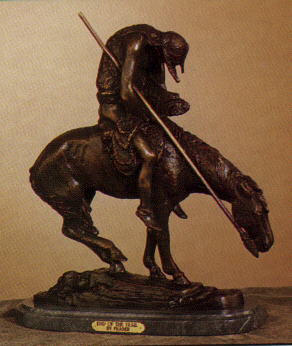
The in-town part is okay--perhaps derived from the actual San Jacinto, Texas. But it's a typical romanticized lament over the fate of the Indian. It's the aural equivalent of the End of the Trail statue:


White people have been crying over Indians for the last century, so this is nothing new. It's all part of the "vanishing Indian" syndrome. "Boo-hoo, my ancestors killed the Indians. Now I'll sing about it to show how much I care."

Meanwhile, Indian nations are growing and flourishing. While Gabriel was singing this live in 1986, Indians were about to win the Cabazon court case and become economic powerhouses through gaming. So the song is a gross distortion of Native reality.

Beyond the mishmash of images, the whole song is vaguely stereotypical--even if it's based on a true story. Indians do mystical ceremonies with medicine men...check. Indians cry over the loss of their land and culture...check. Indians are primitive people of the past who are lost in the modern world...check.

You can believe Gabriel wrote San Jacinto around 1980. It's a typical product of the more "sensitive" 1960s and 1970s. It acknowledges that Indians still exist, but that's about it. They're looking back, mourning their losses, not forging ahead via business, politics, and technology.

For another musical analysis, see Oldfield's Native-Themed Songs.

March 04, 2012

Wannabes obscure real Indians

Wanting To Be Indian

By Myke JohnsonOne of these traps I refer to as “wanting to be Indian.” In fact, American Indians have a name for people in this trap, the Wannabe Indians. This trap is an identification with the Indians, most likely out of our own distress or oppression, our disenfranchised desire. Indians become the “utopic other” holding the dreams we wish were true, whatever they may be. And here the romantic stereotypes take over. So for example, we might say, “In tribal cultures…women were held in respect.” “In tribal cultures…everything was shared communally.” “In tribal cultures…people lived in harmony with the earth.” And so on, filling in the blanks. We desire that utopia, want to be those romanticized Indians.

The other similar trap I call “guilt seeking redemption.” In this trap, we are aware of and acknowledge what White culture has done and reject that, but get stuck in the feeling of guilt. We desire release from the guilt of association with White culture. And so we seek out Indians to say we’re okay, to offer forgiveness, and welcome us, adopt [us] into their own better ways.

We can see an example of this trap in current movies about Indians. Movies went from those portraying Indians as the bad guys who threatened the survival of the White heroes, to a movie like “Dances with Wolves,” where the White hero is the exception to the destructiveness of White culture, and is adopted by the Indians. This trap explains the appeal of an Indian like Sun Bear who taught spirituality to White people, and started a non-Indian entity called the Bear Tribe. He was considered a sell-out by many traditional Native people. However, many White people felt welcomed and assumed a new identity as “tribal” members of a so-called Rainbow Tribe.

What are the problems with these three traps?

First of all, this redemption we find is really a cheap grace. It makes us feel better but doesn’t transform the situation of Native peoples. The injustices keep happening.

Secondly, by denying the spiritual and political autonomy of Indian people, the New Age “rainbow” people subvert whatever good intentions they may have about multicultural community. What gets created is multicultural white middle class dominance in yet another form.

Thirdly, these options perpetuate the fantasy image of the Indian, and distort the real picture. They prevent us from seeing the real lives of Native people. They obscure and drown out their voices and expression of self.
Comment:  For more on the subject, see Mythical Indian = "National Mascot" and Americans = Wandering Strangers.

February 24, 2012

"Two wolves" story is phony

Almost everyone on the Internet has seen the "two wolves" story that supposedly comes from a Native legend. If you're like me, you see it a couple of times a month.

The story's ending and lesson goes like this:The grandson thought about it for a minute and then asked his grandfather, “Which wolf will win?”

The old Cherokee simply replied, “The one you feed.”
I always figured this story was phony. Now blogger âpihtawikosisân (Chelsea Vowel) confirms it:

Check the tag on that “Indian” storyWell recently a tumblr blogger Pavor Nocturnus did the world an enormous favour and dug into the real origins of this ‘Cherokee wisdom’, providing some excellent sources.This story seems to have begun in 1978 when a early form of it was written by the Evangelical Christian Minister Billy Graham in his book, “The Holy Spirit: Activating God’s Power in Your Life.”"This kind of thing is harmful"

âpihtawikosisân goes on to explain what's wrong with this seemingly innocuous legend:These misattributed stories aren’t going to pick us up and throw us down a flight of stairs, but they do perpetuate ignorance about out cultures. Cultures. Plural.

Not only do they confuse non-natives about our beliefs and our actual oral traditions, they confuse some natives too. There are many disconnected native peoples who, for a variety of reasons, have not been raised in their cultures. It is not an easy task to reconnect, and a lot of people start by trying to find as much information as they can about the nation they come from.

It can be exciting and empowering at first to encounter a story like this, if it’s supposedly from your (generalised) nation. But I could analyse this story all day to point out how Christian and western influences run all the way through it, and how these principles contradict and overshadow indigenous ways of knowing. Let’s just sum it up more quickly though, and call it what it is: colonialsim.

And please. It does not matter if this sort of thing is done to or by other cultures too. The “they did it first” argument doesn’t get my kids anywhere either.

The replacement of real indigenous stories with Christian-influenced, western moral tales is colonialism, no matter how you dress it up in feathers and moccasins. It silences the real voices of native peoples by presenting listeners and readers with something safe and familiar. And because of the wider access non-natives have to sources of media, these kinds of fake stories are literally drowning us out.
Comment:  This legend is harmful for the same reasons a romantic painting is harmful. It teaches people that:

  • All Indians are the same--that their legends are interchangeable.

  • They're all wise and spiritual, which isn't necessarily good. If you're a touchy-feely "wisdom keeper," you're implicitly not sharp and tough enough to be a lawyer, engineer, or politician.

  • They're oriented toward a simple life of nature and animals. Which is another way of saying they're backward and primitive. If a modern person told this story, he might say, "You have two Terminators in you: a good one and a bad one." Or, "You have two Aliens in you." You know, something that today's youth could relate to.

  • As âpihtawikosisân notes, even the lesson isn't Native in style. A typical Native lesson would be more like, "There's good and bad in each of us. You need to balance both halves to achieve harmony." Which is markedly different from the Christian dichotomy of black and white, good and evil.

    For more on Native values, see Western vs. Native Education and Europeans Hated Indians' Virtues.

    Below:  Good wolf and bad wolf.

    February 22, 2012

    French surprised by Native diversity

    Native Americans in Paris: Oklahoma Painters Make Historic Trip

    By Dominique GodrecheThe eleven Native artists had come to the City of Light for an art show titled “Oklahoma Painters,” part of the sixth annual “Art en Capital” event at the massive Grand Palais. Skye and ten other Native artists were exhibiting watercolor and acrylic paintings in the Salon du Dessin et de la Peintre a l’eau (Salon of Drawing and Watercolor Painting) one of five legendary annual exhibitions drawn together at the Grand Palais. (The other four are the Societe des Artistes Independants, Societe Nationale des Beaux-arts, Comparaisons, and the Societe des Artistes Francais.) The exhibit was set up by curator Russell Tallchief, Osage, who is Director of Arts & Exhibitions at the American Indian Cultural Center & Museum in Oklahoma City, at the request of Ginette Adamson, a painter and former French Literature professor who divides her time between Strasbourg and Oklahoma.

    For a Parisian public largely unfamiliar with contemporary Native American art, the opportunity to view the works and meet the artists was unprecedented. French ideas about American Indians, like those of many people around the world, remain associated with the “romantic” vision derived from Hollywood movies and the photos of Edward Curtis: Feathers, leather and face paint. Many visitors were taken aback by the display of modern Native creativity. “I am surprised by the great diversity,” said one. “These works are all grouped under the label ‘native.’ I am looking for a common touch in the paintings, and I don’t see one. Coming to this show, I had a simplistic vision, a fantasy of a single unified culture. But I see a wide variety in this art; these painters are drawing on their culture’s past, yes, but from modernity and classicism as well.”
    Comment:  For more on the subject, see Two New England Art Shows and Jetsonorama's Larger-Than-Life Art.

    Below:  "Artist Yatika Fields in Paris."

    December 14, 2011

    Mythical Indian = "national mascot"

    Paul Chaat Smith and His Pal Irony Offer a Dose of Indian Reality

    By Carol BerryBeneath his analysis of contemporary Indian art, however, is a broader conversation about myths concerning Indians that are so intertwined with and essential to central myths about America itself that U.S. historical identity could disappear altogether without its binary, mythical Indian Other, which he calls “a kind of national mascot.”

    “Generally speaking, white people who are interested in Indians are not very bright,” he said, because intelligent white people instinctively understand that everything they are likely to learn about Indians “is probably going to be crap, so they should be avoided.”

    When Smith explains that “the Americas are built on the invasion and destruction of a populated land with hundreds of distinct, complex societies, and a slave trade involving millions of Africans,” he offers that “as an observation that is the minimum requirement for making sense of the history of our countries.”

    Indian people are defined by the “distinctive type of racism that confronts Indians today: romanticism,” or a “highly developed, deeply ideological system of racism toward Indians that encompasses language, culture, and history,” ensuring their status as “strange and primitive.”

    One antidote is acknowledgment of the totality of the lives of such notables as Geronimo, Quanah Parker, Black Elk and Sitting Bull, whose foibles and accomplishments included gambling, entertainment, and entrepreneurial self-promotion. Ironically, however, “Many Indian folks and our so-called friends in the Wannabe Tribe make a pretty good living dispensing jukebox spiritualism and environmental teachings” attributed to them and to other historic figures.

    To dispel the master narrative of colonization, an opportunity exists for those willing to leave behind the “cheap, played-out clichés… It is nothing less than a reclamation of our common history of surviving the unparalleled disaster of European contact and the creation of something new and dynamic from the ashes.”
    Comment:  Smith has stated the problem well. We can see the Indian as a national mascot on coins, statues, and other public displays.

    From this flows all the subsidiary uses of the Indian as mascot: for sports teams, hipsters and holiday parties, etc. They're all trying to capture a sense of "owning" the Indian. And thus of being more authentically American than others.

    For more on the subject, see Americans = Wandering Strangers and Indian Wannabes = Celebrity Wannabes.

    Below:  People trying to be America's sweetheart: the stereotypical Indian.


    November 20, 2011

    Lots of Lover's Leaps

    Days Gone By:  The story of Lover’s LeapNearly every cliffed town, along nearly every river has a Lover’s Leap, and the legend behind the name of the high-topped bluff is nearly always the same. Hannibal is no exception.

    The myth or legend of Hannibal’s Lover’s Leap was written by a man named Aurthur O. Garrison, who claimed that he obtained the details from “ancient inscriptions and a birch bark manuscript.”

    No one seems to know who Garrison was. The clipping of his story has vanished and none know what newspaper or book it was taken from or when it was published.
    The article's conclusion:Such quaint but tragic legends are known up and down the Mississippi, and probably have at least slight basis in fact, but Indians are as expert at fairy tales as the whites that followed them into the land. Only the least romantic of men would question their legends, however. And only the most cruel would attempt to prove or disprove the existence of such unrecorded tribes as the Kirgluou and the Holrois.Comment:  This article confirms what I thought: that multitudes of lover's leaps exist. You'd have to be a fool or a racist to believe any of them are real. Indians commit suicide en masse when their loves are thwarted and hearts broken? Yeah, right.

    These myths aren't as harmless as the author thinks. Rather, they're stereotypical and as harmful as other Native stereotypes. They convey the idea that Indians were weak, impulsive creatures of passion. That everything about them was romantic, sad, and tragic. That they were destined to vanish because of their own failures--not because of America's genocidal policies against them.

    And most of all, that they're primitive people of the past. You'll never hear that someone leapt after graduating from a university, translating the Bible into a Native language, or winning a court case. Like Indian mascots, hipster headdresses, and Thanksgiving pageants, these stories are about keeping Indians in the past. If we can make everyone forget our crimes against them, we don't have to redress their ongoing grievances.

    For more on the subject, see Debating Frog Woman Rock and Legend of Lovers Leap.

    September 28, 2011

    Native romance novel series

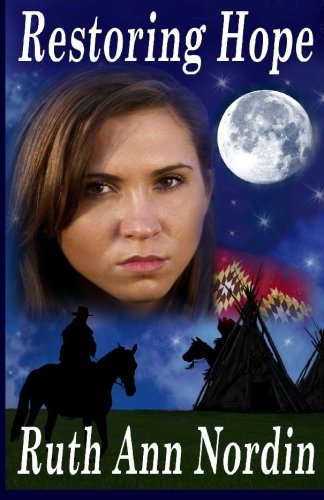
    Restoring Hope (Native American Romance Series Book 1)Books in the Native American Romance Series include:

    Restoring Hope (Book 1)
    Brave Beginnings (Book 2)
    Bound by Honor, Bound by Love (Book 3) due out 2012

    Another one of Ruth Ann Nordin's Best!, June 26, 2010
    By author "Paula Freda" (USA)

    "Restoring Hope" another one of Ruth Ann Nordin's best, is a tender, sensitive story of Woape, a young Mandan Indian woman who is taken prisoner by a rival tribe's cruel warrior, Hothlepoya. Tortured and humiliated, Woape, escapes in the middle of the night. All seems lost until she crosses paths with Gary Milton, a kind young white man. He doesn't know why three Indian men want to harm her, but he is sure of one thing: he must save her. So he does. Woape clings to him and follows him everywhere. Gary nicknames her tenderly, "his shadow," as he falls irrevocably in love with her. She becomes his wife, but this is only the start of their adventure, as the ruthless Hothlepoya has sworn to find her.

    "Restoring Hope" is the first of a planned Native American Romance trilogy. I look forward to reading them all.

    Could Have Been Better, July 14, 2011
    By dstew1973

    I enjoyed Brave Beginnings (Native American Romance Series Book 2) more than Restoring Hope, however I think both books were very one dimensional in the writing. I think the characters could have been much more developed and interesting. I enjoyed them but I didn't fall in love with them, and that's what I am looking for when I read a Historical Romance Novel.
    Comment:  A Native woman who clings to a man because she can't take care of herself. A tribe of cruel warriors. It doesn't sound promising.

    The cover is offputting. I don't know if the woman is Mandan--I'm guessing not. But her perfect complexion, with makeup or airbrushing, looks phony to me. Presumably the story is set in the 19th century, so why would you use a modern photograph? It convey the wrong impression about the story's subject.

    If you want a clue, 19th-century Mandan woman look like this:


    Not this:


    You can see they've lived hard lives. They don't look like they just came from a modeling session. So the book probably is pushing an unrealistic notion of Native women.

    For more on the subject, see Romance Novel About Pala Professor.

    August 08, 2011

    Squaw Rock renamed Frog Woman Rock

    Say hello to Frog Woman Rock

    By Glenda AndersonA landmark rock formation towering over the Russian River and Highway 101 in southern Mendocino County is about to get a new—and more politically correct—name.

    The California State Historical Resource Commission today is expected to re-designate what for more than 50 years has been known as Squaw Rock.

    Henceforth, it officially will be known as Frog Woman Rock, reflecting a Pomo Indian legend of a man-eating creature, part frog and part woman, who lived in a cave in the face of the rock.

    Squaw Rock is being jettisoned as the name of California Landmark No. 549 because of its questionable roots in local Indian lore and also to eliminate the word squaw, originally an East Coast Indian word that has taken on a derogatory connotation, said tribal representatives and state historians.
    The origins of the dueling names:The moniker is believed to stem from a Lovers Leap tale cited in the 1880 “History of Mendocino County,” said William Burg, a state historian.

    As that story goes, a young chief named Cachow from a Cloverdale tribe promised to marry Sotuka, daughter of the chief of the Sanel tribe in Hopland. But he instead married another woman. In anger and despair, Sotuka, holding a great stone, threw herself from the cliff, killing herself along with Cachow and his new wife, who were camping at the base of the cliff.
    And:State officials said further research by the Hopland Band of Pomo Indians and historians has determined that the Lover's Leap account was never adequately verified as legitimate local Pomo lore and that an altogether different story is a better fit.

    In central Pomo dialect, the name for the rock is Maatha kawao qhabe, which translates as frog woman rock, according to a study by linguist Victoria Patterson in 1985. And in local Pomo legend, the giant rock north of Cloverdale was home to Frog Woman, a mythological figure often portrayed as the clever and powerful wife of Coyote, who makes many appearances in Pomo lore as a trickster. She also makes appearances as the wife of Obsidian Man.
    Comment:  Is there any question that the new name is better? The old name has several problems beyond the offensive "squaw." For starters, the legend is obviously bogus.

    1) Most young Native women can't lift a "great stone" big enough to crush two people.

    2) It's a cone-shaped rock, not a sheer cliff. A woman couldn't leap to her "death" because she'd bounce down the incline a few times before coming to a rest. If she were lucky, she might not even injure herself.

    3) Given the rock's shape, there's no way a woman could hit two people at the bottom with her own body and a stone held in her grasp. The woman and the stone would fly in different directions. And it's unlikely the stone would land anywhere near the targets.

    4) How could the legend's scenario have happened? The woman climbed laboriously to the top of the rock? And waited on the off-chance that the chief and his new lover would stop below her? Then found a conveniently sized rock on the bare hilltop and threw it and herself down the slope?

    That's pretty damn ridiculous if you think about it. What happens if the chief and his new lover don't stop at the base of the rock? She climbs back down and climbs up another day? How many days in a row did she do this until the chief conveniently stopped directly below her?

    Again, this isn't a cliff that people pass by on their way to the village every day. It's an isolated cone-shaped rock. There's no way anyone would climb it to commit homicide or suicide.

    Romanticizing dead Indians

    The name is flawed for other reasons as well:

    1) Why emphasize the "squaw" portion of the legend? Why not Unfaithful Chief Rock, Suicide Rock, or Crushed Bodies Rock? Could it be to romanticize the "vanishing Indian"? Because thinking about star-crossed lovers is more comforting than thinking about ethnic cleansing?

    2) Judging by the number of "Lovers Leap" place names based on Native legends, Indian maidens committed suicide at an enormous rate. Maybe this is the origin of the high suicide rates still prevalent on reservations.

    That's a sarcastic way of saying most if not all of these legends are phony and derivative. We shouldn't encourage the false belief--a subset of the romantic- and vanishing-Indian tropes--that Indians killed themselves in tragic circumstances. Unless we have hard evidence that a legend is true, there's no reason to immortalize it with a place name. And every reason to use a culturally appropriate replacement.

    For more on romanticized Indians, see Love/Hate Relationship with Indians, Lamenting Indians = Letting Indians Die, and Hollywood Loves Dying Indians.

    Squaw Rock = Indian mascots

    This issue is much like the renaming of sports team names and mascots. Basically, who the hell cares about something so trivial? No one's forcing you to think or saying something you don't want to. You still can call it Squaw Rock to yourself, or among your friends and family members. There's no penalty whatsoever for using the old name.

    What you can't do, though, is control the agenda beyond your own sphere of influence. You can't tell the community or the world that your Anglo-American history and culture are the only ones that matter. Someone else gets to say how we name geographic places--and by extension, how we frame other issues and arguments.

    That's what this is all about: the loss of white power and privilege. Euro-Americans can't stand losing the power they've exercised for the last 500 years. They don't want to share it; they want it all.

    No "dirty redskin" is going to tell them they were wrong to steal this land. To rename it, develop it, or ruin it. Americans think they have a right to everything from the air and water to their "pet" Indian mascots. Anyone who disagrees is a threat to their centuries-old dominance.

    In short, Indian place names and mascots are like a baby bottle or security blanket for childish Americans scared of the dark (people).

    For more on geographic place names, see Explorers Didn't Consider "Squaw" Offensive and Changing Park Name = Guilt Trip?

    Below:  "The above landmark rock formation towering over the Russian River and Highway 101 in southern Mendocino County will get a new name Friday: Frog Woman Rock." (John Burgess/The Press Democrat)

    May 19, 2011

    Atalanta the Mohawk superwoman

    Badass Women of the Pulp Era

    By Jess Nevins1904: The most popular pulp science fiction writer in Europe in the first decade of the 20th century was the German Robert Kraft (1869-1916). One of his popular characters was Atalanta, who appeared in the pulp Atalanta #1-60 (1904-1905, reprinted in France in 1912 and 1913) and the novel Atalanta: Die Geheimnisse Des Sklavensees (1911). Atalanta is the last member of a tribe of the Mohawk people who had flourished in America centuries before Asians crossed the Bering Strait land bridge and settled the American continent. However, Atalanta initially does not know this. As a baby she was found on the shores of a large "slave lake" in South America, and she grew up in an orphanage ignorant of her background.

    As an adult she goes in search of her birthright, aided by Graf Felsmark, a German millionaire adventurer who Atalanta eventually marries. Atalanta returns to the slave lake and frees the slaves. She carries out a prolonged duel with her arch-enemy, the vicious South American Professor Dodd, a brilliant inventor who plans to use his advanced weaponry to hold the world hostage. She discovers a Lost City of Maya in the jungles of Mexico. She even visits Lemuria in her plane but ends up fighting against the rulers of Lemuria, a group of evil, albino, big-headed dwarf geniuses, and their ogrish servants. Atalanta is physically and mentally superior to ordinary humans and is capable of a number of incredible athletic feats.
    Comment:  Let's see how stereotypical this character is:

  • Atalanta's name is Greek. She looks like Aphrodite or another goddess immortalized in ancient artwork.

  • She's the last of a vanishing breed. If we're to believe the writeup, her tribe existed before the Paleo-Indians arrived in North America. Which makes them some sort of lost race rather than Indians.

  • A Mohawk found on the shores of a South American lake is theoretically possible, but it's so unlikely it might as well be impossible.

  • She marries a white man to make her decent and "civilized." I wouldn't be surprised if she converts to Christianity too.

  • She discovers a lost city of Maya and the lost civilization of Lemuria, which puts her firmly in a fantasy land with pirates and fairies (Peter Pan) or dinosaurs and ape-men (The Lost World).

  • Not bad for a mere two-paragraph description. No doubt the Atalanta magazines and books have hundreds of mistakes and stereotypes.

    Pulp fiction and traveling shows are how people learned about Indians before the advent of movies. The entertainment media was misinforming people then and it's misinforming people now.

    For more on the subject, see Burroughs the Conservative Racist and Rima the "White Native Girl.

    May 11, 2011

    Geronimo "Make Believe" t-shirt

    Adrienne Keene writes about a t-shirt she noticed in her Native Appropriations blog:

    Um, Not Make BelieveSpotted this on Pinterest, comes from a company in Omaha called Make Believe Clothing Co. Best part? It's called the "Geronimo" shirt. Here, I wrote them a note, and re-designed their shirt for them.

    Dear Make Believe Clothing Company,

    You might need to sit down for this news. It might come as a shock. Guess what? American Indians are not "make believe." There are real Indians alive today! Omg, I know, right? Your shirt seems to imply that we're pretend or fantasy characters.
    Comment:  Adrienne goes on to speculate that "maybe you were trying to make a social commentary about how this particular stereotyped image of a Native person is make believe and only bears minimal resemblance to the millions of Native peoples alive today, or even to Geronimo." Maybe. Or maybe it was some sort of statement about belief. E.g., if you believe, and imagine the world ("make believe") you want, you can be like a generic Indian, who dreams of peace and harmony and buffalo and tipis. I.e., a natural paradise--a land untainted by pollution, plastic, and population.

    Actually, since the company name is Make Believe, they probably didn't intend much of a message. They probably could put any dreamy or starry-eyed person above the logo. (Note the stars where an earring should be.) Be like an Indian, or anyone who thinks, and "make believe."

    Whatever the message is, the shirt fails because it's unclear. It also fails because that message has nothing to do with Geronimo. You could find Indians who "make believe," but they probably won't be death-dealing warriors like Geronimo. Put Sherman Alexie or Louise Erdrich on the shirt and then you can talk about Indians who make believe.

    For more on the subject, see AIM Fights "Runs with Beer" T-Shirt and Michigan Opposes "Indian Name" T-Shirts.

    February 26, 2011

    Three dubious literary "classics"

    In The Education of Little Tree, a children's "classic," generic Cherokee Indians send their boy to a boarding school to be civilized. The book was considered an authentic Indian narrative until its author was revealed to be a white supremacist.

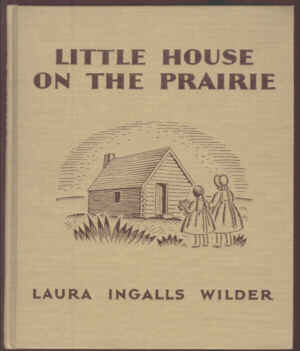
    In Little House on the Prairie, another children's "classic," Indians are intimidating and unclean "savages." What most people don't know is that Charles Ingalls was squatting illegally on Osage Indian land and that his daughter the author was a staunch conservative.

    Henry Wadsworth Longfellow's Hiawatha is the classic romantic Indian and probably the best-known fictional Indian before Tonto. People have adapted the epic poem into movies, plays, music, and other genres.

    For literature that put this questionable literature to shame, see The Best Indian Books

    February 14, 2011

    Bogle's romanticized Indian paintings

    Adrienne Keene writes about a non-Native artist known for his romanticized paintings of Indians:

    Lee Bogle and "Native American Love"So where to even start with these ridiculous romance-novel-esqe images? I mean, clearly, they eroticize and sexualize Native peoples, but they also rely on the ubiquitous stereotypes dark skin, long hair, images of nature, feathers, fur, buckskin, headbands, etc. I picked out the ones that are supposed to represent "love", but there are many others that highly sexualize Native women alone.

    Most people can look at these and see them for their ridiculousness, but the problem is that they are reproduced millions of times all over the internet, with "Native American Blessings" or "Native American Love Poems" emblazoned across them. There are entire websites dedicated to e-cards, desktop backgrounds, cards, and t-shirts of these images.
    Comment:  For more on the subject, see Painting Natives in Ceremonial Garb and Oxborough Paintings Infantilize Indians.