September 10, 2007

Pueblo dance documentary

Film gets to the heart of Tewa dancesMore than seven years ago, with permission from the Ohkay Owingeh tribal council, Garcia teamed with dance critic Marilyn Hunt to document traditional Tewa dances on film. Their documentary, Dancing from the Heart: Journey of a Pueblo Dance Family, will be showcased this week at an Oklahoma film festival. The film already has won a first place at the ReelHeaART Film Festival in Toronto and was screened at the Lincoln Center for the Performing Arts in New York.

The documentary, the first for Garcia and Hunt, takes viewers inside the better-known Pueblo dances such as the Eagle, Buffalo and Butterfly dances. The 45-minute documentary intersperses narration from Garcia on what he hoped to accomplish with the dance group and interviews with youth as they prepare to dance. It shows Garcia teaching an international group of students basic Ohkay Owingeh dance moves during a class he taught at The University of New Mexico.

Oscar for Native movie?

Dan Leonetti and the Screenplay “Woodpecker Waltz”One fine spring morning, Dan’s sister Connie gave him news clipping about a book called Deadly Innocence written by Robert Persky. It was the story about Little Joe Arridy, a mentally challenged person with the mentality of a five-year-old kid. He was wrongfully executed for the rape and murder of a little girl. Sadly the real killer was discovered three months after Joe was killed in Colorado’s Death Row at Canyon City Territorial Prison.After many travails:Production is set for October but it maybe a little later than planned. The movie is set in the winter months so in all actuality, filming will begin sometime this fall or early winter. Course I will have photos from location almost daily if I’m not way to busy. Dennis Quaid signed on with the sole intention of winning an Oscar. The script is a very dynamic and moving piece. I venture to say it should win an Oscar as well.

September 09, 2007

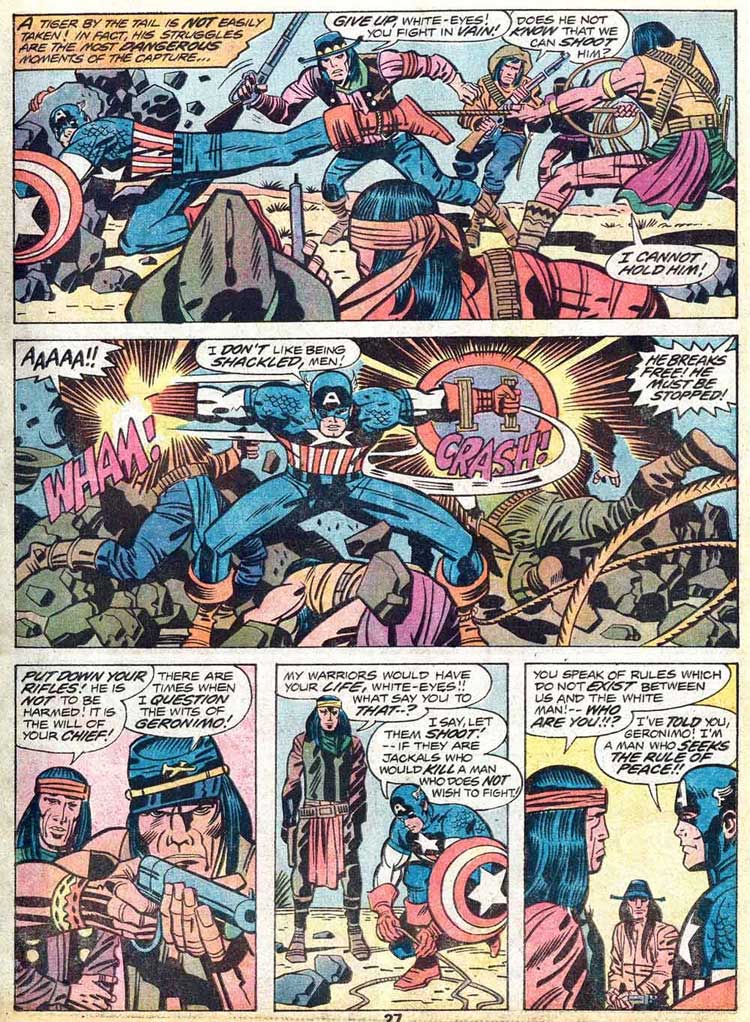
Captain America meets Geronimo

Contemplator(Marvel Treasury Special: Captain America's Bicentennial Battles)--The Contemplator, calling himself Mister Buda, summoned Captain America to his domicile to teach him a lesson about America. He first sent Cap back in time to World War II where he was reunited with Bucky and fought Hitler, the Red Skull, and the Nazis before returning. Buda then placed a psychic-talisman that sent Cap on a number of jumps through time, from Colonial America and a meeting with Ben Franklin and Betsy Ross where his costume apparently inspired the American flag; to the Great Depression, where he fought gangsters harassing a newsboy; to the 18th century where he got caught in a struggle between the forces of Geronimo and some white settlers; to a collapsed coal mine where he helped the victims escape to the surface; to a World War I plane fight; before briefly returning to Buda again, who noted the value of viewing the bad times with the good; and then back to the 19th century where he outfought the legendary boxer John. L. Sullivan; then to where he helped a runaway slave escape those who sought to return him to his former owners; then to Alamagordo where he witnessed the first nuclear bomb test; then to 1871 on the night Chicago burned down; then to a modern era undersea research base; then back to Buda; then to the future for a battle on the moon; then to a Hollywood musical celebrating America's history; then back to Buda; before taking a final trip to the modern era where he enjoyed spending time with the future hopefuls of America's youth.Here's a lengthy analysis of the story, including the Geronimo sequence:

King Kirby, Captain America and American History

By Donald R. McClareyCap is shifted from Depression tenement-land to Geronimo’s New Mexico. The change in climate is subtle but important, and no other episode could have followed to such effect. Both Geronimo and his world are suffused with a grim but unmistakable dignity: the effect is of moving from a mean and dirty world to a dry but clean one. Geronimo is a man who knows his own mind and whose word can be trusted. Yet his dignity that of tragedy, the dignity of men bound to fight and die. The only way they can assert their worth as men is to stand up against the near-certainty of grief, lonely struggle and an early end. It’s rather startling to see the symbol of the U.S. living as it were by proxy the experience of a defeated Indian ridden down by the U.S. Cavalry: a particularly significant case of Kirby’s use of shifting and unusual narrative perspectives.You can read part of the story and see the Geronimo sequence here:

And Now, Bicentennial Kirby Captain America--Lost In Time!

Makahs machine-gun whale

Gray whale shot, killed in rogue tribal huntFive Makah Nation members harpooned and shot a gray whale east of Neah Bay on Saturday morning, shocking environmentalists and tribal leaders alike. The whale died less than 12 hours later, sinking while heading out to sea.

The move short-circuited years of wrangling in the courts over whaling by the tribe, which hunted its first whale in 70 years in 1999.
The background:The hunt wasn't authorized by the tribal council or by the federal government.

"I don't know why they did this. It's terrible," said John McCarty who, as a former member of the tribe's whaling commission, has been an advocate of the Makah Nation's right to resume whaling under an 1855 treaty.

"I think the anti-whalers will be after us in full force, and we look ridiculous," McCarty said. "Like we can't manage our own people, we can't manage our own whale."

The hunt was starkly different from a federally sanctioned hunt in 1999 during which a whale was harpooned and then quickly killed with a large-caliber rifle. That was the tribe's first whale hunt in 70 years.

Shakespeare's Native play

What Shakespeare thought of the American IndianThe evidence is overwhelming that Shakespeare not only set The Tempest on a Caribbean island, but included a native American major character. The play's ambivalent attitude toward this indigenous slave Caliban serves not only as a useful window into 17th-century racial attitudes, it also helps us understand our own period as well. The name Caliban, it should be added, is regarded as a form of Carib, the name of the original inhabitants on the islands invaded by Columbus.

In 1609 a fleet of nine ships set out from England to shore up John Smith's Virginia colony, the first English settlement in the new world. As most people already know from their high-school propaganda, Smith was condemned to death by Powhatan, but was saved at the last minute when his 13-year-old daughter Pocahontas interceded on Smith's behalf. The British returned the favor a couple of years later by burning down Indian villages and attempting to enslave them.

One of the nine ships was separated during a violent storm and ended up on Bermuda. Pamphlets were published that gave a highly imaginative account of the shipwrecked crew's experiences. Evidently Shakespeare got the idea for his play from this background material since The Tempest is a tale about shipwrecked Europeans colonizing an American island and enslaving the native population.

The other important influence on the play was Montaigne's Of Cannibals, an essay that argues that American Indians lived a naturally virtuous life uncorrupted by civilization.
Below:  "Fyodor Paramonov as Caliban in The Tempest, Maly Theatre (Moscow), 1905."

The whale-hunting controversy

Makah WhalingIn 1999 and 2000, after a hiatus of seven decades, Makah Indian whalers again hunted gray whales from their ancestral lands around Cape Flattery on the Olympic Peninsula. The Makah, whose whaling tradition dates back thousands of years, are the only tribe in the United States with a treaty guaranteeing the right to hunt whales. Makahs had not whaled since the 1920s, when commercial whaling nearly wiped out whale populations, but the tribe announced it would resume whaling after the gray whale was removed from the Endangered Species List in 1994. The decision ignited worldwide controversy. Some animal rights activists bitterly denounced the Makah, but other groups, from advocates for indigenous rights to the United States government, supported the tribe's right to hunt. Following legal battles and physical confrontations with protestors, Makah whalers landed their first whale in more than 70 years on May 17, 1999. In 2003, that remains the only whale taken. Court decisions currently block the hunt, but courtroom battles go on as the Makah continue to assert their right to hunt whales.Comment:  If Newspaper Rock had been around then, we would've been all over this story.

Read the whole essay for the details on the whale-hunting controversy.

Bury My Heart wins Creative Emmys

Alberta-made TV series wins big at Creative Emmys

Bury My Heart at Wounded Knee won 5 trophies, including outstanding cinematographyA miniseries filmed in Alberta emerged the biggest winner at the Creative Arts Emmys, capturing five trophies, while a fake music video featuring a male part became the story of the evening.

The gala, held to honour technical, makeup and costume work in television, was held in Los Angeles Saturday night and had a few surprises.

[One] big story of the evening was Bury My Heart at Wounded Knee, which went in with 17 nominations. The series won for outstanding makeup, outstanding single-camera picture editing, outstanding sound mixing, outstanding sound editing and outstanding cinematography for a miniseries or special.

September 08, 2007

Hungry for Turquoise Rose

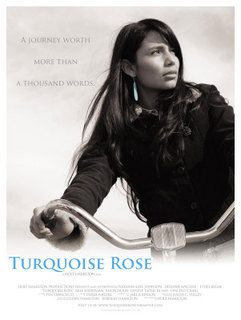
Navajo film reaches across cultural linesThe movie Turquoise Rose, filmed on the Navajo Reservation, has found a Native American audience hungry for films that reflect its culture. But director Travis Hamilton, who grew up in Idaho, is also hoping his film can educate non-Natives.

"At the heart of my intentions of making the film was helping people understand," Hamilton said. "This is who these people are."
What it's about:It's the story of a college-age Navajo, raised in Phoenix, apart from her cultural roots, who is summoned to the reservation to care for her ailing grandmother.

Much of the film was written while Hamilton was deployed in Iraq. His signal brigade from the Arizona National Guard accompanied the first Army soldiers who entered that country in 2003.
Why people are responding:Hamilton said he is hearing from urban-raised Native Americans who share the title character's disconnection from their culture. "We're having Navajo natives that have seen it three or four times," he said. "That's letting us know we're hitting on some chord that is ringing true in Native America."

One Navajo woman, after seeing the film, told Hamilton that she was going to take her children up to the reservation to visit their grandmother and reconnect with their roots. "But then there was a man, a non-Native," Hamilton said. "When he saw the film, it caused him to take a weeklong trip back to New Jersey and see people he hadn't seen for a while.

Indians were football's best

Osage Nation Film Festival Features Original Footage Of Oklahoma’s Hominy Indians, 1927 NFL ChampionsWho was the greatest team in professional football? Many believe it was the Miami Dolphins with a 17-0 perfect season while others argue it was Terry Bradshaw’s Pittsburgh Steelers. Of course, you can never over look Joe Montana’s San Francisco Forty-Niners, but according to two Oklahoma writers the greatest professional football team ever were the Hominy Indians who defeated the New York Giants, in 1927, the day after Christmas, to become the National Champions of the National Football League. If you are a native Oklahoman, love the game of football, and don’t know who the Hominy Indians were you have neglected your football education long enough, come to The 1st Annual Osage Nation Film Festival, September 14–15, 2007, in historic downtown Pawhuska, OK and watch original footage of America’s greatest football team of the 1920s & 1930s. The documentary style footage can be seen throughout the day on Saturday in Pawhuska’s historic Fire Station located at 900 Lynn, behind City Hall. Football & history buffs will witness the Indians first hand as they traveled from coast to coast playing their unique style of football on everything from fields that were nothing more than chalked-off pastures to stadiums that seated 50,000 roaring fans. The Indians played because they loved the game but more importantly because they could play as an all-Indian Unit. The Indians gave up football after the 1932 season, but for 10 amazing years, the Hominy Indians were a big-time pro football team in Oklahoma. Were the Indians really that great you ask? Well, according to a brother of an Indian player, George S. Halas refused to allow his Chicago Bears to play the Indians. The reason is not known but perhaps it could be that one of the fathers of the NFL did not want his Bears beaten by a group of unheralded and unknown Oklahoma Indians.

Audiences weep over Greene

Graham Greene Made Me Cry Last Week.  Why That’s Revolutionary.Graham Greene is an artist in the truest sense of the word; and as any bona fide artist he is unyoking his creative tether by showing that an actor, a proudly Indian actor, can take on two of the juiciest roles in theatre and make them uniquely his own. Juicy roles that aren’t, by the way, Indian at all; juicy roles that call for a Jewish merchant and a slow-witted drifter; juicy roles written by William Shakespeare and John Steinbeck, one White guy who never even heard of Indians and a second White guy who had heard of Indians but never wrote about them.

It isn’t hyperbole to say that it is truly revolutionary that Greene, best known as the Lakota dude with the funky hair in Dances With Wolves, is not only starring in the 2007 Canadian Stratford Festival’s productions of The Merchant of Venice and Of Mice and Men, but while doing so receiving standing ovations from the august Stratford audiences and snarkilicious theatre critics from both sides of the border.

"Chief Thundercloud IV" arrested

FBI & Wichita Police Bust Kaweah Scam and Dry-up ThundercloudMalcolm L. Webber aka Grand Council Chief Thundercloud IV, self-declared chief of the non-existent Kaweah Indian Nation, has been arrested on one count of attempting to defraud the federal government, one count of harboring aliens who were illegally in the United States and one count of possession of false identification documents with intent to defraud the United States.

The arrest followed raids yesterday, September 6, at the group's Victory in Christ Church and South Meridian locations. The complaint filed by the agents says the Bureau of Indian Affairs previously determined that Webber is not a Native American Indian and his so-called Kaweah Indian Nation is not a Native American Indian Tribe.

The Bermuda Indians

Bermuda's Indians reconnect with their ancestorsNearly 100 Bermudians sang and danced their way through a huge Native American festival to honour their ancestors.

They were among 500 'tribes' who came together to share their culture at the four-day Feast of Green Corn and Dance - referred to as 'Schemitzun' - in Connecticut.

The event is significant for many St. David's Islanders because research proves the Pequots were brought to Bermuda many years ago as slaves. As a result the St. David's Island Indians and Minister of Community and Cultural Affairs, the Hon. Wayne Perinchief, were welcomed to the Pow Wow as cousins.

Clarification on Will Rogers

Correspondent Eulala offers some notes on the Amy Ware article:Rogers was Cherokee on both his mother and his father's side. You may be interested in watching the video "More Than Bows and Arrows" where a clip of Rogers is shown commenting about his Cherokee roots. In fact, I recommend you see this video just for your own edification in matters Native American. Most of the stuff in that excellent film (originally) never makes it into American history books or classrooms.

I personally thought the article and Ms. Ware attempted to make much of distancing Rogers from his Native background. In my opinion the opposite was true for him.

Add Newspaper Rock to your site!

You can post Newspaper Rock on your website or blog in the handy format shown here. Enrich your content with the latest news and reviews of Native America. Just click on the "Get Widget" button below or to the right.

September 07, 2007

Conservatives reverse on rights

UN set to adopt native rights declaration, no thanks to Canada:  criticsCritics ranging from the national Assembly of First Nations to Amnesty International say Ottawa has never fully explained its related concerns.

They stress that the declaration is a non-binding document that is specifically required to be interpreted in balance with other laws, standards and the rights of non-native citizens.

"Their argument that it undermines treaties and agreements ... is just not correct," says Malezer. "I think they're making it up. It's not a legal opinion."

The Canadian government not only supported but was a leader of the process toward drafting the declaration before the Liberals were defeated in January 2006, Malezer said from New York. The Liberals pushed for clarifications--especially on land and resource issues--but were clear proponents, he added.

Ottawa's position under the Conservatives changed so drastically that by June 2006, only Canada and Russia voted against the declaration at the UN Human Rights Council.

"Clearly it was a political flip," says Malezer. "And that's just bad behaviour. It's not good faith. It's not about human rights."

Ishi, last of the Mohicans

ISHI:  A Real-Life The Last Of The MohicansJust as the Mohicans in the eastern frontiers were hopelessly caught in territorial conflicts, so too were the Yana. The greatest differences were duration and fate. The Mohicans had engaged in a defense of their lands for two centuries; the Yana for twenty two years. The Mohicans survived as a people; the Yana vanished. Like the fictional Chingachgook, Cooper's grieving last Mohican; Ishi was destined to be an historic grieving last Yahi.

Recalling once again Cooper's tale of tragedy and destruction, we find the story of Chingachgook and his son Uncas riveting, touching. They are running out of time, struggling to hang on, but the Mohicans begin to vanish. One by one they are gone, until only a father and his son remain. We feel the weight on Chingachgook's shoulders as he vainly attempts to steer life's canoe to placid waters. In the end, he can not fight against the current and finds himself coasting along the turbulent water alone. It is an American tragedy that Cooper speaks of ... one he knew full well to be much more than a fictional work. Yet even Cooper's great imagination could not have foreseen the likes of an Ishi stumbling out from a stone age world into the 20th century.

Whiteclay isn't the problem?

For Whiteclay, still more problems than answersIs anything being done to combat the public drunkenness?

"Not anything, not one single thing," said Moss, 38, whose parents used to run the store. Not much has changed over the years, said Moss, who argues that the influence of the reservation, not Whiteclay itself, is the problem.

"People think it's a little piece of hell," he said of Whiteclay. "It's not. The people that come here are good people. They're just so bored and consumed by alcohol; it's all they have."

Problems on the Pine Ridge reservation that spill into Whiteclay are similar to the acute poverty and blight Lisa Adams used to see as a prosecutor in Newark, N.J.

"Many of the problems that exist here are mimicked in urban areas with urban blight," said Adams, a Pine Ridge tribal judge. The prohibition against booze on the reservation, she said, isn't working, just as it didn't work nationally in the 1920s. In Pine Ridge it has caused a proliferation of bootlegged alcohol, she said.

SCALPED's "grief porn"

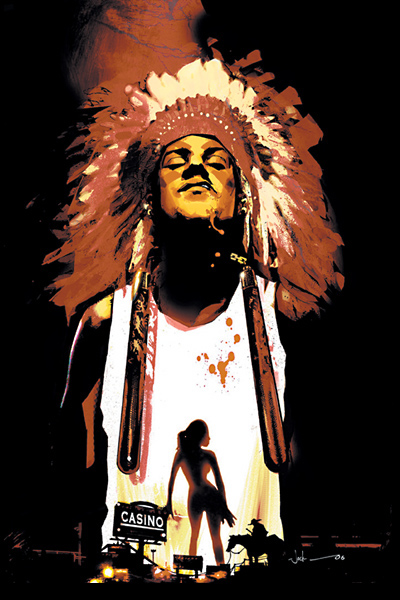
Scalped: Indian Country TPB--A ReviewFirst and foremost, I am upset that a Native writer and artist could not have done this. Because the story is a list of standard reservation clichés; there is a casino being built that will "save the people", there is the usual struggle between the "Traditionalists" and the "Sell-Outs", there are sheep-like gangs, meth, there is constant talk of "The Old Times" and the dire need to get back to them, characters monologue-ing about how it used to be, giving history lessons and reciting reservation lifestyle statistics to the reader, there is an old man who talks to "The Spirits" and at the center of it all is one BIG ANGRY INDIAN MAN. All that was missing was the constant flute music.

A Native writer would have captured the nuances of reservation life. It is not always like this, hell, it is hardly like this. Conditions are deplorable yet the Native Experience tends to survive, find the good and move on however they can. Instead, with "Scalped" we get another outsider "telling it like it is", which is basically what many non-Native readers want: grief porn.
Comment:  Go to the end of this posting to see my thoughts on it.

Buffett nominated for NAMMYs

Peter Buffett Nominated For Two Native American Music AwardsPeter Buffett, the musician/philanthropist who recently released the 'crisp, percolating' (USA Today, 8/7/07) left–of-center rock album 'Staring At the Sun' (BeSide Records), has also been nominated for two Native American Music Awards (NAMMYs). Buffett began exploring the culture after composing the pivotal 'Fire Dance' scene for the Oscar winning score of the film 'Dances With Wolves.'

Nominated for his work on the DVD of the epic stage show 'Spirit: The Seventh Fire,' Buffett has been tapped for 'Best Long Form Video/DVD' along with his collaborator Chief Hawk Pope. Buffett is also a nominee in the 'Native Heart' category, an honor awarded to a non-Native American who has made a special contribution to preserving the music and spirit of Native American culture.
Comment:  Buffett's theme for 500 Nations is one of my favorite Native-style tunes.

Review of Eye of the Wolf

No One Ever Sees ArapahosWhat I like about a good mystery, think Christie’s work, is how there is more than one prime suspect to confuse things. There are several characters in the story that have the motive and opportunity to kill the victim. Coel’s "Eye of the Wolf" and even after eleven novels does not have that type of experienced layering. She seems to be getting by on her knowledge of Arapaho history. It seems lazy to me.

Vicky Holden does nothing. She sits in a holding pattern for most of the novel up until the anti-climactic ending when the suspect needs a hostage, and seems more a reiteration than a revelation. Of late, the series is becoming more and more about Father John O’Malley and his trials and triumphs in and among the people of the Wind River Reservation overshadow the life and loves of Vicky Holden, who along with the people and communities of the Wind River serve only to elevate Father John to savior status.

White liberal bingo

And BINGO was his name-O!

September 06, 2007

Peace prize for Morales?

Morales campaigns with eye on NobelPresident Evo Morales is campaigning for the Nobel Peace Prize, reaching out to comrades of the international left in an effort that belies daily violence at home and a growing threat of civil war that has engulfed parts of Bolivia during his tenure.

As Bolivia's first elected South American Indian president, Mr. Morales has gained an international following for his efforts to nationalize industries and redistribute land in a bid to remake his nation as a socialist state.

To push his Nobel ambitions, he has spent a lot of time traveling, meeting with world leaders and addressing humanitarian forums in which he has proclaimed, "Bolivia renounces war."

Such pronouncements are sharply at odds with daily rioting and street battles that have forced a year-old constitutional convention to shut down, while prompting provinces from the eastern lowlands to talk of seceding.

O'odham vs. STDs

Disease and Discretion

Tracking a taboo illness in Tohono O'odham countryTake syphilis. In April, the Tohono O'odham tribe confirmed an outbreak of the ancient scourge. Since January, 46 cases have been reported, compared to one or two cases in a normal year. It's believed the initial infection came from a town bordering the reservation.

Not that the tribe is alone in this fight. Syphilis has resurged across the United States, with more than 33,000 cases now reported each year. But battling a heavily stigmatized, sexually transmitted disease among the quite modest O'odham requires a particularly delicate touch.

Out here, you won't find explicit billboard warnings against careless sex, or hear radio announcements taking directly about STDs. Like the rangy land they inhabit, the O'odham prefer a round-about approach.

Racist "satire" of Wikipedia

Native AmericansNative Americans, or "injuns," as they like to be called, are the indigenous peoples of America. They got pwned by Columbus during the colonization of America, and their spirits have been crushed ever since. Native Americans are relatively uncontrollable due to widespread depression about their decimation. Either that or they're too fucked up on high gravity beer and don't respond. The Indian reservations don't sell alcohol on Sundays, so an alcohol substitute was created by diluting a bottle of cheap hairspray, usually the 99 cent Aqua Net, in a gallon of water. This beverage in known as ocean. When you drink it it makes you want to pass out on the railroad tracks. This usually results in the consumer getting pwned by a freight train. If you're in search of the red nigger, normally you can find them in KFC, spending their government cheques while clutching to their crack babies, bitching about how they live on a reserve yet never make the effort to get a job. Most female injuns become Teenmommies by the age of 13.

Those brown-skinned bad guys

Like blacks, Hispanics, and other minorities, Indians have been subject to racial profiling throughout their history. They were assumed to be guilty of something because they were savage, uncivilized, shifty-eyed, uncooperative, etc.

Here's a posting that explains the problems with profiling:

"I see nothing wrong with profiling Arabs. ... Let's concentrate law enforcement where it's needed."

Dumb and dumber

Who's more ignorant?

Bush vs. Miss Teen South Carolina

Comics taught about Indians

Comic Book PSA:  What we taught children

September 05, 2007

Indian students get "free ride"?

Putting to rest the myth of a ‘free ride'As the angry voices over UND's nickname and logo grew to a fevered pitch, one assertion stood out as being so blatantly incorrect that it needs to be corrected and never repeated. It is this: The claim that American Indian students somehow get a “free ride” at UND.

This claim was made again and again in some 120 comments that hit the Herald's Web site Thursday in connection with a nickname story (“Group rescinds support,” Page 1A). But it's one of those untruths that is so flagrant, it makes all other arguments from nickname supporters seem false.
The facts:[L]et me tell you from the lips of Boyd and Robin Holden, director of the student financial aid office: All undergraduate students who are eligible (according to a needs assessment by the financial aid office) get a financial-aid package from the university. This package typically includes a mix of grants, waivers, loans and a “work study” amount that, when added to the contribution expected from the student and the student's family, totals the expected cost of a year's study at UND.

I repeat, all students who have financial need get this financial aid package, regardless of their ethnic background. The grant and loan amounts vary among students depending in part on their level of need.
Comment:  The posted comments show the racism underlying the mascot debate. Whites want to keep Indians safely in the past, where they don't threaten the whites' social and economic privileges. When actual Indians assert their right to be free of racism and prejudice, white people can't stand it. "How dare you try to reach beyond your place in society? We founded this country and made it great. You were losers--savage and uncivilized--and you got what you deserved. No matter how hard you try, you'll always be inferior to us."

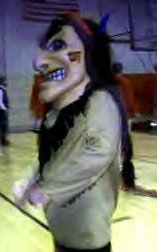
UND "honors" a fictional Indian of the past:


UND students show what they think of real Indians today (my interpretation):
Most censored Native stories?

Most Censored 2007 award to Indigenous PeoplesThe "Project Censored 2007" awards are out and most of what was censored in Indian country was ignored. American Indian readers of the Censored blog say these topics were the most censored during the past year:

  • Silencing of traditional and grassroots' voices by those in power
  • Nuclear, uranium and coal genocide of Indigenous
  • Border deaths and abuse of Indigenous; racism in border news reporting
  • American Indian delegations in Venezuela
  • Zapatistas' meetings at US/Mexico border
  • Leonard Peltier

  • The silencing of traditional and grassroots' voices by those in power includes tribal leaders and councils who have silenced the voices of spiritual leaders and other people in their communities. Those in power continue censoring these voices in the tribally-owned news media; by court actions; local political oppression and access to tribal services.
    Comment:  Norrell is referring to her own Censored blog, so her opinion on what stories were most censored is suspect.

    Her view on what stories are newsworthy is probably different from mine. For instance, regardless of what you think of Leonard Peltier, was there some breakthrough in his case that went unreported? Not that I know of.

    Will Rogers the cowboy Indian

    Will Rogers always proud of Cherokee identityWill Rogers could have played a game of cowboys and Indians all by himself.

    While Oklahoma's favorite son earned acclaim on stage, screen, radio and in his newspaper columns for his cowboy feats, he always identified himself first as a Cherokee. Although he had little Cherokee blood, he became known as "the Cherokee Kid" during his performing career.
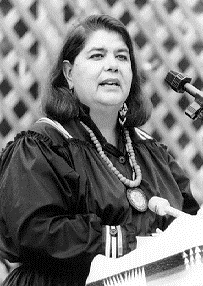
    More on Rogers's background:"I propose he was culturally a Cherokee, a man who grew up in the nation and whose father was prominent," Ware said.

    Rogers was born on the Clem Rogers ranch near Oologah. But, contrary to popular belief, he never lived in Oklahoma. He left the area and began his world travels in 1902, when the area was still Indian Territory.

    Ware described Rogers as a cowboy-Indian hybrid.

    "It is a cultural mix the stereotype does not allow," Ware said.

    The popular conception pitted cowboys against Indians, she said. In reality, the Indians were more likely to be fighting cavalry, while the cowboys were a mixed-heritage lot, with cowpokes ranging from various white ethnic backgrounds to black, Hispanic and yes, sometimes Indian.

    New Karl May exhibit

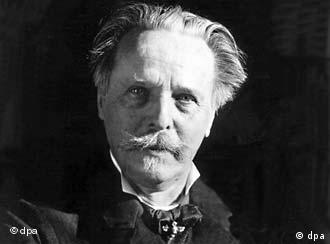
    The Wonderful World of Karl May, Germany's Best-Loved AuthorWith sales of over 200 million books, Karl May remains a household name in today's Germany. As well as his literary legacy of some 33 novels, many films have been based on his work.

    Every year thousands of ardent fans attend open air theater festivals where his fiction is acted out. Young or old, popular or high-brow, he seems to have something for everyone.

    The writer has become most famous for his Wild West series featuring the adventures of the increasingly ennobled Native American chief Winnetou and his blood brother, the white trapper Old Shatterhand.

    Shaped the image of the Wild West

    For generations, as Professor Alex Kuo of Washington's State University has written, "May has been a significant author in shaping the average German youth's view of the American West and the American Indian as well."
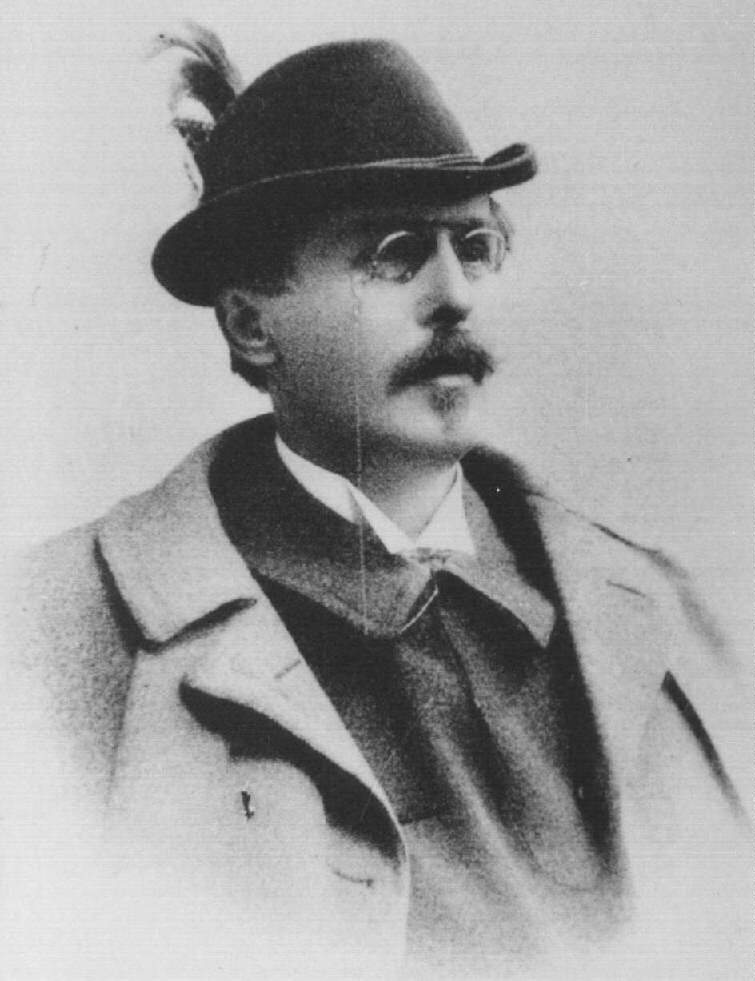
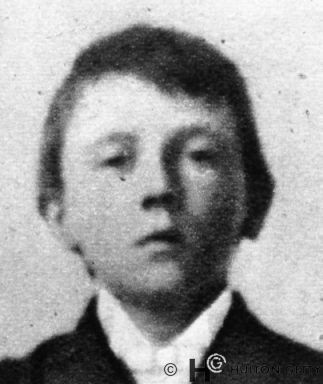
    Comment:  See Adolf Hitler:  A True American for more on Karl May and whether he influenced Hitler.

    The right to control the dead

    Who owns the past?If asked to enumerate their human rights, I doubt that most Americans would mention the right to control their dead. This is not because there is no such right; rather, the entitlement is so basic and universally extended that it is hardly recognized as a "right" by most people. But suppose America were occupied by a foreign invader whose scientists pillaged our cemeteries and shipped our ancestors' remains home for research. I have little doubt that most Americans would regard this as a fundamental violation of human rights and dignity.

    The United States, of course, allowed this to happen to its indigenous people. Although our government acknowledged almost every other group's spiritual and legal claim to their dead, for much of American history it did not extend this basic human entitlement to Native Americans. Huge quantities of their ancestral remains and sacred objects were shipped to research institutions such as UC Berkeley's Hearst Museum, which houses the second largest such collection in the nation. In 1990, Congress tried to redress the injustice by passing the Native American Graves Protection and Repatriation Act (NAGPRA), which requires museums to repatriate human remains and sacred objects to tribes.

    Dollar will commemorate Indians

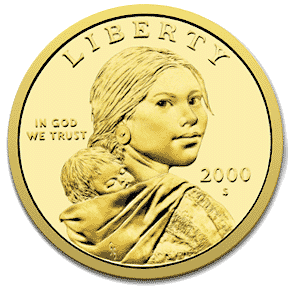
    Congress Changes Sacagawea DollarCongress on Tuesday approved a redesign of the Sacagawea dollar in hopes of enticing consumer and business use of the gold-colored dollar.

    Under legislation passed by voice vote in the House and sent to President Bush for his signature, new editions of the coin honoring the young Shoshone who helped Lewis and Clark on their trek to the Pacific Ocean more than 200 years ago will come out in 2009.

    The new coins will continue to depict Sacagawea and her child, but they will feature scenes on the reverse side, changed annually, commemorating the achievements of other Native Americans and Indian tribes.

    Among design suggestions are the Cherokee written language, the Iroquois Confederacy, the World War II codetalkers and Olympic athlete Jim Thorpe.

    Aboriginal becomes lieutenant-governor

    Chief appointed lieutenant-governorSteven Point, the Sto:lo chief and provincial court judge who has led the B.C. Treaty Commission for the past two years, has been appointed B.C.’s 28th lieutenant-governor.

    The mainly ceremonial job as the Queen’s representative in B.C. is picked by the prime minister. Point replaces Iona Campagnolo, the Trudeau-era cabinet minister who has served as B.C.’s head of state since 2001.

    The Chilliwack-born Point was appointed to the provincial court in 1999. He is a grand chief of the Sto:lo Tribal Council in the Fraser Valley.

    September 04, 2007

    Indian casinos reduce poverty

    UCR study finds families better off near casinosThe UC Riverside analysis of 1990 and 2000 census data found income levels for families living within 10 miles of reservations with Indian casinos rose 55 percent in that decade. The median income for families not living within 10 miles of a gambling reservation rose 33 percent during that period.

    "This study has shown that tribal gaming in California has improved social and economic outcomes on tribal lands and in surrounding areas," researchers wrote in the report. "Benefits include significant increases in incomes and educational attainment and reductions in poverty, especially in the poorest regions of the state."
    Indian Casinos Boost Local Economies

    UCR researchers report reduced poverty and higher incomes on and near gaming reservations.The authors’ analysis of U.S. Census data reveal that the benefits have been significant. California’s gaming tribes experienced a 55 percent increase in average income per capita between 1990 and 2000, compared to a 15 percent increase on nongaming reservations. The average income per capita on California’s gaming reservations was $12,526 in 2000, only 53 percent of the average income for all Americans, the researchers found.

    The number of families living in poverty on the state’s gaming reservations dropped from 36 percent in 1990 to 26 percent in 2000, the researchers found. Even so, poverty rates were more than twice as high as the state and national averages.

    “This study is important because it is the first to present the impacts of gaming on economic development for every tribe in California and their surrounding communities,” Marks said. “These findings show that it is a myth to think that all tribal members have become millionaires or that casinos are a drain on their surrounding communities. Incomes on reservations are still well below the national average. Still, the improvements in poverty rates and incomes on reservations with casinos are impressive.”

    The Coushatta Heritage Center

    An Indian Nation Preserves Its Heritage With a Magic JoystickEli recently helped test a prototype 3-D video game for the museum, in which players are able to explore a virtual world in order to experience how members of the Coushatta Tribe traditionally interacted with their environment and used handmade tools to survive.

    Where a typical video game might feature a European-looking spaceman running around on an alien planet with a laser gun, this game prototype featured a Coushatta hero with darker skin and a build more like a traditional member of the tribe, with a sinewy and slightly muscular upper body and legs. True to tribal history, the character carried a bow and arrow, as well as a blowgun to hunt small animals. His game-play environment was modeled after the traditional Coushatta forests, and he received instructions in the game from a computerized elder who asked him to collect firewood for warmth and pine needles to weave baskets.
    What else will the museum include?Video games won't be the only unique aspect of the museum. Red Knight is also designing an immersive theater, which will feature computerized sound effects and "smell cartridges" that will allow visitors to sense and feel like they've walked into the Coushatta woods in the evening. A timeline wall will allow visitors to "interact with history"--by sliding a display monitor along the wall, they will able to see and hear the tribe's history. Several Kosati language programs will be available, and basket-making games also will allow visitors to make their own virtual Coushatta basket.

    The center, according to Ms. Langley, will also include interactive and physical exhibits exploring the tribe's prophecies and stories from their more than 500-year history. The Kosati language will be integrated into all exhibits, and the Heritage Center will also function as a tribal library, archive, and language learning center for Coushatta tribal members.

    Giant robot Indian!

    Tomahawk No. 70Everyone’s familiar with THE IRON CHEF, that televised competition between Japanese cooking stars! But thanks to this Oddball issue of TOMAHAWK, we get to learn the “Secret Of The Iron Chief!,” a gigantic, feathered-headdress-wearing robot fighting on the side of the Native Americans during the Revolutionary War! (Oh, you say you’ve never heard of the Iron Chief? That’s what you get for falling asleep during American History 101 in high school!)

    Tomahawk first appeared in DC's STAR SPANGLED COMICS No. 69 (June, 1947), written by Joe Samachson and drawn by Edmond Good, eventually gaining his own series, TOMAHAWK, with its first issue dated September-October, 1950. ("Tomahawk" also appeared as a back-up feature in many issues of WORLD'S FINEST COMICS during the 1950s.) Tom "Tomahawk" Hawk, raised by Indians, was a buckskin-wearing frontier scout and hero of the Revolutionary War. His young sidekick, Dan Hunter, was in the tradition of Robin, The Boy Wonder and other Golden Age kid characters. The art chores on the strip were later taken on by Fred Ray, a cartoonist with a rustic style and a genuine fascination with the Revolutionary War. Despite Ray's attempts at authenticity, the TOMAHAWK series eventually fell under the editorial scrutiny of DC's Jack Schiff, Murray Boltinoff and George Kashdan (although the title of "editor" was credited to Whitney Ellsworth). Like many other DC comics of the time, TOMAHAWK gradually began cover-featuring stories that starred dinosaurs, cave men, gorillas, aliens, monsters and all sorts of goofy gimmicks, even including the occasional superhero (Miss Liberty, for example), supervillain (King Cobweb and his giant spiders), or--as this issue of TOMAHAWK cover-features--giant robot!

    Up-and-coming martial artist

    Coty “OX” Wheeler a Nez Perce and Mescalero Apache Indian Is "The One to Watch"Coty “Ox” Wheeler is “the one to watch,” according a recent news article/interview written by Keith Mills and recently published in the Aubi Duabi Combat News, a worldwide Mixed Martial Arts fighting Web-Site. “Coty's aggressive yet unorthodox style is not only exciting to watch but is a breath of fresh air in the division.”

    Wheeler is a full-blooded Native American with Nez Perce and Mescalero Apache roots. Wheeler, like many Native American youth and youth from any other nationalities, got into mischief and trouble as an adolescent, but for the past six years, the 28-year-old has been clean, sober and on a mission to make up for his years of tribulation. "I’ve had my share of trouble over the years" says Wheeler. “I got to a point where I had to make a life-altering decision. Stay on the path of destruction, or clean up my act. And that’s just what I did. I decided to turn my life around and make something of myself.” Coty turned to the gym about four years ago to help himself find a new life path, and now, he is a top-notch mixed-martial arts fighter looking to become the best of the best in his weight class division.

    Moccasin Flats:  the movie

    Gritty Mocassin Flats TV series returns as a movieThe acclaimed and sometimes controversial aboriginal television series Mocassin Flats is coming back to life as a made-for-TV movie.

    The dramatic series depicted the harsh and brutal life led by many of Regina's aboriginal youth, including their difficulties with gang activity, drug abuse, prostitution, poverty and violence.

    It ran for three seasons on the Aboriginal Peoples Television Network before it was cancelled in 2006.

    The movie, Moccasin Flats: Redemption, will reflect many of the same daily struggles as the series, but producer Laura Milliken told CBC News it will also celebrate the young people's strengths.

    Cheeseheads can't pronounce Indian names

    Say 'Chequamegon,' Cheeseheads

    Pronouncing Wisconsin names can be a challenge. But there's a website for that.Even for native Cheeseheads, speaking like a local can be a linguistic nightmare.

    Just ask radio reporter Jackie Johnson, who grew up in Wisconsin. On the air, she has butchered the proper inflection for "Chequamegon" National Forest, and struggled to sound out town names like "Oconomowoc." Her friends have garbled the pronunciation of "Lake Butte des Morts," and gotten tongue-tied over some of the state's Native American tribes.

    So, in her off-hours, the broadcaster created MissPronouncer.com, a website that provides free audio files of the correct pronunciations of more than 190 Wisconsin cities, 400 villages and nearly 1,300 towns.

    September 03, 2007

    Mexicans reclassified themselves upward

    Shades of Mexican

    Mexicans have historically used and manipulated race to improve their social status.Unlike in the United States, where race is understood as purely biological, in Mexico it's defined by culture and class as much as it is by DNA. An Indian, for example, is not simply someone with Indian blood, but an individual who behaves, dresses and speaks "like an Indian." Someone of wholly Indian heritage who speaks Spanish and lives according to Hispanic (as opposed to indigenous) customs would be considered mestizo, or mixed. Not surprisingly, when race is a question of culture, it is a fluid and even changeable category.

    This isn't to say that race has had no social meaning in Mexican history. From the 16th to the 19th centuries, Spain imposed a hierarchical racial order in colonial Mexico, one that favored those with European heritage and lighter skin. Whites, blacks, mestizos and Indians were assigned different levels of access to property, power and prestige. But through the years, racial mixing eroded the categories and weakened that social order. As the categories loosened, upwardly mobile Mexicans gamed the system and climbed the racial ladder by creative categorization. This was most common on Mexico's northern frontier--the contemporary American Southwest--where government control was weak and most pioneers were mestizo. In California and Texas, settlers routinely reclassified themselves to improve their social standing. The first two census surveys of the pueblo of Los Angeles are full of instances of racial re-classification.

    In 1781, a certain Jose Vanegas was classified as Indian. Nine years later, however, he is listed as a mestizo. Similarly, while the first census lists Jose Navarro as mestizo, in 1790, he has become a Spaniard instead.

    How the Kiowa got "civilized"

    Exhibit shows Carlisle Indian School prequelThe first drawing depicts a circle of Midwestern American Indians in counsel.

    A few pages later, another drawing shows many of those same Indians now imprisoned, waiting for a train to take them to a fort in Florida.

    The final pages--focusing on those same American Indians--show them dressed as U.S. soldiers and sitting in a church listening to a sermon.

    The images are the work of Etahdleuh Doanmoe, an American Indian who more than 125 years ago was taken from his home in Oklahoma and imprisoned in an Army fort in Florida along with 71 other Indians. The Army removed them because it said they were raiding nearby settlements.

    Outlined with pens and pencils and shaded with colored pencils, his drawings depict the transformation of 72 Kiowa American Indians from their "uncivilized" life on the Great Plains to their "civilized" life in Florida.

    CPAs specialize in tribal government

    Tribal focus underlies firm’s missionEve, a Great Falls native, set out to gain a national reputation by excelling in the tribal government specialty niche of accounting.

    Today, the firm works with tribal gaming, governments, colleges, housing authorities and other tribal-owned enterprises in 24 or 25 states.

    It is doubling revenue volume every three years and now stands at $11 million. And it’s on target to do $100 million in business by 2016.

    “We have a narrow focus because it makes your life a lot easier,” Eve said. “You can become very good in that niche and very knowledgeable about it.”

    Few others target such a market. There are some much-smaller firms in the tribal field and some “super-regional” firms with divisions handling tribal matters, Eve said, but no others in their size range has a tribal focus.

    May Stereotype of the Month loser

    The loser:  Bury My Heart blames Indians for Army attacks, massacres

    Dishonorable mention:  Pope:  Church didn't alienate Natives, impose foreign culture

    Indians as mobsters again

    "Greedy" tribal "bosses" disenroll members to increase "vig"

    Unfunny column on immigration

    Satire:  Chief "Running Tab" wants scalps to pay for illegals

    September 02, 2007

    Indian vs. non-Indian perceptions

    New Public Opinion Research of Indians, non-Indians Reveals Wide Gaps, Mutual Desire to Increase Understanding Through Education

    Most Americans admit knowing little of contemporary Indian life; Indians eager to show successes and continuing challengesThe nonpartisan public opinion research and citizen engagement organization Public Agenda today released a new qualitative study exploring how American Indians* and non-Indians think about each other titled “Walking a Mile: A First Step Toward Mutual Understanding.” The research explores Indian’s perceptions of their place in contemporary American society and how non-Indians view American Indians, what they know (or think they know), the generalizations they make and stereotypes they hold, how their perceptions were formed and their interest in learning more.

    The research is available online at: http://www.publicagenda.org/WalkingaMile

    Given the limited documented opinion research on the topic, this study may be one of the most in-depth examinations of the thinking of these two groups about each other yet undertaken. The findings are based on the views of people in 12 focus groups conducted in 2006 and 2007 throughout the United States: seven with Indians and five with non-Indians.

    “This study sheds important light on the challenges created by misperceptions of contemporary Native America. It certainly accords with what we see and hear on the ground,” said Joseph P. Kalt, Co-Director of the Harvard Project on American Indian Economic Development at the John F. Kennedy School of Government.

    “Public Agenda's report is a critical step in furthering Indian White relations,” said Ruth Yellowhawk of the Indigenous Issues Forums. “Until we examine those places where we are struggling, and key knowledge gaps that exist we cannot understand ways to move forward with dignity and grace. Let's hope that this small step of revealing ways people are thinking allows for the kind of self-reflection that can engender positive action for such disparate nations.”

    The research details the thinking of both groups regarding Indian history, the present and how better understanding can develop in the future. The research shows how little most Americans know about the diversity of contemporary Indian experience and points to the need for depictions of Indians outside of casinos and impoverished reservations.

    While the Indians interviewed for the research described their sadness about the past and widespread prejudice and discrimination against Indians today, they also talked about their hopes and feelings of success--their pride in the great strides Indians have made economically and theirs sense that their lives are improving.

    The research also points to a number of revelations that call for additional research. For instance, why non-Indians acknowledge that Indians have been badly mistreated in the past, on the one hand, and yet at the same time resent what they see as “preferential treatment” by the government, on the other. The report also notes generally more favorable attitudes toward Indians among Americans living far from concentrations of Indian populations and a somewhat higher prevalence of more negative views among those living closer to Indian reservations.
    Comment:  This is only the press release. I suggest you read the report itself--at least the executive summary. I'd like to quote it, but they've disabled the copy function.

    Spokane team respects Spokane Tribe

    Baseball team does right by tribe

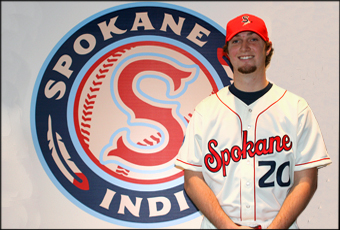
    DETOURS | Spokane Tribe helps create Indians' new logo"For the last 20 years we haven't done anything with Native American imagery," said team president Andrew Billig in a conversation at the stadium along the Dishman Hills. "Our logo was just 'Spokane Indians.' No arrows, feathers or anything. When we decided on a new logo, we went to the tribe and said we were going to stay without imagery."

    The tribe responded by thanking the team for the respect shown by not doing what other sports teams do with Native Americans caricatures and design. Then, the tribe added they would prefer to create a production hand in hand with the team.

    "We hear so much about disrespectful display against Native Americans within the sporting world," said Jamie Sijohn, spokesperson for the Spokane Tribe in a phone interview from the reservation in Wellpinit, Wash. "The baseball team turned that around and made a promise they would not disrespect native culture. This was a great opportunity for the Spokane Tribe not only to help the team stay on the respectful path, but it also gave us an opportunity to educate the citizens of Spokane. Too many people think the Spokane Tribe took their name after the city, which is not true. The city took their name from the Spokane Tribe. We hope other Indian-named organizations across the country keep this ground-breaking concept in mind with their own neighboring Indian tribes."

    Alexie on Churchill

    Sherman Alexie Speaks Out on Nasdijj"[W]henever I try to expose these hoaxsters and exploiters, I'm the one who is accused of racism and imperialism and essentialism." He adds that the Native artistic community has long been aware of frauds like Nasdijj, "but white folks don't pay us much attention. A friend of mine emailed me to say that the whole thing made her sad because if an Indian of my success and influence can be ignored and/or dismissed by publishers then what does that say for less powerful Indians?" For that matter, he wonders, "Do you think the publishers might listen to me now?" It's a legitimate question, and one without an obvious answer. After all, as Alexie points out, Ward Churchill remains a "leftist academic hero" despite the debunking of claims to Cherokee heritage because he's "exactly the kind of Indian his white leftist academic compatriots want him to be [...] an Uncle Tomahawk with a vocabulary."

    Blame the rich tribes again

    Giago:  Poor tribes are the victims of the rich tribes' success

    Another Indian attack ad

    DSL commercial shows Plains Indians attacking stagecoach

    Original Illini were savages

    Nunes:  Illini were "superstitious lot" of "handsome creatures"

    September 01, 2007

    Alexie mellows out

    Talking Volumes:  Man of many tribesIn his first work of fiction for young adults, the Seattle poet, novelist, humorist, screenwriter and master of the short story has created an endearing teen protagonist in his own likeness and placed him in the here and now: Arnold (Junior) Spirit, 14, is a poor kid on the Spokane Indian Reservation in Wellpinit, Wash. How poor? A bucket of Kentucky Fried Chicken is a godsend, not a guilty pleasure, and a trip to the vet for his sick dog (and best friend), Oscar, is out of the question.

    Because of the hydrocephalus, Junior suffers frequent seizures and fevers, has extra teeth, a stutter, a lisp and lopsided vision corrected with government-issued black plastic glasses that make him look like "an Indian grandpa." All of this, of course, incites the Darwinian brutality of his peers, who beat him and berate him with taunts of "hydro head" and "retard." He also has loving, if flawed, parents.

    This much is true about Alexie's own life. And so, too, is the life-altering decision Junior ultimately makes to go to school in nearby Reardan, where he will be "the only Indian except for the mascot."
    Why he's changed:Expanded notions of tribalism, sympathetic biracial characters and empathic excursions into the minds of both victims and victimizers? Is this the same Sherman Alexie who wrote "Indian Killer" (1996), a novel that simmers with race-based rage?

    The terrorist attacks of Sept. 11, 2001, "changed me tremendously," Alexie said. "I saw the end game of tribalism--it ends up with people flying planes into buildings. I've worked hard since then to shed the negative parts of tribal thinking, which almost always involve some sort of fear," the starting point for violence, he said. "'Indian Killer' is very much a tribal and fundamentalist book. I've really disowned it."
    How he's changed:Jim Lenfestey of Minneapolis, who also has taught Alexie's work, said Alexie has matured and mellowed, but hasn't lost his edge.

    "He'll still swing crisply at all around him who presume, but he swings from a different center of gravity now," Lenfestey said. "That center of gravity is more Sherman Alexie as father, citizen of the world and prosperous man, but still against all forms of idiocy, none excepted."

    The Only Good Indian team

    Topeka child actors take part in movie being shot in KansasTom Carmody, screenwriter of "The Only Good Indian," said resistance by the Kickapoos to shedding their customs and adopting white customs is the movie's theme.

    Carmody, also a film producer, said the filmmakers are working closely with the Kickapoo tribe in Horton.

    "We're just thrilled they're allowing us to use their tribal language and customs in the film," Carmody said. In one scene, Frank and 10-year-old Richard McKinney, who Carmody calls a "natural" actor, speak in Kickapoo.

    Willmott is writer and director of "C.S.A.: Confederate States of America," a 2005 satire of what the United States would be like had the South won the Civil War. Willmott also is writer, director and producer of "Bunker Hill," another film shot in Kansas. "Bunker Hill" is in post-production work.

    James McDaniel, the actor who played Lt. Arthur Fancy on the TV series "NYPD Blue," is the executive producer of "The Only Good Indian."
    Comment:  Since Willmott wrote and directed CSA, I guess he's interested in movies with historical and racial themes. Since McDaniel also starred in Edge of America, I guess he's interested in movies with Native themes. Kudos to them for using their clout to do more than the standard escapist fare.

    Coel mystery involves AIM

    Margaret Coel's latest mystery is one of her bestAs soon as forensic experts date the execution-style murder to 1973, the "moccasin telegraph" starts humming with fear and memories of the bad—or good—old days when members of the radical American Indian Movement fled Wounded Knee and went into hiding among the Arapahos. Coel always brushes her tales onto intriguing canvases, but never before one quite so political. More than three decades on, reservation residents are still debating whether AIM—which some tagged ignorant "city Indians"—had the right approach.

    "'What're whites ever gonna do for you?' they'd say. 'AIM's helping people,'" recalls one character, an Indian woman who decided to become a nurse, even at the risk of accusations that she had become "whiteized." "And maybe there was some truth in it, I used to think. ... (But) some of the AIM people were mean, they were violent."
    Comment:  A body in the wilderness, a decades-old mystery, unreliable male characters, a killer you can guess...it sounds a lot like The Spirit Woman.

    Update on The War

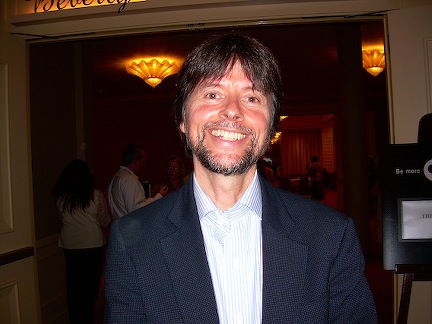
    Fighting through it:  Ken Burns' The War makes peaceKen Burns' The War will grow by about a half-hour to appease critics who objected to its virtual exclusion of Hispanic veterans. Public television's franchise filmmaker met with TV writers Wednesday to both tout the seven-part documentary and explain what's being added to it.

    "We've done more than we were asked or expected to," he said of extra footage that will run during the closing credits of episodes one, five and six. It mainly consists of interviews with two Hispanic World War II survivors and one Native American.
    Comment:  This may mean the Native interview will be attached to episode 6. That makes more sense than splitting one interview among three segments.

    Indians could've had state

    Fest to celebrate Cherokees' impact on stateA lot of the infrastructure that made up early Oklahoma was built by the residents of Indian Territory, which could have been its own state if it weren't for a forced marriage of Oklahoma Territory and Indian Territory to form what became Oklahoma in 1907.

    Indian Territory made an unsuccessful bid to form its own state in 1905 at the Sequoyah Constitutional Convention.

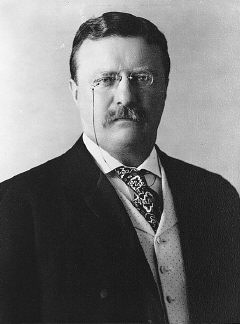
    The idea was rejected by politicians in Washington, and President Theodore Roosevelt said the territories would only be accepted into the union as a single state.

    Indians vs. Anheuser-Busch

    Protesters challenge business to 'distribute responsibly'An American Indian activist and Nebraskans for Peace have challenged Anheuser-Busch to "distribute responsibly," playing off the corporation's advertising slogan of "drink responsibly."

    Activist Frank LaMere and members of Nebraskans For Peace stood across the street from the High Plains Budweiser distributorship in Scottsbluff as part of a protest Thursday. The group said Anheuser-Busch is not living up to its own advertising slogan by allowing sales of beer to liquor outlets in the border town of Whiteclay, south of the dry Pine Ridge Indian Reservation in South Dakota.

    Did Karl May influence Hitler?

    Here's a long and fairly tedious debate on the subject:

    "Obviously Hitler was fascinated by the Manifest Destiny idea but he sure didn't get those ideas from Karl May."

    I wouldn't recommend it unless you're fascinated by the subject. In terms of originality and creativity, it's definitely one of my lesser efforts. But I include it for the sake of completeness.