Showing posts with label Billy Mills. Show all posts

March 28, 2013

Billy Mills's marathon team

Billy Mills' marathon team benefits Indian youthsTeam Running Strong is Olympic gold medalist Billy Mills’ charity marathon team in the Marine Corps Marathon.

Each year, both Native and non-Native members of Team Running Strong come together from across the country to run or walk 26.2 miles for the future of Native American youths. Team Running Strong is a charity partner in the 38th Marine Corps Marathon in Washington, D.C., on Oct. 27.

Team Running Strong offers a guaranteed spot in the 38th Marine Corps Marathon, which sold out in record time of 2 hours and 41 minutes last year. Also, with Team Running Strong, all participants take part in an honoring ceremony and reception held at the National Museum of the American Indian with teammates, friends, family and Mills, a South Dakota native and Olympic gold medalist.

Leading up to the event all participants receive training and fundraising support, including a personal webpage, advice from the Running Strong staff and training tips from Mills.
Comment:  For more on Billy Mills, see NIGA 2013 (Day 3) and Billy Mills Receives Presidential Medal.

March 27, 2013

NIGA 2013 (Day 3)

As we headed over to the trade show floor, Chad and I were distracted by a spectacle: public art made of tin cans. We inspected that for half an hour before heading to our booth.

Victor and Lucy were there, so Chad and I took a walk around the floor. Chad picked up some insurance literature for his new business venture. We spotted Billy Mills at his booth and chatted with him for a bit. Chad bought some Southwest jewelry for the women in his life.

We returned to the booth and spent the rest of the abbreviated day there. Several gaming celebs and a few entertainment celebs (activist Sonny Skyhawk and filmmaker Steven Lewis Simpson, again) came by. Peter MacDonald the former Navajo chairman and Dennis Banks the AIM activist were nearby, forming a mini-celebrity row in the 1500 aisle.

We were supposed to meet someone for dinner, but everyone took off and so did we. After a long drive to Victor's house and a shorter drive to my house, the trip was over.

Pix of the day:

NIGA (Day 3)--March 27, 2013
Driving home from NIGA--March 27, 2013

And a little about the events and awards we didn't see:

National Indian Gaming Association draws crowd to Arizona

For more on NIGA, see NIGA 2013 (Day 2) and NIGA 2013 (Day 1)


February 08, 2013

Billy Mills receives presidential medal

Lakota Olympic Gold Medalist to Receive Presidential Citizens Medal

By Levi RickertBilly Mills, 1964 Olympic Gold Medalist, will receive the 2012 Presidential Citizens Medal, the nation's second highest civilian honor by President Barack Obama at a White House event next Friday, February 15.

Mills is a tribal member of the Oglala Sioux Tribe is the only American to win the gold medal in the 10,000 meters. Billy Mills' win in the 10,000 meters is considered one of the greatest upsets in Olympic history.

He is one of 18 people who will receive the Presidential Citizens Medal. Each year some 6,000 applications are received by the White House for consideration to receive the Medal.

“It is my distinguished honor to award these individuals the 2012 Citizens Medal for their commitment to public service,” said President Obama.
Billy Mills to receive medal from President Obama

Comment:  For more on the subject, see The Best Indian Movies. Below:  "Billy Mills, 1964 Olympic Gold Medalist, with Shawndiin Church in 2012."

May 11, 2012

Best in the World at the NMAI

Best in the World: Native Athletes in the Olympics

Coming to the National Museum of the American Indian If you are traveling to Washington DC in late May or during the summer, you will not want to miss the "Best in the World: Native Athletes" exhibition at the Smithsonian's National Museum of the American Indian.

On the 100th anniversary of the Olympic Games in which athletes Jim Thorpe, Sac and Fox, Duke Kahanamoku, Native Hawaiian, Andrew Sockalexis, Penobscot, and Lewis Tewanima, Hopi, represented the United States in Stockholm, the Smithsonian's National Museum of the American Indian presents "Best in the World: Native Athletes in the Olympics."

The exhibition opens Friday, May 25.

In 1912, Thorpe swept both the pentathlon and decathlon at the Olympic Games, becoming the first and only Olympian to accomplish such a feat and earning the accolades of King Gustav V of Sweden, who proclaimed Thorpe to be "the greatest athlete in the world." Thorpe was joined that year by fellow Native teammates Kahanamoku, who won the 100 meter freestyle; Sockalexis, who placed fourth in the marathon; and Tewanima, who won the silver medal and set an American record for the 10,000 meters that stood for more than 50 years until Billy Mills, Oglala Lakota, won the gold medal in Tokyo in 1964.
Comment:  For more on the subject, see Review of Jim Thorpe: World's Greatest Athlete and Three Native Olympic Gold Medalists.

Below:  "Jim Thorpe at the 1912 Olympic Games."

July 24, 2010

(Native) soldiers aren't heroes

“Our American Heroes”:  Why It’s Wrong to Equate Military Service with Heroism

By William J. Astore[E]ven if elevating our troops to hero status has become something of a national mania, is there really any harm done? What’s wrong with praising our troops to the rafters? What’s wrong with adding them to our pantheon of heroes?

The short answer is: There’s a good deal wrong, and a good deal of harm done, not so much to them as to us.

To wit:

*By making our military a league of heroes, we ensure that the brutalizing aspects and effects of war will be played down. In celebrating isolated heroic feats, we often forget that war is guaranteed to degrade humanity. “War,” as writer and cultural historian Louis Menand noted, “is specially terrible not because it destroys human beings, who can be destroyed in plenty of other ways, but because it turns human beings into destroyers.”

When we create a legion of heroes in our minds, we blind ourselves to evidence of their destructive, sometimes atrocious, behavior. Heroes, after all, don’t commit atrocities. They don’t, for instance, dig bullets out of pregnant women’s bodies in an attempt to cover up deadly mistakes. They don’t fire on a good Samaritan and his two children as he attempts to aid a grievously wounded civilian. Such atrocities and murderous blunders, so common to war’s brutal chaos, produce cognitive dissonance in the minds of many Americans who simply can’t imagine their “heroes” killing innocents. How much easier it is to see the acts of violence of our troops as necessary, admirable, even noble.
Comment:  I agree, and I don't equate military service with heroism. When soldiers come under fire and don't run away, then I'll consider calling them heroic. Or at least courageous. But just for enlisting and serving? No.

As few people are willing to acknowledge, we haven't fought an enemy who threatened our country since WW II. You don't get a lot of credit from me for participating in stupid and unnecessary wars. Someone who protests these wars, even when the wars are popular, is arguably more heroic.

A commenter on Facebook concurs:Making sure that you're actually standing for the right cause regardless of the cost--that's heroism.He adds:This is not just an American tendency...Native Americans as a whole have a thing with turning soldiers into heroes as propaganda.I agree with that too. As longtime readers know, I've criticized the Native obsession with warriors many times. For instance:

Shawn Hawk the "Sioux Warrior"
Weaponized drone = Indian savage
Gang culture in Indian country
Indians join military for paycheck?

Bottom line: Many (Native) soldiers are heroes and many aren't. But nobody's a hero automatically. Do something heroic and then we'll call you a hero, not before.

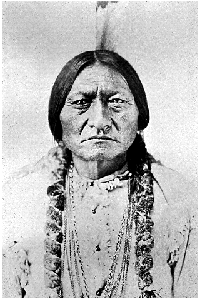
For more on the definition of "warrior," see Billy Mills Defines "Warrior" and Sitting Bull Defines "Warrior." For more on the subject in general, see Indians in the Military and Diplomacy Works, Violence Doesn't.
December 26, 2009

Three Native Olympic gold medalists

Morris held eagle feather high on Olympic podium 25 years ago, dreams 2010 is a new startAlwyn Morris held an eagle feather high during a historic medal ceremony where he became the first and only Canadian aboriginal athlete to win gold at an Olympic Games.

It was in 1984--25 years ago--in Los Angeles when Morris, a Mohawk from Kahnawake, Quebec, and his partner Hugh Fisher won gold in the men's 1,000 metre, doubles kayak race.

Morris's gold medal victory is a rare achievement for any athlete, but even more rare for an aboriginal competitor. He joined the great American aboriginal runners Jim Thorpe and Billy Mills as the only three North American aboriginals to ever win gold at the Olympics.

Morris, now 52, says his eagle feather salute in Los Angeles allowed him to say everything he wanted to his family, aboriginals, Canadians and the world, without uttering a word.
Comment:  For more on the subject, see Olympics Organizers Diss Natives and Native Participation in 2010 Olympics.

Below:  "Alwyn Morris, 1984 Olympic gold medallist, shares the Olympic Flame with local children Tuesday, December 8, 2009 as he carries it through the Mohawk town of Kahnawake south of Montreal." (THE CANADIAN PRESS/Ryan Remiorz)