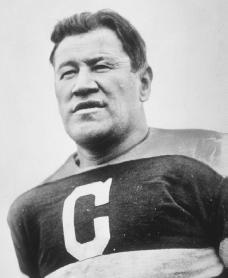
Showing posts with label Jim Thorpe. Show all posts

April 19, 2013

Judge rules Thorpe's remains may return

Judge rules Jim Thorpe’s body should be returned to Oklahoma

By Neely TuckerA federal judge in Pennsylvania ruled Friday that proceedings should begin to return the body of Olympic athlete Jim Thorpe to Oklahoma, a major step in a decades-long battle that Thorpe’s sons and his Native American tribe have waged to return his body to the place where he grew up.

Thorpe is buried in Jim Thorpe, Pa., a small town that renamed itself to convince his widow to bring his body there shortly after his death in 1953 in hopes of launching a tourism industry. Patsy Thorpe and city officials signed a contract and Thorpe’s body has lain in a mausoleum in a tiny park ever since.

But the 32-page ruling by U.S. District Judge A. Richard Caputo rejected the city’s bid to keep their namesake, ruling that the federal Native American Graves and Repatriation Act mandated that the body be returned.

Caputo noted that his decision overriding the contract “may seem at odds with our common notions of commercial or contract law,” but said that Congress passed the law “against a history of exploitation of Native American artifacts and remains for commercial purposes.”
Jim Thorpe's Sons Win Federal Lawsuit Against Jim Thorpe, Pennsylvania

Jim Thorpe’s Remains Can Be Moved To Native Land, Court Rules

But a commenter on the first article says it's misleading:As a current law student who has been following this case closely, I must state that this article is severely misleading. What this ruling means is only that the town, as a "museum" (a questionable legal proposition ripe for appeal itself), must complete an inventory of holdings under the Native American Graves Protection and Repatriation Act.

Once the inventory has been completed, it triggers a right by the family to request repatriation. However, the ultimate disposition of the remains will depend on the outcome of an administrative hearing, which will consider the interests of not only the two brothers who brought suit, but also those of the other half of the family by Thorpe's first marriage (and, incidentally, his only one to a Native American woman) who want the remains kept in their current location and who were kept out of the suit by the judge. They believe Thorpe's soul is already at peace after a burial ritual performed there by Thorpe's daughter Grace, a respected shaman, in the 1990s and think that moving him would itself be a sacrilege.

Considering that both they and the next of kin at the time of his death (his third wife Patricia) have expressed a desire to see him buried in Pennsylvania, and that there is no record of Thorpe himself ever stating a preference, the board may end up awarding possession to them, with the ultimate outcome of nothing happening, since the judge already threw out any possibility of monetary awards earlier in the case!
Comment:  I've never heard Grace Thrope called a "shaman" or anything like that. But the commenter's main point seems valid. It sounds as though the judge ruled that NAGPRA applies to Thorpe's remains. That's different from saying that NAGPRA mandates the body's return.

For more on Jim Thorpe, see Thorpe Still the Greatest Olympian and Best in the World at NMAI.

August 11, 2012

Thorpe still the greatest Olympian

Greatest Olympic athlete? Jim Thorpe, not Usain Bolt

By Sally JenkinsUsain Bolt’s frisky relationship with Olympic solemnity is some of the best entertainment at the London Games. But when it comes to ranking the greatest Olympians ever, Bolt is nowhere near the top of the list. The worship Bolt shouts for belongs more rightly to a 100-year-old dead man who hardly ever spoke up for himself, Jim Thorpe.

Bolt has sprinted hard into immortality; he is indisputably the fastest man ever, and maybe one of the most cheerful, too. It doesn’t hurt that he knows how to freeze for the cameras while we’re still trying to recover from the breathless shock of watching him run. But Bolt himself knows that his claim to sit atop the Olympic pantheon with double golds in the 100 and 200 is nonsense. His boasting, “I am the greatest athlete to live, I am a living legend, bask in my glory,” was just a lot of noisy post-victory exultation. He may not even be the best in the Olympic stadium according to the decathletes. “Just because you’re fast doesn’t make you an athlete,” silver medalist Trey Hardee said.

First of all, so many athletes crowd in at the door and jostle for space in the Olympic pantheon that before you can name one above all the others, you have to group and categorize them. Second, these discussions invariably fail to give proper credit to the historical greats. “They skew towards the modern athlete, because no one remembers,” says Olympic historian Bill Mallon.

When you talk about greatest Olympic athlete do you mean the one with the most medals? That’s Michael Phelps with his 22 doorknockers hanging around his neck, including that masterful, testing eight in a fortnight at the Beijing Games. But Phelps has the advantage of being able to enter multiple events and claim relays. In which case you might prefer Larisa Latynina, whose 18 gymnastics medals for the Soviet Union at the 1956, 1960 and 1964 Olympics were the record for almost a half-century until Phelps broke it.
Jenkins goes on discuss other contenders before returning to Thorpe:Or do you find these definitions too limiting? If what you mean by greatest Olympic athlete ever is someone who displayed such a timeless virtuosity, a combination of agility, stamina, strength, speed, endurance and range that it’s never been matched, well, that’s Thorpe.

His performance in the 1912 Stockholm Games has the quality of footprints disappearing in the sand thanks to the International Olympic Committee. It stripped Thorpe of his victories in the now-obsolete pentathlon (five track and field events in a single day) and decathlon for committing the sin of professionalism, when it was discovered he played minor league baseball in Rocky Mount. What survives are some cool gray numbers marked by asterisks, and some half truths.

It’s hard to envision what Thorpe did, as long as you think of think of him as a long-dead ghost, or a quaint historical photo. When you think of him you have to think of someone alive. As alive as, say, Bolt. When you think of Thorpe, think of him that way. Or think of Bo Jackson, or Deion Sanders—only stronger.

If you want to bask in glory, bask in this: Thorpe competed in 15 events—and won eight of them—despite losing his track shoes and competing in a mismatched pair, running on a cinder track in a slogging rain. He still turned in a time of 11.2 seconds in the 100-meter dash, which wouldn’t be equaled until 1948.
Comment:  For more on Jim Thorpe, see Best in the World at NMAI and AMC Develops Carlisle Football Drama.

May 11, 2012

Best in the World at the NMAI

Best in the World: Native Athletes in the Olympics

Coming to the National Museum of the American Indian If you are traveling to Washington DC in late May or during the summer, you will not want to miss the "Best in the World: Native Athletes" exhibition at the Smithsonian's National Museum of the American Indian.

On the 100th anniversary of the Olympic Games in which athletes Jim Thorpe, Sac and Fox, Duke Kahanamoku, Native Hawaiian, Andrew Sockalexis, Penobscot, and Lewis Tewanima, Hopi, represented the United States in Stockholm, the Smithsonian's National Museum of the American Indian presents "Best in the World: Native Athletes in the Olympics."

The exhibition opens Friday, May 25.

In 1912, Thorpe swept both the pentathlon and decathlon at the Olympic Games, becoming the first and only Olympian to accomplish such a feat and earning the accolades of King Gustav V of Sweden, who proclaimed Thorpe to be "the greatest athlete in the world." Thorpe was joined that year by fellow Native teammates Kahanamoku, who won the 100 meter freestyle; Sockalexis, who placed fourth in the marathon; and Tewanima, who won the silver medal and set an American record for the 10,000 meters that stood for more than 50 years until Billy Mills, Oglala Lakota, won the gold medal in Tokyo in 1964.
Comment:  For more on the subject, see Review of Jim Thorpe: World's Greatest Athlete and Three Native Olympic Gold Medalists.

Below:  "Jim Thorpe at the 1912 Olympic Games."

March 28, 2012

AMC develops Carlisle football drama

AMC Developing Football Drama 'The Real All Americans' (Exclusive)

By Marisa GuthrieAMC is in the early stages of development on football drama The Real All Americans. Based on Sally Jenkins’ book about the Carlisle Indian Industrial School in Carlisle, Penn., All Americans chronicles the school's storied football program created by U.S. cavalry officer Richard Henry Pratt, an abolitionist and early equal rights proponent who made a harrowing journey to the Dakota Territory in 1879 to recruit the school's first students.

Producers are in discussions with Tommy Lee Jones to direct the pilot if AMC moves forward. Nicholas Meyer, best known as the writer of various Star Trek films, is writing the script with Harry J. Ufland (the upcoming Robert De Niro-Diane Keaton romantic comedy The Wedding) on board as producer.

Pratt’s football program had a stunning record of 167-88-13 and produced a string of famous athletes and coaches–including Olympian Jim Thorpe and coach Glenn “Pop” Warner. The subject matter is close to Jones’ heart. The actor, who grew up in Texas, is of Cherokee descent. He also played defensive tackle at Harvard, where he was a 1968 All-Ivy League nominee and played in the infamous ’68 Harvard-Yale game that featured a stunning 16-point Harvard comeback in the final minute. Jones recounted the story for the 2008 documentary Harvard Beats Yale 29-29.

All Americans would give AMC another period piece and also one that deals with racial issues. Hell on Wheels is set in 1865 during the post-Civil War construction of the first transcontinental railroad.
Comment:  Carlisle was a school full of Native students and staff members. So what are the odds that the majority of the actors will be Native?

I wouldn't bet a lot of money on it. Instead, I'd bet on most of the adults and at least half the students being non-Native. For Indians, they'll probably use Latinos, Asians, and other slightly "exotic" actors.

Will they at least do the minimum and cast an Indian as Jim Thorpe? Again, I wouldn't bet on it. This is where they bring in a Johnny Depp or Brandon Routh...to give white audiences "someone to relate to." Because Indians are too brown strange unfamiliar to mainstream society, I guess.

For more on Jim Thorpe, see Review of Jim Thorpe: World's Greatest Athlete and Battle for Jim Thorpe's Body.

February 07, 2011

American Indian Film Gallery

Six Flicks from the American Indian Film GalleryThe online American Indian Film Gallery, a collection of vintage motion pictures that cover the Native American experience, has recently posted its 400th film. “I had all of these wonderful historical movies, and nobody ever made a documentary using the footage,” said founder and curator J. Fred MacDonald. “So I put it all online for free. These are historical documents, for good or bad. They have to be collected and made available for people to understand history.” MacDonald commented on some of his favorites.

1) Before the White Man Came: “This is a unique feature film, a Western starring only Crow and Northern Cheyenne actors. Filmed in Montana in 1918, it tells the story of a young couple from rival tribes.”

2) “Maria Tallchief Dances”: “Here are segments from the Pabst Christmas Special that aired on CBS television network on Christmas eve in 1952.”

3) “El Navajo”: “The Santa Fe Railroad made several promotional films in the 1940s and 1950s intended to attract tourists to come to Indian country in New Mexico and Arizona—an area served by Santa Fe. ‘El Navajo’ is the best of the Santa Fe movies.”

4) “Injun Talk”: “Despite its derogatory title, this is an informative film that explores the sign language employed by plains Indians in earlier times.”

5) “Always Kickin’”: “This is a short comedy from 1932 in which Jim Thorpe (Sac and Fox), the greatest athlete of the 20th century, plays an important speaking role.”

6) “Golden State Gourd Society”: “These news outtakes are from a Los Angeles TV report on off-reservation Indians who gather regularly to renew friendships as well as sing and dance, particularly the Gourd Dance derived from the Kiowas of Oklahoma.”
Comment:  Before the White Man Came seems to have aced out Moonhair as the first American feature film with an all-Native cast. I suspect there are other contenders too.

For more on the subject, see The Best Indian Movies and Native Documentaries and News.

November 30, 2010

Octothorpe named for Jim Thorpe?

An article about the octothorpe (#), more commonly called the pound sign:

What we have here is one of the great comeback stories in the history of competitive punctuation

By Robert FulfordThis year GQ magazine, a major arbiter of the cool, has anointed # "symbol of the year." GQ explains: "Hashtags have changed the way we think, communicate, process information. # is everywhere." What we have here is one of the great comeback stories in the history of competitive punctuation. Today, &, © and ® have been left in the dust (of course@retains its status in email).The "octo" part of the name is obvious.And where did "thorpe" come from? The American Heritage Dictionary says it honours James Edward Oglethorpe, the 18th-century British general who helped found the colony of Georgia in 1732. A more popular story has an engineer at Bell Labs deciding to honour Jim Thorpe, an Indian athlete who won the pentathlon and decathlon for the U.S. at the 1912 Olympics; he had his gold medals taken from him when his background as a professional athlete was disclosed, a decision that was reversed three decades after his death.Comment:  For some reason, this is my first posting about a punctuation mark named after an Indian.

For more on Thorpe, see Review of Jim Thorpe: World's Greatest Athlete and Mauch Chunk Became "Jim Thorpe."

November 29, 2010

Review of Jim Thorpe: World's Greatest Athlete

Last year I reported on the new Jim Thorpe documentary. Last week I finally watched it on PBS as part of Native American Heritage Month. Here's a synopsis:

Jim Thorpe--About the FilmJim Thorpe, The World’s Greatest Athlete is a biography of the Native American athlete who became a sports icon in the first half of the 20th century. Beginning with Thorpe’s boyhood in Indian Territory it chronicles his rise to athletic stardom at the Carlisle Indian Industrial School, winning two gold medals at the 1912 Summer Olympics, his fall from grace in the eyes of the amateur athletic establishment, and his rebound in professional baseball and football. Thorpe retired from pro sports at age 41 just before the stock market crash of ’29. He worked as a construction laborer before getting work in Hollywood as a bit part player. He became a representative for Indian extras in Hollywood, fighting for equal pay for Native Americans in the movies. In the 1940s he crisscrossed the nation as a public speaker advocating for Indian self-determination.

This is a film about a man who used his amazing physical prowess as a way to affirm his American Indian identity in the face of unrelenting efforts to eradicate Native American culture. It is the first documentary film to tell the story of Thorpe’s life outside of his well-known athletic victories.The film uses in-depth interviews with Thorpe’s surviving children, some simple recreations and images culled from over seventy-five archive sources, both stills and motion picture.

Presented by Native American Public Television, the film will air on U.S. public television stations in fall 2009 and winter 2010.


Comment:  The summary pretty much sums it up. The documentary is a bit on the glowing side; it begins with the omnipresent flute music and glosses over Thorpe's drinking and spendthrift ways. But Jim Thorpe is a solid look at the athlete's life.

A few things I learned about Thorpe:

  • He played against Dwight Eisenhower in the Army-Carlisle football game.

  • He spoke out for Indian land rights and oil royalties.

  • He was an extra in Errol Flynn's They Died with Their Boots On, one of the few Westerns in which Indians won. He later punched Flynn in a bar after Flynn taunted him.

  • He lectured in a stereotypical Plains chief outfit under the name "Bright Path."

  • The movie doesn't mention Jim Thorpe, Pennsylvania, or the controversy over Thorpe's burial place. That may be for the best.

    Rob's rating: 8.0 of 10. Check it out if you get the chance.

    For more on Thorpe, see Three Native Olympic Gold Medalists and The NFL's Oorang Indians.

    July 20, 2010

    Mauch Chunk became "Jim Thorpe"

    Here's an update on the lawsuit described in Battle for Jim Thorpe's Body:

    Is There Life After Jim Thorpe for Jim Thorpe, Pa.?

    Olympic Great Is Buried Near Poconos, But Son Wants Him Home in Oklahoma

    By James R. HagertyIn 1953, two adjoining Pennsylvania towns on the edge of the Pocono Mountains—Mauch Chunk and East Mauch Chunk—were desperate to attract business. They made a bet on the corpse of Jim Thorpe, a Native American athlete from Oklahoma who was the star of the 1912 Olympics and later a professional football player.

    The towns made a deal with Mr. Thorpe's widow, Patricia. She would allow his body to be buried here. They would build a "suitable memorial" on the burial site. The two towns also agreed to merge into one community named Jim Thorpe. The name of Mauch Chunk, or "bear mountain" in the Lenape Native American language, was retired.

    Today, 57 years later, the bones of contention are still rattling in this town of about 4,900 people, 80 miles northwest of Philadelphia. Last month, one of Mr. Thorpe's sons, Jack Thorpe, filed a lawsuit in federal district court in Scranton, Pa., seeking to force the town to surrender the body so it can be buried with other family members near Shawnee, Okla. The town of Jim Thorpe still hasn't decided how to respond, a spokesman says.

    "We just want to bring him home and put him to rest where he wanted to be," says Jack Thorpe. He has no grudge against the town: "They've always treated us well." The Chunkers, as locals here are sometimes known, honor the late athlete even though he had no connection to the area and probably never even visited.
    Comment:  The interesting thing to me is how they took one Indian term--Mauch Chunk or "bear mountain"--and replaced it with another. The second term had nothing to do with the region; it was simply a marketing ploy. Euro-Americans have come up with weak reasons for changing Indian place names, but this one is among the weakest.

    How about embracing the location's Lenape Indian heritage instead? Create a memorial or start a festival to them, not to an Indian from across the nation. And don't cry over the loss of Thorpe's remains when your motives were so transparently commercial.

    For more on Jim Thorpe the town, see Jim Thorpe, Pennsylvania. For more on Jim Thorpe the athlete, see Three Native Olympic Gold Medalists and Native Signs on Santa Barbara Buses.

    Below:  "Jim Thorpe's burial site in Jim Thorpe, Pa."

    December 26, 2009

    Three Native Olympic gold medalists

    Morris held eagle feather high on Olympic podium 25 years ago, dreams 2010 is a new startAlwyn Morris held an eagle feather high during a historic medal ceremony where he became the first and only Canadian aboriginal athlete to win gold at an Olympic Games.

    It was in 1984--25 years ago--in Los Angeles when Morris, a Mohawk from Kahnawake, Quebec, and his partner Hugh Fisher won gold in the men's 1,000 metre, doubles kayak race.

    Morris's gold medal victory is a rare achievement for any athlete, but even more rare for an aboriginal competitor. He joined the great American aboriginal runners Jim Thorpe and Billy Mills as the only three North American aboriginals to ever win gold at the Olympics.

    Morris, now 52, says his eagle feather salute in Los Angeles allowed him to say everything he wanted to his family, aboriginals, Canadians and the world, without uttering a word.
    Comment:  For more on the subject, see Olympics Organizers Diss Natives and Native Participation in 2010 Olympics.

    Below:  "Alwyn Morris, 1984 Olympic gold medallist, shares the Olympic Flame with local children Tuesday, December 8, 2009 as he carries it through the Mohawk town of Kahnawake south of Montreal." (THE CANADIAN PRESS/Ryan Remiorz)

    November 24, 2009

    Native signs on Santa Barbara buses

    A Facebook posting by Corinne Fairbanks:

    Warm Fuzzies Signs you will see on Santa Barbara City buses FROM AIM SBHi everybody!

    Had to share this work of art with all of you....

    Have you seen any Santa Barbara MTD bus signs lately?

    Be SURE TO HONK when you see them!

    Hey wouldn't it be cool if we could do this NATION WIDE next year?

    we plan to do this again next year, if your in our area, send in a nomination for a local Native hero-

    HAPPY NATIVE AMERICAN HERITAGE MONTH to all of you and your families,
    from everyone at AIM SB

    AIM SB Design by Rebecca Burns
    rebecca@convergencestudio.com

    Special thanks to the Fund for Santa Barbara
    Comment:  If you can't read it, here's what the poster says:We Are the First Americans of this Great Land
    Celebrating and Respecting Native American Culture


    Athletes
    Jim Thorpe


    Sac and Fox
    All Star Athlete
    Olympic Medalist

    Artists
    Maria Tallchief


    Osage
    1st American Prima Ballerina

    Politics
    Winona Laduke


    Ojibwe
    Activist
    Environmentalist

    Warriors
    Lori Piestewa


    Hopi
    U.S. Army Master Corps

    Chiefs
    Oren Lyons


    Seneca/Onondaga
    Chief of the Onondaga Nation

    Not Your Mascot
    Comment:  This seems like a reasonably effective sign. The only thing I question is making the pictures and print so small. It reads well on a stationary screen, but can people read it on a moving bus?

    For more promotional campaigns, see "Think Indian" College Campaign and Value.com's Jim Thorpe Billboard.


    November 21, 2009

    Battle for Jim Thorpe's body

    Interesting story in the Pocono Record: Jim Thorpe lose its namesake?  Grandson speaks out. Jim Thorpe's sons Jack, Bill, and Richard want to move his body from Jim Thorpe, Pennsylvania, to the family burial ground in Oklahoma. They're suing based on the Native American Graves Protection and Repatriation Act, which "provides a process for museums and Federal agencies to return certain Native American cultural items--human remains, funerary objects, sacred objects, and objects of cultural patrimony--to lineal descendants, culturally affiliated Indian tribes, and Native Hawaiian organizations."

    Opposing them is Thorpe's grandson Michael Koehler, who takes the position of Thorpe's three daughters and the Borough of Jim Thorpe, which wants to keep the body. Thorpe's grandson explains the differing positions taken by Thorpe's sons and daughters:"Jack identifies with the spirituality of the Native Americans. He wants to return his father's body to his tribal resting ground in Oklahoma. He wants to perform an Indian ceremony in which tobacco is spilled into the grave, because he feels, as do most who believe in Indian spirituality, that his spirit is still not satisfied—it's roaming free and it needs to be back in Oklahoma, and he wants his body back in the tribal ceremonial grounds.

    "That's what Jack believes and, fortunately or unfortunately, I'm not sure which, I don't tend to adhere to that. I have felt all along that my grandfather has been well-served by the folks in Jim Thorpe, Pennsylvania, and I know that my Aunt Grace, my Aunt Gale and my mother, Charlotte—although my mother never got into it as much as they did—felt the same way."
    Comment:  Haven't heard NAGPRA used as a reason to disinter and move modern Indian remains. Could be an interesting case if it ever makes it to court.

    For more on Thorpe, see Values.com's Jim Thorpe Billboard and New Jim Thorpe Documentary.

    September 14, 2009

    The NFL's Oorang Indians

    Oorang IndiansThe Oorang Indians were a traveling team in the National Football League from LaRue, Ohio (near Marion). The team was named after the Oorang dog kennels. It was a novelty team put together by the kennels' owner, Walter Lingo, for marketing purposes. All of the players were Native American, with Jim Thorpe as its leading player. They played the 1922 and 1923 NFL seasons. Of the 20 games they played over two seasons, only one was played at "home" in nearby Marion.

    With a population well under a thousand people, LaRue is the smallest town ever to have been the home of an NFL franchise, or probably any professional team in any league in the United States.

    Fielding the team

    Jim Thorpe served as a player-coach and recruited players for the team. In keeping with Lingo's wishes that franchise be an all-Indian team. The Oorang Indians consisted of members that were Cherokee, Mohawk, Chippewa, Blackfeet, Winnebago, Mission, Caddo, Sac and Fox, Seneca and Penobscot. The team roster included such names as Long Time Sleep, Joe Little Twig, Big Bear, War Eagle, and Thorpe.

    Since Lingo’s plan was to advertise his dogs and kennel, the Indians were a traveling team, having only played one home game. That one "home" game was also played in nearby Marion, instead of LaRue since the town did not have a football field. This caused the team to travel week after week to many of major cities in the country. However, despite the hectic schedule, Lingo insisted that the Indians received the very best of care. The same dieticians and the same trainer who fed his Airedales and cared for their well-being, also tended to the Indian team members.

    1922 and 1923 seasons

    There were two future Hall of Famers on the roster, Thorpe and Joe Guyon, but they did not play much. Thorpe sat out quite a few games and never played more than a half, while Guyon did not join the team until midway through the first season. The Indians defeated the Indianapolis Belmonts, in a snowstorm, 33-0 in their inaugural game, taking home 2,000 in profits and a Cherokee tackle named Chief Johnson, who Thorpe recruited at halftime.

    However football was not a priority for Lingo, promoting his kennel was. The pre-game and halftime activities were considered more important than the results of the game, and this entertainment was provided by the players and the Airedale dogs. Because of this lack of interest by Lingo, the Indians turned out not to be a very good team. In fact, they won only three games in two years. The players must have found it difficult to take their football seriously when considering that they were entertainers, instead of an NFL caliber team.

    First ever halftime shows

    Rather than retiring to the locker room at halftime, the Oorang Indians showed Lingo’s Airedales to the crowd. It was debatable, though, whether the Indians were there to play football or give Airedale exhibitions at halftime. In addition to the exhibitions with the dogs; the Indians, including Thorpe, participated in helping the Oorang Airedales perform tricks for the crowd. However, it was their halftime entertainment that made them such a huge attraction in the early 1920s. There were shooting exhibitions with the dogs retrieving the targets. There were Indian dances and tomahawk and knife-throwing demonstrations. Thorpe would often repeatedly drop kick balls through the uprights from midfield. Nikolas Lassa, also called "Long-Time-Sleep," even wrestled a bear on occasion.

    Party lifestyle

    The whole purpose of the Indians was to advertise Lingo's Airedales. The Indians knew that football wasn't important to the owner, so they spent a lot of their time partying and drinking.

    In 1922 the night before a game with the Chicago Bears, the Indians went to a Chicago bar called "Everyman's Saloon." At 2:00 a.m., the bartender stopped serving drinks since Illinois law prohibited the sale of alcohol after 2 a.m.. This action upset the Indians who stuffed the bartender in a telephone booth and turned it upside down. The Indians were defeated by the Bears 33-6 just a few hours later.
    Comment:  For more on the subject, see New Jim Thorpe Documentary and Indians to Protest at Super Bowl.


    August 29, 2009

    Values.com's Jim Thorpe billboard

    Our Mission StatementThe Foundation for a Better Life creates public service campaigns to communicate the values that make a difference in our communities--values such as honesty, caring, optimism, hard work, and helping others. These messages, communicated utilizing television, theatres, billboards, radio, internet, etc., model the benefits of a life lived by positive values. The Foundation encourages others to step up to a higher level and then to pass on those positive values they have learned. These seemingly small examples of individuals living values-based lives may not change the world, but collectively they will make a difference. And in the process help make the world a better place for everyone. After all, developing values and then passing them on to others is The Foundation for a Better Life.BillboardsThe Foundation creates these billboards to promote our values. If you have a good idea for a billboard, we’d love to hear from you.Here's the one Native billboard (so far):

    ExcellenceJim Thorpe didn’t excel in just one sport, but in many, making a name for himself in track and field, professional basketball and football, as well as major league baseball. In 1999 the Associated Press placed him third on their list of top athletes of the century, behind only Babe Ruth and Michael Jordan.

    The sheer excellence with which Thorpe performed every sport he ever competed in is an inspiration to many. Undoubtedly, Jim Thorpe is one of the greatest athletes this world has ever seen.


    Comment:  By my count Values.com has done 49 billboards so far. Only one appears to be Native, which is a fair proportion for the US population.

    The billboards are pretty diverse, although they skew toward white males. For instance, they include Michael J. Fox (Optimism), Christopher Reeve (Strength), a white guy who wrote a book on living while dying (Motivation), a white guy who donated bone marrow to a stranger (Sacrifice), and a white guy who climbed Mt. Everest while blind (Vision). Values.com could've found a woman or minority for all these values.

    But there's an opportunity here to promote more diversity. Values.com lists 68 values but has only 49 billboards. That means it's open to suggestions for 19 billboards. It also does TV and audio spots for each value, so even more opportunities exist.

    For example, there's no billboard for True Beauty. Before someone submits a picture of a pretty young girl, how about this? A beautiful older Navajo woman sitting at her loom weaving a beautiful Navajo rug. That would emphasize the Native value that true beauty is about what someone does, not who someone is.

    I submitted this suggestion to Values.com, but it's an example of what you could do. Find an unfilled slot and suggest something. Let's get a few more women and minorities into this values campaign.

    Below:  An image from the Weaving Worlds documentary.


    True Beauty

    It's the process, not the person.

    or

    Beauty is as beauty does.

    August 17, 2009

    New Jim Thorpe documentary

    Jim Thorpe documentary to be released this fall

    By Nancy KelseyHe was regarded by many--from Sports Writers and Broadcasters of America to the King of Sweden--as one of the most prominent athletes of all-time. And Jim Thorpe remains today a sports legend worldwide.

    A new documentary, Jim Thorpe: The World’s Greatest Athlete, to be released to PBS stations this fall explores the life of the iconic sportsman of the Sac and Fox Nation in Oklahoma in a way that would not romanticize him posthumously but would show audiences that he was a real-life person too, faults and all.

    “Because Jim Thorpe is a legend in many ways, you have this sort of interesting problem of trying to figure out who he really was,” Co-Producer Tom Weidlinger said.

    The film delves into Thorpe’s rise to sports popularity at the Carlisle Indian School, then follows his record-setting feats in the 1912 Olympics and controversy regarding his amateur status, which led to him being stripped of his gold medals, as well as his baseball success. The documentary also touches on his tumultuous marriage, at-times strained relationship with his children and his struggle with drinking, in addition to highlights Thorpe’s eventual work as an advocate for American Indians until his death in 1953.

    “Actually, we had enough to do a 12-hour documentary, which is what my first script would have needed,” joked Co-Producer Joseph Bruchac, who also wrote a book about Thorpe prior to the film. “In many ways he was emblematic of the American Indian experience in the 20th Century.”
    Comment:  For more on the subject, see Native Documentaries and News.

    December 10, 2008

    Bradford like Thorpe, Obama

    Native son:  Okla. QB Bradford brings pride to CherokeesThe Sooners' star is four generations removed from the last full-blooded Native American in his family, and his suburban rearing came with little exposure to American Indian culture. But he's Indian nonetheless, a registered Cherokee. And Saturday's prospective Heisman coronation—near the end of a season in which Bradford has led No. 1-ranked Oklahoma to the cusp of a national championship—is momentous and moving for many Native Americans.

    "It opens everything up for us," says Ray Brady, a Riverside junior and tight end on the football team. "Like Obama becoming President."

    Nearly a century has passed since Jim Thorpe, a Sac and Fox Indian also born in Oklahoma, began shaping his legend as the greatest all-around athlete the modern world has seen. It has been 44 years since Billy Mills, a Sioux, ran to a 10,000-meter gold medal in the 1964 Olympics. They remain the standards of Native American athletic excellence.

    Elders like J.R. Cook, a Cherokee who heads United National Indian Tribal Youth (UNITY), an Oklahoma City-based agency designed "to foster the spiritual, mental, physical, and social development" of young American Indians and Alaska Natives, rank Bradford right behind them.

    "It's not just that he's a college football player," Cook says. "He's the quarterback, a team leader. He's admired by his peers and coaches. They speak very highly of him. … And being a serious contender for the Heisman, that's not happened before."

    He adds, "It's a little sad that you have to go back 40-some years to find a role model of this quality."
    Comment:  For more on Bradford the athlete, see The New Jim Thorpe and Cherokee Quarterback Leads Sooners. For more on Bradford the role model, see Native Athletes Who Do Good and Jocks Aren't Good Role Models.

    September 06, 2008

    Jim Thorpe, Pennsylvania

    Here's an oddity of pop culture: a town named after an Indian who has no connection to the place.

    Jim Thorpe, PennsylvaniaJim Thorpe is a borough in Carbon County, Pennsylvania, USA. The population was 4,804 at the 2000 census. It is the county seat of Carbon County. The town has been called the "Switzerland of America" due to the picturesque scenery, mountainous location, and architecture; as well as the "Gateway to the Poconos."

    Mauch Chunk was founded in 1818 by the Lehigh Coal & Navigation Company. It rapidly became a railroad and coal-shipping center, and was home to the Mauch Chunk Switchback Gravity Railroad, generally acknowledged as the first roller coaster in the United States. The city was the location of the trial of the Molly Maguires in 1876, which resulted in the hanging of four men found guilty of murder. The population in 1900 was 4,020; in 1910, it was 3,952.

    Following the 1953 death of renowned athlete and Olympic medal winner Jim Thorpe, the boroughs of Mauch Chunk and East Mauch Chunk merged and adopted the name of Jim Thorpe in hopes of attracting attention and tourism to bolster the local post-industrial economy. The township bought the athlete's remains from his third wife and erected a monument to the Oklahoma native, who began his sports career as a student in Carlisle, PA (2 hours southwest, near Harrisburg).

    August 21, 2008

    Michael Phelps the greatest?

    Be careful when proclaiming someone the greatest athlete of all time"I knew I was going to hear someone say it, so I braced myself.

    Then it happened.

    “Michael Phelps is the greatest athlete of all time.”

    Every four years when someone does something remarkable in the Olympics, he suddenly becomes the greatest athlete of all time.

    But speaking of history, let’s go back to the time of Jacobus Franciscus Thorpe.

    Better known as Jim Thorpe, this Native American had a pretty impressive resume.

    Let’s see … he won gold medals in the pentathlon and decathlon during the 1912 Stockholm Games.

    As a football player he was a running back, defensive back, kicker and punter for his college team, the Carlisle Indians. In a victory over Harvard, he scored all of Carlisle’s points.

    He led the team to a national championship in 1912, scoring 25 touchdowns and racking up 198 points.

    He also participated in baseball, basketball, lacrosse and track while in college, excelling at all of them.

    He went on to play in the National Football League, earning All-Pro honors one season and being named to the NFL’s All-Decade Team for the 1920s.

    Thorpe played two seasons of professional baseball, and even found time to play pro basketball, starring for a barnstorming team made up entirely of Native Americans.

    Oh yeah, he was also a ballroom dancer. And I don’t mean just some guy who could cut a rug while trying to impress the opposite sex, but one who actually won the 1912 intercollegiate ballroom dancing championship."

    April 29, 2008

    Notable Native athletes

    Along with its list of 100 amazing Indian discoveries, the Fall 2004 issue of American Indian included a spread on some of the greatest Native athletes.

    Winning Ways

    Native American athletes have accomplished some of the most impressive feats in sports history.


    Jim Thorpe
    Big Hawk Chief
    George Armstrong
    Fred Sasakamoose
    Louis "Deerfoot" Bennett
    Ted Nolan
    Louis Tewanima
    Waneek Horn-Miller
    Notah Begay
    Marvin L. Camel Jr.
    Naomi Lang
    Tom Longboat
    Billy Mills
    Sonny Sixkiller
    Bryan Trottier